In short
The podcast examines “The Online Marketplace of Ideas,” a physical exhibition mapping how Web2 platforms, merch, and protocols blur politics and media. It argues that “marketplace of ideas” liberalism looks different now: attention is algorithmically distributed, political movements operate like media brands, and influence depends less on reach than on conversion into real-world action.
Guests (backgrounds)
- Joshua Citarella: co-host/creator of Doomscroll; works on how online media and politics interact.
- Carly Busta: co-founder of New Models; produces internet-culture media and art projects.
- Lil Internet: co-founder of New Models; contributes a theory about internet ideologies as U.S. cultural export.
Key claims
- Merch is an analog for platform politics: cheap “blank” goods become political signals once communities “cosign” by buying/wearing.
- Platform protocols make political orgs and apolitical media indistinguishable (same newsletter/billing/identity infrastructure).
- Alt/political media can outperform legacy institutions by converting audiences into canvassing, votes, protests, and donations.
Notable examples
- DSA’s Twitch/newsletter setup; “Revolutions per Minute” RPM.
- Destiny boosting canvassing during Georgia Senate runoffs.
- Hassan Piker-linked virality and live-streamed canvassing.
- American Communist Party run by Twitch streamers (splintering from CPUSA).
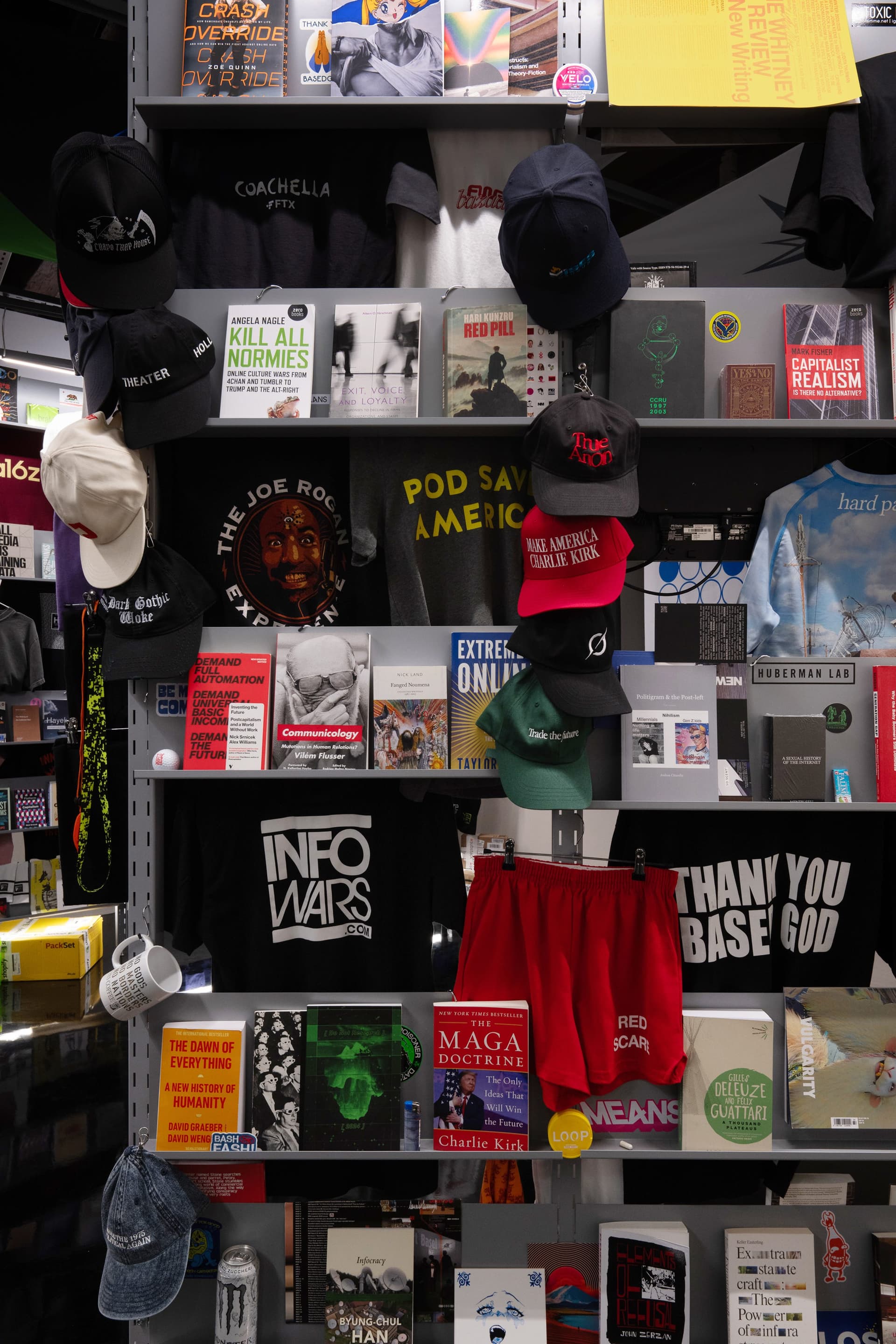
- Palazzo Diedo “Strange Rules” installation: 400+ items (t-shirts, hats, books) including Joe Rogan, Call Her Daddy, Chapo Trap House, Ezra Klein/Derek Thompson, Andreas Malm, Curtis Yarvin, Balaji Srinivasan, Byang Shulhan.
Written by AI. May contain mistakes. Listen to the episode to check what was said.
Chapters
Tap a time to open that second in VOUnderstanding the Marketplace of Ideas
0:11 to 0:47
Exploration of the concept of the marketplace of ideas and its relevance today.
“So, you've probably heard the phrase, the marketplace of ideas.”
The Online Marketplace of Ideas Exhibition
0:47 to 2:20
Discussion about the collaborative exhibition and its significance in today’s culture.
“That's the question that Doomscroll's Joshua Citarella and new models Carly Busta and Lil Internet tackle in a new collaborative exhibition called The Online Marketplace of Ideas.”
Introduction of Guests
2:20 to 3:09
Hosts welcome guests to discuss their exhibition and insights.
“We are so stoked to have you both back on, makers of two of our favorite podcasts in addition to just big powerful brains that we love to follow and learn from and read from.”
Creating the Exhibition
3:09 to 4:38
Guests describe the process of assembling the exhibition and its themes.
“What What does it consist of, like, literally?”
Exploring Protocol Art
4:38 to 8:16
Guests elaborate on the concept of protocol art and its implications.
“And rather than fight this fact, we can have a more interesting conversation by shifting our attention upstream to the so-called protocol layer.”
Curation and Selection Criteria
8:16 to 11:08
Discussion on the criteria for selecting items for the exhibition and the nature of curation today.
“But that magazine shop in particular was like the instantiation of linear media where you would be able to like look through all of the scarce shelf space.”
Cost and Economic Considerations
11:08 to 13:32
Exploration of the costs associated with the exhibition and the economic implications of cultural artifacts.
“But I think it was really important that we had that difference.”
Cultural and Economic Reflections
13:32 to 14:00
Guests share reflections on how economic factors shape cultural discourse and accessibility.
“You know, all of these different media brands, podcasts, whatever, have merch in part so that they can continue existing.”
The Political Economy of T-Shirts
14:00 to 19:54
Explore the connection between t-shirts and political signaling in modern economics.
“So, sorry, I'm going to have to explain a little bit of what this is.”
Alt Media's Influence on Politics
19:54 to 24:43
Discuss how alternative media shapes political engagement and elections.
“inflate as much meaning and attention into your sign, your particular logo of your faction, and then you win.”
Show all 33 chapters
Case Studies of Media and Politics Merging
24:43 to 28:00
Examine specific examples of how media has influenced political campaigns and outcomes.
“Can you offer a few examples just for people who are coming to this cold of like how politics and content creation have merged?”
The Impact of Media Attention on Political Organizing
28:00 to 29:09
Discussing how media figures influence political turnout and engagement.
“So these things have, you know, rare moments where they're like very fringe.”
Governance in the Simulation Era
29:10 to 30:58
Exploring the necessity of governing in both online and physical spaces.
“I went to many canvases and then I went to the Hassan Piker canvases and it was hundreds and hundreds of people.”
The Marketplace of Ideas and Agency
30:59 to 33:18
Analyzing the dynamics of agency within the new online marketplace of ideas.
“And Mamdani does that really well, right?”
Influence vs. Popularity in Media
33:19 to 36:28
Examining how influence can exist beyond mere numbers in media consumption.
“Those are all the things that we're having to newly navigate now in the 21st century.”
Structural Challenges in Political Communication
36:29 to 40:26
Discussing the disconnect between different generations in political mobilization.
“You know, it's probably in the thousands, but that has basically shaped the world that we live in now.”
The Role of Merch in Shaping Public Sentiment
40:27 to 42:00
Analyzing how merchandise reflects and influences public sentiments and ideas.
“I think we really have this mass suburbanization of politics.”
Merch and Cultural Sentiment
42:00 to 48:26
Discuss the evolving role of merchandise in shaping public opinion and cultural identity.
“The chore jacket, I think, sold out immediately and happened after we'd already put all the stuff into the shipment.”
American Culture's Internet Ideologies
48:55 to 54:24
Examine the dominance of American internet ideologies in global culture and media.
“how you compared the exhibition to the american pavilion and this idea that the primary export of american culture right now is all of these internet ideologies and like why do you think we have so many ideas right now.”
Responses to Cultural Installations
54:24 to 56:03
Reflect on the public's reception of an art installation representing internet ideologies.
“You were doing something completely different.”
Exploring Alternative Political Spaces
56:03 to 57:16
Discussing the challenges and strategies in seeking alternative political forms.
“Like, there was, like, some people we only saw during the opening, but there were some people who just, like, were, like, Trump, Trump, MAGA, ew, no thanks.”
Art World Engagement with Digital Spaces
57:16 to 58:24
Analyzing how the art world is responding to digital culture and political narratives.
“And then maybe they'll want to deal with the book cover that they don't like.”
Shifts in Artistic Perception and Accessibility
58:24 to 1:00:15
Examining the changes in the art world's structure and audience engagement due to digital influences.
“I mean, one is like seeing a Trump book and maybe you're still on like the no platforming wave and being like, how dare they platform this Trump book or something in this piece?”
Human-Machine Interaction and Content Creation
1:00:15 to 1:02:35
Discussing the evolving relationship between human creativity and machine learning in content production.
“And in some cases, tickets and things like that, which still operate through these ticket sales platforms.”
Decentralization and Future Media Landscapes
1:02:35 to 1:03:48
Exploring predictions on the future of media and the decentralization of platforms.
“I think the timestamp will be very different in the future.”
The Rise of Neo-Orality in Communication
1:03:48 to 1:09:04
Analyzing the characteristics of neo-orality and its impact on how information is shared and preserved.
“the big platforms are driving them crazy and no one actually wants to do social content.”
Ideology and Tribalism in Modern Discourse
1:09:04 to 1:10:03
Discussing how ideological tribalism shapes today's media landscape and collective projects.
“It's not actually like that anchored in the real or the real is like the post artifact, I guess.”
The Loudness of Ideas
1:10:03 to 1:12:05
Explore how the expression of ideas can attract like-minded individuals and lead to new projects.
“Like does it just become about loudness?”
Infrastructure as Ideology
1:12:05 to 1:13:25
Discuss the role infrastructure plays in shaping political and social ideologies post-1989.
“I made it an hour and 20 minutes into the podcast without saying it.”
Fragmentation of Ideas
1:13:25 to 1:14:29
Analyze the fracturing of liberal democracy and the implications of nationalization on ideas.
“technical side of the stack, it doesn't work.”
The Physics of Platforms
1:14:29 to 1:18:01
Examine how the technical structure of platforms influences social phenomena.
“Like these things all of a sudden become very, very real.”
Curatorial Challenges in Digital Spaces
1:18:01 to 1:19:47
Discuss the curatorial decisions needed to prevent online spaces from becoming toxic.
“4chan is a kind of canary in the coal mine for what has happened to basically every digital social space.”
The Paradox of Variety in Online Culture
1:19:47 to 1:22:13
Explore the tension between variety and limited political agency in today's digital culture.
“Because that's what 4chan, you know, just through the sheer scale of it, the fact that there were tens of thousands of people using it at any moment.”
Transcript
Automatic transcript. May contain errors.0:06It's Cujo, a podcast about culture in the age of platforms. I'm Andrea Dominick, here with my co-host Emily Friedlander. So, you've probably heard the phrase, the marketplace of ideas. It's the liberal philosophy that, in a public square, home to lively debate and free from censorship, the best ideas, like goods in a free market, rise to the top. But what does that look like today? In an information landscape where the loudest and most cartoonish voices tend to capture the largest market share, Where ideas are distributed via personalized algorithmic feeds. And where political candidates and movements are becoming increasingly indistinguishable from media brands.
0:47That's the question that Doomscroll's Joshua Citarella and new models Carly Busta and Lil Internet tackle in a new collaborative exhibition called The Online Marketplace of Ideas. They put it together for Strange Rules, a group show currently on display at the Palazzo Diedo at Thergruven Arts and Culture in Venice, curated by Matt Dryhurst, Holly Herndon, and Hans Ulrich Obrist, along with Adriana Rispoli. Strange Rules introduces the concept of protocol art, or work that engages with the rules that determine how culture is created, distributed, and remembered. And the online marketplace of ideas does just that.
1:25The exhibition is a room packed with over 400 t-shirts, hats, books, and other dropship basics from the personalities that have dominated the discourse of the 2020s, ranging from Joe Rogan and Call Your Daddy to Chapo Trap House, Abundists Ezra Klein and Derek Thompson, Andreas Malm, Curtis Yarvin, Balaji Srinivasan, and Byang Shulhan. We brought on Josh and Carly to walk us through what the exhibition consists of and how they pulled it off, along with the patterns that they uncovered when they brought together physical objects representing such a discrete array of ideologies. We also get into the larger economic and geopolitical shifts this apparent ideological diversity tends to obscure, the increasingly blurred line between being a content creator and being a politician, and our transition from the age of linear media into a neo-oral one.
2:20Plus, later in the episode, we've got a cameo from New Model's co-founder Lil Internet, who hops on to discuss his theory that this profusion of internet ideologies has become America's primary cultural export, as opposed to, say, art or cinema or design, and how that functions as a kind of soft power.
2:54Hey guys, welcome back to Cujo. We are so stoked to have you both back on, makers of two of our favorite podcasts in addition to just big powerful brains that we love to follow and learn from and read from. Let's get into the online marketplace of ideas. Walk us through the exhibition. What What does it consist of, like, literally? Josh, should we start with, like, the basics? Who asked us to do this? How do we find ourselves in this situation? This was a, it's a living nightmare of walking into a extremely online hot topic for the 21st century. That was a fantastic opportunity offered to us by our good friends, Matt Dryhurst and Holly Herndon.
3:37So Carly, myself, and Julian. Also friends of Cujo, former Cujo guests. Multiple guests. Kevin Munger as well was in Venice. We got to all cross paths over there. His book is, of course, included in the exhibition. So myself and New Models put together this massive survey of internet culture called the Online Marketplace of Ideas. This is part of a show called Strange Rules at Palazzo D 'Edo. That's curated by Matt, Holly, Hans Ulrich-Orist, and Adriana Rispoli from the Vigruen Institute. And we spent probably like four or five days installing this enormous high concept store of internet culture with like 400 different items of t-shirts, merch, podcast mugs, books, all sorts of ephemera and curia of internet culture.
4:23Of course, it didn't start out that way. I don't know if it's worth giving some liner notes here, but maybe we can give the premise of the show as well. The strange rules, the idea was that we're in this era where now there's something that we call protocol art. What is protocol art? The idea is that the rise of network media, like the feed, has fundamentally changed the way we relate to these longstanding formats of culture, like art objects and books and magazines, music albums, etc., rendering all of it content. And rather than fight this fact, we can have a more interesting conversation by shifting our attention upstream to the so-called protocol layer.
4:59The idea is that the protocol layer determines everything about how content is formed and transmitted, its aesthetics, its properties, its circulation, the terms of engagement for the users it conducts, and how, of course, it's archived and remembered. But in this shift, the art is often not a gallery-ready object. However, there are these physical traces, namely merch. so the initial idea was there are going to be all these artists in the show who didn't make things that naturally would find a place in a gallery institution type setting but they could be represented potentially by their merch or this ephemera so we're like okay sure we could advise on this we can suggest who maybe is making merch and it'd be fun to do an actual store and we could actually sell things and wouldn't that be like a radical idea but as we looked into the logistics of it, it was like, first of all, Venice is a crazy place to try to produce anything.
5:52Getting like a book to Venice is already an adventure. So you getting merch from all over in quantity felt like maybe not the best idea. And I think the more we sat with this idea, the more interested we became in just aggregating a mass of objects from a representative spectrum of recent internet culture. We wanted to know like, what does Web2 culture look like when it touches down in the human layer? And what does it physically feel like to walk through a space that's filled with these objects? At this point, we sort of had jettisoned the idea of making it like a one-to-one relationship with all the artists that were considered under this protocol art umbrella.
6:28But it really expanded, you know, this meditation on merch, like what is merch? And how do you acquire a large amount of merch? What's necessary for that to happen? We work with Sub, the spatial architect Sub, who have done previous things with Matt and Holly. They also did a lot of the shows for Balenciaga. They now work with Gucci. They're really, really great at taking a concept that's maybe a bit complicated and finding a physical form for it. So credit due to the sub designers who also just helped us workshop like a really efficient container for this idea. About like how big is the actual space?
7:05How like claustrophobic or agoraphobic? You love like agoraphobia to claustrophobia, Yeah, you know, I'm just like 60 square meters or something. It's like a small New York apartment. I mean, how would you would you say? Yeah, if this is a very New York centric answer. But if you've ever been to this iconic magazine shop on Mulberry Street in New York, that was in the initial mood board for the design. All of these the aisles are kind of converging to this one point in the back. And there's a kind of like weird triangular space. So it's spacious enough to fit an abundance of materials. There's like a lot of stuff in there.
7:41It's very overwhelming to walk into the room, but it's pretty cramped and it's floor to ceiling. And you're just as far as the eye can see, you're kind of scrolling all of these different posts and different magazines, editorial, podcasts, newsletters and so on. Yeah, it's a structure that makes a lot of sense. And I like knowing that it is about that size, too, and that it's modeled sort of after that space, which, you know, under itself, even though like originally for Trad Media, right, was also this kind of like space where all these different ideas are like competing for your attention and for your money.
8:11And now this is like the grotesque, like hyper accelerated version of that. I think of that magazine shop as being like, kind of Carly's famous phrase that has stuck with me for many years now. But that magazine shop in particular was like the instantiation of linear media where you would be able to like look through all of the scarce shelf space. And so placement was really, really important, because that's how you competed for attention, have eye catching cover and be, you know, at eye level, something like this. But there was this just enormous archive of stuff to look through. And so the question for the era that we exist in now that's no longer print media, it's no longer linear, it's not chronological, it's in the feed, it's asynchronous, it's organized through search engine optimization and attention dynamics and all of these different things, is like, how do you put a visual language to that experience?
9:01And I think the way that people have solved it kind of up until now is to make like elaborate videos or multimedia installations and to kind of recreate the feed in some way. But that's been, I think for me, mostly unsatisfying. And I want to like see this thing in a physical space. How do you give a visual language this very, quote, quote, immaterial experience? So what we arrived at was merch and we chose to install it in this very chaotic way that feels a little bit hot topic, a little bit iconic magazines. But just to see all of that physical information at once. And then the feeling of scrolling your feed is kind of looking up and down through the rows and they compete for attention in a similar way to the classic magazine shops.
9:42That's great. Was the selection based on some sort of objective criteria of like, this is what is most popular right now? Or was it like your feeds together, like your personal feeds? There's a little bit of everything in there. I mean, one of the conversations that we had while installing it was that if you can crack the code to curation, all of a sudden it becomes uninteresting. So there's some things that are in there because they are quantitatively large. They have a literal just a big audience for the show. There's other things that are, you know, far less quantitatively successful, shall we say, but they're very influential.
10:17Like how many people read this like obscure theoretical text from 1944? 44, probably not that many in circulation, but the ideas that came from that shaped multiple generations afterwards. So the argument that we're kind of making for the value of curation is that like in the era of the platform, everything was just uploaded and then sorted by market forces, basically algorithms, attention, whether people were paid subscribers, things of this nature, and curation has pretty much gone out the window. So there's a set of criteria, which is important to us. And we've chosen those things to kind of create what I think is a pretty unique feel that kind of encapsulates this very difficult, undefinable vibe that is a kind of multi-dimensional number of characteristics that have to join together for something to feel the unique way that it feels to be in online culture right now.
11:07So yeah, big podcasts, small podcasts, there's a very large spectrum. But I think it was really important that we had that difference. I I mean, I remember when we were first conceiving of it, we were thinking of all the things we love, like, you know, our favorite podcast or, you know, favorite books. And I remember Josh put like, call her daddy on there. I'm like, no, why would we do that? That's terrible. And I think at a certain point we called Josh, really, Josh, this is your thing. You know what? You really have a vision for this. If you want that, you just do it. And Josh is like, no, no, no.
11:35I think it's actually a bigger concept than just that. And so it was very important for us to have these disparate positions as part. And I will say, too, I mean, there were some like really practical things that limited what we could have. Like there were books that we wanted to include, but they're out of print and we weren't going to. We had a budget. This is one of those things where. How much did this all cost? I mean, because I feel like that's also like part of the installation concept itself. It's remarkably, remarkably affordable compared to any art installation. But it's a little bit funny.
12:04I think this is the least money I've ever spent on making an art show. Actually, I was thinking about that after we did it. But it was weird because it's one of those things where, you know, the Palazzo Diedo Berggruen Arts and Culture Center is wonderfully funded by a philanthropic benefactor. And when you say, we want to make this piece, and then you go to them, you say, well, what budget can we have? And you say, oh, well, there's no budget. And at first, I'm going to have to just pull my DIY contacts and see what I can do. And they're like, no, like, there's no budget. You need to, like, give us a budget for it.
12:32And then you kind of are in this weird position where you're like, well, I could say 100K and make something spectacular. but is that the wrong move? So there's like a weird social calculation that goes into this. And I don't know why we pulled 5k euros out of the air, but we did. I wish that we had actually done a bit more because I think it would have benefited from having even more stuff. But we said 5k and then we had to work backwards from that amount. And granted, there were some people who donated stuff and we got, you know, there was like maybe five to 10 % of stuff that was given to us or loaned.
13:01But generally, 5K was the cost of all the items and shipping and tariffs that go into doing. Yeah, the administrative cost of tracking 400 some odd items versus just like buying the stuff out outright. It's like the difficulty is the labor time of making sure all the packages arrive and sorting the things and putting them on the shelves. But on the individual level, the T-shirt and the books are not that exorbitant. They're not that expensive. So that is the kind of irony of this particular moment. Right, exactly. Well, part of why I was curious about asking about that too is because, I mean, part of the efficacy of it is like sort of looking at these like underlying structures and systems beneath all these disparate ideologies is the cost of this stuff is also like what's propping up the marketplace, the current marketplace of ideas that we're finding online.
13:50You know, all of these different media brands, podcasts, whatever, have merch in part so that they can continue existing. so kind of what do you think the fact that it is like not that expensive just to me that's just like very telling yeah it's like what else is going on it's supposed to be accessible right so this is where it gets a little bit a little bit weird so this is carly this is our first uh chance to debrief uh other than like our our text thread but like since we did the podcast and met up in venice obviously to do the show but um friend of uh doom scroll quinn slobodian We had a conversation afterwards and he told me that the Gildan t-shirt brand was among the lobbyists or had paid for the lobbyists that was very influential in creating the legal framework for Prospera.
14:41So, sorry, I'm going to have to explain a little bit of what this is. So, Prospera is a libertarian city-state in, it's called a Zedace, basically a special economic zone. Okay, so people will be familiar. Yeah, it's one of these kooky libertarian experiments in the country of Honduras. And basically, it's an enormous tax haven. You can move things through these different sovereignties with very little friction. So the expedience at which Gildan T-shirts specifically moves through the kind of merch assembly line, paraphrasing from Carly here, but there's like a digital storefront on a Shopify that connects to a warehouse somewhere else in the world.
15:21And basically the value of merch is its ability to signal in a social context. So the t-shirt itself is like, these things are really, really cheap. The blanks are not expensive. The cost is the shipping and the movement because the heat printing embroidery is also relatively cheap. So what you're putting a price on is the value that someone feels of belonging or signaling that they belong to a certain community. So it starts to get pretty slippery and interesting here. But you're having to kind of weigh these two things next to each other, which is like the semiotic social value of having a certain sign on your T-shirt.
15:59And then the material economy of moving these very cheap objects across different countries flowing to where labor is cheap and then bringing them to the relatively more prosperous areas where people can afford to buy these types of T-shirts. So that assembly line kind of encapsulates a few of the weird things that are starting to happen in this space where we're used to talking about it in such a way where media cast influence through publishing, right? Like you have a journalist who tells a story and this persuades people to vote in a certain way. But there's all of these other underlying economies which are now becoming visible.
16:34And I think in the context of protocol art, what we're trying to like steer the conversation towards or at least advance this kind of alternative way of viewing it is that the media isn't only casting its influence based on the editorial positions that they take, that they say, you know, support this candidate, do not support that candidate. There's also a kind of protocol level structural thing happening here, which has to do with moving materials across sovereignty is a different stack of laws, a different layers of code and platforms that these things travel through. And that that is kind of making a very new, weird political world is the kind of new institutions that we've been we've been talking about.
17:12So the merch is like an analog in a way for what's happening politically, right? So the merch, it's all the same blank and you get a different image projected onto it that then the audience like cosigns by purchasing and wearing and they imbue it with meaning, almost like a chaos magic sigil or something, right? Like the images are kind of stupid oftentimes or seemingly silly, but they get imbued with a lot of, you know, think the Pepe logic. But you had the same thing that's happening. I mean, it's true, right? And one of the interesting things about not having this narrow spectrum of merch, but really pulling from Call Her Daddy, but also Dark Enlightenment and all this stuff, is that you see all these signs next to each other.
17:53You can go to a very good academic bookstore or cool radical bookstore or an airport bookstore, and you're going to get it one type. You're not going to get all of these different modes mixing. And so that was very interesting to see them all next to each other. But I guess so you have the blank T-shirt, which is cheap and it's kind of like an analog screen space. You can wear it in places where a screen can travel, right? You show up at a party, you have it. And then it's embedded in screen spaces with you contextualizing it by wearing it to a Trump rally or wearing it to a pride parade or wearing it like with your friends.
18:29And then the politics is sort of similar. So you have like the podcast, what we all do. Like I hate to say it, but in a way it's a kind of blank. And we are imbuing it with our, you know, images, our language, our aesthetics that we, you know, put in the writing around it. And then listeners, they co-sign it by subscribing, by sharing it. But ultimately, it's also formatted by a full protocol stack. And there's not a lot of room within there for radical thought. I mean, I'm being absolutist here. Obviously, there's levels of nuance. And maybe we can even at some point talk about Josh's project in Doomstral because it's quite interesting.
19:04I think it's actually reckoning with those protocol forces in order to produce a different kind of subject. But, you know, in all, when we look at this online marketplace of ideas, we see the content, the physical objects being quite similar, but skinned in different ways. And then we see the politics being quite similar structurally, but skinned in different ways. So we hope that maybe, yes, like this installation made you feel that. Sorry, we're just going to go right down the iceberg here. I want to get into the Carly just sorry I open the gate there's yeah yeah well you uniquely inspire me for blazing hot takes but the yeah the Pepe logic is like I know it sounds it sounds very silly but that is that is the fucking game that I think we all believe that we're we're playing right now is like it is the contestation of signs and the game on the internet is to imbue and inflate as much meaning and attention into your sign, your particular logo of your faction, and then you win.
20:06Not just you win internet politics, internet culture and likes, but you win the real world. You win reality and elections and other things like that. Those things are, I would say they are real. They do cast influence. It's important to acknowledge that. But there's another thing happening on the protocol layer, which is that I'm just going to run through a little bit of like nerdy stuff here to try and make this argument. But the DSA, for example, is also it's a political organization, but it's also an account on Twitch. And in the eyes of the platform, it is technically indistinguishable from any other account on Twitch.
20:43The prerequisite markers for what designates a political organization, what designates a substack based on tennis, for example, like these things are on a protocol level, they are, they are identical so this is kind of this is part of the problem here where proper political organizations and then totally apolitical media entities are using the same newsletter services they're running on mailchimp or substack or something like this they also literally have i mean it's called revolutions per minute and sorry to single out the dsa here but they've been in the news a lot recently so i'm thinking about them they have their own rss feed with their revolutions per minute revolution rpm rpm but like revolutions is that like a joke like on like political revolutions for a minute?
21:24It is a joke. It may not be a good one, but it is indeed a joke. But this is so this is where it starts to get kind of funny is that like we have the analog to what would have been party newsletters in previous decades running on the same services that apolitical media publishes on. Right. So it gets a bit weirder where there's a billing process for membership dues to political organizations that are throttled around and sometimes lower than what it means to be a subscriber to a Substack or a Patreon. Weirder still, they run on the same identity verification services, the same billing protocols that connect you as an individual to your government ID, to a bank that is within a certain sovereignty and has an address that is registered by the government.
22:14And so the very basic format of a payment that unlocks a private media stream that informs you about what to do in the world, like that structure in the purely kind of platform view, absent the social context of what these things mean, it's indistinguishable, whether it's a sports newsletter or a political organization. So I think the question that we're trying to advance through this is like, if those things are the same thing on a technical level, well, how do we distinguish what a media entity is versus a political organization? And that has become increasingly fuzzy, too, because post 2024, I mean, this was a difficult argument to advance like eight years ago, because people would say like, well, what does Internet media mean?
22:57Like, is it really that influential? It's like this stuff is all like annoying things in our newsfeed. We don't take it that seriously. And then now it's podcast selection, yada, yada, young men, hearts and minds, podcasts, Lex Friedman, Joe Rogan, all of this kind of stuff. So I feel like, yeah, we can cross that one off that, yes, alt media is quantitatively larger than legacy media, and it's very influential. Like, if you disagree with that, you disagree with the premise of media in general. So we can say that that is, I think there's a clear measurable influence about when the editorial content layer is expressed, it does guide people's decisions in the real world.
23:32On a more granular level, there are now numbers to slice about Canvas turnouts, people knocking doors. This first happened during the Georgia Senate runoffs where the Twitch streamer Destiny brought his followers to Canvas for two weekends in a row and they had more people on the ground than the Democratic Party did. There's all sorts of other numbers for fundraising, you know, going back to like 2021 with Hassan and AOC raising money while playing Among Us. Like these are now things that are like four or five years old. But we have these numbers where the alt media, so-called alt media, quantitatively outperforms the legacy institutions.
24:09And I think if we're going to measure what these social formations mean, we have to look at them in their calls to action and the conversion rates of people who show up to vote, canvas, protest and donate. So it's a very kind of weird moment that we're in where I think totally inadvertently, I think we call it an accidental avant-garde in the language for the show, but we have kind of reconfigured these pseudo party newsletters accidentally through this peculiar stack of all the different software that has gone into these things. And so, yeah, what we're trying to demonstrate, I think, with the piece is that one of the reasons why politics is so insane right now is because we have kind of created these analogs for political affiliate groups through all of our combined media tools.
24:57Can you offer a few examples just for people who are coming to this cold of like how politics and content creation have merged? I definitely saw this here in Philly because we had I was involved in canvassing for this congressional candidate, Chris Rabb. and it was like literally like I don't want to give Hassan Piker too much credit but it was like one of the races that Hassan Piker was like I want this candidate to win and like he kind of launched a virality because of like a Hassan Piker video where he was like doing strong arms while he was talking about and then Chris Rab has like this amazing canvassing game it was just interesting to see even like outside of New York on the small level, like the DSA using virality, partly enabled by Hassan Piker, he came down and had a canvas and did a town hall that was live streamed.
25:51And it just like people came out and they completely surprised and upended the machine candidate. And it was amazing to see that happen. Like we talked about like how the last election was a podcast election, but here I really saw it. Like that was more like, I feel like that was a media narrative in my mind, like, okay, like everyone's trying to go on podcasts, but here I really saw, oh, wow, like the podcasts are getting the people out on this very, very visceral level. Yeah. Okay. So to take these things one at a time, I would say that basically what the rest of us are learning is what the libertarian exit types learned like 10 years ago.
26:29So the preeminent examples of this come from the exit libertarian, right? Things like the Seasteading Institute was, I think explicitly designed to do this. There's some praxis iconography in the show. This is a group that's trying to start a libertarian city-state in the Mediterranean. So those things are always foremost in my mind because I would argue that if you look at the structure of these organizations, that the tendency for politics on the internet to turn rightward is because they are governed almost entirely as private media entities that are not subject to the democratic deliberation or contestation of the people who are in those communities.
Read the full transcript
27:07So if you don't like the way that this podcast expresses their editorial vision or their line on a certain issue, you vote with your feet, you vote with your dollars, you exit and you subscribe somewhere else. But there's no kind of representative democracy within these communities. So if you structure everything on a technical level as an anarcho-monarchy, of course, it's going to trend rightward. Sorry, I spent a long time thinking about this. I'm going to work Sorry, it's a big question. I think that my favorite example of this, because they're entirely harmless and very entertaining, is the American Communist Party, which is run by a group of Twitch streamers, which have had a few viral moments in the last few years.
27:45But they attempted to infiltrate the CPUSA, Communist Party of the United States. They were blocked from ascending into leadership roles. So they started their own splinter organization. This is a literal card-carrying member of a political party in the United States. It's also mostly a Twitter account. So these things have, you know, rare moments where they're like very fringe. And then all of a sudden they'll get like millions of views. For people who are not familiar, Jackson Hinkle is one of the founding members of this. He's a rather influential kind of horseshoe figure on Twitter. Hassan is in the news of the last few weeks because of this, the hateful slate to the elections in New York in particular and DSA victories.
28:26I have not yet seen someone slice the numbers about the impact of his media spotlight. I don't think anyone will do it, but it would be a very important quantitative scientific study to see what that concentration of attention was and how effective it was, whether it brought signups, volunteers, donations, etc. I think the best example of this is Zoran, is that he's running quantitatively an enormous media entity. He's literally governing. He's doing a fantastic job of it. And yeah, he's having to kind of mobilize both of these things at the same time where you are seeing all of the turnouts that you might want, guiding donations, guiding votes, guiding canvassing and everything.
29:08I mean, I don't have a quantitative analysis, but I saw it with my eyes. I went to many canvases and then I went to the Hassan Piker canvases and it was hundreds and hundreds of people. Yeah. See, this is it, though. This is like there will be no OSF funded, you know, Rockefeller funded think tank that ever slices the numbers on this stuff because they don't want to know. Their politics are explicitly designed to prevent us from knowing this. So it's literally going to be somebody like going to the organizers and be like, hey, can you give me an estimate of how many people were here and doing like compare contrast?
29:44cast. But I mean, my sense is that like, it is not insignificant. There's a lot of people showing up. And if you talk to someone who's running for office, it's like hard to get people to sign up. So putting them on a live stream with half a million concurrent viewers is kind of a big deal. I'm probably going to say the obvious here, but I feel like it's interesting to underscore it is that in this, we are really seeing that to govern now, you need to govern first in the simulation, and then you need to match that with these moments of devirtualization. And it's very exciting to be a audience member, subscriber, participant, user, or whatever in the online space, and then see your reality de-virtualized in physical space.
30:24And I think that's part of the appeal, the canvassing. Of course, we don't, I mean, my German is also terrible. I don't see that quite as intensely in Europe. I feel like this is still more of an American phenomenon, but not completely. I mean, if you look at the blowback to that, I think it was in Albania, where the Trumps are trying to buy that island. And then there was the Flamingo protests. They're trying to buy the Hoja bunkers. Yeah, oh, that's right. Exactly. And then you saw that. So, I mean, there are instances where there's like a mediogenic thing that happens and it's incredibly exciting to follow something online and feel like the person who is leading that is able to activate the IRL space too.
31:00And Mamdani does that really well, right? He actually governs and he also understands. I mean, he's kind of like an inverse of Trump. They both follow the same kind of media logic in a way. But he's a little more humane in his policymaking. A little bit. Yeah, I'm glad that you brought this up too because I mean, I think one of the things that intrigued me so much about the installation too or that really resonated with me was like the fact that it like really looks at like what has happened to agency, like individual agency kind of in the eye. And I think what you just said, Carly, about like needing to sort of govern in the simulation, I think you said.
31:35Yeah, yeah, yeah. First, it really speaks to that because I think that's one of the key levers here that doesn't really get talked about enough is the fracturing of agency and just general disenfranchisement because of the nature of the new marketplace of ideas. Yeah. Yeah. And being agentic is a huge thing, right? Like being agentic so that you can conduct a swarm in digital space, but then also actualize it. I mean, if you think of who's powerful in tech, it's Elon, it's also Palmer Luckey, it's also people around Palantir, these kinds of places because they're agentic in both spaces. Exactly.
32:10Yeah.
32:39the best outcomes, right? We might not like the process, we're not going to like all the things that are produced, but what comes out of this competition yields better results for everybody. So I feel like the kind of provocation that we're making here while showing what are arguably the most deranged ideas you can express today in some cases, that this kind of philosophy of competition brought to democratic deliberation is not yielding good ideas. So it's a bit of a tongue-in-cheek provocation that puts us on uncomfortable footing, I think, because we don't necessarily have the rhetorical tools for, well, how do we, do you turn down the volume on some ideas?
33:15Is that censorship? Like, how do we actually go about what are the preconditions for democratic debate and deliberation in a tolerant liberal society? Those are all the things that we're having to newly navigate now in the 21st century. Question I had was like, what does it take to win in the marketplace of ideas? and how does neo-orality or neo-oral culture fit into that? Well, I would say that there's no winner in the online marketplace of ideas and that everything is actually monocultural. It's all part of the same thing. I don't think there's a winner, although I don't have any grand idea about being outside of it.
33:51I saw a slide from a talk that Holly Herndon just gave, Minotaur versus Centaur. Minotaur is stuck in the maze. The Centaur leads outside of it. So I guess the idea is to make more kinds of platforms that aren't part of this massive matrix of LLMs and attention economy. And, you know, I think that's how you win is you get outside of that matrix. I meant win in just like the very like to sort of capture more attention. We come from traditional media originally. So, you know, why is Call Her Daddy winning over the New York Times or something? That's what that's kind of what I mean. I mean, Josh, I'm going to throw the ball to you because I think you probably have better language.
34:33I, yeah, yeah. I mean, I'm kind of on the same page with Carly about like the rules of the game are there's a spectrum of in the libertarian worldview for how these social and social formations are organized. You can be in a LLC of an individual that's you as the monarch who makes all the sovereign decisions, or you can be in a co-op. But everything is organized within the domain of private ownership, whether that's fractionalized or entirely belonging to one individual. So I think we kind of all lose because when it only is the market forces, there is no space for democratic deliberation. It is actually an abolition of democracy, even though you see a ton of options in front of you, which is why there's so much stuff in the exhibition.
35:11One of the things that tends to get conflated here is that, you know, why isn't the exhibition just a list of the 10 biggest podcasts in the world? Sometimes quantitative reach does not equal influence. And so what we're trying to isolate by giving you a broad cross section of some podcasts that are very big and some books that are very small is that the thing that is kind of intangible and constantly moving because there's a confluence of cultural forces that go into it is like, what is the thing that actually casts influence? And the closest approximation we have to that is the conversion rates, meaning how much of the audience is monetized, how much of the audience will show up to canvas vote, protest, these types of things.
35:45With that as your kind of lens of influence, calculating influence, a sub stack that's 10 ,000 people could be in certain cases more influential than a podcast that reaches a million people every week because of how they coordinate group action in the real world. So I think the kind of obvious logic here is that, you know, you act super ridiculous and you do prank videos and you do things that kind of go viral within the attention economy dynamics of the internet. But there's a kind of slower, more deliberate approach where if we were to take, I'm hooked on fucking Curtis Yarvin because we've been talking about him.
36:17But like, you know, if you blog patiently for 10 years and infiltrate into the kind of social and intellectual networks of the people who are designing all of these platforms, that's a very small podcast. What was the total readership of that blog? You know, it's probably in the thousands, but that has basically shaped the world that we live in now. And it didn't require having, you know, a million weekly listeners. like who's more influential ccr you or mr beast right like right right exactly exactly so it's yeah uh when do the numbers mean something i think um the numbers mean something when they coordinate group activity in in the real world so yeah if if attention sorry my last my last screed on the if attention was the kind of singular organizing principle we would just elect beyonce right that would we just have pop stars be the be our candidates but that's not the world that we're in.
37:05I'm glad that you're articulated that way also, because I feel like a lot of people still think the latter. They measure cultural influence or ideological influence through numerical popular. I keep on getting into arguments with people online about this, where like the Poptimists, for example. Yeah. I mean, it's not totally unrelated, but that logic was also, I mean, we're all of the same age. Do you remember when it was Bill O 'Reilly that more millennials watched The Daily Show than Bill O 'Reilly? And so we could assume that the future would be much more liberal and tolerant and progressive.
37:37It's sweet. That did not work out. But then you think of somebody like Charlie X, who did play the numbers game and she was like, I want to make Brack go viral and I'm going to do everything possible. And I think in the beginning it was even a bit forced me, like the summer of 20, was it four? I forget now. 24, right. It was during the election. But then it, then it sort of reached escape velocity and it became organic. And then, you know, she has had outside influence due in part to numbers, but also because I think she's really intelligent in terms of semiotics and mimetics. And she's also just a good performer, a good musician.
38:12Josh, I'm really interested in what you're saying about like, and this is also, I think, something that was written up in the literature of the installation, too. But just like so little of this is quantifiable and there hasn't we just don't have like the numbers on how this stuff is like translating or manifesting. Why do you think that is? Like, why do we have so little data or like information to like sort of support like what's actually happening versus like how many followers Beyonce has, for instance? There's some groups that are attempting to do this. Progressive Victory has been in the last few years, I guess I first heard about them doing it in 2023 to 2024, where they were reaching out to let's call them high conversion rate influencers to mobilize Canvas and votes and this kind of stuff.
38:57So there's people who are paying attention to it. But I think as it's been described to me, it's a what was Kevin's word for it? The kind of gerontocracy of like there's a boomer constituency. Boomer ballots. Boomer ballots. Boomer ballots. Thank you. Yeah. That basically the political institutions are just very slow to adopt these things. And so there's a kind of fundamental misunderstanding between the two groups. They don't know how to talk to each other. And so they don't think to reach out. And I know that sounds a little disappointing, but I think it actually is that simple. It's that there's older people who haven't really figured out how to utilize it for better or worse.
39:35such a powerful tool you know what i mean it's like the missing link almost in so many ways i think there's also though like a structural suburbanization happening of thought of content of politics it's something i don't know if you saw if you follow venkatesh rao his contraptions i think he had a slop traptions piece about this like yesterday or the day before but it's no longer like a dark forest theory of the internet it's a dead forest theory of the internet in that all of these small groups that were in a non-indexed web, Discord servers, DM groups, et cetera, they really can't talk to each other.
40:10And there's no way to project out. So we have this, something we were thinking about, or at least it was like on my mind, is that we have this call to sapification of politics. So you do have some people who really rise to the top, and that's great. But there's not this, it's not democratic. Just the way that the algorithm works, the way that these platforms and LLMs are middlemanning expression, taste has been very much in the news lately. I think we really have this mass suburbanization of politics. And I mean, I don't know what that means. Maybe, Josh, you have thoughts, too, or Andrea, Emily, you do.
40:43But that does seem to be like one of the things we're up against is the suburbanization of politics and political. Carly, can I ask you just do you see like a connection between this Silicon Valley emphasis on taste, like taste is your moat, right? That's what they're saying. Do you see a connection between that renewed emphasis on taste and this kind of weird merch economy that is, I guess, tasteless is the world that they've wrought? I mean, this is so interesting. And it's something that actually, I think, gets into this like fibocracy that I think is also relevant here. So a lot of the merch that we put on view is merch that I would say is like 2020 to 2026.
41:27And it's of this like slightly older idiom of merch. We're now getting into an age where like Palantir and Anderle and Kalshi and yeah, like Zucker, they're making merch that's not just like mimetic. It's like, I want to say it's like a vibe. It has a vibe vector that's trying to condition publics towards certain certain language sets, certain ideas of normalcy. I mean, in the defense sector, we didn't represent any of the defense sector, although it would have been interesting to do that. Did we make a fake Palantir shirt? I forget. I feel like we did. Yeah. The chore jacket, I think, sold out immediately and happened after we'd already put all the stuff into the shipment.
42:09Exactly. We captored our budget. But there's a Palantir shirt with the logo. There's a Palantir shirt. Yeah. I think we actually, I mean, whatever, this is background, But I think we printed like five shirts or five things I think that we wanted in there, like Kiwi Farms, Palantir, that we couldn't, we just couldn't get the right piece of merch that was cheap enough to fit into our budget. But anyway, yeah, I think you're seeing this thing where merch is now like conducting publics towards certain consensus or towards certain sentiments, especially when it's like Palantir or Anderule. You have a like a sort of talk about safety as opposed to defense.
42:44Make it really beautiful. let there be charo squaro like wear merch that you're that like makes you feel like strong but it's not as edgelordy necessarily as like boogaloo boys even if palmer lucky still wearing his hawaiian shirt i mean i guess it is they sell the fuselage from their like drone r &d and call it like you know artifact or i i you know it's probably 250 bucks you can get like a little piece of fiber glass it's been blown up in the desert uh what a merch drop you know i think this was also to your question about like, is this actually an income source for a lot of these podcasts?
43:17And I would say, I mean, sometimes, but often it's a very small run if it's a smaller podcast. And then immediately there's a secondary market for these things like Red Scare, for instance, there's like a secondary market for their shirts, or it's massive companies like OpenAI, who are doing these merch drops in small numbers, but it's just to seed a memetic landscape and to sort of like get people to think a certain way about their product. Yeah, I think that's an interesting use case for merch, but maybe it's something that's emerging more now and is less represented in the kind of merch. Because I mean, Josh, there are a lot of podcasts that we would have liked to have included, but they actually just didn't have merch.
43:52They didn't have an object yet that we could include in the show. Yeah, yeah. There's a kind of era distinction that's happened where people weren't using their logo for a few years and were making some other type of meme merch and to be able to visually signal like the experience of scrolling your feed. We tried to pick things that were either very iconic, like the Tucker hats that says, you know, NYC with the communist sign, like this kind of stuff. And so some of them, if you could not identify the podcast, it just became kind of further noise in the exhibition. But I wanted to throw in quickly, as the art world has kind of waned in influence, there's been a rise of podcasting as this kind of countercultural sphere, particularly around the kind of language policing that you would find in elite institutions and what you're not supposed to say and changing out vocabulary and these kinds of things.
44:40Podcast became a kind of like transgressive punk rock in this era. The merch is a kind of, it has stolen a similar type of cultural zeitgeist where it is kind of naughty, exciting, provocative in a way, and with politics that are completely unaligned from my point of view, but that the Palantir chore coat, for example, encapsulates a lot of really fascinating cultural forces. Maybe say what it is. like unpack it like yeah if people don't know what the chore coat is it's like the traditional garb of workers often from europe and in the history of the communist parties in uh in europe and france and italy the chore coat was like kind of the unofficial uniform that people would wear if you were on the assembly line you'd be wearing a chore coat and stuff now it's like this blue if you've ever like seen guys working on the side of the road as you're driving through france or something that's the it's like iconic it's literally the source of the phrase blue collar It's a blue jacket.
45:34Oddly enough, it's also the traditional garb of artists of the like impressionist era. But Palantir releasing the chore coat is, Hito Steyrall told me this when we did the episode two weeks ago or something like that. It is the implicit promise of the tech oligarchs to automate knowledge work before manual labor. So it represents an alliance between the working class and the tech oligarchs against the coastal elites who will be disemployed through ai and it's like damn that and that's why it's priced at like fucking 300 239 damn okay the line is like 100 u.s grown cotton wait really oh are you fucking kidding me no i mean the descriptions on these things are like our goal i mean they should they should there should be a show of just them yeah i also saw like a great takedown of it too that was pointing out very astutely that you know palantir of course being like so like america first gung-ho america american worker and you know pointing out that they i forget what political era they were referencing but but basically it was like this very french european type of short coat as opposed to like you know using so it was modeled out for like carhartt or like lean yeah you know and they were tending to use materials that were more like a certain woven canvas and like you know has like four pockets instead of three and all this and it's just like again it's just this total aesthetic taste window addressing that kind of actually like undermines the ideology they're trying to promote which isn't to say that it wouldn't or is it i mean i think it's actually part of provocation i mean it's like i think all of this is actually is actually conscious and is a bit of an f you like i think you think they intentionally made it french because that's also like the classy one right and you know you think of like carpe germany and like europe and they they imagine themselves to be like frankfurt school european philosophers and like that's at the end and part of that discourse.
47:26And they think that, yeah, the coastal elites are just getting in their way, but they can compete on that level intellectually. So I think it's totally intentional and a provocation. I don't think anything's an oversight in this. I mean, Trump, maybe so. But I think these teams, I think they're too astute, actually. I want to turn to something that little internet said, who's sadly not here. Oh, he can come on. Do you want me to grab him? Well, I wanted to just ask about the primary export of American culture right now is pushing this internet ideology media out into the rest of the world. Oh, you got it.
47:59You got it. Yeah, let me just grab one really quickly. One second. If you like what you're hearing on this episode, there's a place where you can join the conversation. It's called Cujoplex, and it's a private online hangout zone on discord where smart, cool weirdos just like you, you know, people who like talking about the evolving state of independent culture, can congregate, share links, and talk about the news of the day. We've had some great conversations lately about creative economies, media theory, AI, politics, the future of journalism, and even the records and TV shows we've been obsessing over this year.
48:38Some of our chats have even inspired episode ideas. You can get access to Cujoplex, along with our monthly bonus episodes, by signing up for a paid subscription over at our sub-stack. that's theculturejournalist.substack.com hey julian hey thanks for doing this little cameo so yeah i wanted to ask you to expand upon how you compared the exhibition to the american pavilion and this idea that the primary export of american culture right now is all of these internet ideologies and like why do you think we have so many ideas right now. Like why ideas and not, I don't know, art or cinema or graphic design or something else.
49:27You know, obviously a lot of cultural production has been devalued over the past decade or two. And the U.S. got a bit of a head start with the internet and also owns all the platforms. It's still for many people in the world, a very American internet. There used to be this environment of like American TV or cinema that a lot of people in the world were familiar with. But as I think also domestic markets around the world started making their own films and TV shows, as especially when there was no longer this technological moat or financial moat that allowed the U.S. to produce tons of blockbusters and TV shows and whatnot.
50:12I think the media distribution platforms also became international. I mean, Netflix funds shows for different markets around the world. I think there's a lot more serving domestic markets. I mean, even K-pop has become, I think, the US, UK, and I think Korea is the third largest exporter of music now. So I think in terms of these traditional mediums, the U.S. is no longer as dominant as it once was. But what's really happened is it's almost become a country that's almost parasocial, like people in other countries almost have a parasocial relationship with what's going on in the U.S. because so many people broadcast their lives or host podcasts because the president is like a showman, is a television character, essentially.
51:06Also, I think Twitter became this like wild, crazy discourse machine from which we saw all of these very strange new ideologies come out. I think the ideas of Nick Land were always around, but they kind of got pushed into the mainstream or spread from like the billionaire class of the United States. A lot of things also kind of came out of the physics of these largely American platforms and then were exported to the rest of the world. I mean, we saw with Woke how this very particular relationship with identity and language and categories of every aspect of one's self or personhood become adopted by any country that also kind of engaged with the Anglosphere Internet.
52:00So, I mean, you saw it heavily adopted in any place that spoke English and with places where there's high understanding of English, you also kind of saw it become adopted. And then places where Anglo culture was kind of less present, adopted it less. And I kind of think of that as like, you know, when they put some kind of radioactive dye in your blood or something and where it flows. And, you know, it's almost like if you if you trace woke, you can kind of see how these things, ideas are exported from the U.S. I see it also here in Germany. There's a kind of VC or startup grind set. I use a technical term that I you know, you see some German people kind of adopting here and trying to IRL LARP in a way.
52:52You have some specific neighbors that I think Julian is calling to mind. Yeah, but I think I've encountered it here and there in different places. I mean, so that's like, what kind of export is that? If this kind of comes from the United States, right? Can I summarize it in like a line or two? I think it's like American soft power used to be the content level stuff like music and TV shows and movies, Hollywood, et cetera. And then it sort of became less good at that, whereas other markets still are pretty robust. And instead, its cultural soft power became its digital IP. It's like digital infrastructural IP, which now is the dominant.
53:29It's dominant across the West. And so everyone, in a sense, opens up their phone and lives in America during the day. So all of our neighbors live in America, just like we live in America. But furthermore, these platforms are a kind of, I mean, it's so cheesy to say they're like a drug, but they're some kind of, they're protocols that alter the way life is lived. Well, they're environments. They're environments. So you adapt to that environment, right? Right. They change the organisms that are within it. So you can have a German person who is living within an American structure, an American environment, and therefore becomes kind of American in that sense, for better or worse.
54:05I think that's what you're saying. So by calling the online marketplace of ideas this installation, the American pavilion, the joke was a little bit like, well, this is actually our cultural export right now. and all of these ideologies that come from it are also shaped by an American environment. Is that right? Yes. Yeah. Sorry, Carly, you threw me in. I did. That's so unfair. You were doing something completely different. I know. It's so unfair. But you were the one who came up with these ideas. I felt like you had to speak up. Yeah, I'm glad that you were brought in. Thank you so much. Thank you.
54:38Yeah. Yeah. Yeah, maybe while we have the three of you, we should ask about a little debrief on how things have gone since you put up the installation, what the response has been, if that has furthered your reflections on what this all is. Maybe what's surprised you about how it's been received or not received? We talked a little bit about the canvassing efforts with Hassan and Zoran. I think the most impactful thing was to see the election of all of the DSA candidates, where it was, you know, in some part due to a turnout from people organizing to knock doors that were reached through media. And so the media outreach was a big part of the campaign.
55:21And that, to me, seemed to solidify a lot of the theses and arguments that we had put forward in the piece. I think the biggest takeaway is that for me, I mean, the kind of historical examples that we've been talking about are things that were from like, you know, 2022 and 23. And like, these are, these have been brewing for a long time. But the perception among many people is that this is a very kind of forward facing analysis, that this is something that's going to happen in the future. And to me, it feels like we've been reciting the recent past. Yeah, that's in one way, it feels like nice to be kind of like breaking new ground and theorizing this thing.
55:58And it also feels a little bit scary, because in my mind, we're kind of pulling from, you know much more successful libertarian exit projects that have been deploying this stuff and saying it explicitly and we're just trying to look for the opportunities for an alternative form of politics but um yeah it makes me think that oh we're actually we started very late like the the gunshot the race started and everyone else has started sprinting a lap ahead of us and now we're going to desperately try and catch up there must have been people to whom this was all very new Like, were some people scandalized by it?
56:31Yes. Well, I don't know, scandalized. They just didn't want to engage. Like, there was, like, some people we only saw during the opening, but there were some people who just, like, were, like, Trump, Trump, MAGA, ew, no thanks. And, like, immediately walked out. Which is, like, so missing the point. Yeah. But, yeah, so there was a little bit of that. We're going to make more point, you could argue. Right. There you go. Yeah. I'd love to encourage those people to vote with their feet. And if they don't like the politics on display, they can leave where they currently are and go around to, oh, yeah, wait, every other advanced country in the industrialized world is the same kind of right wing populist leader.
57:06So I guess they can vote with their feet and go wherever they want. And, you know, eventually they'll kind of realize that their elite institutions are part of the problem that brought this thing in the first place. And then maybe they'll want to deal with the book cover that they don't like. Engaging with the work itself. You know, you can vote with your eyes. You can just look over to another book if you really just want to see things that confirm all of your priors and political beliefs, you know? No, yeah. Was there an aspect of this that was like a provocation within the art world specifically?
57:42I mean, I feel like there was a few. We had a really nice write-up in The Guardian where there were like so much art doesn't acknowledge that we all live in these digital spaces. and this piece explicitly does. But there are a lot of people who just kind of didn't, they sort of like blanket were like, oh, what is this thing about AI or something? It's like they just, people either engaged or they didn't engage. And yeah, we thought it was a really enticing installation to go into. It looks like a cozy pre-millennial store. Maybe you want to, you know, you remember what it's like to be surrounded by objects.
58:14But it seems, that seems to be the split. Either people were into it and engaged or just like surface level didn't. I mean, I also think there's so many ways of viewing the work and I don't know, different paradigms for how you relate to the symbols. I mean, one is like seeing a Trump book and maybe you're still on like the no platforming wave and being like, how dare they platform this Trump book or something in this piece? You know, there's a little bit of that still around, I think. But to me, the most effective way to view the work is to just like feel it all at once. Like don't focus in on all of the individual objects.
59:03I mean, when you first walk into it, it's really overwhelming. And subconsciously, you're kind of processing all of these symbols and words and what they represent. And if you tune into that feeling, I think you really do get the sense of how much of a kind of like dangerous Cambrian explosion of ideas and ideologies and social movements and thought is actually surrounding everyone at every minute. And also how perhaps the absence of a commons or a, you know, centrally calibrating narrative for society, if that makes sense. I maybe didn't articulate that too well, but. I would echo the art world has these high barriers for institutional walls.
59:55And then what the platforms did was kind of invite in all of these other forces where there's no mediator between like you and what you can post. There's no longer a curator who's between a whole city worth of artists and then this scarce wall space. so part of the problem of like provoking in art world and air quotes is that the art world has become so much more porous than it ever has been because of this cambrian explosion that julian's talking about and so when we look to quantify what the art world is this is the kind of uh i mean the proof is in the pudding it's like we're not looking at the kind of um archive of the programs that the museum has put on we are measuring the art world by the audience size on their platforms meaning the size of their email lists and their socials.
1:00:41And in some cases, tickets and things like that, which still operate through these ticket sales platforms. So yeah, it's like everything has kind of been forced to conform to this new logic. And so yeah, there's maybe a small provocation of the art world, but I think it's specifically this kind of like institutional structure that has been challenged by the forces of the internet and this open horizontal platform thrusting everything into the world of competition. yeah I think if there's a provocation it's that I think the art world tended to ignore this stuff quite a bit yeah and it kind of just confronts its scale and diversity and influence and it kind of hits you all at once I'd actually say there's a more not more interesting there's a there's another division that I think is more important than art world not art world because I mean that break happened now 10 years ago and maybe it's evident a little bit and this happening during the B &LA, but I was, it's a statistic that I know has been circulating for a while, but LLMs need human created data, right?
1:01:43And I think they think that sometime between now and like 2030 something, they're going to reach maximum like training data. Like they will have all the human, basically LLMs use human created data faster than humans make it, right? And one thing I think we see in this installation is all of this is presumably human made information. The books that are written, the podcasts that are happening, they're made by people who are like presenting themselves as people. And we're doing this in 2026, right at a moment when, you know, maybe stuff is still mostly human made, but is it really human directed or really being directed by LLM systems that are changing the way we speak, changing the way, the kind of consensus that we have that's the real machine learning the algorithm also right not just like your chat you know chat chatbot or something and it's like i i think if i were to think in in 10 years time will i see that as actually the bigger division like this was an installation that incorporated all you know let's just say human created content content created for humans more or less and then between now and a decade from now i think we're going to see that gray area really grow i you You know, how much of that is going to really like what is it going to mean to make something that's human directed versus like, you know, has been sort of machine shaped?
1:03:05Yeah, I'm really glad that you brought that up, because one of the things we were excited about asking was if you have to take an educated guess, what do these objects that you featured in the installation tell us about what the media landscape will look like in 10 years or the political landscape? I think the timestamp will be very different in the future. And the parameters that we have around speech and particularly the international component where the American platforms just kind of soft colonized everybody else's mode of conversation, that those things will probably look very different. I think there's probably going to be continued decentralization, though.
1:03:41I mean, I just know as someone who also works creatively freelance, we're like musicians and doing social content and strategy and things like this. the big platforms are driving them crazy and no one actually wants to do social content. Everybody feels like now that the algorithm is a wall in between them and their audience, an audience they feel they used to reach and no longer can for some reason. And everyone's kind of strategizing to create content to please a machine rather than to target their own audience. It's like you actually have to make decisions, not what's going to resonate with your audience, but what's going to resonate with the algorithm so that it gives it to your audience, which is crazy.
1:04:30And I think with the, you know, the one way that AI actually provides a possible exit for this is that it is so much easier to code new apps and to make more local kinds of social media or alternative platforms. And I can't imagine, you know, 10 years from now, our artwork actually filling an entire pavilion rather than one small room of one. You know, I do think that's a possibility that it actually just looks quaint in scale compared to the media landscape we'll see. True. Yeah. That subarbonization is going to, I think, just only multiply. multiply. Yeah. And then, of course, like when it comes to like raw news and reporting and facts, I mean, that will probably just consolidate.
1:05:22I think there's a new value for that. I mean, state outlets and financial times. I mean, I wouldn't say state. I bet you that like, I bet you that Andreessen Horowitz or like, you know, right. Right. Dario Amadai. Well, I bet they will sponsor people. I mean, this is taking from Matt Dryers, but like the value of the person on the ground with the microphone who's validated by something as visible as like, you know, anthropic or A16Z, that is going to hold more value than just your random substacker. Right. You will need journalist again. This might be a good place to jump in and just ask again about we didn't we kind of didn't really touch on it, like neo-orality and the role you expect to see that play 10 years from now or which is your contributing prediction to our 2026 predictions episode we we loved it so much yeah yeah good to halfway point to do a check in on that again yeah i mean i think you know i was i think about that prediction often actually i think my prediction in mine i think i said something about how we'll increasingly use agents to interface with the internet and i think that's true i think that is what's happening but i mean i don't love it i I really don't love it.
1:06:33I don't know how much, like how it makes me feel. In terms of neo-orality, I feel like that assessment also holds that nobody's reading more necessarily. The idea of the neo-oral age is that instead of ideas being recorded in books in a linear fashion where they can be referenced in the future, they record data in this kind of stable state way that information is going to be transmitted by individuals embodying it, giving it an effective vector, speaking it probably mostly via video, but not always. I mean, Mondami is a good example of somebody who's charismatic on social media, but also in person.
1:07:14And that's how information that is said in the most charismatic way, like in the most memorable way, most memetic way, that is the information that will travel. It's going to be a human-to-human network in that. I mean, maybe there's going to be some machine intelligence as well, picking up on things that are particularly mimetic and spreading those. But I think that's true. I think things are embodied. We do hear it through voice more than we read it. And even if you're talking about text or like a sub stack, that's not like you're reading the journal October or you're reading like a classical academic journal.
1:07:48You're reading it in a spoken way as though someone's telling you that at a bar. and you're hearing it in that more like voicey way but also it's it has to do with the fact that you know in the original mode of orality the only way things were archived were through repetition like songs or well songs are a mnemonic that helps you to remember it right but but repetition is the only way because you couldn't write things down and that felt important in a book and then it was preserved it had to be repeated by others which is like the retweet right which is the me right right it is it is taken and replicated by others and that's the only way things stay or they just disappear with the original speaker and so even though everything is technically you know theoretically archived online forever you all know whatever yeah you know the only way things are preserved or deemed as important is when they're actually replicated over and over by as many people as possible and also replicated through time as memes often are and then they get changed and reformatted.
1:08:58But yeah, I think that the neo-oral age just shares a lot of characteristics of orality even when text is being deployed. Yeah, of course, the major variable here, which is one of my favorite points that our frequent Cujo Gaston, member of our Discord, Jamie Brooks brought up in our episode about the geopolitics of pop culture is just we're seeing a kind of neo-oral culture now but oral culture was originally so heavily anchored in location in space that as a limiting factor and it's interesting now to think about how it's become inverted and how it's changing now when or like tribalism right and now we're seeing this kind of neo-oral culture organized around tribalism that is well I guess to bring it full circle it's just purely ideological.
1:09:41It's not actually like that anchored in the real or the real is like the post artifact, I guess. So just curious to hear how you see like that factor influencing the shape that neo oral culture is taking. That makes sense. I think in the text, we, we referred to these media entities as the organizing signals through which new institutions will take shape in the 21st century. So I think you're totally on the money to say that like, it is the expressing or loudly expressing these ideas that will draw people to a certain project and even hyperbolically exaggerating expressing these ideas in their most extreme forms is what calls people together and then they will build new things out of it.
1:10:24Right. Like does it just become about loudness? I mean, I guess we sort of touched on that with like the winning factor that we were talking about earlier, but loud enough that, you know, the kind of political imaginary of building a new city somewhere in the world that may or may never happen. It's at least a bold enough idea that it attracts like-minded people who may get up to all sorts of smaller but very influential projects in some cases. Yeah, it's not necessarily loudness, just memorability, stickiness, compulsion to repeat it. Yeah, the affective potency of it. I think all of these things are factors.
1:11:02And yes, it's also a kind of non-local orality this time around. Yeah. Is that Jamie Brooks from Elite Gymnastics? It is Jamie Brooks from Elite Gymnastics. Goated. Wow. So just to bring it back to like the protocol stack of it all, if the same infrastructure can kind of sell all of these disparate and opposing ideologies and ideas, again, going back to what we were saying, like they're all using the same dropshipping Shopify backends platforms. Is there some larger structural ideology at play here underlying all of it? And if so, what is it? Like, is infrastructure actually the new dominating ideology here?
1:11:40So the infrastructure is also shaped by the rules, the laws that accompany it. So there's software, there's law, there's material infrastructure. And so in the widest view, I would say that in the kind of post-1989 world, like the fall of communism, there's no more fascism. End of history, Josh. End of history. Well, you know what? I made it an hour and 20 minutes into the podcast without saying it. Finally, I could no longer avoid it. But the assumption that basically the American model, like political economic model, the social model, the discursive model, was the one thing that would be exported to the world.
1:12:28For me, that took shape in the platforms and that we were going to extend liberal democracy by reshaping the communications infrastructure of every other society in the world, that the platform was kind of the sharp tip of the spear that was going to allow that to happen. So think of a country that has like anti-gay laws that you would give a voice to the subaltern through the platform that everyone would be liberated, able to express their opinions. Once all the opinions were expressed, you would then get this democracy which took hold. This is the Arab Spring narrative of the early 2010s. So what started to happen is that vision for a whole variety of reasons, which is the history we've experienced in the past 15 years, has just kind of been fractured and broken down from almost every constituent part.
1:13:20that like the economics no longer work, the discursive components no longer work, the technical side of the stack, it doesn't work. Like you can have alternative internets that are completely contiguous with the nation state. Like you don't need to thrust the world into an enormous marketplace of ideas and goods and capital and whatever. And so, yeah, I think the thing that we're looking at now is this kind of model of nationalization where the kind of open contestation of ideas and free markets and borderless societies is kind of re-Balkanizing, re-fragmenting into these hemispherical stacks and zones of influence.
1:13:59So I think it looks very different in the world coming up. It may also in many ways be worse, where we could be nostalgic for what it meant to have a kind of global and borderless society, as terrifying as that sounds. But yeah, I would say that the kind of technical layers themselves, the technical infrastructure is not enough because there is a code and law that sits on top of it, which kind of shapes the things that are allowed within that space. And, you know, there are certain countries where if you make a certain type of post, you go to jail. Like these things all of a sudden become very, very real.
1:14:33But just like the lock-in, I mean, this is something, you know, there's massive valuations that are happening right now in the tech space. and those valuations are tied to the fact that like, you know, these frontier models, are they the bedrock of society in the next 30 years? Like, is it a complete lock-in? Like, are we completely dependent on them? Are they as important as the water and the electricity? And obviously, electricity and water and data centers are also connected as a social concern. And yeah, I mean, I don't know. There's like, before, I guess you'd have the rails or the printing presses, You'd also have major pieces of infrastructure that control communication.
1:15:12But something feels more like totalizing than ever before. Something feels more like how do you get outside of that? How do you find some kind of space of some sort of outside to think? I am not really sure of the answer. The LLMs are middleman in thought. They are, right. They're middleman in thought. So it's not even like can I have a revolutionary – like what will happen if I have a revolutionary thought? It's like can I even have an actually revolutionary thought? and that that to me is like the concern i mean and then at the same time we have you know as josh has expressed we have a hardening of borders again and one other thing i think in retrospect will be i mean we had to use amazon accounts in three different countries we also shipped stuff to josh in new york and us in berlin and then just bought extra like ryan air bags to bring it because the tariffs on this material just even in the months since the exhibition was first conceived have increased.
1:16:08And so we're not going to have that free passage of goods. Who knows what are we going to be using open source AI models? Are we going to use Chinese models, American models? How will information, how will thought even be like, what will the global stacks be in terms of information sovereignty? I'm not sure. But I think that that will look different in 10 years. One thing I would mention about the platforms themselves, as you were asking, I mean, aside from ideology, one thing I made for the show was this poster where I printed out a poster that contained the entire source code of 4chan on it.
1:16:41It's only a thousand lines of code. It's like under 80 kilobytes or something. It was originally written by an anonymous person in Japan in 2001, used for this site to channel, used for the Japanese predecessor of 4chan. That code was then taken to create 4chan a few years later. But what's interesting is out of the physics of that code itself, the protocol, the affordances and restrictions within that a thousand lines of code, you saw very similar things emerge both in Japan and the United States, even though there was this like huge language barrier, right? There was the Neto right in Japan, which was like a earlier instance of the alt-right as it would come to emerge in the US.
1:17:29And you also had these kinds of shooters posting their manifestos on the Japanese site, which also happened in the United States. It's like something within the code itself and the structure of the platform shapes the activity within it enough that you saw very similar social phenomena emerge out of it in two different places at two different times. So I think with these platforms, their mechanics, their physics, their affordances, the protocol itself, that's always going to shape everything that happens within it. And I think as ultimately the physics of all of these platforms, social media especially, has really shaped all of the ideological and social production over the past 15 years.
1:18:154chan is a kind of canary in the coal mine for what has happened to basically every digital social space. Like we're deep enough into the podcast that I can maybe show our cards a little bit. But like if you allow the online marketplace of idea, this kind of competition of discourse, like it's not surprising it all turns into 4chan. So the kind of uncomfortable question for us, and I think what makes it uniquely relevant in the art world is that to me, at least in my analysis, this, like the online digital social space is that market competition where everyone can say whatever they want. People can freely choose between the things.
1:18:53And the curator who was in between the whole city of artists and this scarce wall space, that person makes dictatorial decisions that are not subject to democratic feedback. And they decide who to exclude. Some art is not invited in because it's offensive or it's bad or because of completely undefinable specific tastes of that individual arbiter, the curator in this case. And so what are the necessary curatorial rules to place around democratic deliberation so that all of the internet doesn't turn into 4chan? Because clearly the code yields kind of only one thing. That is the kind of difficult work that we're going to have to go through in the next few years.
1:19:33And I think if we don't have those conversations, we pretty much know what it's going to turn into. So yeah, it's a long overdue conversation. One thing you can do is just not orient the entire machine to maximizing attention. That kind of helps. Because that's what 4chan, you know, just through the sheer scale of it, the fact that there were tens of thousands of people using it at any moment. And the way it works is that if you post on 4chan and no one replies within 10 seconds, that post disappears, which led to this A through Z testing at an extremely rapid pace of what would immediately grab attention and elicit a reply.
1:20:12So it kind of, through a hive mind, basically made an artificially intelligent attention algorithm before such technology was possible to automate. And it really foreshadowed exactly what happens in the algorithmic social media when attention is seen as the point to which everything is optimized towards maximizing. A thousand percent, yeah. I feel like, you know, in an art context, it used to be this like, you sort of commend somebody by being like, oh, you're such a critical artist. It was like a good thing, you're critical. Critical of what? Usually it meant the market or market dynamics. But I think now it's like, oh, you're protocol aware.
1:20:54Like that's the thing that, you know, oh, you're making art that's protocol aware. because if you're not, then it's, I mean, people can still make paintings to hang on walls. I mean, it's perfectly fine. I'm not saying it's not valuable, but I think there's a particular value now in being protocol aware. Yeah, I agree. If historians in the future were trying to understand this era of online politics and culture, what would the merch that you've assembled tell them? And do you think they'd learn more from the posts and memes of all that or would they actually perhaps learn more from the merch? I thought of the exhibition as something like, I mean, I guess I've had this thought for different projects, but when someone writes about this era, there's like very few images to kind of define what the vibe, the aesthetic, the peculiar feeling of right now was.
1:21:43So I kind of imagined this very chaotic image in like a history textbook. And then internet culture destroyed everything in the mid 2010s. So I guess the thing that they would learn would be observing that, wow, there's an enormous amount of variety made from almost the identical stock. And that applies to both the t-shirts and the books and the podcasts and that like kind of infinite variety. But the constraint of the material economies is kind of like the perfect analogy for what's happening now, where it's like you have every hot take under the sun, but you have increasingly narrow or few political avenues for agency.
1:22:23They will sing the legend of Gildan, Lord Gildan. I was going to say, you know how when you see a pub in England that's been open since the 16th century and it's called the Spoon and Pony or something like that and it has a little sign of a spoon and a pony? It's going to feel like that but for ideologies. I think. Yeah, yeah. All right. Well, guys, it's been a pleasure. So great to have all three of you on. If people want to look more into of course the installation it is running through november i believe november 21st i think yeah right but people be shoplifting so i'm not sure like the density there may not be much left we shouldn't tell them that they're gonna go and do more there's not shoplifting the best stuff so far luckily so oh my god there's gonna be like a whole secondary market now like for the installation i know and ben ditto just very nicely sent us a box of vices so i think a bunch of holes were just filled in with the like the not the photography issue so it's changing its form continuously but catch it while you can document it send us photos cool and we'll have links to all the information about it of course up on our sub stack and in the episode description anything else that you guys want to plug promo or ways that folks can follow you we don't know subscribe to zoom scroll subscribe to new models patreon sub stack youtube yeah thanks gang this This was super fun.
1:23:48It's good to see you guys. Yeah, totally fun, guys. Yeah, thanks for coming on.
1:23:57This episode of The Culture Journalist was produced and edited by Emily Friedlander and me, Andrea Dominic. To check out more, head to our Substack. That's theculturejournalist.substack.com. And if you like what you're hearing, leave a rating or review on Apple Podcasts or share us with friends to help support independent journalism.
From the publisher
CUJO is a podcast about culture in the age of platforms. Episodes drop every other week, but if you want the full experience, we recommend signing up for a paid subscription. Paid subscribers also get access to our CUJOPLEX Discord and The Weather Report, a monthly episode series where we take stock of where the cultural winds are blowing and tell you what’s rained into our brains. Catch last month’s episode with Callahan & Witscher’s Jack Callahan, where we dig into the Fenix Flexin saga and the future of AI-assisted music, the recent hipster discourse, and more.
You’ve probably heard the phrase “the marketplace of ideas”: the classical liberal belief that when ideas compete freely in the public square, the best ones will always rise to the top. But what does that “marketplace” look like in the media landscape of the 2020s, where ideas are distributed via personalized algorithmic feeds and the public sphere has fragmented into clusters of charismatic content creators with cult followings?
That’s the question that Doomscroll’s Joshua Citarella and New Models’ Carly Busta and Lil Internet tackle in “The Online Marketplace of Ideas,” an installation they put together for Strange Rules, a group show currently on display at the Palazzo Diedo at Berggruen Arts & Culture in Venice, curated by Mat Dryhurst, Holly Herdon, and Hans Ulrich Obrist, with Adriana Rispoli. Hint: It’s a room packed with over 400 t-shirts, hats, books, and other “dropship basics” from the personalities that have dominated the discourse in the 2020s, ranging from Joe Rogan and Call Your Daddy to Chapo Trap House, “Abundists” Ezra Klein and Derek Thompson, Andreas Malm, Curvis Yarvin, Balaji Srinivasan, and Byung-Chul Han.
We brought on Josh and Carly to walk us through the exhibition, what bringing together all these objects reveals about the larger economic and geopolitical shifts this apparent ideological diversity obscures, the increasingly blurred line between being a content creator and being a politician, and our transition from the age of linear media into a neo-oral one. Plus: a cameo appearance from New Models co-founder Lil Internet, discussing his theory that this wild profusion of internet ideologies has become America’s primary cultural export.
Strange Rules is on display at the Palazzo Diedo in Venice until November 22, 2026
Subscribe to New Models on Substack or Patreon
Subscribe to Doomscroll on Substack and YouTube
This is a public episode. If you'd like to discuss this with other subscribers or get access to bonus episodes, visit theculturejournalist.substack.com/subscribe