
In short
The Disciplined Investor Podcast - Episode #965: Grocery Inflation Bomb
Episode Summary In this episode of *The Disciplined Investor*, host Andrew Horowitz discusses pressing economic issues including soaring Producer Price Index (PPI) numbers, the impact of a recent freeze in Florida on grocery prices, and the broader implications of inflation. David Gaffen, breaking news editor at Reuters, joins as a guest to provide expert insights on these topics, alongside ongoing geopolitical concerns.
---
Key Topics Discussed
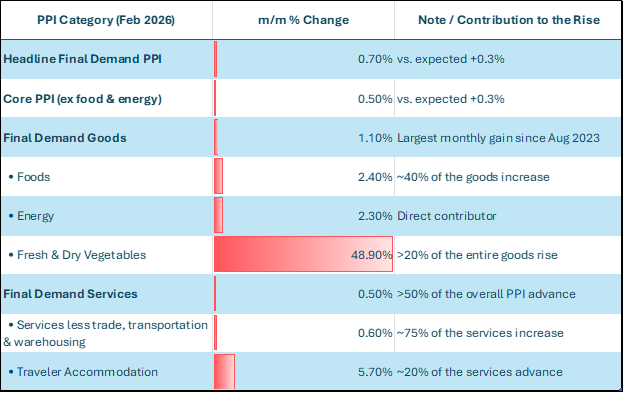
- Producer Price Index (PPI) Surge
- Recent PPI figures were significantly higher than expected:
- Final Demand PPI: up 0.7% month-over-month (double the expected 0.03%).
- Core PPI (excluding food and energy): up 0.5% against an expected 0.3%.
- The annual PPI growth reached 3.4%, higher than the anticipated 3%.
- Impact of Florida Freeze
- Severe freeze events in Florida led to massive agricultural losses:
- Estimated losses exceeded $3.1 billion.
- Key crops affected included:
- Tomatoes: 80% production loss.
- Sweet Corn: Up to 100% loss.
- Bell Peppers: 80% loss.
- Squash: Losses of up to 90%.
- The freeze is expected to lead to increased grocery prices, particularly for fresh produce.
- Fertilizer Shortages
- Current urea and fertilizer shortages are exacerbated by geopolitical tensions, particularly related to the Strait of Hormuz.
- Urea prices surged 35% over the past month, impacting agricultural production.
- Geopolitical Factors and Economic Implications
- Ongoing wars and geopolitical tensions are influencing economic conditions and market reactions:
- Concerns over energy prices and the implications for inflation.
- Impact on growth rates in the U.S. and abroad.
- Inflation and the Federal Reserve's Stance
- Powell's recent comments indicated a cautious outlook on inflation and economic growth.
- The Fed appears to be in a holding pattern, awaiting confirmations and further data before making rate adjustments.
- Private Credit Sector Concerns
- Rising default rates in private credit are concerning, with current rates at 9%.
- The sector is growing, but it may pose systemic risks due to a lack of transparency and high retail investment stakes.
- AI and Defense Contracts
- Discussion on Anthropic and its contracts with the Pentagon raises concerns about AI usage and restrictions imposed by the government.
---
Key Takeaways
- Inflationary Pressures: The recent spike in PPI and grocery prices signals ongoing inflationary pressures potentially affecting consumer spending.
- Geopolitical Influence: The intersection of agricultural challenges and geopolitical tensions may have lasting impacts on global markets and inflation.
- Private Credit Risks: Increased retail involvement in private credit with a backdrop of rising defaults could lead to significant market disturbances.
- AI in Defense: The Pentagon's reliance on AI technology from companies like Anthropic indicates the growing importance and complexity of tech in national security.
---
Guest Profile
David Gaffen
- Position: Breaking News Editor at Reuters.
- Experience: Over 20 years in journalism, covering significant events including the 2008 financial crisis and the oil-market meltdown in 2020.
---
Next Episode Preview
- Guest: Howard Lindzen, a renowned tech entrepreneur and social media expert, will join the next episode to discuss technology trends and market insights.
---
Conclusion This episode of *The Disciplined Investor* delves into critical economic issues that could shape consumer behavior and investment strategies in the coming months. The intersection of agriculture, inflation, and global events presents a complex picture for investors and consumers alike.
Written by AI. May contain mistakes. Listen to the episode to check what was said.
Chapters
Tap a time to open that second in VOBirthday Reflections and Personal Updates
1:12 to 2:38
Host Andrew shares personal birthday reflections and updates.
“Horowitz & Company, from seed through harvest, cultivating financial success.”
Market Insights and Inflation Concerns
2:38 to 4:23
Discussion about recent PPI data and market reactions.
“I am the host and the birthday boy of the Disciplined Investor Podcast, the co-host of DH Unplugged.”
Deep Dive into PPI Numbers
4:23 to 6:40
A detailed analysis of the latest PPI numbers and their implications.
“This came out the same morning as Powell talked.”
Impact of Florida Freezes on Agriculture
6:40 to 9:30
Exploration of how recent freezes in Florida affected vegetable production.
“Because the surprise in this particular PPI number was this strength that we saw.”
Supply Chain Challenges and Fertilizer Shortages
9:30 to 12:31
Discussion of ongoing supply chain issues, particularly with fertilizers.
“Vegetables were among the hardest hit in the produce category.”
Future Projections for Food Prices
12:31 to 14:03
Insights on how the discussed issues will affect food prices moving forward.
“They're jumping somewhere in the 17 to 30 % range is what we're seeing.”
Impact of Fertilizer Shortages on Food Prices
14:03 to 15:49
Learn about the effects of fertilizer shortages on grocery inflation.
“so that we can grow these vegetables and reach decent yields.”
Introducing David Gavin and Current Economic Challenges
16:20 to 17:14
Get insights into the current economic landscape from David Gavin.
“Because the best informed investors choose interactive brokers.”
The Complexity of Modern Warfare Reporting
17:14 to 19:15
Explore challenges faced by journalists in reporting on modern conflicts.
“It's better than I can say for the rest of the world, I suppose, in a way, but I'm doing pretty well.”
Navigating Bias in News Reporting
19:15 to 22:38
Understand how news organizations strive for neutrality amidst bias accusations.
“So reporters deal with this kind of thing on a regular basis.”
Show all 23 chapters
The Stakes of Religious and Ideological Warfare
22:38 to 28:00
Examine the implications of religious zeal in current global conflicts.
“I think that the idea that some others present, you know, bias is a bit overstated at times.”
U.S. vs Iran Military Dynamics
28:00 to 29:10
Explore the contrasting military strategies of the U.S. and Iran, focusing on energy infrastructure and geopolitical implications.
“This is a fundamental different change here.”
Market Reactions to Energy Concerns
29:10 to 30:50
Discuss how Wall Street's perceptions of energy market stability are evolving amid geopolitical tensions.
“You know, you saw that piece I wrote this week about PPI and agricultural prices.”
Inflation and its Ripple Effects
30:50 to 34:10
Analyze the long-term inflationary effects of energy prices and supply chain issues on various industries.
“We have mortgage rates back at a three-month high.”
Impact of Energy Prices on Goods
34:10 to 37:30
Understand the cascading effects of rising energy prices on transportation, agriculture, and consumer goods.
“So, you know, it's interesting because I, the word I'm going to use, hand wringing, for a while, I was looking at this like, okay, you know what?”
Global Economic Implications
37:30 to 39:10
Examine how prolonged energy supply disruptions affect global markets and economies, particularly in Asia.
“And the only way you offset that is through demand destruction.”
K-Shaped Economic Recovery
39:10 to 42:08
Explore the disparity in economic recovery, focusing on how different income groups are affected by current market conditions.
“If, in my opinion, if in fact there is a significant break in the oil prices, you'll see that jump pretty hard.”
Economic Resilience and Consumer Spending
42:08 to 45:12
Explore the paradox of consumer spending amidst potential recession.
“If we were in a recession, would we even know?”
The Federal Reserve and Inflation Concerns
45:13 to 50:12
Discuss the Fed's stance on inflation and the implications for the economy.
“He's basically a lame duck right now, but yet still saying that if Warsh is not going to be confirmed, he'll stay in as a pro temp and just hang around.”
The Risks of Private Credit Investments
50:13 to 56:00
Analyze the challenges and risks associated with private credit markets.
“And I was asked to come to this cocktail party at the end of the conference to meet a bunch of the guys.”
The Challenges of Investment Control
56:00 to 57:20
Learn about the control and transparency issues in investment management.
“that can be utilized once again for capital calls in the future.”
AI Tools and Government Contracts
57:20 to 59:13
Explore the complexities surrounding AI tools like Anthropic in government contracts.
“Let's kind of close out with some of the AI discussion.”
The Impact of AI Restrictions on Productivity
59:13 to 1:01:19
Discuss the potential effects of AI usage restrictions on productivity and industry.
“And that gives you the impression that, you know, just sort of, you know, chopping this out and throwing in something new will not be easy and will make things less productive.”
Transcript
Automatic transcript. May contain errors.0:00This episode is sponsored by Interactive Brokers. And where could quantum computing take your portfolio? Investment themes from Interactive Brokers? Well, it helps you find out. Start with a trend like quantum computing or even clean energy and instantly see what companies are most connected based on revenue, strategic focus, and product relevance. You could explore competitors, global exposure, and business relationships across more than 500 themes. Built with AI-powered insights from reflexivity, investment themes turns complexity into clarity and helps you move from trend to trade with speed.
0:40Available now across IBKR desktop, mobile, and trader workstation. You know, the best informed investors choose Interactive Brokers, member SIPC. Check it out at IBKR.com slash themes. The Disciplined Investor is all about you, your money, and the markets. Sit back and get ready for this edition of The Disciplined Investor Podcast.
1:06David Gaffen:This episode of The Disciplined Investor is sponsored by Horowitz & Company. If you're looking for a portfolio manager, look no further. Horowitz & Company, from seed through harvest, cultivating financial success.
1:25PPI just exploded higher. Florida freeze about to hit our wallets. The Fed's on hold, but not happy. And the war carries on. Our guest today is David Gaffin, breaking news editor at Reuters. All this and much more on episode number 965 of the Disciplined Investor Podcast.
2:02And welcome to Birthday Headquarters. It's my birthday this weekend. Well, not the whole weekend. You know, my kids, they have like birthday months. My wife has birthdays that just go on and on, right? One right into the next, holiday into the next. I have a day, maybe two. I'm going to go out to some great dinners. over the next couple of days with my family and enjoy the time together and spend time together because what's more important than family? And you are my family too. So I hope that you are celebrating as well. This is Andrew Horowitz. I am the host and the birthday boy of the Disciplined Investor Podcast, the co-host of DH Unplugged.
2:45We've got a bit of an update on DH Unplugged. They spoke with John C. Dvorak about two or three days ago. Two days ago. He was actually, he sounded pretty good. You know, he had a heart situation. He was in the hospital. He had a double bypass. Everybody knows that. And I've been working with his son, John S. Dvorak for DH Unplugged. And we've had a lot of fun. He's really good with AI. As a matter of fact, the last episode, he brought a Google Canvas that he put together to estimate not only the unemployment rate, but oil pricing, what would happen under certain circumstances that he put together with Gemini.
3:19Very cool. I mean, I was like, wow, how do you do that? That was awesome. So we talked about that. We talked about AI. We talked about the jobs. We talked about oil. We talked about what's going on around the world. Lots of great information. Much different vibe than it is with John C. Dvorak, who you know and love probably. But check it out, dhnplugged.com is where you'll find the information. Also on YouTube, Amazon Music, Spotify, Apple Podcasts. wherever that you get your podcast, you get DH unplugged and the disciplined investor as well. And in fact, if you're on one of your particular podcast apps right now, click the share button and send it out to a couple of friends that you're listening to this right now, because we're going to get down and deep into what's going on with PPI.
4:09That came out last week or this last few days ago. And it was pretty ugly. The Bureau of Labor Statistics, the BLS, told us that inflation was well above expectations. This came out the same morning as Powell talked. That was Wednesday. And he talked about how he's not really happy with where inflation is right now. Markets didn't respond very well to that notion, even though they know that he's kind of, at this point, kind of a lame duck, right? He's, you know, as soon as Warsh is confirmed, he's out. And in fact, maybe some time due to the lawsuits that are going on, but Powell was gracious enough to say that, you know, if in fact it takes a while for Warsh to come in and get confirmed, he will maintain that pro temp position just as long as it needs to be.
5:02So that was nice, I guess. He's standing up to the ridicule, the lawsuits, the constant pounding about being too late, etc. for a while. He is talking about some of this and looking at the inflation numbers, X the war, which we're going to get into in a second. But the PPI number, just to be clear, well above is an understatement. Shocking what happened. The headline final demand PPI came in at 0.7 % on a month over month basis, which is more than double the consensus that came in at plus 0.03. Now, core PPI, which excluded the food and energy, that's kind of what a lot of people look at to see, okay, even though we do eat and we utilize energy, but those are volatile numbers.
5:52What did the rest come in at? Well, it came in pretty bad too, plus 0.5%, which was ahead of the 0.3 % expected number. And on a year-over-year basis, it was 3.4 % versus about 3 % expected. We're going to have a couple of, I think we're going to put a couple of charts up on the show notes for episode number 965. You can go over to thedisciplinedinvestor.com. If you haven't gone there, by the way, you should make a special trip right now as we're talking, as you're listening, as we're spending time together. Go over to thedisciplinedinvestor.com. There's plenty on there to see all the past podcasts, some of the strategies, how we work, what we do.
6:33But in the show notes, I'll embed a couple of these tables and charts that we have here. Now, the surprise that was, here's what was so interesting and why I wanted to bring this up and talk about this and get through some of the ideas of what's happening. Because the surprise in this particular PPI number was this strength that we saw. And it was goods and services. And a few key categories really was like, what? Are you kidding? Fresh vegetables, travel accommodations are how much up? So we're talking about hotels, we're talking about, you know, the whole vacationing travels. It was like, wow.
7:19And, you know, gains in food and energy, other services, and more than half the overall rise came from services. well, check this out. Foods alone were about 40 % of the goods increase. Yeah, 40 % of the goods increase. And here's the problem. There was about a 48.9 % month-over-month surge in the PPI subcategory for fresh and dried vegetables. And that was a huge component of this whole thing. It accounted for 20 % of the overall rise in the final demand goods prices. And energy was 2.3 % month over month change. Travel accommodations 5.7%, which is about 20 % of the service advance. So this was a problem.
8:17Florida was the problem. Right here in my own backyard, we knew that at the beginning part of this year, the first couple of three months, we saw a good amount of cold weather come through. right? But we had those freezes. But here's the thing. The country, United States, in the PPI, what we spend our money on in terms of the vegetables and fruits, we rely on, during this time of the year, Florida. And the late January and early February freezes were absolutely brutal. You remember we had these multiple rounds of this unusually cold weather that hit through here? We had, in fact, there was record-breaking cold, record-breaking lows in some spots.
9:04And what did it do? It obliterated, hammered, took apart the crops all across the state. And it was especially tough on vegetables. Melons got just smoked. Reports from the Florida Department of Agriculture, I dug into this, I wanted to see what was going on, showed that the preliminary estimates of total agricultural losses exceeded about$3.1 billion, with some estimates as high as about 3.17. Vegetables were among the hardest hit in the produce category. Now, it was concentrated in south and central area. The growers got the worst of it all for the key staples. We're looking at things like tomatoes.
9:53Listen to this. There was about an 80 % production loss on the remaining crop, wiping out roughly$164 million of total revenue cost from selling or revenue from selling. Sweet corn got devastated, up to 100 % loss in some cases in many fields around Florida, leading to about$255 million in damage. Bell peppers, 80 % hit,$108 million. Squash, they do a lot of that down south as well, in Homestead, in south of Homestead, but also all around the state, losses as high as, listen, 90%. We're not talking about a little bit, you know, there's a couple of one out of eight. No, we're talking about, you know, seven out of eight.
10:43Squash were frozen. Lost about$24.5 million in other veggies like potatoes, about a 75 % loss. Cabbage, around a 40 % loss. And that was a lot. Now, it wasn't just the fields getting wiped out completely either. That wasn't the only thing. On the stuff that survived, it's reported that yields dropped sharply because you have all this cold and if it didn't get wiped out, it was having a problem growing, right? It was stymied. Shelf life was shortened. Shipments got messed up right through the February harvesting and shipping window. So all of this rounded out to this incredible, which you're going to see show up, by the way, in cost factors.
11:23If you haven't seen it already at the grocery store, you're going to see it. And that was, looking back, what's coming is a whole different animal. Why? You say to me, Andrew, it's not going to get colder. What are we worrying about here? The next phase. The next phase, what could come from this urea and fertilizer shortages tied to the Strait of Hormuz? That's not funny. Now, what is this doing? It's like pouring salt onto an already open wound for the growers, specifically and especially down here in Florida. Now, urea prices have already shot up sharply. Key markets have been seeing since about February lots of volatility right when the northern hemisphere is going to start their spring plantings.
12:21It's going to kick into high gear into the March through May, you know, in the United States for veggies, corn, and all the rest. And some reports are showing that New Orleans barge prices, New Orleans, New Orleans, New Orleans are barge prices. They're jumping somewhere in the 17 to 30 % range is what we're seeing. That was the initial surge with others showing even steeper prices that are increasing for all of this. This is what moves things back and forth. And particularly the nitrogen-based and other fertilizers, about 25 % to 35 % because this whole thing is related to the Strait of Hormuz.
12:59Why? Well, there's all this, about 40 % of the urea that passes through is related to the Strait of Hormuz. And what are we seeing? Just like oil. You have a stoppage of this? Well, what happens? Urea prices are jumping. They've climbed about 35 % in the past month. Southeast Asia has seen some big moves as well, up about 40 % on their pricing over there. Now, U.S. farmers who rely on imports to up to half the urea in certain areas are starting to really feel this shortage. There's been reports from the Fertilizer Institute and other areas, other reports that come out That shows that we're about 25 % short on the usual spring supplies needed for planting So now we have, looking back, the freeze and the frost where we relied on Florida for a lot of these things For the vegetables and other fruits And now we're working ourselves into the March through May area where there's all of a sudden a supply shortage on the fertilizer that is required for the planting so that we can grow these vegetables and reach decent yields.
14:11Now, this initial hit wasn't bad enough that we saw. It's now layering on the higher input costs and potential supply issues right when we're replanting. The spring season is here. We're in the end of March. So that in itself is a big problem. So here's what we're thinking. Here's what we think we can expect. that consumers, you, me, everyday shoppers, grocery stores, restaurant goers, families, all the people that have to eat, kids, adults, everybody. We're going to see the biggest pinch from these higher fresh vegetables and food prices coming soon. The Florida freeze damage and the urea fertilized shortages probably will drive up costs and get passed straight from farmers to the checkout line and the restaurant menus.
15:02Right now, that spring season, as where that planting, growing ramps up, feels like we're going to be just kicking farmers right in the teeth when they're already down. Now, there's some things you could do. You could buy some of these agricultural ETS. We own actually CF Industries, which is probably the largest producer of a variety of fertilizers here in the United States. We own that for clients, as full disclosure, by the way. But that's something to think about and to look into if you are of the same mindset that the potential higher costs are coming. Not to mention what it's going to do for inflation.
15:43Whole different topic, and we're going to talk about that with our guest. And we're going to get to that in just a short second. Before we do so, I want to mention IB, IBKR, Interactive Brokers, once again. and ask you what's driving your portfolio's performance. Do you know? Well, you can ask IBKR. Ask IBKR is a breakthrough AI-powered tool from Interactive Brokers that lets you interact with your portfolio using plain English. Ask a question and you're going to get an instant data-driven answer about positions, risk, and returns. It's actually built right into the IBKR platform. I want you to check it out.
16:20Go to ibkr.com slash ask. Because the best informed investors choose interactive brokers. Now with all that, we've got to talk about oil. We're going to talk about weather effects and information about what's going on with inflation. And we're going to talk about what's going on about the economic growth in the country. All that with David Gavin. He's the U.S. breaking news company's editor at Reuters, where he's worked for almost two decades. He also did stints as a U.S. Energy Editor, U.S. Deputy Markets Editor, and been a business journalist for more than 20 years. During that time, he's covered the 2008 financial crisis, the oil markets meltdown in 2020, and was nominated for a LEB award for a series of articles on the growth of stock buybacks in 2015.
17:12Let's welcome him right now. So, David Gaffin, how are you? It's been a while, my friend. It's been a while. I'm doing well. It's better than I can say for the rest of the world, I suppose, in a way, but I'm doing pretty well. It's certainly interesting. It's a very, very busy time, as you can imagine. Yeah, it is. I mean, last time we talked, the world was round. Now it's kind of pear-shaped. Yeah. That seems to be the direction we're going, isn't it? And the idea of no wars, no foreign wars. And then, of course, the wars now are played more like the movie Enders game, where we have people just on joysticks, it seems, shooting things at random areas that they have no connection to.
17:53So boots on the ground. We don't see any kind of horrible. We see building destruction. We don't see any kind of human destruction. Right. I mean, have you seen any signs of I mean, we see numbers of kill, but, you know, you don't see any of those like people coming back with their heads wrapped up and bleeding. and all that. That's kind of like not part of the new age war, I guess. Yeah, we're not seeing a lot of those images. Obviously, we're doing a lot to try to tell the stories of people who are caught up in this, which is not an easy thing to do because it involves putting our assets on the ground, our reporters to deal with those kinds of things.
18:27And it's, you know, not easy. Of course, there's not a lot of visibility in Iran by any means. And there's been a lot of destruction, obviously, in Lebanon. We've got a lot of, you know, burned up buildings and, you know, rubble and that kind of thing. But it's, you know, it's, it's obviously, you know, engulfing a lot of the world here, the entire region, and it's gotten very grim, very quick, I think, for a lot of people. So as a journalist in the in the media of today, and you've been doing this for a long time, how do you deal with trying to report? I'm not even talking about taking a position.
19:01I'm talking about just reporting facts where that can be characterized as against the current administration and the backlash would be great. Is that something that you guys are dealing with on a regular basis? Yeah. So reporters deal with this kind of thing on a regular basis. And certainly we deal with it right now. And I would say that it's less me because I'm in New York and doing a lot of editing and scrambling a lot of business related coverage than it is, you know, a lot of my really smart colleagues in Washington, D.C., and of course in Jerusalem and Beirut and all over the Middle East, where reporting is even more fraught because you're dodging, you know, explosive devices and things like that and weapons in addition to, you know, the ire of the administration.
19:50And, you know, you do have to just sort of stick to the principles that we have on reporting accurately, on making sure that there's time for fair comment. And when you can't get it, you know, at least trying to represent the viewpoint of, you know, the administration in this case as much as you possibly can in, you know, based on things they've said previously or things they've said publicly. And obviously, it's hard not to avoid feeling like that people are going to accuse you of taking a position. There's always going to be people who say that you're taking a view, you have a bias. And I suppose there's bias inherent in everything.
20:27But we try to use as neutral language as possible. But, you know, there are things that are hard to escape and things like energy prices, which don't lie and, you know, casualties, which don't lie. And from that respect, you know, it's a very complicated situation. War is unpredictable. And then there are a lot of things that people don't know. And a lot of people want to run with, you know, certain information without really making it clear where their information is coming from. So we're constantly sifting through facts, sifting through opinions to try to present things as accurately as possible.
21:05But it's not easy. And, you know, it is, as they say, first draft of history. And I will say that we've had a number of big scoops about what's going on, about, you know, the potential for ground troops that, you know, was discussed. Excuse me, that, you know, we got a scoop on that the other day or excuse me, yesterday. You know, the amount of impairment there is at the big natural gas field in Qatar. So we've been really all over the place. And it's, you know, obviously a big moment for journalists as much as possible because people do want that information somehow, you know. Well, that's an interesting thing.
21:40That's why, I mean, to be not just telling you this, but seriously, Rogers is one of my go-to places because I find it to be as neutral from a political standpoint and as clean from a news standpoint and from a factual standpoint that you could find. And there's only probably, I would say, that I am aware of, I'm going to go under five, and I'm going to go with the number three, by the way, places that I can actually go to that I feel comfortable that the information that I'm getting, whether it's on world news, whether it's on business, whether it's on breaking, right? You know, something is going to be the facts, ma 'am, just please the facts.
22:20That's my opinion. Yeah, that's our kind of goal. We try to be pretty much straight up the middle on everything, to present things in as unadorned a way as possible, to just present the facts, to without, you know, taking a point of view, without, you know, really taking an editorial stance. And in a lot of ways, there's always an editorial stance everywhere. I think that the idea that some others present, you know, bias is a bit overstated at times. Sometimes people just don't like, you know, the truth and what they're hearing. But, you know, you can't really help that, you know, but we do have a reputation for being very much a straight arrow in a lot of this and our reputation around the world, especially in conflict zones and in complicated markets like energy is very, very strong.
23:12And it's one that I think we want to keep and that we've done very well with. And for that reason, you know, it's moments like this that I think we tend to do well. And I don't mean to just be, you know, just tooting our own horn. And I know that's not the primary reason I'm here, but we're in a bit of a crazy time. And so that's how I do feel about it. I will say that much. So when it comes to what's going on right now, there seems to be this interesting variance that is appearing with regard to the idea that, and I think, well, I'm not going to put words in your mouth, but I think what I think is this proverbial carrot that keeps on putting us in front of us, that this is going to be a short-lived war that we're going to get all of our things that we want done, which we're still unclear.
24:01I think most of us are unclear of exactly what we want. And we think we know that maybe we're rooting out evil and issues with regard to, you know, the potential for nuclear armament of an adversary. And, you know, we're all OK with this kind of thing. But then Iran is like, hey, you know what, go screw. They start. Who would have thought? Did you think that this kind of thing would lead to Iran bombing Qatar, UAE? Do you think Iran was going to do that? Was that in anybody's playbook? You know, I feel like it should have been in somebody's playbook and maybe and I don't want to, you know, characterize what the administration is has done and, you know, not try not to play pundit.
24:43But, you know, the Trump administration managed to remove Nicolas Maduro with no real relative problems. It was relatively, you know, as these things go and I don't know the nature of the exact bits of the operation. It went in that respect smoothly. A, you know, his vice president became the president or acting president, if you like. And, you know, is clearly much more pliant as these things go. And it's possible they want to. Well, he knows he needs to be. Yeah. Yeah. Yeah. If you want to be vice president, if it's not, we can come and kill you. It's up to you. Right. That's kind of what she may be dealing with.
25:20But Iran has, you know, is a large place that is essentially a fortress in terms of its terrain because it's all mountains on every single border. And when it became clear by way of these attacks and statements from the president that their goal and then immediately by killing the Ayatollah was regime change, that is no longer a negotiating position for the Iranians. They, you know, prior to this, with the original bombing campaigns last year to try to destroy the nuclear facilities, you know, the Iranians could at least look at it and say, well, this is a limited goal you have. Whether you're successful or not will be one thing.
26:02But they responded in turn in that they responded with their own bombing campaign. But the idea of this sort of, you know, mutually assured destruction, not quite the same in this case that the U.S. and the Soviets always used to have. But the idea was we both know we're going to be restrained on this because you have the thing you're going to try to do and we're going to anomaly try to stop you. But they would not say to themselves, well, why would we risk everything, you know, if your goal is this one thing? But once you decide to sort of try to say we're going to decapitate the leadership and then kill every subsequent person who might be a leader, well, then why would, you know, Iran not necessarily just decide to go scorched earth, which is what they have done, literally gone scorched earth?
26:47David, the other problem is that it isn't just a simple regime change from a political standpoint. This is a government that's ingrained with religion hand in hand. It is, the Ayatollah was not only a political leader, but to a degree he was a religious leader, right? That's correct. So therefore, now you're messing with God. Well, right. So now the zealots come out and now everybody doesn't mind that, you know what, this is now a much more than just a war over land. It's a war over God. And that is a bloody war. That's what people don't go to the mat for. Right. And it's clear that they've decided to go to the mat with targeted attacks on energy infrastructure in Saudi Arabia, Qatar, Bahrain.
27:41They've just hit the refinery in Israel. And so that's a signal that they feel that their existence is one that is not guaranteed. That is a very different war than you have this facility we don't like. So we're going to try to blow it up. This is a fundamental different change here. And in some ways, you know, if you were to say, compare the two militaries and by two, I mean the United States and Iran against each other. Of course, it's no contest. The United States is much better prepared and much more well equipped. But in a lot of ways, I think that what some people are realizing is that Iran, in a sense, can win by not losing.
28:24And by not losing, I mean drawing this out, you know, doing what it is doing to energy infrastructure around the entire region, which is so crucial. keeping the Strait of Hormuz completely impaired where nobody wants to go through it. And whether there were people who, I'm sure there were people who thought this through, it does not seem clear that those people were the ones who had the ear of the president of the United States. So there is a difference. There is a chasm between the Beltway and Wall Street. How do you balance this? What's going on? Is this, like I said, when I started this discussion about the carrot, the beltway the pundits everybody in Washington is going to be quick it's going to be no big deal and then everything goes back to normal by the way that's the I think that's the way they're trying to couch this whole thing but Wall Street is starting to be like wait a second and I'll tell you my own opinion is and I talked to a few clients about this today this thing just stops today, tomorrow, next week maybe two weeks okay You got, I'll use the word transitory for inflation with regard to energy.
Read the full transcript
29:34But you have other problems. You know, you saw that piece I wrote this week about PPI and agricultural prices. That Straits of Hormuz blockade on not only on oil, but on urea and fertilizers, that's going to be long lasting. That's going to be inflationary. How, where is this difference that you're sensing from reporting on the political side of this from, oh, we're, you know, we can get through this quickly and we're America, we're strong, to Wall Street saying, wait a second, we need to gear up for this. It's funny because in the initial way of thinking, the way the markets were reacting, it was something of the reverse.
30:15And one of the very smart analysts from RBC said something along those lines a week ago where she said that she was struck by the fact that many Washington-based security analysts anyway, who probably operate a little bit behind the scenes, were working with much more of a longer duration timeline than people in the market. It seems like the market is at least waking up to that now, certainly in the energy markets and in the bond markets, which is kind of your first real signs of real concern here, that those markets are starting to get frightened. We have mortgage rates back at a three-month high.
30:55We have short-term bond yields are going up on the expectation that the Fed is now kind of in a box, that they are not going to lower rates. So, you know, the market is, I think, finally waking up to it. And while there are the pundits out there who are saying, you know, yes, this could only take this amount of time or that amount of time. I think the market's reaction to the idea that Qatar's LNG terminals and, you know, production has been impaired now, as they said, as they told us, for three to five years really matters. And it's a slow creep that's kind of kind of growing through the rest of the energy market.
31:30These things, as you say, they they ripple and they ripple into places like agriculture. And that's the part where you go from the idea of the transitory inflation, as, you know, the Fed officials and Janet Yellen like to say four years ago after Russia invaded Ukraine to something that is not transitory. As we saw, it took a long time for inflation to even come down to roughly the three percent level, which was still higher than optimal for the Fed. And that trend lower has now been once again completely interrupted. And now we're going the other direction. And then you have things like diesel fuel prices through the roof.
32:08And let's kind of just say the obvious. Who uses diesel fuel? Well, a lot of places, but truckers. Trucks use diesel fuel. And what do truckers do? They transport my widget from Florida to New York so you can get it and buy it there, right? You know what I'm saying? And that means that the widget price is going to go up. This is no longer a, hey, companies can absorb for so long. Like you've been probably hearing about this, right? Companies have been saying, we're going to absorb these tariffs. We don't know how long they're going to be on. Now we're maybe getting a refund. Now they're being hit again.
32:43How are companies reacting to this? Yeah, they are. So, I mean, the first areas you start to see things are the obvious ones, the energy companies and then airlines and people that are immediately affected by the likes of rising jet prices, jet fuel, that is. They are now starting to talk about whether they have to cut flights. They are talking about having to absorb a higher, you know, bill from jet fuel. But that hasn't even really sunk in and kind of fanned out into the rest of the world just yet. We're only starting to see the first trickles. I mean, C.H. Robinson, the logistics company, spoke about it last week.
33:19Honeywell, a few days ago, said that it is going to see, you know, some sort of revenue-related hit as a result of, you know, its operations in the Middle East being completely impaired. And then you brought up diesel and you brought up truckers and, you know, and agriculture. I mean, they use diesel for their machinery. They use it for fertilizer production, of which, of course, that has also been hit by what's happened in the Middle East. And it kind of It all then flows through back into groceries, back into, you know, making gigantic things like steel and aluminum and all that stuff. It, you know, continues here and we are, you know, into a bit of a worrying economic situation that, you know, seemed like we were finally receding from the combination of, you know, years of higher energy costs.
34:09And, of course, the, you know, shock from tariffs from 2025 that had finally started to recede as well. So, you know, it's interesting because I, the word I'm going to use, hand wringing, for a while, I was looking at this like, okay, you know what? Oil is going to go up, of course, straight to Hormuz problem. The straight of Hormuz, in my opinion, not a problem. That will eventually open up and that will get things rolling again. It is these attacks on, we'll call it the manufacturer of oil in the refiners or in any other production. Those that you all, think about this. I mean, if you're listening, think about this.
34:47The oil is stuck in ships within the vessels that a floating long sea can't get through the Strait of Hormuz and then pass and get to its final destination. Okay, fine. The oil is there. It's there. So eventually it will get to where it needs to go. And you take that to its fullest completed thought, I would think, okay, stays elevated for a while because of supply constraints, and then it drops off. You cut off oil production, right? You cut off LNG, natural gas. You cut that all off. That's a whole different discussion, especially because it's not like, okay, start the boat and drive through.
35:25You're talking about the facility is down and how long does it take to rebuild it? Isn't that what's happening? Yes, that's what's happening. I mean, Qatar has already said it's going to be three to five years before it can get its capacity online. That's an enormous amount of capacity, 17 % of its capacity. And they're one of the biggest natural gas producers in the world, most of which obviously they export because they are very, very small countries. So they are there for export power. And the other big ones, of course, are Australia and the United States. And we've seen it with that and with other attacks.
35:56And it's not clear that those attacks are going to stop right now. Those things really do complicate things. And I would say that it's clear that a prolonged shutting of the Strait of Hormuz, which we are in right now, may ultimately ripple into other markets that we are perhaps in the United States not seeing as much because the international benchmarks are doing worse than U.S. crude in terms of the rise. But certainly that feeds through to big importers in Asia like Japan and like South Korea and, you know, China and the rest of those. And so what matters is having the supply that you have on hand and what may be sort of limiting the oil price rise is that it appears that, you know, quite a few countries did have a good deal of supply and storage as we do, as, you know, some of the EU nations do.
36:50But, you know, that's why there's this sort of, you know, weird sort of liminal space where what you're talking about could very well be true in that the supply that's out there in storage and floating storage and various caverns and things like that may be enough to hold over this market for a little bit if Hormuz can get open again. And if it doesn't, then that is not quite as bad as destruction of supply. But it certainly isn't good either. It's not close. But as you said, destruction of oil fields, of refineries, I mean, that is, you know, like people have said, the absolute nightmare when it comes to the energy world.
37:32And the only way you offset that is through demand destruction. It's through prices that go so high as to people that they stop using it. And of course, the places they'll stop using energy will be in emerging markets and in parts of Asia and places that depend on those imports from the Middle East. You know, it's interesting. You look at a country like South Korea and you would wonder, well, wait a minute. Why is South Korea getting hit so hard in their stock market due to the fact, which is a lot of technology there. But with this whole thing, they do not, and they're not the only ones, but they do not have any production of oil or energy at the country at all.
38:10They're fully reliant on outside sources. And the closest place to it was, you know, the Middle East, et cetera. And that's why their stock markets were moving like, what, 8%, 10%, 12 % in a day. Yep. Which is unbelievable. Now, mind you, the dollar came up a bit. Then it came down a bit. Then it came back up again. And that hurt a little bit from the South Korean won. But the main culprit was the fear that the energy was not there, especially to run their data centers. How are they going to do that, right, if not running through the LNG, liquid LNG and oil related? They have some renewables, but not enough.
38:53Not enough. Right. Pretty amazing. That's something to watch. EWY is the symbol, by the way, on the South Korean Kospi ETF. And that one is a real mover. A lot of fun to watch to see what's going on. But I'll tell you this too. If, in my opinion, if in fact there is a significant break in the oil prices, you'll see that jump pretty hard. Probably. I see that happening. So let's talk about the economy itself. Things that you're seeing here about, you know, we talk about this K-shaped recovery or this K-shaped, it's not a recovery anymore, it's an economy, where the haves, the people in the markets, those in the top 1%, 2%, 5 % are doing really well.
39:42Everybody else is not. The people that are reliant on a fixed paycheck are getting hurt by, this is before gas prices went up. Let's forget that. Let's forget about this last three weeks. Before that, the people on fixed income, those that were reliant on hourly wage, were seeing a much different picture over the last number of years, but especially over the last year when it comes to the economy. Can you explain that? Yeah, that's correct. And so what had been happening for a while, about four or five years ago as we came out of the pandemic, is that the folks on the lower end of the income ladder in terms of wages were actually seeing a little bit of catch up.
40:24That was notable for a year or two in part due to some fiscal policy and then just part labor-related issues. And that's disappeared. And of late, you know, the income gains are widening once again, both not just between, you know, the top and the bottom, but also between the top and the middle. And what's resulted is that much of the consumer spending in this country, in fact, almost half of it comes from the top 10 percent of earners in America. That is the thing that increasingly drives economic activity. And you can see it through the various announcements and pronouncements that come from publicly traded companies who talk about their efforts.
41:06You see numerous, up until recently, numerous airlines all talking about wanting to go up market. And I don't just mean the likes of Delta, which has always been in that area, but, you know, the likes of Frontier and Southwest and companies that were, you know, more inclined to serve the sort of broader mass market. You know, and you have the same thing. You know, one of the best performing stocks over the last something like 10 years or so has outdone most of the tech names is Walmart. Why? Because Walmart has found through online, its online memberships, that it can serve, you know, the plus 100 ,000 a year earners even more who are, you know, flocking to it.
41:49And that's become sort of the mainstay of things. And so sometimes I ask the question and I don't have a good answer for it is that you see the weakness in consumer sentiment surveys. You see that when those surveys go up, it's largely because the upper echelon earners, when asked, are happy about their stock portfolios. But you see the reasonably OK consumer spending figures that continue, at least until recently, to chug along in the United States. If we were in a recession, would we even know? Or is 70 percent of the country in recession and everybody else and the rest are the ones that are just kind of carrying this thing along?
42:24And maybe that's, you know, not much different from 10 years ago or something, but it can't, it's certainly not the way the economy always was. And so I can't help but think about that sometimes. And I don't know the answer to that question. It's like a company that does very well in their earnings, but yet multiple divisions are not doing well. Same thing. Right. You know, but what's interesting, you mentioned about Delta Airlines. Last week they came out with an announcement. They talked about how they, I don't even know how they did. I was like, what? They're like, they're projecting a much better travel season.
42:52All this stuff is going on, right? with people not wanting to fly due to war, people not wanting to fly, they don't want to deal with the whole line thing going on at the airports right now. And Delta comes out with this really rosy outlook. How does that happen? Yeah, that was curious to me as well. Seriously, it was weird, right? Yeah. Is it still, is it Ed Bastian? Is he still in charge of Delta? Is that who it is? He is. Yes, he is. And, you know, they had been doing, yes. And he is still in charge there and they had been doing very well. They seem to, at least as of right now, still have a very strong outlook for everything, which is interesting.
43:32And that was continuing up at least until very recently. It's possible that their Middle East business is pretty much de minimis. It's perhaps that their growth is the long haul flights to Europe and to Asia and places like that, as well as a lot of America. So and they do rely very heavily as much as they can on the higher priced seats in the economy plus in the first class and business cabins. So I am surprised in some sense by it, too. And we will be interested to see how that evolves over the next few months. Right. So, again, we see a lot of K going on, right? this world of many different levels.
44:17And, you know, if you're in one, you can only see that. If you're in the other, you can only see that. The markets themselves have been extraordinarily resilient, don't you think? Through all the things that we've seen in the last, I don't know, six months? I'm just going to do six months. We can go longer. But unbelievably resilient. And I think a lot of that still is the excess stimulus. A lot of people didn't see that the one big, beautiful bill act, the OBAA, that was, that was, that was stimulative. That was, yeah. And the expectation was that it was going to be stimulative for this year with some favorable things like tax refunds and that kind of thing.
44:54So the expectation was that that was going to come into the, you know, that that was also going to come into play as well. So, you know, we will see how that pans out as people start to get tax refunds. and if there is any kind of stimulative effect there as well. Right. Let's switch gears here. Let's talk about Powell. He's basically a lame duck right now, but yet still saying that if Warsh is not going to be confirmed, he'll stay in as a pro temp and just hang around. Not sure if he's going to stay in on the committee otherwise and also not going to be giving up any position at all until all the lawsuits are dropped.
45:38He came out with a conversation the other day where there was no change in the Fed funds rates and there was a lot of uncertainty. I think the most use of the word uncertainty in a Fed speech in a very long period of time. He also said that basically the war with inflation is not over. Right. Which I thought was pretty interesting. They were seemingly claiming victory or at least close to victory for a while. And now they're not. You got Stephen Mirren who's just, you know, I don't know what he's just wants rates lower. Forget him. But there was basically uniformity with the others about no increase.
46:11I think they're starting to see things. The PPI numbers were absurdly high. So what's the thinking out there on the Fed penciling in a slightly higher inflation look for 2026? Yeah, no, it was very interesting to see that. And what's also interesting, the most recent meeting as well is that, you know, some of the other governors, Christopher Waller didn't dissent in favor of a cut this time either. He had dissented back in January and gave a big, you know, his statement through the Fed as to his reasons on it after supporting rate cuts prior to that. But if he's not on board, you know, then we're not getting interest rates lowered anytime soon.
46:51And so, you know, and Powell was talking a lot about inflation, the inflation overshoot, a lot of the upside risks right now. And it has been, And, you know, we've already had inflation that's been high as it is for several years now. And so while there may be some concerns about the labor market that still exists, the labor market seems to be on the softer side. The job growth has not been great. And he even said that we've essentially we're at no job growth right now. You're still talking about, you know, a lot of uncertainty around the war and where things stood. You know, never mind the unclear situation with tariffs, which maybe that by now had been baked in.
47:27But you can't help but think that, you know, there's certainly the Fed is now on hold. The market doesn't see them doing probably doing anything this year. And if they're going to do anything, it's a rate increase by the end of the year. And as you said, producer prices were up, you know, by the most since July. We're at the fastest rate of growth we've been in a year at 3.4 percent for wholesale prices. It hasn't been as bad in the consumer inflation, but you never know. And, you know, and and and from a consumer's perspective as well, the thing that people, of course, notice more than anything else is gasoline prices.
48:00And those are just defiantly moving higher, not far off of four dollars a gallon nationally, which is always been kind of a pain point number. So I don't see any way in which, you know, the Fed officials can really credibly call for more rate cuts. And obviously they don't as well. Unless we look through the oil situation and realize it's going to create a lot of pain for individuals. And therefore, the economy slows down precipitously, which is the potential outlook that I'm seeing now. Before, I didn't see any rate cuts at all because I thought inflation was there. And now you would look at me and say, well, Andrew, here's the deal.
48:41There's going to be more inflation coming. But that inflation due to the stoppage of maybe fertilizer that's going to slow the planting season and create less yield. And then the other thing about oil, that all, well, semi-temporary on oil. I'll put an asterisk on that one. But the thing is that that in itself can slow the economy down so dramatically. Uncertainty, war, higher prices, that they may actually have to look at other options. and think about looking through the inflationary numbers, what I think eventually, once we get to that point, and actually cut rates rather than raise rates. Because I think if they raise rates into that and they do it because the majority of the gains are in energy, that would be problematic for everything else.
49:27That's just an opinion. I understand what you're saying, and you may very well be right. It doesn't escape my mind that we are entering into an uncertain period that you've just described, whereupon energy costs and, you know, associated costs like agriculture and other things and transportation continue to rise while the relative weakness in the labor market and the uncertainty around that and the higher costs kind of restrain growth. And there's a word for that I've heard. But don't say it. It's not one. Don't say it. Yeah. Don't say it. But still, you can't help but, you know, think that that isn't entirely out of the realm of possibility here.
50:06Yeah, we're entering the 70s again.
50:11good grief yeah we're entering the 70s i can tell you stories about that but um let's switch and do a do a little bit of a a right turn a hard right turn sure let's talk about um private credit for a second here the private credit world it's interesting because uh i've told a story before i don't think i've told you about a year or so ago i was at a conference down in Miami. And I was asked to come to this cocktail party at the end of the conference to meet a bunch of the guys. And there was a bunch of people that have been on the show and all that at the conference. So I'm there. I'll go. So I went down to the conference, went to the cocktail hour and I get literally swarmed out of nowhere.
50:53Like, I don't, I don't even know. I'm just like minding my own business by the way. And I guess by people telling me, Hey, how much private credits in your portfolios? what you need private credit i'm like who are you you know yeah and they're telling me private credit private equity you got to have it it's the thing if everybody's doing it you got to do it let me give you my cards and i was like by the end of the event i'm like oh and there was one it wasn't an event it was a two drink cocktail hour that's what it was i was like this is ridiculous so i immediately started thinking about that that was about a year or so ago and decided i gotta steer clear of this stuff for a lot of reasons i always always steering clear but i'm not gonna get myself into it.
51:31Let's put it that way. And that kind of really resonates with me now and how the move to really sucker, I use that word seriously and I use it unabashedly, sucker the retail into a non-liquid investment, which they said was semi-liquid, which is total bullshit, by the way. And they get them into this and not telling that really, you really can't get your money out without taking a major haircut on this. And here we are today. With 9%, I think there's a 9 % default right now, which is higher than ever that we've seen in a vehicle that you can't get your money out of. Right. Defaults would be worse if you could actually get your money out, by the way, because then there would be lack of liquidity.
52:23So you've got a liquidity lockup and you have a defaulting. Obviously, we never learn our lesson. Yeah. The reason private credit was born was because the need for, seriously, everybody should listen carefully. The need for a lack of transparency and hold up and lock up periods after the crapola that was pulled by the banks back in 2006 through 9. Right. That is no longer allowed. But once you bridge over to private credit, voila, you could do those kind of things. You could do that crazy kind of lending, lower your lending standards, hope for, wish for, you know, and that's what really happened here.
53:11And the question is, long-winded discussion to now throw back to you, is there any systemic risk in what's going on? You have to wonder, you know, you can't help but say, you know, you know, it doesn't repeat itself, but history does rhyme. This sector is now a two trillion dollar sector. And the worries that are coming through are the kinds of worries we've heard before. You know, returns start to fly. People start worrying about their money. Redemption start getting cut off. You know, they now start saying, well, you can't remove your money. Anytime somebody says you can't remove your money, people start to say, now I want my money.
53:48You know, that's, you know, a little bit more of a concern. The private credit sector is not as large as the subprime sector was with regard to housing. I mean, it's$2 trillion. I think the subprime was much larger than that. So in that respect, it's not as large. But, you know, there is a heavy amount of retail investment involved. The Investec people said it's somewhere around 16 percent of investment is retail investment, whereas in 2020 was like five and a half percent. So you you do have much more skin in the game from retail investment. Private default rates are growing. And so, you know, certainly there could be some ructions after you've already had, you know, a couple of those bankruptcies like those auto parts companies.
54:36You had the Blue Owl thing. And so you do have to worry about the transmission for all of the problems. if we start to see some real problems with economic growth may not be directly as a result of this. It may be that it is a side contributor if, you know, we see an economic slowdown as opposed to subprime housing where it was the absolute culprit and was at the center of everything that happened when the housing market cratered. But that doesn't mean that, you know, the world is, you know, or the country is out of the woods on it and that it shouldn't be paid attention to. It's just going to be yet one other thing that could be a problem for people.
55:16This is just, again, one, but private equity, private credit. I could tell you some of the private equity stuff that I've seen across my desk. I'm, I'm, that's not happening. I mean, literally, I could tell you none of it ever happened here. I have never, that I'm aware of, had any clients move into any, nothing that we've recommended. Nothing that we've said, we're doing this. We may have hedge funds and things of that nature and SMAs, much different Liquid, relatively liquid. Some have quarterly distributions. But okay, most of the – but this stuff where you're literally blind. Private equity, you're blind.
55:50You're hoping they're doing what they say they're doing with your money, and then they're sending you statements that are extraordinarily difficult for the average person to read. And then you have capital calls, and then you have distributions that are held back that can be utilized once again for capital calls in the future. So you have these kind of, I'm getting my money, but they can give it back to them. and a lot of strange things that go on inside of all this. Yes, absolutely. And they have total control of your money. And the transparency is not, which we call opaque. And dare I say that the oversight is much different than it is with your liquid investments through regular custodians and brokerages.
56:34Much different. Yeah. So if they don't get their shit together, to be honest with you, it's going to be a real death blow to this industry. The institutions will still want it, but retail is just going to say, you know, screw that. And by the way, you knew it was going to be a problem as soon as you started hearing them trying to get into the 401k plans. That was like the, oh God, here we go. Trying to rug pull on the 401ks, not a good idea. Yes, that's always the reason, isn't it? It's always the thing that you start to see is that as soon as you start to see this trickled into things like, you know, retirement plans and retail investment, it's kind of, you know, you can't help but feeling it's like the last rung on the ladder here, you know?
57:20Yep. Yeah. Let's kind of close out with some of the AI discussion. And, you know, Anthropic, that's a big thing. It's in the middle of this whole mess with the government. It seems that they don't want to contractually obligate themselves. Well, the government won't allow them to put into the contract that Anthropic can essentially throttle some of the things they're doing in the event that Anthropic feels that it's against what their core beliefs are. Is that an explanation? Is that right? Is that correct? Yeah, I think so. I mean, yeah, that was the dispute between Anthropic and the Pentagon was over what kind of guardrails it would be, you know, by which it would use its AI tools.
58:00And there was this all kinds of, you know, you know, back and forth over it. You even start to, you know, get to the point where then it gets labeled a supply chain risk. But it's funny as a result, you know, we just published a story about where we spoke to some Pentagon staffers and other, you know, former officials say that the military is reluctant to give up on Anthropics AI tools because they think they're superior to the alternatives. They, I think, tend to think they're, you know, better, that the Claude model is the best one, that the XAI grok is inconsistent and nowhere near as good.
58:41And so, you know, ripping that out from what the Pentagon uses doesn't seem to be something that's going to happen easily. Of course, you know, the kind of rhetoric that we've seen from the likes of the administration makes you wonder whether they're going to continue to try to take retaliatory action against Anthropic, which, you know, in there's a but but it has been working with the Defense Department for a good while. And so it's been using their tools. And as a result, you know, the, you know, the Defense Department, I think, seems to really value it. And that gives you the impression that, you know, just sort of, you know, chopping this out and throwing in something new will not be easy and will make things less productive.
59:23Well, also the other thing that I heard, I have some colleagues and contacts in the industry that knows a lot about this situation, is that the biggest concern is if the government says no government contractor can utilize Anthropic in any of the work that they're doing related to the government, That means that the trickle-down impact of that, where a lot of people are already embedded and ingrained, the tentacles of anthropic usage is inside of those companies, separate companies, private companies, public companies. Whereas IBM may be using – I'm just picking this as a weird example. But IBM may be using Anthropic for something to do with something that attaches to this that, by the way, has – that the government, some part of the government may be working with.
1:00:13That wouldn't be allowed. And then all of a sudden it's going to be like, wait a minute, I got to rip out the entire usage of this to what? And that has to go to what degree? You follow what I mean? It's really problematic. Yes. There's some real questions that I think people have raised about this decision and what it will do as far as productivity, the undertaking of doing this. And then the questions about, you know, how other companies that had been working with Anthropic, will they be able to use it for their non-governmental activities? And how do they make sure they maintain that wall as well?
1:00:53It feels like a lot of, you know, make work, a lot of stuff that's been added in that will make things difficult for more people. It's a path of most resistance kind of move is how I think some people are putting it. It's going to be kind of fascinating what falls out of this because there is a period of time that everybody has to undo this. But my hope is that they can come to an agreement if it is the best product. You know, if it's the best product and there is a desire to have some guardrails on it, I don't see the necessary problem with that. There should be for all of these kinds of products.
1:01:27But who knows? Who knows? David Gaffin, Reuters. Make sure to check out Reuters. Just read what he has to write and what is going on in the business and stock and the world and all that over on Reuters. Thank you so much for joining me as always. I appreciate you. Yeah, it's great to be here. It's always good to talk to you. Thanks so much. Thanks, Andrew. See you. Yeah. See you. Another great show of great information with a great guest. We have some other ones coming on. Next week, Howard Linzen. If you have not heard Howard Linzen in the past, you need to tune in next week as he comes on. He is a no-holds-barred tech giant and marketing guru, social media maven.
1:02:06Just a great guy overall. I've known him since 2007, I would say. One of the first guests I ever had on this show, actually, was Howard Lindzen. And he is just a really funny. He has great information. I think you're going to really love him. Coming up the week after that, Thomas Thornton from Hedge Fund Telemetry. So we are lined up. We are locked and loaded. Things are good. Thank you for joining me this week and every week, and I'll see you again real soon.
1:02:41This podcast is intended for informational purposes only and does not constitute personalized investment advice. Investing involves risk, including the possible loss of principal and past performance is not indicative of future results. The views and opinions expressed are those of the host and any guests and may not necessarily reflect those of Horowitz & Company, Inc., an investment advisor registered with the U.S. Securities and Exchange Commission. Registration with the SEC does not imply a certain level of training or skill. Advisory services are only offered to a client or prospective clients where Horowitz & Company is properly registered or is excluded from registration requirements.
1:03:19Any mention of third-party companies, products, or services is provided for informational purposes only and does not constitute an endorsement. Hypothetical scenarios or forward-looking statements are for illustrative purposes and should not be viewed as guarantees. Content is intended for U.S. residents only and may not be applicable in other jurisdictions. Listeners should consult a qualified financial advisor before making any investment decisions. Please visit our website for additional information, disclosures, as well as a copy of our form CRS. Advertisements are not related to the host or affiliates and are not considered recommendations by the host of the show or any affiliates of Horowitz & Company.
From the publisher
PPI just exploded higher.
Florida Freeze about to hit our wallets.
The Fed is on hold but not happy.
And the War carry’s on…
Our guest this week – David Gaffen, Breaking News editor at Reuters.
NEW! DOWNLOAD THIS EPISODE’S AI GENERATED SHOW NOTES (Guest Segment)
David Gaffen is the U.S. breaking news companies editor at Reuters, where he has worked for almost two decades. He also did stints as the U.S. energy editor and U.S. deputy markets editor and has been a business journalist for more than 20 years.

In that time he has covered the 2008 financial crisis, the oil-market meltdown in 2020, and was nominated for a Loeb Award for a series of articles on the growth of stock buybacks in 2015. He lives in New York with his family.
PPI Table Discussed: PPI Table – Feb 2026
Check this out and find out more at: http://www.interactivebrokers.com/
Looking to invest in The Disciplined Investor Managed Growth Strategy?
Click HERE for the virtual tour.
Stocks Mentioned in the Episode: (WMT), (DAL), (AAL), (EWY)