In short
The episode of The Disciplined Investor (Ep. 972) is about “The History of the Future,” focusing on two themes: (1) how AI is likely to affect employment and (2) how Americans historically were taught to get rich with money—and what still works today.
Key claims on AI and jobs
The host argues Silicon Valley’s consistent “AI won’t replace your job; it augments” message (Sam Altman, Jensen Huang, Sundar Pichai, Chris Collins/Twilio, Brian Moynihan, Mark Zuckerberg) is intended to reduce fear and speed adoption. He contrasts this with efficiency history: productivity gains typically reduce labor at the margin. He cites forecasts (McKinsey: ~14% of workers may need occupation changes by 2030; World Economic Forum: 92M displaced, 170M new roles) and more pessimistic insider warnings (Anthropic CEO Dario Amodei: up to 50% of entry-level white-collar jobs eliminated; possible 10–20% U.S. unemployment). Notable examples include AI-driven automation already cutting tasks like audio/video clipping and company headcount reductions tied to AI efficiency.
Guests
Joseph S. Moore (PhD), author of How to Get Rich in American History. He’s a historian (PhD in American history, no econ/MBA training) who became interested after personal experience in the 2008 housing crash and researching what Americans were historically told to do with money. Key claims from Moore: “go ahead” was an active, permission-based American motto; pessimism is seductive but optimism and saving habits predict financial wellness; and investing decisions should be guided by “slow time” (long-run habits) rather than “fast time” (rare crisis moments). He also discusses a study linking Dave Ramsey’s radio show to reduced credit card spending.
Written by AI. May contain mistakes. Listen to the episode to check what was said.
Chapters
Tap a time to open that second in VOMarket Analysis: A Tale of Two Cities
2:06 to 3:15
Explore the contrasting experiences of retail investors and consumers amidst market highs and lows.
“Isn't that how every YouTuber starts their whole thing?”
Navigating Investment Strategies
3:15 to 4:25
Understand how to approach investing amidst market uncertainty and develop a solid plan.
“But one thing is for sure, that there is an undercurrent these days of positivity.”
AI's Impact on Employment: A Critical Look
4:25 to 7:20
Delve into the narrative surrounding AI's role in the job market and how it affects the workforce.
“And maybe you're not fully in or maybe even not in, but there's a plan to get in.”
The AI Augmentation Narrative
7:20 to 10:30
Examine the common narratives by tech leaders about AI augmenting rather than replacing jobs.
“He says, quote, AI will not replace people, but people who use AI will replace those who do not.”
Historical Perspectives on Job Displacement
10:30 to 12:48
Learn how historical trends suggest potential risks of job displacement due to technological advancement.
“of the manufacturing facility and the assembly line.”
Future Predictions and Warnings
12:48 to 14:03
Discuss predictions about job losses and the potential impact of AI on employment in the coming years.
“I don't think they really appreciate some of the unintended consequences and risks because job losses, when you look at what tends to happen, is that job losses will happen faster than creation.”
The Impact of AI on Employment
14:03 to 20:20
Explore how AI advancements are changing job markets and employment.
“and there'll be a merging of all of these ideas.”
Connecting History and Money
21:56 to 28:02
Discover how American history informs modern financial decisions.
“No, like there's this, it's almost a Monty Python sketch when you walk around an academic hallway and it's like doctor, doctor, doctor, doctor.”
The Power of Compound Interest
28:02 to 29:10
Learn how compound interest significantly impacts wealth accumulation over time.
“However, I have to point out to them, 99 % of Warren Buffett's wealth came after his 60th birthday.”
Historical Perspectives on Wealth
29:11 to 30:36
Explore how historical attitudes toward wealth have evolved and shaped modern financial advice.
“And how is this idea different from how we talk about getting rich today?”
Show all 26 chapters
The American Spirit of 'Go Ahead'
30:37 to 32:48
Discover the active mindset of early Americans that encouraged personal initiative and entrepreneurship.
“And by the way, statistically speaking, that was true and is true.”
The Myth of the Dead American Dream
32:49 to 35:08
Debunk common narratives about the impossibility of achieving the American Dream today.
“Oh, so in 1676, this is a hundred years before Hamilton is going to wrap on Broadway.”
Comparing Socioeconomic Mobility
35:09 to 38:15
Understand the realities of socioeconomic mobility in America relative to other countries.
“and they would call out from the crowd like it's a rock concert.”
A Hopeful Message for the Future
38:16 to 40:04
Learn about the potential for growth and success in modern America despite challenges.
“Okay, here's today of children born into the bottom 20%.”
The Importance of Attitude in Financial Wellness
40:05 to 42:06
Discover how a positive mindset can significantly influence financial success.
“That's a truly, that was where I started.”
Optimism in Market Cycles
42:06 to 46:07
Explore the concept of optimism as a driver of market behavior and investing philosophies.
“And that is the basic premise of buy and hold throughout all the different cycles of the market that you believe that tomorrow would be a better day.”
Fast Time vs. Slow Time in Investing
46:08 to 47:22
Learn the distinction between fast time and slow time in financial history and investing.
“I think of it often a little bit as getting really close to the screen, and that screen can be any kind of item that's happening right now, right?”
The Role of Gurus in Financial Education
47:23 to 49:46
Understand how financial gurus provide practical advice that complements academic theories.
“A lot of academics, and I'm calling you an academic, sorry, but academics are - It's okay.”
The Importance of Financial Literacy
49:47 to 52:26
Discuss the importance of ongoing financial education and the pitfalls of limited awareness.
“And I always go back and look it up and it's invariably like the best high school in the state of California or whatever, right?”
Diversification vs. Concentration in Wealth Creation
52:27 to 55:27
Investigate the controversial role of diversification in wealth creation versus concentration strategies.
“I mean, I get how they're trying to kickstart it and kickstart you into a groove that will be forever.”
Understanding Financial Independence Today
55:28 to 56:00
Delve into modern concepts of financial independence and their historical context in society.
“And it's this financial independence, retire early or known as FIRE, which has multiple meaning.”
Retirement Dreams and Historical Perspectives
56:00 to 56:48
Exploring the concept of financial independence and historical approaches to early retirement.
“One, when I get that BMW 325, you know, I'm going to be there.”
Historical Figures and Financial Independence
56:48 to 58:19
Discussing historical examples of individuals who achieved financial independence and their stories.
“What did financial independence mean actually historically and what people are thinking today?”
Cautionary Tales of Financial Independence
58:19 to 59:58
Examining the risks and misconceptions surrounding the pursuit of financial independence.
“Okay, so it's actually very doable and very old.”
The Search for Purpose Beyond Wealth
59:58 to 1:01:27
Understanding the importance of purpose and satisfaction in life beyond financial success.
“because you are riding the wave of how much wealth there is.”
Key Principles to Achieve Financial Success
1:01:27 to 1:06:20
Identifying timeless principles that contribute to financial success and independence.
“But it's also something that is multifaceted.”
Transcript
Automatic transcript. May contain errors.0:00This episode is brought to you by Interactive Brokers. And you research your investments, you analyze markets, and you manage risk, right? But have you researched your broker? For the past three years, Interactive Brokers' individual clients averaged an annual return of 24.3 % compared to 23.1 % on the S &P 500. IBKR's lower trading costs, competitive rates, efficient execution, and access to over 170 global markets helps investors keep more of what they earn and put more capital to work. Over time, the broker you choose matters. Interactive Brokers, member SIPC. If you care about performance, find out why the best informed investors choose interactive brokers at ibkr.com slash performance.
0:53Visit ibkr.com slash performance. The Disciplined Investor is all about you, your money, and the markets. Sit back and get ready for this edition of The Disciplined Investor Podcast.
1:09Joseph S. Moore, PhD:This episode of The Disciplined Investor is sponsored by Horowitz & Company. If you're looking for a portfolio manager, look no further. Horowitz & Company, from seed through harvest, cultivating financial success.
1:28Absolutely blowout numbers from semis. Tech is on fire. The war is kind of over, but nothing has changed really. I'm going to do a deep dive into AI and employment trends. Are you worried if your job's at risk? And our special guest today, author of How to Get Rich in American History, Joseph S. Moore. All this and much more on episode number 972 of the Disciplined Investor Podcast.
2:05Hey, what's up, people? Isn't that how every YouTuber starts their whole thing? Funny. Andrew Horowitz here, the host of the Disciplined Investor Podcast from the studios in Fort Lauderdale, inside of Horowitz and Company's offices. We have this great studio for audio video. It's been quite an interesting month, to say the least. A lot of things that are swirling around. We saw very conflicting information like what we see with the markets reaching all-time highs and at the same time, consumer sentiment hitting all-time lows. We see that some companies are doing extraordinarily well. And then we have other ones like a Shake Shack or a Whirlpool that are just getting battered.
2:50And we see that this is a tale of two cities, really. We see that on one hand, the retail investor is really embracing, but the retail consumer is not. We see that the corporate investor, the CapEx provider, is just doling out money like it's 19, I don't know, 1999, I guess. But a lot of things are happening and a lot of things we need to talk about. But one thing is for sure, that there is an undercurrent these days of positivity. And that's great. And a lot of people are looking at things like the price of gas. They're looking at things like what's happening with consumer confidence. They're looking at all the negative things about the war.
3:34And yes, all of that is negative. And if you're feeling it, I feel you. I get it. But at the same time, you can't let that dictate what you're doing with investing. And if you are, if you are, you need to do something about that. I've had more conversations with people over the last few weeks about this exact topic. And talking about the idea that if you can't do it alone, you can't do it by yourself, if you're not pulling it off the way you should, go find somebody. Doesn't have to be us. Find an advisor that can help you. Find an investment manager that can take the burden off your shoulders of this whole thing about, I don't know when to invest.
4:19It's too late. It's too early. I'm worried about this. There is a trend that is going on right now. Now, and while you do not have to be fully invested by any means, in fact, we've talked about this before, the one foot out concept, one foot in concept, get maybe some things that are invested over time through a dollar cost averaging approach. And maybe you're not fully in or maybe even not in, but there's a plan to get in. And if you don't have that plan, you're never going to get in. Especially if you got out entirely. A lot of people blew out their portfolios. a couple months back. Something to think about and really take the time right now because I know you're thinking, yeah, I know, I know, I know.
5:03But if I invest, the day I invest, the next day, it's all going to hell. Oh, come on. The world doesn't revolve around you. The markets don't revolve around what you're doing. There's nobody with a camera looking, okay, when's Bob investing? Because when he does, we're going to pull the plug. That's not how this works. Come on. This is for the long haul. This is not for today, tomorrow. It's for 10, 15, 20 years from now. Now, with that in mind, I want to talk about something that I think is really important because there's a lot happening with this whole AI trade and AI in general. And for the past several years, there's been a message, this dominant message that's been coming out of Silicon Valley and has been consistent, incredibly consistent.
5:51They've been saying that artificial intelligence, AI is not coming for your job. Nope, nope, it's not. Instead, we're all told that, you know, AI is simply gonna augment, they use that word a lot, and enhance. It's gonna eliminate repetitive tasks. And what does that do? That's gonna free us all up to really do things that are much more important, things that are creative, strategic, and reach that higher level of higher value work. And that message has been ingrained into the consciousness of everybody. The repetition of this has been happening so that all the influential people that are involved in the whole AI trade, the tech bros and the tech execs, have been really hammering this home, and what has it done?
6:52It's, what I see at least, it's created an acceptance of this by all of us. It's now a mantra. It's a steady, repeated mantra that we all are like, oh, okay. I did some research to find, you know, what exactly has been said? Who's saying it? And there's an incredible amount of consistency. that goes along with all this. Sam Altman, right? The founder, co-founder of OpenAI. He says, quote, AI will not replace people, but people who use AI will replace those who do not. A little bit of a twist on that idea. Jensen Wang from NVIDIA says, you're not going to lose your job to AI, but you're going to lose your job to someone who uses AI.
7:39Very consistent, very similar to what Sam Altman said. Then we have Sunjar Pichai from Alphabet, Google. He says the future of AI is not about replacing humans. It's about augmenting human capabilities. Chris Collar from Twilio. AI is an accelerant, not a replacement. Brian Moynihan from Bank of America, not even in tech. Although, you know, admittedly, some tech. AI will augment. There's that word again. AI will augment rather than replace workers. And Zuck from Meta, he says, people are very fixated on this notion that AI is going to replace people's jobs. It's the wrong mental model. Now, when we take each of these, we look at each one of these, right?
8:27From Altman to Kohler to Moynihan. And there's so many other examples of the same thing. But if we look at these individually, I think each one of them, well, that's reasonable. I don't see anything wrong with the idea that, well, we're not replacing. We're just, you know, we're just doing something different at this point. But what is the intent? And I think what they're trying to do is collectively create this calming narrative, you know, so that nobody's too worried about working hard with or at or on creation or just even using AI to a point that we say, Well, we're not going to adopt that because we do and we get to, well, where's my job going to go?
9:12I think the idea that they have is to really tamp down this whole fear to make essentially a global adoption of AI a lot easier to sell. And it makes sense Because there's a strong incentive for companies To really spend time Honing this narrative Emphasizing the idea that Augmentation, augmenting Is happening rather than replacement It's good for them We have this widespread belief that AI directly leads to job losses And that, if there is that really that's going to be part of the consciousness of the worker, not only the average worker, the non-AI user, but those that are creating the AI, where does that lead us?
10:09That could lead to a big backlash from employees and the public at large.
10:17However, sticking to this mantra, it buys time. Definitely. Now, history, if you look at history, it suggests the idea that this framing that they're doing may be slightly incomplete, not really totally flushed out. It's kind of part of the story. Because what we've seen in the past, if you look at all the different areas of enhancement, I mean, way back to the buggy whip that disappeared because of the car and, you know, the automobile, the, you know, Ford's miracle. of the manufacturing facility and the assembly line. And if you look at all the different things that happened all the way from, I don't even know, looking at fire.
11:03You know, that invention way back when, I mean, way back when, this idea of productivity, when it rises meaningfully, what happens is the need for labor eventually falls at the margin. It's not a judgment or a slam at all on corporate management. Rather, in fact, I would have to say that this is simply how efficiency works. It's part and parcel of the program. Companies have to do this, right? Because if they fail to do this and they fail to find the efficiencies, they're going to lose out. They're going to fall behind. And there's plenty, I mean, there's literally plenty of research. I've read so many things from various, from whether it's Harvard Business Review or any of these things over time.
11:53And you look at books and white papers and articles and research pieces on this. It's consistent about efficiency. McKinsey. They're estimating by 2030, about 14 % of workers globally may need actually to change occupations, with up to 30 % of hours worked in certain roles being eliminated or automated. Now, the World Economic Forum paints a longer-term, more optimistic picture. They're saying that roughly about 92 million jobs may be displaced globally, but about 170 million new roles could be created, which results in a net gain over time, right? but those forecasts are just, I mean, these are pie in the sky.
12:45These are just pulling it out of their butts, in my opinion. I don't think they really appreciate some of the unintended consequences and risks because job losses, when you look at what tends to happen, is that job losses will happen faster than creation. New roles often require different skills. And when you displace workers, When somebody leaves a position and there is no longer that position that's available, they have to move into a different position, those opportunities don't emerge quickly because they may not have the training necessary to actually do those jobs. There's even more sobering warnings that come from some of the AI insiders.
13:30For example, Dario Amadi, who is the CEO of Anthropic, I mean, he's been as negative as can be. He suggested that the advanced AI systems could eliminate as much as 50 % of entry-level white-collar jobs. And we're seeing some of that happen right now. And that's going to happen maybe in the next five years, he predicts. He even talks about some of the pessimistic scenarios that they developed that have maybe even pushing U.S. unemployment into the 10 % to 20 % range. So I don't know if this is going to actually happen. Somewhere, some of this will happen. and there'll be a merging of all of these ideas.
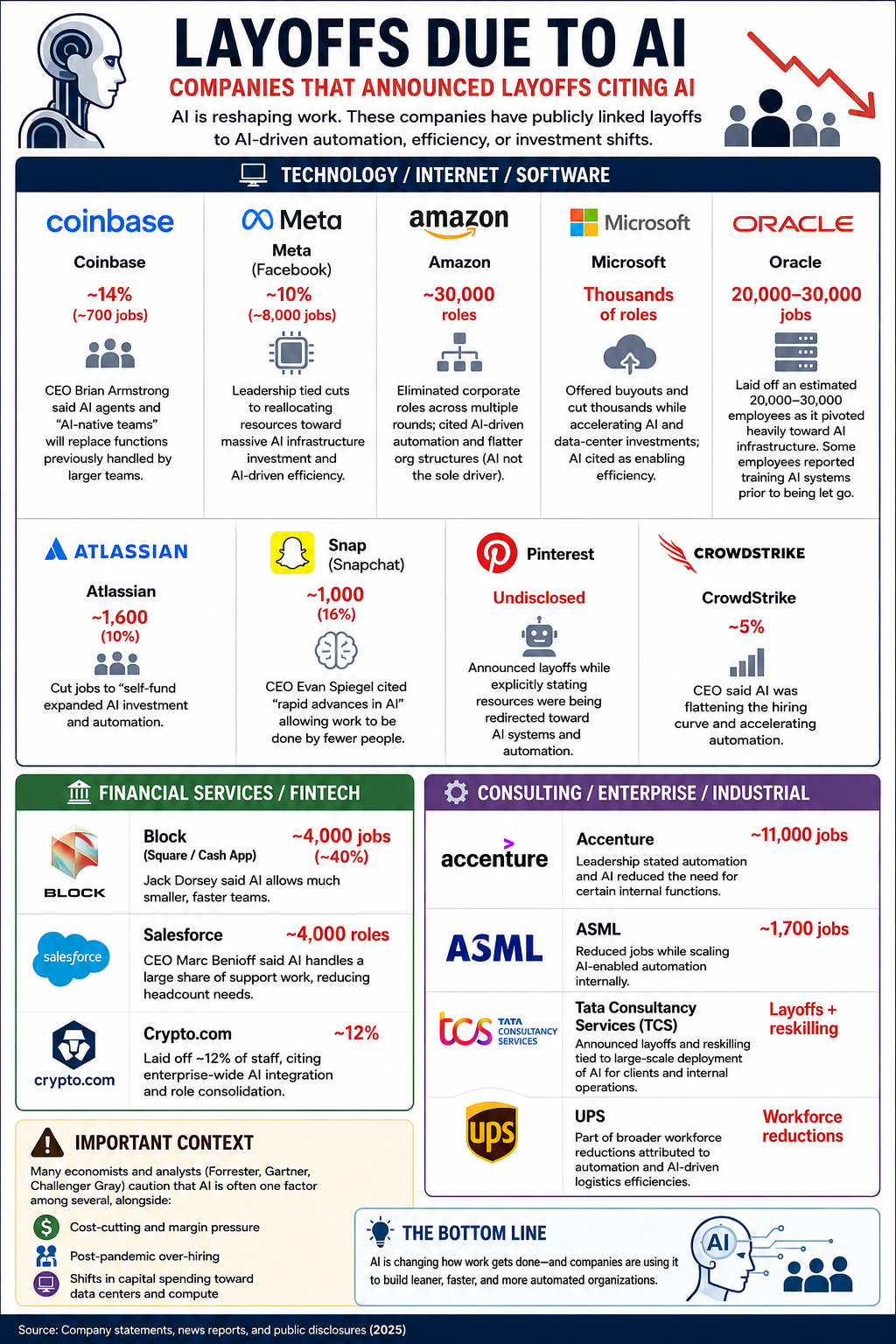
14:09This is all so new, we don't know. But clearly, if you've used AI for any kind of task, you know that it's saving time. For example, the idea of what we do here, clipping audio, video for other kind of repurposing happens behind the scenes in an instant where we used to have a team to do that. where you want to create a, on DHM Plug last week, I created, actually just on this subject, job losses from companies that reference AI as the reason why they are actually cutting and the infographic that was created by, I think that was ChatGPT, that one. The information we got from, where did we get the information from?
15:02I think it was Grok or maybe it was perplexity. I don't know, Claude. So anyway, put it into chat. Beautiful. First time, right out of the box, unbelievable graphic. So whether or not any of these things materialize entirely, I think what's happening is they're highlighting how exposed many roles may actually be now or become. But I think maybe if we really stop for a second and we think about the proof being in the pudding, it's not forecast or the carefully chosen language that is going to settle this debate. It's how companies behave when efficiency is on the line. Because if you think about it, and we just spent a time really just for a moment looking at this, the companies that have been out there and been very vocal about AI and endorsing it as a tool to assist you, me, the workforce, already reducing headcount as the AI efficiencies that are being brought out are showing promise.
16:17The job cuts shown are pretty remarkable. We put, again, a graphic up. You know, I'll try to put it up in this. I'm going to do that. I'm going to put it up in this episode in the show notes. Go over to thedisciplineinvestor.com, episode number 972, and there'll be a link for this graphic. And this is just a part of the names that actually are out there. But they're not coming from failing firms. The job cuts are not like, oh, we got a cut. We're not doing well. We got to – no. They come from strong companies with extraordinarily capable management and teams inside of the companies that are doing and providing what exactly markets reward.
17:08One, they're doing what they can to improve margins. We love that. Love that. Improving margins. Part of the core of what we look at for the TDI managed growth strategy, one of the core principles, what's going on with margins? They look at things like markets love flattening of organizations, getting rid of the fat. So when everybody talks about flattening an organization, that means basically it's cutting fat, cutting various levels of management and increasing output per employee. All these things that are happening, the productivity, the cutting the fat, the margin expansion, all of that is great.
17:48And what we know about great companies is efficiency wins every time. And that itself is great for investors, for markets. But it also challenges the idea that AI adoption is not going to impact employment. There's going to be new roles that are created. There's no question about that. Productivity, yeah, absolutely is going to increase for some workers. But it's also going to reduce the number of people needed to perform all sorts of white-collar work, particularly at the entry level. I agree with that comment. And I don't think this is any longer theoretical. The loss is already starting to show up.
18:28So there's so many questions that are left to be unanswered, or actually unanswered questions that are left to be answered, I should say, about how this impact of AI unemployment around the world is going to happen. But the point I think that I can state is this. Yes. AI is going to create new roles. Yes. It's going to increase productivity for many workers. We got that. Yes. Individuals that will adapt, that can be augmented, will benefit. But we could also say that it's equally true at the same time that fewer people will be required to do the same amount of work. Entry-level work rolls, gone.
19:12Going to be disproportionately affected. White-collar automation, going to arrive faster than most people expect. So this is all good and bad news. Obviously, questions are coming in of, you know, well, people are out of work. How's the economy going to work? We have a universal base income, you know, basic income, UBI. How do companies benefit if nobody's buying stuff because the consumer is not making? There's all sorts of things. We can go down this rabbit hole. But I will tell you right now, if we look at what's going on, there is clearly a major push. And if, in fact, the idea is to augment every single worker in the world, that's why this push is happening so hard.
20:00The money spent is extraordinary. There'll be losers in this game. But in the end, I think that while technology is pretty hot and probably overdone right now by any metric you could imagine, the spend is not quite over just yet. Not yet. So there's my AI discussion. Go over to thedisciplineinvestor.com. We invest in a lot of these companies as well, by the way. Obviously, they hold a big part because they're the names that you want to have in your portfolio. in our TDI managed strategy, growth strategy as well. All right, let's move over to the next part of our discussion. Let's talk with our guests, shall we?
20:42Before we do so, I want to talk about interactive brokers again. Here's something you want to ponder. Will the Fed raise rates by 25 basis points in June 2026? With interactive brokers, you could trade that prediction market and others alongside your stocks, options, and bonds. all on one integrated platform. IBKR prediction markets prices reflect market probabilities. And if you're right, you'll receive$1 per contract. You'll also earn interest while your position is open. Predicting contracts, of course, are not suitable for all investors. The last day of trading is June 17th. Learn more at IBKR.com slash predictions.
21:27IBKR.com slash predictions. So let's get to our guest discussion today. You know, this gentleman has written a great book. It's called How to Get Rich in American History. And it's full of really interesting things. You know what? Let me just bring him right on. Let's hang on a second. And this is Dr. Joseph Moore or Joseph Moore, PhD, whichever you, what do you like to be? Do you like to be called Dr. Moore or how does that work? I prefer to be called Joseph, Joe, or Hey You. Hey You. Yeah. No, like there's this, it's almost a Monty Python sketch when you walk around an academic hallway and it's like doctor, doctor, doctor, doctor.
22:04Yeah, it's just like, okay, let's just, let's drop this. Can we please? And just, you know, we're all, we're all Joseph and Joe here. So. So my grandfather, by the way, as I knew him was Papa Freddy. And he was always, when we went out to dinners and things like that, he would call in and we'd get a reservation. We'd go up to the front of the restaurant or maybe his club, whatever it was that we went to. And it was always Dr. Saffir. And when I was young, I'm like, my grandfather's a doctor, you know, but how come he knows nothing about my health stuff? I never understood that. And then I found out he was a chemical engineer from Princeton and PhD.
22:39But anyway, let's talk about you. Let's talk about a few things. So I combed through this upcoming book. And when's the release? It's any day now, right? It released on Tuesday. Tuesday, it did release. Okay, good. So I got the advanced copy. So I want to go through from the beginning to the end because I got lots of things to talk about. And I guess I'm going to start out with the first question is, so what led you to write this book? Because after years you were a historian, right, a professional in that area. What professional experience or maybe even a personal realization moved you towards the idea of connecting American history, I would say directly, I think, to how people think about money?
23:32Yeah, well, excited to be here and thank you for the question. I have no training in money at all. Like, I don't have an MBA. I don't have an econ degree. I was getting a PhD in American history, studying very different things, very non-economic history. And in 2005, when we were graduate students, my wife and I were told by everyone around us that the lesson of history was very clear. Renting is throwing your money away. So instead of thinking like a historian and asking if that was true, I nodded my head like everyone else. So we got a no income, no verification loan, the ninja loans that you see in the movies and TV.
24:12And, you know, we bought a house. We were graduate students, right? We have no money. And so it's 2008. A friend at church decides to lead a financial class, like a personal finance class for families. He asked us to go. I said, no. He said, why? I said, I'm smart. I don't need that stuff. He said, listen, will you come just because I'm scared? It's going to be like one or two people in a weird empty room. and it's going to be awkward if you'll just come to help me. I said, all right, fine. We go, they make us, we go home, they make us do a budget. My wife falls asleep. I literally did not sleep all night.
24:45I paced the floor. Yeah. Who gave us a mortgage? I was just, I was dumbfounded. Right, right, right. And what idiot signed the paperwork? Oh, I signed the paperwork. Yeah. So we put our house on the market. It sold the next Saturday. Wow. Our neighbor put her house on the market the following Saturday. It never sold. We were the last two people off the financial Titanic. Wow. Wow. Lucky, lucky, lucky. And I was yes, lucky. And I was so humbled by this. I was in I was humiliated. Like I thought I was so smart. And I just got saved by some common sense principles that are taught, you know, in church basements.
25:25And so I had to figure out what I had taken for granted, why I just nodded along when people told me what to do with my money. And so I began researching this, just as the historian in me came out and said, well, I want to understand what were Americans told to do with their money? Did it work? And how has it changed? And I started doing this, honestly, as a hobby project on the side. And it just, the more I studied it, the more interesting it became. And the more I realized nobody had helped people understand how history can help you with your money. And so about halfway through the project, I decided that if I was going to make this recipe book, I should eat my own cooking.
26:03And so I started to try out whatever had worked in the past, does it work in the present? And it became kind of both a history but also like does this stuff still work experiment in which I was the guinea pig and blessed my wife. I say that I would do anything within reason and within reason was set by my wife saying under no circumstances. The real boss. You know, yeah. So I was trying to take the past and say, does it actually teach us anything? And as it turns out, it teaches us a lot. You know, it's funny because I started in this career many moons ago. And when we first started out dealing with the idea of trying to get people, because this is always the basic tenet of financial planning, investment advice, anything working with people with their finance was to get them to someplace in the future where they're financially independent or something of that nature, right?
27:03That concept was always the end goal. And when we first started, you know, I'm dealing with people who are in their 30s and 40s. I'm young at the time. I'm in my 20s. And, you know, somebody in their 40s was old. They have only a short period of time towards retirement. The plan was to, and my listeners have heard me talk about this before, the plan was to get them to 65. 65 is when they continue to save. They have maybe a defined benefit plan, maybe a defined contribution plan. It wasn't really a big thing then. At that point, they can get some Social Security. They'll get a Medicare. They'll get their pension.
27:35They'll live for the next 10 years until 75 when they drop dead, right, because people didn't live. That was it. We only plan for a window of 10 years of using your money at that time. Much different these days. Totally different animal, isn't it? Right. So life expectancy, you know, I often kind of poke fun at my friends who are obsessed with compound interest as the solution to all financial problems. And compound interest is just real and powerful and it works and all those things. However, I have to point out to them, 99 % of Warren Buffett's wealth came after his 60th birthday. And I think 90, no, 99 % came after his 60th or 65th birthday, something like that.
28:16Yeah, I think 60. That's the year most Americans never saw. I'm like, yeah, yeah, I still got hope. Just to live to 60 or 65 was unusual. There are periods of the American West where the average life expectancy was under 40 years old. So like we live, I say in the book, you don't live one American life, you live two. And so we need to start thinking about the fact that we have a pretty incredible runway to build wealth because you have so much more room on the back end, both for it to grow and for you to enjoy it. So the idea of the extended lifetime is very real and very recent. It's one of the reasons that financial advice has to change, right?
Read the full transcript
28:56One of the lessons of history is that what always worked was always changing. So we're in an era when life expectancy is changing all the assumptions, both of what you need, but also what you can do with money. So early in the book, I think it was chapter one, you revived the old phrase of go ahead as something that I never heard of this before, right? Early Americans really understood. And how is this idea different from how we talk about getting rich today? So it was this kind of go ahead, get ahead. Was that the whole way they talked about things back then? Yeah. So, you know, we say, are you nobody?
29:42What we like to say now is nobody can get ahead. Notice how passive that is. Get ahead. Yeah. They said, go ahead. There was, it was an active verb. Go ahead. One of my, my brother played professional baseball and he said, the solution when anyone would start complaining about their playing time is play better. Right. Just, you know, nobody wants to hear you complain, play better. You'll get more play in time. And it was the same way that in the early part of American history, you want to, you want to do something, go ahead. You want to, you want to go West, go ahead. You want to start a business, go ahead.
30:10You want to improve your lot in life. Go ahead. This was literally the motto that would be in newspapers and sermons. Was it a permission-based situation or was it a motivational? Both. It was that you don't need permission. Go. You have been given permission by virtue of the fact that you are here in America to go. So inherent permission. Yes. Part of the baseline expectation of the American project is if you want to go ahead, you can. and we've lost some of that kind of the sense that it's totally fine to just get up and decide I'm going to advance my position and I tell people oftentimes like stop this obsession with like beating the market which is actually fairly new is kind of silly because what Americans would have told you is the benchmark you're trying to beat is what's behind you right go ahead from where you started in life to where you want to get to and that definition for you may be different in the definition for me, but the idea was that here is a place you can do it.
31:08And by the way, statistically speaking, that was true and is true. So Americans got ahead. They moved from their economic circumstances improved at a faster rate than any other place on the planet for the vast majority of American history. It wasn't easy. In fact, that's one of the points I make in the book. It was actually really hard to get ahead, but you could do it easier here than anywhere else in the world, which is why people flocked here. And that is still true today. It is actually statistically easier to get ahead today than it is in most places in the world. And it is easier. It is a heck of a lot easier to do it than it used to be in the 1800s and early 20th century.
31:46That's interesting because a lot of people take a very difficult, different approach to that, right? So early days of social media kind of get up there and you can amass a whole host of people that stuck with you for years. You go on later onto social media and You can get 15, 20 people and you're like, I've hit a wall. Or said differently that it was easier for earlier generations. The next generation will never have what we had, right? We're really worried about what the children had because I can give you the litany of issues, right? The government, the world, the fact that things are too pricey, the fact that you have to attain so much schooling, all these costs and loans and the whole list.
32:27the whole list, whatever, whatever that falls into that category. But you, you, you're contending that somehow, uh, there is no difference than it was before than it is today to, to, to get ahead, to go ahead. Well, I'd actually argue there is a difference in that it's gotten easier, not harder. Okay. That's what I'm saying. Which a lot of people have the opposite opinions when I mean. Exactly. No, it's, and, and, and, and of course they do, right. Cause that's what everyone tells them. So I can find people telling you the American dream is dead about 300 years before I can find the phrase American dream.
32:55Oh, so in 1676, this is a hundred years before Hamilton is going to wrap on Broadway. In 1676, the colonists of Virginia burned their capital to the ground specifically because they said nobody can get ahead anymore in Virginia. Oh, in the 1800s, there were speeches saying the rungs on the ladder to success were sought off by the people who got ahead of you. In 1980, there was a bestseller, there were two bestselling books in the 1980s talking about how the baby boomers would never afford to retire. So the anxiety that someone else got here and got rich and now I'm stuck is very old. But what has happened is we have put that old tension and anxiety on steroids with what I call big woe.
33:40There is a despair industrial complex because there are no clicks for journalists. There are no votes for politicians. There is no tenure for academics like me. telling you the world is getting better. But we can have every one of those things if we tell you it's getting worse, somebody broke it, we know who did it, trust us to solve it. So there is an incentive to tell you it's broken. So you're coming from the negative sentiment and the negative headline, and nobody wants to, it's very, people are immune to things are going to be great ahead. No, they're much more focused in, hey, there's a bomb about to go off in your backyard, you've got to do something about it right now, when that may not even be a fact.
34:22Right. And that human tendency is very old. We've always had, believe it or not, your great-great-grandmother was very anxious about these things too, right? But the reality is, over and over, every study that I could find shows if you believe you can act on the world and you take some certain common sense principles forward, you do generally end up in a better place. It's interesting to me, Frederick Douglass, right? He's in our history books as one of the most famous abolitionists of all time. He runs away from slavery, all these things. and every college class that teaches him teaches his speech, What to the Slave is the Fourth of July.
34:56It's an important speech. It's brilliant. We should teach it. But in his own lifetime, that was not even close to his most famous speech. The speech he would, everywhere he went, white audiences and black audiences would beg him to give this speech and they would call out from the crowd like it's a rock concert. Give the speech, right? And the speech they wanted him to give was called Self-Made Men. And the crescendo line of the speech is when he says, our, meaning all of us, our motto as Americans is go ahead. I can be prosperous. Now, think about who his audience is. This is a runaway slave talking to people who were born as slaves, who are now free.
35:37And he's saying the promise of America is you can actually go ahead. So in this world in which we are told, and of course young people believe they can't get ahead because every microphone is held by someone saying that. And what I try to tell young people is the real lesson of history is not to worry and be angst-ridden about what type of economy you would build. It's what are you going to go build in this economy? Because you can. It's funny because I can tell you that the natural proclivity of people, generally speaking, that will get people to do something is the idea. And this was sales training 101 back 40 years ago that I remember reading about this is to disturb them about something.
36:18It's not to create some kind of, you know, yes, you disturb them about something, break it, fix it, and then you're the savior, solve it, and then tell them, keep them on the hook, if you will, with the promise of a better tomorrow. Right? You're usurping all that. You're saying that the reality is a much different factor, which we know. I don't think, I'm not going to argue that point, right? But it's unfortunate that we're so well-trained to really identify with the negativity rather than the positivity, which is what you're saying. Yeah, so it's over and over again. The stats that I would cite in the book actually came from histories and from studies that were trying to claim everything was broken.
36:59And I would look at these stats and flip them on their heads and go, wait a minute. There were a series of studies that tried to claim that nobody really got ahead in America, that it's all a myth. And by the way, I have to admit that I started this as kind of a lefty-leaning humanities academic professor who was the research itself that kind of drug me along into believing in the American dream and actually all the evidence points in one direction. But we have these studies where people would try to say, look how few people got ahead. And only 30, 40, or 50 percent of people were moving ahead from poverty into the middle class and the upper middle class.
37:34And I thought about that for a second. I said, well, let's go look at the rest of the world at that time. How many people were going ahead? Oh, it was 5%, 10%, and 15%. So like Americans statistically were outpacing, and I'm talking about median Americans. This book, by the way, is about what everyday people did with their money. I don't care what the Rockefellers did. They don't need our help. But what did everyday Americans get told to do with their money and did it work? And what we find over and over again is that what they were doing was working. And when they compared themselves to people back home in Italy, back home in China, they were becoming wealthy beyond their wildest imaginations just to become middle class.
38:12And so these are the things that we've mistaken. Now I say, oh, well, that's all in the past. And what about today? Okay, here's today of children born into the bottom 20%. Six in 10 will get out. Four in 10 will become middle class, upper middle class, or rich. One in 10 will go all the way to the top. Now, if I go back 300 years and I tell your ancestors, one in 10 children born at the bottom will make it all the way to the top. They would not believe me, or they would drop to their knees and praise their Lord. Like there's no in between. It's either unbelievable or it's a miracle. And so we tend to look at these stats.
38:46It's not perfect mobility, right? Obviously it's not. We could do better. We could have more mobility, but we have a lot more mobility than we think we do. And if you compare us to somewhere like Denmark, where about seven in 10 rise out of the bottom 20%. That's great. But I remind people, Denmark is the size of Phoenix, Arizona. So you're not comparing apples and apples there, Phoenix Metro, right? So we, and by the way, there are certain American cities where mobility is the same as in European countries. So we've vastly drawn out of proportion the lack of mobility we think we don't have. We actually have a lot.
39:25So we've covered just two of the chapters, and there's a lot of positive points that you make here. First, for the older people, that there's still hope, a la Warren Buffett making quadrillions of dollars post-60. And now you're saying for those people that don't have, that never think they may have, that don't even have the basis of having, have the opportunity to actually have in the future. So there is, you're bringing a very hopeful message is my point. It is. And I have to admit, like this book surprised me. Like I started the book saying, all of this must be a big scam perpetrated on everyday people.
40:06That's a truly, that was where I started. I used to assign Karl Marx on day one of class. Like that's who I am going into this. It's like, oh, this is all gonna, and the more, I mean, I spent 10 years researching this book. And the more I did it, the more I researched the past, and the more I started to experiment with investments in capitalism in the present, the more I realized, the more people I met in real life were successful, I realized, oh, actually, I'm the one who's wrong. That's an interesting epiphany because it's very, you know, a lot of people will go into a project of any sort with a very, you know, and then lean, lean, lean, lean, lean until they get their answer, by the way, right?
40:43Exactly. Yes. I will torture the data until it tells me what I want it to say. Here's the thing about pessimism, and this is not my point, by the way. I think Morgan Housel made this point as well as anybody could, that pessimism is seductive because it sounds so smart. Like telling you not to make a dumb choice sounds very smart. But if you actually look at the past and the lesson of economic history, what you see is over and over optimism is where all the outsized rewards are. I would tend to agree, yeah. I would tend to agree. And so let me give you an example of this. The Consumer Financial Protection Bureau, they did two studies.
41:16And in those studies, they found, by the way, to their own surprise, this is not what they went looking for, that the number one predictor of financial wellness was it outperformed income and it outperformed inheritance was a positive attitude combined with the habit of saving. So what that means, or they call it an internal locus of control. Believing that you could act on the world and succeed combined with some basic common sense habits was the largest predictor of financial wellness and success. Then somebody did a follow-up study of 150 ,000 personal financial accounts and found that that was strongest for the poor.
41:57So just believing you can do it combined with some basic common sense steps, vastly outperforms things you think it wouldn't. Optimism is where the rewards are. And that is the basic premise of buy and hold throughout all the different cycles of the market that you believe that tomorrow would be a better day. What's happening right now, by the way, through this whole wartime environment where we see oil spiking, and yet we see that markets don't care. Why? They're not looking at today. Now, maybe that's wrong. I don't know. We're not going to debate that concept because who knows what's going to happen, right?
42:32But the fact that people are still very busily putting money to work, not pulling money out of the markets per se, some people are, of course, but generally speaking, that the fact is they look past a lot of the things that happen with some of these stock names and where this is going. It's the ultimate sign of optimism and looking past the future. In chapter two, you talk about a distinction of time. You talk about the two different notions of time, one being fast time, one being slow time, as these very, I would say, very powerful ideas. Now, it brought me back to the idea of where did I hear about something like this, you know, the concept of this.
43:20And there's a book out by Daniel Kahneman called Thinking Fast and Slow. I don't know if that had any impact on your writing with this. But tell me about the whole fast time and slow time. Yeah, and Conor's book is a jewel. I love it. That's not where the concept came from. I will tell you where the concept came from, because the concept is really Benoit Mandelbrose from the misbehavior of markets and various papers that he wrote. But there's a lot of math involved in that. And it's kind of hard for the average everyday investor to follow some of those arguments. And what I did was I parsed that out.
43:53And I said, really what this boils down to for everyday people's investing lives is there's kind of two speeds of time. And it's hard for people to wrap their mind around this. But like, you know, if Einstein can prove that time is relative, right? What Benoit Mandelbrough proved that was that financial time is relative. And I put all that in the footnotes for the people who really want to nerd out about it and try to make it a lot more readable for people. And I have found, by the way, over and over that this is the part of the most certified financial advisors and CFPs and insurance sales. Like people who are in the industry, this is the chapter they're just like, they immediately want to call me and talk about this chapter.
44:28Because it kind of helps take a very complicated topic, I hope, and make it usable both for themselves and for their clients. So what this concept boils down to is this. Most of the history that we talk about when we think of financial history is what I call fast time history. These are the moments when everything changes everywhere all at once. All the assumptions are tested and broken, and a few smart people saw it coming. And you just don't want to be one of the dumb people who lost everything, right, or missed the boat. So it's always 1929. It's always 2008. And what I tell people is those are what I call fast-time histories, and they're actually very rare.
45:08And most of those histories, by the way, are not written to educate you on what to do with your money. They are murder mysteries. You are supposed to yell at the screen, he's behind you. The subprime mortgage lender is behind you. Run away from the mortgage. It is meant to entertain you. But the lesson of financial history for what you actually do to succeed are slow time histories. By the way, in slow time, at any given moment, someone is screaming that it's going to blow up and everything's going to go to the moon. And somebody is saying that it's going to go crash tomorrow. There are people promising that it's going to go up or down, but volatility stays within a certain range.
45:47And in slow time, the decisions you make, what career do you pick? How good do you get at it? Who do you marry? What do you get addicted to? What strategies do you employ with your money and your wealth? That is what is going to get tested when fast time comes. It'll be stress tested. But fast time is actually very rare. And we think because of the way history is written and produced and turned into movies that this is the norm, it's not. I think of it often a little bit as getting really close to the screen, and that screen can be any kind of item that's happening right now, right? You know, taking that magnifying glass versus stepping way back.
46:27Yes. You know, this whole kind of constantly having this back and forth motion on a regular basis to, because there are some times that you want to, you know, look at that. You got a splinter. You're not going to be trying to take a splinter out, with your arm halfway across the room. You got to get up close with the magnifying glass and take that splinter out, right? But at the same time, there are other things that require a little bit more patience, the souffle mode. You know, don't touch it. Don't touch the oven right now. Let it do its thing. But fascinating discussion. Fast forward to a few more chapters.
46:59But before we go anywhere, can you please, because I don't think, I think at the opening I mentioned it, but please mention the name of the book again, please. So the book is called How to Get Rich in American history, 300 years of financial advice that worked and didn't. And it covers both of those topics. Like what did people do that worked? What did people do that failed? And how much of that can translate into today? A lot of academics are, this goes both ways. A lot of academics, and I'm calling you an academic, sorry, but academics are - It's okay. I can take it. Are harsh, are tough on financial professionals and the gurus out there, right?
47:43Whereas, by the way, a lot of, me included a lot of times, are kind of tough on the academics also. Like, dude, it's not all in the books. Just step out for a second, join the party for a minute, then go back and let's start mixing this all up. You seem to be rather generous. What do you think the gurus get right more often that traditional finance theory often gets wrong? Yes. So finance professors have equations that work very well in a spreadsheet. And gurus have some basic concepts that tend to work in the real world. and you know gurus understand super bowl ads work jobs go overseas birthday sex leads to baby number three and i have yet to see a personal finance equation for a midlife crisis or a child with special needs like just gurus understand that life comes at you fast and it's it's complex and you don't know what to do and you need some basic ground rules for how you're going to behave Dave, you know, you don't need the perfect equation for wealth.
48:53You need the rough and tumble version that will get you through because the American economy is the greatest economic engine in the world. And if you can just ride it without falling off, you're probably going to do pretty well. And so I think gurus get a bad rep. Now, there are some bad ones. Let's be very clear. There's some people. What I tell everybody is read their books, watch their podcast. You know, you don't need to go to five seminars. Most of what a good guru offers you is already free. Unless you want the free dinner. Unless you want the, exactly. The free dinner is helpful. But so, but I have this instinct and I think part of it becomes academics come from elite society anyway.
49:35One of my favorite tricks is to be at an academic conference. And as we're sitting around talking, I'll say, where'd you go to high school? because nobody's ready for that question. Everybody thinks you're going to say, where'd you go to college, right? And I always go back and look it up and it's invariably like the best high school in the state of California or whatever, right? So elites start at the top of society and stay there. But if you actually look at what everyday people have to do with their lives, they need a different set of principles that work in real time. And so I'll give you an example of my favorite study.
50:08This is of Dave Ramsey. And I know people have some strong feelings about Dave Ramsey. And you're welcome to all of those feelings. But an economist in Europe who had no dog in the fight, this is just an economist looking for a dissertation project, overlaid the credit card spending, credit card data by zip code in America. And he overlaid that with a map of where the Dave Ramsey show came into a metropolitan area for the first time. In other words, a radio station picked up Dave Ramsey. And he found that spending on credit cards went down 1.3 % in the first year. Wow. And it stayed down. Now, of course, it's like, was this correlation or is it causation?
50:48So brilliantly, he goes back and he says, okay, AM radio waves cannot pierce mountains. So he went to the zip codes that had the signal blocked, and sure enough, the spending stayed elevated. Really? Which means that over the course of 20-something years, Dave Ramsey has saved the United States economy, the GDP of a mid-sized nation state by yelling at people to sell their car. Now, whatever you think of the advice, for the average person who just found out their uninsured spouse got Alzheimer's, they need some quick and easy to follow steps. And whether you're getting those from Clark Howard, who I'm a huge fan of, or Dave Ramsey, or even some of the ones that I might not be as big a fan of, that's what the average everyday person needs is rules of thumb that they can apply when things are complicated.
51:35Yeah, I mean, it's funny because that's one of the things that we try to do on a regular basis, this whole idea of a disciplined investor and creating a discipline, something that you can do over and over again and learning from some of the greats out there. And while each individual show may stand on its own and provide a detail about some topic that may or may not be connected to last week's topic, right? The fact of the matter is that when you start to put all this together and the education you get out of it and the understanding you have about the jargon, what's happening in markets and me constantly going over and over about the PCE and all this and what it means and how to either ignore it or use it or what's happening with and why you should be more or less looking to in a specialty manner, dollar cost average in and this format or that format.
52:23It all makes sense to have this financial education. The whole idea of financial literacy, which is an amazing thing that it happens once a month in April is financial literacy month, which is actually mind blowing when you think that's like saying I'm only going to be healthy once a month and eat right once a month. I mean, I get how they're trying to kickstart it and kickstart you into a groove that will be forever. But it is kind of interesting the way we do things where it almost infers be reckless 11 months out of the year. Learn about what you can do in one month if you have any interest in it.
53:04And then I don't know what. But anyway, fast forward. Chapter, I think it was nine. you talk about diversification, how diversification is a great idea, but rarely creates wealth. And why did we kind of, it protects wealth, but it doesn't create wealth. Why do we invert that investing in the modern day? Yeah. And I think, and this is one of the more controversial takes in the book. And I literally, this is my, I'm back in Atlanta, Georgia, where I live. And I was on Wall Street all week. And boy, the level of consternation I got from people on Wall Street talking about diversification. Here's the reality.
53:49If you look at the history of America, most of the people who start at the bottom and move ahead, the people who go ahead in their words or leapt ahead, were people who were willing to concentrate on one thing or one strategy that worked very well. And then after having made their money diversified. So the real pattern of history was limit yourself to an area you could become an expert in, then concentrate on succeeding in that area, and then diversify the wealth you just created so you don't lose it. And I think diversification is very, very important. I think investors today are obsessed with the upside and have relatively little awareness of the downside.
54:28And so protecting the downside is very, very important. But in terms of actually accruing returns that outpace the normal or allow you to leap ahead, concentration is, you know, PT Barnum, who knew a thing or two about how to separate fools from their funds. Barnum said, when a dentist hears that he can make money diversifying into anything else than drilling teeth, he'll lose all his money in South American high yield bonds. By the way, it was happening in the 1800s. And there were actually like high, high income earners losing all their money, trying to like get all their money into all these other plays.
55:03And he was just like, just get good, get it drilling teeth. And then when you've made that money, then you diversify it into safe assets. So you get rich, then you diversify. And I think there's perfectly good arguments for Americans taking most of their money that's going to come from their income, right? From being great at their, at their job, and then take that money you've made and diversify it out to protect it. There is a phraseology that you brought up a couple of different times in some of the later chapters. And it's this financial independence, retire early or known as FIRE, which has multiple meaning.
55:40It's like fire my job. I'm doing the firing. I'm quitting. This whole idea of breaking away from work, from leaving, from escaping work. Give you a quick background. I remember when I first started my career, I was like 21. And I said, you know, two things. One, when I get that BMW 325, you know, I'm going to be there. Once I, by the way, a couple of years later, I could afford the BMW 325. I said, you know, I don't want it. But that was another story. Second part was, I'm going to retire at 35. I really didn't have a plan, by the way. It was just this whole brute force try to lift the boulder.
56:20and without any thought process behind it, right? Not how much is it going to hurt my back? Am I going to get a hernia? You know, anything else that goes along? What training do I need to do this? How long is it going to take? None of that. Is it even possible humanly? I'm retiring at 35. I don't know. I guess it was early fire. But it seems to me that that's a bit of a cop-out and a desire, not that you need to work for 40 years, 50 years. I'm not saying that either. but historically it was different. What did financial independence mean actually historically and what people are thinking today?
56:58Yeah, no, I, I, I think a lot of young men have that sudden urge to like, I'm going to pull this thing off. I don't know how. Right. Yeah. So I call, and it's interesting. I love your analogy because I call fire the CrossFit of personal finance, which to me, like it takes an extreme level of commitment. A lot of people get injured trying, but if you do it, you're going to get in great shape and you don't get hurt. Right. And so it's, it's kind of this, the real lesson of history about financial independence, retire early is that it actually was happening for a long time before anyone was talking about it.
57:30So my, one of my favorite examples, a guy named Sylvester Judd, he is born the year of the constitutional convention or the year the constitution was ratified, I think. And he dies the year before the civil war. So he literally lived all of antebellum America, but he only worked for half of it. And the other half, he spent kind of like doing what he wanted to do, which was writing histories of New England, as it turns out. Well, how'd he do it? He built a printing business. He sold it in his 40s. He looked around and thought, I have enough, right? And he didn't feel like he needed to pursue a whole lot more wealth.
58:02He wasn't wildly wealthy, but he had enough. And so he spent, and it turns out, you go through history, most every town of any size had at least one person doing this. In fact, a lot of the early science done in the 1800s, 1700s was done by people who were like cashed out with enough money and decided to go pursue interesting hobbies. Okay, so it's actually very doable and very old. Now, there's a flip side of this, which is people telling you and selling you about it. And that, I think, is where some of the danger lies. Thoreau goes off to the cabin and, you know, goes off to the woods and he makes a real cabin in the woods like a real man.
58:34And Emerson, his best friend, travels around Europe and writes essays about the joys of not having to work too hard and pursue too much. And there's a guy who writes a best-selling book in the 1850s about how he cashes out of the game. He gets a 10 acre farm in New Jersey and just lives this beautiful life. This is done again in the 1930s, 40s, 50s. There's a couple named Helen and Scott Nearing. They wrote bestselling books. I mean, the newspapers just drooled over these people because they said we work four hours a day on our beautiful Vermont maple farm. People like flocked to Vermont to learn from them how to live.
59:09It's like the original four hour work week was the original four hour work day. Okay, so let's go back through all of those. Thoreau's mom brought him food so he wouldn't starve and took his laundry away. Emerson's wife died. She left a trust fund. He sued her family for it. The day he won the lawsuit, he quit his job and went to Europe to talk about not having to work too hard. The guy from New Jersey with 10 acres was a real estate agent selling farmland in New Jersey. And the nearings, as it turned out, people started to starve because they came to try to learn from them how to do this. And they were literally starving.
59:43and turns out the Neerings had not had one million dollar inheritance. They had had two. So be careful for what people put in the fire to sell you on it because it can be somewhat dangerous because maybe what they're doing is not what you think they're doing. But you actually can be financially independent in America because you are riding the wave of how much wealth there is. Now, here's the other problem. You get there, which by the way happened to me, and you find out I want to do something with my life. If you're the kind of person who can work hard enough to get to the point that you can retire early, you're probably going to be bored with it at 35 years old.
1:00:17You know, one of the things that I've always, early on I learned about this whole concept of the horizon, and I've tried to teach this and really promote this idea to really get stuck in the front part here on a regular basis, where if you set out on a task to reach the horizon, you're never going to get there. The horizon is a never ending place somewhere in the future, in the further out. And a lot of people do that. They're never happy. There's the index investing. You know, I'm going to beat the index. You beat it by 5%. Why don't you beat it by 8%. Why don't you beat it by 10%. Why don't you beat it by a hundred percent?
1:01:02And it's, it's, you're never happy. You're never getting somewhere. You're never getting anywhere. You are moving, by the way, you're moving, but how much are you moving? You know, What is that point? What is that goal? What is the finality of this game that you're trying to play? And there's something to be said about the happiness factor once you get that fire, once you get, if not the fire, the FI, financial independence only. Forget to retire early. But you get that satisfaction of loving life, right? What I try to do, and this is what I think has been the lessons which you've looked at also and brought them full circle into today from yesterday, is the idea that financial independence is, first of all, it's in the eyes of the beholder, right?
1:01:47But it's also something that is multifaceted. Is that something that you're seeing from back then to now? Yeah, so I think one of the things that you find over and over again is, you know, some of these lessons are eternal, right? And one of them is that money is a tool. And you will learn maybe, somebody said about stock market investing, that it's a wonderful and expensive mirror to find out what you really look like. And that is true. Like you find out a lot about yourself in the process of investing, in the process of building wealth. And you find out a lot about yourself once you have some of it.
1:02:28You know, I quite frankly, you know, one of the things that happened as I was researching the book is I kept trying these different investments out, some of which were crazy and some of which lost a bunch of money, but some of which popped and made real money. And I started to look around and go, oh, for the first time in my life, because I didn't come from a family with any money. My mother was brought home to a house with no flush toilet. Right. Like when your family remembers getting the first flush toilet. Right. You see success in a somewhat different lens. And so for the first time in my life, I had money, but I was very fortunate that happened to be in my 40s.
1:03:01I think because had it happened in my 20s, I'm not sure what I would have done with that. Sure. But there is something about realizing that your life is about something much bigger than the money. The money is just going to be a tool to help you accomplish the goals that you have for life and not making money the goal of your life and letting it be a tool that you use for what's really important. I say in the book, I have an almost instant revulsion to anyone who can tell me their net worth at the drop of a hat. Because that's not something I want to carry around in my pocket that I can pull out.
1:03:30I want to know, do you coach girls basketball? And money succeeding financially empowers you to go do those things. Where's your favorite restaurant? Where are you traveling? What interesting cultures have you seen? What interesting books have you read? So after studying 300 years of Americans trying to go ahead and trying yourself, by the way, as you've talked about many times here, what ultimately separates those who move forward from those who just don't? That's a great question. I have in the book, I have 25 kind of lessons from history that stood the test of time and seven things that failed pretty consistently through time.
1:04:19And so I hope that'll be a useful history for people. But I can kind of summarize five principles that they all revolve around. The first is you got to solve somebody else's problems. So much of financial advice is focused on you and your problems. Should I drink lattes? Should I buy crypto? That's you and your problems. That'll help keep you out of the ditch. It doesn't get you rich. You get rich solving somebody else's problems. And I think we've kind of lost sight of that sometimes, but that's where the real money is. The second is you're going to have to take some risks. Now, be very careful here, because especially if young people hear that, they think, I'm going to take out a loan and buy crypto.
1:04:53No, that's not what I'm talking about. That's gambling, because you have no control over the outcome. But you do need to take strategic risks where you have some level of idea that you've educated yourself in and that you have some level of control over the outcomes, because risks are wildly out or are rewarded disproportionately in the American economy. Risk taking is where a lot of the real money gets made. The third is you got to move more, especially for young people. Over and over again, we find you live in the largest free market zone in the world. There is an opportunity for you somewhere, but you may have to go where it is.
1:05:27And we're not mobile like we used to be. In the 1800s, one in three Americans changed addresses every single year. In the 1950s, it was still one in five. Today, it's one in 13. So we are not the mobile go-ahead society we used to be, and that's partially accounting for why people feel stuck. The fourth is marry well, which that survives in every era. Marriage is one of the single largest predictors of financial success, and it confounds everything. Married black men earn more than single white men. Married women earn two times what single women make. Married men at retirement are worth 10x what single and divorced men are worth.
1:06:05So marriage is a superpower because capitalism is a team sport. And then finally, as we went back to you earlier, like optimism. You actually have to believe that you can get ahead to get ahead. And over and over, that optimism has been rewarded. Great. Dr. Moore, aka Joe, thank you for coming on today, joining us. Really fascinating discussion, fascinating book. Hopefully we got, we flushed out a lot, I think from, from there. And hopefully you'll come on again soon. Appreciate it. Oh, I'd love to. I'd love to. This is a great podcast. Great questions. Great audience. Thank you. And anytime you, anytime you want to chat, just let me know.
1:06:40Cause I'd love to come back. Thanks. Appreciate it. How interesting was that? Love it. I mean, to frame some of the concepts that we all know so well, but looking back in history and understanding how all these things actually are not so new. Finding out a phrase like go ahead versus get ahead, great stuff. Great stuff. I love it. These distinctions that he came up with and what he talked about with financial gurus and academics and loved every minute of it. Anyway, thank you for joining me this week and every week. Go over to all the various places that you can to give a rating, give a report, give a review.
1:07:24And of course, you know, if you can't do it on your own, let's find somebody to do it and get you rocking. Let's get you in the markets the right way according to your risk and time horizon. And make sure that you are set for the future. Thanks for joining me again this week and every week. I'm Andrew Horowitz. I'm out.
1:07:49This podcast is intended for informational purposes only and does not constitute personalized investment advice. Investing involves risk, including the possible loss of principal and past performance is not indicative of future results. The views and opinions expressed are those of the host and any guests and may not necessarily reflect those of Horowitz and Company Inc., an investment advisor registered with the U.S. Securities and Exchange Commission. Registration with the SEC does not imply a certain level of training or skill. Advisory services are only offered to a client or prospective clients where Horowitz and Company is properly registered or is excluded from registration requirements.
1:08:27Any mention of third-party companies, products, or services is provided for informational purposes only and does not constitute an endorsement. Hypothetical scenarios or forward-looking statements are for illustrated purposes and should not be viewed as guarantees. Content is intended for U.S. residents only and may not be applicable in other jurisdictions. Listeners should consult a qualified financial advisor before making any investment decisions. Please visit our website for additional information, disclosures, as well as a copy of our form CRS. Advertisements are not related to the host or affiliates and are not considered recommendations by the host of the show or any affiliates of all of us.
1:09:17We'll be right back.
From the publisher
Blowout numbers from Semis – tech is on fire!
The war is kinda over – but nothing has changes.
A deep dive into AI and employment trends – is your job at risk.
And our special guest today – author of How to Get Rich in American History – Joseph S. Moore, PhD.
NEW! DOWNLOAD THIS EPISODE’S AI GENERATED SHOW NOTES (Guest Segment)
Joseph S. Moore, PhD, is an author, historian, and investor whose self-experimentation with history’s wildest financial strategies made him financially independent in his mid-40s.

His writing blends deep, unconventional insights with some of history’s most hilarious stories His first book, Founding Sins , from Oxford University Press, was praised as “extraordinary” and “witty.”
Check this out and find out more at: http://www.interactivebrokers.com/
Looking for style diversification? More information on the TDI Managed Growth Strategy – HERE
Stocks mentioned in this episode: (AMZN), (META), (AAPL), (NVDA), (SNDK), (OIL), (GOOG), (WHR)