Ask ChatGPT

 The Dr Louise Newson Podcast
10 Sep 2026 · 32m · 12 chapters
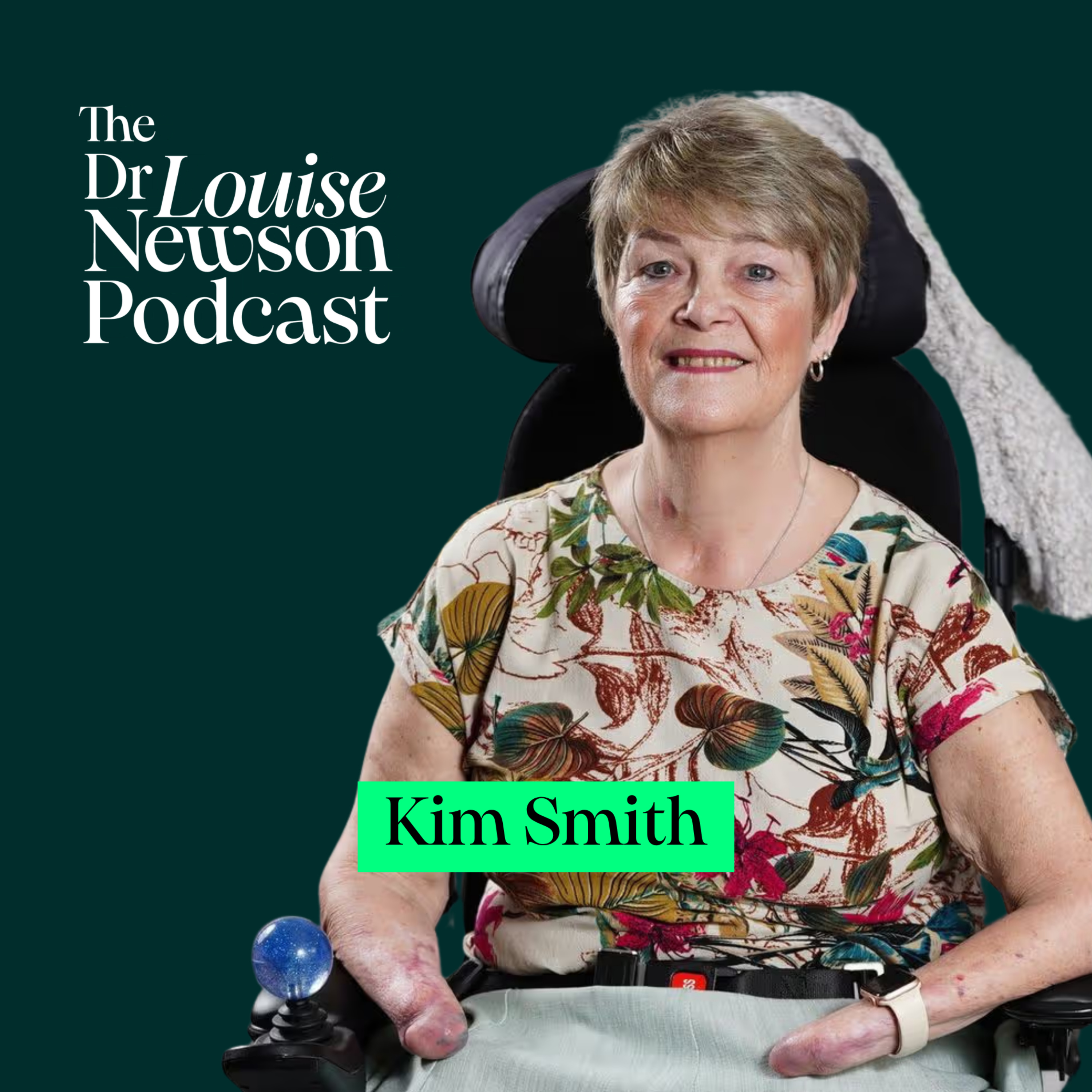
Kim’s near-fatal urosepsis after a presumed UTI while on holiday in Spain, leading to sepsis, quadruple limb amputation, rehab, and her advocacy for faster recognition of sepsis and serious treatment of UTIs (including red-flag symptoms and vaginal hormone prevention).
Kim (pathology degree and medicine degree; survivor and sepsis awareness advocate; later pursuing a double hand transplant; uses vaginal hormones). Host is a GP/doctor who discusses sepsis and UTI management and language/triage.
Kidney pain plus shivering/coldness can signal kidney infection/urosepsis needing IV antibiotics and fluids and hospital admission. “Just a UTI” can progress quickly. Patients should advocate and request second opinions. Vaginal estrogen/DHEA can reduce recurrent UTIs, including for menopausal women and those on HRT.
Kim’s miscommunication in Spanish led to delayed care; she was told she had “hours to live.” Her daughter’s sepsis was initially missed because clinicians didn’t use the sepsis framing until MRI showed osteomyelitis.
Written by AI. May contain mistakes.
Kim shares her personal experience of feeling unwell on holiday and the alarming symptoms she faced.
“I've been bleeding blood and just thinking this is terrible.”
Kim details her misdiagnosis, her husband's panic, and her eventual hospital experience.
“And obviously my muscles had stopped working as well and everything because they had been just laid there for nine weeks, I guess.”
Understanding the serious consequences of sepsis, including Kim's amputations and recovery.
“But if someone then develops feeling cold, shivery, that means you need to go to hospital.”
Kim emphasizes the importance of awareness around sepsis and its impact.
“said in my videos so I won't stop I will never stop it's it's it's so important but how would If someone stopped you in the street and said, what is sepsis?”
Discussion on how to recognize sepsis and advocate for medical attention effectively.
“I just tell them sepsis is an extreme reaction by your immune system to an infection.”
Learn about diagnosing sepsis and the importance of medical language.
“And it made me realize in medicine, the language of what you use is really important.”
Discover how vaginal hormones can reduce UTIs and their importance for women.
“Me as a doctor, but for people as patients, they have to be listening to.”
Hear how hormonal treatments transformed Kim's life post-transplant.
“So we've known that for many years that the hormones can really improve the way our immune system works as well.”
Learn the critical symptoms of sepsis that can indicate a medical emergency.
“So a lot of people say, well, it can't be hormonal because I'm on HRT, but you can just get it differently and different amounts.”
Understand the steps to take if sepsis is suspected to ensure timely treatment.
“So the symptoms are slurred speech and confusion, extreme shivering and muscle pain, passing little or no urine in a day, severe breathlessness, it feels like you're going to die, skin mottled or discoloured.”

Get the gist, explore an idea or ask about something said.
 Claude
On The Dr Louise Newson Podcast, what are the key points of this episode?
Searching your listeningAutomatic transcript. May contain errors.
0:01So Kim, I'm very excited. I've sort of hiked you in after seeing you on Instagram and Instagram's great for connecting with people. And I just read a few lines about you and I thought I really want to speak to this lady because you've got a story which is hard but it's good because look at you, you're here, you look great, but it's not good and it could have been a lot worse. And do you know what? It resonated me for two reasons. One is that you had your new tract infection, which is, and they're so common and they're almost like a bit belittled. And I've had UTIs that have been a bit come and go.
0:42And I've had UTIs where I literally would prefer to die because I've been in so much pain. I've been bleeding blood and just thinking this is terrible. But also you had sepsis, which really makes people think. And my 12 year, well, when my middle daughter was 12 she had sepsis and we can talk about that but you know those two things only tract infection can cause sepsis and can kill people and it's not spoken about enough so listening to this story that you're going to tell us is going to make people think differently I hope or some people think differently so just tell me what happened Kim if you don't mind And yeah, so I was in Spain on holiday and started to feel a little bit unwell.
1:26I didn't have any UTI symptoms, which some people are quite shocked about. But then I started to get kidney pain in my left side and I thought, maybe I've got a UTI and it's gone to my kidneys. And that was the first inkling that I might have a UTI. I'd got severe breathlessness that I'd put down to my asthma. so I was using my inhaler I was shivering uncontrollably I'd got the central heating on we were in a villa and the log burner and I'd got thick jumpers on I'd got blankets around me and I was shivering and I just thought it's the weather I'm just cold and my husband kept coming in going oh it's like greenhouse in here I can't sit in here it's too hot but I was so cold I didn't know I hadn't passed much urine that day but hadn't really noticed and I'd got really cold hands and feet and I could not get my hands and feet warm.
2:24He'd even done me a hot water bottle and I'd put that under my feet. It made no difference. I'd got several pairs of thick, fluffy socks on and they were still icy cold. But something in my gut told me that I needed to get checked and it would probably be better to go to the hospital. I must have thought I was quite poorly for me to want to go to the hospital. so in my little bit of spanish i said to them dolor aquí which means pain here and point it to my left side stupidly i didn't say muy enfermo which means very ill um i didn't say infection because i didn't know the word for kidney or urine i didn't say infection so they apparently x-rayed my back and i say apparently because i don't remember because you were so poorly.
3:14They, yeah, they x-rayed my back and sent me away saying nothing's broken. The next day, at some point on my phone, I'd done a translate app and I'd written in there, I think I have a urine infection. And I translated it into Spanish and screenshot it. And my husband took me to the doctors. I vaguely remember getting out of the car and trying to shuffle I could hardly walk at this point and I was hanging on to my husband and seeing the doctor and I don't remember seeing him I don't remember going into the doctor but I showed him my phone apparently and he must have done a urine sample and confirmed I've got a urine infection and he gave us a prescription to go to the chemist which we did but the chemist said we don't have been any of those antibiotics in stock come back tomorrow I now believe it was too late for oral antibiotics at that stage I now know I needed IV antibiotics and fluids at hospital so the hospital missed it and then the doctor missed it I don't think he took my blood pressure or temperature and just sent me away um and I went home I was so unwell and it's not like me to take myself to bed I just don't do that unless I'm obviously really ill and I did I took myself to bed and I woke up four in the morning and I said to my husband I'm dying I need to go to hospital I'm gonna die and I don't even remember getting to the hospital any part of that at all and I woke up nine plus weeks later in Milton Keynes Hospital back in the UK because finally my travel insurance after six weeks decided they would fly me back and being told that all four limbs had to be amputated and I said to the doctor yeah that's fine how soon can you do it because I couldn't even lift them off the bed it was like somebody had super glued them down they were so so heavy I couldn't lift them.
5:27And obviously my muscles had stopped working as well and everything because they had been just laid there for nine weeks, I guess. And then it was just a matter of them being shipped to another hospital for the amputations because my hospital doesn't do amputations. And I spent three months there before going for rehab in London at the Queen Mary Hospital in Roehampton. and I had to literally learn how to walk on my bottom yeah it was it was quite a traumatic time when I came out of hospital as well because you know you're used to having nurses kind of just do everything for you and then all of a sudden you're at home and you've got to keep asking family and it's okay to ask a nurse because they're there to do it when you've got to then start asking family I was a very independent woman and would be the one running around after everybody else not asking people to do things for me so I found it really really hard but I've come a long way since I've learned how to blow dry my own hair I've learned how to do my own makeup and even without hands I can do it and I do a lot of things now but my big thing is raising awareness of sepsis and making sure that people understand that any infection is serious and that UTIs are extremely serious for women because so many people just think oh it's just a UTI.
6:58Yeah and there's a big difference so you know urinary tract infection the whole urinary tract is a long system and it starts with the kidneys and ends with the urethra that we're wee out of so some people get a bit of cystitis, it burns a bit and stings and they feel absolutely fine. But you had kidney pain. That is a red flag, actually. Kidney pain in people. It could be stones. But if someone then develops feeling cold, shivery, that means you need to go to hospital. It doesn't always mean but it means you've got possibly pyelonephritis, which means infection in the kidney, which you probably had brewing then at that time.
7:40But it's very scary. It must have been very scary for your husband as well. Exactly, yeah. I mean, he was made to wait in a waiting room and I think they came out to him a couple of hours later and said, she's got hours to live. She won't be needing these and gave him a bag of my clothes. I've got him my pyjamas and my dressing gown and my jewellery and they just gave it to him and said, she could die. she's got two hours to live. I was like, oh, wow. He doesn't speak a word of Spanish. They spoke a little bit of English. And so he must have been absolutely petrified. And then he had to go home and phone the family.
8:17And then they all got flights out. Goodness me. I mean, urinary tract infections are very common. In fact, most women have them at some stage of their lives. I don't know the figures, perhaps you do, but I would have thought it's way over 70 % of women have a urinary tract infection. I mean, I don't know. I read that it can be 95 % women and 5 % men. Yeah. So I know it's a higher percentage with women than men. Absolutely. Yeah. Yeah. And, you know, it's very interesting because there's a big move to not give antibiotics for every episode of cystitis. Wow. But it's really difficult. As a doctor, I've seen hundreds of thousands of women with urinary tract infections.
9:02How do I decide who doesn't need an antibiotic? And actually, we also know that it's not always in the urine test because sometimes you can come back with a negative test, but people still have an infection, which I'm sure you've heard of. I've had negative tests and I know I've still got an infection. Yeah. But also, as a GP, it can take two or three days or longer if it's over the weekend for a result. So then what do I do as a GP? Do I wait for the result or do I treat the woman? And so it can be very, very difficult. My sister had a kidney problem and she had to have an operation when she was young and she's very prone to urinary tract infections.
9:43And she knows very early on whether she's got an infection or not. But so many times she's been told you can't have antibiotics because we haven't got the urine test result back. But she knows if she has a short course and gets on top of it, it's a lot better. So it can be very difficult to know because guidelines will say different things, different doctors things. But actually, like I was saying to you before we started recording, my job as a doctor is to listen to patients. And often we know if it's an infection or not. And if it is, then they often need antibiotics. Kidney pain, fever, really can take a hold as it did for you very quickly.
10:28Something like, and you probably know the sepsis, about 30%, I think, of sepsis is due to urosepsis. So sepsis from the... It's one of the highest causes. Yeah. And it's more common as we age. It's more common in women. yeah lots of women when I used to look after women in nursing homes they would be very confused delirious we wouldn't know what was going on and then we realized that it was a urine infection so you don't even have to have classical symptoms um and you know sepsis means different things to different people doesn't it I think there's still some confusion what is extremely extremely drastic you know to lose my limbs from it I mean I'm lucky I didn't die because so many do die and and I I find I'm lucky I mean people say oh poor you and I'm like I don't need a pity I don't need pity you know I I'm I'm I want you to learn about sepsis is what I want I don't need pity I'm I'm doing great I've got a good life I'm I'm happy and you know I'm I'm raising awareness of sepsis I'm doing something really healthy really good you know it's I had a message just a couple of nights ago about um I'd saved this lady's life because um because of my posts and my videos um she'd gone to the hospital and got treatment and she had got sepsis from what I'd said in my videos so I won't stop I will never stop it's it's it's so important but how would If someone stopped you in the street and said, what is sepsis?
12:03What do you say? What's your answer? I just tell them sepsis is an extreme reaction by your immune system to an infection. And anyone can get it at any time. It doesn't matter if you're fit and healthy because I was fit and healthy. And to seek medical advice, usually I tell them to go to A &E because you need IV antibiotics and fluids. and going to your doctor isn't really going to give you IV antibiotics. If you can't get to hospital, phone 999 because most of the paramedics are very well trained. They certainly are in the south anyway. And get treatment because sepsis can kill so fast. I mean, I've known that people die within 24 hours.
12:49It's the speed I think is really important. And I do think as patients we have to advocate for ourselves or our relatives. But I think if we say that word, I think it could be sepsis. What about giving intravenous antibiotics? No one is going to tell me off as a doctor for giving intravenous antibiotics if someone doesn't have sepsis. But it could go wrong the other way. And it is about the language, I think it's really important. A lot of people now are aware, thankfully, of sepsis. But when my daughter had it, I knew she was ill and she had a lot of pain in her hip, actually. But hip is a really unusual place to get an infection.
13:30And she had this awful pain with getting worse. It woke her up twice in the night. And the second time I said to my husband, something's not right. I can't carry her. She was too big then for me to carry her down the stairs to take her to the hospital. So we had to call an ambulance. And they gave her heavy duty painkillers. And even then she was in pain. and going to the hospital, the x-ray was normal. So the doctor said, well, she can go home and have some physiotherapy. And I said, but she started to vomit. Like there's something going on. She's not right. But even then as a doctor, sepsis wasn't on my radar.
14:03The next day she got worse. They did another ultrasound scan. That was normal. I said, she needs an MRI scan. Something's not right. And they went, oh, you're very anxious. I think we'll wait tomorrow. And I said, look, I'm really anxious because she's really ill actually and I'm really concerned and then she became very unwell and the MRI showed this florid infection but actually what they did was they said she's got osteomyelitis which means infection of the bone bone yeah and was very ill and went to the ward and it was only a few days later I said actually she's got sepsis but they never used that word so the physiotherapist used to come and make her walk and I said no she's still really ill she's still getting fevers.
14:42She's not right. And it made me realize in medicine, the language of what you use is really important. When I told the school, oh, she's off because she's got an infection of a hip. They were like, oh, that's a shame. But once I started to say she's had sepsis, it was like, oh my gosh, is there anything I can do? And I thought, actually, isn't that interesting? Because for me as a doctor, I'm quite old now. So I wasn't trained in sepsis. I was trained in infections so like you had pyelonephritis but it did develop to sepsis but it's that language I think is so important but it's also important for us when we're with a patient or we are a patient to use that language properly so if you had known the Spanish for sepsis that would be you know I didn't but I didn't even know what sepsis was back then I had no idea what sepsis was I didn't know the word for urine or kidney as we even say so I didn't say infection yeah you know if I'd have said infection would they have checked me more I don't know it's impossible to know isn't it if I had gone to Milton Keynes hospital would they have done any different I don't know you know I don't know if it had been any different in in the UK I probably would have got to the doctors first of all and I probably would have asked for antibiotics because I thought I had a urine infection if I still hadn't been well I'd have probably gone to the hospital then but yeah it's hard to know because it happens in this country as well as abroad so it happens all over the world unfortunately because it does because it does so awareness is really important intravenous antibiotics really important and admission to hospital and you know we've got Martha's Law that's come in now where people can ask for second opinions and actually when it stopped my husband's adopter but when he read about it he couldn't even read he gets very traumatized thinking about what if you know it happened to my daughter you can't because you don't know but I can guess what happened if she'd been sent home because she was so poorly but it's so important you know yes I was labeled as an anxious mother I can get over that a lot of people aren't so I've had that as a as a mother being told I was an anxious mother when my daughter was a baby and she was vomiting and had diarrhea and losing weight and they told me I was just a neurotic mother was what they said and I said no there's something wrong every time she's eating she's then vomiting and she's got diarrhea so what is going on it turned out that she'd be in hospital they'd give her I rely on all kinds of treatment she'd be fine they'd send her home but what I didn't know because I had another child at home that I had to be at home for I was going home overnight coming back of a morning they were giving her farley's rust a day before she was leaving hospital and she was supposed to be non-cow's milk she was they thought allergic to cow's milk and lactose and sugar they're giving her farley's rust that's full of lactose and sugar so she was then back 48 hours later so i think they thought i was taking her home and doing something she shouldn't be having which i was only giving her vegetables and doing what they told me and then i'm back it out on my own at home in the end.
17:59So, but listening is the most important thing. Yeah, you know, definitely. Me as a doctor, but for people as patients, they have to be listening to. Yeah. The other thing is, I know you told me before, if you don't mind me sharing, that you're using vaginal hormones. And that's really important because we know one of the reasons that women are more likely to get infections is because hormonal changes. And we've known actually since the 1980s, that vaginal hormones will reduce frequency and severity of urinary tract infections. Yet only the minority of menopausal women are given vaginal hormones, which are very safe.
18:39They don't get absorbed in the body. Anyone, including women who've had breast cancer, can usually very safely use them. So anyone that's had any urinary tract infection, certainly recurrent urinary tract infection, should be prescribed vaginal hormones. yeah a lot of times that's not even spoken about or considered so many women don't know you know when they see my videos talking about you know getting um vaginal oestrogen they're like oh i didn't know that i didn't know i could get that and you know and how can you have it and i said well it's either a pestle or a gel i believe but maybe there's cream as well i'm not sure i'm not a doctor so i don't know but you know and it's big to your doctor it's so important because some of my patients say to me my doctor says I don't need vaginal hormones because I'm not sexually active and it's like hang on it's not just for the vagina it goes through into the bladder and it makes a massive difference and you know because urosepsis as you say is common and it's it's still up there it's not reducing and partly because women are living longer they're menopausal for longer they've got low hormones for longer and they're not being given any vaginal hormones so the doctor i saw at the portland hospital about my constant utis actually said that um pregnant women really need it and breastfeeding mothers need it yeah and yeah they're not told they're not told no of course not no one's told anything but also people on contraceptives that can often um because it's synthetic hormones often can increase someone's instance and risk of having urinary tract infections so anybody of any age actually can use vaginal hormones and once you start using them it should really continue as well because but also systemic hormones can really help prime our immune system so the hormones help our immune system to work effectively because there's one thing avoiding an infection but if you have one you want to make sure that your body is really fit to fight it so it doesn't take a halt and developing sepsis.
20:46So we've known that for many years that the hormones can really improve the way our immune system works as well. So a lot of people we see who've had urinary tract infections, we give systemic HRT and testosterone if they need it, as well as vaginal hormones. And there are different preparations as well. So you can have both? Yeah, absolutely. HRT and vaginal. Yeah, and a lot of people need both. So there's quite a lot of people who are on HRT, and then their hormones drop and then they need vaginal hormones as well so I mean I'm I'm 55 I've been on HRT for about 10 years and I just had HRT and testosterone and then I had a hysterectomy and I got urine tract infection after UTI UTI all the time and I had them when I was younger as well but they were really severe and so using vaginal hormones has transformed literally my life That's amazing.
21:42Yeah. So a lot of people say, well, it can't be hormonal because I'm on HRT, but you can just get it differently and different amounts. And so there are the vaginal, like you say, there's the vaginal estrogen pessary, the little tablet, there's a cream, there's a gel, there's a ring, actually, that's a silicon ring that's slow release estrogen for about three months. And then there's something called interosa or prasterone, which is a daily pessary of DHEA. So it converts to estrogen and testosterone. And that's more effective at reducing urinary tract infections than just vaginal estrogen. Wow.
22:19I think I need that then. Yeah. I mean, honestly, anything that's going to help reduce urinary tract infections is really, really important. Absolutely. Because I'm currently waiting for a double hand transplant too. Wow. And when that does happen, I will then be on immunosuppressants for the rest of my life. So then that's going to make me even more at risk. So you want your immune system to be as strong as possible. Yeah, absolutely. Absolutely. And it's very important. I've got a pathology degree as well as a medicine degree. So I spent a lot of time in my pathology degree learning about the immune system and what makes it as healthy as possible.
22:58And we know that hormones do as well as lots of other things. So really important. But the work you're doing, Kim, is incredible. and like you say, people, especially women, share stories, they share experiences, they talk, they learn from each other and you are living proof not just how sepsis doesn't always kill, but also your positivity just shines through here today but also on your Instagram and, you know, that's so commendable. It really is. Everyone says that. I'm just me. I'll just, you know, I've just always been the same. But, yeah. It's great. So I'm really grateful for you coming on just talking about this I always end my podcast with three take-home tips, so you can't be excluded.
23:42So three things that everyone needs to know about sepsis. Everyone needs to know the symptoms. So the symptoms are slurred speech and confusion, extreme shivering and muscle pain, passing little or no urine in a day, severe breathlessness, it feels like you're going to die, skin mottled or discoloured. You can also have cold limbs, cold skin to touch or cold hands and feet. You can also have extremely high or low blood pressure and temperature. And if you've got any of these, they are big red flags. So that's about sepsis. Two other things that we need to know about sepsis. So those are the symptoms.
24:23What people do if they think that they've got sepsis or someone that they know might have sepsis? I always tell people, if you think you've got sepsis, get to hospital immediately. Tell them you've got an infection and you suspect you have sepsis, you have the symptoms. If you get fobbed off, which often patients do, ask for a second opinion or tell them, no, I'm really not well and I need you to listen to me. And then ask for a second opinion if they won't listen to you. Because I tell people, don't get fobbed off. Don't let them fob you off. If you think it's something wrong, trust your gut and tell them nicely that you need them to listen to you and that you need them to check you because you know something isn't right.
25:10Yeah, so important. And then the third thing, I think really, if you agree, would be just other people need to learn and help that person. Absolutely. Everybody needs to learn what sepsis is to keep everybody else alive. You know, it might not be you, but it might be your family member. it might be a friend down the road it might be a neighbor and they might not know what sepsis is but by telling them about sepsis and making everybody aware we are going to save lives and that's what I bang on about all the time so that people understand everybody needs to know what it is because it can be anybody at any time absolutely so keep banging the drum yes and using your vaginal hormones that's for sure yes I will and I think I'm gonna wait for your email and I'm going to be contacting my GP about getting HRT again.
26:00Absolutely. So thank you. Oh thanks Kim, it's been great, thank you. Thank you very much.
26:26Thank you.
26:56Thank you.
27:26Thank you.
27:56Thank you.
28:26Thank you.
28:56Thank you.
29:26Thank you.
29:56Thank you.
30:26Thank you.
30:56Thank you.
31:27Thank you.
31:57Thank you.
Kim Smith went on a family holiday to Spain with a UTI and woke up nine weeks later having lost all four limbs to sepsis.
Twice missed by Spanish doctors, Kim's kidney pain and uncontrollable shivering escalated so fast she doesn't remember being flown home. She tells Dr Louise Newson what actually happened, from the misdiagnosis to being told all four limbs would need amputating, and how she's rebuilt her life since as a quadruple amputee and sepsis awareness advocate.
Louise and Kim discuss the sepsis warning signs so often missed, why kidney pain and sudden shivering are red flags, and how around 30% of sepsis cases start as a urine infection. They also cover why vaginal hormones significantly cut UTI frequency and severity and are safe for almost everyone, including women who've had breast cancer, yet are still rarely prescribed.
Kim shares her three take-home tips on sepsis before the episode ends.
Follow Kim: @kims2ndchance
Let’s connect
👉 Track your symptoms andunderstand hormones, download the Balance app: https://bit.ly/4yZty5A
👉 More from Dr LouiseNewson: https://linkin.bio/drlouisenewson