Ask ChatGPT

 The Dr Louise Newson Podcast
2 Nov 2026 · 32m · 13 chapters
Bleeding while on hormone replacement therapy (HRT), why it happens, and what it means; also broader themes of hormone education, patient listening, and cancer-risk anxiety.
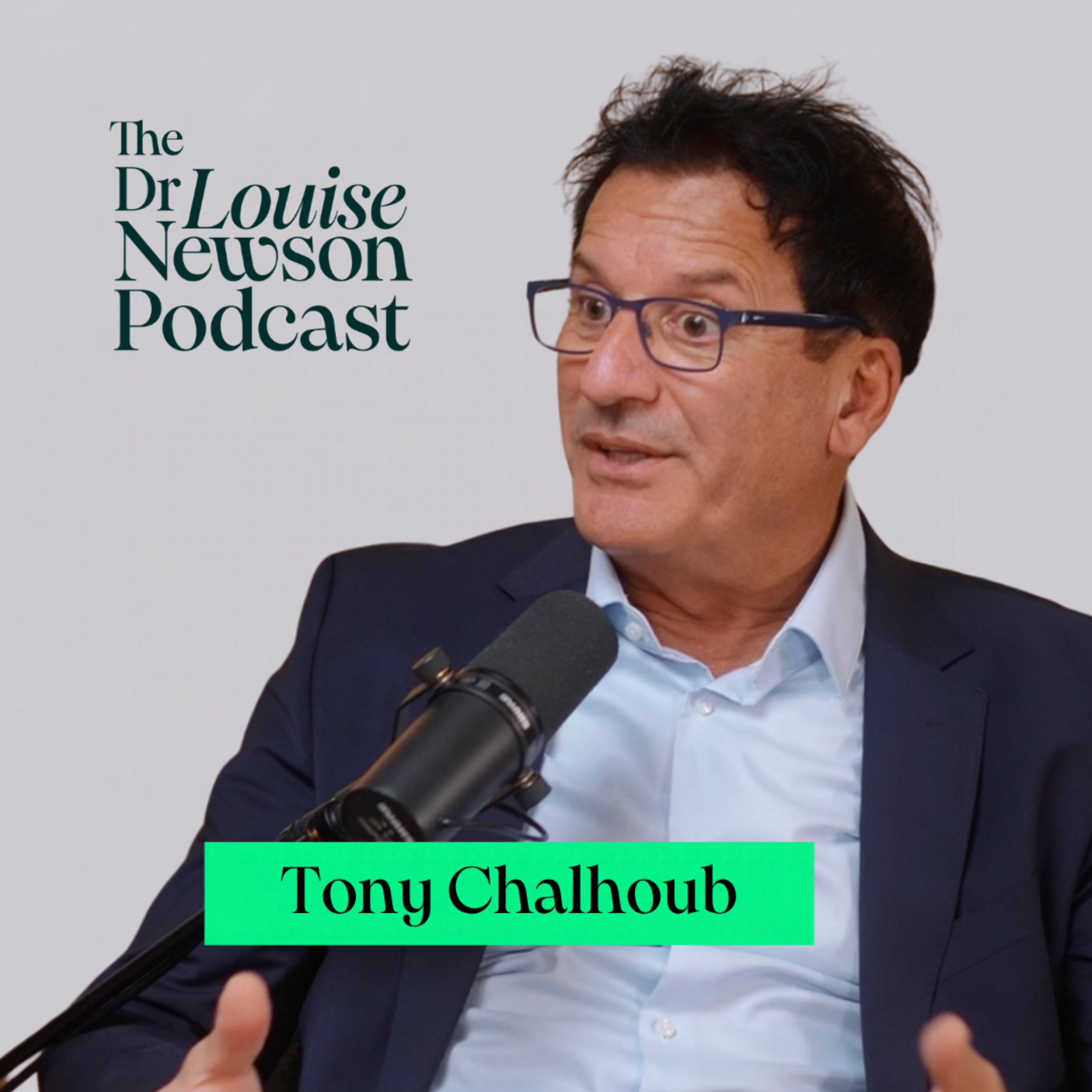
Tony Chalhoub is a UK gynecologist specializing in endometriosis. He trained across hospitals in the UK, helped develop outpatient hysteroscopy with conscious sedation, set up an accredited endometriosis center in Newcastle (2012–2024), and ran a rapid-access post-menopausal bleeding/cancer-weight clinic.
Most HRT-related bleeding settles over time and is often due to missed progesterone doses, patch issues, or non-cancer causes (e.g., infections). Fast-track “suspected cancer” pathways can flood clinics and create fear. Stopping HRT may worsen symptoms/mental health; continuing short-term is unlikely to worsen prognosis. Evidence and guideline language are often oversimplified (e.g., “estrogen causes cancer” depends on type).
Women sent for two-week cancer referrals after brief HRT lapses; patients with hysterectomy still needing evaluation for residual endometrium; endometriosis misdiagnosed for years due to normal scans; rare extragenital endometriosis in a man’s penis after estrogen exposure.
Written by AI. May contain mistakes.
Discussion on the importance of collaboration between gynecologists and general practitioners in hormone therapy.
“I mean, Louis, thanks very much for inviting me.”
Tony shares his background and experiences in the field of gynecology and endometriosis.
“you're more familiar with the patient's comorbidities, with the history.”
Tony discusses advancements in outpatient procedures and patient choice in gynecology.
“Then in Newcastle, I was very humbled, you know, came into a unit, big teaching hospital, has lots of very specialists.”
Discussion on the common symptoms of hormone treatment, particularly bleeding, and its implications.
“And that was originally meant to be for, like by default for undermittal ablation.”
Exploration of the challenges faced by women regarding fast-tracked cancer referrals and the impact of misdiagnosis.
“But then because people don't know about hormones, they often still get referred to the gynecologist for advice.”
The significance of taking a thorough patient history in diagnosing and treating symptoms effectively.
“At least one in ten will be cancer and you have to be seen.”
Discussion on the misconceptions surrounding hormone therapy in women with a history of cancer.
“say you know i follow you on instagram and i see you do you do fantastic work because the patients I mean, you have to be a patient to realize.”
Discusses the challenges faced by women with a history of cancer regarding hormone treatments.
“So he was worried that the consultations were being too long.”
A discussion on the implications of removing ovaries and the importance of hormone replacement therapy.
“I think it's really awful when I see people who have been devoid of all their hormones.”
Explores the guidelines surrounding hormone treatments and the inclusion of progesterone.
Emphasizes the need for clinicians to believe patients and validate their symptoms, especially in cases of endometriosis.
“It's very important, you know, to be honest and to be upfront, you know, and then not to be intimidated because patients now are very savvy.”
Learn about the complexities of endometriosis, including symptoms and case studies.
“And they probably would have had a synthetic estrogen as well.”
Discover three key aspirations for improving endometriosis diagnosis and care.

Get the gist, explore an idea or ask about something said.
 Claude
On The Dr Louise Newson Podcast, what are the key points of this episode?
Searching your listeningAutomatic transcript. May contain errors.
0:00This podcast is great to listen to. I'm with a gynecologist, Tony Chalhoub, who specialises in endometriosis. But I tell you what he also specialises in is listening to patients. And this is something that sadly so many female patients are not listened to. They're not believed. They're not understood. So this is going to make your heart warm listening to this. So enjoy it. so tony this is great because this is you as a gynecologist in my podcast studio and um i it's it's interesting because i'm not a gynecologist i'm a gp i'm a general physician as well i've done a lot of hospital medicine and traditionally hormone care menopause is a gynecological specialty but i sort of challenge that because like the hormones get everywhere don't they?
0:51It's not just gynecology, is it? Yeah, correct. I mean, Louis, thanks very much for inviting me. You know, it's really a pleasure to meet you. Eventually put the real face to the name. You're doing fantastic work. And I agree with you. As a general practitioner, to be honest, you're more familiar with the patient's comorbidities, with the history. So really, I should sit with a general practitioner when it comes to hormone and hormone replacement therapy. and you have some specialists also gynecologists really a nice thing about upsetting and gynecology is multi-disciplinary within the same specialty yeah you find the hormone replacement therapy is like a niche within gynecology unfortunately we're not taught uh throughout our training and it comes up you become a consultant somebody comes to you and then all of a sudden oh my god what can I do you know and either you scare the patient off their with you know about it even if they don't have any comorbidities just because you're not familiar with where really in a sense you need to refer them to somebody who understand rather than trying to scare them off well this is this is the thing and you know your career has been really interesting and you've changed and learn and I think in medicine our learning doesn't end the day we become doctors or the day we choose our specialty it's constantly evolving and also we we do have a responsibility to train and teach others as well don't we and so if you just talk a little bit about your career because it's really interesting how much you've done yeah thanks Louise so basically I did my training here and I'll give you a little background why did I do for example ups and ghani what attracted me and some patients they do ask the questions being a male sometimes i don't understand why they're asking a question but then it rings a bell uh from me uh i was the only doctor you know i'm lebanese in origin my wife sarah is here is a british you know from a newcastle so uh i came in as a house officer to the uk and i did my training throughout up and down the country from uh haywood's heath princess oil hospital all the way to aberdeen yeah you know but i got my national train number in newcastle and then straight away i get a consultant post in there so that to be honest louise i even though i was like a traveling trainee yeah it opened my eyes to lots of good practices and not as good practices and this is where you pick up the good and you keep and you learn not to do the things that you thought and you don't want to do.
3:27Then in Newcastle, I was very humbled, you know, came into a unit, big teaching hospital, has lots of very specialists. Straight away, I was able to change the culture within where, for example, office gynecology wasn't heard of then to offer women like outpatient hysteroscopy as part of their choice. Equally, not everybody can have outpatient hysteroscopy, so you don't force it on it. So we were the first to bring the anesthetists down and offer conscious sedation hysteroscopy, for example, in the outpatient setting. So that gave the patient the choice, but equally the innovation to the trust, and that means patient can come in, have her procedure in the morning, go pick up her kids half an hour or an hour later, you know.
4:24And that was originally meant to be for, like by default for undermittal ablation. And then that expanded. It became some poor women. They cannot even tolerate cervical smear. You don't want to put them to sleep, but at least they have this option and lots of other indications. Same time, I set up Newcastle as an endometriosis center. so we became accredited 2012 until I left 2024 November in Newcastle and as part of my role also I was deputy lead for Ghana Oncology Unit so we had a one stop post-menopausal bleeding clinic or what we call rapid access clinic or cancer weight clinic where any patient present with anything suspicious of cancer so you diagnose them and if they turn out to be high grade on the material for example you refer them to gaysad if low grade i used to operate on them locally and that also with that you'll have lots of other indications like breakthrough bleed women on hormone replacement therapy postmenopausally or premenopausally like in sclerosis all these things and then 2014 I started robotic assisted surgery I was one of the innovators in the complex B9 because robotic assisted surgery is another form of laparoscopy so it's nothing really exciting other than ergonomically a better position and then the instruments evolve to allow you to do much more minimally invasive where laparoscopy is fantastic and was gold standard for anything gynecologic however you reach a point where it becomes a bit difficult or challenging or also even challenging to to teach for example my myomectomies you know fibromas myomas so they're quite common it's the most common benign growth mass or on the women's womb yet again another like the hrt i was the only one up in the northeast who offered the service to poor patients where others they used to scare them oh no if you to have a fibroid removed you're gonna bleed to death have a hysterectomy or live with it you know and again because unfortunately same with menopause and hormone replacement therapy pre-menopause and menopause we haven't been taught yeah you know it's not like a essential i mean it's so interesting isn't it because there's there's so much i was did a podcast earlier with a medical student and there's very little training in an undergraduate about hormone treatments what they are what they do and even what hormones progesterone estradale testosterone do in the body and then as gps no training gynecologists there's very little training and it really varies and um i i feel sorry for gynecologists actually because you know you you are trained as a surgeon you do the most amazing laparoscopic surgery, robotic surgery, all of this.
7:35But then because people don't know about hormones, they often still get referred to the gynecologist for advice. And so the advice, the treatment can really vary between different gynecologists. But then the other thing that I think about a lot is bleeding is a really common symptom. It's a really common side effect of hormone treatment and it usually settles with time. And women who take combination, so estradiol, progesterone, the continuous progesterone, their risk of endometrial cancer is lower than not taking anything. But the problem is if they're over the age of 50, then they always get fast-tracked into a query cancer two-week referral.
8:17And so the clinics are flooded with people who really are not very high risk for getting cancer. And often when I take a good history from them, they've been on holiday, They've forgotten to take their progesterone for a few days. They've also had, I don't know, a urinary tract infection and the bleeding is actually from the wean up from their vagina. Their patch didn't stick on very well and then they had some bleeding. So it's not going to be suspected cancer, but it's just fast-tracked into this. So a lot of the hospitals are really flooded with women who shouldn't really be needing two-week referrals, should they?
8:54Correct. No, I agree with you. and that also put the fear of God in these poor women. Of course it does, because they get letters saying suspected cancer. At least one in ten will be cancer and you have to be seen. And then as part of setting up a post-meposal bleeding clinic per se, where patients, they come in, if the undometrial thickness, in order to fast track them, not delay their cancer weighting pathway, we offer hystereoscopy if the undometrial more thickened. However, you find some of these patients, they had a hysterectomy before. it's still there for potential under material cancer it's crazy which is crazy and some patients like you mentioned rightly so they might have lichen sclerosis that led to a little bit itching precisely a little bit of blood on the on the underwear oh my god you have cancer then people worry and and in medicine you know i'm sure you were taught the same most of the diagnosis is in the history correct and it's difficult when you're busy and you've got lots of patients but sometimes taking a bit of time to take a history you don't have to need you I mean when I was as as a as a GP for many years we didn't have two week referrals it wasn't there so we had to prioritize is this urgent or is it not how much can we do ourselves take a really good history you might try something if it helps fine and if it doesn't you try something else and then you might speak to it one of your mates who's a consultant going on and say what do you think oh that sounds like we need to be seeing them in the go.
10:16Whereas now it's a bit more tick box, really. Have they bleeding? Yes or no. Are they this age? Yes or no. Off they go. And there are some guidelines that came out with HRT to say, one of the things you could do is stop the HRT. And if the bleeding settles, you know, it's related to HRT. Now, I've seen a lot of women whose symptoms have come straight back, especially their mental health symptoms. And it doesn't feel the right thing to stop an evidence-based treatment because it's still not helpful is it correct i agree with you and for many reasons one because they fast track they're gonna get a diagnosis very quickly yes and continuing on hormone replacement therapy for another two weeks or four weeks is not gonna worsen their prognosis and they're not gonna get cancer i agree with you louise and that's why i say you know i follow you on instagram and i see you do you do fantastic work because the patients I mean, you have to be a patient to realize.
11:11I remember, you know, as I'm not a bear, but my wife, sometimes, you know, she shaved my back a little bit. And then one day she told me, oh, Tony, I have this thing on your back. It wasn't there before. Make story short, that triggered going to a GP. Again, I'm sitting, I cannot see the thing, you know. I'm taking a photo and then blew it up. And the GP started, the terminology, oh irregular borders and blah blah blah refer me to the melanoma clinic of course then not long uh long beforehand i lost a very close friend a colleague of mine to pancreatic cancer he passed away within six weeks oh gosh at the age of 54 so all these things start playing in your back i go to the melanoma clinic another person all of a sudden i have like a you know like you go and you watch the movies in the states how they start taking pictures of you they brought behind me pictures and then i remember the clinical nurse specialist she said oh we could take little biopsy or we could remove it i said please remove it and then for two days we got the soldier really within within 48 hours those 48 hours million things went in my head you start thinking about your kids yeah so really like you said louise you know education or education us you know uh or being in the place of a patient that you'll see how it could affect you and these poor women not only they've been asked to stop hormone replacement therapy some of them they got recurrent bleeding and then what would you do and that bleeding could be because they're so dry and they need a little bit estrogen so that will put them sex for the rest of their life because every time they have intercourse, oh my God, go to the two weeks wait.
12:55So it's really crazy. It's really worrying. And I think it is a hard time. You know, there was a study that I read recently looking at urologists and a lot of them are so scared to prescribe vaginal hormones because in the insert, it says risk of clot, stroke, heart disease. I mean, it's completely wrong. But if people are not being updated, if the computer systems that are linked with the wrong warnings are scaring people, then they were saying that they are scared to prescribe vaginal hormones and they haven't got the right education. So then they're putting women's symptoms are continuing or they're too scared to ask the questions because then the women might want treatment and they don't know how to prescribe.
13:39So it's a really difficult time and I think things are changing because women are getting it and women are understanding it often quicker than healthcare professionals. and a few months ago someone I trained with actually phoned me up and he's a cancer surgeon and he said Louise what do you think you're doing he said I'm really cross I said what do you mean he said because women now are asking for hormone treatments after having cancer and it's outrageous I said oh is it is it really outrageous surely they can have a choice and he said well it's making our clinics really busy because the women won't stop asking questions and the consultations are longer.
14:16So he was worried that the consultations were being too long. And in my mind, I don't know what it's like to have cancer, but women still get benefits from hormone treatments, regardless of their cancer. So for their bones, their heart, their brain, all their systems can improve, and their symptoms as well, obviously. And so he was so cross, he ended up putting down the phone. And I really respected him as a medical student, so I was quite surprised. But, you know, women, I see a lot of women, and I hear from a lot of women through my social media, but women who've had cervical cancer who have been told you absolutely can't have hormone treatments.
14:54And these women are quite young often, so they've had a total hysterectomy, everything's been removed. And then often chemotherapy, sometimes depending on the cancer, they might have had radiotherapy. So they've got a lot to deal with, and then they've got no hormones. Especially the disease, it's a virus disease, it's nothing. It's not related to hormones, is it? No, but equally, Louise, I used to counsel patients. And, you know, ignorance is really harmful for us and for the patient. Because the evidence, even in endometrial cancer, certainly low-grade endometrial cancer. Yeah. If somebody's below the age of 50, the longevity is increased with keeping their ovaries.
15:36Yeah. I know there is, and the ovaries produce a lot more hormone than the HRT that you've given them. Absolutely. for that reason for the cardiovascular for the bone density but also for these are young women below the age of 40 sometimes you know the 50 they get on the middle cancer and then what we do we keep their ovaries you know we'll biopsy them because you have maybe nearly five percent they have synchronous ovarian and if the biopsy is normal then you don't have to yeah to remove the ovary for that particular reason but like i just mentioned ignorance unfortunately absolutely and also there is uncertainty we we don't know because no one's done the studies there'll never be randomized control studies looking at people and even if there were your patient is not the same as a patient in the studies and you know i saw someone recently who'd had breast cancer 12 years ago and she had been told she can never have hormones ever but she's now got osteoporosis she's got raised blood pressure she's given up her job because she can't think properly and she said I've spoken to all my family I've spoken to my GP I just want to try some hormones and if they help the way I feel then I'll probably continue but I just want to try them you know I don't drink I don't smoke I exercise so it's like well that's your choice really and and and that's fine.
16:57Before we continue I'd like to tell you about Newsome Clinic the sponsor of this podcast. I founded Newsome Clinic to improve access to expert evidence-based hormone health for women. My clinic makes this podcast possible, allowing us to continue sharing free education and information to help women better understand their hormones and health. To learn more about Newsome Clinic or book an appointment, visit newsomehealth.co.uk. This link is also in the show notes. I think it's really awful when I see people who have been devoid of all their hormones. But it's interesting. I'm 56, so I had a hysterectomy when I was about 48.
17:42And I decided to keep my ovaries. And my consultant really wanted to take my ovaries out. And I was already taking hormone treatment then. But I said, well, they're probably producing hormones that I don't even know about. And I just don't see the point of them coming out. And he said, well, okay, well when you're 55 come back and i'll do a laparoscopic bilateral nephrectomy so take out both your ovaries and then when i was 55 my husband said oh are you going back to see him and i said no like why why would i like would you take your testicles off so you don't get testicular cancer and he sort of crossed his legs and went oh well no you're probably right but it feels a bit weird doesn't it it does uh louise i mean especially if you don't have any family the history or risk of any breast or ovarian cancer no to remove it like you said we don't just start chopping people's arm and length especially that nowadays we're doing things minimally invasive precisely in the past they used to do midline uh open surgery one would say okay oh my god if something happened with your ovaries gonna be a nightmare to go in nowadays it's very different now it's very easy to to go back you know and remove and and at least you owe it to the patient to discuss the risks and the benefit if any you know yes i mean if i had a strong family history and oh i had brachycine i would sit down and have a different conversation and it's a choice thing you know absolutely but to to just sort of take them out regardless which is what happened you know more and people now i think are changing and thinking which is i think so i mean thanks to this podcast and then now patient awareness you know it's fantastic especially the evidence even on the middle cancer yeah the the benefit is to keep your ovaries so let alone at age 48 they want to remove your ovaries for i presume you know benign disease it's it doesn't make sense it doesn't make sense no but it's also interesting so i was at a conference in america earlier this year and someone was talking about the guidelines pathways for poi premature ovarian insufficiency so this is women under the age of 40 and we know it's common it's about three to four percent of women and as you know without those hormones there's all these health risks but they were talking about if women who are under the age of 40 had a surgical menopause and so they had their womb removed with their ovaries then they would only needed estrogen so I got the microphone at the end and I said to the speaker look we know that our ovaries also make progesterone and testosterone so why would you not give all three hormones back why is it the decision just for estrogen so do you know she said to me Louise that's because that's what the guidelines say and everyone in the audience like asked then she said next question please and that was me being just and I but I'm one of those doctors for many years only gave estrogen to women who had a hysterectomy because I said which is partly true you haven't got a womb so you don't need progesterone for your womb but then over the years I've realized progesterone affects every cell in the body and it's very beneficial so now if people have had a hysterectomy we talk to them about progesterone and testosterone as well especially if their ovaries have been removed too but it's a it's a changing conversation isn't it yeah but because like i said we talk to patients and then you talk to patients that's the important thing you're right and progesterone nowadays you have bioidentical progesterone so they're no longer it's very different to the synthetic very different we're not worried about breast cancer anymore come back to women that poor patient you were talking about who had mastectomy i suppose you know the lady with the breast cancer if you remove the glands the whole breast you know so the risk going from hope and have marriage nearly non-existent you know for her to recur so you know the nice thing is we need to educate ourselves more certainly i i i feel the royal college ofst gynia now through having a president who's gynecologist, the last president and the current president, they're looking more into not only the surgical pathways where to, because it's scary, even as a gynecologist, to become a first-year consultant, all you have to be signed off to complete your training to be able to do open self-injection and move in a fallopian tube for ectopic pregnancy, not even laparoscopically.
22:00so these things has to go within you know our core curricula same with the research yeah you know so just so people we got a little bit more savvy to go and research and and study the guidelines and you find lots of guidelines based on very flimsy research you know so if you start microscoping you know the evidence you'll find either a lax or is not very it's not very good evidence it's not very robust is it and i was i was trying to find a study um i've tried many times to find to show that estradiol causes endometrial cancer we've known for decades since the 1970s that the pregnant horses that you're in the premarin is associated with the small it's small instance of endometrial cancer we know ethanol estradiol which is the synthetic estrogen in contraceptives is associated with a small risk of cancer but estradiol on its own i can't find and when i ever i read guidelines to say give progesterone because the risk of unopposed estrogen with cancer i can't still that what they what they refer to is not about estradiol it's about older types of estrogen.
23:20And so like for me, language is really important, but also showing people lack of evidence is also really important because I think sometimes, and I've written books on evidence-based medicine, so I'm used to really unpicking the data. But when you're a busy clinician, you just read the top line. It's like reading the headlines, isn't it? And so then you also learn by rote. So if someone tells you estrogen causes cancer, you go, oh, okay. therefore it must do. But then someone like me will say, well, hang on, what do you mean by oestrogen? Do you mean oestradiol, oestrione, or a synthetic oestrogen?
23:58Because they're all very different metabolically. And then people say, well, fat cells produce oestrogen. People who are overweight have more risk of cancer. But then our fat cells produce all sorts of inflammatory cytokines as well. So then you have to be, and it's fine to say, I don't know. I think in medicine, and I'm sure for you as a surgeon, just to sometimes to say, no, an operation won't cure you or no, this treatment might not help or I don't know whether it will help or not. I think that's fine with our patients as well, isn't it? You're right. It's very important, you know, to be honest and to be upfront, you know, and then not to be intimidated because patients now are very savvy.
24:41You know, they come up sometime with some things, you know, I haven't heard of, you know, not necessarily in the obstinacus, but they come in and tell you about, say, some comorbidity you have in. So you do a very quick search and you'll be able to find out with them or they'll educate you these days. So it's very important to be upfront and patients will pick up. Yeah. If they go talk to somebody and normally the defense mechanism, if you don't know something about a patient, you shut them down. You'll start talking over them. But patients nowadays, they're through and some of them, they come and apologize and oh sorry but i've looked this up on the net or whatever i say no it's good on you i think it's great i totally agree um and i think what's really sad is there's a lot of um medical gaslighting there's a lot of people who are not being believed with their symptoms and i'm sure you hear a lot of stories women with endometriosis where they're told it's in their heads and because they can't do a blood test or a scan that's going to show the endometriosis but I was always taught and I'm sure you were that you have to believe your patients you listen to them and you believe them and even if they've got symptoms that don't really fit into a diagnostic pattern they're still having those they're real symptoms just because we can't see them if they're pain or you know it's different like when you have a rash I can show you what it looks like but if it's something internal or I get a sensation we still have to believe our patients don't we?
26:13Definitely And then so many times, Louise, you know, patients, I go to them. So I get patients referral for redo surgery or I get patients referred for second opinion, especially when it comes to endometriosis who have been depressed, you know, literally. And they put on antidepressant because nobody believed them. And then ultrasound scan is normal. MRI scans normal. or it's in your head or you have Ritter-Bowell syndromes which again it could symptoms flare up around menstruation but then I'll go in the recovery to just tell the patient oh you had Ando and they start crying oh my god crying with the relief that all these years oh doctor oh I thought you know I'm gonna waste your time you know it's very validating isn't it it's validating but the evidence is there Louise and thank god they changed the guideline two years ago now november because poor patients they're waiting eight to nine years before they got diagnosis because not only seeing the gp seeing also the gynecologist and sometimes specialist who oh no your ultrasound scan your mri scan we know there's no correlation between the staging or amount of disease and degree of pain and that's why endometriosis per se it's the sonic kidney killer in some women some women they come into you to be sterilized because they had their three children also you put the laparoscope and then you feel oh my god stage four and oh this lady didn't have pain where others they're rolling in pain and then you know very little but when you treat it improve improve their symptoms so no we need to listen to patients and me having four sisters i was brought up to listen to my sisters you know because i i yet uh people talk about negative laparoscopies i.e patients they go in and you find nothing touch wood yet for me not to find anything because you listen to the patient like you said and the symptoms you know uh will be suggestive of endometriosis and there's a list of symptoms being like a pain during intercourse cyclical anything pain cyclical what started and become chronic throughout the month it depends because endometriosis multi-organ inflammatory condition that things are getting sticky now and affect many organs and we don't know the etiology yet although there's so many theories i have two patients and now male patients that they have undo yeah where we heard about endometriosis in senior men who had for example prostate cancer and had to have estrogen or or as part of the treatment and you find they develop undo so the theory then was or maybe we all have this undifferentiated cells but it's very Very interesting.
29:02And they probably would have had a synthetic estrogen as well. But that's also a theory because then, oh, maybe then these cells are through hormone and influence they're differentiating now into something where one patient referred to me through the urologist who was having pain in his penis every time he had wee. So he got tested for STI, sexually transmitted infections, for urine infections, nothing. Eventually, the GP referred the patient to urologist. They did look with the telescope, and then they found a little area. They biopsied, and it came back on the metriosis within his penis. So anyway, so I saw him thinking he might have gynecomastia.
29:45He might be obese. He was. Nothing. So there's lots of things we don't know. and lots of like you suggested or you mentioned Louise, lots of guidelines built up on things that maybe we don't know or we don't know enough but then becomes like oh my god you have to follow the guidelines there's so much we need to do and I'm looking forward with trepidation but how the next few years are going to be because I think we're going to be more patient led we're going to be more led hopefully by hormone treatments more led just by inquisitive doctors which is the way it should be as well so i'm really grateful you're coming before i end i always ask for three take-home tips so three things that you're looking forward to um when we're thinking about endometriosis and women what are the three things that you would really like to see in your professional so from endometriosis now we have you uh mentioned and the test which uh now the nice guideline they're looking at them positively but unfortunately they still self-funded even the insurance doesn't cover them and and they're not cheap one nearly 400 pound one or 900 pound they're very sensitive and specific you know for the but unfortunately not unless we start looking at women's as a strategy throughout nationally to prioritize them for every prostate for every four prostate you got maybe one procedure for women so now we're gonna increase my fear the diagnosis which is rightly so shorten the peer patient to get diagnosed but they're still gonna be waiting for ages so i'd like to see one this diagnosis to yes to make it quicker and quicker second more patient awareness and more education and more podcast yeah you know so patients are equipped they come and challenge the physicians you know absolutely and the third thing is the physicians to listen to their patients because once we listen to the patients you make their journey easier and we make our life easier as well oh i love it thank you so much tony for coming it's been really great thank you oh thanks very much louise so just a quick one it would be really great if you could follow or subscribe to this podcast this will really help me reach more people with evidence-based information about hormones and their future health and it also ensures that you'll never miss a future episode thank you
Is bleeding on HRT normal? It’s a common side effect that usually settles and there’s often a simple explanation.
Consultant gynaecologist Tony Chalhoub worked for years in a rapid-access clinic for postmenopausal bleeding and helped establish Newcastle’s accredited endometriosis centre. He shares how a health scare ofhis own changed the way he listens to patients.
In this episode, Dr Louise Newson and Tony Chalhoub talk about how a few missed days of progesterone, patch that didn’t stick or a urine infection can all lead to bleeding, why a careful history matters so much, and why stopping an evidence-based treatment can bring symptoms straight back.
They also discuss why Louise kept her ovaries at hysterectomy, why estrogen alone may not be enough after surgical menopause, and why women with endometriosis deserve to be believed even when their scans are normal.
If you have any bleeding on HRT, speak to your doctor so it can be properly assessed.
Follow Tony: @drtonychalhoub
Chapters
00:00 Why does listening to women matter so much?
00:22 Why aren't gynaecologists taught about HRT?
02:24 What did training across the UK teach Tony?
03:39 Can a hysteroscopy be done without going to sleep?
06:41 Why were women told fibroid surgery was too risky?
07:29 Does bleeding on HRT mean cancer?
10:25 Should you stop HRT if you have bleeding?
11:20 What did a cancer scare teach a gynaecologist?
12:40 Could bleeding after sex be vaginal dryness?
13:05 Why are doctors scared of vaginal oestrogen?
13:50 Can women have HRT after cancer?
15:17 Should you keep your ovaries with womb cancer?
16:39 Why would a breast cancer survivor try HRT?
17:22 Why did Louise keep her ovaries at hysterectomy?
19:18 Is oestrogen enough after surgical menopause?
21:26 Should HRT be part of gynaecology training?
22:31 Does oestradiol cause womb cancer?
24:06 Is it OK for doctors to say I don't know?
25:19 Why are women with endometriosis not believed?
27:13 Why doesn't endometriosis pain match the scan?
28:40 Can men get endometriosis?
30:36 What needs to change in endometriosis care?
👉 Bleeding on HRT? Trackyour symptoms and treatment in the balance app so your doctor gets the fullpicture: https://balance-app.com/?utm_source=DLN&utm_medium=biolink&utm_campaign=crosspromo
👉 More from Dr Louise Newson: https://linkin.bio/drlouisenewson