Ask ChatGPT

 The Dr Louise Newson Podcast
5 Nov 2026 · 33m · 10 chapters
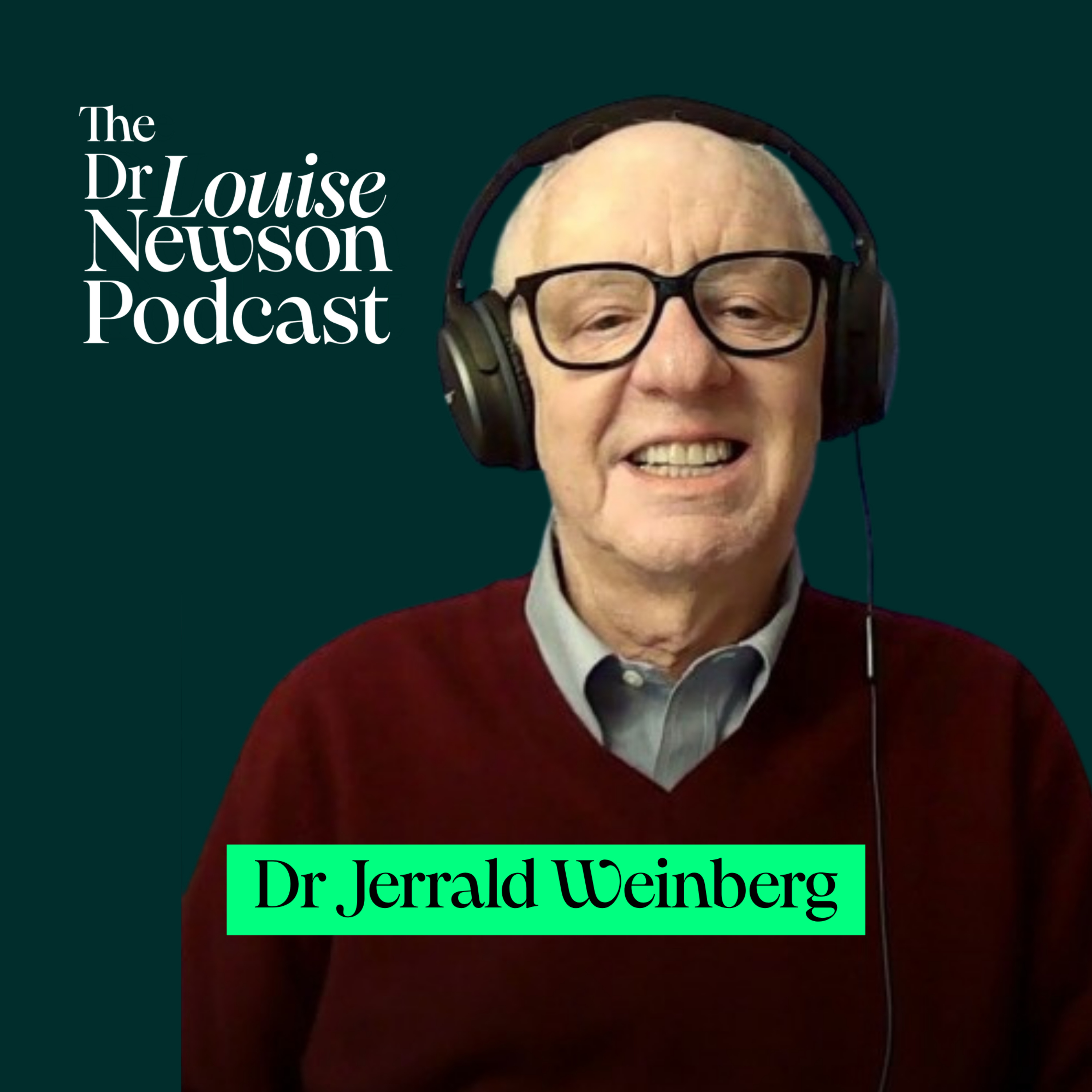
Bioidentical hormone replacement therapy (HRT) for menopause—why it’s underused despite “good safety data,” and how confusion about synthetic vs bioidentical hormones (especially Premarin and Provera) led to avoidance.
Menopause is a hormone deficiency (estradiol loss) and symptoms are largely negative; estradiol and natural micronized progesterone are appropriate treatments. The controversy stems from the Women’s Health Initiative (2002) studying Premarin (pregnant mare’s urine) plus Provera (synthetic progesterone), not estradiol or natural progesterone. Oral estrogen increases clotting proteins via the liver; Provera is linked to breast cancer risk. Transdermal estradiol and oral natural progesterone are preferred; dosing can be adjusted using compounded creams/pumps.
thyroid analogy; women stopping HRT after WHI; patients who didn’t absorb patches/gel and improved after dose/formulation changes; osteoporosis prevention and longer life expectancy on hormones.
Gerald Weinberg, US physician who trained at Sinai Hospital of Detroit under Dr. Alfred Sherman; author of Menopause Mended; treats ~3,000 patients/month and is working with the University of Michigan on quality-of-life studies.
Written by AI. May contain mistakes.
Discussion on the importance of questioning medical practices and the background of Dr. Weinberg's training.
“So in the beginning of your book, there's a bit about you.”
Exploration of the challenges faced by doctors who adopt hormone treatments and the societal perceptions surrounding them.
“And patients have always been the center of everything I do.”
Discussion on menopause as a hormone deficiency and the need for hormone replacement therapy, including historical context.
“Well, no other mammals have a menopause than humans.”
Insights into misconceptions about hormone treatments and the effects of misinterpreted studies on women's health.
“The risk is low, but there were so many benefits from hormone treatments.”
Learn about the benefits of compounded hormones for adjusting hormone therapy dosages.
“So the patch and the oral progesterone are extremely healthy.”
Explore why many women feel hormonal treatments don't work and how proper dosing can change outcomes.
“So I've treated 4 ,000 patients in 25 years.”
Discuss the long-term health benefits of hormone therapy and the misconceptions surrounding it.
“So there's no question, and it's very frustrating to us to see this happening, and people telling us, I don't want to, I came here for menopause, but I'll do anything but hormones.”
Learn about the difficulties healthcare providers face in managing menopausal care.
“Okay, well, let's have you see a counselor or a psychiatrist and let's get to the bottom of this.”
Understand the valuable role nurse practitioners can play in menopausal medicine.
“Yeah, excuse me, I'm sorry to interrupt, but a very important thing.”
Discover three actionable tips to improve women's access to hormone treatments.
“So what I'm going to ask you is three ways that you think are going to make a big difference to women being able to be prescribed hormones over the next 30 years, because I don't want to keep listening to these stories.”

Get the gist, explore an idea or ask about something said.
 Claude
On The Dr Louise Newson Podcast, what are the key points of this episode?
Searching your listeningAutomatic transcript. May contain errors.
0:02So I'm very excited in today's podcast. I've got in front of me someone who's across the pond in the US, Gerald Weinberg, who wrote this book called Menopause Mended. And I flew to America earlier in the year and I couldn't put it down. And actually, I felt like almost I'd written it because there were so many things that I'm just nodding my head. But I also was quite sad because I wish that I'd read it 30 years ago when I was a junior doctor. So there's a lot of things that I wish I knew then that I know now. And we just want to have a conversation about hormones, what they are, and the confusion between synthetic and natural and bioidentical hormones.
0:44So welcome to my podcast. Thank you for coming. This is really exciting. So in the beginning of your book, there's a bit about you. And you talk about being trained by Dr. Alfred Sherman, and he taught you to ask, why is that the best treatment? Who says so? What evidence do they have? What are other things to approach this problem? What is their agenda, and do they work with big pharma? We should all be challenging, whether we're doctors or patients. It's quite useful to ask those questions sometimes, isn't it? Yes, an interesting sidelight is I trained at a Jewish hospital, Sinai Hospital of Detroit.
1:26Many of the physicians were Jewish. Many of the patients were Jewish. A longstanding tradition in the Jewish religion is questioning. When they studied Torah, which is the Jewish Bible, they studied in groups of two. And as they're studying, the two students, they're asking each other questions. Why do you think this is? What are other alternatives? That's why, because of that training, Talmudic training it's called, many Jewish people end up being lawyers and judges, disproportionate number, because they're thought to think deeper than just what's the answer to the question. Why is that the answer?
2:11In the Jewish religion, people sometimes argue with God, that's part of our tradition. Why did you do this to me? There's no good answer, of course, but it's part of our tradition is to question. So that's what I was taught in my residency. I don't know if it was a direct effect of Dr. Sherman's religious background or just something that happens with Jewish people. We tend to question things. So I was taught that just because somebody tells you something or you read something in a textbook, and the more you meet people who have written papers and written books and question them, sometimes you're very surprised that they don't know much more than you do.
2:52It's really interesting, isn't it? Because I sometimes describe myself as an annoying two-year-old who just keeps asking, but why? Well, I call myself a disruptor. And when I read your book, which is, as you said, I was very surprised to see how similar it is to my book. I realized that you and I are both disruptors. And it can be very unpleasant. There's a chapter in my book about how very few of my colleagues sent me patients once I started using bioidentical hormones. They thought I had gotten off the main track. It was no longer part of the mainstream medicine, which they were practicing. I became an outlier.
3:34And patients would come in and say, you know, you started me on hormones. And my internal medicine doctor and my family practice doctor said, you have to be crazy. You shouldn't be on those hormones. Who is this Dr. Weinberg? So I had to go through a lot of that stuff. And it's not easy. It's not easy, actually, because, you know, I'm sure, like me, you went into medicine to do your best for your patients. And patients have always been the center of everything I do. too. And also, you know, people, I think, think that I'm forcing people to take hormones. We see women in our clinic and we see a lot.
4:14We see about 3 ,000 a month. But there are people that have tried to get hormone treatments from elsewhere. They don't come to us first line. They come to us because they've been told they can't have them or they're not on the right dose or type of hormone treatment. So when we share everything with them, they're very confident, They feel better, but they still get told, what are you doing going to that clinic? That's ridiculous. You need an antidepressant. You don't need hormone treatments. Why is she telling you this? And it's really interesting how even, you know, with your history, how over the decades, it's always become quite a binary sort of either people love hormone treatments or they hate them.
4:57But what's lovely about your book and the way you think, and mine too, is that all we're doing is going back to the basics and reminding us and our readers and our audience and our patients what hormones are, because they are made in our bodies for a reason, aren't they? Yes. And the other thing, very simply, menopause is a hormone deficiency. And the analogy I use is people coming in with possible thyroid disease. And they say to their doctor, I'm getting cold all the time. I'm gaining weight. I'm sleepy. And the doctor says, sounds like you may have thyroid problems. And they order a few blood tests.
5:35And they come back and say, you do have a low thyroid. And I'm putting you on thyroid hormones. And they say, of course, I need thyroid hormones. And they don't say, how long will I need them? Because they understand that once the thyroid stops functioning, you need them forever. Menopause is exactly the same thing. the woman stops making estradiol, and the very simple solution is she needs estradiol. And the reason that all this controversy arose is because when they realized that menopause, about 100 years ago, when scientists realized that menopause causes low estrogen, they tried to prescribe estrogen.
6:15The only way they made drugs in those days was to go out into nature and find a substance that had that property. If something raises your blood pressure, some leaf that you can chew or it changes your heart rate or whatever, the only place you can find estrogen in nature is in pregnant mammals. So placentas are a major source of estrogen. So they took the urine from a pregnant mammal. They use horses probably because they're large enough to make a lot of urine, and they're relatively tame. They took pregnant mare's urine. They didn't know how to make estradiol is the whole point. If they would have known how to make estradiol at the time, it would have been just like the thyroid analogy.
7:02Every woman would be on it. Now, the thing I like to help people understand is what causes menopause. Is it a disease is the natural state of being. In caveman times or whenever, people lived to be about 30 years old. Fred Flintstone probably didn't make it to 35. Okay, neither did Wilma. So there was no menopause. I mean, an occasional person lived past 50. When they started to have symptoms, they would say, well, I guess she's really old. This is a symptom of aging. It wasn't until 1900 that the average life expectancy of women and men went over 50. So it's only 120 or 150 years that our life expectancy is so high.
7:49Why did that happen? Well, no other mammals have a menopause than humans. Why? Because all mammals essentially live the same amount of time that they ever did. dogs, cats, wolves, whales, their lifespans haven't extended, so their ovaries work until they die. But in humans, because we've gone from 50 to 80, the ovaries only have enough eggs in them to last until 50. And the cells that make the hormones are the cells that surround the eggs, the follicle cells. So when the eggs are gone, the hormone-producing cells are gone. So when women get to be 50, they develop a hormone deficiency. Every symptom of menopause is negative.
8:39There's nothing that happens at menopause that's positive. People say, well, the only positive thing is I don't have to worry about getting pregnant. And for some women, that's the most wonderful thing. Otherwise, every side effect of menopause is negative. Osteoporosis, vaginal dryness, heart problems, all kinds of issues. They're all negative. The obvious answer is they need estradiol. Well, what happened was, getting back to 100 years ago, since they couldn't use estradiol, they had to use pregnant mare's urine, which is shortened to Premarin. Premarin's been used for that long. And there are side effects with Premarin because it's not estradiol.
9:21And the other side effect with Premarin is the fact you're taking it orally. And when you take estrogen, your body makes estrogen, the ovaries make it and put it into a vein next to the ovary. It never gets to your digestive system. It goes into your circulation. When you take it orally, that's not natural. It goes through the digestive system through the liver. And when estrogen goes to the liver, it stimulates the liver to make excess clotting proteins, which means that any woman who's taking Premrin is walking around with a tiny bit too much clotting proteins in their system, leading to a very rare heart attack and stroke.
9:58The other thing is when they used Premarin, they saw some vaginal bleeding because it makes the lining of the uterus grow faster. The way you get rid of that is with something called progesterone. They didn't have natural progesterone then, so they had to use Provera, which is a synthetic progesterone, which turns out to be one of the causes of breast cancer. It's very rare, but Provera causes abnormal breast tissue. So between the Premarin and the Provera, a lot of women did great, except for these cases of breast cancer and strokes and heart attacks. So that's what happened. They did a major study, the Women's Health Initiative study, came out in 2002, and they only studied Premarin and Provera.
10:42They did not study estradiol, which by then was on the market, and so was natural progesterone. So when these studies came out and they showed an increased rate of breast cancer and strokes and heart attacks, which are only caused by the fact that we're using artificial hormones and not natural hormones, people stopped taking everything. And we saw this happen in 2002. Not only did the people, the patients at the time stopped taking them, health care workers said, I'm not prescribing this stuff anymore. and I don't want to hurt my patients and I don't want to get sued. So the next generation of physicians, this is 22, 24 years ago, the next generation of healthcare workers was trained not to use hormones.
11:28So now we have a whole population all over the world of women, only 5 % of which are taking hormones. For a hormone deficiency situation, because they're afraid of Primerin and Provera, And they think that now that we can make natural hormones, estradiol and progesterone, that those are bad too. And they're absolutely not bad. And that's really where all the misconception comes from. This is a hormone deficiency. And now we have the right hormones to treat it. Women feel great. They go on the hormones. They don't become miracle people. They become the exact people they were before menopause started.
12:06It just gets rid of all the symptoms. And it is the biggest travesty, I think, to the health of women, this study that has been misinterpreted. And I was a family physician, a GP in 2002, and I wrote a weekly article for GPs. And I wrote about the WHI study at the time, but I said, oh, it's no big deal because it's not really the hormones we prescribe. The risk is low, but there were so many benefits from hormone treatments. and I presumed outside my practice everyone else was thinking the same. But even now, I mean I don't go to any of the Menopause Society's conferences but when I used to they'd still be talking about the WHI study and I'm like guys, unless you're prescribing this stuff, my patients and me as a menopause woman, I don't want pregnant horse's urine inside my body.
12:52I don't want a synthetic progesterone and what's interesting about Provera, the other name is mejoxyprogesterone acetate, it actually works as an aromatase inhibitor So it blocks the synthesis of estradiol. So if you have that in your brain, of course it's going to cause symptoms and cause problems as well. Yet it's still given as a contraceptive, which I find really ironic that almost the whole world are worried about prescribing hormone treatments to menopausal women. Yet millions of women are being given synthetic hormones as contraception, yet they're called hormones. So there's so much confusion, but going back to the basics is the only way really to unpick it, isn't it?
13:37Yes, yes. And now that we have, as I said, estradiol and progesterone, and they should be given through the skin because you don't want to give estrogen orally. So there are many, many forms. You can give the estrogen patch. It's pure estradiol, very, very healthy. The progesterone can be given orally, natural progesterone, micronized progesterone it's called. So the patch and the oral progesterone are extremely healthy. It's just a matter of adjusting the dose. One of the things I do to make it much easier to adjust the dose is use compounding pharmacies because they will formulate a cream, which means everything is going in through the skin and nothing is going through the GI tract.
14:24have them put estrogen in the cream, and it's very easy to use in a pump container that is pre-prescribed by the doctor for the amount of estrogen that they think that patient needs. That's what we start them at. They take two pumps a day, rub it on their inner thigh or lower abdomen. After a couple of weeks, how do you feel? Well, I'm not quite, my symptoms are only 75 % gone. Okay, take three pumps a day instead of two and give me a call in a couple of weeks. Generally, we don't even need blood tests. If they call back and say, you know what, I'm taking three pumps a day, I feel great. We re-prescribe this down to two pumps, make it a little stronger dose because three pumps a day cost more than two pumps a day, and they're happy.
15:15So by using, it's much easier to adjust the dose. When somebody's on a patch and they're not getting enough results and you want to increase the dose of the patch, you have to re-prescribe it. The pharmacy, the insurance company is not happy because patches are not cheap, and now they're giving you a three-month supply of a new patch. And if that one isn't good and you need a third one, they won't even talk to you, the insurance companies. So the problem with the patch is it's very hard to adjust the dose with it because the patch lasts for either a half a week or a full week. With the compounded hormones, and I found compounding pharmacies here in the States, the ones that I've been using, extremely professional, extremely exacting.
16:03Their prescriptions have to be like one out of a hundred or once a month have to be sent to a lab and tested for accuracy. They are very carefully monitored. I found them to be highly professional, and it's not really that expensive. So that's the only thing that we have a slight difference on, Dr. Noosa and I, but even there, it's not. Well, what's very interesting is that when I started to go to some of the Menopause Society's meetings, I was taught that compounding is terrible. And like you say, in medicine, you learn something and you don't quiz. So I didn't quiz, I thought, okay, maybe. And then with time, because with a clinical practice that's as big as ours, we learn from our patients.
16:48And also I've learned a lot from myself being a patient. And if people don't absorb maybe the gel, in my case, it just floats off my skin. The patches don't stick very well. So then how do we get Estadol through the skin? Well, the alternative is a cream, but it has to be compounded. But then I sat back and thought, well, hang on, what else in medicine is compounded? I said to you, I wanted to do cancer medicine. So all chemotherapy is compounded. It's made in an individual way for that patient. A lot of drugs for children, if you can't get the liquid form and it's only a tablet, you have to have it compounded, made as a liquid.
17:25Or in a lollipop or something. Yeah, absolutely. And we have no problems with that. And pets. We use the Latin for pets. Absolutely. So vets use them, but even in the RNHS, our National Health Service, they do a lot of compounding. So there's this unfounded fear, really. So we've been working with some compounding pharmacies over here, and it can be really useful for people who don't absorb well, but also some of the preservatives that are in some of the preparations, especially some of the vaginal preparations women get very sensitive to, so we can know exactly what's in them. And also testosterone can be very difficult to prescribe because we haven't got a licensed preparation over here.
18:11So we're trying to tell them to use a little bit of a sachet, which is liquid and watery. Or there's a cream that they can measure in a syringe and it's a real nuisance. So having a pump of a testosterone cream that you can also add estradiol in, which again makes it more cost effective, is actually safer for our patients as well. so I've changed our practice a lot you know we're still insured to compounding medications because it makes sense and I think it's really important that people know that there's choice because a lot of people come to our clinic and their doctors have said well you're on HRT and you're not feeling better so it's not a hormonal imbalance and we look at what they're on And if we do their blood levels, they're not absorbing.
19:01Well, of course they don't feel better. Then we give them the right dose and type, change the formulation, and the difference is amazing. Oh, yeah. I get a lot of patients that say, I've been on bioidentical hormones. They don't work. And I'd say that's because the majority of physicians or any health care workers don't know how to prescribe it. They're so afraid of it. They give you the lowest dose, and when it doesn't work, say, okay, it didn't work well, but you weren't on it enough. Let's try the dose that I start people at. And they come in with a big smile on their face two weeks later, and I don't even have to ask them how it's doing because you can see.
19:40So, yeah, it's a problem re-educating people, and people have to understand. My big push in my book is to explain to people that I've been doing this for 25 years. I practiced medicine for 50 years, but I got into menopausal medicine because I got a little tired of delivering babies in the middle of the night after 25 years and wanted a little niche, and I got into menopausal medicine. So I've treated 4 ,000 patients in 25 years. And many of those case studies, by the way, patients have allowed me to use in the book. They've written letters, which are in the book, explaining what they went through with other doctors and what happened when they went on biomedical hormones and how good they feel.
20:28So this is not a theory that I have that I'm trying out. This is something that I'm even working on a major study with the University of Michigan, which will be published soon, measuring quality of life in women on bioidentical hormones. And there's some very detailed quality of life studies that can be done nowadays. and it's showing there's no question that the quality of life improves greatly with women and any hormone, even permanent Provera, which I never prescribe, is better than not being an hormone. It's better than nothing, isn't it? And, you know, I feel really sad because I've been a doctor for 31 years, you've been a doctor for longer.
21:08This isn't something we've only just worked out now. We've known about it for decades And I was reading some minutes of a conference from 1972 talking about healthy aging and talking about hormone treatments and how they reduce osteoporosis and dementia and cardiovascular disease. And they're really detailed minutes. And so people have known for decades the health benefits of taking hormone treatments. And, you know, it's great to have a treatment that will prevent disease as well. Yet there's still people are scared of that because they think about the risks with the synthetic hormones. And what worries me is that there are more risks of not taking hormone treatments than taking them.
21:55Yet you've already said 95 % of menopausal women are not prescribed hormone treatments. So their quality of life is not as good. Their future health is not as good. And it's costing the economy so much money because of all the diseases they get that they wouldn't get as frequently. And they're giving up jobs and, and, and. It feels so unjust and unfair. Well, all these women, not all, the majority of women that you see that have osteoporosis. And you can see them from the next block if you're walking down the street. They're very thin. They're very hunched over. and most of those people have a very difficult life because everything they're getting fractures all the time their movements are restricted and they don't understand that if they had taken good care of themselves in a lot of ways but one of the best ways is by being on hormones it cuts the incidence of osteoporosis tremendously so that's something some people don't even think of in terms of the female hormones.
23:01It's not hot flashes, it's not night sweats, but these long-term effects can be totally ruining somebody's life totally unnecessarily. Many studies have shown that if you just look at the life expectancy of menopausal women on hormones and off hormones, if you take a bunch of 50-year-old women, and this has been done many times in public health studies, the women who've been put on hormones at age 50, regardless of what kind of, if it's permanent provera, and the women who weren't on hormones, very simply, the women who have been on hormones live longer, period. So there's no question, and it's very frustrating to us to see this happening, and people telling us, I don't want to, I came here for menopause, but I'll do anything but hormones.
23:55And they've tried every supplement in the world, which don't work. They're more expensive than hormones generally, and they don't work. But the public is, yeah. Yeah, and I mean, this is a real problem because the marketing ability of supplement companies is huge. There's been a lot of, in the press recently over here, because they did a report showing the money that people are spending on these menopause supplements. And I was talking to somebody the other day, and he said one of our biggest sellers is menopause, whatever it's called, they've got some name, it doesn't really matter, menopause supplement and perimenopause supplement that they just introduced.
24:37And I said, well, what's the difference between the two? Oh, one has got a bit more something in for the brain fog, which is worse than perimenopause, apparently, he said. I said, well, really, is it? And on their website, it says it balances hormones. So I said, well, how does it balance hormones then? And he said, well, it's got some phytoestrogens in it. And I said, but why would you give phytoestrogens rather than estradiol? I'm not sure the evidence for that. And he looked really blank and said, I don't really know, but I thought they were estrogen. Well, the answer, I'm sorry to interrupt, but the answer is, they love to say, well, it's a non-hormonal.
25:15supplement because phytoestrogens are plants. They have hormones and phytoestrogens are but this is a non-hormonal thing which means safe. And the use of non-hormonal is a selling point when the irony is they need hormones. Yeah. And that's the thing. The other thing that I feel over the years, women's perception of hormones has really changed. So when I started my dedicated menopause clinic 10 years ago, women would come to me and say, I just don't want hormone treatments. I've read about them. I'm scared. I don't want them. Whereas now, every woman who comes to our clinic is coming because she's desperate for hormone treatments.
25:59And then the doctors are saying, no, you can't for the wrong reasons. So what's even more sad for me is that women want to take something that will improve their future health and quality of life, yet they're still being refused and often medicalized with treatments like antidepressants at double your risk of osteoporosis and have side effects and whatever else. So people are being medicalized, and it's the same in the U.S., isn't it? The number of medications women who don't take hormone treatments are on is quite special. Well, the other, I'm sorry, the other problem with menopausal patients, I was in general OBGYN practice for, as I said, for 25 years, taking care of pregnant women, vaginitis, endometriosis, all the other conditions.
26:45And when you're going from room to room in your office and there's pressure in the States, and I think it's the same pressure in the UK, to see as many patients as you can as quickly as possible to make it economically justifiable. Menopausal people take more time. And when a woman is in the office and says, I have some itching and burning, that's a five-minute visit, et cetera. I need a refill of my birth control pills, et cetera. And when a woman says, well, the problem I'm having is my periods are getting kind of far apart and I'm just not feeling good. I'm feeling depressed and I have hot flesh.
27:25And the doctor's thinking to himself, because you have your hand on the doorknob, okay? And this woman is listing things. She needs more time. And what you need to say to her is, it sounds to me like you need a longer appointment. Stop at the desk and I can see you for a half hour appointment in a few days. And let's talk about this. The easiest thing to say with menopause is there's not much available because hormones aren't good for you. So if you're having palpitations, I'm going to send you to a cardiologist and they're going to put you on a beta blocker. or I'm having these emotional things, I'm having trouble getting along with my family and my husband and everything else.
28:06Okay, well, let's have you see a counselor or a psychiatrist and let's get to the bottom of this. That takes less time than to say we have to sit down and talk about these symptoms and talk about how hormones work, etc. So doctors are also a tiny bit, I won't say lazy, but menopausal patients take more time. And very frankly, the financial rewards of spending more time, the way you're paid, is minimal. The only thing that really pays is procedures. If there's a DNC involved, if there's some ultrasounds involved. So my point is, from a standpoint that you're not used to hearing about, about menopause, It's not, especially in a busy primary care practice or a busy GYN practice.
29:00That's why when I specialized in menopause, menopausal medicine, virtually all my appointments were 30 minutes. And if patients needed more time, I gave them more time and people waited a few. You need to be able to sit at your desk and speak to someone and explain things and answer their questions. that's when they walk out feeling comfortable. When you've told them that you've done this with a few thousand patients and here's why it works and here's what we're going to do and here's what I'm going to see you back, you have a whole new patient. Yeah, and in my mind, it's worth the investment in time because as a GP, when you only have 10 minutes, actually these women come back and back and back.
29:44But actually, if you invest the time up front, they don't come back in the future, which is wonderful. Yeah, excuse me, I'm sorry to interrupt, but a very important thing. I trained a lot of nurse practitioners in my practice. There was a school nearby. They spent three months with me as their OBGYN rotation. And of course, I did mostly menopause. And nurse practitioners are the perfect people to do this. Nurses are trained differently than doctors. They are much better at sitting down and talking with someone and looking them in the for a half hour. They can understand menopause as well as a physician can.
30:22And they are the perfect people to do menopausal medicine. And many of the ones that I trained, I sort of influenced them and they ended up doing menopausal care for some practice somewhere. So that's one solution. I totally agree. I totally agree. They're better than physicians many times because they know how to sit and talk to people. Yeah, and that's the same over here. So there's so much we need to talk about. I will invite you to come back on my podcast, but I always end, Gerald, with three take-home tips. So what I'm going to ask you is three ways that you think are going to make a big difference to women being able to be prescribed hormones over the next 30 years, because I don't want to keep listening to these stories.
31:09What are the three things that you think people, healthcare professionals, healthcare providers, women can do so that more women can be prescribed hormone treatments? Number one, healthcare practitioners need to be trained in menopausal care. They need to be taught how to do this, and most don't, and that's why they discourage people from pursuing it. Number two, people need to understand what hormones are all about, that hormones became a bad thing because of the case with the Pramlin and Provera, but hormones are what keep us alive, as you've mentioned in your book with the history of how all the hormones got discovered.
31:51And three, the woman has to be persistent. She has to understand reading your book or my book, she has to understand menopause, understand what she wants. If she can't find a health care provider to give it to her, at least in the United States, I guess in England, she can look under the Menopause Society at menopause.org and find a list of certified menopause practitioners in their area. So that's one way to find a menopause physician. The other way is to go into a compounding pharmacy and say, I'm menopausal. which doctors would you recommend that I see that will prescribe hormones for me? And the compounding pharmacists know who sends them patients and who knows what they're doing and who doesn't when they send them prescriptions.
32:42So the answer is you have to be proactive. You have to know about menopause, which is why you're watching this podcast right now. And you have to go into the doctor's office or the health care worker's office with a list of questions showing that you understand menopause and you want these specific questions answered. And don't take no for an answer. You have to be your own advocate. I like that. Definitely be your own advocate. It doesn't matter if you see more than one healthcare practitioner on your journey. So I'm really grateful for your time today. It's been really wonderful talking to you.
33:16And thank you so much. Thank you very much. I appreciate it.
Bioidentical (body identical) HRT is safer than the old synthetic hormones, so why do so few women take it?
Dr Jerrold Weinberg spent 25 years delivering babies in Detroit before moving into menopause medicine, and has since treated around 4,000 women. When he began prescribing bioidentical hormones, colleagues stopped referring patients to him, a story he tells in his book, Menopause Mended.
Louise and Jerrold explain why the Women’s Health Initiative study tested horse-derived estrogen and a synthetic progestogen rather than the estradiol and micronised progesterone used today, and why many women on HRT still feel unwell because their dose is too low or they aren’t absorbing it. They also talk about compounded creams, menopause supplements and why rushed appointments leave women without answers.
Jerrold closes with three take-home tips, including how to walk into an appointment prepared and be your own advocate.
Let’s connect
👉 Understand what yourhormones actually do before your next appointment. Read The Power of Hormones: (https://bio.to/ThePowerofHormones?utm_source=DLN&utm_medium=biolink&utm_campaign=crosspromo)
👉Follow the podcast on Spotify or Apple Podcasts so you never miss an episode:https://open.spotify.com/show/7dCctfyI9bODGDaFnjfKhg?si=d4107b19c31743c5
👉More from Dr Louise Newson: https://linkin.bio/drlouisenewson
👉 More from Dr.Weinberg
LinkedIn: https://www.linkedin.com/in/jerrold-weinberg-md-facog-ncmp-0323a644/
Instagram: @menopausemended
Facebook: @jerroldweinbergmd
Link to purchase book on Amazon: https://www.amazon.com/Menopause-Mended-Bioidentitcal-Hormone-Business/dp/B0G63HDN72/ref=tmm_pap_sw…
Chapters
00:00 Why should doctors question what they're taught?
02:59 Why did colleagues stop referring patients to him?
05:13 Is menopause a hormone deficiency, like low thyroid?
06:09 Why was the first HRT made from horse urine?
07:09 Why do women go through the menopause?
09:28 Why does oral estrogen affect blood clotting?
10:29 What did the 2002 WHI study actually test?
12:05 Why is synthetic progestogen still a concern?
13:36 Which estradiol and progesterone are used now?
14:05 Why use a compounded estrogen cream?
16:22 What's the fear about compounded HRT?
19:07 Is your HRT dose too low to work?
20:57 Does HRT protect your long-term health?
22:19 Can HRT lower your risk of osteoporosis?
23:43 Do menopause supplements actually work?
26:28 Why are menopause appointments so rushed?
29:48 Could nurse practitioners improve menopause care?
31:17 How can more women get the HRT they need?