Ask ChatGPT

 The Dr Louise Newson Podcast
22 Sep 2026 · 39m · 20 chapters
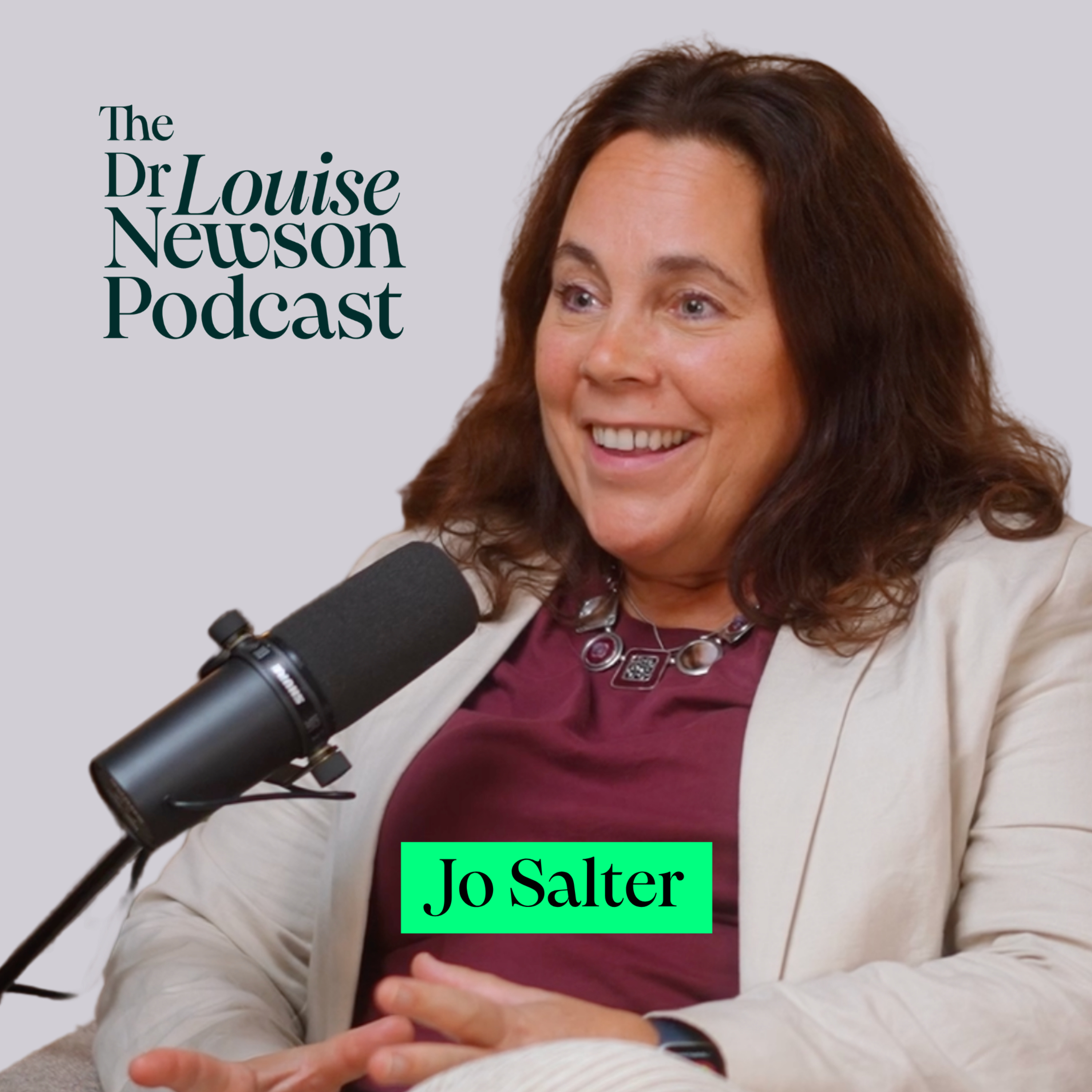
Jo Salter, Britain’s first female fast-jet pilot (Tornado), discusses her menopause and perimenopause hormonal journey, then argues for women’s access to full hormone assessment and advocacy (estrogen, progesterone, and testosterone), including after surgical menopause and breast cancer. She also links normalized PMS/PMDD and postnatal mental illness to hormone changes, especially progesterone withdrawal.
Jo Salter is a former RAF fast-jet pilot who later became a public speaker; she describes severe perimenopausal symptoms (including migraines, insomnia, anxiety) and how she sought medical help after recognizing symptoms matched menopause.
Many women are normalized/overlooked; guidelines often under-treat surgical menopause (less than 15% get estrogen; testosterone 0%). Progesterone and testosterone matter beyond the womb and beyond “estrogen-driven” cancer fears. Fear-based medicine and outdated guidelines block care.
Jo’s desk “ticking” of menopause symptoms leading to treatment; women post-hysterectomy not sleeping/hot flushes; estrogen-receptor-positive breast cancer patients asking about HRT; postnatal psychosis cases improved with progesterone (Katrina Dalton).
Written by AI. May contain mistakes.
Jo shares her experience as Britain's first female fast jet pilot and her personal hormonal struggles.
“So, Jo, it's great to see you here in the podcast studio.”
Discussion on recognizing menopause symptoms and the impact of hormonal changes.
“But why it was so pivotal for me based on my age and the menopause is I remember sitting at a desk surrounded by all of these wonderful people and many doctors listening to the talk before me.”
Jo describes her methods for managing her symptoms through diet and lifestyle.
“So you did have more than a millisecond to look at those symptoms and the penny dropped.”
Exploration of the challenges women face in accessing hormone treatments and misconceptions about their necessity.
“Probably wouldn't have used the right words.”
Discussion of the inadequacies in current hormonal treatment guidelines and their implications for women.
“Now, our ovaries make all three hormones, not just estrogen.”
Clarification of the relationship between estrogen and breast cancer, highlighting misconceptions about hormone therapy.
“We work out of the guidelines, even though the guidelines are wrong.”
Discussion on the beneficial effects of testosterone for women, especially after breast cancer.
“So then we go back to basic science and think, well, would our own hormone estradiol worsen a cancer?”
Insight into how stress affects hormonal levels and overall health, particularly during high-pressure situations.
Learn how stress affects hormone production and menstrual cycles.
“You know, cholesterol, which everyone thinks is bad, actually isn't.”
Discuss the normalization of severe premenstrual symptoms and their effects on women's lives.
“If you'd like to explore some of the topics I've discussed in more detail, I'd recommend downloading my free Balance app.”
Explore the impact of hormones on postnatal mental health and the stigma surrounding it.
“People didn't really like her because she was only a GP.”
Understand the historical challenges faced by pioneering doctors in hormone therapy.
“But what they do is they talk about, would you want to go on your antidepressant in the late stage of your pregnancy or maybe throughout your pregnancy or an antipsychotic?”
Discuss the inadequacies in current medical guidelines regarding hormone treatment.
“So it feels like this sort of groundhog day, really.”
Hear firsthand accounts of women who benefited from hormonal treatments.
“And then you have to, well, you don't have to, but usually we give the progesterone at quite a high dose, either rectally as a suppository or vaginally as a pessary.”
Learn about the importance of advocating for women's health choices and knowledge.
Learn about the importance of empowerment and self-advocacy in hormone therapy choices.
“And before you know it, you've taken a step down that path rather than the other one.”
Discover strategies to overcome barriers when seeking hormone treatment from doctors.
“You know, they might be the best doctor, but it might just not be right for them.”
Understand the difficulties women face in accessing testosterone treatments and the reasons behind them.
“time and time again by doctors, and then you become worse because your hormones aren't balanced, Do you feel maybe it's not a hormonal thing?”
Examine the misconceptions surrounding testosterone and the need for a paradigm shift in understanding its safety.
“They were concerned because this synthetic chemical, testosterone, is associated with risks to heart disease and clots and various things.”
Gain practical advice on how to confidently approach doctors about hormone treatments.

Get the gist, explore an idea or ask about something said.
 Claude
On The Dr Louise Newson Podcast, what are the key points of this episode?
Searching your listeningAutomatic transcript. May contain errors.
0:00Today's podcast you're all going to really enjoy and learn from. I've got with me Jo Salter, who's a great friend and also the first female fast jet pilot. We talk a lot about her own hormonal journey, how it took her a bit too long to recognise her hormonal imbalance. But we also talk about ways that women can really become strong and advocate for themselves and others. It's a great listen, so please enjoy it and share with others. So, Jo, it's great to see you here in the podcast studio. We were just talking, I think it was about two years ago, actually, that I met you and you came to our conference.
0:41So every year we have an in-house conference. And in fact, our next one's in two weeks time because it's eight years since we opened the clinic. So it would have been six years that we opened the clinic. So you came. We all needed a boost. We were having difficult time in the public with various things. and you came to really boost the staff, my clinicians, people that work with me and we had just such a great time. So just tell me a bit, for those people that don't know you, just tell me a bit about your story and why you're so inspirational. Of course. I mean, I remember it really well because it was quite a pivotal moment for me coming to speak to you.
1:20So I was Britain's first female fast jet pilot flying the Tornado and I speak about it and I tell stories about what that really was like and how that happens and some of the challenges and how you overcome them. And my belief is that the biggest barrier in life is getting over ourselves. But why it was so pivotal for me based on my age and the menopause is I remember sitting at a desk surrounded by all of these wonderful people and many doctors listening to the talk before me. And there was a piece of paper that had menopause symptoms Yeah. And I remember just mentally ticking every single one of them.
1:58And even though I was, you know, through the menopause and had coped with it and dealt with it on my own. And so I started my speech with that. And immediately I was booked in for an appointment and saw one of your wonderful doctors. And of course, we have become friends over the time. And it's made a real difference to me. If I could explain the difference in my clarity of thought, if I could explain the difference in my sleep. Yeah. And just there's almost like a level of anxiety that used to exist that's completely gone. Yeah. Well, I remember seeing you and just having a little chat beforehand.
2:36I just think you need to watch. Saying to one of our doctors, can you see her quite quickly? and the thing is you don't know how much is life and how much is anything else or how much is your hormones and you know I'm highly trained I'm very specialized I'd see you know in our clinic we've seen tens of thousands of women so it's pattern recognition but as an isolated person on your own you don't know whether it's just you know you're super busy with your life whether it's just part of age whether it's whatever and and people normalize their symptoms all the time so and And also you probably never have time where you sit down and think about yourself for more than a millisecond.
3:14So you did have more than a millisecond to look at those symptoms and the penny dropped. And also I thought it was a once done and gone, you know. And so going through that whole perimenopausal time when I had migraines that came on, I didn't recognise people. So it was quite severe and I was quite hormonally sensitive to it. And it was seven years ago now. But what I did is I did this sort of, I read and I couldn't find much. No one was talking about it then. Seven years ago, you see, you were just starting. And that whole approach of I did fasting. I found a difference with green leafy vegetables.
3:54I don't know why. If there's anything in that and keto. And I just tried everything and I managed my symptoms. And I think that that was significant. I don't think it got rid of them all which is different Yes and I think that's the thing because the majority of women are unable to access hormone treatments they will try things and actually eating green vegetables will change the pathway of the hormones being broken down in the liver so some people do find it has a small effect exercising can have a small effect all these things can have a small effect but they're not the same as replacing those missing hormones but women do try anything because you want to feel better you know you've you you know you're really busy and you need your brain I mean you do some incredible lectures and you you want your brain to be up there because it always has been in the past so I'm big sharp yes and interestingly I have a couple of friends of mine who have gone through one's gone through a complete hysterectomy and she was saying to me can I take hormones and then my now she's gone through surgical menopause And then my other friend, and they're both in their 50s, has had breast cancer.
5:07And it was an estrogen. Receptor positive. Thank you. Probably wouldn't have used the right words. But again, she's asking me, can she take HRT? Because I don't think we know. Yeah. And what's interesting is that, you know, those are two separate questions. But if someone has a surgical menopause, so they've had their ovaries taken out. if I changed it and just said to you what would you say to a man who had both his testicles removed would you think he'd get testosterone well of course but then it's a good question but if somehow when the ovaries are removed I see and speak to so many women who the doctors at gynecologist see how you get on well I tell you how a man's going to get on if his scrotum go into the pot so we already know how she's going to get on and she's feeling she's three, four weeks post and she is not sleeping well and hot flushes.
6:02And so I'm sending her to you, Louise. So she needs to be seen. And it's really sad, actually. We did an audit of some teaching hospitals of people who'd had a surgical menopause, that had their ovaries removed, to see the percentage of women who were given hormone treatments afterwards. And the guidelines are clear that all of them should be, you know, have a conversation at least about hormone treatments. and less than 15 % have been given estrogen. When you look at testosterone, it was 0%. Now, our ovaries make all three hormones, not just estrogen. So even though she's had her womb removed, a lot of gynecologists think you only need progesterone for your womb, but progesterone is a really important hormone that works on every cell in the body and brain.
6:46So a lot of women after hysterectomy, we should be talking about all three hormones, not just one. So that's really good. And that's really important because I was at a conference earlier this year in Los Angeles and someone was presenting some guidelines about surgical menopause in women. And it was someone from one of the menopause societies and they've got this flow chart, you know, do they have a womb? Yes, no, no, we'll just give them estrogen only hormones. and so then I went up afterwards with a microphone you know in front of the big lecture theatre and said oh I'm just a bit confused here because most people most girls really know that our ovaries make oestrogen progesterone and they make testosterone so I'm just wondering why your guidelines only say oestrogen when progesterone is made in the ovaries they're being removed so you're removing progesterone why is it you're not giving progesterone and you know the female professor who was presenting just said to me, Louise, that's because the guidelines say estrogen only.
7:47And that's what we do. We work out of the guidelines, even though the guidelines are wrong. Yeah. And it was really interesting because the whole audience just went. And then she said, next question, please. And that was the end of the like, I was like a little annoyance in her, in her perfect life. And I don't think it was a stupid question to ask, because why would you like if you remove the thyroid gland, you wouldn't say, oh, I don't think thyroid hormone is relevant. Well, it's not, again, because my friend has already told me, she's been told she doesn't need progesterone because she doesn't have a wound.
8:18So actually, they're following the guidelines still today. Yeah, yeah. And guidelines will never change unless they're challenged, if you see what I mean. And they are guides. They're not a legal document or anything like that. Well, law, look at how law evolves, doesn't it? Of course. As you have case law. And we should be doing the same as we practice medicine. Absolutely. So progesterone says she should be talking about all three hormones, Stephanie. your other friend who's had estrogen receptor positive breast cancer some more nuanced conversation estrogen receptor just means that when they look down the microscope it's got estrogen receptors on it but every single cell in your body has estrogen receptors on it so there is a form of breast cancer that's estrogen receptor negative and that generally means that the cancer has sort of mutated and changed in appearance so it's lost the receptors on its surface.
9:05Oh, I see. But a lot of people think estrogen receptor positive means it's been caused by estrogen. That's exactly what I thought. Estrogen driven or hormone driven and everyone goes, oh my gosh, because a lot of the treatments for those women are blocking hormones, blocking estrogen. So people think estrogen is the baddie really. There are no studies that show that estradiol, the estrogen that's in the gel or the patches that we prescribe is associated with the worsening of prognosis after breast cancer either. It's not associated with an increased risk of recurrence or metastatic disease or mortality from breast cancer.
9:41But we haven't got good studies because, of course, unsurprisingly, not really, you won't be surprised to hear that the studies haven't been done because it's about women. So then we go back to basic science and think, well, would our own hormone estradiol worsen a cancer? It's very unlikely because estradiol is very anti-inflammatory as well. But it's not just about one hormone. We've got those three hormones. And we've just published a series that we've studied of women who actually were given testosterone on its own after having breast cancer. Because it's all about choice, but there's more certainty that testosterone is a different hormone to estradiol.
10:22And testosterone can be very beneficial for a lot of symptoms. There's some data that show that women take testosterone after breast cancer, actually have a better prognosis as well. Oh, interesting. Which is really interesting because it's anti-inflammatory, because it's really important. So often in the clinic, especially if someone's been recently diagnosed, I'll talk about testosterone first and then see how the symptoms are, see how the people feel. Or I might see somebody, I saw someone recently in my clinic who'd had breast cancer seven years ago and she'd had the most awful symptoms and she's now got osteoporosis.
11:00She can't remember things. She's given up her job. She's asked two different oncologists if she can have hormone treatment. One of them just laughed in her face. The other one said, are you stupid talking about hormone treatment? No. So then that made her do nothing, but doing nothing has caused her all these problems. But she's so like further on, if you see what I mean, she's seven years cancer free. Her cancer was very small. um it was an early stage low grade she had his she had a sorry she had a mastectomy she had chemotherapy she had estrogen blocking drugs she had everything thrown at her and she said you know I want all three hormones I don't want just one I want my life back I really want to feel better I've made the decision I want hormone treatments please give me everything so this is where women our patients are central to everything that we do and then we can share uncertainty I mean you've been the highest risk job probably ever and did anyone ever sit down to you and say well joe i don't think you should fly that plane because it might be you know you know that there's a risk only my mom yeah yeah who's only sure you want to do that but but you know what i mean it's like i feel as it was a there was a brilliant doctor oh she still is brilliant but she's retired now charlotte fleming and she mentored me a lot you know eight ten years ago when i was on my own and I said I feel really scared giving women who've had breast cancer HRT and she said Louise let me tell you something I've been practicing as a doctor for 35 years and I've been prescribing hormone treatments to women with breast cancer for 35 years and I've never been sued once I said but I'll tell you something else she said I've had breast cancer and I take hormone treatments but I also do bareback horse riding without a helmet none of my oncologists or doctors have ever told me not to do this high risk activity which I can assure you has a higher risk of death than me taking hormone treatments yet so many doctors have tried to stop me taking hormone treatments but it's about choice Louise and I thought actually isn't this a great mentality you know as doctors we're always watching our backs and thinking are we going to get sued what's going to happen and we're being driven by fear and when you're in fear you become paralyzed and you stop doing things and the immediate reaction is to protect yourself in all measures and not think about the benefit of what you're doing and if I said to you as a patient sorry Jo no you can't have hormones close the door I think oh good I'll never get sued by that woman but actually your life could have fallen apart and you know so I think we have to be responsible for our decision making and and I feel so balanced now with where we are and when I look back over you know becoming a teenager where teenager is very difficult with all of the hormones and the pain that came with it but then going into the air force and flying and i don't know if you're aware or if this is just me or if it's a medical thing but the moment that there was something stressful yeah i would have my period even though it wasn't quite in time it was almost like the body but it's really interesting there is a physiological reaction sort of reason for that So I don't know how much you know about hormones, but they're made from cholesterol.
14:15You know, cholesterol, which everyone thinks is bad, actually isn't. So cholesterol makes progesterone. And progesterone obviously makes testosterone and estrogen. But it also makes cortisol our stress hormone. So if you're suddenly doing something that's highly stressful, your body needs that fight and flight adrenaline hormone, but also cortisol. so your progesterone is pushed to making more cortisol and then it forgets about your estrogen and testosterone so you have like a drop of those other hormones so your body thinks oh I'm having a period and that's what happens so first so it's not um it's not a made up thing yeah well I observed it happening and I went on my survival courses and the only good thing about when you went on survival courses is all the guys bought tampons because they were compressed cotton wool ready to be able to light fires.
15:05So I was completely had enough tampons for however long I needed it. But that must have been hard though, doing some of the stuff that you did and having periods as well. Just deal with it. It's just something that we learn to deal with, isn't it? And I think the first time I ever went to the tanker where you're going to have a much longer trip, I had my period as I went there. I think again, the stress. So my interrogation training course I went on, period. Yeah. So I just got used to wherever I went having you know having to deal with it and I think as women it's just part of what you know that that's part of our day-to-day how we operate but what worries me in that though is that so much is normalized so I see a lot of women with premenstrual syndrome and a lot of women with PMDD premenstrual dysphoric disorder which is a more severe form of PMS and then it's got so bad that they've come for help but when you talk to them it's gone on for years and they said but it's only a day a month that I don't go out it's only a few hours a month that I feel like it's the end of my world and it's just part of being a woman but if you said to a man well you're going to feel terrible or you won't be able to go to the gym for two or three days a month because you'll feel so tired and exhausted and you have muscle aches and pains it wouldn't be acceptable so it's that fine you know balance where yeah we're strong we can get on with most things and we can we can cope with a lot as women but then if it's something that's impacting us we should be reflecting and try and get help if there is especially available a way of making a balance i think my worst time if i think about over my sort of life with periods was post children and yeah the hormonal response and really feeling low after that and there not being any discussion about the impact post having a baby and especially to my first to go from being a fighter pilot to suddenly having this baby at home and then all of those hormonal things going on as well.
17:08Thank you for listening today. If you'd like to explore some of the topics I've discussed in more detail, I'd recommend downloading my free Balance app. It's an app that I created to give women easy access to evidence-based information about their hormones and future health. You can track your symptoms, access expert articles, keep a record of your health journey and connect with a community of women. My aim has always been to help women feel informed, empowered and then they can advocate for the treatment that they both want and need. The Balance app is one of the ways that I'm making that possible.
17:45Search Balance in your app store and download it for free today. I think about it a lot because I see a lot of women who've had postnatal depression and postnatal psychosis and they've often don't admit it because at the time they're so worried that they will get misjudged and one of my good friends recently told me she'd had postnatal psychosis twice and And her husband, who thankfully she's divorced from now, was a complete control freak. And she said, if I ever told him how I was feeling, then the children would have been taken away from me. And I couldn't have that. Luckily, he worked long hours and she could hide how she was feeling.
18:27But it's only now she's menopausal. Now she's taking the right dose of hormones, especially progesterone. She's like, I wish I had had this after both my daughters were born. I wish I had. Yeah. Yeah. Yeah. but nobody was no even talking about it and I'm not sure they're talking about it now they're not actually Jo and there's a big case obviously with Lindsay Clancy of course yeah and I feel so sad I've written about it on my website and done some posts about it because it's horrendous what's happened of course it is and no one will ever know the full details but I just look at this poor woman and think is anyone giving her hormones even now whatever the outcome you know is going to happen in the future wherever she ends up is anyone actually looking after her hormone health because we've all seen the list of dozens of medications that haven't helped her all these psychiatric medications but it's a hormonal problem and we've known this for decades um Katrina Dalton was a very pioneering doctor 50 years ago more than 50 years ago she qualified and she talked about this big hormonal progesterone dropping falling off a cliff after giving birth so she gave women progesterone at quite high doses and I've spoken to quite a few of those women and she she saved their lives and some of them had had postnatal psychosis the first time and she gave it to them as soon as they had gave birth and prevented other episodes and And, you know, it feels so sad that no one really listened to her.
20:03People didn't really like her because she was only a GP. So the gynecologist didn't really like her. But she was also working in the 50s and 60s when all the synthetic contraceptives were coming to market. And there was a big move to market these through the drug companies, through the Department of Health. And they didn't want anything to stop their way. So her talking about natural progesterone and they're pushing out the progesterone only pill. the contraceptive that contains synthetic progesterone. They didn't want her in their way. So she got reported to the GMC. It was the first GMC tribunal, 1959, where she was hauled in front of a male panel because she'd been prescribing progesterone to her patients.
20:45None of the patients had complained. They all felt better. It'd be interesting today, I mean, especially for anybody listening to this podcast now that suffered after their first child that's pregnant again. Yes. Would GPs today do anything about it? Sometimes if they've been under the psychiatrist after their first pregnancy, then they will be referred. And I was speaking to seven psychiatrists this morning. We're hopefully going to do some research in Australia. But what they do is they talk about, would you want to go on your antidepressant in the late stage of your pregnancy or maybe throughout your pregnancy or an antipsychotic?
21:20And the answer is no, obviously. But people do because they're so scared. And it is horrific. can I say having been there? Yeah, and the other thing is people keep saying, well, there isn't enough evidence, Louise, for progesterone, for postnatal depression or postnatal psychosis, but that's because the studies haven't been done. And so this morning they were presenting some data where they looked at every single study. And a lot of the studies were given synthetic progestogens. Well, that's not the same as natural progesterone or a very low dose or it was only for a short period of time. So all the studies were not very well set out.
21:56So I said, well, that doesn't prove they don't work. It just proves that the studies haven't been written up and done. But I said, I'd really love to see the studies of the effectiveness of antidepressants and antipsychotics given to women who have postnatal depression and postnatal psychosis, because what I've read, there isn't good evidence. Has anyone else scrutinized those drugs in the same way? And they said, well, we don't need to, Louise, because it's already in the guidelines. We're back to the guidelines again. We're back to the guidelines. But who's written the guidelines? And when were they written?
22:28When were they written? Of course, and they were written by psychiatrists. So it feels like this sort of groundhog day, really. It's a sort of circular element to it. Yeah, whereas, you know, if you had low iron because you'd had massive bleeding after a pregnancy and your iron had dropped, well, if it was really bad, I'd give you blood back. And if it was just low and you were feeling a bit weak, I'd give you iron back. You wouldn't question it. so if your level of progesterone had gone from 40 000 to nothing overnight and you're feeling awful so here's some progesterone it's it feels really weird it feels really simple it is so simple that's what i hear and again looking at it from the non-medical point of view you know for for all of us women out there it should be simple yeah but it is simple and i it's almost too simple to believe almost and um I'm a very inquisitive doctor and I like to ask questions and I like to challenge myself and challenge my clinical practice a lot and one of our doctors um is amazing or they're all amazing who work with me but she had postnatal psychosis and depression had a very difficult time she had a history of PMDD and her mother had died from breast cancer so with her first child she tried you know she was offered antidepressants and everything else and then she I think it was her second child she just thought this is too much I can't nobody would help her so she managed to get medication for some progesterone and within days that was it she felt completely different and and then she started reading this Katrina Dalton's work and her books and her papers and when she came to work with us she kept talking about progesterone and I always said but Hannah progesterone is just for the lining of the womb it's only for the womb it's only for the womb because that's what I'd been taught she said all right and she bought me some of Katrina Dalton's books.
24:15And so I read. And you were, wow. And then I'm like, why didn't anyone tell me this? And then you have to, well, you don't have to, but usually we give the progesterone at quite a high dose, either rectally as a suppository or vaginally as a pessary. And she said, no, you have to, because a lot of the lower dose actually can make people feel a bit worse. So it's always hard in medicine, trying something new. But I've learned a lot, read a lot. It makes sense, offered to the patients. and then you see the results and it's incredible. You know, I've got one lady who's had postnatal depression twice and she's had PMDD and she's also been a drug addict because she was trying crack cocaine and heroin to improve her mood those days before her periods.
25:00And she was on a bit of HRT when I met her and I said, well, I think you need proper dose of progesterone and probably some testosterone too. So I gave her the cyclogespecerase and she messaged me she said it feels like gold going through my veins I have not felt this good ever not even with heroin did I feel this great oh my goodness and then she then she messaged me last week and said I'm on a holiday with my children and it's the first family holiday that we've had and I've enjoyed oh and it's but it's just a gift to give to women who are suffering you know I mean it makes such a difference it does but it's it's frustrating you know I feel like you know there's millions of women suffering I've just written an article that went out today about you know as doctors we're taught do no harm yet harm has been given to millions of women every day because they can't access hormone treatments and it's how we change perception it's not good enough to sit back and say oh sorry Jo I don't know about hormone treatments you just crack on with your life and you're an inspirational speaker you do the most amazing talks like how do you get people to change their thinking because that's what this is about really it's about mindset shift it's totally about mindset one of the one of the techniques that i talk about which is really simple and i say that that what you're paying attention to is effectively and i don't quite know if this is right and i shouldn't say this in front of a doctor is where your glucose and oxygen or whatever happens in your brain yeah that's where you're feeding and spending your energy whatever whatever that energy is coming from versus the things that you don't want to think about you know and then you the work that's been done on neuroscience brilliant professor called dr andrew huberman yeah yeah who's in uh i've got my stanford yeah i've listened i listened to his podcasts when i couldn't sleep on the on the menopause through the menopause so yeah he had a really good two and a half hour podcast and a lovely voice yeah and he talked all about this rewiring of the brain and where you are paying attention and so what i use as a real i suppose technique is pluck out those thoughts that you don't want to have because once you stop feeding them and you actually are focusing on other parts of your brain you are rewiring and rebuilding the brain that you want that has the mindset shift and i absolutely believe that the hardest thing we've got to do in life is get over ourselves yes that we are that barrier to stopping us and it can come from so many places it can come from things that people have said to us in the past the self-belief we have that little voice that's saying we're not worthy yes we're not good enough we won't make it all of those different elements but actually just say no to them stop focusing on them and just start becoming and being and saying the version of yourself yeah that you dream of being and want to be And before you know it, you've taken a step down that path rather than the other one.
28:04And I think that's such great advice because a lot of the work I do, and I've worked quite hard, well, very hard and quite differently, I suppose, to other people, is it's about empowering other people. You know, I don't actually mind if people take hormones or not, but I want them to be able to have a choice and I want them to be able to advocate for themselves. And so many women, that choice is taken away because the doctors are just saying no. but what is changing is that women are stronger together they're stronger with this voice of reason and logic and belief and I think that is so important isn't it when we're trying to it's like a groundswell really they don't people don't need me to the extent that maybe they did in the past because I'm just talking about basic science it's not like a new drug I've invented that I want people to take this is just established basic physiology and once people understand it's giving them the confidence to ignore the breast cancer nuisance noise in their head from older types of HRT and helping empower other people so it has that ripple effect isn't it it's really important and you never know what the word that you say or what you're reading how the impact it has I spoke at a dental conference just a couple of months ago.
29:23This lady came up to me and she was really emotional. And she said, I don't know if you remember me, but you spoke for us three years ago when I came to your conference. And I decided to do what you said. And I said, yes, she shifted her mindset. She was just brave. You know, I talk about feeling the fear and do it anyway. How do you learn to be comfortable in discomfort? that stretch zone so that you are saying oh I don't know if I can do this but still giving it a go yeah she said I woke up the next morning and I just said yes she said I've had two promotions my life has changed that's amazing isn't it and then she tried to share it in the Q &A session after I'd spoken and she she just broke down in tears and I said would you mind if I share this but actually your emotion is because it's real yes actually how we are feeling when we're holding ourselves back or those voices that we believe or the hormonal issues or the medical issues all of these things are stopping us from becoming the version of ourselves that we're meant to be yeah so how do we take a step again towards that and that's really important because a lot of women i speak to have been turned away and you know um i don't want to big myself up but a lot of people think big yourself up louise yeah go on we love you bigging yourself up a lot of people think that doctors are are godlike and what we say is the only way and this is where we have to have a mind shift to think actually doctors are human beings we can not know everything we might not be trained in hormones we might not have the knowledge we might not have the consulting skills we might just be our you know we are human beings so i think one thing is for people to know that not every doctor is right for them.
31:07You know, they might be the best doctor, but it might just not be right for them. So having that confidence that they can talk to someone else. And then also, if someone has decided that they want to have testosterone, for example, then it's making them feel that it's okay to ask for it. Because it's really hard when people have been pushed back time and time again by doctors, and then you become worse because your hormones aren't balanced, Do you feel maybe it's not a hormonal thing? Maybe I should be feeling like this. And then you lose all that confidence and inner strength. And I think, you know, the way that you talk and giving people the information and the positivity to go back.
31:48And we're doing a lot of work with Balance App. We've got this Navigating No series where we're even giving people little scripts to say. So if you were my doctor and you said, no, you can't have testosterone, Louise. and I could say, well, Dr. Salter, sorry, could you just give me the evidence where it's harmful? Could you just write down exactly why you don't want to give it to me so I can show my husband later? Then you might feel a bit uncomfortable, but I'm not being rude to you. I'm just asking you in a, do you know what I mean? And it's having those tools really to challenge in a positive way because when we're emotional, fear can come to anger and then we can be more threatening and that doesn't always help.
32:26And I think there's something about pushing the appointment as well, because one of the reasons I never went and saw a doctor is it's impossible in my old doctors. I've moved now to get an appointment. You have to sign on at 8.30 in the morning. And if you haven't got your appointment by 8.31, then try again the next day. And so it just became too difficult, which is why I thought, oh, I'll just use the Internet or Dr. Google. And then, of course, we've already talked about what happened. I've changed doctors though and I have they now are actually really keen on supporting you through the menopause and I contacted them on Monday I had an appointment yesterday and they've agreed to take on the progesterone and the oestrogen of course the testosterone is another story because the one that I got from you which is I think from Australia so they don't have it in the NHS they don't have it on the NHS In fact, she said to me, how much do you pay for that?
33:24Isn't that very expensive? But my understanding is that the only testosterone you can get through the NHS is one that is for men. But you have a smaller amount of it because we are just little men, is my thought. So, well, that is right. But we are not little men. No, that was a tongue in cheek. So what's really frustrating is that the Androfem cream, which is licensed for women in Australia, it is licensed over here. They've had the license about a year now, but they don't have any stock. So it's like, why do they bother doing the licensing if they're not actually going to give it to us? So the amount of testosterone we produce as women is roughly about a seventh to a tenth of what men produce.
34:07But we're all different. So there is gel, but what happens is it comes in a sachet and we say to the women, make this sachet of really slippery gel last for about seven days. Like it's just, it's a bit bonkers. So it's actually the man's one day's worth. Yeah, because there is a pump, but the pump produces like one day's worth for a man. So to do a tenth of a pump is really impossible. So then people use paper clips or they decant it into pots. I've got some patients who literally weigh it or use tiny syringes. So it's really ridiculous. So by the time you've done all that, and then sometimes it gets absorbed differently or it doesn't get absorbed as well as the cream.
34:49Some people find it gets absorbed better than the cream, so everyone's different. But it's a complete faff. So how we're allowed almost to prescribe something which is dosed so poorly is just beyond me. And it's the same in America as well. My other observation was immediately I'm allowed to be prescribed just by showing her the bottle and showing her the packet, the oestrogen and progesterone. But I have to have a letter from you. So I'd like you to write that for the testosterone. So it has a different permission level. Well, this is all stems back. So because it is down as a controlled drug, but not controlled to the extent of morphine or heroin.
35:30but what happened was in the 60s and 70s once they discovered testosterone the drug companies made synthetic type of testosterone so they chemically altered it and then it became an anabolic steroid so so it was in the sort of olympics in the 70s people started injecting this synthetic testosterone people got big muscles they did and so then they thought So they banned it from all sports. They made it controlled substance. They were concerned because this synthetic chemical, testosterone, is associated with risks to heart disease and clots and various things. But what they forgot is it wasn't actually testosterone.
36:12The same way that the contraceptive pill is not estrogen and progesterone. It's a synthetic version. So we still got this hangover that people are petrified of testosterone own because they think it's dangerous or it's going to cause side effects or it's you know and it's not it's just a natural hormone so until people have this mind shift and realize that it's really safe and really effective it carries on and it's when it seems to me that this is part of what we should be learning at school totally just the basic information absolutely how our bodies work in the hormonal side yeah absolutely i think boys girls they all should know and it's really crucial actually i'm really grateful i like your inspirational talk it's given me more positivity so that's great but before i end i always ask for three take-home tips so if people are listening there will be people listening who either are struggling to be believed listened to understood by their doctors or they'll have friends who maybe are too scared to even talk about hormone treatments because of unfounded fears using your positivity techniques what three tips would you give them to become a positive version to actually ask for hormone treatments from their doctor number one would be trust your intuition yeah believe your gut because i absolutely believe that there is so much sense there and we don't spend time yeah listening to it and in fact i'm writing a whole book on that at the moment about you know in this ai world about how we need to go back to listening to what we know already the the second one really is about talk to a friend yeah talk it over yeah speak it out say what outcome you want and why you're a bit scared what's the fear what might happen and i have a technique which i use which is called so what yeah and the so what is so what so what might happen so what just keep saying so what which usually drills down to something which is a bit unlikely it's quite small or ridiculous and you think yes okay so what let's go and do it anyway and yeah the third one is feel the fear and do it anyway step out take a deep breath use that as the energy that courses around your veins and say do you know what i am going to go and speak out and see what happens yeah brilliant great so keep listening to those three tips and we can change the world absolutely thanks joe for coming today so just a quick one it would be really great if you could follow or subscribe to this podcast this will really help me reach more people with evidence-based information about hormones and their future health and it also ensures that you'll never miss a future episode thank you
Jo flew supersonic jets under extreme pressure for a living, but missed the menopause happening inside her own body.
This week Dr Louise Newson is joined by Jo Salter, Britain's first female fast jet pilot, who spent years pushing through severe menopause symptoms without realising what they were, until she found herself mentally ticking off a symptom checklist in the middle of a conference. They talk about why testosterone is still so hard for women to access even on an NHS prescription, and the guidelines that leave many women denied any hormones at all after a surgical menopause.
Louise also explains why breast cancer shouldn't automatically rule out HRT, the buried history of progesterone and postnatal depression, and shares a patient story that shows just how much hormones can transform a life.
Jo closes with her three take-home tips for building the confidence to advocate for your own health.
Let’s connect
👉 Track your symptoms and understand hormones, download the Balance app: https://bit.ly/4yZty5A
👉 More from Dr Louise Newson: https://linkin.bio/drlouisenewson
👉Follow Jo: @josaltermbe