Ask ChatGPT

 The Dr Louise Newson Podcast
15 Oct 2026 · 31m · 14 chapters
The episode argues that many women who “can’t tolerate progesterone” are actually reacting to synthetic progestogens (e.g., medroxyprogesterone acetate/MPA) rather than bioidentical progesterone. It also claims progesterone is crucial for mood (“molecule of calm”), neurosteroid production, endometrial protection, and cortisol regulation, and that hormone balance—not “high hormone levels”—matters.
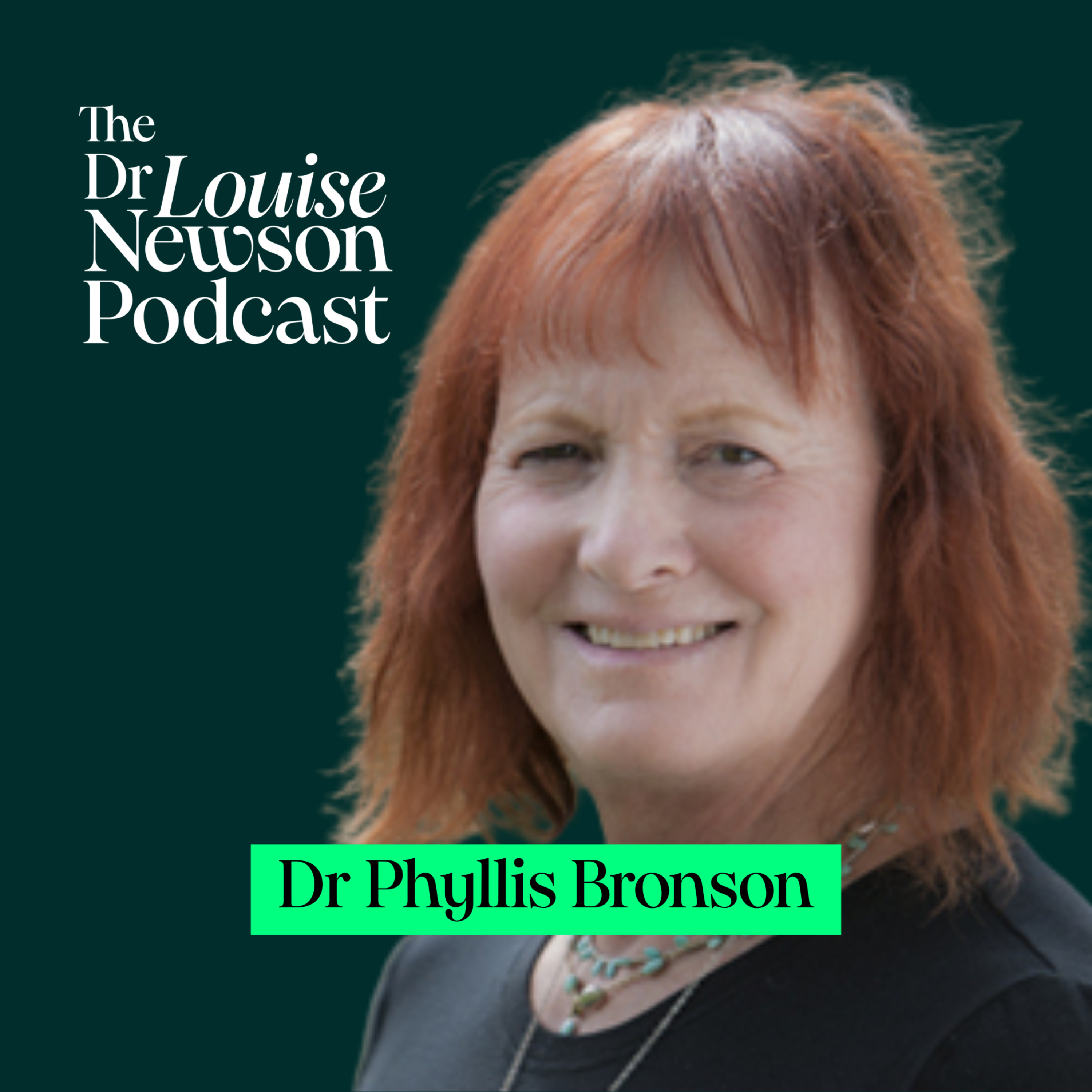
Phyllis (Phyllis is the scientist/biochemist; author of Moods, Emotion and Aging; background in chemistry/biochemistry and neurobiochemistry; works in hormone balancing in Colorado). The host is a clinician who discusses hormone grand rounds and hormone-related patient outcomes.
Synthetic progestogens differ chemically from progesterone and can cause cardiovascular and mood harm; transdermal progesterone is rapidly converted in skin to neurosteroids (e.g., allopregnanolone) and can calm; oral progesterone can cause daytime sleepiness via GI metabolites; “progesterone intolerance” often reflects inadequate estradiol or heightened neurosteroid sensitivity; cortisol is linked to chronic inflammation and depends on available “straight progesterone.”
1997 rhesus monkey study where estradiol alone helped vascular function but MPA caused severe cardiovascular spasms; discussion of WHI blaming MPA; Katrina Dalton’s progesterone suppository work for postnatal psychosis; women improving after switching route/dose (rectal/vaginal vs oral) and deprescribing benzodiazepines/antidepressants.
Written by AI. May contain mistakes.
Phyllis shares her background in biochemistry and her approach to hormone research.
“So hormones and the mind-body connection and you know it's not even got ovaries in this title.”
Discussion on the importance of understanding hormones for women's health.
“I'm a fiery girl, and I love the dark weather.”
Delving into the chemical differences and effects of progestins versus natural progesterone.
“biggest selling drug in the States anyway, and I think worldwide, they desperately need hormones, but I'm not happy with anything that's out there.”
Exploration of the pharmaceutical industry's impact on hormone treatments and misinformation.
“Because they were being fed the same toxic stuff they're fed today when they say such stupid things like transdermal progesterone doesn't absorb.”
Discussion on the protective role of estrogen and the concept of hormonal balance.
“But you can see making a small change with the same composition, actually, is massive.”
Insights into the effectiveness of transdermal progesterone and its applications in therapy.
“and he has data on how many actually died from deep depression and related health issues.”
Learn about the differences in progesterone metabolism between oral and transdermal forms and their implications for women's health.
“because of enzyme activity in the skin, and those receptors are everywhere.”
Explore the historical challenges and advancements in the use of progesterone for women's health, focusing on past and present practices.
“brake on the excessive adrenaline that might happen and the proliferative tendency of estrogen.”
Distinguish between genuine progesterone intolerance and side effects of synthetic progestogens that many women experience.
“So she was really struggling to have a voice, really.”
Discuss the complex histories and sensitivities women may have regarding hormone treatments and their effects.
“Most of what you're saying is right on, but one thing you need to be aware of, there is a small subgroup of women who are adamantly sure they're progesterone intolerant.”
Learn about the necessity of hormone balance and the critical role of progesterone in women's overall health and mood regulation.
“But in science, we have to keep facts alive.”
Understand how progesterone relates to cortisol production and the implications for chronic stress and inflammation.
“We've been looking at this for years, and you're absolutely correct.”
Learn about the significance of progesterone and its effects on women's health.
“And so you need that straight type progesterone to make cortisol.”
Discover essential tips regarding the role of progesterone versus estrogen.
“And so the rush to use estrogen and make estrogen the center of a discourse before progesterone is adequately supplied is incorrect.”

Get the gist, explore an idea or ask about something said.
 Claude
On The Dr Louise Newson Podcast, what are the key points of this episode?
Searching your listeningAutomatic transcript. May contain errors.
0:02So Phyllis, I'm so excited for you to come onto my podcast because I really admire your work, your research, your intelligence, your everything really, the way that you very holistically look at things. And certainly I went into medicine to, maybe it was a bit naive, but to help people and to help people's future lives. And doing the work that I do at the moment, you know, my clinical work is helping women balance their hormones. And it's the most transformational work that I've ever done as a clinician. And I've done various jobs over the years. But actually to know that I can help a woman feel better, but I'm also investing in their future health is incredible, actually.
0:45And women are understanding it more, but there's still so much uncertainty and scaremongering about hormones. so I want to sort of unpick a bit about what hormones are with you but before we start properly I'd just like you know the readers to hear or the listeners to listen a bit about your background because I've got your book here but I've actually earmarked loads of pages because I love it so much called Moods, Emotion and Aging. So hormones and the mind-body connection and you know it's not even got ovaries in this title. And that's just, I love it. So could you just explain a bit about your background?
1:25So it's great to be with you. I've admired you for a long time, actually. And we've talked about you here in the States on our Institute of Bioidentical Medicine and Grand Rounds, which we have Hormone Grand Rounds with David Rosenzweig almost every Wednesday. We have it this afternoon. So we talk about people who are pioneers and you are one. And my background is hard science. My background is chemistry. My doctorate is biochemistry. But I like to say, I live up here in the mountains of Colorado. I've spent a great deal of time at the University of Denver over the years. And I grew up in a medical family in world in Boston.
2:13And I had to leave there. I don't think I could have done the science I've done out West if I had stayed in Boston. It was too state, too constrictive. And now they, some of them clamor to hear me talk, not all of them, but, but that I essentially came West and was able to do really creative biochemistry with the former chair of the department of chemistry and biochemistry, actually two chairs. My scientific father, Dwight Smith, we spent hours and hours and hours discussing the biochemical nature of progesterone. We did the original molecular spectroscopy, and I'll get into that in a moment. So I like to say I'm up here in the mountains.
2:59I'm a scientist and a ski bum. I still love to ski. I love the gray and the dark. I'm a fiery girl, and I love the dark weather. I do very well in England and Scotland. My late husband did his doctorate in biology in Aberdeen. Amazing. I know. He always said I belong in the Scottish Moors. So it's just funny because so many of the women who talk to me want sun, sun, sun, and I want dark. I love the dark and I love the coming of winter and it's supposed to snow this weekend. I'm very happy. All right. So jumping in, I did the long and winding road to finish my doctorate. My father died suddenly in my late 20s.
3:44I was kind of pushed out into the world a little sooner than had been expected. I was still planning to go on and finish a PhD. And at that time, I really had to start working and figure out what I wanted to do. Things had gone from being pretty cushioned to, it's still affluent, but not the same. And, you know, there's a wonderful quote by Pema Chodron, the Buddhist nun. I used it at my beloved son's recent marriage. And Pema Chodron said, to be fully alive is akin to being pushed out of the nest at every moment. And it's a wonderful quote. And that's how I felt back then. And I started working in neurobiochemistry because that was my background and mood issues.
4:42And over time, it became clear when I was working with my great late medical partner out here in Colorado, Dr. Whitcomb. he would come into my office at the end of the day and say, all these women who are coming to us for nutrients, for mood, and who are all hooked on Xanax, a lot of them, biggest selling drug in the States anyway, and I think worldwide, they desperately need hormones, but I'm not happy with anything that's out there. And I was doing my doctoral research and ended up writing my thesis in doing the molecular work on the difference between progestin and progesterone and why it matters.
5:25And how long ago was that? In the late 90s. Amazing. Yeah. And I already had an extensive chemistry background, but that's when I did that molecular research. And what happened was, should I just jump in and tell you some of the triggers that were so important? There was a wonderful study going on. I think it was in 1997 at the Oregon Regional Primate Lab. Separate from my work, but a wonderful biochemist named Kent Hermsmeyer. Absolutely brilliant. He was showing how important pure estradiol in significant amounts is for vascular integrity, for cardiac function. With rhesus monkeys, he was not looking at mood issues.
6:17He was looking at vascular function. And when he injected the monkeys with straight estradiol, they thrived, great blood flow, et cetera. And then he gave them real progesterone just to see that it didn't interfere. And it did not. Then when he gave them medroxyprogesterone acetate, the dominant MPA that's used for most older women in hormone replacement therapy and is the substructure of most birth control pills. The MPA was the prototype for all the synthetic hormones. And they then injected those monkeys with medroxyprogesterone acetate. That's the pro part of prem pro. The monkeys went into such severe cardiovascular spasms, they stopped the study.
7:14And Kent Hermsmeyer said, wow, this is a really dangerous drug. Now, what did the pharma companies do? And not everything pharma does is bad. They do some very good things, but they do a lot of mischief when they mess with molecules that are meant to be intact. what pharma did was they kept making the same bad molecule mpa just in lower doses yeah and at the same time we were studying the molecular spectroscopy for a transform infrared spectra looking at the difference between progestin and progesterone and we were doing that with the background noise of young influencer doctors, we would call them today, saying, oh, there's no difference.
8:04Because they were being fed the same toxic stuff they're fed today when they say such stupid things like transdermal progesterone doesn't absorb. And when they say such stupid things as high estradiol causes cancer when the opposite is probably true, which is very much what is discussed in the great new book by Jeffrey Dash, my colleague, chapter 19, all about the importance of estrogen as cancer protective. And so let's jump in and talk about all the distortion and how these things happen. And it's just really, I mean, I feel very embarrassed, and I said to you before we started, because as a doctor, you believe what you learn, don't you?
8:56So even the mini pill was always called progesterone-only pill. And I do actually know our Faculty of Sexual Reproductive Health have, I don't know when, but recently changed it, so it does now say progesterone-only pill. But we were always, I just thought progesterone is progesterone, but actually it's not. And, you know, you say progesterone, we say progestogens. It doesn't matter. It is not progesterone. And everything has its own chemical structure. That's right. And I was trying to think a while ago how to explain it in a simplistic way because I did, obviously, an A-level in chemistry and I've got a degree in pathology.
9:37So I find this quite basic, but a lot of people aren't scientists. So I was thinking about carbon and the structure of diamond. So carbon is the only element in diamond, as many listeners will know. But so is graphite pencil. So pencil lead is carbon, but they're just made in a different way. They've got an extra bond to form the diamond. But you can see making a small change with the same composition, actually, is massive. You know, if my husband came home and said, I bought you some... carbon. I really hope it's diamond and not a pencil. But, you know, and these are more than just adding an extra bond, the difference between progesterone and the synthetic progestogens, are they?
10:22They're really quite changed. And you can see how they have such a different effect. Your example is charming. However, you're talking more about the alchemy, you know, how carbon eventually becomes diamond and how natural elements morph into other natural elements. It's kind of the alchemical aspect of chemistry. Whereas what pharma does is a little more mischievous. They actually take a perfect molecule. They take a perfect molecule. And it's not that it's evolving. They actually tack on side chains saying, well, it's just a little mischief and just a little bit to make it patentable. Okay. And I don't care if a molecule is grown on a shrub or a tree or synthesized in a lab if it's the exact molecule.
11:20Bioidentical molecules, when they're compounded at a great compounding pharmacy or at a pharmaceutical company. There are a few versions. We prefer compounded for a number of reasons, but there are pharmaceutical versions. Most of them are oral. The problem is those little tweaks are made to make the molecule patentable, you see, because you cannot patent a biological substance. and that's where the mischief happened and it happened 50 years ago when doctors were told all these women are thriving on estrogen they were all getting estrogen and then most of them were getting primarine when it became available and primarine is conjugated equine estrogens i don't like it but it's better than nothing for a lot of women it's the pro part that i object to Well, this is a problem, isn't it?
12:19Because, you know, lots of people know about the ill-fated WHI, the Women's Health Initiative Study. And actually, when you divide it into two, so you divide it into the people that had the conjugated equine estrogens, although we don't prescribe those anymore, and the ones that had the mejoxyprogesterone acetate in them, all the bad press is with the addition of the mejoxyprogesterone acetate. Of course. And we knew this at the height of our research, this information was coming out only couched in women have to get off their hormones. And according to Jeffrey Dash and other colleagues, 50 ,000 women, I would say radically declined after losing their estrogen.
13:05and he has data on how many actually died from deep depression and related health issues. You know, you have to understand people say, well, is it natural to be replacing hormones in women who are older? Well, is dementia natural? Is cancer natural? So we're not looking for this holy grail of high hormone levels. That's not what we're looking for. What we're looking for is a question of balance. What works for that individual woman? Let's talk about progesterone here, right? When you rub that cream, 80 % of it is immediately absorbed into the skin and converted immediately to neurosteroid precursors and actual neurosteroids like allopregnanolone.
13:58And that conversion happens because of enzyme activity in the skin, and those receptors are everywhere. So 5-alpha reductase takes that progesterone. 80 % is converted. So how on earth could you then say, as some of these influencers are claiming, well, you can't get 6 nanograms of progesterone to protect the endometrium? No, you can't. That's why it's insane and totally lacking in biochemical consciousness to use the same discourse for oral progesterone as you would for transdermal because 80 % has already been converted, which is why women love it. We've gotten so many women off of benzodiazepines with transdermal because they get calm, whereas with oral they get sleepy.
14:56Why? Why? Because with oral, the conversion happens the same way, only with the liver first pass, the enzymes are more abundant, more intensified. So you have a stronger reaction and it's measurable in serum, which it's not with transdermal. However, the same endometrial protection happens from whatever straight progesterone is not metabolized with either transdermal or oral. With oral, there's more exogenous progesterone available to be measured. So they measure it and they say, oh, if it's over six nanograms, your endometrium is protected. Well, we've had 27 years of women saying they feel great on transdermal and years on suppositories as well.
15:57No endometrial. We've had two women with significant breakthrough bleeding. Now, when breakthrough bleeding happens, almost not always, and it has to be checked out if it's ongoing. but almost always it's a buildup in the endometrium that needs a shed. And so you use as much progesterone as needed until you get that shed and then you start over. But you don't cycle like you're a teenager having a period that makes no sense. If you're going to use high levels of estradiol, as some claim you should do and have a fake menstrual cycle, that's not safe. It's not safe to have unopposed estrogens circling around without progesterone to mediate the proliferative tendency.
16:49So we are big advocates for daily use. You're not messing up your neurosteroid chemistry. It's pretty intensely intact. What progesterone does is it puts a brake on the excessive adrenaline that might happen and the proliferative tendency of estrogen. I mean, you can't just say, well, you'll have better neurosteroid chemistry and get cancer. I mean, no. You want to block the proliferative tendency of estrogen. So progesterone is the molecule that does that. And when you have that transdermal molecule, and I'm so thrilled to have people learn this, because when you use enough, a woman gets calm.
17:35With progesterone, it's 100 % clear. With estradiol, what people don't realize, you need enough to get out of depression. You need enough estradiol to counter some of the crazy metabolic things that happen as women age. And as women age, their fat cells are pumping out estrone, the more toxic estrogen. And the way you compensate for excess E1 is by getting enough E2 going. and most women don't get enough. So there you go. Yeah. It's so interesting. And I often say to patients, you know, it's a balance of those hormones, but progesterone really has been the forgotten hormone for so long. I mean, even many years ago in the 60s and 70s, Katrina Dalton was prescribing higher doses of progesterone as a suppository, so rectally or vaginally.
18:38And I know she was hauled in front of the General Medical Council and the British Medical Association to be told off. But she was very scrupulous with her note-taking. And they said, oh, gosh, you seem to have had good results. And I've spoken to some of her patients who she treated with postnatal psychosis, who really, she saved their lives. And she was very insistent at the time that it had to be a certain dose and it had to be progesterone, not the synthetic progestogens. But in the 60s, obviously, all the new synthetic hormones were coming to market as the new birth control pill. So she was really struggling to have a voice, really.
19:15And the people that listened to her were women, actually, who really noticed such a difference. And her work has been forgotten for a lot of time, really. But it is really important about having, you know, some people absorb things very differently in different ways. And I think to have a choice is crucially important. You know, there's a lot of talk about progesterone intolerance. And I did a YouTube about progesterone intolerance, and it was one of the most downloaded YouTubes I've had. And I don't actually think that there is an intolerance of progesterone. There is progestogen intolerance.
19:54There's lots of people that have side effects to synthetic progestogens. and then they think they can't tolerate natural progesterone. Let me jump in here biochemically, okay? Most of what you're saying is right on, but one thing you need to be aware of, there is a small subgroup of women who are adamantly sure they're progesterone intolerant. I don't negate any woman's experience, okay? What I try to poke at them with is look at your history. Look at your history as a young woman, as a girl, as a young woman going back till you were 14. Most of the women who claim that they are progesterone intolerant have a history.
20:44And I'm not blaming their symptoms, okay? I'm saying they have a history of being overly empathic, of giving more than they get in most relationships, of being emotionally, what's the word, too accessible to life. And they have neurosteroid chemistry that correlates with that. They are ultra sensitive. Many of them have been on mood drugs for years, not all, but many, many, many on these sites that I've coached. and they get adamant about their progesterone intolerance. Carol Peterson says most of them need more. Most of them need more. Now, I will slightly deviate from my great colleague, and we have done a lot together on this general field.
21:39So she would say more and more and more. I will say sometimes the issue is more estradiol is needed for depression and then bring up the progesterone. And she has found that many women who think they can't tolerate progesterone are just not getting enough. Now what happens, it's so interesting when you look at some of the theories that pop up today. There's a theory for everything, right? But in science, we have to keep facts alive. and there are very few testing modalities that make any sense for hormones i think most of the urine tests are crap um they're just there to confuse people oh you need this and that and you got to buy 800 of supplements it doesn't mean anything we test estradiol and testosterone and if there's an issue we test again in the in the research world blood is the gold standard and because of our affiliation with the hospital, we have to do blood tests occasionally.
22:47But they really are not very telling unless somebody is really off and you want to know. And with most of the testing modalities, they just aren't telling you much. Absolutely. And I think what's really interesting over the years, I've learned a lot from my patients. And, you know, like you're saying with the doses of progesterone, And I've seen some women who haven't tolerated a standard dose of oral micronized progesterone, and then they've used a higher dose rectally or vaginally, and it has literally either transformed or saved their lives. And also, you know, it's quite short acting. I always say to patients, I'm not giving you a long injection.
23:28I'm not giving you an implant. You are in control, but just try it for a few days, and then you will start to know how you're feeling. And often it makes such a difference. And, you know, these women then, we can deprescribe some of their antidepressants, their antipsychotics, their lithium and so forth. And when we know how progesterone works in the brain, especially the effects on cortisol as well and all the other neurotransmitters, it's very, when you take it down to basic level, it's such an important hormone. Yet most people think it's only for the womb. And whether people have a womb or not, it's still a very important hormone, isn't it?
24:08The second chapter of my book is progesterone, the molecule of calm, C-A-L-M. I think it's chapter two. We've been looking at this for years, and you're absolutely correct. And Gerilyn Pryor, who's head of Semcor, C-A-L-M-C-O-R, she's semi-retired now. She's probably, I mean, she's getting older, but she's brilliant. she's used 300 milligrams of oral at night of bioidentical progesterone that's her standard dose and she's had great results for endometrial protection and for insomnia but the problem is some some doctors who are learning the importance of transdermal on mood are saying things like, well, with oral, you're making too much allopregnanolone.
25:01No, you're making allopregnanolone. That's a good thing with both, okay? What happens with oral is a different thing. For women who are vulnerable, and it's a lot of them, they form these upper GI metabolites from oral progesterone, real bioidentical progesterone that are a first cousin of phenobarbital. So I think it's 5-alpha-pregnandione, and that makes them incredibly sleepy. And so it's fine at night. It's not fine during the day. We have women on top of their nighttime 400 milligrams average who will use 100 milligrams every hour for four or five hours if they're going through an intensely difficult time transdermally.
25:58And we don't recommend using 200 at a time during the day. It's too calming. But you can use 100 easily. But you see, our bodies are also designed not to produce the same amount of hormones every day. you know when we're younger we're constantly changing and that's what happens with all our hormones you know our bodies are amazing and our hormones you know progesterone, estradiol and testosterone do not work in isolation do they? They work with all our other hormones too. Exactly. And some women are very intuitive actually. I've got some patients who just know whether it's a hormonal issue or something else especially if they're still having periods they know when they've got more of a drop of their progesterone and they might use slightly more before their periods, after their period, they don't need as much.
26:44And I think it's important for women to have some control as well, because they usually get it right when they know what they're doing. Well, one more important thing. Do we have a little time? The straight progesterone that's left over after so much conversion to the neurosteroids to help women get calm, whether it's transdermal or oral, you need leftover straight progesterone to protect the endometrium, and you get it from either form, and for such crucial functions as making cortisol. And this is something I must bring up because there's so much misinformation about cortisol in the, quote, holistic naturopathic discourse, even though they do some things well, this is such a misconception that it's cortisol spikes that are indicative of high stress alone which they can be for sure but it's a chronic low cortisol that is such an indicator of chronic inflammatory issues and allow when you don't have enough cortisol the inflammatory cytokines and major markers like interleukin beta are so easily able to produce a lot of mischief neurochemically, biochemically, and especially since COVID from the virus and from the vaccine itself either can have this inflammatory, chronic, long-term effect.
28:26And so you need that straight type progesterone to make cortisol. And if progesterone's low, cortisol's high because it's being used up to try to overcome that spike. Yeah. And it makes so much sense when it's understood, but sometimes in medicine, people don't go back to the basics. So I'm very grateful for your time. But before I finish, I always ask people for three take-home tips. So I just thought if it's okay to ask you three things or the three main things that are important about progesterone because we've already acknowledged it's such an important hormone. And I'm talking about the natural progesterone, not the synthetic progestogens.
29:12So the three main reasons that people should think about progesterone in perhaps a different way than they have done before. The most important is for mothers to hear, don't put your daughters on birth control pills. Start them on a lifetime of synthetic progesterone and anxiety if they're vulnerable. And so for us, one of the most important things is the inhibitory aspects of progesterone, the calming aspects of progesterone. Women go into perimenopause in their 20s and 30s. It is the first hormone to decline with the decline in progesterone. And so the rush to use estrogen and make estrogen the center of a discourse before progesterone is adequately supplied is incorrect.
30:05So those two points. And I would say to recognize the difference between a vascular symptom and a nervous symptom. For example, a lot of headaches in young women are emotional, right? But there are headaches that are clearly vascular that need estrogen. And I like to point that out because those women are sensitive to the barometric changes too. Those are not classic migraines. Those are vascular headaches that need estrogen. Nervous headaches need progesterone. Yeah, really important. So thank you so much for your time. It's been great. Thank you. My great pleasure. I really enjoyed talking with you.
Biochemist Dr Phyllis Bronson on why women who can't tolerate progesterone may actually be reacting to progestogens/progestins (the synthetic type of progesterone)
Phyllis has spent decades researching progesterone and mood, and her doctoral work looked at the molecular differences between body identical progesterone and the synthetic progestogens found in many contraceptive pills and older types of HRT. She joins Dr Louise Newson to share the primate study that changed how she saw synthetic hormones, and why a small change to a molecule can have such a big effect on the body.
They talk about progesterone as the "molecule of calm", how transdermal and oral progesterone work differently in the brain and why some women may simply need a higher dose. They also discuss progesterone's role in making cortisol, and why it's often the first hormone to decline, sometimes as early as your 20s and 30s.