Ask ChatGPT

 The Dr Louise Newson Podcast
21 Jul 2026 · 27m · 12 chapters
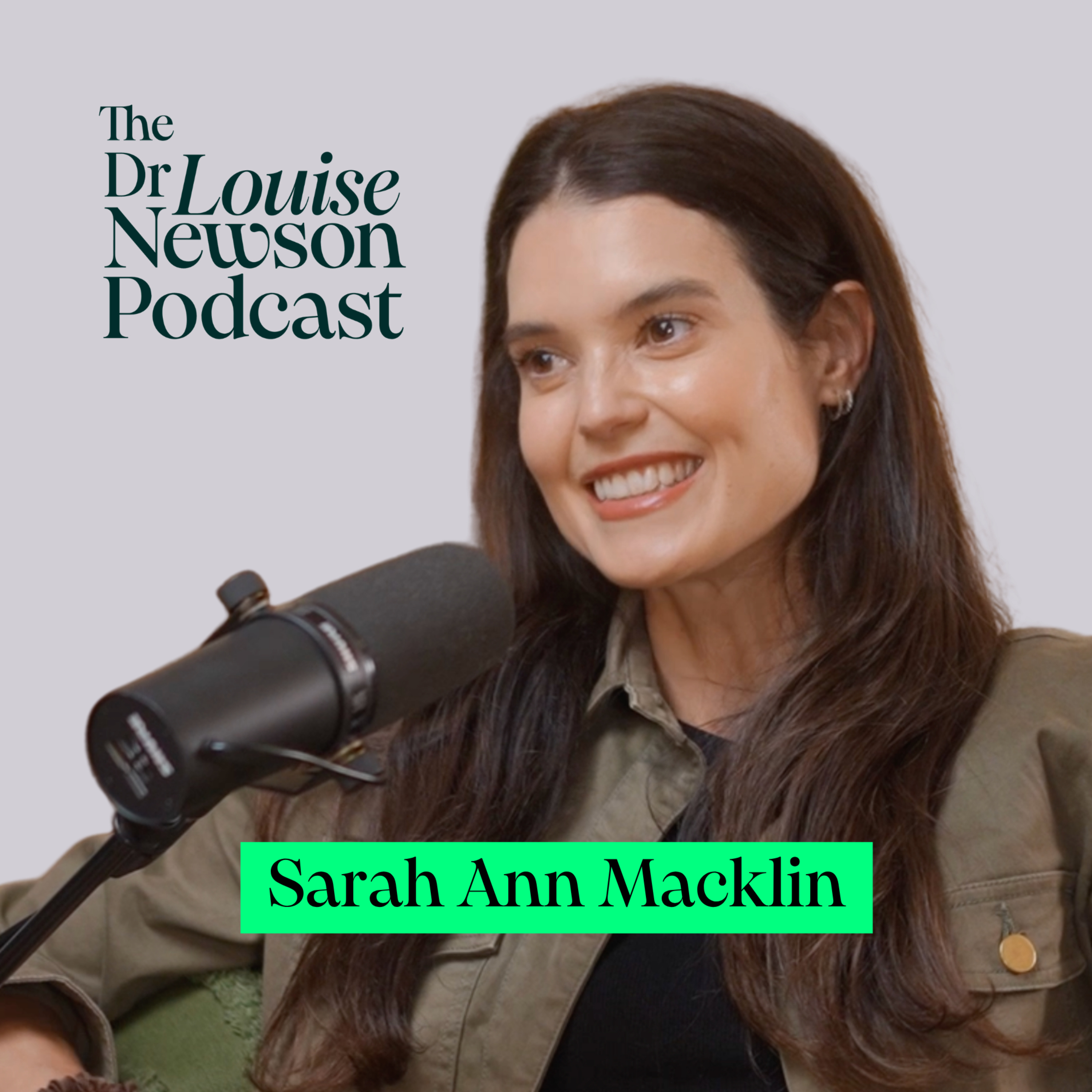
The episode argues that “being healthy” is hard because people focus on food protocols while neglecting mindset, self-compassion, and chronic stress. It links mental health, inflammation, and gut-brain pathways, and criticizes the wellness/optimization industry for selling expensive “longevity” fixes instead of basics like sleep, eating well, and emotional self-care.
Sarah Ann Macklin. Background: international model (spotted at 16; moved to London; successful career) who was hospitalized at 23 with life-threatening infections (urosepsis/E. coli, kidney issues, “10-burst cysts”). Later studied nutritional science; diagnosed with dyslexia; founded/hosts “Live Well Be Well.” She writes Healthy Shouldn’t Be This Hard.
self-compassion reduces stress response and supports long-term habits; mindset changes how people respond to food and affects gut microbiome; basic interventions can reverse outcomes.
SMILES trial (modified Mediterranean diet; 33% remission vs 8% control with a befriender); Harvard “chambermaid study” (belief about energy expenditure improved waist/blood pressure); “milkshake study” (indulgent vs diet framing changed hunger hormones despite similar calories).
Written by AI. May contain mistakes.
Sarah shares her background, hospital experience, and transition to studying nutritional science.
“Yeah, and the cover, it's quite provocative I think, the cover.”
Sarah discusses self-compassion and its impact on health and mindset.
Dr. Newson and Sarah analyze the link between mental health and inflammation.
Discussion on various studies revealing the influence of food and mindset on mental health.
“and a lot of people don't join the dots and I don't think doctors join the dots either which makes it even harder for lay people to try and get help from a medical professional.”
Exploration of the wellness industry's growth and the need for self-care and compassion.
“They hadn't had the differences of 600 to 160 calories.”
Discussing the challenges of prioritizing health and well-being.
Emphasizing the value of basic health habits over expensive solutions.
“We all know that when we do really basic things that don't cost lots of money, eat healthily, sleep, you know, reset in a better way, have a positive outlook.”
Exploring the concept of self-compassion and its psychological benefits.
Discussing the dangers of self-esteem based on external validation.
Encouraging listeners to develop their own strategies for better health.
Addressing the prevalence of negative self-talk and its effects on health.
“They're like, I actually feel like I have, I can actually take action.”
Summarizing key insights and sharing actionable tips for listeners.
“So I'm very grateful for you, Kaka, because I know you're so busy at the minute.”

Get the gist, explore an idea or ask about something said.
 Claude
On The Dr Louise Newson Podcast, what are the key points of this episode?
Searching your listeningAutomatic transcript. May contain errors.
0:00Sarah Ann Macklin is a guest on my podcast today. She's recently brought a book out called Healthy Shouldn't Be This Hard, a simple way to eat, think and feel well. We all often know what we should do, but actually putting it into practice can be difficult. We also talk about how the longevity and well-being space is worth a fortune, but are we really spending our money in the right ways? sometimes making it very basic can really make the biggest difference so we talk a lot about how we can improve our health in simple ways so you're in my podcast last time i was in your podcast and you've now written and i love the cover do you it's really cool so it's called healthy shouldn't be this hard and what i really like is this like you've got a list where everything's crossed out and actually it says a simple way to eat to think and feel well and I really like the think bit actually I'm really controlled by my mind a lot I I like my mind and I don't like it because it's just gets a bit overwhelming so this is really really important book and I love it and it's very easy to read thank you so welcome really so for those of you that don't know you, tell me a bit about you and your background.
1:22Okay, well thanks for having me. It's quite nice to re-swap seats. Yeah, and the cover, it's quite provocative I think, the cover. My background is, I feel all the way back to over 20 years ago when I had a completely different world, a completely different life. I was an international model for like many years. I got spotted at 16 and at 18 when I finished my A-levels. I moved to London and I was very lucky that I had this amazing career. But there's always a but, isn't there? At 23, I kind of had, I was admitted to hospital. My body basically stopped. It kind of, all the signals that were sending me over those years, I ignored.
2:04And I ended up hospitalized with a whole host of things like urosepsis to E. coli to 10-burst cysts and and yeah it was life-threatening I mean they had to helicopter the only antibiotic left from Scotland down to me um within 12 hours or I would have passed and so I think like that was quite pivotal moment quite young yeah really young you know and there's multiple diagnoses there and you have so many different consultants but my diagnosis many years later was that I shut off every signal my body ever sent me because my mind was incredibly strong and overrode everything and that sent me on like a huge path and if you think you'll know this but you know 20 years ago health and nutrition was not mainstream mental health was massively stigmatized it only really started changing in covid when everyone started to realize that mental health isn't always a mental illness it's everyone has mental health and we all need to kind of look after it and so I kind of went down the road of I'm not well I need to figure out how I look after myself and went back to went back to school and studied nutritional science everyone thought I was mad totally mad yeah because I I was living the dream I would say although obviously I wasn't because I was hospitalized but you know the words success is quite an interesting one to define which you know the Oxford Dictionary describes it as fame wealth and social status and so like externally I had that right but internally I had none of it so I went back to school and everyone was like what are you doing like you had all you know making all this money living in new york you kind of got this great life but i was that happiest i ever was and when i went back to school to study nutritional science within six weeks i went to drop out and my professor said why do you want to why do you want to leave and he was like i'm just not very smart like i'm really not smart and i don't think that like i can do this and she did something extraordinary which i'll always remember she looked at me and she was like why would you say that I said well you want me to give a presentation in two weeks in biochemistry about this thing called the Krebs cycle that I don't even know what that is and I was so overwhelmed in class and she said okay well here's something that I've picked up within like you just started uni I think you're neurodivergent I think you have dyslexia um and I think once you can understand your brain you will really enjoy this degree wonderful she said that she was amazing and I just looked at her and I was like what it's dyslexia I'd never heard of this anyway so she sent me she had promised me please don't drop out just do this first don't have to do the presentation and then let's like kind of regroup so she gave me a lot of compassion in that moment and then two weeks later they gave me the diagnosis of dyslexia which sounds like a terminal illness when you're like I was diagnosed with and it kind of feels like that at the time right and then the woman who diagnosed me said this is going to ultimately be your superpower and she really helped me understand my brain and that gave me a huge connection to wanting to know more about the mind and nutrition because then for me I was like well this is something that really affects me and I'd realized that you know my mindset had also really affected me through modeling and so that sent me down this like long path wanting to know everything about nutrition and the mind and then once I got there I wanted to know more about the mind and that sent me down another long path and I started the podcast live well be well and after five years I kind of got to the emphasis of this book which for many people who listen to this who I'm sure are English will have the cringe when I say the word self-compassion but I realized one from that professor telling me to not give up that was compassion mirrored to me that ultimately I had no self-compassion and actually we can have the healthiest diet in the entire world but if you do it whilst you're hating yourself you won't get the same result and it's the same with everything and so I had to learn the steps towards what self-compassion really meant and especially being English there was a huge kind of friction for me to to have that word the Americans love it but the English really struggle and you know what I realize is it's the antidote to so much of that kind of controls us and to kind of makes us make the poor health choices or increases our stress hormones which increases inflammation turns on our threat response in our brain which we know is like not healthy and we're always living in this chronic stress and we know all of these things but for me it was like how do we break that cycle how do we actually look after us first and so that's where kind of my journey is today talking about this well it's incredible though isn't it because it is so important and I'm as you probably know really interested in inflammation because it's the core of so much and how we can reduce inflammation will keep us healthier and we've known for many decades that mental health is associated with inflammation in the brain yet so often people are just given chemical drugs to help or not help depending on how you look at the research but I think like you say people are thinking about mental health differently and I was one of those doctors in the early 2000s that prescribed a lot of antidepressants because I was taught that's what you did and I thought giving Prozac was the best thing ever until I realised the harms of some of these drugs but we need to be thinking within how we can help because mental health, our brain is not an organ that works on its own you know, once we discovered the connection of the gut and the brain everything feeds into the brain the brain tells our whole body what to do and a lot of people don't join the dots and I don't think doctors join the dots either which makes it even harder for lay people to try and get help from a medical professional.
7:50Yeah totally I think there's a part of the book where I talk about SSRIs it's very brief but you know there was a study the first study that I came across that connected the mind and the body was Dr. Felice Jack at the SMILES trial which was like a renowned kind of pioneering study at the time which actually showed that and this is the food first step that food can reverse clinical depression so she put participants on a modified Mediterranean diet which basically just means an extreme version of the Mediterranean diet like five to eight portions of whole grains a day um so they had no room to eat anything else and what they found is that after um three months 33 % of the participants overcame clinical depression I was like oh well so the food really does influence the mind that's the gut going up to the brain then there was really interesting control group and I've spoke to Felice Jacker on the show and we still didn't even speak about this but eight percent of the control group also overcame clinical depression now this is people that had been in clinical depression for years they went into remission now that eight percent was the control group but the only thing they had was a befriender so it wasn't a therapist it wasn't someone they went in and spoke about childhood traumas to what went through their whole life it was something that they did with a befriender that they enjoyed something that kind of took their mind off and allowed them to have some joy in their life.
9:09And I was like, that's interesting. Imagine if they put that group with the food together. Imagine if there was a study that could see, would we even get better results? And I think about that. And then I thought about Dr. Ellen Langer, and I don't know if you've heard of her. She's the kind of pioneering woman at Harvard. She's like the first ever woman to come out of Harvard. And she did this incredible study called the chambermaid study which then really changed my perspective so I was only looking at food and mental health for such a long time and then when I spoke to her she told me this really interesting study about chambermaids where she asked you know how often do you exercise and they all just looked at her and they were like well obviously never I never have any time and she said okay well I'm going to split them in half I'm going to tell one half of that group that this is how much energy they expend from mopping the floors changing the bedding hoovering all of the things that they do on their feet all day and i'm actually going to show them how much exercise they're doing the other group she said nothing she said okay cool just carry on one month later the ones that had been told that they were doing you know a lot of energy expenditure they lost weight around their waist circumference which we know is the most important metric for our health their blood pressure reduced by 10 percent they had so many different changes to their overall health just from telling themselves that they were actually doing enough that they were actually doing as much as somebody who was going to the gym class and that made me then think oh I wonder what that happens if we relate to our health I wonder if our mindset also influences the food we consume and then the next study that came along was Aaliyah Crumb and this kind of takes me to like the connection with the mind and body where she did the milkshake study now I was small.
10:56There was only 46 participants, but I found it really fascinating because I would always go and order like a skinny hot chocolate. That was always my natural order. I could never go, I'm going to go and have like the delicious, luxurious, full fat, all sugar hot chocolate. I was like, absolutely not. And I read this study and she basically gave two groups a milkshake. And she said one was indulgent and one was diet. And she said, this one has over 600 calories. This one has around 160 calories in the diet. Then when they drunk the milkshake, they both hormonally responded completely differently.
11:30The hunger hormone actually went down in the one that was indulgent, which meant they felt fuller. And the one that was diet, the hunger hormone didn't. Yet the milkshakes were both 300 calories. They hadn't had the differences of 600 to 160 calories. They were just being told. Exactly. So it was their perception, their mindset with the food. So when I started to like put all these studies together, I was like, well, we do know food influences mental health, but that can't be the only connection. Our mindset is also bi-directional. We know it changes our gut microbiome, but it's also changing how we respond to food, the choices that we make, like how we see that, how even full we feel, it's changing.
12:11and so I thought I feel like we've got a bit of this backwards I feel like before we put food on a pedestal we also need to put the mindset there as the foundation because I was seeing clients come in and just taking their biomarkers and looking at a food diary for me I was like I felt like I was banging my head against a wall a little bit I was like what if we reverse that start with the mindset and then we add the diet on top surely that's a much stronger foundation for long-term change and how they see themselves than just the food itself. And so I think, you know, the connection between the mind and body is, you know, the gut, as you said, has exploded off over the last 10 years.
12:50And I think this is where it's going to be going with the mindset, the mind and body connection. We know it's so important, but we haven't quite created the tools. And now we live in what is predicted to be next year, which I find mind-boggling. The wellness industry is predicted to be$8.5 trillion. I read that. Isn't that wild? It's just crazy. But then isn't that people making money out of people who just want to feel well? And I felt really sad because I read it and I thought maybe it's a misprint and it was billion, not trillion. And then I read it again. And I think what I'm really very sad about as a healthcare professional is that a lot of healthcare professionals are letting down their patients.
13:31So they're going elsewhere. But often in medicine and in life, it's the basics. you know we we need to look after ourselves and I think there's so much words that scare people or means that something different you know even longevity means different things to different people self-compassion people think oh well that's a bit woo woo but actually let's just put ourselves first if we're healthier we can look after other people better you know my oldest daughter many people know has chronic migraine and I'm constantly going down to the flat that she lives in in London and I'm cleaning and tidying and cooking for her if I'm not well I can't do that and I have to be able to look after her because it's not fair you know on others so it's my incentive but I should be doing that anyway because I've got two other children and I want to be healthy for work and everything else but somehow for call it self-compassion I feel like it's really selfish but if I'm there saying no I've got to be well for my children it feels like I can say that but I shouldn't have to justify it to anyone interesting right I hope you enjoyed today's episode.
14:38If you'd like more information about your hormone health, download my free Balance app. It allows you to track symptoms and cycles, access hundreds of educational articles and videos, and also connect with supportive community of women navigating similar experiences. We all know that when we do really basic things that don't cost lots of money, eat healthily, sleep, you know, reset in a better way, have a positive outlook. It makes a big difference. And I feel sad that people are spending so much money and they're not doing the basics. Well, I think like what that dissects, right, is it's going to be 8.5 trillion pretty well predicted to be in a bio next year.
15:21I think it's since I've written the book even gone up now to 9 trillion. But I think what that says is that ultimately we all want to be healthy, right? Ultimately, I wanted when I was 23 to have the glowing skin and I probably didn't I just didn't see myself in that way so I would buy everything under the sun to make myself feel better and that is where health come to now we're all kind of trying to peddle like the optimization culture what does optimal even mean like we don't even have a measure for it and as you said longevity is a massive buzzword and I think when it comes to self-compassion it's so I find it so fascinating because Oliver Berkman always said if you feel the cringe lean into the cringe that's where your work is and i remember him saying that to me in a podcast and it's when i was writing this book and i was like because i feel it as i'm writing it right i feel the cringe i don't feel it anymore i mean i still always have work to do but i think the interesting thing is that it's not about like loving yourself it's not about putting yourself above anyone else it's actually the complete opposite it's about treating yourself with kindness that you would as a friend so when someone comes to you and asks for advice we all seem to be very wise in those moments right we can all like extend it really easily but when we flip it back to ourselves it's really difficult and that isn't selfish like actually reducing friction and reducing like the heavy mental load and the rumination the thought loops and the negative self-criticism actually isn't helpful it's actually you know it's not that if you did that to friends you wouldn't have any friends there's no one would want to be around you yet when it's in your head it seems to be completely justifiable and i think that's the most important thing about self-compassion is that it's about stepping into the to the uncomfortable moments that is what self-compassion is because you know the thing that i have around positive thinking when i started to uncover all of this research because for me self-compassion was was buddhism it was very eastern philosophy i was like it's beautiful to read about but not very scientific and at the end end of this book there was a meta-analysis of 113 studies that came out to say that self-compassion was one of the most protective factors for psychological well-being and I was like why do we not speak about this because it's free you know it's free to do it's harder to do because you have to do a little bit of mindset work but it's free and ultimately treating yourself as you would a best friend is so essential for our long-term health and well-being and that's kind of what this meta-analysis showed.
17:46I was so annoyed that I finished the book and couldn't put it in there. But it just kind of, for me, with all the research that I did, it kind of really brought everything together just to go, actually, there is so much research behind how it increases your motivation, how it helps you reach your goals better, how it helps you sustain long-term healthy habits, how it massively reduces your stress response. Like there's so many incredible outcomes to using self-compassion. Doesn't mean it's going to be easy. but I think we've got to change the relationship and if it feels really uncomfortable there's a reason that that feels uncomfortable and I think it's also important that you know I speak a lot about compassion fatigue in there and you saw this with doctors and COVID you know where they were extending themselves so much that actually they they really struggled and found it even harder to give themselves self-compassion so I think it's about meeting yourself where you're at with your capacity but the more uncomfortable it is normally means the more work there that needs to be done and I think that's really important because a lot of people now will not label things like self-esteem as a good metric for psychological well-being because self-esteem will put you your self-esteem will rise if you do better than others and your self-esteem will lower if you feel like you're beneath someone else so for instance releasing this book if my book smashes other books my self-esteem goes way up if my book plummets under loads of other books my self-esteem goes way down so it's a really unhealthy metric because you're basically always pitching yourself towards external things in society whereas self-compassion is inward it's more about kind of like acceptance of how you're feeling in that moment whether it's pain whether it's happiness like whatever it is it's about having the acceptance of where you are and then taking the next step as you would say to a friend this is what I would do to support you and that is always a really hard shift um but i think it's a really important one to speak about because it's not go and love yourself no because it's the opposite isn't it yeah but it is very difficult because most of us have got insecurities most of us don't see the the things that other people will see in us as well i'm a very negative inward looking person and i i don't do it because i want support from people but i find it really hard to to like myself in the right way and it's quite it's a very difficult mind i'm happy to look after myself but i'm not happy to think about myself in a positive way and it's the way i've always been but it's it's it is a big mind shift for a lot of people isn't it it's really big and i think it's also different to positivity because i because when i'm sad i'm sad yeah someone goes i just think positive i want to slap them i'm like i haven't thought about that like of course we all want to be positive but that's also not the natural way to be that's not the human existence you can't always just be positive you're also missing out on a range of amazing emotions so I think like compassion is about acceptance that's kind of what it comes down to it's about the acceptance of like sometimes like I am really critical but it's about taking the step what can I do to make myself feel less critical what can I do to not beat myself up every day like what is going to be the best thing for me and it's like the advice you would then extend to a friend like what you would then say to a friend of like well why am I always so critical we'd probably be like have a conversation about it and that's self-compassion right it's kind of giving yourself a bit of flack like okay I've been like this for a really long time like no wonder why I'm still stuck in this cycle you know it's kind of like acknowledging where you're at so then you can do something about it then you can do something about it rather than just being like well I'm always going to be this way because then you kind of don't move forward you kind of don't take any action but also if you just like push it off it just suppresses it so compassion is about like nurturing and moving which is so important so what have people the feedback that you've had so far from the book obviously it's doing well but yeah what feedback have you had what how have people changed or improved well i think a big thing one i think people resonate with the title healthy shouldn't be this hard i think people are exhausted right now i think i felt exhausted writing this as someone in the healthcare industry you know someone who talks about this all the time I was like why is this so difficult so I think one people are like connected to a little bit of like relief around there's like not another protocol that needs to be done secondly I think for many people they've also connected to their own negative self-talk that they've had in their mind that they're very unconscious of so there's there's the third part of the book which is all the tools that you create your own formula at the end of it so there's lots of different ones and I never believe that there's one right way to do anything i think sometimes you need more somatic work i think sometimes you need more cerebral work and you should kind of mix and match on what feels right and so you're meant to pick two from each section and some will work for some some will not work for others and so i think it's really important that you go through the stages to figure out actually what's right for you and the tools and people have said that that's been like transformative for them they've got their like own kind of their own individual because you know it's like you can't see everybody in clinic yeah absolutely so they've kind of created their own toolkit but even similar to the food diary that I will I put in here too there's also a thought diary and I get people to write down the all their thoughts they have in a day that are negative just to see how often how frequent they are because I think when someone comes with a food diary sometimes they're like I didn't realize how little or how much or these things it's when it is the awareness part and i think the thought loops is also a really really big part that people just sit for a moment and go wow i didn't i didn't realize like how often i spoke to myself negatively i think we all know we do but you know research shows it's between three and five um positive comments to balance one negative yet we outweigh our negative comments way more because from evolution our brain has evolved to be more negative we've got a huge negativity bias and that's kind of taught us to survive it's there as a safety metric but now in the world of 2026 we are constantly on the whole time we don't live like how we used to with our ancestors and so our negativity bias is much much more strong and so having a tool to help you assess that and be aware of it people have found to be really really helpful which is great and I think it's just kind of i don't know for me i wanted to give people autonomy back i feel like sometimes we are so overwhelmed by everyone else always doing something on social media always looking like their best selves always if i see another thing on x where it's like the 10 best things to get you know most productive most best in the gym best diet this like longevity protocol i think we just kind of go god i'm haven't got enough time in the day into it to doing nothing because it's too scary so So this helps people take the step forward.
24:39And that's what people have said to me. They're like, I actually feel like I have, I can actually take action. The thing is about the book is that it's very simple. It's very basic and it is going back to those ways. There's nothing in it that you go, oh, I didn't know that. But it's all there for you and it's empowering people. And I think that's what is working so well, really. And it's not unachievable, which is really important. So it's great. I hope more and more people read and learn and change the way that they are. Because like we said at the start, eating and feeling well is one thing, but thinking well is really so important.
25:16So I'm very grateful for you, Kaka, because I know you're so busy at the minute. But before we finish, I always ask for three take-home tips. And this is a really easy thing, hopefully, for you to answer. Three reasons why people should read your book. Okay, so one, this is going to be your best friend. Two, you're going to feel better about yourself at the end of it, which is really important. You're not going to feel deflated. You're going to feel empowered. Great. And three, I think it's one of those books that it will teach you a lot about your mind and your body together as a whole mechanism, not separate mechanisms.
25:54It will help you make your own toolkit. But I also think it's one of the best gifts to give someone that you love after you've read it. I think it's just that book that has a lot of heart to it and it's one of those books that I wanted to write a book that was going to try and change people's lives in a mindset way and I really believe like this book does great that's the third one yeah brilliant bring it on so everybody should buy one for themselves and another one for someone else yeah gifting is so important and you know if we can all be healthier for longer that's more important i think thinking more about health span than longevity in my mind is key so thank you so much for coming it's been great thank you thanks please so just a quick one it would be really great if you could follow or subscribe to this podcast this will really help me reach more people with evidence-based information about hormones and their future health and also means you never miss a future episode.
26:59Thank you.
We’re surrounded by advice about what to eat, how toexercise and the latest wellness trends. Yet despite having more health information than ever before, many people feel overwhelmed, exhausted and nohealthier.
This week, Dr Louise Newson is joined by nutritionist, podcast host and bestselling author Sarah Ann Macklin to explore why looking after our health shouldn’t feel so complicated. Together they discuss the powerful connection between the mind and body, why self-compassion is backed by growing scientific evidence, and how our thoughts can influence everything from the food choices we make to the way our bodies respond to stress.
Sarah shares her own remarkable journey from international model to being critically ill in her twenties, an experience that completely changed how she viewed health. She explains why understanding her mind became just as important as understanding nutrition, and why sustainable health starts with kindness rather than perfection.
Together, Louise and Sarah discuss:
why mindset and physical health are inseparable
the science behind self-compassion and why it isn’t self-indulgence
how chronic stress and negative self-talk can affect our health
why the wellness industry has become so overwhelming
simple, practical ways to build healthier habits that last.
This conversation is a refreshing reminder that good health doesn’t have to come from doing more. Sometimes it begins by changing how we think about ourselves.
LET'S CONNECT
👉 Subscribe on YouTube
👉 TikTok
https://www.tiktok.com/@drlouisenewson?utm_source=DLNpodcast+&utm_medium=shownotes&utm_campaign=BAU+
👉 Spotify
LEARN MORE
👉 Download mybalance app
https://balance-app.com/?utm_source=DLNpodcast+&utm_medium=shownotes&utm_campaign=BAU+
👉 Order my new book
https://bio.to/ThePowerofHormones?utm_source=DLNpodcast+&utm_medium=shownotes&utm_campaign=BAU+
👉 Speak to NewsonClinic
👉 Visit my website
https://www.drlouisenewson.co.uk/?utm_source=DLNpodcast+&utm_medium=shownotes&utm_campaign=BAU+
👉 Order Sarah's book, Healthy Shouldn’t Be This Hardhttps://linktr.ee/HealthySBTH👉 Sign up to Sarah's Substack newsletter, The Compassionate Curehttps://sarahmacklin.substack.com/👉 Follow Sarah on Instagram @sarahannmacklin 👉 Connect via Sarah's website: www.sarahannmacklin.com