Ask ChatGPT

 The Dr Louise Newson Podcast
3 Sep 2026 · 29m · 18 chapters
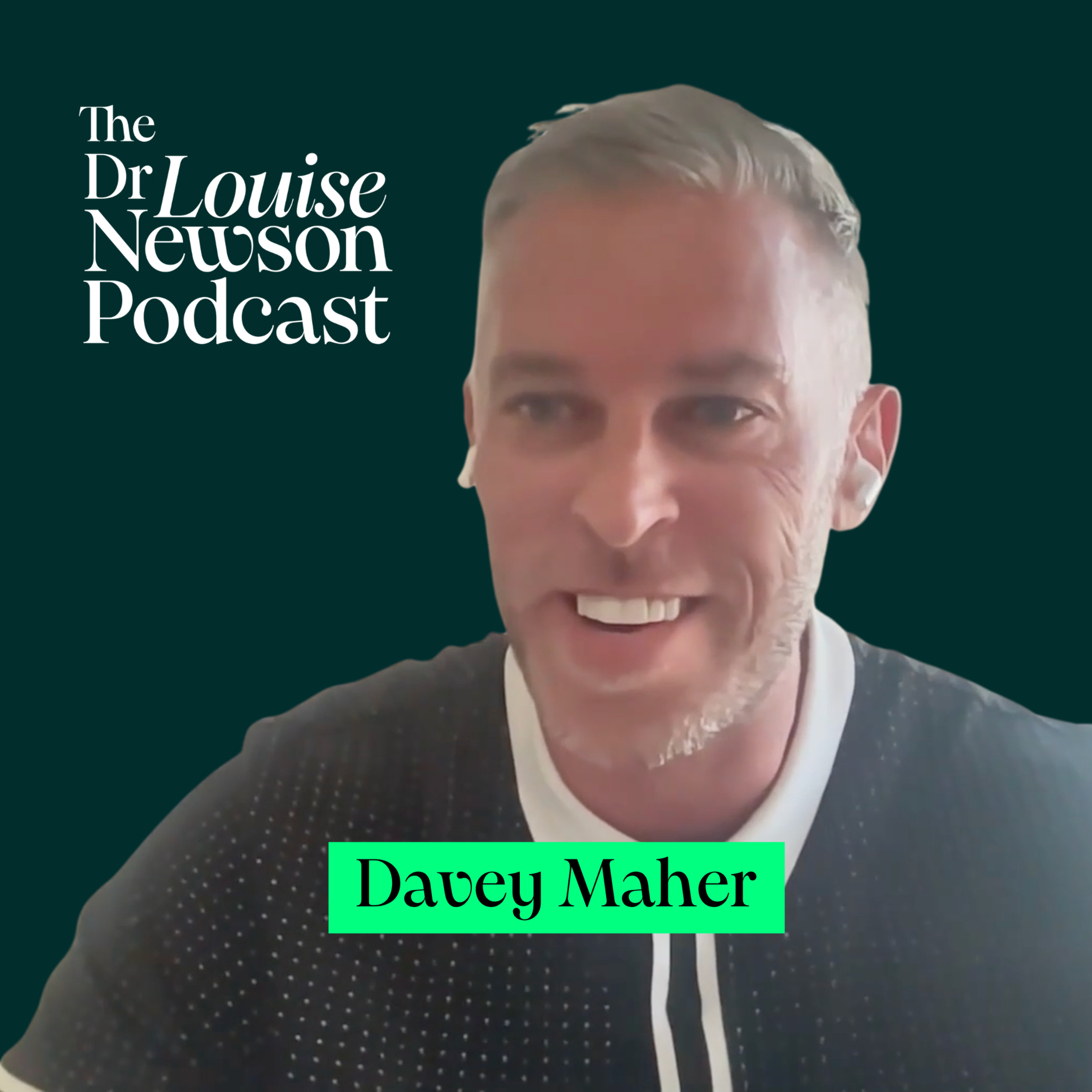
How different sex hormones (especially estradiol vs other estrogens) affect midlife health and fitness, and why hormone type and “bioidentical vs synthetic” matter for brain, bone, heart, body composition, and exercise response. Davey also argues that synthetic hormones (contraception/HRT types) can worsen inflammation and block natural hormone signaling, and that training/nutrition must be adjusted in perimenopause/menopause.
Davey Maher is a physician and scientist (pathology degree), evidence-based medical writer, and former personal trainer/online coach. He coaches mostly women over 40 in the US via a medical team.
Estradiol (E2) is “armor” (anti-inflammatory, protective); estrone (E1) is “problem child” (more inflammatory/proliferative); estriol (E3) is “gentle protector” (urinary/vaginal health). Transdermal estradiol bypasses liver, avoiding stroke/blood-clot risk. Synthetic hormones are “imposters” and can raise inflammation markers and contribute to thyroid issues/autoimmunity.
A 49-year-old on Mirena showed high TSH, low free T3, Hashimoto’s, high CRP, insulin resistance, and elevated estrone; after switching to bioidentical HRT, brain fog and sleep improved and CRP/insulin resistance normalized. He also cites women losing 3–8% muscle per decade after 40 and recommends strength training (5–8 reps, 3x/week) plus zone-2 cardio.
Written by AI. May contain mistakes.
Discussion on the impact of menopause beyond common symptoms.
“Yeah absolutely and I think as many people know I'm unusual in many ways but one way that I'm unusual is that I'm a physician, so I am not a gynaecologist.”
Davey shares his background as a personal trainer and his focus on women over 40.
“oh wow nearly 11 14 years ago so majority of my clients were always that demographic that over 40 woman.”
The conversation shifts to nutritional approaches for women over 40 experiencing hormonal changes.
“So you've got to work with your body at this phase of life, not against it.”
Detailed explanation of different types of estrogen and their physiological impacts.
“syndrome it's it's a very like it can be combined E2 and E3 can be combined together called biased So then we have the E1, which is what I like to call the problem child, estrone.”
Exploration of the roles and effects of estrone and estriol in women's health.
“but they're also found in old school HRT, like primarin, which is an estrogen type of HRT.”
Differentiation between synthetic hormones and bioidentical hormones, discussing their implications.
“But they also block my own hormones working as well, don't they?”
Discussion on the adverse effects of hormonal birth control on women's health.
“You know, the synthetic contraception or natural hormones?”
The need for increased awareness and education on hormone health among healthcare professionals.
“Like when we lose our eyesight, we replace them with glasses.”
Learn about the historical impact of hormone prescriptions on women's health.
“which is an amazing start, actually, because it's admitting that millions of women have been harmed by not being prescribed hormones, which I think is a really pivotal time in the history of health of women.”
Explore the resistance faced in promoting hormone therapy for women.
“And we knew there were health benefits and people felt better as well.”
Understand the effects of personal hormone levels on health and exercise.
“They're not getting comprehensive testing done.”
Discover how hormones affect brain energy and mood.
“Yeah, you mentioned there about your brain health.”
Learn about the effects of contraceptives on women's health.
“She had an autoimmune disease, thyroiditis, Hashimoto's.”
Discuss the critical role of muscle mass in women's health post-40.
“And it is changing, you know, but people are still, I think sometimes doing the wrong exercise for them as well.”
Examine the right exercise strategies for women in midlife.
“But I think that that age group, that demographic are doing excessive amounts of cardio.”
Learn how nutrition impacts hormonal health and overall well-being.
“Like if you have an inflamed gut, which we see all the time, hormones are basically useless.”
Get three key exercise recommendations for menopausal women.
“But there's nothing wrong with high intensity cardio as well.”
Learn why testosterone is vital for both men and women and its broader health impacts.
“we're seeing great results with our female clients, microdosing testosterone for less brain fog, more energy, but it actually builds bone.”

Get the gist, explore an idea or ask about something said.
 Claude
On The Dr Louise Newson Podcast, what are the key points of this episode?
Searching your listeningAutomatic transcript. May contain errors.
0:00So Davey, it's great to finally meet you. It's always, I find, really interesting and frustrating actually when men talk about hormones, it gets so much more attention in social media than when us women talk about hormones. And I'm not undermining your intelligence or your knowledge, but it's just a bit triggering. but I'm using that to my advantage because you've come onto the podcast to talk about hormones as a man so thanks very much. You're very welcome Louise, I'm really excited to be here and it's true when one thinks of menopause it's all about maybe hot flashes or night sweats but nobody knows about the impact it has on brain health, bone health, heart health.
0:46Yeah absolutely and I think as many people know I'm unusual in many ways but one way that I'm unusual is that I'm a physician, so I am not a gynaecologist. And I'm also a scientist. I've got a pathology degree, and I'm very evidence-based. But I also really like looking at basic physiology, how hormones work in our body. And once you understand that, everything else is very easy to unpick. But we've got ourselves in a bit of a mess over, I would say, the last 80 years since we discovered hormones because as soon as they were commercialized and prescribed to people, they were prescribed as different products.
1:26So I want to unpick that in a bit. But before we do that, just tell me a bit about you and your work and what you do, if that's okay. Yeah, for sure. It all started 15 years ago when I started as a personal trainer back in Ireland. my first three clients were a woman in her 40s 50s and 60s i was just basically teaching them very basic body weight exercises in the gym because they were so used to doing excessive cardio they didn't know anything about strength training so i was just teaching them compound lifts strength training lifts and then i started my personal training business in toronto canada oh wow nearly 11 14 years ago so majority of my clients were always that demographic that over 40 woman.
2:14And then I started my online coaching in 2016, where I just started getting these crazy results online with women over 40. Just when I dialed in their food, their nutrition, like the calorie deficit, the reverse dieting and the maintenance phases. But actually I stopped personal training six years ago. I'm lucky enough, I'm grateful enough to have built out a team now, a coaching team, a marketing team, sales team and a medical team as well for our clients in the United States. It's not as simple as eat less, move more for the over 40 women. Yeah. Yeah. And that is so important because for many years, that's the message that we're given.
2:56And I know myself when I was 45, I started to get a tummy and I was putting the seatbelt on in the car and just thinking, where's this come from? Like I haven't changed anything. I haven't changed my exercise. I haven't changed my nutrition. I don't want to be overweight. Like I've spent my whole life not being overweight. Do you know what I mean? And it's not until it happens to yourself that you think, wow, actually, what is going on metabolically in my body? Yeah. Look, us men can lose 10 pounds in a week, but women, it's a different ball game. What worked for that demographic in their 20s and 30s does not work in midlife.
3:35It takes a different approach. When estradiol specifically starts diminishing, it has a massive effect on a woman's body composition. Just by having bottomed out testosterone and estradiol in a woman's body equals more belly fat, less muscle. We don't want that. Sarcopenia sets in, osteopenia. So you've got to work with your body at this phase of life, not against it. So you have to optimize hormones. And that's absolutely true. And it's very important because oestradiol, like you said, is a specific type of oestrogen. And I'm very pedantic about language. I've been a medical writer for many years.
4:14And I feel that I have a responsibility as a medical writer to make sure I explain everything that I say. And I remember years ago writing actually about breast cancer and realized that a lot of people didn't even know what cancer was. So just really unpicking, you know, terms that we use a lot when you're used to them. So estradiol is one type of estrogen, isn't it? Yeah, not many people know this, but there's actually three different types of estrogen. So you have E1, which is estrone. You have E2, which is estradiol. E3, which is estriol. So E2 is very anti-inflammatory. I like to call it the body's armor.
4:56It's very protective of a woman's brain, her bones and her heart. Our team prescribed transdermal estradiol for our clients that are over 40 women in the US. So transdermal means it bypasses the liver. There's no risk of stroke or blood clots. So it's a patch, a cream or a gel. E3, not many people know, estriol is basically, I like to call it the gentle protector. it's very very powerful for bladder health for urinary health for the vagina a lot of our clients actually use E3 on their faces believe it or not it's anti-aging it's it's protect it increases the collagen it's it's used vaginally as well for protection of UTIs genitory urinary syndrome it's it's a very like it can be combined E2 and E3 can be combined together called biased So then we have the E1, which is what I like to call the problem child, estrone.
6:00It's very, it's actually inflammatory. It's more prevalent in women in postmenopausal. So it's very proliferative, meaning it tends to grow things like breast tissue, uterine tissue, fibroids. You don't want that. You don't want that high. it's all about estrogen, how estrogen is metabolized in the liver. Yeah and it's very interesting because estrogen is actually also made from our fat cells our adipocytes as well isn't it? So one of the ways our body tries to help really if we don't have enough estrogen so including estradiol in our body is it will make more fat cells to try and produce some estrogen but it gets a bit confused and produces estrone rather than estradiol.
6:50And then, as you say, estrone is inflammatory. So when we talk about the so-called harms of estrogen, we need to be really, really precise with our language and talk about the harms of estrone as opposed to estradiol. Because as a woman, I want more estradiol in my body and I don't want estrone. And that's really important to understand because metabolically they're completely different in our bodies. Yeah, it comes down to like synthetic hormones and bioidentical hormones. So synthetic hormones are basically hormones our body does not recognize. They're foreign. They're imposters. So these type of hormones are found in hormonal birth control, like the Mirena IUD, like the Yaz, the Yasmin.
7:38They're estrogen-based birth controls. but they're also found in old school HRT, like primarin, which is an estrogen type of HRT. It's taken from pregnant urine of horses. We're humans. Precisely. So even though people say I want something natural for my menopause, you could argue that pregnant horse's urine is natural, but it's not natural in the human body. But you're right, but it's not just the estrogen. So like the Mirena coil has a synthetic progestogen in. And again, that language is really important because when we talk about progesterone, that's just one type. It's progesterone that we make as women and we can prescribe it as well.
8:17Whereas all the other hormone of progestogens that are in the coils, that are in contraception, some older types of HRT, they contain synthetic progestogens, don't they? Yeah, a lot of people get mixed up between progestin and natural progesterone. Yeah. The tooth is completely different. It's completely different. And this is really crucial. And this is, you know, I was listening to you talk about it on social media and I really feel that we can't say it enough. And I actually feel quite embarrassed as a doctor that I didn't know the difference for many years. So when I was taking the contraceptive pill many years ago, So I was taking ethanol estradiol, which is a synthetic form of estrogen.
9:06It's confusing because it's got estradiol in the world, but it's also got ethanol. So it's got an ethanol group added to it. So it's not the same as pure estradiol. And then it was also a synthetic progesterone as well. And so they're completely different to my own hormones. But my concern when I think about how they work is twofold, really. Firstly, they work differently in the body. so they can increase inflammation. But they also block my own hormones working as well, don't they? Yeah, I mean, birth control is handed out at a very young age to a lot of young women, handed out like candy, but they're unaware of what it actually does.
9:45It stops the communication between the brain and the ovaries. It shuts it down. So not only does it affect the ovaries, it affects the brain. You see it and depression rises. like there's a high risk of blood clots. We've seen it in blood work actually, red blood cells like elevating in some of our clients. We're seeing it now in women in their 40s coming into our program, being on birth control for years on end. They have thyroid issues like thyropause, I like to call it. They have CRP, which is an inflammatory marker and blood markers through the roof. It's autoimmune diseases. Like why is it that 80 % of autoimmune diseases are in women?
10:25it's because of hormonal birth control women are not educated so they need to be aware of what's going on yeah and it needs to be spoken about more and more and i do talk about it but i think sometimes you have to keep repeating it for people to understand and you know a lot of my work is about enabling people to have a choice by giving them the information that's right for them so if i was 20 years younger like i'm 55 years old now so clearly i don't need contraception but if If I was 35 and I wanted contraception, I could pretty much guarantee to you that I could go to any doctor and get birth control.
11:04It would be very easy to get synthetic hormones. If I was 35 and I was experiencing some muscle and joint pain, some fatigue, some low mood, some urinary tract symptoms, dry eyes, whatever. And I thought, oh, my periods have become a bit irregular. Maybe I'm perimenopausal. and I went to my doctor and said, oh, I'd just like to try some estradiol, progesterone, testosterone as HRT because I think I'm perimenopausal, I can pretty much guarantee to you that the majority of doctors would turn me away and say, no, you're too young to be perimenopausal. But which of those is safer? You know, the synthetic contraception or natural hormones?
11:45Well, first of all, there's a lot of incredible doctors out there creating awareness like yourself and Dr. Marie Claire and Dr. Vonda Wright and Kelly Casperson. But the fact is doctors just get two to four hours of menopause training in med school. OBGYNs just get six hours of menopause training in their four years. So I think the tide is turning though, for sure. There's more. Yeah, and it has to. You know, I realise it's difficult for doctors and nurses and pharmacists and healthcare professionals and I didn't have any formal training. but actually we have a responsibility for our patients and we have a responsibility to do the best for them and we should be kept up to date it's up to us to be able to be educated on something that affects half the population you know we're not talking about something that's really obscure that I might or might not see you know I might not see a fractured ankle and I don't really need to know the different ways to put a plaster cast on because it's not going to help me as a doctor unless I was an orthopedic surgeon or working in casualty.
12:54But actually, if I'm seeing women of any age, surely every single healthcare professional should know something about hormones. Exactly. Like when we lose our eyesight, we replace them with glasses. When we break our hip, we replace with a hip replacement. When we lose our sex hormones, I mean, there's a whole taboo. Like bioidentical hormones, studies have shown when done correctly, They reduce the number one killer in the world for women by heart disease by up to 50%. They reduce Alzheimer's, dementia by up to 33%. They reduce osteoporosis, osteopenia by up to 50%. This is life-saving. It's longevity.
13:38It's optimal health. But people aren't aware of how powerful, how beneficial these bioidentical hormones are. Well, we've been sold lies for far too long. And this is a problem not just as women, but also as healthcare professionals. We've been given misinformation. And actually, we're recording this in the week that the FDA have announced they're removing the black box warning for estrogen products, which is an amazing start, actually, because it's admitting that millions of women have been harmed by not being prescribed hormones, which I think is a really pivotal time in the history of health of women.
14:22That was a huge announcement during the week because we lost a whole generation of women over the last 20 years by an incorrect WHI study which was debunked. Like, you know, basically overnight in America 20 years ago prescriptions of HRT went from 25 % of women over 40 to 4%. It was more, it was from 40%. It was 40 % in the US and 30 % over here. And I mean, HRT used to be the number one selling pharmaceutical drug. And, you know, but even then that was a synthetic. That was usually primary, which was, but even so it still had hormones in it. And we knew there were health benefits and people felt better as well.
15:06So we've been trying to, a lot of us trying to just state the obvious over the last decade or so and met with a lot of resistance, actually. And even now, we're day five after that announcement and there's nothing, nothing in the UK media about this announcement. Whereas if the FDA had put out a statement on Monday to say we found another risk of HRT, it would be all across our media. And I feel this is really damaging for women because women in the UK are the same as women in the US. You know, there's no difference to our hormones, are there? Yeah, we hear it every day. I mean, for the last seven years, we do like one hour consultations for women wanting to join our program.
15:54And what I've learned personally, and I've done 7 ,000 of these one hour consultations with women on the phone and Zoom, women are suffering. They're going to their doctors. They're not getting comprehensive testing done. They're being put on synthetic hormones. They're being told, get on with it. It's part of aging. It's just, they're being medically gaslit. they're not getting any support and only five percent of government funding in the u.s apparently goes towards women's health it's crazy it is a scandal because women are living longer and we want to stay healthy as long as possible and it's it's always hard you know i spend far too long at my desk and i tend to exercise in the morning because it's done but i still feel i should be going for walks I should be doing more and I've got so much else going on and it's always difficult but if I didn't have my hormones I would have muscle and joint pains and I was getting a lot of migraine as well when my testosterone level was low and a lot of reduced energy and apathy so there's no way I would get up and you know earlier in the morning to do workout because I would have felt awful so I know myself personally I would be feeling very different and my relationship with exercise would be completely different without hormones.
17:12Yeah, you mentioned there about your brain health. Like a lot of women have brain fog and low energy. It's not just the ovaries. It actually affects the brain. There's a really interesting book. You probably read it, The Menopause Brain by Lisa Moscone. She talks about images of a woman's brain in her 30s and the same woman, the images of her brain in her 50s. The brain shrinks. Actually, there's 30 % less energy. Like it affects the dopamine, the serotonin. What do most doctors do? Maybe put them on SSRIs or antidepressants. It's not getting to the root cause. No. And there's also some interesting scans that if you delve into the literature of women before and after being given contraceptive pill as well and how their serotonin levels reduce when they're on contraception.
18:01And we see this a lot. I've recorded a podcast with Sophie, my middle daughter, to talking about some of her friends that have been put on birth control and then their mood flattens and then they're given antidepressants and then they might put on weight and then they're not exercising. And a lot of it stems back from them having the contraception. Yeah, I mean, it's not uncommon for new clients to join our program, women in their late 40s, 50s, and still on the Mirena IUD or birth control from their OBGYN saying that it's going to handle or help with menopause symptoms. And how can it? How can it replace histidial and testosterone and even progesterone?
18:45Exactly. We actually done some testing recent blood work with a 49-year-old woman who was on the Mirena IUD and her blood work showed some, like her macros, her thyroid, her TSH was very high, free T3 thyroid hormone was very low. She had an autoimmune disease, thyroiditis, Hashimoto's. C-reactive protein inflammation was high, insulin resistance. All sex hormones were bottomed out. Estrone, the problem child estrogen was actually raised. Okay. So we transitioned her to bioidentical hormone replacement therapy. Within six months, the brain fog left. She was feeling better, sleeping better, weight loss.
19:30She was in a better place to lose body fat. But all of her markers, blood markers improved. CRP, inflammatory marker went down, insulin resistance no longer there. Estrone, the bad estrogen, basically flattened out. Estradiol was optimal. Testosterone, optimal. Lipid markers, optimal. That just proved the difference between synthetic hormones and bioidenticals. Yeah, and we see it a lot as well, especially, you know, cholesterol coming down, like you say, blood pressure coming down, weight coming down as well, and the ability to exercise to improve. So you mentioned earlier about this sarcopenia, this loss of muscle mass, which is really important because, you know, our muscles obviously hold us up, they hold our skeleton up, but they're biologically and metabolically active as well.
20:21They produce lots of hormones into our bloodstream to help keep us healthy, don't they? Yeah. Women lose up to 3 % to 8 % of their muscle mass after age 40 every decade. So sarcopenia is a very real thing. The more muscle someone has, it prevents insulin resistance. It's going to help with burning more calories. It's going to give you a healthy metabolism. But I think the mistake that we're seeing over the last seven years that women are approaching their gym, their training with a, I need to burn calories and lose weight mindset instead of a, I need to get strong and build muscle mindset. And it is changing, you know, but people are still, I think sometimes doing the wrong exercise for them as well.
21:12And thinking, you know, there's a lot more talk about doing free weights, but people are still confused. like what do I do how much do I lift and how do I do it but I think it's so important to have exercise that is right for that individual because I've seen people who think they're really fit and they go running a lot and then they never do any pelvic floor exercises they're not looking at their core strength and it sort of catches up with them a bit when they become in their 40s or 50s. Yeah I think a lot of that demographic are going to the gym but they're doing two high reps, they're lifting the light pink dumbbells and are afraid to lift heavy weights, which is more endurance.
21:56Yes. Like you've got to train for strength to grow muscle in a five to eight rep range. It's really important. I was doing some weights this morning actually and my husband does weights and his are ridiculously big. I can't even lift them when I'm trying to like just clean up. But it's interesting because over the last few months I've actually got more weights out of his room into my room because I can hold stronger, bigger weights. And actually something I was doing this morning, I did a few weeks ago, I found really hard and I found it so easy that I needed to get a heavier weight. So I was like, oh, that's progress.
22:32That's amazing. So it's quite impressive, actually. That's fantastic. Cardio is important too. It totally, yeah. Yeah. But I think that that age group, that demographic are doing excessive amounts of cardio. Like the midlife woman is already stressed with a high performing job. They're looking after their kids, their elderly parents. They're doing these boot camps in the morning at 45, adding more stress. So it's more low intensity, moderate cardio is more beneficial. Yeah, absolutely. It's so important. and I think unless people understand different types of exercise you know as a doctor we talk to just ask people do you exercise yes or no how long do you exercise for but I think you know you learn a lot more from people when you hear about the types of exercise that they do but one of the things that frustrates and saddens me is that a lot of women are told well you're menopausal now you don't need to do as much exercise or you might need to modify your exercise or if you're perimenopausal, you might have some days where you feel worse.
23:42So just sit it out and don't exercise. And there's quite a few, I'm sure you've seen them as well, personal trainers who are experienced, I've seen in inverted commas, in menopause, so they can guide you through a modified program. And I feel like stronger than I have done for many years, but I'm clearly menopausal so I but I take hormones and I feel very strongly that if women want to take hormones they should be able to exercise the same every day we shouldn't have to duck and dive because our own hormones are lowering and just sit it out yeah it's a it's different approaches is needed for everything in midlife not just training but like in nutrition as well like under eating a lot of women in that age group are unintentionally under eating like they're already losing their bone their muscles so one meal a day doesn't cut it how can you hit your protein and fiber goals eating 1200 calories a day so everything needs to be dialed in not just training hormone health liver support like if a person has a sluggish liver they're not detoxifying the estrogen properly, hormones will not be optimized.
24:56They won't work. Like if you have an inflamed gut, which we see all the time, hormones are basically useless. You need everything working optimally. Yeah. And that's where looking at nutrition as well is super important because it's so easy now to eat badly. You know, I think it's, you know, recently I was out and I just struggled struggled to find just some fresh fruit and veg from where I was walking through and I'm just like oh hang on this is really difficult and it's hard for people and because I have migraine if I don't eat healthily it will trigger migraine so I can't just eat a protein bar or snack bar I have to eat proper food but I think now people think they can get away with not having such good nutrition that it catches up we got away with it yeah in our 20s late nights and crappy food but we don't get away with it in midlife no that's for sure yeah there's so much we need to think about so i'm really grateful for you coming on and just trying to unpick some of it so people can make decisions that are right for them so before we end i always ask for three tips and i just keen to ask you three we've mentioned it already but three reasons why people should consider doing maybe slightly different exercise when they're menopausal or when they're just older to help with their bones and muscles in particular yeah you got to look at muscle as i think it's the greatest anti-aging product that woman over 40 can have so you have to whether we like it or not dial in strength training so three times a week in that five to eight rep range you don't have to lift heavy weights like at the start just get your form right get your technique right first and slowly build up the progressive overload over time cardio is very beneficial for for the lungs the brain as well so try that 80 of your cardio should be that zone two fat burning zone like 220 minus your age and then get 60 to 70 % of your max heart rate.
27:13But there's nothing wrong with high intensity cardio as well. It can be maybe 20 % of your cardio come from maybe high intensity type of cardio. Great. Go on. I just want to talk about testosterone just really briefly, Louise, because a lot of people think that it's just a bodybuilding steroid or a man's steroid, but it's actually the most abundant hormone throughout a woman's lifetime. It's produced in the ovaries, the adrenal glands. So every woman that comes into our program, none of them have been on testosterone, but it's actually the first hormone that we add in. We microdose it with our clients, the women.
27:57So they only need one tenth of it compared to men. So why do we prescribe it? we're seeing great results with our female clients, microdosing testosterone for less brain fog, more energy, but it actually builds bone. It's anabolic. So I think it's a very important hormone, not just for men, it's for women as well. Totally. Absolutely. And we need to be thinking about it as an important biologically active hormone rather than just something for libido because it has affected every single cell in our body, of course. But it's not the magic bullet either. Just lastly, we have a lot of our new clients thinking that BHRT is going to magically help them to burn fat.
28:45But when we look at what they're eating, they're not eating enough nutrients or food or protein. They're not moving. They're stressed out of their mind, sluggish liver, inflamed gut. If you don't dial in the other aspects, the foundations of health, hormones will not work. Yeah, absolutely. It's so important to look very holistically and certainly we do a lot in our clinic as well that, you know, yes, I use hormones but I can't just sit there and expect them to do everything for me. Exactly. So thank you so much for your time. It's been really good. Thanks, Louise.
Many women are told that all hormone treatments are essentially the same. But the reality is far more complex, and understanding the difference could have a significant impact on your health, fitness and wellbeing.
In this episode, Dr Louise Newson is joined by women’s health and fitness coach Davey Maher to discuss why bioidentical and synthetic hormones work differently in the body, how they influence inflammation, muscle, metabolism and long-term health, and why these differences are so often overlooked.
Together, they explore why so many women struggle with weight gain and muscle loss during midlife, why strength training and nutrition become increasingly important as hormone levels change, and how taking the right hormones alongside healthy lifestyle habits can help women stay stronger, healthier and more active for longer.
Let’s connect
👉 Track your symptoms and understand hormones, download the Balance app: https://bit.ly/4yZty5A
👉 More from Dr Louise Newson: https://linkin.bio/drlouisenewson