 Ask ChatGPT


Timeless Skincare’s omnichannel growth strategy—selling DTC plus marketplaces and international retail (85+ countries)—and how they’re adapting to AI-driven discoverability and marketplace dynamics in 2026.
Julianne Earthcraft, Senior Director of Marketing and Sales at Timeless Skincare. Greek-born; grew up in a family D2C sports/water-sports business, selling from a kiosk as a child. 14 years in marketing/sales professionally; 8 years at Timeless (started managing retail accounts; promoted through director to senior director in 2021). Oversees growth across retail, B2C, marketplaces, and international expansion.
Don’t chase trends; keep a small, targeted catalog and simplify education. For AI/LLM discoverability, optimize product pages for LLM readability (schema) and content for FAQs/search. Marketplaces are “vital” now; international success depends on local partners and compliance/labeling timelines (up to 24 months). Retention is driven by education, promotions, and loyalty (D2C), not just acquisition.
Timeless manufactures everything in its Texas facility; shifted from California to Texas in 2021. TikTok Shop is treated mainly as discoverability (starting heavy investment in ads/affiliates; planning live selling). Black Friday/Cyber Monday strategy expanded to marketplaces and retail partners with high discounts. Influencer partnerships focus on authentic, already-trusting users (KOLs/dermatologists/esthetician), not mass outreach.
Written by AI. May contain mistakes.
Learn about the foundational aspects of DTC marketplaces operating internationally.
“DTC marketplaces retail internationally in 85 plus countries.”
Discover Julianne's journey from her family's business in Greece to her role at Timeless Skincare.
“Hey, Julianne, thanks for being on the show.”
Julianne shares her fond memories of Greece and the cultural aspects she misses.
“I mean, I've never been there, but my parents and many friends have been there.”
Julianne discusses her career trajectory and growth within Timeless Skincare.
“I love that I can do both for Timeless and for the family business.”
A look at the team structure at Timeless Skincare and its operational dynamics.
“My current role as a senior director, I believe since 21.”
An overview of Timeless Skincare's journey to expand internationally.
“D2C, marketplaces, retail internationally in 85 plus countries.”
Julianne discusses the outlook for DTC brands and evolving challenges in 2026.
“So definitely a lot of brand awareness that led to our expansion.”
Exploration of discoverability strategies in a rapidly changing AI landscape.
“What are you doing to be, you know, to improve this capability, let's say, for the brand?”
Discover how AI assistants are shaping the future of online shopping.
“at least most people I know, and I talked to about the nerdy staff, they were all using ChatGPT for Cloud, but back then ChatGPT for similar stuff.”
Learn about the challenges and strategies for launching products in retail.
“So many brands listening are already present in big retailers, but many others are not.”
Understand the key considerations for successful international market expansion.
“It's very difficult to execute, especially as you're growing.”
Discover the rising trend of live selling in the US skincare market.
“And they already go live three, no, sorry, four times a week, two hours a day.”
Learn about effective customer acquisition strategies in the skincare industry.
“AI surge is becoming increasingly, it's, you know, heading up in the mix.”
Understand the significance of customer retention and education in skincare.
“And I think consumers really appreciate that.”
Explore strategies for maximizing sales during the Black Friday period.
“If you want to share it, of course, only if you want.”
Find out how to create genuine partnerships with influencers in marketing.
“You know, I recently ran a poll on the DTC insider newsletter.”
Learn why marketers should understand the broader business context.
“And how do you build those partnerships?”
Discuss the challenges of balancing brand awareness with revenue generation.
“And when they don't see that, the awareness play probably dies or is misjudged because it was, again, judged as a performance play when it really wasn't.”
Explore the balance between immediate revenue generation and long-term marketing strategies.
“And ultimately, what you care about is the bottom line.”
A recap of key insights from the discussion and an invitation for audience engagement.

Get the gist, explore an idea or ask about something said.
 Claude
On The DTC Insider, what are the key points of this episode?
Searching your listeningAutomatic transcript. May contain errors.
0:00DTC marketplaces retail internationally in 85 plus countries. We manufacture everything ourselves here in the U.S. at our own facility in Texas. We're not trend chasers at all. We don't launch new products often. We have a super small catalog that is targeted and specific. We try to simplify education because the ethos of the brand is... Welcome to the DTC Insider Podcast, where online business owners come to find actionable tips and tactics to grow their businesses. Now, here's your host, Brian Roizentl.
0:46Hey, welcome to another episode. I'm Brian Roizentl, your host. And today I'm joined by Julianne Earthcraft, the Senior Director of Marketing and Sales at Timeless Skincare. Hey, Julianne, thanks for being on the show. Hi, Brian. Thank you for having me. Great to be here. Yeah, my pleasure. So I think this is going to be an amazing episode. No pressure, because you have one, you know, a really extensive career. And then the company is, you know, doing things that many brands listening to these are not. So I think that, well, I'm super excited about it already. So let's get started by, you know, introducing yourself, you know, where do you come from?
1:28You know, where did you start and when your journey in the DTC space or in the consumer's goods space? Yes, sure. So I'm actually originally from Greece. I'm in the U.S. now. No way. Wow. Yes. And back in Greece, my family owns a business and they've owned a business, you know, since before I was born. And it's a D2C business. Athletic sports were specified for professional athletes and water sports specifically. So I was in the business since day one on looking over at every single aspect of the business, from marketing and sales to operations to production to everything, everything in between.
2:08So really my experience with the marketing and sales world started as soon as I can remember myself. But most recently, I've been in marketing and sales for 14 years, I guess more professionally. Eight years, about eight years with Timeless Skincare. And at Timeless, I oversee our growth across retail, B2C, marketplaces, international expansion. And a little bit about Timeless. It's a skincare company, 100 % family-owned, family-operated, 100 % bootstrapped. We're U.S.-based. We manufacture everything ourselves here in the U.S. So, yeah, that's a little bit about me. My role specifically, it's really a combination of strategic thinking, strategic marketing, operations, and then distribution and everything in between.
2:59Brand growth, of course, brand strategy. So I really enjoy that I've been able to grow along with the business. And my role really has been sitting mainly in marketing and sales, but really non-traditional marketing also. So as I've had the opportunity to have a zoomed out view of every single aspect of the business. So it has been a phenomenal experience. Yeah. So I'll get to time left in a minute. But before, I love Greece. I mean, I've never been there, but my parents and many friends have been there. My wife has been there. And everyone tells me it's beautiful. So I wanted to ask, you know, what do you miss about Greece?
3:40I miss the people. the people and I miss summers in Greece I think if you've never experienced a summer in Greece it's should be back at least it's it's what I envision summer being about you just lay on a chair at the beach at beautiful beaches beautiful water you have amazing food the hospital hospitality is great just just really nice and and heartwarming I would describe it well a summer in Greece sounds like a name of a movie. I don't know if there's a movie named after that, but it's a great name. And yeah, I've been told that summers in Greece are amazing as well. So yeah, it's beautiful.
4:20So talking about your experience first, you said with your family business, right? Back in Greece? Yes. So you said, you know, you said something like after that experience, you've been working in this space for 14 years, let's say, between quotes, more professionally. But I mean, the first experience and even more from, you know, let's say being part of the family that owns the business, I think it's huge. How old were you when you started working with that family business? Yes, it truly is. I was very young, I'd say, probably my first experience selling out of a out of a kiosk when different sports events would happen we would have our booth so i would be there behind the booth selling probably 12 if not younger and i always remembered i i always had an inclination towards business i just love love marketing specifically for how creative it can be but i love all the other aspects of the business because looking at the numbers and i then find patterns you can see what's driving profitable growth for your business so that's really intriguing to me.
5:29I love that I can do both for Timeless and for the family business. I've seen a lot of what not to do and what works well. I've seen everything in between. Yeah. I mean, you know, to get to grow up working at the family business, getting to see the different areas and, you know, getting to experience firsthand the real world because at 12 year old, probably you're at school, you're not, you know, experiencing what really happens in life, let's say, business-wise, and already working for a business. I know many people who have done that, and it's a very rich experience, or so they tell me, at least.
6:10So moving forward in time, how long have you been working for Timeless? For about eight years. Eight years. And did you start this role, or where did you start? I started, I was managing our retail accounts. That was my first role with the company. And then I slowly grew to senior director of marketing and sales. Nice. And how long have you been in the current role? My current role as a senior director, I believe since 21. And then before that, in the director role for about seven, yeah, seven years, I think. So a lot has changed. right, in seven years, what are the things that you think that changed the most for you, for your role, and for the company in these seven years?
7:05So for my role, what I was saying before is that I've had the opportunity to grow alongside the business. And a lot of times in family-owned and family-ran businesses, you don't really have the department depth or the layer depth that you have in corporations. So you have to be able to jump in where needed and really have the operational mindset that making sure that you're not seeing marketing as a silo. Marketing is in isolation, but really looking at the business as a whole. And so my role has evolved in that way. I've been able to see a lot of different things in the business that if I was working for a larger corporation, most likely I wouldn't have the chance to.
7:50So I'm super grateful that I have been able to do that. I think it's made me a better marketing leader, a better business leader, because at this point in my career, I never look at an opportunity as, yay, this is a great opportunity, let's close the sale or let's create the marketing plan around that opportunity and let's push along. You really have to be able to see how is this going to affect your business as a whole. And yeah, that's been my experience with Timeless. How big is the team currently and how big was the team when you started working for the company? I don't recall exact numbers when I started.
8:30We haven't changed much. The majority of our team sits in the production. Like I was saying, we manufacture everything ourselves here in the U.S. at our own facility in Texas. We did transition from California to Texas back in 21, but the majority of our team sits in our production, and then we have about 15 people on the operation side of things. Okay, 15 people in marketing. How many people do you lead in your team? Marketing and sales combined, we are 12, I think. Oh, wow. We're 12 people marketing and sales at customer service. Wow. Okay. About, I may be off a couple of people here and there, but just roughly just about that.
9:16Okay. And you are, you sell online and you also sell where? Marketplaces, retail? Yes. D2C, marketplaces, retail internationally in 85 plus countries. So everywhere we can add value. Okay, so let's break things down so we can understand more about that. So what percentage, more or less, could you say that it's DTC, marketplaces, retail? I can't give you exact numbers, but I can tell you DTC is our number one channel. Marketplaces are creeping up very fast, and then international would be retail, and then international is our next bucket. Okay, and when did you decide to go international and why?
10:03I can't tell you why I wasn't here when the brand started internationally. I can tell you that we started, when I first started with the company, I think we were in maybe 10 countries, maybe 15 countries. And we've grown since to 85 plus countries. So definitely a lot of brand awareness that led to our expansion. Okay. I'll ask you more things about, sorry, international in a minute. But first, DDC. Yes. 2026, things are moving, I don't know, super fast. I don't know even how to describe how fast things are moving, as we both know, and probably most people in the audience knows. So what's, you know, the biggest thing that's on your mind and on these brands roadmap for 2026?
10:59What are you saying that this is a different animal? This is like 2026. This is different. And we need to take care of that. Yes, that is a great question. There's two things top of mind that I think about every single day. And I work on every single day. And my team works on every single day. One is discoverability in this new AI world that we live in. That, like you said, is changing at a pace that it's hard to keep up with. And I can go more into depth about that. And then the other thing is marketplaces. which if you ask me that question maybe in 23 or 22 I would say to maybe even 24 I'd say yes they're important I wouldn't say vital important they have a completely different opinion today I think they're vital for a business I don't think you can have a complete strategy without marketplace for many reasons marketplaces have also evolved a lot to provide a brand experience on their end.
12:00Amazon does it differently. Target does it differently. Walmart does it differently. TikTok. Everyone is a little bit different, which poses challenges for lean teams as you have to be careful how you're allocating your resources and a lot of other things in between. But I'd say those are the two top things in mind. Okay. And DTC first. Sorry. Yeah, DTC, not marketplaces. You said discoverability. Talking about first DTC. What are you doing to be, you know, to improve this capability, let's say, for the brand? Yes, there are a lot of things that we're doing from a technical standpoint, as well as customer-facing and LLM-facing standpoint.
12:44So it's interesting because now you're switching strategies from, okay, let me make my pages customer-facing and make sense. Now I have to make my content make sense for LLMs, which is, again, something that I wasn't thinking about in 24, and it has switched so quickly. So a lot of on-page changes from the content perspective, mostly technical perspective with schema, ensuring that the website product pages are readable for LLMs, which have a little bit different specifications than when you were optimizing for SEO. And then on the content side of things. What is the type of content that we are producing that will help answer frequently asked questions, that will help answer oftenly search queries?
13:34We want to make sure that we're being recommended when customers are searching in AI for recommendations. And so all of those changes that we're making are assisting ultimately to be recommended by LLMs. Yeah. And these, there's, I always say that up until 2025, I dare to say that most brands I know, at least most people I know, and I talked to about the nerdy staff, they were all using ChatGPT for Cloud, but back then ChatGPT for similar stuff. What changed this year, early 2026, is the MCPs. You know, MCPs came to be and we are connected. All of a sudden, Claude and the rest of LLMs are connected to your apps, Shopify, Meta, etc.
14:32And more recently, I think less than a month ago, So AI assistants were announced dot news AI to a different place because I posted in the newsletter, I think two years ago, that agentic commerce, like I started talking about agentic commerce like two years ago because there were already news about things related to that. But nobody was really doing anything. And now it's getting real. Now it's getting real. I see people using fewer dashboards and reports because of using and consuming information on NLMs. And now I think we'll see really an increase of AI assistance buying for us. And that's when it gets real.
15:20And it's really important that companies like yours implement all of these, like GEO or AI, AEO, etc. Yes. And to echo what you said and to add another challenge for marketers and a tricky thing we're going to see, we're already seeing, we're going to see a lot going forward. And it's a prediction. And I don't know for a fact, because we really don't know what is driving those recommendations. We have an inclination. we we sort of know that we have to do x y and z but it isn't really clear by the llms that you need to be doing x y and z to be discoverable and recommended one thing that is going to be super interesting and why omni channel i think is really important now more important than ever is let's say your brand is recommended how do we know if the llm is going to link to your website or your marketplace or your retailer?
16:19How is it going to make that decision? Is it going to be based on price? Is it going to be based on domain authority? Because all brands will be, you know, they won't stand a chance if that's the deciding factor. Is it going to be speed of delivery, which again, when you compete with Amazon and now Walmart that is making a lot of updates and changes in their shipping, it's going to be increasingly harder to compete with those marketplaces. And so being an early adopter, making sure your brand voice, your brand story comes through those marketplaces and you don't necessarily wait until, oh, no, we know.
16:57Be early on that. That's my advice here because you have to make sure that your messaging is consistent across. Yeah, 100%. I think I'm an expert in this subject matter, but I think that it makes sense that the LLM that you use frequently keeps in mind context about that consumer. So maybe I love buying things on Amazon and somebody else loves buying things on Walmart. So I think that that will influence what each agent recommends to each person. But to your point, that's exactly right. You know, being everywhere or almost everywhere gives you more chances to reach your customers with or without LLMs, right?
17:44So many brands listening are already present in big retailers, but many others are not. What's the biggest difference between DTC and retail? What were the biggest expectations that you had when you launched in several retail stores that you actually, I don't know, didn't see them come true? Or the biggest myth, I could say, of launching in a retail store? And what are the biggest challenges and the biggest things people need to pay attention when launching products in a retail store versus putting them on a Shopify store? Yes. So when launching at a retailer and even before launch, when evaluating the opportunity, the hope is that it will increase your brand awareness.
18:37It will increase your sales, of course, and then it will create that halo effect among your other channels. So that's what you would hope to see. There are it for specifically for I should say specifically for brands that are omnichannel. If your main sales channel is brick and mortar and retail, then we're talking about that doesn't apply. But if you are omnichannel and you have your own D2C and you are working on your brand awareness, then that's the hope to have increased brand awareness, increased sales and the hello effect. The biggest challenge and when evaluating opportunities, it's super important to understand is this, what's the strategy?
19:17Is this going to be a brand awareness play where margin is not going to be super low, but you're betting on that hello effect? Or is this going to be a revenue generating opportunity? So we evaluate both differently. If it's a combination, it could be a combination of both. You have to weigh where it stands, where each opportunity stands. something that i think a lot of brands do not think about when launching at a new retailer is the investment that is going to require to be present in that retailer there are a lot that go into that a lot of requirements support that the brand is to provide versus perhaps you would you were thinking that i'm going to launch at the retailer the retailer handles all of that actually no they don't have they wouldn't be handling a lot unless you're a really big brand that perhaps you have different arrangements so on the brand side of things you have to be prepared for that investment and when i say prepared you should be you should know this up front before you even say yes to the opportunity and then because you need to obviously analyze your margins if you're not going to be profitable you have to know up front and you may even you may say yes because it's a good opportunity for for brand awareness but you need to know that up front and then the other thing is having a demand estimate, even if it's a rough estimate, knowing what that's going to look like and what sell-through is going to look like so that you can be prepared with inventory.
20:49For example, for us, like I was saying before, we manufacture everything ourselves in our own facility, which comes with a lot of challenges and a lot of benefits as well. But for us, that it's increasingly complex because we have to make sure that we're, you know, we have everything that we need to produce the product at the level that the retailer expects us to produce the product and replenish. Otherwise, you can really damage the relationship. You can damage the partnership, the opportunity. Let's say those. Right. Makes sense. And what about now? I do want to go, and talk about going international, it always said that the grass is greener on the other side, that many brands operating only in the U.S.
21:37say, well, we should probably explore other markets. Maybe we have it easier, or maybe we can get expand or reach opportunities, etc. You are present in over 85 countries, And you said before they started, before you joined the company, right? But I wanted to ask you before the questions that I'll ask you next, were you working at the company in the current role when you launched at least some markets? Yeah, I do oversee international growth. So yes, it's... Okay. What are the biggest misconceptions then of... And same questions probably that I asked you for marketplaces and retail is for international expansion.
22:24And what is like, when do you think it's the right time? Even though it depends, of course, of many things. But when do you think it's the right time to say, let's go internationals? Which markets do you think are worth exploring right now? At least, let's say, I don't know if in your industry or in general. and what are the things that you didn't know before doing that that you now know? Yes. So for international, I think the most important thing is finding the right partner at each market. It's extremely difficult for a brand to execute internationally for many reasons. One, compliance, packaging, logistics, knowing the local nuances.
23:08It's very difficult to execute, especially as you're growing. Maybe, you know, eventually the hope is that you will get to a point where you can potentially execute at that level. But as you're dipping your toes into international markets, finding the right partner for each region is vital. The other thing is knowing that you can really take your U.S. strategy and copy paste it and execute at a different country or a different region. And also knowing that within that region, there's different channels and different marketplaces. whether you're going to see or not, you need to evaluate each individually.
23:46And likely, the strategy is going to change by channel. And so again, for us, what has worked is having really strong partners at each region that are able to execute locally. They know the landscape very well, they know the customers. And it's sometimes it's as simple as education. For example, the way we introduce a product in the U.S., it may not really make sense for another country. So we may need to tweak some things to make sure that the main key benefits of the product are communicated properly for the customer to understand what that product is. So heavily rely on our partners internationally.
24:24When you talk about partners, who are these partners? Is it logistics and marketing? So distributors will typically have different relationships. They would typically take care of logistics and that entails registration. It entails labeling. And those alone can take sometimes intake up to 24 months. And so when evaluating markets to see which one is the right market to enter, you have to think of all those things. You may have found that the demand is really great at that particular market, but if it's going to be 18 months to actually be able to sell in that market, you have to evaluate other opportunities at the same time.
25:06So the do take care of logistics, like I said, registration, labeling, and then local distribution. The marketing side of things, we collaborate on that. okay and is your expansion currently only online only offline or both both okay and i guess it's not only as you said you know creating another market in a shopify store and translate it to into spanish or whatever language are you in argentina by the way they didn't ask you We are working towards Argentina. Nice. Nice. Well, now it's... But we're in Latam, yes. As you were saying, more offline, more stable before it was the Wild West, probably.
25:54But now many international brands, you know, big brands are coming to the country. So it's an interesting moment. So we said, what are the top countries outside the U.S.? Top countries outside the U.S.? Well, North America is big for us in general. So Canada, we have a big Latam market. Actually, we have a really strong Asian business. So those are our top regions. Nice. When you mentioned the marketplaces, going back to that, you mentioned TikTok. I guess you mentioned you were referring to TikTok Shop, right? Yes. What are you doing there? Is that working for you? How do you interpret performance on TikTok Shop?
26:35Do you see it as a profitable channel on its own? Do you see that it brings brand awareness and a halo effect to Amazon and other marketplaces? What do you do there and how do you see performance? That's the hope. So for TikTok shop right now, we actually are starting to heavily invest in the shop, in ads, in affiliates. And when I say just, I mean just like in the last week, in the last week is when we're starting. So let's talk again in 12 months and see where we are. But our expectations, it's hard to see TikTok as a revenue generating platform. Of course, you hope to see the numbers, but I think it's not so much a conversion platform.
27:21It's more discoverability and brand awareness building. So that is how we're seeing it. We, of course, will be evaluating the numbers closely. there are some ways that you can track Palo effect that we're hoping to, that they're pretty accurate. Like I was saying before, identifying some patterns will be what we're going to be looking for. So, yeah, let's talk again in a few months. I'll let you know how it goes. Are you planning on going live TikTok to do live selling? We will be going live, yes. We haven't before, but we will be. Yeah, so one of the biggest brands I know, it's a nine figure brand i interviewed on this podcast and i was part of their let's say tiktok shop mastermind the guy was saying that they are they were like probably a few months ago so probably now they're doing that or not they were planning on going live 24 7 they were already going live really often and their goal was to go live 24 7 and yesterday i interviewed probably a smaller brand than timeless.
28:29And they already go live three, no, sorry, four times a week, two hours a day. And they are planning now to go live every single day, at least two, three hours a day. And they do a weekly live six hours, you know, like it's, it's like changing things. Well, in Asia already happened, but here in the US, even more, more and more brands I speak with, they sell on the shop, but also, you know, They go live and sell on the lives. That's great. Yes, it's definitely, TikTok is natively pushing this. So it is, I'm super interested to see results from that. Yeah. So when we talk about the online, let's say the US market for now, customer acquisition, is it mainly meta, Google?
29:17What's working for you right now? It's a combination. Of course, page social, page search. AI surge is becoming increasingly, it's, you know, heading up in the mix. VR, brand partnerships and influencers is also a huge acquisition channel for us. Okay. What do you think that brands are missing when we talk about brand acquisition, like customer acquisition in 2026? How do you stand out in such a competitive landscape? And besides the industry, you know, it's a competitive landscape. And now we are heading into November, which is huge for most brands. What do you think brands are missing these days that they should be doing more?
30:02Yes. As a consumer, authenticity and simplicity also. It's really hard. In our space, we're so highly oversaturated in skincare and beauty. And for consumers now, they have so many different options with so much education and a lot of trends. And what I appreciate about Timeless is that we're not trend chasers at all. We don't launch new products often at all. We have a super small catalog that is targeted and specific. We try to simplify education because the ethos of the brand is two things. Skincare doesn't have to be expensive to be effective. And so we sit in that space between we are mustiched.
30:48So luxury ingredients, mass pricing, and then simplicity in our formulas that make it easy for the consumer to not get that decision fatigue. They know they can choose one product and the product is going to do X, Y, and Z. The ingredients are simple. They have been used for years and studied for years. You're not going to see us launching new products because we saw this one trend and we're going to chase after it. And I think consumers really appreciate that. I think they get overwhelmed and fatigued. And I'd say that's super important. Okay. What about retention? Because I guess it must be a big thing for you.
31:28You know, LTV more than AOV, correct me if I'm wrong. So you have two stages after you acquire a customer. Again, correct me if I'm wrong at any time, or maybe there are more or less. It's activating, you know, the customer who just bought, you know, to use the products because sometimes, you know, they buy products and they don't use it or they use it once and never again. And the other one is to get them to come back after they were active and using the product. So how do you approach both? What channels do you typically use for those efforts? Yeah, probably that's the question. Yes. Well, let me start by saying that retention when you're omnichannel is interesting because you may acquire a customer from D2C, but the customer may replenish on Amazon.
32:16and it's something that you won't really know again you can see the pattern and if you're growing you know healthy you know healthy margins then you're looking good but in terms of of that the more you grow omnichannel the harder is to track returning customers what we're doing on our end is really honing in on education because like you said sometimes customers use the product once and then you know they switch they're not that loyal but if we make sure that we educate them how to use it, when to use it, how to incorporate it into their routine, we give them the tools they need to, A, eliminate decision-making.
32:57They don't have to think about another brand. We actually give them reasons to use our products for longer with different ways. That's our goal. We're also a promotional brand, so we do have promotions on a monthly basis. And so that is where we see a lot of our returning customers come from. And we, of course, have a loyalty program like a lot of D2C brands that, you know, we reward our customers for staying with us on D2C. And yeah, those are a few things that we do to ensure retention. Okay. If you want to share it, of course, only if you want. This episode will go live, you know, in a few weeks from the time that we are recording it.
33:37So it's not going to be Black Friday yet. So would you like to share whatever you can share about your, let's say, November slash December plate? What are you focused on? Is it more new customers, returning customers? Is it a big discount or is it a regular discount that you typically do? Is it a full month, only a few days? Whatever you can share. Yes, what I can share is that we have followed a similar strategy every year that I've been with Timeless and before I was with Timeless in regards to Black Friday, Cyber Monday. We are taking that strategy now and we are expanding it to our marketplaces and retail partners.
34:24And I can say that it's going to be a very high promotional discount like we do every year. but also we make sure that we meet the customers where they are so we're not only isolating D2C we are giving customers a chance to purchase along with other products you know if they want to buy a mattress and also buy skincare we want to make sure we give them that opportunity so we're expanding in that in that sense we of course we're hoping for retention during that period but But New Cosmo acquisition is so important. They are coming in, though, through a promotional period. So we have to monitor the expectations that they're not always going to find us at that price.
35:04But yes, it's definitely the biggest time of the year for us, as I'm sure other DTC brands. You know, I recently ran a poll on the DTC insider newsletter. And most brands that replied to the same thing, that they were running the same offer. And yeah, same thing, same strategy that worked in previous years for the brands we work with at the agency. It's probably similar with some brands, but there's a caveat. Not for all of them, because some brands, they just don't want to mess with that. But with some others, what I always like to tell brands that would love to improve and see some kind of growth in that period year over year, it's to maybe execute the same action, but differently improving it.
35:54So the same what, but different how. So many brands these days, 2026, they don't run any actions with influencers at all. not whitelisting them on meta, no organic collaborations, nothing. So that's a quick example, you know, running a Black Friday or now, I don't know, Halloween sale, Columbus, they sale or whatever sale, or even a product launch with a lot of communication from creators. I think that could amplify the message. And there are many more examples, right? It could be the red mail, it could be many other things. Have you experienced that improvement, even if it's not with creators, if you do it with creators, you can say that, but ever since you are in more or expand your presence in more retail stores and marketplaces?
36:46Yes. So good question. We, a few things here. So A, we are, like I was saying, we're 100 % bootstrapped, which means we have to be extremely intentional with where our spend is going and we do try some new things but we typically stay within what has worked for us. With that said, what we see as being really successful for us, D2C as well as omnichannel, is our partnerships. And the way we approach partnerships is we approach them organically. And what that means in the influencer world is that we like to work with people that already know the brand and already have tried the products, already recommend the products.
37:33In our opinion, that is the most organic approach you can have to this type of marketing and also the most trustworthy for the customer. If the customer knows that they trust somebody for their expertise, whatever that is, and then they see them recommend the product and it comes from, yes, I love that product. You've seen me talk about that product multiple times and now I'm a partner of that brand. it converts a lot better. So that is where we hone in. We don't try to do, you know, approach a thousand, two thousand people for those type of partnerships. We're very specific. And that has worked really well for us.
38:09And how do you build those partnerships? Do you have become an affiliate section on your website? Do you have a loyalty program? How do you build that? For D2C specifically, no, we don't have an affiliate section on the website. We basically outreach when we see somebody using the product already and we try to build a partnership and a relationship. If it's somebody that we think would be a great fit for the brand for whatever the reason, typically it's because they are a key opinion leader, whether that is in the ingredient space or the more broader beauty skincare category, or if they are a professional, like a dermatologist or an esthetician.
38:50and we really want to introduce them to the brand. We'll do outreach like that as well. And our approach there is, again, the same thing. Please try the products. We think you're going to love them. Try them for weeks and weeks and weeks. And if you do like them, great. Let's see if we can work together. And if you don't like them, that's fine too. We want really authentic voices out there for Timeless. And I think that's why we do have the loyal customers that we do have because the product speaks first. And going back to what you were saying about the challenges, How do you stand out? It really starts with the product.
39:23If your product is not good, it's really hard to retain. Yes, you may get customers to purchase once, but you will likely not see a returning customer. Oh, yeah. A hundred percent. Yeah, agree. Last thing I wanted to ask you, it's something that you said before, and it's that the best marketers need to understand the entire business and not just marketing. And I love that. And I preach the same thing. So I wanted to ask you, what do you think that many marketers are missing and what does it mean understanding the business in practice? Yes, what I think marketers are missing is they get really tied up into the creative side of marketing, which I'm not going to lie.
40:02I love that side. It's fun. It's every day. It's different. It's creative. It's great. but when you get tied up to that to that and you don't open up your eyes to okay how is this going to impact the entire business can we sustain this can we have profitable growth from what we're doing how is it going to look like operationally like i was saying before for us that impact is making sure we can we can keep up with demand or making sure that we have our suppliers know exactly what to expect from us in terms of recurring orders and replenishments. So it's really important to be able to look at an opportunity, not only as marketing, but as if you're in marketing and sales like me, it's really important to evaluate an opportunity for what it is.
40:51That's what I was saying before, knowing if that's going to be a brand awareness play versus a revenue generating play. Both are super important. Both are good. But knowing that but my margins are going to be thin, very thin with this opportunity. It's good enough front. You tell me, but from my experience, selling another party, it could be the CEO, founder, or another director of a different area in the company, an awareness play is tough in the long run because at the end of the day, My experience, at least, is, you know, I always see that behind scenes, they're actually expecting some kind of performance result.
41:35And when they don't see that, the awareness play probably dies or is misjudged because it was, again, judged as a performance play when it really wasn't. So has it happened to you maybe in previous jobs, previous companies or in conversations with colleagues? That is true. I think it's really hard to differentiate in your mind as in a leadership position when you're leading a company. And ultimately, what you care about is the bottom line. And when you invest heavily in an initiative that doesn't instantly generate revenue, it's hard to justify. So I completely relate and understand that. and what I think is important is if you trust your team and you know I've been with the company for a very long time you know it's I love timeless I it's it's my everyday life when I come to the table with a recommendation I weigh everything from margins to potential to loss I look at everything because I don't want a recommendation that I make to have a negative impact on our bottom line, even though it's a long-term play.
42:47If it's a long-term play, true long-term play, like for example, TikTok. TikTok, it's also another thing to add to there. There's a lot of things that we have to do as marketers that are a defense play. For example, bidding on your branded terms on search. Who wants to do that? Who wants to pay for defense? But you have to. So TikTok is, for me, a little bit like that too. Everyone is doing it. We have to get a little a little piece of the pie. We have to be present. Otherwise, we're nowhere to be found, especially for that newer generation that is on TikTok every hour. So I think what's important is being able to, as a marketer, communicate all those points and show your leadership team that you understand all the nuances, that you're not just pushing because of marketing.
43:30You're pushing because that's what you think ultimately is going to push the business forward. Amen. Love that. Julia, this has been great. I have fun and I learned a lot. so I wanted to ask you before we go is there any question that I didn't ask you that you would like to share with the audience I don't think so I think we had a lovely conversation I appreciate it yeah so my pleasure and thank you and of course thank you the audience you know for being there for watching this video or listening to this on Apple podcast as well as I always say we do this to you know expand knowledge and share knowledge and that's why I interview amazing brands and amazing people like Julia.
44:12So if you are on YouTube, subscribe to our channel and share it with anyone you think that could use this knowledge and this content. And the same, if you're an Apple podcast, leave us a five-star review so more people can keep consuming this content and learning and potentially, why not, thriving with their own brand or working for another brand. Julia, again, thank you. Thank you, Brian. Bye.
44:40This episode was brought to you by BSR Digital. We help DTC brands grow through paid ads and email marketing campaigns. If you'd like us to help your business grow, head on over to BSRdigital.com and schedule a call with us.
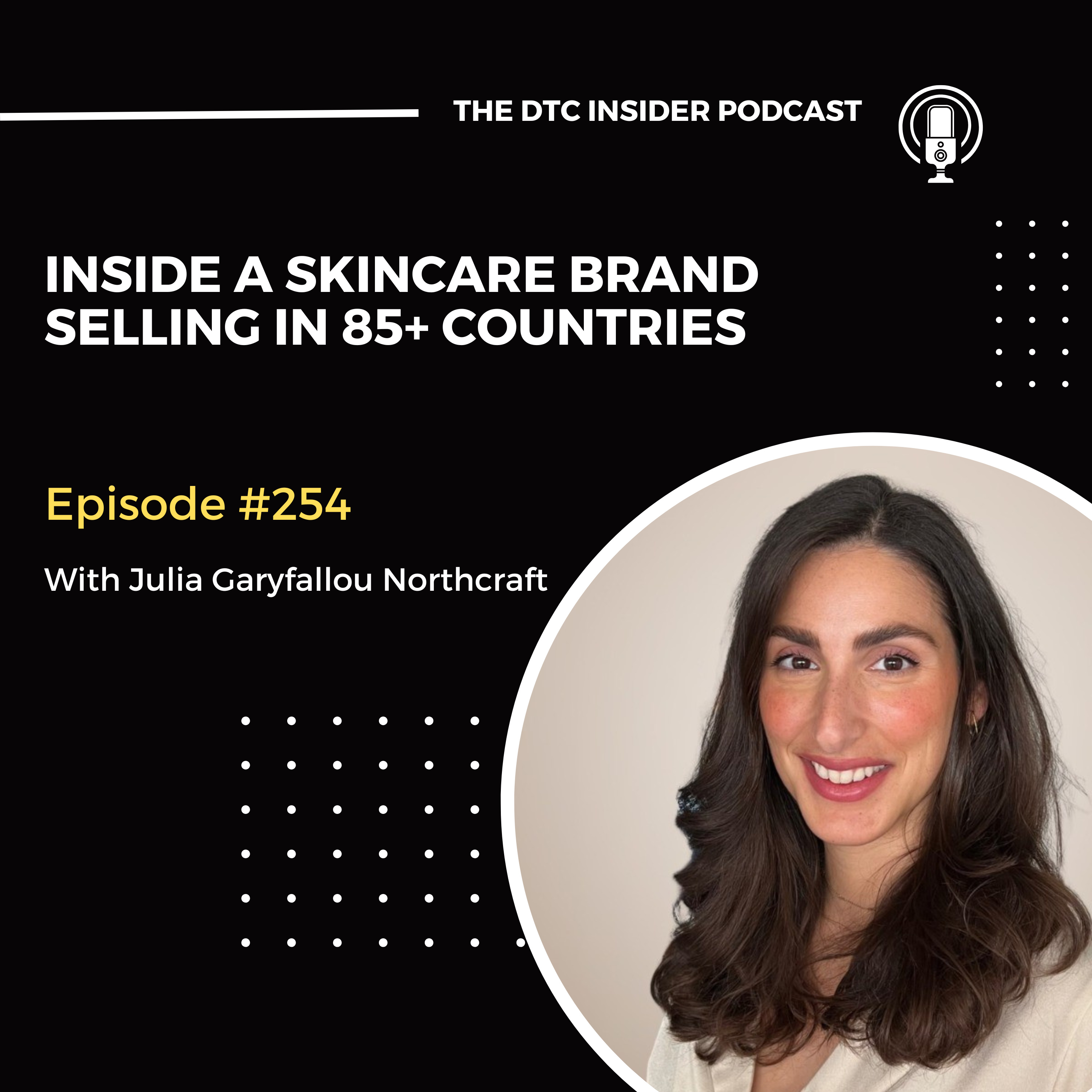
In this episode of The DTC Insider, Brian Roisentul sits down with Julia Garyfallou Northcraft, Senior Director of Marketing and Sales at Timeless Skin Care, to discuss the decisions behind running a fully bootstrapped skincare brand selling in more than 85 countries across DTC, marketplaces, and retail.
Julia shares how growing up in her family’s business in Greece shaped her approach to marketing and sales, how her role evolved over eight years at Timeless, and why understanding operations matters as much as creativity. She explains how the brand manufactures its products in-house in Texas, maintains a small, focused catalog, and prioritizes simple formulas and accessible prices instead of chasing trends. They also discuss international expansion, finding strong local partners, and adapting strategies to different markets rather than copying what works in the U.S.
They dive into AI discoverability and why Julia now considers marketplaces essential to a complete strategy. She discusses adapting website content and product pages for large language models, maintaining consistent messaging across channels, and the uncertainty around whether AI recommendations will send shoppers to a brand’s website, a marketplace, or a retailer. Julia also explains why entering retail requires careful evaluation of investment, margins, demand, and replenishment capacity before accepting an opportunity.
Plus, Brian and Julia explore how customer education, monthly promotions, and a loyalty program support retention when customers can return through different channels. Julia shares why Timeless works with creators who already use and recommend its products, how potential partners are encouraged to test products before collaborating, and why product quality remains essential to repeat purchases. They also discuss the brand’s early investment in TikTok Shop, its plans for live selling, and extending Black Friday and Cyber Monday promotions beyond DTC. Throughout the conversation, Julia explains how she balances long-term brand awareness with profitability and the operational demands of growth.
-- This episode is brought to you by BSR.
BSR helps 7-figure+ brands build and optimize strategic growth systems that unlock hidden revenue and scale profitably, without adding chaos, channels, or unnecessary spend.
To learn more about BSR, visit their website or book a call.