 The DTC Insider
2 Oct 2026 · 46m

 Add vo to ChatGPT or Claude to ask about everything you hear
vo listened to this episode to put together the overview and transcript, so there may be the odd mistake.
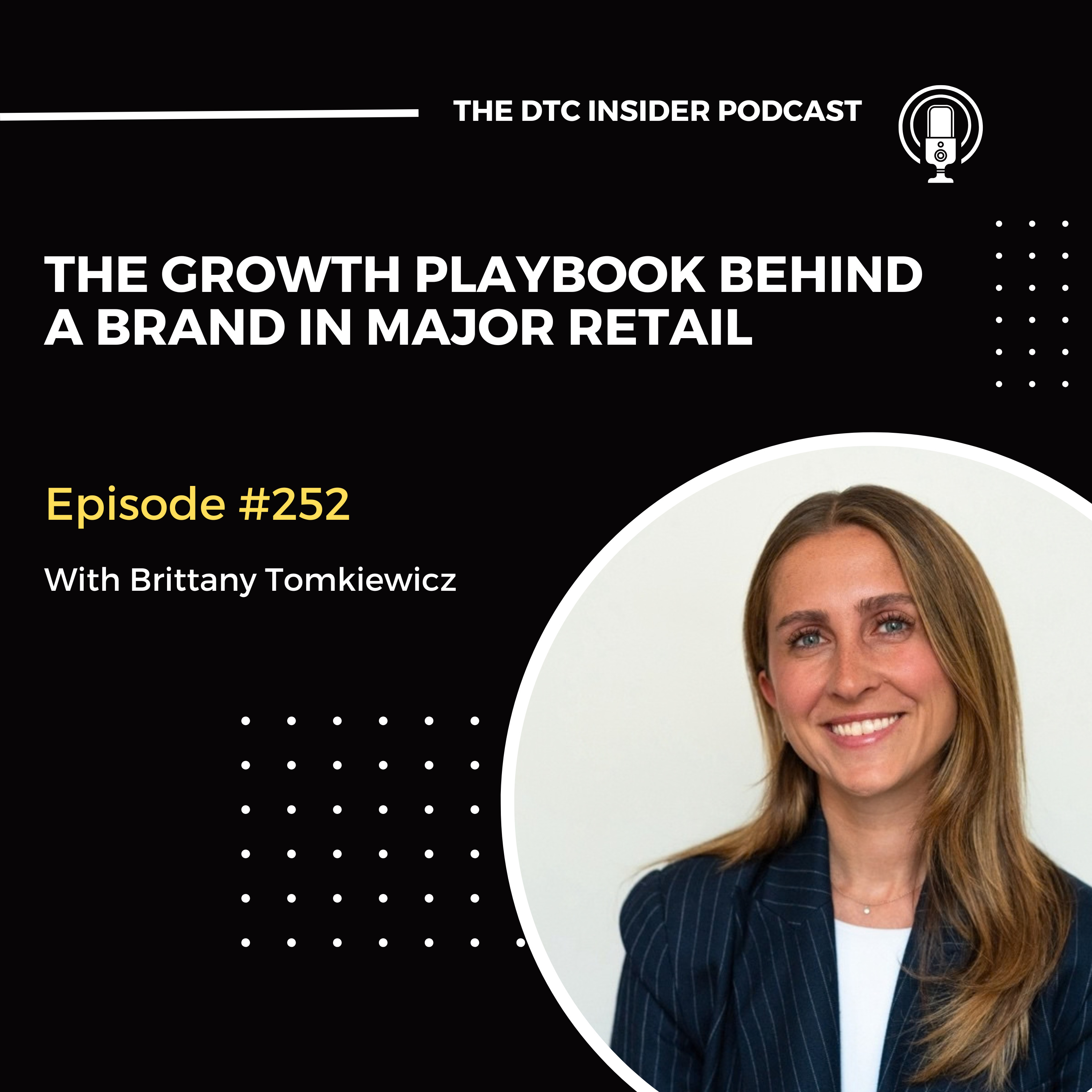
Kate McLeod’s Q4 growth strategy for major retail and DTC, focused on customer acquisition, creator partnerships, and disciplined promo planning (especially Black Friday/Cyber Monday). Brittany Tomkowitz (VP of Marketing at Kate McLeod) explains how the brand scales paid growth via an “acquisition ecosystem” of iterative creator content plus Meta/TikTok/Google media, while tailoring retail tactics to Sephora vs. Nordstrom.
Tomkowitz has ~15 years in brand-side marketing, mostly D2C startups; she’s built Kate McLeod’s acquisition/content/creator engine and works closely with paid media on CPA/blended CAC thresholds.
acquisition still determines survival; keep offers consistent in Q4; founders should personally message creators early; use whitelisting; diversify content to avoid algorithm throttling; contingency-plan weekly for Q4 stress.
Sephora and Nordstrom distribution (plus Anthropologie, Goop, boutiques via Fair); Nordstrom sponsored product ads and in-store events; Sephora “Sephora Squad” creator marketing; TikTok Shop ads vs driving to DTC; AI website agent for customer tickets and AI discoverability via blog/content.
0:00We are on Sephora. We sell with Nordstrom as well in-store and online for both of those. We are with Anthropologie, Goop, and many, many other boutiques across the U.S. We are keeping things the same, particularly for Black Friday, Cyber Monday. We've kind of found a good groove of what historically works well. We also are not very promotional in general, and the sale that we do do around Black Friday is one of the very few and the biggest deal that we offer for the year. If you could like a single, like a biggest piece of advice for brands listening to this ahead of Q4, what would that advice be?
0:46Welcome to the DTC Insider Podcast, where online business owners come to find actionable tips and tactics to grow their businesses. Now, here's your host, Brian Roizenthal.
1:05Hey, welcome to another episode. My name is Brian Roizenthal. I'm your host. And today I'm joined by Brittany Tomkowitz. She's the VP of Marketing at Kate MacLeod. Hey, Bernadine. Thanks for being on the show. Hi. So nice to meet you. I'm happy to be here. Yeah. I'm super excited about this episode because, you know, it doesn't always happen. I get to chat with someone with a lot of years of experience in the marketing space, helping brands grow. How could you tell us more about your experience? How many years have you been doing this? Yeah, I've been in the marketing world in some way, shape or form for about 15 years now.
1:42Yeah. So it's been it's been a little while. And a wild ride. It's been marketing changes by the day, it feels like. So it's been an interesting journey. 15 years ago, talking about e-commerce wasn't even the same thing. Totally different. I mean, Instagram stories and ads, I don't think had launched when I started working. It was not a thing. TikTok was not a thing. There's so much that exists today that did not when I first started in this business. That is wild to see. Was it always from the brand side? Yes, I've only ever worked on the brand side. I've not worked in a corporate environment either.
2:22I've mostly been at smaller D2C startups and brands. Yeah, with exception to a small stint that I did as more of a consultant, but where I worked for myself. But otherwise, yeah, brand side for the most part. But it's worth it. I started my, like the first version of my, because it was a different world in 2013. So I can really tell you that back then it was probably the right column ads on Facebook back then. Not even Instagram stories where the feed wasn't what it is today. No, not at all. Giving away all kinds of crazy stuff like cars, trucks in return of, you know, likes and shares. A different world.
3:07Totally. Yeah, very different. But it's been fun and it's a fun, fun journey. And it's part of why I like marketing in a lot of ways is that there's always something new and interesting to learn and explore. And yeah, it's kind of fun to have to evolve consistently. It helps build resilience. And yeah, there's never a dull moment, that's for sure. Yeah. You know, the last few years, as we know by now, or most of us know by now in the industry, have been kind of unique, right? Because we had, of course, the peak of the pandemic for many brands, many new brands, everything was growth, growth and growth, especially for new brands trying to aspire to scaling aggressively.
3:47a lot of, let's say, between quotes, success playbook or playbooks to success. And then we all realized that something called retention and loyalty and LTV and some of those things were something that we needed to address. So after all of those years, how would you define in a word, in a sentence or without the pressure, maybe in a phrase, 2026 for Brian's? Gosh, I mean, I think probably evolution and resilience are two of the words I would associate with the year of 2026, you know, in that just there are so many macro, you know, changes and factors that have impacted. And that's true, honestly, the last handful of years, really, since the pandemic.
4:33I feel like the economy has been in an interesting place. You know, things like TikTok have emerged. Other platforms have emerged as major sources of media consumption for consumers in a way that have forced people to pivot and change the way that they market and create content for customers. And I feel like that has just been the story of this year in a lot of ways, particularly as a result of AI and how that influences people's buying decisions and even controls things like Meta's algorithm and the way that ads are served. there's a lot that has changed that has forced marketers to evolve really consistently that has been a bit you know you get kind of whiplash i feel like whiplash is another word that i would probably associate with 2026 as well just with all of the like evolution of every platform every touch point something that you know i i speak with a lot of clients every single week and what i found the common pattern has always been the same probably since i remember but now with a different, let's say, with different ingredients and some gray areas, but it's customer acquisition.
5:51Even though everyone says we're more brands than before, say, these days that they value retention and all this stuff, at the end of the day, if they are not acquiring customers, they are gone, right? So both of the equations are important. And customer acquisition has been, like most brands I speak with, have been struggling a lot or more than before with customer acquisition. because it's not easy to stand out these days. Costs on Meta or other platforms aren't the ones that you can get. So what's working for you on that side and what do you think about or how do you think about CostWorks? Yeah, I mean, at Kate McLeod, we, you know, over the last couple of years since I've been with the company, I would say what I've worked on building up here is sort of our, I would say, our acquisition ecosystem.
6:43We have really built out our content creation abilities and our creator programming. And I work really closely also with our paid media buying team to set up sort of thresholds that help help define what success looks like in the form of CPAs and blended CAC that we need to achieve in order to scale. And as long as the, you know, those numbers are right, and we are operating within those thresholds, we've sort of given ourselves the license to scale into paid ads and growth on Meta and TikTok and Google as we're sort of observing the dynamics. So there's a very kind of real time, I would say, incredibly iterative process and ecosystem that we've created here where, you know, really every week, every couple of weeks, we're handing off new styles of content and, you know, working with different types of creators to kind of keep that creative engine going.
7:51And then on the other end of that, you know, working really closely with the paid media team to closely track, you know, numbers and our blended CAC so that, you know, when we see those opportunities and are seeing really efficient growth, we scale into it as to the extent that we can. And in doing that and having that sort of, you know, basically like bringing all those resources kind of together, like they're all part of the same system. We're all talking to each other on a regular basis. We've been able to, you know, consistently scale into new customer acquisition growth. So which channels do you use to advertise or what channels do you advertise on?
8:30You mentioned a few of them, Google, Meta, TikTok. Are those the ones? I would say those are the main three channels that we're active in. We are getting live on Pinterest as well. But Meta and TikTok are, I would say, our two main channels. I mean, those two channels have millions upon millions of users and multiple ways to reach people within those two platforms alone in terms of a lot of creators are active there. And, you know, so we really try to keep our areas of focus quite tight, at least for now, and are just trying to maximize and grow within those platforms rather than spreading ourselves a little bit too thin.
9:13But obviously at a certain point, you know, you want to start diversifying and branching out into other media channels. And so we're starting to look at Pinterest as kind of our next frontier for us at this time. Meta, the number one, then TikTok, and then Google. Yeah, well, I would say in terms of spend, TikTok and Google at times are at parity with each other. Sometimes Google winds up spending more depending on the time of year. If there's when there's more underlying demand for our product, you know, sometimes Google can be the number two channel. But I would say we're spending the bulk of our meta is our number one ad channel and really the space where we spend the most time in terms of building our community.
9:59Again, you know, reaching creators, working with creators is really like concentrated largely to the meta ecosystem. I'm going to talk about creators in a minute. But before going there, when you mentioned TikTok, is it only ads or the shop as well? We have a shop presence there. I would say we don't we haven't found success yet in driving to that shop. Our ads, when we run ads, they're typically work best when we drive directly to our direct to consumer. It is an area that I'm interested in cracking into a little bit more because I do think there's a lot of opportunity there for sure. We've just, as with a lean and smaller team, we haven't been able to fully crack the code because that channel in particular requires even more iterative content than meta does.
10:49And so we're thinking about that actively for next year, building out resources to support that. I used to be part of a TikTok shop community from one of the biggest agencies of TikTok shop in North America. And something they said, you know, stayed with me because it's pretty interesting. Some brands, such as the one you work with, probably have had some success with building a good community or a creator program and some, you know, good relationships with them and strong results. But it's not the case for most. and TikTok shop besides the direct results that you might or not get directly, what they call GMP or the sales getting that you can get from the platform.
11:35What I find more interesting is that TikTok shop is forcing brands to exercise the muscle of reaching out to creators and building a creative community and having an army of people because we are talking about acquisition, right? And I always tell brands that, And correct me if I'm wrong or if you think differently, because I always love learning the approaches. But it's, you know, it's not what you launch. It's not what you do, like a promotional, what promotional action you do. It's how you do it, right? And if every single year you do the same way, it's different than if you launch a certain action, let's say, with a thousand creators or a hundred or even dozens to start off with.
12:17Yeah, absolutely. I mean, I think that goes back to the beginning of our conversation and the word evolution and iteration are really inherent parts of our creative execution process here. You know, we're constantly looking at, like, of course, what performs well and are consistently reviewing what are our top ads, what is driving the most efficient growth at the highest AOV. and right, like taking learnings from those and replicating that as much as we can. But a part of our process too is looking outward. We're all, you know, every member of the team is responsible for being consumers of media and content.
12:58And we are paying really close attention to styles that seem to be working, topics that seem to be trending among our target consumer and, you know, tracking creators that are, you know, emerging as people that maybe we wouldn't have expected to work with, but could be an interesting fit for helping us break through. And so there's a lot of sort of factors that we consider every time we're going into a creative production sprint that helps inform what the content output is. And we're always trying to diversify within in the set of content that we have, you know, what the content looks like, what the hooks are, the cast of talent that we're utilizing and trying to create as much variety as possible to hedge our bets when we get to, you know, the stage of rolling that content out into the algorithm.
13:54Because what we've seen, and I'm sure I think most brands experience this from my conversations with other marketers is that meta tends to, and TikTok to some extent too, really tend to focus in on very few pieces of content and really throttles those and scales into those versus it being pretty evenly spread across multiple pieces of content. I think back in the day, there was more of a scenario where, you know, your budget was split across a lot of different ads. Now it's a bit more concentrated and it's, you know, become a lot harder to predict and anticipate exactly what's going to perform well each time because the media landscape and content landscape is changing so rapidly all the time.
14:42So we're constantly bringing those learnings into our, you know, into our process and, you know, are churning out a lot of different types of content to, like I said, hedge our bets when we get to the almighty algorithm. The experience that you have with the creator programs, now there are some marketers, operators, and founders listening to you. What's the advice you give them to start out with a creator program? Because I've been in recent conversations with them, and they don't know. One said, hey, I'll hire a creative director. One said, I'll reach out to one or two, and I don't know how many will record the content if I see products.
15:26So what can they expect about, you know, what are the first steps they should take? And what's the immediate, I don't know, outreach volume and the expectations for that first round of creatives? Yeah, I mean, I think if you're particularly a younger brand that's just starting out and you're a founder with a very small team, I personally think that the best means of executing or getting started there is I think the founders themselves need to be directly messaging and looking up individuals on Instagram or TikTok. I think it's very important to fully immerse yourself in those channels and be an avid consumer of the content there so that you're getting served people that could be relevant for your product and your brand.
16:17And I really do think it's I think the nicer touch is when the founder themselves, especially again in this earlier stages, is reaching out and, you know, is personally offering to gift the product and explaining from their voice why they exist and what they're so excited about, you know, in terms of the existence of this product on the market. And I feel that in a lot of ways, even today, you know, Kate McLeod is, you know, eight, almost eight years in. And Kate and myself and our other co-founder are still to this day, like we prioritize relationships and reaching out to people directly ourselves and forging those connections because that you can't, you know, mimic that in any other way other than authentically, you know, caring about those connections yourself.
17:08So it's a bit of a grind and it's a bit manual, but I do think that that's going to net out the best results in an earlier stage business because you are going to be, you know, connecting yourself and directly with these people and they'll have a different impression of your brand than if you fully outsource it out to a platform or an agency or what have you. That said, I do think that there are a lot of great tools and platforms that are out there to help connect with creators and a lot of creators simultaneously. We use a platform called ShopMy that I'm sure you've heard of before. And I do think that if you are a founder or a really, really lean team and you have a somewhat limited budget, you know, I do think that you could like somewhat easily get started on a platform like ShopMy.
18:01and I find their platform very helpful for being able to discover talent a little bit more easily. They have great filters and search tools and functionality within their system that makes it easy to find different people and then you can reach out to them directly. And so I think that's another probably worthwhile investment of time and money. I think once you build up the organic relationships and you've done a lot more gifting and you have a little bit more of that under your belt then i think sure bring you know resources in-house to help manage some of those things because obviously at a certain point it gets kind of unruly to do all by yourself but i don't think that like hiring a creator manager or like a director of something to in-house manage that out the gate is is necessarily the best move that's just what i think it's great writing in in times like this, which automation is the default or the expectation to be the default.
19:02Manual, because not everyone is willing to do the manual work because everyone wants the easy stuff, the automation. So I think that there are many tools, as you said, and that one, I know them as well. So I think that it's great advice. I wanted to ask you a question because you mentioned, you said to forge connections. You didn't talk about finding a thousand creators. You talked about building connections. So does it mean that you see these not as a one-off? Some could be a one-off, but you look for building longer-term relationship with creators. If that's the case, what does that look like?
19:41Yeah, I think, you know, we try to balance that out with, I mean, listen, we try to bring as much of a personal touch to every single interaction that we have. Obviously, you know, to simultaneously scale to a certain degree when you're trying to, like I said earlier, you're trying to get a lot of pieces of content in the pipeline. And of course, you need to start automating some amount of the process. And I do think that's where tools like ShopMy come in. They make it a bit easy to sort of prop up systems in that way. But, you know, in terms of the one-offs versus longer term partnerships, we definitely do try to return to creators, I would say, periodically, especially ones that we see where the product really resonates.
20:32and there is a clear uptick in product market fit within their communities. So we're always tracking sales from those creators. And, you know, the engagement that we receive even on our own Instagram, you know, we'll look at if we gain a really large bump in followers or a really large bump in profile visits that is outsized from the norm. And for creators that have that, you know, ability to drive incremental followers, visitors, sales to our brand, we definitely take note of that and we'll cycle back to them. We try not to oversaturate, though, at the same time when it comes to paid partnerships in particular, because we simultaneously don't want to overdo it with those creators communities, because there is a point at which, you know, if you're constantly doing ads or promoting the same product over and over, there's definitely some diminishing returns and just maybe some, you know, a lack of like engagement.
21:38that kind of occurs over time. So we try to be really careful about the consistency with which we're re-engaging with partners and try to create, I would say, maybe like a six-month-ish distance between paid partnerships if we're re-engaging with a creator. And then others are, you know, one-off partnerships and, you know, but we always are keeping tabs on, you know, everybody that we've historically worked with And particularly for people that, you know, did a great job on the content they created or, you know, people who particularly have like an excitement for the brand, like there's a felt kind of proactive interest in continuing the relationship.
22:22Like we do kind of react and respond to that and we'll definitely cycle back to creators that even if maybe their content didn't quite perform to the degree that other creators content had performed, if there's a real genuine connection there, we try to cycle back to that because there is something to the authenticity of that relationship that feels worth kind of keeping tabs on. You know, by the time this episode airs, it'll be beginning of October, meaning Q4. The scary but rewarding Q4 as well. That's scary. A lot of hours of work for many of us, right? But it's good. It's a really expected time of the year.
23:02And how do you approach Q4? I recently surveyed. I have a newsletter as well. under the same, the DC Insider started in 2023. And I sent balls to the list, you know, or to the subscribers. And this time I asked them about what they were planning to, you know, these Q4. And the options were something about, you know, same thing as the last few years. I don't know yet, or something new or whatever. And it was something like this, where the biggest challenge for a Q4. And many people said that they are continuing with what worked in previous years. So they are not changing much, maybe some details, nuances, but the offer is sort of the same.
23:46Is this the same case with you? Yeah, I would say in terms of offer structure, generally speaking, we are keeping things the same, particularly for Black Friday, Cyber Monday. We've kind of found a good groove of what historically works well. We also are not very promotional in general. And the sale that we do do around Black Friday is one of the very few and the biggest deal that we offer for the year. So we've been able to kind of maintain consistency there. obviously as brands get bigger and bigger and bigger and you may right have to start becoming more promotional throughout the year to sort of maintain pace with your expectations in terms of sales should we get to that point i could see us maybe revisiting or rethinking what our offer structure is to ensure that it's differentiated but for now we are keeping the offer the same however we're always looking to um because obviously there's like something nice about consistency in a lot of ways when you have a lean team for execution.
24:51You don't want to introduce too many new things and new systems and new strategies to the point that it becomes difficult on the execution side of things. So we're looking to maintain a lot of what we executed well last year. But of course, there's always learnings and things that we wish we had done differently, ways that we may have wanted to plot out the calendar a little bit more methodically. You know, like we have to obviously pay attention to when retailers and Amazon and other brands are doing sales and trying to make sure we're not, we're either, you know, competing, you know, with our own sort of promotional strategy at that same time.
25:33You know, we're doing, I think, going into this year, we've, we're like going in really eyes wide open relation in relation to sort of just external activity, external macro factors that could potentially have an influence or an impact on our own ability to drive sales and just proactively planning things to kind of have in our back pocket pending how things go. So we're definitely going into Q4, just thinking really, you know, intentionally about that. And then, you know, we also are rolling out some new, You know, we have some additional gift with purchase options this year that we historically have not executed that we're excited to offer for some of the early bird shoppers to sort of, you know, sweeten the deal for them as they're shopping to try to get more, you know, like an increased basket size.
26:22So there's things like that that we're just we're trying to introduce in a way as a way to maximize the amount of revenue that we're able to get in this upcoming quarter. Do you notice, just a quick question on that, and we were discussing previously about creators, have you noticed drastically the difference between doing something that you used to do in previous years with and without creators? Have you seen a clear uptick? If you did promotion one in 2024 and then in 2025, you did the same thing with creators. Did you see a clear uptick there? in terms of meaning like giving creators promotional codes or yeah or over revenue let's say you do a promotion in july every july in 2020 without creators because you weren't using them and then in 2025 you started a creator program and then you did the same thing or similar with you know creators did you see a real aptitude there or if you have done that of course yeah Yeah, yeah, for sure.
27:24I mean, I think any, anytime you're introducing a totally net new channel or tactic that did not exist before that is new to your strategy, you know, we, we definitely when we started introducing creator a bit more significantly into our, you know, into our marketing strategy and started ramping up with paid partnerships in the last couple of years since I started with Kate McCloud. we've definitely seen a major uptick in sales as a result of those partnerships in conjunction with, you know, the organic partnerships themselves, of course, but we also have found a lot of success in whitelisting the content.
28:08So what we'll do is we'll take the content and gain access to the creators, business manager temporarily, and we will run the piece of content as an ad through their Instagram handle and have found a lot of success at reaching new customers and even reaching more of their own communities of followers through those whitelisting partnerships. And when we started to introduce that, we definitely saw an uptick just across the board, you know, not in relation to a promotional time of year. It was just, you know, we definitely saw a major uptick there. And then what that's kind of enabled also is the, you know, in the last couple of years, just the ability to restrict the amount of promotionality that we do introduce and we really pick and choose sort of those times of year to really throttle sales in a way that, you know, feels very planned.
29:14At the end of the day, my way of thinking and my approach when we speak with brands and work with brands and what I learned from many great founders and operators such as you is that growth leaps in the marketing calendar and not as much in the ad account. And one founder said, like a nine-figure founder, recently or last year said something like trying to, you know, look at growth only within the ads manager. It's like trying to rearrange chairs in the Titanic. And it's because not every problem is another problem. But acquisition and ads and all this stuff, which is, let's face it, even though organic exists, some brands or most brands are not big inorganic.
29:57So they need ads and they rely big on ads to grow. And some, they don't know how to scale anymore. And it's not about adding more creatives only. It's doing the, again, enriching the marketing calendar through actions that, of course, tap into the ad account as well. So yeah, we're saying about partnership ads. It's something that we work on a lot. We are experienced with that. Of course, there are some good and some bad partnership ads. But good awareness is that in some accounts, they take over the ad account. like the partnership ads take over the budget. So we take them into their own, we put them into their own campaigns because that's typically what happens, but it's a great way of - Yeah, we do the same.
30:37Yeah. Yeah, for sure. I want to ask you about retail because you mentioned what Amazon and other retailers do. Are you on retail stores? We are, yeah. We are on Sephora. We sell with Nordstrom as well, in-store and online for both of those. We are with Anthropologie, Goop, and many, many other boutiques across the U.S. We work through an intermediary called Fair. And that company and the platform has been incredible at connecting us with smaller gift shops and boutiques throughout the U.S. and have a really thriving business there also. So, yeah, we're really lucky and have a lot of great retail partners.
31:23Great. And what have you found over time about the RIDL strategy versus the DTC strategy? The biggest ones out of Sephora and Nordstrom, for example. Yeah, for sure. I mean, I think obviously for our DTC, you know, our community and the way that we generate sales is somewhat constrained to the online environment. So we just sort of have to think about digitally how we are or just like, you know, how we're reaching people digitally more so. Obviously, with Nordstrom, Sephora and other retail in-store retail partners, you know, we have to consider the in-store component and our merchandising and look and feel of the brand there.
32:05So that obviously introduces another layer for us in terms of just how we think about driving sales and how we're driving foot traffic and people into those stores to shop our products. And so and I would say in terms of just the online presences for those businesses, particularly for Nordstrom and Sephora, where obviously they they serve different customers and different communities of people. And so we're always thinking about, as it relates to their online businesses, how to sort of customize our strategy based on what that particular retailer, you know, tends to see perform well in relation to doing well in their dot com.
32:51So for Nordstrom, for example, we invest in online advertising that's on their website. We have sponsored product ads that show up throughout categories on their website. We also invest in a good amount of eventing in store with them. They have a really robust, you know, community of very loyal shoppers and credit card holders. And they really invest into, you know, their VIPs. And so we participate in a lot of that programming and have found a lot of success in leveraging those two tactics in terms of growing awareness on Nordstrom. And then with Sephora, Sephora has their Sephora squad and they really emphasize creator marketing.
33:45And so we tend to, that's sort of the tactic that we've deployed really with Sephora has been more about tapping into the Sephora squad and the creator communities that they partner really closely with as a means to get the word out about the fact that Kate McLeod is available. there. And so we really tailor sort of our approach depending on what is going to help us reach those consumers that, you know, each retailer is connecting because each of them have different ways of, right, like engaging with their own communities and, you know, and reaching customers. So we try to sort of go with the grain, so to speak, when it comes to collaboration with them.
34:33All right. So this is far from being a one-side-fit-all strategy, right? Yeah. Yeah. Strategy for each channel. Not only DTC versus retail, but also one for Sephora and one for Nordstrom. Instead of just in the shelf and waiting for sales to come, they've been brought out of it. And yeah, that's, it's amazing. Yeah. Yeah. It's, it's, it's been, it's also really, it's been really cool to sort of think about each individual retailer and what they need and you know, reimagine the product and the marketing through those different lenses. Like Sephora, for example, we, you know, have, I would say our product page assets are very different there.
35:17We really customize, you know, our assets on that channel in a way that is very particular to the Sephora community and, you know, leverages a lot of their unique best practices when it comes to communicating the product and the brand and why a customer from Sephora might be interested. And so it's interesting, you know, just having to constantly reimagine how we explain what the body stone is to different retailers, consumers. And it's been, you know, fun. It's been a really fun challenge to think about that. Our last topic from my end, at least, and how to avoid measuring this one. We're bringing it up in 2026.
35:59AI, right? I mean, we talked about the body of, you know, STEM to stand out in 2026 in an automation era to value the manual work because it's the one that probably makes us stand out as well, but we cannot ignore AI and everything that is true for us and it's only the beginning and what, how we can also help us stem out and in another way. So you're sort of exploring as a company, you know, AI. And if you can tell, of course, what are we, I mean, it could be either consumer facing or internal. Yeah, totally. I would say the way that we've largely thought about AI is really, I mean, it's kind of like the same goal in a way for both of the sides that we think about it.
36:48It's to make an experience easier and better. And so we do that for consumers and we do that for our team internally. You know, we leverage AI internally to assist with various sort of processes and, you know, supporting with things like, you know, helping us analyze data a little bit more quickly so that we get insights a bit faster than, you know, going about it in a bit more of a manual way. And then on the consumer side, you know, we have an AI agent on our website that can help solve tickets for customers and inquiries for customers, you know, in a way that is a bit more efficient, right?
37:35Someone's, say, looking for tracking information or if they're looking for a quick answer to a question that's a little bit more turnkey and straightforward to answer. You know, we don't want them to have to reach out and wait, you know, 24 hours even for a response to something that feels like you can just give it to them a little bit more quickly. And so we're leveraging AI to support with answering some of those more turnkey questions that consumers have so that they're not unnecessarily, you know, waiting for an answer that could be given to them even more quickly. So we're thinking about it as a as a way to just, you know, make make experiences better and easier for our team and for our customers that visit our website for now.
38:22You know, we're also simultaneously thinking about it through the lens of, you know, our website and are currently noodling on and toying with launching a blog that would be more conducive to kind of answering questions that are relevant to our product and brand that would be beneficial to have on the site. so that when ChatGPT or Claude is scraping the internet for answers to certain things that are connected to our product, that we're in contention for that. So we're also working on, you know, making sure that our products are discoverable for those AI, you know, agents that are scraping websites.
39:04Yeah, we all need to be ready for that. Yeah, we do. We run JGPT ads for some brands and it's, of course, in a very early stage, but it's getting more fast as we speak because a couple of weeks ago, Shopify integrated finally. Yes, I saw that. yeah and now yesterday the the shopify president announced the integration with muse the brand and you can now use shop pay to check out without leaving muse so it's happening a few years ago i wrote about the newsletter you know things about what jumped to commerce and blah blah blah but it It was two years ago that we only started talking about that. But in 2026, like I described, I wrote about it and I said that it's probably not the end of websites by all means.
40:00I think that TV didn't kill radio, online, it didn't kill offline. I don't think this is free to keep websites. But it is so far, I think, killing dashboards because of the release of the MCPs, you know, the connectors between cloud, chat, GPT, et cetera, with FI, meta, et cetera. Yeah. We consume, at least we consume fewer dashboards because, yeah, it's getting smarter and a jump to commerce around the corner with all these releases and integrations. We are this far from getting that to happen. We'll see which products we trust the agent with most. I think probably cheap subscriptions or whatever, but I don't know.
40:42It's fun times and interesting, definitely. Yeah, absolutely. No, it is. yeah and we're yeah we're trying to keep on top of all that and keep tabs as best we can it's honestly overwhelming at times though there is so much and that's what it was saying early you know going back to our first question just iteration and evolution and just this constant you know kind of state of change it's it's just it's true i feel like especially driven by ai and the changes that that is introducing across not only just, you know, how people discover products, but how people are shopping, how they're doing day to day activities, it's changing so much about our day to day lives.
41:27And yeah, it's, I mean, it's, it's important to stay on top of and simultaneously, you know, Kate McLeod is a brand that, you know, the product, the body stone is this tactile, beautiful lotion bar that is, you glide along your skin, and it's a very sensorial experience. And there's something really human and in your body about that, that we also don't want to forget about in our day to day execution of things, because it's very, very easy to, you know, write something, you know, just throw something to a clod or a chat GPT or reduce consumers down to numbers and write like numbers on a screen.
42:07And we try really hard to counteract the like rapid expansion of AI and adoption of AI with also just remembering the importance of the other end of that spectrum and the importance of striking somewhat of a balance and work really hard to, you know, ensure that we're not over-rotating there to the point that we're just losing sight of, you know, what we're doing. I preach the same. I always say that brands should go beyond the website or beyond the storefront because, you know, selling a property, anyone can do that but going back to what we were discussing before about the manual work you know caring about somebody and of course putting the mission and vision into practice and connect really connecting with our consumers it's something that still pays off and i think it will be for a long time but we'll see yeah we will all right hopefully we'll all make it through yeah i'm final like if you have to like i know it it will be a tough question i'm giving you the heads up but i know you can do it it's if you could like a single like a biggest piece of advice for brands listening to this ahead of q4 what would that advice be like to getting ready for q4 any anything that you could say this is the biggest thing that i can tell brands to you know the biggest advice ahead of q4 anything that.
43:31Yeah. Say, I mean, I think that the biggest source of stress in a lot of ways for Q4 is the fact that there is so much riding on the amount of revenue you drive in this three-month period in relation to how it ladders up to your annual strategy and your annual revenue needs. And I think what I would suggest as the best piece of advice is probably just to sit down and make sure you are contingency planning and you are sitting back and thinking about every single channel that you are currently going to become active on, making sure that you are going through each one, like checking off the boxes of what you need to make sure is tidied up or, you know, optimized and organized, you know, going into Q4 just to make sure you are ready to go.
44:24Because I think the biggest source of stress is typically if you feel like, you know, sidelined by something or surprised by something. And so that to the extent that you can try and mitigate that, you know, I think just contingency planning and, you know, making sure you're looking like week by week at each single week, what is going on on your marketing and e-com calendar? And how is that laddering up to driving revenue and just really granularly kind of going through all that, I think helps just like ease a bit of stress, ideally going into this time period so that you can, you know, just know that you've done everything you can to prepare.
45:06And then you're just kind of like waiting to, you know, you'll be like head on a swivel and you're kind of ready to react to whatever comes your way. Brilliant. Thank you. It was great meeting you and learning more about you and the company. Thank you. It was great to meet you too. Thanks for having me.
In this episode of The DTC Insider, Brian Roisentul sits down with Brittany Tomkiewicz, VP of Marketing at Kate McLeod, to discuss how the brand approaches growth across customer acquisition, creators, paid media, DTC, and major retail partners including Sephora, Nordstrom, Anthropologie, Goop, and boutiques across the U.S.
Brittany shares how nearly 15 years in marketing have shaped the way she thinks about growth in an environment where platforms, consumer behavior, and technology are constantly evolving. She explains how Kate McLeod has built an acquisition ecosystem that connects content creation, creator partnerships, and paid media, using CPA and blended CAC thresholds to determine when to scale. They also discuss why Meta remains the brand’s biggest advertising channel, how TikTok and Google fit into the mix, and why Pinterest is becoming their next area of exploration.
They dive into Kate McLeod’s creator strategy, from building authentic, long-term relationships to paid partnerships and whitelisting creator content. Brittany explains how the team evaluates creators, why they avoid oversaturating audiences, and how expanding their creator program has led to a major uptick in sales. She also shares why founders of younger brands may be better off building creator relationships themselves before hiring someone to manage the program.
Plus, Brian and Brittany discuss how the brand is preparing for Q4 and Black Friday, why one of its biggest promotions of the year remains largely unchanged, and how gift-with-purchase offers and contingency planning can help maximize revenue. They also explore how Kate McLeod adapts its strategy across DTC and major retail partners, from sponsored ads and in-store events at Nordstrom to creator communities at Sephora, and how the team is beginning to use AI for data analysis, customer support, and brand discoverability. Ultimately, Brittany shares why successful growth today requires constant evolution while still staying focused on the channels, relationships, and strategies that actually work.
-- This episode is brought to you by BSR.
BSR helps 7-figure+ brands build and optimize strategic growth systems that unlock hidden revenue and scale profitably, without adding chaos, channels, or unnecessary spend.
To learn more about BSR, visit their website or book a call.
Scan the code with your iPhone camera
Listen in the app.