 Ask ChatGPT


How “AI commerce” (AI-driven product discovery and recommendations from tools like ChatGPT, Perplexity, Gemini, Google) is changing e-commerce traffic and conversion, and what brands must do to be recommended.
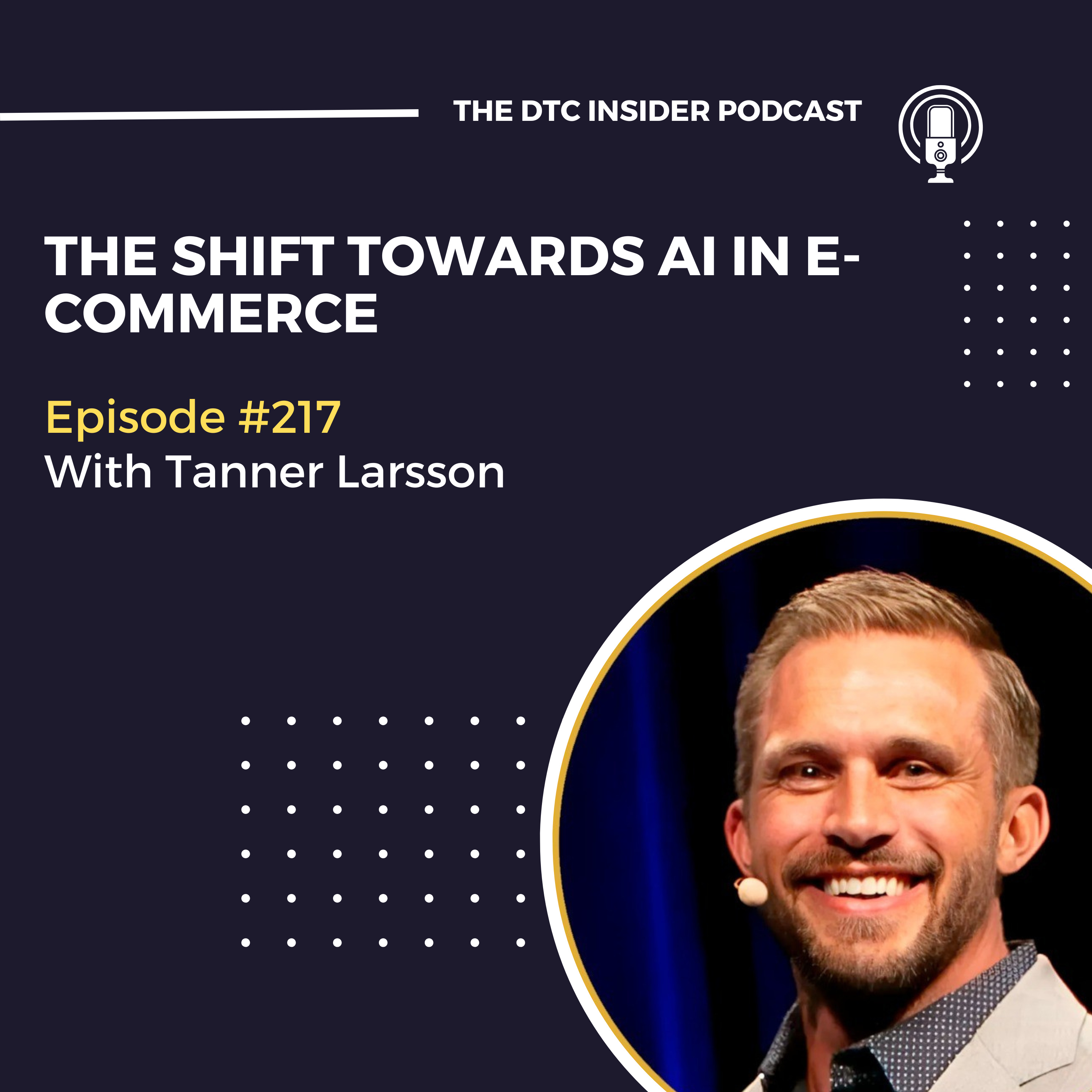
Tanner Larsen (DTC/e-commerce optimization veteran; 20+ years in direct response/funnels/e-com; founded and sold a major e-com optimization company in 2022; consulted/scaled 70+ brands past $20M; wrote “e-commerce evolved,” 160k+ copies; works on audits, retention, and scaling).
Written by AI. May contain mistakes.
Explore how AI influences consumer behavior and purchasing patterns in e-commerce.
“The time on site for people who purchase like AI referred traffic purchases is 50 % less than other purchasers coming from other traffic sources.”
Tanner Larsen shares his background in e-commerce and direct-to-consumer business.
“Hey, welcome to another episode of the DTC Insider Podcast.”
Discussion on the rapid changes in e-commerce due to technology and AI.
“But those who focus on the fundamentals also don't need to, you know, overlook probably the AI, the benefits that AI can bring into their business.”
Understanding the foundational elements necessary for scaling an e-commerce brand.
“Unfortunately, most founders are not classically trained.”
Exploration of common hurdles and pitfalls in the e-commerce landscape.
“You know, if you get those things patched up, you're strengthening your foundation and then you will be able to grow to scale, have a better CAC, better lifetime value.”
A discussion about the importance of mastering business fundamentals for sustainable growth.
“What's the absolute maximum a customer could spend with me?”
Insight into the significance of customer retention and repeat purchases.
“And all of them, I noticed that they were doing the same thing.”
Understanding how to increase customer lifetime value (LTV) in e-commerce.
“The other day, Nick Shackleford, one of the founders of Breeze, he said that they, I think they got an extra million or so in revenue only by shifting a few details.”
Learn how optimizing supply chain and understanding customer journeys can boost profitability.
“Now it may not be at that level based on your volume and everything, but I mean, you could make, one fix to your supply chain.”
Explore the current challenges businesses face in leveraging AI effectively.
“Talking about data, you know, I want to go into AI now because I think there's a lot of noise.”
Discover how AI is transforming product discovery and consumer shopping behavior.
“that you could have just had it done and moved on by then.”
Understand how AI is changing the dynamics of e-commerce websites and customer interaction.
“And that's why so many people are shifting.”
Learn what brands must do to remain visible in AI-driven commerce environments.
“So I think there's going to be not so much that the long form and the VSL is going to go away.”
Learn how structured data layers enhance AI's understanding of products.
“They need more data than what's normally available.”
Discover how various platforms compare in AI visibility and data completeness.
“Now, here's the other thing that's really crazy.”
Explore the rapid evolution of AI in commerce and its implications.
“So even if you're on Etsy and you can't, like Etsy is not going to rank for crap in contextual search because we've all seen the product descriptions on Etsy, right?”
Learn practical steps to optimize your product data for AI search.
“Because right now, this is a competitive advantage.”
Learn how to optimize your e-commerce site with smart data points for better AI visibility.
“work down and then build out like a monthly operation or process where you keep tackling a few more SKUs every week or every month until you eventually get through the catalog.”
Explore how AI is transforming consumer purchasing decisions through personalized recommendations.
“But this is, this will eventually be just like the foundation, right?”
Discover tools and resources available for improving your e-commerce strategies.
“I would spend probably hours talking to you because it's so interesting.”

Get the gist, explore an idea or ask about something said.
 Claude
On The DTC Insider, what are the key points of this episode?
Searching your listeningAutomatic transcript. May contain errors.
0:00The time on site for people who purchase like AI referred traffic purchases is 50 % less than other purchasers coming from other traffic sources. The storefronts are also working with right now it's Shopify, but eventually I'm like shop with AI on Google, shop with Pro on Perplexity, ChatGPT. They're all rolling out in app purchasing, right? That's coming. So eventually you won't even need to go to the store, but there will still be a large percentage of traffic that's going to click through that's not going to buy through the app, right? Right. So but there, think about this. If people are spending 50 percent less time on site already, do they need to be taken to a long form sales letter?
0:36Are they going to convert as well after the product was recommended? They click through, it takes them to a long form letter and then they have to scroll and read through all the normal sales hype that we usually have to put people through. They're not they don't need that. They're ready to buy. Do they want to watch a VSL? Welcome to the DTC Insider Podcast, where online business owners come to find actionable tips and tactics to grow their businesses. Now, here's your host, Brian Roizenthal.
1:10Hey, welcome to another episode of the DTC Insider Podcast. I'm Brian Roizenthal, your host, and today I have an old friend of the house. I'm joined by Tanner Larsen. He's, I don't know, how many years have you been in the space, Tanner? Like over 20? Yeah, I'm old. Yeah, you're not old, but you've been in the space for a while. So welcome to this second episode here on this pod. Actually, it changed name in the middle. You've been here in the first or second season. Now it's the fifth season. So it's been a while. Yeah, no, it's gone through some evolution, but I love where it's headed. So why don't you start by telling the audience more about you and your pack?
1:50Sure. So guys, my name is Tanner Larson. Like Brian said, I am an absolute dinosaur in the e-com direct-to-consumer space. Also, like Brian said, been around for about 20 years, direct response guy at heart, funnels, e-com, everything. I have built and founded and built one of the largest e-com optimization companies around. I wound up selling that company in 2022. I've been consulting and building, scaling my own, selling, sitting all those fancy terms in the e-com space for about 20 years. One cool little tidbit fact is that, you know, we've scaled specifically. I've been involved in scaling over 70 brands past$20 million in the DTC space.
2:29And I've worked with, through my programs, my events and everything else, I've worked with thousands of e-compreneurs and DTC and CPG guys over the years and their brands. And I work with the founders, work with the teams, all of it. even done private equity turnarounds. So in the e-com space, like I've been around the block. I really kind of have a good feel for what's going on. I also wrote the book e-commerce evolved, which was the first version came out in 2016. I've had several versions since then. To date, we just crossed 160 ,000 copies sold and it's referenced as kind of a modern day Bible of e-commerce.
3:01Not my name, but that's what it's called, which I thought is pretty cool. But other than that, like, that's a little bit about me. Yeah, I remember shortly after we met during the episode, back then I joined your company back then. Like I joined, you know, as a member of your beautiful community and for a year or so, and even though I wasn't joining as a brand, because mainly all of them were brands, I got a ton of value. I learned a lot. It was a beautiful community and I can totally see that you know what you're talking about. So that's why I'm I'm super happy to have you on the pod again, this time to discuss something different because as you know, of course, you know better than me and many people in the audience that e-commerce changes all the time because technology changes, the landscape changes.
3:43These days, the socioeconomic landscape or context changes as well. So what are we going to talk about today? Are we going to talk about, I'd love to talk about a mix of stuff. I'm super excited about AI and I'm curious also about the fundamentals that are still valid for building a solid e-commerce brand because most people are chasing, you know, the shiny objects, even more with this AI hype. Everyone is like, oh, I want the latest hack to grow and forget about the fundamentals. But those who focus on the fundamentals also don't need to, you know, overlook probably the AI, the benefits that AI can bring into their business.
4:22So where do you want to start? Do you want to start from, you know, by the AI or by the fundamentals? Let me tease with a little bit of the AI and just to get people a little bit excited for what's to come and then we can hit some of the fundamental stuff and how it all ties in. Amazing. So, yeah. So, fundamentally, e-com is still e-com, guys. Direct-to-consumer is still direct-to-consumer. I use those terms interchangeably. Even a lot of the CPG stuff falls under DTC a lot of times as well. But, look, the biggest thing about e-com today is that the brands that are half-assing it are the ones that are struggling.
4:55People have said all the time, but like the days of being able to have a half ass website, some mediocre products, throwing ads at the wall, that's all gone. And it's only been getting further and further away from that. Now we've had, you know, the tariff scares and everything like that. I mean, most brands can't survive 10 to 15 percent cost increase in their products. They're running that close to the margins with their acquisition costs. And part of that problem comes down to the fundamentals and the fact that these brands, it's not just you, it's all e-com and direct-to-consumer brands, are not actually built for growth.
5:30And I'm really into scale. And what I mean by that is what got you here won't get you there. And you've band-aided so many things together. You have a hodgepodge tech stack. Something works. You keep doing more of that. But then you hire more people and you have bloat. And all of a sudden your revenue is climbing, but your profits are shrinking and, you know, things are breaking on the back end. You as the founder, you're juggling like a million plates wondering like, hey, I have a bigger team than ever. Why am I doing more work? Why am I more stressed? Why is this all not working? And that's because your brand, your business is not built on a strong foundation.
6:01That foundation includes your supply chain. That foundation includes your marketing and advertising, your conversion rate optimization, your team management, your org chart, and also the founder. How do you operate? Unfortunately, most founders are not classically trained. They're not, they're founders by nature of creating the business, not by actually having the skillset. Many founders aren't even good leaders, not from a lack of wanting to be. They just don't know what to do and they've never led. And then they find themselves having to manage a team, but they don't know how to do that. How do I hire?
6:30How do I fire? How do I actually get people to drive things forward? So those fundamentals, and those are the fundamentals of business. Truthfully, I didn't just say anything specific to e-com besides maybe conversion rate, right? That's what's true. That's what's always been true. That's what I have been doing for the last 20 years. It's what makes the biggest needle movers in all the businesses that I consult with, my portfolio companies, everything. It's not the next, how do I get a better CAC on Facebook ads or how do I test Twitter ads or all these different things, which are all important.
6:59And I should say X, I'm still old school, right? But I don't say Twitter or X, right? But anyway, it's not these hacks and these things, which are still what everybody and all the gurus and everybody's talking about. Everybody really during this time needs to go back to basics and figure out, look at your business. Where are the gaps? Where are the holes? Where are you leaking? Think of it like a pipe full of water. Where are the drips? Look, identify every single drip in the entire business, including your financials, and start plugging them and figuring out what the problems are. And if you can't solve it, find somebody who can come in and help you solve that particular issue.
7:31You know, if you get those things patched up, you're strengthening your foundation and then you will be able to grow to scale, have a better CAC, better lifetime value. And I would say one other thing on, I keep rambling a little bit, one other thing on I see problems today is that many, many, many e-com brands, their AOV and their LTV are almost the same. They still don't truly have a back end. They don't do a very good job of repeat purchases or increasing it. They also don't consider the fact of what's my maximum LTV? What's the absolute maximum a customer could spend with me? And how do I keep increasing that possible maximum so that I can keep pushing people up, not surely an ascension ladder, but just up into multiple purchases, multiple more spending and increasing that, you know, average LTV.
8:17And then the other piece of the LTV curve that's wrong is that these brands are not factoring in time. I see a lot of bigger brands running negative on front end acquisition because they think or they say their LTV is big enough to support it. But what's the timeframe that that LTV takes to come in? The CAC to LTV ratio. Sorry, the CAC payback period, right? A hundred percent. What's your payback period? You know, that's where we talk about like 30, 60 and 90 day LTV, right? Yeah. Even, and this is what's crazy guys. Even the big brands that you're like, man, these guys are crushing it. They're doing it right.
8:50A lot of them still aren't doing these basic things. I ran into a$30 million a year company and did an audit for them two weeks ago and they're a supplement company. You'd know them. Everybody would know them if I said them. One of the first questions I asked for was, let me see your financials. Do you have your balance sheet, your profit and loss statement, anything like that? They're like, oh, we can ask our accountant for that. I'm like, when was the last time you had that? Oh, last year when we did our taxes. How do you operate a business, especially at that level, monthly at the minimum, but ideally weekly P &Ls or something like that so you can keep things going?
9:23So it's crazy. But again, it comes down to fundamentals. You said it's super important and I can talk hours about that. Me too. I mean, I had the pleasure of interviewing amazing brands here and some of them, you know, Breeze is crushing it. They're killing it. Montana Knife Company, Born Primitive, those eight and nine figure brands are crushing. I found that I tried to identify the patterns, but not the tricks and tactics. As you said, it's like the fundamentals, the basics. And he started doing a presentation about the top 10 that I at least identified from all those brands that I interviewed.
10:01And all of them, I noticed that they were doing the same thing. First off, they knew their numbers. You named a supplement company. Well, you didn't name it, but one of them, one supplement company is nine figures now, Upby. They built in public. Ronak Shah, Ashen Mawani, all of them, they built in public. And Ron said a few months ago, I think it was through a LinkedIn post and through their newsletter as well, that they have a daily P &L on WhatsApp. A daily P &L. So it's like, of course, a summary of the main stats. But still, you're looking at numbers daily. The spend or revenue meta or it's like overall, right?
10:39And I asked him, you know, and then he made a post about that, how they avoided that daily message to become noise, from becoming noise. because at some point, if you receive a daily P &L, it's like, okay, it's like, again, again, again. So what are some of the things you look for? Do you say, oh, there's a red flag here or not? And it was very interesting, the conversation with them. And also, you know, one thing you said about being profitable in the first order or not, you tell me, but I guess that from at least with the brands I speak with currently, that changed over the years because money was cheap before, and now it's not.
11:14So many brands that could afford or had the luxury of not being profitable in the first order, now they are looking to be because they don't have room. There's no room for errors anymore. Yeah, I agree. I mean, the brands that can afford to still go negative are definitely positioned higher than the ones that can't. But the days of more brands being able to run negative is declining because everything's so tight now. And yeah, everybody's trying to extract that profit on the front end sale. And, you know, I mean, it's been a problem ever since, like since inception of it being a thing, right? Your AOV can only do so much heavy lifting, especially when you have a physical product versus a digital and you only have so much contribution margin in that AOV.
12:00Yeah. Right? So, yeah, it's shifted. The other day, Nick Shackleford, one of the founders of Breeze, he said that they, I think they got an extra million or so in revenue only by shifting a few details. In that case, he was talking about subscriptions. But the point is that brands, I mean, I think this is human nature because it's not about e-commerce only. It's about human nature. We are all after the new thing. In this case, new customers, right? Many brands have, I think, I would dare to say most brands have neglected retention for a long time. And now they are paying the toll, right? Because as you said, in many cases, AOV equals LTV.
12:41And that's not fine. Many brands don't work on the offer. Many brands don't care about working on the buyer persona. They don't care about the lifts in revenue that could yield lifting margins. They are just after the new customers. And new customers are important, but it doesn't make the other part less important. It's like the old adage, right? There's the three ways to grow a business. But how can people only focus on one way, right? And that's just the new customer angle. But, you know, that's still one of the biggest things when I come in and audit a company and I do a lot of them for friends and other people and people who just come into the business and want to see what I have to say.
13:18The retention side of things is almost always dismal unless someone has a recurring program. And that's like their core of their business, which I've taught for years as well. But if they don't, it's hit or miss. And if they do, oh, yeah, we focus on repeat customers. Really? We look at their flows and their setups and it's like, oh, yeah, we focus on that second time purchase. but what happens beyond that? Like it just, nobody really does a good job of that. So, and the, the other piece that you mentioned is also another thing that's super important that I also see a lot is that that whole, like everybody would rather throw up new offers, new creatives, whatever, than tweak different parts of the business that could completely, I mean, like you mentioned Nick and how they changed something in the subscription that added up an extra million plus bucks to them, right?
14:00That kind of stuff is in every business. Now it may not be at that level based on your volume and everything, but I mean, you could make, one fix to your supply chain. You know, if like one of the things we did with one of our brands was we actually started purchasing the raw materials ourself for the manufacturer. Now that obviously incurred more cost to us, but the savings down through the rest of it added like another like 18 % to the bottom line in the business. And our product quality and consistency went up when we had, we needed new orders and stuff. We didn't have to fight over availability because the manufacturers, they buy what they need when they need it.
14:36You know, and it goes to all their customers, but if you control your own raw materials. Now that's a bigger example, but you could do something as simple as just, you know, auditing your team's time and where they're spending their time. You could save money there. You could fix your upsell and have it convert at one or 2 % better than anything. You know, there's so many little things you can do. And that's when we were talking about the leaks, those are all leaks in your business. Yeah. One thing we do in that line that we find really valuable for our clients is that we map out the customer journey.
15:07We use a tool called Lifetimely. I'll give them a shout out. I have no affiliation with them, but I love the tool. I guess there are some others. I think Peel is another one, but I haven't used that one. Yeah. And they have this beautiful chart called the product journey that I haven't seen anywhere else, at least myself, you know, that you plug, you know, your Shopify store, if you're using Shopify. Basically, you can see, you know, a path, like the navigation flow in Google Analytics. you can see the same thing there, but you can see what people buy in the first order, the second order, and the third order by product type or by SKU.
15:42So you can see, okay, so people buy first product type A, 40 % of people buy that. Then from those, a percentage buys product type B. And you can see the time between orders. So with that information, you can actually adjust your, let's say, email or SMS flows. Otherwise, what are you doing? You know, if you know that your top performing products are X, Y, and Z, and then you know that people after, I don't know, 30 days by B or C or whatever, then go with that, you know, try to do something. Or if you identify, you know, again, the time between orders and your goal is to increase LTV, that's like a broad goal, increase LTV.
16:15Well, one of the ways to do that, as you of course know, is decreasing the time between orders. Now, so if you first know, I think this is the main thing I want to say is like, most brands don't know the current status of things to then see the evolution, right? But those on top of that, like Breeze or these brands we mentioned, that's why they are ahead, because they are on top of those little things that move the needle. They know all their data. And if they don't know something, they go figure out how to find that data point. It's a huge differentiator, and it's a massive competitive advantage that everybody else takes for granted.
16:46Exactly. Talking about data, you know, I want to go into AI now because I think there's a lot of noise. Because this is super cool. So we are all like, I think we are all really excited about it because it's like, we can see clearly that the sky is the limit. But I think, and I was wondering what you think about it, that the problem is people don't know what to do with it. People are going crazy. It's like, can I do this? And then can I do this? And then can I do this? And they don't know how to focus and how to leverage it for their brands. 100%. I think that's any online, actually, heck, maybe even any business right now.
17:20There's so much noise in AI. There's so many opportunities, so many new launches, startups. all these different tools and, you know, what do I do? How do I use it? Oh, I'm not using it enough. Maybe, and then you go down these rabbit holes. And, you know, I think one of the biggest future things that's gonna, I don't think it's quite there yet is gonna be agentic AI for e-com. I think that's gonna be super powerful, having onsite agents that are actually good and don't hallucinate. We're not quite there yet. I know that'll piss off the people selling those things. I'm not trying to hurt you, but I know you're gonna get there.
17:49Right now, the only ones that I know that are really, really good or the ones that are custom built on a standalone like LLM that's not using anything else. But I think that's the thing. Now, in my opinion, I think any tool you can use for AI to help you streamline what you're doing, help you do better at what you're doing is good. Within reason, I'm also a big believer in just getting shit done. Quit looking for the fastest way to do it. If you know how to do it, just get it done, right? Because otherwise you may spend so much time trying to find a better way to do it that you could have just had it done and moved on by then.
18:23So there's a give and take. But when it comes to AI specifically, the thing that I shared with you that also is really shifting the market, and I think it's the biggest, as it pertains to e-commerce, online shopping, retail, all that stuff, this aspect of AI is the biggest thing since sliced bread, and that is AI commerce. So AI commerce is literally, it's not a hack, it's not a tactic, it's not anything, It's the new foundational shift that's happening in how online commerce is done. We're literally seeing the, probably the, well, we are seeing the first real shift in consumer shopping behavior since mobile shopping adoption.
19:03Okay. Because once there hasn't been another shift since then. And what's happening now is people are preferring. Now, I think I actually have a number here somewhere. What did I say? 8 % I think it was, right? Yeah. Yeah. Yeah, 58 % of consumers prefer AI tools for product discovery now over regular search. Now, you think about product discovery originally. You go to Google. I'm not talking about paid ads. Paid ads are still going to work. I do think they're going to take a little bit more of a hit as more transition over to this other stuff, which we'll talk about. But traditional product discovery is you go to Google, you go to your search engine, you put in a keyword and you search and you look through a few products and you try to make the decision yourself.
19:42and you try to, does it, you know, I'm looking for running shoes for flat arches and wide feet under 150 bucks. Let me figure it out. Now I take that same exact thing, but only in more detail, which an AI already knows about me from our previous conversations. And I say, hey, ChatGPT, what's the best women's running shoe for me? I have flat arches and wide feet and I want 150 bucks and I want them to be pink, right? Super contextual, whatever, search, send that out. And now ChatGPT, Perplexity, Gemini, Copilot, all these things are going out and they're using this new commerce engine, which I'll talk about.
20:17It's really crazy because it doesn't work the same way as AI, but they're going out and crunching the data and finding products to recommend for that particular search. And what we're seeing is that people trust AI because it doesn't come through as a sales message. It comes through as like, I'm, hey, Brian, this is the best sunglass cleaner that you should use. And you're like, cool, I'll start using it. It's a recommendation. You trust it. AI has become the number one and biggest trusted shopping assistant on the planet. Over 50 % of online consumers, according to McKinsey, have said that they have made a purchase through AI-referred products in the last three months.
20:53Whether they're, they're not saying they're shopping in AI, but AI is referring to product and they're clicking out through it to go to that thing. And now that's happening. Like it's right now, between the, now and the end of the year, $47 billion is expected to be shifted away from non-AI ready stores into AI enabled commerce stores between now and the end of the year. So where is that going to hit? That's going to hit Black Friday. This is the first Q4 in history where AI commerce has existed, right? It's massive and it doesn't operate the same as traditional search. It doesn't operate the same as the AI prompting that we're used to.
21:32A simple way to look at it. I mean, we're all used to using AI at this point. I'm sure every one of your listeners is using it. But if you think about traditional search engines, you plug it in, think of that as like a one-dimensional search, right? It has one dimension of crunching data. Then we have the AI that we've been using for like the last year and a half, which is two, maybe three dimensions of data crunching. AI commerce is their next evolution that they've been working on. And it crunches data in nine, 10, 11, 12, however many. It can take hundreds of different data points from different sources, crunch them all together to deliver the most curated perfect result based on what you tell it and what it goes out and finds.
22:10And it does all the comparison and contrasting. It does the reviews. It does all the stuff to make sure it's delivering the absolute most contextually perfect product for what you need. We've never had that power in the history of the world before. And that's why so many people are shifting. And by 2030, it's expected to be 280 some odd billion dollars exclusively operating through AI commerce. So it's crazy. I have another data point from no commerce post-purchase solution and they do much more, but that's the main thing they are known for. They said that at least from their clients, they have over 2000 or more brands.
22:52They said that it was something like 27 % of orders come from, you know, search engine clicks, right? So those are going to be, you know, distributed in, probably they are going to shift away from search engines into AI. You know, some others happen on social media, which we have in parallel, you know, the rise of AI, but we have the rise of social commerce. So people are buying through TikTok shop. They are buying through other platforms as well. YouTube, I don't know. Maybe people are talking about Netflix and some other platforms connected to TV and now chat, GPT. So I was wondering, with this big change, what is going to happen to websites?
23:32How do you think websites will take a part in this equation? So I think that's obviously still evolving. Now, one of the cool things that I got is I got to kind of go behind the scenes through one of my clients. They got invited to one of the closed-door AI beta programs put on by some of the big ones. I'm under NDA, so I can't really say it. But the ones we use, right? And they got to be a part of the integration of them testing AI commerce and making sure that, you know, products would show up in the commerce searches and things like that. And I got to sit in on some of those with the AI engineers and all of that.
24:03So there's a lot of, and there's a lot of stuff that I've learned, a lot of stuff we still don't know yet. They're not, they're, they're playing their stuff pretty close to the vest, obviously. But I was just having a conversation with one of those brands this morning, and they are a supplement brand, and they sell through storefront, but also through long form and VSL. They've got multiple types of front end acquisition points. And the way AI commerce is working right now, well, let me build to this. Okay, let me back up a second. So when someone does a search for best resistance, like what's the best resistance bands for home workouts for mothers who just had babies or something like that, some really specific thing, which is what we do in chat GPT, right?
24:42Or perplexity or whatever. When that's happening, those that comes across as a recommendation. It's not salesy, right? And currently we're still clicking out. Okay. But it's coming through as that trusted recommendation. So one of the things, the data points that I have, that's very interesting. Actually, I've got a couple of them that you'll get a kick out of. But one of them is that the time on site for people who purchase like AI referred traffic purchases, the time on site on average is 50 % less than other purchasers coming from other traffic sources. So they go straight to the point. They go straight to the point.
25:16They're not shopping. They're being AI is telling them this is what you want to buy. We've done the decision making and the review and the analysis for you. We're serving it up on a silver platter. Click and buy. That's what's happening. So the time on site, that's crazy. right? I've got some other ones we'll share in a minute, but to tie this to your point about what's going to happen to websites, first and foremost, I don't know, right? But here's what we think. So in this conversation this morning with the supplement company, the storefront makes total sense because they click through, they add the car, right?
25:45And they can purchase. And also the storefronts are also working with, right now it's Shopify, but eventually I'm like shop with AI on Google, shop with pro on perplexity, chat GPT, they're all rolling out in app purchasing, right that's coming so eventually you won't even need to go to the store but there will still be a large percentage of traffic that's going to click through that's not going to buy through the app right so but there think about this if if people are spending 50 less time on site already do they need to be taken to a long form sales letter are they going to convert as well after the product was recommended they click through it takes them to a long form letter and then they have to scroll and read through all the normal sales hype that we usually have to put people through, they don't need that.
26:26They're ready to buy. Do they want to watch a VSL? No. They see the product bottle. They want to click through and see the product. So I think there's going to be not so much that the long form and the VSL is going to go away. That's still going to be super prevalent on potentially organic and paid media for sure. But I think on this AI referred traffic, like commerce referred traffic, there's going to be a very important need for your products to be synced up in a way that when they click on it, it takes them to a easier purchase, quicker purchase, less markety stuff, right? I guess the million dollar question that everyone must be asking, at least I'm wondering, you know, what does a brand need to do to be showing up as a result when someone searches for something related to what they sell?
27:08So this was actually the biggest, yeah, this was the biggest wake up call or not even wake up call, I guess that's not the right term, but like a surprise to me when I got behind the scenes on some of these beta programs, watching big brands, like one of the brands I work with is a nine figure brand. You'd know them huge. They spend millions of dollars a year on their content marketing, their SEO. Like they're well established. Okay. And they do it all right. And they get a ton of organic traffic. They did not show up at all in AI commerce search for their own products. Unless you did a direct search for like brand name and product name, then it would show up.
27:41But if you just search, you know, best product X for blah, blah, blah, blah, blah, they should show up. And they weren't. And it's not because their SEO is bad. It's not because they're doing anything wrong. It's because these AI commerce engines, because like I was talking about them being multidimensional, they need to be able to serve up effective contextual results that are actually curated and a perfect fit for someone. They need more data than what's normally available. Like, yes, they need all your product data, but they also need like extra stuff that has never in the history of the world.
28:14We've never needed to provide it because there wasn't a way to use it. Right. And what the other thing about these AI things. So first of all, your question is, what do they need? Well, they need a structured data layer that's machine readable, not what's pretty on your website that the human reads, but a machine readable data layer. Now, a lot of people, when they hear this, they think rich snippets or SEO schema. Yes. In as much as these are both fruit, but one's an apple, one's an orange, right? So they're different. Yes. They like schema or rich snippets. They still use a structured machine readable format.
28:45That's very easy for them. The websites are the bots and stuff to crawl and extract. But the type of information is much more product centric and contextual related. And it goes into its own data layer that's separate from those. Now, the cool thing is, is if you get that in place with this race for all the regular search engines to like adopt AI search, and you know, there's a merging of the worlds happening. So all this stuff that you're doing for AI commerce will ultimately help you as well for AI search and regular traditional search. But you need to get this data layer in place that provides all these different contextual clues things i mean there's things that we never think about like use cases and specificity so instead of like this water bottle is this dimension at the bottom okay yeah you need that but you also need contextual clues fits tesla model y cup holder fits chevy malibu cup holder does not fit kia sportage right like those kind of things and that's just one little layer but so you need all of that for every product because it extracts that.
29:45Now, here's the other thing that's really crazy. And then I'll let you go for a sec is the, the thing that was also very like eyeopening is that, well, we've all heard how expensive AI is to operate, right? Sam Altman's always saying like, don't say please. And thank you. It costs us millions, right? That kind of thing. And we also know they're losing money. So the AI commerce is their evolution of like eventually getting to the money, right? But the other thing is, is that we learned through this is that these AI, we'll call them bots because I'm not, there's, I'm not sure what they really are.
30:18It's one of their proprietary thingy that goes out there and looks across the internet. And when it goes to a website, if the website does not have the structured data that it needs and it assesses it and it says, this is going to be complex or time consuming or energy consumption high to consume. And which means expensive, right? They're trained to skip it and go somewhere else and try to find something else. So basically, if you don't have it and you just have it on your on your product page, they're not trained to read that. They don't scrape. They don't rank. They don't do any of that stuff.
30:48So they're literally skipping websites that don't have the data. And to be fair, schema alone, SEO schema, less than 30 percent of websites on the planet have SEO schema, even the stuff that we needed for the last 10 years in the e-com space, less than 18 percent of websites have any kind of schema. And if the ones that do predominantly only have the little rich snippet thing that the plugin injects, right? So it doesn't come natively with Shopify, you could say. No. Now the cool thing, that's a great point. Shopify has a massive leg up. Now they have a couple of reasons. One, their structure is built very well.
31:25It's a great, we all know it's an amazing platform, right? But natively, the stuff that's in, that puts you at about 8 % of like 100 % of what they would need. And that's not optimized. That's just what you get by default when you have your products on Shopify. So that's a huge start. Now, these are numbers before Perplexity now is integrated directly with the Shopify catalog. The new one that's coming with ChatGPT, there's like some leaked photos of them testing the checkout URL, right? And all that stuff. So those are coming. And the Shop with AI from Google. So I have no doubt that's going to boost.
31:59But again, something we learned from the engineers is that, yes, this connection is there, but it's like having an internet connection or an internet cable ran, but no data flowing through it. If the data is still missing, the connection to Shopify is not going to help you anymore. But if you put that in place, now you've created like super speed internet, right? So it still needs that. But an interesting point on that, like, so I said Shopify is at like 8 % natively, right, without optimization. If we look globally, again, this is from the engineers, and they have these really cool tools that they've built, you know, so they can rank and analyze and do all this stuff.
32:33But some of the stuff they said was, in terms of AI visibility for commerce specifically, like AI commerce visibility, the number one site, there's only one website in the world at 100%. It's Amazon. And Amazon has spent the last five years building this, right? They're going, so they're already ahead. Like they're actually doing, now they're on their dime, they're doing 3D renders of all their products and building it into their data layer. And rumor is they're over 50 % of their product catalog is done now with 3D renders because they know the visual search in commerce and all that stuff is coming.
33:05But obviously we're not trying to compete with Amazon. Below Amazon, the next level is Walmart at 97%. And then where it gets crazy is it drops all the way down to Target at 30%. And then the rest of the world and the internet basically follows between 30 % and zero right now. And it sounds scary and like, oh my gosh, it's so bad. I'm not trying to be like a fear monger or anything. But the cool part is it doesn't take, like once you get the visibility in, you're going to jump, like target's not that dialed in. They just have more than other people. So you could easily get above them in terms of like data completeness.
33:41Now you won't have the aged domain and all the other trust factors there. But again, we're not trying to rank. We're trying to serve the perfect product for the perfect contextual search, right? So even if you're on Etsy and you can't, like Etsy is not going to rank for crap in contextual search because we've all seen the product descriptions on Etsy, right? There's no information. But if you took your Etsy brand and you set up a Shopify store and benefited from all those connections, set up all your products, installed the AI visibility layer, never ran traffic to your store, you would still be able to show up in contextual searches because it's not based on traffic or any, it's passive.
34:17It's looking for the data. Once it finds it, it will recommend it if it's the right fit. so oh man i have many questions no no no you weren't rambling and giving a lot of useful information so thank you because this is really new let's face it nobody knows what's going to happen in the future i mean we we know probably the immediate thing they are planning because they revealed you know that they are going you know to um embed shopping you know within each of these platforms but we don't know about you know the adoption we don't know about the next step we don't know about many other stuff that are going to happen and that's that's beautiful at some point, right?
34:50But it's also, you know, we don't know what to do as brands for tech companies as well. So I've been trying to educate myself on these, you know, not a lot. I just barely started, you know, I could say. And you read that first off, you know, I wanted to validate a few things with you, you know, it was crazy to see that the average number of words in a search query, let's say on Google or other search engines is something like 4.2 or something like that. And then on these AI tools, it's like 23 or something like that. So it's super long, super specific. And as you say, use case related or something else that is not only the cheapest sneakers or something like that.
35:33I read that, you know, besides, you know, checking whether it's, you know, compatible with the schema and all this stuff. It's about, you know, adding, as you said, you know, use case scenarios, FAQs to product page, blah, blah. But if all of us, or let's say most decent brands do that, what else can they do to stand out? Because I guess that the same way nobody looks past the first page on Google or Bing, etc., something similar is going to happen here, even though it's not entirely related to SEO, as you said. No, you're right. If everyone does that, who's going to win? Yeah, perfect. So this is exactly one of the reasons that I'm like, and when I reached out when I was like, hey, dude, I got to show you what I'm doing, because this is so timely, it needs to be talked about now.
36:22Because right now, this is a competitive advantage. And I'll explain a couple other reasons why in a second. But yes, we guys, we've seen how fast AI moves. Like two years ago, we didn't have really AI, right? And now we've got, everybody's got it on their phone. All right. AI commerce is barely a couple months of rollout old. And this is the first year of it, well, year of it really in existence. So it's moving fast. It's moving 300 % faster than like mobile phone adoption. Wow. Which is insane, right? Yeah. So yes, so here's, but here's the thing. Right now it's a competitive advantage and there's a way, there's what you use it.
36:56And there's, I'll talk about how you can get like ahead with it as well. But eventually it's going to become table stakes. It's going to become just a prerequisite just to compete. So yeah, once, like you said, once everybody starts doing this, then it's, you have to do it. You don't have an option at that point. Now, the good news is, is because it's contextual and it's very hyper-focused and you can always get better at what the data you provide and looking at your search traffic and doing, there will be a whole world of AI commerce data layer optimization that will evolve out of this. Of course, we don't know what it is yet, right?
37:32Like it's too new for that, but obviously it's going to happen. And then of course there's, but you're also showing up for products that your competitors might not show up for because your differentiation or the way it's set up. So it's not like, oh my gosh, everybody's doing this. Now I'm not going to show up at all. You're all going to show up, but then the other factors come into play. So right now, another reason why I highly recommend everybody jump on this at some level now, not to follow me, I just mean do it, right? And I'm telling all my portfolio companies too, like we're not doing any new initiatives.
38:02We paused anything we were working on that was a new initiative to focus exclusively on the data layer right now, partly because of this fact. So you mentioned, well, actually two facts. So you mentioned the whole thing about like, they're not going to dig deep between like the second page or whatever. They're going to look at what's first recommended. Well, currently, like if you go to Perplexity or any of them, really, they all recommend between three and 10 products, depending on if you're on a dedicated shopping tab or a regular search tab or whatever, right? Well, taking it, looking at it from the AI engineers, from the beta program, what we've learned is that 72 % click on the first one.
38:38Is it 12 %? My math's going to fail me. It's like 12 % on the second one. And then I think it's 9%. I think that adds to 100. Clicks on between three and 10. So 9 % is split between number three and number 10. 72 % is in number one. So that's obviously, like you said, you need to be able to show up good. Well, right now, one of the things that's weighting it, and it will always be a weight, but over time it will obviously lose the amount of weight that it gives is AI learns from itself. We already know this, right? So think about this journey. You search for a product, product X, it pops up, three products.
39:16You click on one of the products. Whether you buy or not, you engaged with it. AI knows you engaged with it. Later on, I search for a similar prompt that where that product would be a good fit again and others, but because you engaged with it, It's giving it weight like, oh, this one people already like. So now I click on it, boom. And it's like this snowball of like the more of a product gets seen and engaged with, the more likely it's going to be continually recommended in the appropriate contextual search. It's not going to be recommended where it doesn't fit. But if it fits, it's going to have a higher likelihood of showing up.
39:49So that's another reason why early adopters, people who jump on this sooner, are going to be better. Because right now we're talking like 80 to 90 % of the interwebs doesn't show up in AI commerce at only minimal levels. And if you start doing product searches for like mainstream products, you'll notice that it seems to be a lot of the same companies getting recommended over and over again. There's maybe a few hundred companies that you see consistently. And right now there's not enough data to truly provide those more niche type product references. So an example, I was looking for, I am still looking for a new protein powder.
40:28I just want to try something new. There's new stuff always out. But I'm big on no artificial sweeteners, no fillers, low carb. I want a really pure grass-fed, really good protein powder. So I was like, you know what? This is a perfect way to try this because I'm actually looking for this. Put it into Perplexity, which is my absolute favorite search engine. I don't even use Google anymore. But using Perplexity. And I basically typed in, look, I need a no sweetener, no artificial sweetener, grass fed whey, no fillers, a low sugar, low carb, blah, blah, blah. It was a fairly long prompt. And I wanted vanilla.
41:01And so I did the search. And the first four of the 10 in the shopping tab results served were Walmart. Now, Walmart does not sell any protein that matches even one of my criteria other than the fact that it's a protein powder. Like they're full of sweeteners, they're full of sugars, they're full of fillers, they're garbage protein. their mass market. Why? So I was asking the AI engineers, I'm like, hey, I did this. And they're like, oh yeah, that's because sometimes it can't find what it needs to find right now. And that's where that structured data comes in. So the opportunity is really big right now.
41:34And that's again why I said like all my portfolio companies and ones I work with, we're focusing on getting this data layer out. Now, I do want to quantify this. It is a little bit labor intensive at first, right? First of all, you need to know what to do, what the data is that needs to be put in, but you got to do it for each product. It's not like you copy and paste it. because each product has its own nuance. So brands that have a huge SKU library, you're not going to get them all done, right? So you want to 80-20 it. Figure out what your top 20 % are, work down and then build out like a monthly operation or process where you keep tackling a few more SKUs every week or every month until you eventually get through the catalog.
42:11But the other, two other things, and then I'll let you go because I got to not go ask questions. This ties into this. So in the beta program, stores that implement AI visibility on average, like globally across the program, are seeing X or more week over week traffic increases. Not site wide. I mean, in AI referred traffic, right? So I'm not saying like their whole site blows up, but going from none to some and then week over week increasing in that traffic. And it's purely passive. You can't opt. You can optimize by putting the data layer, but you can't rank. You can't tweak it. You can't pay for it.
42:45You know, it's just it's passive. And it's actually a completely new traffic source. Like everybody's like, oh, here's an untapped traffic source. Well, yeah, it's untapped, but it also never existed before this year. Right. So crazy, crazy times. Yeah. Yeah. I'm thinking a lot as we speak. So what would you say are the, for any brands, you know, listening, what would you say are the top three or top things for them to start tackling right away to, you know, be among those few results that ChatGPT will show or ChatPerpectSecure? Yeah, but it doesn't matter which one. They all use the same. They all use, now, they all have their own engine or way of doing their math, right, or the calculations, but they all still use the same machine readable stuff.
43:28So the first thing is, you know, I just want to clarify, like people always are like, oh, you're just trying to, you know, say SEO guys are bad. It doesn't, they're not doing a good job. No, you could have the best SEO. It doesn't matter. So keep doing your SEO. It's still important. But obviously there's a new world of SEO that's going to take place over the coming years as traditional search gets left behind by the new AI evolved search. Right. I mean, some people are already talking about what do they call it? Like AEO or something like that. Yeah. Answer engine optimization and GEO, generic dimension optimization.
43:57So it's coming, right? I mean, that's even been out before the commerce stuff, right? But when it comes to the commerce stuff, so the first thing is, as I would say, try to learn a little bit about this. There is a little bit of information out there. I have a case study that if you guys want to go through it, we can give it about at the end. And also there's a little analyzer tool that I'll give you guys. It's nothing fancy, but you can plug your product page into it and it will spit out what's missing. So you can at least see it visually. You could plug your competitors in there too, if you wanted to.
44:24But one thing I want to say about that tool, and then I'll give you the three things, is we dumbed it down. Okay. Well, actually, when I built the tool, I tried to make it like the tool that the AI platform guys were letting us see but not have. And where it gives a score of like, where do you rank in terms of 100 % visibility? And we couldn't get the score. It always scored it way higher than it was supposed to. because it was like a store, one we used as a beta test was brand new store, nothing done to it, just a product without even meta tags. And it was saying, oh, you're 40%, 45 % optimized.
44:58Like, no, you're not. You don't have anything in place, but that's the tool because it doesn't have enough of the knowledge. So we started adding constraints to the tool to try to get it back into alignment. And then a colleague was like, that doesn't look very good. You're constraining the data. Like, okay, let's just scrap the whole scoring thing and just point out what's wrong. So I can't give you a score of like where you rank against Walmart or anything else like that, but you can see what's missing. It'll tell you. The work you need to do to fix. Yeah, and it'll show you exactly all the points, the advanced points and different things like that.
45:28To your point. Sorry, I got off on a little tangent there. But I'll give you that tool. But the three things that you guys need to pay attention to are what we call smart data points. Okay. And it's these are the smart data points are, again, the machine readable content for your site. So smart data points that are the basic ones are everything about your product. Okay. Like, and this includes like the box size, includes the, how it's packaged, includes the weight of each individual piece, the pricing, the sale price, the, the, the, when it goes on and off sale, but literally everything, many of, most of which is already on your product page, but it's not all there.
46:05Okay. And then the next level, that's your basic level of stuff that you need to have. Now there's a way to do it. I can't teach it on a podcast, but there's a way to actually implement it into the code, but understand just what you need to do. So if you just got together with figuring out what data initially to start with would be a big start. And using that tool will help you get a really good start on like, man, because here's what's happened. If you use that tool, you'll look at it and it'll give you a list of like 10 or 15 things on the advanced side. And I almost guarantee you don't have any of those currently, even on your product page, because there would be no use for it.
46:39Nobody's going to read the data that way. So assembling that data, but you need smart data points. And we call it enhanced attribute data points. Enhanced attribute are the things that make your product more unique. This is where the more contextual search intent type stuff comes from, how it can be used, what it's good for, the fits Tesla cup holders, you know, those kinds of pieces. And this can be massive. This doesn't have to be just five or six things. It can, and it can expand over time. So it's not something you have to perfect day one. Biggest thing is just getting it done. And then you need to start looking at the comparison aspects.
47:12So when you think about comparisons, normally we think about a comparison chart on a website with like checkboxes and X marks, right? Brand versus brand or product versus product. Cool. That's one level. But you need to do specification versus specification. Like in blenders, motor speed versus motor speed, decibel level versus decibel level, brand versus brand. Yes. Product versus product like blender another example would be like space how much space it takes up right so all those it just makes you think in a whole nother level of ways and again guys i actually am putting together an entire like training on this so that because it's there's so much and it's not complicated once you know how to do it it's just you got to know how to do it so i'm putting together a training on that so everybody can kind of get all the way through it but the the best way to start is literally those things i just said and using that tool to like spark the mind and go, okay, and then start assembling that data.
48:04And then once you've got it, put it into place. It's pretty straightforward. Yeah. Well, thank you. And as you said, important things don't need to be complicated. We just need to do it. We just need to know what to do and how to do it. And that's it, you know, at least for now, you know, until this gets crowded or evolves somehow, I don't know, but I'm sure it's going to keep evolving. But this is, this will eventually be just like the foundation, right? And then you have to build on top of it. Yeah, I mean, we are not even talking about the agents or when people stop buying from brands and it's agents buying on behalf of people.
48:40It's like, oh, that's probably something else. And what about the customer psychology and triggering people? We are not like, it's someone without something, let's say without emotion, something without urgency or it's like just, you know, doing your bidding and following your orders to find something for you? Well, listen to this one. This is a personal experience one. I've told a couple of people about it because it's so crazy. So this is another way to think about how we need to provide smart data points in our search in terms of like the comparisons and how it can be used and what it fits.
49:15So my wife loves ChatGPT. She got out her phone. She named it Echo. She talks to it all the time for everything. She buys a lot of stuff through there. But one of the things that caught my attention and hurt the wallet was that she decided she was going to remodel, but redecorate a fireplace mantle in our formal living room, which was already decorated like four months ago. So it didn't need to be decorated, but whatever. That's her. So she starts uploading a picture to ChatGPT and saying, hey, here's my style. Here's what I want. I want to change this. And then it would obviously suggest it mock up new images with products.
49:47Right. And she'd say, no, I don't like this. Yes, I like this. And eventually they got to a version that she liked. Okay, now this is just images at this point. Her next prompt was, I love all of those. Give me links where I can buy them. And it found her links to all those. So those products, and she went, clicked, and bought every single one of them. Not one of the five or six things that she bought was, for lack of a better word, like mythical or a fake thing that ChatGP just drew. It was actually a product. Or if it did draw it, it was able to go find something that was directly related to it.
50:18And she spent like a thousand bucks, you know, just off of AI walking her through this whole generative image thing and then recommending the products. There's nothing else on the planet that has ever been capable of doing that. And that's just one thing. Like I know another friend of mine uploaded his like blood work and medical stuff and said, you know, what supplement should I be taking? And it built him a whole supplement plan and gave him links to all the best supplements to buy. So it can't make those recommendations without the data. But it's just it's the Wild West. It's amazing. I can't wait to see how it evolves.
50:49100%. Well, Tanner, I want to thank you for coming. I would spend probably hours talking to you because it's so interesting. Definitely. Yeah. So where can people go to learn more about you and your business? I know you're working on Build to Scale, right? Right now. So please tell the audience a little bit about it if you want, of course. And of course, we can learn more about it as well. Yeah, sure. Guys, if you want more, you can connect with me on socials, on LinkedIn, whatever. If you want to learn more about my e-com side of the business world, my company is Built2Scale with the number two.
51:23So built, the number two, scale.co. But specifically for the tool that I was telling you, I put a domain together just so you guys can always find it. You don't have to remember some crazy URL. It's ecomaidatalayer.com. Go there. You get the report. It's a case study slash white papery report. It's like 25 pages, but it sets the stage for everything, gives you a bunch of case study examples, and then also gives you the tool that you can analyze your site and see if you even like what I have to say, right? Because, but at least that'll give you a jumping off point to do more research for what you need.
51:58But again, if you guys want to connect with me for anything, socials, builttoscale.co or wherever. And so for those of you listening or watching this, why not? But first off, thank you. And second, if you go to the ddcinsider.com and you find the episodes, you will find all the show notes, including every single link he mentioned and more. The case study slash white paper as you define it, the company, and of course, the social handles as well. Tanner, it was amazing to have a second episode with you. Thank you for being here. Appreciate it. Thanks for having me.
52:34This episode was brought to you by BSR Digital. We help DTC brands grow through paid ads and email marketing campaigns. If you'd like us to help your business grow, head on over to BSRdigital.com and schedule a call with us.
In this episode of The DTC Insider podcast, Brian Roisentul sits down with Tanner Larsson to discuss the evolution of e-commerce, emphasizing the importance of fundamentals amidst the rise of AI technologies. They explore how brands can optimize their operations, understand customer lifetime value, and leverage data for better decision-making.
Here's a glimpse of what you'll learn:
Introduction to E-commerce Evolution
The Importance of Fundamentals in E-commerce
Understanding Customer Lifetime Value and Retention
The Shift Towards AI in E-commerce
AI Commerce: The Future of Online Shopping
The Role of Websites in AI Commerce
The Importance of Structured Data in AI Commerce
Understanding AI Visibility and Its Impact
Competitive Advantage in AI Commerce
Strategies for Brands to Stand Out
Implementing Smart Data Points for Success
--
This episode is brought to you by BSR Digital.
BSR Digital helps e-commerce brands grow by aligning their paid ads and email marketing strategies with their broader business goals, so every campaign drives profitable, strategic growth.
To learn more about BSR Digital, visit their website or book a call here.