
 The DTC Podcast
19 Oct 2026 · 50m

 Add vo to ChatGPT or Claude to ask about everything you hear
vo listened to this episode to put together the overview and transcript, so there may be the odd mistake.
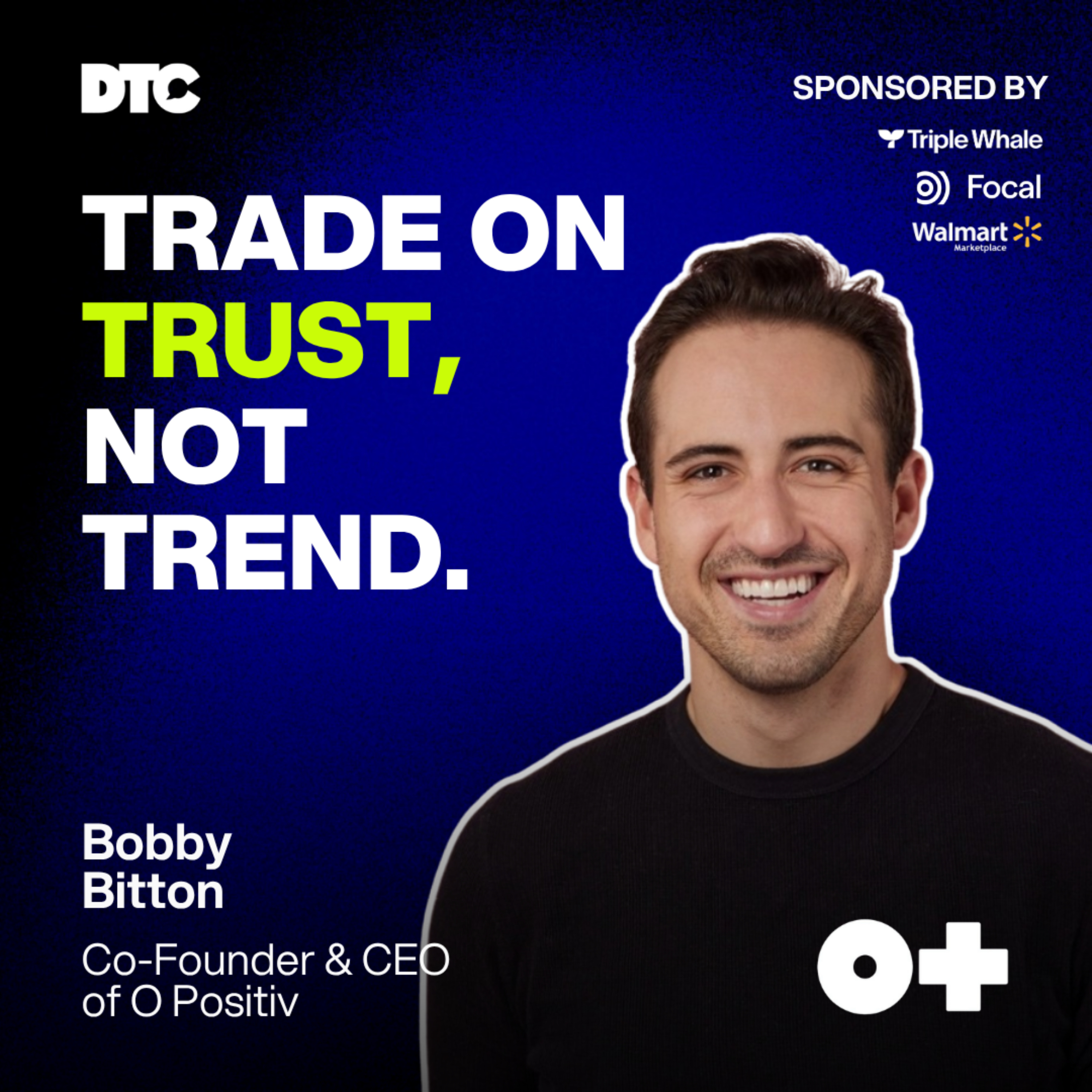
O Positiv’s DTC-to-retail growth and customer acquisition strategy, centered on TikTok Shop affiliate-driven CAC, creative testing, and long-term retention across women’s life stages.
Bobby (O Positiv founder; built the brand from 2018 kitchen-table beginnings; performance/creative background; led TikTok Shop push). Host: Eric (DTC podcast interviewer). No other guests mentioned.
O Positiv started self-funded by Bobby and his sister Brianna; sister’s personal women’s health experience drove the mission. Bobby previously did direct-response marketing for a baby care company.
Viral TikTok content acts as an impressions, sales, and affiliate recruiting engine. TikTok Shop produced the lowest CAC via affiliate commissions (20–30% of product cost). Retention must be as important as acquisition; aim for “40 years” LTV by matching products to life stages. Trust beats flashy “sell an issue” brands.
2018 launch with PMS Relief; 2019 first VC round with Guild Capital; CMO Martin Yee (McKinsey) helped 1M to 10M run rate in 6 months. TikTok Shop: first $2,000 day in two weeks; scaled to ~$70K/day on one SKU by mid-January 2024, then paused for inventory. Retail: expanded to Target/Walmart/Costco/CVS; end-cap and out-of-aisle displays used to launch new SKUs.
0:00We just weren't going to sleep without trying everything to go make this bigger because we had both things. We had a mission that we really believed in and we really just had this passion for building a great business. You can talk about your product strategy all the time. Getting a product to 80%, getting it in the hands of the consumer, and then tweaking it to 100 % is, to me, the best use of time. The secret of 2026 for us and why we've been able to push the pedal to the metal this year was what's beautiful about a piece of content going viral on TikTok is it does three things. It gets you impressions if they buy or they don't buy.
0:34Two, it works as a sales engine that they buy the product. Three, it's a recruiting engine for your affiliate program. For us, it's people, it's product, and it's focus. And that's kind of what we're in for.
0:52Bobby Bitton: This episode is brought to you by Triple Whale, the AI operating system for e-commerce. Just a quick gut check for brand owners and media buyers. Have you started your Black Friday Cyber Monday planning yet? If the answer is not yet, you're not alone. But the brands that win BFCM aren't the ones scrambling in November. They're the ones planning right now. And here's why it matters. BFCM keeps getting more expensive. Last year, ad spend climbed faster than demand did. CPMs went up and the season stretched from a single weekend into a full month of promotions. Show up unprepared and you spend more to reach the same shoppers right when your margin matters the most.
1:27Bobby Bitton: Triple Whale built a free resource to help, the BFCM Hub. It's like a command center for planning your most profitable Black Friday with everything in one place. Real benchmarks from tens of thousands of brands so you know what performance should actually look like for brands just like yours. Free tools to set goals and forecast outcomes. Strategy guides and checklists covering ad performance, retention, and conversion, and AI-powered tactics you can put to work before BFCM week hits. The best part, it's completely free and there's no login required. Go to triplewhale.com forward slash BFCM26 and start building towards your most profitable Black Friday Cyber Monday today.
2:06Bobby Bitton: Bobby, welcome to the D2C podcast. Been really looking forward to this one. The supplement space right now is just absolutely on fire, and you guys have been doing it for a while now. Talk to me about O-Positive. Why did you build it? Yeah, Eric, first of all, thank you so much for having me. I'm so excited to be here. Love getting in the weeds, so I'm excited to get in the weeds and talk about the specifics. So O-Positive, kind of the leader in women's health supplements, focusing on really kind of all areas of her life. these areas that have been overlooked, wrongfully tabooed. We want to make products for education for a community around.
2:45It was built from my sister's personal experience. She was in her mid-20s, really frustrated that everything around women's health was so reactionary, right? Like if it's recurring UTIs, BV, menstrual health, whatever it is, that it was previously like, let's solve the problem after it's already happened. And the mission of O-Positive is saying, no, we actually want to stop the problems from ever happening. And there was this white space between, you know, hey, here's a prescription and hey, you know, suck it up and deal with it. That's just part of being a woman. We don't accept that, right? We're playing in that space in between.
3:19And it's been incredible to grow this business over the last eight years. We started kind of with the first product ever for PMS Relief in 2018. Now, today, we're on the shelves of Target, Walmart, Costco now, and north of 35 SKUs, kind of spanning all these areas of her life, primarily focused our biggest part of our business and where we're doubling down is vaginal and intimate health. That's kind of what we're known for.
3:44Bobby Bitton: And you've really pioneered that area. I know we'll dive into some of the pioneering you've done on TikTok. I think that's a really interesting line where you're really, you know, in order to crack TikTok, you had, you know, you got banned almost immediately just talking about your product. Talk to me about how that went down. Yeah, I think being in women's health, you know, there was a lot of trailblazers before us, but for us, it was still living in the dark ages when it came to what we were able to market, what we were able to say on a lot of platforms. It could be meta, it could be TikTok, it could be Amazon, Google.
4:18It was an uphill battle. So talking about things like vaginal health, talking about things like even periods and menstrual health would get you a straight ad denial and rejection. And as a lot of us know, you have too many ad rejections and denial stacked up, your account gets shut down, right? So for us, when we launched our vaginal probiotic, which was one of the first vaginal probiotics on the market, we launched that product, immediately got shut down on ad account level on Meta. And we had to appeal and we had to work with them. It took months. And it took us building a case around, you know, on my feet, I'm getting ED medication.
4:57I'm getting sexual performance stuff, all men's health, all okay. We had to build this case that vaginal health is not sexual health, right? This is not a sex product. This is a health product. And this is the anatomically correct terminology to talk about it. And again, hats off to these platforms for changing because almost every single one of them, because of O-positive, was able to build a case and change that, TikTok included. And now that terminology is open and there's lots of women's health companies thriving on those platforms.
5:28Bobby Bitton: So you, yeah, you, you guys pioneered that in a way, but you've kind of opened the door to competitors and to other, you know, other supplements kind of, kind of using that term. Have you found a big increase in, like, just, just the supplement space right now is just so crazy with, with whether it's IM8 or Gruen's and their, their crazy story. How do you, how do you contextualize O-positive in this like supplement boom that we're kind of currently in? I think the boom has happened for a really good reason, which is people and for specifically for us women taking health in their own hand. And I think it goes hand in hand with the rise of content and the rise of education that people can get at the touch of their fingertips.
6:07So for us, we're very pro this rise because it's proactive health. It's people taking health in their own hands, feeling the results of products, and inevitably helping them live longer, healthier, better lives before they have to go either to the doctor and get prescriptions, right? If you need to do that, of course. But for us, it's how can you take health in your own hands? And the boom, I think, has been exactly that. It's people telling their stories. It's the rise in science and research, to be honest, in these categories, specifically women's health. Like people weren't doing research in women's health before, you know, the 90s.
6:39And it's increased dramatically over the last couple of years. So these are genuinely new products and innovation that we can bring to market, which is really exciting. But competition is real, right? When you're looking at a market or an industry like ours, barriers to entry are low. But I would say to counter that, a lot of people can launch brands to earn a consumer's trust. That barrier to entry is very high. And that is where the people that are around for one year and go away versus the companies that are here for eight plus years like us and some of the companies you mentioned, Thorne, for instance, incredible.
7:13Instead of just trading on an issue or selling on an issue that they want to solve, great. That'll get you a customer. How you keep a customer a long time is you're trading on trust, meaning results that they can feel, right? science they can read and then a long-term strategy of something that they want to stay with. And for us, that's through these stages of life. So definitely competitive. I think there's this barrier that people have a hard time getting past over those first couple of years of, guys, it's not just about having a good CAC. It's about having a great LTV and having a great LTV means you have the trust of a consumer.
7:47Bobby Bitton: And I think you're really thinking about this business long-term. You, you, you, like when I, there's, you know, Grunz, I think it's like their third year in, they're like at this billion mark or whatever. How do you think about this business in terms of longevity? Are you looking to escalate it quick, make a sale? Are you looking to build it out over like a long period of time? Yeah, I think I'll separate maybe like personal ambitions for the company versus what I want for O-Positive, right? What O-Positive, the mission of O-Positive and what I wanted to create is that if someone took a survey of O-Positive and said, is O-Positive going to be here in 50 years?
8:21I want 90 % of people to answer yes. And that is what we're building, right? We're building something that has longevity, something that is going to be when women in 20 years think about any kind of intimate health issue, they're thinking about O-Positive and they're going to the intimate health care aisle and they're picking up our products. And that is like the trust that we're trying to build. I think from a company perspective and an exit perspective, for us, it's all about that key term strategic partner, which has to be strategic, has to be a partner that says, okay, I'm going to partner with you because I believe that we want to make this company here for 50 years, not just, hey, let's invest, flip it, and do it again in three.
9:02It's like, no, I want longevity because I love running this business. And I think always building a brand for longevity is really important. And the brands that maybe you take, you do that same survey and say, oh, you do think this is going to be here in 50 years? I think a lot of people would answer no to some of those brands that are very, feel like very quick, grow, flash in the pan companies. Yeah.
9:21Bobby Bitton: Okay. Take me back to the early days. I think it was around 2018. You started this as a self-funded venture on credit cards. Tell me about what that felt like with your sister over the kitchen table in those early days. Yeah. So it was me and Brianna. We originally thought this business was going to be a side hustle, right? We were solving one of Brianna's core needs, which was menstrual health and PMS relief. We didn't come from science backgrounds. We crashed every OBGYN appointment, pretending it was appointment for Brianna, my sister. And we said, actually, we have this product idea. So will you listen to it?
9:54And will you please give us critiques on it? And we pieced together what this product would be. And honestly, I have to just give so much credit to my parents. The reason we made the jump was I was 23, Brianna was 26, and we were on a family vacation. And we're talking about this idea because it's all we're talking about around the kitchen
10:11Bobby Bitton: table, right? It's very much a family affair. And my parents sit us down and say, we don't think this is a side hustle. We think you guys are young. We think you guys should go do this full time. And we will help you buy your first 8 ,000 bottles. And that was the agreement we had with my parents. And my parents are equity holders. My dad's on the board. Like it was the best investment they ever made, which is fantastic. It feels really good to be their son. But having parents that believed in you and actually pushed you to make that, because I know a lot of people aren't lucky enough to have that, right?
10:39They have to take the risk themselves with parents saying, hey, let's, you know, take the lawyer job, take the doctor job, you know. But they saw that we were young. They said, you have a safety in it. Don't be ashamed of it. Go use it and go make something of it, right? That was incredible. and we didn't really know what we were doing. I came from a little bit of a performance marketing background. My first job was doing a baby care company, running their direct response marketing. So I knew a little bit. Honestly, Eric, we got the product. We got our 8 ,000 bottles. We had a Shopify store and I turned on Facebook ads one day and that was the launch, right?
11:17And yeah, I think we made 15 sales that day, which was incredible. And we're like, oh my God, this feels like something. I didn't understand LTV. So I think we spent$2 ,000 and like made a thousand. And I was like, oh my God, I just lost a thousand dollars. And I was like, did not understand that subscribers come back or people come back and it was okay. Cause I don't think we've ever had a first order profitable day ever since then. But you know, I was learning on the job. I didn't know what LTV was when I, when I started the business.
11:43Bobby Bitton: And when you mentioned the intimate health aisle, was there an intimate health aisle in 2018 or were you kind of like creating this category to start? Yeah, so there's an intimate health aisle at most retailers. But before we came to retail, what was in the intimate healthcare aisle was tampons, pads, and like OTCs for yeast infections and things like that, right? It was not an exciting category. So for us, when our first retailer was, partner was Target, we went to retail in 2023. And we made a decision to choose intimate care and to try to grow that category because we wanted to be next to the pads and tampons.
12:23We wanted to be where she was thinking about these things that she's going through. And it was an opportunity for us, kind of an arbitrage of to get a lot of opportunity out of aisle placement and things like that. If you're going in vitamins and nutrition, I'm competing against the grooms and the blooms and the thing like that. Those are great businesses doing doing really big numbers for us being in a category with more sleepy pads and tampons, but still a major foot traffic of exactly our core demo. We quickly, within the first year, became the biggest growth driver in that entire category.
12:53And that meant they loved us, which means they gave us opportunity. So thinking about arbitrage of where you're placed in store, foot traffic is always the most important. and where people are looking for you is always most important. But if there's a slight arbitrage where you can be, where you can be actually a bigger fish and help that buyer on that desk get promoted, like that's all I want, right? I want them to be like, I found O positive and that's created my business and grew it year over year, which means your relationship just gets so much stronger and opportunity comes to you before it goes to anyone else.
13:24Bobby Bitton: I think that's a really great point to really thinking about on that personal level. Like how do I make this person who's making this decision look like a hero and then they'll, yeah, I think that's great insight. Take me back. So your first couple thousand orders in 2018, you've got, you know, you realize you have something with those first 15 sales, essentially. What was your next move when you basically like after, how long did you realize that you like, or when did you start thinking, okay, we're going to need some outside capital to really get this to the next level? Yeah, so we, for the first year, it was just me and Brianna self-funded.
13:59So we grew the business. just us to about 1.3 million in our first year. And we got to that point where I was spending two hours a day answering customer service tickets at the end of the year. The numbers were big. I was like, okay, we got to think about product. Every dollar we're making, we're just buying more inventory. So we're actually inhibited by how much we can pump Meta and Google because I'm spending it all on inventory, right? So for me, it was really at that moment, about a year in, when we were thinking, you know, how do we grow the business and get people around us, less important than capital, more important about the people to really supercharge the business.
14:45Also, we were just thinking, okay, well, what's the broader vision here? This product worked, what do we want to actually create? And for us, it was taking a step back and saying, okay, okay, we want to create the number one brand in vaginal and intimate health, focusing on these different stages of life that have been overlooked. And we want to find a partner more importantly than money that can help guide us, right? That can almost put us in a little bit of a boot camp to learn because I was 23 and this is our first business. And like, we could get capital because the, you know, we could get more credit cards and debt and things like that, but like we wanted guidance.
15:21So that's where in, in late 2019, we raised our first round of funding with our one and only VC partner. We only have one venture capital partner and investor, uh, Guild Capital. So they've done Dr. Squatch and Ruggable and incredible businesses. Um, and they were the bootcamp that we needed.
15:40Bobby Bitton: Very cool. What, what do you think sold them? Was it, was it the trajectory, uh, that you'd already laid out with the business or was it, was it you guys as founders that they were really investing in? Well, I guess it's a bit of both, but what, what do you think they really saw in what you, what you were building? Yeah, I think their thesis always, and we've talked about it a bunch is first category. They're just like, we love this category. We love women's health. We like supplements and see how much it's growing and the access to health that, that this offers to consumers too was a product with really good NPS.
16:14I never heard about NPS, net promoter score. I had to do it in their due diligence for the first time in 2019. And it's what we talk about all the time. It's would you recommend this to a friend or colleague, right? It's like one question. It's on a scale of one to 10. And that is what we gauge is, is this a good product? Do people like this? Are they going to stay with it? And then third, yeah, a little like, you know, not to have any ego, but like, yeah, they resonated with me and Brianna's values and what we were trying to build and the ambition that we had. And that like, we just weren't going to sleep without trying everything to go make this bigger because we had both things.
16:53We had a mission that we really believed in. And we really just had this passion for building a great business, right? Like, I think you need both. I love what we do. I love the impact. It's what drives me on the hard days, but I also just have this fire in me that get me in a room with my team on a whiteboard and whatever problem it is, oh, that's my best day, right? And I love businesses that you can have both and we're lucky enough to be in one.
17:18Bobby Bitton: So how did that capital get used? It sounds mainly on the growth side of things. At what point did you start making key hires? And which was a hire that maybe stands out in those early days as one that became super important for you? We made our first hire right away. It was actually in the term sheet with our venture capital saying, hey, we have a recruiting arm and we're going to introduce you to people and we really want you to use this capital to hire great people. Because a big part of their thesis was talent, talent, talent, which is I eat, breathe, and sleep talent is why this business is what it is.
17:50So for me, within two months of getting the capital, we hired our CMO. He's still the CMO today. Martin Yee, he came from McKinsey, did marketing at big companies, Fortune 500 companies, and took a big cut in his salary to work on my kitchen table. And it was this really important thing that was hire for your weaknesses and find someone that's so much better at the things that you're not great at, right? Martin is a statistician by training. That's what he went to school for. he worked at McKinsey. Like I like a creative brand product. Martin was numbers and looking at things and understanding where to scale.
18:36And within six months of, of Martin joining, we, we, we 10 X right. Our run rate, we went from 1 million run rate to a 10 million run rate in six months. And I give Martin a lot of credit. And the next hire was Alicia. Who's, who's still today, my CFO. She came in as VP of, of operations and finance. And oh my God, like she's my rock. Like she came in and just helps me fundamentally prepare the organization for scale, figure out key hires and how to like, we didn't have health insurance. We didn't have any, like, I didn't, you know, we didn't know what we were doing. And just like build the infrastructure of the business so Martin can go and grow it and I could be creative.
19:15And those having like us three, that dream team, we're still together today. Like that dream team is like, like, that's why we're here, right?
19:23Bobby Bitton: Those two people. When did you realize you wanted to, I guess you probably knew you wanted to expand the product right from the beginning, but when did you launch your second or your other products in your line? Really good question because we stayed a one product company for two and a half years. We had one product, it was PMS Relief, and we grew that business and focused on it because we wanted to learn how the business operated on one SKU and keep it very simple. So for us, it was really that focus. And then we started expanding out very selectively. And there's like a really important lesson we learned, right?
19:58Which was, you know, we launched two products that fall that third year. One was an immune health gummy and one was a fiber gummy. One succeeded and one was a total flop. And the reason, you know, the fiber gummy really worked and the immune product really failed in our mind was we created the thesis that every product we make, you need to feel working in your body. And we're not a business that's going to compete on price. We're not a business that's going to compete on anything other than it working and you feeling it. So the immune gummy was double the price of any immune gummy, tasted fantastic, but really was not something you take every day.
20:37You kind of take it when you're sick. You couldn't really feel if it was working or not working. And we bought way too much inventory and ended up having to scrap a bunch of inventory, right? When the fiber gummy was still kind of in the more equity of women's health, right? It was like bowel movement and not enough fiber in your diet. This is way before everyone kind of was doing fiber. Now everyone's doing fiber, right? This product was something you could feel. You're going to take it and you're going to go to the bathroom, right? And it fit within our equity. And those first products were fiber still in our portfolio today, our fiber gummy.
21:10And it was these learnings that were the most important thing. It helped us come together with our product strategy. You can talk about your product strategy all the time. Getting a product to 80%, getting it in the hands of the consumer, and then tweaking it to 100 is, to me, the best use of time. You could spend years making a product, and then you launch it, and nobody wants it, or nobody resonates with it, or it doesn't work as well. Getting a product, as long as it's safe and has a great customer experience and aligns with what you're doing, in the hands of consumers early, is the best thing that we've ever done.
21:40Bobby Bitton: And then once you launched your complementary products, how much of the business, I guess, retention just becomes such a big, and getting your existing customers to expand their use cases to your other products. How big has retention been and how much of an effort are you putting on to get your customers into more than one of your products, I guess? I think retention should be equal as important as customer acquisition. And very honestly, Eric, it wasn't in the early days, right? For us, I was a performance marketer and I was like, what's my CAC? How do I lower my CAC? How do I get as many customers as possible?
22:16We had good products with good LTVs. So that's why the company worked, right? That's why we could grow. But putting as much effort into retention as you do acquisition to us is like, we started thinking that way three years ago and really focusing on, yes, the product has to be great and it can do a lot of work for you. But also how we're thinking about our marketing org needs to be designed around keeping customers, informing customers, making them part of our community so they stay a long time. And that when they're going through these different life stages, right, they're going to trust you with that product, right?
22:51So if someone's on our PMS relief product, but then they get pregnant, like we want them to take our pregnancy product. And then when they're going through menopause, we want them to take our menopause product. So for us, like changing our philosophy around how do we get a four-year LTV to how are we keeping a customer for 40 years, right? They might come off, they might come on, they might do this, but like that trust is ingrained in them where they're going to come to us when they need us for whatever stage of life they're going to, really critically important. And again, I think it's the death of supplement companies.
23:18I think there's a lot of flashy supplement companies that come up really cool. They're selling an issue. They maybe are making a little crazy acclaims. They get a lot of customers and the product either doesn't deliver or they're so focused on customer acquisition that they're forgetting that it's, it's the benefit is double that customer's LTV and your business works better than lowering your CAC, right? Like that is like, I thought that way in the early days. And I'm excited to preach that to anyone starting a business in any business, focus on that with equal amount of attention.
24:06Bobby Bitton: Creative, that can get expensive real fast. Brands winning on Meta and TikTok are shipping dozens of new ads a month across different angles and formats because that's what the algorithm rewards. Keeping that pace only works if the whole team knows what's winning. Try pulling up last Black Friday's ads and figuring out which ones actually drove sales. Most teams I talk to end up digging through Drive, Slack, and a pile of spreadsheets. Fogel ties ad performance to the Creative itself across every ad it ever ran in. You can find any asset in seconds with AI Search and run your whole production process from brief to approval in the same platform.
24:41Bobby Bitton: Brands using Focal ship four times more creative with the same headcount and get from brief to live ad 50 % faster. AI is already taking over the slow parts of creative work like tagging, reporting, and drafting briefs, but an agent is only as good as the context it can access. With Focal MCP, your whole team and the AI tools they use work from the same creative memory. everything you've tested and what actually won. So the next brief starts from what already worked for your brand, and you can make more of what sells. DTC podcast listeners get a free 14-day trial of Focal and 20 % off annual plans when they sign up in October.
25:18Bobby Bitton: Head to focal.inc.dtc. That's F-O-C-A-L dot I-N-C slash DTC.
25:28Bobby Bitton: Now, as a performance marketer to drill in, And what are some things that you've done throughout the course of this business that have worked really well to lower your CAC? Is there anything you can kind of point to, whether it's a certain style of ad, a certain platform, a certain approach, a certain tech? Is there anything that you can kind of point to that like really moved the needle when it came to lowering CAC? It changes every year and it's rolling with the punches. I think for us, having a creative engine is really important, both internally and more like not more importantly, equally as important now is externally.
26:02So for us internally, we do all of our creative in-house. We have the best creative strategists in the business that understand how to test ads. You know, I think we make, you know, over a hundred ads a week that we're running through the engines to test, understanding the data, testing copy. It's much more different now than it used to be. We used to take one static image that was the same static image and test 10 different copies on it. And that's how we used to test. Now, creative diversity is very important.
26:28Bobby Bitton: And if you do that, like all 10 are never going to get spent. So creative diversity, having your team really focus on the quality and storytelling of what you can do while having that same team. I think it's important that it's the same team work with external creator creators for volume. And a big lesson for us is we used to over brief. We used to write, here's the script. Here's what we want you to say. Please hit this. And lately we're like, our brief is here's the product. Here's what it does. Here's what you can say. Here's what you can't say. Please be creative. And the impetus of that really came from the TikTok shop growth.
27:00So the biggest thing in our business of lowering our CAC overall was TikTok shop, right? Like truthfully, right? Like meta is a hard beast and CACs, you know, we kind of maintain our CAC and modulate spend. It's kind of how we manage our CAC. So in some months we're spending a lot because our creatives are really good. And sometimes we don't, but we maintain our CAC because that's our allowable. We have our allowable. That's what we're going to spend to. We'll spend the maximum to that allowable on any product. TikTok was a different ecosystem because the CAC is what are you paying your affiliate?
27:31And that is, say, 20%, 30 % of your product cost. That's the lowest CAC I've ever seen, right? So for us, really doubling down that engine and then taking learnings from that engine and porting it over to Meta. If that be literally the creative and compensating the creators for that and giving them extra incentives. There's platforms like Tribe and Yuka and we've built internal tools that are like that, which are really good. Those are new. Or it's just having your team act that way, which is like less briefs, give a bunch of samples, let people make content, get it in front of people and rapid creative testing.
28:09That's been, I think, the secret of 2026 for us and why we've been able to really push the pedal to the metal this year was taking you're learning from TikTok shop and applying them to meta literally and just figuratively, and then doubling down on TikTok shop because the amount of impressions you're getting for the amount you're spending is so far unmatched.
28:30Bobby Bitton: I was on a call a few weeks ago with a bunch, it was a bunch of supplement people and there were some, some big, some big spenders. And they were just talking about TikTok shop about like what an amazing platform it is, but also like just what a rigmarole it is. Like just how much work goes into scaling on TikTok shop when it comes to managing your affiliates, you know, incentivizing your affiliates, keeping them interested, keep, you know, creating contests for your affiliates, essentially like, as opposed to, you know, the creative meta game where you're just pumping in creative and, and, and sort of, you know, working with your audiences and things like that.
29:06Bobby Bitton: How, when it came to TikTok shop, was it an instant success for you guys? Or did you, did you, Did you know the amount of work that TikTok shop was going to be when you embarked on it? Yeah. No, we did not. It was a personal project of mine. The whole company was pretty busy at the time. This was late 2023, I think, when they launched it. It was out for like a month. I was like, guys, this is really important. And I'm really excited by it. The live shopping aspect, the influencer side of it. And they're like, Bobby, we're busy. And I'm like, okay, well, you know what? I haven't done something myself in a while.
29:42So let me take on this side project. So me and our director of marketing kind of raised her hand and said, okay, I'll help you, Bobby. Let's do it. So we set it up and launched two months later in like November of 2023. We were one of the first companies on TikTok, definitely in health, right? Very early. It was like Guru Nanda was like maybe the first. We were a pretty close, close follower. And it was, it was, I mean, yeah, pretty, pretty quickly an instant success. We were growing in within two weeks. We kind of had our first $2 ,000 day. I was spending every Sunday night messaging. My goal was a thousand affiliates.
30:20So I put on Game of Thrones, I'd sit on the couch and I would just click, click, click, copy, paste, copy, paste. This is before bots, right? Like they didn't have bots. You just copy and paste your message to affiliates. You have their leaderboard that you'd reach out to. And it was like December and they were like, you know, my team was like, oh, Bobby, wow, your channel did$2 ,000 a day. And they're like, oh, that's so cute. Like, congratulations. That's wonderful. And I'm like, yeah, like it's going to keep growing. Within 30 days, that was from like mid-December to mid-January, we hit$70 ,000 a day in mid-January on one SKU.
30:54And I was like, and we had to turn it off because nobody forecasted$70 ,000 of sales daily incremental. And it actually then boosted our Amazon sales. And I was like, guys, you can't let me turn this off. And they're like, Bobby, you've got to turn it off. We don't have inventory. So we turned it off for like two months because we had to get inventory. I haven't had inventory issues since like the early days, right? So it blew everyone away. It was a game of don't be precious with your samples. Send as many samples and have as many women tell their stories in their bedroom and in their bathroom with an iPhone.
31:27And there was definitely an early mover advantage. TikTok back then was basically a beta, right? It was breaking all the time in this. but that built a relationship with a TikTok shop team that not many other companies have. Cause I've been there since the early days. I know leadership, we helped build some of their things together. Um, and we got it up and running two months later and it's been, you know, a huge platform for us ever since.
31:49Bobby Bitton: At$70 ,000 a day, approximately how many affiliates were you working with at that time? That's a good question. I don't know at that time. I think there was, it couldn't have been that many cause we were only doing reach out for a couple months. I think now, like maybe is a better list test for now. And we do a little bit more revenue than that a day, every day now. I would say it's probably people are posting about like 1 ,000 to 1 ,200 pieces of content every single week. And that is usually quite unique. So I'd say it's 1 ,000-ish a week are posting for our products. Yeah. That's amazing. And are you still constantly seeking out affiliates or affiliates now reaching out to you more?
32:33It's both. It's both. I think what's beautiful about a piece of content going viral on TikTok is it does three things. One, it gets you impressions if they buy or they don't buy. Two, it works as a sales engine that they buy the product. And three, it's a recruiting engine for your affiliate program. So we see the inbound modulate with viral content, which is wonderful because that's kind of the thing that gets the ball rolling. And then we do reach out every single day, every single week, thousands of messages. And it's both a numbers game of saying, okay, how can we get as many affiliates to try the product, like the product, and make content, but also very much nurture and nurture your community.
33:20and it's the 80, 20 % create 80 % of the return. And you want to treat those people like extensions of your team. And it's the most, it's really a beautiful thing. You, like these people have quit their jobs and able to pay their mortgage. And like, it's such a fun ecosystem because you're not just throwing money into an ether of a huge tech company. You are actually changing people's lives that are helping you get your message out there. Like, I just love it.
33:48Bobby Bitton: Yeah. Is it too late for TikTok shop? The answer is obviously no. There's always a way. It's always growing. It's always growing the attention share it gets from individuals, I think, just TikTok as a whole. But do you think, has the landscape changed since when you first started there? Like if a brand's starting today, is it still, is the playbook still build up affiliates, you know, get them posting? Has anything changed really today? It's changed, but today is earlier than next month. And you're going to wish in three months that you got on the platform two months ago. So it's never too late to get on TikTok Shop.
34:22It's growing from the sense of there's more affiliates, right? There's more people buying on it. They don't feel like a lot of consumers felt uncomfortable buying on the platform maybe a couple of years ago. Now it's more normal. So more people are buying on the platform with it, I think is huge. So everything's growing in a direction. So it's never too early to join TikTok. The landscape has changed. It's definitely harder. The top affiliates are now like celebrities and getting to them is very hard. I think how you start today is finding the people who are also starting out with a brand who is also starting out, who are going to double down and make content for you and believe.
34:59But it's affiliates and it's finding people to make great content. The amazing thing about TikTok is it's content first. more than followers, more than likes, more than this. Every piece of content has the chance to go into the ether and go viral. And that doesn't mean the person who's, you know, has$500 ,000 in GMV versus the person that has a thousand, if they're making good content and they're working hard, they're just as good. So it's definitely a little harder, but it's going to be harder next month and it's going to be harder in three months. So start now and affiliate is the first place to start, right?
35:34Like everyone, you know, talks about the GMV max and the spending and the, and the campaigns and the contest. It's just like, just get affiliates to start posting and send out a bunch of samples and then learn. And then you're going to be able to do the more exciting tactics, but like you want to keep everything simple at the beginning.
35:49Bobby Bitton: And you mentioned incrementality, which is, which is exciting. You're, you're unlocking this really, truly incremental platform. How are you thinking about brand awareness at this point? What's been the most effective venture maybe in the past year or so for really getting brand awareness out there for you? It's going to be the same answer that we just talked about, which is TikTok shop. I think TikTok shop. Yeah, it is. Yeah. It's just such a powerful engine. I think, you know, it still serves a different purpose. I think, you know, for us, the thing that's worked for us recently on the brand side is linear TV has really worked for us.
36:26But like if I'm saying impressions and people recognizing my bottle and knowing where we sell and how we sell and what we do, TikTok can't beat the amount of impressions and the dollar you're getting it for and the unique storytelling and the unique angles that people come up with that I and my team and the head of brand can't just sit in a room and come up with because you have a thousand people a week thinking about it is really special. But to ladder up to your one thing that you want people to think about every single day when they think you're a brand, that has to be from the brand. and TikTok is not that because there's a lot of different messages.
36:58Those are things like, you know, even we still do out of home or we definitely do out of home. We do TV. Those things have been really big for us, especially when you have a retail business. Those things don't really make sense when you don't have the distribution. When you have distribution and people can buy you almost anywhere, then it unlocks the ability to do these harder to measure, you know, bigger, more expensive channels.
37:20Bobby Bitton: Like linear. I talk about CCTV on this podcast all the time. I think so many brands are dabbling in testing and seeing great results from that. But fewer, I think, are going whole hog on linear TV. Talk to me about how has linear TV, for instance, compared to CCTV for you? Yes. Streaming. Yeah, streaming for us, we've done a bunch of tests. We spend on streaming currently, but our bigger budget's on linear. Linear for us has been more successful for a couple of different reasons. One, the costs we have found to be cheaper. The targeting is a little less exact, but we've seen more in incrementality, right?
37:58We do geotesting on both linear and we do geotesting on streaming. And for us, linear has always come back kind of the champion. But when we want targeted, specific messaging that we can look at the data more and understand it, nothing can beat streaming because linear just doesn't have that data and they don't really give it to you and they're still a little bit old school. But I like a nice mix of it, although our budget is primarily linear. mainly for bang for your buck on CPMs. It's just cheaper. And for us, like we want to find our audience that meta is not reaching. And that's probably, you know, meta is probably reaching the people that are watching streaming.
38:34You know, TikTok might not be reaching and meta might not be reaching the people still watching linear. So it is to us still very different audiences.
38:41Bobby Bitton: How many doors are you in now? That's a really good question. We're in all doors at Target, all doors at Walmart, and we will be in all doors at Costco. And those are our big ones. and all doors at CVS. I don't know the total number, but if you add all those up, those are our total doors. Thousands and thousands of doors. Thousands and thousands, yeah. When did you, what year in your trajectory did you guys kind of go all in on retail? It's a good question because all, we started in retail in late 2023 with Target, small tests, couple hundred doors on NCAP, went incredibly well, expanded to about half chain in 2023.
39:17And then I would say 2024, was really, again, focusing on Target. And then last year was, I would say, all in on retail was last year. That's when we were full chain at Target. We went full chain at Walmart, full chain at CVS, and selectively some great grocers. And that was when we went big last year, which was both a wonderful thing and changed our business, but both very challenging things for our marketing model. Because all of a sudden, we just lost visibility of a lot of people purchasing. and you're looking at your CAC and you're like, why is my CAC going up? But the business is doing really well.
39:52It's going up because people are seeing a meta ad and not buying on Shopify and they're buying somewhere else. And all of a sudden you have to create this world of omni-channel measurement, which again, Martin, our CMO is the perfect guy to do and has led us through the woods a little bit there. But it's both one of the most challenging things we've ever had to deal with as a business, right? It's just like, where do you spend that next dollar when you can't track every single purchase anymore?
40:17Bobby Bitton: And then how have you invested in retail to really, obviously, like you guys made a big splash, you got great results early. What are some of the best ways you've invested in retail, whether it's displays or just to really build that relationship? Because the bigger you get with retail, the bigger asks you can kind of make from the partners. Maybe talk to me about how you've really invested in retail as a channel and what's worked best. Yeah, for us, it's space in store to tell our narrative and educate the consumer. So out of aisle display. So if that be a tray that you put in aisle, if it be an end cap, which is ideal, always push for an end cap.
40:52Those have been ways of launching new products, ways of launching the brand for the first time it went to the brand. And, you know, we waited a while to go retail. We were a big business. We were a$100 million business before we went into retail. And we waited that very intentionally because we wanted to make sure that we had the velocities that when we went and we wanted the, you know, leverage is kind of a hard word. but we wanted to go in and say, hey guys, we're going to do really good things. We want this from you. And they said, okay, we're going to take a chance. We're going to give you this end cap.
41:18You're in intimate care. Maybe it wasn't as competitive as going into vitamins right away. We're in vitamins now, but it was very competitive back in the day for a smaller brand. And that proof point earned us so much credit on the relationship that we get an end cap for months every single year. That is our opportunity to one, perform and show them, but also launch new products. So out of vile is huge. The not sexy answer is have a big DTC business before you go retail, right? Some categories that's hard in beverage, maybe supplements. You should have a big DTC business before you go retail, right?
41:52Like that is how you win in retail and how you get things that you ask for is by hitting it strong right away. So that's how we started. And then relationship forward, always fly out for the meeting, always show up, always fly to Minnesota, always fly to Bentonville, build that relationship and ask for the world because the worst they can say is no.
42:12Bobby Bitton: You're going up against people like David Beckham and Khloe Kardashian. What are your thoughts on that sort of like celebrity level of influence that maybe some of your competitors have? Is it something that you guys seek out or is it something that you sort of actively avoid? It's something we don't seek out because we are operating under the assumption of we want to be a company that people know is going to be here in 50 years. And I think trading on trend is dangerous. But I think from a brand perspective, being of the moment and being of culture, yes. Doing a campaign with a celebrity that resonates a lot with what we're trying to solve and creators and things, yes, absolutely.
42:55We want to be modern and of the moment. I don't want to be stale, right? But long-term company associating on one person, for me, makes it harder to answer yes to the question of, is this company going to be here in 50 years? because we want to trade on trust, not trend. And I think that is like a big thing we think a lot about. So those are, again, they look like great businesses now and they're doing well. For us, like I'm playing a longer game. I'm playing chess, right? Not checkers.
43:24Bobby Bitton: You say it was, you know, you hit that nine figure mark a few years back. Now you're in the nine figures, potentially at a 10 figure valuation. I feel like this space is so hot. everyone in PE and Global Strategic is interested in women's health. How do you see the next few years, like in your dream scenario, how do you see the next few years playing out? Yeah, I think, you know, for us, it's the goal of being number one in the US in vaginal and intimate health. That's our mission. We're going to go be that company. We're going to grow. We're well on our way. And for us, it's always being open to the opportunity of finding a partner that's going to help grow that and expand that vision.
44:09So for us, I love this company. I love running it. We're going to keep running it forever, right? And I think when the moment comes of a partner that can add a lot of value, that's the partner. It's the same thing we do with our first investor. It wasn't about the money. It's about the boot camp to get to the next level. And I imagine that taking the number one vaginal health and intimate care brand in the US and making it the number one globally might take another round of bootcamp that I would be looking for and really excited to do. But for us, it's people, it's product and it's focus. And that's kind of what we're in for.
44:42Bobby Bitton: Are there other, I just did a podcast yesterday with Lauren from Flex, which is innovative period product, essentially, the Flex Disc. Have you guys ever experimented with partnerships that are sort of beside you rather than competition in the intimate health space? We have not, but I'm very excited to explore it. I think with our kind of renewed focus of, you know, over the last couple of years being a little bit more broad women's health to our new real focus being like we're vaginal and intimate health, and that's kind of what we're going after. It makes it more clear of the value that we add to partnerships.
45:17So how do we bring our value of this incredibly engaged female consumer, but get something from another brand that's doing really cool stuff? Also, like a little bit of having fun. I want to have fun. I want to find a partnership that's talkable, that's fun, that's maybe a little out of the box, 100%. So I think more partnerships to come in 2027, it's a core mission of ours to one, like, yeah, shake it up a little bit and be a little cheeky with some of these and actually be value and add value that isn't just in our core consumer base, right? Like, if like, okay, if it's not a vitamin or a supplement and that's not what we do and think about all day or topical, what does someone think about all day but yet would be really valuable for the intimate health consumer.
45:56That, like those two things, a little bit of fun, a little bit of innovation, I'm going to bring to the playground next year.
46:02Bobby Bitton: Last question. If you had to do it all over again, is there anything, or even if you had to do it all over again today versus 2018, is there anything you'd change? Or like, so say there's a new body part that everyone's like, oh my God, everyone needs to focus on their upper arm health or something. and you were to launch something game-changing in that space in a new sort of blue space. Is there anything you do different about how you've kind of built this business? Yes. I think the one that I talk about a lot internally and I think is a really important lesson that I would do differently is really understanding your brand architecture and thinking enough steps ahead.
46:41We have a very complicated brand architecture. There's O-Positive, then there's Euro, then there's Flow, and there's all these things. And moving forward, we're actually consolidating some of that really to focus on Euro, which is our core product line and drives the majority of the business. And I think you want to be really careful of how many brands that you are creating. There's some understanding what you are. You're a house of brands or you're a branded house. Having that conversation, understanding where it goes, thinking more than one product in advance, like planning for what do you want the brand to be?
47:09What do you want it to stand for? What do you want people to know as the household name? It's got us where we are today. We're very proud of where we are, but it is very messy, Eric. And I'm very happy in the next couple of years to clean it up and understand, okay, what does the consumer know us as? What do they know us for? And really simplify it because we're a quite complex business. But again, it got us to where we are, but I would have done that differently.
47:31Bobby Bitton: Yeah. I think it was one of the comments in the pre-interviews. You're probably one of the smallest logos on your own product, like for your main overall brand, all positive health kind of goes at the bottom. But I think that's, that's served a great purpose for you as well, because you're very, your products are very problem-focused, problem-aware, solution-aware kind of thing. And the brand is a little bit secondary to that. And then you have the fun brand on the side, the Euro flow, things like that. But yeah, it's interesting that it creates, especially as you expand, it just, it expands the complexity.
47:59A lot of complexity. I would err on the side of simplicity. And I like what you said because, yeah, telling the consumer what it is and what it solves for was always important. That should be primary. But yeah, we had these two brands almost on the front of the bottle, still two to this day, more to come on that next year, like competing for the number one spot. And then also add to that, we had another fun brand selling a different product with the same tiny logo on the bottom. Like it seems innovative. Guys, don't copy it. Okay. It's very confusing.
48:31Bobby Bitton: I love it. All right. Well, you have to come back on once you wrangle it. I would love to see how you do that. Bobby, thank you for taking the time to come on the DTC podcast today. Look forward to staying in touch with you. If people want to follow your journey, do you recommend they maybe reach out on LinkedIn? Yeah, people can reach out to me on LinkedIn, of course. Follow a positive on Instagram, a positive on LinkedIn, and kind of watch the journey. We're just getting started, baby. Well done, sir. Thanks for coming on, man. This was a lot of fun. Thanks, Eric. That was great.
49:05Bobby Bitton: Thanks so much for listening to today's episode. If you're not a subscriber to our newsletter, you can do that right now at direct-to-consumer, all one word, dot co. I'm Eric Dick, and this has been the D2C Podcast. We'll see you next time.
49:39Bobby Bitton: You could receive up to 100 % off referral fees on those items. Get holiday ready with Walmart Marketplace. Visit marketplace.walmart.com slash DTC pod and sign up today.
How do you lower customer acquisition costs for a DTC brand? Bobby Bitton, co-founder and CEO of O Positiv, says TikTok Shop did more for his CAC than any other channel. He launched it as a side project in November 2023, and within 30 days one SKU went from $2,000 a day to $70,000 a day.Bobby walks through how O Positiv runs more than 100 ads a week through an in-house creative team, how they move what works on TikTok Shop over to Meta, and why retention now gets the same attention as acquisition. He also explains why the brand waited until it was a $100 million business to go into retail, why linear TV beat streaming in their geo tests, and the brand architecture decision he would make differently.Get the DTC Newsletter: https://directtoconsumer.co
Key takeaways:
About the guest:Bobby Bitton is the co-founder and CEO of O Positiv, the women's health brand he started with his sister Brianna Bitton in 2018. O Positiv makes FLO, URO, and MENO, and sells through its own site, TikTok Shop, Amazon, Target, Walmart, and CVS.https://www.opositiv.comStay connected:Follow The DTC Podcast on Apple Podcasts, Spotify, and YouTube.Want to be a guest? Email eric@directtoconsumer.co
Scan the code with your iPhone camera
Listen in the app.