Ask ChatGPT
 The DTC Podcast
12 Oct 2026 · 45m · 22 chapters
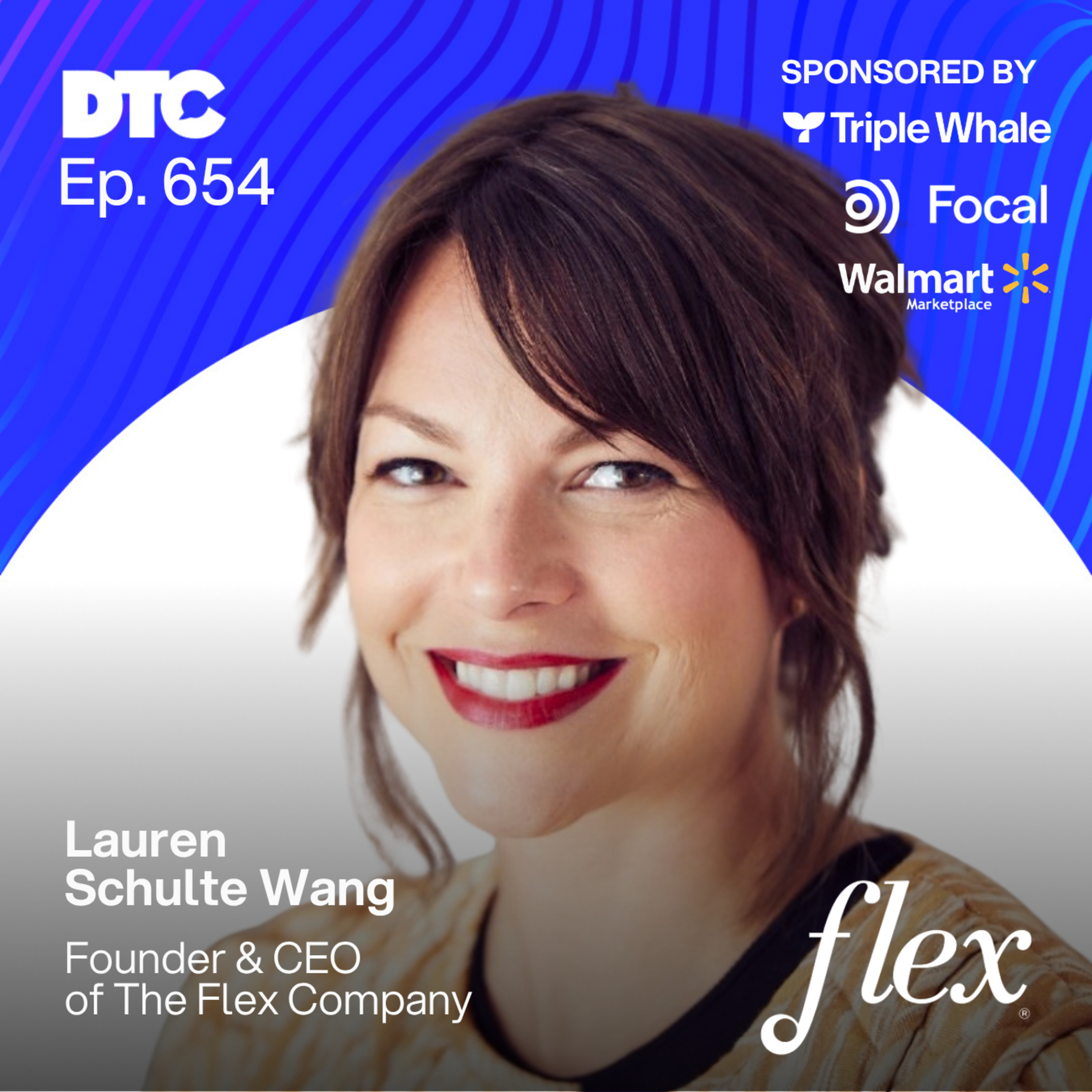
Flex founder Lauren (co-founder with her husband) recounts how the menstrual disc brand grew from a viral 2016 TechCrunch moment into a major omnichannel retailer. After pitching “mess-free period sex,” Flex went live with only an email landing page, collecting 200,000+ emails before the website launched. With FDA approval in Europe but not the U.S., they shipped free samples by flying to Iceland and then hand-packing/enveloping discs country-by-country to build momentum (sold $80k in pre-orders by demo day).
stay close to customers; do “things that don’t scale” early; retail works because customers want to buy immediately; ads must include education.
turning down Target twice (2016/2017), later reaching 30,000+ stores and 60%+ revenue from retail; “old people talking about periods” TV creative failed, so they test on YouTube first; a simple educational YouTube “pull tab” video drove double-digit Walmart velocity.
Lauren (Flex CEO/founder). No other guest is interviewed.
Written by AI. May contain mistakes.
Learn about the challenges and initial successes faced by Flex's founders.
“It was kind of a magical moment, but also kind of our worst nightmare because we ended up getting over 200 ,000 emails and we didn't have a website.”
Hear how Flex's founder presented a unique product to a male-dominated investor room.
“I'd love you to take me back to the beginning in 2016 when you pitched Flex to a room full of male investors and it ended up on the front page of TechCrunch for two days.”
Explore the backstory of Flex's product development and early marketing efforts.
“So talk to me about where the idea came from and kind of what you did once you had this huge amount of coverage that happened way back 10 years ago.”
Understand how Flex tackled initial operational challenges to gain momentum.
“But then we had to figure out what to do with all those emails.”
Delve into the lessons learned during the Y Combinator accelerator program.
“I have not heard of the flight to Iceland to access the European market before.”
Discover the pivotal decision behind Flex's entry into retail and its implications.
“And Sam Altman was running YC at the time and he was just full of wisdom.”
Learn how Flex adapted its strategy based on customer feedback and market needs.
“Well, in 2016, when we went super viral, Target had reached out to us and said, like, we want to carry your product.”
Examine how Flex's marketing strategies evolved over time to enhance brand awareness.
“but in terms of velocities and sell through.”
Learn how Flex uses various marketing channels to enhance brand recognition and customer engagement.
“The platform that we just use, use just changed their attribution data.”
Discover the importance of educating customers about products in marketing campaigns.
“This episode is brought to you by Focal, the AI asset management platform for creative teams.”
Understand the significance of normalizing discussions around menstruation and product choices.
“I didn't put this in the pre-interview, but my 12-year-old daughter has just been initiated into the sorority of life.”
Explore the journey of Flex from initial concept to becoming a leading period product brand.
“The other thing I would say is like there's a wider variety of period products today than there has been in like the last hundred years.”
Learn how the company scaled rapidly and achieved profitability.
“And we acquired them when we were in the middle of YC, which is amazing.”
Understand the impact of tariffs on manufacturing and market growth.
“So we make our products in Canada and we've always been in USMCA exempt.”
Explore the strategies for increasing brand awareness and marketing effectiveness.
“How do you quantify awareness of the product right now?”
Discover key insights and mistakes made in past advertising campaigns.
“That's such an interesting topic for me.”
Learn how to effectively use YouTube as a marketing tool.
“You opened the Pandora's box with YouTube.”
Understand the importance of hiring for cultural fit and long-term growth.
“The first one that came to mind for me was HR, like hiring a full time HR person felt like a very like grown up company thing to do at that point.”
Examine retail strategies and future opportunities for growth.
“And then finally, like you have massive retail penetration, I think.”
Learn about the Flex Disc and the importance of educating the next generation about menstrual products.
“I'm public on LinkedIn, on TikTok, on Instagram.”
Discover the historical challenges in testing menstrual products and the industry's perception of menstrual blood.
“I'd love to send your daughter some of our non-toxic pads and liners.”
Understand the societal perceptions of menstrual blood and the call for change in the industry.
“So I don't really understand like the difference of the feelings there.”

Get the gist, explore an idea or ask about something said.
 Claude
On The DTC Podcast, what are the key points of this episode?
Searching your listeningAutomatic transcript. May contain errors.
0:00It was kind of a magical moment, but also kind of our worst nightmare because we ended up getting over 200 ,000 emails and we didn't have a website. The most important thing I would say is just being really, really close to your customer and also doing things that don't scale. In the beginning, most things don't scale and can't scale. That's actually okay. For anyone that's going out and doing TV for the first time, don't let an agency talk you into doing something that's off the wall. To see it on shelf at Walmart is the best advertisement that I could ever get. I could never pay for that good of advertising and the trust that comes with having a huge brand block at Walmart.
0:39We're the number one period disc, number one period cut brand in the U.S. Sold over 185 million discs.
0:52This episode is brought to you by Triple Whale, the AI operating system for e-commerce. Just a quick gut check for brand owners and media buyers. Have you started your Black Friday Cyber Monday planning yet? If the answer is not yet, you're not alone. But the brands that win BFCM aren't the ones scrambling in November. They're the ones planning right now. And here's why it matters. BFCM keeps getting more expensive. Last year, ad spend climbed faster than demand did, CPMs went up, and the season stretched from a single weekend into a full month of promotions. show up unprepared and you spend more to reach the same shoppers right when your margin matters the most triple whale built a free resource to help the bfcm hub it's like a command center for planning your most profitable black friday with everything in one place real benchmarks from tens of thousands of brands so you know what performance should actually look like for brands just like yours free tools to set goals and forecast outcomes strategy guides and checklists covering ad performance, retention, and conversion, and AI-powered tactics you can put to work before BFCM week hits.
1:54The best part, it's completely free and there's no login required. Go to triplewhale.com forward slash BFCM26 and start building towards your most profitable Black Friday Cyber Monday today. Lauren, welcome to the D2C podcast. I'd love you to take me back to the beginning in 2016 when you pitched Flex to a room full of male investors and it ended up on the front page of TechCrunch for two days. What did you say to them? I told them that I created a product for mess-free period sex. And, you know, it was truthfully a new innovation in period care, but one of the benefits happened to be for mess-free period sex.
2:36And that seemed to really appeal to the majority male investor audience in that particular situation. It worked so that you understand the male mind. I suppose so. I suppose to the extent that anyone can understand anything, I guess. That's a loaded question. That is a loaded question. You should ask my husband. So that was the initial pitch. So talk to me about where the idea came from and kind of what you did once you had this huge amount of coverage that happened way back 10 years ago. 10 years ago, yeah. So I created Flex because I was getting infections from tampons and pads for 15 years.
3:14And what I learned as I grew older was that it didn't matter if the tampons or pads were organic or not organic. It was the cotton itself that was throwing off the pH of my vagina and causing these recurrent infections. And, you know, fast forward to pitching a room full of investors, not really realizing that TechCrunch was actually in the audience. It was kind of a magical moment, but also kind of our worst nightmare because we didn't have a website. Or technically, we did have a landing page that just said, you know, fill in your email and get to get notified when we launch. And we ended up getting over 200 ,000 emails.
3:55And, you know, maybe like a week later or so, the site was up and running. But then we had to figure out what to do with all those emails. And what'd you do? Well, we were in Y Combinator at the time, which is a startup accelerator. And we told them about this problem. It was actually Alexis, who started Reddit, that I had a meeting with to be like, I don't know. Yeah, I was like, Alexis, I don't know what to do. and he's like well this is actually kind of the best news because you don't have any of their mailing addresses so you know at a minimum you got to email all these people back and say hey you know give me your give me your mailing address so we can actually send you it was an offer for a free sample but part of the issue was we didn't have approval from an FDA perspective to be distributing our products in the U.S.
4:46yet but we did have approval in Europe. And our YC partners, Michael Seibel and Dalton Caldwell, were like, why don't you guys just start shipping your product in Europe? But we didn't have enough money to do that. So we flew via, it was like Iceland had some crazy deals at the time the government was sponsoring flights. I remember that. We ended up, yes, I think we got like a flight for like$100 or$200 round trip. So we, you know, flew to Europe and we just went country to country, hand packing, sealed flex discs into envelopes and going to the local post office. And so we would go to the post office with like bags bigger than my body to just ship all this product out so that we had a way of gaining momentum and driving revenue before we had finished YC.
5:42That's a new one. I have not heard of the flight to Iceland to access the European market before. That's a new one for the podcast. Take me back to YC too. When I think of YC, I think of mainly SaaS products and tech products. Were there a lot of other physical products or even physical products focused on women's reproductive health when you were there? Or were you kind of alone with that? There weren't at the time. There have been since, which is really exciting and promising. But no, we were primarily with software products. There were a number of hardware companies, like there was a furniture company in there with us, but no female specific products at the time.
6:23I had never heard of YC before. I was on my entrepreneurship journey and I had a friend say, you know go check them out they invest in super early stage companies and I actually used their application to write my first business plan and it helped me really clarify my thoughts and ideas I thought it was really helpful and so I went through the trouble of doing all that work and so I used it for my application and lo and behold I get an interview and lo and behold they said yes And at this point, I'm like, well, it's a lot of money. Like they, you know, I think at the time it was like$120 ,000 investment.
7:03I think they increased it since then. But, you know, they take a good chunk of your company for that money. And I wasn't really convinced that there would be folks there that would be able to help me. So I had initially, you know, said thank you, but I don't think this is going to be a great fit. and Michael Seibel called me and talked me into going, which was great. And at this point, I imagine you wouldn't change anything. You probably got a ton of value just in terms of all the different perspectives you got there. What was your big takeaway from the YC experience? Oh my gosh. There's way too many things to note.
7:40And Sam Altman was running YC at the time and he was just full of wisdom. And there are things that I use every single day in my life, and so does my husband, who's my co-founder, that we learned at YC. The most important thing I would say is just being really, really close to your customer and also doing things that don't scale. I think that we tend to, just as humans, get really caught up in this idea of like, oh, is that thing going to scale? And in the beginning, most things don't scale and can't scale. That's actually okay. You have to do the manual thing to get to the point where then it makes sense to set up something to scale.
8:20So, you know, flying to Europe and, and like mailing out a bunch of discs, you know, before we had a 3PL didn't scale, but that gave us enough momentum that we needed ahead of demo day that, you know, we had sold$80 ,000 in pre-orders at that point. So you got to find some way to solve the problem. I have a note here and correct me if I'm wrong, but that you grew to around$20 million in your first few years on D2C alone. Talk to me about that crazy frenetic pace that you achieved in those first few years. That was a very crazy ride. So this is the early days of Shopify. And prior to starting Flex, I had like not done DTC anything.
8:59I think like even the phrase DTC was kind of newish. The newsletter didn't exist. So it must not have happened. It didn't exist without you. Yeah, it was pretty frenetic. I think like a lot of stuff broke. Fulfillment broke. our manufacturing equipment broke, got to wait, you know, months for a new piece of steel to be cut and you're just throttling down your orders. And what you really don't want to be late with, Eric, is a woman's period product, especially when she's become overly, like extremely in love with it and will never, ever use another period product again. And you're the only maker of said product, you better believe that you don't run out of inventory.
9:44But we had all kinds of hiccups like that. Amazing. And then you made the decision, I think, against maybe some of the advice at Y Combinator to get into retail. I think back in like 2017. Talk to me about that decision and maybe why some of your advisors were against it at that time. Yeah. Well, in 2016, when we went super viral, Target had reached out to us and said, like, we want to carry your product. And I I had flown out there, really loved the buyer's perspective on women's health and how she wanted to transform the category. And I said no and then flew back the next year and said no again.
10:18I wanted to make sure that we were ready from a supply chain manufacturing operations piece, but also on the marketing flywheel. Like until you have your LTV to CAC, like a margin-based LTV to CAC, like really, really dialed in, it's hard to know that your marketing engine is going to scale. And if it can't scale before you get into retail, it's not going to scale when you get in retail. You know, it's a little bit too late and you have such a short time window to perform. I didn't know any of that stuff at the time. But what I did know was, you know, my customers kept saying every single month, I don't track my period unless I'm trying to not get pregnant or trying to get pregnant.
10:57Most people most of the time aren't tracking their menstrual cycles, which means you run out of your period product and you're like, oh, my gosh, I got to go to the store right now to get my period product. So when you're on a DTC subscription, which at the time we only offered subscriptions, you need your product when you need your product. You can't order online and like sit around and wait for your, you know. And we kept trying to solve this problem by, you know, adding fewer disks, adding more disks, you know, changing the subscription frequencies. We opened up like two different fulfillment centers on both sides of the country to try to shorten the shipping window.
11:31Like there are all these different ways we tried solving this problem. But the truth was in our data. The truth was in our customer research that came up every single month. I wish I could buy this in retail. And it turned out the number one destination where people want to buy their period products is retail for the reason that I said. So obviously, if you're an investor and you're like seeing a company like ours with hockey stick growth, they're like, why are you going to do a totally different business model? It doesn't make any sense. And I'm like, hear me out. I agree. Like I've been saying no for a long time to Target, but I know nothing about retail.
12:06But all I know is this is what my customers are telling me. And they taught us NYC, listen to your customer. And, you know, they were right. Talk to me about the retail lever and what it's been to the biz. Of course, retail is now over 60 % of our revenue. It's definitely the fastest growing portion, not just in terms of new points of distribution, but in terms of velocities and sell through. I mean, we're outpacing growth in our category overall and definitely in our subsegment of discs and cups, which is really exciting. And we see from data that Gen Z likes going to stores. They like going shopping and they like buying our products at retail.
12:48And you described your marketing flywheel. I'm sure that's changed over the years. Talk to me maybe about what it was back then. like just describe it as best you can and and and what it's evolved into at this point how does your marketing flywheel work in the very early days before I could hire a growth marketer and trust me we were trying it was just they were very difficult to come by we did the only things we knew how to do which were of like small scale events and PR and that like carried us pretty well for a couple of years and then we you know slotted in also a growth marketer and then you You know, a lot of our spend was focused on meta, obviously, for many, many years.
13:29And then we would kind of go digital channel by digital channel. We would take what we learned from one channel and apply it to the next. I think over the last couple of years, we've recognized that a lot of our customers are in places that we haven't marketed before. And the biggest problem that I have to solve with 3 % awareness of our category is awareness. And so while we have these, you know, definitely performant channels for us digitally, we started investing in things like connected TV and New York City subway ads, other out of home things, campus. we're just trying to create a more well-rounded brand experience so that people who see us on a subway after their friend has been talking about us for a while and then they get that micro-influencer content on TikTok those things all work together to drive that purchasing decision super cool talk to me a little I'm always interested in CTV what has been the strategy there and how effective has it been at creating awareness we think it's been pretty effective we you know, continue making investments there.
14:36The platform that we just use, use just changed their attribution data. I think it's like any other marketing channel these days. It's like the in-platform data will always show you that it's more favorable. Take more credit. Exactly than what we would necessarily measure. But the thing that I really like about it is it's highly targeted the way that other digital channels are. And are you noticing, like, there's got to be a halo effect too, right? Because most people are buying these products in store, as you mentioned. TV is the best rectangle. It's the rectangle we like the most that we watch all the time.
15:16And so I think you get credibility from being on that rectangle. So there must be also like, there's probably a lot you can quantify, but are you also noticing a halo effect from it in retail and other places? It makes our other marketing channels perform well, provided that the creative is effective, but there is a halo effect, I think, across other marketing channels, which then drives velocities at retail and drives sales on e-com. Talk to me about some other ways, I think staying close to your customer, obviously that sounds like the prime learning for any brand in this space, really understanding your voice to customer, understanding what they want and serving it.
15:53What are some other ways that you stay really close to your customers? I regularly talk to customers. I regularly ask for feedback. I regularly, I think, make myself extremely open to very difficult feedback from people. And that helps, you know, inform the product development process. We have a full-time customer insights person, which that to me is a major, major investment that we made a couple of years ago to ensure that we have a steady stream of not just like once a year, twice a year information that we have, you know, really in-depth ongoing insights. And so we get like a richer picture from that.
16:33going back into the early days of the company, it looked like the 1-800 number on the website went to my cell phone and nobody on the phone knew that it was me. And so that's kind of how I started. And then, yeah, we've just evolved it. Now it's like more personal, more face-to-face. And I think any time you launch a product with a fairly new form factor, especially for one that's going to be inside you, education has got to be a really critical part of things. How have you handled the education aspect of awareness and delivery here? We have to include education in our actual ads. And ads that don't include educational pieces don't perform as well because people see the product and they instantly have so many different questions like, how's it going to fit inside my body?
17:26Is it going to get stuck? Where does it sit inside of my body? Is it going to be messy to remove? And so we have found that we really need to address a lot of those things in a very, very short time period. But that is the beauty of digital marketing is you have more leeway to be able to talk about those types of things. But we really think about education is a full funnel exercise, like I said, starting with advertisements going all the way through to retention. It sounds like you've really got your omni-channel approach dialed here, but you also mentioned that word of mouth is still probably the majority of your marketing.
17:59I think that's probably because you have such incredible advocates and people that try the product, say they never want to use anything else kind of thing, and then they spread the word to their close friends. Is that, maybe describe what word of mouth is for your business and how you foster it as much as you can, make sure it continues to be the biggest source. the thing that we hear over and over again is there'll be one friend in the friend group that's the early adopter and then she'll kind of never stop talking about the product and then you kind of get this entire group of women all using the product at the same time i recently met another ceo um and we were introduced and she was like hold on a second flex this is so weird i was at a dinner last night with a bunch of other girlfriends i asked for a tampon and everyone at the table gave me dirty stares.
18:45Like, what are you doing? So using tampons, is there so bad for you? Like, da da da da da da. And she's like, I've literally never heard of a disc before. And I was so shocked that my question was like, received that way by a group of my best friends. But that is a very typical story that we hear. And I think women are really good at not gatekeeping things that work very well and things that we're in love with. We love sharing with each other our favorite, moisturizers or laundry detergent or fill in the blank. And when it comes to something this intimate and personal, it takes a real user to be able to convince the non-believers that it actually does work and that it's not going to get stuck and it might be a little bit messy the first time, but I take it out in the shower or those types of back and forth conversations happen.
19:39So, yeah, it's the word of mouth, but it's also the education that they're providing to really get somebody to, you know, from a no to a yes. Have you experimented much with groups or anything like that? Facebook groups or Instagram kind of things? Interestingly enough, yes. When Facebook groups first came out, I'm really dating myself now. Yes. I had the hypothesis that people wanted to talk about periods and they just weren't doing it and there was no forum online to do it. so we started a secret facebook group and named it something very silly and um we didn't tell anyone that it was like the company and then we would kind of see content in there every once in a while not about our product but just about like periods and this thing just grew and it absolutely blew up and then we had you know tens of thousands of people in there it's still going today we don't even go and look at it and moderate it anymore because we're not really on, spend a lot of time on Facebook.
20:39But I think it's just very interesting. It goes to show that small groups or communities of people are a great place to seed your product and to get feedback about your product and just to quietly watch and see what types of questions that they have. This episode is brought to you by Focal, the AI asset management platform for creative teams. Everyone working in D2C uses an LLM now, but almost everyone uses it in their own silo. Your media buyer and your creative strategist each have their own chats and neither knows what the other knows. In creative, that can get expensive real fast. Brands winning on Meta and TikTok are shipping dozens of new ads a month across different angles and formats because that's what the algorithm rewards.
21:22Keeping that pace only works if the whole team knows what's winning. Try pulling up last Black Friday's ads and figuring out which ones actually drove sales. Most teams I talk to end up digging through Drive, Slack, and a pile of spreadsheets. Focal ties ad performance to the creative itself across every ad it ever ran in. You can find any asset in seconds with AI Search and run your whole production process from brief to approval in the same platform. Brands using Focal ship four times more creative with the same headcount and get from brief to live ad 50 % faster. AI is already taking over the slow parts of creative work like tagging, reporting, and drafting briefs, but an agent is only as good as the context it can access.
22:03With Focal MCP, your whole team and the AI tools they use work from the same creative memory. Everything you've tested and what actually won. So the next brief starts from what already worked for your brand, and you can make more of what sells. D2C podcast listeners get a free 14-day trial of Focal and 20 % off annual plans when they sign up in October. head to focal.inc.dtc. That's F-O-C-A-L.I-N-C.dtc. I have a question. I didn't put this in the pre-interview, but my 12-year-old daughter has just been initiated into the sorority of life. What do I need to know? Give me some tips. What do I need to know about her period?
22:47Wait a second. I can't believe you have a 12-year-old. How was that? Were you 12 when you had her? I have a 12 year old. I'm 46. I have a rosy complexion maybe and that keeps me and I have joie de vivre. But yeah, I'm 46. I have a 12 year old and she's amazing. Her name's Iris. She's not going to maybe love that I'm talking about this on the podcast, but too late. Sorry, Iris. It's all good. We should normalize periods and we should normalize conversations between dads and daughters. I think it's such an important, special place to start. And I love that you're being so thoughtful and asking that question.
23:18I think the most important thing, like other than, you know, education and making sure that she understands like what's happening to her body and you understand what's happening to your body, her body is like letting them lead when it comes to product selection. I always say like young girls or young women should be able to use whatever period product that they feel most comfortable with there's already so much going on and so much feeling and emotion and about now you're grown up you know there's like a lot of weight that comes with that for girls and I think they just need to know that their period product is going to work I think as a parent I would definitely research you know safety and testing and just to make sure that whatever products that you're giving your child are safe in addition to being effective.
24:10The other thing I would say is like there's a wider variety of period products today than there has been in like the last hundred years. So there's period underwear. So there's reusables and then there's disposables and the reusables there's period underwear, menstrual disc, menstrual cup. That's pretty much it. And then on disposables there's tampons and pads and and panty liners. Um, and then there's like various brands under each of those, um, those buckets. There's also, sorry, single use menstrual discs, of course. Of course. Um, take me back because, because you kind of really evolved the form factor with, with your product.
24:47Take me back to the manual early manufacturing days. You have an interesting story about a manufacturer who laughed at you. Uh, and then you got the last laugh. Can you tell me about that story? I think say laughing is a little harsh. I don't know that they like. They were. Smirked? Smirked maybe. Yeah. On the phone. Yeah. So I had a lot of starts and stops when it came to product development. My background is in marketing. It is not in product development. Actually to the point where I had shelved the idea of Reflex and decided not to quit my day job. But through an interesting conversation with a product designer from Apple, decided to go back and do some additional research.
25:24And in my several years of research, I had never, ever come across this particular patent, which I was shocked by because when I read through it, it had all of the features and functionality that I wanted in my own product. This product was created by a female triathlete and a team of doctors. I'm an avid runner. And I was like, hold on a second. I need to know more about this product. Like if something like this has been made before, that means that we can make it. and it turns out that that product was still for sale. I had just never seen it and I'm like, whoa, that's a marketing problem. And I'm a marketer and this thing has all the features and functionality that I want.
26:05So I contacted the company, I called, emailed them on LinkedIn and I pitched them my idea. My idea was, hey, I think millennials, we were younger at the time, millennials really want to talk about periods. There's been nothing on the internet talking about periods. It's I want to make, you know, like your product a different, like call it a new product category and start selling it direct to consumer online. I can help you. And they were there in retail at the time. And they were like, who are you? You have a Gmail address. Like, I don't know what's going on. So they said no to me working with them.
26:41So I decided to design around their patent, apply to Y Combinator. in the interview I told them all of this I was like I didn't invent this thing I'm not a product designer inventor but I do want to create this category called the disc right now they're calling it disposable cup it isn't a cup it looks different it acts different it's like it's a totally different format and it's a different target consumer than a cup consumer and And so like what had happened at that point is I went out and, you know, had to find a manufacturer that can make this thing because all their stuff was made on bespoke manufacturing equipment and under patents and all the other stuff, like I said.
27:26And like found a manufacturer, but then I had to go raise money to be able to start, you know, to build the line at the manufacturer, which I did. but then we're in YC at the time and they go back to the manufacturer. I'm like, great, I just raised my 120K from YC, like time to start building. And they're like, we gave up the spot on the factory floor. There's no, it's taken you a year. Like, where have you been? So I ended up going back to that original company that had created this thing, which we now call the disc and brokered a deal with them. And we acquired them when we were in the middle of YC, which is amazing.
28:05And we made that business profitable and we ended up leveraging a lot of their R &D and relationships to build our own product and start shipping our own product. So we were able basically to start shipping product. Let's see, we finished YC in May and then we were shipping by October. So it was very, very fast. What can you say, you know, just skyrocket in those early days, even before the 2020s to be in the eight figure range. What are you comfortable saying about how big you guys are now? Not a lot. I could say we're the number one period disc, number one period cup brand in the US based on sales.
28:45As of last year, we'd sold over 185 million discs, which is something I'm really proud of and never been linked to toxic shock syndrome to something else I'm really proud of. But yeah, it's been a fun ride. That's a lot to be able to say. Congratulations on that, first of all. Thank you. And then what are your biggest challenges today? You've gone through so much. You're fully omnichannel. You've got this great community, great word of mouth side of your business. What are the biggest challenges in the business today to get to where you want to get to next? Tariffs. Yeah, straight up. It's up for me this week.
29:24Okay. So we make our products in Canada and we've always been in USMCA exempt. and then every day is a different thing. So I think everybody is kind of sitting on pins and needles right now. And I say this because you're based in Canada, you know, you feel my pain. How can I help? My elbows are down. I'm just, I'm keeping my elbows down. Elbows up isn't really helping anyone. Maybe I'm just, talk to me about what like this. So the USMCA might end and then what, and then what? We just don't know. Then it could be a 50 % tariff or first of all, why did you choose Canada to manufacture? sure. I wanted to be able to go and see the plant and to be able to go whenever I wanted and not be encumbered by, you know, like really, really long flights.
30:07And I wanted to be able to speak the same language, mainly because I had such a steep learning curve in every other area of my business and my life that I didn't need to add like translation as an additional complication. and Canada has been absolutely wonderful I'm so happy that we manufacture there so I hope this tariff thing will get sorted out I'm sure that it will but the reality on on your question the most difficult challenge is really just awareness right now you know there's only so much a brand that's not you know a major CPG like a Procter & Gamble or a Kimberly Clark there's only so much that we can invest in awareness right and so our growth is dependent on it.
30:53And we're happy with our growth. We're happy with being profitable. And it's still, I'm like, endlessly impatient because I'm like, we have such a big market opportunity ahead of us. What did you say awareness was? Was it only three? How do you quantify awareness of the product right now? Through our customer insights team. So they'll measure this on a quarterly basis, like what household penetration looks like, aided and unaided awareness. And this is unaided awareness. So if you're like, have you heard of a menstrual disc? Yes or no? Like 3 % of people will say yes. So much opportunity still.
31:34That's absolutely wild. And what do you, is it just going to be a block and tackle, you know, sort of performant topic, just extending your funnel out? Or when is the Super Bowl commercial happening where you ask the question that you asked the YC guys? I don't know if you can get that onto TV, but what's the next big play? I mean, you know, when The Weeknd performed a few years ago, I'm like, if he's allowed to say these things, I should be allowed to have a Super Bowl commercial for sure. I'm counting on it. I have a good friend that actually makes Super Bowl commercials, and we've been talking about that would be baller.
32:10I look forward to the day. I think you're ready. We have the distribution, right? Just like go to your local fill in the blank, Walmart, Target, CVS. And if you can make something viral, I like, and it gets all the repeats and people are watching it after and after the fact, like, I bet you can make the CPMs make sense too. I think it's possible. I mean, like I said, I have a friend that makes Super Bowl commercials and they've worked really well for those businesses that he's done them for. I am going to keep my eye. That's a reason to watch the Super Bowl for me. Yeah. What can you say? Just back to TV for a second.
32:43That's such an interesting topic for me. What can you say about what's working in creative for CTV? Similar to what works in creative digitally, and we'll test things digitally before we do like a big media buy on television. It's a lot of the tried and true things that make our other ads work really well. There always needs to be an educational component. Ads that have me in it tend to perform better. there is a certain trust and authenticity, especially for a category that's so private, like you said, and like so intimate of like something that you're putting inside of your body, you have to trust somebody with it.
33:19Of course, you want to know that it's a woman that's starting, you know, like that's behind the company that's leading the company. It just builds that other layer of trust. And so I would say for anyone that's going out and doing TV for the first time, don't let an agency talk you into doing something that's off the wall. I will tell you the first time we did tv was a complete disaster um i hired this big the team hired this we hired there's a big fancy agency that came in and they were like you know what um you know it would be really different and cut through what if we have old people talking about periods and i was like i don't know that this is gonna work and they're like no we're gonna shoot it's going to be like super color rich it's going to be very eye-popping we're going to get these with really endearing people we're going to get two women and a man and they're just going to be delivering the lines about you know talking about flex and and it's going to be great and i had reservations at every corner and by the way like listen to your gut founders on ad creative if they're like i don't think if it's digital who cares but if you're spending a lot of money like hiring actors that were SAG approved and doing a whole building a set and like a high production there are there are faster cheaper easier ways to get to a tv commercial that will perform really well than doing that um traditionally in any case ads did terribly uh they didn't perform we had to get our media by but we we had we had a contract so there was like a certain amount that we had to spend.
34:56And it was a very expensive mistake. And so from that point forward, we're like, we're not going to run anything on TV that doesn't perform well on YouTube. Like, why would we, you know? So like, let's start there. You opened the Pandora's box with YouTube. I was on a call a couple of months ago with a bunch of big brands and they were starting to talk about just YouTube, not just as the top of funnel for the Google suite, but YouTube as the top of funnel for the whole digital marketing suite, for Meta, for everything. How have you looked at cracking the YouTube nut? Has it been an organic play?
35:31Has it been almost all ads? How do you view YouTube in your funnel? It is a mix and it's been a mix. It's dependent on the year to be completely honest with you. I would say over the last 12 months, it's been far more of an organic play for us because that's where we found most of our traction. In the year prior, it was almost all paid because that's where we found most of our traction. The thing that's really surprised me on YouTube is some of the things that make no sense to me at all that would be viral are completely viral. Like there's a video, there's one that we have of somebody like taking the cup and like pulling the string and then you see them like dump blood in the toilet and it just kind of explains like what the menstrual cup is and what this pull tab is and it breaks the seal for you.
36:22There's nothing funny in it. It's like, why is it viral? I can't tell you. But that drove our velocity is double digits at Walmart. I'm like, okay. And it educates people about what the product is, how it works, like at the same time. It's like a visual hook that is also educational. Exactly, yeah, that's exactly right. So I think, again, whatever works, do more of that. You still interview every hire. I read the book a couple years ago, Who Not How, and I always think about whenever I'm thinking about problems that I have in the business, and I've had, not all the hires that I've made have come in like this, but when you're able to hire someone with the right experience, it can really accelerate your learnings.
37:04Can you think, I don't know if you want to single anyone out or any positions out, but are there any hires that you've made in the last little while that you really focused on hiring for a competency that really worked well? Mm hmm. Gosh, I mean, so many different ones. The first one that came to mind for me was HR, like hiring a full time HR person felt like a very like grown up company thing to do at that point. You know, we had always had some sort of outsourced HR or HR consultant. But at a certain point, you need to move HR in house. And yeah, it was like one of the best decisions that I think that we've made, you know, it just takes so much work off of my plate every day.
37:46And it feels also great to have somebody that I can go and like, talk through about different people's career trajectories and like thinking about like the, you know, longer term org strategy and org design. Yeah, a right HR partner will go a long way. So that's not DTC specific, but it is. It's all part of the biz. And then you still interview every hire, What are you looking for in those interviews? I ask everyone the same 10 questions. Somebody's probably published them on the internet somewhere. I wouldn't be surprised, but I ask everybody the same 10 questions and I'm only looking for cultural fit.
38:22I'm not looking to assess them on their skills. That happens much earlier on. The first phone screen that we have is actually like a culture fit screening with HR. So it isn't the first time someone's screened for culture, but I'm also trying to find out from the candidate, like, why this job? Not why Flex? I think most people have like a really solid answer on why Flex. Like, oh, the mission's so amazing and I love the innovation or I use the product or my sister uses the product. But the thing that I'm looking for in answers is like, how does this role right now fit into your Eric's career trajectory?
39:00And what are you hoping to learn here? And like, where's that gonna take you five, 10, 15 years from now? And is this an environment that's going to provide that to you or not? Does this person have a good understanding of what the day-to-day actually feels like? You know, if it's somebody that hasn't worked at a startup before, for example, like they might have heard lots about working at a startup from their significant other, but do they really understand like what the pace of work feels like? So yeah, that's just giving you a sense of when I say culture fit, I'm not like, oh, do they like the same movies as everybody else?
39:34is like, is this, does this job make sense in their story of themselves and in their own career arc? And can I help reflect back to them as accurate of a picture as possible about what the day to day reality is like to work at Flux Company. Of that. And then finally, like you have massive retail penetration, I think. Do you have a lot more to go in terms of growing retail or do you see most of your growth happening in D2C going forward? I think a lot of our growth will come from e-com, from new product innovation, and from increasing velocities at retail. We do have, I think if you look at how many doors a Tampax or an Always are in, it's in the hundreds of thousands, whereas we're in 30 ,000.
40:24But to your point, we're in Walmart, Target, CVS, Rite Aid, et cetera. We're in Canada as well in Walmart and a variety of other places. But we haven't done club. Believe it or not, we're not in the natural channel, which is a little bit shocking. We're about to be, which is very exciting, but not yet. Yeah, we took like an opposite approach. We started with a really big box retailers and kind of worked our way down. And that was very strategic on our part, A, because it made the financials make more sense for us in terms of the investment. We are able to invest more in marketing and other things like that with broader distribution.
41:12but also like for something that seems as like weird as a period disc to a lot of people or a period cup to a lot of people to see it on shelf at Walmart is the best advertisement that I could ever get I could never pay for that good of advertising and the trust that comes with having a huge brand block at Walmart just listen to your gut I think that's that's that's my big takeaway here even when you have people like Sam Altman and and you know this this whole group of investors that you've paid a lot of your company to be in, you're still going with your gut and your decisions are still paying off for the most part.
41:46So well done, Lauren. Thanks for coming on the D2C podcast. Thank you so much for having me. This is such a fun conversation. Yeah. Anytime you'll have to come back. I would love to hear. Once you have your Super Bowl commercial, you got to come back. If people want to follow your journey online, are you public anywhere on LinkedIn or anything? I'm public on LinkedIn, on TikTok, on Instagram. If you just look for Flex, the handle is at FLEX, just four letters. And then you'll see my bio. I don't know what time it is. What's happening right now? You'll see me tagged. I'm the one that came back from the festival, Lauren.
42:23In the bio. Yes, link in the bio. I'm getting my period tomorrow. Oh, there we go. And I'm sitting here with a heating pad right now. Okay. You've done great. It's distracting. Super fun. And anyone in the audience, if you want to experience the Flex Disc, you've got to go to flexfits.com. I'm going to be chatting with my daughter about it later, not imposing any of my views or ideas, but just letting her know what's out there. And I know her mom will as well. But yeah, thanks so much for coming on today. This was super fun and educational. Thank you. I appreciate it. Yeah. Thank you. Let me know.
42:56I'd love to send your daughter some of our non-toxic pads and liners. They are as thin as a sheet of paper and three times more absorbent than the leading brand. Beautiful. Absorbent. I just, one last thing. I have a note on here because I have so much, so many memories of like commercials where they're literally showing a tampon in like a blue fluid and they're using water to prove its absorbency. And water is not at all the same viscosity or anything is blood. I feel like it's just like a symptom of like a male dominated industry sort of creating products without really thinking through the use case that well.
43:33Is that something, is that an experience that's common? It is very common. I mean, we weren't like, the menstrual products were not tested with real blood until just a few years ago. It's bizarre to me that we're in the 2020s. And that's the first time that that happened. But yeah, I think it's deeply ingrained in this idea that somehow menstrual blood is ick. yet we watch all these movies and TV shows with all kinds of violence and red liquid everywhere. So I don't really understand like the difference of the feelings there. Well, here's to change. Thanks again. Let's stay in touch. Thank you.
44:07I'd love that.
44:13Thanks so much for listening to today's episode. If you're not a subscriber to our newsletter, you can do that right now at direct-to-consumer, alloneword.co. I'm Eric Dick, and this has been the D2C Podcast. We'll see you next time.
44:51on those items. Get holiday ready with Walmart Marketplace. Visit marketplace.walmart.com slash DTC pod and sign up today.
When should a DTC brand move into retail? Flex founder Lauren Schulte Wang said no to Target twice, and retail is now over 60% of revenue. She waited until her supply chain and her marketing engine could handle it, and she went because customers told her every month that they wanted to buy the product in a store.
On the DTC Podcast, Lauren tells Eric Dyck how Flex got from a landing page with 200,000 emails and no product to 30,000 retail doors and more than 185 million menstrual discs sold. She covers the DTC strategy behind the timing of the retail move, how connected TV and subway ads lift every other channel, and what she is doing about a category that only 3% of people have heard of.
Get the DTC Newsletter: https://directtoconsumer.co
WHAT YOU WILL SOLVE
ABOUT LAUREN
Lauren Schulte Wang is the founder and CEO of The Flex Company, the period care brand behind the Flex Disc, the Flex Cup, Softdisc and Softcup. She started Flex in 2015, went through Y Combinator in 2016, and coined the term "menstrual disc." Flex products are sold in 30,000 stores including Walmart, Target and CVS. https://flexfits.com
Instagram and TikTok: @flex
STAY CONNECTED
DTC Newsletter, daily ecommerce marketing and ecommerce growth tactics: https://directtoconsumer.co
YouTube: https://youtube.com/@dtcnewsletter
LinkedIn: https://linkedin.com/company/directtoconsumer
TIMESTAMPS
00:00 How Flex turned viral attention into growth
08:00 Why doing things that don’t scale works
12:00 How retail became Flex’s biggest growth channel
17:00 Why product education drives performance
32:00 What makes TV and YouTube creative work