Ask ChatGPT
 The DTC Podcast
27 Jun 2025 · 25m · 11 chapters
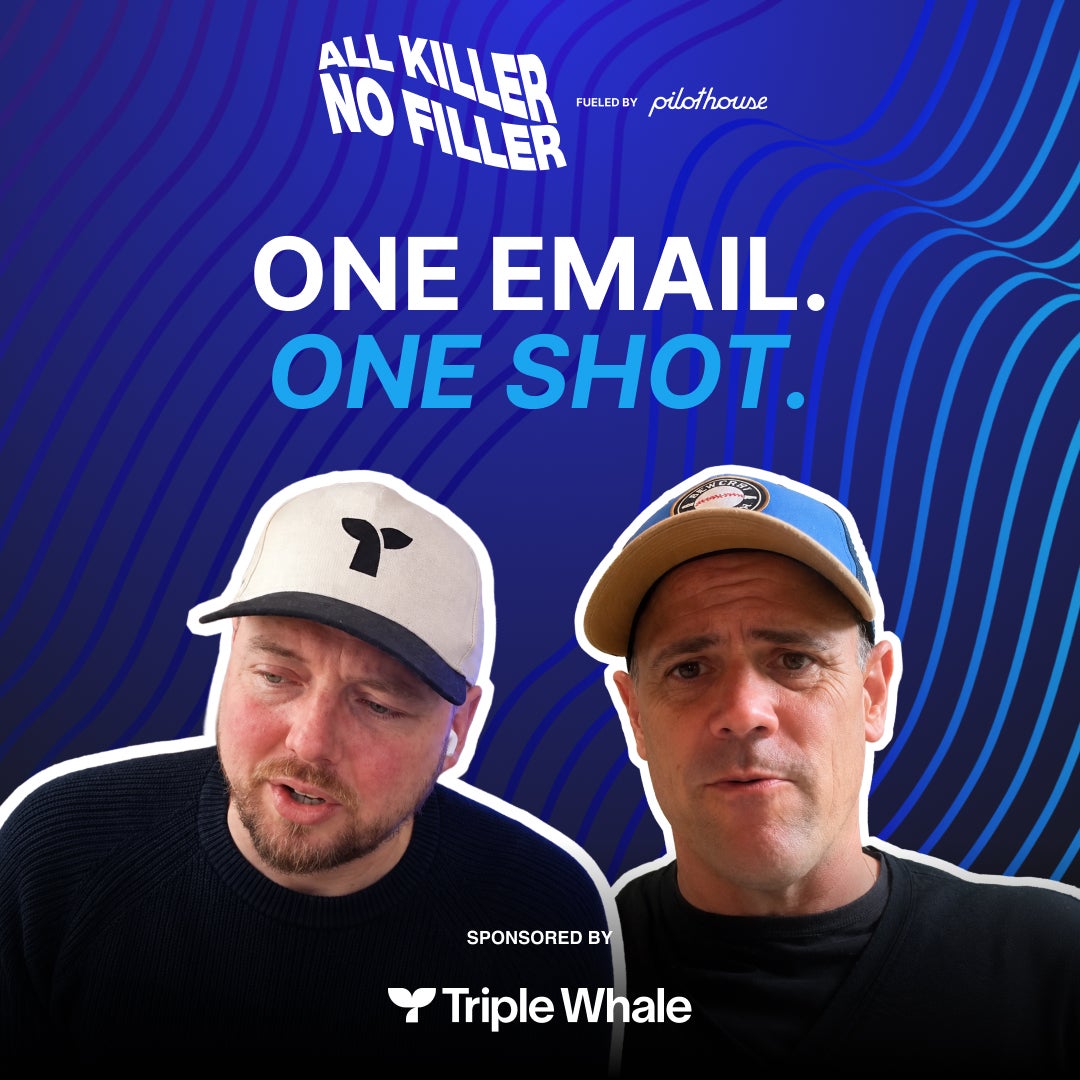
Meta testing at scale for DTC brands during summer into Q3/Q4—how to structure creative tests (ABO vs CBO/Advantage Plus/ASC), how much budget to allocate, what Meta optimizes for (net-new creative signals, first 3 seconds of video, text vs visual), and how to prepare for Prime Day and health/wellness tracking limits.
Eric (host) and the “Pilot House Meta Brain Trust”: Cody Plofker (mentioned via his post), Taylor (client performance “temperature check”), Jacob (creative testing strategy; discusses Meta AI delivery systems and testing structures). Northbeam rep insights are referenced.
CPMs down, traffic cheaper, returns climbing; launch 30+ concepts/week with low-budget ad sets; pilot tests run at ~5–10% of total spend; Advantage Plus can find winners faster but may underfund “bottom dwellers”; health/wellness “Core” setup limits conversion/audience data and can cause a death spiral; some brands shift budget toward app-loving.
ThirdLove, Toys R Us, The OOdie—Instant case study claiming ~11.2x average ROI lift and 4x ROI guarantee; Prime Day increases buying intent (often via Amazon awareness).
Written by AI. May contain mistakes.
Learn about the current trends in traffic costs and CPMs in advertising.
“CPMs have been down a bit the past month.”
Explore the current performance of Meta for clients and seasonal trends.
“One of them is Cody Plofker's exciting post that he made about how brands are testing at really high volume.”
Understand how brands can effectively test creatives at scale on Meta.
“comment about how I can't keep track of how we do creative testing on here.”
Discuss the importance of testing creatives for insights rather than just immediate performance.
“Yeah, I would say it's like, it also comes down to exactly what you're trying to get out of the test.”
Analyze how Meta's AI systems influence creative testing strategies.
“And with this idea that your creative is your targeting and that as you, you know, maybe target different avatars with your creative, you unlock different aspects of the meta audience that it then has to find.”
Learn how to implement pilot tests in advertising campaigns for optimized results.
“But at the same time, it's so far off that there's there's a balance needed for sure.”
Learn about effective pilot test structures and how to evaluate creative performance.
“Is that, do we set up the pilot test in these ABO structures where we take all of these different themes and they get a certain amount of traffic and we go by click rate or by these other lower funnel metrics?”
Discover how Meta uses user signals and creative elements to optimize ad delivery.
“They've been doing awesome, awesome work as always.”
Understand the unique challenges health and wellness brands face with Meta advertising.
“less time at the campaign level and focus more on just feeding it creative in alignment with that.”
Examine the trend of increased spending on app-loving amidst data challenges.
“there's a lot more increase in app-loving spend for these brands.”
Learn how brands can leverage Prime Days to enhance their Meta advertising effectiveness.
“A, do you just, do you get more conversions?”

Get the gist, explore an idea or ask about something said.
 Claude
On The DTC Podcast, what are the key points of this episode?
Searching your listeningAutomatic transcript. May contain errors.
0:00Jacob: CPMs have been down a bit the past month. Cost of traffic is more affordable right now. Overall returns seem to be climbing a bit. Often July and August can be a bit of a lull. Good time to take advantage, stocked upon as much as possible.
0:14Taylor Cain: How do we think about testing at scale on these platforms? This is a big question. I think it really comes down to people may have noticed in their ad accounts, they've got value rules that are coming into advertising settings and the ability to set those. From what I've heard, Meta is looking at trying to give advertisers more input at that level. Prime days in July. What changes in Meta on Prime days? Do you get more conversions? Are you ever driving to Amazon? Yeah, so basically it's just...
1:11Taylor Cain: Thank you. increase Shopify revenue by over 15%. Third love, Toys R Us, and The OOdie. These are all massive stores that use Instant to see an average ROI lift of 11.2x. They'll even guarantee you a 4x ROI or your money back. It only takes 15 minutes to set up and you'll start seeing results fast. If you're serious about getting more out of the traffic you're already paying for, now's the time to fix it. Get 50 % off your first month at instant.one.dtc. That's instant.one.dtc. It's all killer, no filler. I'm Eric and I'm here with the Pilot House Meta Brain Trust. We've got a smattering of topics to cover about Meta today.
1:57Taylor Cain: One of them is Cody Plofker's exciting post that he made about how brands are testing at really high volume. So I'm excited to dive into that. But I'm just curious, like on the overall temperature check, how is Meta performing for our clients at a high level right now, Taylor? I'd say things are looking pretty good overall. It's definitely been an interesting like recent couple of weeks this year to date. Things have been solid. The platform's kind of doing its thing as it always does. But more recently, I think we're in that kind of transitional period of the year. So, you know, coming out of Mother's Day and Father's Day, moving into, I guess, at the time of this recording, we're just a few days from the official start of summer.
2:39so it's definitely feeling like there's a bit of a switch up in some of the ad accounts as far as like what's working and where some of the trends are so that's been top of mind for us right now but I think I think given the the challenges a lot of brands have faced this year whether it be with tariffs or other components like that a lot of brands are starting to get ready for going up in volume and being prepared to jump into the Q3 Q4 season.
3:07Taylor Cain: stalking the pond, as we like to say every year on this podcast. Jacob, any other observations from clients in the market?
3:15Jacob: No, yeah, pretty similar. As a whole across all our clients, CPMs have been down a bit the past month. Cost of traffic is more affordable right now. Overall returns seem to be climbing a bit. So yeah, well, it's basically three days from summer here. often July and August can be a bit of a lull for a lot of a product unless you have a summer product. So good time to take advantage while the traffic is there. And really, yes, like you said, stocked upon as much as possible because the moment you get into September, October, November, it's just like every month is going to keep upticking and you're going to want to have momentum by then.
3:55Taylor Cain: So this post by Cody that you is actually a reply to an Olivia Corey comment about how I can't keep track of how we do creative testing on here. Are you guys all launching new creative into business as usual campaigns right away? Do you have a testing sandbox? If the latter, what's the criteria for graduating an ad out of the testing sandbox and into business as usual? And Cody's answer was that they currently use ABO, which is, is that ad set level bid optimization? Ad set budget optimization. Yeah. Yeah. Ad set budget optimization. They're launching 30 concepts a week. Each ad set is at a low budget.
4:31Taylor Cain: And then they're maybe graduating things out of there. I'm curious how maybe Taylor kick us off here. How do we think about testing at scale on these platforms? Yeah, this is a big question. I know, I don't know the exact number of replies in that thread. But I know there are a lot from a lot of people who are well respected and well known in the industry. And I think like the fact that it is such a big discussion you're like that probably hints at the sentiment that I'm I'm gonna share with I'm I feel like I'm the the it depends guy but um I think like I've been having a lot of these conversations recently as well with various people in the industry we go back time and time with our our brands as we we take a look at how we're testing for them I think it really comes down to a lot of factors that extend beyond even the ad account specifically like because when it comes down to it, you know, there are some brands I work with where I might even launch net new concepts directly in a scale campaign.
5:28There are some brands I work with where I run the ABO structure, given the creative volume and the performance of ABO. There are some brands where I'm testing in a CBO with ad set minimums and graduating from there. A lot of it kind of comes down to the risk appetite and the hit rate or the success rate of the content and how you're approaching it that way. So I think it's really interesting. Like some brands, they have formulas developed. They know what works. And we've been learning more and more about what Meta's algorithm prioritizes, which is an interesting topic related to this. Like how they understand what is net new creative versus what is not net new creative or notably different creative.
6:10So it's tough to give like an umbrella statement for it. But brand to brand, I'm doing it a little bit differently. And a lot of it is kind of treating it like I want to diagnose what the best opportunity is for that brand, given where they're at, how all of their channels work together, where meta fits into that, and ultimately where we want to go from there.
6:31Jacob: Yeah, I would say it's like, it also comes down to exactly what you're trying to get out of the test. Like, is it just trying to find the winning ad as quick as possible? Is it that you're actually need an apples to apples? Like, hey, we need to test the different colorways of this ad because we need to translate that learning to our website. In that case, ad set budget is kind of needed because you actually need an equal spend for that comparison to make sense. If you're just like, we need to test all these ads to find the winner. Yeah, like Advantage Plus probably makes more and more sense now.
7:08Jacob: Like Meta is going to find that winner quicker with their AI like delivery system and everything. So, yeah, I think it comes down to exactly what you're trying to get out of it. And then really the pathways become more clear as well.
7:21Taylor Cain: It's almost like you could test really big concepts at the ABO level, but then all of the like subtle variations within those concepts within ASC. I don't know if that really makes sense. But I guess the problem is if you're not forcing budget into all of your concepts, you may not give them a chance to find their audience, I guess, right? And with this idea that your creative is your targeting and that as you, you know, maybe target different avatars with your creative, you unlock different aspects of the meta audience that it then has to find. So I guess part of it is that you're forcing meta to assess each one of your creatives when you're doing it in that ABO standpoint.
8:00Taylor Cain: Like, how often do we do we make creative that just doesn't even get a good look? Like that just doesn't, you know, obviously, you've got a bunch of winning creatives that are that are building, you know, building the account. But like when you try to run new creative, it just won't ever get a foothold. Is that something we run into?
8:14Jacob: Yeah, like definitely run into it. And like by philosophy, if we are running a pointed test, we try to get basically like whatever your average order value of your product is, you know, maybe get at least that amount of spend to every creative to give it that chance at least. But you're also looking at all the metrics, the clicks, the add to carts. And yeah, if you launch them all in an advantage plus, I'd say like if you launch 10 ads in there, three or four of them might get like two cents a spend a day. Like there's just those bottom dwellers that Meta just knows somehow immediately, like those aren't going to work.
8:48Jacob: But then you actually test them in an ABO campaign with dedicated spend and like a few purchases do come through. So yeah, again, just goes back to like, if you need an apples to apples comparison, and you're actually trying to extract insights for other reasons beyond just immediate performance, then that data is valuable, even though it's, it's not converting, it's actually not wasted spend, right? Like, you're learning from that spend and translating it across your ecosystem. Yeah. And to that point too, like meta, meta operates, like why I think a lot of brands will see, like all the spend goes to like one or two ads because meta predicts that the action rate is going to be higher from that.
9:29So like CTR, for example, might be a metric that it's, it's weighing. And this gets back to why I think like AI and media buying and like the art of media buying is, is still really prevalent because there are, you know, as a functional team working with a brand, we're going to have moments where all the of us sitting at that table taking a look at the performance together are going to say this concept we're coming coming up with is probably going to have a really high ctr but we don't know if that's going to actually convert out the same way as some of our other ones that maybe don't have as high of a ctr so now we need to think about that and where we place it in the ad account strategically like that's where a lot of that comes into play and in uh in my eyes based on what you're what you're
10:09Taylor Cain: saying as well jacob so cody's comment here is when you're when you're testing a lot of different concepts in an ABO. You're forcing spend. He said things scale too slowly. He says that the wasted spend is as big as issue. Jacob disagrees. But then he says it also violates everything Meta is telling us about how Andromeda, Lattice, and Gem work. I'm actually not familiar with Andromeda, Lattice, or Gem. What does he mean by that statement? What is Meta telling us about how those platforms work and what are they?
10:35Jacob: These are like Meta's like AI delivery systems that they're implementing um so like andromeda is i mean i don't know like all the specifics but basically the behind the the doors of how meta's like algorithm works and it's a self-learning system that's what's feeling like advantage plus so he's just alluding to that essentially like meta's trying to work towards this these systems that they're investing in and they want us to just put in inputs and like, hey, here's your results. And that like, they're quite far off that there's a lot of management, there's a lot of strategy. And like, to the point of this tweet, it's kind of like a minor outlook of the bigger picture, how much manual involvement is needed.
11:21Jacob: And that's what he's just saying, like the ABOs kind of do go against what what they're pushing towards. But at the same time, it's so far off that there's there's a balance needed for sure.
11:32Taylor Cain: What is Meta's, dare I say propaganda, what are Meta's talking points about how they would want marketers to solve this problem? I assume it's just throw everything in ASC and let Andromeda sort it out. Is that accurate, Taylor? Like what is Meta's company line about how people should be testing this amount of creative? meta's kind of stance to my understanding based on conversations we've had is really lean on the machine learning and like just keep fueling it with content so worry less about the structure keep going and like it was last year they were doing a lot of interesting like tests looking at how many ads you should put in an asc campaign and i know at some point it was getting up to like 30 to 50 like it started getting kind of crazy and it's it's the idea that meta is continuing to try to flush those signals out on their end and those AI systems, as Jacob mentioned.
12:21So you just keep feeding it more content based on what we learn about the system itself.
12:26Taylor Cain: And then Jacob, back to Taylor's original point, are you the it depends guy as well, where you really are testing some your hot swap and creative in BAU in business as usual campaigns, in some cases, your ASC, your ABOing all over? Like, what's your general sort of strategy? Do you have a general strategy when it comes to testing creative? Are you, it depends.
12:46Jacob: Yeah, like, I mean, initially, if you're still kind of trying to unlock what's working, like angle-wise, you know, unboxings, reviews, like all these different kind of broad angles, I would say like we do a lot of ABO testing still, just again to like get those true insights across the board. And the way we structure our tests though is very pointed and actually doesn't require a lot of the budget. You know, once you're at a certain scale and you're spending X amount a day, the test budget really is like five to maybe 10 % of your total budget. So it really doesn't hurt that much to be running these tests, getting the data back and learning from what isn't working.
13:28Jacob: But I would say more matured campaigns where you just know what's gonna work, what's not. You're more in like iteration phase versus discovery phase. Those ones I would say you start rolling more with just fire it into, you know, Advantage Plus, fire it into the catalog, whatever it might be, and let Meta take it because there is data that led you to that point. That's my outlook on it, I guess.
13:53Taylor Cain: And we haven't talked about it as much lately, like, or we haven't named it as such. Are we still talking about the pilot test? Are we still talking about going with, you know, is that what you were just referring to? Is that, do we set up the pilot test in these ABO structures where we take all of these different themes and they get a certain amount of traffic and we go by click rate or by these other lower funnel metrics?
14:11Jacob: Yeah, yeah, pretty much. Looking at the full funnel, you know, click rates, but also like view contents, cart rates, and pretty clearly there's losers and top ones, it might not be, you know, proven out on the purchase side, but taking those signals and then moving those winners into your foundational campaigns, your, you know, your evergreens, your advantage plus, and that's, so yeah, pilot test in a way is almost like a battleground and definitely something we're always still running. And that is what is at that, you know, five to 10 % usually of the total budget. Not every campaign runs them now, but definitely those newer campaigns trying to elevate to that next threshold.
14:53Jacob: And in that discovery phase, definitely run a lot of those.
14:56Taylor Cain: And then what was your comment, Taylor, about what Meta considers net new creative? Where is that relevant? And what did you learn about that? Yeah, so it's really interesting. So I've been diving in and having various conversations. And one of those conversations has been about what signal Meta is using to try to understand how to deliver and cohort users to build those delivery patterns. So when it comes to some of that, I know they're kind of working on some different types of bid multiplier type signals. So weighing psychographic and demographic components against what it knows about the brand.
15:34One example might be it might weigh like targeting women higher based on the product offering is a pretty simple delivery pattern.
15:42Jacob: And then as far as the creative itself, it's pretty interesting on the static side of things. meta considers the relationship between the message and the visual itself so there are cases where if the text is the prominent message in the creative that may end up getting priority over the actual visual component in and of itself so it does score that and look at that and then on the video side it's the first three seconds that meta really considers strongly in the current uh weighing from the conversations that we've had. So, you know, testing different like end components of longer videos doesn't matter as much in theory as trying different hooks, intros, and those first three seconds to basically say, hey, this is a different video concept than the other ones.
16:29So there are ways that you can kind of come back to aligning your test strategy based on all of that information and continue to customize it accordingly.
16:38Taylor Cain: A lot of these insights you said came from a call with our Northbeam rep about what he's sort of seeing across. Maybe set that up and share any other sort of insights that he shared. Yeah, so big shout out to the team over there. They've been doing awesome, awesome work as always. So that was one of the big ones. The other one was the bid components. I think the other thing too, like speaking to this, this testing structure component, if you're choosing between like moving quickly with momentum and you have a sense of what's working versus you want to have a more methodical approach, you're maybe trying more contrast, taking some bigger swings with your creative.
17:12There's kind of two main schools of thought that are still relevant based on the conversation that I have, which is you launch a test campaign with your group of new concepts. You see momentum start to pick up. This might be an ASC campaign or a CBO campaign where it's set up to just go if it works. And then you basically just flip that into a scale campaign. You don't really change anything there. You just let that go, scale it up, and then keep going and build your pipeline out accordingly. That's one school of thought for faster momentum. And then the other one is more so the ABO structure where you have the graduated process and you're controlling it.
17:50again, it kind of depends on what's most relevant for your account and what you're looking to do based on stability, how much growth you want, et cetera, et cetera.
17:58Taylor Cain: What was their other point about cohorting users by behavioral and psychographic details? Yeah. So that's kind of the idea that a lot of people may have noticed in their ad accounts, they've got value rules and whatnot that are coming into advertising settings and the ability to set those, basically bid multiplier type things. From what I've heard, Meta is looking at trying to give advertisers more input at that level. So prioritizing how we might want delivery and almost adding a manual component to that where you can combine your strategy with customer personas or products, et cetera, et cetera.
18:41And then scoring that accordingly. So you can tell what it values, and it can go and try to find those users, which then enables you to spend less time at the campaign level and focus more on just feeding it creative in alignment with that. So again, nothing else going to be on that at this point. I think it's still a ways out, but it is a pretty cool potential insight that might be something to watch for.
19:04Taylor Cain: And then maybe one of the last points we want to hit on is sort of an update check-in this health and wellness category with meta-advertisers. We did a podcast on it a little while ago about how they were deprecating any sort of personal identifiable data points, including conversions and all sorts of clicks and all sorts of stuff that makes it tough. And I think Jacob, you and I had a chat yesterday about a Jonathan Snow post about the health and wellness death spiral that campaigns can find themselves in when they aren't able to gain purchase or gain purchase data, and they end up kind of flailing and performing poorly.
19:41Taylor Cain: Is that something we're seeing?
19:43Jacob: Yeah, like if you're in that health and wellness space and you're marked under this like core setup, it's called now, there's certain data that's limited being passed back, which means meta isn't able to define your audiences correctly, which means you're not necessarily self-fulfilling new customer uh goals which means your budget is like yeah you don't have that control so if you are in health and wellness and marked under course set up like other reporting tools are basically required i'd say like getting north beam on on or whatever it might be triple whale any you know of those reporting tools um and as well as just mapping your you know before data and after.
20:24Jacob: Um, cause yeah, it's like different, there's like eight different buckets people are being put under in health and wellness and it can be like different data that's limited based on those buckets. Not every brand is getting hit with it. It kind of depends how you're messaging, um, the brand and product, but yeah, we're definitely seeing that as a issue for a lot
20:45Taylor Cain: of, uh, brands. Um, and then I guess maybe your insight from the near North beam talk Taylor about how a lot of supplemented health brands are turning to app-loving. Maybe in this lack of data that Meta's giving, there's a lot more increase in app-loving spend for these brands. Yeah, that was an interesting discussion point. Hearing that there may be a pattern in kind of more budget share going to app-loving for some of those brands. So potentially something to look into for anybody who's navigating that issue on Meta and working to try to work around that. We haven't talked about app-loving in a while, but they're still crushing for e-com.
21:21Taylor Cain: Is that true? Yeah, it's interesting. It's like, from what I've seen, it's like the whole kind of app side of things has been, it's definitely had some extremely powerful moments and then kind of also had its own challenges like you'd encounter on any channel. So creative is really important, but it's still a pretty prominent growing side of the space. So definitely something to watch. And I think especially as we as we get closer to Q4 as well, though, we'll continue to see see where it goes. But a little bit more from from having more brands exploring it, I think brand fit with that placement seems to be a big, big thing.
22:02And then the potential nature of it being like an assisting platform in a lot of cases as well, based on what you're doing on other channels and then kind of capturing that has been an interesting pattern that we've been we've been diving into a little bit to try to learn more about and see. See how we can best use it.
22:19Taylor Cain: Nice. Well, we are Mother's Day is down. Father's Day is down. We've got July 4th. Big, big holiday weekend in the States. And then, oh, Prime Days. That's right.
22:32Jacob: 11th, which is always big across all channels. And then, yeah, big Q4, hopefully a year. Seems like, seems like it's going to be a good one.
22:40Taylor Cain: When you say that, I'm just curious when, so it's probably, you know, Prime Days in July. What changes in meta on Prime Days? A, do you just, do you get more conversions? Are you ever driving to Amazon or mentioning Prime Days in your ads? How does Prime play into meta?
22:55Jacob: Yeah, so basically it's just buying intent is high those days because Amazon is doing a lot of the legwork, making people aware it's Prime Days. So a lot of people online buying intent is high. And a lot of brands that are on Amazon on their website will still run like a Prime Day sale. they'll either match the price of Prime Day or basically use it to capture that audience that isn't going to buy you on Amazon anyways, right? Use that messaging Prime Day sale and you bring it to your campaign front, you run campaigns. So yeah, it's more or less just taking advantage of the intent. And some brands definitely will be sending people to their Amazon from meta ads and whatnot.
23:40Jacob: But just the tracking side of that is obviously very hard and whatnot. And we found that they are kind of different ecosystems, like people that are going to buy on Amazon and seeing a meta ad, they're still going to search for you on Amazon anyways. So on meta, usually you want to stay focused on just purchase intent, get people, you know, buying through meta or buying through the website. Those Amazon buyers will still buy through Amazon. So you don't have
24:04Taylor Cain: Give them that 20 % margin and no one can afford to.
24:07Jacob: So keep it on meta.
24:09Taylor Cain: Cool. Well, thanks for coming on today, guys. This is interesting. Look forward to checking back in with you as we approach Q4.
24:20Taylor Cain: Thanks for listening to today's episode. If you're not getting the DTC newsletter, you can subscribe for free at directtoconsumer.co. And if you want to learn more about Pilot House's all killer, no filler services, take off to pilothouse.co. I'm Eric Dick and this has been the D2C podcast we'll see you next time
Subscribe to DTC Newsletter - https://dtcnews.link/signup
In this episode of the DTC Podcast, Eric Dyck hosts Taylor Cain and Jacob from Pilothouse Meta Brain Trust to unpack how high-volume DTC brands test creative at scale on Meta. Learn their hybrid approach using ABO for insight discovery and Advantage Plus/CBO for scaling winners—while keeping testing spend lean at 5–10% of total budget.
Key Moments & Takeaways:
30+ ads/week testing: how they structure ABO for high-velocity creative discovery
Budget allocation: keep risk predictable by dedicating a small portion to tests
Meta signals: what defines ‘net-new creative’ and how visuals/text/video intros affect delivery
AI vs. human oversight: balancing Meta’s algorithm with strategic media buying
Health & wellness challenges: dealing with regressions in data permissions
Channel diversification: why brands pivot to AppLovin amid Meta data limitations
Seasonality playbook: capitalizing on lower CPMs pre-summer and prepping for prime Q4
Did you know that 98% of your website visitors are anonymous? Instant powers next-level retention by identifying who they are and converting them into loyal shoppers. Sign up for a quick demo today to get 50% off and unlock a guaranteed 4x+ ROI: instant.one/dtc
Timestamps
00:00 – Why July is the best time to stock the pond for Q4
02:05 – Creative testing structures: ABO vs. ASC vs. CBO
06:50 – Meta’s evolving definition of “net new creative”
11:55 – How Meta’s AI systems (Andromeda, GEM, Lattice) influence delivery
17:35 – Health and wellness brands and Meta’s tracking limitations
22:00 – AppLovin’s rise as an alternative channel for supplement brands
23:45 – Prime Day effects on Meta ad performance and purchase intent
Hashtags
#MetaAds
#FacebookAds
#CreativeTesting
#EcommerceMarketing
#DTCBrands
#PerformanceMarketing
#PaidSocial
#DigitalAdvertising
#PilotHouse
#AllKillerNoFiller
Subscribe to DTC Newsletter - https://dtcnews.link/signup
Advertise on DTC - https://dtcnews.link/advertise
Work with Pilothouse - https://dtcnews.link/pilothouse
Follow us on Instagram & Twitter - @dtcnewsletter
Watch this interview on YouTube - https://dtcnews.link/video