In short
Priority Bicycles’ low-maintenance DTC scaling story—how they grew to ~25,000 units/year by combining belt-drive differentiation, 365-day in-house customer service, and tighter, benefit-led marketing plus customer-driven product development.
Guests
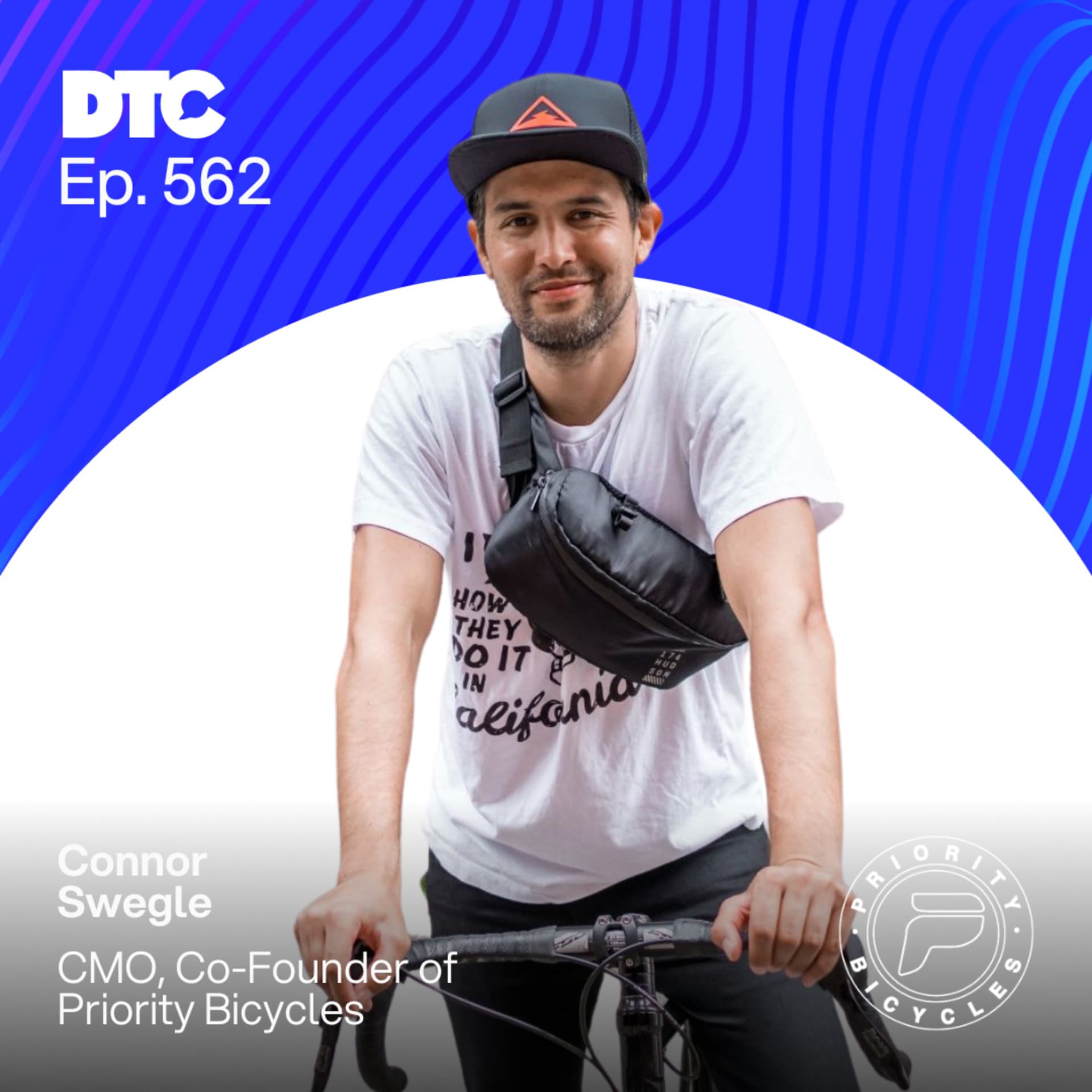
Connor (co-founder/CMO of Priority Bicycles). Background: started Priority ~11 years ago; leads marketing; focuses on customer service and data-light decisioning. Also referenced: Dave (Connor’s partner/co-founder) and YouTuber Ryan Van Duser (partner on an adventure bike feedback loop).
Key claims
Belt drives (vs chains) make bikes truly low maintenance; DTC success depends on answering questions fast and “talking like the customer” online; platform ad metrics can mislead—optimize for simple funnel actions (views, cart, checkout, purchases) and efficiency; avoid transactional sponsorships; use crowdsourcing but apply expertise.
Notable examples
Kickstarter launch (1,500+ bikes; $565k+); “Bruiser” crowdsourced adventure-to-backyard needs; color “pumpkin” feedback rejected after purchase data; mountain-bike “blank slate” belt-drive R&D tested at a North Carolina bike park.
Written by AI. May contain mistakes. Listen to the episode to check what was said.
Chapters
Tap a time to open that second in VOIntroduction to Customer-Centric Approach
0:00 to 0:53
Learn how customer-focused thinking drives business success.
“If somebody has a question, you've got to be able to answer it.”
The Launch of Priority Bicycles
0:53 to 2:24
Discover the story behind the founding of Priority Bicycles and its Kickstarter success.
“Maybe we can start by why you build priority.”
Unique Selling Proposition: Low Maintenance
2:24 to 3:51
Understand how Priority Bicycles differentiates itself through low maintenance features.
“I think it showed us not only was there an appetite for the product, but I think there was an appetite for the story as well.”
Evolving Direct-to-Consumer Strategies
3:51 to 6:36
Explore the challenges and strategies of DTC sales in the bicycle industry.
“Yeah, it's an interesting sell because it's definitely not a sell that, you know, you really think about out of the gate, right?”
Growth Phases and Market Adaptation
6:36 to 9:50
Learn about the growth phases of Priority Bicycles and adapting to market changes.
“And you did that from day one through to like your first bike sold to 25 ,000 bikes sold this year?”
Marketing to Diverse Customer Types
9:50 to 11:15
Discover techniques for effective marketing to various customer segments.
“Because bikes have so many different purposes.”
Feedback-Driven Product Development
11:15 to 14:00
Understand how customer feedback shapes product development at Priority Bicycles.
“And does that extend to the kinds of top of funnel marketing or like, you know, there's, you could have 20 different campaigns with each different avatar kind of going.”
Customer Feedback and Product Development
14:00 to 15:25
Learn how customer feedback shaped the design and launch of a new bike.
“I think that stuff is just turning into noise that people can filter through.”
The Balance of Data and Expertise
15:25 to 16:52
Discover the importance of balancing customer feedback with expert insights in product decisions.
“And it felt like we were really developing something for customers.”
Simplifying Metrics for Better Marketing
16:52 to 19:16
Understand key marketing metrics that drive effective decision-making in a business context.
“We ended up ordering a different color split than what people asked for.”
Show all 20 chapters
Efficiency Over Features in Marketing
19:16 to 21:00
Learn why focusing on efficiency can lead to better ROI in advertising campaigns.
“If what we see is high conversion, a lot of visitors, a lot of conversions, but not, and we say, you know what?”
Understanding Consumer Behavior in D2C Marketing
21:00 to 23:18
Explore the importance of understanding consumer behavior beyond traditional metrics.
“So for example, and I know that there's a lot of people that do this, but there's probably a lot who don't, right?”
Navigating Direct-to-Consumer Challenges
23:18 to 27:02
Gain insights into the challenges and strategies for thriving in a D2C environment.
“But how do you then like because I look at you guys like because Warby Parker, I guess they've I don't know what they've done.”
Expanding Distribution with Costco
27:02 to 28:00
Learn about the unique distribution strategy of working with Costco to reach customers.
“When you're not depending on the distribution or shelf space game, you got to be meaningful for why people feel confident to spend money.”
Breaking into the Hardcore Mountain Bike Market
28:00 to 28:38
Learn about the strategies for entering a mature market with new products.
“to consumer while still being able to serve that Costco customer.”
Innovations in Bicycle Technology
28:38 to 29:48
Discover how technology advancements influence product design in biking.
“you either have to look at new products or you have to look at acquisitions.”
The Product Testing Journey
29:48 to 30:45
Hear about the rigorous testing process for a new mountain bike product.
“And we said, let's not set out saying we know what this product is, but let's just say we want to be able to use this technology for the best application.”
Collaborating with Creators for New Products
30:45 to 32:35
Understand the benefits of co-developing products with creators and athletes.
“So long process, but something we feel really excited about.”
Innovative Ideas in Biking Culture
32:35 to 33:21
Explore creative ideas that resonate within biking communities.
“One might say, oh, well, working with sponsored athletes, there's nothing new in that.”
Entrepreneurial Insights and Networking
33:21 to 33:56
Get tips on following the journey of entrepreneurs in the biking industry.
“And so if you had the bike built for the bike rave, that could be a flagship product.”
Transcript
Automatic transcript. May contain errors.0:00If somebody has a question, you've got to be able to answer it. We're thinking like the customer, talking like the customer, communicating to the customer online. And then we also have 365-day-a-year in-house customer service, traditional brand positioning. Data has allowed us to ignore those factors for the last few years. I think we're getting back to making sure that we're very clear about what we stand for and what our products stand for. You can't be in a position where you have to buy every single eyeball. There just is not a way these days to be able to do that effectively. A lot of sponsorships, they're just transactional.
0:32I'm going to give you a product and pay you and you're going to talk about it on social media. I think a lot of that is falling flat for a lot of people. Whenever we launch a new product, we kind of call it the like, why should I give a moment? We take a step back and say like, why would anybody care to buy this?
0:53Connor Swegle:Connor, welcome to the D2C podcast. Excited to dive in with you today. Maybe we can start by why you build priority. Yeah, for sure. So started Priority 11 years ago now, which is wild. I like to say that I'm unemployable by anybody else at this point. I feel the same. Yeah. But 11 years ago, we had a passion for bicycles. I mean, we had a product design that we thought could be unique in the marketplace. And then something that's really relevant for your listeners is we were at this shining D2C moment where we had the leaders like the Warby Parkers of the world that said we can deliver great value at a better price.
1:30And so I think being able to combine those three things, we set out to launch Priority Bicycles.
1:35Connor Swegle:How did you sell your first bike? Yeah. So our first bikes, we caught the very end of Kickstarter excitement. So we were still at a point where you could get media coverage for Kickstarter, right? There's been enough people who I think have defaulted on their Kickstarters that it's really hard to have them cut through. But we launched on Kickstarter and we wanted to use that platform. It was really brought to brought to us by a friend of ours, said you should try this platform, you know, to kind of pre-sell your products. And so we thought this is a great way for us to fund early production of our bicycles.
2:08And so we went on to Kickstarter and we wanted to raise 30 grand, which we felt like was going to help us just get the ball rolling. And over the 30-day campaign, we ended up selling over 1 ,500 bicycles. The Kickstarter campaign funded at over$565 ,000. And it was a shock to us. I think it showed us not only was there an appetite for the product, but I think there was an appetite for the story as well. Which again, you know, at that time, that was very meaningful for people to feel like they were getting access to something unique.
2:38Connor Swegle:What are the key? Because I know you have a lot of different bikes. You guys go across a lot of different sort of genre of bike. What's the key brand element that makes you guys different? Yeah. So we do have a differentiator in what is a very mature and crowded marketplace. I'm sure a lot of your listeners can understand the challenges of cutting through in a mature and crowded marketplace. But for us, what we really hung our hat on from day one was low maintenance. So from a bicycle perspective, everybody is very familiar with riding a bike and seeing a chain below them. We actually put belt drives on all of our bicycles.
3:11So same brand gates that you might see on like a Harley Davidson or it's in Dyson or it's in HVAC or it's in your car. The technology existed, but it was really in boutique spaces. So what we wanted to do was apply that technology and get it really for the mass market. And so we put this belt drive onto the bicycle. It made it a very low maintenance experience, which was very different. And then again, launch that customer direct.
3:36Connor Swegle:Looks cool. So it's got a visual differentiator. I like that it appeals to like, people are like, you know, they like shiny things. They like cool bells and whistles, but this is just deep down. They know they're not going to spend enough time maintaining their bike. And so this kind of solves that, right? Yeah, it's an interesting sell because it's definitely not a sell that, you know, you really think about out of the gate, right? Like, you don't necessarily go to somebody and say, do you want to work on your bike less? Okay, cool. Now go buy a bike, right? There's an interesting customer story there that you have to navigate.
4:08But it does offer something that's very differentiated when you're looking at the research process. There is something unique for us to build around as a brand. And so those are things that, you know, from day one were very helpful, but they certainly, you know, year 11 are just as helpful.
4:24Connor Swegle:Talk to me about, you know, because in the DTC trend, Warby Parker, for instance, trying on glasses, that's pretty easy to do with an AR tool or something like that. Bikes, I know to this day, I bought a Marin recently and I was like, oh, I just want to buy it from the website. But most of or a lot of the big brands still won't even go DTC. They make you go experience it through a retailer or something. You guys going D to C from day one, I know you're expanding and have expanded into retail now, but how did you overcome the test drive aspect or how did you get people to want to lay down the cash for these bikes?
4:58Yeah, it's interesting. When you look at the business models that really excelled 15 to 10 years ago, a lot of that was because they were coming from this distribution model. Warby Parker, again, that's the easiest for us to understand. For a company to come in and cut out the layers of middlemen to make the product more accessible, a lot of the markets have figured that stuff out. That's a separate topic. But that is something that we have to deal with every day where, yeah, you can't just, there isn't just an AR tool where you can kind of like pop yourself onto the bike. The way that we have taken that on, which I think is very important for any entrepreneurial business and, you know, or any growing business.
5:38And I'm talking about not just companies that are trying to get to their first million, but I'm talking about even companies that are trying to get to their first 50. Is the customer service aspect of it, thinking about what the customer wants, how the customer is evaluating your product, I mean, that is top of mind for us. So we know that we have, that you can't just go to your local bike shop that's a mile and a half away anywhere to see our bikes. So we, it's put more pressure on us to make sure that we're thinking like the customer, talking like the customer and communicating to the customer online.
6:08And then we also have 365 day a year in-house customer service. So that is something that is very unique, like for, you know, for Marin and you know, we don't need to use Marin as an example, but for a lot of companies, not just in the bicycle world, like if you want to get a question answered, you're not going to call or text or WhatsApp them and get a response within 15 minutes. And so it put the pressure on us to make sure we were very present for our customers, which I think is very important in the DTC space.
6:36Connor Swegle:And you did that from day one through to like your first bike sold to 25 ,000 bikes sold this year? Yeah, I mean, day one. Yeah, like, my partner, Dave and I, we were doing, like, literally unwrap Christmas gifts with the kids and have the phone on in the pocket, waiting because if somebody had unwrapped a bike, and there was a washer missing, you're going to answer that question. And that's the same value that now our customer service team is much larger. But, you know, that's the same value that our customer service team has, where it's like if somebody has a question, particularly as a DTC company, if somebody has a question, you got to be able to answer it.
7:13Connor Swegle:I love that. And it actually mirrors the in-store experience. Every bike shop I've ever been in is filled with really cool people who you feel like who you have. I have great rapport with every bike shop that I've ever been into. You sort of trust their expertise explicitly. So it's cool to see that being transferred across to the online world. Yeah. I think that's the other factor of having in-house customer service, which I can't stress how much good customer service makes a difference. But, you know, we've got people who, you know, they're going to be in our videos, our informational videos online, and then they're answering the phone.
7:45You know, I'm here on this podcast, somebody's going to hear it. And then maybe we do a group ride next year, I'm going to be on that ride sweating right next to you, right? And I think that does create the connection. So I think what we don't have in that, you know, the shop on your corner, we certainly will make up for if you shoot us an email at nine o 'clock, we're going to get back to you. If you go on a ride, you're going to see us riding there. So, you know, there are other ways for us to build confidence.
8:09Connor Swegle:In your growth journey over the last 11 years, what have been like the, I don't know, the biggest tranches, for instance, like when you get to your first million, now you're up at, you know, 25 ,000 bikes sold a year. What have been like the tough, has it just been slow and steady growth or have there been sort of like noticeable tranches of like evolutions that companies had to go through? Yeah. I mean, you know, what's interesting about our growth is in doing customer service every day, you hear a lot about what your product needs are. Because people will tell you, you know, I was going to buy this, but does it do that?
8:38Or I bought this and I wish it did this, right? You have this information to build on and that organically has helped build our product line, you know, and that definitely creates a pretty natural arc, right? When you have more products to sell, then, you know, your numbers go up, right? Those kind of line up on the graph. I think there's definitely areas that we've grown into. I mean, we started with a single speed, or not a single speed, we started with one bike that was a three-speed around town bike. Now we make bikes, we're making a full suspension mountain bike 11 years later, right? I do think areas of the product growth, you know, moving from recreational and then adding on kids' bikes, and then adding on commuter bikes, adding on adventure bikes, where our unique factor being positioned around low maintenance was really helpful.
9:25I mean, those were all definitely jumps within the outdoor industry. The biggest one that's happened to us, right. It's affected all of our lives in a variety of ways was COVID, right? The rush on bikes for COVID was a massive jump for us. So obviously for a couple of years, really great. But what you have to do is determine as a company, how do you understand where the marketplace is going to level out and not overextend yourself, which a lot of people have done, not just in cycling or outdoor, but in industries throughout our lives.
9:53Connor Swegle:How do you treat the marketing funnels? Because bikes have so many different purposes. There's so many different things, so many different kinds of people, and yours spans so many different use cases. How do you think about marketing to all those different kinds of people? When your product suite grows organically and sometimes just around you, you definitely lose sight. I think one day we looked up and we're like, there are 20 bikes on our website and somebody who just heard about us for the first time has nowhere to go. And I think there's two things that sort of happen. And I think this is a very important trend right now.
10:29One is you definitely like for us, we definitely have to think about traditional brand positioning, right? And like data has allowed us to like ignore those factors for the last few years. I think we're getting back to making sure that we're very clear about what we stand for and what our products stand for. And then what we need to be able to do on the customer side, since we don't necessarily have somebody directing you to this part of the store or that part of the store or assign it an escalator, we really have to think about wayfinding on the site and how a customer can get where they need to be.
11:02And then once they're there, we really have to think about the language and the considerations that that customer is taking into account. So it really just comes down to a lot of rigor, but it's just thinking about what's unique about our brand and what might be going through that person's head when they're on the shopping journey.
11:16Connor Swegle:And does that extend to the kinds of top of funnel marketing or like, you know, there's, you could have 20 different campaigns with each different avatar kind of going. How do you think about your different customer types at top of funnel or on the marketing side of things? Yeah. So, you know, there's definitely been a big slimming down of how we approach top of the funnel recently. And I would say probably five or six years ago, the idea was throw money in the algorithm, we'll figure it out for you. Because that's what the algorithm is for. We have all this data and it's going to make your spend efficient.
11:48And I think what we've all learned is that that's not necessarily the case. And so what we've done is really put a lot of rigor into who we think is in the consideration set for our products. And I think that's really important for any marketer that is trying to make the most out of their money is I don't believe that it's smart to just throw a bunch of tests against the wall and be in this always testing environment and figure it out. It's very costly and it's very hard for creative scale to actually cover your bases and get enough relevant data to slim it down. So what we do internally is really think about who are the customers who would be in a position to buy and then target them.
12:23So for example, we're never gonna buy broad reach terms on Google for all bicycle terms. We don't, you know, if somebody's just trying to get a$99 cheap bike to kind of throw in their vacation home, we don't wanna spend money on that. We want to find the people who are looking for benefits that we could provide and make sure that we're spending our money in those areas, particularly at the top of the funnel where consideration is lowest.
12:46Connor Swegle:Obviously, you mentioned the rides that you do as a way to kind of stay engaged with the community. I have a story here about how one of your recent bikes, The Bruiser, was crowdsourced sort of with your customers in mind. Talk about, I guess, how that feedback loop evolved and what it looks like today. Yeah, so the biggest challenge that faces D2C companies, and I almost feel like we're talking about like a dinosaur now. We're still D2C. Yes, we're still D2C. We're still doing it. But the biggest challenge that you have is just customer awareness. Like how do you get the scale of people to come in and be interested and learn about you?
13:21And you can't be in a position where you have to buy every single eyeball. Like there just is not a way these days to be able to do that effectively.
13:28Connor Swegle:And rebuy them over and over again. Yes. Yeah, rebuy them. I mean, the amount of accidental clicks that somebody makes in meta is unbelievable, right? Like a small business could be out in a few months if they were trying to do that. And one thing for us that we've had, since we're a lifestyle company, we do have real riders who are on our bikes and doing very interesting things. And so what we didn't want to do, which I think is a trend right now, is you see a lot of these UGC companies that just send products out and somebody posts a video. I think that stuff is just turning into noise that people can filter through.
14:04It was really neat the first couple of times, but I think that customers are going to see through it in time. So, you know, we worked with one of our great partners. His name is Ryan Van Duser, and he's a YouTuber. And he was getting feedback about a bike that we had launched with him. It was called a 600 ADX. It was a really robust adventure bike. And what we were getting a lot of feedback is people were saying, hey, I love your bike and I love what you're doing, but I don't do what you do. I'm not out on my bike for six weeks. I need something that I can go out in my backyard with. Or I need something to just do a three-day trip with.
14:37I don't work for myself. I got to show up for work every week. So we had this idea of saying, let's not just take their feedback, but let's actually open up and synthesize everything that we've heard in these comments, whether it was internally from our customer service or with our buddy Dooser and his channel. And we synthesize that into a set of requirements or discussion points. And then we created a video series around that where we were just talking about what some of these different opportunities were, the things that we may want to design. And we got great feedback from our customers directly on what that was.
15:09We looped them into that project. It lasted over a year so that when we launched that product, the customers actually felt like they were part of it. They knew exactly what it was and they weren't starting at zero from day one about educating themselves on that product. So it was a very successful launch and something that felt very natural. And it felt like we were really developing something for customers.
15:31Connor Swegle:And that's gonna, yeah. And if it reflects that exact need of, even if just one person, it's like there's gonna be other people like that and the authenticity shows up, right? People will see themselves in it. Yeah, I think people wanna be heard. Research is interesting. And I think for, again, when I'm thinking about companies like ours or when I talk about small and medium-sized businesses, again, I'm thinking about companies that are still to that$50 million mark. It's very challenging to get, like we'll hear from consultants or friends, oh, you guys should do a big quant or a big qual. You do a big brand pillars study.
16:09And the reality is that when you do the research, it's very challenging to actually get the scale you need as a business of that size, right? And so I think opening up to customers is a great way to get the verbatims, but you also have to synthesize that and really put your own expertise against it. And the example I give for that is we got a lot of feedback from people in comments when we said, okay, we have the final colors for you. What color do you want? We're thinking, God, this is gonna be so great. We finally won't be overstocked on one color that nobody wants. We're not just guessing. So we got overwhelming feedback.
16:42Over 80 % of people wanted this like bright orange color called pumpkin. And we said, you know what? That really feels like something that people say they want, but they don't actually want. So we kind of modified that. We ended up ordering a different color split than what people asked for. And that ended up being how that purchase data landed for us. So I think it's one of those things where in crowdsourcing, you can get the feedback, but you also still need to take your expertise into account and make sure you're doing the right thing for the business.
17:10Connor Swegle:Maybe correct me if I'm wrong, but I remember like when you, when it shows up on your site, it, uh, as like the hero shot of that bike, it's still orange. Yeah, the hero is the orange. Which is smart. It's like you're playing it off, right? A little bit. You know, and that's the thing with selection is that, you know, and that was another trend a few years ago is like everything needed selection. That was sort of the Nike ID echo, right? Yeah. I can go and make my dunks whatever color I want. I did that. And then anybody who used Nike ID found that they had 40 screenshots of shoes they were never going to buy, right?
17:40And every color option available. The reality is the same with automobiles, right? What color is in the commercial red, but what do people buy? they buy black, gray, or white. And, you know, that goes to that difference between what people say they want versus like when their dollars are at stake, how they're going to behave. 100%.
17:58Connor Swegle:Super cool. You alluded a little bit to data. And I'm just curious, because you're CMO, you're a co-founder and with your main focus on the marketing, what are the key metrics you're looking at maybe day to day that you find most important these days? Yeah, I get in a lot of trouble from people with this, but I am definitely a data simple person. And I think a little bit of that is blowback from the amount of data that we've been able to have access to in the last few years. I think that I definitely have reactions where I think a lot of the platform data that we get is acting in self-interest and can really confuse you.
18:32You know, and you had a podcast with Constantine on, I think. Yeah. And I felt great that he echoed my sentiments about how the data can actually create challenges for you. What we want to look at is a very simple view of what pages people are looking at for our products, what people are adding to cart, what people are starting checkout on, and then what people are buying. And we want to slim that down. We don't look at aggregating. We don't look at stitching our data. We don't look at trying to build a customer journey. But we really look at those simple factors. And from there, it's very easy for us to pivot.
19:08So, for example, if we see that a product has a lot of views but not a lot of conversions, we say, great, that's either information on the page or it's a checkout issue. If what we see is high conversion, a lot of visitors, a lot of conversions, but not, and we say, you know what? That just means that's a traffic issue. Let's go up that journey and get more traffic built in. So what we want to do is really simplify that to what the true customer behavior is and then use our experience to try and make those numbers better.
Read the full transcript
19:36Connor Swegle:I don't know if how on the tools when it comes to meta you are, but I'm actually just doing a podcast tomorrow with our media buying team at Pilothouse about some of the fallout from the Andromeda update on Meta. First of all, am I right that Meta is the lion's share of your top of funnel spend or your marketing spend? It definitely has been. I mean, three years ago, we were probably three to one, if not four to one Meta to Google. And that has definitely balanced out to, we're about one to one now. Have you had to make any, I know Meta campaigns are constantly evolving, but are you aware of any big changes you've had to make in maybe this year to unlock better results on Meta?
20:15No, if anything, I would say, to be completely honest, if anything, we have had just a consistent downtrend of what we're spending on Meta. And what we have spent a lot more time on is trying to understand the attribution within campaigns, average order value that's coming through, what products people are buying through the different campaigns. Because I think that the data and reporting within the platform is so convoluted. And it definitely leads you to think that you should be spending more. And what we have found - Yeah, exactly. And what we found is that the less we're spending, that our ROAS results are better.
20:53And so our work with that has been less about optimizing features that Meta has, but more about being increasingly efficient about what we're spending there. So for example, and I know that there's a lot of people that do this, but there's probably a lot who don't, right? Because the numbers look really good, like astoundingly good, right? Oh, our meta is doing 12 ROAS, like it's crushing it. Like I don't have anything to worry about there. Well, you know, when you look, you know, we're talking about this bike, the Bruiser. So we had a very robust campaign that we launched for the Bruiser, this crowdsourced bike, and it was a really good price point, right?
21:25It was about 2 ,500 bucks for us. But what we were finding in that campaign, the ROAS was really great. But when we looked at the average order value, the average order value in some campaigns was like$600 or$700. So people are clicking on that campaign, we're paying for it, but people aren't buying it. And so I think for us, it's been really more about understanding what that is and where the important places are to spend and what types of campaigns are running versus looking at any of the new features. So we're still in a refining and slimming down of what we're doing on Meta.
21:55Connor Swegle:I just did a podcast yesterday with the founder of Stella, which is an incrementality sort of testing tool. And he pointed out something that's obvious that I didn't quite realize, that quite often the higher your ROAS is on platform, the lower your incrementality is. Because the higher the ROAS is, it's going to be because it's saturating the bottom part of the funnel. People that might have bought anyway, it might have come from other sources as well. So it's like you find if you can focus more on just bringing new people in and less on saturating them in the bottom part of the funnel, you might have lower ROAS but higher incrementality.
22:28Yeah, the amount of dollars attributed to the bottom funnel campaigns really holds the weight of a lot of meta campaigns. You know, again, there's a lot of people listening to this who are like, yeah, of course. But I think there's a lot of people, particularly people who are looking to start their business or grow their business in the first few years that aren't looking at that. And, you know, to the point about incrementality, you may find like if it's either people who are buying already or people are buying products that you already have, right? they're not buying a new product, but it's a second, third, fourth, fifth time buyer, you may find that you're running five different campaigns, but all they need is the trigger of seeing your brand.
23:01And then they're going to, it'll remind them to buy. So why run five campaigns? Why spend on five campaigns? You might be able to just have one really strong middle to bottom of funnel campaign that just says, Hey, remember us, we're awesome. And that ROAS is going to kick ass and you don't have to worry about building out five different campaigns.
23:17Connor Swegle:So with your pullback on Meta and because Google is not really a top of funnel platform, they want YouTube to be that. But how do you then like because I look at you guys like because Warby Parker, I guess they've I don't know what they've done. I think they're one of the stories that hasn't done as well. You guys have just sort of stayed steady, for instance, in this model, even long after the direct to consumer benefit wore off. Like no one really cares that much right about that cutting out the middleman anymore. So what have you done to sort of like to continually keep growing eyeballs on the bikes?
23:49For sure. I think the big challenge that we saw with D2C is that accessibility was the key promise. We all thought it was the product, right? We all thought it was the cool luggage. We thought it was the cool shoe. We thought it was a cool toothbrush. But it wasn't. It was just the accessibility and this idea that you were saving money and it would just show up at your door, right? Right. And so I think what we're finding is that it's drawing us back to having to really understand what our benefits are and why a customer would care. Whenever we launch a new product, we kind of call it the like, why should I give a shit moment?
24:23Because it's like when we're launching a new product, we have to take a step back. Right. You fall in love with your products. You drink your own Kool-Aid. We take a step back and say, like, why would anybody care to buy this? Like as D2C companies, like we always have to remember that like dollars are difficult for people. People are buying things for very specific reasons that are outside of the product, right? And I look at a product like ours. If somebody wants to buy that$2 ,500 bike, they're thinking like, are we going to go to Disney around Thanksgiving or am I going to buy this bike, right?
24:55And when you think like that, you really drill down to what's important for the customer. I think staying focused on what was important to the customer and not just the buying trend is what's allowed us to stay even and still continue to grow even after COVID fallout.
25:09Connor Swegle:I keep referencing past podcasts, but last week I did one with a CPG expert on why people kind of pick things up. And he was talking about how quite often when you're thinking about your marketing, you want to think about not only the benefits of your product, but like what else, if they don't buy your product, what else would they be doing in a way? And I think your idea of like, when it's your case, when it's 2 ,500 bucks, it could be like a family trip or something. So really understanding the negative space that would happen if someone didn't buy your brand can help you figure out how to sell them your product.
25:41Yeah. I mean, the soft marketing stuff is really important right now, right? And I think it's, again, a lot of this goes back to the fact that I don't trust a lot of platform data that's coming to us because I think the platform data in the last few years has led us to believe that people are linearly deciding robots, right? Like I find new products because of a meta ad. And then when I'm curious at night, I go and do a Google search, right? The people aren't like that, right? Like anytime any of us have, you know, if you've got a partner, you're married or whatever, anytime you've made a purchase, you're, you're thinking, your main thinking point is how am I going to break this to my partner?
26:19There's nothing that's linear in the data process that can illustrate that.
26:24Connor Swegle:Yeah. Like you need another, I gotta go like within the bike world, right? I have a garage with eight bikes in it and I need to go tell my wife that I'm going to go buy another bike. Like she's, she's not going to buy that. Right. And so I think what we have to do, we really have to think about what those other factors are. Like what are the things holding people back? Where else could they be spending money? What is the right time? How can we maybe know when somebody is in that right mind frame to take action and we can make sure that we're amplifying that and giving them the confidence to be able to say to their partner or to themselves, I'm making the right decision.
26:57Those are all the soft marketing things that I think in the DTC world are really important right now. When you're not depending on the distribution or shelf space game, you got to be meaningful for why people feel confident to spend money.
27:10Connor Swegle:I see a streaming ad in your future that's around that concept, like the guide on how to explain to your partner that you need another bike. Oh, for sure. Yeah. The amount of comments we get are like, I love this bike, but my wife will kill me. So I don't think we talked about this on the pre-interview, and you'll have to correct me if it's wrong, but ChatGPT brought it up. Are you guys launching into Costco shortly? We actually have had a limited run of bikes at Costco for a few years. So that's really the only kind of formalized distribution that we have. And so, you know, there's a section of our bicycles that I think really fit that Costco buyer.
27:43You know, Costco is really unique because Costco is kind of its own little direct to consumer beast, right? And so, you know, they don't operate like other retailers. And I think it was a really good space for us where our low maintenance promise really worked with that customer base. And we were able to, you know, work out arrangements with them that made it possible for us to remain direct to consumer while still being able to serve that Costco customer.
28:08Connor Swegle:And then just to dive in a little bit on your full suspension bike, because I've got some friends who are big mountain bikers, It's kind of like a, I would, it's like a hardcore space. It's not like a cat. It's not as casual as like cruisers or things like that. So I'm curious, like how you thought, I know you do lots of other kinds of bikes, but how have you thought about breaking into this sort of mature hardcore market with it, with your product? Any company that's looking to make these jumps, right? When you're a company, particularly like us, right? It's been 11 years, right? And so for companies that after a certain point, you either have to look at new products or you have to look at acquisitions.
28:41You know, that's the only way you're going to get jumps of growth. Both of them are very viable. Acquisitions can take less effort but more dollars. But, you know, for us, because of our position as this low-maintenance company, we've been working with certain technologies for 11 years, right? And so we talked a little bit about Belt Drive, which we're one of the only, if not the only, certainly the only in the US or in the Americas that focus on only Belt Drive bicycles. We have internally geared hubs that are sealed and weatherproof and really cool. We've been working with these technologies for a long time.
29:16And so I think we were always trying to keep our eyes and ears open to where those could find new application within new segments of the market. And there has been a big desire to see how some of those technologies that we're using could be applied within the mountain bike space. But there's been a tremendous amount of engineering and design that has to go into that because there have been product limitations. I think for us, what we said is, let's set the goal of making the best execution within this mountain bike space, whatever it is, right? Because there's a variety of different executions, right?
29:48You can ride trails. You can go downhill. You can do a variety of things. And we said, let's not set out saying we know what this product is, but let's just say we want to be able to use this technology for the best application. So we really started with a blank slate. And it's been a four-year design process with key partners. And we let the product find its way there. Ultimately, we were kind of at this last phase about seven months ago where it was kind of a go or no-go on the product. product and of course by you know after three almost you know three and a half years everyone internally had fallen in love with it but we had to put it out to the market so we did a testing event in North Carolina at a mountain bike park with people who didn't know who we were because it's a mountain bike space nobody knows who we are in the mountain bike space and so we did a live consumer event we and we did a product test with people letting them just tell us do they like the bike or not and the reaction was great and that gave us that last kick in the pants to get over the finish line with this product.
30:45So, you know, I think it was having the idea of making sure that we were going to be able to excel in a unique way with a great experience of the bike, a lot of research and development, and then letting customers say, yeah, this is, this is good. Let's do it. So long process, but something we feel really excited about.
31:01Connor Swegle:And as you say, that kind of horizontal expansion is a true path to growth here. Are there more of those to crack or how do you see the next three to five years go in terms of your growth goals? Yeah, you know, the more products you launch, the slices of white space get smaller and smaller, for sure. You know, I think that's definitely a challenge. We have our core products, right, like our kids' bikes, our cruisers, our commuter bikes, our adventure bikes that are really core to who we are in our low-maintenance position. And I think those can continue to shine because there are always new consumers in that space looking to refresh what they have.
31:39I don't think we need to feel the pressure like a distribution company does to have to just do a fresh model year so that you can entice the salespeople on the floor to get the customer excited a new way. We might have to refresh our language or the packaging of it on the site, but we can keep those core products. I think what we're looking to do is from a product growth standpoint is just continue to refine and listen to the customers and find where are their pockets where we can modify, change, or create new products in the space. So something we've been doing more of, which we talked a little bit about what we did with our buddy Dooser for this, for the Bruiser, was talking to different creators and adventurers and really hear from them and, you know, find out if there's products that we can develop in conjunction with them where we can offer a product that's unique to them, but then also something that they can be a part of from the development and storytelling process.
32:34And I think that does two things. One might say, oh, well, working with sponsored athletes, there's nothing new in that. Well, a lot of sponsorships are just like, they're just transactional, right? Like I'm going to give you a product and pay you and you're going to talk about it on social media. I think a lot of that is falling flat for a lot of people. Like we need things that are meaningful and understandable for people. So if we can actually have partners who can give us their feedback based on what they've learned, based on what they know, something that speaks for what an audience might need and then include them in on the process, then we can actually develop products that we know have a baked in user base for it.
33:08and people who have been along with the story throughout the development.
33:11Connor Swegle:As long as you don't get Homer Simpson as your test case. I remember when he made that car that sunk his brother's company. And it makes me think of my terrible idea. It was I went to my first bike rave this summer. And so if you had the bike built for the bike rave, that could be a flagship product. Hey, we can't talk about it because they hate when you do. So you might have to bleep this out. But we definitely are a major bike at Burning Man. Oh, nice. Yeah, because of the low maintenance thing. I remember one year, probably seven years ago, somebody posted a video and we shared it and we got the cease and desist from Burning Man.
33:47They're like Fight Club. I don't think I realized that.
33:50Connor Swegle:That's interesting. Yeah. So nobody has our bike at Burning Man. Okay. Yeah, of course. No, never. Dude, this was super cool. I want to thank you for coming on today. If people want to follow your entrepreneurial journey, where do you recommend they do that? Are you active on LinkedIn? I'm active on LinkedIn. in. People can send me a message. I talked about the customer service. So if you send us a text and say, hey, I want this to go to Connor, it'll get to me. But definitely prioritybicycles.com, easy to follow along with us. And then on socials, we're ride priority. I love it. I just think bicycling is one of the most objectively good things there is.
34:26Connor Swegle:So good on you for building a great business in this space. No one's not happy when they're riding a bike. For sure. We'd love to have more people riding. But maybe when they're changing their chain, they're less happy. So you get in best of both worlds. Yeah, exactly. Get dirty with the chain you have and then realize that there's a better way.
34:49Connor Swegle:Thanks so much for listening to today's episode. If you're not a subscriber to our newsletter, you can do that right now at direct to consumer, all one word dot co. I'm Eric Dick, and this has been the DTC podcast. We'll see you next time.
From the publisher
Subscribe to DTC Newsletter - https://dtcnews.link/signup
Connor Swegle co-founded Priority Bicycles to build bikes that look good, ride great, and don’t require you to be a mechanic. From a Kickstarter that sold 1,500 bikes to 25,000/year today, he’s grown a DTC brand that rides differently — literally and strategically.
For DTC founders scaling from ~$5–50M looking to tighten marketing funnels, reduce wasted spend, and build real community.
Launched with a $565K Kickstarter campaign that validated product and story
- Built a brand around low-maintenance belt drive bikes — a real differentiator in a crowded market
- Why they ignore most attribution data and focus on 3 things: product views → add to cart → purchases
- Slimmed down Meta spend and saw ROAS increase by tightening targeting
- How community-led R&D helped launch the Bruiser with built-in demand
Who this is for: founders and marketers growing DTC product brands with real AOV
What to steal:
- Don’t run campaigns unless your audience is already in a buying mindset
- Measure funnel performance with just 3 steps: view → add → buy
- Involve customers in product development, but don’t let them pick the color
Timestamps
00:00 Why Priority Cycles was created
03:00 Launching on Kickstarter and early traction
06:00 The low-maintenance bike differentiator
09:00 Building DTC trust through customer service
12:00 Simplifying brand positioning and wayfinding
15:00 Crowdsourcing product ideas and community involvement
18:00 Using customer insight vs platform data
21:00 Meta downshifts and rethinking paid efficiency
24:00 Incrementality, ROAS traps, and smarter funnel design
27:00 Understanding real customer motivations and tradeoffs
30:00 Entering the mountain bike market
33:00 Working with creators to co-develop products
35:00 Growth outlook and category expansion
Hashtags
#dtcpodcast #prioritybicycles #ecommercegrowth #marketingstrategy #dtcbrands #digitalmarketing #customeracquisition #growthmarketing #brandstrategy #directtoconsumer #bicycleindustry
Subscribe to DTC Newsletter - https://dtcnews.link/signup
Advertise on DTC - https://dtcnews.link/advertise
Work with Pilothouse - https://dtcnews.link/pilothouse
Follow us on Instagram & Twitter - @dtcnewsletter
Watch this interview on YouTube - https://dtcnews.link/video