In short
Episode topic: How 7-figure D2C brands should prioritize growth metrics and execution—what to fix first, how to structure Meta accounts, and how to scale with creators/organic without wasting ad spend.
Guest background
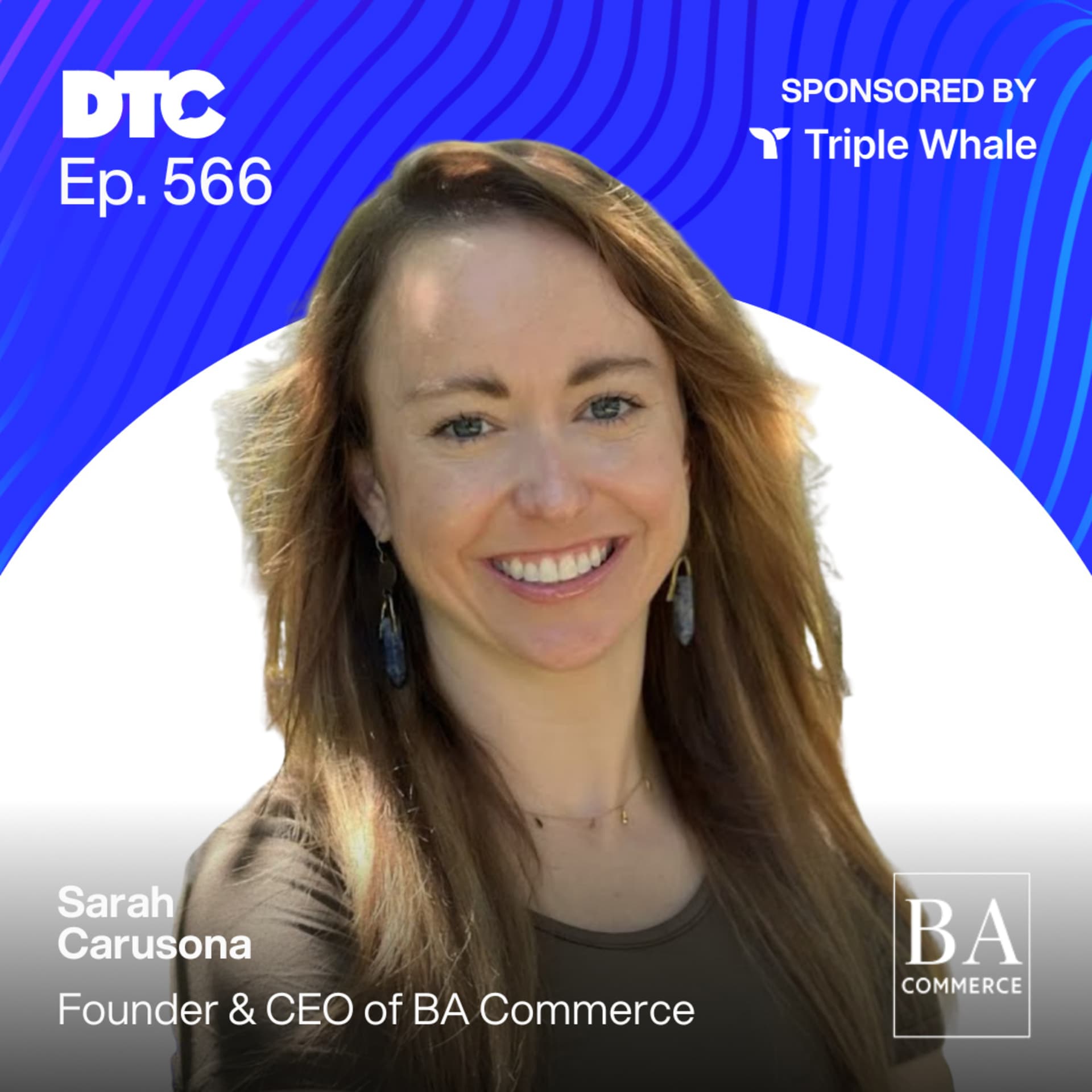
Sarah Carusona is a growth operator/consultant behind BA Commerce, which deploys trained “growth operators” into brands under her guidance. She previously did fractional CMO work and moved from Chicago to Argentina (Buenos Aires) and now Mexico City.
Key claims
Brands waste money on tiny ad differences; make bigger creative swings. Hyper-focus on the core growth levers: Meta + content, organic, email/SMS, and the marketing calendar. Growth should cover acquisition, retention, and conversion (not acquisition-only). Don’t work with weak products or missing “story to sell.”
Notable examples
Tiered influencer affiliate program (tiers from promo-code affiliates to revenue/spend-linked tiers to co-branded partnerships). Attribution/forecasting uses ROAS targets per channel plus an “organic ratio,” and optionally Meta incremental ROAS/Northbeam modeled views. Account testing via CBO with minimum spends/cost caps, not flat ABO.
Written by AI. May contain mistakes. Listen to the episode to check what was said.
Chapters
Tap a time to open that second in VOThe Importance of Creator Content and Strategy
0:00 to 0:39
Learn the significance of focusing on creator content and brand strategies for growth.
“We are getting so many ads and they all look the same.”
Sarah Carusona's Journey and Consultancy Launch
1:34 to 2:38
Explore Sarah's journey from brand side to launching her consultancy.
“It's like, I never lived in New York, but a lot of people compare it to New York City.”
Designing Growth Strategies for Brands
2:38 to 4:06
Discuss how Sarah identifies key pain points and designs effective growth offers.
“So when I met you all there, I was still in Chicago, but then since then, my husband and I moved to Argentina.”
Metrics for Growth: Analyzing Brand Performance
4:06 to 8:21
Understand the key metrics to analyze for driving brand growth effectively.
“I love working for myself and being able to do your own things.”
The Role of Creative in Marketing Strategy
8:21 to 11:13
Learn how creative strategies can enhance marketing performance and target audiences.
“to get in the weeds, want to work with these small businesses.”
The Impact of Creator Content and Partnerships
11:13 to 14:01
Explore the importance of creator content and partnerships in driving success.
“In my head, I've always said it that way.”
The Importance of Creator Partnerships
14:01 to 17:08
Learn how strategic influencer partnerships can drive brand growth and creativity.
“It could be like, you know, you don't know what is going to be the hook.”
The Role of Organic Growth
17:09 to 18:25
Discover the significance of organic growth in a brand's overall strategy and success.
“As someone, I know you're, I think you're an ad first person in the growth world to a degree, but how do you think about that importance of organic in growth today?”
Optimizing Ad Account Structure
18:26 to 21:39
Explore best practices for structuring ad accounts for maximum efficiency on platforms.
“Can you geek out a little bit on account structure and the way you're thinking about that on meta platforms right now for say a brand that's spending half a million a month?”
Identifying Common Brand Mistakes
21:40 to 23:53
Understand common pitfalls brands face that hinder their growth potential.
“And so on the growth side, do you guys handle retention consulting and growth as well?”
Show all 13 chapters
The Growth Framework: Acquisition, Retention, Conversion
23:54 to 26:51
Learn about the essential components of a successful growth strategy.
“I think the video you might be referring to is like a, I think I did an extreme example where it was like somebody was given like a white shirt.”
Using AI in Growth Strategies
26:52 to 28:00
Explore how AI can enhance workflows and data analysis in growth marketing.
“How are you using AI in your workflows these days and where are your lines in the sand where you're not?”
AI's Impact on Work and Efficiency
28:00 to 29:28
Discover how AI is transforming data analysis and workplace efficiency.
“Have you seen these announcements for this Neo robot?”
Transcript
Automatic transcript. May contain errors.0:00We are getting so many ads and they all look the same. There's like little tiny differences. And then we're spending money on all of them and we're wasting a ton of money on these little tiny differences. We need to be making bigger swings.
0:12Sarah Carusona:What's your philosophy on creator content, partnership ads, and how important those are in the account? They're extremely important. What I've started rolling out with a lot of my clients is a... What are some common themes that you see brands making mistakes with when it comes to their growth? brands need to just be really hyper-focused on their strategy. And typically that is going to be your meta and your content, your organic strategy, your email and SMS strategy, and your marketing calendar. What are the things that you're doing to add excitement to the brand? Hyper-focus on those things.
0:51Sarah Carusona:It's a D2C podcast and I am back here with Sarah Carasona. If you're watching video, your eyes do not deceive you it is halloween today this won't come out in halloween this will come out in like two or three weeks so you'll be wondering why i'm dressed like heisenberg but that's what and i didn't tell sarah i was doing it today so she she just has her regular get up welcome back to the ddc podcast how are you doing sarah i'm good i'm good excellent and i'm actually in mexico city right now and there's a lot of celebration here for dia del muertos so it's uh it's pretty fun it's high on my list mexico city what an amazing city it sounds like?
1:24Sarah Carusona:Are you staying there? Are you living there or just visiting? We've been living in Mexico for about six months and we spent about five months in Mexico City and then one month in Oaxaca City. Nice. It's awesome. It's like, I never lived in New York, but a lot of people compare it to New York City. I mean, it's ginormous, but the food here is just like out of this world. And it's not just Mexican food. Like there's most of my husband and I talk and most of our favorite restaurants in Mexico City are like not Mexican food. I mean, because the Mexican food are like the best food you get is like on the street.
1:56Uh, but like, there's like, I mean, we've been to like Michelin star restaurants for that are, uh, like there was a Mediterranean place we wanted. It was amazing. Anyways, it's, it's really international city. Yeah. Yeah.
2:07Sarah Carusona:Well, catch me up on your journey because I think the last time we've kind of connected a little bit on, on socials and stuff, but the last time we spoke was when you were here for our event in 2023, when you were still brand side, I think at that point. Yeah. So I think when, when I came to that event, I had just started doing like some fractional, like CMO type consulting. So I was kind of like brand side, but you know, in the fractional sense, whatever you want to call it. But I actually have you to thank for the launch of my consultancy, because it was at that event that I met my very first client and who is going to be today.
2:40Yeah.
2:41Sarah Carusona:Oh, that's fantastic. Love the way that works out. Yeah. But yeah. So when I met you all there, I was still in Chicago, but then since then, my husband and I moved to Argentina. We were in Buenos Aires for six months. And then we've been in Mexico for the last, like I said, like five, six. And then we're actually going back to Buenos Aires on this weekend. And for all the people listening who are looking to make a change or take a leap, how has it worked out for you, this leap of faith that you made into kind of really focusing on your own thing? I so recommend it. And I think what I would recommend is, it's worked out very well for me is that I didn't define exactly what I wanted to do right away.
3:22I kind of just trialed things out. So like I said, when we met last year, I was doing kind of fractional CMO just on my own. And I saw some issues with that and some challenges with that. So then I trialed out kind of like a different offer. And I just, I allowed myself to not be so strict in like defining my offer before I actually worked with people. Instead, I tried to like work with people in flexible ways and understand like the actual needs of the businesses I wanted to work with. And then from doing that over time, I basically was able to like identify the main pain points and say like, okay, cool.
3:58I can design an offer around that. And that's what allowed me to launch BA Commerce. And it's been going really well from there. And I highly recommend it. I love working for myself and being able to do your own things.
4:09Sarah Carusona:Describe what, where you've landed with your offer. Like, I guess every agency comes to the table with a take on how things should be better, how things should be done. What's your sort of thesis on, on what a growth operator should be doing? Yeah. So for me, a growth, let me back up for a second. So the, the challenges that I saw with fractional CMO was I could come in and I could say, Hey, I'm working, you know, 20 hours a week on your brand, or I'm working, you know, three days a week or whatever it was, but that's just me. And I'd be working with their team. But what I found was like, I could, I could do the strategy and I could do some of the execution, but especially the businesses that I work with, which tend to be like high seven figures, low eight figures.
4:51So they're in this like real growth phase and they're, you know, they don't have a huge pool of resources. They really need people who are in the weeds, like getting shit done day in, day out. And don't get me wrong. I can get to that to an extent, but there's always more that's needed. And on top of that, what I started to identify is that a lot of these companies are also trying to hire like a head of growth. And that's a really hard position to hire because you either find somebody like me who's like, I'm not going to be a head of growth for one brand anymore. Like I'm just, I'm past that in my career.
5:21Or you're going to find somebody who is super, super expensive, or you're going to find somebody who maybe has some of the experience, but not all of it. And they need just a little bit of training. And so as I started to talk with a lot of people, both like Brandside and people in the industry who were trying to become head of growth, I was like, there's like this like supply and demand kind of gap going on here. And I love to coach. I love to train. I love helping people in their careers. So basically the offer that I designed is we come in. So BA Commerce is a consultancy and we have kind of like three main offers.
5:55But what it essentially is, is that we have growth operators who are trained directly under me. These are people that I've worked with hand in hand on a client or in the past or who have gone through all of my kind of training materials. And we deploy them on a brand under my guidance. And so basically, I become their pseudo manager. I'm the person that they're troubleshooting with, that they're coming to for ideas and all of that. But otherwise, they are in the brand day in and day out. And the way that we work, our statement of work is basically grow your brand. So it's whatever that means for your particular situation.
6:26So we basically work with the clients and we identify like what team members they currently have, what team members they're missing. And then we like insert ourselves, a part of our onboarding is we design an org chart and we're like, okay, here's where we sit. And these are the people we're managing. This is the like roles that we're taking based on what they already have. We'll also work with them to say like, hey, this person's been doing this, but they're actually way better at that. So maybe we kind of like help to reposition some people just to be able to design the team in the way that can fully support the growth of the brand.
6:55And then we're in it day in and day out. So we've got a whole, I call it a growth hub. We've got a whole forecasting and tracking model from a day-to-day perspective on contribution, ad spend, MER, AMER, cohort models, contribution. We work on Amazon, we work on TikTok. It's really just a way for us to be able to fully insert ourselves in the brand and for them to solve the need of needing kind of a head of growth who can also get into execution. And then the other things that we do differently is like we don't have a we do a 30 day contract or sorry a 30 day opt out. So we don't do harsh like hey you got to sign with us for the next six months because I hated that on the brand side.
7:33So I'm like hey you can it's low risk for you. If you guys are trying to figure out if I if you can find the right head of growth like this is a very low risk way to do that. And then we don't have any harsh non solicitations. So part of what I wanted to do is allow the people who work with BA Commerce, if they really want to work with a brand and they really want to be fully in-house and work full-time for a brand, I want to give them the opportunity to be able to do that if it makes sense for them and the brand. So we just have, hey, if the growth operator and the brand decide that that is the route they want to go, then it's just a 30-day notice and a 20 % referral, which is kind of your typical referral fee for recruiting.
8:14So it's a little bit different than I think a lot of agencies, but it's been really fun because I get a lot of really, really hungry people who are like, just want to learn, want to get in the weeds, want to work with these small businesses. And the small businesses need people like that. And then I'm able to oversee from like the strategic level to make sure that we're like going in the right direction and lend my kind of expertise from my past experiences.
8:41Sarah Carusona:So in a platform agnostic growth shop, what are the metrics or when you come into a brand, what are the key metrics you're looking to get a handle on in order to grow? What I typically do before I even work with a client is I tell them to send me their P &L. And I say like, hey, I want to do some due diligence on my end. So I typically look at their P &L so I've got an idea of all of their expenses, their top line, their bottom line. Once we start working with the client, some of the first things that I want to define is how much can we spend to acquire a customer? based on what they need from a first purchase contribution versus an LTV.
9:16So depending, we've got some clients who are in supplements, so they're cool with losing 26 % or more on that first purchase because they're making their money back in two to three months and they can scale to the moon. And they've got enough repeat coming in that they're still profitable. I've got other clients who are in apparel. That's obviously a very different situation. We want to be first purchase profitable. How much do we need that to be? Once we have that, then it becomes, okay, now if our AMER target is a 2 or AMER target is a 1.5, whatever that is, then we break that down into what that looks based on their channel mix.
9:49Okay, what does that mean? What does meta have to drive? What does that ROAS need to look like? How much should we be spending there? What does that look like for Google? What does that look like for TikTok, any other channels that they have? We're looking at their repeat, so their LTV, like what's their LTV look like in 3, 6, 9, and 12 months with a real big focus on that like three-month period because that's typically when you're going to see the biggest bump. We're looking at their flows and understanding, do they have systems in place that are kind of promoting that second or third purchase or subscription, depending on the brand?
10:20And then understanding all their costs. So understanding their COGS, their shipping, got some clients that are dealing with tariffs. So understanding all of that full picture to be able to then say, okay, here are the main opportunities. And from a numbers perspective, like, okay, we know we need to hit this 1.5 AMER, but currently we're at a 1.2. What are the like five things we're going to do to improve that? Is that a, we got to fix conversion rate. We got to have a higher AOV bundled offer. We've got to get better ads that are more engaging. And we kind of identify that. And then we say, okay, now how do we fix that?
10:54Like if it's an ad situation, then it's okay. Diving into the account, understanding what's working, what hasn't worked. Obviously looking at other things in the industry, creators are a huge thing right now. And then we work with their team or we hand on deploy the strategy to be able to get the ads in the account that are going to help us to scale at that AMER.
11:13Sarah Carusona:Speaking about meta, we're living in the age of Andromeda, which again, not new. It's been around for a while. Is that how you pronounce it? Andromeda? Andromeda. Yeah. How are you saying it? I say Andromedia. I don't know. In my head, I've always said it that way. Potato, potato, but I think generally in the astrological terms, it's Andromeda. Okay. Maybe I've just never heard it said out loud and I've just been thinking about it in my head. You heard it here first, folks. It's Andromeda. That's hilarious. We've done some content on it. I just did a podcast with Nate Lagos where he said, I think the smart marketers were already thinking about meta and advertising in the way Andromeda wants you to think, I think, in some ways, where smart marketers were creating smart personas based on that persona's drives and desires as to why they want to buy that product, building that into your creative, potentially into your landing page, creating these conversion tunnels.
12:13Sarah Carusona:But it seems like that's really what Andromeda prioritizes. Is that something that you're seeing or is that exercises you do with your brands? Yeah, I think it's so interesting because I've also had this notion for a while now that once consolidation, like going back, I don't know, two to three years, once people were like, okay, we've got to consolidate and we're taking less control of the media buyer and we're not going to scale an account by setting up 15 different campaigns and age targeting and whatever else. And it became all about creative. And so then everybody's like, okay, now it's about creative.
12:44And so then the media buyer starts to be like, well, I can't do anything. I need more creative. So then teams are like, okay, we're going to pump creative and we're going to get like 500 ads a month and we're going to have these win rates and all of this stuff. And then what I started seeing is I was like, we are getting so many ads and they all look the same or there's like little tiny differences. And then we're spending money on all of them and we're wasting a shit ton of money on these little tiny differences. And I remember like starting to, you know, we starting to push my clients away from, Hey, we don't, one, we don't need to spend on every single iteration and every single ad, but also too, like we need to be making bigger swings.
13:20And so yeah, 100%. And I think one of the things that I really am interested now with a lot of my clients is like, once you start to see scale with a certain message or offer, it's then how do you create, how do you understand what audience that is targeting? And then how do you figure out a different persona that you can then create new campaigns and offers and ads around that really are trying to target a net new person.
13:45Sarah Carusona:We've been saying for since iOS 14.5 or whatever, that creative is the new targeting, but it's like, and it's, yeah, you're right. It's not going to be a button color change or, or it's going to be something in that ad speaking to something in the person. And you don't always know what that is. It could be their hairstyle. It could be the kitchen they're in. It could be like, you know, you don't know what is going to be the hook. And so you got to have that actual diversity. Yeah. And I think it's going to be really hard for creative team style because they're going to have to, they're not gonna be able to pump out as much creative or like as high a volume because it's going to be more about the diversity and the kind of almost like research and background that goes into it.
14:26Sarah Carusona:What's your approach? I know it'll change by brand, but what's your philosophy on creator content, partnership ads, and how important those are in the account? I think they're extremely important. So I had a moment early 2025 where I was working with a client and we have a couple key influencers that we partner with and we do some whitelisting access through and whatnot. And then we had an agency where we were doing all of these different types of UGC ads and image ads. And we were trying everything under the sun to get things to work. And it wasn't working. Everything, it was just these creators were the best ads.
15:06And I had this moment where I was like, let's stop doing any of that shit. Let's just double down on creators. If that's what's working, like double down on it. And so what I've started rolling out with a lot of my clients is a kind of tiered influencer affiliate program. So kind of taking the playbook of TikTok shops, basically, and applying it to meta. So as a simple example, we would have tier one would be affiliates. And so this is anybody that we want to work with that we can send them a promo code, they get a commission, et cetera. Just basic, they get the product, all that good stuff. Then if they are at a certain follower count or they're starting to drive enough revenue for us or we really like their content for paid, we get them into tier two.
15:47In tier two, we basically give them a percentage of ad spend or a percentage of revenue, which I used to be very much against. But I'd rather do that than just pay them$1 ,500 or$2 ,000 or$3 ,000 a month and have 30 days whitelisting access and have no idea if it's going to work or not. By doing it as a percentage of spend or a percentage of revenue, you have, as long as media buyers aren't crazy. They're going to only spend on it if it's working or meta is only going to spend on it if it's working. So it allows you to have a better kind of equal, I don't know, shared goal there. And then tier three is like, you know, partnerships and like, I don't know, you do like co-branded things and landing pages and all of that.
16:27But it was just that moment where I was like, I want us to continue to use influencers, but I want us to use them in a smart way that also helps drive our paid. Because when you work with influencers, and you just do like one off things, it's only you're so limited in the breadth of which that content can go. And so being able to almost exclusively work with influencers and in a way that allows us to use it for paid has been really beneficial.
16:54Sarah Carusona:The other theme I'm seeing on all those successful brands that come on the podcast is just how built out and developed their organic engine is generally a lot of the ones that I'm talking to that I've done best started organically and really built that product market fit with people without paying and then scaled ads. As someone, I know you're, I think you're an ad first person in the growth world to a degree, but how do you think about that importance of organic in growth today? It's incredibly important. And I wish I could find more people to, that I could hire to help with that, to be honest.
17:27It's an extremely hard, If you have founders who are already, you know, know how to lean into organic and whatnot. And I mean, Frostbuddy guy, I'm blanking on his name right now.
17:37Sarah Carusona:Yeah. Brock. Brock's amazing. Like, I mean, he's the perfect example. He, you know, knows how to do organic. He gets in front of the camera and he cranks it. If you've got founders like that, that's awesome. A lot of times I've experienced working with founders who are open to it and they will do it, but it doesn't come natural to them. And so then it becomes a situation of trying to either train them or trying to hire somebody who can help script with them, film with them, and get the content that's needed. And that, I found, has been a very challenging position to hire, to be honest. But I would say 1 ,000%, for all of my brands, organic is a key focus.
18:19And it's something that we want to continue to grow. But it has been challenging if it doesn't just come natural to the founder.
18:26Sarah Carusona:Can you geek out a little bit on account structure and the way you're thinking about that on meta platforms right now for say a brand that's spending half a million a month? How do you think about structure for an account like that? Yeah, it's always like a fun question because I just did a video on this where I have certain opinions on the account structure, but I've also seen a lot of different varieties work. And so I would say I'm one of those people who's probably open-minded more than like, no, this is it. What I would say is like, I believe in consolidation. So I believe that if you have specific offers or you have specific personas, separating those into a consolidated CBO or ASC, which I think ASC isn't there anymore.
19:12It's basically a CBO, ASC. It's like the same thing. I don't know. But you get into like a consolidated campaigns. And I would say that I still think that if you have a certain volume of creative and you are getting a certain volume of creative that you are excited about and you think can hit a net new audience, I do think there is space for some form of like a testing campaign. but my strong opinion on testing campaigns is to not do a flat out ABO where we give you know 100 bucks to a thousand two thousand dollars per ad because you're just going to waste a lot of money and so what I typically do is do a CBO testing campaign where if you've got the budget and you're willing to take the risk you just set a campaign budget on that and then you have uh minimum spends on your new ad.
20:00So you get just a little bit behind it, but it limits your downside or you set up a CBO and you have it on cost caps and you allow it to run that way. But that's how I would, I would approach testing and then just having consolidated campaigns per funnel or persona.
20:14Sarah Carusona:With the brands that you've started to work with, what are, I, you know, I don't, you don't have to call anyone out, but what are some common themes that you see brands making mistakes with when it comes to their growth? The most common one that I see, and especially in brands of the size that I'm at, are a little bit of distraction, I would say, in terms of when you're at high seven figures, low eight figures, you have to be hyper-focused on the places that can drive your growth because your resources are limited. You can't be, unless you've got some VC backing or whatnot, you don't want to be hiring out the wazoo for everybody to do every single thing and invest in every single tool.
Read the full transcript
20:53So you need to be hyper-focused on the tools and the resources and their time on the right things. I think the places that I see people go wrong is all of a sudden you've got a limited resource on your team who all of a sudden is doing this thing that looked shiny and fun, but actually is just going to take a ton more work and a ton of time and probably not going to come to fruition for another six months, if ever. And that's where I think brands need to just be really hyper-focused on their strategy. And typically that of, again, the brands that I'm working with, typically that is going to be your meta and your content, your organic strategy, your email and SMS strategy, and your marketing calendar.
21:30Like what are the things that you're doing to add excitement to the brand? And just hyper-focus on those things and try not to get too distracted with every single salesperson who emails you with a new tool that you should trial out.
21:43Sarah Carusona:And so on the growth side, do you guys handle retention consulting and growth as well? deliverability has got to constantly, because people are constantly having to mail more to get the same results. The platforms are all tightening up. I imagine deliverability is just an ongoing challenge with brands. Yeah. It's one that I haven't dove super deep into, to be honest. I probably should. I know that we work with a couple of my clients. We work with some tools that kind of help and support that. But yeah, I mean, when I think of growth and I think that different companies approach this differently, but I think growth as three buckets, It's your acquisition, it's your retention, and it's your conversion.
22:20So I have a pretty strong opinion that your head of growth or your growth operator, our growth operators, for example, need to have oversight of all three of those. Because I can't grow your company by just focusing on acquisition because acquisitions are tied to retention. It just, it is. And although I have seen some agencies or whatnot who do only focus on acquisition, which I can understand, but I think that that puts so much pressure on the owner to figure out the retention side of the business. And I think that a true head of growth or growth operator should be able to understand the full picture for the business.
22:54Sarah Carusona:You got to follow Sarah on, on platforms. Cause you've got a lot of personality on there. Always a good, always a good watch. I think one of the ones that's, that's coming to mind recently was just about like, so much of it also just comes down to the product and how good the product is and how good of, and so it's how much can you fix from the marketing side if the product isn't great? I guess, I don't know. What are your thoughts on that? I will not work with a client where I don't think the product's good, to be honest. I've been there several times and it's extremely hard. I mean, you could probably make some money doing it to an extent, but eventually you're going to get customers who aren't happy and they're not going to come back and buy again and that's going to eat into your profitability.
23:40And it's just, you have to have the right product. I think the other thing is I have to know when I talk with a client that there's a story to sell. And there's something beyond just the physical product that can help me sell it. I think the video you might be referring to is like a, I think I did an extreme example where it was like somebody was given like a white shirt. And it was like, give me, sell this white shirt. And it's like, well, what's unique about this white shirt? Does it never stain? Is it really cheap? Is it made with the most amazing material ever? Like, give me something. But if it's literally just a white shirt from China that is actually expensive, like I can make something up, but it's not going to be genuine and it's going to fall through the cracks at some point.
24:22So I would say, yeah, for me, I need to know that the product actually sells.
24:26Sarah Carusona:What does your attribution stack look like? Like how are you how are you sort of when in this omni channel or unified world, how are you proving incrementality in your organizations? Fun question. So I'm still actually using a pretty similar formula that I presented at the event that was last year, where I have a forecasting method and then using common sense and every tool available to me to make the right decision at the right time. For the companies I'm working with right now, they're not on TV or doing direct mail or some of those other things that I was dealing with at Olokai where you really do need that additional incrementality type of measurement to get some information to make big six to seven figure budget decisions on.
25:16For most of the clients, their stack is pretty minimal. So it's like meta, Google, TikTok, being some affiliate influencers, and then we're starting like Amazon and whatnot. And so I still, to this day, use a last click or a first click model to be able to set a ROAS target for a new customer ROAS target for each of my channels. And then I have what I call like an organic ratio, which is basically for every dollar that you get from a paid channel. How many dollars do you get from a non-paid channel? So I still use that from a forecasting and tracking perspective. but then also using, like I said, common sense of, you know, if your new customer ROAS goes down on meta, but your organic ratio goes up and your AMER is where you need it to be, like, that's okay.
25:58We keep churning and keep going. I also use now, like on meta, they have the incremental ROAS, which is really helpful to be able to use. And then I do have some clients that are using Northbeam, and I do really like their clicks plus modeled views. So if the client's able to get on Northbeam and use that, I really enjoy that because what it does is it takes your view attribution, which in my model would basically end up in this organic ratio, and applies it to one of the upper funnel tactics. So if somebody clicked on a meta ad and then clicked, or sorry, viewed a meta ad and then clicked on a Google ad, rather than giving the credit to the last click on Google because it's a lower funnel tactic, it's going to give the credit back to meta.
26:39And I really like that because that's just common sense. It makes sense. So yeah, I've got my model and then it's basically every other data point that you have available to you from Northbeam Triple Whale on platform. And then, like I said, just kind of common sense.
26:52Sarah Carusona:Last question. How are you using AI in your workflows these days and where are your lines in the sand where you're not? I haven't gotten into a lot. I haven't gotten into AI with people like fake UGC yet. That is a line that I'm going to hesitate. I like that line. Uh, but I use it, I use it a decent amount, honestly, more so in my personal life or like quick admin type things. A lot of what I do right now is I'm, I'm coaching and training. And so I'm kind of like on, on calls with, you know, my growth operators or the clients and whatnot, but I do use it a lot to like summarize trainings or I use it somewhat in my content to help me, but I haven't gotten to the point where, and I don't know if I ever will, this is probably another line that I'll draw where I will fully just have AI write my LinkedIn or X content or my scripts because it just never feels like me.
27:53I always end up having to fully rewrite it. So I'll use it for inspo and things like that. But I think there's a level of quality and personality that I don't think AI can capture.
28:05Sarah Carusona:Have you seen these announcements for this Neo robot? Can you believe that we live in an era where there's going to be tele-operated people doing chores with cameras looking into your home? Yes. It seems like a joke. It seems like an idiocracy joke that this is happening. No, my husband sent that to me yesterday and I think he was like, should we buy one? I was like, no. It's a little scary. The idea that it's like arbitrage is human labor for, you know, that you're going to have these people expertise. like the fact that it's humans on the other side is doesn't make it more comforting somehow.
28:41No, it's really way worse. It's quite freaky, to be honest. But also, though, the other thing just on AI, before I forget, is that my team and I use it a lot for data analysis, like the speed of which we can do data analysis now has like quadrupled because of AI. And I think that the, you know, everyone in this stage, they need to understand how to use AI to be able to, I don't think it's going to, I do think obviously jobs are going to get reduced and they already are from AI. But I think that as somebody who's like growing in their career, my biggest advice would be like, figure out how you can produce three times what a normal, what like just a one person can do.
29:20Either from being super efficient with your work, just from like work streams and whatnot, and then using AI as much as you can. Because that's what companies are looking for right now.
29:28Sarah Carusona:Well, thanks for coming on the DTC podcast again, Sarah. This was always, always interesting. We'll have to stay in touch. People want to find you and your work. Where do you recommend they go? Yeah, just you can find me on LinkedIn and X. It's Sarah Carasona, C-A-R-U-S-O-N-A. Or you can go to ba-commerce.com and check us out there.
29:53Sarah Carusona:Thanks so much for listening to today's episode. If you're not a subscriber to our newsletter, you can do that right now at direct-to-consumer, all one word, dot co. I'm Eric Dick and this has been the D2C podcast. We'll see you next time.
From the publisher
Subscribe to DTC Newsletter - https://dtcnews.link/signup
When Sarah Carusona showed up to a DTC event last year, she didn’t know it would spark her first client. That client’s still with her. Today she runs BA Commerce, where her team drops into brands and drives growth from the inside.
For DTC founders scaling from $5M to $20M who need strategy and execution in one package.
What you’ll learn:
- Why fractional CMOs often fall short and what brands really need instead
- How to drop in a trained operator who owns growth from top to bottom
- The key metrics Sarah watches before touching a budget: contribution margin, AMER, LTV, and the “organic ratio”
- Why most influencer budgets are broken and what happens when you tie pay to performance
- How to focus your team’s time when there’s no room for fluff
Who this is for:
Founders and growth leads who are tired of hiring gaps, agency fluff, and shiny-object distractions
What to steal:
- Rebuild your org chart around execution, not job titles
- Structure your influencer deals like paid media, not PR
- Get obsessed with contribution margin and work backward from there
Timestamps
00:00 Why micro-iterations waste ad spend
02:00 Sarah’s global move and early consulting leap
04:00 Building BA Commerce and the growth operator model
09:00 How Sarah evaluates brands and sets growth metrics
12:00 Creative fatigue, Andromeda, and persona-driven ads
15:00 Creator partnerships and a tiered influencer program
17:00 Why organic content still drives the biggest wins
19:00 Modern Meta account structure and testing philosophy
21:00 The biggest mistakes high-growth brands make
23:00 Why product quality drives everything in growth
25:00 Attribution, incrementality, and Sarah’s forecasting model
27:00 How Sarah uses AI and where she draws the line
Hashtags
#dtcpodcast #ecommerce #dtcbrands #mediabuying #growthmarketing #metaads #ugcads #influencermarketing #digitalstrategy #founderstories #shopifybrands #emailmarketing #smsmarketing #marketingpodcast #directtoconsumer
Subscribe to DTC Newsletter - https://dtcnews.link/signup
Advertise on DTC - https://dtcnews.link/advertise
Work with Pilothouse - https://dtcnews.link/pilothouse
Follow us on Instagram & Twitter - @dtcnewsletter
Watch this interview on YouTube - https://dtcnews.link/video