
In short
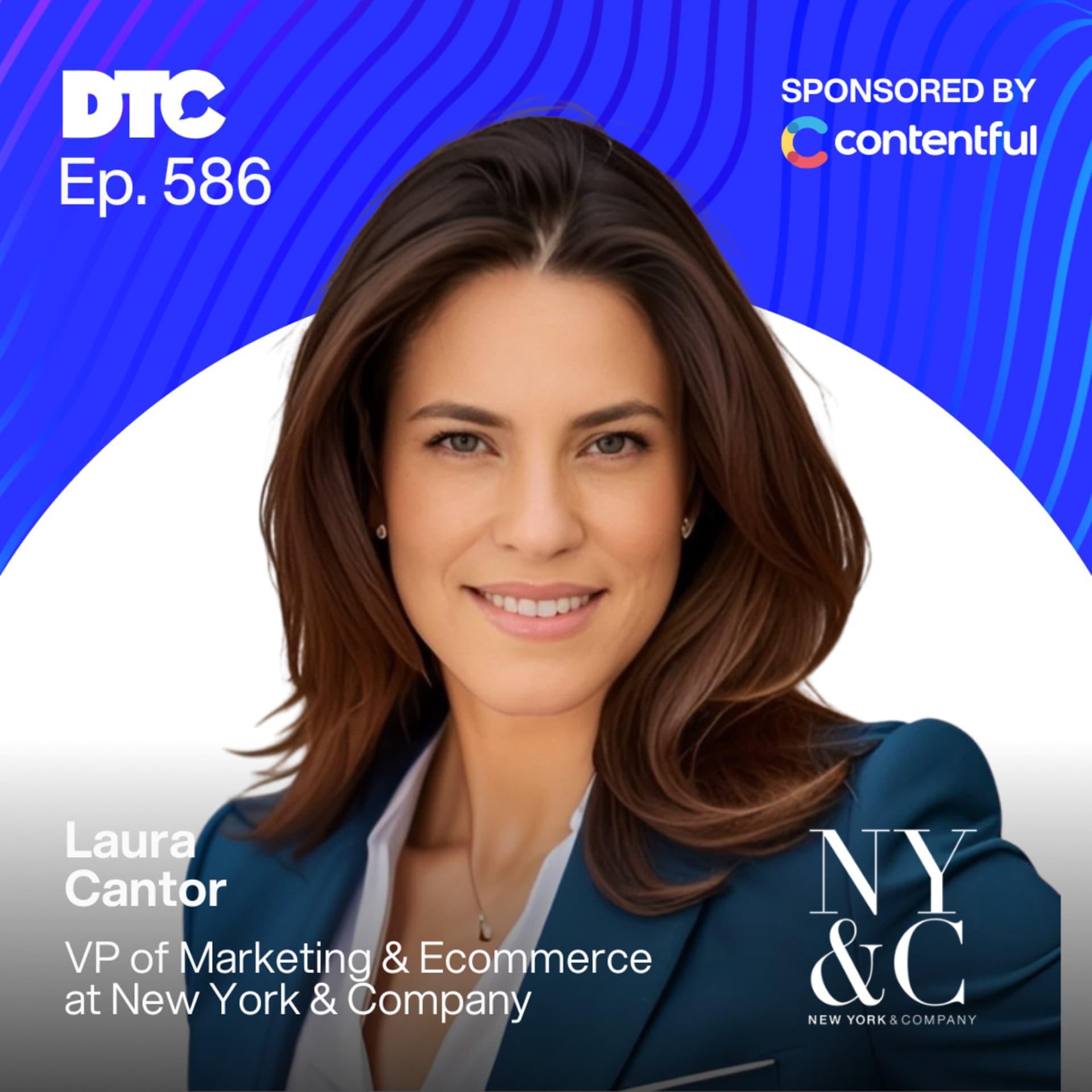
DTC Podcast Episode Summary: Ep 586 - Laura Cantor: Digital Transformation, AI Collaboration, and Why We're All Failing Calculus Together
Podcast Overview
- Podcast Title: DTC Podcast
- Description: Discussions with disruptive direct-to-consumer ecommerce brands focused on marketing, funnels, and scaling insights.
Episode Details
- Host: Eric Dick
- Guest: Laura Cantor, VP of Marketing & E-commerce at New York & Company
- Air Date: Not specified
- Episode URL: [DTC Podcast Episode](https://dtcnews.link/signup)
Episode Themes Digital Transformation
- Laura is leading a significant digital transformation at New York & Company, transitioning from a legacy retail brand to an AI-driven commerce platform.
- She emphasizes the importance of collaboration and community learning as the industry navigates complex challenges.
Key Challenges and Adaptations
- Resource Limitations: Laura discusses how limited resources can create unique opportunities for innovation and risk-taking.
- Iterative Problem-Solving: The necessity of rapid decision-making and iterative improvements rather than waiting for perfect solutions.
AI's Dual Role
- Problem Solver and Creator: AI contributes both solutions and complexities in site management (e.g., quality assurance challenges).
- Laura mentions utilizing AI to identify over 500 issues on their website, showcasing the importance of effective QA processes.
Shift in E-commerce Strategy
- A notable transition from Shopify Hydrogen to Liquid for better integration and simplicity just before Black Friday.
- The decision was motivated by the need for faster, more efficient operations while leveraging the Shopify ecosystem.
Collaborative vs. Competitive Mindset
- A shift from competitive practices to partnerships within the retail space, focusing on shared learning and growth.
- The importance of adaptability (AQ - Adaptability Quotient) as a critical skill for success in the evolving retail landscape.
Key Takeaways
- Simplicity in Complexity: The episode discusses the value of simplifying complex processes and problems in e-commerce and AI integration.
- Community Building: Emphasizes the need for networking and learning from peers to navigate the challenges of digital transformation.
- The Role of AI: Explores the duality of AI as both a source of issues and a tool for resolution, highlighting its pervasive impact on retail.
- Future Retail Trends: Insights into upcoming retail dynamics and the evolving relationship between brands and their audiences.
Important Concepts
- Adaptability Quotient (AQ): A crucial metric reflecting a person’s ability to adapt and unlearn old ways in a rapidly changing environment.
- Collaborative Innovation: The idea that partnerships now outweigh competition in driving innovation and solutions within the retail sector.
Episode Structure Timestamps
- 0:00 - Intro
- 1:30 - Laura's Retail Background
- 2:10 - Digital Transformation Journey
- 4:40 - Challenges of Doing More with Less
- 8:15 - AI's Role in Quality Assurance
- 15:50 - Transition from Hydrogen to Liquid
- 21:10 - Post Resonating Across the Industry
- 28:30 - Importance of Partnerships
- 33:00 - Agile Team Adoption of AI Tools
- 36:35 - Failing Calculus Together
- 39:00 - Understanding Adaptability Quotient
- 44:50 - Power of Clarity in Communication
- 52:30 - Retail as a People Business
- 55:45 - Upcoming Events
Conclusion This episode of the DTC Podcast offers valuable insights into the ongoing digital transformation within retail, highlighting the importance of adaptability, collaboration, and the effective use of AI in overcoming challenges. Laura Cantor's experience provides a roadmap for other brands navigating similar transitions, showcasing the power of community and shared learning in the fast-paced world of e-commerce.
Written by AI. May contain mistakes. Listen to the episode to check what was said.
Chapters
Tap a time to open that second in VOThe Complexity of Simplification
0:44 to 1:26
Discussion on the importance of simplification in digital marketing and AI.
“If you can simplify something and like even just name the problem for what it is, you're going to resonate.”
Laura's Transition to E-Commerce
2:30 to 4:40
Laura discusses her journey at New York & Company and the transition to full e-commerce.
“Those are two of my favorite brands, two of the best apparel brands in America, in North America, Ralph Lauren and J.Crew.”
Challenges and Opportunities in Retail
4:40 to 6:59
Laura shares the challenges faced during the retail transformation and how they turned into opportunities.
“I think it's easy to get caught in your head on coming up with something perfect and then letting inaction kind of take over.”
AI Tools and Quality Assurance
6:59 to 8:22
The discussion focuses on the use of AI for website quality assurance and problem-solving.
“So it's not, there's a lot of problems on every one site.”
The Shift from Shopify Hydrogen to Liquid
8:22 to 10:46
Laura explains why New York & Company moved back to Liquid from Shopify Hydrogen.
“So it was just old and it takes a lot of maintenance.”
Performance Post-Transition
10:46 to 12:06
Insights on performance changes after the switch from Hydrogen back to Liquid.
“It took very little resources or less than we expected to make that happen quickly.”
Driving Growth at New York & Co
12:06 to 14:03
Discussion on the strategies used for driving growth in the e-commerce space.
“the bio if anyone wants to check it out.”
Challenges in E-commerce Scale
14:03 to 14:39
Discusses the difficulties of achieving operational scale in e-commerce.
“You get a lot of fatigue and it's hard to let someone own this too.”
Growth Drivers at New York & Co.
14:39 to 15:29
Explores the growth strategies employed by New York & Co. in the e-commerce space.
“Originally, New York & Co was a retail giant.”
Enhancing Customer Experience with Technology
15:29 to 16:48
Examines how technology and data integration improve customer shopping experiences.
“But I think growth for us shows up now or even like brand in the types of tools and experiences that she has on site that elevate that shopping experience.”
Show all 27 chapters
Innovating Loyalty Programs
16:48 to 18:37
Describes the introduction and impact of a new loyalty program at New York & Co.
“this great offer or I can get it quickly, or maybe there's a discount involved.”
Acquisition Strategies and Customer Retention
18:37 to 19:25
Details strategies for customer acquisition and retention amidst reduced media spend.
“You're spending a little bit less on the top of funnel, focusing more on retention.”
Viral LinkedIn Post Insights
19:25 to 20:41
Discusses the unexpected virality of a LinkedIn post and its implications.
“thousands of likes on this post about the move from hydrogen back to liquid.”
The Shift Towards Media-Centric Brands
20:41 to 22:46
Explores the transformation of brands into media companies and the role of partnerships.
“Like, I don't know about you, I don't typically save a lot of content on LinkedIn.”
Navigating AI Complexity and Vendor Relationships
22:46 to 25:11
Analyzes the challenges of communicating AI solutions and fostering vendor partnerships.
“It's not about like maybe there was some friction between partners and the buy side of the brand side previously or some competitiveness.”
Effective Use of AI in E-commerce Operations
25:11 to 28:00
Highlights the practical applications of AI in solving operational problems in e-commerce.
“So working together with a vendor to spread their message is always another tool in the toolbox to facilitate that as well.”
The Rise of AI in Business
28:00 to 29:12
Discover how AI is transforming work efficiency and organizational dynamics.
“and themes that we're seeing for this year, because that 12 second video, right?”
Empowerment and Decentralization in AI Adoption
29:12 to 31:09
Learn about the decentralized approach to AI tools and the benefits of empowerment in teams.
“So that's definitely had to spark the hunger for that.”
The Need for Adaptability in the Workplace
31:09 to 33:37
Understand the importance of adaptability in navigating the changing landscape of AI and business.
“But again, like the idea was like, it was really an off the cuff post, honestly.”
Defining Adaptability Quotient (AQ)
33:37 to 34:32
Explore the concept of AQ and its significance in today’s fast-paced environment.
“Well, that brings like the third phase is that, you know, if everything is created on the back end by AI, then everything is checked and dealt with like what a human would manually do with AI.”
The Importance of Early Adaptation and Networking
34:32 to 36:29
Discuss the need for early adoption of ideas and the value of networking in professional growth.
“And that like another thing with this post maybe was just like, we don't know shit.”
The Role of Human Connection in the Age of AI
36:29 to 39:27
Examine how AI can enhance, rather than replace, human connections in business.
“We ended up sitting next to each other after this viral post.”
Building Connections and Community in Retail
42:01 to 43:31
Learn how personal relationships and community drive success in retail.
“And this is the kind of relationships that are built brick by brick.”
The Landscape of E-commerce Challenges
43:31 to 45:28
Explore the complexities and strategies of growing in the e-commerce sector.
“And my friend Brock, who runs FrostBuddy, was talking to me the other day.”
Inspiration Amidst Economic Challenges
45:28 to 46:57
Discover the potential for growth and inspiration in today's economy.
“And that, you know, if you have the spirit of an entrepreneur inside of you, here's your tool and go.”
Consumption and Human Connection
46:57 to 49:21
Understand the role of consumption in human experience and connection.
“We did our first one in Vancouver last week.”
Upcoming Events and Key Industry Trends
49:21 to 50:33
Get insights on major events and trends in the retail and e-commerce industry.
“I'm glad that LinkedIn brought us together for this great chat today.”
Transcript
Automatic transcript. May contain errors.0:00Laura Cantor:Hello and welcome to the DTC podcast. I'm Eric Dick. Today's conversation is with Laura Cantor, VP of Marketing and E-Commerce at New York & Company. Laura's leading one of the most interesting digital transformations in retail right now, turning a legacy mall brand into a fast-moving AI-powered operation. And she's doing it by building in public and learning alongside the entire retail community on LinkedIn. We dig into why she moved from Shopify Hydrogen back to Liquid right before Black Friday, how AI tools are everywhere but clarity is scarce, and why the skill that matters most now is adaptability, your ability to unlearn as fast as you learn.
0:34Laura Cantor:This one's about transformation, collaboration, and why we're all in one giant study group trying to figure this all out together. Let's get into it and on with the show. Simplification. Everything is so complex. If you can simplify something and like even just name the problem for what it is, you're going to resonate. We're all failing the calculus class together. We are, this is AI. We are in one giant study group. The task at hand is so technically challenging. It's strategy. It's brand. It's touch points. It's really analytical. It's data. You're going to need an army of people to support your learnings, to give you that confidence to go forward and test anything.
1:26Laura Cantor:This episode is brought to you by Contentful. Marketers, you know that feeling when your creative clicks, when that social post sends engagement through the roof, when your outside-of-the-box campaign hits ROI positive, when a personalized homepage turns prospects into customers? It's utter marketing bliss. Contentful helps you create tailored omni-channel experiences without working overtime. No stress, no limits, only possibilities. Get the feels. at contentful.com. Welcome to the podcast, Laura Cantor. I came across your post on LinkedIn about some really interesting stuff you were doing with your website and just kind of really became enamored with your story.
2:10Laura Cantor:You're the VP of marketing and e-commerce at New York and company. You're leading one of the boldest digital transformations in retail right now, turning a well-known mall brand into a fast-moving AI-powered commerce layer. You came up through Ralph Lauren and J.Crew, and you were also named to the Direct 60 list for reshaping how legacy brands go to market. Maybe start with a little bit of your background. Those are two of my favorite brands, two of the best apparel brands in America, in North America, Ralph Lauren and J.Crew. Talk about how what you're doing at New York and Company has been influenced by your retail background.
2:42Yeah, well, I've been in retail and specifically apparel my whole career. And those are some strong brands to start with, for sure. However, when I worked there, it has relatively little to do with what I do now. But the DNA and the ethos of what it is to be a brand, what it is to understand just the apparel vertical itself was a great foundation.
3:08Laura Cantor:Talk to me about what you were brought in to do at New York and Cohen. And what inspired this pivot from legacy retail into full e-commerce? Sure. Yeah. New York & Company was bought and moved all D2C. I came in slightly after that change to work on growth, particularly, and then ended up doing the full funnel, all the retention, all the CRM, and then pivoting to site experience. So it's really the whole experience is tied more closely together than ever before. We're really a agile flat team. We're not as siloed. So we're heavily integrated where we weren't before. So that's been a really interesting pivot living through that.
3:52I think we're a little early to that move before other brands. And we have a lot of stories to tell about that experience.
4:01Laura Cantor:What's been the most challenging thing so far about this transition? Challenging? I mean, everything is really a challenge, but I do believe that all the problems are really the opportunities. The problem of not having enough resources or budget always lead to being able to adopt things first or trying things out of the box, where if you have everything perfectly going in the first place, you're less likely to take risks, to try things differently. And today's market and environment really call for rapid change and complex problems to be solved in new ways. So it actually served as an opportunity rather than a problem, every challenge that we faced.
4:44Laura Cantor:I think one of the things I've noticed about your approach is just, and it's something we talk about at D2C all the time, like is, you know, when you're building an e-commerce or a digital business, your ability to just sort of ship iterations. I think it's easy to get caught in your head on coming up with something perfect and then letting inaction kind of take over. And I feel like you're pretty good at making decisive iterative changes on the fly. Yeah, I think it's more about focusing on what needs to be solved now. Maybe in the past or recent past, it's like what tool or what strategy will inform our next year's sales or five-year sales.
5:22And that's the lever that we need to pull. but it's really looking at what are the problems we have today and how do we solve those most efficiently, most successfully right now.
5:34Laura Cantor:Give me an example of a problem that you've solved at New York and Company and your tenure there. Yeah, it was actually something that I think brought us together on this podcast is I spoke about it on LinkedIn and I had a post that went absolutely nuclear and we got in each other's radar and here I am today. And one of those problems was the QAing of our site and how complex that's become in an environment where so much of what we produce on the back end is through AI. So text, images, you know, sometimes it's another people's translations. So much is automated where it used to be manual. So we have a lot of data that's created by AI coming in, but we don't have the ability to use AI to check and QA that data.
6:23That's still a manual process. And when you aren't Walmart and you don't have all the money and resources in the world, what do you do to solve the scaling that's happening because of AI on the back end and make sure that it's not creating any bottlenecks or problems for customers when you can't have visibility to lots of pages, lots of SKUs, and lots of different things that are being created by AI on the site.
6:50Laura Cantor:AI is both the creation of and solution to so many of our problems because you went and used AI to Q &A 500 micro issues. Talk about that a little bit. So we piloted this platform and it is really an agentic AI that shops your site and it quantifies the value of what those problems are and structures those in an order and priority that tells you this is what you need to focus on for the maximum impact. So it's not, there's a lot of problems on every one site. That's not unusual, but, you know, we had moved from hydrogen to liquid. We came out with a brand new site. So there was, you know, extra things to check, more considerations than normal.
7:34And of course we found, I think over 500 problems on the live site that we had zero visibility to.
7:42Laura Cantor:Talk to me a little bit. I think for people that I get accused by my family members who listen to this podcast of not explaining things well enough because it's a business to business podcast. But talk to me a little bit about the decision to move from Shopify Hydrogen, which is a React based headless version of Shopify from the liquid, the traditional theme on why did you guys make that change? Yeah, I've been asked this a lot. It's probably the one of the reasons this post went viral is because I started off saying that that term and it is quite controversial you know i was surprised some people don't know what headless really even is at this point because it seems to have been popular maybe like five years ago and has you know certainly lots of sites run on headless and it's you know i have nothing against it either it has a lot of reasons and positives for particular circumstances right what i don't think people realize this i new york company was the first headless store on job 5 or one of When we had experienced sort of a depreciation of like Headless 1.0 and worked with some of the top agencies that really needed to support a Headless site, which we were doing this all internally, they went into our code repository and like shop if I wrote this code.
8:57So it was just old and it takes a lot of maintenance. So you need a lot of extra considerations in terms of integrations. Like number one, like anyone who's on a headless site takes a lot longer. And that's fine if you have the resources. But as we, you know, pared down and became more efficient, we didn't have access to as many resources. And it takes a lot of learning to have to keep up with the technology for headless because it's changing. So we wanted to be quicker in what we did. and we wanted to integrate better into the Shopify ecosystem. There's, you know, one of the advantages of being on Shopify is you have the integrations at your fingertips and not being able to use that became more of a problem than the benefits of what hydrogen provided.
9:43Laura Cantor:How did the transition go? You did this right before Black Friday, which was another key part of your viral post. Yeah, people say it could take six months to transition. I think our site had been particularly broken to the point of where it sometimes wouldn't function, that it needed to get done very quickly. And liquid isn't that hard to work with. It's actually pretty easy. So in an enterprise environment, this really scares a lot of people. Oh my gosh, we're going to be re-platforming essentially. But you have to keep in mind the context that it's re-platformed to something that's much less complex and is almost out of the box, right?
10:23There's Horizon that's almost like a headless environment to the extent of speed and customization. So, you know, that didn't exist prior. Shopify has made a lot of changes before our site launched in about 2021. And it was easy. It wasn't hard at all. It was actually really easy. We did a lot of customizations. There's so many sites out there for great inspiration. It took very little resources or less than we expected to make that happen quickly.
10:51Laura Cantor:And how have the results been? Have you seen any sort of drop or increase in performance after the switch back to liquid? Yeah, the site's been a lot faster. It does have that snappy quality that we were on headless in the first place, right? So it is, you know, at risk for needing some support that you may not need with hydrogen. But to now, I mean, it's not very heavy. A new site is always going to be fresh. You know, we took some video assets off, we did pare down and so much of that speed issue that we're having too is also, you know, GTM codes and depreciated apps and other things hanging out that we cleaned up.
11:27So I feel that, you know, it's a better customer experience. We have much more integrations and tools that, you know, serve our customers. And if we want to start a new tool or stop a new tool, or we have an idea, you know, there's so much great conversion tools out there that we're using, we can quickly adopt and test where this would be impossible on hydrogen.
11:54Laura Cantor:I want to dive into a few of the most impactful tools, but the one you alluded to originally in this conversation was the AIQA tool, where you found 500 micro issues on the website. What tool was that? It was Zent. So Zent AI, and hopefully we can put a link in the bio if anyone wants to check it out. You get a free audit of your site, which I think is really cool. So you don't even have to sign up. You can do this on your site without signing up, talking to anyone or paying any money. So that's a low lift offer that I think they just have. So that's exciting. And then when we did use the tool, certainly got more granular in respect to the different types of agents we could try because it's checkout, it's discoverability and SEO.
12:37It's beyond just UX and, you know, copy mistakes or whatnot. But those copy mistakes and photo mismatching and meta, you know, meta fields being wrong, we know that those affected people from making purchase decisions. When they see a skirt that says pockets and then there's no pockets in the photo, you know, some of the AI does create this issue, right, where, you know, it doesn't show exactly what the description shows. Those were very confusing to a customer. So, you know, there were a lot of them.
13:10Laura Cantor:They're just trust breakers, right? And you never know. Conversion busting. Total conversion busting. And if you see more than one of them, it's going to accrue, you know, and even one of them can be enough to send you away. So can if your page loads a little bit slow, which so you had all those things. Same thing. Exactly. It's all these little things. And these are particularly customer facing. And we're not on the PDP, like shopping, you know, looking through this and considering something for purchase typically, right? We're on there visually, it is everything there, right? Is the format I'm testing for format or color of button or placement of text, not necessarily the context of what a shopper is saying, hmm, I'd like this, should I buy it?
13:49Laura Cantor:You had a point here about it. It's like seeing your site through your customer's eyes for the first time. Because you see things all the time and it's so easy to like look over things or to assume something is right. But customers come at it so natively that, you know, I think having a tool that allows you to see things with fresh eyes obviously makes a lot of sense. Yes. You get a lot of fatigue and it's hard to let someone own this too. Whose responsibility really is this? Because it's almost impossible to achieve at scale. We're dropping a thousand SKUs, you know, just getting product to site quickly has been another key advantage that we have, but that also allows the, you know, testing or just making sure everything was done correctly, like almost impossible.
14:27So this is really, really helpful in reducing that, you know, that need entirely and just going back after the fact and fixing those, those issues.
14:38Laura Cantor:Super cool. Talk to me a little bit about growth. Originally, New York & Co was a retail giant. So it has the footprint that people are used to, the brand that has been established. You come in to help move things all fully over to e-commerce. What's been the big driver? Has Has it been retention from people that are aware of the New York & Co brand? Is it Facebook ads? What are you driving growth with? Yeah, originally, we had a very healthy paid media program and did really well. We have a lot of advantages of being a legacy brand, a well-known name, and a large customer file and list and CRM list.
15:15So those things all play into the fact that we can focus on what's happening on site experience and retention very well without some of the considerations that other brands might need to drive more top of mind relevance, right? We don't have that as much. But I think growth for us shows up now or even like brand in the types of tools and experiences that she has on site that elevate that shopping experience. Obviously, products is always going to be at the center of everything. But what can we do outside of the product and value that we offer to establish trust, to increase conversion? And a lot of that has to do with the technology.
15:55And so much of it is now centered around AI.
15:58Laura Cantor:Give me an example. Are you using like Recart or things like that where you're increasing your AOV through some of these tools? I think there's been a lot of consolidation around the whole stack of things that are needed to your site. You see this in platforms that are taking over a lot of things that have been cherry picked before. But I see it mainly as anything that has to do with the data that's being ingested from actions being taken on the site, whether some type of messaging needs to pop up to save a card or an abandonment, whether or not there's some social proof on your PDP or PLPs, and you know, offering different things for first-time customers, first-return customers.
16:44And a lot of it has to do around shipping and getting that person at the cart to, you know, say, hey, I'm getting this great offer or I can get it quickly, or maybe there's a discount involved. Then what does that experience look like after the fact, right? The post-purchase experience as well to just create that customer second purchase, which is just elusive and has been really tough and challenging for that's not us as a brand. I think that's every brand.
17:12Laura Cantor:Well, one of the things you've done to combat that is your VIP segment, where it sounds like you've got really great repeat rates and you're doing some different things there. You're not, it's not just like, it's not an out of the box solution. You're doing innovative things with your loyalty program. Can you talk about that a little bit? Yeah, we just introduced a loyalty program. We never had one before. We had a hard issue being so large with understanding like the real economics around the loyalty program. And finally, we were able to get to the point. The tools also improved and we were able to launch on Liquid, which was also helpful.
17:47And yeah, it's been great. It definitely promotes a sort of segment that's more loyal or reason to come back and shop. And then also the acquisition efforts through referrals is super important to us, given, you know, we have reduced media spend for a company of our size. and, you know, there's not much new to say about loyalty. It should, you know, for us now, it's more of like a, yeah, we have a loyalty program and we, you know, have it in our Klaviyo and we've surfaced points and reasons to shop all the time with it. But I wouldn't say that's our key level of growth. That is just, I think, necessary, like spoke in the wheel to support, right?
18:28Reprook purchases.
18:29Laura Cantor:So what would be the main lever? Because I know, because I think I have some notes here. You're sort of like, you've actually, lowered the meta spend, for instance. You're spending a little bit less on the top of funnel, focusing more on retention. So what's been the biggest needle mover there? Yeah, we do a lot of acquisition through organic efforts, through CRM, through pop-ups, through social media, and again, referrals, and keeping that list really healthy and fresh. We have a really phenomenal CRM program with the loyalty built into it. And that does drive primarily a lot of the revenue. Now, yes, we have larger direct traffic than a typical brand, so we benefit from that.
19:09But because we have less media spend currently, that won't be forever, it forces us to just tend to that side of the business with a lot more focus than just dumping new customers into the funnel.
19:24Laura Cantor:I want to just go back to the post that connected us here. thousands of likes on this post about the move from hydrogen back to liquid. Why do you think this post caught the fire that it did? Well, let me just tell more about the post first, because I didn't have that many followers on LinkedIn, you know, had a healthy, healthy amount, let's say, you know, a couple thousand. And I have been in the DTC world almost 20 years and have had all iterations being on the brand side, being a brand owner, an agency owner. So I have, you know, I certainly have a lot of vendors, but, you know, I have, you know, I attend a lot of events.
20:02I have a lot of great first connections, but this post really resonated to the larger retail ecosystem in a way that was completely not predictable at all. So that was very much of just a shock in a way, because it really reached, you know, every single D2C brand that's really relevant and extended beyond to, like, huge enterprises to the likes of, like, the Altas and Starbucks and Nikes of the world. So to have something resonate between that difference of scale is pretty, like, something's going on, right? It had over 900 saves. Like, I don't know about you, I don't typically save a lot of content on LinkedIn.
20:47It was shared by the head of fashion at TikTok. And that was just the people on the post. There were hundreds of comments that I received in my inbox from people, maybe are lurkers, which I sometimes do too. I don't want to comment or engage, begging me to tell them about what I was doing and what this tool was about. Almost to the point of like, if you don't send this to me right now, I'm going to come find you. That's wow.
21:13Laura Cantor:So your career as a tech influencer was really launched with this post. Yeah. And I wouldn't call it a career per se, but it showed me a couple of things that are really relevant for some themes that are colliding in the retail world in general. I think a lot of them make sense in the context of what we saw coming out of NRF. We do see brands becoming more like media companies, right? You have key hires that, you know, are more about entertainment and owned media than, you know, we're talking about the things that we did to, you know, advertise, right? It's a different mindset. And I wonder if, you know, inside of a company as an employee, we are also being tasked to somewhat be a media channel per se.
22:01And there's a several types of reasons for that, but it does, there is an alignment there about how we're attracting new customers and how we are amplifying either A, our brand's message, our own message as employees or professionals, and the partnerships that we have that have become so important. Another key element at NRF is partnership. Partnership is everywhere because complexity around AI is so hard to not only like understand and learn just to explain so much of it is verbiage. And, you know, vendors speak robot, right? So we really need partners to grow now. There was an event that was all about partnerships and honoring these partnerships.
Read the full transcript
22:47It's not about like maybe there was some friction between partners and the buy side of the brand side previously or some competitiveness. Now it's more like we learn and grow together and depend on each other. So I would say talking about your partners on a post might have been like, you wouldn't want to say that, right? A year ago, you don't want to give away your business advantage. But now we are all partners in this together. We have really no other choice. We learn from people and we get, as an employee or an advocate of my brand, I get benefits by signaling that I'm ahead of the game. This is who I'm working with.
23:28These are what I'm doing. Come follow me. Come understand and we learn together. And just as I put my knowledge out there, I've learned so much from other people also as my peers in the industry.
23:40Laura Cantor:Super relevant. And it's literally what we've done here at D2C and our agency, Pilot House, right? We created a media company to talk about the space, to talk about e-commerce, to talk about performance marketing. And then we intersect with Pilot House in all these ways. And by the time someone reads our newsletter five times, they're like, oh, I should take a meeting with Pilot House. I think it's really exemplary for other brands to look at. I look at all the other brands that are mastering channels, whether it's TikTok shops, you know, figuring out the content that resonates with your audience.
24:06Laura Cantor:And it doesn't have to always be about your product. It can be tertiary or sort of run alongside your product like a lifestyle. So with these sort of topics, this idea of creating media for a brand and creating stick-to-itiveness, how are you translating that into what you're doing at New York & Co.? I think I get a lot of benefits from being heard and speaking about the particular challenges that we're facing. It's not enough to just work alone and not talk about what those challenges are and how you're fixing that. I think it's really important that we share more about some of the things that we're going through so that we can get access, whether it's beta-ing something that's new, a new tool comes along.
24:50I'm now connected to you and other people. Likewise, my network grows. I actually become a more valuable employee and professional. And I bring a lot of value to my company by amplifying what we're doing. So I think price is always a consideration working with vendors. I think it's really a lot of people are looking to save. So working together with a vendor to spread their message is always another tool in the toolbox to facilitate that as well.
25:21Laura Cantor:So did you speak at NRF? I didn't speak at NRF. It's a very large conference and it is really a retail conference. I particularly speak at places that are more focused just on D2C, which is my specialty, but I did go to some events and I heard a lot about what's happening. And the other key topic, well, the key topic is AI, eye, right? And agentic protocols and all the announcements that were made. And so that, you know, that again, further, I think why this post resonated even further was because, you know, when a vendor talks robot about their product, it is really hard to understand what it does today.
26:07Does it solve a problem? And I think we're at the point where everyone knows AI. Like last year, maybe we were just talking about it. It's like, this is coming or this is what's possible. And now people are like, okay, well, what does it actually do? What are the practical implications of this AI and how does it solve my problem today? We need more proof in order to, you know, apply it. We're done talking in the future. And I think vendors still talk that speak. They still talk it like this product, you know, can do X, Y, and Z and all these amazing things. And it really goes over the buy side head, right?
26:44Because they're like, well, I'm literally here, hands-on keys in the weeds, solving my problems every day. And so when I spoke about, you know, a tool that I was using, it wasn't about what it could do or what's possible. It was like, this is the application I used it for, and this is how it solved my problem. And I think that's why it was like, it was heard in a new way.
27:05Laura Cantor:And I think the video, I'm just on the post right now, and I'll make sure I link to it in the show notes, the video or the gif that you attach that literally shows agents testing all aspects of your site and color matching various things. It really just gets the idea home right away. I had a guy, I worked in a previous business and I had a guy that was trying to teach me how to make LinkedIn posts that go viral because it's like the platform itself is hungry for content. But it's so easy to put out blah content. I think with yours, it's like because it solves a problem, because it's written well, it's of who you are and I think the brand that you're with as well, like the fact that you're leading this digital transformation and it starts with a confession.
27:46Laura Cantor:We did something a little nuts right before Black Friday, Cyber Monday. I'm just trying to, yeah, the anatomy of a post. I think everyone should go look at it because it's gone crazy. And again, none of that was really planned or really thought out. That's what makes it so shocking. And that's why it shows me a lot of indications of the kinds of things we're talking about and themes that we're seeing for this year, because that 12 second video, right? It's 12 seconds, has like almost like 30 days worth of watch times, like hours upon hours of watch time. So it shows you like there's definitely this interest in understanding like, oh, this is AI and I can use it today, right?
28:24I can go and figure out something that not only like maybe makes me look good as a, you know, a contributor, but also it like literally takes the pressure off because I'll repeat this because it's been said a million times, we're all being tasked to do more with less, right? So if that is the task at hand, you're going to be looking for not necessarily shortcuts, but any way possible that you don't have to upend your entire framework or get into a year's exploratory about some kind of tool that may or may not achieve something or other. You want something that you You can plug and play in correctly today and show up tomorrow at the meeting and be like, look, I found all these issues and then I'm continuously running this.
29:12So we're good. There's one less thing to worry about. So that's definitely had to spark the hunger for that.
29:18Laura Cantor:How do you handle it organizationally? Because it's such a decentralized movement. Any one of your employees could find a tool that could be a game changer. Do you guys think about it more as sort of a centralized organization where you test things very systematically through the core channels? Or is a lot of your team empowered to kind of go out and find things? We're really empowered. It's like the gateway drug with the AI. We started with AI content. It worked really well. So it's like, if that's going to work well, what else could work well? Now, we have a really great structure and framework and process that keeps us from overreaching ourselves or, you know, possibly going into like a harmful territory and taking away from the impact that we could be having.
30:05But it's one of the things I like about, you know, more agile organizations is, you know, there's less steps to hop through and more the timeframe is shortened. I think everyone will compile it and do things. We just have a shortened timeframe around it that makes it less of like a burden for somebody in the organization to champion something like and take, you know, full responsibility for something because there's just less pressure around it.
30:32Laura Cantor:I wonder also just back to your post, if it was the fact that you didn't actually share the company in the normal text, you use a hack where you ask people to ask for it, and then you give them below. And that just makes them comment. I wonder if that really helped fuel the algorithm as well. Yeah. And, you know, that was, that was, that was tragically hard to, to keep up with, but that completely unplanned, completely unplanned. It just was like, that makes most sense. Um, and then, you know, LinkedIn has like, they don't let you automate responses. There's a lot of things around LinkedIn that keep it from, you know, being able to do that.
31:08And that could have been part of the strategy there. But again, like the idea was like, it was really an off the cuff post, honestly. And, you know, put me in like a center of a conversation, you know, get to meet people way outside of my scope, certainly not famous by any means, but it allows me to get access that I think is really a differentiator in what it means to be a professional, it's just not enough to do your job. You need to have like a, I wouldn't call it personal brand that seems too light for what this is. It's some type of channel that you have that is almost like a safety net in a way too, for what's either a coming, what could happen.
32:00Yeah. Like a lifeline. Yes, absolutely. Because again, nothing is guaranteed and the changes we see now could be accelerated quite soon. We don't know what's happening with the agentic commerce. It's in play, but it's really hard to understand the forecasts around that and where brands may go. So I think of it more as like not trying to go viral or doing things to make things viral, but showing like the real, you know, being a little bit vulnerable, I think is better now, like then we're more accepted because you have to be like, we're all failing the calculus class. together. We are, this is AI.
32:40We are in one giant study group and it's not like we should or can necessarily hang out on our own Island and think that we're going to conquer these massive undertakings and shifts in, in the way that we do business. So.
32:58Laura Cantor:It's funny, my brother, actually, he just, this is news to the podcast, but he was just let go after nine and a half years at Shopify. But for the past year or the year before he was like, He was sort of telling me that the AI revolution was so aggressive at Shopify that there was like this grace period where people were getting their jobs done faster. They were being more productive. And that was great because they were looking great. But then the year flipped over and it was like, that's expected now. The performance gains that we're able to make on AI are getting like baked into the models.
33:28Laura Cantor:And so it's like it sort of really does behoove you to create a channel where you're both sending and receiving intelligence about AI, I guess, right? Well, that brings like the third phase is that, you know, if everything is created on the back end by AI, then everything is checked and dealt with like what a human would manually do with AI. Then where stands the person that used to do anything in the company, which, you know, as these things get more complex, I feel like this conversation has kind of flattened a little bit because, man, we need people to make these decisions. This is really, really hard to unpack, but I've heard also at NRF, another key theme was the idea of AQ, the ability, other than IQ, EQ.
34:19What is AQ? Hold on, you have to cut this part out. Adaptability quotient. I forget.
34:25Laura Cantor:Adaptability quotient. Okay, I like it. Okay. So that's another thing. Like what I've learned about it, it's like the ability to unlearn as quick as you learn. And that like another thing with this post maybe was just like, we don't know shit. We are struggling. Here's a tool. We got it up and running immediately. It solved a big problem really quickly for very little cost and very little work. That's an adaptability move, right? So that's like the ability to just try something different, to know what to try in the first place and then to get the next iteration, what that might look like so that we can repeat those wins over and over again.
35:06So that I think is a core skill for what will be needed moving forward.
35:13Laura Cantor:It's to almost forget the way that things have been done always when there are these new ways to do things. Yes, and to be open, you have to have a little bit of openness to some type of risks, yes, But being early is really important too. When I go to dinners or conferences and I hear brands that are definitely a little bit bigger or have larger, more complex organizational structures, what they talk about now is what I've been talking about 18 months ago, maybe 10 months ago, maybe six months ago. And it worries me because we've already been through that arc, right? We've already made those mistakes and already learned those learnings and have applied them.
35:55And you're just now questioning whether you should be doing this or not doing this. And that question might circle around for another few months. And that is also where that AQ might need to come into play is we're going to need people who could come in organizations and take on that feedback loop and shorten it up a bit.
36:18Laura Cantor:Are you planning your next post or are there other tools? Well, this is going to be one of my next posts. So that's the, I wanted to bring this up. I went to a dinner with the vendor that, you know, I spoke about Zent, Arthur Pentecoste, he's the founder and it was also not planned. We ended up sitting next to each other after this viral post. Can you believe that? That's wild. Someone who had commented on the post was there too. And he's the head of digital at a very, very well-known brand. And I'm friendly with him. And so, you know, he was like, yes, I know you because of Laura's post. And he said, no, we talked, you know, about six months ago.
36:57He's like, I had a call with you and I had no idea what your company did. And he's like, when I saw Laura's post and immediately understood what you did and then called you up and we had a second demo. And then they ended up buying the Zent product and have consider it one of the key initiatives that have driven growth over the last few months. That's why the post went viral is because I do think one other theme, and this is not coming out of NRF, this is coming out of me. And I do a lot of calls with vendors and work very closely with vendors. That's part of a job scope now is really understanding the vendor ecosystem is simplification.
37:39Everything is so complex. If you can simplify something and like even just name the problem for what it is, you're just going to resonate. And I don't, and it's very, it's going to be very, very hard as new AI products come out. It's going, like there might be a giant disconnect between what tools can actually do and what people knowing that that can solve their problems. So that was a pure example like that I got firsthand and that, that happened last night. So.
38:06Laura Cantor:Are you taking any commission? You need to get, you need to get on this, you need to get on the Zenit payroll. You know, another lever in growing your career, just as we grow an e-commerce site is giving back and supporting people and bringing people with you as you grow, you know? So I do like to support people that are doing great things. It brings me more tools and more great things and more connections. And I, yeah, I do think there are additional revenue streams for employees, you know, as I don't know, very few people are getting great raises or bonuses, you know, just to have a job is like a bonus, right?
38:42So I had my own brand, I had my own agency. So I have a more enterprising approach to having a career than a normal person maybe who's maybe taken all those steps and risen the ranks. That's another reason I post on LinkedIn and do podcasts. I didn't have formal executive training, how to present and talk and show what I do. I just do it. And I didn't really have anyone to answer to. And this position, this was stage of my career, which I love. I really do love being in an organization because I feel so impactful. And that really drives the enthusiasm and the will to continue to break through and get results.
39:25I think there is a way for, you know, people and B2B and vendors and SaaS and all of us to benefit off each other, whether it's monetarily, whether it's networking, whether it's, you know, when, you know, you need a job, a vendor will be the first person to step in and say, who do you need? I know everybody, you know?
39:47Laura Cantor:And as you say, with Zent, you know, It's solving a problem that was maybe created by AI because you have all these images, you have all these things that are out there, and then it also becomes the solution to the problem, which is really cool that maybe even a lot of people don't even know they have. That's the other part of it. Someone reading that post might be like, oh, my God, do I have 500 plus mistakes? Yes. It's embarrassing. It's all the embarrassing stuff. You don't want to admit that you misspelled the word turtleneck or something, and your customers are seeing that every day and thinking, who's working there?
40:16you know or I mean and to that extent like when we get into cleaning up our feeds getting discovered in chat and Gemini and whether when that becomes paid all those things are also going to need to be cleaned up anyways like the better alignment you have with your images and text and checkout and promo codes working and all those things you're going to have you know that much more leverage as the channel mix changes entirely.
40:47Laura Cantor:I love that also that the solution to like, because people worry with AI that we're, that will become less human or that it'll take the roles of humans. Hopefully it frees us up to do more human things. And what you're describing is humans connecting and staying connected. And that's one of the things that was one of the reasons we launched our agency community business was, you know, we wanted to focus on things that like bring people together. And I think that's really what posts on LinkedIn, especially when that go as viral as yours really do. Because it's like, now you get all these people like, hey, I tried that tool you tried.
41:15Laura Cantor:That was great. Here's a tool that I tried. They'll send that to you. You'll just have this ongoing dialogue of potentially thousands of people who are in this mastermind with you now based on that post. That's it. It's a people business now, right? Yeah. Have you noticed that there's so much more in-person things that happen post-COVID? A lot of people work from home, A. And even if you don't, you're going to need a group or an army, let's say, of people to support your learnings, to give you that confidence to go forward and test anything. There's too much at stake. Too much could go wrong. I need someone to open up their entire tech stack and tell me everything they're paying, right?
42:01And this is the kind of relationships that are built brick by brick. So the viral post was the first connections were all people that I literally have had dinner with, have been to my, these are, I've really worked on this and it wasn't intentional either. It was a necessity to get up to speed and to do things that get results, not just to play in the retail space and look nice and say, I checked off these boxes. But to really turn something around takes a lot of institutional knowledge that was a group project, 100%. And I think when the comments started rolling in from those first connections, it provided that, I guess, fire to let that LinkedIn algorithm throw it out to so many more people.
42:50We're talking hundreds of thousands of impressions. A QA agent isn't that deep. You go on LinkedIn and you see, I had this amazing epiphany in meditation or someone did something incredible. Or something super, super cringe. This was very boring. This was like, we have a QA tool. And yet it struck a chord with the pain that's going on right now. People trying to solve an impossible problem is how to grow when you have less. And it's almost like relearning everything that you used to know.
43:30Laura Cantor:It's funny. We've done events. We've done a bunch of events. And my friend Brock, who runs FrostBuddy, was talking to me the other day. And he was like, you know, I'm still in touch with four of the people who I went to that event with on like a weekly or monthly basis. They formed like just an impromptu like mastermind WhatsApp group or whatever. And it's just and it was actually the only event. I think he's been to a few now, but that was his first event he'd ever been to. And he got so much value out of it just through the human connections that you make. Like, I always wonder if other industries are the same as this.
43:56Laura Cantor:Like, do insurance salesmen, salespeople. I wonder that. Do they share hacks like this? Are they much of the rising tide raises all boats as we are? Because I feel lucky to be in an industry that is open to this. I'd like to say it's our industry because I really love that part. It's not like it's like a family, but it's kind of like your friends and your peers and your family. It's all mixed up in one. And I think that too, what is it like when you go to the banking conference or the gambling conference or the healthcare conferences? I think the task at hand is so technically challenging. It's strategy.
44:33It's brand. It's touch points. It's really analytical. It's data. It's lots and lots and lots of data, right? It's also, you know, somewhat like of a zeitgeist thing where luck comes into play, like something ticks off and suddenly you're the star, you know, viral product. You know, this isn't very predictable in a lot of ways, retail. It's a little bit of an art, a little bit of a science. And it's a small world too. Like it's not, maybe not as large as other industries as well. And it's fun. You have to admit, there's something more fun about e-commerce in particular, the G2Z environment. The fact that even 10 years ago, a challenger could come in or an incumbent and it could take over a large brand.
45:20And we saw that at the first leave, you know, that was the whole idea. And the premise of Shopify is that anyone can be a major brand or -
45:29Laura Cantor:Arm the rebels. Yes. And that, you know, if you have the spirit of an entrepreneur inside of you, here's your tool and go. And, you know, I did it too. And to see the results of that with your own eyes is so inspiring. And today it's even less of a barrier of entry because anyone can get distribution, photos, copy text, ads, even organic channels that didn't exist before and now chat. It's only amplified itself, yet it's become so much more complex. It used to be so much easier. You just set up a Facebook ad, set up your Shopify store, open your shingle and go. You just had to show up. Now I'm in it.
46:13I'm in the enterprise. I'm in the side where, whoa, these are hard, complex problems to solve. Who would ever want to start their own or go off on their own? Maybe I'll feel different in a year or two, but their opportunity is just so big still. Even though we've seen layoffs and tariffs and economy, like sensitivity and whatnot, I think there'll be the next round of gigantic wins within one to two years based on what's possible.
46:47Laura Cantor:I feel so grateful to be in this growth part of the economy in these challenging times. And I find everything you're saying very inspirational. That's why we're launching D2C Dines, which is our D2C dinner series. We did our first one in Vancouver last week. We're not announcing where we're coming yet, but it will be in New York. We'll be all over the place to join us for Adidas C Dine. So you can put that on your calendar as soon as I - Yes, definitely recommend it. I haven't been yet, but it sounds fantastic. And I'm sure you're great at knowing what topics and things to ask. And that's so important because those conversations are gold mine.
47:23And I do want to leave too with the thought that it's pretty depressing out there, despite all these changes, like I said, you know, I do fundamentally believe that humans, they do need to consume in some way, like to consume things is to be alive, is to grow. You know, that's what I've always been attracted to in apparel per se, is that you really can change who you are with your outfit. Sometimes I don't show that part of myself, but I do, You can be someone who you're not today with a change of that, your look, your feel. And I've always been attracted to that sentiment. And I'm just so curious to see how that works out in the next few years.
48:11So I'm really excited to be on this ride with you. And I really appreciate this time together.
48:17Laura Cantor:Yeah, me too. I always think of the children's book, Going on a Bear Hunt, when I think about humanity. because there's all these obstacles that they've got to contend with. And every time they come to a big obstacle, they say, can't go under it, got to go through it. And I feel like that's where humanity is right now. And I feel like humans go through things by consuming. So I feel like we've created this engine that involves consumption, that it isn't always pretty, but as an Iroquois shaman told me one time, we're right where we need to be. So it's hard to believe sometimes when you look at the news, but that's what I take heart in.
48:52Yes, and if we can turn these challenges and problems into our next opportunity, that's probably the first place to look is what's broken, what's not working? And is that the actual thing that we can solve? Like that, or not how to solve it, but that's the solution right there, right?
49:07Laura Cantor:And then make a LinkedIn post about it. And then make a LinkedIn post about it, let the world know. And then, you know, hopefully sometime when you need a little help, you come by a post or a friend and get it right back to you, so. Amazing. Well, I will keep my eyes peeled on your LinkedIn feed for your next viral post, as should everyone. I'm glad that LinkedIn brought us together for this great chat today. Thanks again. People, I guess I'll just put your LinkedIn link on this podcast. You know what, if you want to follow me, yes, please. I would love that. And I'd love, you know, I have and always was, you know, attracted to and get maybe technologies or ways of doing things that are a little earlier than, you know, you typically see.
49:49So I hope to be more of that voice and share my journey in a very challenging environment and be supportive to those around me who are literally helping. We're all helping each other as we go.
50:03Laura Cantor:Last question. You mentioned NROF. Are there any other big events on your calendar that you're excited about? Yeah. So I will be speaking about UX and merchandising, another key component to conversion, which is getting more and more important as costs of acquisition rise at E-Tail West, which is one of my favorite, favorite places to go in this industry. And it's also beautiful because it's in Palm Springs and it's a really great place to meet people. And then I think after comes Shop Talk, which is a can't miss opportunity. I'll be going there. I'll be at Shop Talk this year again. Shop Talk, that is a lot of fun.
50:44Laura Cantor:Vegas is just always fun. Vegas is really fun. And it's one big party and it's really great and you learn a lot. And again, get to connect with the peers and vendors that you don't always get to see. And then, you know, Commerce Next comes up in New York, always a great time. And the lead. So that's where I'll be in the coming months. And hopefully I catch you somewhere at a dinner or an event soon. Awesome. Thanks, Laura. This is great. Thanks, Eric. Appreciate it.
51:19Laura Cantor:Thanks so much for listening to today's episode. If you're not a subscriber to our newsletter, you can do that right now at directtoconsumeralloneword.co. I'm Eric Dick and this has been the D2C podcast. We'll see you next time.
From the publisher
Subscribe to DTC Newsletter - https://dtcnews.link/signup
Laura Cantor, VP of Marketing & E-commerce at New York & Company, shares the reality of transforming a legacy retail brand in the age of AI - and why nobody can do it alone.
In this episode:
🚀 Leading digital transformation at a legacy retail brand
🤖 Using to find 500+ site issues (and the problems AI creates) zenyt.ai/start
💻 Moving from Shopify Hydrogen to Liquid right before Black Friday
🤝 Why partnerships replaced competition in retail
🧠 AQ (Adaptability Quotient) - the skill that matters most
📱 Building in public and learning together
⚡ The reality of doing more with less in 2025
🎯 Why every problem now has 10 AI solutions (and nobody knows which works)
Key topics:
- The shift from headless back to Liquid (and why simplicity won)
- AI-powered site QA and the translation gap (zenyt.ai/start)
- Why collaboration beats secrecy in the AI era
- Post-COVID conference culture and community building
- Adaptability and unlearning in real-time
- NRF insights and retail trends for 2025
- The calculus class we're all failing together
Timestamps:
0:00 - Intro
1:30 - Laura's retail background (Ralph Lauren, J.Crew)
2:10 - New York & Company's digital transformation journey
4:40 - The biggest challenges: doing more with less
8:15 - AI creates problems AND solutions (the QA challenge)
15:50 - Why we moved from Hydrogen to Liquid
21:10 - The post that resonated across the industry
28:30 - Why partnerships matter more than competition now
33:00 - How agile teams adopt AI tools
36:35 - We're all failing calculus together
39:00 - Adaptability Quotient (AQ) - the new essential skill
44:50 - The power of clarity: translating robot to human
52:30 - Why retail is fundamentally a people business
55:45 - Upcoming events (eTail West, ShopTalk, Commerce Next)
Subscribe to DTC Newsletter - https://dtcnews.link/signup
Advertise on DTC - https://dtcnews.link/advertise
Work with Pilothouse - https://dtcnews.link/pilothouse
Follow us on Instagram & Twitter - @dtcnewsletter
Watch this interview on YouTube - https://dtcnews.link/video