In short
How Lexington Bakes cut CAC from ~$180 to ~$25 by redesigning product value perception (smaller but thicker 1.65 oz treats), expanding retail (200 stores), and launching first-time D2C “First Taste” variety/bundle offers with free shipping.
Guests
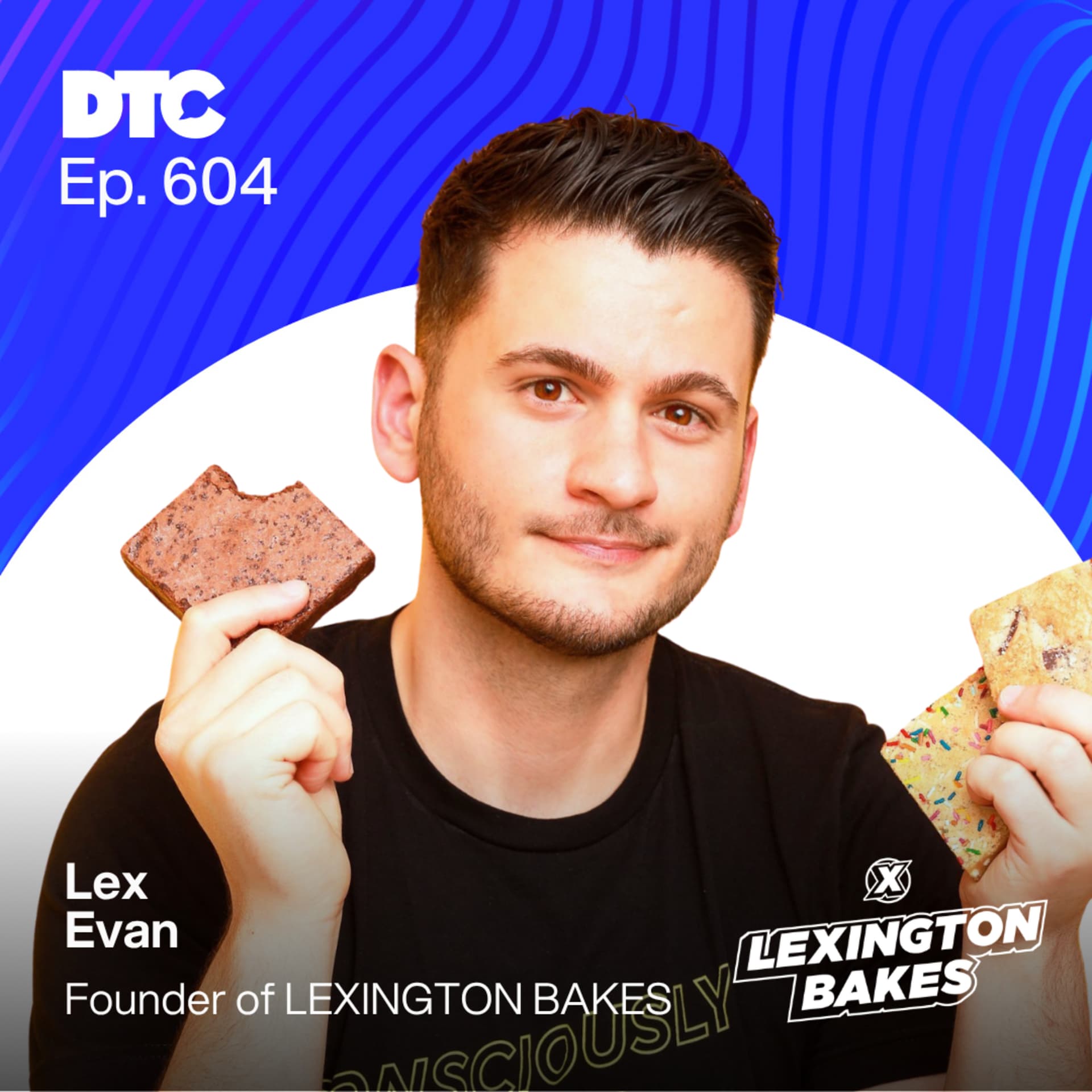
Lex (founder of Lexington Bakes). Background: 15 years in brand strategy/design (20 years total branding), taught herself baking via a KitchenAid; later built the bakery from scratch after moving NY→LA. Host: Eric (D2C podcast host; follows Lex on LinkedIn).
Key claims
Don’t use artificial preservatives; “fridge is our preservative,” products stored frozen. “Radical ingredient transparency” means listing exact ingredient brands/partners and extending ethics to suppliers. Self-manufacturing avoids “path of least resistance” from co-packers (including hidden processing-aid seed oils). Value-first packaging reduced shelf price confusion and improved conversion.
Notable examples
Pre-sold 500 brownies via Google form/Venmo in 5 days (2021). “Cosmic Forest” cookie renamed to “Berry Blackout” after poor retail performance; formula tweaked to be more protein. CAC drop driven by $19 six-pack variety (free shipping, break-even) and $49 three-pack bundle.
Written by AI. May contain mistakes. Listen to the episode to check what was said.
Chapters
Tap a time to open that second in VOThe Birth of Lexington Bakes
0:00 to 0:45
Learn how a passion for baking turned into a thriving business.
“In four, maybe five short weeks, I went from never working in a bakery to officially having my own bakery and shipping out 500 brownies across the country.”
From Hobby to Business
0:45 to 2:15
Discover the journey from baking for fun to starting a bakery.
“I've been following your antics for a while on LinkedIn.”
The Secret to Tasty Treats
2:15 to 4:15
Understand the importance of using quality, natural ingredients.
“And when you kind of take pride in sourcing really good ingredients and justifying what it means to bake with the best ingredients, you end up making something really special.”
Unexpected Demand for Brownies
4:15 to 6:45
Hear about the surprising response when shipping brownies became a reality.
“And we're only in the fridge in the grocery store.”
Navigating Manufacturing Challenges
6:45 to 9:00
Explore the hurdles of scaling a food business and maintaining quality.
“They're like, dude, we've tried yourself.”
Radical Ingredient Transparency
9:00 to 11:15
Learn about the commitment to transparency in sourcing ingredients.
“So there's trace amounts of seed oils in your products that don't have seed oils in the ingredient list.”
Evolving Standards in Ingredients
11:15 to 14:01
Discover how ingredient definitions and consumer expectations have changed.
“Why are they allowed to be mysterious about their sourcing?”
Evolution of Lexington Bakes' Product Line
14:01 to 16:50
Learn how Lexington Bakes evolved its product offerings to meet consumer demands.
“When I first started, it was really my way or that way.”
Adapting to Market Changes and Consumer Perception
16:51 to 20:14
Discover how market dynamics affected Lexington Bakes' pricing and product visibility.
“They had more cash from COVID where you weren't spending that much.”
Lowering Customer Acquisition Costs (CAC)
20:15 to 23:58
Explore the strategies taken to lower customer acquisition costs for Lexington Bakes.
“So I spent the last six months of 2025 understanding all of this and executing it.”
Show all 15 chapters
New Promotional Offers and Their Impact
23:59 to 27:59
Learn about new promotional strategies that improved sales and customer engagement.
“which is the first time we've ever done a variety pack.”
Understanding Retail Dynamics
28:00 to 30:00
Learn how retail behavior impacts customer engagement and product placement.
“that have no attention to detail on their ingredients.”
Analyzing Consumer Patterns
30:00 to 35:00
Explore the different buying patterns and preferences of consumers.
“Because like every time I'm grocery shopping, it's like, okay, am I getting a treat for this grocery shop?”
Naming and Marketing Strategy
35:00 to 40:00
Discover the challenges in naming products and how it affects market performance.
“product and realizing that it didn't quite meet the market the way you wanted to.”
Future Goals and Manufacturing Challenges
40:00 to 42:00
Hear about the goals for 2026 and the challenges faced with manufacturing.
“even if it does get acquired, I would want to stay on with whoever requires it and kind of continue building division and just have more help to build this global brand.”
Transcript
Automatic transcript. May contain errors.0:00In four, maybe five short weeks, I went from never working in a bakery to officially having my own bakery and shipping out 500 brownies across the country. I'm not going to compromise on how I bake. I'm not going to take the shortcuts and put additives to extend shelf life. I didn't want to make more of the same crap. So if I was going to do this, it was really going to be my own terms. We're leading with value, but still delivering experience. Once people try Lexington Bakes, it just clicks. Like, I understand the price. I understand the ingredients. I wasn't expecting it to be this good. Like, yeah, I'm hooked.
0:49Welcome to the D2C podcast, man. I've been following your antics for a while on LinkedIn. in. I feel like the plight of the grocery, the CPG founder is a very special plight within the D2C world. So I'm glad to have you on. Thank you. I'm excited to chat. Give me the rundown. What caused you to create Lexington Bakes? I didn't want to do it. So that's a good place to start. My background is in brand strategy, brand design. I had been doing that for about 15 years before I started Lexington Bakes. I still do that. So 20 years total branding. Along the way, I bought a KitchenAid mixer and taught myself how to make all my favorite desserts because I love sugar.
1:35And as I started baking and bringing stuff into work every Monday for literally years, I would show up with like two, three dozen cupcakes, cakes, eclairs, macarons, everything. I just loved baking for fun. I kept getting this consistent feedback from people who would tell me, hey, I really don't like macarons, but I love yours. Or I don't like eclairs, but I like yours. I don't like this, but I like yours. I'm like, all right, what am I doing? Tell me. Turns out when you bake with real food ingredients and you don't take shortcuts, everything tastes better. So that was the secret trick is just don't take shortcuts, don't use flavoring, don't use artificial crap.
2:18And when you kind of take pride in sourcing really good ingredients and justifying what it means to bake with the best ingredients, you end up making something really special. And long story short, I had moved from New York to LA about six years, five, six years ago. Everyone back home was like, hey, Lex, We miss when you used to bring us treats every Monday. We see your baking over there in LA. Why don't you ship some of those to us in New York over here? We'll pay you. And I was like, you guys are insane. Just go to like literally any of the hundreds of bakeries in New York. I'm not special.
2:57They're like, nope, you are. So I put up a Google form and a Venmo link. And I was like, I don't believe that you're going to spend$40 to ship four brownies across the country. but I was wrong because I had$5 ,000 in five days. I pre-sold 500 brownies and it's like a Hallmark movie plot where this was around November or probably end of October in 2021. And I was like, all right, if you guys Venmo me the cash, I will get you the brownies by Christmas. And I did. I had never worked in a commercial kitchen before, but I found a commercial kitchen From day one, I bought all the equipment I needed and ingredients and packaging.
3:38That was my expertise. So that was easy. And in four, maybe five short weeks, I went from never working in a bakery to officially having my own bakery and shipping out 500 brownies across the country. And this category too, there isn't really the category of like, not health conscious, but ingredient conscious package desserts. It's like you have to forego that. If you're buying a packaged dessert, you're not really looking at the label kind of thing, but you're kind of fitting a niche. And you're in the refrigerator as well, right? Yes. So no artificial preservatives means the fridge is our preservative.
4:15And we're only in the fridge in the grocery store. We actually store our products frozen, which preserves the flavor immensely better than the fridge does. it's kind of how this whole thing started from the beginning was I'm not going to compromise on how I bake. I'm not going to take the shortcuts and put additives to extend shelf life and have things sitting on in warehouses for like months, like six, eight months before they get to the retail shelf. The flavor is going to degrade. That's why people use natural flavors because natural flavors are chemicals and the flavor doesn't degrade. But I didn't want to make more of the same crap.
4:57So if I was going to do this, it was really going to be my own terms. And I had not set my sights on selling my stuff in grocery stores when I started this. It was just a small online hobby for people in my life who loved what I made. And then it just kind of spread word of mouth. And within three months of launching the website, which I had done like in my sleep, because that was my job, our first retail partner was like, what is this? This sounds amazing. We need it in all 22 of our stores. And I was like, what the hell are you talking about? Like, little old me, like I'm not trying to do grocery, but once people taste it, they're like, nothing else exists like this because everyone is outputting the same things that have existed before with the same processes and the same kind of base operational understanding.
5:57Nobody's challenged that. Everyone is just fine with the status quo of we make shelf-stable stuff with preservatives and natural flavors because that's how it's been done and that's what sells on shelf. And here comes Lexington Bakes to say, that's cool, but there's a better way. Maybe. Have you had challenges along the way? I've got this advice from a founder recently, is that like when you work with a co-packer or a product formulator, they're going to try to put you into the path of least resistance. So like, here's the way we do it. Here's how it's done. Have you kind of ran in, like, I guess you're cooking in your own kitchen, so you're kind of calling your own shots.
6:35But as you've scaled this business up, have you ran into trouble when you're trying to do something in a unique way and people are trying to push you towards the status quo? That is precisely why I still self-manufacture because it's not that manufacturers don't want to do this. They do. They're like, dude, we've tried yourself. It is amazing. We want to make it. It's a struggle. The first hurdle I ran into was cash. I had been bootstrapped for three years before we raised our seat around. And I was still relatively small. And without a ton of cash, you can't do the volumes that manufacturers need you to do.
7:13You can't get into the grocery stores that you need to get into to make that manufacturing scale work. And I was totally fine keeping it small scale until I saw just how much people cared about this. And it became a real viable path to bringing this to every grocery store in America. I have found manufacturers that want to do this, but as we get deeper into the details of like, here's the process, I'm not stuck to the process. Like if you think there's something that needs to change to make it work with your equipment, with your processes, with your scale, like let's talk about it and it's it's never really like oh you need to change the ingredients you need to change the you need to add preservatives they're like no we're we're good with cold chain like we've got walk-in freezers and if we don't we can bring in a frozen trailer to park the product once it's made it comes down to format so we make cookies that are squares which is unconventional Our oat bars are squares.
8:20Everything we make is in a square shape. It's two by two. Everything, the dough or the batter is poured or patted into a sheet pan. It's baked, it's chilled, and then it's cut and packaged. That process is where we have hiccups all the time. It's not about the ingredients. It's not about cold chain. It's not about adding preservatives. or like even when we're talking about processing aids, there's ingredients that aren't really ingredients that don't need to be disclosed on packaging. And most people don't know that. So your ingredient list might not have seed oils, but as a processing aid, they may be using seed oil.
9:01So there's trace amounts of seed oils in your products that don't have seed oils in the ingredient list. Even pushing back on that, I would say like we can use avocado oil or olive oil or water. And they're like, yeah, cool. We're down. Like if, if you have the margin to support doing it the better way, we're down for it. So there's never any shade to manufacturers. They're, they're eager to do better things, but it's, there's a challenge in so many different avenues, not just the ingredients. Talk to me about the principle of radical ingredient transparency. What does that practically look like for a brand like yours?
9:38So everything I do can be tied back to a gripe that I have with just the food industry. And this is before I even dove into DTC packaged food, just bakeries. Every bakery on earth claims to use the best ingredients. Logically, that cannot be true. You can't all be using the best ingredients because you're all using different ingredients. And that just really pissed me off that like you can get away with saying this and nobody challenges it. So I was like, all right, I am going to use the best ingredients, but I'm not going to hide behind that arbitrary, ambiguous phrase. I'm going to actually show you why they're the best ingredients.
10:24I'm going to tell you the exact brand of ingredient, the exact company that makes it so you can investigate for yourself why it's the best. Do you find, because you mentioned seed oils, is that one of the things that you're sort of, that you are avoidant of? Because I think the customer is always getting more and more educated. There's more people who've listened to more podcasts. And I think microplastics is the new one. I think Joe Rogan just had a big microplastics episode. And so how important is radical transparency in ingredients to the customer that you're targeting? I would say from the feedback that we get, people are amazed and kind of have never thought about it before.
11:05They never think to question anything beyond the ingredient list because that's all they've known. So when they see we go above and beyond and we have our standard FDA ingredient list and this radical ingredient transparency list of like the brands that we use, they're like, wait a minute. Why does no one else do this? Why are they allowed to be mysterious about their sourcing? and it goes beyond the ingredients themselves. If Lexington Bakes is a brand that stands for better for you and better for the planet, that means everyone we work with also has to do good for the planet and people. So our radical ingredient transparency isn't just about the quality of ingredients.
11:51It's knowing that when you support Lexington Bakes because you care about what we care about, we source partners who also care about these things. So that impact compounds, that's like a whole nother layer that people don't even realize until they get deeper into the brand. And that's my branding background is developing these like Easter eggs and kind of layers of brand loyalty or kind of like discovery. Like there's always something new to learn about Lexington Bakes, no matter how, whether you've been a customer for a week or like four years, there's there's still things to uncover and it it really connects with people because they they don't expect it they don't see it in other brands the amount of care that i put into everything i do is is why we have such strong loyalty and you've been iterating it pretty rapidly kind of since its beginning uh you're at lexington bakes 4.0 now i am so that goes back to my gripe with the best ingredients.
12:52That's not a fixed definition. As the years go by and standards change, I didn't care about seed oils five years ago. I didn't care about being 100 % organic five years ago. But as I made my products and talked to consumers and kind of learned more and more about supply chain and ingredients, it's like, wait, this definition of better gets better every here. So in year one, we were maybe 60, 70 % organic. It wasn't on my radar to be a big organic brand. But then I realized most organic brands are not 100 % organic because the threshold is only 95%. And I'm like, all right, if we're going to be the best, then we're going to be organic, but we're also going to be only organic.
13:39So we are 99.5 % organic. And that 0.5 % is salt or baking soda because those things cannot be organic certified. So what goes into it? So you're pretty active on LinkedIn. And one of the things you've been talking about a lot lately is Lexington Bakes 4.0. So at this stage, what were the big shifts that you made in the product positioning packaging at this time? When I first started, it was really my way or that way. So I was making five ounce brownies because that's what I made for myself. And that was the experience that I really wanted to deliver to the country. That could have worked if we wanted to just stay at a single isolated bakery or even maybe a small chain of like a few bakeries.
14:23As I've grown and kind of leaned more into this being my next dream, because I had already lived my dream as a designer, I realized, okay, you have to cave a little bit because grocery stores aren't going to sell five ounce,$11 brownies. there's a limit to how many grocery stores can sustain that or have the customer that is willing to pay that. So there have been adjustments along the way because my ambition has grown and what consumers want has changed and the economic climate has changed. So when I first started, it was brownies. Now we have brownies, protein cookies, protein oat bars. There's three different types of products, three different platforms.
15:09They all serve a different purpose. They all have different guardrails. So our protein oat bars are designed for an everyday treat. There's no refined sugar. They're sweetened only with maple syrup and dates. They have eight grams of added sugar for the entire bar compared to the cookies and brownies that have 18 grams of sugar. It's designed to be an everyday treat. The protein cookies are vegan because they're powered by nut butter and nut flour. They're grain-free. They have seven grams of protein, four grams of fiber, but they still have 18 grams of sugar. So it's still the original intent of me making the best tasting dessert.
15:51But now I've added function to it and I've given it these attributes that really make you feel better eating it every other day, afternoon. And then you have the original brownies, which are your like, your once a week, every four or five days, like you really want that, like the best dessert ever. You've had a hard day. That's what you're looking for. Right. So I needed a way to help consumers and retailers understand like this is like, dude, you've, you're losing us because you have, you're no longer just selling different flavors. You have three different types of products. We had to readjust how we communicate all the, all that information and still keep it simple and about the product and about just really good dessert.
16:37But it's layering in so much more messaging and kind of understanding and navigation for the portfolio of products. And then the big jump was when I started in 2021, 22, people were seeking experience. They had more cash from COVID where you weren't spending that much. They were willing to spend$11 on a five ounce brownie they hadn't had before on the promise of like, this is an experience. Now people still want experience, but value has risen above experience. So first and foremost, people need to see value before they take a risk on a brand or a product they haven't tried before. All of that paired with our new portfolio of products, expanding into more retail.
17:29We had to level set the value perception of our products on shelf. There's another layer, which is, and as a designer, I'm kind of like mad I didn't realize this before I made all these changes, but things are moving so fast that I just missed it. we went from five ounces which is a big visual disruption on shelf because everything else is one ounce we went in like in version 3.0 we went to two ounces and because our products are thick our two ounce treats appeared to be the same size as a one ounce treat that was next to it because you couldn't see the depth because they're they're they're just bird's eye view on the shelf.
18:17The one ounce treats were$3. Our two ounce treats were$6. Same value, but the consumer didn't understand the thickness because they were just looking at price before they even picked us up. So we were losing people because they thought we were arbitrarily twice as much. They didn't realize we were twice as much because we're twice as much volume. So - Reminds me a little bit of the McDonald's when they tried to introduce the third pounder to be bigger than the quarter pounder, but because three is smaller than four, they got screwed because everyone thought it was smaller. Exactly. And I use psychology and kind of brand strategy to leverage that hurdle into an opportunity.
18:56So with Lexington Bakes 4.0, instead of matching the shelf and giving you one ounce treats for$3, the thickness is still part of our experience. I needed that thickness. We went from two ounces to 1.65 and we shaved off$2. So now you have one ounce treats for$3 and you have Lexington Bakes 1.7, essentially, ounces for$4. So for a dollar more, you're getting practically twice as much. The reason for that is anchoring the brand in value first, but still maintaining the experience. So we're actually giving you a better value now. Now, previously we were parody with the shelf as like$2 per ounce. Now we're giving you a better value than most of the treats on shelf because we're giving you more product.
19:50We are more organic. We are cleaner ingredient deck. We surpass a lot of brands on taste and experience. And we've wrapped it all up into an amazing value. So we're leading with value, but still delivering experience. And has this been the main driver of your lowering of CAC? No, that's a whole other. That's a whole other thing. Yeah. So I spent the last six months of 2025 understanding all of this and executing it. In January of this year, we launched in the first region, NorCal, and it's done phenomenally well. In Southern California, same thing. The new price is working. The value perception is working.
20:37when it comes to that was all in retail we're in 200 retail stores and and we started seeing that in our first retail regions and it's great because now we can scale with less marketing cost for demoing explaining to people why we're two ounces why we were six dollars now the the product sells itself on shelf because that value perception is aligned with what people expect to see on shelf and in often cases surpasses it. When it comes to D2C, we had a different problem, but still anchored in that same value perception area. We started working with an agency in September who I adore for paid advertising.
21:18They'd done a phenomenal job driving traffic to the website. Our ads were above average, click-through rate, engagement. The intent was clearly there. we are making something that people are looking for and are vibing with and really want to experience, but the website wasn't converting. And it goes back to people not realizing the thickness of the bars. Everyone is so used to this one ounce size for treats that when they saw a box of six treats for$36, they're like, bro, are you high? Like what, what is happening? What, why is this so expensive? It wasn't coming across that our six-pack box of two-ounce treats was essentially the same as a 12-count box of one-ounce treats of other products.
22:11So we could either spend a ton of money acquiring people and explaining that, or we can kind of level set the expectation. So when we reduced our size, the box is now still a six-count box, but it's 1.65 ounce treats. It dropped from$36 to$28 for one. And then we have a tiered pricing system where if you buy three boxes, you get 10 % off. If you buy four more, you get 15 % off. So now the boxes are essentially, the target price is$24 per box. And that pricing model allows us to have sales throughout the year where they can get down to$18 a box. What is the split at this point with the business?
22:51Is it still mostly retail? It's mostly retail because I couldn't focus on both D2C and retail when I first started because I still had my job for the first two years. And retail happened so quickly within month three that I'm like, all right, let's go all in on retail. That seems to be a faster path to selling more products and getting me out of my previous job and doing this full time. When we started working with our agency in September, we had a really good first two months, but then we noticed that the CAC was like$170,$180. And like, that's not sustainable. But we had a really phenomenal retention.
23:27So even at that$180 CAC, we had people placing three, four orders within the first 60 days that actually made it viable, but it wasn't scalable with the funds that we had. So yeah, we haven't been able to build up the D2C business to surpass our retail business yet. But now with the changes that we've done in January, the website is converting better. So we took that 180 CAC down to about 120 to 140 for just everyday basic offering on the site. What gave us the shift from$180 to$25 CAC is this new introductory offer that we launched, which is the first time we've ever done a variety pack. It's a six-pack variety.
24:12We call it a first taste experience. Normally, if you buy one box, you have to pay for shipping. If you buy two or more, you get free shipping. So the value of ordering one full price box plus the$10 shipping is$38. With this offer, it's$19 for the six-pack variety box with free shipping. And we practically break even, it's tough because we ship two-day shipping. So we have to absorb that cost. And we're not a huge company, so we're not getting the crazy discount. But our margins are very healthy. So we do break even when someone buys a$19 box to get it shipped. So our CAC is really just that $25 meta CAC and then whatever we're spending on ads in our agency fees.
24:55And the LTV is going to be strong potentially because they're going to get a real smorgasbord of things they might like and will, you know, order more of in the future. That's the hope. It's only been two weeks since we've launched this. We did a small trial with like some makeshift boxes we had in February, but it took about a month to get the custom box printed. We finally made about 100 boxes just to be like, all right, let's see if they lost for the month. We sold them in less than like a week, which was insane. So now we're working to get like a thousand of those boxes on the site so we can scale that model.
25:35But in the meantime, we're also evaluating like, okay, let's see how many of those people convert. What does the LTV look like on that customer? On the back end, we're also trialing a second offer, which works in tandem with the First Taste Variety Pack, which is a First Taste Bundle Pack. And that's a$84 value three-pack box that you can get for$49. And these offers are for first-time customers only. And we don't know how long we're going to run them. So they are limited time. So there's a time incentive because you don't know if this is going to be a permanent year-long thing. But yeah, each PDP is kind of looped back and forth between the variety pack and the variety bundle.
26:15So that I guess there's two customer cohorts for our target consumer. One is willing to spend on three boxes of three flavors. and one is more apprehensive about trying a new brand and being stuck with six of the same flavor that they haven't tried before. So we've built a system that allows us to kind of satisfy the needs of both consumers with a really strong welcome offer. And that$49 bundle is profitable on the first order because the margins are great. The CAC is a little higher, but it actually nets out to the same cost as the$19 offer, which is still phenomenal. I wasn't expecting either of those two offers to have the meta CACs that they have.
27:05Our agency is phenomenal and it's our nimbleness to create these things really quickly and test them. But again, it's only been two weeks and this is phenomenal work already. We just have to wait and see which one is a clear winner over the other, what the LTV is going to be. But we found a clear, scalable path to get our bars in the hands of people who are seeking clean ingredient, indulgent treats. And the reviews that have come back already are phenomenal. People are like, I wasn't expecting it to be this good. Holy crap. I cannot wait to order my next box. So it's looking very promising. And you're pretty unique in your category.
27:51Like, you know what I mean? Like your little Debbie, I'm trying to think of your competitors of packaged dessert goods. You're dealing with this like archaic set of hostess and Twinkies and things like that that have no attention to detail on their ingredients. So it seems like, how do you find like when you get a customer at retail, do you have good ongoing sort of pickup rate? Yes and no. So the retail landscape changes so frequently because retailers are incentivized to kind of test and learn rapidly. You have, whenever a brand gets into retail, you get a free fill, which is a free case per flavor per store.
28:34So there's very little risk for you to bring in a new brand. I'm not saying there's no risk. Like there's still like a lot of evaluation. Opportunity cost. Yeah. Yeah. But if something doesn't work over like the retail shelf changes frequently, I'll just leave it at that. So you invest time in sampling and talking to consumers and getting people in these retailers to buy your product and you build fans. but like we're people we can't eat the same thing every single day every week so i'm trying like putting my little behavioral psychologist hat on i'm like analyzing my own behavior of what i eat and then trying to like analyze how other people eat like what are the patterns there are people who buy our stuff every single week there are people who cycle between us and other brands every two to three weeks, every four weeks.
29:25The velocity is consistent, but there's the weekly velocity and then there's the monthly velocity. And you see these patterns. There's clearly consistency there, but it's different types of consumers who are weekly, monthly, seasonally. But yeah, once people try Lexington Bakes, it just clicks. I understand the price. I understand the ingredients. I wasn't expecting it to be this good. Like, yeah, I'm hooked. I think there's a real war going on in the grocery store for like treat psychology. Because like every time I'm grocery shopping, it's like, okay, am I getting a treat for this grocery shop?
Read the full transcript
30:07Or I'm going to be disappointed later when I don't have a treat. And then it's like, okay, there's the ice cream. Maybe I'll get a little ice cream or maybe I'll get something with a bakery. So it's sort of like there's probably constant warfare going on for what sweet treat people are going to allow themselves to have. And it's an interesting challenge you have because it's like, I don't know if there's a lot, maybe it's different in the States versus Canada, but in that aisle, in that refrigerated section, there's not a lot of other like, I think there's midday squares in Canada. We have those, which is more of a functional bar, although you're verging into that as well.
30:38So part of it's just about training where customers look for the sweet treats they're looking for, right? Or are you up against in the States more like purely, you know, indulgent things in that aisle? I always tell buyers, we do not belong in your bakery section. That is not our consumer. The person that is standing in the bakery section of a grocery store is looking for like 12 brownies for$5. They don't care about ingredients, clean ingredients. I haven't jumped too far into that behavior, but I know that that is not our consumer. There is a very specific consumer that we target, which is the consumer who is seeking out organic ingredients and products.
31:23They care about fair trade ingredients. They care about what's not in the product. And being in the refrigerated set communicates all of that for us. Like there is a threshold to pass for you to even be in the refrigerated set. And some bakery sections do have refrigerated sets, but it's more of like puddings and mousses and other things. We belong right next to Midday Squares. We are not competitors because we serve different purposes, but we serve the same consumer. So Midday Squares is functional, extremely low sugar. it is your like two to three times a day treat or kind of like you get protein with a little sweet treat that's how i eat it i love midday squares peanut butter lexington bakes serves a few different purposes beyond that so our protein oat bars have the same protein and fiber as midday squares but we have a little bit more sugar so we will never replace the intent or kind of use case of midday square.
32:31So we're not a competitor. We add to it. So if you have a Lexington Bakes protein oat bar in the morning, you have your midday square midday. And together, you get the protein and fiber that you need, and you get this balanced amount of sugar throughout the day. Our protein cookies are when you want more than both of those items. When you really want the dessert, but you want to feel better about it. So you have our protein cookie, which is vegan, grain-free, seven grams of protein, four grams of fiber, but it's still just as sweet as our brownies because there's 18 grams of sugar. And people are like, holy crap, 18 grams of sugar is a lot.
33:12Perfect Bar, the protein bar, has the same amount of sugar. They just have double the protein. And Perfect Bar and our protein cookies have the same amount of fat from nuts. So they're very comparable. It's just that one is very clearly the protein forward indulgence. Ours is indulgent forward protein. And then our third use case scenario is our brownies, which they're not intended for every day, unless you portion them out, which I do. I'll take my small little two ounce square and cut it into fours. And I'll be like, all right, I've got one little square for lunch one for dinner and like that'll hold me over until the weekend where i have like two brownies warmed up in a bowl with vanilla ice cream it's one of the best desserts ever i that is my my go to for like yeah my entire life it's just a hot microwave them at all do you get them warm so i don't own a microwave but i'll pop them in the oven nice but yeah the the brownies heat up so well and like they're almost like lava cake but they they're not going to melt like a lava cake and when you have that hot brownie with like cold vanilla ice cream on top it's so good our cookies heat up very well in the oven too so you'll get those like crispy edges and the gooey center and the chocolate will melt because it's chocolate chips so like it'll really melt um i haven't heated up the oat bars but but customers tell me that they do and i'll put it on like yogurt or ice cream.
34:44And like, I'm like, Oh, you can actually get some protein ice cream and put a protein O-bar on it. And suddenly it's like, you can have a Sunday during the week and you'll feel really good about it. Love it. The last thing I wanted to touch on was a post I read about yours about changing a SKU name, about having a pretty clever idea for what to name a product and realizing that it didn't quite meet the market the way you wanted to. What happened there so i created this cookie back in 2023 and it was my very first vegan baked good i had ever made and i was so excited about it it was inspired by black forest cake which is chocolate cherries and whipped cream and the cookie was a double dark chocolate chip cookie with raspberries I tried cherries.
35:34Cherries just don't have a lot of flavor unless you're eating the actual fruit. Raspberries have an intense, explosive amount of flavor, which make them really great as an inclusion in baked goods. So I was like, okay, we deviated from Black Forest, so I can't really call it a Black Forest cake because every German person on earth would hate me. So I was like, all right, it's vegan and it's inspired by Black Forest. I think Cosmic Forest would be a phenomenal name. Turns out Little Debbie didn't love that. So that was our first hurdle. Oh, Cosmic Cakes, yeah. Yeah, the Cosmic Brownies. Cosmic Brownies, yeah.
36:11This was a cookie in a square shape that was called Cosmic Forest. It had so many things working against it to confuse people into what the hell this thing is. People would call it a Cosmic Brownie. I'm like, it's not a brownie. So you're going to be disappointed. it. It's not Black Forest because it's raspberries, but trust me, this is the best tasting cookie I've ever made. And I fought for so long to keep it. I even changed the name from Cosmic to just abbreviated CSMC and people were like, huh? It went from our worst selling SKU to one of our best performers in retail right now. And we changed the name to Berry Blackout.
36:50Berry Blackout protein cookie. So we went from like everything working against this cookie to now everything working for this cookie, berry blackout protein cookie. I haven't done anything in retail to boost the sales of this product other than change the name and the formula to make it more protein. It is surpassed all of our other schemes. It's a great lesson as a founder, right? When you have these little pet projects or things that you, you know, I run into this all the time, like little things that you're precious about, but the market just sometimes will just tell you, will set you straight.
37:27It's something I didn't encounter before because I came from working at Neutrogena, which has this naming hierarchy and mentality from like the forties and fifties where you just call things what they are. Like Neutrogena started with a cleansing bar and most of the cleansing lines that have been developed since that have been very straightforward. Oil-free acne wash. It's just, you call it what it is. So when I started my brand, I'm like, we're going to call these treats what they are. A fleur de sel, sea salt brownie, a chocolate chip cookie, hazelnut brownie when i went to this this cosmic forest cookie it's like my brain just abandoned everything i knew about branding and naming and i was like all right the brand's been around for a while maybe now people trust that whatever i do is delicious that it'll work in hindsight that that does work when you're midday squares or literally any other brand of that size or bigger where you're in 10 ,000 stores, we were only in 100 stores.
38:38Nobody knew who the hell I was. They're not going to take a risk on this brand and product name they haven't heard of. So in the future, once we're in 10, 20 ,000 stores, we can get whimsical with the naming. Until then, you have to stick to that just straightforward, let people kind of taste before they bite into it because that's what's going to convert on-shelf familiarity, familiarity, recognizability. You got to meet people halfway and kind of like give them something to expect when they pick up your product. Not everyone wants a surprise. What is your big hairy goal for 2026? Are you more focused on this exciting D2C, the offers that you're piloting or retail expansion?
39:22What are your goals for 2026? it's it's d2c and retail they they work in tandem the way i view it is two distinct businesses the d2c site is where i can be creative with flavors and and do limited edition stuff and really build out what the brand is going to be famous for the retail side is the meat and potatoes of like this is what's going to scale the brand to ultimately be a billion dollar brand or exit it's going to be a sad day when I exit. I don't want to scare my investors that that will happen, but my investors invested in me because they know how much I care about this and how like, even if it does get acquired, I would want to stay on with whoever requires it and kind of continue building division and just have more help to build this global brand.
40:11But yeah, for this year, our focus is manufacturing. So our, we had this like unicorn manufacturer who was willing to do everything from scratch and like they were close by and they're phenomenal partners. And after a year of testing, getting them organic certified, which took four months, getting the funding, we were ready to go. Like March was supposed to be the month we started production. And unfortunately, March is when they lost their largest client and they had to shut down operations. So now I'm back to square one. Well, not square one, but there's a lot of learnings to take from that relationship.
40:49But I'm talking to four other manufacturers now just trying to get our next partner lined up and up and running in the next two months so that we can meet our retail growth sales for the rest of the year. And now that we've unlocked growth for DTC, we're going to need a lot more product there too. Well, it's a super exciting journey around. The category is just massive overall. So I'm excited to kind of stay in touch as you continue to ascend. And thanks for coming on the D2C podcast today, Lex. Thank you very much. A lot of fun. If people want to follow your journey, I'll maybe include your LinkedIn posts or your LinkedIn handle where you post often.
41:26Most of my gripes are posted on LinkedIn. Nice. What's your biggest gripe right now? Honestly, I'm just having a great time building this. Nice. Not a lot gets me down after four years of going through it. I'm just grateful and happy that I get to do all the things I love. I get to design, I get to write, I get to bake, I get to develop new recipes, and I get to build this brand publicly. And eat delicious brownies whenever you want, within reason. Oh, no, it's like every day. It sounds like you got it pretty well rationed out. You know exactly when to expect your brownie squares. I need to get more dessert discipline like this in my life.
42:05I like the sound of it.
42:12thanks so much for listening to today's episode if you're not a subscriber to our newsletter you can do that right now at direct to consumer all one word dot co i'm eric dick and this has been the d2c podcast we'll see you next time
From the publisher
Subscribe to DTC Newsletter - https://dtcnews.link/signup
Lex Evan built Lexington Bakes after years of baking for friends who kept telling him the same thing: they didn’t usually like desserts like this, but they loved his. That turned into a bootstrapped brand built on better ingredients, frozen and refrigerated distribution, and a refusal to follow the usual packaged dessert playbook.
For CPG founders and DTC operators trying to improve conversion, CAC, and retail sell-through without watering down the product.
In this episode, Lex breaks down:
- How Lexington Bakes went from a holiday presale to about 200 retail stores
- Why premium products can fail when value is not obvious at first glance
- How changing format, sizing, and offer structure helped bring CAC from roughly $180 down to $25 on a new-customer offer
- What “radical ingredient transparency” actually looks like in packaged food
- Why a product rename turned a weak SKU into one of the brand’s best retail performers
Who this is for:
DTC founders, CPG operators, grocery brands, and marketers working on pricing, offer design, retention, or retail expansion.
What to steal:
- Build first-order offers around how cautious buyers actually shop
- Make value obvious without forcing customers to do math
- Use plain-language product naming until the brand has enough equity to get more creative
Timestamps:
00:00 From zero to shipping 500 brownies
02:30 Why Lexington Bakes started
05:00 No preservatives and cold chain strategy
07:00 Manufacturing challenges and scaling
09:30 Radical ingredient transparency explained
13:00 Product evolution and Lexington Bakes 4.0
17:00 Pricing psychology and shelf perception
21:00 Fixing DTC conversion and CAC
24:00 Intro offer strategy and LTV thinking
29:00 Retail behavior and repeat purchase patterns
34:30 Naming mistake and SKU turnaround
39:00 2026 growth strategy and manufacturing focus
Subscribe to DTC Newsletter - https://dtcnews.link/signup
Advertise on DTC - https://dtcnews.link/advertise
Work with Pilothouse - https://dtcnews.link/pilothouse
Follow us on Instagram & Twitter - @dtcnewsletter
Watch this interview on YouTube - https://dtcnews.link/video