In short
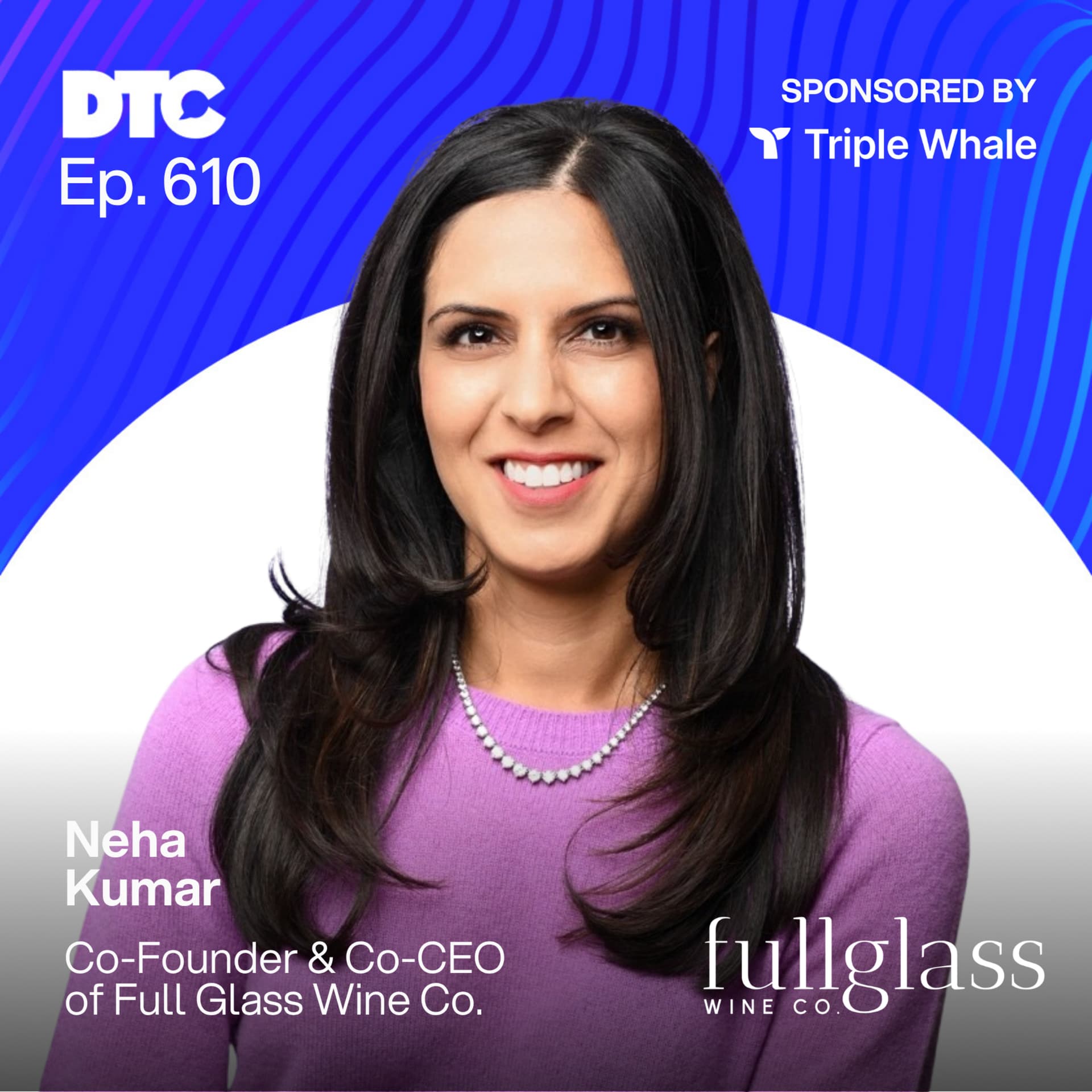
Neha Kumar, co-founder/COO of Full Glass Wine Co, explains how Full Glass built a $200M wine rollup by buying DTC brands and fixing unit economics. She argues DTC needs a “three-legged tripod”: marketing, operations, and finance; retention is the engine, especially for wine where customers want ongoing discovery and education.
Key claims
subscription can backfire in wine because frequent emails increase unsubscribes; retention and profitability matter more than growth after the pandemic. Notable example: Wink (acquired 2023) filed for bankruptcy after pre-purchasing heavy inventory during 2020–2021 demand spikes; unit economics were stuck around four-bottle shipments versus a tipping point of five to six. Full Glass integrates tech and 3PL shipping first, then accounting/finance, then marketing; shipping/logistics is the earliest unlock via 3PL scale.
Guests
Neha Kumar only.
Written by AI. May contain mistakes. Listen to the episode to check what was said.
Chapters
Tap a time to open that second in VOThe Pillars of DTC Success
0:00 to 0:40
Learn about the essential elements for successful DTC wine brands.
“These companies that we've acquired had very, very good brands, very strong brands, and the people who set them up did a phenomenal job they did.”
Challenges and Opportunities in the Wine Industry
2:26 to 4:19
Explore the evolving challenges and opportunities for DTC wine brands.
“Neha's background is in finance and operations.”
Adapting Business Models Post-Pandemic
4:19 to 6:41
Understand how DTC brands must adapt their strategies after COVID-19.
“And so if you had looked at a lot of the companies in 2020, 2021, they were raising at very, very high valuations.”
Acquisition Strategies and Challenges
6:41 to 9:25
Learn about the key factors and red flags in acquiring DTC wine brands.
“to earth and then just not being able to reconcile it with the fixed costs that they maybe invested it in during that time?”
Integrating Customer Service Across Brands
9:25 to 14:00
Discover how to effectively integrate customer service in acquired brands.
“or margin sound perspective, you're just going to be pouring fuel on a fire that's going to burn you.”
Optimizing Customer Service for Wine Sales
14:00 to 17:08
Learn how Full Glass improves customer service efficiency to boost sales.
“is going to be any orders that people have coming in.”
Understanding Customer Types and Wine Choices
17:08 to 21:03
Discover the significance of customer types in selecting wine brands.
“So one might essentially be going to wink for a certain purpose, a certain use.”
The Year of Yes: Embracing Opportunities
21:03 to 23:07
Explore how embracing opportunities can lead to rapid business growth.
“Every coin has two sides, but it is really, really amazing to see everything come together.”
Integration Process After Acquiring Brands
23:07 to 24:04
Learn the essential steps for integrating newly acquired brands.
“Because by T minus 10 days, that has to be set up, teed up, ready to go.”
Shipping Innovations in the Wine Industry
24:04 to 28:00
Understand the role of shipping logistics in enhancing wine sales.
“And it comes back to what I started at the beginning of this podcast was three legs of the tripod.”
Show all 19 chapters
The Importance of Consumer Communication in Wine
28:00 to 30:00
Learn how effective communication enhances customer engagement for wine brands.
“Again, showerheads, filters, that's a great one to do, right?”
Retention as the Engine of DTC Success
30:00 to 32:00
Understand why customer retention is crucial for direct-to-consumer wine businesses.
“where it's coming from getting people excited, or what are new grapes?”
Tapping into Existing Customer Bases
32:00 to 34:00
Discover strategies for leveraging acquired customer databases effectively.
“Marketing a brand for us gets split out differently.”
Managing Inventory and Cash Flow for Growth
34:00 to 36:20
Explore how effective inventory management supports business sustainability.
“We're very fortunate that we do have organic growth in some of these brands as well.”
The Evolution of Personal Intuition in Business
36:20 to 38:40
Learn how personal intuition can influence business decisions and growth.
“And when we acquire these companies, they already came with so much inventory.”
Embracing AI in Business Operations
38:40 to 40:50
Find out how businesses can leverage AI for enhanced operational efficiency.
“But it's all your data points, like your brain is this AI processing machine going so quickly, not artificial, obviously, but it's just a machine that's going very quickly.”
The Future of the Younger Generation in Entrepreneurship
40:50 to 42:01
Discuss the potential and capabilities of the younger generation in today's market.
“to be able to serve our end consumer better.”
The Next Generation and Technology
42:01 to 44:10
Explore how today's youth leverage technology for innovation.
“just going to enhance what individuals are able to accomplish so much more.”
Embracing Change and Entrepreneurial Spirit
44:10 to 46:03
Discuss the benefits of embracing technological change in entrepreneurship.
“My favorite thing about cars, I've maybe brought this up on the podcast before, but before cars, cities were literally choking in horse manure.”
Transcript
Automatic transcript. May contain errors.0:00Neha Kumar:These companies that we've acquired had very, very good brands, very strong brands, and the people who set them up did a phenomenal job they did. What's missing, in my opinion, is there's three legs in a tripod. You need the marketing, and you can put marketing and branding if you want for a moment in one. You need the operations, and you need the finance. You need all three of those combined. Subscription was such a big thing. The more times you email them, the more times you talk to them, the more chances you're going to see unsubscribe rates. In the world of wine, people want to hear about it.
0:29Neha Kumar:They want to know about the discovery of wine. What are the new types of bridals that are coming up? Retention is the engine. That needs to be that way for the majority of direct-to-consumer companies, period. Everything really is built on their retention.
0:49If you're still making decisions based on messy, scattered data, bouncing between ad platforms, spreadsheets, and dashboards, you're not alone. Most e-commerce teams are stuck piecing together a story they don't fully trust. Triple Whale changes that. It's a complete intelligence platform built for modern operators who are done guessing. Triple Whale centralizes all your data, equips you with measurement tools you can actually trust, and layers in best-in-class AI to turn that data into clear recommendations, showing you what's driving growth, what's hurting profit, and exactly what to do next.
1:20It even takes action for you. With Triple Whale, you can quickly spot trends, catch issues before they impact revenue, and uncover opportunities you would have otherwise missed. It's about moving faster, making smarter decisions, and operating with real confidence. That's why brands like True Classic, Whey, Press Juicery, and thousands of the fastest-growing D2C companies rely on Triple Whale every day. They're saving time, increasing efficiency, and unlocking insights that simply weren't possible before. And if you want to hear directly why users love it, here's your chance. Triple Whale is hosting The Whaleys, a one-day summit designed for e-commerce operators who want to make more confident decisions and scale faster.
1:57You'll hear from industry leaders and experts sharing practical, data-driven strategies you can actually implement. If you're ready to stop guessing and start growing, you won't want to miss it. Visit triplewhale.com slash Whaley's, that's T-R-I-P-L-E-W-H-A-L-E dot com slash Whaley's to get your ticket today. Hello and welcome to the D2C podcast. Today, I am joined by Neha Kumar, co-founder and COO of Full Glass Wine Co. They've acquired seven D2C wine brands and built a system of scale under one roof. Neha's background is in finance and operations. She was COO and CFO at Create and Cultivate through their exit, and now she's applying that lens to fix what's broken in D2C wine.
2:41Welcome to the podcast, Neha. How are you doing?
2:43Neha Kumar:I'm doing well. Thank you for having me. I'm always impressed with when people are in that acquisition mode, when they're willing to put it down and actually acquire wine brands. So maybe start by telling you what's the biggest challenge in the wine industry where it became an opportunity to do this acquisition play? I'd actually even take like a 10 ,000 step foot back even further, right? And I would say it's not even necessarily that there's something wrong. I think that if you take a really far standing back look and you look at a long enough timeline, every so many years, you almost need a tilling of the soil, right?
3:19Neha Kumar:So things start to get a little stale. People keep doing things the same way. People get caught up with the same items. The way in which a lot of direct consumer companies were looking at customer acquisition when you're looking at it in the, let's call it the influencer and heyday, you know, and also the subscription heyday of 20, let's say 13, 14, 15 up through 20, 18, 19 was very different. Then you throw in COVID, right? We have a global pandemic. So a lot of companies that were direct-to-consumer where products could easily be delivered at home were really seeing a very high peak during 2020, 2021, and even sometimes into 2022.
3:58Neha Kumar:The thing that you have, Eric, and I'm sure a lot of your listeners are very well in tune to this, is that a pandemic is not a frequently occurring item. them. It happened once and you need to take in as much cash as you can as a lot of these direct to consumer companies, but you need to manage your business model accordingly to looking at what do I think is going to occur in the next so many years. And so if you had looked at a lot of the companies in 2020, 2021, they were raising at very, very high valuations. They were bringing in, hoarding in, I could say to a certain extent, inventory, pulling in things as quickly as possible and really getting their fixed costs locked in.
4:36Neha Kumar:You look at someone like Peloton at the time, right? It's yes, they're starting to move things and turn it around right now. But essentially what you had is they said, listen, if we take our numbers of how many units we think we're going to sell and we extrapolate them out and we forecast it, we're going to keep going down that route. The challenge that companies like that had is then they started to go international and they started to basically open up all these facilities, these manufacturing facilities. You have fixed costs that are tied in, which make it very hard. So now kind of going from that lens to answer your original question, what was going on in the direct to consumer space?
5:13Neha Kumar:We happen to go into wine. I love wine. I love champagne. I'm sure you can see in my background. It is not a background. It is real. So it's a nice fun thing for me that it happens to be a product that I do really love. Having said that, a lot of direct-to-consumer companies at that time needed to modify the way that they are working. How so? Because you essentially are extrapolating out a model, a forecast that is based off of how things were in the pandemic. And people aren't going to keep sitting at home and buying. So right now today, our competitor is someone like a wine.com. You can even say Trader Joe's.
5:52Neha Kumar:Trader Joe's is a big one. Costco, right? Those are our competitors. During the pandemic of 2020, 2021, the alternative was is essentially going to a restaurant. Of course, people were going to go back to restaurants later on. So you're going to have that consumer going back and buying those products. So what we ended up doing is looking in the market and saying, OK, what kind of industries needed to have some love? A company called Wink ended up filing for bankruptcy in 2022. That was our first one that we acquired in 2023. And with the case of Wink, was it a problem of the fake or AstroTurf demand spike that COVID happened and then not being able to sort of reconcile that, having that big disappointment of being like, okay, people aren't going to keep drinking like this forever, having it come back to earth and then just not being able to reconcile it with the fixed costs that they maybe invested it in during that time?
6:46Neha Kumar:And a lot of this information, I'll share it with you here, Eric, and all your listeners as well. It's public information because Wink was public, but they bought a lot of inventory. So for example, I'll give you two things on Wink, which I always find interesting. The first one essentially is let's just say right now, you're selling 10 bottles a month, just to keep the numbers simple, right? So in one year, you're selling 120. The pandemic hits and those numbers go up by 100 a month. All of a sudden, and now you say, listen, this is what I'm going to see for the go forward for the next five years.
7:18Neha Kumar:I want to make sure I have enough wine for my consumers. Let me buy a lot of wine. They pre-purchased so much inventory and so much cash went into their inventory. So the challenge that you have is you have all this liquidity, this cash is now sitting locked up and tied into inventory. At some point in time, the company is going to need additional cash to just run basic operations. And then 2022, they ended up filing for bankruptcy. So that was one thing. The second thing was, is you essentially have, we are operators and you started off the podcast that way as well, right? We are operations people to the T operations and finance people.
7:56Neha Kumar:And one of the things with operations and finance, when you combine the two of them, and then you look at marketing as the third leg of the tripod, that's where you really make magic happen. One of the things that Wink did a lot was they would send four bottle monthly shipments. The tipping point essentially from a unit economic standpoint is between five and six bottles. So what can we do to take four bottle monthly shipments and move the customers into essentially a quarterly 12 pack? We could even give consumers one bottle for free a shipment, two bottles for free a shipment. We We can do all these modifications and change it around, but the unit economics weren't ideal.
8:40Neha Kumar:In 2020, 2021, when so much money was floating around and the interest rates were so low, everybody was just talking about how quickly can we grow our consumer base? How quickly can we get more customers in? The pendulum, if you look back, it swings back and forth all the time, every five to eight years, maybe 10. And so now there's a very hyper sensitive focus on profitability. We essentially take the companies in and we turn them profitable within 60 to 120 days. I think that's a really good point though, that if you don't, if you haven't thought of, you know, that deep level of operations where it's like, okay, this is where we'll make our money when we, when we get them to make this purchase or whatever.
9:19And you pour a lot of gas on it in marketing, even if you're making sales, if it's not set up from an operationally sound or margin sound perspective, you're just going to be pouring fuel on a fire that's going to burn you.
9:30Neha Kumar:That's exactly true. And so a lot of these companies that we've acquired had very, very good brands, very strong brands. And the people who set them up did a phenomenal job. They did. What's missing in my opinion is there's three legs and a tripod. And without the three legs, you don't stand. You have to make sure that it stands. You need the marketing and you could put marketing and branding. If you want for a moment in one, you need the operations and you need the finance. You need all three of those combined. And the challenge that you have, and this might answer your original question more in detail, the challenge that you have with this type of a product is one of the most expensive cost is shipping because it is very heavy as opposed to let's say you're looking at a beauty or skincare product that's a life product, margins are higher, so you have more to play with.
10:15Neha Kumar:Essentially for this type of a company, you have to be very, very hyper-focused in regards to the unit economics and the operations or everything in this business. Now walk me through a little bit. You mentioned the brands that you acquired having really strong brands, really great customer market fit. Walk me through your process for determining whether you were going to acquire one of these brands. Was it just the brand strength? What else were you looking for? And what were maybe the red flags that you were looking for that made you not want to buy one? The red flags. That's always a very fun one with this too.
10:45Neha Kumar:It's a really good question. We essentially were looking for one. So in the beginning, we were looking for companies that would help us fill out the infrastructure. Some of them, maybe not very sexy, but some of them had certain licenses that we needed. And direct-to-consumer alcohol, there are certain things that just take a very long time. So some might have had some certain licenses. One of them had a lot of work that was done on an AI algorithm that had already been in play. And so for us, we were able to inherit that. All of them came with really strong customer lists, which was great. But you almost want to look at it.
11:16Neha Kumar:I look at these as if it's all of them were pieces of a puzzle, but you're combining that with a very fast game of Tetris. because sometimes in life, there are pieces that come at you with some of these companies that you might not have wanted. So how do you manage it as quickly as possible to make all this come under one umbrella? So it was definitely very challenging. In regards to some of the red flags that were out there, some of it would have to do with the rapidly deteriorating customer base, right? So even if you have a great customer list that is there and it's a high number and the purchase price, et cetera, everything is good across the board.
11:54Neha Kumar:What we really want to look at are the trends of the customer list over the past two to three years, ideally, right? In addition to that, some of the companies were highly levered. How do we manage the debt that we're taking on or if we're taking it on? And then also we have the third part, which is the personnel. What is the infrastructure that they currently have in place? What are the things that we're missing that we need? One of the companies that we acquired, there was a multitude of reasons we acquired it as Wine Access. Their customer service team were required for an extended period of time to actually have taken the W set one and some of them the W set two as well.
12:33Neha Kumar:So there's three parts of learning for essentially for like to get really good wine knowledge. There's the W set one, two, and three. A lot of those customer service representatives were required to take one and some of them even too. For that type of a product, it is very helpful to have an extensive base of knowledge and understanding, even from a customer service standpoint, because people will be calling in to ask and they might want to know a little bit more about the wine, what's happening. Now, for us, it was very important when we take our customer service team to essentially segregate it out.
13:07Neha Kumar:So some people might be calling in for, hey, where's my shipment, right? And other people are calling for, well, I didn't like this type of Pinot, but there might be something else that's a little bit more suited towards my palette? How could I find something that works for me given my lifestyle? So when you acquire a company like that, do you then apply the customer service from that company to the rest of your brands? Or how much is it a game of keeping what works in a silo versus centralizing things into like the full glass way of doing things? Do you almost want to look at it? It's such a good question because that's almost the magic sauce of what we essentially have.
13:42Neha Kumar:I'm not going to say secret sauce because implementation of it is everything, but it's definitely the magic sauce that we essentially have. I almost would look at it as like the 80-20 rule. So 80 % of it gets integrated and then 20 % of it is going to stay essentially separate on its own, right? So of the customer service, what we can do is we can say 80 % of it is going to be any orders that people have coming in. Where's my shipment? I mean, that's always the biggest one, right? Did it come? Did it arrive? It got to my house. There's logistical kind of just questions that come up. We don't need specialized experts helping those people.
14:15Neha Kumar:So those kinds of customer service questions can now get routed over to a team that's going to be significantly more cost effective. The majority of the customer service team for us that does that type of work is actually abroad. And that's what really helps us from a cost standpoint as well. But then 20%, we make sure those calls are going over to that specific staff, that specific team. Now, what we have been working on, and it takes time to put all this into place, but what we've been doing slowly and slowly is for some of the other brands, when people are looking to get upsold or people want to go up tier essentially and buy more premium wines, we now want those calls routed over from the other storefronts over to these customer service to encourage them to get excited about higher price point wines.
14:59And then you mentioned like putting it together like a puzzle. And I'm sure there's lots of different like lenses that you can look at that puzzle through. Like, is it about the quality of the wine or the price point of the wine? Is it about making sure you have a Pinot and a Chablis and a, you know, a champagne essentially? Is it about completing the puzzle of varieties of wines? Or was it more about the customer type that each brand spoke to? I'm sure it's a medley.
15:27Neha Kumar:It's actually, it's very specific. It's the customer type that each one spoke to. So 90 % of our wines are private label. And we have the ability right now, just because we've hit such scale, that was the biggest thing with this business is can we hit scale? We've been able to hit scale, which gives us a lot of buyer power with a lot of our vendors, which is phenomenal. And we're allowed to then take on the benefits, the great things that we get the access essentially to a lot of different varietals. And we get to share that with our customers. In regards to what kind of companies we acquired, it was specifically on the customer type.
16:00Neha Kumar:So you want to think about it this way. Right now, we've just talked about two. We've talked about Wink and Wine Access. So if I have right now a Saturday, I'm having brunch with a bunch of my friends, I'm probably going to get Wink Wines, right? Cute, fun, different labels. They're very Instagrammable. We can talk about them on social. Wink had come out with last year a non-alcoholic rosé, which is one of the best rosés I've ever tried called Cheeky 0%. And so you get all these wines, you have fun. Now, the thing is, I might have my mother-in-law, let's say, coming over. My mother-in-law watches my two little kids.
16:32Neha Kumar:They're seven and five years old, and I need her for my life. So I want to make sure she's impressed, and she also has very discerning taste. She is an Irish woman. She has discerning taste when it comes to wine. So she's coming over. I'll probably go to Wine Access, get some help from someone there, and maybe buy her an$80 bottle of wine for a special occasion. Now, the whole point here is under full glass mind, we want to keep our consumers under one umbrella. We're okay if you go from brand to brand, whatever it is. Now, people might essentially in your life as a customer, your taste profile will change over time.
17:05Neha Kumar:So you might go from one brand to go to a different one. And in addition to that, your use case might be different. So it's received value as well, right? So one might essentially be going to wink for a certain purpose, a certain use. girlfriend's coming over for brunch on a Saturday, discerning mother-in-law might be a wine access drink. So she still helps you with childcare, right? So that's really how we're looking at it. So it wasn't for varietals or access to the wine. It truly was the customer base is what we were looking at. And then do each of the brands retain their own storefront or does it all get rolled up under full glass?
17:41Neha Kumar:Each one retains their own storefront. I'm actually just on fullglass.wine, which you should all go to in the audience here if you like wine like me. And I'm just seeing the article that was in Entrepreneur, and it's really piqued my interest. How did Willy Wonka inspire you to say yes to everything for a year? So do you have kids, Eric? Yes, I have a 12-year-old. Okay, so you'll remember these days, and I'm sure. My son, he's now seven. He was four or five years old at the time. He would watch Willy Wonka, the one with Johnny Depp, on repeat. And when I mean on repeat, it was like to the point of cringe, right?
18:19Neha Kumar:You're watching it every single day. I'm like, I can't even hear this anymore. And I have all the lines memorized. The thing that ends up happening is when you hear something on repeat, you start to actually listen to it a different way, which is really interesting. There's a scene in that movie where Johnny Depp is telling Charlie why he ended up doing the golden tickets and why he went out there And he said, I want to find some other people to come in and take over the business. Ultimately, he was in his annual haircut with an oompa loompa. And while he was getting his annual haircut, he found one gray hair.
18:51Neha Kumar:And the gray hair for him was an indicator, not that he's getting old necessarily, but that time is finite. Shortly after that time, I started to get some gray hair. And it wasn't about, you know, and I got gray hair at an older age. And so, which is nice. And I'm, I'm very grateful for that. Right. It wasn't about aesthetics, Eric. It was essentially about the fact that we think we have all the time in the world. And I always wait to put everything out there in the world when it was perfect. I didn't want to do a podcast recording. I wouldn't want to put an Instagram post out. I wouldn't want to show my ideas to, to capital providers until it was absolutely perfect.
19:33Neha Kumar:And when I was watching that movie on repeat every day, right? It really sunk in for me. We as human beings genuinely think we have all the time in the world, but we don't. The one thing we know is that time is finite and we don't know when something is going to happen. So I decided I'm going to make this, that time period, my year of yes. And anything that comes to my mind or any idea that comes from somebody else, I'm not going to hesitate. Of course you say no to things. You don't want to overburden your plate on things that are going on, right? Or things that are bad for you. But it's that hesitation that you have and you all know what I'm talking about, Eric, you included.
20:12Neha Kumar:You know that there's that moment where you're like, oh, I'm nervous. I want it to be perfect. And I said, you know what? I'm going to make this my time of yes. And I told myself I'm going to do it until X month. And it happened to be like one year later, right? So until next March, I'm going to do everything that comes up and I'm going to go out of my way. And everything shifted for me. We would not have acquired this many companies, we would not have moved so fast. I would have not have put myself out in the market because we all have self-doubt. We all have imposter syndrome. And when you come to the realization that that is just a human set of traits and everyone has that, then the next thing is, okay, now what am I going to do about it?
20:52Neha Kumar:And so getting out there, trying things, it has worked miracles for me. And I am so grateful that my son watched that movie on repeat. And now he gets to watch you living your Willy Wonka dream with a$200 million company within 17 months of that Willy Wonka inspiration, which is pretty cool. Thank you. It's been hard. Every coin has two sides, but it is really, really amazing to see everything come together. I don't know if you can pick a child, but what was the best acquisition you made during that period? I definitely cannot pick a child. I would say that each one had its benefits and each one had its challenges.
21:34Neha Kumar:That's for sure. Wink was one of those where it was the first one. So the first one's always going to have a special place in your heart, right? Because you ended up acquiring at the beginning. Wine Access is right now the last one that we did, which is probably why subconsciously I talked about both of those with you on three occasions now during this recording. because we each remember the first and the last one there. But I think each one of them brought something different and unique to the puzzle, which really helps us be a whole company. Okay. So you've acquired these brands. Walk me through what happens on day one after you acquire one of these brands.
22:07Neha Kumar:So Eric, we actually start on integration probably two to three months before we close on the transaction. That's how we were able to do so many of them so quickly. So the first thing is the tech. The first thing is we put everybody on the same sub stack because essentially everyone has to be on the same technology. Everyone has to be moving together. Otherwise, it makes it very, very hard to integrate and we can't move quickly. So the first thing we work on is tech integration. Now, you never know for sure if the deal is going to go through, but you'll have someone who's under the tent on the other side, on the acquisition side, and you start working with them through the tech to see what are all the things that need to get done.
22:43Neha Kumar:Is this something that's possible? Because a lot of that actually, Eric, has to do with our purchase price as well. So for example, if they're on the same tech stack as us, the integration work is going to be easier. And then therefore, it would be a modification potentially to the purchase price as well, as opposed to if there's a higher lift for our team to integrate it, it's going to be a lot more work. So the first thing is tech. Then the second thing is going to be our 3PL for shipping. Because by T minus 10 days, that has to be set up, teed up, ready to go. Because for the customers, it shouldn't even be a glitch.
Read the full transcript
23:14Neha Kumar:It should just be one system turns off and one system turns off, right, off and on. And then basically the customers are getting their direct next shipment. Then the third thing after that, so you say day one, we've closed after everybody's introductions, all those things, that is accounting and finance. The last one, ironically, is actually marketing and branding. If you don't have the others, we're very big on infrastructure. So the infrastructural components have to get done first before anything else happens. And the accounting and finance can take six to nine months because a lot of times the systems that they're in, the numbers that we're getting, everything is all over the place.
23:57Neha Kumar:And finance is very, very important because that's what ultimately helps us look at, again, the unit economics. And that's what gives the visibility and the direction to marketing for them to be able to the marketing team to say, listen, this is where we need to go. This is what we need to move. And it comes back to what I started at the beginning of this podcast was three legs of the tripod. And then would you say that the shipping and logistics piece is the biggest impact soonest in a way with you can just with your economies of scale and what you can provide there with how hard and expensive shipping is in the wine industry?
24:30Is that where your biggest unlock is in the early days?
24:32Neha Kumar:In the early days, the first thing that you're going to see the biggest unlock is going to be in shipping and logistics. Because we are the largest client now for our 3PL. And it gives us a lot of negotiating power, but we have a very good relationship with our 3PL. And so it's a very symbiotic relationship that we have because we're their largest client. And then talk to me about your philosophy around marketing with wine. I think in the pre-interview, we talked a little bit, and I think I mentioned something about subscription being such an important unlock for wine. I think you pushed back on that a little bit.
25:09But maybe talk to me a little bit about how you think about marketing and retention acquisition in the wine space.
25:15Neha Kumar:Let me tell you first on subscription. So subscription was such a big thing in 2016, 17, 18, 19, right? Subscription works very well for products, essentially, where you don't want to keep talking to the consumer. So you think of something like shower heads, right? We've been seeing that a lot. So you think of like a shower head company and the shower head company, essentially you buy the shower head and then now you're buying the replacement filters. That's on subscription. That is amazing, right? No one is sitting there thinking, I can't wait to go look at a new replacement filter and try to find a different kind.
25:47Neha Kumar:That's the coolest thing in the world. That's not something that's very rooting for the majority of people. That's a great subscription product. You also look at something like cat litter. You see pretty litter that they think sold for like 700 million something tomorrow's a few years ago. No one's sitting there going, yes, a cat litter is very sexy either, right? I'm so excited about it. Subscription, great, go. You know, that's amazing. Wine is very different. The challenge that you have with subscription customers typically and anyone in subscription will understand what I'm talking about is you essentially don't want to keep emailing them.
26:18Neha Kumar:The more times you email them, the more times you talk to them, the more chances you're going to see unsubscribe rates, right? So that's where you kind of have an inverse relationship. You email them more, you see more unsubscribe rates. It's not a great thing. In the world of wine, we want to be reaching out to them more. We want to be talking to them more. So somebody had a quarterly shipment. They might get one shipment in January, and now they're getting their next shipment in, let's say, May. If I reach out to them more, then they're going to unsubscribe. Having said that, if they aren't on subscription during those three to four or five months period of their normal subscription, I can reach out to them and tell them, Hey, listen, you know, Neha Kumar over here has a bunch of great champagne magnums and she wants to offload some of her stock and she's going to give, you know, the first thousand people who buy or whatever it is, a special deal or whatever, you know, on these magnums.
27:11Neha Kumar:And so, um, let's say it's after the holidays. So we now have the ability to not only be able to reach out to them more number two, it also really helps us to push market because it allows us to manage and hedge our inventory balancing. We have three different warehouses that we currently use accordingly because our product is going to be, it's nuanced because you have a pick pack process, essentially, if you're dealing with, if someone's buying six wines in a box or 12 wines in a box, what if we only end up with a small limited number of inventory in one warehouse? So if I can email out and say, listen, I have all these rosés that I'm getting ready to move for Mother's Day and I can reach out to the customers even more, that actually shows us a big increase in the number of purchases that we're getting.
27:58Neha Kumar:So subscription versus transactional, essentially for us, it depends on the type of product and service you're providing. Again, showerheads, filters, that's a great one to do, right? Wine, people want to hear about it. They want to know about the discovery of wine. What are the new types of varietals that are coming up? Is there some new vintage that came out to be very good that we should know about? So in those kind of situations, being able to communicate with the consumer is infinitely more important than that regular subscription. Now, having said that, Eric, we model out our customers internally as if they are subscription because we are 100 % direct to consumer.
28:37Neha Kumar:So we have the ability to actually manage and get all of the data and information on all of them. So we can see how they behave. And for us, essentially, even with our existing investors, they view them very akin to subscription as customers because you can monitor their progress accordingly. As opposed to if you're retail, you just, I mean, that's a completely different model then. I never thought of the idea of emails during a subscription lifetime as being potentially detrimental versus when they're just buying it. You have this opportunity to storytell and they become this positive thing. I think even in our pre-interview, we talked a little bit about storytelling in email versus sending always transactional emails.
29:20How do you balance in your retention flow storytelling versus like, you know, sales messaging or more transactional messaging?
29:27Neha Kumar:So we're actually putting together a playbook and we're creating it at this point in time. Our marketing was our last one. We just finished our full year of having all of the brands underneath us in 25. Again, we're a relatively new company. We launched in 2023 in June. All of our acquisitions were essentially completed in 24. So 2026 and 2027 is exactly what you're talking about. And what we're essentially looking at creating right now is a multi-part series. where the consumers are getting a few emails, which are a multi-part on storytelling on the wine, where it's coming from getting people excited, or what are new grapes?
30:07Neha Kumar:Not new grapes, but some certain vintages, which might have a certain essence, something to them, and then tying it with some of the products that we have that are going to be coming out on the market. So then you get the transactional email after. But so many people, they want to learn. This is the fun part about wine. It's an educational product, again, as opposed to cat litter. No one's sitting there. most people aren't sitting there saying, I can't wait to learn more about the nuances of Patletter. No, 100%. I'll go on retention now too. Retention is the engine. And that needs to be that way for almost the majority of direct-to-consumer companies, period.
30:43Because unless
30:44Neha Kumar:you have a product that is of its mouth, unless you have a product that you're selling that is a very tight ticket price and the acquisition cost is justified and the margin is high enough, it absolutely is fine if you were just to bring in one the customer does one purchase right having said that if you're selling lower margin products across the board or even just decent margin product everything really is built on the the retention um i teach undergrad i think i was telling you that before as well in our pre-interview and so one of the things i go through with my students in our um managerial accounting class essentially is is you know somebody's buying a Porsche, you could sell one, right?
31:23Neha Kumar:If somebody is buying water bottles, the margin on the water bottles, like you need to sell so many water bottles and you need people coming back and buying those water bottles over and over again, if you're going to actually make a viable business out of it. But if somebody just buys one water bottle, it's really hard to call that a viable business in the long term. Retention is the engine. Yeah, it has to be. Do you employ SMS as well as email? We do. We do. And so that's essentially comes back to part of your question before on some of the things that we do centralize. So what we've been working through, so again, we do tech, then it's operations, and then it's accounting and finance, and then marketing.
32:00Neha Kumar:Marketing a brand for us gets split out differently. So marketing essentially has, and what we've been working towards is creating a shared services platform for marketing. So with the marketing team, essentially what you're looking at is there's one, there's like a team, one head, and then there's a team under them involved with just spearheading what are the right platforms to use for sms how do we get the price best pricing how do we scale what are the best things that are happening with email what are the best things that are happening with all the different kind of sales channels that we can look at so that's all centralized and you get scaled there and you get institutional knowledge learning all of those things get gained but the brands sit on their own the brand is who are we speaking to who is my customer what is my customer doing how is my customer growing?
32:43Neha Kumar:How is their life changing? What is the look, the colors, the feel, the voice that we're using over to the customers? That is the one thing that sits separate from the marketing engine. And then this is retention, but talk to me about how are you bringing new eyeballs into your ecosystem with Full Glass? We've done a lot of testing over the past year. Our number one focus has been on the existing consumers because we acquired so many customers through the acquisitions. This is something that is public knowledge as well. I mean, Wink alone came with approximately 7 million email addresses just with one company.
33:19Neha Kumar:And a very large percent of those were active customers. They essentially had a quiz that went out to a lot of people before. I'm sure anyone who had shopped at Wink remembers it, but it's like a 30-second quiz. And so essentially, it's do you like cantaloupe or watermelon or chocolate or cherries? And so these people had all taken a 30 to 40 second quiz. So you have a higher qualified email list as well. So we're very fortunate that that's our number one place to really tap into in regards to the existing email list. But in addition to that, too, our number one focus is really taking care of the existing consumers before we're really pushing out there, trying to just go acquire new ones.
34:00Neha Kumar:Is new customer acquisition good? Absolutely it is. We're very fortunate that we do have organic growth in some of these brands as well. Yeah, I think we spoke about this on the pre-interview a little bit, but I think there's a real opportunity for, you know, we started this newsletter, D2C newsletter, in order to grow an agency. It's become its own company, its own media company, but it's also helped fuel the growth of this agency where people are reading our newsletter, listening to our podcast, and then they're like, hey, where do you get all your content or your insights from? And we're like, well, it's this agency that we sort of run beside.
34:29And I feel like there's a real opportunity for user acquisition to be done for, I'm sure there's lots of wine newsletters, but something like that where you're creating lifestyle content around the wine lifestyle, essentially, and then having it kind of backed by full glass in a way as a way to, like, I wonder how Wink got 7 million emails. Was that all from purchases or were they, I wonder if they were running, you know, lead acquisition campaigns on top with the quiz, I guess, right? That's how they would have got those.
34:57Neha Kumar:Yeah, it's with the quiz. And you have a qualified email list. So just a question about inventory. So inventory or problems with inventory management were one of the reasons that have given you the opportunity to grow and acquire the companies that you have. How do you manage inventory and cash flow for the business now to make sure you don't get into the same problem? We really look at lead time, right? And then we have more realistic forecasts. And I don't really want to say that people had problems before. I mean, obviously, the Wink filed for bankruptcy, so we can all make assumptions there to begin with.
35:29But it was just people had very hopeful, optimistic outlook that the trends that were going on in 2020 and 2021 were going to continue onwards.
35:38Neha Kumar:But it's a global pandemic. Everybody's going to people are going to eventually go outside. People are going to go back to restaurants. People like to eat out. Right. And so the people that were essentially buying now at Trader Joe's, maybe some of those are still buying at home, which is nice. The people that were going to restaurants and eating at home that were ordering direct-to-consumer wine, they're going to go back to restaurants, right? And so you're going to have to remove that component of the market. So how do we look at these things a little bit differently? We're very cash conscious.
36:07Neha Kumar:We're very, very cash conscious. So we're profitability focused first over growth at this point in time. Now, could that change later? Absolutely. But today, that's currently where we are. And inventory is our big thing. We are very hyper-focused on inventory. And when we acquire these companies, they already came with so much inventory. And when you acquire companies, are you generally acquiring the, like, how much of the founding team of these wineries are you acquiring? It depends. It's on a case-by-case basis. Some of them, it depends on how many people that we need. I mean, that is a hard part of it, right?
36:43Neha Kumar:Because we already have an existing infrastructure in place. So the first two companies that we acquired, we kept a lot of the people on. Then after that, the companies that we acquired, we didn't necessarily need to take on the majority of the company. Having said that, there were a lot of changes at some of these companies that had occurred even prior to us acquiring them, right? Because some of these companies were essentially, they were in a position where they already had some challenges and they needed some love. So they might have already had a series of layoffs. They already had a series of downturn.
37:14Neha Kumar:And you also have just normal attrition whenever layoffs occur at companies. And so a lot of these companies had those already. Is there anything you've changed your mind on in the last couple of years that you would have held to be true earlier in your career? Wow, that is a really good question. I'm going to go back a little bit to my Willy Wonka one here just for a moment to just expand on that. And you really like when I was younger, earlier in my career, I wouldn't say younger, I said earlier in my career, I really wanted to make sure that everything was perfect. And I really cared a lot about what other people said and valued a lot of other people's opinions.
37:49Neha Kumar:I thought that a lot of people around me, just because they created something or they made some progress, that they knew what they were doing. During the pandemic, an amazing thing happened for me was I was pregnant at the time. And so because I was pregnant, we didn't see anybody. I was pregnant with my second child. And so we were very health conscious. and I was forced to have to use my own intuition as my counsel because I didn't have other people around me. And I was at Create and Cultivate at the time and I was selling it. So I really learned to listen to my own inner voice and my own intuition.
38:30Neha Kumar:And I don't believe gut is some magical force. Gut is a series of data points based on your experience and what you know, when it happens so fast in an instance, it just comes to you, right? But it's all your data points, like your brain is this AI processing machine going so quickly, not artificial, obviously, but it's just a machine that's going very quickly. And so I learned to trust that so much more than what anybody else was saying around me. And as I have continued to go forward with my career, I have continued to strengthen that muscle. And I just really listened to what comes to my mind and what I need to do.
39:09Neha Kumar:And if my take is go out there, go bold, go do it, don't worry about the consequences, then I go and do it. When I was less experienced, I was constantly listening to what other people were saying and looking for validation. And I was always apprehensive to go out there and do something without it being perfect. I think that's an underrated insight. You mentioned our brains being AI computers. It's also like we live in a, not to get too woo-woo, but in a quantum reality where expectation kind of creates reality And you're really only going to be capable of what you think you're capable of. So much of our lives are sort of dictated by the limits that we set on ourselves.
39:45So I think like having that sort of like brush with mortality via Johnny Depp can be such a profound thing because it gets you to kind of live in or open up the possibility, you know, it can kind of allow you to open up the possibilities of what you think is possible for you.
40:00Neha Kumar:Yeah. I mean, we could have a whole separate talk just on that. I completely, completely agree. And I do think it's a muscle. And it's an upward spiral, not a downward spiral. Because once you start, you let go of the hesitation and you keep going. You start to see the benefits that can come from it. You go for the next thing. You go for the next thing. You go for the next thing. And then you start to see the benefits occur. And it's not to get woo-woo on you either, but it's almost like magic. So what's on the horizon? What are you most excited about for Full Glass in 2026? Very, very excited for some of the things that we're working on in regards to artificial intelligence.
40:39Neha Kumar:Speaking about just what we're talking about with our own brains and everything else. So being able to do these things, being able to integrate everything internally, it's going to take us some time, but get these things to move forward truly allows us the ability to be able to serve our end consumer better. And that is very fun and it is very fulfilling. What AI tools are you using? Are you a chat GPT person, a Claude person, or just all of the above? I'm a combo of both. So UCLA has us on Claude for a lot of different things. For some of the other stuff, I'm using chat GPT. My biggest thing on AI is everyone just needs to get moving and grooving with it because you got to learn it.
41:18Neha Kumar:You got to use it for your everyday use, whatever it is. And then you start to become more comfortable and familiar with it. And it's almost like an obsession, right? Like it is amazing. It is amazing what you can do with AI. It blows my mind. Like the intuition, the modeling, everything around it is next level. What it enables, right? Like I thought we were talking with one of Pilot House's top clients and they're, for instance, like they're looking at like recoding a number of, you know, SaaS platforms that's going to be directly for their company. Like we live in such an age of empowered operators in a way where it's like people have pessimistic ideas of, you know, AI taking over this or that.
42:00But, but to me, it's like, it's just going to enhance what individuals are able to accomplish so much more. And I'm curious about your take on the line, the kids are all right. I just finished last weekend. I had my daughter in this awesome event in Victoria called Kidivate. And it was, I think, 200 different tables of middle schoolers and high schoolers, all coming up with their own brands, and selling at the at basically for a day. And my daughter did a little skincare brand and it was really, really fun to do. What's your take on the kids, on the students that you're working with? Are the kids all right?
42:34Neha Kumar:I think that they are. I think that they are so technologically advanced. I think it's amazing. You want to think about it this way. Each one of these students that even, so I teach undergrad, right? So each one of my students right now, even my children, my seven-year-olds, he has access to more information at his fingertips in a moment than the president did when I was growing up. That's just mind blowing when you think about someone running the country. My seven year old has more access to more information than the president did when I was growing up, when I was a child. Right. So now when you think about this to you, when you look at my undergrad students, so Eric, I don't know your age.
43:11Neha Kumar:I'm not going to try to guess it here either, but I grew up in a world where we didn't have social, right? And so social was something that was up and coming later. We didn't have cell phones. I had a pager my first two years in college, right? So, but here's the thing about these younger generations right now, this is all they know. So they've only grown up with social, with technology. They've only grown into this world with that. And they are going to continue to find ways to make things work for them. Eric, when, when, when cars were created, I understand it's not the same thing, but just look at like, everything is relative, right?
43:45Neha Kumar:But when cars were created, people thought, okay, everything is going to end. When ATMs were created, people thought everything was going to end. Right. And so when personal computers came around, everyone's like, this is going to, you learn to evolve based on what we need to do as a civilization. And this is happening, no matter what, it's just happening. So we might as well grab the bull by the horns and have fun with it and learn from it. I a hundred percent agree. My favorite thing about cars, I've maybe brought this up on the podcast before, but before cars, cities were literally choking in horse manure.
44:19And they were like, how are our society with more people, we're just going to, we're going to have dysentery. We're going to have all these problems because we have all these horses in the street. And then all of a sudden cars came and that whole problem disappeared in like a matter of years. And it's like, so there's, there's going to be upsides to, to the things that, that, that happen as well. We don't know what problems will disappear. and the thing humans have an infinite appetite for novelty. So it's like once we don't have to toil, I think Claude likes to say toil is optional. Like what will that open up for our appetites, for our potential?
44:53It is indeed a brave new world, but I'm pretty excited about it. I want to thank you for coming on the D2C podcast today. I think everyone in the audience, go check out what Neha's doing at fullglass.wine. I'm going to go take a look at a few of the brands that you've conglomerated. Are you looking for more? Are you looking to acquire more? Or are you sort of really, are you set with what you have now and maximizing the potential within there?
45:14Neha Kumar:So right now we're set with what we have and maximizing the potential that we have in there. That's where for us, the retention engine is the biggest thing. We are opportunistic. We're entrepreneurs, right? So we essentially, we never really set out to buy this many companies. It just kind of happened. We thought we'll do two, maybe three, you know, okay, let's go for four. But we did seven companies and nine brands in such a short period of time. And it was definitely a roller coaster. And I think that's the entrepreneurial journey. I always think about it as it's not what you want to do. It's what you want to do next.
45:47Neha Kumar:And one thing leads to another leads to another. And it's that upward spiral and amazing things can happen as long as you keep moving forward, work hard and work smart and truly work with integrity with the people around you, because it is a really small world.
46:11Thanks so much for listening to today's episode. If you're not a subscriber to our newsletter, you can do that right now at directtoconsumeralloneword.co. I'm Eric Dick, and this has been the D2C Podcast. We'll see you next time.
From the publisher
Subscribe to DTC Newsletter - https://dtcnews.link/signup
Neha Kumar joins the podcast to break down how Full Glass Wine Co. acquired 7 DTC wine companies, integrated them under one operating system, and scaled to a $200M platform in under two years.
This wasn’t a “buy brands and hope” strategy. Neha explains how COVID-era DTC brands overbought inventory, ignored unit economics, and optimized for growth over profitability — creating one of the biggest acquisition opportunities in modern ecommerce.
For DTC founders scaling from $5M–$50M who want to improve retention, fix unit economics, and build operational leverage across brands.
Inside the episode:
- Why subscription models quietly broke a lot of DTC wine businesses
- The exact operational changes Full Glass uses to make acquisitions profitable in 60–120 days
- How they centralized shipping, finance, SMS, and retention while preserving each brand’s identity
- Why retention, not acquisition, became the core growth engine
- The hidden downside of emailing subscription customers too often
- How Wink’s 7M-email quiz funnel became a massive acquisition asset
- Why customer segmentation matters more than product assortment in brand acquisitions
- The “three legs of the tripod” framework for building durable DTC companies: marketing, finance, and operations
- Neha’s “Year of Yes” mindset shift inspired by Willy Wonka that changed how she built companies
Who this is for:
Operators, retention marketers, DTC founders, PE-backed ecommerce brands, acquisition entrepreneurs, and anyone trying to scale profitably after the cheap-CAC era ended.
What to steal:
- Move from monthly shipments to higher-AOV quarterly bundles to fix shipping economics
- Centralize infrastructure, not brand voice
- Treat retention like the business engine, not an afterthought
Timestamps:
0:00 Intro to Full Glass Wine Co
2:18 Why DTC wine brands struggled after COVID
6:12 How Winc collapsed from inventory overload
8:05 The 3-part formula for profitable DTC brands
10:05 What Full Glass looks for in acquisitions
13:05 Centralizing customer service across wine brands
15:02 Building brands around customer identity
17:42 The Willy Wonka “year of yes” mindset
21:58 What happens after acquiring a company
24:45 Why subscription models don’t work for wine
29:12 Storytelling vs transactional retention emails
32:18 How Full Glass approaches retention marketing
35:05 Managing inventory and cash flow in wine
37:15 Trusting intuition as an operator
40:18 How Full Glass is using AI internally
42:05 Are the next generation of entrepreneurs ready?
45:00 What’s next for Full Glass Wine Co
Subscribe to DTC Newsletter - https://dtcnews.link/signup
Advertise on DTC - https://dtcnews.link/advertise
Work with Pilothouse - https://dtcnews.link/pilothouse
Follow us on Instagram & Twitter - @dtcnewsletter
Watch this interview on YouTube - https://dtcnews.link/video