
 The DTC Podcast
9 Nov 2026 · 39m

 Add vo to ChatGPT or Claude to ask about everything you hear
vo listened to this episode to put together the overview and transcript, so there may be the odd mistake.
Cadence Markets a DTC “anti-trip” sneaker for seniors/people with walking impairments using pre-orders, clinician trust, linear TV, and a call center.
Johannes (co-founder) of Cadence. Background: MIT-origin robotic gait-training work; later built a passive sneaker after a beta trial. Cadence is a class I medical device.
Shoe reduces trips by using low-friction nylon pads on the toe area that slide over obstacles, transitioning to grippy rubber via soft foam compression. Trips are framed as 42% of falls vs slips 8%. A retrospective study of 705 customers reported 87% reduction in monthly falls (self-reported; not yet prospective).
MIT treadmill/camera system removing ground; pre-orders started Sept 2023, shipping March 2024, pre-sold two-thirds of first container; 750+ PTs (“Cadence coaches”) recommend without commissions; 1 in 5 TV-callers lack email; linear TV remnant ads route to outsourced call center; checkout surveys start with easy questions to boost completion.
0:00Johannes Sauer: You can't manipulate the ground or the surface people walking on in the outside world, but what you can do is manipulate the footwear. If your listeners take one thing away from this podcast is, gosh, put your product that you're going to release on pre-order. It's the best way to launch a company, get a temperature read on the market. If you want to build a billion-dollar enterprise, your chances of creating a billion-dollar brand, D2C only, are slim. If people can walk more and stay active longer, guess what? They're going to live a longer and healthier life. Statistically speaking, a fall costs a health care plan$20 ,000.
0:37Johannes Sauer: Here's a$200 solution to that problem.
0:46This episode is brought to you by Triple Whale, the AI operating system for e-commerce. Just a quick gut check for brand owners and media buyers. Have you started your Black Friday, Cyber Monday planning yet? If the answer is not yet, you're not alone. But the brands that win BFCM aren't the ones scrambling in November. They're the ones planning right now. And here's why it matters. BFCM keeps getting more expensive. Last year, ad spend climbed faster than demand did, CPMs went up, and the season stretched from a single weekend into a full month of promotions. Show up unprepared and you spend more to reach the same shoppers right when your margin matters the most.
1:21Triple Whale built a free resource to help, the BFCM Hub. It's like a command center for planning your most profitable Black Friday, with everything in one place. Real benchmarks from tens of thousands of brands so you know what performance should actually look like for brands just like yours. Free tools to set goals and forecast outcomes. Strategy guides and checklists covering ad performance, retention, and conversion. And AI-powered tactics you can put to work before BFCM Week hits. The best part? It's completely free and there's no login required. Go to triplewhale.com forward slash BFCM26 and start building towards your most profitable Black Friday Cyber Monday today.
2:00Welcome to the DTC podcast, Johannes. I'm excited to have you on here. Thanks for having me. Yeah, man. Really interesting product with Cadence. Tell me, why did you build it?
2:08Johannes Sauer: Awesome. So for people who can't see, I'm going to try to do a good job describing what the product is. So we made a sneaker for people who worry about tripping and falling over things or who really have a hard time lifting the foot off the ground while swinging it through. For us, a completely normal thing to do. But after a stroke with multiple sclerosis, Parkinson's and a few other neurological conditions or simple old, simply old age, what tends to happen is people lose the ability to lift their foot off the ground while swinging it through. and as a result they catch their toe potentially trip and fall in order to avoid that what they do is they start shuffling they swing their leg out to the side what's called circonduction or hike the hip up so all of that's done pretty much to prevent trips and falls and our shoe is designed to help with that the way it does it is for those who can't see on the outside of our of the bottom of the sneaker, there's two nylon pads that are installed.
3:13Johannes Sauer: And if you look at it from the front, it's almost like a catamaran. So what these do is nylon has low frictional properties, meaning it slides. So when you catch your toe or where you typically would catch your toe, you can now slide over that obstacle without being penalized with a trip in the fall. But you might be wondering, sliding sounds dangerous. And it were if it was the only thing the sneaker did which is by the middle part is just as important so this is rubber you'll find that on any athletic sneaker and that's what the footwear industry has done really well is they've designed footwear to prevent slips but slips make only eight percent of fall incidents whereas trips make 42 so the way it transitions is this is very soft foam as i press my finger in here on the side where the nylon pads are installed, it compresses.
4:04Johannes Sauer: So with body weight, it transitions from that sliding feature to that grippy feature. And all of that, for those who can't see, is packaged in a completely regular-looking athletic sneaker, which is almost as important as its function. People, if you have a walking impairment, the last thing you want to do is stick out more with ugly shoes. 100%. So how did you recognize this was a problem? How did you recognize that in the marketplace that this needed to be made? That's a great question. My co-founder started this at MIT, and he built a robot that basically was comprised of two treadmills that had a camera system installed, and as people were bringing the leg through, it would detect that and remove the treadmills beneath them.
4:47Johannes Sauer: So effectively removing the ground. And that was designed specifically for those after stroke to learn to walk again. And people were like, oh my gosh, it's so much easier to walk. I wish this wasn't a million dollars and we could replicate it outside of the laboratory. And 12 short years later, here we are with a good-looking shoe. It's really that you can't manipulate the ground or the surface people walking on in the outside world. But what you can do is manipulate the footwear. So a 12-year-long journey started. A motorized and robotic sneaker was the first stage. That's problematic. It's too heavy.
5:26Johannes Sauer: can't get wet, it's too costly. And so it became more and more of a passive device until we went to market with what you're looking at here, the Caden sneaker in 2023. How did you go to market? I understand it when you explain it to me and it makes perfect sense. It actually looks, we were joking on the pre-interview, like a Balenciaga. It's like a little bit high fashion, a little bit with the interesting bulges the way it has. But talk to me about how you went to market with this first in order to explain to people what it was. Yeah, that's a fantastic question. So a couple of things. When I joined the company and co-founded it, my co-founder just completed a beta trial.
6:07Johannes Sauer: And one of the key takeaways from that was, yeah, it was a lot easier for folks to walk in these shoes. but almost as an aside he was like well and they took they get compliments for it i'm like that is amazing we need to build a consumer brand so at the time lululemon was still hot currently it's not so much but um i was like let's let's let's create an athleisure brand that people can be proud of to wear uh on an everyday basis so we from the beginning on put a lot of emphasis on making sure our footwear is designed beautifully. We then in fall of 2023 went to market putting it up for pre-order.
6:50Johannes Sauer: At the time I realized our consumer is probably going to be older and pre-orders I'm not so sure about it but if your listeners take one thing away from this podcast is gosh put your product that you're going to release on pre-order. It's the best way to launch a company to get a temperature read on the market is that if there's something there to work with before fully committing to production, we did that. So we started pre-orders in September. By the time we started shipping in March the following year, we had pre-sold two-thirds of the first container that we took in. So I'm a strong believer in pre-orders.
7:28Johannes Sauer: It's great for cash flow. As a startup, your cash strapped. And so for us, in the first year and a half of the business, it allowed us to cash flow our business with doing pre-orders. So we start out with a few colors and men's sizes nine through 12, women's sizes seven through 10. That's very, I mean, yes, it's the top of the bell curve, but you need to expand to be successful. And so we just put more colors and more sizes on pre-order and that allowed us to cash flow our business in the early stages of our company. So that's how we went to market back in the day. And you did this without Kickstarter.
8:07You did this just on your own website where you have like an explain, like maybe just describe the setup of what made an effective like pre-sale page or pre-sale campaign that allowed you to sell, like you say, two thirds of the inventory.
8:18Johannes Sauer: Yeah. I've been in D2C for over a decade now and I've done three Kickstarters. and I was like why would we send traffic to kickstarter.com when we are building a brand we knew we were going to build a brand and I was like why don't we take that traffic send it to our own pdp we can collect money on shopify with pre-orders you can totally do that why don't we do that and learn from the traffic that we are getting to the page opt and also the ad creative You want to learn all stages of the funnel, what works, what doesn't. Had I sent the traffic to Kickstarter, you lose a lot of the analytics and insights and the one-to-one relationship with your customers that we've been able to build.
9:05Johannes Sauer: So that's why we chose to go straight to our site. We knew we were going to build it no matter what. And it just felt like the better option for us to do at the time. And it worked. It sure did. it. Transparently speaking, we got lucky. We made our own luck, but we also got lucky. We had a doctor of physical therapy who reviewed our product. And she at the time had decent reach, 25 ,000 followers on Instagram, but highly curated because she's a specialist in multiple sclerosis. She did a review and that allowed our initial scale with partnership ads to acquire customers on a very efficient sort of level.
9:48Johannes Sauer: So yeah, I just think there was a lot there that you could otherwise not do if you didn't send the traffic to your own side and get those first purchases in. You mentioned the MIT studies in the beginning and sort of the treadmill test and things. Talk to me about how you were able to generate, what claims you're able to make in terms of fall reduction and then how you were able to kind of make those. Because I imagine that was a big part of the trust building and the education piece, especially in those pre-sales? That's a fascinating question. So Cadence is a class one medical device. Comparatively speaking, a Band-Aid is a class one.
10:26Johannes Sauer: I believe toothpaste or toothbrushes are also class one. So it's the lowest tier of medical device that you can be. But with that comes regulations around claims you can make. We've never gone out and said, this product is to do x y and z we rather explained how it's supposed to work and made suggestions who it could be potentially be good for so we kept it pretty broad strokes of you know if you if you if you shuffle gait if you circumduct and show these sort of gait patterns in videos people were able to self-identify and then the doctor physical therapy was like here's who I think this could potentially be good for.
11:12Johannes Sauer: And you always want to couch those claims because it's dangerous territory. We don't want to put out any sort of claims that we can't prove. Since then, we have done quite a few studies and have invested in our clinical study body. And quite recently, we came out with a fall reduction study. So that was a customer retrospective study, 705 people were interviewed about their experience with cadence shoes and their falls history before and after with um and ball carrying cane shoes and we saw an 87 reduction in monthly falls so that's huge right you still can't you still need to go out there and do what i just did by saying it was a retrospective study people were interviewed it's it's self-reported so you always want to have that disclaimer with it but it now allows us to talk about the efficacy that our shoes potentially have and now it needs to be verified in the what you do next is the the next step up from a retrospective study is a prospective study where you have a control group and the group that tries your product and see if those data points hold true but yeah it's important and making claims that you can stand by.
12:32Johannes Sauer: It's not the wild, wild west, right? We are selling in a market where there's the FTC that's going to look at your claims. And we as a company just want to be very authentic and say what we can say and prove, but don't suggest that it's a cure for all. Fair. At this point in the company's growth, what are the major growth levers? There's obviously meta ads that go direct to clients. And then you also mentioned you've got, I guess, not quite an affiliate program. Talk to me about what happened when you tried to create an affiliate program from some of the therapists in the industry. Oh yeah, this is fantastic.
13:10Johannes Sauer: You're going to love that. So I've thought about who our clients or customers would potentially work with. Like I said, there's just probably got to be some medical professional at scale that works with our customer base. And that turned out to be physical therapists. Because what happens after a stroke is you're in the hospital, but then after you leave the hospital, you go back to learn your motor skills with physical therapy. And so I talked to 12 and the e-commerce market in me was like, well, this is great. Let's just sell this to everybody in the BT world in the United States. and let's set up an affiliate system because why wouldn't they want to make money and i spoke to 12 and had this this you know the tiers of affiliate commission you can make creatives flyers unit like the whole whole nine yards and 11 out of 12 pts were like your product sounds great and i'm happy to recommend it, but I don't want to take commissions for it.
14:20Johannes Sauer: That's unethical. I was completely stunned. And that's, you know, I was like, okay, that's fine. I mean, I still don't like the idea of not being able to successfully track sales that come through that channel. We do it in a different way. And I think that's something that I want to touch on. But I was like, oh, an affiliate system would be great because you can attribute sales to producers, You can encourage them to do more. So that's not happening. But at the same token, we're getting these referrals for free without having to pay commissions. And it's a very trusted source. If you think about it, if you have ever gone to a PT, what your PT tells you to get, you typically end up buying.
15:02Johannes Sauer: And it also helps us with returns, right? So the PT looks at somebody and they can determine is it a good fit for that person or is it not? And both are honestly equally important because sending someone a pair of sneakers that, you know, who has, say, bunions, that's not what our shoe solves for. So it's a mismatch of problem solution. And so the PTs play an important role in terms of referrals, making sure the solution is good for the patient. And it's a third party trust element that we have. We have now more than 750 PTs in the United States recommending our product. And how do you explain that?
15:43Are those what you call your cadence coaches? That's right. Yes. So talk to me about how you adapted what would be, you know, in your in your marketer's mind, a traditional affiliate program into something that was, you know, that suited these these physical therapists more.
15:58Johannes Sauer: Well, so what ended up happening is it was very much an inbound inquiry. inquiries so we start shipping our product and then pts would reach out to us as the company like i'm a physical therapist in so and so area and work with uh this patient population a patient just walked through um into my practice with your shoes on that never heard of them can you tell me about them so in the very beginning stages we would take i would take one-on-one calls with every single PT that would come in. We've since automated that program, as you would expect. But I would talk to them and try to understand what motivates them, which patients they think this could be successful with.
16:44Johannes Sauer: And so we really took the time to educate the clinician. And I think that's super important. With a novelty product like ours, you need to spend time telling people about it. There's going to be people that have been doing things the old way and it takes convincing. And so the way I transformed it from an affiliate program is we're giving you a pair of sneakers to try with one of your patients. And typically what we do is, or they can have a pair for themselves because it's also good for them to try on. But we wanted them to set up them to experience firsthand what it would be like to work with our footwear before recommending it.
17:23Johannes Sauer: And so they would get a simple pair of sneakers after talking to us, and we would send some marketing collateral, basically a postcard that had a QR code with tracking UTM parameters on it and the discount code for further attribution. But that's how we transformed that program. Since then, we've made it a full-blown clinician program with continued education units that they can obtain. There's a 15-minute training. um so we've well advanced it beyond its initial stages but i just took with i leaned into what worked and what they were curious about rather than pushing an affiliate program that nobody wanted to do it's funny i think about doctors and like pharma and for and you know there's always like pharma reps coming in and maybe chatting with doctors is there any aspect of like where people get taken out for lunch or there's like retreats is or is it really i guess in this physical therapy world, it's just all about sort of altruism.
18:19And does this product help? And can I educate properly in order to make my clients realize it helps?
18:25Johannes Sauer: Yeah, it's funny you bring this up. I feel like there's a lot of other medical professions where they'd be like, sure, give me that commission. It still strikes me that PTs seemingly are the only medical profession that isn't interested in taking commission for something. So yeah, there's no such thing as lunches. We go to a lot of PT conferences where we have people try on stuff, but it's really, they do make that recommendation if it's good for the patient, which very admirable. Yeah. But no way to track it, I guess, in a way, or are you tracking which limited, limited tracking? Yeah. So here's another thing for your listeners that I see a lot of people not doing enough is checkout surveys.
19:18Johannes Sauer: And the reason why the response rate in checkout service is so low is because people start with an extremely hard question that makes them think. Typically, what would you think people ask most often about as a marketer? you'd probably have a very good guess what they ask people in the checkout survey. Well, it'd be, where did you hear about us would be the number one. Correct. And you have to think about that. So I, I start out with something that you do know, what's your gender. Yes. And I follow that up with an age bracket. So, and then there are two questions in and then they complete it. So we see about a 75 % completion rate on our thank you page survey.
20:00Johannes Sauer: And it's eight questions long, right? Once you have to opt in with easy questions, you can get to the harder questions where people have to think about. And so we gather data around why people buy from us. That's important to us to just understand what ailments they are and problems they're trying to solution for. We captured a false history. We do this because we're not doing it currently, but eventually I'm envisioning we're taking someone in that tells us they have fallen. And through a digital experience in the future, I want a check-in with them where I can see, have we been successful? Because that would allow us to collect data and show efficacy at scale without having to do a study.
20:46Johannes Sauer: Then we go into, are you working with a PT? The reason we're asking this is an automation follows. If somebody indicates that they work with your PT that says, hey, we have this clinician program, send it over to your PT before you see him the next time to go and check out Cadence and hopefully join the program. And then it's attribution. And the last thing that I've recently implemented in that survey is describing your own words, what bothers you with your walking. And that's a goldmine for at copywriting. So that's a free tidbit of how to structure a good thank you page survey and how to make it successful where people actually answer your questions.
21:31Johannes Sauer: Start with some gimmies. Something that's super, yeah, 100%. Because if I have to think, I'm like, this is too much. I'm not going to bother. Really cool. You mentioned in the pre-interview about one physical therapist's YouTube review of the product and how effective that piece became in your meta campaigns. Talk to me a little bit about what made that review so effective and how you've used it. I think it was a lot of third party trust. So we, of course, whitelisted that. She did a full 20, 25 minute YouTube review. But what was more important was the minute or so or minute and a half clip that she then posted on Instagram and allowed us to run it as a partnership, whitelisted ad.
22:17Johannes Sauer: And we scaled that, right? So I feel like we've been put on the map because of a clinician, a trusted source talking about our product and educating what it's supposed to do and how it works. And I imagine that helped with other clinicians as well, like customers directly who see the ad, but customers or clinicians who see like, okay, I could get an edge. I could help more people in my practice in the same way this person has probably paid there as well. Of course. Yeah. So there's, I suspect her followers are people who use the product or who are patients, but also other clinicians. So yes, it did both.
22:54Johannes Sauer: And we, the content that we put out and it's that transforms and changes over time. But we, we typically source content through either clinicians. So our coaches, we utilize them for ad content creation. We have an ambassador program. That's something nowadays you have tribe. And I feel like that's the hype right now for a lot of people. And that's great. But we hired on two interns that we paid a little bit to do one-on-one outreach to people that are potentially affected or could have a benefit from our solution. And I think that's underestimated that sort of hands-on, non-albumated outreach to people, taking the time to sit down with them and having a conversation of, hey, we have this new product.
23:46Johannes Sauer: We want you to try it out because I'm an able-bodied person. I don't have an ailment that our product solves for. I have family members, right? Three out of my four grandparents had falls. My grandfather, my father's side passed three months after. So I understand the severity of the problem that we're solving, but I'm able about it. And yes, I can do some founder at Creative, and that's great. But I always believe that we need to curate from people that are actually going to be using our product. So our interns, and since then we hired one of them on, run a 250 or so creative strong ambassador program where we source at Creative's from.
24:29Johannes Sauer: And the last thing that we do is customer testimonials. So if somebody leaves us a five-star review, my customer support team reaches back out to them and says, thank you so much for the review. Typically, if you go to our site, people write a novel about why it's great if it's working for them. And so we then reach out and ask them if they can send us a video testimonial of telling a little bit about their story and showing them walking our footwear. and we tell them you can be part of our customer spotlight and people send us varying degrees of quality but you know it's very authentic so that's how we end up sourcing content so it's very much clinicians ambassadors and customer footage talk to me a little bit about you've already you know ambassadors and and this your coach your cadence coaches um program you have a unique audience in that you're, you know, it's a 60 plus, or you maybe even potentially higher.
25:28What are some other ways that you think differently maybe than other marketers who are reaching broader audiences because you're targeting an older demographic?
25:37Johannes Sauer: Yeah. One fascinating thing that we experimented with this year is linear TV, as opposed to connect. So it's traditional TV advertising, which people like, wait, did he dump like$150 ,000 on TV ads? The answer is no, I didn't. So you can buy a remnant TV space. Not a lot of people know about this, but you can run TV ads just as low of a budget as you run your meta ads. And specifically, if you're targeting an older adult, the option there is to run a 60 or 120 20-second commercial that they actually will consume. And what we have found is that one in five customers that calls in, so the call to action there is not go to our website, but call into our call center, which we've outsourced.
26:31Johannes Sauer: One in five customers doesn't have an email address. So if I think about this more, that means we could have never reached them with digital means. Could we have gotten to their support system? Maybe. But I can reach them directly with a medium that they consume and that they trust. Being seen on TV is still something that holds a lot of gravity with people. It must be a real brand if they have the money to run TV ads. So marketing to an older adult, that's one of the aspects that I'll leave your audience with is look into TV advertising. Like I said, linear TV, traditional TV. The other thing is advertising to the support system, right, to the kids off.
27:19Johannes Sauer: And my suspicion was going to be as we walked into this venture, I was like, well, I think half and half is going to be the mix of people buying for themselves versus me, the grandkid or the kid is actually buying it for their parent or grandparent the truth is closer to 70 and 30 where people buy for themselves versus the support system and again this goes back to our checkout server where we see 85 tell us they bought for themselves that leaves 15 to buy for someone else but there's also a on any given day a 15 or so friends and family referral rate, which I take is somebody saw it, I saw it and I sent it on to grandma to check out.
28:06Johannes Sauer: So that's the interesting bits and pieces about older adult marketing that I think are noteworthy. You also mentioned call center. Talk to me a little bit. Do all of your ads go to call center? Do they go to PDP? Because I think call center is a pretty unique aspect to the sales process that not a lot of guests that I talk to use. Talk to me about that. Super hard. So there's in the funnel, if you think about it, so there's multiple stages as always, but somebody sees the ad and then getting a low enough CPC cost per call for that to make sense is the first stage. So you need a winning creative.
28:48Johannes Sauer: It needs spark interest with the audience. And we have an agency who specializes in remnant TV advertising. So they go and select the networks, the airing times and all of that to make sure that cost per call is low enough for that to make sense. But then it goes into the call center and the call center is outsourced. And I think in the long term, if we wanted to scale that, that's something that we'd probably have to take in-house. The reason I say this is there's two major barriers. One is picking up the phone. So you're like, well, isn't that the call center's job? But there's a certain sort of threshold where if you spend like us in the$10 ,000 sort of area, you don't generate enough calls for you to get a dedicated agent group.
29:42Johannes Sauer: And in a mixed environment, they pick up whatever capacity they have. So you have some loss of income inbound phone calls, and that becomes tricky. And the second, so that you can overcome, I think, with IVRs or AI voice solutions so that the call is actually taken. But then the larger portion is converting people on the phone. And I believe that nobody will do a better job than our in-house team that knows how to sell the product. An external call center can never replicate that at scale like your internal team can. So those are the tricky sort of things with call centers. Now, the majority of our traffic still goes to, I would say, landing pages, not PDP.
30:38Johannes Sauer: So it's the top of funnel traffic goes to ailment-based landing pages, caregiver landing pages. We try to be as precise with that as we can because we have unique use cases and personas that we target. So we send all our digital traffic to LPs, but the TV stuff goes to the call center. So I hope that answers your question. That does. The other piece you mentioned is that you're one of the rare advertisers where your meta makeup is a lot more Facebook than it is Instagram. Oh my God, it's like 80 % out of the entire spend. Yeah. Oh, to the age demographic, I think, right? So we do see some spend and placement on Instagram.
31:25Johannes Sauer: Multiple sclerosis is one of the demographics and ailment groups that we serve. And that has its onset in your 30s. And it's got a five to one prevalence in women versus men. So that's why we're seeing traction there. But the general older adult, you'll find more on Facebook within the meta house. And I just have to get the point out there because we had my friend Drew on the podcast a couple weeks ago. And he mentioned that he'd never seen anyone operate Apple Oven well at scale. So you guys are having some success on AppLovin to be a nice counterpoint to that. We do. So I wouldn't say scale.
32:02Johannes Sauer: So we spent between$30 ,000 and$50 ,000 a week. We're spending around three or four on AppLovin. And it has comparable rows to meta, but you can't really push it beyond that. I do like the format, though. I like that it's not skippable, that you can't tell a story. Is it living up to the hype that it's seen in early 2026? Not so sure. I think meta is still your best bet in the digital realm. We spend on a lot of other channels too, just for additional impressions. So we do display as you'd expect. We've tried some native. If anyone's listening here and they're killing it on native, I'd like to talk to you.
32:51Johannes Sauer: You can reach out to me on LinkedIn. plugging an inquiry for help here. I do think that is an interesting avenue, specifically giving the older adult the sort of immersive news article way of doing things. We haven't cracked that, but I'd love to. I think there's a lot of scale to be found in the digital realm. We do some connected TV, Tricora, Reddit. It's all not as good and not as high intent as Meta is. And because we're a novelty product, people don't typically search for a shoot at slides, right? So I can't scale Google, so I need to create my own Google traffic, meaning I'm spending it on Meta as top of funnel to drive my Google traffic.
33:40With our aging population, this is definitely a growth industry, and you've exhibited a great growth trajectory you were telling me about in the pre-interview. What can you tell our audience about your growth trajectory? And then to cap it, how does this become a billion-dollar company through Medicare Advantage?
33:56Johannes Sauer: I think that's a fantastic question. So we started with zero sales in 2023, basically. Last year, we closed the books with$5 million in the bank. So within 28 months, we did more than$10 million in lifetime sales. I have always been a proponent. I know this is a D2C podcast, but I believe strongly in channel diversification. I think you ought to, if you want to build a billion-dollar enterprise, you can't, I shouldn't say can't, but your chances of creating a billion-dollar brand, D2C only, are slim. So we have started to diversify our channel mix into senior living, so assisted living facilities.
34:44Johannes Sauer: And I forgot to drop the stat. One in four Americans over the age of 65 falls each year. In senior living, it's three out of four falling each year. So it is like our product is a necessity. So we are starting to sell into those environments. And the next step over with large scale is Medicare Advantage. And Medicare Advantage for probably all of the young listeners, Medicare is what you get when you're over the age of 65 in terms of insurance in the United States. Medicare Advantage, there's a base level. Medicare is the base level that the government pays for you in simple terms. Medicare Advantage is a premium offering where you get more wellness services, more things are covered.
35:29Johannes Sauer: And those are managed by large corporations and insurance companies like Humana, Blue Shield, United Healthcare. They run their own MA plans and their job is to financially outperform what Medicare does because that's how they get bonuses. So here comes Cade and you might be like, well, what's the appeal for Cadence or for an insurance program to bring on Cadence? Statistically speaking, a fall costs a health care plan$20 ,000. Here's a$200 solution to that problem. You can do the ROI on that. Right. So that's the appeal. On the other side of the house, we are now starting to expand into retail.
36:11Johannes Sauer: And it is not like the footlocker. Right. Because you need to tell a story, the story that I told you. So we're looking into environments where there's a more educated sales force that can tell our story and educate the consumer. So the big unlock for cadence will be diversification of those channels and then scaling them. And honestly, I think D2C will, why D2C is great, you need D2C and its logistical mechanism for all of these channels, right? You need to have a 3PL setup. You need to be able to drop ship. You need to be able to do bulk orders. And it's a proof point. What we have shown in 28 months is that there's 50 ,000 people out there.
37:00Johannes Sauer: Our product is efficacious at scale. It works. There's very minimal problems with it. That's all of those things that a larger partner will be wanting to know from you before they're going to start working with you. So we've built our credibility on D2C and now we're scaling it in other channels. Yeah. When one in five of your customers may not have an email address, D2C isn't going to be the be all and end all. And people just don't. Yeah. Especially your audience is not like buying shoes online as much as a younger audience is. So it just makes sense that it would have to be where they shop.
37:35Cool. Johannes, thank you for coming on the D2C podcast today. I'll make sure I include your LinkedIn link so that anyone who out there who might have some native advice can help you out. And then I bet there are a lot of our listeners who may be aging, but who have aging parents. So make sure, drop the domain for people who want to go check out the product.
37:57Johannes Sauer: Yeah, it's cadence.com with an S in the second position. even though we run brand search on the regular spelling of the word um yeah i i can only echo what you said you may not be the one using our product but i guarantee you you know someone who could benefit from our product so go to cadence.com check out our footwear and send it on to a loved one who could benefit and honestly it's yes it's preventing falls but it's staying more mobile it's allowing them to be active in their community, getting out of the house, going to the grocery. If people can walk more and stay active longer, guess what?
38:38Johannes Sauer: They're going to live a longer and healthier life. So that's what we do at Cadence. We provide walking without limits. And thank you for helping us to spread the word by having me on the podcast and allowing me to share a little bit about what we're building. I appreciate it. And anyone out in our audience who is currently looking to sell to that older audience, Johannes would be a major source. So make sure you reach out to him. Thanks again, man. This was really interesting. Thank you.
39:10Thanks so much for listening to today's episode. If you're not a subscriber to our newsletter, you can do that right now at direct to consumer all one word.co. I'm Eric Dick, and this has been the DTC podcast. We'll see you next time. Thank you.
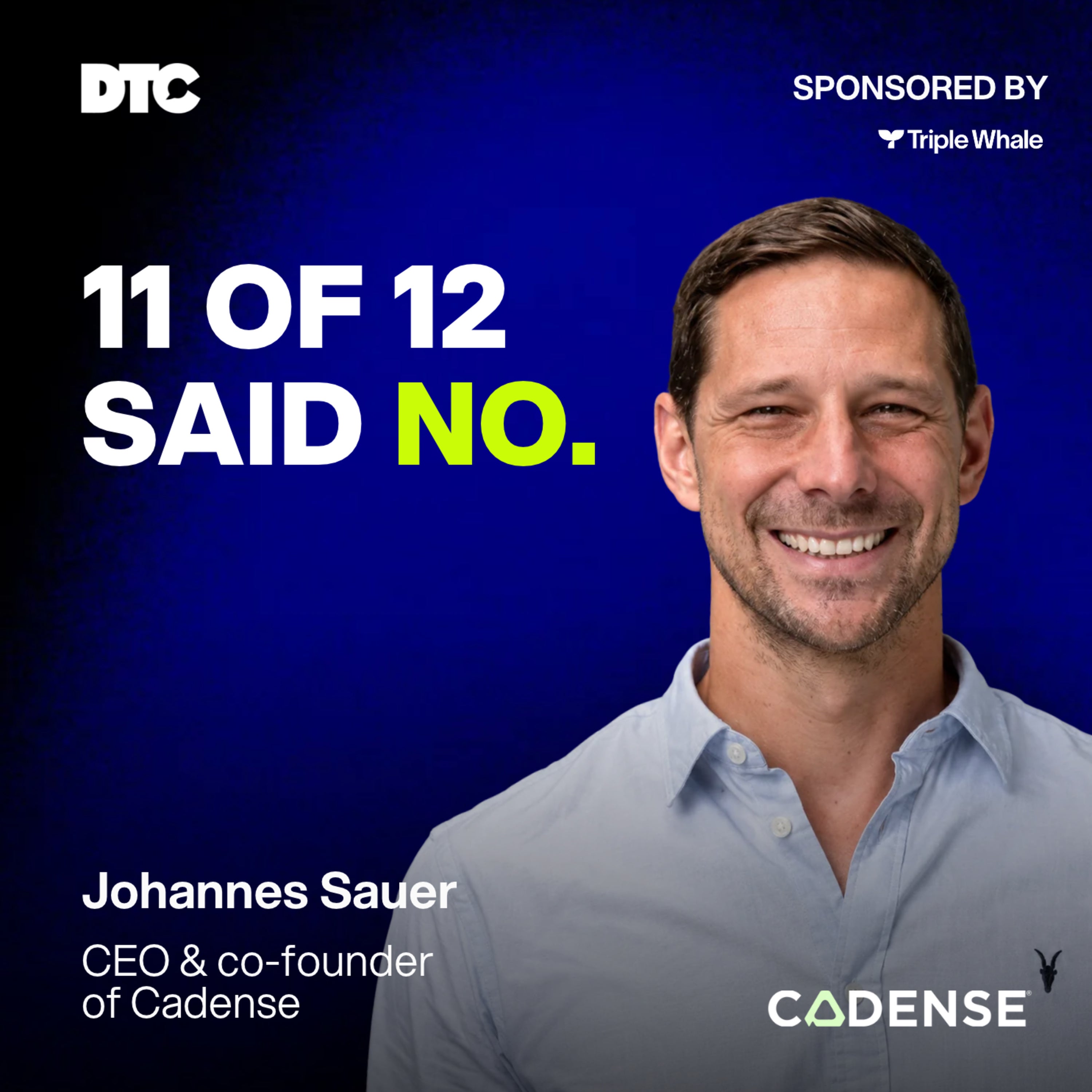
How do you market a DTC brand to older adults? Johannes Sauer, CEO and co-founder of Cadense, sells an adaptive sneaker to a customer base that skews 60 and up. His answer has been physical therapist referrals, linear TV and a call center, with Meta still doing the heavy lifting online.
Cadense makes a sneaker with nylon pads on the sole that let the foot slide over a snag instead of catching, built for people who trip after a stroke, with multiple sclerosis or Parkinson's, or simply with age. It looks like a regular athletic shoe on purpose. Johannes says Cadense passed ten million dollars in lifetime sales within 28 months of launching on pre-order from its own site. He walks through the clinician program that replaced a failed affiliate pitch, an eight-question checkout survey that 75% of buyers finish, and the channels that come next: senior living, retail and Medicare Advantage.
Get the DTC Newsletter: https://directtoconsumer.co
WHAT YOU WILL SOLVE
You want to test demand before committing to a production run. Cadense opened pre-orders on its own Shopify product page in September 2023 and had sold two-thirds of its first container by the time it shipped the following March. Pre-orders cash-flowed new colors and sizes for the first year and a half.
You're about to send launch traffic to Kickstarter. Johannes has run three Kickstarters and skipped it this time, so Cadense kept the analytics and a direct relationship with every early buyer.
Your ads can't promise what the product does. Cadense is a class one medical device, so early ads showed walking patterns like shuffling and let people recognize themselves. A recent retrospective study of 705 customers found an 87% drop in self-reported monthly falls, and Cadense always presents it that way.
Your affiliate offer gets turned down. Eleven of the first twelve physical therapists Johannes pitched said they'd happily recommend the shoe but wouldn't take a commission. Cadense sent them a sample pair and a postcard with a tracked QR code and discount code instead. More than 750 PTs in the US now recommend it.
Nobody finishes your post-purchase survey. Johannes opens with gender and an age bracket before asking anything that takes thought, and 75% of buyers complete all eight questions. The last one asks people to describe what bothers them about their walking, and the answers become ad copy.
Your customers aren't reachable online. Cadense runs 60 and 120-second spots on remnant linear TV that send viewers to an outsourced call center. One in five of those callers has no email address.
You assume the adult kids are the buyers. Johannes expected a 50/50 split between customers and caregivers. It's closer to 70/30 in favor of people buying for themselves.
Your audience isn't on Instagram. Facebook takes around 80% of Cadense's Meta spend.
Nobody searches for your product. Cadense spends on Meta top of funnel to create its own Google demand. AppLovin matches Meta on ROAS at a small slice of the budget but hasn't scaled past that.
DTC alone won't get you to a billion. Cadense is moving into senior living, specialty retail and Medicare Advantage, using its DTC track record as the proof point. The pitch to insurers: Johannes puts the cost of a fall to a health plan at $20,000, against a $200 shoe.
ABOUT THE GUEST
Johannes Sauer is CEO and co-founder of Cadense, which he built with Dr. Tyler Susko, whose gait research at MIT led to the shoe. https://cadense.com
STAY CONNECTED
DTC Newsletter, daily ecommerce marketing and ecommerce growth tactics: https://directtoconsumer.co
YouTube: https://youtube.com/@dtcnewsletter
LinkedIn: https://linkedin.com/company/directtoconsumer
TIMESTAMPS
02:00 How Cadense created its innovative footwear
06:00 Launching a DTC brand with pre-orders
13:00 Building a referral network of 750+ physical therapists
19:00 Increasing post-purchase survey completion rates
25:00 Reaching older consumers through TV advertising

Scan the code with your iPhone camera
Listen in the app.