Ask ChatGPT

 The DTC Podcast
15 Oct 2026 · 40m · 18 chapters
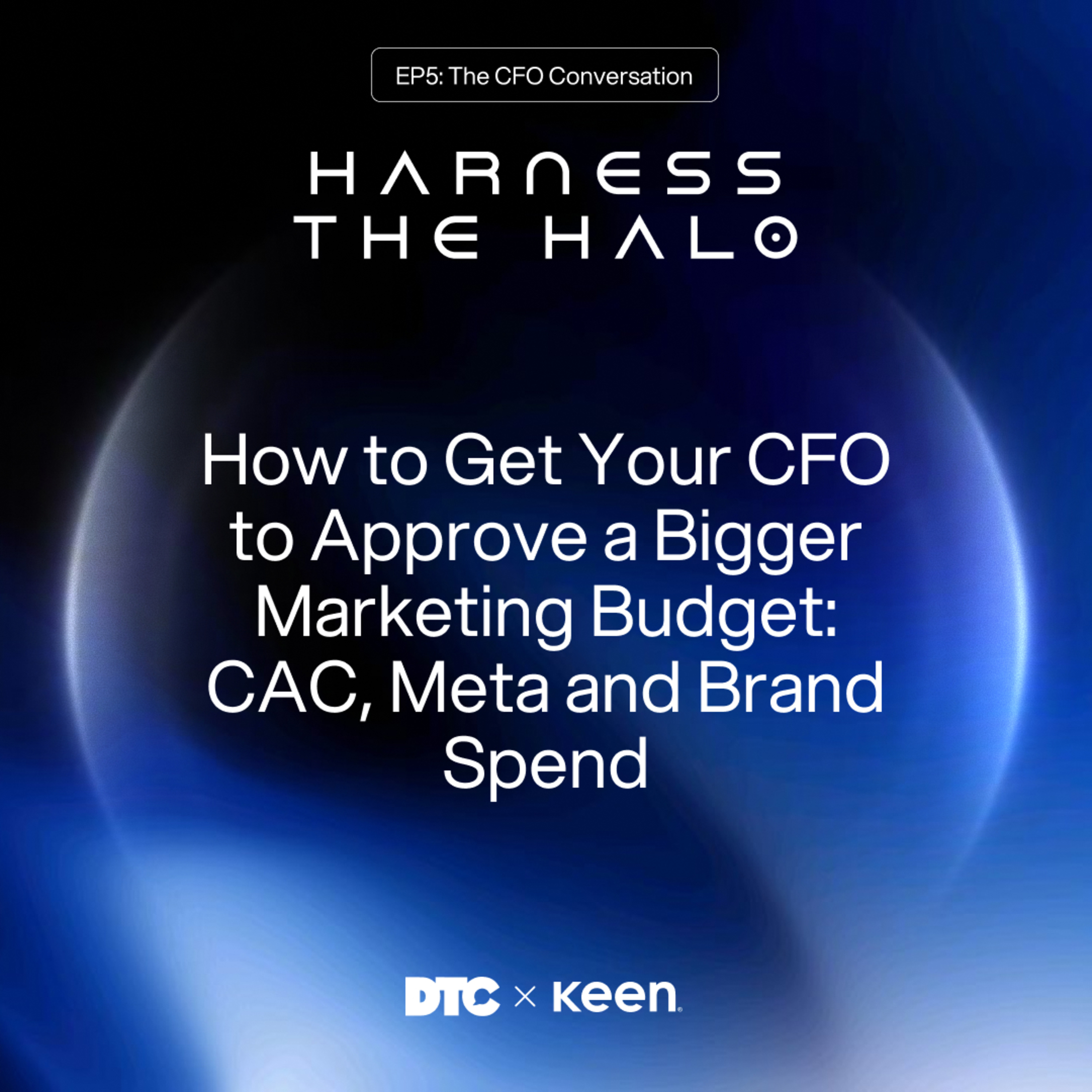
How finance leaders and marketing teams can justify and approve bigger marketing budgets by using shared CAC/contribution-margin language, scenario planning, and “halo effect” measurement (upper-funnel brand spend plus longer payback).
Drew Fallon, former CFO of Mad Rabbit; now CEO of Iris Finance, a finance platform for CPG/D2C brands. Claudia Latour, VP Client Services at Keen, working with brands to build measurement and scenario plans finance teams can approve.
Attribution tools are “guesses” with low confidence intervals; CFOs should focus on whether plans work for net income/EBITDA via contribution margin. Marketing must prove CAC impact; CFOs ensure budget fits the business plan and cash constraints. Upper-funnel cuts to hit quarterly goals erode brand and create “reverse halo” (base erosion). Bottom-funnel must be efficient enough (e.g., ~3.0 MER) to fund top-funnel.
Meta can be “ridden” to high scale (often up to ~$100M revenue); AppleLovin scaling can crush margins. Tribe within Meta can become administratively unmanageable at scale. Q4: more TikTok pullback and supplements delaying heavy spend to January.
Written by AI. May contain mistakes.
Learn about the significance of balancing direct response and brand investments for long-term success.
“Back in like 2020, 2021, it was a little bit of like a novel concept that like Amazon could benefit from like meta ads.”
Explore how Drew's views on marketing spend have changed over time, focusing on the halo effect and measurement challenges.
“So great to be mixing up with you, Drew.”
Discover strategies to foster collaboration between marketing teams and CFOs for better investment decisions.
“that I kind of believe in to like, I just don't even know, honestly.”
Discuss the importance of upper funnel marketing and the long-term consequences of cutting brand investments.
“pitch one of these upper funnel, longer payback period type exercises?”
Learn how to utilize scenario planning to make informed decisions about marketing investments.
“So we work through multi-scenario plans to be able to say cutting our upper funnel hits this goal for the next couple of quarters, but what it starts to also do is erode the brand, right?”
Understand the traditional frameworks CFOs use for financial forecasting and planning.
“What does that conversation actually look like?”
Explore how Keen helps clients model different scenarios to optimize marketing strategies.
“but you do have to have a bear case, and you have to be ready.”
Hear Drew's insights on ineffective marketing strategies based on his experience with various brands.
“We do, like, I recommend, like, about as far as, like, I've gone with it in the past is, like, just, like, elasticity around, like, CAC, for example.”
Exploring doubts about the effectiveness of App Lovin in scaling brands.
“So again, I think that maybe is reserved for the marketing folks who are just a little bit smarter than I think some of us.”
Discussing the need for a comprehensive approach to marketing strategies.
“Do you have a Apple Lovin case to counter at this point?”
Understanding how CFOs view marketing expenses and budgeting dynamics.
“But I don't know, honestly, the processing well enough to like say whether or not it like is legitimately unmanageable.”
The struggle between immediate sales targets and long-term brand investments.
“And whether that's like CPMs or CTRs or like creative output or like whatever else.”
Examining the implications of acquiring customers through investment funding.
“If you're a$10 million company, do you need to go spend a bunch of money on top of funnel brands, things that aren't going to continue to grow the business?”
Analyzing how marketing investments affect brand health over time.
“Any comments on the way that deal shook out?”
Learn about the dynamics between CFOs and CMOs in determining marketing budgets.
“But also when you have a base that's eroding, not investing in it kind of compounds the issue.”
Explore strategies for marketing teams to collaborate effectively with CFOs.
“And I think that's a bit of the struggle that we try and help.”
Discuss the challenge of trusting advertising metrics and data accuracy.
“The example that I gave earlier of the old school bean counter CFO, those are the folks where it's like you need to bring your keen data and you need to shove it in their face and rub it around until they understand it.”
Examine how businesses are adapting their marketing strategies for Q4.
“Yeah, but people would still go as hard as they could in Q4 only to realize that the returns are higher than normal and the churn is crazy and everybody is just discount shopping and all that.”

Get the gist, explore an idea or ask about something said.
 Claude
On The DTC Podcast, what are the key points of this episode?
Searching your listeningAutomatic transcript. May contain errors.
0:00Back in like 2020, 2021, it was a little bit of like a novel concept that like Amazon could benefit from like meta ads. We worked through multi-scenario plans to be able to say, this isn't going to help you hit this quarter's goals, but like here's also the long-term effect of not doing this. There's so many brands, all they do is just like hardcore direct response. It'll last for as long as it'll last for, but the reason that like Olipop and Poppy, whatever all these other brands like actually made it to the distance that they made it, is because they continue to invest in brand and top of funnel and everything else.
0:33The reality is that there's a whole ecosystem that's influencing your marketing.
0:45Hello and welcome to the DTC podcast. This is Harness the Halo, a six-part series with Keen on how better measurement earns you the right to make bigger bets. This is episode five, And today we're hearing from the finance side. Drew Fallon is the former CFO of Mad Rabbit and is now CEO of Iris Finance, a finance platform for CPG and D2C brands. Also joined by Claudia Latour, VP of Client Services at Keen, where her team works with brands on their plans that finance teams have to approve. So great to be mixing up with you, Drew. I've been following your financial analyses on both LinkedIn and Twitter for a long time.
1:23So it's great to have you here. Thank you. Yeah, I appreciate it. So you went from being CFO of Mad Rabbit to seeing the books of a lot of brands through Iris. Is there something that you thought about marketing spend back then that you've changed your mind about now? That's a very provoking first question. So maybe not necessarily, but I do think the number one thing that I've kind of seen over time is that sort of people are getting more and more accepting of like this halo effect. So like back in like 2020, 2021, which is like when I was running Mad Rabbit, it was a little bit of like a novel concept that like Amazon could benefit from like meta ads.
2:03Right. And people like wanted to like look at things in their very own halos. So I think I was always kind of interested in that. However, I guess if there was something that I think now that I didn't think back then, I thought back then that like it was probably like super measurable. And now I'm just kind of like, I don't even know if there's like a right answer or if like anybody actually has, you know, a really good method. it's undeniably true. But I think like attribution, incrementality, like all of these types of measuring tools, like they're great and they're helpful, but they're guesses and the confidence intervals are not always very high.
2:36So I think I went from saying like, hey, like this is something that I kind of believe in to like, I just don't even know, honestly. So maybe that's like my evolution. How would you respond, Claudia? Yeah, I mean, I would say your position coming from a finance layer is a lot of what supports the conversations where a lot of our marketing teams come to us and work with us and are trying to really find a shared framework in terms of how do they speak to their CFOs. And like our recommendation from a keen layer is to bring them into the conversation, really have them be a part of this and really show them not just what your gut and what all of your industry experiences is kind of coming into play, but really use the data that you have and actually start to talk through like a shared framework.
3:20So it's not really marketing versus finance, but really like, how are you guys looking at the data and sort of the next layer of decisions that you're going to need to make together? I think that's, that's totally right. Like the way that I think about it is like the, it's the marketing people's job to kind of like prove that. And then as like CFO, it's my job to just make sure that like, whatever the plan is kind of works in the context of the rest of the business. So like, I do think that like, that's an important exercise and distinction that like a lot of marketing folks like should be very, very focused on at the end of the day, as long as like the MER and the marketing spend are the same, you know, from what we're planning, then I think it's, you know, it's kind of up to the more smart marketing people to figure out the best like capital allocation for that actual budget line.
4:01Drew, you've argued in blog posts about ad spend living inside contribution margin. And that gets tricky when you're doing something like CTV or other brand building exercises where, as we've reported in this series on previous episodes, it can take months to see a return on. Like you guys are just saying, you just need to have a shared language to talk about the benchmarks you're looking for. But how do you, like, what are the benchmarks that I guess you're looking for on the finance side when someone does come in to pitch one of these upper funnel, longer payback period type exercises? So I think like really, like I said, everything goes down to like net income or like EBITDA, whatever you want to like call it basically the idea is that like contribution margin is kind of like the end of like the variable expenses um and then your opex is obviously like everything under that and so you have to maintain a certain contribution margin the opex stays the same right so even even a moves it's because it's because contribution margin is moving um so i think you have to just be able to make the case like to some cfo that like hey this is going to either increase our mer and thus our contribution margin, or it's a worthwhile risk to take to the point that like, hey, like if it does work, then the ROI is, you know, significant.
5:19I think in D2C specifically, like marketing drives the complexion of the business model so significantly that like, I do think that like the old school kind of like crunchy bean counter CFO is like not the right type of finance talent to be leading those businesses. I think they need to be like a little bit more progressive. But they also need to kind of like hold their ground and say, hey, like this is like how this is like the amount of money that the business is trying to make. And this is like the budget. So if you come to me and you say, hey, here is the case for how we could beat the budget, and you have a convincing argument like, hey, we can do this, we can do that, then there's a good chance that any reasonable CFO that understands whether what you're saying is probably true can think about how that might fit into the plan.
6:00Yeah, I would say from a keen layer, what you talked through, the conversation of upper versus lower funnel is probably one of the core things that we see our clients kind of confide in us that they're struggling to justify. We've seen multiple brands almost panicking because they're like, all of my upper funnel spend is getting cut in pursuit of hitting these short-term goals. So part of the language that we also start to work through with our teens is justifying and really showing the numbers behind what does it mean to invest in something long-term, right? Like you need to have that conversation and that shared framework to say, this isn't going to help you hit this quarter's goals, but like here's also the cost of the long-term effect of not doing this, right?
6:47So we work through multi-scenario plans to be able to say cutting our upper funnel hits this goal for the next couple of quarters, but what it starts to also do is erode the brand, right? And so here's the trade-off if we go this path versus this other path. So again, less instinct-based, even if your instincts are right, but actually allows you to show the numbers behind it. And I think like the bottom of the funnel sort of action, like they have to be good enough to support top of funnel investment. Like I, I think like so many, there's so many brands, all they do is just like hardcore direct response.
7:22And it's like, it'll last for as long as it'll last for, but the reason that like Olipop and Poppy and Coterie and whatever, all these other brands like actually made it to the distance that they made it is because they continue to invest in brand and top of funnel and everything else. So I think like it's like it's a little bit of like a greedy, like you have to have both kind of a thing. And it's really hard to do. But if you want to go the distance, like your bottom of funnel has to be able to pull like a 3.0 MER, then you got to put the other point of it back into top of funnel and brand. And you still have to be, you know, having good margins after all that, which is very hard to do.
7:59Can you put any more color, Claudia, on the kind of language or the actual metrics or conversations that you're having with both the marketing heads included in the financial discussions where you are making the case for these longer term things? What does that conversation actually look like? Yeah, absolutely. So one of the things that happens in the Keen platform is that we're able to look at here is your base. So everything in terms of volume that would have happened in the absence of your marketing efforts. And what we're saying in our platform is, and what we're trying to measure is the incremental impact of your marketing investment, right?
8:35So what we look at based off of leveraging your historical data, the historical model really being the starting point to kind of fuel the scenario planning that we do is we're looking at how that base progresses over time. So every tactic is marked as short-term or long-term. And so we, when you're running a scenario with us, we look at what are the potential like tails across all of those investments over time, how would your brand in theory move? So again, those upper funnel tactics are going to help to build that brand up versus your short-term tactics are really going to drive those short-term goals for you.
9:12So we could look at a plan that starts of, here's what, let's say marketing wants to do, maybe a more balanced plan that has a good mix of upper funnel versus lower funnel versus their worst case scenario, right? That more short-term focus plan. And then we'll look at, here's what your numbers look like year one. What happens year two if we run the same two plans on top of this? What are your outcomes look like? What happens year three from there? So really having that comparison of what's the long-term impact of making these two decisions instead of just fighting about what's at stake in this moment now, but what does it do to the brand over time?
9:49Drew, from your side, how do you work with, I guess, as a CFO, you are doing different kinds of scenario planning about rising costs or tariffs coming in. How do you work with scenario planning on your side of the biz? So the conventional sort of like framework for this would be bear case, bull case, base case, right? So like at the beginning of the year or like during your annual planning cycle, your finance department should be producing at least three scenarios for you. Hey, what if we get into that target rollout? Or what if we keep CAC flat the whole year? Or what if CAC doubles? What if we get delisted from Amazon?
10:25You know, like all these different variables. you should always have, in my mind, a plan to fall back on. And so it may not be fun, and it could be doomer-ish, but you do have to have a bear case, and you have to be ready. Like, hey, what if we miss our goals by 50 %? If the answer is if we miss our revenue goal by 50%, the answer is we then run out of money, that cannot be a surprise. You have to be prepared. You have to know what's going on. So I think in the office of the CFO, what we would typically do is just like sensitize a base case model. And we say, okay, like what if we beat it by 40 %?
10:59What if we miss it by 40? And then like at which point up and down does it start to like become untenable? Because oftentimes, even if you beat it by 60%, you can still run out of money because we have that whole thing that we call inventory, right? And so you should never be surprised by your cash position because you should have already planned out at least three scenarios. And that's like a very, that's very much like a sort of like squishy strategic finance kind of like pie in the sky type stuff. Like it's not super actionable or, or like tactical. So I don't know that like it gets into the weeds so much as like, I mean, theoretically you could model like different like halo effects and like marketing mix and stuff like that.
11:38And maybe that, that would be kind of like an interesting way to incorporate some like marketing plans and stuff. But I think usually that's kind of like CFOs just trying to figure out like what might happen. Claudia, that's what Keen does, I guess, right? Yeah. You know, A lot of our clients come to us having worked with his, you know, MMM providers that really just focused on report carding. And really, that's the first step. But where the bulk of our clients spend their time is really in sort of the scenario planning phase and really wargaming. What are the different potential outcomes? So when a new client starts to work with us and we've sort of gotten your historical model underway, there are sort of three base scenarios that we start to talk through with them to, again, get them to think about what are the range of scenarios that I might see.
12:25So the first is like a status quo, which is what if I did the same thing that I did last year? What does that potential outcome look like? Versus a, what does your current plan right now look like? So again, starting to measure the impact of your hopefully improved thinking based off of like what you've learned. And then we also start to look at like sort of your most rosy optimized scenario, right? What if you were able to just use the data to fully inform it? What is the high end of the potential? And even just starting with those three scenarios, it's really interesting to see the range and the sort of conversations that come out of that.
13:01But from a day-to-day basis, it becomes a lot of what you just described, Drew, of here are sort of the three scenarios that I'm thinking of or my ideal versus what I'm trying to fight against a best case. And even beyond just, you know, conversations around budgets, what we also talk through are the external environments that could potentially impact that, right? What happens if your distribution increases versus decreases? How does that change your current plan? As well as a number of other, you know, scenarios that we see our clients face on a day-to-day basis. Yeah, that's interesting. We do, like, I recommend, like, about as far as, like, I've gone with it in the past is, like, just, like, elasticity around, like, CAC, for example.
13:44So it would be interesting to even go, like, drill down, like, one step further and try to understand, like, why would, like, under what scenario, like, would CAC change, like, if we move from channel mix or whatever other types of measurements. Like, there probably is, like, a lot deeper that you can go. So again, I think that maybe is reserved for the marketing folks who are just a little bit smarter than I think some of us. Do you have any – are you sort of tactic or strategy agnostic at this point? I know you came from the D2C world. But are there any – when people come to you and they're like, okay, we want to invest here.
14:20Are there any things you just kind of roll your eyes at or any things you're like, okay, that's a red flag. You shouldn't be doing that. Do you see a lot of that or you just sort of like anything can work under the right scenario if the numbers line up? I've never seen a brand scale app love and spend and make more money. Interesting. Not one time ever on the 200 brands that we have in the portfolio. Never seen somebody make more money with app love and spend going up. That's interesting. That's not to say that it hasn't ever happened. Yeah. I've never seen it. And most of our brands are somewhere between 20 and 300 million.
14:53So sort of like middle market type folks. And they've been running Meta and Meta got them to 50 million. and then they're like they're topping out. So they look for another channel and then sometimes they start spending 200 grand a month on Apple Lovin and then it's like their margins go away. So I'm a little bit of an Apple Lovin skeptic. Anything to add to that, Claudia? Do you have a Apple Lovin case to counter at this point? Or is there, can you think of, do you have prebuilt opinions at all on certain strategies or tactics? So I think for us, the difference that really happens is that we get our clients to stop thinking about one particular tactic as being the hero, because the reality is that there's a whole ecosystem that's influencing your marketing, right?
15:39So we have general benchmarks for AppLovin or other vendors based off of like your industry, what we know about that individual business. But that changes from brand to brand, even brands that look very similar based off of what else you're running in tandem with it. So less about a hard conviction on a particular case and more about having our clients look at the holistic picture of what their overall marketing plan is going to be. Flip side, Drew, your question is, is there anything that you, that's a green flag, anything that you think that people are under indexing on that you have seen move the needle significantly?
16:18Oh, that's a good question. I mean, I think like meta typically, I mean, you can really ride meta as you guys know, like so far, like farther than you think, honestly, like you can probably ride it to a hundred million, you know, like pretty much all the time. And so it's probably maybe, maybe it's not like an exciting answer, but like it's, it's like the answer probably is meta, unless you're like doing like a couple hundred million. The answer is like probably meta. And then the one thing that's kind of come on my radar just in the past couple of weeks is within meta. Are you working with a lot of clients that are working with tribe drew that Actually, yeah.
16:55So like Lucas is a customer of ours, the founder, and we have a lot of TikTok brands. And I feel like they all kind of jumped on Tribe pretty early. Is that on your radio, Claudia? The Tribe aspect of Metaspense? Because basically it's created an amazing sort of network, like a marketplace for creators who actually drive GMV and they actually reward. But I've heard that at scale, it can become unmanageable. It's like really good for brands in a certain band. But when you're pledging one to 2 % of GMV based on winning creatives, it can get really deadly on a line item as it really scales. Do you see that as being a problem on the real high end, Drew?
17:38Yes, just administratively, like literally, because it's like, it is crazy. Like some people have like hundreds and hundreds of creators. It was something that we like considered like tackling, honestly, at one point. But it is like pretty unmanageable. But I don't know, honestly, the processing well enough to like say whether or not it like is legitimately unmanageable. I just know that like it is a bond. Like there's a lot to it. That was a challenge actually with our agency where we had this really performance heavy, where we were on the same skis as our clients, where we really wanted to focus on, okay, when we win or when you win, we win.
18:11We're able to make you win. That's really where we'll make our profit. But it just led us to having these wildly uneven line items for our clients. And then talking to CFOs like, okay, why did your agency cost you three times more than it did in the previous months? Well, they delivered three times as good a result. But from a financial side, you don't always see it that way. Have you had situations like that? Yeah. I mean, I think a lot of the times that stuff just comes down to what's like the actual dollar figure. So like, for example, like at Mad Rabbit, we had an Amazon agency that I very, very much enjoyed.
18:43And I'm friends with the CEO still today. and we ended up letting them go at some point just because like we ended up we were paying them like 60 grand a month or something um and it was like i don't really care like how good you are you know like i can i can hire two full-time people for you know two-thirds of that price so i think like ultimately it like has a little bit less to do with like what are the results that the agency's actually driving and more so like what does it cost us to like do this in-house and that's like usually well where you'll see cfos push back and it it can be like a little bit short-sighted um a lot of the time because sometimes agencies have like true advantages and like that's why they're driving the results but like when you're looking at it on the pnl and you're just like i could hire five people for this price you know like how could you justify this i think there is like it's there's there's some friction there for sure yeah claudia you had a question for drew basically when a marketing team walks into your office with a plan what are you assuming before they've said anything maybe describe to me back in your i guess if you're doing it now drew uh with uh with your clients, but previously you were doing it in the Mad Rabbit space.
19:45What are some of the assumptions that you and marketing share, I guess? Well, the big one is like CAC, right? So we have to be aligned on like a CAC goal because the output of our CAC and our spend and our returning customer revenue is our contribution margin, which is sort of the North Star in terms of like driving EBITDA. So everything else, as far as I'm concerned, is like downstream. And whether that's like CPMs or CTRs or like creative output or like whatever else. As the CFO, like I really don't care, honestly, like as long as you're hitting the CAC goal, you know, and then once you're hitting the CAC goal and if we're hitting our retention numbers and our LTV to CAC is kind of shaking out, you know, how I have it in my model, then, you know, I don't care how much you're spending on anything.
20:31You know, the unit economics are working and the business model is working. And so, you know, it's up to the folks that are, you know, like I keep saying, like a little bit smarter than us finance folks to like go and actually execute on some of that directive. Claudia, anything you'd want to dig in there with Drew on that question? I think that's really interesting perspective. And again, I think part of this comes down to like the shared language, right? Where brands know what they believe or sorry, marketers know what they believe. They know what they want to invest in. But I think it comes down to how do I translate it back to CAF in this instance, if that's all that you care about.
21:07I think that's the layer of like where, where they've struggled to actually explain that in a way that justifies the spend that they're, that they want to invest. Right. It comes back to that layer of like miscommunication almost. Yeah. There's a lot of like different data sources that people will be looking at, um, to try to like answer that question and they'll give you all different answers. And like, people will try to like use like AI to do it and like AI just lies to you and stuff. And so like, There are a number of organizational, I think, hurdles that present a challenge that are maybe incremental to what Claudia is describing too.
21:39And especially when you're dealing with a traffic source where in previous episodes in the series, we've talked about, for instance, CTV having a 30 % short-term impact and then a 70 % impact over the next three to six months. have you found a successful way for allowing CMOs to pitch those like longer payback period windows? Or is it really just a matter of, you know, maybe not using AI, but using third-party tools in order to kind of put a thumb on what it'll be in six months out? How do you deal with things like that? I think it kind of comes down to, I think we might say this like a different question, but like your direct response efforts have to be effective enough to support those other sort of like less measurable initiatives, right?
22:23So like if your MER is like 2.0, you know, and you're doing only direct response, like you don't have a ton of room to now layer in like some brand or like longer term initiatives, right? So you have to be driving like a certain amount of efficiency, I think, to actually like say, hey, now we can afford to invest in brand. And that's why like you don't see a lot of companies start to even do brand style stuff until 30, 40, 50 plus million in revenue because they just literally don't have like the dollars coming in to actually justify it. Every day is a fight of getting the next purchase. And so until that problem really goes away, I don't know that you should be doing a ton of brand stuff anyways.
23:02If you're a$10 million company, do you need to go spend a bunch of money on top of funnel brands, things that aren't going to continue to grow the business? Then I don't really think so, to be honest. Especially if, in your opinion, you can get to nine figures with a really good meta funnel. How do you react to that, Claudia? With all the brands that you work with at the different phases, when do you see it becoming really relevant that they look to invest more in that brand story? Yeah. I mean, I think this is probably one of the most consistent struggles that we see amongst our client base of like, what is that balance between upper versus lower funnel spend?
23:39And how do I, again, make that case and justify that investment when we're very focused on shorter term goals. And it really does come down to a layer of balance, right? Because there is the need to hit, again, those quarterly, yearly targets. But when you're not investing in brand, you also have to look at that longer term impact and that potential erosion that happens. So the way that we work through it is, A, making sure that we're aligned on, if this is the decision that we're making, what does it look like in the short term? But then we're also looking at scenarios on a two or three year basis to also say, you know, if we're totally stripping all brand spend, as an example, what does that impact look like three years from now versus just are we hitting today's goal?
24:26And that, I think, just facilitates a much deeper conversation in terms of why you're driving for that more balanced mix of investment. And I do think, just to jump in, it's a really, people say like, oh, you don't need to raise money for like a D2C brand. I think that's like a really good argument against that stance where it's like, like Groons is like a great example of like, they raised like a shit ton of money, um, you know, basically from day one, because why? Cause like they were building a brand, you know, and like in, and they wanted to make those investments early and often. So I think, um, there is like, you know, a big difference between like building a brand and like building like a DTC store and it's expensive.
25:03I'm curious on your take, Drew, I probably wrote about it. I don't know if I read it on, on the, um, the IM8, uh, investment story that just sort of happened where 70 % of the, uh, investment was going towards active customer acquisition. I don't always hear that as something people aspire to is having their customer acquisition funded by investment. Any comments on the way that deal shook out? Um, yeah, I mean, it's not terribly uncommon, honestly, like usually it's referred to as like revenue financing. and so like Wayfly or Figgable there's all these sort of MCAs it's the same thing as an MCA it's just like a much more enterprise grade version and so I think they are taking what I just said to a little bit of a crazy extreme in terms of like, I'm friends with those guys, they're crazy they're just spending as much as they possibly can on customer acquisition and they're convinced and I believe them honestly that they have the economics to back it up and to support that from a business perspective.
26:06So it was a little bit like, I texted Brian, the CFO, when they announced it. And I was like, this is kind of like community adjusted EBITDA kind of a thing. But yeah, they just got a giant MCA. And I think it is a vote of confidence though, because General Catalyst is a highly sophisticated investor. Typically those instruments are reserved for truly recurring revenue businesses. so like Lemonade was kind of like one of the success stories of using that that vehicle which is like Lemonade is like a you know consumer sass basically they're it's like an insurance company so yeah they definitely like took that to the extreme but it's it's not it's not like as unique as like I think they maybe wanted it to like appear the size of it was crazy the size of it was unique yes that's that was not that was not the first like revenue financing uh loan ever no of course Claudia you mentioned in your previous answer there just about the idea of like maybe cutting upper funnel to hit a quarter.
27:01Do you have an example of, without giving names, of a client who maybe did that and then what the numbers looked like a year later? This is like the reverse halo effect, I guess, right? Have you ever seen the reverse of the halo effect happen with a client? We absolutely do. So when we talk through multi-year planning or even just looking at the impact of your investments, right, we're looking at that tail, right, where your lower funnel investments, the bulk are coming through in that first like about three months through the first year. And the reverse is happening with those longer tail investments.
27:36So that's one of the things that we're able to break down within the platform is how is that contribution from your marketing investment happening over time? And then also, what does that look like against your base? So this is one of the things that we see with a lot of our clients that come in is that like their base over time is declining, which is one of the things that is really difficult to balance because again, they're very focused on that short-term goal to help sustain the business. But also when you have a base that's eroding, not investing in it kind of compounds the issue. So we continue to see that trend line continue rather than it starting to like level off and reverse essentially.
28:15Drew, in an organization, in a 20 to 40,$50 million organization, who actually owns the marketing budget? Is it a situation where the CFO is sort of dictating what's available and then a CMO is kind of going in and determining what investments are made within there? How does that process look? So there's a difference between who does and who should, in my opinion. So I think like more often than not, it's probably the marketing leader that's driving the budget. The reason that I believe that to be suboptimal is because it's like a multi-variant equation, right? And so like, like they're like these businesses have working capital, right?
28:57They have operating expenses, right? And so to ask a CMO or, or VP of marketing or whatever level to be able to like contemplate a marketing budget in the context of the broader financial model is like a very tall, that's like a CEO level, like ask, right? And so I think on the flip side of the coin, it's very, very rare that you find a then CFO who understands like digital marketing and e-commerce and LTV to CAC who can actually then take it and do that marketing part and understand the broader context of like the cash conversion cycle and the operating expense, the capital structure, et cetera.
29:36And so this sort of like perfect CFO, speaking of Iomate, like Brian, like if you ever, I have a podcast with Brian Rosen, the CFO of Iomate, like he's like an example of somebody who's a very very rare individual who actually like understands like e-commerce unit economics growth marketing and can go out and raise you a billion dollar facility right so like i think it's it's it's nobody's fault that this has never done that well um it's just that like it's so so so rare because e-commerce specifically is so unique in the standpoint of like candidly like marketing and finance are the same thing in in this part of business.
30:11And so like, there's like a spectrum and the CFO, like the sort of old school, like being counting CFO, like would never be able to like, you know, help you do that. But on the other hand, the, you know, typical sort of like CMO is never going to be able to like tell you, Hey, this CAC target is tolerable or not like given our like inventory lead times, you know? So it's, it's, it's, um, it's a really, really hard conversation, but I think like My answer would be, it should be the CFO with the caveat of they need to be able to understand growth marketing, which is pretty rare. What do you think of that, Claudia?
30:46And then I guess, how does Keen help bridge that gap? Yeah, so I'd say that the dynamic that you described is super common in our client set. And I think that's a bit of the struggle that we try and help. Again, more often than not, we're working with the marketing team. So we're trying to help them find a shared language, like coming to the table as a team, because I think the reality is that based off of exactly what you described, like no one side is fully equipped to own it without the other's input. And at the end of the day, you are actually on the same team. So the way that we work through clients is that like we invite people to bring their CFOs into the conversation, right?
31:25We invite you to bring your broader team because we understand all of the battling dynamics that kind of come into play. And for us, we don't necessarily have like skin in the game in terms of what output looks a certain way. We're looking to be sort of just the truth layer to help facilitate you all making the best decision for your business overall. right and and the other layer of it as well is that you know depending on the decisions that you come to for any given period of time part of our process is also to refresh on a consistent basis to be able to say last quarter or last month we believed that these decisions would lead to x result and then what we're also measuring is like did that happen why or why not and then how do we pivot based off of that because even if you are perfectly forecasting the outside world is changing your goals are changing so we're also just needing to consistently have that conversation even if there isn't like this adversarial dynamic and then drew how does that land with you i think i think you when it comes to marketing measurement tools like how deep do you go in with tools like keen in order to justify marketing spend um i i i honestly personally have never been inside one of those tools i mean besides like the triple whales or like Northbeams, like the attribution style stuff.
32:46I don't know Keen very well. It sounds like a little bit more like enterprise of a tool. But I think, again, like the attitude that I would take into a conversation like that would just be like, hey, like, what is CAC? And if you want to prove to me that like what you're doing is driving CAC in a certain way, then like bring all the data that you can. And let's have that conversation. And I would love to see all of it. But at the end of the day, it's basically coming down to that one number, which is CAC. So I think the goals for various brands might vary, but part of our engagement is also understanding what is your business's goal, right?
33:26What do you need to do to justify the actions that you're choosing to take? What does success actually mean for you? So I agree with that fully in the realm of if your CFO doesn't believe the outputs or isn't understanding what we're showing, that means that we need to change, again, what we're driving towards to be able to continue to hit your goals. Otherwise, we're just a platform versus what the whole team can leverage. The example that I gave earlier of the old school bean counter CFO, those are the folks where it's like you need to bring your keen data and you need to shove it in their face and rub it around until they understand it.
34:08Because those types of folks are going to have a very difficult time understanding. I forget the 70 % lift on CTV or something over time. That's real. But those old school guys, those CFOs, they would never be able to comprehend that. So I think that's like a really good use case for certain types of platforms to come in and start to prove that out because you do need it for the actual like long term health of the business. I agree with that as well. And that's where, you know, we, we arm our clients with the data, but we also are there to back them up in that conversation as well to explain, you know, the nuts and bolts of how we're measuring.
34:43And again, making, making sure that there's like confidence across the board. When you say, based off of the plans that I ran in Keen, I feel super confident that X decision is how we want to proceed. Last question. I've asked it of everyone in this series so far. What's a number that you have stopped trusting in this process? We'll start with you, Drew. Any numbers that you've just really stopped trusting? Basically, just like anything that's inside of like an advertising platform, basically. Why? Because when you add them all up, it's all higher than what you get on your P &L. And it's like, well, you're all lying.
35:19So I think that's like a really good use case for like a third party tool, honestly. Yeah. What do you say, Claudia? I'm a little biased, but I'm going to agree with you in that sense. because from that layer where we work with our clients is like there's layers of truth in it. But if you are asking anyone to grade their own homework, everyone's going to give themselves an A. Everyone's going to take as much credit as possible. And, you know, if that was the case, there wouldn't really be room for tools like us because you wouldn't need that third party layer of truth. Real last question. We are in the heat of Q4 really heating up here.
35:58We talked a little bit about it on off camera there, Claudia. But what are some things that are maybe different about this year's Q4 than previous years? Is there anything you're seeing? Are there more conversations being had? Is there more trepidation? What is different about this Q4 than previous Q4? Start with you, Drew. That's a good question. I feel like this year, we've actually seen more people kind of pull back on certain channels like TikTok, for example. Like I think last year people, this is like purely anecdotal. I don't have any data with me to back this up, but like people were like, I think a little bit more willing to lose money on TikTok last year and like see like the halo benefit kind of around the rest of the channels, which I think is like still like very, very real.
36:41But again, just anecdotally speaking, like I think I'm, I'm hearing a little bit more about people saying like, Hey, like we're not just going to like spam views on TikTok this year because we lost a bunch of money last year, or at least we think that we did. And so maybe we should just focus on like a little bit more of like the core channels. And also, we do a lot of work with supplements businesses. And I think in supplements, people are kind of realizing that Q4 isn't the right time to spend that much. Q1, new year, new you, right? Yeah, but people would still go as hard as they could in Q4 only to realize that the returns are higher than normal and the churn is crazy and everybody is just discount shopping and all that.
37:24So I've talked to more than a couple of founders and supplements that are like, yeah, we're just, I don't care about Q4. We're waiting for January kind of a thing. Interesting. What about from you, Claudia? I'd say right now a lot of our clients are being conservative, just kind of trying to hedge their bets against what the economy might hold, layers that are sort of outside of their control. So yes, a layer of going, you know, trying to lean into those like core, those sort of like core tactics that are tried and true, but also wanting to balance that without like leaving dollars on the table in other places.
38:00So I think those conversations about how can I put my best plans forward and then also, you know, not over promise in this regard. Thank you both for coming on the podcast. Drew, tell me, first of all, I got to say, my daughter's name is Iris. It's the most beautiful name in the world. How did you pick this for your finance company? Iris is meant to like give you visibility into your business. And so the platform is meant to give you visibility in your business, past and future. And so Iris was like kind of a, like it's like the eye, right? So the eye, not the flower is why. It also means rainbow apparently.
38:37And it's also a great Goo Goo Doll song. So - Great song. It was a really great song. I found that song after I named the company and I was like, wow, this is a great song. It's beautiful. I like your tagline, Iris Finance, your P &L is lying to you. So go to irisfinance.co if you want to work more with Drew, especially if you're in that supplement space. And then how would people find you, Claudia? Yeah. So I'd say our sales team is out in the market at various events, but also KeenDS is where you can find us. You can learn, you know, initial information about our platform and then also receive like a demo and find out a lot more about what we do.
39:20Thanks so much for listening to today's episode. If you're not a subscriber to our newsletter, you can do that right now at directtoconsumeralloneword.co. I'm Eric Dick, and this has been the D2C Podcast. We'll see you next time.
39:37Thank you.
How do you get your CFO to approve a bigger marketing budget for a DTC brand? Drew Fallon, former CFO of Mad Rabbit, says finance is watching one number, CAC, and that brand spend only gets funded once direct response is efficient enough to pay for it.
Drew is now CEO of Iris Finance, a finance platform for CPG and DTC brands, where he sees the books of 200 brands, most of them between $20 million and $300 million in revenue. He joins Eric Dyck and Claudia Lauture, VP of Client Services at Keen Decision Systems, to work through the argument between marketing and finance, including who should own the budget and when a brand can afford upper funnel. You walk away knowing what to bring into the budget meeting and how finance will score it.
Get the DTC Newsletter: https://directtoconsumer.co
WHAT YOU WILL SOLVE
ABOUT THE GUESTS
Drew Fallon is co-founder and CEO of Iris Finance and the former CFO of Mad Rabbit. https://irisfinance.co
Claudia Lauture is VP of Client Services at Keen Decision Systems, the marketing mix modeling, planning and forecasting platform. https://keends.com
HARNESS THE HALO
Harness the Halo is a six-part series from DTC and Keen about the spend that doesn't pay you back the same day, and the measurement that gives you room to make it. This is episode 5 of 6, and a new episode drops every other week.
SPONSOR
Harness the Halo is presented by Keen Decision Systems. Keen measures the incremental impact of every channel on sales, revenue and profit, and forecasts how a channel will perform before you spend in it. https://keends.com