Ask ChatGPT
 The DTC Podcast
1 Oct 2026 · 40m · 24 chapters
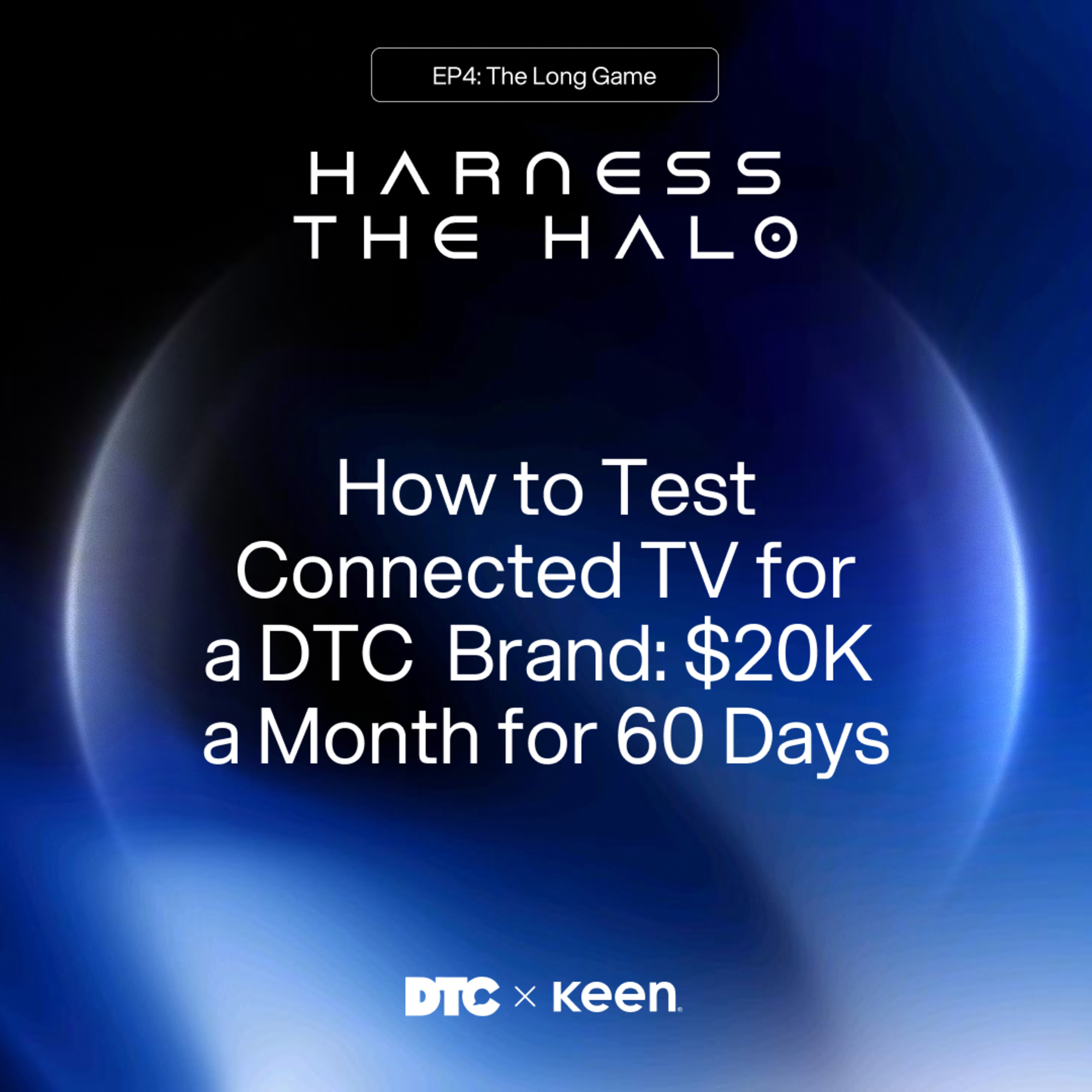
How Carve Designs tests and scales connected TV (streaming) and direct mail for a DTC brand using incrementality, MMM, and forecasting; why ROI can mislead and how to plan for diminishing returns.
Hannah Fleming, performance marketing leader at Carve Designs (coastal lifestyle/apparel brand; runs direct mail for ~10 years, now also connected TV). Jesse Math, VP Strategic Partnerships at Keen (measurement/forecasting platform; helps brands plan and measure incremental lift across channels).
ROI averages hide diminishing returns; better decisions come from incremental causal lift and holdout tests. Direct mail’s “halo” shows up in correlated revenue spikes and higher LTV, and CTV compounds over time. CTV can drive short-term site/search impact and longer-term conversion lift.
Carve’s 60-day CTV test at $20K/month; KPIs on target, conversion rate up for users who saw CTV plus clicked email/paid social; CTV impact ~30% short-term, ~70% over time. Pinterest trials underperformed. TikTok took ~6 months to show momentum; whitelisting took ~18 months.
Written by AI. May contain mistakes.
Learn about the complexities of ROI and its implications for marketing decisions.
“The truth is that ROI is an average number across your full investment.”
Explore how Carve Designs has utilized direct mail for marketing and retention.
“Carve Designs has spent years funding direct mail, connected TV, and loyalty, none of which pay you back necessarily on the day you spend the money.”
Discover how Carve Designs measures the impact of direct mail on overall revenue.
“So we're able to see the revenue pretty clearly every time a catalog is in the mail.”
Uncover how direct mail's effectiveness is tested and its long-term value assessed.
“But do you see it across other channels, whether that be meta, Google or streaming or anything else?”
Learn how direct mail influences the overall media planning for Carve Designs.
“influences a purchase, the investment that you made in today's activity deserves credit for incrementality for the future value of that customer also.”
Examine the investment required for direct mail and its expected returns.
“Because direct mail is one of the foundational layers of the plan.”
Discuss how Carve Designs plans to scale its direct mail efforts effectively.
“And because it is an established channel that we know, we've talked about the IROAS that we've seen from it.”
Learn about the transition of Carve Designs into the streaming marketing space.
“And are you at the upper end of how much you can scale it?”
Learn about the initial testing phase for brand awareness strategies.
“there of like, okay, what else can we test to grow brand awareness?”
Discover the outcomes of a 60-day test and its impact on traffic and KPIs.
“Maybe we can go a little bit smaller or some platforms allow that.”
Understand how connected TV affects customer conversion rates and overall performance.
“extends across retail and apparel brands as well as CPG brands.”
Examine challenges in forecasting and evaluating CTV attribution effectiveness.
“And then again, going back to that conversion rate lift that we see across all channels, it really does have a halo.”
Learn how to model the potential impact of investments based on historical data.
“It's like, are we optimizing for new conversions or did we just like find inventory sources that our audience watches?”
Explore how to evaluate the performance of various marketing channels, including CTV.
“So that now in the next planning period, we could say, should you have spent more?”
Delve into the long-term effects of advertising spend on brand performance.
“But Pinterest is one that stands out because especially for our category, I think inherently you would think it makes sense.”
Learn about adjusting marketing strategies based on advertising performance metrics.
“And I think a lot of brands really approach this question in a very binary way, right?”
Learn about the delayed return on investment seen from connected TV ads.
“And we gave it some time and it's taken about six months, but we're starting to see the momentum there with our ads as well.”
Discover the complexities of advertising channels and the importance of transparency.
“So I think that there's also, there is a degree of like, you just have to put the systems in place and give things a bit of time to ramp up.”
Explore effective strategies for using TikTok to build brand presence.
“And you mentioned TikTok and earlier in the pre-interview, we were talking really about your move into affiliate for Q4.”
Examine the evolving promotional strategies for the upcoming Q4 season.
“It's not in our immediate plan, but definitely we're going to consider it for 27.”
Understand the impact of expanding product categories on marketing efforts.
“Speaking of price and promotion and Q4 prep, Hannah, are there any big bets that Carve is looking to make this Q4?”
Learn how to approach media budgeting when introducing new product lines.
“I have a question for Hannah, if that's okay.”
Identify emerging channel trends and the importance of a balanced marketing approach.
“Eric, I guess the answer to your question is this holiday season, I'm excited about Hannah's capacity to spend.”
Discover how AI tools enhance marketing decision-making processes.
“Are there any really standout AI tools that your team is using to support what you just spoke to?”

Get the gist, explore an idea or ask about something said.
 Claude
On The DTC Podcast, what are the key points of this episode?
Searching your listeningAutomatic transcript. May contain errors.
0:00The truth is that ROI is an average number across your full investment. Let's say you have a$2 ROI and you spent a million dollars on any channel. The question is, if I spent one extra dollar on top of that million, am I going to get$2 back? Probably not. So ROI can actually be a pretty misleading metric on which to make decisions over your next dollars. TikTok, we didn't see immediate ROI in platform or in any of our tracking tools, but this was another channel that we wanted to continue to grow, both on the organic side and paid. We gave it some time. It's taken about six months, but we're starting to see the momentum there with our ads as well.
0:36You just have to put the systems in place and give things a bit of time to ramp up.
0:46Hannah Fleming: Hello and welcome to the D2C podcast. This is Harness the Halo, a six-part series with Keen. Every episode ladders up to one main argument. Better measurement earns you the right to make bigger bets. This is episode four. Carve Designs has spent years funding direct mail, connected TV, and loyalty, none of which pay you back necessarily on the day you spend the money. Hannah Fleming runs performance marketing at Carve and was just on the show recently to talk about how they built retention in a really interesting way. Jesse Math is VP of Strategic Partnerships at Keen. Today, we're going to dive deep with Hannah about how some of the bets that she's been able to take looked wrong before they looked right and how she decides where the next dollar goes.
1:26Hannah Fleming: Welcome back, Hannah. Welcome to the D2C podcast, Jessie. Let's just start with direct mail. Direct mail is something that Carve has run for, I think, for 10 years, but you've introduced some changes to the program. Maybe talk a little bit about the direct mail program at Carve. Yeah. So first of all, thank you for having me back again. So at Carve, we have a few different channels that we run. So we have your standard catalog, which we just have our fall catalog right here, where we break up those groups in prospectors and existing buyers. And we have five catalogs that we send out a year. We then layer on programmatic direct mail with things like site abandonment, card abandonment.
2:05And then our third layer that we layered on last year was a win back series that also is a postcard that's attached to the rest of our win back flow, your standard win back in email and SMS.
2:18Hannah Fleming: So it sounds it's pretty standard retention, not standard, I guess, because a lot of brands don't run mail, but this is a retention play. How do you describe the halo that the direct mail program casts over the rest of the business? Yeah. So we're able to see the revenue pretty clearly every time a catalog is in the mail. We see those revenue spikes very consistently. And then we use a few different measurement tools in order to actually track that. One of which I think I spoke about last time I was on, which is prescient and MMM tool. And basically we track then the days that we're spending money on direct mail and then the correlated revenue spikes that happen on those days so that we can attach an actual ROI to our spend.
3:06And then we also do matchback data. So we have an awesome agency and they work to get us clear matchbacks of, okay, these customers were mailed a catalog during this time period. Did they purchase during this time period? They factor in the other communication that we're also sending out at that time via email, paid, et cetera. And we're able to attach an actual ROI there.
3:29Hannah Fleming: Is direct mail exclusively for pre-existing customers? Are you mailing catalogs prospectively to people that you think would like the brand? Both. So we have a very large portion of the budget is prospecting as well. and that kind of changes throughout the year, that percentage breakdown. But we absolutely look at it as a prospecting channel too. And then where do you see the halo? Obviously, it shows up in last click in email purchases and things like that. But do you see it across other channels, whether that be meta, Google or streaming or anything else? Yeah. So we actually haven't looked at the specific conversion rate across those other channels with direct mail.
4:08We look at it for some of our other marketing channels. But again, going back to that overall revenue lift, that's where we really see, you know, we see the lift there. I'd be curious, though, if Jesse does track that with any brands, if, you know, there's a different way that you guys look at direct mail. Yeah, you know, I think direct mail is a really great use case and a really great question because it tends to be attributed with a lot of the revenue because it is so deterministic, right? You have names and addresses of people that you're sending mailers out to, and then you have names and addresses of people who buy.
4:44And that seems to be a one-to-one connection. The question that Keen is interested in tackling is how many of those people that bought would have bought anyway without the direct mail? And how much revenue is direct mail actually causing, even understanding that the consumer journey is exposed to multiple channels? So that's ultimately what Keen measures is what's the incremental causal lift revenue that any channel, direct mail, TV, out of home, social search, all measured in the same way, which is what's the incremental contribution that they're providing, understanding that there are interaction effects across channels and interaction effects between your channels and your other business strategies like price, promotion, distribution, because all of that matters.
5:36One other thing I would add to it is not just what's the short-term impact of direct mail and other channels, but what's the long-term value of direct mail? When you spend, Hannah, on sending mail out to a new customer and that direct mailer really influences a purchase, the investment that you made in today's activity deserves credit for incrementality for the future value of that customer also. So it's in one case, ROI for direct mail can seem inflated because it's so deterministic. On the other hand, it can be deflated if we don't understand the long-term impact of today's activity. And that's a great point.
6:17And kind of going back, Eric, to your question, we do incrementality testing. That's like really at the core of the direct mail program. We are constantly doing holdout panels. We also, you know, we've done that with holding out to email non-subscribers as well. So then we know these people are not getting emails during this time period either, and also email yeses. So we've played around a lot with that, and then also suppressing them across paid social too. So we have played around with quite a few different incrementality tests over the years to show the incrementality of the channel for us.
6:53Hannah Fleming: And so what does it show? Do people that receive the catalog on an annual or quarterly basis tend to have higher LTV, I would imagine. Yes. Yep. Clear as day. Clear. I was on with our direct mail agency this morning and, you know, we're starting to talk about how we want to test for 2027. And, you know, we reflect on, okay, we've tested all of these different ways. It's clear that this channel works. How can we continue to make sure that we're testing to continue to show that incrementality? And now we're really fine tuning. You know, We think about things like, does a customer need five catalogs a year?
7:29Do they need four? What size of the catalog? How many pages? All of these different factors then can come into play once you show that the channel works. That's really interesting, Hannah, and I think something else that's interesting is how do you plan media now in light of that direct mail schedule? Because direct mail is one of the foundational layers of the plan. The question is, well, how do you fill in? What do you do the week that the mail is going out? What do you do in week two, week three, right, to fill in the gaps? And that's part of probably holistic media planning and business forecasting is like, well, how do we expect these other channels to perform in light of what we think we're going to do from a volume perspective of direct mail?
8:09And then when we go back and review omni-channel performance, it's like, well, did we actually send out all the pieces that we thought we were going to? And if we did, great. And if we didn't, how did that impact the performance of other channels around it? Exactly. Yep, exactly. We factor it in and then we tweak our spend in other channels around when the catalog is in home.
8:29Hannah Fleming: And so with Carve having done this for the past 10 years, you obviously don't need to make a big case for when you want to invest more. What does investment in direct mail look like? Is it one of those channels that's sort of outsized, like SMS, for instance, where the return on your SMSs can vastly outstrip the cost to send those SMSs? Is direct mail a similar thing or do you have to invest? Obviously, there's physical aspects to it, so there's more investment. But talk to me a little bit about the investment side of direct mail and whether or not you've had to make serious cases to raise that investment.
9:00That's a great question. And because it is an established channel that we know, we've talked about the IROAS that we've seen from it. When we think of if we want to scale it, we typically do like a tiered approach a bit. So it's more like, OK, if we were to invest this much, this is the expected return there. It's less proving the viability of the channel. And then from an ROI perspective, it varies a bit based on the actual piece. There's a lot of factors, but we do look at the contribution per piece. That's like one of our core KPIs that we're reviewing as far as if it was successful. Yeah, I could chime in on that.
9:40I think what Keen adds to our customers on top of that is the truth is that ROI is an average number across your full investment. Let's say you have a$2 ROI and you spent a million dollars on any channel. The question is, if I spend a million and one extra dollar on top of that million, am I going to get$2 back? And the truth is, probably not. The first dollars that you're investing are going to have a higher ROI than the last dollars that you're investing. So ROI can actually be a pretty misleading metric on which to make decisions over your next dollars. The better question is one of diminishing returns.
10:19And so the question that I'm sure Hannah and her team really thinks about is, where is my next dollar going to make the maximum impact? Just because direct mail seems like it's working really well, do we continue to lean in on that? Right? Does it mean that we're already doing four mailings a year and now we should do five? or will that fifth make it less profitable and less efficient because now we're overspending on the same audiences? So it's a really important frame to think about the diminishing returns, even of successful channels and identify, Hey, can we, do we have room? Do we have runway indirect mail or would our next dollar, are we like pretty well maxed out there?
10:58And now our next dollar would perform better somewhere else.
11:02Hannah Fleming: When it comes to scaling that channel, Hannah, like what are your main levers? Is it, is it sending to more, it's just sending the catalog to more people. It's sending more pieces to the same people. How do you think about scaling that? And are you at the upper end of how much you can scale it? Yeah. So I'll tackle that, the first part of that question. So as far as what levers we have to pull, there are, you know, additional audiences that you can tap into. And then we also segment our audience. So then 13 to 24. And we can play around with the weighting between those two. Certainly also factoring in diminishing returns there.
11:41And we look at our own internal prospecting file too. So there's all these different audiences that we can kind of tweak and weigh depending on the season as well. So for us, we used to be a really swim heavy brand. We are now apparel focused or apparel led, I should say. And as we continue to try and get more summer buyers into fall, for example, that's going to tweak what that mix looks like in fall, where we potentially want to bring back a spring buyer in fall. So we might change our audiences there. So that's a lever. And then another, there's the size of the catalog. So like a physical, the physical size of it, is it smaller?
12:19How many pages are in it? Those are a few of the factors. And then the holdout tests, of course, are also when we're looking at the overall marketing cost, that's a factor and a lever that we have to play with. And then of course the in-home dates too, just kind of going through all the different factors. There's so many here. And then an interesting one is also how catalog plays with other direct mail channels. And this might be a little bit too in the weeds, but we do factor that in because do I want to be sending a boomerang and a win-back postcard to somebody who's also getting a catalog during the same time period?
12:52Cause then it actually is harder to track the incremental return on that piece as well. So we really try and factor in the whole ecosystem when we're thinking through expanding any channel.
13:05Hannah Fleming: On to streaming. We talked a little bit about streaming on your interview that came out this past week or coming out soon. And so that maybe represents a channel that you kind of pioneered a little bit more. Like we say, the Carve's been doing mail-outs for 10 years or so. Talk to me about your decision to jump into streaming, what were you seeing maybe in your other acquisition channels meta that made you realize, okay, it's time to get more omni-channel. It's time to focus more on something like streaming. Yeah. So I'll definitely give huge credit to the rest of the team that also helped pioneer our connected TV activations.
13:43But we were at a point where we were ready to move up the funnel and really connected TV was the channel that we were interested in. We, you know, had seen success from other peers. And certainly as acquisition costs rose on Meta, you know, there was also a timing consideration there of like, okay, what else can we test to grow brand awareness? So that was really what led us to the conversation. And then it became an exploratory, like anything, we start with a test. And, you know, we have really set time window for our test, clear objectives that we think, you know, objectives going in and clear targets.
14:23And then we run the test and kind of see what the outcome is there. But for us, it was more so like we wanted to grow our brand awareness and this felt like a great channel to do so.
14:33Hannah Fleming: What was the approximate size of the test? And then I guess, where did you see its impact first? We did a 60-day test and for us, it was a 20K minimum per month. So I think that's pretty standard. Maybe we can go a little bit smaller or some platforms allow that. And we saw the impact in direct. So direct traffic to site as well as search. And then all of the KPIs that we track through the program were right on target or slightly beating target. But when we think of like the halo effect that this is a channel where you do really see it. We also were using our MMM tool at the time. So it's also easy to see the halo effect directly in that tool.
15:19Hannah Fleming: And where did you see it, I guess? Did you see it mainly in, did you see it in retention? Do you see it in meta? Do you see it everywhere? The way that we're looking at it, I mean, when we look at just where's the revenue, we can kind of see it in our MMM tool there. We also see, so that's one place, we see that our conversion rate is up across the board for customers who have viewed both a connected TV streaming ad as well as clicked on an email or click through paid social. We do look at that through GA4. Jesse, from your end, where are you seeing it show up? Where is streaming showing up in your clients' ad stacks?
15:58Yeah, it's certainly a growing segment across our clients, which extends across retail and apparel brands as well as CPG brands. We're seeing the investment rise both in terms of just CTV as a channel in and of itself, also as a really important part of retail media investment today. It's a channel that different brands buy very differently. Some do view it, like Hannah talked about it as, as an upper funnel channel. Others are buying it truly as a performance channel. And there's not one right answer there. It's like there are different mechanisms and different approaches based off of the role that it plays in your media mix.
16:40So the way that we measure, again, is based off of the incremental impact that it's having at the level of a brand's P &L, sales, revenue, profit. And we see its impact both on short-term and long-term time horizons. So for brands that are buying it from more of an upper funnel perspective, We see the incremental impacts on sales, revenue, and profit. We see about 30 % of it in a short-term duration just after activation. But then we see about 70 % of it over time. So it's really a channel that compounds its value and really works hard to not just generate awareness, but the kind of awareness that actually converts to sales and revenue in the future.
17:22Hannah Fleming: Does that check out with what you're seeing as well, Hannah, that you kind of you did it as a as a awareness generation sort of play, but that it has real benefits just on the performance and, you know, short term benefits as well? Yeah, definitely. So we look at cost per site visit. That's one of our key metrics. But then we also do track ROI. And again, sometimes you have to take ROI with a grain of salt, but it does show positive returns directly. And then again, going back to that conversion rate lift that we see across all channels, it really does have a halo. So you started with this, you know, the minimum of 20K.
17:58Hannah Fleming: And so after you per month and then, you know, you see these these KPI go in the right direction. Is it something have you guys really doubled down on it since that test? Yeah, so we've continued to scale. We now have a few different pieces of creative that we can swap out throughout the year. We have early summer focused and then fall focused creative. It's still a small part of our overall mix, but a very important part for us. You know, as we continue to grow, having that brand awareness lever is critical. So we've continued to scale. And then also a part of it are the companion ads as well.
18:33So I often talk about CTV, just the streaming. But there is, you know, a retargeting component too with your standard companion ads as well.
18:42Hannah Fleming: Was there any time during the Connected TV tests where things really looked upside down and you were kind of stressed? It takes a little bit of time to gain some momentum, but I will say the team felt pretty confident that, you know, this was worthwhile for us to test into. And we really, we were hopeful that it would work out for us. And then Jesse, on your side, when brands come to you with an idea, okay, I'm ready to jump into Connected, what are some of the things that you look at to help them gain confidence before they make that investment? I'll answer that in one second, Eric. But where I also see, just to your last question with what you asked, Hannah, I think a lot of brands come to us because their CTV attribution looks too good to be true.
19:26And I think we hear it's not that it doesn't look good enough, it's that it looks too good. It's like, oh, like my CTV attribution says that I'm driving all these conversions, but my CFO doesn't say that our business has moved. What's going on? Right. And so that's, again, like the importance of parsing out incrementality and causality. And like, you know, I think it's a really important question to ask oneself when getting into the streaming world. It's like, are we optimizing for new conversions or did we just like find inventory sources that our audience watches? And so now we're reaching our audiences where they watch, but not necessarily acquiring more revenue.
20:04So I think that's important. And now I'm going to totally blank on what you actually asked me. Oh, yes. I'm forecasting, but go ahead. Ask me that if you want.
20:12Hannah Fleming: Yeah. Just basically like how are you helping brands? And Hannah's team had a lot of conviction that CTV was going to do what they wanted it to do. What are the conversations that you're having with brands who come to you with similar convictions or hunches? How do you help them model out how it might work for them? Yeah, this is a core value prop of Keen Decision Systems. And what Keen is, is a unified platform for measurement planning and forecasting. Our secret sauce, if you will, is that we have a database of$45 billion of our clients' spend and the measurement of the impact of that spend has on their sales, revenue, and profit, both on short-term and long-term results.
20:53We're able to then weight that database to predictively forecast the impact of channels even before a brand ever spends a dollar in that channel, right? Because we've seen other brands that aren't necessarily of the same category, but probably category is just one weight. Other brands of similar revenue sizes, of spend levels, of mixed strategies. And so we can use that to create essentially an ingoing assumption of when you spend on CTV, here's the performance that we would expect for your brand, not just in CTV, but when you launch CTV, how's that going to impact your brand search performance and your direct mail performance?
21:34and what's the halo across. So all of that is forecasted. And once you actually launch, we're going to, in real time, bring in actual data, which is going to give us a sharper and sharper picture of how CTV is performing for you. So that now in the next planning period, we could say, should you have spent more? Should you spend less? What should your overall mix be? Where should, like, should CTV all come from new budget? Or should we be pulling from a different area and if so, which area or areas more likely. So your question, Eric, is again, exactly like the purpose of our platform for brands like Hannah's.
22:14Hannah Fleming: And Hannah, back to my question, I think about the direct mail is where do you actually, I think you talked about this in our previous podcast. I think Amazon is one of the main answers, but where do you see the main halo show up? Where do the purchase show up? Because people aren't buying on their TVs yet. You know, whatever Tubi wants us to do, or I think there was another company that had, I think Amazon does it now too. You can actually buy on screen, but where do you actually see the purchase show up most for your connected TV spend? For connected TV, we see it direct with a small portion also on Amazon.
22:45There's some limitation, I think, around reporting and like where you're able to fully track that. But for us, we see it direct on connected.
22:52Hannah Fleming: Have you had any swings, you know, like so, you know, direct mail and postcards have worked really well. CTV has worked great. Can you think of an example of an initiative that you kind of championed or pioneered that didn't have the result you wanted it to and how those results showed up? Yeah, I think an interesting one that is also, it's in a discovery channel for us, or what I think people consider is a discovery channel is Pinterest. So for a women's apparel brand, Pinterest, I think off the top of your head seems to make sense, right? Like it's where people are going to discover new products.
23:29And we've tried it a few times and we just haven't quite cracked the code there. Some of it could be a timing issue, but that's one example where it hasn't worked out for us. There's been a few other channels that we've had similar issues where maybe it worked for a few months and then we started to see the returns not quite as strong. But Pinterest is one that stands out because especially for our category, I think inherently you would think it makes sense.
23:57Hannah Fleming: Jesse, any data from Keen about what you see on platforms like Pinterest? Much love to our friends at Pinterest. I mean, for sure, there are brands that it's a very strong performer for, for sure. I think the takeaway is that the best strategy is only as good as the best measurement plan. And it's possible that something that appears to not be performing the way that many brands measure in GA and multi-touch and things like that, something that actually is having a positive impact may appear not to. and maybe that impact is more of a long-term impact and we're measuring it in 14-day or 30-day look-back windows so the definition of performance really matters in terms of how we talk about what worked and what didn't work in Keen's system, we bring visibility into almost every investment has some positive impact assuming that creative is good and targeting is good and things like that The question is, well, could we have had a bigger impact if we put those dollars somewhere else?
25:01It's a relative question, right? We spent this 50K on this channel. Could that 50K or could 30 of that K really been more impactful if we spent it somewhere else? And so, again, it's really about really looking at your media plan dollar by dollar and even week by week and tactic by tactic and figuring out, You know, how do I maximize my investment relative to my diminishing returns of P &L, of sales, revenue, and profit? I think one more additional thing to add on there from a brand perspective is there's also a bit of tolerance, right? Like, so to Jesse's point, you might not see the return in maybe like the anticipated or in the anticipated return immediately, but maybe it has longer term effects on the brand.
25:48and every brand can has to make that decision for themselves of like how long are we willing to invest in something before we see that return and depending on the growth stage that you're at that answer could be completely different right so it just depends on also how much extra funds you have or how much are you willing to spend when you don't see that immediate impact so i think that's a really important distinction too because a much larger brand you know might be able to keep spending, whereas we're really tactful with our dollars. Yeah, I agree. And I think a lot of brands really approach this question in a very binary way, right?
26:23Did it work or didn't it work? And I think maybe the more advanced question is, is like, well, maybe seven, like maybe 30 % of it worked really well and 70 % didn't. So let's pair it back. But does it mean that we have to cut it completely?
26:37Hannah Fleming: What's the longest, I've, from doing this podcast, I think podcasts are one of the, can be can have the longest latency i talked i've talked with a lot of brands who found out that the podcast advertisements that they made uh you know a year ago or six months ago are finally paying dividends like now is that something that you see in the data jesse the podcast can have a really a long latency yeah absolutely um podcasts and and also even channels like out of home and even like traditional tv you know um we do like to say it's hard to have a long-term impact if you don't first have a short-term impact.
27:13The question is just degrees of that impact. And for sure, it's like the bulk of, you know, brand awareness and brand preference are really leading indicators. Like, why do you want brand awareness? It's because you want future sales and future revenue, right? In our experience, many CFOs don't really care if you go with them and say, look, like we drove brand awareness. And they're like, I'm looking at my bottom line. And I don't care. So the more important thing, I think, is getting into this, like how much value for the, like financial value for the brand that we create and when is that going to be realized?
27:48And I think that's really the promise of what's unlocked with betterment and analytics technology and creating better plans because of it. I have an example of kind of the opposite where another channel for us, TikTok, which is probably a bit controversial. but we didn't see immediate ROI. Let's just speak to ROI. We didn't see immediate ROI in platform or in any of our tracking tools, but this wasn't another channel that we wanted to continue to grow both on the organic side and paid for a lot of the reasons that I've already spoken to. And we gave it some time and it's taken about six months, but we're starting to see the momentum there with our ads as well.
28:31So I think that there's also, there is a degree of like, you just have to put the systems in place and give things a bit of time to ramp up. Whitelisting is another great example that I have noted, which took us almost, I would say like 18 months for that to really start working for us. And now whitelisted ads are a top performer. So there are some things that, you know, like fundamentally are going to work and you just need to tweak things, try different creative targeting until you can find the formula that works for your brand. That's such a good point because I think in both podcasting and streaming, there's so many smoke and mirrors and there's so many different ways of buying it and like transparency into what you're even buying can be a challenge.
29:13And so it's like doing the channel isn't necessarily the question, like figuring out, tweaking your approach to the channel and figuring out how you're going to buy and exactly what you're buying can really be important to success. A hundred percent.
29:27Hannah Fleming: And you mentioned TikTok and earlier in the pre-interview, we were talking really about your move into affiliate for Q4. That's the approach I hear again and again with TikTok is less about just sort of like hammering it with ads and more about like building an army of affiliates and influencers who are going to talk about your brand. Is that the approach that you guys have taken that's paying dividends? Or maybe just talk about what you're doing on TikTok that is finally working. Yeah. So for us, it's been a combination of really ramping up our organic channel. So posting very consistently. That's one layer of it.
30:03Another is we've grown our overall influencer program across Instagram and TikTok this year. So certainly that helps as well. And then the third is the paid component with paid ads. We haven't actually focused a ton on affiliate, but I've spoken to many peers who that is very much the name of the game there. And it's something that we're looking to in the future. It's not in our immediate plan, but definitely we're going to consider it for 27.
30:31Hannah Fleming: And also live shopping. I was just, I was six months ago or so, I was at the True Classic office and they would just hired someone to do their full-time live shopping. But I feel for apparel, it's a potential low-hanging fruit. I've heard that as well. And I've heard of, you know, people having full studios now in their offices to go live 24 hours a day if they want to. I was just at a conference and that was a big talk of, was all about the live TikTok shopping. Does that hold up with what you're seeing, Jesse, as well? It is. Affiliate is a powerful part of the mix. Influencer and the creator economy in general is part of that affiliate strategy.
31:09Huge area of focus. But again, the way that we see the world is that marketing is the primary lever that a brand has to drive profitable growth. We believe that and I believe that marketing should drive profit. And so it can also be a trap to just something that we work with our clients a lot on is the right balance between brands and promotion. Because an over-reliance on promotion can make media ROI look very strong, but maybe make profit ROI erode. And so I think a brand should really be focused on winning on brands and not continuously winning on price and promotion.
31:51Hannah Fleming: Speaking of price and promotion and Q4 prep, Hannah, are there any big bets that Carve is looking to make this Q4? Or is it sort of more running with a playbook that you ran with last year? Are there any exciting bets that you could tell us about? Yeah, I'd say that we continue to evolve our playbook. We certainly look a lot at historical, though, and what the market is doing to help inform on Jesse's topic of, you know, this sweet spot of price and promotion. We try and be a little bit more conservative on promotion in general. I will say that one thing that we've added to our promotion mix the past few years, our gift with purchases, and we try and do something unique that's not an item available on site the rest of the year.
32:38and that is going to continue to be a part of our promotion strategy.
32:43Hannah Fleming: We just released a report moving beyond the discount. So I think a lot of brands are feeling as though, you know, they're hooked on having to discount and being squeezed on all sides, their margin in other areas. So obviously I think, yeah, gift with purchase is a good antidote to that. I think you guys just expanding your product catalog is just such a big deal for you as well. We talked a lot about that in the pre-interview, But maybe just talk a little bit about what opening up to all seasons and just general apparel from swimwear has done to your marketing mix. I bet I'm sure it's had a few headaches, just sort of the breadth of what your marketing has to cover now has changed so much.
33:21Yeah, so we, just to give the followers a brief synopsis, so Carve really started as a core outdoor swim brand and kind of slowly over the last 25 years has expanded into that coastal lifestyle apparel. And we've really found that our customer loves it and we want to continue to give them more of it. So, you know, what that looks like for fall is a really beautiful collection, and it gives us an exciting opportunity to continue to give our customers more product, of course, throughout the whole year. And as far as our marketing mix goes, I might have spoken about this on the last episode. We've been really conscientious of how we are merchandising swim with apparel throughout the year so that then our customer is really used to seeing, of course, the apparel in the fall.
34:13And it's just exciting to expand into a new season and reach those customers, put them in new product. Yeah.
34:22Hannah Fleming: Very cool. I have a question for Hannah, if that's okay. The question, for brands who are in similar positions as you and expanding their product catalog and new seasonality, what a challenging yet awesome position to be in where it's like, how does that impact your media budget? How do you know how much more you could spend now? Because you have new selling seasons, more sales capacity with a broader capacity to sell. So that's going to impact how much you can spend and market those products. How are you approaching planning in light of that uncertainty? Yeah, so it's grown a bit over the past few years.
35:05So I would say it's not like we were like, hey, here's an entire new category that you guys don't really have a larger budget to sell. The team has been working towards us and we're now in this place. When we think about the overall mix, we certainly continue to lean on the things that work. But then we know that there's some areas where we potentially have to overinvest a bit. So we are strategic about, I think, influencer is a good example of seeding more product, getting more of this new product out there. And then we look at our existing customers quite a bit to see, okay, who was already buying these categories that we are expanding into?
35:44or what are the comparable categories that we think that they would be able to expand into. And we use our owned channels quite a bit to really craft that messaging as much as we can instead of just completely expanding our overall paid media budget. That's come naturally over the years. But there's certainly a little bit of overinvesting that needs to happen and also some overinvesting at key moments in the front half of the year where we know if we acquire a customer during key months, they actually have the highest LTV and they'll come back in the fall. So we want to acquire more of those types of customers.
36:22It's a long-winded way of saying there's a lot of different factors happening, but we're trying to really be strategic as much as we can about how we approach it without just spending a ton of money with no return. Nice. Eric, I guess the answer to your question is this holiday season, I'm excited about Hannah's capacity to spend.
36:41Hannah Fleming: Yeah. Just to open that up. Hannah, any questions for Jesse before we sign off here? I'd say, I mean, this is really broad, but what are some trends that you guys are seeing with the channel mix? We have so many emerging channels coming up, just high level. Like, are there any really standout trends that you guys are seeing? Yeah, we have a really awesome insights report that's available on our website that tracks some of this. And certainly, like I was talking about, the growth opportunity in retail media, both for endemic and non-endemic brands, we see a lot of runway in out-of-home as a channel where there's a lot of underinvestment.
37:22But without speaking too specifically, I think that the bigger trend is not a new one, which is that brands are always struggling to find the balance between upper funnel and lower funnel. And the trend is really thinking about the full funnel as a performance vehicle that works together and just the ability to now measure, plan, and drive organizational alignment around making full funnel decisions to ensure that brands are hitting short-term and long-term growth goals. But the technology that's coming out and the speed at which those decisions and insights are available now for marketers is a true game changer and enabling much more full funnel investment.
38:10Hannah Fleming: Love that. Anything to add there, Hannah? I was going to ask one more question. Are there any really standout AI tools that your team is using to support what you just spoke to? It's called Keen Decision Systems. We are an AI native tool. The core of our technology, I think that's one of the things that differentiates us is like for a lot of the MMM space, the technology is that it's software. For us, the technology is not software. The technology is called Keen's AI Cortex, and it just makes MMM much more real-time, fast, priced more efficiently, and enabled for real-time decision-making. So, yeah, we build it in-house, and it's powerful stuff.
38:59Hannah Fleming: Thanks for doing my job for me, Hannah. Amazing. I know. I really teed you up on that one. That was great. We're at an end for today. So go to keen DS.com, check out some of the resources that Jesse has mentioned here. And if you want a sweet set of coastal apparel, go to carvedesigns.com and order yourself a catalog. I might be doing the same. Thank you both for coming on today. This was awesome. Glad we could make it work. Thank you so much. Yeah. Thanks for having me.
39:34Hannah Fleming: Thanks so much for listening to today's episode. If you're not a subscriber to our newsletter, you can do that right now at directtoconsumer, all one word, dot co. I'm Eric Dick, and this has been the DTC Podcast. We'll see you next time.
Carve Designs gave connected TV 60 days at a $20K monthly minimum before deciding it worked, which is about as clean a test as a DTC brand runs on a new channel. The lift showed up first in direct traffic and search, and conversion rates rose across channels for customers who had seen the ads.
Hannah Fleming runs performance marketing at Carve Designs, the coastal apparel brand that grew out of swim. She joins Eric Dyck and Jesse Math of Keen Decision Systems to walk through the bets that take months to pay back: direct mail, connected TV, TikTok and whitelisted ads, plus the Pinterest test that never worked. You walk away knowing how to size a first test, where to look for the halo, and how long to wait before you cut a channel.
Get the DTC Newsletter: https://directtoconsumer.co
WHAT YOU WILL SOLVE
ABOUT THE GUESTS
Hannah Fleming is Performance Marketing Director at Carve Designs. Shop the collection or request a catalog at https://carvedesigns.com
Jesse Math is VP of Strategic Partnerships at Keen Decision Systems, the marketing mix modeling, planning and forecasting platform. https://keends.com
HARNESS THE HALO
Harness the Halo is a six-part series from DTC and Keen about the spend that doesn't pay you back the same day, and the measurement that gives you room to make it. This is episode 4 of 6, and a new episode drops every other week.
STAY CONNECTED
DTC Newsletter, daily ecommerce marketing and ecommerce growth tactics: https://directtoconsumer.co
YouTube: https://youtube.com/@dtcnewsletter
LinkedIn: https://linkedin.com/company/directtoconsumer
SPONSOR
Harness the Halo is presented by Keen Decision Systems. Keen measures the incremental impact of every channel on sales, revenue and profit, and forecasts how a channel will perform before you spend in it. https://keends.com