In short
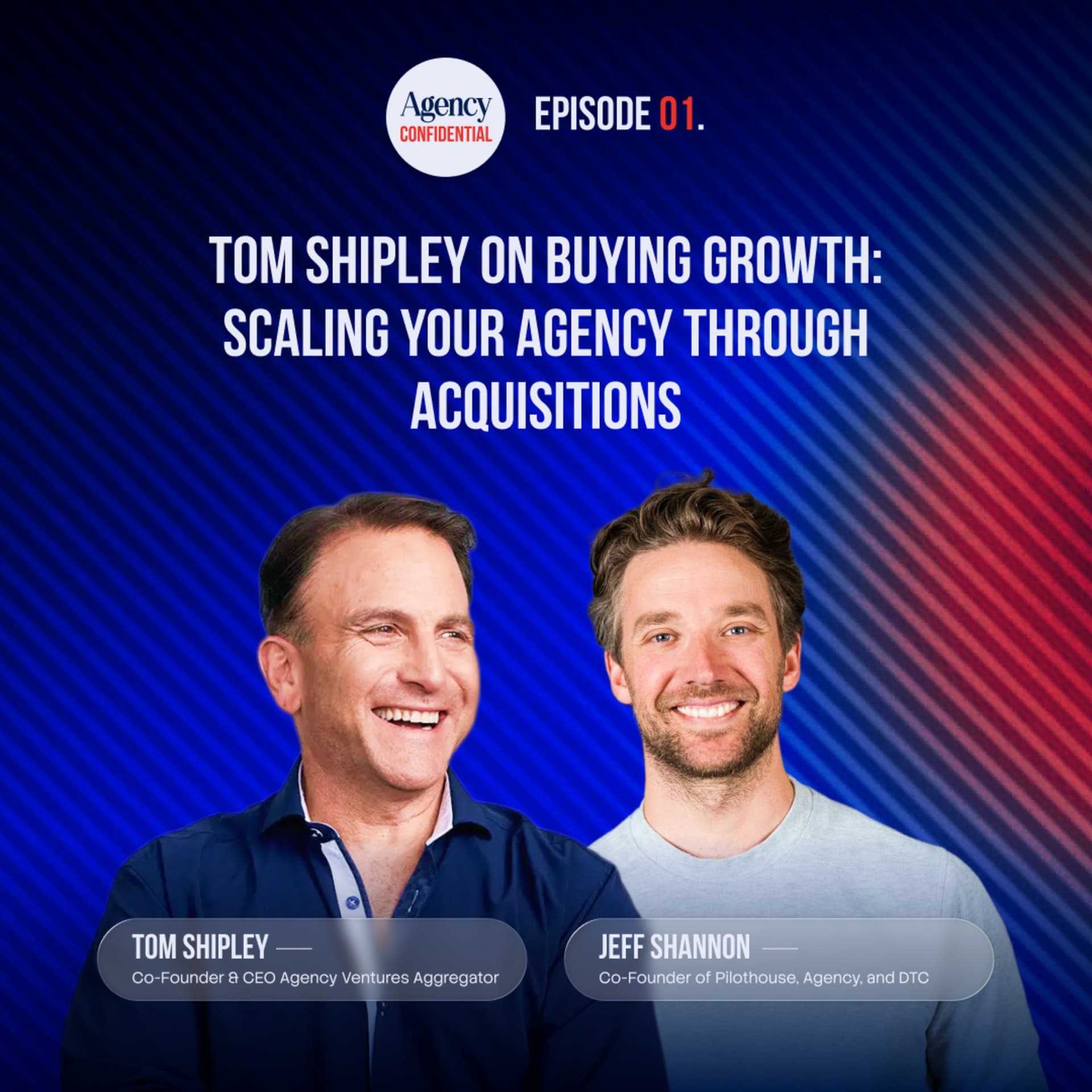
DTC Podcast Episode Notes: Agency Confidential - Tom Shipley on Buying Growth
Episode Overview In the inaugural episode of Agency Confidential, host Jeff Shannon interviews Tom Shipley, a seasoned investor and operator with extensive experience in mergers and acquisitions (M&A). The episode focuses on how agencies can leverage acquisitions as a growth strategy, particularly in the context of current market uncertainties and the impact of AI on the industry.
Key Concepts and Takeaways
Acquisition as a Solution
- Core Belief: "Any business problem can be solved with an acquisition."
- Shipley emphasizes that agencies facing challenges (like cash flow issues) can find opportunities for growth and stability through strategic acquisitions.
Growth Through Acquisitions
- M&A as a Growth Lever: Acquisitions can often outperform organic growth, particularly when scaling agencies.
- Shipley shares stories from his own experience, highlighting successful acquisitions that allowed his businesses to accelerate growth significantly.
Criteria for Acquisition
- Defining a Buy Box: Establish criteria for potential acquisition targets, similar to customer profiles in marketing.
- Importance of Seller Conversations: Engaging with multiple sellers increases the likelihood of finding a good fit and understanding the market better.
Deal Structures and Risk Management
- Creative Deal Structures: Many agency acquisitions can be financed through seller notes or seller financing, minimizing upfront cash requirements.
- Due Diligence: Critical to identify both yellow (caution) and red (danger) flags in potential acquisitions. This process helps ensure informed decision-making and mitigates risks.
Integration Post-Acquisition
- Focus on People and Culture: Integration should prioritize employee and client well-being to avoid disruption. Shipley advocates for a trusting relationship with sellers throughout the acquisition process.
- Day One Planning: Creating a solid plan for integration on the first day post-acquisition is crucial for long-term success.
Episode Chapters
- 00:00 - Introduction to the concept of acquisition as a solution.
- 00:31 - Meet Tom Shipley and his journey in M&A.
- 01:57 - Strategies for buying a business when cash-strapped.
- 05:17 - Case studies of acquisitions adding capabilities.
- 08:03 - Comparing organic growth to growth through acquisitions.
- 12:18 - Engaging with motivated sellers and creative deal structures.
- 20:50 - The due diligence process and its significance.
- 24:33 - Understanding integration challenges post-acquisition.
- 30:11 - The influence of AI and market uncertainty on agency acquisitions.
Additional Resources
- DealCon: [Visit DealCon Live](https://dealconlive.com) for further information about the event focused on M&A strategies.
- Pilothouse: [Explore Pilothouse](https://www.pilothouse.co/) for insights into performance digital marketing in the e-commerce space.
- Agency Network: [Join Agency](https://www.joinagency.co/?utm_source=podcast) to connect with established agency owners.
Conclusion This episode of the DTC Podcast offers valuable insights into leveraging M&A for agency growth, especially during uncertain times. Tom Shipley’s experiences and strategies provide a roadmap for agency leaders looking to expand their businesses through acquisitions, highlighting the importance of adaptability and strategic planning.
---
Feel free to explore the episode further and consider how these lessons could apply to your own business endeavors!
Written by AI. May contain mistakes. Listen to the episode to check what was said.
Chapters
Tap a time to open that second in VOGrowth Through Acquisition
1:24 to 2:57
Discussion on the philosophy of solving business problems through acquisitions.
“Welcome to Agency Confidential, where we uncover the stories behind the business of running an agency.”
Tom's Acquisition Stories
3:21 to 6:36
Tom shares his early acquisition experiences and their impact on growth.
“The first acquisition was my business was a online store, but I mailed out millions of catalogs.”
Solving Growth Challenges
6:38 to 8:09
Exploring how acquisitions can solve various agency challenges.
“And suddenly within three years, we did a hundred million dollars.”
Building an Acquisition Machine
8:11 to 11:54
Strategies for creating an acquisition process that minimizes risk.
“So you tell me what your challenge is, is whether you need to do incremental channels, new products, expertise, capacity, cash flow.”
Identifying Motivated Sellers
11:56 to 14:02
Understanding the landscape of motivated sellers and leveraging opportunities.
“A lot of the deals you can do in the agency world can be off-seller financing.”
Navigating Agency Acquisitions
14:02 to 15:10
Learn about the challenges and strategies in acquiring agencies.
“So I said, if someone will just sign for the inventory that they're going to give us a note, and they'll pay for this business by buying off the inventory.”
The Importance of Seller Conversations
15:10 to 18:02
Discover how to effectively engage with potential sellers to find ideal acquisitions.
“It's just having enough seller conversations to get to it.”
Building Trust in Acquisition Talks
18:02 to 21:08
Understand the significance of transparency and trust in acquisition discussions.
“Typically, I say if you end up having, the numbers are, if you absolutely have 100 conversations, you will end up closing the ideal acquisition, even 50.”
Due Diligence in Acquisitions
21:08 to 23:39
Learn about the critical steps in the due diligence process when acquiring a business.
“doing and what your vision is for your business and the opportunity that's there.”
Integration Strategies Post-Acquisition
23:39 to 27:31
Explore effective strategies for integrating businesses after an acquisition.
“Once we have a signed LOI, then I'll send them my first letter of due diligence questions and information, which is a lot of work for them to actually give to me.”
Show all 15 chapters
Maintaining Culture During Integration
27:31 to 28:00
Learn the importance of preserving culture and trust during the integration process.
“Some people believe day zero, that agency you're buying loses its name, loses basically its culture and they're absorbed in.”
Integrating Acquisitions: Key Strategies
28:00 to 29:26
Learn effective strategies for integrating acquisitions and minimizing failure rates.
“they're going to create these crazy narratives and the room you go.”
Risk Mitigation in Acquisitions
29:26 to 31:30
Discover how to structure deals to mitigate risks associated with agency acquisitions.
“And from a failure rate, if you just follow those rules, the failure rate is extremely small with acquisitions.”
The Impact of AI on Agency Growth
31:30 to 33:52
Understand the role of AI in agency growth and the changing landscape of acquisitions.
“What do you see, you know, AIs coming in, consumer spendings all over the place.”
DealCon: Elevating Acquisition Knowledge
33:52 to 36:54
Explore the goals and benefits of attending DealCon for agency owners.
“But one time I said, SEO agencies are in trouble.”
Transcript
Automatic transcript. May contain errors.0:00Jeff Shannon:Welcome to the first ever episode of Agency Confidential. I'm really excited to be here. This is a podcast dedicated to chatting with some of the best agency leaders in the world, going under the hood, really understanding how they built their businesses, how they overcame challenges, their biggest wins, and the takeaways that you can then go and put into your agency. I'm your host, Jeff Shannon. I co-founded an agency about six years ago called Pilothouse Digital. We're a performance digital marketing agency focused on the e-commerce and D2C space. Over the years, we've worked with everyone from small mom and pops all the way up to the biggest of the big brands, Unilever, Kellogg's, and we've made every mistake in the book.
0:37Jeff Shannon:The thing that we keep coming back to is every time we go and talk to other agency leaders and owners, we get better and they get better. The more we can share our failures and share our wins, the better we become as agency leaders. So that's what this podcast is really dedicated to, having those conversations in the open so people can learn and share and grow together. About six months ago, we actually started another business called Agency as a way to connect established agency owners together in a myriad of different ways. If you're interested in that, this podcast is brought to you by agency.
1:13Jeff Shannon:If you're a seven, eight, or nine-figure agency owner, we'd love to have a chat with you. See if you're a fit for the agency network. We'd love to see you there. So on with the show. you have this saying and this way of thinking that really changed my perspective on our business which is any business problem can be solved with an acquisition tell me about that we're losing
1:34Tom Shipley:money we argue between my cfo whether we have 30 days or 90 days of cash what do you do when you run out of money jeff you buy a company if you have a motivated seller you can come to terms that you can work with
1:52Jeff Shannon:Hello, everybody. Welcome to Agency Confidential, where we uncover the stories behind the business of running an agency. Today, I'm really excited to have a conversation with Tom Shipley. He's an investor, advisor, builder who's done a bunch of amazing things in his career. He's acquired a ton of agencies. He's helped people acquire a ton of agencies. He co-founded Atlantic Coast Brands, where he took that business, if I'm not mistaken, I think from almost the brink of failure to selling over$2 billion in product, He created Foundry, an e-commerce aggregator that raised$100 million right out of the gate.
2:23Jeff Shannon:He's an investor in many brands and agencies. He's an advisor to many brands and agencies. He runs some great events, which I'm sure he'll talk about. And at the end, at the top of it all, Tom is a master of M &A. He's a huge proponent of growth through acquisition, spends a lot of his time teaching and advising brands and agencies on how to grow their business by acquiring other businesses. And he's an all-around great guy. So, Tom, welcome to the podcast. Great to have you. Hey, Jeff. Great to be able to be with you again on the podcast. So I think, you know, I think we should just dive into it.
2:52Jeff Shannon:We've got a pretty short one today. I'd really love to hone the podcast on the idea of growth through acquisition. I met you a couple of years ago at one of your events about scaling your business through acquisitions. I think it was called Scale at Speed. It's funny. I actually, I found the notebook this morning, so I've been taking notes in there. And you have this saying and this way of thinking that really changed my perspective on our business, which is any business problem can be solved with an acquisition. Tell me about that. How did this come to be one of your core beliefs?
3:20Tom Shipley:I want to take you back and just tell you a story about my first two acquisitions. And I'll be very quick about this. The first acquisition was my business was a online store, but I mailed out millions of catalogs. We had up to about a dozen pages in the SkyMall Magazine. Life was great. Dot-com bust happened, which means we couldn't access capital. Slight recession. Conversion rates goes down. Average order goes down. We're losing money. we argued between my CFO, whether we had 30 days or 90 days of cash. I ended up speaking with an investment banker who said, Tom from New York, he said, Tom, I have the perfect acquisition for you.
3:56Tom Shipley:Remember, I'm out of money and I have no access to it. He said, perfect acquisition. He said, I represent Boise Cascade. We're selling off a$750 million division. That division has a$15 million company that the buyer does not want. So they have a buyer for that business. He doesn't want this$50 million. And he said, they don't want to write it off. And you are the perfect buyer for that business. With that, I learned that if you have a motivated seller, you can come to terms that you can work with. And we end up buying that business. And over double the size of our business, we exit a year later.
4:29Now, fast forward two years later, myself and my partner, again,
4:34Tom Shipley:remember, we're two former Special Forces guys in Richmond, Virginia. And we have this vision. We're going to take my playbook on how to develop an iconic brand using direct response marketing. Now, everyone laughed at us when they heard our idea. We were going to build for the first time, this is 2005, a$100 million beauty brand using direct response marketing. And everyone laughed at us that this will never happen. At the end, we had such strong conviction. At the end of the 12 months, we had proven the model work. Great customer acquisition costs, great lifetime value. We did$331 ,000 in revenue, but we ran out of money.
5:11Tom Shipley:Now, here's where it comes in. What was our problem? The problem was is we proved it worked in print and radio. However, internet, it was working, but we weren't great experts at that time on internet marketing. So that was the first problem. The second is we didn't have a team. It was myself and my partner and a part-time bookkeeper. We didn't have this tech staff. There was no such thing as you can, there wasn't Shopify or any other type of microsites, platforms that you can just, a funnel platform that you can go and plug and play. So we basically had someone build us. It was a little bit kludgy.
5:44Tom Shipley:So we didn't have all the fundamental tools to succeed. And the worst part is we ran out of money and I couldn't even feed my family and neither could my partner. And so what do you do when you run out of money, Jeff? And we had so many problems and stuff. You buy a company. So that's what we did is we bought a$15 million business in Hoboken, New Jersey. It was a vitamin supplement company with nine brands. That was important about that. They were throwing off a million and a half of cash. they had a great tech platform basically you plug into designer developer they were great internet marketers and basically we put our little 331 000 brand on top of this platform and within three years we did a hundred million dollars we did a billion dollars in that first skincare brand so when i say it could we had so many problems where do you start if we were to grind it, it would have taken us years and a lot of risk to get there.
6:38Tom Shipley:And suddenly within three years, we did a hundred million dollars. So whatever challenge you have in your agency, for example, you have an Amazon, you have a problem with lead flow and you have an Amazon agency. Well, one of the hottest things is, is TikTok shops. What would I say is you can either build it on your own or you can buy a TikTok shop agency. Give an example, a buddy of mine, Brian, Brian was probably one of the best. He had an Amazon agency from the area of, he was brilliant from marketer and a salesperson in business development. There's no one better than Brian. The challenge that Brian had is, he had so much confidence that he was able to charge twice the growing rates.
7:17Tom Shipley:His problem was his team was mediocre. Now, what happens when you charge twice the growing rates and mediocre results? Churn. So he's bringing on clients, but they're churning out just as fast. so he went and found the best operator in the business who could not generate new clients they were having trouble making payroll and he was going without the the the ceo and they had 1600 pages of sops so brian bought that agency so an aqua hire small piece of equity basically gave everyone jobs hired this guy as a ceo with a very strong salary gave everyone raises and suddenly he had the best core platform in the business as far as amazon and that's why he two years ago he He got an offer for$187 million for his agency.
8:00Tom Shipley:Again, his core problem was he didn't have the capacity and the core capability to match the amount of level sales. He acquired it, and that allowed him to become this rocket ship. So you tell me what your challenge is, is whether you need to do incremental channels, new products, expertise, capacity, cash flow. A lot of times people have such a strong in the agency. They say, well, we're at the capacity to grow because of our C team is great, but we just don't have enough business. But if you acquire a business and then book a business, you can get there.
8:36Jeff Shannon:So I want to come back to the how you buy a business when you run out of money, but I'll come back to that. I think a foundational piece to that, we've always, you know, at Pilothouse, our agency, we've always thought about acquiring, we've always talked about it. We've just never done it. And part of it is, you know, I feel like we're never in the right headspace or it seems daunting. What kind of, what are the foundational pieces? What's the headspace? What are the things you kind of, the non-negotiables you need to figure out to be able to start acquiring?
9:05Tom Shipley:First of all, remember, it is never the knowing all the how, it's knowing the who. What I do with everything I do in business, I'm a business architect. I don't need to know every detail. What I need to do is understanding what I'm going to do and why I'm doing it and the overall framework of the steps. And then I need to focus on the next step and really find the experts that can help me get through the next step. And that's really it. And so it is, and it's the conviction. And let me just share this with you. and part of it is an attitude. Let's say I've been in business for three, four years in my agency or five years.
9:40Tom Shipley:Now, suddenly my goal is I'm going to have aggressive growth goals and I'm going to go, what would be a really good growth goal for an average agency, Jeff, after five years, annual growth rate? 25, 30%. Okay. And then the reality is because there's stuff that happens, they have a bad year on average when agencies shoot for 20 or 25 % growth after they have a certain size, I'm seeing the average results about 10%. If an agency, and this is five years, if an agency grows by 10 % every single year over five years, they'll increase and it compounds. Great, great job. At the end of five years, you just increase your enterprise value by 50%.
10:16Tom Shipley:Now, what have you done? You've dedicated a lot of times for lead gen, sales team, events, a lot of things to keep that pipeline going and you've launched new products. And again, Yet there's so much work that goes in to retain your clients, but also generate new clients. Now, let's look at the alternative. You dedicate about 5 % of your resources for acquisitions. You buy one business every year that's half your size. One business every year for half your size. At the end of five years, you'll increase your enterprise value by 1 ,200%, not 50%, by 1 ,200%. That is the power of M &A. Now, you don't have to buy a business that's half your size.
10:53Tom Shipley:You can buy a third of your size. You can do two acquisitions. But I just want you to understand that if you understand that this is a lever for CEOs and founders, if you want to just invest the time and the resources, and it doesn't have to be, do not internally hire all these people internally. Don't ever do that unless you're doing five, six acquisitions a year. When you're starting to, there's a lot of resources of people out there that will show you how to do basically acquisitions. And the first is, and we can go through the process of that, on what it actually takes to actually create the lead flow of the conversation, the conversion, but it's the fundamentals.
11:32Jeff Shannon:So when we talk about acquisitions internally at Pilate House, there's always differing opinions from leadership groups. And people are like, well, we've got to spend$5 million on buying an agency. That's a ton of debt to put on the books. Can you talk about how do you build an acquisition machine that doesn't risk the whole business?
11:54Tom Shipley:Yes. Well, basically, so let's put it this way. A lot of the deals you can do in the agency world can be off-seller financing. So again, it's stacking understanding is how much equity, if you're putting your own capital into a deal, if you're borrowing debt, and then also you could have burnouts as well as you could have seller notes. So again, I have experience buying a couple agencies where the deal we negotiated, one was doing$250 ,000 in EBITDA, the other was doing$550 ,000 in EBITDA. both the one deal we close with five percent cash it close the other ten percent cash it close with an average of a three times multiple in those businesses okay so just run that now i can show you a resource that anyone almost anyone could borrow one to two months of revenue on any business you're buying within seven days you you're buying a business i'm going to borrow it on the business just simply on the business that i'm buying and the rest of it so i bought two of them with that and the rest were seller notes and with some kickers on performance and the guaranteed of the seller notes were on the business themselves not my business so i was funding 90 % of the deal 90 95 % on seller notes but if the deal didn't work out what i said is uh two things are going to happen the the consequences and the remedy for a lack of payment was number one is that i would go out and number one if i can't cure it there's some default interest rates.
13:21Tom Shipley:And then if I can't cure it, I would actually go and sell the business. And if I can't sell the business, then I turn the business back over to them. Oh, interesting. So therefore, I'm not risking my business on it. So I want you to understand that it all starts with motivated sellers. And let's change paradigm. You have to get out of the fact of what you would sell your business and what your business is worth and the terms that you did. Understand there are other motivations out there. Let's go back to my own business. I owned a$7 million beauty brand. We couldn't focus on it. We were focusing on everything on our$50 to$100 million beauty brands.
13:57Tom Shipley:So what did we do? We wanted to close it down, but I didn't want to take the write-off. I wanted someone to buy. We couldn't find a buyer. So I said, if someone will just sign for the inventory that they're going to give us a note, and they'll pay for this business by buying off the inventory. And inventory is typically in the beauty business is 10 % of your cost of sales. So as you're selling every unit, pay it for us. Therefore, I did have to go right down. This is a$7 million beauty brand. Let's talk about in the world of agency and business in general. There are 12 in the United States. There are 1 ,200 business owners retiring every single day.
14:31Tom Shipley:Understand that 75 % of them, over 900 of them will never find a buyer for the businesses. Some will have term sheets and have brokers and investment bankers, but the deals won't close. And if you've been in business for 20, 25, 30 years, you're just ready to move on. Most of those businesses will close down. There are motivated sellers. And that's why I have conversations with people and you have to find out there's an area of trust. You're carrying their legacy, which people hate to lose their legacy after so many years. If you're treating their legacy, if you have a great vision for your business and you're taking care of their clients and you're taking care of their people and you're giving them away through just monthly payments.
15:09Tom Shipley:They don't have to operate the business. They give some transition support. They're there after monthly payments. You could pay off that business. There are deals out there. It's just having enough seller conversations to get to it. So you're not risking your business.
15:23Jeff Shannon:That's super cool. The idea that you could put 5 % kind of in cash. I'm sure there's a multitude of different ways you can acquire. There are so many.
15:32Tom Shipley:So, you know, Eric Huberman, Talk Media. Eric's speaking at our next event. And Eric has spoken a couple of them. He is a great model. Well, in ballpark, what he does is he basically gives an agency, he wants to take all the implementation off their plate and he'll take it on. And he basically gives the owner somewhere between on average 7 % of revenue for of existing accounts and somewhere about the same thing for new accounts that they bring in over X amount of years. So they're getting the payoff from a revenue. So the risk he's taking is zero risk. So again, and he's buying some great agencies.
16:08Tom Shipley:he's taking care of them. He's scaling. The owners are getting their money and getting great return. They're getting a great home. He's done, I think, 20 acquisitions in this model. So it works. So again, so if you have enough seller conversations, there are ways to minimize the risk on your business.
16:24Jeff Shannon:Very cool. And I was going to ask, how do you match? Because I can imagine someone retiring and getting basically an annuity for the next five years or two years or whatever it is, versus what you need. Like if I say, hey, I need a TikTok shops team. Is the game just volume of conversation in order to find the people that are both motivated, but also have what you need?
16:45Tom Shipley:A hundred percent. So here's what we do is, first of all, is we start off creating a buy box. What's a buy box? It's a criteria. It's like setting up your ideal customer acquisition profile. Same thing here. It's what did you write? What are you actually looking for? Okay. And then we use tools like Clay and Apollo and we LinkedIn Navigator to find the companies that meet that port with that profile. Then we create very simple messages going out to them. My goal is just to get on a phone call. So we do simple messages. Here's what we are. Here's what we're doing. We're basically looking to collaborate or to acquire a business just like yours.
17:24Tom Shipley:And you meet the profile. We love what you're doing. Let's hop on a call and just chat. Now, when you have a company like Pilot House with the caliber and the reputation that you do, you have an unfair advantage in getting those phone calls and having those conversations. And if you set that pilot, and again, we hire an outside company that does it for us very inexpensively, and basically they're filling up my calendar so that I can have a conversation a day. even if you're going to think about it, if you have five conversations a week, spread that over 50 weeks a year, you're having 250 seller conversations.
17:59Tom Shipley:Those are once-in-a-lifetime deals, and you don't have to do that many. Typically, I say if you end up having, the numbers are, if you absolutely have 100 conversations, you will end up closing the ideal acquisition, even 50. Sometimes you get it. The other thing you do is you can even post. We had someone at our event, and we ran a little exercise. We said, let me show you the ideal LinkedIn post to do. So right now on your Facebook, Instagram, and LinkedIn, post this and we give the exact wording. So there's a great agency out of New York City. So Scott ended up doing exactly that. He had 30 responses and he had basically within three weeks he had a term sheet out.
18:37Tom Shipley:It was perfect for his business. He has a very large, more traditional direct response agency. They wanted to, they are basically referring all their Amazon businesses. They want to buy an Amazon shop. So that was their target. And this was the ideal acquisition. And again, this is done through just social media posts. And again, there's so many different ways of creating late legit, but it's just having conversations. Now, if I can teach you a secret, something that, understand this, I do not have seller conversations in order to collect competitive information. I do it because I'm interested in some type of investment.
19:16Tom Shipley:I don't want to waste my time as I use my time. However, when you have those calls, the sellers will share with you information about their business, what's working, what's not again. Their goal, your goal is to build trusting relationship and really having clear. You're going to learn so much ideas and things that will inspire you that will make your business stronger. And if they're a great partner, you will collaborate, do JVs, or you'll buy their businesses, period. However, you can't learn this information by calling up people that are in other agencies or areas you're interested to get into or direct competitors and say, hey, tell me what you're doing for a lead gen.
19:51Tom Shipley:Hey, how are you doing such a great, you know, what's your churn rate? How are you doing such a great job with stickiness with your customers? What are your different approaches? In general, you're not just investing in developing your lead flow. you're investing in becoming a better founder, CEO, and operator of your own business.
20:12Jeff Shannon:Yeah, I love that. It's one of the reasons we built agency, which is our vetted peer community, because those conversations just weren't happening. And I have tons of conversations with agency leaders, and it's so, so valuable. We find the same thing with hiring, honestly. We're hiring VP level roles and that kind of thing. You just talk to a ton of different people. So you get such a cool cross-section of how the agency community does things. With these conversations, not to get too into the weeds, but with these conversations you're having when you're doing outreach, is it beating around the bush?
20:44Jeff Shannon:Is it saying, hey, I want to invest? Is it saying, hey, I'm looking to buy an agency?
20:48Tom Shipley:I don't know what the structure is, and therefore it is. So basically, but I'm very, very transparent because I want to be having a trusting relationship going in. So basically, your first call is a 30-minute get-to-know-you call. The idea is that you want to share with them and inspire on who you are and what you're doing and what your vision is for your business and the opportunity that's there. You also want to learn about their business, who they are as people. If basically, if you don't like them, then you're not going to have a second call. And so your goal is to find out about their business.
Read the full transcript
21:21Tom Shipley:I always need people to have shared with me the revenue and their EBITDA numbers or even a margin. And I could do the quick calculation there. how many employees, what they're great at, what their aspirations. I also want to know what their personal goal is. What is your personal goal? What would you do? What is the next chapter of your life looking like? And people share with you with basically, if you create that trust environment about what they're, if I understand what their goals are, I understand what their agency is and what they're great at and how there could be a fit. And I start off is that we're basically growing through this, growing our business.
21:54Tom Shipley:We're doing it through mergers, acquisitions and collaborations because sometimes it is you start off with saying, let's refer business to each other and you see how they go. So you're both there. And it could be, I'm going to refer a business to you and we're going to test our relationship out. And if it works, then we're going to talk something about the next level. So there's an opportunity that they're going to get some new accounts in it, which is absolutely true. Yeah. Because I know when I want to do an acquisition, I want to test the relationship by giving them business to see how they handle it.
22:21Jeff Shannon:How important is that? How much, how important is the due diligence aspect of buying one of these new businesses? Okay. So it's a great question, Jeff.
22:29Tom Shipley:So there's different phases of due diligence. So my first call is very simply is I use Fathom. I record it. I have all the information. And even though I, because I don't want to misunderstand anything or not remember correctly what you're sharing with me. Then the next call says, oh my God, this was a great call. Let me tell you about our next step. Our next sauce is that if you choose to continue this conversation, and I'd love to, I'd like to invest an hour into a business, basically a deep dive call, where we'll basically spend an hour with each other. You can ask me whatever you want to. And then also, I want to really learn.
23:01Tom Shipley:And my goal is very quickly is to identify, is this the right opportunity for both of us and for us or not? Because I would not want to waste your time. But basically the next call is to really learn about your business. I love what you're doing and I like you. So the next call is your business due diligence. Now, in advance of that, depending on the way the call is going, I say in advance of that, I'm going to ask you for a few things. So I ask for some basic information, and part of it is to be better prepared for the business due deep dive call. But my call at the end of that call is to have the information.
23:30Tom Shipley:If I want to go on after that, then what's going to happen is I'm going to say, well, what I'd like to, they're going to say, well, what are you looking at? What is the deal structure? How much are you going to pay? What's my value? And I'm going to say, I wish I knew. and unfortunately is it would be insincere me to start sharing that with you now so i'm going to send you a list of information and i'd like you to send that to me so we can put together some indication of interest of what we think could work together and some ranges there and with that i'm going to ask for the initial information now remember there are different phases i don't want someone wasting time and sending either artist corporation all their client contracts and everything else until there's a serious deal my goal is enough information that i can give them a letter of intent that I can stick by with some general terms that I know that we can move forward with.
24:16Tom Shipley:Once we have a signed LOI, then I'll send them my first letter of due diligence questions and information, which is a lot of work for them to actually give to me. And I'm looking for a validation. Due diligence is about several things. One is validating that what I think I knew at the business is true, identify real issues with the business. And most important is at that point, What you have assigned an LOI is to inform you for the most important day, which is day one after the acquisition. It's starting to formulate your ideas on what the day one is going to look like and the integration and the timing for integration, how you guys are going to work together, all that informs it.
24:51Tom Shipley:Now, due diligence. You're going to find information due diligence that's going to be yellow flags and red flags. If you find a red flag, it doesn't mean walking away, we're done. It means certain things. is. One is, a lot of those things is, listen, you don't have assignability on any of your client contracts. So prior to close, I need you to go to your clients and just update your agreements to get assignability on those agreements. Otherwise, we're not buying anything. Certain things can be addressed prior to close. Other things is, there are some things you find out that there were some historical lawsuits and things that are looming.
25:25Tom Shipley:I can cure that through reps and warranties of the agreement that they're taking responsibility and they can get an insurance reps and warranty insurance that covers it so I don't have to worry about it. And also in the deal structure, the way I'm doing acquisition, stock or asset purchase, there's a lot. And certain things are smaller things you're going to identify. They're going to say, we're going to fix this together after close. So again, you have your list of the green, yellow, and red items, and then you have your keeping list on how you're going to address those. And that's your due diligence process.
25:55Tom Shipley:The one thing you don't want is surprises. There'll always be some surprises. You want to minimize the level surprises and anything that will, as you say, blow the company up or hurt your business, you want to identify that due diligence.
26:06Jeff Shannon:And if you do a good job, you will. Once the due diligence is done, once you've figured out your financing, what does integration look like for most of these agency deals? This is where I've heard of tons of deals falling apart because people do it the wrong way.
26:19Tom Shipley:Tell me about that. So let me just walk through some quick process. I'm going to jump integration. Okay. So most of what you can do when you're doing a deal structure is there's so much creativity. There are some really amazing people out there that can help you with deal structure. That's something that will minimize the risk as well as inform what needs to go in the purchase agreement, whether you're doing an assets or stock purchase on that. and maintaining the relationship throughout this whole process. Remember, you have two different sets of advisors in both the buyer and the seller are telling you, don't trust this person.
26:50Tom Shipley:They're trying to screw you. They're planting seeds. Everything's about trust. So what I try to do in relationships when I'm buying a company or I'm selling, I'm saying, listen, our advisors are going to be putting seeds of doubts, and you're going to see something in a term that they're going to say, this is horrible to trust me. And what I'm going to tell you is if we're both going with positive intent and understanding that we won't have a long-term relationship. I don't want you to lose a moment of sleep. Text me. Let's get on a call that day and let's talk with the group. Typically, 99.9 % of the time, it's a misunderstanding.
27:20Tom Shipley:Or, oh shit, I didn't know that my attorney did that. So again, therefore, let's get on the phone. Let's maintain the relationship. And we're spending our time talking about day one integration. Now, there are different philosophies from integration. Some people believe day zero, that agency you're buying loses its name, loses basically its culture and they're absorbed in. I'm more of the do not harm philosophy. So while I might have a playbook, my number one is the only thing I want to do is making sure on day one that I'm taking care of the clients, cash, and the employees. So again, if you don't fill the gap of what the stories that the employees are telling themselves, they're going to create these crazy narratives and the room you go.
28:06Tom Shipley:And therefore, I do a lot on day one, the day you close when it's announced to all the employees of having, first of all, a full town hall meeting where there's an introduction. And then I have quickly day one and day two, I meet with employees in groups of three. So they have a chance to ask questions. I'd create a trusty environment. So I want them to basically I want to kill all this suspicion. Clients, a clear transition. Do we need to communicate anything to clients in day one or is it going to be after a week or two weeks? And how are we going to notify them? This is all mapped out in advance.
28:36Tom Shipley:And so all I want to do is making sure that the employees that end up taking control of the cash and the bank accounts and everything I need to. Other than that, we can delay. We can actually run two separate agencies for a long period of time. You're not getting all the benefits of that, but you can run for a long period of time as separate agencies. If you buy good growing agencies, you don't have to, and you can identify, spend the first 30 to 60 or 90 days getting to know each other to refine your integration plan. And then saying, okay, here's how we're going to merge our websites here. This is going to stay, but it's going to be under a sub of the parent company.
29:10Tom Shipley:Or this is how we're going to transition because we're really the big, incredible agency. And therefore, we have the brand reputations, and this is how we're going to pull the clients into it. But they're going to know this, and we're going to do that in 90 days. So that's why I said everything when you're going to your due diligence process is informing for what you're going to do during the integration process. And from a failure rate, if you just follow those rules, the failure rate is extremely small with acquisitions. If you rush and assume and you ignore the people and the clients and the cash, you will have real challenges.
29:42Jeff Shannon:And how important is the deal structure to mitigating that failure rate? You talked about it a little bit with some of the deals you've done where the previous owner will get the business back if X, Y, and Z are completed and they don't work.
29:57Tom Shipley:Yes, yes. Or things, by the way, everything with that. And I have a lot of different seller notes that are set up that they believe in their numbers. They believe in the stickiness of the customers and the clients. My goal is to maintain the health of their agencies and take care of their clients and employees. If something happens, such as they lose several clients along the way, revenue drops, then basically some people's deal terms is then you get less money for your agency, which is fine. In the earn out part of it, the approach that I like to take is you'll always get the same amount of money for your agency in the seller note, but the time is going to take longer.
30:31Tom Shipley:And again, if revenue takes a hit, then that thing, because we don't want to destroy the agency. We don't want to hurt it. It's going to have to cash flow. So basically the payments are going to basically go down. And if when we recover and here's all the resources we're going to dedicate to growing it again, then we can increase the payments again. But you're going to get it. It's going to take you a little bit longer to get your money. And again, those are the deal terms and it's how you mitigate risk. And everything, again, is about a trusting relationship. You're buying an agency that has a concentration risk of 70 % with one client.
31:01Tom Shipley:There are deal terms you can do to mitigate your risk on that. So nothing says don't do a deal. So the question is, and here's the most powerful question that when you have people who always say, yeah, but, yeah, but, yeah, but, and here's my question that I love to ask. Great, I understand that. What would have to be true to make this possible? What would have to be true to make this deal possible? That we're protected as well as they get their money and their needs are met.
31:26Jeff Shannon:Oh, I love that. Last kind of question. What do you see, you know, AIs coming in, consumer spendings all over the place. we're in a pretty wild climate with tariffs coming in and out. I've seen agencies, you know, drop 50 % in a year in our space. Does that change anything in the philosophy of acquisitions as growth? A lot of agency people in our group are really worried about that. You know, are they going to go to business in two years? Are they going to be crushing it in two years because their cost basis goes down? How do you see that changing acquisitions or does it?
32:02Tom Shipley:The answer is everything informs you. You have to determine from an AI perspective what your strengths are. If you don't have an AI culture and your people are AI resistant, can you buy an agency that basically are great at AI, have implementation, and basically they're helping you leak from, and you change your culture in order to make your agency AI-enabled? If you're basically AI resistant and you want to stay in this game a long time, I'd say then your days in your agency world are numbered. You can't, again, it's like saying before the internet, yeah, we're never going to be a digital agency.
32:37Tom Shipley:How could you not? Same thing here, okay? So what is your path? But you also, if you're buying an agency and they're not, if you are really on your AI journey and your AI implementation and the way you're handling data, lead gen, and basically operations, and you're basically making great progress for your AI integration, and you find an agency that doesn't have it, it's a great advantage and let me let me just flip it this way 2026 in my opinion is the year for acquisitions why is there are so many owners of agencies that are right now scared to death they're scared that their business is not going to be relevant they don't have the skills or the mindset to start implementing ai in their agency and they're struggling and they're basically saying well we're using chat gpt for copy okay but they really don't understand how to implement agents and basically to automate their workflow and everything else.
33:28Tom Shipley:So therefore, there's a fear factor. They want to get their mark. They're afraid and they're going to put their business on the market. And therefore, that's where you have the advantage of basically coming up with the right deal terms that meet their needs and your needs. So I see more openness of sellers wanting to exit and more flexibility with deal terms because of the fear. The agency world's not going away. The question is is can you adapt and utilize the tools of what ai is to give you to deliver a better product better value better service and ultimately for a good customer remember remember doing 2 billion of sales how much i spent on marketing an agency is what i cared about is results and if you're really great is especially in certain you know run a performance agency again there's so many way things that you could do to adapt in this changing environment agencies aren't going away mediocre agencies, especially those that used to deliver base level things like copy, are going to have challenges.
34:26Tom Shipley:But one time I said, SEO agencies are in trouble. I was wrong because of AO or GEO, whatever you want to call it. Okay. You're a phraseologist. It's not, it's extremely powerful. So there is the adaptability no matter what you're in and understanding that. Data is king. Analytics are king. Creative is great. So you have tools to creative. Even if you have a production shop, you're going to be able to do a production. If you basically have a hundred thousand foot studio and that's what you do, then there's some adaptability that you have to think about.
34:55Jeff Shannon:Yeah. Very cool. And so 2026 being the year of acquisition, what's the, you know, talk about your, your event deal con, because I went to an event that Tom put on two years ago now, um, all about just the nitty gritty, like, like this conversation, but on steroids, three days of it really getting into the weeds. Tell me about deal con.
35:13Tom Shipley:My goal is very simply as I don't care whether you've never done an acquisition you've done one or whether you've done a dozen is to drastically increase the bar on your knowledge so you can do acquisitions with lower risk and a bigger upsides and higher probability of the return you're looking at i'm looking at helping work basically we fly our team in for this we spend over a quarter million dollars on this event and we're building incredible relationships in that room and my goal is is you might find your next business part in the room You might find your next acquisition. If you're selling your agency, we actually have our third day.
35:47Tom Shipley:We're dedicating it simply to people that want to exit. And the other track is about implementing AI in your agency, as well as AI in M &A. So that's really the third day. But what we're doing is I'm going to have capital sources in the room. So you get to meet them. So different M &A attorneys and the knowledge you have to be to be successful in this game. So there's aggregators that are doing roll-ups in the room. So it's an incredible community. And what I look for is, and I try to interview all the 150 people that are going to be in this room, because when people leave, I want them to say is the quality of content is the best they've ever had.
36:25Tom Shipley:The experience, because we do a lot from experience in our special events that we do, but also the quality of the character of the people in the room is the highest of any event they have ever been to. If we've achieved that, we've succeeded in the event. And then we keep on doing this over and over and over again. So our next event is February 9th through 11th in Miami. The event sells out every time. We will sell out over the next two weeks. It's happening fast. I know the rooms are, we're still trying to get some extra rooms from hotel because they did sell out the other day. So if you're going to join us, go to dealconlive.com.
36:58Tom Shipley:And my goal is that DealCon will be a defining moment in your life, in your business. It'll be transformational.
37:04Jeff Shannon:That's great. Well, I thoroughly enjoyed it. And we're going to try and get down to Miami as well. me and the other partners at Pilot House. Tom, this has been fantastic. Really, really great catching up. Really great chatting with you. Really enjoyed it, Jeff. Thanks again. You guys are the best.
37:38you
From the publisher
Follow Agency Confidential on Spotify: https://open.spotify.com/show/6lbaJzKRArC51qwCX00fUp?si=QdWT3jyjTAC3cUgB--r58w
Follow Agency Confidential on YouTube: https://www.youtube.com/@AgencyConfidential
“Any business problem can be solved with an acquisition.”
In Episode 1 of Agency Confidential, Jeff Shannon sits down with investor and operator Tom Shipley to break down how agencies actually use M&A as a growth lever—from buying businesses with limited capital to structuring deals that reduce risk.
Tom shares the stories behind his first acquisitions, the criteria he uses to identify potential deals, and why he sees growing opportunity for agency acquisitions amid AI disruption and market uncertainty.
If you’re an agency founder, operator, or leader thinking about growth beyond organic sales, this episode explores the mental models, deal structures, and real-world mechanics behind acquisition-led growth.
What you’ll learn:
- Why acquisition can outperform organic growth at scale
- How to define a “buy box” for acquisition targets
- Why volume of seller conversations matters
- The real purpose of due diligence
- What integration looks like after an acquisition
- How AI and uncertainty are influencing agency exits and deals
Chapters:
00:00 Any Business Problem Can Be Solved With an Acquisition
00:31 Meet Tom Shipley and His M&A Journey
01:57 Buying a Business When You’re Out of Cash
05:17 Using Acquisitions to Add Capability (Agency Examples)
08:03 Organic Growth vs Acquisition Growth (The Math)
12:18 Motivated Sellers and Creative Deal Structures
20:50 Due Diligence and Risk in Agency Acquisitions
24:33 Integration: What Actually Breaks Deals
30:11 AI, Market Uncertainty, and the Future of Agency M&A
Links & Resources:
DealCon: https://dealconlive.com
Pilothouse: https://www.pilothouse.co/
Agency (peer network): https://www.joinagency.co/?utm_source=podcast
Subscribe to the DTC Newsletter: https://www.directtoconsumer.co/