
 The DTC Podcast
5 Oct 2026 · 42m

 Add vo to ChatGPT or Claude to ask about everything you hear
vo listened to this episode to put together the overview and transcript, so there may be the odd mistake.
Brand strategy for a chaotic, AI-mediated media and cultural environment. Eugene argues brands must shift from a “control mindset” (tight campaign-by-campaign approvals) to an “orchestration mindset” that maintains coherent, favorable brand associations across hundreds/thousands of autonomous outputs. He frames the core challenge as salience (“right person, right place, right message”) when media is unstable and distribution is the key variable; creative must be conceived within delivery.
Brand strategist/educator; previously agency strategist and University of Melbourne lecturer in marketing/brand management; runs a strategy studio and teaches structured brand strategy via a course.
“Creators aren’t the future; AI-enabled distribution/review cycles create ‘slop grenades’.” Static brand books can’t govern third-party contexts; teams need qualitative discernment and shared language. Human creativity and judgment still matter; AI is mainly pattern recognition.
Everlane acquisition by Shein as “death of the middle” signal; Gap’s remixable music-video culture; Sydney Sweeney rage-bait ad as earned-media engine; Meta/Andromeda targeting; Tracksuit evolving to brand tracking and AI search visibility.
0:00The media environment and the cultural environment have changed so violently that there is a new fundamental set of skills around what I call shifting from the control mindset to the orchestration mindset. Everyone's talking about how creators are the future of marketing. Creators are not the future of marketing, but they represent increasingly what the future of marketing looks like, which is that someone sends something with AI and then someone will use AI to review that and get an AI response and creating these slop grenades. The way that most brands come to market right now is mediated through armies of third parties.
0:35Media is now the variable we're having to go out to all of these independent media companies that themselves all have their own brands. You can't give them a brand guideline. You can't give them a brand book.
0:51This episode is brought to you by Triple Whale, the AI operating system for e-commerce. Just a quick gut check for brand owners and media buyers. Have you started your Black Friday, Cyber Monday planning yet? If the answer is not yet, you're not alone. But the brands that win BFCM aren't the ones scrambling in November. They're the ones planning right now. And here's why it matters. BFCM keeps getting more expensive. Last year, ad spend climbed faster than demand did, CPMs went up, and the season stretched from a single weekend into a full month of promotions. Show up unprepared and you spend more to reach the same shoppers right when your margin matters the most.
1:26Triple Whale built a free resource to help, the BFCM Hub. It's like a command center for planning your most profitable Black Friday, with everything in one place. Real benchmarks from tens of thousands of brands so you know what performance should actually look like for brands just like yours. Free tools to set goals and forecast outcomes. Strategy guides and checklists covering ad performance, retention, and conversion. And AI-powered tactics you can put to work before BFCM Week hits. The best part, it's completely free and there's no login required. Go to triplewhale.com forward slash BFCM26 and start building towards your most profitable Black Friday Cyber Monday today.
2:04Eugene, I'm really excited to have you back on the podcast. A little state of things. The funnel is now a tornado. The brand is a mosaic. Creative is now targeting. Maybe it always was. The medium, as always, is the message. Slop grenades are everywhere. Welcome back to the D2C podcast, man. I've really been enjoying your content as of late. Have you been enjoying making it a lot? It's been, I think the aperture for what I've been making has been really broad over the past two years. I think just recognizing that I could use the platform as a way of interrogating whatever it was that I was thinking about, whether it had anything to do with brand or not.
2:44but over the last, I reckon, three months, I've been able to focus back in on the things that I'm really, really interested in. And I actually have a team now that I can use to augment with more research. We can add production to it. It's getting to a stage that I would actually say most of the things that are coming out, I'm actually really proud of. Amazing. Well, just take a moment. If you're listening to this podcast in real time right now, Now go to E-U-G Brand Strat, huge brand strat on Instagram and make sure you're following Eugene because every time one of your videos comes out, I'm sure to watch it.
3:20We may have talked about it in the podcast back in the day, but I was in the belly of the beast in university in a postmodern film degree and all of these things about semiotics and the way people generate meaning and all of the stuff that you speak about in your content is stuff that I kind of studied way too long ago. So it's so cool to see it super relevant in culture now. Talk to me about why you decided to turn what you've been speaking about for years into a course. It was always the plan in a way in that, you know, the first 10 or so years of my career was split between teaching and strategy.
4:00So I worked as an agency strategist. And at the same time, I taught first as a tutor and then as a sessional lecturer at the University of Melbourne in marketing and brand management. And for this particular turn, it was just about bringing those two things together. I think what I found also is with the scale of my platform, the questions that people come to you in my strategy studio always end up eventually being the same. Everyone is dealing with the same problems, which is that the fundamentals that they've been given, the what and the why, like there's nothing wrong with them. They haven't changed.
4:38All of the problems right now exist in the how. the media environment and the cultural environment has changed so violently brand building has gotten so complex i was joking about this before with um a cmo that i met yesterday you know if you told you know if you plonked a cmo from 20 or 30 years ago and you're just like you know or you went back in time you're like hey by the way all you got to do is manage one quarterly campaign and there's going to be six assets and just make sure that the creative is good compared to what the role is now the revenue expectations the platform expectations the level of fragmentation the expectation on how everything is going to be platform native all of the different forms of technology the fact that the audiences themselves are so culturally fragmented too like all of these problems are the things that continually come up and so i decided that i was going to build a structured learning program that addressed all of these things in a way that is delivered like the best type of education that you got while you were at university.
5:43And give me the central thesis of the new fundamentals of brand. The central thesis of the new fundamentals of brand is that while the fundamentals of brand have not changed, we need strong, favorable brand associations consistently delivered, trained into the minds of the audience so that when they're in market, they remember you and they remember you for the right reasons. We need distinctive brand assets, etc. None of that stuff has changed. But the media environment and the cultural environment have changed so violently that there is a new fundamental set of skills around what I call shifting from the control mindset, ruthlessly control every campaign, every execution, tone, style, form, to the orchestration mindset, where we have hundreds or even thousands of autonomous pieces of output operating, circulating at once, how do we build two coherent associations when we no longer actually control all of those outputs?
6:41The term that came back to me, it's a word I knew a long time ago, but a team member recently brought it up was salience. Just the idea of like right person, right place, right message. And it's like, that's always been the goal of advertising. And you see, you know, the landscape has fractured in all these ways, but also technology has enabled and actually requires you in a lot of cases to think about person to person avatar to avatar salience in how you put out like I think about Andromeda and what a big impact that's made on the meta landscape essentially of this idea of you know never turning ads off and having you know publishing dozens or hundreds of ads a week basically that are all speaking to different salient moments to different avatars in different times how do you make sense of salience in in today's environment?
7:30I just think like we're talking about media, right? Like what we are talking about, the central problem in creativity right now is media. It used to, you know, this is the conversation happening at Cannes this year. Everyone's talking about how creators are the future of marketing, you know, creators are not the future of marketing, but they represent increasingly what the future of marketing looks like, which is that the task of figuring out how to get in front of the audience has become the central problem. Before it used to be, we had a stable media environment in which you could reliably reach the vast majority of your targets relatively simply and so media sorry creative was the key variable now the media environment is unstable and dynamic so media is the key variable and then what you're talking about with androbin and all of this targeting stuff is that like this is why we talk about creative and media and creative being the new targeting like creative has to be conceived within the context of distribution.
8:28That is the major step change, is that whatever the idea is has to be thought in the context of how that idea is actually going to be delivered. If you are still developing things in that very linear, segmented, campaign-driven mindset, like you're five to 10 years behind. Yeah, it's funny. I always think about just the media environment and the metaphor that comes to mind is like Walter Cronkite. Like back in the day, Walter Cronkite was able to sort of tell you what the world was. And it's funny, like you look at, you know, how much of that was state media at that time, you don't even know. And now it's the same thing, creating meaning is, you know, whether it's political, or whether it's commercial, it's fragmented in the same way.
9:11It's like this, the same metaphor holds true from the way it was with the news and the way people create meaning about the world now. It's just, it's the exact same thing on the commercial side. Yeah. And I think news is actually a really good way of looking at it, because it's, we're not just talking about marketing communications here. We're also talking about influence. So everything has fragmented into what I call the creator model. And I think I'm not talking about this literally just as creators, but what I'm talking about is the fragmentation of institutional trust into individual trust.
9:42So the only reason that creators work in the first place is that over the last 10 years, we have seen the extraordinary decline in trust in institutions. If you look at Edelman's trust barometer across media, NGOs, governments, and big business, basically you can see this line just going down, down, down every single year. But we still want somewhere to place our trust. And increasingly, instead of having that come top down via institutions, they're coming bottom up via individuals. So it's not Walter Cronkite who is seen as an institutional figure who's attached to an institution, but it is a Tucker Carlson or a Hassan Piker or a Taylor Lorenz or a Kyla Scanlon, all of these different figures that have very, very individual, so what some may say radical points of view, that build communities around that highly individual, idiosyncratic point of view.
10:34So news is a matter of taste. I wanted to call back on a few things that we talked about on the first podcast in 2024, just under two years ago now. You were talking a little bit about the death of the middle, which is a theme that you've kind of continued on. And you specifically named Everlane as one of the sort of companies that is in that messy middle. And they recently sold to Sheen. What do you see that acquisition of being indicative in the space? I just think that the, look, if we want to talk specifically here about brand narratives, you know, in consumer societies, brands function as our sort of accumulated compensatory vessels and fantasies for our desires, hopes, fears, anxieties.
11:18And so in each era and each epoch, there will be certain brand narratives that are more powerful and resonant than in others. During that particular era, let's call it the era of the millennial brand, this idea of a generation of people who are coming into wealth, but not enough to enjoy the prosperity that their parents offered. They were provided access to rent access to a particular premium lifestyle through these products that were all aspirational middle in nature. They were not conventional luxury brands, nor were they, you know, the Costco's, the Gillette's of old. They were aspirational, but accessible.
12:02And that tension point was where a huge number of brands were, successful brands were created. The challenge there, I think that we've experienced not only media fragmentation and the way that these brands communicate has changed quite significantly, which we spoke about back in 2024. I think like we're now two years later in a society that no longer believes in aspiration in the same way. Like if I do think there, I do think there is a defining temperament shift between the millennial generation and the generation that came afterwards, which is, as I said, millennials were alive to witness the setting sun of the golden age of capitalism.
12:43And some of them did manage to abscond with quite extraordinary wealth when you think about the tech boom. Whereas for the generation that came after, the sun had already set. And now I think when you look at the economy that many young people seem to find themselves in, many admittedly millennials as well, the economic narrative right now is casino economy. everything is either gambling or fraud right like the the inshidification the inshidification of everything but basically the idea is that there's no structured orderly way that you are going to be able to get to uh not even a it wasn't even like a wealthy life now it's just a good life the ability to be even somewhat comfortable is going to require you to take a big bet and so So that makes it harder and harder for brands like Everlane or things that lived in that aspirational middle, which were all about, it's a little bit nicer than today.
13:36You know, like tomorrow can be better than today. Take incremental steps forward. Those narratives just don't fly anymore to the same extent in a society where the middle increasingly does not exist, where everything lives at its extremes. It makes sense. And that was Everlane's lane, right? Where they were sort of saying, you know, they were being very transparent in their supply chains. It was a slightly more ethical version of what Shein is and Shein absorbed them. So I guess that's a sign. I think that's a sign where one of your predictions was pretty accurate, I think. Where it's like that absorption into Shein really speaks to it.
14:14One area that I think I'd hold you to of one of your predictions where you said you predicted a mass unplug and offline becoming a luxury good. But this year, just recently, you wrote that this analog revival never happened, and it was simulation all along. What happened to the analog revival? you know what like that um that prediction i think was talking more about the idea that offline was increasingly becoming a luxury good and i do feel that that narrative really took hold certainly you can see it in the way that luxury itself is positioning these days they're increasingly moving into experiential if you go if you go to the uk experiential is the only form of marketing spend that's increasing this year.
15:00So I think like there is a sense that digital environments created a sort of ice skating rink, which made it very hard to build enduring brand associations. Almost, I think Anya Angelic was talking about, it's like showing up too much on social media, particularly as a luxury brand can make you look desperate. So I think that there were some elements of that that were correct. Where my thinking evolved was in probably taking stock more of the institutional and systemic perspective and recognizing that while there has been an extraordinary push, a revival in interest in analog artifacts, the strategist Nick Susie has been doing all of this stuff showing about how like music hardware has become fashion accessory again, like there's a sense of tactility that we're looking for.
15:49Aesthetic revival interest in all of these things is not the same as an analog revival or an analog revolution in that if you're still running your life on DoorDash and Venmo and ChatGPT, if your banking stack is incredibly digital, if cash is disappearing from the economy, if we have a complete lack of funding and infrastructure for third spaces or affordable healthcare or childcare, which means that our cities themselves are literally less diverse, if we're spending less time together, if we don't have all of these pieces of analog infrastructure, then it will always remain a filter. That is what I think changed for me.
16:24Interesting. And it still could be coming. There could be still more of a backlash because we're kind of deepening into a lot of our digital ties so that the backlash could still be coming down the road. I think, look, I actually, yesterday I was doing a Snapchat conference presenting some of the research from my good friend Leah Karam, who owns a behavioral science consultancy in London called Mindscope. She just done this, you know, this big longitudinal study with Snapchat called the Great Brand Reset. where she was analyzing how sentiments towards media and social media were changing. What she found is that there's been this extraordinary inflection point between around 2021, 2022 in the attitudes and behaviors that people are exhibiting towards their media consumption online, like basically saying that increasingly people are moving into private social spaces and they're asking the majority of their brand interactions to be private.
17:20They're moving away from the big follower feeds into smaller, closer connections. Most of them are using social for messaging these days. The Guardian published this stat earlier this year that active posting is down from 61 % to 49%. So I think what you're seeing is just a bifurcation in that a lot of these, like Meta and TikToks, for instance, I call them social entertainment platforms. They have chat functions. They have things that can be shareable, but primarily they are entertainment. And this is not a controversial statement. TikTok openly calls itself an entertainment platform. Zuckerberg has previously referred to Meta as the platforms for the digital consumption of content.
17:59So I think increasingly that just like those environments are becoming not really social at all. They're instead just becoming like highly interest-driven entertainment environments. And they are like brands are advertising as such on them. There are still, I think, true social media environments where the fundamental metric is connection, Snapchat, Reddit, and actually Pinterest. Connection and expression, the true premise of social media, I think is still alive on them. And the context in which you're advertising is a little bit different. It's not this kind of like public coliseum all the time.
18:31But I do think there's a bifurcation in user behaviors and how people are starting to use these platforms. That is changing. This episode is brought to you by Focal, the AI asset management platform for creative teams. Everyone working in D2C uses an LLM now, but almost everyone uses it in their own silo. Your media buyer and your creative strategist each have their own chats and neither knows what the other knows. In creative, that can get expensive real fast. Brands winning on Meta and TikTok are shipping dozens of new ads a month across different angles and formats because that's what the algorithm rewards.
19:06Keeping that pace only works if the whole team knows what's winning. Try pulling up last Black Friday's ads and figuring out which ones actually drove sales. Most teams I talk to end up digging through Drive, Slack, and a pile of spreadsheets. Focal ties ad performance to the creative itself across every ad it ever ran in. You can find any asset in seconds with AI Search and run your whole production process from brief to approval in the same platform. Brands using Focal ship four times more creative with the same headcount and get from brief to live ad 50 % faster. AI is already taking over the slow parts of creative work, like tagging, reporting, and drafting briefs, but an agent is only as good as the context it can access.
19:46With Focal MCP, your whole team and the AI tools they use work from the same creative memory, everything you've tested and what actually won. So the next brief starts from what already worked for your brand, and you can make more of what sells. D2C podcast listeners get a free 14-day trial of Focal and 20 % off annual plans when they sign up in October. Head to focal.inc.dtc. That's F-O-C-A-L.I-N-C.dtc. One of the things we talk about on this podcast all the time is a creative volume, creative velocity. And I realized the more I talked to people in the broader marketing world that what my agency, Pilot House, and what we talk about on DTC is really a very narrow, a really narrow point of the broader marketing world.
20:35But when it comes to things like your course, How does your course talk about the necessity for creative velocity, variation, volume on a platform like Meta? So I don't talk specifically about platforms. I'm a brand strategist by trade. So we definitely talk about creative velocity, but more in the context of what is the internal system that you need to be able to build to deliver that. And I mean that from an approvals point of view. The old way that, you know, let's call it the campaign mindset is two parts. Like I said, it's linear. We do strategy, then we do creative, then we figure out where that creative goes, we do media.
21:15But it's also a sovereign military model of creative approvals because, you know, we are trying to very tightly control the associations that the market holds of us. So everyone defers responsibility, run it up the chain, right? We go through steering committees and exec presentations and board approvals, etc. I have a friend that works for a major financial company where the CEO wants to approve every radio ad. That works in environments with relatively little creative output. The course is basically about what happens when the expectations are amplified up to infinity. What are the systems? And these are, I call them qualitative systems because they're really about developing muscle where senior people are the ones that are approving the overall pattern.
22:02But it's actually juniors and mid-levels that are responsible for the day-to-day approvals. That is a huge step change that the people that are now the more junior in your organization are the ones that are responsible for brand in a way that only senior people were beforehand. So you need to be able to provide a language to be able to build and monitor and strengthen this pattern over time with the extraordinary demands of creative output that we have today. And the tool lurking right beside every one of those 24-year-olds is usually like a disconnected, like it's not even built always into the brand Bible of the brand.
22:37Like they're using a frontier AI and people's discernment with those AIs is a big challenge. Toby from Shopify just yesterday tweeted out about how he's seeing organizations who will ship, you know, someone sends something with AI and then someone will use AI to review that and get an AI response and creating these things he's calling slop grenades. So having human discernment at all levels of your chain on the marketing team seems more critical than ever when you have the temptation to ship slop. And the challenge is the tools that we have been provided to date have been static brand guidelines, right?
23:14A brand Bible or a brand book. Sorry, yeah, we've got a strategy up front, five to 10 strategy slides. But then there's just 80 pages of how much white space around the logo, in what context can this show up versus that, when we make sure it's in this context versus that. But that all stems from the idea that the brand is the person that is delivering that communication. So, hey, let's make sure that everyone in this company is delivering to this particular guideline. The reality is that the way that most brands come to market right now is mediated through armies of third parties, whether that be creators and influencers or curators or gatekeepers, whether it be through a brand collaboration or a partnership or a community activation.
23:53Like, as I said, media is now the variable. We're having to go out to all of these independent media companies that themselves all have their own brands. You can't give them a brand guideline. You can't give them a brand book. Like, what you need to be able to do is give them a suite of assets that can travel into their context and still make sense within that. I think, like, System One has done a really great job of showing all the types of distinctive brand assets that work well on social. But we can't assess things. when those pieces of creative come back to us, they can't be assessed according to a brand guideline or a brand book.
24:24Like there is, as I said, potentially infinite autonomous ways that a brand might be displayed in context. If you want a brand book, the brand book is going to have to be like 20 ,000 pages long. And even then, like that doesn't rely on any judgment. It's just saying like, is this right? According to these particular design guidelines. So as I said, the skill is a qualitative skill of whether it's the discernment or the judgment, this feels right. And one of the things that's like big in the course is that the answer is never going to be able, we're not going to be able to come to it like, you know, a lesbianette, hey, we need to follow the 60-40 rule here or there's a future demand, it's 95-5.
24:58It's like, it's actually all in the conversation that you're willing to, able to have with your team about why this does or does not feel right. Like, I think I come from, coming from academia and also coming from like a debate background is understanding like the value is always in the debate and the ability to build that judgment. Like that is accumulated brand knowledge that over time becomes instinct and intuition. but you have to be able to create environments that help everybody build that muscle because otherwise it's just like Florence who's worked at the company for 40 years and she has every bit of accumulated information and she knows everything and it's crazy how many companies have that one person that one person needs to be more people these days with the volume of creative output that is required can that one person be ai to me it just blows my mind that the amount of companies Mine included where everyone has their own AI account, but we don't have a team account.
25:51So we're not like all the things that we're learning and developing are kind of in silos and then the Slack messages that we send to each other. But I'm wondering, like when it comes to creating these brand tomes or whatever they are now, brand zeitgeist or whatever, can that be the job of an AI to help give people discernment or does it have to be human? I think that AI can support in that the one thing that it is really good at is pattern recognition. So yes, you should have some kind of tool that holds the accumulated brand knowledge and you can interface with it. But you can interface with it.
26:25And as you said, you were talking about this issue before about these slop grenades. One of my friends has been throwing around this word meat proxy of basically people that just send things unedited and in many instances unread as well. like that's a huge problem right because then what's the point of the human in the process at all like the and and creative is incredibly nuanced right because at the same time like we're not just talking about messaging here that is on brand or off brand it also has to be compelling like i think the i think the idea of using ai particularly for copywriting and creative production is quite extraordinary to me because even if you can save money there guys media is still really expensive it's as expensive as it's ever been it's getting more expensive than ever like can you really afford to to um scrimp on the one thing that is actually going to deliver that outsized return understanding yes the creative velocity is a is an issue and there's certainly like the the extraordinary expectations for creative but all of that stuff even meta says right it can't just be repeats of the same thing in different fonts we need actual genuine creative diversity that requires a certain level of creativity that a pattern recognition machine cannot provide.
27:46And the other piece to that, I was just in a mastermind group with a bunch of nine-figure founders, and they were talking about how it's also the cheapest it's ever been to hire an Oscar-nominated screenwriter, you know, in his off hours to do your writing. And if they can handle an Aaron Sorkin screenplay or something, they can handle your UGC script. But you know what I mean? Like, I think your point to, to, you know, you're paying more and more for media. So you might as well be putting your best foot forward. And then the other fact is that human talent is, is quite attainable at this time as well.
28:19So you might as well use it. Yeah. Yeah, absolutely. Yeah. You posted this week and it's something, it reminds me of when you were on with Abe's last time and she was talking about cooperating with culture rather than co-opting it. And to me, that fits in a little bit with a video you made recently about advising brands not to make memes, but to sort of like integrate and sort of become the meme. And you pointed to Gap, how Gap has done that well. Can you maybe elucidate that for the audience a little bit? Okay, so we exist in a culture that is highly processed and highly memetic in that memes are the dominant language through which culture is like shared and spread.
28:57And I don't just mean that in terms of like Wojax and stuff. What I mean is like a meme is an environment in which like the original author is destroyed. the author becomes the format itself, but that format is then endlessly mutated and recontextualized, a copy, a copy of, like, that's what meme means, right? Like to copy. And that is what our culture is now. It's an endless series of takes and takes and takes on takes. Like that was the example that I give is basically like, you don't find out about the new Cat's Eye video through Cat's Eye or their publisher. You find out about it through someone doing a take of a take on a podcast where they're breaking down some particular piece of the video.
29:32All those bits of culture come hyper-processed. So understanding that this is the language through which culture is spread, a lot of brands think the answer is like, oh, make memes or participate in this or comment on somebody else's memes or comment on someone else's page that that is participating in a meme or memetic culture. I think the answer is that, again, it goes back to this idea of brands that have to be able to travel. You have to be able to think of your brand in terms of distribution. What are the elements that you are giving over that are able to be remixed by yourself, but then also potentially by other people?
30:13And Gap is such a fantastic example of this. And I have to call out the work that Invisible Dynamics is doing, because that's the studio that is working with Gap to produce all of these pieces of creative. and what they've done is they've effectively brought back music video culture with all of these artists but their dance covers at the same time and they're bringing in all of these pieces of new talent and but they're remixing it with the old so it's always an old song or older song something from like the 90s or 2000s etc so it's playing on that gap 90s nostalgia but at the same time they've got a new artist or like someone new and hot that's singing or dancing along to it and the choreography is always quite extraordinary as well so it's giving all of these elements over that they know are going to be commented on and remixed and reappropriated into other people like the cat's eye get denim gap ad from last year was a really extraordinary piece of work that was reinterpreted by the communities over and over and over again it's actually how i found out about the cat's eye gap ad in the first place i found out about it through somebody else doing a dance cover off it.
31:21Yeah. And, you know, like I looked at the tracksuit data, like gap has been like, was doing really well, like the, particularly among young people, like in their twenties and thirties, like really, really extraordinary, not only increases in awareness, but like all the way through preference and consideration too. You talked a little bit about tracksuit, the platform that you, your partners in on our last podcast, how's that platform going? And maybe what are some of the, the, the evolutions of, of what that's become? Look, tracksuit is increasingly moving to a brand tracking platform that is queryable.
31:53So where the insights that you have been provided, you know, previously, like how are you tracking on these associations? How are you doing from awareness through to preference? And now becoming, like many other things, a conversation that you can have so you can extract some insights from it. And they also just bought Hall, which is an AI search ranking company. So rather than just being able to see how your brand is doing because tracks it polls it has like live customer data now you're also going to be able to understand how it's showing up within the context of ai search like what are machines how how machine legible is your brand effectively like those are the the major changes that have happened over the past couple of years and also i now own equity in tracks it too that's full transparency full transparency yeah that's awesome it seems like a good partnership um it wouldn't be a podcast if i didn't bring up sydney sweeney i just i just messaged you the other day on a post that you had made.
32:47I was looking for it. I think it was a story, so it had already gone. And I'm loathe to even make you comment on it because you really perfectly articulated what a sort of callous act of rage baiting. Really like how that ad seems to, the betting ad, whatever company it's for, the Novig ad, just seems perfectly designed to rage bait. And it's done extremely well. The amount of headlines that are going on to this day from that ad are incredible. What was your take on that ad? I moved through phases. Look, first off, I think the ad is incredibly boring, right? If taken at face value, it's an incredibly boring ad.
33:27It's not terribly creative. She's done it to us before, I think. A year ago, it was exactly the same thing. Now the sex and the sensationalism has been dialed up further. The eugenics were dialed down. Yeah, the potential eugenics were dialed down. But I think if we can acknowledge that the naked purpose of this was rage bait, my first instinct was, we've seen it before, why are we not inoculated? Every other time when we catch a virus the first time, we are usually more resistant to the infection the second time around. It's the COVID era, so you never know. Where I've been coming to over the last couple of days is that we allow ourselves to be rage baited because it lets everybody else have a take.
34:18And that's what people really want to have. So we let Sydney Sweeney rage bait us because she's part of a media ecosystem that then allows everyone else to write their take on women in sports or gambling or addiction or this. or, you know, I saw someone use it as a jumping off point the other day. It's quite extraordinary to say, you know, where, where are all these people that when, um, when I saw someone the other day, use it as a jumping off point to talk about trans women in sport and, oh, uh, you weren't saying anything when men pretending to be women were trying to get into the sport. Like everyone is allowed to have a take on this because Sidney Sweeney has such universally defined character flaws.
34:58It was almost like Trump. And it was really reminded me of what Michelle Wolf said at the White House Correspondents Dinner back in 2018, when she was talking to all of these people who said, you claim to hate him, but I think he actually helped you. He helped you sell your books and your panel shows and your TVs and your movies, etc. And it feels the same with this, which is that we actually allow ourselves to be rage-vaded because we get something out of it. And so Sidney Sweeney is actually, it's a check on us as a society. If we really wanted this stuff to go away, if we were really outraged by it, all we had to do was ignore it.
35:32If it was ignored, deemed as boring, put in the drawer, then if we weren't talking about it, we wouldn't be talking about it, right? But there is a compulsive need to have a take. It's quite meta, like my take on the takes, really, because it was. It's a very naked, rage-bait, earned media campaign that has absolutely achieved its goals because it knew that we couldn't help ourselves and this is her brand now right this is this is like i think her movies kind of since then have not done extremely well um but her brand is like the annual rage bait she gets she gets drafted up into for for ads which is like what what's it going to be next year super bowl i imagine yeah so look i mean yeah Probably.
36:19Look, a couple of things. One is, I think the most interesting story out of all of this is that she is an investor in this company, which is, you know, after years of having other people use her body for their own surplus, she's like, well, I guess in this instance, I should at least get to be my own pimp. And so, I think that's actually the interesting story that comes out of all of this. But yeah, for me, what the really interesting thing is, is again, like, we know what's about to happen, but we engage in it anyway, because it allows us to fulfill our own aims and goals as part of it. All right.
36:55Plug the course here. We've got a couple thousand D2C brand founders, CMOs, e-commerce directors listening to this podcast. Talk to me a little bit. I think you had some neat methodology, your background in academics. Talk to me about like how the philosophy with which you put this course together as a learning experience, because I think there's something interesting there. The course is designed to replicate what you would get from the best uni experience that you had not the bad ones the good ones and trust me i taught a lot of bad uni classes as well as some good ones in that it's online but it is live sessions they are recorded as well in which you do get some interaction with myself as the teacher as well as um as well as with your cohort you are also placed into studio groups of five to six people that are in your time zone and you meet them fortnightly to critique one another's work and advance the thinking.
37:53You're given readings that are not, you know, we give you readings that are like five pages each week, but then we also give you a podcast with a bunch of different brand leaders. So we're talking with people like Jackie Jantos from the CEO of Hinge. We're talking to Charlie Smith, who's the chief brand officer of nothing. Like we've got some really, really exciting brand leaders. So you can listen to them on your commutes that take the course concepts into the real world with brand leaders that are building stuff today not some like dusty apple case study from 20 years ago and so that there are all of these different elements that are really there to and then we've got you know q a's one-on-ones and drop-in time as well or you can like have conversations with us and like what you're wrestling with too so it's meant to be a quite it's not a passive course the lessons are ones the core lesson of the course is that brand these days is all in the doing, not just in the strategy itself.
38:47And so the lessons of the course are ones that you actively do, not just passively watch. That's what we really believe great education is. And since myself, my business partner is a service designer and a learning designer as well. And then we also have a teaching assistant too. So it replicates, and I as the lecturer, so it replicates like a university subject, how I've seen that pedagogy designed basically through my education career. That is the way that we want those lessons to actually be learned. I think it's much more compelling than just watching a bunch of videos. And yeah, I've worked in education and produced courses and things like that.
39:22People also buy courses and that's like job done. They'll buy a course, a course that isn't interactive in the way this one is. And they'll be like, okay, I've consumed, even if they don't ever watch it, it's like that's sort of like scratch the itch for them. They've bought the course. And so I've always been more interested in educational things that have this group aspect to them, that have this real-time aspect to them. My friends at Cut30 have done a really good job, I think, with the creative course that they've done. So I'm eager to see how this one does. You sold out your first tranche of seats for this one, right?
39:54Yeah, yeah. So early bird seats are now sold out. We're sitting at around 50 % remaining so far. Super cool. Well, this podcast, we're going to rush this one out in the next couple of weeks to give people a chance to check it out. You can go to thenewfundamentals.co if you want to work with Eugene on figuring out how you can orchestrate coherence out of chaos. Thanks for coming back on the podcast today, Eugene. It's a lot of fun. As always, go follow hugebrandstrat. Did you ever mean that as like a Trumpian phrase ever? Like, huge, it's hugebrandstrat. Probably not, eh? in the same way that we develop handles that we never think are going to get to the size and scale.
40:36Well, now I can't get rid of it. I think it's kind of a silly handle, to be honest, but it's a brand asset. So what am I going to do? So go follow Huge Brand Strat. All right, man. Have a great rest of your day and we'll talk to you again soon. Thanks. See ya.
40:59You can do that right now at direct-to-consumer, all one word, dot co. I'm Eric Dick, and this has been the D2C Podcast. We'll see you next time. Holiday starts early on Walmart Marketplace. Apply to sell and get your inventory to Walmart fulfillment services to prepare for millions of holiday shoppers. Build your seasonal assortment with customer favorites, products Walmart customers love and are actively searching for. Add eligible customer favorites to your catalog and you could receive up to 100 % off referral fees on those items. Get holiday ready with Walmart Marketplace. Visit marketplace.walmart.com slash DTCpod and sign up today.
Brand strategist Eugene Healey on DTC marketing at high creative volume: why creative is the new targeting, why brand books fail with creators, and how teams approve hundreds of ads a week.
How do you keep a DTC brand coherent when you're shipping that much creative? Eugene says the fundamentals of brand still hold. The job around them has moved from controlling every campaign to orchestrating hundreds of pieces of creative the brand no longer controls.
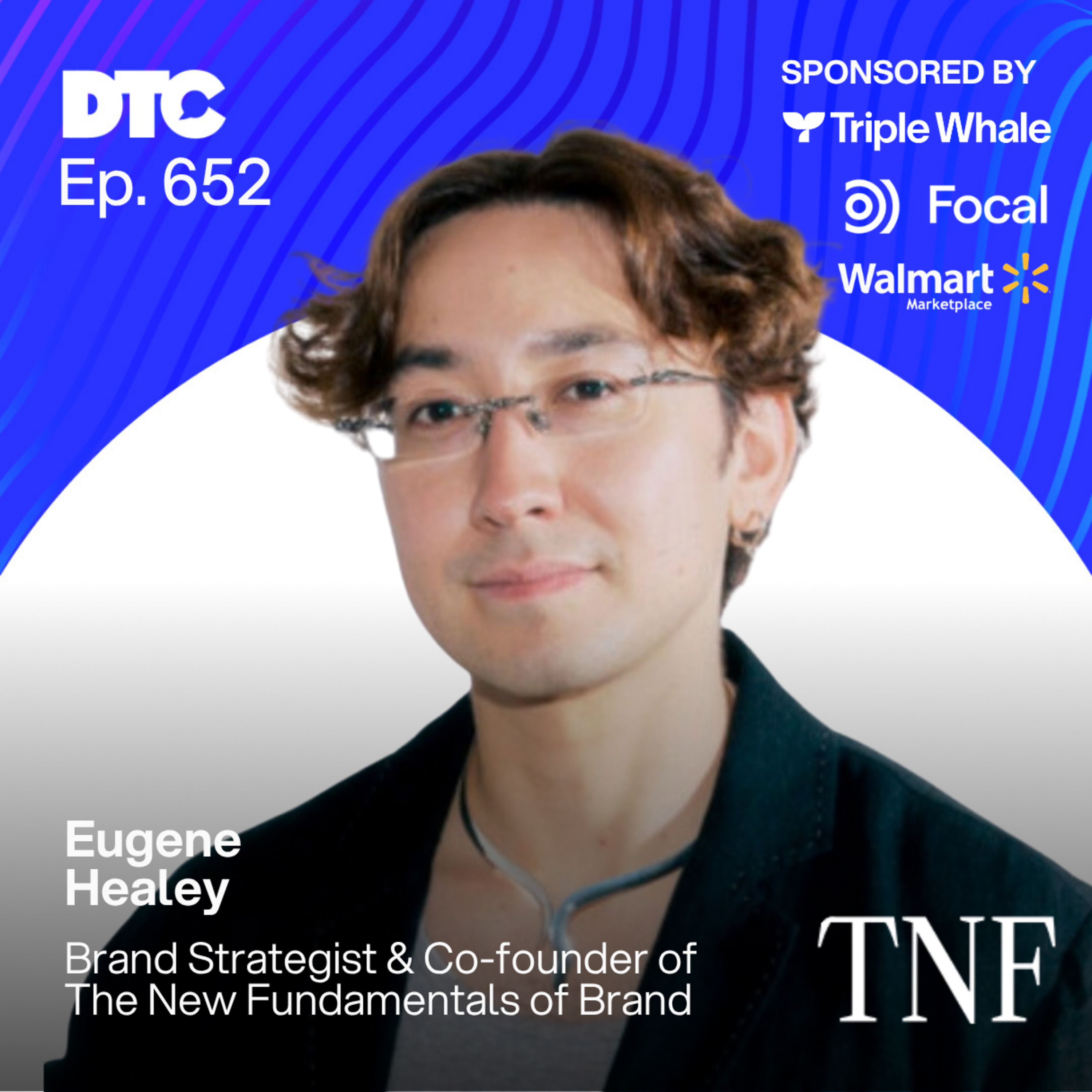
Eugene lectured in marketing and brand management at the University of Melbourne, runs a brand strategy studio, and is an equity partner in the brand tracking platform Tracksuit. On his second DTC Podcast appearance he tells Eric Dyck where brand strategy goes when media becomes the key variable, and how a team builds the judgment to approve work at volume.
Eugene's live cohort course, The New Fundamentals of Brand, starts October 12. It runs seven weeks, with live sessions, studio groups of five or six people in your time zone, and interviews with brand leaders from Hinge and Nothing. Final-release seats are limited: https://thenewfundamentals.co
Get the DTC Newsletter: https://directtoconsumer.co
WHAT YOU WILL SOLVE
ABOUT EUGENE
Eugene Healey is a brand strategist and co-founder of The New Fundamentals of Brand, a seven-week live course for marketers and brand leaders. He previously lectured in marketing and brand management at the University of Melbourne and is an equity partner in Tracksuit. https://thenewfundamentals.co
Instagram: https://www.instagram.com/eugbrandstrat
00:00 Cold open: the funnel is now a tornado
00:22 Two years of making content, and what changed
01:51 Why he turned it into a course
03:50 The central thesis: from control to orchestration
04:50 Salience in the Andromeda era
05:39 Creative is the new targeting
06:56 Walter Cronkite and the creator model of trust
08:51 Everlane, Shein and the death of the middle
12:16 What happened to the analog revival
15:23 Private social and the entertainment platforms
17:26 Creative velocity and who approves the work
19:39 Slop grenades and human discernment
22:56 Can AI hold the brand's judgment?
25:06 Hiring top screenwriters for UGC scripts
25:45 Stop making memes and become the meme: Gap
29:08 Tracksuit, queryable brand tracking and Hall
30:17 Sydney Sweeney and why we let ourselves get rage baited
34:54 Inside The New Fundamentals of Brand
38:02 Seats, and where to sign up
38:30 Wrap
Scan the code with your iPhone camera
Listen in the app.