Ask ChatGPT
 The DTC Podcast
2 Nov 2026 · 43m · 23 chapters
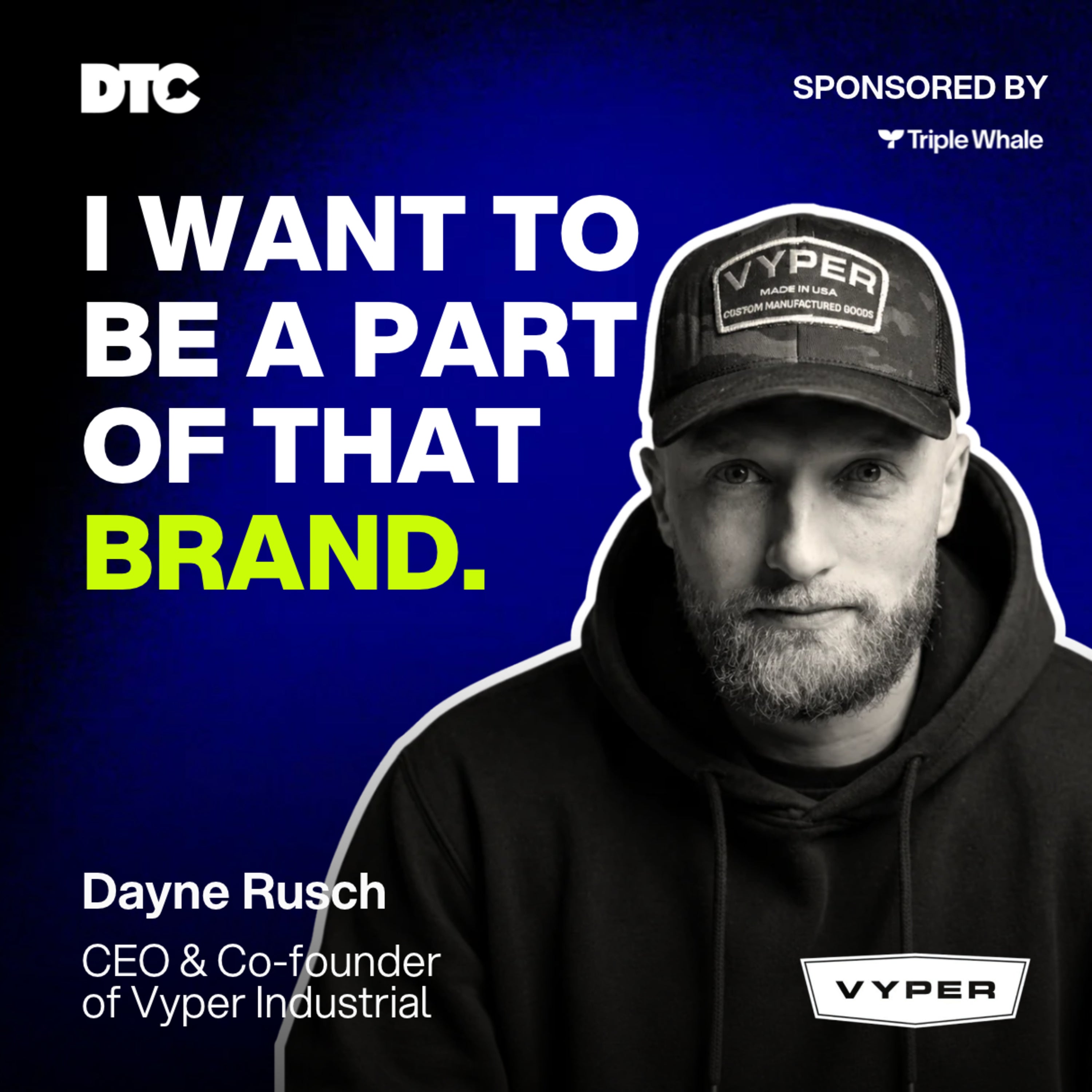
Vyper Industrial’s growth strategy for a premium DTC shop-chair brand—how a 5 ROAS mindset changed, why they invest in upper-funnel brand building (especially TV), and what they changed on-site to lift conversions before Black Friday.
Dane Rusch, co-founder of Vyper Industrial (manufactures shop chairs, shop carts, creepers; positions as “Yeti in the garage” premium). Vyper is run with his brother (engineering/operations) and Dane leads front-end/marketing and B2B. Guests mentioned: Richard Rawlings, Adam LZ, Grant Anderson, CJ Greaves (collaborations/appearances at Viperfest); plus automotive/brand partners like Ford, Chevy, Hedrick Motorsports, Realtree.
They lifted mobile conversions 37% and desktop 67% with sessions flat by rebuilding homepage/product pages around customer research (reviews, forums, on-site questionnaires). They avoid “test till you’re dead,” and believe TV/Meta/Email are reliable “buckets.” They target first-purchase profitability but scale CAC/ROAS to grow market share.
5,000+ person Viperfest; TV creative shifting from problem/solution to brand credibility via Ford/Chevy collaborations; AI used for tedious creative production (image/hero duplication) and inspiration, but not for copy to preserve authenticity; Black Friday brand-style changes, product drops, and a $20k UTV giveaway to collect emails.
Written by AI. May contain mistakes.
Learn how Vyper Industrial emphasizes community and values in its brand strategy.
“Yeah, we just like live and breathe what we sell.”
Hear about Vyper's recent developments and expansion efforts.
“No, I'm happy to be here and yeah, thanks for bringing me back on, man.”
Explore how Vyper differentiates itself in the market as a premium brand.
“Teams, teams grown a ton over the last even, you know, two months.”
Learn about Vyper's successful brand exercises and event participation.
“What's been the best for building the brand since we spoke?”
Discover strategies Vyper implemented to improve online conversions.
“It's a community that people want to be a part of.”
Understand the balance between customer acquisition costs and profitability for Vyper.
“So now we have, you know, senior e-commerce manager, web developer, and a full-time UI UX designer.”
Learn how Vyper manages customer lifecycle and repeat purchases.
“Are people making, I guess, enterprises are making more than one purchases, but individuals, are they buying one for life kind of thing?”
Explore Vyper's approach to TV advertising and brand awareness.
“And the thing with our accessories too is, you know, there, our accessories are a higher price point than some people's full product.”
Learn how Vyper Industrial is shifting its TV marketing strategy to enhance brand credibility with collaborations.
“fit and you're in this situation where probably most of your audience doesn't even know that there's like a premium option.”
Explore why Vyper Industrial created Viperfest and its benefits beyond profit.
“And that's where Viperfest is so interesting to me.”
Understand the role of merchandise in Vyper Industrial's branding and sales strategy.
“There was like a 45 minute wait at that shuttle just to get a shuttle.”
Discover how Vyper Industrial utilizes AI in creative processes while maintaining brand authenticity.
“stools or something for like computer for keyboard warriors like us.”
Learn about Vyper Industrial's focus on organic growth and community engagement.
“realize it's a human, like a real dude, that person's now going to spread the word.”
Discover how Vyper Industrial is utilizing user-generated content and influencers to enhance brand visibility.
“So I must be, I must live under a rock or something.”
Learn about Vyper's unique branding approach for different sales events and strategic product drops.
“That's what Tony, Tony from Vessi told me one time, it was his goal with the marketing at Vessi was to own the rain.”
Explore how Vyper decides to allocate their advertising budget to optimize marketing efforts.
“honestly dropping within the next 15 days.”
Understand the challenges faced by Vyper in marketing high-value products and measuring their effectiveness.
“the quality and everything that we sell.”
Discover how Dayne and his brother collaborate in running Vyper Industrial and how they handle conflicts.
“You went from around$400 to north of$600.”
Learn about the significance of American manufacturing for Vyper and its impact on their brand identity.
“So the big thing for us is that's who we're selling to.”
Find out how Vyper uses giveaways to engage customers and collect valuable leads.
“Are you psyched about the results from it?”
Explore inventive marketing ideas discussed by Dayne, including leveraging AI and creative promotions.
“I think you need to get your most souped up stool and use AI to put it on the Tesla Roadster ramp where it's inverting and then it's using rockets going all the way down.”
Listen to a light-hearted discussion that leads into a product recommendation.
“I mean, you got to start somewhere, right?”
The hosts wrap up the episode with final thoughts and a call to subscribe.
“And I'll reach out about the hat so we can get some DTC dollars coming your way.”

Get the gist, explore an idea or ask about something said.
 Claude
On The DTC Podcast, what are the key points of this episode?
Searching your listeningAutomatic transcript. May contain errors.
0:00Yeah, we just like live and breathe what we sell. It's more than just like an online product. You know, it's a community that people want to be a part of.
0:09Dayne Rusch: You lifted mobile conversions by 37%, desktop 67 % with sessions basically flat. How did you do this? If there's one thing with this direct-to-consumer space that like drives me nuts is like you can test till you're dead. What I really want to focus on going into 2027 is like what's getting the brand out there. if you're doing an event to make money you're probably doing it for the wrong reason people are going to listen to this and be like oh this guy's not even wanting to make money he doesn't care about profit but it's like look we threw an event because one
0:45Dayne Rusch: this episode is brought to you by Triple Whale the AI operating system for e-commerce just a quick gut check for brand owners and media buyers have you started your Black Friday Cyber Monday planning yet? If the answer is not yet, you're not alone. But the brands that win BFCM aren't the ones scrambling in November. They're the ones planning right now. And here's why it matters. BFCM keeps getting more expensive. Last year, ad spend climbed faster than demand did, CPMs went up, and the season stretched from a single weekend into a full month of promotions. Show up unprepared and you spend more to reach the same shoppers right when your margin matters the most.
1:21Dayne Rusch: Triple Whale built a free resource to help, the BFCM Hub. It's like a command center for planning your most profitable Black Friday with everything in one place. Real benchmarks from tens of thousands of brands so you know what performance should actually look like for brands just like yours. Free tools to set goals and forecast outcomes. Strategy guides and checklists covering ad performance, retention and conversion. And AI-powered tactics you can put to work before BFCM week hits. The best part? It's completely free and there's no login required. Go to triplewhale.com forward slash BFCM26 and start building towards your most profitable Black Friday Cyber Monday today.
1:59Dayne Rusch: It's the DTC podcast and I am here back with a podcast favorite, Dane Rush, co-founder of Viper. Welcome back to the DTC podcast, man. How you been? Thanks, bro. No, we've been great. We've been great. No, I'm happy to be here and yeah, thanks for bringing me back on, man. For those who haven't watched the first episode, you should go back and watch it because we're going to do some catch up on it. But give people the thumbnail of what Viper is. And catch me up quickly on that because you guys were poised for some incredible growth. I think you were just talking about whether or not to expand into a much bigger footprint of a facility, which I think you have now.
2:37Dayne Rusch: But yeah, catch up the audience. Yeah, a lot has happened. I was looking at her past emails, bro. It's been like two and a half years, two years. Two and a half. Yeah. Yeah. A lot has happened. Teams, teams grown a ton over the last even, you know, two months. And honestly, like the team that we just brought on, we should have done like two years ago, especially being so heavy on the direct to consumer side. So now we've got a killer CRO team. We got a, we got a great ad team, performance team. We built a brand new facility. So built a brand new facility. Honestly, it was probably right around the time when you and I had the last conversation, uh, 65 ,000 square feet, brand new state of the yard right off the, one of the busiest highways in Wisconsin.
3:25Um, so yeah, it's, we're, we're rocking and rolling. Super cool.
3:30Dayne Rusch: So, and for people that aren't familiar, tell people what Viper is. Yeah. Forgot that one. Uh, we, we We manufacture shop chairs, shop carts, creepers, essentially the replacement for your cheap$40. I don't want to call it any big brands, but your cheap$40 stool, we all are picturing the same thing. So we always compare it to like we're the Yeti in the garage space. you know yeti yeti's the high-end premier uh cooler and worthy high-end premier you know shop chair shop cars shop creepers stuff like that what's been in the time since we've talked what's been the most effective brand exercise i think you guys have built such an amazing brand i think right from the beginning you were still not from the beginning but last time we spoke you were already selling into uh you know spacex or into some you know tesla into these other crazy companies And so that was a huge part of it.
4:26Dayne Rusch: What's been the best for building the brand since we spoke? Yeah. Brands, honestly, like been the biggest thing for us being, you know, the high price premier product. Um, it, it's been the culture behind what we do, you know, like you can just feel it through our marketing of like who we are, what we sell, uh, who we team up with, you know, Richard Rawlings, Adam LZ, you know, Grant Anderson, CJ Greaves, like this race automotive community. Just a month and a half ago, we put on one of the most epic events called Viperfest. It was over 5 ,000 people came. We had Adam LZ, Richard Rawlings, Burnout Pit, Car Show, food trucks.
5:09So it's more than just like an online product. It's a community that people want to be a part of. And yeah, we just live and breathe what we sell. We are automotive of enthusiasts. Like that's who we are, whether we're working at Viper or, you know, it's the weekend and we're going to cars and coffee and, you know, car shows and events and stuff like that.
5:32Dayne Rusch: One of the posts I caught up with on your LinkedIn there was a post that you made about your website rebuild you made this year where you lifted mobile conversions by 37%, desktop 67 % with sessions basically flat. How did you do this? Yeah. One, we just made it way cleaner. We had – man, even our product pages, we just had so much stuff that we thought we needed on the product pages, the home pages. We were talking to the customer as if we thought we knew what they wanted to hear where we actually put ourselves into their shoes, read reviews, did forums, actually did on-site questionnaires and let the consumer tell us like, hey, what were the holdbacks that you were having?
6:19What almost prevented you from buying? Why did you buy? And we essentially took what the customer told us and just like infiltrated that throughout the homepage, product pages, all that stuff. And yeah, it worked good, but it's so funny because like we're in the process right now of redoing the product page, homepage, collection, navigation right before Black Friday. Not completely revamping it, but just making it better. and yeah honestly dude i like the site's good but you take a look at what some of these other big brands are doing on direct to consumer it's like you're always behind it's like you can do you can do something better um but yeah then i see other brands that are that are like maybe not focusing on it as much as they should be you know so yeah it's it's always something that you're
7:07Dayne Rusch: chasing but the levers that you pulled in that in that attempt there have paid some dividends Yeah, most certainly. And that was before we brought in a CRO team. So now we have, you know, senior e-commerce manager, web developer, and a full-time UI UX designer. And these guys are already seeing, you know, a ton of improvements that we could be doing, even on top of what we just did or thought we, you know, thought was good. So yeah, now we should move at rapid speed with the team that we got. Talk to me about your paid approach. I think when we last spoke, you were talking about investing more in real world things in your new factory, in a few other areas.
7:51Dayne Rusch: And you were talking even about like de-emphasizing digital a little bit. But I see that's a bit like that has kind of come full circle now and you guys are all in. You've always been all in. But yeah, I mean, that was at a point where we're like, man, are we spending too much on, you know, are we like too reliant on paid ads? But honestly, we're at a point right now where with how much overhead we have with the new facility, all this stuff, we're really focusing on what is that bottom dollar new customer acquisition and new customer ROAS that we can hit even at scale. You know, like we were always, man, I remember, you know, three, two, three years ago, we were so focused on how do we get as much profit as we possibly can on the first customer.
8:37And don't get me wrong, of course, making profit as a business is important, but you can suffocate growth so much. Like I remember we're like, oh, we need to be at a five row ass. And it's like, dude, that's stupid. Like you could, you're not going to grow and you're not making enough top line revenue to even, you know, overcome all your operating expenses. So, you know, now we're at a point where it's like we have dialed in new customer and CACs for, you know, through Black Friday. We're checking it every single day. It's like if we're low and you had to want to say making too much profit, but it's like if we can scale even more and grabs, you know, more market share at a discount during these holidays, let's go do it.
9:18you know, so ever since discovering that, I mean, that's gotta be like a year and a half ago. We just been like, let's just keep investing, keep going, keep going, keep going. We know what ours, you know, we are first purchase profitable, but our, we don't have a long tail end, you know, like our customers, yeah, they'll come back, but it's, you know, it's a high, it's a high price point product where a lot of brands are like subscription-based. We'll take a loss on first one because we'll know we'll recoup it, you know, three, four months on their own.
9:43Dayne Rusch: What does the LTV equation look like? Are people making, I guess, enterprises are making more than one purchases, but individuals, are they buying one for life kind of thing? Because I guess you guys have a lot of different products now. How does a customer lifecycle look in terms of LTV once you acquire the customer? Yeah, for sure. So it's a good point. We do have two parts of the business. We have direct-to-consumer plus we have B2B. I'm more talking just D2C here. But yeah, B2B is multiple reorders, stuff like that. But direct-to-consumer, yeah, what you'll see is you'll get – you've got this bucket of guys that will come to the site.
10:18They know about us. They want – they know they need three or four of them. But what they're going to do with the price point is buy one. And then they're going to see if they like it, see the quality. like, is this actually worth what Viper says it is? They'll get it. They love it. They'll come back and buy, you know, four. That's like our like ideal customer. Obviously they're all not like that. Then you get your, you know, everyday garage guy. He'll come in, he'll buy a chair and then see if he likes it. And then he'll buy an accessory, you know, two months, maybe three months down the road.
10:52So we still do have a like flow of lifetime value throughout the customer. It's not just like one and one and done. We'll see. It's like, it continues to extend, you know, a couple hundred bucks year over year of each customer versus like multiple$600 purchases, you know, from like one customer.
11:15Dayne Rusch: That makes sense. And the thing with our accessories too is, you know, there, our accessories are a higher price point than some people's full product. You know, like our, an accessory right now is 200 bucks for us. You know, we're like, some people are like, Hey, our AOV is 200, you know? So, uh, it's not like these second purchases are small buckets. Like it's still, you know, 200 bucks. I think in our last talk, you were just about to, or you had just launched OTT streaming. I'm curious, where does TV sit in your mix today? Yeah, we don't do any of it anymore. We're using Mountain. And honestly, man, if there's one thing with this direct-to-consumer space that drives me nuts, you can test till you're dead.
12:02You can be like, okay, well, there's incrementality and MMM and all this stuff. and what I really want to focus on going into 2027 is like, what's getting the brand out there? You know, Peter with Chubbies with the shorts, he talks about it all the time is the 95-5 rule is like 95 % of the market that's seeing your ad is not interested in buying that day. You know, only 5 % of the people that have seen your ad at that given point are like ready to make that purchase. So knowing that it's like, I just want to be the brand people remember and be less pushy on sales, you know? So, um, with, with that is like the, the TV side, it's like, we just go, it's like, we're doing heavy national spends like MLB last night.
12:50We're doing MLB spends like Monday night football, get in front of as many people as we possibly can at the lowest cost. and all those people are just building the pool. It's like none of those people are buying, not none, but like a good portion of those people are not buying that night, but they will come back six months down the road, seven months down the road, eight months down the road when they are actually ready and then make that purchase. So like I'm going more on the point of like, here's our bucket of spend we have for six months. Let's go all gas. And yeah, we can do incrementality testing and all this junk, but it's like, we know TV works.
13:25We know meta works and we know email works. It's like, those are three big buckets. Let's just go all in on those. You know, otherwise you're just like, I feel like if you try a new, oh, let's put a hundred K towards this new app that everyone's, you know, craving about. It's like, you could just blow a hundred K and it could get you nothing. You know, it's like, I'd rather stuff that into TV. And I know that it's going to get me something back. I don't know. That's just my mindset. I'm on the point of just like, get the brand out there in front of as many people as you possibly can and just let the funnel work, man.
13:58Dayne Rusch: You have so much invested in your product as, you know, and you have such product market fit and you're in this situation where probably most of your audience doesn't even know that there's like a premium option. You know, a lot of, a lot of, a lot of your audience that isn't aware of you, isn't even aware that there is this like more premium option. So it like, it checks out for me, what, what's your communication strategy with TV then? How are you, what are, what are your, what's your mindset for how you're making your creative really, you know, stick and really, really get in people's heads for when they are ready.
14:26Yeah. So we did have a problem solution TV campaign running for the longest time, you know, which is like really focused on the older demographic guy falling off his chair, you know, like tired of falling off each stool, like really focusing on the problem that everybody who's watching, you know, TV at that time can relate to.
14:46Dayne Rusch: And then here's a solution, Viper chair, you know, whatever, throw your other chair away. But what we're moving more towards is we have some collaborations now with Ford. We're about to drop one. I think I can say it. We're about to drop one with Chevy. We're about to drop one with, or we have Hedrick Motorsports. We have Realtree. So we're going to go way more focused on, you know, top of funnel TV with putting Viper Ford, you know, like have a Viper Ford TV commercial because ultimately that builds the brand credibility. Massively. Everybody knows Ford's logo. Everybody knows who Ford is. Everybody knows that Ford's not going to do a deal with a small little company.
15:29So we want to use their brand credibility that they built over the last, whatever, 100 years and put our name next to it. So that's kind of the strategy with TV. It's like, I want to get away from pushing sales and just pushing more of lifestyle, pushing more of like, I want the customer to see it and either laugh, be like, that was funny, or to be like, I want to be a part of that brand, whatever it is. Like, that's really cool.
15:55Dayne Rusch: And that's where Viperfest is so interesting to me. I have a big background in events, having put on a lot of them. I'm curious. We just did a podcast with Drew from Iris Financial, the CFO guy. And I'm wondering, what number do you have to show your CFO to get budget for Viperfest? Yeah. Well, we don't have a CFO yet. There you go. So it's pretty easy to get the budget by. uh yeah i mean look you know you've been in events uh if you're doing an event to make money you're probably doing it for the wrong reason like the whole the whole reason we went into it it sounds so stupid like people are gonna listen and be like oh this guy's not even wanting to make money he doesn't care about profit but it's like look we we threw an event because one we wanted to establish like our our brand in the local area two is people don't realize how good of an employee search you become.
16:52A lot of people, you may have 2 ,000 people that come there that are like, I hate my job. And they come there like, what is this company? I want to work for this brand. So you help get your name out there with how competitive the talent pool is out there. And then third or fourth is we just, my brother and I, we just want to have fun too. You know, it's like, selfishly, that party was for us a little bit too, to have a, you know, just have a good time I mean, like get this, get people like associated with this brand. You know, we sold a boatload of merch. We got to hang out with Adam LZ, you know, Richard Rawlings.
17:24Like those guys are awesome. And yeah, we just, it was a fun free event for everyone to come to. And whether you make money or not, it's like a crush on social. So yeah.
17:34Dayne Rusch: Great for brand equity. And why are we doing this if not to have fun along the way? Yeah, of course. If you can make money, I mean, of course, you know, do it. But what do they say? like the first event you throw, you lose a ton. Second, you break even 30, you make money. Well, we're on the second. So hopefully the third, we can make, we can make money. My understanding with events, I actually haven't put on one this big, but you really only make money with events when you have the exhibitors hall, when people are paying you 20, 30, 40 grand. So when you're the only brand, it's like, it'll be, I think it might be tough to make money, but it's going to be great.
18:11Dayne Rusch: Like you say, for, for social, for brand equity, for potentially creative throughout the year. So you are putting, you're putting it on again. Are you aiming to do it bigger or what's your, what's your thinking with the second event? Yeah, we're going to do it again for sure. So, um, I mean, dude, we had cars lined up like miles and miles down the road just to get there. So we had a, we had a big parking lot and we had a shuttle running back and forth. There was like a 45 minute wait at that shuttle just to get a shuttle. So did you have a drone flying over that? Like showing the lineup? Yeah, we did.
18:40Dayne Rusch: Yeah. Yeah. So from like all different angles, like every road was packed. Yeah. So it, it rained a little bit, which, you know, kind of, kind of sucked, but the events still turned out really well, even though we had, you know, some, some, you know, rain throughout the day. So we're like, we're doing this again next year and, you know, hopefully we can get a good day so that we can really get an understanding of like, how big could this event actually be? You know, if you got like a good day. So yeah, we'll see. We're planning like September next year again. We talked about this in the pre-show.
19:12Dayne Rusch: You have the best merch. You have some of the best, like, is the merch a fun thing? A merch is obviously a fun thing. I love merch. How do you think of it in terms of the business? You sold a lot at the event. It's almost like it could be streetwear. You know what I mean? I'm curious how big of a line item the merch is to a business like yours. Yeah. Honestly, for us, it's not as big as it should be. You know, like, you know, friends with Brandon over at MKC. I know you had him on. Like, those guys crush merch. Like their merch is a huge revenue line for them where it's not that big for us, you know, and like we're trying to get there.
19:48So I think the merch is a little bit more of like selfishly a little passion project where like I want to wear this stuff too. And like our creative manager and I have like the same feel for high quality merch, like even jackets and hoodies. Like this isn't just your local print shop printing it on just hoodies that they have. they're like you know we go through having them send us all these different samples like make sure that it's something that we would actually want to wear as well but yeah merch isn't as huge as you know we would like but it's it helps locally like we got we get quite a bit of walk-ins that come in and buy some merch and all you got to do is send me a hat and then you're going to
20:27Dayne Rusch: get free impressions among dude because i i don't know if you need you need like work from home stools or something for like computer for keyboard warriors like us. Well, man, if we get you, if we get you some merge, we better stock up. That's right. We're going to sell that out. Super cool. One of the things I'm asking people about right now is where there's, what their state, you know, how they're using AI specifically how they're using AI in the, in the growth side of things. What's your state? I think you made a post recently that got had a lot of, a lot of activity on LinkedIn around AI creative.
21:00Dayne Rusch: What's your philosophy with AI creative in ad buying? Yeah. Yeah, bro. I got hammered on that post a little bit. I'm like, geez. I mean, I didn't think it was too bad. No, I think. So the thing with it is, is like, dude, you got to use it. And if you don't, you're going to fall so far behind. And I stand on the side. Like, I'm a big brand guy. So like, I don't think a company can be built. The brand can be built using AI. I think AI can help you automate a lot of tedious stuff that we used to have to do by hand. Our creative team uses it every single day for collections. We have to duplicate the product images, the hero images, all this stuff.
21:45And it's probably like a two or three hour task for one person to do it. Where now we have the cloud system set up where we can literally just tell it what we needed to do. Here's the Google Drive folder, pull these images and fill it in exactly what we have. Now it takes 15 minutes for it. And we're not sacrificing quality. We're not sacrificing brand. It's just doing a tedious background task that would have taken a dude two or three hours to do. So what we're also doing too is on the creative side, our team, Austin's got it dialed where we use it a lot for inspiration. So like even just to get an idea, like any creative listeners that you have will relate to this is like, when you're designing a homepage or a landing page or whatever it is, You can get creative fatigue.
22:29You know, it's like, oh man, I'm like stuck. Where do I start? And it's a great tool to use. It's just like, hey, here's some screenshots of examples of what I'm thinking. Here's where I want to be. Like, just dump me a bunch of examples, you know, just to get the wheels turning a little bit. And then our designers will take it and, you know, move on from there. But that's how we use it. And look, that's our business. You know, we're, we're a premier product where I know a lot of supplement brands, like they can pump out creative with it. Great, dude, like use it. Where I look at it as like our product, could we use it for creative?
23:07We certainly can. We do, we do to a sense, but like we don't rely on it because I don't know what I'm afraid of is especially like using it too much in your voice and the style and the look and feel of your brand. what I what I can see happening is like no matter how much you try to like tweak Claude to like be you or be your be your brand it'll always use AI strategies in the end where you can point it out it's like yeah I can tell like you kind of start seeing these AI trends and designs so I think use it but with caution bro it's just like if you want to be an authentic brand I think now is the bet like in the LinkedIn post is like now is the best time to be authentic and like make your brand I want it to where a customer reads one of our emails and feels refreshed because it's like, wow, this feels like a human.
24:00It feels real. It just doesn't feel like words. And that's why even in copy, we don't use it at all. We'll use it to get the ball – again, get the ideas, get the ball rolling, and then we'll take that and then type it in human form. and you know one last thing on this is like we tried some ai stuff on like text message responses to abandoned carts and stuff and yeah dude honestly like we we tried a free trial and it wasn't it wasn't great you know so we just hired a full-time person in-house to make abandoned cart calls and abandoned cart texts a human you know it's like yeah it's overhead but it's like where you're giving that personalized touch when that customer gets a phone call from viper and they realize it's a human, like a real dude, that person's now going to spread the word.
24:47He's going to go tell his buddy, be like, yeah, everyone's using AI, but I call it Viper. It's a human. It's like, that's what we want to be. So that's how we look at it. I know a lot of like, let's say if you're bootstrapping a company and like you need claw to help build out a website, bro, use it. 100%, go for it. I just think if like you want to build the authenticity, just be super careful.
25:09Dayne Rusch: Yeah. Like as a, as a non-technical founder, it gives me the ability to create starting points and I'm always, you know, running things over with designers and, and having them, but it just, just to get my ideas across as a non-technical person, non-designer found it extremely valuable for that. For sure. Like, look, dude, Claude code is insane. Insane. You know? So it's like, I'm, I, I'm a huge advocate of like using it for sure. A lot of potential. It's going so fast. And yeah, it's just like, if you don't do it, you will fall behind quick and it's going to be tough to like catch up. All I'm saying is just like, make sure no matter what you do that you just like keep the human aspect in there somewhere.
25:49You know, like it's got to feel like your brand and you, you know, otherwise you're just going to fall in line with like everybody else who's using it for copy and design. And like all supplement my brands are going to look the same. You know, they're all just going to be clean, same design, same style, same language, same everything. It's like, what's the difference between all of you guys? You know, it's like, yeah, well, we used AI and it took, it, it went really fast. It's like, yeah, but now you're no different than someone brand X, Y, and Z next to you, you know? So that's, yeah, that's just kind of my, my take on it.
26:20Dayne Rusch: What are you, how much have you guys invested in organic? I think obviously with your, with your events and like, it just makes me think of Montana Knife Co. And they're like, as an organic, they can't even buy ads on their knives generally, um, because they're knives. And so they've had to live on this like release frequency and this drop model. I'm curious with it with, you know, you, obviously your brand is going to have a lot of really loyal people. How do you think about organic in your, in your growth mix? Yeah, a ton. And that's what we want to push heavy in this in 2027. Um, yeah, dude, MKC, like honestly Viper and MKC there's a couple other brands too honestly I feel like our two brands are the brands that like are actually brands Brunt's building a great brand as well and it's because it's just authentic and there's people behind the brand and the you know the face and the name of it but organic is huge for us you know we got some really cool stuff lined up with garage beer it's like you know it costs us a lot of time a lot of money to do these prototypes and all that stuff but it's like it's cool and it's fun and it's like it gets people engaged we're gonna do a really cool garage beer drop in november super limited quantity and you know it's like will we make a ton of money in it no but it gets the name out there you know people would be like wait is that a keg on a chair you know it's like we'll never sell it again but it's like yeah so organic's huge for us huge huge huge and something that i think we do a good job on but next year we want to put like a really big budget towards.
27:52Dayne Rusch: Are you on the tribe train tribe? The, the UGC network, are you using, I've just, I've been talking to a lot of operators lately and they've been telling me that their ad mixes are getting taken over by tribe creators. Are you familiar? No, I'm not. Okay. So I must be, I must live under a rock or something. So tribe is like a UGC network where basically you're paying for performance and you're basically paying the creator out of G there's like a GMV component so that the, you know, they're actually tracking the UGC that ends up getting that. So it's, so it creates this network effect where it's really only the best creators are getting paid.
28:31Dayne Rusch: They're getting paid a ton. And when you scale it up really high, it has, it has, can have problems on your P and L, but that generally, if all of the other aspects of your business are working well, tribe can be an accelerant is what my read on it is. Got it. No, I, I haven't heard of that, but take some, take a look into it. It's kind of like a refund. Not familiar. I'll check it out. Yeah. Yeah. Yeah. Is UGC a big part of your mix? Like is creators, uh, content a big part of your mix? Yeah, I bet. Yeah. And it's, it's even going to grow from here. So we just brought on an influencer manager and yeah, she's fully just responsible of, we call it product seeding, you know?
29:06So it's like, how do we get the product out there where even if it's in the background of a video or, you know, somebody's just using it and not even promoting it our product's great because like the people that are using it are obviously typically sitting on it where some products are maybe in your pocket or you know underneath your like a t-shirt or you know you wear it in your shoes and they're never being shown so like we have a good product where even if it's not being pushed like hey you gotta you gotta buy a viper chair they're at least using it and you can see like oh what is that chair.
29:39Yeah. We get all the time. People are like, we can't see your product without, you know, watching like we, whatever, whatever mechanic video or automotive or whatever garage show, like you guys are always in it. And like, that's the goal. It's like creating familiarity. If a, if a customer ever thinks of a shop chair, like, or shop cart or anything in the garage,
29:57Dayne Rusch: they come to us. In generations to come, they won't even call them work chairs. They'll just call them vipers. That's a goal. Like Kleenex, right? You just, just own it. That's what Tony, Tony from Vessi told me one time, it was his goal with the marketing at Vessi was to own the rain. And I was like, that's pretty badass. I was like, if it rains, you should be thinking about your Vessis. If you're in your workshop, you should be thinking about Viper. Dude, 100%. That's the goal. That's the goal. We're close, honestly. Household name, brand, and yeah, we'll get there. What are you most excited about for this Black Friday, Cyber Monday?
30:33We turn it up a notch on branding. So what we like to do is do a different brand style for every sale. So Veterans Day has a different sale, Black Friday, Early Bird has a different sale, Black Friday, Cyber Monday, Cyber Monday Extended. They all have a different feeling. So whether you're looking at our brand from an email, an ad, or the website, like let's say it's Cyber Monday, you're going to see that brand consistent from the ad, email, website. Like our buttons on the website are going to change. Like everything's going to flip over. So creative team crushed it on this. Also, I'm fired up for we have a more strategic sales season.
31:16So last year, we just kind of ran the same discount where now we actually have it different sales for different blocks. And we're kind of going risky here. We're trying to different some different methods on discounting. So we'll see how it works. And then the last thing is strategic product drops. So Black Friday, we do Return of Legends. So we'll bring back, like you said, Montana Knife doing the limited editions. We do limited editions all year too. We'll bring back our top sellers just for Black Friday, where usually we won't bring back limited editions, but we'll bring back them on, it was a Thursday night at midnight for Black Friday, obviously.
31:56So a lot of cool product launches on big buyer days. Yeah, we got some monster, monster goals. And then obviously we have a ton of website revamps, honestly dropping within the next 15 days. So it'll look like a whole different brand if you go on in a month.
32:17Dayne Rusch: Are you using any tools for your A-B testing on the website side? We use IntelliGems. Yeah. Which we found was, was the best. I know Evan's got a whole boatload of other stuff that he wants to, wants to test, but yeah, right now we, we have an IntelliGems connected. Um, if we were to give you a hundred thousand, this is a new stock question we're testing out for all podcasts for, for Q4. If we were to give you a hundred thousand, a hundred thousand dollars, I know you said you're not big on like little tests here and there, but where would you pour that gas? If it was just like a free a hundred thousand dollars to go into your like November ad budget?
32:52100K. Uh, I would pour probably more on TV to be honest. Um, cause right now we're, we're like pre-spending, you know, where last year we, we found some kind of like inefficient spending days where we didn't have to spend to get that purchase. So like I'll, I'll probably take it right now and do something for these MLB games and dump it on that before black Friday. Um, yeah, I'd say throw it on TV or take it and divvy it up.
33:19Dayne Rusch: up with the team or spend it all on trying to get Tim Allen on board. I feel like Tim Allen and Richard Kern, the original home improvement duo, when you'd be like, is there a better workshop chair? I don't think so. Tim. Tim Allen's a legend. Yeah. His real name is Tim Dick, by the way, just like me. So that's Tim Allen and I go way back. Anyways, that's my free consulting idea for you there. One of our other stock questions is what's the worst thing about selling your product? It's definitely a high consideration product. So, you know, like I was saying before, you have other alternatives, way cheaper alternatives at a fraction of, you know, the quality and everything that we sell.
34:04So the dollar we spend today, we don't see right away. And I think that's where it can become challenging because it's like, is what we're doing today working? And, you know, you almost have to have this faith where it's like, we feel like what we're doing, the marketing we're putting out, you know, the advertising, the messaging, uh, is good and will pay off, you know, six months down the road. So I think that's like the biggest challenge with our product is, yeah, it's a high consideration to take somebody that sees it today. Isn't buying today. Some do, but usually people sit on it for a while.
34:37No pun intended.
34:39Dayne Rusch: Pretty good. Um, what, with all of the brand spend you, so we just finished the six part series with Keen, which is like a decision system company. and that was called Harness the Halo. And it was about how to measure upper funnel brand swings, like brand growth swings. And I'm curious, like with all of the attention you're going to put into upper funnel and brand growth in 2027, I'm curious about your thinking on how to measure it. Yeah, TV is like this gray box and I feel like it always has been. So if you know someone that has a good calculation of like, you know, how to truly determine the impact, I love an intro.
35:18Yeah, honestly, a few things with us is you can obviously search branded search. You can track organic to the site. Those are like the biggest things. Obviously, we have like post-purchase survey, but not everybody is truthful on where they say they first saw us. So those are the few things. It's like, honestly, are we getting a lot of branded search on Google. Is our new customer cost for acquisition going down? And yeah, we're just getting a lot of direct traffic that's purchasing.
35:50Dayne Rusch: How did the price raise go? You went from around$400 to north of$600. Talk about that process. How did that, was there any pushback or did people not even blink? Yeah, that was a while ago. Well, it took a while. So like we originally, right when we first started, of the product was like$450, but it has a fraction of the features it has now. It didn't have a backrest, didn't have the cylinder that it has now. So it wasn't comparing apples to apples. We advanced the product and then as we advanced it, we increased the price at each one. So where it's been is$625. We haven't raised the price in probably like two or three years.
36:31Dayne Rusch: You do offer a 105 % money back guarantee. Never seen that before. Yeah. So we got the idea from, it was first form. So what we were doing, we switched it back. It's a hundred percent now. We switched it back. And what it was, was 105 % money back guarantee. We would give you a hundred percent back plus pay for, pay for your shipping as well. So, you know, it came out to be around 105 % of your money, of your money back. And you're running your company with your brother. You said you don't have a CFO, but you do have a brother. Is there anything that you guys, you guys will butt heads about? Yeah.
37:08I mean, there's, there's always things, right? Like, you know, even if you and your brother weren't running a business, you butt heads. No, it's a, it's a cool dynamic. Cause like he's, he's on the engineering side, the operation side, you know, like, like the backend dude that's making sure everything's running. And then my role is more on front end. Are we getting sales? Is our marketing dialed? Is our business-to-business sales strategy dialed? Do we have the right people? How's the brand looking? Really forward focused. You need both in a company. If we had two of me or two of him, we wouldn't be what we are right now.
37:45But yeah, dude, it's two brothers, but we know that we're in it together and we don't hold anything against each other it's like if if we get frustrated it's almost like a good sign because we both care you know we're like if both of us are just like yeah whatever it's like then none of us even care
38:04Dayne Rusch: so yeah it's a good dynamic i think well we talked a lot about you guys being a fully american made product uh and it was pretty it was well before all of this tariff stuff came in i'm curious how how how you've been like how important being an all-american made and source brand has been to the company? Yeah, it's been great. So the big thing for us is that's who we're selling to. We're selling to the guys and girls that love quality, love American-made products, love to support American manufacturing and American jobs. And we feel that it's been a huge selling point for us because that's one of the reasons why we came in the industry is it was so just like clogged by this overseas, you know, China made products.
38:55And that's our claim to fame, man, is like, we want to keep this American made, make sure that when you're spending, you know, five, six, 700 bucks with us, that you are getting the best product on the market. You know, like this isn't, this isn't something where like the bolts don't go on or the, the assembly instructions aren't actually what the product is. It's like, when you get this, you get a full lego set of uh assembly guide it is beautifully laid out with 3d renders you have videos for every single product getting put together the nuts and bolts go together like butter you know it's part of coated not painted like everything goes in it's a small little details that we pay the closest attention to that a lot of brands just like oh well we'll we'll just cut it because like you know we got to hit profit you know we got to hit margins we got to be the lowest on the, on the market where we go like, Hey, let's, let's just make the best products, solve all the problems.
39:48And you know, we'll price it there.
39:50Dayne Rusch: Last question. I noticed on your website, you're currently doing a giveaway reminds, I don't know if you worked with my friend van, who is like, Hey, it runs a giveaway agency, uh, in Utah, but I'm curious about the economics of this giveaway. Are you psyched about the results from it? Yeah, it's been good. So we tried usually for the giveaways we'll do, we'll do a car or a truck. And I mean, dude, you're talking, you know, six figures for the vehicle. And when you do a giveaway, you have to own it outright. So, you know, you can't have a loan on it, whatever. So you have to upfront cash pay for, you know, whatever you're giving away.
40:23And what we realized is like, when we gave away the last two, the TRX and the Porsche, it's like, do we have to give away such a high price point product or high price car or vehicle? Or could we get the same results with a, you know,$20 ,000 UTV? So that's what we tested out this time. And it's going really well. So we're doing it where it's free entry also. You can just do email sign up to get entered. And obviously the goal with that is get as many as you can before Black Friday. Hexclad, I see they're running a similar model right now with a trip to Italy or something with Gordon Ramsay. Yeah, it's a great play.
41:03Get attention, eyes on the brand. Our cost is$20 ,000 plus some ad spend behind it. And yeah, we're collecting thousands and thousands of emails that possibly could purchase in Black Friday.
41:14Dayne Rusch: Love that. I just had another great idea for you. I think you need to get your most souped up stool and use AI to put it on the Tesla Roadster ramp where it's inverting and then it's using rockets going all the way down. Dude, I think it's just about as feasible. I think putting all that powered rockets in a car, just about as feasible as putting it in a stool. I love just my quick take on everyone's like agog at this amazing stunt. And it was an amazing stunt. But do we really think that this technology is going to impact the future of transportation in a way? Like we're not blasting nitrous rockets from our cars, are we?
41:53Dayne Rusch: Yeah, we might be. We didn't think we'd be driving battery vehicles, you know, and now they're all in the room. I guess so. Yeah, who knows, man? I mean, you got to start somewhere, right? Like it's better than a propeller on a car. Or on a stool, I'm telling you. Just put it into an AI video machine to make me the Tesla Roadster video with my product and watch the money roll in. And the Viper chair. I love it. All right. Well, thanks for the catch up, man. This was awesome. If you want to have a better workshop chair, you got to go to Viperindustrial.com. You also got to follow Dane on LinkedIn.
42:27Dayne Rusch: I'll make sure to include it on the show notes. You've got the occasional hot take on there, which people love. Thanks, man. This was a lot of fun. Yeah, dude. Thanks for having me. Have a great weekend. And I'll reach out about the hat so we can get some DTC dollars coming your way. Let's go, bro. We'll get you a hoodie too.
42:49Dayne Rusch: Thanks so much for listening to today's episode. If you're not a subscriber to our newsletter, you can do that right now at directtoconsumeralloneword.co. I'm Eric Dick, and this has been the DTC Podcast. We'll see you next time.
What ROAS should a DTC brand target when it sells a high-priced product? Dayne Rusch, co-founder and CEO of Vyper Industrial, used to demand a 5 ROAS on the first order and now calls that target stupid. Vyper sets a new customer CAC goal, checks it every day and keeps scaling while it holds.
Vyper makes premium shop chairs, carts and creepers in Wisconsin, with its flagship chair at $625, and calls itself the Yeti of the garage. Two and a half years after his first visit, Dayne is back with a new 65,000 square foot facility, a new CRO and performance team, and a plan to spend 2027 on brand: national TV, collaborations with Ford, an event that drew more than 5,000 people and a full-time human calling abandoned carts.
Get the DTC Newsletter: https://directtoconsumer.co
WHAT YOU WILL SOLVE
You set a high first-order ROAS target and growth stalled. Dayne says chasing a 5 ROAS suffocated Vyper's growth and didn't bring in enough revenue to cover operating costs. The target now is a new customer CAC, checked daily, and when Vyper is under it during the holidays, they spend more.
Your product is too expensive for subscription-style LTV math. Vyper is profitable on the first purchase. Its ideal customer buys one chair to test the quality, then comes back for four more. Others come back for accessories that run $200.
You keep testing new channels. Dayne puts the budget into the three he knows work, TV, Meta and email, and says $100K on an unproven app can get you nothing.
Your TV ads sell too hard. Vyper is moving from problem-and-solution spots to brand spots built on collaborations with Ford, Hendrick Motorsports and Realtree, because a partner everyone recognizes lends credibility.
Your site is cluttered with what you think customers want. Vyper rebuilt its pages from reviews, forums and on-site questions about what nearly stopped people from buying. Dayne's LinkedIn post put the lift at 37% on mobile and 67% on desktop with sessions flat.
You want to use AI without sounding like everyone else. Vyper's team uses Claude to cut a two to three hour image task to 15 minutes and to spark design ideas, but keeps the copy human. After a trial of AI replies to abandoned cart texts, Vyper hired a full-time person to call and text abandoned carts.
You can't justify an event on ROI. Vyperfest drew more than 5,000 people. Dayne counts local brand, hiring and team morale as the return, and a second one is planned for next September.
You can't measure brand spend. Dayne watches branded search, organic and direct traffic, and whether new customer cost is falling. He doesn't trust post-purchase surveys on their own.
You are running the same Black Friday as last year. Vyper gives every sale period its own brand look across ads, email and site, splits discounts into blocks and brings back limited editions for one weekend.
Your giveaway prize is eating the budget. Vyper swapped six-figure trucks for a UTV that costs it $20,000, with free email entry to build the list before Black Friday.
ABOUT THE GUEST
Dayne Rusch is co-founder and CEO of Vyper Industrial, which he runs with his brother Dylan. https://vyperindustrial.com
STAY CONNECTED
DTC Newsletter, daily ecommerce marketing and ecommerce growth tactics: https://directtoconsumer.co
YouTube: https://youtube.com/@dtcnewsletter
LinkedIn: https://linkedin.com/company/directtoconsumer
TIMESTAMPS
00:00 Building Vyper into a premium automotive brand
05:00 How Vyper increased website conversions
12:00 Why Vyper is investing heavily in TV
21:00 Using AI without losing brand authenticity
30:00 Vyper’s Black Friday strategy