Ask ChatGPT

 The Game Business Show
15 Oct 2026 · 1h 3m · 24 chapters
Two-part episode on major IP recovery and expansion. Part 1 covers Activision’s plan to fix Call of Duty with Modern Warfare 4 (launching next week) amid declining franchise metrics. Part 2 discusses Lucasfilm Games’ recent Star Wars releases—Star Wars Zero Company and Star Wars Galactic Racer—made by veteran independent studios.
Written by AI. May contain mistakes.
Details about upcoming events and guest introductions.
“In the second half, I'm going to be joined by Douglas Riley.”
Discussion on the struggles and recent performance of Call of Duty.
“So Call of Duty, look, it appears to be in a rough spot, at least by its very high standards.”
Tyler Ball discusses strategies to revive Call of Duty with Modern Warfare 4.
“Now, again, the numbers are probably slightly higher because of those missing games, but obviously a big drop overall.”
Discover how community and social play enhance the Call of Duty experience.
“And then I think at the end of the day, what makes Call of Duty so last the test of time, I think is the community and the social experience.”
Learn about the advantages of focusing on newer consoles for Modern Warfare 4.
“Yeah, I mean, we're rebuilding this relationship, right?”
Explore the partnership with Nintendo and the potential for a broader audience.
“I say I shouldn't have forgotten it, but the fact is not in Game Pass day and date this year.”
Find out about the plans for post-launch support and future innovations in Call of Duty.
“I wasn't going to ask a question about those ports in the summer and the fact that I'm really fascinated that they did so well.”
Understand what success will look like for the upcoming release of Modern Warfare 4.
“And we have to, you know, what we heard from the audience is they want new or better or different, right?”
Explore the various components of the Call of Duty audience and marketing strategies.
“you have so many different components of the audience, right?”
Discuss what success means for the upcoming Modern Warfare 4 game release.
“Like, I'm really focused on the quality of life elements of it and hearing the community say, you know, this is a Call of Duty that I love and I care about.”
The hosts express excitement for the upcoming Call of Duty title and its long-term plans.
“Well, Chris, we're going to get you a code so you can get back in and tell us what you think.”
Transition into discussing two recent Star Wars game releases and their connection.
“This one is about another iconic pop culture IP in the form of Star Wars.”
Insights from developers on creating Star Wars games and the challenges faced.
“Or are we seeing what can happen when you pair a Mega IP like Star Wars with an experienced independent team?”
Discussing the significance of partnerships and collaboration in game development.
“in those terms of having something stood up pretty quickly.”
Learn how the location and expertise of development teams impact game quality.
“still a relationship, but a little bit more transactional, and they're generally in lower cost locations for us.”
Discover how Lucasfilm plans to create diverse Star Wars games with various developers.
“Douglas, we've had two Star Wars games in less than two months.”
Explore what constitutes success for Star Wars game projects from a quality perspective.
“Well, I think the scores for both of these games must be the highest scored Star Wars games for 20 years.”
Learn about the challenges and strategies of working with independent game developers.
“some independents are obviously not necessarily set up to work with someone like a Lucasfilm or a Disney, right?”
Understand the future trajectory of Star Wars games and community involvement.
“And that's incredibly valuable because I've worked with other licensed partners in the past and it's an approval transaction model.”
See how new characters in the Star Wars universe can enhance fan engagement.
“Yeah, I think Matt hit on something really important, which is, you think you know the thing that is going to resonate with fans, you know, as you're making it.”
Learn about the exciting new characters and gameplay elements in the Galactic League.
“And with the Galactic League, we've kind of got that.”
Discuss the latest AI developments in gaming and Xbox's new divisions.
“And indeed, thank you to Tyler early on in this episode.”
Get the latest updates on layoffs, new projects, and industry trends.
“Ubisoft has proposed the closure, finished studio Red Links.”
Analyze the recent console sales figures and their implications.
“What I will say is the UK numbers for September are already in.”

Get the gist, explore an idea or ask about something said.
 Claude
On The Game Business Show, what are the key points of this episode?
Searching your listeningAutomatic transcript. May contain errors.
0:00Tyler Bahl: This week it's a double bill of pop culture icons. Activision is here to talk about Call of Duty's recovery and Lucasfilm chats about its latest Star Wars triumphs. You don't want to miss this.
0:13Tyler Bahl: Hello and welcome to the Game Business Show. This week's edition is sponsored by Unreal Engine and Unreal Engine 5 is of course the engine behind the new hit Star Wars game, Star Wars Galactic Racer. Developer Fuse Games will be on the show later on and if you've been playing it like me you'll see exactly why it is the highest rated Star Wars game in 20 years and if you're wondering what it takes to achieve that result well it meant building worlds worthy of a galaxy far far away that hold up at breakneck speed You can now get an inside look into the development process as Fuse Games has shared how Unwell Engine 5 helped the team deliver cinematic environments in Star Wars Galactic Racing without sacrificing frame rate or fluid controls There's a link to the article in the newsletter attached to the show.
0:56Tyler Bahl: It's also in the description. And if you're watching this on video, you'll find it on your screen now. Now, let's get back to the show. So we have a big show for you today. It's very much a two parter. In the second half, I'm going to be joined by Douglas Riley. He is the vice president of Lucasfilm Games. And Lucasfilm has just released two of the highest Metacritic scoring Star Wars games in 20 years. In the form of Star Wars Zero Company and Star Wars Galactic Racer. They're both games built by independent teams who are made up of veteran developers. He's going to talk about that. And with him, he'll be joined by Matt Webster, the head of Fuse Games that just made the brilliant Galactic Racer.
1:31Tyler Bahl: Well, I will come on to that in the second half. You definitely want to stay tuned for it. But in the first part, I'm going to be talking to Tyler Ball. He is the chief marketing officer at Activision. And we're going to be talking about Call of Duty. Obviously, the series had a tough year last year, but they're coming back strong with Modern Warfare 4, which is out next week. Now, before I welcome Tyler, I did have one house message to deliver for you all. So if you are one of our UK listeners or you happen to be in London next week, there's an event on at London Excel called MCM Comic Con. This is not an ad, by the way.
2:00Tyler Bahl: It's just the big comic convention that takes place in the capital. And we're going to be there. We're going to be doing panels and sessions throughout the show. But significantly, we're going to be doing one on Friday, October 23rd with John Romero. Now, that will be released as an episode of the show at some point in the future. but if you want to come and watch that being recorded and you happen to be in the video game industry you can come for free so if you work in games you can watch John Romero you can then walk around the halls of Comic Con meet a celebrity buy a Funko Pop whatever you want to do and on top of that there's also an industry drinks there's also free to attend for industry people now if you get the game business newsletter and hopefully you do the links are in the newsletter to where you can sign up for those things for free and it'll be lovely to see you I'll be there in fact the whole team will be there.
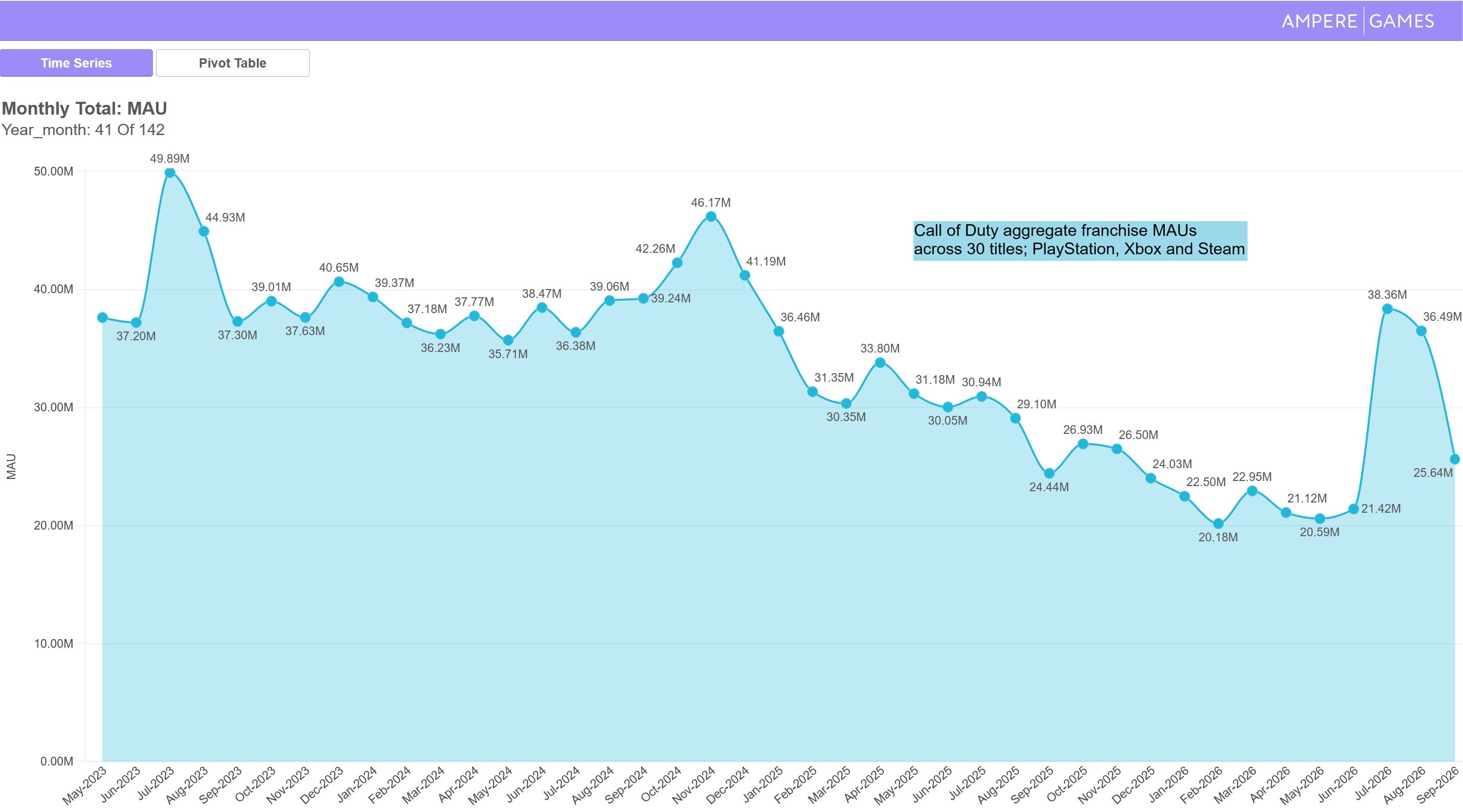
2:42Tyler Bahl: Richard, our producer, George, our commercial director, will all be there. Come and say hello. Right. Shall we get on with the show? And let's begin with Call of Duty. So Call of Duty, look, it appears to be in a rough spot, at least by its very high standards. The launch of Black Ops 7 in Europe last year was 50 % below what Black Ops 6 managed in its first few days. That's based on GSD data. It was 63 % below the launch of Battlefield 6 in Europe, which was its big competitor last year in fact battlefield 6 was the best-selling shooter of 2026 ending call of duty's nearly two decade run at the top in the us back up 7 actually finished in fifth spot for the year the franchise's lowest annual u.s sales ranking ranking since 2008's call of duty world at war now of course call of duty isn't just about the latest game that comes out but our data partner ampey they've shared some facts with us that highlights there's been quite the drop in players for the series overall.
3:34Tyler Bahl: Now this data that is in the newsletter and I'm going to talk about it here as well, it isn't entirely correct. Ampere tracks 30 Call of Duty games, including something called Call of Duty HQ. Call of Duty HQ is a launcher that features multiple Call of Duty titles, but in July 2025, two of those titles, Call of Duty Modern Warfare 2 and 3, were removed from the launcher. And in July 2026, another one was removed in the form of Black Ops 6. Now, Ampere doesn't track those games separately, so they think they're probably missing about one and a half million players from July 2025 and another one to one and a half million players from July 2026.
4:09Tyler Bahl: So it's not entirely correct. But even so, we're still looking at a sizable job. So in 2024, Call of Duty player count was routinely just below or at 40 million players. In fact, in November 2024, it hit over 46 million players, a huge number. Now, in 2025, the numbers dropped into the low 30 millions. And then towards the end of the year and into 2026, we're now into the low to mid 20 million number. Now, again, the numbers are probably slightly higher because of those missing games, but obviously a big drop overall. However, we have had some recent successes. In July this year, Activision released ports of Call of Duty Black Ops 1 and 2, the games that were first released in 2010 and 2012 on PlayStation 4 and PlayStation 5.
4:50Tyler Bahl: And this did really well. It caused a massive spike in players to just below 40 million for the whole franchise, according to Ampere. And there's real positive buzz around the launch of next week's Call of Duty Modern Warfare 4. Now, there's really a lot going on with this year's Call of Duty. It's not in Game Pass this year. It's been in Game Pass the last few years. It isn't this year. Xbox isn't including it in the subscription service for 2026. It also isn't coming to PlayStation 4 and Xbox One. This is the first Call of Duty this generation not to launch on those machines. But it is coming to Nintendo Switch 2, which marks Call of Duty's return to Nintendo.
5:22Tyler Bahl: for the first time since Call of Duty Ghosts in 2013 which was which was a Wii U game and of course Modern Warfare 4 arrives less than a month before the highly anticipated release of Grand Theft Auto 6 which is dominating the conversation right now on top of all that there's a Call of Duty movie in 2028 and Activision announced earlier this year that it will no longer be releasing back-to-back games in the same Call of Duty sub-series going forward so explain that in 2022 they released Call of Duty Modern Warfare 2. And then in 2023, they released Call of Duty Modern Warfare 3. So it is a sort of a quick sequel.
5:54Tyler Bahl: And then in 2024, they did the same thing. They did Black Ops 6 in 2024. And in 2025, they did Black Ops 7. They're not going to be doing that anymore. They're not doing that anymore. So there's a lot to talk about. And earlier this week, I had the privilege to chat with Tyler Ball, the Chief Marketing Officer at Activision, about the goal of getting Call of Duty back on track. Check out this conversation. Hello, Tyler. Welcome to the show. Hey, Chris. Excited to be here. Well, we'll get onto Modern Warfare 4 in a moment because I'm hearing very, very positive things about it. But as I've been saying, sort of last year's game did do lower numbers than, certainly lower than we're used to seeing from Call of Duty.
6:29Tyler Bahl: Overall player metrics, Call of Duty HQs been down a bit as well. So I want to get your take on it. How would you evaluate sort of the state of Call of Duty or where you're at at the minute?
6:39Douglas Reilley: Yeah, I don't think we were happy with every aspect of last year's game. and we heard the feedback from the community loud and clear. And so I think with Modern Warfare 4, we've tried to adjust, you know, based on that feedback, right? It's getting back to a grounded, you know, military, you know, shooter, really making it cinematic, making it authentic and bringing that edge back that Call of Duty is known for, right? There's always that mission that everyone's talking about. And we really wanted to make sure that this title really had something like that that we could talk about. And so being in that North Korean front is really exciting because there's a lot, you know, for us to explore.
7:18Tyler Bahl: So you think a lot of it might have been, it just didn't connect with the quality of the audience. Black Ops might be because of that grounded nature. That's what people really want from the series.
7:26Douglas Reilley: Yeah, I think we were pretty public about, you know, the idea of us going back to back with MW2 to MW3. And Black Ops 6 to Black Ops 7 was not something that, you know, our community was looking for, right? and they wanted something new and fresh. And even though there were different time settings, right, different ways to play the game and lots of new features, that tonal shift is something that they were looking for, you know, us to shift. And so we've already kind of stated that, you know, a future title is going to be a new sub-branchise. And, you know, we've already kind of laid the groundwork there.
8:01Douglas Reilley: But we're really excited about what we have to offer with Modern Worker 4. And that kind of addresses some of that feedback that we heard so loud from the community.
8:09Tyler Bahl: I like the idea of it, though, when you were doing the sort of quick sequel. I know it wasn't a quick, I know it worked on beforehand, but I like the idea of it, even if it hasn't pan out necessarily as successful as you'd hope. It's worth trying, I think. You mentioned a little bit about how Modern Warfare 4 was going to be different. Is there any other ways it's going to sort of, you think it's going to connect more?
8:27Douglas Reilley: Yeah, I mean, I think first the tone, right, you know, with campaign and going to the Korean front, I think is something that we felt like was totally new and different. and someplace we've never been before. I think on multiplayer, you know, we have this new mode called Kill Block where the Mac actually dynamically changes, right? And so this is something that we, you know, wanted to say, okay, what can we do in multiplayer that's truly different? And it's basically a map that has infinite combinations, right? And every time you go into it, it'll dynamically change. And so really excited by that.
9:00Douglas Reilley: And then, you know, bringing DMZ back, right? You know, the extraction shooter space It was just absolutely exploded since we launched DMZ in beta with Modern Worker 2. And I think the team is really proud of the four years of work that they put into this mode. And so last week we had DMZ week. Every single day we had a different announcement about DMZ. It's really robust and we have really high hopes for how this mode is going to land. So that's why we're bringing it to early access.
9:27Tyler Bahl: I'll come on to sort of the coverage of that, but you've got new studio leaders at Infinity Ward. Yeah. They're not new to the studio, though. they've been around for a very long time. Has that brought around much change or has it been very much continuous because of that legacy?
9:40Douglas Reilley: Yeah, I think Mark and Jack, I mean, they were, you know, obviously I've worked at the studio before and Mark laughed and came back, but it's brought a whole new, fresh, youthful, I would say, vibe to the studio itself, right? And I think, you know, the way that they're approaching it is, okay, how do we be more part of the community than we've ever been before? And so, yeah, I think there was a period of time when Call of Duty was a little bit more hands-off and not talking to the community, taking them behind the scenes. And I think IW and with the new leadership has done a lot to really engage, right?
10:16Douglas Reilley: So we put out a series called From the Ward, right, that goes behind the scenes, shows all the developers and how they're building the game, and actually goes into details on how we make a Call of Duty video game. But I think in addition to that, we've actually gone out to more events, like gaming events, than we've ever done before. So we'll be at 20 or more. We kicked things off with Fanatics Fest earlier this year, which is a totally different space. Not a gaming space, a sports space. And had first hands on there. But we've been everywhere, thinking about Gamescom. We had four different booths at Gamescom.
10:56Douglas Reilley: We were in Nintendo's booth, we were at Xbox's booth, we were at Samsung's booth, and we were also with TikTok and stuff. So we were just absolutely everywhere. And so it was really showing the confidence that we have in this game and getting people hands-on with it early. And so I think that was, you know, coming out of last year, we really wanted to rebuild trust. And, you know, the best way you can do that is put the game in people's hands and let them see for themselves.
11:19Tyler Bahl: That's really fascinating. I didn't notice you'd gone to all those events. Fanatics Fest is one of the people running that. He used to be my boss at ReadPop. But I have had this observation, and this might be completely wrong, that the media, the traditional media anyway, doesn't cover Call of Duty like it used to. And it seems a lot of the coverage comes from the influencer space and the communities, I guess, in many ways. Is that just my blinkers? Is that fair?
11:43Douglas Reilley: I mean, I think we get the coverage. But, you know, we call it the Call of Duty taps, right? I mean, when we're thinking about the reviews or we're thinking about the reception and stuff, right? Like in a lot of ways, there's obviously a lot of fandom around indie games and excitement around new games popping up every day and stuff on Steam. And I think in a lot of ways, ColorDude has been here for a very long time. And with that, people sometimes forget that there's so much work that goes into making these games. There's 4 ,500 employees here that are trying to make the best possible experience.
12:20Douglas Reilley: And then also how big it is, right? I think that's the bigger challenge is that we have 100 million free-to-play players. We've sold 500 million units. It's one of the biggest franchises of all time. And we have a billion downloads on our mobile game, which I think people tend to forget about, which is much more bigger internationally. Oh, yes, I do. So that huge audience, I think sometimes, you know, gets overlooked or just becomes status quo. And I think, you know, the craft that goes into these games and the dedication from the teams was something that we wanted to show this year with the marketing.
12:53Douglas Reilley: And so it was less about us, you know, having, you know, more of some of like a bombastic spot that we made before, but really kind of getting behind the scenes of back to the roots of how do we make our games and the dedication that teams have to doing that.
13:08Tyler Bahl: It's interesting. I'm as guilty as anyone else. I did a piece not so long ago on sort of Zelda and GTA in November, and I called it the Barbenheimer. And it's quite rightly, you know, hang on. What about Call of Duty? And I guess, I mean, I was maybe talking a little bit more about what's going to drive console sales, but it's fair enough in observation. There's this huge shooter game that's coming out just before that. Well, actually, is the noise and attention around GTA 6? Is that making it difficult to get the message out there? Is that a challenge?
13:40Douglas Reilley: Well, no offense to Zelda, but I think these are the two biggest games of the year. And I think in a lot of ways, more people coming in to the dashboards, more people taking the dust off their Xbox or PlayStation and starting to play again and loading up that experience is going to be more eyeballs for us overall and stuff. And then I think at the end of the day, what makes Call of Duty so last the test of time, I think is the community and the social experience. Right. And I think the idea of, you know, being able to play with your friends, right? Like when we look at our research and we say, OK, what is the most exciting things about our games?
14:19Douglas Reilley: Is it the combat or the gunplay? It's actually my friends are there. Right. And or I'm able to spend time with my friends. And so, you know, I think that still, you know, we stand on our own there where, you know, being able to play with your friends on all different platforms, right? from Switch 2 this year, which is a new platform for us, you know, all the way to PC and Xbox and PlayStation still, you know, I think makes it a unique opportunity. And it's an exciting time for gaming. Like if more people are talking about games, if there's more press around it, that's going to be good for everybody, not just us, but the entire industry.
14:55Tyler Bahl: Well, the early signs are positive that GTA might significantly bolster sales with PlayStation and Xbox. And so a lot of people are thinking about, you know, what's the second game? What's the game they'll get along? It's weird calling Call of Duty a second game, I have to say. It's of a certain scale. But Matt, are you thinking about that? Like, you know, you're going, how do we make sure Call of Duty is the game these new console players get alongside GTA 6, or maybe once they're done with GTA, you know, is that something that's in your thinking, or is it you very much focused on you?
15:23Douglas Reilley: Yeah, I mean, I think we're very focused on us. Like, we're, you know, going into Campaign Early Access on Friday this week, and then that game has its full release the following week. And so everything is heads down on trying to make this the biggest launch. And again, really the focus for us is to rebuild that trust coming out of last year. And so I think for us, it's, you know, how do we build that relationship again? And, you know, this idea of return to form, right? It's the call. If you're a new player, you know, there's a lot to be excited about about this game. But also if you've maybe left the franchise, there's also a lot to come back to.
15:57Douglas Reilley: and we are definitely leaning into, you know, the nostalgia of playing with your friends. You know, I think the BO1, BO2 ports this summer, right, were huge successes and something that we weren't even necessarily expecting. We thought they would do well. We didn't think they would do that well. But you can see that pent-up demand of being able to get back to the good old days of, you know, playing with your friends on a Friday night and having fun. And I think, you know, MW4 does that. And I think, you know, once, you know, you know, people get through some of these other games, they'll come back to this experience because of the social element.
16:36Douglas Reilley: Are you braced for a slightly
16:37Tyler Bahl: a slight dip in my players on November 19th, though? Is there? Yeah,
16:43Douglas Reilley: yeah, you know, we'll see how it plays out and so we might actually see, you know, a slight uptick. Ah, it's true. I might go the other way of, hey, you know, I can take a little of this and I can also play a little of that and so we'll see.
16:54Tyler Bahl: Yeah, it's true. Again, as you quite rightly pointed out, there are different types of experiences, certainly at this stage. This is the first Call of Duty this generation that's not coming to PS1, Xbox One, which is crazy for me. Has there been any benefits to being fully focused on the newer platforms, any advantages?
17:11Douglas Reilley: Yeah, I mean, I think it's just the graphic fidelity, right? Like I think there, you know, in some ways from a development standpoint, you know, it was always hard for us to kind of balance both worlds, right? Of being able to, you know, support last gen and also support next gen and stuff. So I think in a lot of ways, I think this is probably one of the best looking Call of Duties and in our franchise history. and I think it'll show what we're seeing, what we're showing our trailers, but also once people get hands-on with the campaign, it'll really come to life of how good this Call of Duty looks.
17:48Tyler Bahl: It's obviously on Switch 2, though, this year. That's the new one. It's not Call of Duty. I mean, I remember previous Call of Duty games being on Nintendo. It's not always been frantic, particularly associated with that platform. But what are your expectations here? Do you have high hopes?
18:03Douglas Reilley: Yeah, I mean, we're rebuilding this relationship, right? And so I think Nintendo has been all in. Like I mentioned before, we were at their booth at Gamescom. We are going to continue to show up in partnership with them. We have a co-marketing campaign that we've launched with them to support the game. I think in a lot of ways they want to age up their customer and look at getting a broader spectrum of having an FPS on there. I think actually helps them stand out. And I think their console sales has grown to a certain point, but then they're kind of stagnated. And I think this will allow them to continue to kind of extend this offering.
18:45Douglas Reilley: And then also I see it as a companion experience. So that's what I'm excited about because I definitely have a Switch 2 at home. And when I'm on the go, right, flying to London this afternoon, and I think in a lot of ways I bring my Switch 2 with me and am I able to play Modern Warfare 4? I think that's an awesome companion experience. And it plays really good, especially when you use the controller as almost like a mouse and stuff. I think in a lot of ways you can get that precision shooting. And I think in a lot of, you know, comparably, it's actually really good.
19:17Tyler Bahl: I've got a bit of a theory with Nintendo. It's not based on the real data, but I've also got a theory that it does speak to a sort of mum and dad audience. Like it's the thing, you know, because I was 2007 when I first played Call of Duty 2, Modern Warfare 4 and I was 22 and I'm now 41 and I've got two children. And so the cut switch is handheld from the form and I get the game console for the kids, they're playing Mario Kart. But I always think that there's a slightly like mum and dad audience. And I do wonder, you talk about the nostalgia around Black Ops, you know, the remorse you did and stuff.
19:51Tyler Bahl: I do wonder if maybe you might be surprised by that there is actually an old Call of Duty audience on that platform that might have maybe temporarily ducked out of games because of life getting in the way who might be coming back. I don't know. I'll be interested to see if that's the case.
20:06Douglas Reilley: Yeah, totally. I mean, I see the Star Fox poster and I got the new one and it was introducing it to my seven-year-old son and stuff. And I think in a lot of ways, that's really exciting. And then at the same time, when we're shutting that down, he's going to bed, I can go on the back porch and actually play Call of Duty, which is kind of absolutely amazing, right? To be able to kind of travel with the game, which is not something that our community has been able to do outside of mobile, which is a different game, you know, altogether. I think there's something to that. And so we'll see how this lands.
20:37Douglas Reilley: But I think Nintendo's been an amazing partner in co-marketing this and helping us jump back onto the platform after being off for so many years. And I only see that relationship developing as, you know, we have, you know, future titles like Spyro coming back and, you know, that's going to be a really good opportunity for us to kind of go all in. I got Tony Hawk on PlayStation and Nintendo.
20:58Tyler Bahl: For that reason, I'm assuming, right? Yeah, yeah. So I can, you know, I, yeah. One of the things I'd forgotten before this is obviously, I say I shouldn't have forgotten it, but the fact is not in Game Pass day and date this year. Does that change much for you?
21:11Douglas Reilley: No, I mean, you know, for us, it was adding a little bit of confusion to the market, right, of how you can get Call of Duty. And I think in a lot of ways, you know, we really wanted to simplify that. I think working with the Xbox team, though, So they've been all in and we're just really focused on how do we get the message out. So we actually had a 10 % loyalty discount. We offered a blueprint with Xbox just to kind of, we understand coming off of Game Pass, the perception there. And so I think we wanted to make sure that we're still totally invested in Xbox and the community there and making sure that we have an offering that is unique and exciting to that audience.
21:53Tyler Bahl: obviously modern warfare for it's just the start as it always is um i know you can't tell me anything and i wouldn't expect you to but what what might we expect after the game comes out you've already talked about doing these videos and being close to the community is there going to be much of a change in terms of your approach to post-launch yeah i mean we're jumping right
22:09Douglas Reilley: into season one right so i think that that's what's going to be really exciting is that you know the live um you know season is going to start you know i think roughly two weeks after the game comes out. And so I think there's even more content coming. So it's crazy when I tell people how we launch a game and then we're immediately putting more maps and new areas and new weapons and new characters into a live services business. And that is always on. And every two months, roughly, we're launching a season and stuff. And to do that is like launching a game itself like i think on the marketing side you know we're marketing those things with trailers and um and you know key art and really kind of pushing really heavily on how to bring that to market so i think that's the biggest challenge but you know we have a robust pipeline there and uh you know the the team's really excited by what they have to offer in this chapter
23:08Tyler Bahl: it's interesting because i think um some of the headlines and i wrote some of them about quality being down and maybe not performing quite as well as it done in the past but when you actually look at those numbers, they're still like most games would be a kill for this sport.
23:22Douglas Reilley: I think everybody would be happy to have. And you know, we're our own worst enemy. I mean, we set such a high bar for ourselves and expectations. And we're our biggest critics so that we're not hitting those goals and stuff, right? Or when the community is disappointed, we take it to heart. And I think the team is, you know, we had a similar situation for Modern Warfare 3 where it wasn't out the door delivering to expectations. But by the end of the chapter, through those live seasons, every chapter or every season, the sledge was building new modes and new offerings and stuff. And by the end of the year, I think we were really happy with where the results were for that game and stuff.
24:05Douglas Reilley: And so I think that that just shows the commitment that the developers and the publishing teams have to kind of win it back when things go wrong. And I think, you know, last year we reflected, we actually did a, um, what we call a pre-mortem, right. Where we look at instead of a post-mortem because a post-mortem is where you look back and you say, where are all the things that went wrong? But like next year's game is a different game, right? It's a different offering and it has different challenges to it. And so we did a pre-mortem to say, well, what are all the things that could go right or wrong for the next game?
24:37Douglas Reilley: Right. And so it's, it's a different, uh, you know, process and I think we started the year that way and we looked at all the issues that we needed to address and the teams been working really hard to address them all but also get people excited again. That's really what it's about and getting friends together and I think we're liking what we're seeing so far and what the community is saying about the game. I wasn't going to ask a question about those ports
25:02Tyler Bahl: in the summer and the fact that I'm really fascinated that they did so well. It speaks to some of the other trends we're talking to in this industry about an aging audience and people want to go back to different times. There's nothing wrong with the deeper games and the more complex games. People want them as well, but there is a craving for that sort of simpler core experience that perhaps some people remember from 15, 20 years ago.
25:23Douglas Reilley: Yeah, I mean, like, also, you know, as a dad who's a similar age, you know, as you, you know, picking up the controller fresh, right, is, you know, and logging in for the first time, it can be overwhelming, right? Like, and there's so much going on in a lot of these games, not just ours, right? And so how do you create modes, you know, casual modes, like, you know, more party modes and things like that, that, you know, actually allow people to jump in and just have a good time, right? Right off the bat and not necessarily have to overthink it. And I think the, you know, the BO1, BO2 ports over the summer was, you know, a great example of that.
26:00Douglas Reilley: It's like, it was a local entry point, you know, caught from a cost standpoint. it brings back the nostalgia of what it was like to play back then and I think we took a lot of learnings from that and are starting to apply then to not only this game but future games of what they can expect
26:20Tyler Bahl: I'm quite interested about what comes next I know you can't possibly even hint at it but you're calling there's a social post calling Modern Warfare 4 an epic conclusion and then Treyarch was talking about making something nobody's ever experienced before. And, you know, we said earlier, you're moving away from the quick sequel approach. And obviously, there's a movie coming out. I may be getting ahead of myself, but it feels like we might be entering into another period of reinvention, The Call of Duty. But it's, yeah, that's not really a question, was it?
26:48Douglas Reilley: Yeah, I mean, I don't want to give any spoilers for the game coming out. But I think, yeah, I mean, I think in a lot of ways, this is going to be the epic conclusion, you know, of, you know, this, you know, recent series of Modern Warfare. And I think, you know, it's not that some characters and pieces can't live on beyond this, right? And be reinvented. But I think in a lot of ways, you know, we're excited by, you know, closing this chapter and launching a new one, right? You know, and I think where we go with, you know, potentially future games, I think is really, we have to innovate, right?
27:25Douglas Reilley: And we have to, you know, what we heard from the audience is they want new or better or different, right? Like, in a lot of ways, it's a combination of those things. And so, you know, I think, you know, we want to make sure that what we bring to the table is exciting. And there's so much changing. I think, you know, the landscape is changing right under our feet, right? when you're seeing new games being built overnight and you're seeing all kinds of tastes change and how people want to play and stuff. And so it's the only thing about Call of Duty when you're this big, you have so many different components of the audience, right?
28:05Douglas Reilley: There's some people that just like zombies, right? There's just some people that are like Black Ops versus Modern Warfare, right? Like, you know, there is just some people that, you know, just want to play a game like Prop Hunt, right? Where they're not actually shooting anybody, but they're a refrigerator and they're hiding in the map someplace, right? And so I think in some, you know, like those are all great ways to experience Call of Duty. But at the same time, you know, as a marketer and, you know, from a positioning and a comp standpoint, it's hard to speak to everyone, right? And so, you know, I spent a lot of time thinking about, okay, how do we reach different audiences with different messaging?
28:38Douglas Reilley: And that's really been the focus. I'm excited for Modern Warfare 4.
28:41Tyler Bahl: I think it looks really good. I've heard some of the people, some of the buzz around it seems really positive. I know a lot of GTA is getting all the headlines, but I suspect Call of Duty will be getting plenty when it comes out in a couple of weeks. I guess my final question is, what would success look like? What would make you go, right, we delivered on that one and we nailed it?
28:59Douglas Reilley: Yeah, I mean, it's really hearing from the community. Like, I'm really focused on the quality of life elements of it and hearing the community say, you know, this is a Call of Duty that I love and I care about. and this is what I remember. And it has all the elements that we talked about of being authentic and grounded and cinematic because I think that's what the studio intended and that's what we're really excited about. So we're not really holding ourselves to a specific number. It's more about are we living up to those expectations that we set out at the beginning of the year to deliver on, right?
29:36Douglas Reilley: And if that works, then we can build on that, Chris. Like we can go from, you know, this game to the next game and kind of build on that foundation. But it's about getting that right first before, you know, thinking about anything else. Because even if it delivers on sales, but people don't like the game or it doesn't feel like they deliver it on, you know, being grounded, authentic, you know, cinematic, you know, edgy video game, then we missed the mark and we missed the goal altogether. Tyler, thank you so much. Good luck with it. Well, Chris, we're going to get you a code so you can get back in and tell us what you think.
30:08Douglas Reilley: But we're really excited to be on here and hopefully more conversations as, you know, new opportunities develop within Activision. Brilliant. Thank you, Tyler, there.
30:18Tyler Bahl: I appreciate those answers. I'm looking forward to Call of Duty this year, actually. I've been watching some of the videos. I'm watching the Infinity War videos, and it does look really good. I hope it does well. And it certainly sounds like Activision is taking a long-term view with the series, as it should. Right, now on to part two of our show. This one is about another iconic pop culture IP in the form of Star Wars. So in about a six week period, there were two Star Wars games released. The first was a strategy game called Star Wars Zero Company, and the other was a racing game called Star Wars Galactic Racer.
30:49Tyler Bahl: Now, outside of the Star Wars brand, you might think very little connects these two games. They're very different genres. But you'd be wrong. Star Wars Zero Company was made by an independent developer called Bit Reactor, which is a studio formed by veterans of the XCOM franchise. And the game is very much Star Wars meets XCOM. Meanwhile, Star Wars Galactic Racer was made by a developer called Fuse Games, which is a bunch of veteran developers who worked on racing games such as Burnout. And the game is very much Star Wars meets Burnout. They're both games with sort of double A budgets, I think, and they've both been critical darlings.
31:23Tyler Bahl: Galactic Racer is the highest scoring Star Wars game on Metacritic in 20 years, while Zero Company is the joint second highest rated Star Wars game on Metacritic from the last 20 years as well. It's impressive, right? Is this a happy accident? Or are we seeing what can happen when you pair a Mega IP like Star Wars with an experienced independent team? I think it's probably the latter. But to discuss this and a few other things as well, I was able to sit down with Douglas Riley, the Vice President at Lucasfilm Games, alongside Matt Webster, the CEO of Galactic Racer developer Fuse Games. Check it out.
31:54Tyler Bahl: Hello, Douglas. Hello, Matt. Welcome to the show.
31:56Matt Webster: how you doing very well harry very well thank you for having us yeah look at that smile on matt's
32:02Tyler Bahl: face that's something with the uh that's someone with a good metacritic score um i i actually look look i bought my copy of the game and i and i want to and i want to like i would this this surprised me so i i saw as i didn't realize it was available on amazon prime um but um but i uh i bought it and i saw the price and i just ordered it and it came and it's the deluxe edition i don't remember ordering the deluxe edition and then i realized that i had ordered the deluxe edition it's just
32:28Douglas Reilley: that the game was cheaper than i was expecting it to be oh i guess i was expecting a triple a you
32:33Tyler Bahl: know 70 dollar price game so i the fact that it cost about that then was fine by me the fact it was less than that it wasn't a question i was planning to ask but because that happened right um what was the thinking behind the uh the price point was then was it was that a secret mode thing
32:46Matt Webster: was that were you all involved i think it was a conversation with all of as as all of this is is a collaboration. And I think we want as many people to try and get into this game as we possibly can. And that felt like the right value proposition for achieving that aim, really. I think we've got an incredible amount of scope and quality in this experience. So I think it's terrific value for money.
33:15Tyler Bahl: We had Liverpool Games come on the show. They're releasing a game this month. And they also set a sort of, I wouldn't call it a budget price, but a sort of lower than AAA level price that you would normally expect. And they said it was because of GTA. Right, okay.
33:30Douglas Reilley: We're all trying to figure out a way to navigate around that in our own special way.
33:37Tyler Bahl: Okay, I know it's early. The games need just come out. The scores are great. How are you feeling? How is it all going so far?
33:45Matt Webster: We're thrilled. I mean, it was an emotional moment when the review embargo left, I think, on Friday. I was traveling and wanted to get away for a few days just before. Not to get away from it all, but I don't know. You go through these things. Making a game is difficult. Launching a game is hard as well. And you have this moment where you're so fixated on everything that's wrong at the end when you're finding something that you're constantly looking for things to optimize or to fix or to, you know, you have to remind the studio, only we know those things, only we see those things. So that launch moment is one where you're sort of transitioning away from that mode and into a, oh my goodness, what are people going to think about it?
34:32Matt Webster: And it felt like we had something good, but to see it, to see that reflected back in the critical reception and now that we've launched in some of the wonderful comments that we're seeing from people that have, thankfully, like you have, Chris, supported a small independent studio by buying the game. That's great. We're really thrilled.
34:52Douglas Reilley: Yeah, and we believed in this from the very beginning. I think, Matt, you hit it right. You are too close to it in the months leading up to the launch to be a true neutral observer of it. But I've always, from the beginning, this was a thing that if we just did what we can do together, we were going to have something that people really loved.
35:14Tyler Bahl: Now, I know that the journey on this was three days after setting up Fuse, Matt, you spoke to Lucas and then three weeks, three months, you had a prototype and then here we are three years.
35:24Matt Webster: It was three and a half weeks, three and a half months, three and a half years is my small little mantra at the moment. And there's nothing at all to do with when I gave up smoking about 15 years ago that someone said to me, it's two days, two weeks, two months, two years, apparently. So I must have been reflecting on that strangely when when I got to that one. But it was, yeah, three and a half weeks we went and we flew over to see Douglas and the fact that we've had a working relationship for a number of years, Douglas and the crew there were very kind to accept a meeting from us and to hear what we had to say.
35:59Matt Webster: And felt it was a good idea and we progressed on that. And three and a half months later we had, I think, about 20 people on a prototype that we felt was beginning to show Thomas. And then three and a half years later, we'd actually gone gold. So to get onto that disc of yours, we have to finish it up front. And it's really important to us actually that what's on the disc is as good as we can possibly make it. And clearly we have the opportunity to patch things later, but what is on the disc is a really wonderful expression. And that journey, is it's a nice wrap up I think of the time but also it's a reflection of the incredible support and belief that we had from Douglas and his team there at Lucasfilm Games to support us.
36:45Matt Webster: There was just five of us and with a big idea I suppose and to support us and to offer up even before we had any sort of official relationships with anybody else that belief and that commitment to get engaged and collaborate from such an early time was really profound for us now when we look to reflect on it. It's a pivotal moment for us and profoundly important.
37:17Douglas Reilley: Yeah, I think the thing that Matt's being very gracious and humble about it. Yes, true. It was true. It was him and his four merry band of mates trying to convince us to make a racing game. But I really have to emphasize how important it was that we had worked with them together, that we'd had an experience with that leadership. I've been very fortunate to work with some of the best teams making some of the best stuff in the world. And maybe this is a personal thing, but the burnout games are a trigger for many bleary-eyed mornings over the years. And so I obviously have a lot of affinity for the things that the Fuse team had done in the past.
37:55Douglas Reilley: And it was not a question of do we do this? like how do we find a way to make this work from the very beginning.
38:01Tyler Bahl: But it seems quite fast, Matt, to go from launching a studio to having a game in three and a half years. It feels fast to me. I mean, how have you pulled it off?
38:10Matt Webster: I think we felt like we were going quickly when we talk about it in those terms of having something stood up pretty quickly. When you talk in weeks and months, that sounds fast. As soon as you start talking in years, it feels like it, well, that's years. It doesn't feel fast at all. But the things that folks are telling me, I think it is fast to go from zero. And it really was from zero to done in three and a half years and a little bit later to where we are now. And everything that's involved. And also at the time, I remember about sort of six months in, somebody saying to me, wow, you're brave starting a studio in 2023.
38:51And I was like, am I?
38:53Matt Webster: Am I missing something? Yes, you were.
38:56Douglas Reilley: I was missing something.
38:58Matt Webster: I don't know, I've got some sort of naivety that I've got in me, but we went on a journey and maybe that naivety was what took us through. Maybe not knowing sometimes is of value, but yeah, I think you're right. We stood up the studio, we stood up... Everything that we've learned has led us to here though. So we knew that you've got to build a great team to build a great game. So that's the starting point.
39:25Tyler Bahl: Can I ask about this Lunar partnership? How did that come about? It surprised me. It was an interesting thing to see it launched day in there. Why does it work for a game like this? Tell me about it.
39:36Matt Webster: I think it's just a really good opportunity to get. I mean, when I reflect back on, I think a game like this deserves to be on as many platforms as we can possibly get it or in as many hands as we can possibly get it. And the modern gaming landscape is one that there's lots of opportunity and there's lots of competition. So how can we continue to find ways in which to get a game like this? In particular, I think a game like this, where when you hold it in your hands, that's as much a part of getting it as watching a video or seeing somebody else play or reading something about it. And that was one of the reasons why getting out to Gamescom and getting it into people's hands there is really powerful, because that's when you believe.
40:18Matt Webster: And so we felt that that was a great opportunity for us to do something there, to see how something like this that we had spent an awful lot of time on from day zero in terms of its feel but also in terms of its technical objectives of low latency, high frame rate, high consistent frame rate, how does that work on a streaming platform? And it's pretty good. I guess the dream, Douglas, is to get this on Disney +, right?
40:46Tyler Bahl: There is a dream. There is a dream. I'll ask you a specific question, which is when we spoke earlier this year, you said about how, I think it might have been all your codev partners or most of the codev partners you worked with were UK based. And I sort of thought that was interesting. Since then, I've had loads of conversations with similar developers that outsource to cheaper locations or work with that. So I'm interested, why was it important?
41:14Matt Webster: Yeah, well, it's part of a broader strategy that we had, as long as the big idea of making a racing game inside the Star Wars galaxy. It was, how do we as a new young studio, punch a ball away, I guess it would be the metaphor. How do you do that in a modern way, where games are expensive, where lots of talent is in a high cost location? And our assertion was, scale, capacity and capability, they'd scale the studio. So we concentrate on the core and building that just incredibly valuable and vital core team. and then supplement that with capabilities and capacities that we will bring in. Now, it just so happened that the development landscape in the UK really lends itself to that.
41:59Matt Webster: And so we think about distributed development, as we call it, across three vectors, really. There's the further out from a relationship point of view, still a relationship, but a little bit more transactional, and they're generally in lower cost locations for us. Then you come in and we call it external development, where maybe there's a piece of work that we can place wholly with somebody. They operate and execute against it and then we bring it back in. And then there's code development, which is closer to us, and they're in our stand-ups, in our dailies, they're in our source base. And when that's true, time zone is of incredible value when you want to iterate quickly.
42:35Matt Webster: So for us, the iterative loop is build it fast, review it, change it. The more times you go through that loop, the better something gets. So optimizing when you have people close in, optimizing on high frequency communication is important. But it just so happens that there are a number of partners that we have around the UK that were pretty much an extension of our team and their location was of value, but also their expertise and the capacity and capability that they brought to us was really valuable.
43:08Tyler Bahl: One of the things that I've come around to in these conversations I've had on other shows, It's like, yes, you can outsource to cheaper locations. But actually, we're in a very competitive industry where you've got to be the best. You can't just do things cheaply. It has to be good. And obviously, when it comes to racing games, the UK is pretty good at racing games. So my connection in my brain was like, you've got the expertise here. Maybe there's a cheaper option somewhere else, but is it the better option? And in this market, you've got to pick a better option if you can, right? That's one of the conversations we've been having.
43:41Tyler Bahl: Douglas, we've had two Star Wars games in less than two months. Both are quite similar in a way, even if they're not. But in the sense they're both from independent developers. Both those developers are famous for a certain genre and they've made Star Wars versions of that. Is this part of the strategy now? Should we expect more Lucasfilm projects to receive sort of high quality AA executions from veteran independents, as somebody called it on LinkedIn?
44:07Douglas Reilley: No, it very much is part of the strategy. Obviously, making the big, huge AAA games like Battlefront and other kinds of things, they're always going to be a central part of the strategy. But one of the great things about Star Wars, it has all kinds of other opportunities to tell stories in different genres. If you can imagine it in the real world, you can find an application inside Star Wars. And so the goal has really been find the best partner who makes that experience come alive inside the galaxy far, far away. And it doesn't have to always be AAA. Sometimes it can be AA and it's really about the experience that we're delivering and the fantasy we're fulfilling.
44:47Douglas Reilley: And sometimes those fantasies aren't triple-A fantasies there. Sometimes they're smaller in scale, smaller in scope. They're more narrow in their ambition. But it gives us the ability to take something... There's a very iconic moment from the movies that people love and then pick it out and pull it and express it in a different way where people can be part of it and learn something new about the galaxy far, far away in ways that the rest of the franchise will have to. and we have that ability to do that.
45:18Tyler Bahl: Obviously, both these games have been really well received. What does success look like when it comes to a project like this?
45:24Douglas Reilley: To me, success is, is it a great game? Everything flows from, did you make a great game that feels authentic to the Star Wars universe and it is something that the fans want to play. So it's really not that hard. I mean, we've kind of really boiled the strategy down to something that's find the best partners to make the best games and kind of all of the business-y stuff. Well, for the most part, it sort itself out because we're fortunate enough to play in an IP where we have lots of fans ready for us to make things that they want to enjoy. So just give them great things that they want, and it gets a lot easier from there.
46:01Tyler Bahl: Yeah. Well, I think the scores for both of these games must be the highest scored Star Wars games for 20 years. Obviously, in my head, this is from a Star Wars Galactic Racer. That's why I was surprised by the price. It looks AAA. It plays like one of the best racing games you can get. It looks like a really high quality XCOM-like sort of strategy game. It's up there with those sort of top, top games. Obviously, because they're more focused and they're more genre specific, but I still think the quality is sort of AAA. And I think when we use the terms AA and in these sort of sometimes it can get confused.
46:37Tyler Bahl: We're talking really budgets. I'm in Denmark.
46:39Douglas Reilley: No, no, that's exactly the way we, we don't think of it as AA in terms of its execution of a great Star Wars experience. To the team's credit, it is very much a AAA experience. It is the best expression of Star Wars racing you could probably imagine. But its scope is different. Its budget is different. And so we have to try and find, I think, some language to describe these things differently, because I do think this world where titles are$59,$69,$79, they are lower priced and lower scope to deliver a thing very well and then to stop. Like, you don't have to have everything in the kitchen sink in one of these experiences.
47:15Douglas Reilley: They can be just really good, tight, well-scoped, well-delivered games.
47:20Tyler Bahl: Maybe if we get rid of the labels entirely. It is. You can figure out a way to do that, Chris.
47:26Douglas Reilley: You will be a hero among many. Yeah.
47:30Matt Webster: Yeah, that's an us thing, isn't it? You know, it's us that's labeling in those particular ways. I think we want to operate at the highest possible level of our craft. And to Douglas's point of make the best thing we can possibly make. And of course, along the way, there's compromises. Are you making the right ones? Do you have that tightness of vision? Do you have something compelling from a creative perspective? And I think that's the thing that's bringing in the surprise people, because the obvious thing here would be for us to have made a Star Wars racing game. But actually, we both wanted to do more than that.
48:05Matt Webster: Why can't you do that and push the genre forward and take some bold creative choices and sort of bring something new and fresh and contemporary to a beloved genre that we felt you know, could do with some shaking up. And so that's where the belief comes in and the support. And I think that's then reflected in in what people are telling you about it when you go and execute against a very clear vision.
48:37Tyler Bahl: Douglas, I've got a sort of nuts and bolts question to follow up on all that, which is some independents are obviously not necessarily set up to work with someone like a Lucasfilm or a Disney, right? Maybe they don't have the right legal teams or that kind of thing. Fuse is, I imagine, a bit of an exception here. So because you want to work with these sort of people, how do you manage that? Is that where a middle partner like an EA or a secret mode come in?
49:00Douglas Reilley: So, yes, I mean, we're obviously a licensing business, so we're not the publishers anymore of products. Our goal is to try and find a publishing partner and a developer or a publisher and a developer. Sometimes it's a little bit of grab tab A, grab tab B, combine a secret mode with a fuse and let the magic happen so to speak i think we've tried to be more flexible about like who we're willing to take pitches from and who we're willing like good ideas can come from a lot of different places you don't have to necessarily be a top five publisher to make a great star wars game there are some you know hurdles in terms of like we have a high quality bar and we want to make sure there are some experiences and that means typically you work with more experienced teams than new teams who have no track record of making great things.
49:46Douglas Reilley: But we're exploring all kinds of things that large and small with partners that I think are going to continue to surprise folks who are like, oh, they're doing a thing with them. That might be interesting to see how that turns out. Because again, the goal is to try and find a way to express those Star Wars fantasies with the people that are best capable of doing it. And they don't necessarily have to be the biggest and most expensive studios in the world.
50:10Tyler Bahl: My next question is going to be what makes a good partner for an IP like Star Wars? But you kind of answered it there. Go on, Matt. Sorry, I was interrupting you.
50:18Matt Webster: No, I was just going to follow up on that. I think it will surprise you when actually, well, this collaboration with Lucasfilm started from week four, really. and that was before we had any of the structures in place. But what we did have was an understanding of the relationship and how to operate within that. So because we have an understanding of what it takes to work with Douglas and his team and in this incredible galaxy, you just have to build that into your way of working. It's like any other constraint, really. You can't fight it. You're working with it. and it's an honor and a privilege to do so.
51:05And they are the experts in Star Wars and
51:09Matt Webster: are game makers there. And that's incredibly valuable because I've worked with other licensed partners in the past and it's an approval transaction model. This is not that by any stress the imagination. And so you go in understanding what that's all about. And you don't need perhaps all of the mechanisms and machinations that you might think. You just need to have an understanding of how each other operate and what the expectations are. And then you build that into your operating model.
51:42Tyler Bahl: It's worth noting, Matt, that you've, you know, you helped launch FIFA. This is a, you know a little bit about this space.
51:49Matt Webster: No, well, no, I was very young in my game-making career when that design happened. And yeah, there wasn't many people involved in that as there are now, that's for sure. I would imagine it's significantly more complex than I can possibly imagine now, that thing. But the thing remains true. If you want to be making something with somebody else's property, in particular, like such a beloved thing, as we're talking about here, there's a responsibility to that. So you need to take it and operate accordingly.
52:24Tyler Bahl: Okay. So what now, right? Are we talking Galactic League eSports tournaments? Are we going Galactic Racer, Toy Range? What's the... We're through stage one. What's next?
52:34Matt Webster: Well, it's launch week. We haven't even had our first weekend yet.
52:38Douglas Reilley: No, we're not going to get a week to like bask in the glory, man. It's like, what are you going to do?
52:42Matt Webster: That's it. What now? Yeah, come on, surely you know everything else. I'm not being flippant, but it's really important that we are going to learn more in the next 72 hours than we ever will have done throughout the development of this game. We're going to get a few hundred thousand hours worth of play on Saturday, I would imagine. And you ain't never testing for that. So there's going to be things that you discover
53:19from a play and a profile that you haven't seen before.
53:24Matt Webster: So it's important for us to respond to that. So clearly, yes, we've got ideas of where this can go and what we want to do. We certainly don't want this to be launch it and that's it. We're done. We're off onto something else. you know, modern games and modern gamers expect there to be extensions and enhancements or something and we hoped to be able to do things like that for this game. But the true thing is, we need to do that in concert with the community and we don't have all the answers. So we need to see, we need to reflect, we need to watch, we need to hear, we need to listen, we need to participate together with players, and that will help inform some of the ideas that we've got, and it will help determine where we go next and when.
54:13Matt Webster: We've certainly got some ideas, and we've got plans in place, and we're going to be talking about them, I would imagine, in the coming weeks and months, but for the most part, we've got to go and see how people are reacting and responding to what we've made.
54:29Douglas Reilley: Yeah, I think Matt hit on something really important, which is, you think you know the thing that is going to resonate with fans, you know, as you're making it. And then you get surprised by something that turns out to be, you know, way more fascinating and interesting to the fans than you expected them to be. And the good news is, you know, Star Wars doesn't just disappear three weeks after launch. We have a whole ecosystem of potential ways of taking these characters and stories and applying them to a whole bunch of other expressions that we know our fans love to see the gaming experience and the characters they played with show up in other places doing other things inside the star wars galaxy and it rewards that connected fandom in a very unique way that we're fortunate to have so we're always looking for like okay what worked and what excited people let's let's lean in
55:17Tyler Bahl: and try and give them more of what they want i just want to skim speeder lego set um that's the
55:23Matt Webster: well somebody's already done that oh you can go online and someone will show you how to make your with the bits that you might have knocking around. Is it you? It's not me, actually. Someone came with that really quickly. And I looked at it and I went, wow, that's actually really good. But this is the wonderful thing that you've got with an engaged set of fans that love the thing that you've made. I'm thrilled with what I'm already seeing, how people are hooking with the characters that we've all created together. I mean, we came at this, we wanted to tell a sports story in Star Wars. We knew that racing as an activity and as a sport, as existed in Star Wars for a long time, there wasn't anything that sort of joined those two things together.
56:02Matt Webster: And with the Galactic League, we've kind of got that. And here we've got these races and these rivalries and these characters that are new and interesting and fall into this wonderful galaxy and are already creating people that are going to fall in love with some of these new characters from our skin. You know, I think we made our slash Liverpool with Hippie, the Scouse mechanic, you know, and so that's... And then we've got Orion Purr, who's one of my favorite, or Biddy Blaze. You know, there's some characters that people are going to see that they're going to fall in love with. And that's why we love working in Star Wars.
56:43Matt Webster: Wow.
56:45Tyler Bahl: I'm out of questions. Congratulations on the launch so far. Are you pleased to know, Matt, I'm a lot better at it now than I was in the summer.
56:54Matt Webster: Well, that's good. That's the game loop we've got going on. It's practice and mastery.
56:58Douglas Reilley: Congratulations. We succeeded in the roguelite die down. Yeah, that's right.
57:07Tyler Bahl: But, yeah, so congratulations on it. I think it's an excellent game and it's wonderful to see. And I hope that you get the audience success that matches the critical success as well.
57:17Matt Webster: Yeah. Thank you very much, Chris. I appreciate that. Thanks, Chris.
57:20Tyler Bahl: Thank you to Matt and Douglas there. And indeed, thank you to Tyler early on in this episode. Right. All that's left for me to do is to wrap up the news. And oh, my goodness, there's a lot of AI news this week. Fries the brain. Xbox has formed Xbox Labs. It's in response to the recent explosion in AI game modding ports and recompilations, including big games remix into the source code of other titles, all using AI. In an email to staff, Xbox boss Asha Sharma wrote, these experiments challenge long held assumptions about our industry. The tether between software and hardware, the boundary between creation and play and how people discover and experience games.
57:57Tyler Bahl: While it is hard to predict the future of gaming, it is easy to see the possibilities in making great games easier to access, giving old games new life and allowing more players to become creators and co-creators. These are unmistakably good outcomes for players, even when and sometimes because they challenge our existing business models. As a result of all this, Xbox has formed Xbox Labs, which is, according to Asher, a small group of game makers, engineers and scientists whose job it is to turn emerging ideas into things our players and developers can experience. So Xbox has launched a sort of experimental group looking at these AI could be compilations to see what they can do.
58:30Tyler Bahl: Speaking of new Xbox divisions, Xbox has also revealed its XP business unit. It's a division all about extending the Xbox franchises outside of games. That's film, TV, merchandise, events, all that sort of thing. It's basically stuff it was already doing. You know, it's already doing the Minecraft movie and the Fallout TV show and a Call of duty movie and a Diablo TV show and partnerships with Ikea for Xbox furniture and events like BlizzCon and you know they already do this stuff but this division sort of gives it all a bit of a name Xbox does say it wants to be the number one entertainment company in the world which is very it's a very Xbox ambition I have to say Kayleen Walters has been named the president of XP he was doing she was doing a similar thing before but actually she was also president of Mojang and has been a bit of a moving around of people there so um uh it's not a massive story really but it's It sort of shows how important that division has become to Xbox.
59:19Tyler Bahl: Well, we've got some layoff news. Ubisoft has proposed the closure, finished studio Red Links. That's the studio famous for the Trials games, which are great. And it's also making job cuts at Skull and Bones developer Ubisoft Singapore. There are 52 employees affected at Red Links and 70 in Singapore. One of the big conversation points this week has come out from Epic. So Epic Games is shifting to an AI-first development model, which is impacting its upcoming Disney collaboration, according to Bloomberg. The whole thing is that they're really, really trying to push AI. Epic boss Tim Sweeney said, we have a huge pivot underway here at Epic, moving developers around to retool the maximum AI acceleration.
59:55Tyler Bahl: The aim isn't to do the same stuff with fewer people, but to enable everyone here to build more and better stuff and to bring the benefits to all teams using Unreal. He responded to a few people on Twitter or X, sorry. And one of the things he said was our more modest aim is to survive the AI revolution, help other developers do the same and come out. the other end making better code and content faster. I do think making games faster is very important. I think AI can definitely play a role in that. I'm not entirely convinced that there's going to be space for all of these games. In fact, we already know there isn't.
1:00:26Tyler Bahl: A few other stories. One of a game developer, used to be former Karma Sutra, if you remember, the sort of GDC-owned games media publication. Very, very good. Chris Kerr, who was the senior editor there, he's launched a new subscription-funded publication called Vertical Slides, which wants to deliver incisive, bold reporting for video game industry professionals. is sort of leaning very heavily on subscription for its business model. It's big. Lots of cool people are doing this at the moment, but I'm not sure it can scale beyond one or two people. But if you're going fully subscription only, at least that's in my experience.
1:00:57Tyler Bahl: But good luck to Chris. Very good journalist. Very exciting. Power Out Pictures is adapting a live action film set in the Cyberpunk 2077 universe. The project will be co-produced between CD Projekt Red and Transformers producer Lorenzo D. Bonventura. Some big names involved there. Elsewhere, Sony will transfer 419 global VR patents to Meta. The firm is winding down its VR efforts. They've been backing away from the technology ever since they launched PlayStation VR 2 basically in 2023. Another Ubisoft story, Rainbow Six Mobile is shutting down less than a year after it came out. The tactical shooter will be available to play until January 15th, 2027.
1:01:31Tyler Bahl: The team will now move on to other projects. And finally, in sort of depressing US console sales news, console sales fell 15 % year-on-year to 559 ,000 units in August. It's the lowest August total since 2013. Xbox hardware unit sales declined 31 % year on year. PlayStation fell 11 % and Nintendo hardware sales decreased 15%. What I will say is the UK numbers for September are already in. And it's that based a far more positive picture. We saw a big uptick in the UK as a result of the GTA Netflix reveal and the Zelda Ocarina of Time reveal on Nintendo Direct. Both of that caused a bit of a surge in interest around consoles.
1:02:06Tyler Bahl: I don't know if that's happened in the US yet. September data will come in later in the month. so hopefully it's just a bit of a summer blip and we'll see obviously there's been loads of price rises on the consoles which is having an adverse effect right that's it for me now we recorded this episode by the way on Wednesday morning so there may have been a few news stories that slipped through the graph that isn't here if you want to make sure that we didn't miss anything you can check the newsletter the newsletter will be fully up to date we'll all be talking about some of those news stories as well on Here's the Drink that's our paid newsletter that we do and podcast that we do on a Monday.
1:02:40Tyler Bahl: If you want to become a paid subscriber, please do. As I say, it's what keeps us going. You can find out more on how to do that at thegamebusiness.com. So all that's left for me to say is thank you for joining us. We will be back next week with more big interviews, including, hopefully, an interview of Ken Kutaragi, the father of PlayStation. In fact, by the time you'll listen to this, I would have just got off stage having interviewed him in the UK. I hope it went well. And if it did, you'll be watching it on Tuesday next week. But until then, Thank you for tuning in.
It's a mega edition of The Game business this week, featuring two huge interviews. Our big focus is on Activision’s bid to regain fan trust with this year’s Call of Duty: Modern Warfare 4, featuring insight from chief marketing officer Tyler Bahl. We discuss leaving PS4, Xbox One and Game Pass, returning to Nintendo, the disappointment of Black Ops 7, the GTA 6 opportunity, press coverage and the surprise success of the Black Ops 1 and 2 PlayStation ports.As well as that, we also have an interview with Lucasfilm Games VP Douglas Reilley and Fuse Games boss Matt Webster to discuss a more independent approach to making Star Wars games, and what comes next for Star Wars: Galactic Racer.