Ask ChatGPT

 The Game Business Show
8 Oct 2026 · 1h 7m · 27 chapters
September console and boxed-game performance (UK Nielsen IQ; multi-country estimates from Ampere/GSD) plus the “problem” of video game industry consolidation—how revenue concentration among top publishers/platforms limits opportunities and innovation.
Yoast van Drunen, industry analyst and writer of the Substack “Super Yoast playlist.” He has a long-running research/data focus on market structure and publishing concentration.
September console demand rose in the UK, likely boosted by major reveals (GTA 6 on Netflix; Zelda direct). Boxed sales remain significant, especially for strong IP and in some European markets. Consolidation is worsening: ~56% of publishing revenue controlled by 10 companies (per his dataset), potentially reaching ~two-thirds by 2030. Platforms increasingly act as intermediaries with pricing/marketing constraints, creating a bottleneck that favors incumbents.
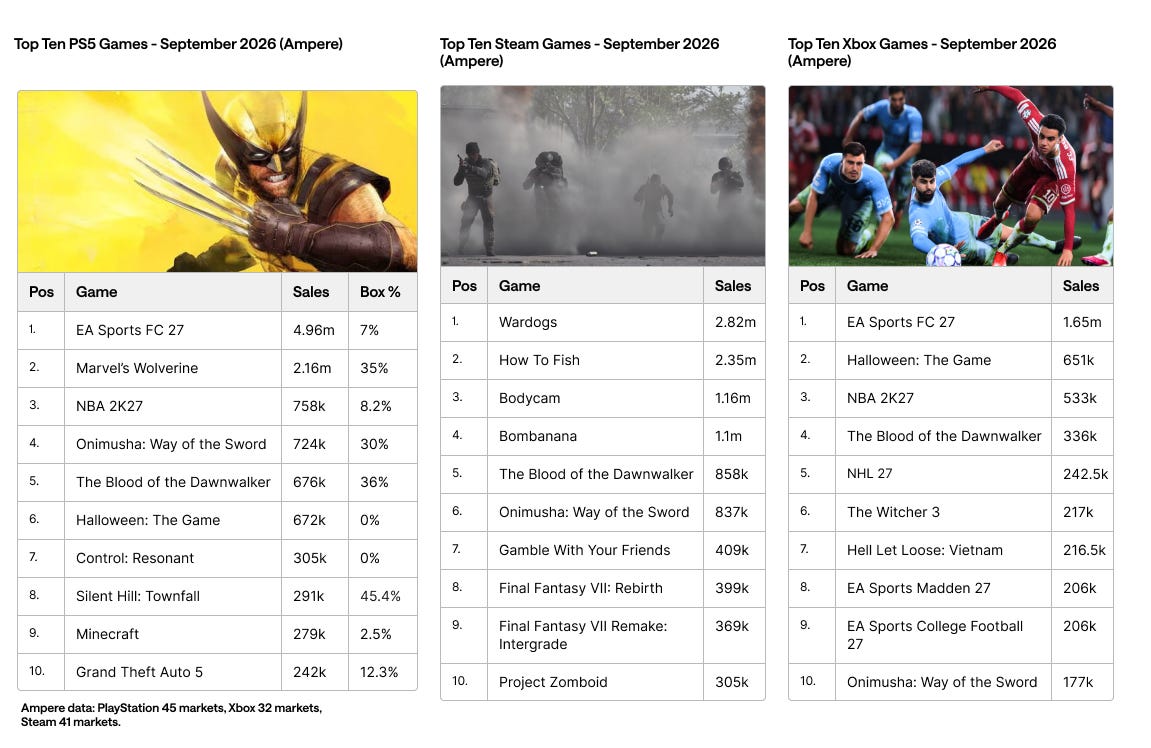
PS5 #1 game EA Sports FC (~5M copies across tracked markets); Wolverine #2 (~2.16M) with high physical share (35% September; over half in Europe; France more physical than digital). New IP/standouts: War Dogs (nearly 3M Steam sales), Blood of the Dawnwalker (top five on all platforms), Halloween (Xbox #2 behind FC). Consolidation examples include licensing/IP barriers and the rise of mid/AA studios.
Written by AI. May contain mistakes.
Discussion of video game sales data for September, including console performance.
“Right, now in a moment, I'm going to be welcoming our guest.”
In-depth conversation with Jost van Drunen about industry trends and consolidation.
“I've just been sharing some facts and figures about September and sort of end of August.”
Exploration of the changing dynamics in the gaming industry and consumer behavior.
“I think this luxury category is cool, but you've got to give people what they want.”
Exploring the economic structure and market dominance in the gaming industry.
“of restrictions and constraints and opportunities.”
Understanding the implications of market consolidation on game publishing.
“Sorry, I'm saying this the wrong way around.”
How mid-sized studios are finding success amidst industry giants.
“Like that's his growth thesis in that sense.”
Discussing the challenges independent studios face with IP-based projects.
“There's only a few ways out of that, right?”
Analyzing the shifting power dynamics between publishers and platform holders.
“To develop, to set up studios internally and also do the capitalization and all the licensing and the legal work, I think that that is probably unaffordable for the EAs.”
Examining how platforms influence game development and market access.
“It really does highlights how the business has changed in that time.”
Explore the challenges posed by intermediaries in the gaming market and how they impact competition and innovation.
“So you end up dealing with these intermediaries that just sit on top of everything.”
Discuss the current landscape of the console industry and how major players are adapting to market changes.
“There were new characters, new games, new ideas.”
Understand the balance between third-party and first-party content in gaming and its implications for companies like Sony and Nintendo.
“The big strength that Sony has is that it does rely mostly on third-party publishing.”
Delve into the distinct gaming market in Japan and its implications for publishers and platforms.
“It's only to Japanese publishers when you're living in a market where most of the audience is playing on that machine.”
Analyze the potential impact of AI on game development and industry consolidation.
“So, it's like it's, there's an incredible demand and there's an incredible sort of pervasiveness or penetration.”
Examine the rise of user-generated content and AI's role in shaping new gaming experiences.
“You suggest that in the immediate future, actually, that that consolidation might stop happening because of AI and sort of prompt based games, I guess.”
Look into the growth of browser-based games and the emerging advertising models within this segment.
“same way that esports and live streaming is a subset of the industry.”
Discuss how the integration of ads and AI in games might affect user behavior and piracy trends.
“There's all the advertisers come in the town for play funds and ad week and all this kind of stuff.”
Explore the shifting dynamics of the gaming industry and its audience segmentation.
“way you couldn't do this on the on a browser you couldn't do gta6 in the browser-based launch not Not until way at the end, at the end of the cycle.”
Discuss how gaming demographics have evolved from the 90s to today.
“So there's categories of content and distribution models and revenue models attached to those that apply to very specific demographics that traditionally don't have anything to do with the games industry.”
Analyze the implications of industry consolidation on innovation in gaming.
“I don't know if my kids, when they're 40, if actually they'll be interested in the same games that I am interested in now that I'm 40.”
Introduction to the upcoming interview with Libby Park, CEO of Pearl Abyss Europe.
“Well, I'll borrow one of your lines, which is whatever the circumstances in the industry, the only way out of it is make better games.”
Discuss the success of Crimson Desert and its impact on the gaming industry.
“At Gamescom, I had a chat with someone called Libby Park.”
Learn about the shifting dynamics in the console gaming market and player preferences.
“Everyone has these higher goals that they've been growing up playing and also watching all those amazing console titles and dreamed of becoming one of those titles.”
Explore the reasons behind the mixed critical reception and strong player response.
“They had to play the build that is not the exactly same version of the launched game.”
Discuss the decision-making behind offering free updates and maintaining player satisfaction.
“That doesn't seem the most commercially prudent way of doing things.”
Wrap up the discussion and acknowledge contributions from guests.
“And congratulations on the success so far.”
Catch up on the latest news stories affecting the gaming industry.
“And one of the biggest stories was about Google because they've announced Playground, which is a new consumer platform for games made using generative AI tools.”

Get the gist, explore an idea or ask about something said.
 Claude
On The Game Business Show, what are the key points of this episode?
Searching your listeningAutomatic transcript. May contain errors.
0:00Lybee Park: This week we discuss the consolidation of the video game business. We reveal who came out top in a competitive September and we chat with the European boss of Crimson Desert publisher Pearl Abyss.
0:13Lybee Park: Hello and welcome to the Game Business Show. Now this week's edition is sponsored by WeHype. Now if you're releasing a game you know how hard it can be to cut through the noise, especially when release windows are as packed as it is right now. big names drive reach but some of the most authentic trusted recommendations come from the thousands of smaller content creators who are the closest with their communities the problem is that they've always been the hardest creators to reach at massive scale now that's exactly what we hype's new official integration with twitch solves we hype sponsorship campaigns can now be sent directly inside twitch sponsorship dashboard putting your game in front of hundreds of thousands of creators of all sizes natively on Twitch.
0:56Lybee Park: Creators opt in themselves in a couple of clicks so there's no cold outreach just hundreds of creators going live with your game when it matters most. EA's Battlefield was among the first to run a campaign through the integration for the past 10 years WeHype has helped game publishers build creator campaigns that reach the right audiences from launch week to seasonal updates and new markets. This year WeHype supported Pearl Abyss with data strategy and creator campaigns for the launch of Crimson Desert. We'll be talking to Pearl Abyss in just a moment. Whether planning your next launch or looking to try sponsorships at a mass scale on Twitch, make sure to grab a chat with the WeHype team.
1:29Lybee Park: You can get in touch at partnerships at wehype.com. Now, back to the show. Right, now in a moment, I'm going to be welcoming our guest. His name's Jost van Drunen. And he's been on before. He's going to be talking to us about the consolidation in the video game business. And knowing us, we're bound to talk about other things as well. But before I welcome him on, I've got some data to share. It's been unusually long time since we've done the data thing. And September was such a big month for video game releases. I thought, let's do it. And there's some really positive stuff and some really surprising stuff in here.
1:59Lybee Park: So I'm going to start with console sales data. Now, I don't have it for every market, but I do have some UK data from Nielsen IQ. The data covers August 23rd to September 26th. And it reveals that 125 ,000 consoles were sold in the UK over that period. at 78 % up over August and 9 % up over September last year. It's units, of course, and it's just the UK, but I think it bodes well for the other markets. Now, consoles are more expensive this year, so the revenue was up even more. PS5 sales, its unit sales, up 117 % in September versus August and up 24 % over September last year. It was the number one console of the month in the UK.
2:38Lybee Park: However, overall, it's still down 26 % year to date. Switch 2 was up 70 % over August and 17 % over September last year. It was the number two console of the month. And overall, it's up 13 % year-to-date. So it's doing still well in terms of year-to-date numbers. And in third spot is Xbox. Now, this one was up 30 % over August. It's actually down 29 % over September last year. But overall, Xbox sales are up 1.7 % year-to-date. Now, UK, as I say, isn't the world, but it can be a good indicator of what we might see in other markets. And there's a few things that are happening here. because this data window does include the reveal of GTA 6 on Netflix.
3:13Lybee Park: I think that's had a big impact upon sales of next generation consoles. We also have some big releases like Wolverine, and we'll come on to that in a moment. On the Nintendo side, they had the big direct, which revealed the Zelda reveal. So I think that's probably done good to them as well. It all bodes really well for November. But let's look at some of the games. I've got sales data estimates here from Ampere Analysis. they track 45 countries including all the big ones like us japan france germany uk china you know all the big countries are covered and according to ampere analysis no surprise ea sports fc was the number one game on playstation 5 and xbox on ps5 it sold nearly 5 million copies across those tracked markets that's not a surprise the number two game on playstation was wolverine also not a surprise according to ampere it sold 2.16 million copies across the markets i think probably a little bit lower than playstation would have liked but we don't know um interesting Stat with Wolverine, 35 % of its sales in September were for the physical version of the game.
4:10Lybee Park: So over a third of the game was sold in boxes. In Europe, according to GSD, more than half of Wolverine sales were sold in boxes. More than half. So more people in Europe bought the game in a box than they did as a download. Now that number will go down in time, I know, and it does differ by market. So two thirds of Wolverine sales in the UK were digital, but in France two thirds were physical. We talked about this in previous episodes, How about how markets like France, they like their boxes. So for me, stats like that sort of show I'm not sure PS5 players are ready to go fully digital. And it does, to be clear, it does vary by game.
4:46Lybee Park: Ampere's got loads of stats here around the PS5 games that did well in September. Like 7 % of EA Sports FC sales were physical. But, you know, 30 % of Onimusha sales were physical. 36 % of Blood of the Dawnwalker cells were physical. Physical is still a big thing. And I know I've said that before, but I'm going to keep saying it. There's some other really interesting stats in this. Halloween the game did really well on console, coming out ahead of games like Control and Silent Hill Townfall. Both those games didn't make the top ten on Xbox or PC, by the way. Halloween was the number two game on Xbox behind EA Sports FC, so 650 ,000 units on that platform.
5:28Lybee Park: on the movie ship from capcom did good numbers on all platforms it did nearly 850 000 units on steam 725 000 units on ps5 177 000 units on xbox is all ampere data it is all estimates to be clear but you know it clearly did well for me what stood out is how many how many new ips did well war dogs topped the steam charts with nearly three million sales we know that friends like game how to fish also performed exceptionally well blood of the dawn walker which is the new rpg from former developers of the witcher was top five on all three platforms it's it's a really it's a really fascinating chart some of the things that we thought were going to do well in september i'm not saying they did badly but they were they were outdone by games like halloween and on a movie show and and and uh uh blood of the dawn walker and war dogs and body cam and loads of things like it's checking check out the full charts on today's um game business newsletter i'm not going to read it all out here you'll find that uh pretty boring just head to the game business.com and you can get that.
6:25Lybee Park: Right, let's welcome this week's big guest. He's one of the industry's leading analysts, perhaps even the next Matthew Ball, dare I say it. He is the writer of the Super Yoast playlist substat, which I fully recommend, by the way. And he's a lovely man that I've known for many, many years. He is, of course, Yoast van Drunen. Hello, Yoast. Welcome to the show. Thanks for having me. I've just been sharing some facts and figures about September and sort of end of August. Any of it catch your eye?
6:51Joost van Dreunen: Yeah, it's been an interesting month. everybody is getting ready to full force for the for the announcements the release right it's um it's not going to go any other way than we know that it's going to go we don't have to say what title is launching and so then it's sort of interesting to see how everybody else is reacting in in the on the fringes and in response to it i guess and so i've you know first things first i I did like the Saturday Night Live skit of having Link to go at it for a bit. You know, it's just an observational point. Like when the industry is always being mocked, you know, there's always sort of like this underhanded commentary around it.
7:38Joost van Dreunen: I think it's hilarious. And I think it's interesting that mainstream media picks up on the fact that Nintendo is like, yeah, whatever. We're doing Ocarina of Time. GTA be damned, we got what we got and we're not, you know, we're confident about it. So that's one observation. I think, you know, we're going to see sort of some of the pillar releases, but then there's going to be a lot of nothing, a lot of, you know, why would you launch against this? The reason or the secondary observation here for me is that it's sort of the changing of the guard at different companies. So Xbox has had a lot of layoffs, as we know, not exclusively, of course, on the creative side.
8:13Joost van Dreunen: In fact, there's a lot of management people that have been shuffled around or have left on their own accord over the last 18 months, 12 months. And you see them pop up everywhere else. So when you and I were both at Gamescom, I had more than a few meetings and sort of sightings of former executives from both Xbox and some of them at PlayStation as well. They're now wearing a different shirt. They have a different logo on their polo shirt and they walk around for a big tech company and they have a different flag that they carry. which is, you know, in many ways, I think an indication of what's to come next.
8:47Joost van Dreunen: Like once GTA launches and we get over that hump, you know, I think in many ways the road will be much more open for other companies to jump in. The road will be clear for other large companies to make their play properly in the wake of GTA 6. So those are some of the things I see for the remainder of the year.
9:07Lybee Park: Yeah, well, I think I loved that Saturday night. I know there was the joke at the beginning about, you know, I don't play games because I've had sex, sort of a classic line. Which is, you know, it's a joke from 2002. But even then, I actually quite, I did kind of, I enjoyed it. I also enjoyed it because I know other people had used the Barbenheimer comparison, but I'm pretty sure I'm the only one that put it in a headline. So I'd like to think that the SNL were readers of the game business. But what I found fascinating about that, you look at Zelda. it made me think because would this whole Ocarina of Time sort of versus GTA fun thing even though they're not really versus each other Call of Duty would normally be in this conversation yet somehow I think because of Nintendo's placement of the game into November I don't know maybe I'm overthinking this I think that they've made themselves the jokey competitor to GTA 6 and Call of Duty has almost become silenced coming out the week earlier we're only two weeks away three weeks away from Call of Duty coming out.
10:09Lybee Park: And it's strange not for, even though it looks great and it's great not to be part of the conversation at the moment, I guess it will be as it picks up.
10:16Joost van Dreunen: Yeah, I think Xbox really put all of its money behind the Gears of War, E-Day. You know, I think that that was their big one. That's the bookend and then we're going to have a little quiet time and get GTA spun up. They've renewed their license too. If you recall, a week ago, they announced that they had this sort of new consolidated license with Take-Two Interactive, which doesn't really change too much. It sort of consolidates some of their existing things, but they want to get all of their third-party titles, I think, set for the time that's ahead of them. And so they probably are holding short on some of the marketing and some of the effort behind, you know, the Call of Duties.
10:58Joost van Dreunen: Does it really need a big blowout?
11:00Lybee Park: Yeah, the community for that is very, like, I'm talking about it from a media point of view, and actually Call of Duty has become so focused on the influencer space from a PR and marketing perspective that it sometimes does pass by. But I don't know, I think the game, I've heard good things about it and after last year's disappointment, I just, I think it'll be interesting. And I am, the other few things that I picked up, I was really pleased to see console sales spike and I know I've only got the UK data at the moment, but I think that's probably the GTA 6 reveal and the Zelda reveal, which bodes well for the launch of those games, I think, particularly off the price rises.
11:35Lybee Park: I was also surprised, I wasn't surprised actually, to see Wolverine's physical sales so high. Because Spider-Man 2 had the same stat, even though it was a few years ago. But it does make me, it just sort of cements in my mind that I don't think PlayStation fans are ready yet for that disc switch off. At least some of them aren't.
11:57Joost van Dreunen: No, I'm with you on that. I mean, physical sales, I mean, it's both sort of the industry data, but also the casual observation in my classroom, if you will. And it's particularly around strong IP. People have a need to collect, you know, like the thing about GTA. I would have done this differently, right? But the GTA box, the whatever collector's box, that's the one with the map in it that used to come with the game. If you recall, you know, the same thing with, you know, things like around the Marvel Universe, it's like these are heavy collectors. They want to have the little box with the pretty pictures and the swag.
12:34Joost van Dreunen: I think that's where the physical sales are still incredibly relevant for the consumer markets. And the industry is ready to move on. It's like, yeah, I'm not so fast. This is increasingly a big part of it. In fact, you could argue if you look at other industries, whether it's music or fashion, merchandising is an increasingly large part of the overall revenue. And so it's a bit of a, you know, are we missing an opportunity here to extend the fan experience? Why isn't there more available even at a lower price point? I think this luxury category is cool, but you've got to give people what they want.
13:07Lybee Park: Yeah, I always talked about it at length. I think it also depends on the market, actually, because some of the stats, was it? Two-thirds, over two-thirds of people in France bought Wolverine physically. And so for me, that's like, well, France, it obviously varies by market. But we've talked about it before. I think that just sort of cements my thought of you. And I was pleased actually from September to see two of the big games were War Dogs and Blood of the Dawn Walker, which is a new IP from Independence Studios, which happens a lot. I know it's not that infrequent, but it's good to see. But anyway, shall we talk about this?
13:41Lybee Park: You've just done some research into the consolidation of the business. I did. You've been busy on it. Is it a three-part series that you're preparing?
13:53Joost van Dreunen: Yeah. Yeah, let me lead it in, bitches, to say, so for the longest time, my angle on a lot of things is that games are amazing, of course, but they're developed and designed and published not in a vacuum, but in a market with lots of restrictions and constraints and opportunities. And so if you look at the economic structure of a creative industry, it gives you a sense of direction of how things go. So that's not unique to games, of course, that applies to all media and entertainment industries. but nobody does it so fine i'll do it i've collected over the last 20 years a data set that looks at all the major companies private and public and then aggregates their market shares based on revenue across different categories pc console mobile countries and so on just to get a sense of like who's dominating the space right when we talk about gta 6 it's like you know that's the big one left.
14:50Joost van Dreunen: That one takes so much market share in all these in all these aspects. But we used to have a games market where you had lots of pure play probably traded publishers like EA, Activision Blizzard and so on. So the structure of the economy has shifted. So the short form or sort of the summary of that is that over the last couple of years, like 10 % of publishing revenue is now controlled by 56 companies. 56 % of publishing revenues is controlled by 10 companies. Sorry, I'm saying this the wrong way around. And so when the top 10 companies own and control that much of the market share, it's very difficult for everybody else to launch into the industry.
15:32Joost van Dreunen: And that's remarkable because we had a transition when mobile came around where everything dropped in terms of concentration. All of a sudden, it was much lower because you had more platforms, more people. and so you see this reconsolidation where consoles were historically very consolidated and pc came out in the early 2000s if you recall with of course steam and it became this hugely distributed industry and then mobile came after it and so everybody sort of thought like oh no big deal that's changed now to the point where it's uh it's breaking through the ceilings of say the FCC or the CMA's metrics for concentrated industries.
16:10Joost van Dreunen: And so suddenly now we are, you know, we're looking at an industry that's consolidating and it's impacting the creative outputs. So that's sort of the top line finding, right? So the top 10 companies control most of the markets.
16:23Lybee Park: And what does that mean for everybody else? I found it really interesting because obviously the data is the data. You can't really challenge that. But I had Undead Labs on the show this week talking about, they were part of Xbox, have become independent and they went out, we need to find a publisher. They went out looking for a publisher and the guy who runs Undead Labs, he hasn't had to do that for a long time. When he had to do that before, it was like EA Activision and Ubisoft. It was like, it was a handful of companies. And now he's presented with like huge number of potential publishers. And we've, you know, we just had a big Star Wars game come out and that's by Secret Mode and Claire Obscure was by Kepler and War Dogs is by Team17.
16:58Lybee Park: And it feels like there are more publishers than ever breaking through and that's before we get to the self-publishing side of stuff but you're suggesting actually that these organizations are going to get you know they're either going to get bought up or they'll be going to be playing they're playing in a smaller smaller slice of the pie it's um yes
17:16Joost van Dreunen: that's correct so the there is a degree to which we have more sort of the double a style companies that are finding success that has everything to do with the fact that the large game companies the world they can only afford so many shots so maybe that's why call of duty is sort of taking a back seat this season you know but they at a at a high level you know the sort of multi-billion dollar scale you can't afford to take that many shots on goal it's just too expensive uh you know the risk is too great and so you put all of your eggs in one basket this is why you have these blockbuster releases but that's its own category in fact um a month or two ago i wrote a piece on sort of the this recurrence or the the comeback of the mid markets on steam uh there's yeah we have blockbuster titles coming out and that's true but the double layers of the world are finding success so it's um while market share is controlled by the large companies innovation and sort of growth is coming from the bottom and the middle increasingly i saw also sean laden i think finalize his fund former playstation head of studios, you know, and he's focused very clearly on AA studios.
18:27Joost van Dreunen: Like that's his growth thesis in that sense. So that's what you're up against. And so I say consolidation not to throw my hands in the air saying like, well, that's it. We're done now. That's the market circumstance. And so if you want to zig, then you've got to first figure out where all the big dogs are zagging, so to say. And I think that that's really the lesson for me.
18:48Lybee Park: You also, you do predict that it's going to get to what, two thirds by 2030 of publisher revenue will be amongst those, amongst that top 10?
18:58Joost van Dreunen: Yeah. I mean, it's a function of a few things. So you have to immediately break the industry out into mobile PC and console. Console, of course, is console. That's always going to be consolidated. Always has been in a sense. PC has gotten very expensive and it's increasingly difficult. It's encouraging to see that Steam is trying a little harder to bring visibility to everybody else, but it's still relatively difficult to do it there. Mobile is the hardest one. And because that's half of everything, you see these incredibly successful companies like Supercell or Dream Games, but they spend 95%, 99 % of their revenues on marketing and user acquisition.
19:38Joost van Dreunen: And so that's where a large part of that consolidation comes from. That's why I would say two thirds will be owned by 2030 by the top companies, because it's really just who has the deepest pockets. There's only a few ways out of that, right? One of them is sort of innovation from the middle or some technological disruption in the form of AI. But it really depends on the degree to which companies and consumers are comfortable adopting it.
20:08Lybee Park: The AI thing was, well, loads of things. I could spin off that one. I think, I'll ask though, I had a little bit of a conversation on LinkedIn about this, which is a dangerous place to have a conversation. Star Wars game came out this week, right? And it is from Fuse Games, which is former Criterion Lock, former Burnout developers, right? But it's an independent studio and it's published by Secret Mobile, an independent publisher. The last Star Wars game, which came out at the end of August, I know EA and Respawn were involved, but it was also an independent studio made game. And Lucasfilm clearly have an interest in Disney in general, going, hey, let's find some of this innovation in these independent teams, the team that used to make XCOM, the team that used to make Burnout, and let's work with them on taking these IPs.
20:49Lybee Park: And I do wonder, even if that consolidation happens more at the top level, when EA decide they want to do a new Command & Conquer, do they build a Command & Conquer team or do they, maybe it's a stupid question, but does the money sort of flow out potentially to these new companies that are cropping up as a result of these layoffs at the moment? That's a good... My question makes sense.
21:12Joost van Dreunen: no it does so the the the problem or the challenge with ip-based um development at that scale is things like minimum guarantee and the fact that disney will hold you accountable i mean that disney is no different than like the toy makers or the legos of the world saying like yeah you can make it at first you're going to cut me this size check and then we're going to talk about royalties and then you're going to jump through all these hoops so that i feel comfortable that You're not putting my name, my brand, my characters out there and somehow dilute the value of our asset. And so that's not for everyone, right?
21:48Joost van Dreunen: If you go to like the licensing expo and, you know, development shops or studios that will try to get an IP. And one of the barriers to entry is like, can you afford to bring enough lawyers into the room to negotiate all these things? If not, then you're not in the right place. Then you can't have our project. And so there is substantial pairs to entry to get those contracts, in other words. So as a development studio, it always helps if you have a big publisher to help you out with that stuff. And so what publishers get out of it is they de-risk or offload a lot and they outsource a lot of the creative work, but they take care of all this sort of business-y capital stuff and vice versa.
22:27Joost van Dreunen: So that's sort of the trade-off. To develop, to set up studios internally and also do the capitalization and all the licensing and the legal work, I think that that is probably unaffordable for the EAs. They're better off just giving it out of hand and take a piece, come on the way. That's how they de-risk a lot of the work here.
22:47Lybee Park: Yeah, no, I just didn't. I'm just, it's interesting. You know, you've got IP. Also, these big companies are focusing. You're talking about how many shots on goal they can have. And Xbox is an interesting one because they've got so many IPs that you think this is probably not going to do anything with. Why resurrect that mid-sized shooter franchise when you've got Halo and Call of Duty? Why do a Banjo-Kazooie game when you've got Spyro and Crash Bandicoot? Like, you know, you've got all that, but then there's probably studios that go, oh, I can see an opportunity there. And I don't know, I'm deviating off from your topic a little bit, but it's just a thought.
23:17Joost van Dreunen: It's sort of like a recurrent theme, right? So you have portfolio management, whether you're an IP holder or just a platform or publisher, or saying like, well, we have two or 20 IPs that we could put into market. For large conglomerates like Xbox, for instance, what you often see is that they will take just the two or three that work and the rest of them, they either get much less attention or they go into the freezer entirely. And that's fine for a season, but over time, that means that innovation slowly withers because the big IPs are also rarely the site of most innovative gameplay or sort of forward thinking around what you could do with them because they have so many rules attached to them.
23:58Joost van Dreunen: Whereas the back of the portfolio allows for a lot more wiggle room. And we've seen this time and again. So the larger the company, you could make an argument that it will also give you less innovation. And that's why innovation comes from elsewhere. The skirmishers of the world, they are much easier. They're much more flexible there.
24:18Lybee Park: I did wince at your stat that 10 cents entire publishing business in 2025 was larger than the top five publishers a decade ago. It really does highlights how the business has changed in that time. That's remarkable. It's interesting. If the 10 publishers, big publishers, are two thirds of the market, because you're planning to do something on platform holders. I think we haven't done that one yet. And they're increasing power in the industry. But if the 10 biggest publishers are two-thirds of the market, does that not shift the power a bit towards those publishers from their perspective?
24:52Joost van Dreunen: Yes. So, this is – that's an excellent question because it comes down to definition. So, this analysis is only on game publishing revenue. Yeah. So, it's just all of the money made by people paying games. The platform component is just the platform fees, right? It's the 30 % that you fork over to the Steams or the Apples of the world. And so what you see is that, of course, game publishing as a revenue category is larger, but platform revenue grows much faster. And it's sort of the numbers are still in beta, but think of it is that over the last 15 years, game publishing revenue has grown 3x compared to 11x for platform holders.
25:33Joost van Dreunen: And so when you basically have all these toll booths, you have this bottleneck in the value chain. everybody has to feed up into this one subset of companies that control things and increasingly those companies don't even make games and so you can kind of go back and forth like yeah you know of course valve does have games in its own marketplace and so does epic and so does you know apple has like apple arcades sure i guess it all counts but really most of their money comes from platform feeds and so that's really their primary function is to continue to be an intermediator between audience and creatives.
26:10Joost van Dreunen: When you have a bottleneck, all of a sudden, you know, you'd think you'd have leverage against that. But if you are a small publisher or a small creative outfit, good luck getting Apple on the phone. Good luck getting Steam on the phone. You know, that's never going to happen. If you're EA, you have a much bigger seat, then you have a special product, a special line of communication, of course. Then you can negotiate better deals, better rates, but everybody else. And so it's really, you know, I'm a little unsure to use this analogy, but so you get this sort of gig economy. We have all these like small individual units that do all this work and they hand it off to this all-knowing, omnipotent platform in the middle.
26:46Joost van Dreunen: And while we're not at the same level in the games industry as you would see in like an Uber or Instacart, those are platform economics that they all have in common, right? And so that's a problem. You know, creatively, can you build anything outside of what works for those platforms is really the challenge then. And so by 2030, yes, they will have more negotiating power, but okay, so now we have four or five providers for a handful of platforms. Where's the rest? Because this industry thrives on the innovation coming from the bottom up.
27:24Lybee Park: i've always got a slight thing about it's sean laden said this to me once about how platformers have become too powerful and he wasn't necessarily talking about um the the the size of them the scale of them he talks about the fact there was a time that a game console was just a machine you played a game on and now it's now it's the shop and now it's increasingly becoming the media outlet as well like it's where you discover the games it's where you buy the games it's where you um play the games. And he said, I don't think that's healthy. And, well, someone who's associated with games media people, I agree strongly.
27:58Lybee Park: But anyway, what do you eat?
28:04Joost van Dreunen: It's true. So you end up dealing with these intermediaries that just sit on top of everything. But it's not that the problem was never paying Apple 30%. it's now you're also paying for marketing. And in fact, if you don't adhere to our rules, that's a whole nother problem because now, you know, you can't compete in a certain way. You can't always make what you want to make. And so it isn't that they dictate what you can make as a game developer, but they restrict what works in their store. And so I think, and that's where Sean and I generally agree. It's sort of like, it's, you know, should they get a fair price for the service they provide?
28:44Joost van Dreunen: Of course. but by doing so they have all these other policies for instance one of the big ones is always you you can't price your content at a lower value somewhere else to draw in customers that maybe could not afford as much in that other market whatever that is it has to be on par with everything else sort of this parity clause as they call it and so in other words you end up subsidizing more affluent players by overcharging less affluent players. And so that's an economic inefficiency that is only constituted by the fact that platforms operate this way. So those are some of the problems that you get and that restricts access to capital and therefore restricts innovation and growth.
29:25But I think long term, we're seeing it now with consoles.
29:29Lybee Park: One of my big things about the state of the console industry right now, and I'm sure it's making more money, but it's it's a shrinking industry and actually the way particularly playstation is at the moment but the way sometimes these companies act i'm starting to think they're okay with it audience expansion isn't necessarily their number one their number one focus at the moment but and i'm sure that might be this the circumstances they're in with all the component prices but my worry about that is you talked about it in your thing about how there's no middle on console i think in your article and i interview a lot of independent developers and publishers who are doing the innovative stuff and they're all esteem they all i mean china as well but they spend all their time talking about steam and that is their focus sometimes every now and again i get somebody getting excited about switch or nintendo but console is very much an afterthought it's it's not the thing they're talking about and i think that's a problem maybe not today but certainly down the line for consoles when i think this generation has suffered from the fact that the biggest games of this generation were the biggest games of the previous generation and i remember the launch of the ps4 and it was okay these are big games big companies but it was destiny and Watch Dogs with these big PS4 launch things.
30:33Lybee Park: There were new things. There were new characters, new games, new ideas. And the biggest launches of PlayStation 5 and Xbox was Call of Duty and Spider-Man. And anyway, I'm not sure. I think I made a pause. It wasn't really a question, but that's my...
30:47Joost van Dreunen: No, you point out what's been troubling the console space in a very clear way, which is the reason Xbox is having a hard time is because it is only this large stuff and they are too dependent on first-party content. right post acquisition of activision blizzard now they're making 11 12 billion dollars a year just first party publishing and third party publishing is like three to four billion and so they've just put that whole balance out of whack and they're trying to run that back in a sense right they're investing and they're doing layoffs and stuff and you start you will slowly see them turn back into third-party publishing as probably the largest category because it's two competitors nintendo and Sony have been doing this the whole time.
31:31Joost van Dreunen: The big strength that Sony has is that it does rely mostly on third-party publishing. It has its own first-party content, of course, great, but it's really to help everybody else sell. When you talk to their third-party people, that's a thriving business. All these account managers, that's really where they make most of their value because that creates the most value for the ecosystem. Nintendo, which has long held out for most of this, that was historically mostly first-party content, has started to open that up with the Switch 2. Very deliberately saying, like, we must be more innovative. We must allow for smaller games to be in here.
32:05Joost van Dreunen: We're going to support indies and so on. So all the consoles realize now that third party is really the way for them to grow, to create value for customers and sort of get people to come into their ecosystem. Whereas previously, they didn't think that way. They just wanted to be big and exclusive and, you know, the only thing that you care about. It's interesting. We didn't turn out.
32:25Lybee Park: I was at Tokyo Game Show. How was that? the thing i found with japan somebody mentioned described japan to me as being a country that seems like it's the future from 1980s and i kind of i kind of get that it both feels incredibly futuristic and somehow retro and the um i also found it really fascinating to see so many people buy video games in shops and there being lots of arcades but what i found into a tokyo game show about i think it's interesting when you see it you sort of get it a little bit more is i was fascinated by the sheer number of japanese publishers that are going all in on nintendo Switch 2, like Square Enix going in with Final Fantasy and Capcom and Monster Hunter and this sort of stuff.
33:01Lybee Park: But when you walk around Japan and realise that Switch is the market in that country, you start going, if you want to sell a game in Japan, you've got to be on the Nintendo. And I thought that was, in a way, it's not really what your point, anything to do with what you were saying there, but it just made me realise why that can be so attractive. It's only to Japanese publishers when you're living in a market where most of the audience is playing on that machine. But yeah, that was my one observation.
33:28Joost van Dreunen: It's a unique market. The two cents I'll add is Japan is always, it's futuristic, but it's also just an odd one out. In the same way that Korea was with free-to-play for a long time. What you have in a market like Japan is there's just barely any Xbox presence there, which is not some secret. But then that leaves really Nintendo and Sony. Sony, you know, developed a handheld device, right, the portal, because they realized every household in Japan might have one PlayStation, but they have multiple switches. Like, we got to get it. So, it's like it's, there's an incredible demand and there's an incredible sort of pervasiveness or penetration.
34:09Joost van Dreunen: And it's such a keystone of their entire economic model that it's, they must do well there. And so, and it has everything to do with this sort of oddball behavior that you don't see anybody anywhere else.
34:19Lybee Park: Yeah, it is. It is a definitely unique place to visit. But obviously it's a big market as well. And also games are sold there. Anyway, I think that's interesting to your thoughts on the third party expansion. I hadn't really had it framed like that before. Let's talk about the other thing you bring up in your article, which is around AI. You suggest that in the immediate future, actually, that that consolidation might stop happening because of AI and sort of prompt based games, I guess. because we've got Roblox, got Google now doing it, and Meta doing its prompt games, experiments, and platforms they're launching.
34:52Lybee Park: One of the things I can't quite work out is if this is a business opportunity or is it sort of a thing for people who are playing around, people in their spare time, UGC thing. Right.
35:08Joost van Dreunen: So that's an excellent question. Is it sort of a bolt on existing stuff or is it something new in its entirety right does it come and and if it is entirely new does it come with its own revenue and business model yeah and so you know one allegory for me is uh live streaming for instance when twitch became popular and okay everybody kind of got the concept did twitch develop an amazing revenue model and not really right it's it's a it's a sort of intuitive part of the industry and there's a lot of marketing around it and there's a lot visibility and you have your your influencers or whatever that category that class of people and then there is a degree to which like okay well but they never really overtook the core business which is just playing games with ai you know you could argue i think you pointed out correctly like ugc is sort of playing with the game rather than playing the game is sort of the primary objective you see this in younger audiences they're just sort of tinkering but this this whole brain rot phenomenon, this aesthetic that you see on Roblox has very little to do with let's make a pretty game with a cool story and save the princess.
36:15Joost van Dreunen: It's about what's the most insane thing that I can conjure up to entertain my friends right now and then tomorrow we log back in and we do it again which is why I think Roblox and Epic and Unity and everybody in between is making this available because they realize that's the nature of it. It's like just this goofy fun of it. if they can figure out a sustained revenue model is another question but certainly it's it's gradually taken over you see it's expressed everywhere right it's a it's a challenge for existing incumbents in that for instance in music you see now like companies like these are will announce it's like 50 percent of uploaded music in the month it's like ai generated and they're not sure how they even like deal with that because it's so overwhelming but it devalues the service in a sense and it creates a huge amount of additional costs for them so what is the equivalent there for the games industry will steam be flooded with ai generated slop kind of is but is that a problem and what does valve think it should do about that can it do anything different than like a deezer or spotify when it's when you make the comparison but it's the so that's where it's disruptive um but ultimately in the absence of a revenue model it will just be part of it in the same way that esports and live streaming is a subset of the industry.
37:35Joost van Dreunen: It's not the dominance. Yeah. It doesn't have the dominance of anything.
37:38Lybee Park: The thing that I wonder if most people will be playing these sort of AI generated prompt based games, if they'll be browser based, right? Which is a growing, growing segment of the industry. I've just recently spoken to Poki, Poki, Poki, Poki. And they went from 10 million MAUs in 2020 to 100 million in 2025, which is obviously amazing, but still the top performing games on their platform they sort of hit a million dollars a year that's what they make which obviously is a lot of money if you're a you know three people the game developers like these games cost 10 grand to make right they're all very different economics but obviously from a big business point of view it doesn't seem worth the attention
38:16Joost van Dreunen: yes it's the you know does ea care about any of this and the answer is probably no um but that's why there's an opportunity there because there is an absence of apex predators that's why I think browser-based games have been increasingly popular, right? Sort of this web GPU phenomenon where in recent years as both consumers and creators have been spending more time there you know, I mean the easy explanation is like well, consoles cost a thousand bucks I can't afford a custom PC anymore everything is so expensive but I have a browser on my whatever walkie laptop that I still have left from the pandemic kind of thing So accessibility is a sort of requirement for growth.
39:00Joost van Dreunen: And as a generation of new players comes into the market, it's like, yeah, I don't think it's a lot of hand-me-down devices. They don't have top of the line stuff. They can't afford it. So that's where the growth comes from. But then that's just the distribution model. The next is then the revenue model, which you correctly point out. It's like, well, the numbers aren't exciting. Once, of course, so this is a space where you could expect direct monetization to be sort of the first line of thinking or maybe free to play. sort of the existing set of models. But here's also an opportunity for advertising.
39:29Joost van Dreunen: Right. Which is, you know, entirely ad based. There you go. So yeah, that's a that's a, you know, and that's going to dramatically offend lots of people because there's a wiser ads in my games now. It's like, yeah, well, you know, in the set for the same reason, it's everywhere else and shortly. But you see, for instance, this week in New York, there is a big advertising week. There's all the advertisers come in the town for play funds and ad week and all this kind of stuff. And increasingly, game companies take up presence and market share. EA comes rolling around, Unity's out to play, Xbox is here with a full team.
40:03Joost van Dreunen: And it's interesting how the big dogs are moving into the ad space at the same time that you see growth in these low entry barrier markets like browser.
40:13Lybee Park: The browser-based games, obviously, this is based on my chat with Poki, is that the games seem to be almost the TikTok, video game equivalent TikTok. People play these games. These aren't, people aren't playing Halo in their browsers. These aren't big story games. They're things you play for 10 minutes, maybe even less. And then you move on to the next one, which I think is like the opposite to a live service game where you're living it for years and years. So the browser games actually look a lot better than I think people expect them to. We've moved on from the Flash days. I think AI plays into that.
40:41Joost van Dreunen: It seems like, like, what's the next logical step in all this? It's like, this is sort of brewing. It's like, how do we expect this to manifest in a more material sense? And I would argue that it's, if you've ever read any of that sort of Clayton Christensen innovators dilemma stuff, where a lot of innovation comes from the bottom. And so if I, as a 13-year-old, with the use of some AI tool, some language model I get for cheap or free, can generate something that's fun enough, that costs me 10%, and it's 80 % is good, whatever, then all of a sudden it starts to push everybody else in the market up.
41:16Joost van Dreunen: you know, it reserves incumbents only the top spots where they spend the most to capture the most value. In the meantime, the bottom of the market is, you know, it moves up a little bit. And so I suspect browser-based AI-generated content, perhaps, you know, driving revenue through advertising will start pushing everybody else up the chain. This is why you see GTA 6 being this spectacle i mean come on like this is a this is the taylor swift of video games right it's like how much bigger does it get is that appropriate is that going to offend people it's just like how how do you launch the biggest thing in an industry you know and you couldn't possibly do it the other way you couldn't do this on the on a browser you couldn't do gta6 in the browser-based launch not Not until way at the end, at the end of the cycle.
42:09Lybee Park: Yeah. I might have a slight, this is like a side worry when you talk about the ads in the ad business model. Go on. There's a lot of moment talking about AI sort of part of the conversation around piracy at the minute. And piracy is a thing that sort of faded away. I mean, it's always bubbling in the background amongst certain communities, but it's sort of generally been pushed down and down and down. with the prices of everything rising. I think Game New York famously said like piracy isn't a price issue, it's a service issue. And I sort of broadly agree with that. But then you throw in the fact that our services are now increasingly complicated and then now we're throwing ads into everything and then we're making the service worse potentially.
42:48Lybee Park: And then we've got all this AI stuff going into it. I don't know if it drives more users towards illegal means of obtaining their games and AI is making that potentially easier to do. I don't know. That's a weird side of conversation that I've not fought through.
43:04Joost van Dreunen: It's a question that's in a lot of people's minds, whether it's investors or creatives. And the precursor would be something along the lines of, you know, I think maybe the best way to explain it is like the games industry has this stubborn history of seeing its audiences, this homogenous, singular, uniform category of humans. Until 15, 20 years ago, they discovered women like wow there's two genders you know and it's and i think this incredible growth spurt right i mean candy crush and that's your mom playing they never felt that that was possible um once you start to take entertainment or gaming seriously then you have to also adhere to the different food groups of different categories of users in there and so what may not work for you like i'm a gen x gamer so i'm mostly single player i like narratives you know, I like campaign mode.
43:55Joost van Dreunen: Multiplayer, cool, but I suck. But it's, you know, put me in front of BrainRot and I will pay you to get to leave because it's not for me. So in other words, but my 13 year old, like he's all about it. And so I think that the static appeal and the sort of sensibilities around it have changed. And as we take the industry more seriously, you start to do more segmentation in terms of the type of content, the kind of stuff, like, I don't know, let's ask this question. How much reality TV do you watch, Chris? For me, it's whatever I see in the corner of my eye when my wife watches it. I don't watch true crime, but I know lots of people do.
44:30Joost van Dreunen: So there's categories of content and distribution models and revenue models attached to those that apply to very specific demographics that traditionally don't have anything to do with the games industry. And so that's really the mindset shift. We are more people now, and we have different tastes and different revenue models and distribution models and so on. That's really the change. The fact that the industry is more businesses than it was before.
44:53Lybee Park: You've phrased it a lot better than I've ever done it. I've said it a few times where I talk about the fact there was a time when the video games industry, for me, was two groups of people. There were nerdy men and children. That was the 90s, right? They were the two people that played games. And if you made a game, you knew it was one of those groups of people, right? But now we've got to that point where everybody plays games. So therefore, you need to think, when you look at something, you think, oh, I'm not sure that will succeed. But you often find it's older industry people that haven't quite escaped the mindset that that is what the video games industry is.
45:26Lybee Park: It's nerdy men and children. And I've mentioned it a few times now, the Star Wars game that's out this week. He talked about in an interview recently that the games industry has become so much broader now and there's so many different groups of people. That a Star Wars racing game actually, even though it did quite well back when PodRate, when episode one came out, it sort of faded away for a while. And he wonders if now the reason why it might work today is because there's just a lot more people who just like that kind of thing. And that's what Amazon are trying to do with Luna now. And it's what Netflix is trying to do with its Playground, what Next Playground is doing.
46:00Lybee Park: I know that a lot of this is going back to stuff that we've tried in the past, but it's sort of going, there is entire groups of people in this industry that aren't actually being served by the traditional market. I don't know. That's another subject.
46:12Joost van Dreunen: No, that's the future. That's the future. It's like, how do you accommodate? Like if we truly are three billion people, you can't possibly expect to know I'll buy a Spider-Man copy. Like it's crazy. Right? And so I think it's like, and so because play is such a universal phenomenon and because we all have access or increasingly have access to all these different technologies and devices and ways to connect with others. Okay, what type of forms of play can we come up with and design and all these different moments for all these different audiences? And I think it's been very uniform. I mean, the same way that the film industry used to be all spectacle and, you know, Cleopatra and pyramids and elephants, and then it became reality TV, piped right into your home in a little box, right?
46:56Joost van Dreunen: And so there's a transition of what filmed entertainment looks like nowadays. The same way the games industry, as it becomes more mainstream, it has to also accommodate much more diverse, different tastes and aesthetics. And that is a whole nother question. That's where the growth will come from. But the longer you look at this as how do we keep doing the same thing, which side note, one of the interpretations around the Xbox troubles is the fact is like, yeah, okay, so there is a lot of movement here, but no production. And when it comes out, it's more the same. And so like, at what point do you turn over the generation of developers and designers?
47:34Joost van Dreunen: like in the same way that you see that in fashion and music like you know if the rolling stones were still top of the charts really do you think people would listen to music because they need their own artists they need their own songs right so it's it's time to move sort of refresh it a
47:49Lybee Park: little bit also i think that's a good good idea so i'm going to bookend this because it's a great bookend i feel i've got in the mind but i'll also say that i've always had this slight issue with the generations you've talked about it there like my 13 year old's into this and i'm into this because I'm a Gen X gamer, but actually I've always got, I don't know, because we're a first generation gamers really. I don't know if my kids, when they're 40, if actually they'll be interested in the same games that I am interested in now that I'm 40. Because I played a lot of multiplayer games when I was a teenager.
48:19Lybee Park: I played a lot of GoldenEye. I played a lot of that stuff. And now I play less of it. And now I'm watching my, you know, youngest play a lot of multiplayer games. I know there are different types of multiplayer games. I know the industry's moved on, technology's moved on. but i do wonder to myself sometimes actually would i have played the games he's playing now when i was his age and is it more an age thing than a generation thing that's impressive i have less time now i've got um i've got different needs sometimes i just want a bit of me time it's just different right so and so i am ponder with um when we talk about people have different needs younger people have different needs we need to be thinking about what different groups are actually i think older people you'll be thinking about them as well and what they did for one but It's interesting with the going back to the SNL sketch we talked at the beginning.
49:04Lybee Park: One of the jokes in the SNL sketch was how boring Zelda sounded versus how cool GTA sounded, right? Who wants, you know, GTA was heists and stealing things and attractive women. And Zelda is wandering around Hyrule solving puzzles. That was the joke. But what was really funny, I found really funny, is the roar from the crowd was higher, louder, further wandering around Hyrule playing puzzles. than it was for the heists and the stealing kings. Because I think maybe what we thought was a cool video game idea in 2005, actually, there's lots of people that would just like to wander around a field and solve some puzzles.
49:42Lybee Park: Ride a horse. Yeah, ride a horse.
49:45Joost van Dreunen: But you have to always wonder. So GTA, I love GTA, big fan. But Rockstar and Take Dude, they're very sort of entertainment-focused sort of media company almost. and so to a media audience gta is what a video game looks like right it has like action heroes and explosions and guns and cars whatever and to a gamer audience something like zelda is what a game looks like and so they're just different aesthetics and so many of you could argue it's like dta is what media companies think think a game looks like and it does to some degree and it's super popular but that's not the only version of that right yeah so i i take that point very I think you're right.
50:25Joost van Dreunen: I think it's a good observation. We've gone off consolidation.
50:30Lybee Park: I don't know, you seem quite pessimistic at the beginning about having become consolidated at the top and where's the innovation going to come from. But actually, there's a lot of hope we've had through this conversation of where some of that might come from.
50:41Joost van Dreunen: Well, I'll borrow one of your lines, which is whatever the circumstances in the industry, the only way out of it is make better games. That's just fundamental. And so the challenge is never like, oh, are big companies too powerful? Of course, that's always been the case. That was the case from day one. Atari was way too powerful and then spent it all kind of thing. And so you realize what are the pockets of innovation? Where can we create something that we haven't seen before? Where can you be brave? Where can you invest? Because no investor wants to go up against GTA. So where do you go, right?
51:18Joost van Dreunen: And I think that that's really the answer. is like, once you understand the environment, okay, then if they're zigging, let's zag this way.
51:26Lybee Park: I think, should we end on that one? It's us. We could talk for hours. We should definitely have you back on, Yos. I really enjoyed chatting to you. Yeah, and yourself. Yeah. Thank you for your time. Of course. Always. Pleasure, Chris. Right then, we're not done yet. I have another thing for you. It's a small interview. At Gamescom, I had a chat with someone called Libby Park. She's the CEO of Pearl Abyss Europe. And Pearl Abyss obviously launched the breakout hit, Crimson Desert earlier this year. It's another successful game to come out of Korea and I thought I'd kept up with her to talk about the game, talk about Korea, how it's impacted the studio.
51:58Lybee Park: It's a short interview. It was on a very noisy booth at Gamescom, but I think you'll find it interesting. And here it is. Hello Libby. Hello Rick. Welcome to the show. Hello. Thank you. Thank you. Congratulations on the success of Crimson Desert. Six million sales. Thank you. The success. Has it had an impact upon your other games? Like if you had to sort of move people over to work on Crimson Desert?
52:19Joost van Dreunen: Not really. We have our designated Black Desert Studio and then Crimson Desert Studios on their own. And we have also Dokevi Studio internally and et cetera. But since we are sharing, especially for Dokevi and Crimson Desert, we are sharing our Black Desert more. Black Space Engine. We are sharing Black Space Engine. So whenever they actually learn something new that works amazing on Black Space Engine. Just talk every team shares it with Crimson Desert team. So not really, they are sharing internal knowledge, basically.
52:56Lybee Park: 80 % of the game sales are in US and Europe, at least initially. Was that a surprise for you?
53:02Joost van Dreunen: For me? Yes, it was like, it was very good surprise. But indeed, we had this confident inside of deep inside of us, like people will recognize us. But it is also a bit of a gamble because it is our first title and our audience never met Pearl Abyss' this style of games and et cetera previously. Yeah, but it was really like surprise, surprise for us in a good way.
53:30Lybee Park: Obviously, it's been this massive breakthrough success in the West. What is it? We're starting to see more and more of this. What is it about Korean games that appear to be resonating so strongly outside of the markets it normally does well in?
53:43Joost van Dreunen: I think it's being exotic is one side. Yeah, but also Korean game industry was very small. Nobody knew where Korea is located before or if we make our own games and et cetera. But initially, Korean developers make our presents with MMORPG jungle in the Western market And by having that recognition of international fandom, it gives us more confidence to build up and expanding our game knowledge or game languages. So it's been decades, even though we are recently recognized as a memorable company when it comes to the games. But for real, it has been preparing for these years to actually meet these international audiences' expectations while keeping our own identity and kind of being slightly exotic or different to the audiences.
54:48Lybee Park: But it's not just games, is it? K-pop and Squid Game and all that sort of stuff. It seems to be, I guess, digital distribution is making it easier for people to discover this thing.
54:58Joost van Dreunen: Yes, for sure. And also during pandemic, everyone became more open to listening to those foreign languages and reading those subtitles other than having like full voiceovers in their own languages and etc. And also that opens up a lot of opportunities for entertainment industry in general. So they already have enough amount of those familiar contents of their own languages. And people were willing to explore further. So it was a very difficult time. But in that sense of cultural experiences, it was really different. It made huge difference.
55:39Lybee Park: And I think the game sales were 50-50 between PC and console. Has console become a bigger focus for Pearl Abyss?
55:47Joost van Dreunen: I should not admit. Maybe it's my personal opinion, but console is obviously the dream goal, no? Because Korean game industry, we started as a PC game developer because it was more familiar tool for us. But obviously everyone is gamers, right? Everyone has these higher goals that they've been growing up playing and also watching all those amazing console titles and dreamed of becoming one of those titles. So those experiences while developing PC game now giving us more chance to understanding console market, console language, console like fans needs and wants. Yes. Yeah.
56:32Lybee Park: I didn't expect to see the 50-50 numbers on console. Really? I was just, well, I just felt, I think because it's Pearl Abyss and it's flat, you know, I thought it was destined to be more PC favorite. To see it do so well on console is great. But I guess that's part of the Western success. If it's succeeding in the West, it's probably doing quite well on PlayStation and Xbox. And it's coming to Nintendo as well, isn't that right? Switch 2.
56:52Joost van Dreunen: I was about to say this. So just we are eager to meeting the more fans possible. So we would like to support the tools they are comfortable with. So that's our main focus. That's why we are trying to expand to serving all these different consoles, including Siege 2.
57:12Lybee Park: Now, I was a bit surprised to see the player response to the game was very strong. The critical reception was a little bit more mixed, right? It wasn't terrible, but it was a little bit lower. Do you have any theories as to why there was a disconnect there?
57:26Joost van Dreunen: I can have my personal opinion, right? So I do believe both parties have fair points, especially for critics. They had to play the build that is not the exactly same version of the launched game. Also, they had limited time. And then usually the classical approach when they review the game is following the main quest line. But Crimson Desert, our unique charm is spread all over our in-game world. All those tiny details that are hidden, all those freedom you can actually explore even further beyond the common expectations. So all those unique bits and interesting new, fresh enough bits, I don't think critics had a fair chance to explore experience while those reviewing periods.
58:18Lybee Park: Obviously, there was some controversy around AI assets in the game. And I know they've been taken out and all that kind of stuff. but has there been any impact on sales, or have you had to change any processes as a result of all that?
58:33Joost van Dreunen: So our game being so massive, and also we've been developing this game for years and years while working on our own engine development. So since it is so huge, there are all those small bits or important bits still not found or realized within the build. So it was really good waking up call for us because it was never intended to be even in, right? So it was more of a kind of placeholder at a kind of initial settings to check how the atmosphere would feel and it should have been immediately removed. So yeah, it was a bit hard experience, but it was really good learning point that we really need to kind of approach with all this cautiousness.
59:23Lybee Park: You're focusing on free updates rather than paid DLC. I might be being naive. That doesn't seem the most commercially prudent way of doing things. Why do it that way?
59:34Joost van Dreunen: Why do we do it that way? So it is very similar approach to us trying to reach out all these different platforms and etc. We wanted to deliver our game that satisfies us and that we can be proud of. So we thought, is this fair to add this additional changes, adjustment that we feel even more comfortable, even after launch? So that's why we made decisions of just giving it to our fans for free. Because we want as many as possible can experience as our full game.
1:00:15Lybee Park: I'll ask a couple more. You've got multiple projects in the works, right? How do you make sure you don't get distracted by all these new projects?
1:00:23Joost van Dreunen: So we have our amazing operations team. So they are the frontliners who meet our fans. So Black Desert team, even though, of course, they share our success of Crimson Desert with Full Heart and etc. But still, they know and the love of them. There's too Black Desert is amazing. and they understand Black Desert is our first ever game title. And it kind of contains all this vision of Parla Bist. It speaks Parla Bist language. Thanks to Black Desert, we learn a lot. And so it allows us to implement into even Crimson Desert, etc. So they have their own pride in our title. They still want to learn things from Crimson Desert experience.
1:01:14Joost van Dreunen: but implementing into Black Desert, working even further for Black Desert. And we also recently announced that we are closing our first chapter, 10 years of first chapter of Black Desert, and it'll be the second new chapter of Black Desert. So Black Desert team is excited, and they will still develop even further purely on Black Desert.
1:01:37Lybee Park: You've got separate teams that are fully focused on their project, and they're sort of learning from each other. So that is helping each other. Oh, I see. Okay. I'll ask one last question. Where would you like to see Pearl Abyss in five years? Like I was going to say 10 years, but five years, I think you're doing so much.
1:01:54Joost van Dreunen: So I would like to see Pearl Abyss being recognized as a trusty developers, even though we are going to have multiple IPs, new IPs, different junks and et cetera. but still we have our own spoken languages throughout those games. So I would like us to be received as the devs with the characteristics, unique characteristics. Thank you so much for your time. Thank you so much for having us.
1:02:31Lybee Park: And congratulations on the success so far.
1:02:34Joost van Dreunen: Thank you. Thank you so much.
1:02:36Lybee Park: Thank you to Libby there and thank you to Yoast earlier on as well. Now, before we completely finish, it's worth wrapping up some of the big news stories of the last week. And one of the biggest stories was about Google because they've announced Playground, which is a new consumer platform for games made using generative AI tools. Anyone 18 plus in the US can generate and customize playable games using a text prompt with no coding required. You can make 2D and 3D games and depending on the genre, both single and multiplayer experiences. The company calls it an experimental platform. Now, later this year, this will be supported by an expanded creation tool set called Unity Spark, which is from, as the name suggests, Unity.
1:03:13Lybee Park: It keeps the prompt-driven interface, but at professional level, mechanics, high-fidelity 3D and more. It follows similar offerings from Roblox and Meta, and we will be covering this story more and more in the weeks ahead, including we've got an interview coming up with Meta. By the way, it also follows the playground naming conventions that other companies are using. So you have the Next Playground, we have the Netflix Playground, and then we have the Google Playground. That's three video game platforms called Playground. Anyway, another massive story this week. Paramount and Warner Brothers has completed its$110 billion merger.
1:03:41Lybee Park: The company's on average called Skydance. And more importantly to us in the video games industry, their two games teams are uniting as well. Now, Paramount Games has only recently formed and they're overseeing titles including the upcoming Teenage Mutant Ninja Turtles, The Last Ronin from Platinum Games, plus games in the Avatar, SpongeBob and Star Trek franchises. It's also working on the Marvel 1943 Rise of Hydra game, which Amy Henning is building. Warner Brothers, of course, is a massive games company. It makes Hogwarts Legacy. It has Batman developer Rocksteady in its portfolio of studios.
1:04:10Lybee Park: It got the Lego games. It's got Mortal Kombat. It's got loads of titles. However, the new combined entity will be managed by the Paramount Games Studios boss, Tony Driscoll. Disappointing story, this one. We knew it was coming two months after announcing layoff plans. Horror game developer Supermatic Games has cut 70 employees, according to the studio's facilities director, Frank Tindall. on LinkedIn. Another sort of, it's a UK story in a way, but a bar more positive one. So you may have seen Star Wars Galactic Racers come out this week. Got great reviews. I'm very excited about it. I've just bought it.
1:04:41Lybee Park: But it's also a surprise released on Amazon Luna. The game's single player mode is available to all Prime subscription holders and reading that out makes me realise I should probably have done that rather than bought it from Amazon, like I say. Anyway, I'm actually looking forward to it. I'm happy to have bought it. Elsewhere, Embark Studios' Ark Raiders and the Finals are both being adapted for film and TV. the production company that has signed the projects is churning in entertainment another sales story torn banners no room in hell too has sold one million copies after leaving early access and finally craft and is ending development on pubg spin-off black budget the extraction shooter has a closed alpha test earlier this year but had a closed alpha test earlier this year but the publisher concluded it isn't going to deliver the right experience that's it for today's episode of the game business show i hope you enjoyed that next week we've got loads and loads of cool stuff we've got a big interview with Velland Studios at Guha and Karthik Bala those are video game legends they really are and their new studio well it's not new studio anymore it's 10 years old and they've just released that Starbox game with Nintendo it's a really good chat I can't wait to show it to you that comes out on Tuesday then on Thursday barring you know any last minute changes we've got interviews with Lucasfilm and Call of Duty so check us back on Thursday for that if you are in the UK and you're heading to New Horizons which is a big conference that takes place in the UK you might see me there because I'm interviewing PlayStation legend, the father of PlayStation, Ken Kuturagi, live on stage.
1:06:03Lybee Park: So a bit of a game business live mini there for you as well. So busy week for us next week. And if you want to make sure you don't miss any of that, head to thegamebusiness.com and put in your email and you'll get an alert every time we put out a new episode. You can also become a paid subscriber. We do a Monday morning bonus show for paid subscribers that you'll get if you want to do that as well. But until then, thank you for tuning in.
In today's bumper The Game Business Show, we're joined by leading analyst Joost van Dreunen as we discuss the perils and opportunities from a rapidly consolidating video game industry.
We also reveal how the GTA 6 and Zelda reveals boosted console sales, how PS5 physical games performed last month, who came out top in September, and there's a small interview with Pearl Abyss Europe CEO Lybee Park about Crimson Desert, too.