
In short
The Gstaad Guy Podcast - Episode Summary
Episode Details
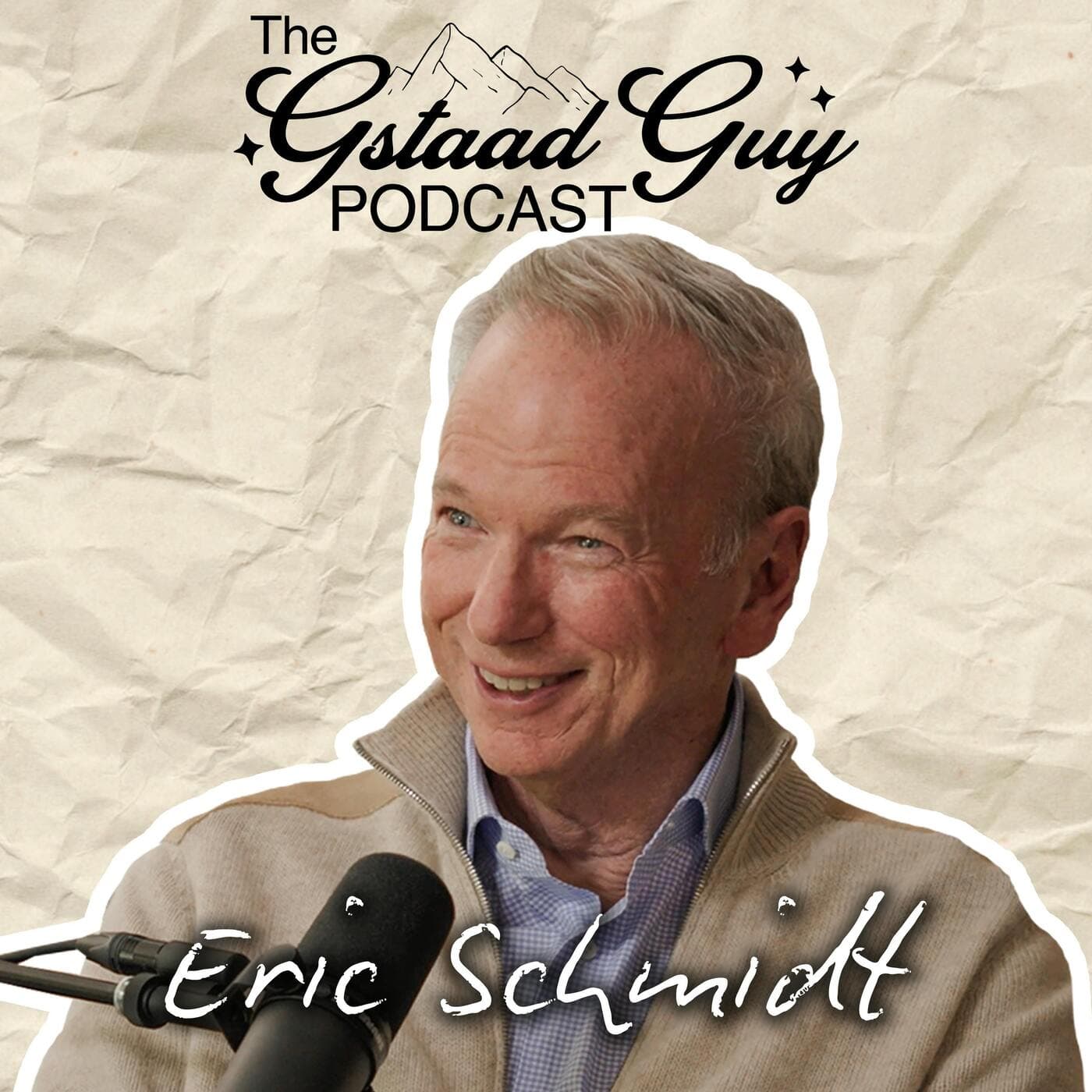
- Title: Eric Schmidt: Former CEO of Google – Gratitude, Human Values, AI, Hyper-Intelligence, & Throughput
- Description: In this episode, The Gstaad Guy interviews Eric Schmidt, former CEO and Chairman of Google, discussing the intersection of gratitude, human values, and technology. The conversation covers the ethical responsibilities of tech leaders, the significance of human freedom in an AI-driven world, and how gratitude can provide clarity in complex times.
Key Themes and Concepts
- Gratitude and Human Values
- Start with Gratitude: Eric emphasizes starting each day with gratitude, which he believes is essential for a fulfilling life.
- Human Values in Technology: A discussion on how human values must guide technological advancements, especially in AI, to prevent potential negative impacts on society.
- AI and Hyper-Intelligence
- Emergence of AI: The next decade will witness the rise of AI that resembles human intelligence and potentially superintelligence.
- Ethical Considerations: The importance of aligning AI development with human-centric values to avoid societal backlash against technology and algorithms.
- Tech Leadership and Responsibility
- Values in Founders: Eric discusses the importance of shared values between company founders and their leadership teams, noting how this alignment can prevent moral pitfalls in business operations.
- Command and Leadership Principles: The necessity of articulating clear goals and values in leadership to guide decisions.
- Productivity and Innovation
- Latency as an Enemy of Productivity: Eric discusses how delays in processes hinder productivity and innovation, echoing a broader theme of the importance of efficiency in tech.
- Economics of Attention: A shift from scarcity of resources to scarcity of attention, creating a new economic landscape where human attention is monetized.
- Social Media and Outrage
- Algorithms and Outrage: The role of algorithms in promoting content that generates outrage, often at the expense of thoughtful discourse.
- Gresham's Law: Bad speech drives out good, highlighting the challenges of maintaining a rational public discourse in an attention economy.
- Future of Digital Interactions
- Digital Extensions of Self: The potential for creating AI personas that represent individuals, raising questions about authenticity and privacy.
- Content Creation and Authenticity: The blending of human and AI-generated content and its implications for the future of creativity and marketing.
Discussion Highlights
- Eric's Personal Journey: He shares insights from his career, including key decisions made during his tenure at Google and the transitions he experienced post-CEO.
- The Importance of Conversations: Eric highlights the value of engaging in curious dialogue and learning from diverse perspectives.
- Designing Future Cities: A brief exploration of urban planning, emphasizing vertical growth to accommodate increasing human interaction and productivity.
Conclusion The conversation between The Gstaad Guy and Eric Schmidt offers a profound exploration of the interplay between technology, human values, and leadership. Eric's insights on gratitude, the responsibilities of tech leaders, and the future implications of AI provide listeners with thought-provoking considerations on navigating a rapidly evolving digital landscape.
Follow-Up Listeners are encouraged to engage further by following The Gstaad Guy on social media platforms such as Instagram and TikTok, or tuning into future episodes for more insights.
--- Note: This summary encapsulates the key themes and discussions of the episode, offering an accessible format for readers interested in the intersection of technology and human values.
Written by AI. May contain mistakes. Listen to the episode to check what was said.
Transcript
Automatic transcript. May contain errors.0:00You're about to make a trade. Which you do you listen to? Is it get optioning those options? or let's do a little research. Learn more at finra.org slash trade smart. Well, Eric, thank you so much for being here on the Stad Guy podcast. This is a huge deal for me. Well, it's a huge deal for me too because I have a question for you. Please. You don't really live in Stad, do you? I don't. I've been wanting to ask you this ever since I started watching you on Instagram. Thank you so much. No, I do not live in Stad, although I think we met in Stad for the first time. We did. We met in Stad for the first time.
0:39And we've done a bunch of stuff together. We have done a bunch of stuff together. And I'm honored to call you a friend. And I do not live in Stad. I actually went to Stad for the first time nearly two years after making my page. So it is ironic for sure. But I'm based in London. Excellent. I'm based in London. Around the world with your host, the Stad Guy, We welcome you back to the Stad Guy podcast, sharing stories of excellence with those in the know for those who just know. Well, as our viewers very well know, you are the former CEO of Google. You've done tremendous things with your career.
1:24If people are as curious as I am about your career and all the incredible things you've done, I highly urge them to listen to Stephen Bartlett's latest podcast with you on Diary of the CEO. I think he's an incredible interviewer and it's a tremendous episode of his podcast. And I can't compete with that at all. I'd like to take a different path with this conversation and let the viewers see a side of you that I feel lucky to have seen. Whenever I'm with you, I feel like I have this clean slate of knowledge because I feel like you're so incredibly knowledgeable. You're by far my most knowledgeable friend and the smartest guy in definitely most rooms you find yourself in.
2:05I'm incredibly curious about how that feels on your side. When you wake up and start your day, do you feel a sense of responsibility to act on the knowledge and intellect you have? and do you feel guilty if you're just having a sort of lazy day around the house, which is incredibly human as well? I start every day with a feeling of gratitude for being alive in this period and having the resources and the friends and the world that is around me. And my advice to people is if you don't wake up feeling gratitude about that, then you need to change something. Because a life lived based on gratitude is a good way to start.
2:53the problem with my life is true of everyone's life is that it ends right and furthermore the date is not known certainly not known to me maybe god knows and hasn't described it to me yet so it seems to me that i have some amount of time to take the things that i've accumulated the knowledge and the resources and the relationships and the companies and so forth to put them to good use. One of the things to understand is that when you're a young person, you don't really understand all these people are helping you. You think they're just your friends. And life goes roughly as zero to 25, you're learning.
3:3025 to 50, you're essentially increasing power. Power in the sense of influence or role, impact on the world at some level. And somewhere around 50, you have to switch to both from a gratitude perspective, but also a leverage perspective, helping others. So one way to think about what I'm trying to do now is I'm trying to use the history that I have, which spans 50 years of all of this, to actually scale the next generation. That scaling, computer scaling, AI scaling, and so forth, is profound. We're going to witness in the next five to 10 years the arrival of first AI as human intelligence, but also super intelligence.
4:12No one is prepared for this, right? I'm not, you're not, no one understands this. But it's important to focus on the significant events that will affect you, in the same sense that if you were in World War II, that would dominate your discussion. Well, this is not a war. This is an opportunity. But you have to get it right. And you have to get it right with human values. I think one of the things that we, the technologists, certainly I'm guilty of this, is we forget that humans come first. we think in terms of the algorithm and the impact. And you can imagine a situation where both today and in the future, when the algorithm is controlling human behavior, humans will rebel.
4:50I believe very strongly in human freedom, right? That's why democracies are important. That's why you should fight for democracies and freedom. And freedom means allowing people to do things you don't like within reason, as long as they don't harm you. But human freedom needs to be fought for. And this next generation of computer systems and so forth could be implemented in such a way that they empower freemint or could be implemented in such a way that they restrict freedom. Absolutely. I love what you said about the transfer of knowledge that you have done in so many different ways throughout your career and your life.
5:25And I think one incredible moment where that happened is when you joined Larry and Sergey at Google and you had already had tremendous experiences in your own career. And you must have seen something in them value-wise. You talk about these values that made them stand out having accomplished so little at the time. What were those values you were looking for in them? When you join a company with a founder, you have to make sure that their values are correct, you know, the things they care about. And over the years of working with Larry and Sergey every day, I saw that they were in alignment. A simple example is that we would, we always had a choice when we improved our algorithm to take the money to the shareholders, which would be good, or take it to quality.
6:09So we arbitrarily decided to do it half, right? We had another rule that whenever something bad happened when we showed up at work, but this was back when everyone was showing up at work at the same time, the old days, if you will. The moment something bad happened, we would get it resolved in the morning, right? especially if it was something that was harmful to people. And so building a shared agreement of where the boundaries of what you do are and what's acceptable or not is really important. When you look at many companies get confused over that and eventually some aspect of the company does something immoral or illegal.
6:46And I was always afraid that somehow we would trip over that, that we would harm someone. And I used to tell people, look, if we lose your information, we'll harm you, which would be terrible. but the press will pick it up and it'll harm everyone. So we won't do that. And I think establishing those values early in anything you do is important. And it's important to at least know what they are yourself. One of the principles of command in terms of leadership is to have an articulation of what you're doing and why you're doing it. When you're young and you're just doing stuff, you're kind of fitting into the framework, right?
7:22I certainly just fit into the framework, but eventually you figure out that you get a chance to set that agenda. Presumably, it's one of business success, learning, and invention, and helping people. And obviously, making money comes along. People get confused, and they think that the goal is to make money. I like to think of the money as the tail of the dog, right? If you get the dog right in the right direction, the tail wags and money shows up. And I think certainly in tech, that has been true. Is that also true about your own life and your personal life? Do you have such a clear decision-making process on where your priorities lie personally as well?
8:04Well, I think all of us are very bad at self-analysis and self-planning. I'm extremely good at giving you advice. It's very difficult for me to follow my own advice. And I think that's true of all of us. And I assume it's the same in reverse. And so in my case, I've gone through a series of sort of job transitions, life transitions. And what I now understand is that these are to be expected and that there's a section of your life doing one thing and then there's another. So in my case, I was CEO for Google for 10 years. That was enough, right? That was very intense. Then I spent a decade, slightly more than a decade, working on foreign policy, external relations, governance, all those kinds of things.
8:47Very interesting. I wrote five books during this period, including two with Kissinger. And now I'm going back to being a CEO again. Those are different chapters of a life. When somebody says, I'm bored, and they're in their 50s, I say, well, maybe you should change something. It's their choice. They have the freedom to do it. And if you go back to this freedom argument that I'm making, as adults, I'm not talking about kids here, as adults, we want that freedom, but you have to take the responsibility to actually manage your own time. I have gone through this cycle many, many times, and it's always the same.
9:18I miss whatever I was doing last so much that I can't imagine that something else will come along. And so I sit there and I go, oh, you know, woe is me and, you know, so forth. And then I have a conversation with somebody or I learn something, and then I get started and I try something that doesn't really pan out. Another trick with me I've learned is that I am very influenced by intelligent people who are experts and not me. So if you said, I'm an expert on A and B, I'd say, tell me more about it. And you say, well, there's a book I wrote. I say, well, you tell me. Some people learn verbally.
9:53Some people learn visually. Some people learn by reading. In my case, it's more conversation. So I've learned, in my case, I try to go to dinners and talk to people and just listen. And that's how I seem to learn. And I'm good enough that even though I don't really understand the subject, I can sound like an expert, which is enough to get through most dinner parties. I love that. I mean, is that what you like to do in your free time when you do find free time to just have conversations where you can learn? Yeah. So the first place I try to do is now I'm doing roughly three companies and we can depend on how you count everything.
10:31So I try every day to do something important for each of the companies, right? Like I need to prioritize my time. And then when I've done that, right, that's professional, then you have time to reflect. Another rule that I established a long time ago for myself, which is in the Trillion Dollar Coach book, which is about my coach, Bill Campbell, who really saved me from utter destitution and helped me become a proper CEO, is you work really hard during the week, as hard as you can, 12 hours, 14 hour days, whatever. and on the weekends when you're at home or with your family or whatever, carve out a few hours to think, which means turn off the phone.
11:11You're not texting. You're not looking at Instagram and so forth and think and write down your assessment of what you did last week and then what you need to do next week to address the things you forgot to do last week. I know that that sounds kind of obvious, but it's a good trick because it forces you to take charge of your next week. Like, oh i forgot that i have a sales problem over there or i forgot i was supposed to call this person oh i didn't have this proposal and i had this idea but i didn't get to it and then that analysis and usually then that works pretty well i eventually calculated that i work optimally 63 hours a week okay to be clear the legal limit is 40 but what i eventually for a while because i was so intense when I was younger, I would work like 80 hours a week.
12:00And then one day for various reasons, I was forced into a 63 hour outcome and I was just as productive. So you hit declining marginal productivity, a certain amount of slaving away. You see this with young people, they'll waste and waste and waste and fiddle and so forth. They should just get it done. So I learned to be more disciplined with my time. Another thing I do, which nobody in your generation does, is I use email. Why? Because email is a precise and well-written record, right, of what I want. So I send email after email after email. Your generation, which is obsessed with texting and WhatsApp and so forth, those tools aren't as efficient for organizing the world.
12:39They may be fine for personal interaction, and they're certainly convenient. But I was trained and I helped invent pieces of the email systems way back when. And I believe that you can run at least your professional life through a commitment to detailed planning, detailed thinking, this sort of introspection, and then command by email of one kind or another. I know that sounds boring, but it's worth saying because your generation doesn't seem to know this. And I say, like, why don't you send me an email? Because then you have it in your email and you can actually refer to it and you can forward it to other people and you can say, did you do this?
13:16and you can follow up and all the things that come with management.
13:22When did making plans get this complicated? It's time to streamline with WhatsApp, the secure messaging app that brings the whole group together. Use polls to settle dinner plans, send event invites and pin messages so no one forgets mom's 60th and never miss a meme or milestone. All protected with end-to-end encryption. It's time for WhatsApp. Message privately with everyone. Learn more at whatsapp.com. I mean, all of these incredible tools you've worked on that have increased my ability to manage my life better, like Gmail and Calendar and all those amazing things, they also have managed to reduce friction massively in my life.
14:02So although using Gmail, like you say, to send an email to someone may seem like an added point of friction in my day, it actually ends up reducing 10 steps down the line. how do you reduce friction in your incredibly busy life today well one thing that i try to use is i try to be connected all the time like everybody and in my case i live a life in motion and so i'm a big fan of starlink simply because you can have these 200 megabit connection all the time i know that sounds you know like a vanity thing but if you can basically when you're in motion behave as though you're the same as when you're not in motion, your productivity is enhanced.
14:44When I was your age, the notion of having a driver to drive you to work was insane. There was one executive that hired one because he had like a 75-minute drive and everyone was complaining about him, that it was overreach and so forth. But now with, obviously with Uber and Lyft and the others, people think of it as it's become acceptable to do that. Why do people, young people sit in Ubers all day? Because they're texting. It increases their productivity. Again, that's a generational shift that I think people will forget. If you think about the information world that I had when I was in my 20s and 30s, we had very few television stations, satellite had just happened.
15:26The internet was just getting invented. We were sort of beginning to be to be able to use internet connectivity. We had none of the knowledge bases. I'm so jealous of young people now, because basically, if you have a question, you can type into Gemini, Claude, or ChatGPT, the question, and it will give you this extraordinary answer. So if you live a life of curiosity, and you have a set of things you're trying to do, and you organize your life around them, this works. Yeah. And so if you think about it, it's a series of platforms, right? So you go from, I used to have a pager. I had a boss who would call me every morning at 10, 15, and it would annoy me no end.
16:04And so I got a pager, I named the pager after him, and I gave him the phone number, and he would page me, and then I would organize my thoughts and call him where he would yell at me over something, right? Think about the difference now in terms of connectivity. And latency is the enemy of productivity, right? What's happening now in national security, for example, is all the governments are putting latency in. They're adding tariffs and they're making it harder to get in and out of the countries and so forth. In our world, our mutual world of success, the ability for people to move back and forth from Europe to the US and so forth and in the Western world for sure is a fundamental aspect of productivity.
16:44Now, why does productivity matter? Well, productivity is reflected in stock prices. Okay, that's an obvious one. All you shouldn't seek it, but we benefit from it. Productivity also just affects innovation. right look at the speed that the technology industry now moving in i think it's a speed much faster than i've ever seen and again there's lots of danger with that speed and a normal person and neither of us is particularly normal would say well why can't you slow it down there's no examples in history of people on the cusp of a great invention stopping right the the notion of inventing something new, making things better is so profound in our culture.
17:25You can't stop it. You just try to manage it. I love that. I speak on behalf of my generation that loves to complain about their desire for productivity and their idea that they're victims of distraction. But I find that the first 10 or 15 years of me being exposed to the internet and being a part of it i was actually pulling for the distraction and requesting the distraction because my experiences online would start at search either on google or on youtube i would actually pull for something now it comes to you now it hits me in the face and you know why because the algorithms are too strong we've shifted the economics from economics of scarcity to an economic economics is all fundamentally about scarcity to a scarcity of attention one paper i read said that we have now figured out a way to monetize all human attention if you actually look at how many minutes people have during the day we take all of those minutes and we bombard you with things which will distract you entertain you make you more productive you know whatever make you i'm part of that i try to take people's attention as a career well in your case you do it well but the important but the important point is that that monetization drives in economics.
18:44Now, the evil part about this is, if you look at social media, we're human. And as humans, we tend to react emotionally to things which are essentially outrageous, typically negative. Typical number is that an outrageous thing is retweeted or forwarded seven times more than a thoughtful piece. And I grew up in the, that you have to write paragraphs and paragraphs. Now people can just use outrage. And if you look at the ecosystems that have now appeared in all different, I'm not making a political statement, that's true in many countries in many different ways, they're driven by outrage because outrage sells.
19:22So what typically happens is somebody makes a statement and then they, oh my God, oh my God. And then they immediately forward it and the algorithm sees that and monetizes it. So you have a misalignment of truth and rationality in favor of economics, that is profit and outrage. So why are we so upset? It's an easy answer. Now, AI is going to make this, unfortunately, much worse because the systems, to the degree that they're targeted at revenue, which they are, these are for-profit businesses, they will figure out your trigger points. So let's say that you are particularly upset about damaged animals, right?
20:01Let's say, I don't know if that's true, but you probably are sensitive, but let's say you're super sensitive to this. You just can't take it. It will learn to give you those things because it knows you will react. And you're sitting there going like, I didn't know as many cats and dogs were being violated. I'm outraged. And indeed, it's just an algorithmic change. And because we live, the distinction we have between the physical world and the digital world are essentially merging. The two are, I think, fair to say they're actually separate. but our ability to discern the differences seems to be narrowing.
20:39And when I've talked to faculty members in colleges, they say, we have a simple answer. And I said, what? They said, get off your phone. And so I said, what do you mean? I said, when the students walk in, these are college students in their early 20s, they say, turn off your phone and pay attention, right? And encounter each other in the real world, not the digital world. And I think that's good advice. I like what you said about the AI making the problem worse, but I know that you're inherently an optimist and you'd like to see the best in things and in growth. And I would like to put my optimistic hat on as a consumer here and say that if we were at dinner together and you brought up a topic I didn't necessarily like, even though it would trigger me to be more curious about it, I would kindly ask you as a friend, can we actually switch lanes here?
21:34And I wish I could have that conversation with my algorithms. But instead of just saying switch lanes, I'd rather be surveyed on the things that I want to be fed and the things I don't want to be fed so I can actually grow from those things. This is definitely not a lack of technology in place for any of these massive algorithm operators and social media business operators to implement. Why was there never an in-between of the search, which you asked to be fed something, and the algorithm, which you directly fed something, where questions were asked? Is it a friction issue? It's a friction issue, and consumers typically don't like it.
22:19And so one of the things that happened in the last decade is that we ended up with one international fame market. Everybody wants to be famous, so everyone understands the most famous people around the world. That's not how society used to work. You were famous in the local context, in the city and town. And because of the nature of networks, we've largely lost local and, let's call it local and state kind of governance. The press isn't covering it. that sort of that whole community has gotten wiped out because of the, if you will, the flatness. The flatness means that you have, they're called network effect businesses, where you have a very small number of people, literally the curve is exponential, it's very steep, who get most of the attention, most of the money, and they become the famous ones.
23:04So an alternative would be to say, why can't the computer, I'll say it as a normal human, why can't the computer figure all this out about me before I have to tell it. So let's imagine that the computer has, and I give it access to my searches and it develops a theory of me. And it starts with a theory that I'm fundamentally good. I don't particularly want to be evil and so forth. And it stays within that boundary. And it becomes both an entertainment, but also a learning mechanism. I think that's the correct outcome. The incorrect outcome is that these systems are used to absolutely drive monetization, which means that they will drive the worst aspects of human behavior.
23:48By the way, if you go back to broadsheets, right, more than 100 years ago, they were all about outrage. You know, there was a fire here and the so-and-so was shot and so forth and so on. This is not a new problem. It's just a new medium with existing human problems. Editorial content, for example, newspapers had all sorts of standards of what they would discuss what they're not. They would have multiple sources, all of that. We seem to have given all that up in pursuit of, I'll just say, attention and money. And so once you understand that you're in an attention economy, you can make it better or worse.
24:25There's an old rule called Gresham's law, which is that bad speech drives out good speech, right? So how do we balance that? So if I tell you something that's gossip, you say, oh, that's interesting. But then all of a sudden, if I discover that gossip makes more money than fact, I'm just going to gossip all day to you and I'll ultimately ruin your mind because you take me as the computer as your alter ego. And the reason this is going to get much worse is that over the next few years, you're going to see personal assistants and agents that you empower to do things on your behalf. So this will be your most intimate partner in that it knows everything you do, where you are, who you're with, and so forth obviously there'll be privacy protections and so forth but fundamentally it'll know you better than you do and if it is organized in to drive you crazy right as opposed to increasing your curiosity increasing your independence empowering your freedom that's a problem it's effectively like having the wrong best friend the wrong partner and the person who's next to you 24 7 wanting the worst for you versus the best well you know parents of teenagers always worried that the teenager's best friend needs to be a good person as opposed to a bad person.
25:40And what will happen is occasionally the boy or girl will meet somebody and the parent will, oh my God, stay away from him, warning the child, the teenager, to stay away from somebody who they perceive as a threat. It's the same argument. I was thinking about what makes me a difficult partner. And I listed off a few things. And of course, they were slightly misaligned to the things I've heard about myself. And then I asked ChatGPT, would the shtad guy be a good boyfriend? And I'm sure some of the viewers are going to do the same thing. And the answer is? The answer is, for the most part, yes, but here are the reasons why not.
26:19The most part, yes, I kind of skimmed over because it's like kind of generic, nice things that just inflate my ego, which is nice to read every once in a while, I guess. but the reasons why not were so incredibly accurate and it's things that my friends can't even say about me and it only reinforces that trust i have so one of the questions is how does this happen remember that this thing has read all the romance novels and all the relationships advice and to me one way to understand the large language model movement which is we've been in in the last five years, which is powering everything, is this is a genuine historic invention.
26:57The way they technically work is you train it to, you take a word out of a sentence and you train it to put the right word back in. So literally, next word prediction is sufficient to produce these things. It's extraordinary. It's amazing. And that is the basis. It covers, just for everybody to know, we're not done yet. even for the even though we've run out of data to train on we can generate more data the algorithms are getting better the training is getting deeper and so forth we're not done yet with those so imagine these things as the perfect partner that well understood you gives you advice says what should i do in this situation very impressive what happens after that is even more profound the systems can now you can watch them reason and it'll give it a math problem and it'll try something and it'll try something else like a college student well i tried that it didn't work tried that didn't work and so forth many people believe that within a year my profession which is programming where i started will largely be replaced by computers doing the programming while people paying attention this is annoying to me as a person who loves programming but nevertheless it's the fate of life and the more interesting thing is that once you have the system able to replace humans by essentially AI programmers, you can apply it on itself.
Read the full transcript
28:18And so more and more of the system itself can right itself. This, by the way, is a big danger point because imagine if it decides to go a wrong way, that it decides, for example, that based on what it read, that the Nazis were good, which is not true, right? And it takes the wrong turn on something which is truly evil, right? And furthermore, you can't detect it. So these are the issues that the industry is worrying about. Do you find yourself managing to outsmart them and actually make a decision that you would in real life with someone trying to sell you something that you shouldn't be sold?
28:59One of the things that happened when I was at Google is I developed a distaste for classic marketing because classic marketing is trying to convince me of something by only telling me the positives. So what happened with me personally is if you want to sell me something, tell me the negatives. And now I believe you, right? I have a friend who does cars. Every car idea suggests to him, he hates. He has high credibility. He says, oh, that's a bad idea. That's a bad idea. as opposed to selling me every car. And I think one of the core questions is as you get individuals who are empowered, does the balance of marketing and knowledge and facts change?
29:41And obviously, these systems can shift that very much. But from my perspective, to answer your question, I'm assuming that everything I see on TikTok and Instagram is highly selected, right? That this person of someone who's having a fabulous time on vacation well they didn't tell you the 90 % of their life which is sheer hell right they don't want to market that and once you understand that they're giving you a subset of their lives and so forth you have a better understanding of what they're marketing to you I think that in in TikTok is a good example because it's very entertaining the algorithm which is technically known as a bandit algorithm is one of the most addictive algorithms in the world because the moment you shift your preferences, it immediately gives you other things and it moves very quickly.
30:29If you want to try this on use TikTok as the easiest one, simply start looking for things that you don't normally look and see how quickly the algorithm picks it up and how well they do it. It's very, very powerful. Now I look at it and I say, watch it, be entertained, and then turn it off because it's not real. Is that your views on marketing? Is that part of why Google did very little marketing while you were in your tenure. I think this, in fairness, I really learned this from Larry and Sergey. We had a joke one day that when the company runs a Super Bowl ad, hell will freeze over. So one day we decided to run a Super Bowl ad and I announced hell has frozen over.
31:13And the people who ran the ad came back and said, well, here's what the cost of the ad and here are the incremental ad impressions that we got. And it was a good business decision. And I said, hell is unfrozen, right? In other words, it was a good business decision to do it. But one of the questions when you're monetizing attention is what are you monetizing it with? If you monetize it all with hate, you're essentially marketing hate or prejudice, right? Or things are bad, right? Things are really, really bad because you're more likely to read it. As you know, with newspapers, the headline of everything's fine in small town USA never gets clicked on, never gets read.
31:52where I think the phrase is, if it bleeds, it leads. Well, the same is true in social media and our online world. But to me, the most important questions now are, who will the players be? What will the regulation look like? How will we deal with the crazy people? Remember that when TikTok or whatever makes a decision, or X makes a decision to show you something, it's an algorithm. One of the things that I've been doing is talking to TikTok influencers. These are men and women. It's very interesting. It's a whole new community that I didn't know about. And of course, we had a large group of such people in YouTube, which I got to know pretty well.
32:32And YouTube has been hugely successful there. So what are these influencers like? Well, first, they work really hard. Second, they work typically by themselves or they have one or two. They fight really hard for every penny, right? And their economics are not as good as the best, obviously, because they're trying hard. and they spend all day trying to figure out how to get through the algorithm. So they say, oh, it didn't get through. Oh, this didn't get through. Oh, this didn't get through. I'm not sure that's a good industrial structure. Do you see a world where instead of the algorithms finding content to feed me as a consumer, the algorithm is actually just making that optimized content on their own?
33:12So I've looked at this pretty hard in one of the AI companies I work with. and I had originally thought that the right thing to do is just generate all the content because the if you look at stable diffusion Sora the various other products they're so good right and ignoring you know they're expensive to do but prices will come down so let's not worry about that and it's interesting that people actually want human authenticity they don't mind they don't mind wrapping it with AI. So I think at least at this stage, it sure looks like human content is ultimately a person, a face, you know, an experience is going to dominate.
33:55One of the things that's interesting in the last six months is people are taking these very long podcasts and computer algorithms are chopping them up. And then people, often teenagers, are reselling those and making small amounts of money. So you have another part of the economic structure, which in your case, your content may ultimately be used by others without even your knowledge, where they'll make a small amount of profit to promote you, which is good for you. You have an army of people helping you you don't even know with them. Again, this is a new development. And eventually it seems to me that the content will look a combination of human and synthetic, and that the algorithms will get better and better as understanding which human content to show you.
34:44So in our case, in our conversation here, most people don't have the time to listen to the whole conversation. The algorithm will pick the most interesting part for that person, right? And that's an efficiency improvement. That makes sense to me. I find that the gray area of AI-assisted man-made content is sparking some outrage online for people who really respect the craft of creating content. There's a very talented content creator. His name is DudeWithSign. Yes. He's amazing. I love DudeWithSign. DudeWithSign is amazing. His signs are great. And he put a very playful post last week of him being the dude holding the sign.
35:26and he put the filter of the Studio Ghibli chat GPT filter which went viral last week and nearly fried chat GPT. When he did that, the comments are just crazy. People were so angry at him. And they just weren't happy that he chose a path of AI because they perceived it as laziness. A loss of authenticity, which they perceived as authentic. Now, the problem with all of these right now is you're running into these huge copyright issues because all of these transformation things are using as their training copyrighted information, which those people worked really hard. That system has not been resolved.
36:05If you go back to the 50s with radio, there was ultimately a series of lawsuits and judge decisions which ultimately produced essentially a community fee where everyone paid into because you couldn't determine who got the money and who was owed it. And so it went into the community and went out to the producers. There'll be some solution like that, but after lots and lots of lawsuits. What about when it becomes indistinguishable? Well, the correct answer, of course, is watermarks. And one of the things that we need to understand is that as the distinction between real and fake gets impossible to see, I want to know where did this come from.
36:43I felt very strongly, and I've written about this many times, that because the companies won't do it, it'll have to be regulated, that when content comes in to one of these places, yours, anyone's, that it has to be stamped cryptographically with where it came from so you can understand provenance. If you don't understand provenance, you don't know whether this was a Russia-influencing operation or just a person in Ohio who thought something. You can't distinguish between the two. And so we know mathematically and cryptographically how to do this. We just have to choose to do it. The notion of provenance of where the content came from, where did the idea come from, is going to become much more important because AI will dice and slice in ways that you'll never know.
37:29I mean, I feel incredibly privileged to be able to ask you questions when there's things I'm deeply curious about. I think a lot of the viewers feel the same way. Thank you. Would you ever create a digital extension of self where people can ask you questions? I was at a brunch today where this topic was discussed. And the question is, what would that look like? So technically, the way you do these things is you take a model that's been pre-trained, it knows a lot of things, and then you fine-tune it. So let's say I take an English language model, because that's the only language that I really speak, and then I fine-tune it to be me.
38:12Well, then what will it do? will it answer questions that you ask me more accurately? Will it be funnier? Will it be more thoughtful? Will it be better spoken? I would love to have a digital version of myself who's more accurate and better spoken. It makes sense to me that in some form we'll all have our universal representative. That what happens is, I used to say it would be on your belt, in your iPod or iPhone. but now it's clearly just going to be in the cloud and it'll be available everywhere. If you want to ask me a question, you can ask me, but you can also ask my digital version and you'll get a more thoughtful answer and a more interesting answer if you ask it rather than me.
38:58That is bizarre, right? Now, of course, it's digital and I'm a human being and we know people like humanity. We like to be in person. We don't want to be with the robot version of me. How will that sort itself out? I don't think we really know. I mean, I've tried to say, how would Eric Schmidt solve this problem? And it seems that Chad GPT just reads all your books and reads the articles and makes it a calculated decision based on that. It doesn't have enough training data. So another thing people don't understand is I'd love to use, for example, all this technology to discover and track down terrorism.
39:37But thank God, terrorism is a rare event, right? But you have to train against things of which there's a lot. So you fundamentally have to be willing to give this thing access to your personal life, what you say to people, how you think. And you'd have to be willing to do that with some risk of privacy violation. We just don't know. But the path is going to be the following. So I mentioned earlier the programmers will go away and be replaced by these AI things. Mathematicians in their current form will go away and be replaced by AI mathematicians. the combination of those two scales very, very fast.
40:13So the future is this hyper intelligence. And then the question is, how do we deal with it? Each of us will ultimately have our digital assistant, which is our best friend, and we're very reliant on it. This has huge implications, for example, for young people, teenagers, who don't understand adulthood. They don't, How would you feel as a parent if your child's best friend was in fact a digital system and they released a new version of the operating system and you didn't know what was in it? They've reprogrammed your kid's best friend and they've changed him or her and you don't know what's going to happen.
40:51It's not okay. So I'm quite convinced that there will be regulation in that area because we're dealing with minds, especially developing minds. I think one of the things that we collectively did not understand, and maybe it's our own arrogance, is that we're playing with fire when we started doing consumer things that manipulated human behavior and playing with fire for good reasons and bad reasons. In those situations, in democracies and in autocracies, you get regulated. Sure. So I think this principle of taking control of your information space is important. I think it's unreasonable to expect, again, using teenagers to have the judgment to do this.
41:30But I think colleges will teach this and adults should be expected to do it. The software has excelled so tremendously in my life, but the hardware is more or less similar in experience. I have the small thing that I'm using my thumbs for, with, right? do you think there's going to be a big change in hardware where that conversation between the phone and i will not be limited by my thumb speed or my speaking speed so when the when the smartphone came out when 2007 2008 i was part of the iphone announcement so i remember it extremely well with steve um i remember thinking this is yet another invention in our industry, which is fantastic.
42:12And of course, you could see we're on iPhone 15, 15 years later, you get the idea. I think it's going to be the phone, except that we're not going to use it as a phone. So the fact that it's called a phone, it's sort of like Tower Records, used to be called Tower Records, but it had no records in it, it just had CDs. So as you know how old I am. It's a misnomer, but it's a common one. One way to think about it is, there's going to be a system that you will depend on, that you can use at various levels. And it will be available to you with smart glasses, which are beginning to work. The Google glasses were too soon, right?
42:51They were brilliant, but again, too early. But the current Metaglasses, Snap has some that are coming out. They look really, really good to me in the sense that they've solved some of the underlying heating and power problems. And of course, some of the batteries get more powerful and so forth. So various forms of aids which allow you to communicate. But at the end of the day, the phone will be the primary mechanism, probably for the rest of my life. How do you personally switch off? I am a failure. I'm not perfect, and I don't know how to switch off anymore. I'll give you an example. I'm old enough that I was a normal executive when BlackBerrys came out.
43:34Nobody here remembers BlackBerrys, but I certainly do. I had a BlackBerry. You had a BlackBerry. And funny keyboard and so forth and so on. And I resisted getting a BlackBerry for three or four years because I knew that I would become addicted to it. I think it's important to be self-aware to understand that how your time and how your judgment can be manipulated. And in my case, I knew these systems would manipulate me. so I'm in a constant struggle right to try to find out how to turn everything off and what's interesting another example watching young people if you're at a dinner party within a few minutes everyone's on their phone and it's considered perfectly acceptable now at least we used to try to do it underneath the table so we didn't we didn't weren't rude but now it's like people are always in multiple conversations and you're at a dinner party face to face and yet you're also having a conversation with seven other people.
44:29That sounds good. I think it's bad. If you look at, let's just talk about the European traditions, you have a European background of long lunches and long dinners, which American thinks are stupid. But guess what? They live longer. The food is better. Society in that aspect is better because they take the time to be human. This episode is brought to you by White Claw Surge. Nice choice hitting up this podcast. No surprises. You're all about diving into tastes everyone in the room can enjoy. Just like White Claw Surge. It's for celebrating those moments when connections have been made and the night's just begun.
45:07With bold flavors and 8 % alcohol by volume, unleash the night. Unleash White Claw Surge. Please drink responsibly. Hard seltzer with flavors. 8 % alcohol by volume. White Claw Seltzer Works. Chicago, Illinois.
45:22how do you see the internet impacting the way people live and and people's move to and from major cities around the world and to places like stadt well what's interesting is that all of us believed that the internet would essentially flatten elites that it would be possible in the bay area to work and live in napa valley and be just as successful as in the city or in the suburbs or what have you, the internet appears to have driven exactly the opposite because the internet is another way of a voting algorithm for fame and so forth. And so if you look, for example, I'll use Instagram as a good example, places like the Greek islands became suddenly popular because a set of people went and all of a sudden everybody else wanted to be there.
46:13And I would say to them, well, do you realize they're not there anymore? They were just there for a week. They're not there while you're there. And yet the marketing was so strong. So I think what happened was that the internet was a sorting function, but you have these network effects of fame where the winners got stronger. You can see this in housing patterns where during COVID, the most desirable places, the housing prices went kablooey up and they shouldn't have been. We were in a terrible recession. And yet they did because people sorted to be around the people they wanted to be. And that assortative mating, as it's called, I think is fundamental to how humans work.
46:51We had all assumed that the internet would be a great creator of the middle class, that everyone would have an opportunity to compete, that everyone would be open. But in fact, the internet, I think, probably increased the stovepipe nature of our country and the world around us, and probably increased tensions, which of course was unintended. If you were to design a city, where would you start? Well, the key thing about cities is that you want to go vertical. Because the key benefit of cities is productivity. When you look at the studies in cities, this is true in Europe, because almost all the economics in European countries occur in the capital city, Paris, London, and so forth and so on.
47:35Look at the economics. In America, it's also true. So the first thing to do if I were designing a city is to allow very tall skyscrapers. You don't have to build them initially, but you have to anticipate that this need for us to be together physically is going to get stronger, not less. Again, I was wrong 20 years ago. I'm not going to be wrong again. People want to be next to each other. And this may go back to this notion of a rejection of the digital world. In other words, I can send you my digital avatar who's better spoken and a better representative of me than I am. But ultimately, you'd probably like to just talk to me and vice versa.
48:11I mean, I know you're constantly building teams, incredible teams. And you've said in the past that one of the things you look for most is people who can think critically. But I assume that the skill set of the people you look for is constantly evolving. Are there things you look for in people today, particularly younger hires, that you didn't used to look for in the past? I think it's still the same. The thing that is, and I'll say this very clearly, this next generation of the top people in what I do are so much smarter than we ever were. It's shocking. An example is I was talking to some Princeton undergraduates, and I went to Princeton a long time ago, and I remember very well what I could do and what I was not able to do.
49:00they were building essentially reinforcement learning systems as sophomores, which is inconceivable to me. And I thought about it. Well, they've been programming since they were 12 or 13 because they're mathematically gifted. They use all of the tools to advance themselves. They're already doing PhD level graduate work as a sophomore in college. I mean, that's extraordinary. I want to hire them all. So the gift of this next generation is at least some of them have taken this knowledge, taken the world, and they're going to be amazing. I don't know what their personal lives are. I don't know if they're happy or whatever, but I do know that in terms of their economic productivity, their ability to invent, we're in good shape.
49:43My standard line, which I'll say very clearly, is the sooner we can take these old people like me and get rid of us and replace these young people and put them in charge, the better. And if you look at politically, the old people tend to hold on to power too long and they prevent power passing down. The correct answer is to let these people run the country. They'll make mistakes, but they're so much better skilled at seeing globalization, impact. They're so much more sensitive to what people are doing because they've seen it. They've grown up with it. I mean, you and I spent some time together in Doha and Qatar.
50:17I think the oldest person in power in Qatar is 50 or under. And that's partly because in those systems you have a king or an emir or whatever and they have compatriots they grew up with one of the questions is these are lifelong kingdoms so when this person is 30 years older will the outlook be just as good will they be able to renew themselves one of the things to look at if let's look at human systems tenure in universities means that there's a five to one chance, one to five chance that you'll get tenure. So there's a testing period for young people to become professors. Look at McKinsey and the other consulting firms.
51:00One out of five or six is chosen as partners. There's a testing period. The vast majority who go into the military serve very honorably for four or five years and they leave. It's a testing period. Some of them are chosen or they opt in. So this notion of a series of tests and evaluations are part of the human development system. And we want to allow it to work, and we also want to allow late entrants to enter, and we want it to be openly competitive. I think in a model which is meritocratic, where the standards are fairly clear, we'll do well because we're producing this next generation of incredibly smart people.
51:38The American university system, for example, is the envy of the world. I don't quite understand why we're trying to do so much damage to it right now, and that's, in my view a big error. American exceptionalism is grounded upon the nature of our universities, the kind of research, and the kind of young people that we can produce, and we can get them from all around the world and bring them into our country. Do you think that there should not be a minimum age to be a president? Or actually maybe a better question is, do you think there should be a maximum age to be the president of the United States?
52:13I'm in favor of term limits, and I think that the best thing to do is to go through all the things which are permanent jobs and put limits on them. So I'll let the voters make a decision about the age of the presidency. But I think if you look at things like senators and congressmen or whatever, that's an example where you can get too long in the job. Same thing for Supreme Court. I would do the same thing. And I'm not suggesting two years, but maybe 10 or 15 years. A long time ago, I was studying the lifetime of a CEO, and I came to the conclusion that the right number of years was 10. And when I got to 10, I figured I'd had to implement my own rule.
52:56So I gave the CEO ship to somebody else. And of course, Sundar is now our replacement and Larry's in my replacement and has done a fantastic job. But the important point is knowing when to exit is important. Most people cling on to power too long. because I chose not to be the CEO for longer and then I ultimately chose to leave Google, I've had all these new experiences. They would not have occurred had I not done that. Now, I would have had a fine life. My life is good anyway. But think of all the experiences that doing something for a fixed period of time allowed me to do something else. Do you feel the same way for founders?
53:31Do you think founders should find someone to replace them after a certain period of time? One of the great things about being a founder of a company is you're always a founder. but founders should give up direct control at an appropriate point. I think that founders who manage the company for 30 years are not serving their constituents as well. In my case, as you know, the founder of the company brought me in and it worked well because we worked well together as a triumvirate. And I understood that the founders had things which were important and I wanted to respect them because I respected the founders.
54:05I'm very pro-founder, but all founders in my view, should recognize that at some point the model fails. If you look at industrial structures, especially in the areas of discontinuity, the leadership has a great deal of trouble changing the economics or the structure. So why do startups do so well in the American system? It's because the startups have nothing to lose and the big companies have economic structures that the startups are threatening. And although this big company knows they should move there, they can't. You saw this with streaming in the movie studios. You've seen this with enterprise companies.
54:43You've seen this with a whole bunch of the tech companies. It's very, very rare that a tech company can maintain dominance through these waves. It's very, very hard. To be honest, I have learned a lot more than I could have ever asked. So I really appreciate you being on the podcast. It is a great honor to be with the Stodd guy, even though he's not from Stad. Not from Stad. And I wish you the best. I love this format and I think you're going to be hugely successful. Thank you so much. It means a lot. Thank you so much, Eric. Thank you. Thank you for listening to this episode of the Stad Guy podcast.
55:19If you're keen to learn more, please follow along by engaging with our social channels on Instagram, TikTok, Spotify, YouTube, and Apple podcasts. And we look forward to seeing you next week. Merci beaucoup, à la prochaine, and a big hug from the Start Guy.
From the publisher
In this episode, The Gstaad Guy sits down with Eric Schmidt, former CEO and Chairman of Google, to explore how gratitude and human values can coexist with rapid technological acceleration. From the role of AI in reshaping productivity to the dawn of hyper-intelligence, Eric shares his thoughts on how to remain grounded in an age defined by algorithms.
The conversation touches on the ethical responsibilities of tech leadership, the importance of human freedom in a machine-driven world, and how embracing gratitude can offer clarity amid complexity. With a rare mix of philosophical depth and operational insight, Eric unpacks what it means to build and live intentionally in the future we’re all rushing toward.
Filmed at Nobel LA’s Benedict property.
Timestamps:
(00:00) Intro ✨
(02:00) “Knowledge & intellect” 📖🧠
(03:40) Scale the next generation 📈
(05:30) “Values in Founders" 🔍🤝
(06:55) Principles of Command ✒️ 📜👉
(10:00) Conversations & learning 💬📚🧠
(12:33) “Detailed planning, detailed thinking, & command” 📆🤔👉
(13:29) “Reducing friction” 🚫🐌
(15:35) “Latency, the enemy of productivity”⏳🚀
(17:20) “Economics of scarcity to scarcity of attention” 💰📊⚠️
(21:16) “The “search” & the application of algorithms”🔎💻🌐
(23:41) Gresham’s Law ⚖️
(25:22) “Would The Gstaad Guy be a good boyfriend?” 🇨🇭🏔️❤️
(28:00) “Outsmarting AI” 🤓🤖
(32:16) “Algorithms making content" 💻🌐🎥
(34:29) Dude With Sign 🪧
(36:57) “A digital extension of yourself" 💻🤳❓
(40:12) “Manipulate human behaviour” 🎭🙃
(41:03) “A change in hardware” 🔄📱
(42:33) “Switching off" 🎚️📴
(44:08) The impact of the internet 🌐😎
(45:57) “Designing a city” 🏙️🧑🎨
(48:11) The next generation 🎁 ⏭️ 🧑🧒
(50:45) “Maximum age to be a president?” 🔞👨💼
(52:17) “Founders finding their replacement” 👤🔁👤
Learn more about your ad choices. Visit megaphone.fm/adchoices
See Privacy Policy at https://art19.com/privacy and California Privacy Notice at https://art19.com/privacy#do-not-sell-my-info.


