Ask ChatGPT

 The Gstaad Guy Podcast
28 Oct 2026 · 1h 15m · 26 chapters
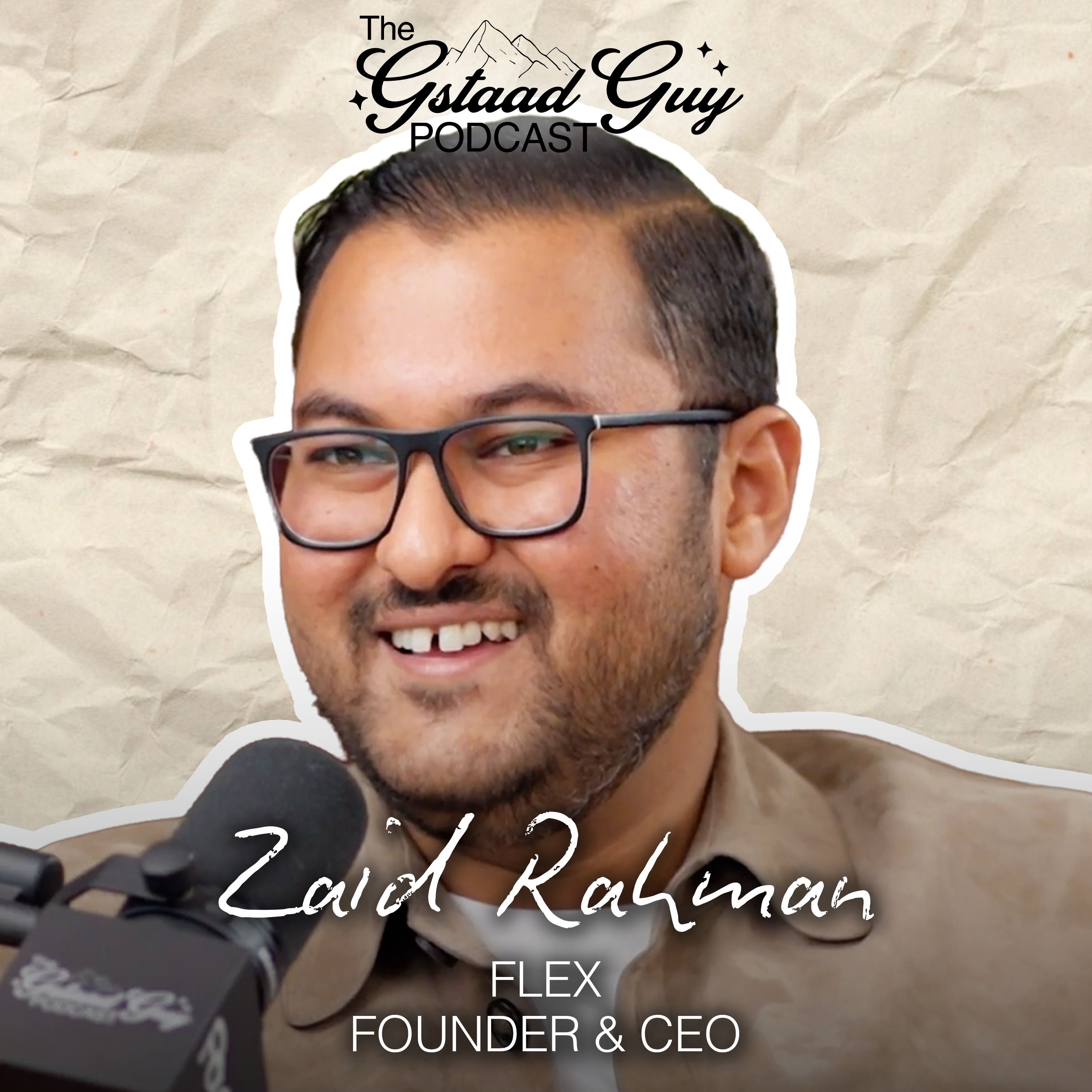
Zaid Rahman, Flex Founder & CEO, explains Flex’s mission to be a “financial co-founder” for affluent, growing business owners—rooted in his father’s construction-business cash-flow problems (clients paying 2–5 months late). He also discusses his path as a college dropout via the Thiel Fellowship, and how Flex uses AI agents for underwriting, product building, and customer support; plus his critique of “token maxing” incentives.
Zaid Rahman is a high school graduate with zero college days (never attended Columbia). He grew up in Dubai after his family moved from Bihar, India. He joined the Thiel Fellowship (Peter Thiel’s program) after a gap year; it funds founders and provides a peer network for two years. He says Flex has 45 engineers and built 24 products in the last three years.
Flex’s Net60 credit card provides 60 days float; Flex offers a unified “financial home” (payments, credit, banking rails, back office, personal finances) across entities and geographies. Flex uses “deep KYC” AI underwriting to approve credit in days vs ~90 days manually. AI is an output-focused rail, not the brand.
“Danny from iMate” uses Net60 credit; Zaid cites import-export fruits/vegetables, an apparel brand (Comfort), and global VIP/billionaire clients. He gives agent examples like HVAC call-handling and accounting automation.
Written by AI. May contain mistakes.
Zaid discusses his background, family influence, and entrepreneurial spirit.
“Around the world with your host, the Stardguy, we welcome you back to the Stardguy podcast, sharing stories of excellence with those in the know for those who just know.”
Zaid shares the challenges his family faced and the ambitions that drive him.
“I think taking a step back, right, you know, this is my third company, have been building for a while, and through my sort of entrepreneurship journey, learned a lot of lessons.”
Zaid explains the inspiration and vision behind his company, Flex.
“And I always thought if my father had an incredible CFO, he'd be far more successful, right?”
Zaid discusses his decision to join the Teal Fellowship and its impact on his career.
“And you instead went to the Teal Fellowship by Peter Teal.”
Learn about the success rates and unique structure of the Teal Fellowship.
“So if you like, you know, one in five people start a billion dollar company if you joined a program, it'd be a pretty crazy thing.”
Discover Zaid's journey as a high school graduate and entrepreneur without a college degree.
“It's actually funny because, you know, I'll apply to like certain formal things.”
Explore what Zaid's day-to-day looks like as a CEO and the pursuit of product-market fit.
“I think all the learnings I've had in building startups from the age of 13 can be summarized in three words, never give up.”
Zaid discusses the need for a financial platform tailored for high net worth entrepreneurs.
“Is that a problem that you are solving for yourself as a serial entrepreneur?”
Learn how Flex is revolutionizing banking for nomadic entrepreneurs.
“When you're sort of, you know, chartering a jet to go to Monaco to film an interesting podcast, right?”
Discover the challenges and solutions in managing multi-jurisdictional banking.
“And then, you know, in your case, your team is growing.”
Explore how AI is transforming financial management and advice.
“There's a company that's incrementally adding on to existing innovation, like Uber.”
Understand the deep KYC process and its importance for credit assessment.
“Takes all the context from the prior week and then just gives you this beautiful sort of collage and tells you what you're doing.”
Learn how AI has reshaped Flex's operational efficiency and innovation.
“Yeah, so we call it deep KYC internally.”
Get insights on how AI agents can drive efficiency in service-based businesses.
“I think to many of the listeners, this sounds entirely alien.”
Learn how AI is transforming customer service and accounting processes.
“and someone's calling you to sort of fix, you know, are you available to fix my AC?”
Discover how AI is automating accounting tasks and reducing legal costs.
“Almost every job is going to be automated.”
Understand the implications of token economics within AI companies.
“So just for some history, when these AI models dropped a couple years ago, and so developer platforms got built on top of it, the way these companies decided to monetize was monetized via use of tokens.”
Explore the growth potential and risks associated with leading AI firms.
“can review in an afternoon right and so it gets pushed to you know production which is you know It's committed to the app.”
Examine how AI is reshaping business operations and service models.
“And the bull case is also that, you know, these companies have just so much data.”
Delve into how consumer perceptions shape the adoption of AI in businesses.
“I think that's a great product, especially for the very global customer base you have.”
Discussing the shift from AI-centric branding to focusing on results.
“Every sentence would be, we're an AI native financial platform.”
Exploring Flex's new high net worth credit card and travel concierge services.
“the podcast so flex today has 23 products we're about to launch our 24th um and the 24th product really sort of ties the full lifecycle of money.”
Encouragement for young adults to prioritize happiness and self-care.
“Much of our audience listening today are in their early 20s, which I think to be some of the most confusing years of life.”
Engaging in a light-hearted debate about things to celebrate and discard.
“On this podcast, we always play a game of fantastique versus à la poubelle.”
Explore the concept of token maxing and its implications for employee productivity.
“Everyone has their own things to worry about.”
Discussion on the potential decline in value of major AI model companies.
“But I don't think the large model companies, i.e.”

Get the gist, explore an idea or ask about something said.
 Claude
On The Gstaad Guy Podcast, what are the key points of this episode?
Searching your listeningAutomatic transcript. May contain errors.
0:00The Gstaad Guy: This episode is brought to you by Indeed. You're ready to level up your business, but the pressure to find the right person to make that happen is intense. Indeed Sponsored Jobs can help carry the load. It boosts your job post to help it reach quality talent fast. Cut through the chaos with Indeed Sponsored Jobs. Get a$75 sponsored job credit at indeed.com slash podcast. Terms and conditions apply. Hiring now? Then this is a job for Indeed Sponsored Jobs. Is there anything you can say on this podcast that we can play back in five years and think, wow, I can't believe he called that? I don't think you're an admission dropout.
0:38I am literally a high school graduate with zero days of college. There are only 45 engineers who have built 24 products in the last three years. That's not possible without AI. My family is from a place in India called Bihar. It's the poorest state. And so my vision is what if Flex becomes that financial co-founder that my father never had.
0:56The Gstaad Guy: People feel handicapped if they don't have a phone today. You would rather go EasyJet economy class with Wi-Fi than Gulfstream 650, no Starlink. You know, everyone talks about how like running a business and building a company is extremely painful. But if you do it long enough and you don't give up, things work out. Around the world with your host, the Stardguy, we welcome you back to the Stardguy podcast, sharing stories of excellence with those in the know for those who just know. Zaid, it's an honor to have you here. Thank you for having me. Very happy to see you here, especially in this fantastic Laura Piana outfit.
1:34The Gstaad Guy: Had to match your vibe. I think you've actually created the vibe, much more so than matched them. Thank you. Long time fan. I've been watching you since, I think you had like 10 ,000 followers. Wow. So awesome to see how much you scaled. You're very kind. and it's incredible to see all the things you've managed to accomplish. And during those years, I was reading about all the different projects and businesses you've worked on just during that eight-year Shtadgai timeline. I focused on Shtadgai. You've done many different, very cool things. So equally honored and excited to have this conversation.
2:08The Gstaad Guy: Thank you. Thank you. So we are sitting today in London at the Peninsula Hotel to record this podcast. Awesome set. Thank you. Love being here. I know this is very different to a typical Wednesday for you. And you are now managing an incredible business with a very robust team, both of humans and AI agents. And I'm very excited to unpack all of that and what the business does. Maybe we actually will start there briefly and understand from you what you're up to today and what's keeping you busy. Yeah, no, absolutely. First of all, thank you for having me. As you mentioned, I don't do much of these, but, you know, I thought it would be awesome to come on this platform.
2:59I think taking a step back, right, you know, this is my third company, have been building for a while, and through my sort of entrepreneurship journey, learned a lot of lessons. one of the things I realized across all businesses was that running a business is really, really hard, as you know. So for some context, my family is Indian, and they're super Indian, right? My family is from a place in India called Bihar, which, fun fact, is the largest state in India in terms of population. It's about 100 million people. and it's the poorest state and also has a literacy rate of 50%. So one in two people are illiterate.
3:45My family in the lineage of families is the educated family in that sort of state. And so my father, when I was three months old, decided to move to Saudi Arabia. The Middle East was booming. He was in construction. He's a civil engineer. And so he decided to sort of become an engineer in the Middle East. worked on a bunch of skyscrapers in Saudi. And my mother's brother, my uncle, convinced him, was an architect himself, convinced him that, hey, he should move to Dubai because Dubai was really booming. Construction was happening. And this is sort of the 90s, we're now talking 1998, 1999. And at the time, Dubai was still quite small.
4:27It's not anywhere near where it is today. And for context, Dubai was really famous for being kind of the layover destination when the Brits would go on holiday to Asia, as an example. They would stop by Dubai for a day or two. It was actually a refueling hub for airlines. That's how Dubai became famous. They turned that layover destination into this massive kind of thing. My family moved there. Very humble beginnings. My father, being a civil engineer, in the early years of his company, effectively was carrying bricks and those types of things, sort of getting the company going. And it took him many, many years to kind of make it happen.
5:15Went from building small little villas to then building larger and larger buildings. Became this sort of skyscraper construction business. But most of my life until, call it the late teen years, was pretty lower middle class. And it was not anywhere near the sort of glamour you see on Instagram about Dubai. There were no Lamborghinis, no Rolls Royces, no butlers. Very simple life. My mother was a homemaker. She lived at home, took care of the children. I have two sisters. My sisters then became architects. right and and yeah it was it was just a very kind of normal sort of family great family though not a broken childhood or anything like that but what did have was my father was incredibly ambitious my father always talked about ambition and always pushed me that hey you can do great things and I talked about this with my therapist you know I feel like you know my friends tell me I'm incredibly driven and ambitious and I work really hard and very high pain threshold.
6:27And it really comes from, you know, my therapist and I talk about this where it almost comes from my father's ambitions. My father was quite ambitious and kind of reached a certain milestone, but not like all the way. And my family had a little bit of an up and down kind of experience where, you know, things started going really well. And then 08 happened with the great financial crisis in Dubai sort of went down and my family business went down as well. And so I kind of experienced that and, you know, going off high school, I was really into tech and really into sort of the idea of becoming an entrepreneur and, you know, was always into problem solving.
7:07And so naturally, whenever I saw a problem, thought there was an interesting opportunity to sort of go build a business, did it. And so I started my first business when I was like 13 years old, signing websites for local companies.
7:19The Gstaad Guy: Wow. I've actually never had a normal job. I've always been an entrepreneur. I'm sorry you had to go through those tough times, but I'm very also happy to see that many of those moments and the perspective that you gained through that allowed you to have the ambition you have today and share your father's ambition in many ways. And this is a cliche that I've heard many times, but perspective is the greatest luxury and being able to see what people want and don't want for their life is an incredible thing. Absolutely. And actually, frankly, the mission and vision for Flex really comes from my father's lived experience.
8:00Our tagline is Flex fuels ambition. My father loved the word ambition. And all the sort of problems we really focused on initially came from my father's financial journey, which was really upside down, right? Like there are lots of ups and downs in that kind of experience. And I always thought if my father had an incredible CFO, he'd be far more successful, right? And so that kind of, you know, it doesn't come up often in sort of customer conversations or investor conversations, but the kind of root of flex really goes to this story that my father had a construction business and all his clients would pay him late.
8:44In construction, it's always two, three, four, five months late. And if you're managing a business, it can be so challenging. And so the idea of our most popular product, our Net60 credit card, where you give you 60 days afloat, comes from this idea that, hey, my father got two months late payments every time. What if we could just make that super efficient? and initially it was really designed for like solving my father's problem turns out everyone has that problem and it became really popular and this whole notion actually what's really counterintuitive is most people from the outside when they look at successful business owners right let's say they have you know 50 employees and you know they're running a business there's a almost like an instinctive assumption that things must be amazing but actually those business owners, those kind of not too small, not too big entrepreneurs, they often have really complicated lives.
9:41They're sort of managing a lot. They don't have the best resources. They don't have necessarily the best execs at their companies. And so I often thought it was really interesting that the affluent but not extremely successful business owner is the actual customer to focus on because they have potential, clearly, because they've reached a certain scale. but no one's really focused on taking them to the next level. If 50 employees becomes 500 employees, how many jobs have you created as a result of that? And so that's why the kind of Flex founding story is so kind of pain point driven. And so my vision is, what if Flex becomes that financial co-founder that my father never had?
10:31The Gstaad Guy: I know that after working on several startups through your teenage years and growing up in Dubai, you nearly went down a traditional path of going to college at Columbia in New York, but then quickly realized who you are and you avoid those quite traditional jobs and school systems. And you instead went to the Teal Fellowship by Peter Teal. Can you tell us more about why you did that? as I mentioned um my first company you know I started was like I was like 13 years old I was always that kid you know in high school who you know never did homework uh just focused on like the final exams and just kind of went by right but um I was like that too uh worked out and yeah somehow sort of you know got into a good school and all of that you know always wanted to move to America because, you know, I remember seeing Steve Jobs announce the iPhone in 2007.
11:31And I was like, I want to go where Steve Jobs lives. And so that was Silicon Valley, really sort of focused on, you know, could I get into a top school in the US and all of that. And and then one day I was reading, believe it or not, like a local newspaper magazine. it's called the Friday Magazine in Dubai and it had an article on this like mythical program called the Teal Fellowship where this crazy rich guy, Peter Teal who started PayPal, first investor in Facebook has decided to start a program which pays you to drop out of college and I thought it was the craziest thing ever like wow and my parents were super conservative Indians they did not like that They did not like that idea.
12:19So I applied. And it was an interesting journey. Actually, a fun fact, which I don't talk about often, is I initially didn't get it, right? They actually flew me to San Francisco and - From New York or from Dubai? No, from Dubai. This is before I had started college. And the experience was so sort of enlightening, seeing these entrepreneurs who were all 17, 18 at the time. that it sort of blew my mind, you know? And I sort of realized that there's this whole other world, sort of made in the kind of top 40, if you will. And, but I decided after that experience to take a gap year and focus on my journey as a founder myself.
13:05You know, I was working in an education software business at the time and, you know, ended up exiting that business. And then a year later, the Teal Fellowship called me saying that, hey, you shouldn't go back to Columbia. you should just become a Teal Fellow. And so join the Teal Fellowship where they give you a couple hundred thousand dollars. And that kind of started a whole other journey and a whole new network and all of that. Fun fact about the Teal Fellowship, in the last, call it 12, 13 years, there have been 300 Teal Fellows. Off the 300, 50 have started billion dollar companies. Wow.
13:4450 out of the 300. And does Peter is always a shareholder basically by default because of that? What's crazy is it's a non-profit and a couple hundred thousand dollars. It used to be$100 ,000, now it's$200 ,000. It's literally a grant.
14:01The Gstaad Guy: 50 of the 300 ever Teal Fellows? Yeah, it's like they select. It used to be 20 under 20. They expanded it to 23 years of age. they select 15 to 20 people every year right and off the 15 20 people every year across call it 12 years it's like 300 to 320 people or so 50 have started billion dollar companies it's like the highest hit rate of all time it's actually a pretty well-kept secret too um not many people know of the teal fellowship relatively speaking um you know compared to you know getting into like a Harvard or Stanford, the hit rate's like approaching almost 20%. So if you like, you know, one in five people start a billion dollar company if you joined a program, it'd be a pretty crazy thing.
14:53Pretty good program. How long does that fellowship last?
14:56The Gstaad Guy: How long were you with them for? Yeah, the fellowship is two years. And what's interesting about the fellowship is that it's not necessarily like a super like formal program. It's sort of like they just give you like they just give you like a bunch of money and they kind of drop you in a peer circle that's really ambitious so there's nothing like y combinator nothing like y combinator there's no like demo day there's no like formal classes or anything like that um they just sort of like expect you to figure it out and i think um so many people have asked me the question over the years that, hey, what sort of makes these 50 people so successful or whatever?
15:43And the next 50 are coming up too, right? Because oftentimes, maybe the first company of the fellow does not work out, but then the second or third company is a huge hit, even in my case, right? And so what's interesting is that I think it's almost like a psychological experiment of sorts where seeing your peer become successful kind of has like a weird effect in your mind. Right? Like, you know, one of the guys who interviewed me is the CEO of Figma. And Figma, great business, great product. Everyone in sort of tech uses it. You know, publicly traded between 15 to 20 billion, my cap. um you know when you see that kind of thing happen and you you know have a conversation you know and it's a friend of yours who sort of achieves that you know another example is a really close friend of mine who you should have on the podcast um is a guy named shahid shahid khan uh he's one of the co-founders of loom again another business that's used a lot uh he sold a couple years ago for a billion dollars and you know it sort of has this kind of effect on you that, hey, like my friends are doing this.
17:02I can do it too. And it's sort of like a positive reinforcement. And it's sort of like, and then you see in this sort of fellowship, because it's not like a company based thing. It's an individual kind of human based thing where you track the fellow over time. Right. I wouldn't be surprised in a decade or two decades, very significant politicians. RTL fellows. RTL fellows who are college dropouts with no formal education.
17:30The Gstaad Guy: How long were you at Columbia before dropping out? Or did you never actually? Actually never started. Oh, amazing. A gap year and then, you know, got the fellowship. So you're an admission dropout. Yeah. I am literally a high school graduate with zero days of college. It's actually funny because, you know, I'll apply to like certain formal things. For example, you're applying for a visa or like there's certain conferences that are like really like, you know, prestigious or whatever. and they'll ask the question, you know, like what level of education you have. In my U.S. green card application, I remember that.
18:04It was actually quite challenging because, you know, they were asking for a certificate from my college. And I was like, well, I don't have a college degree.
18:12The Gstaad Guy: So what's the life of Zaid now as an entrepreneur in terms of your day-to-day whereabouts, the way you engage with your team? I'd love to know more about what that looks like today. Yeah, it's so funny. I was just slacking a teammate last night and Slack literally said, I don't know about you, man, but it feels extremely chaotic, but in the nicest possible way. It feels like, you know, the thing that most founders are looking for is this beautiful concept called product market fit. Your product has people interested in. You know, it's sort of a simple adage the founder of Y Combinator has, build something people want.
18:59And when you achieve that, it's a beautiful thing, right? And so, you know, after achieving product market fit with Flex, it's become all about scale, scale, scale. And so, actually, what's funny is that something like 30 % of my time these days is customer support related stuff. Wow. We have a lot of VIP clients, a lot of billionaires, a lot of successful entrepreneurs, some of the fastest growing companies in the world. And naturally, you know, they want to talk to the CEO. And so I spend a lot of time in all sorts of really kind of random industries from, you know, we have the largest sort of import-export business and fruits and vegetables using Flex.
19:41We have businesses that are fastest growing apparel brand in the world, Comfort using us, right? You have all these kind of companies and they have esoteric problems that can often be very different from each other. And what's interesting is I'm sure if you went to like the CEO of JPMorgan Chase or American Express or anything like that, you know, they'd say something similar where so much of their life is just, you know, thinking about customers. And the more customer obsessed you are, the better. And so no one week resembles the prior week. It was really interesting. and you get to a certain level of scale um it almost becomes you as a founder are you happy because if you're happy you can optimize your sort of day-to-day to be really really sort of you know fulfilling and kind of motivational right such that you can actually show up every single day so when things are not going well you're still there right because that's one of the challenges with founder-led companies where the founder at some point gets burned out after a certain level of scale and they sort of bring in someone else and they bring quote-unquote professional management and that ruins the business that happens all the time right and so it has become very much about you know how do you optimize you know just so that your own kind of mental function is that peak every single day is there anything you wish you could tell your younger self today?
21:10I think all the learnings I've had in building startups from the age of 13 can be summarized in three words, never give up. Right. And there's a great sort of saying, um, all defeat is psychological until death. You know, everyone talks about how like running a business and building a company is extremely painful. Once you live that experience, you truly realize, you know, it's like chewing glass and sort of staring into the abyss from a flying airplane that's about to crash. And every single day you're trying to find, you know, for hope to survive. But if you do it long enough and you don't give up, things work out.
22:05And the thing that usually sucks the most is finance. Finance sucks. Nobody really wants to do finance. Banking, cards, etc. And it's like 20 different things, from payroll to managing your insurance, to accounting, to tax. And then you add your personal wealth to that. A lot of your listeners, I'm sure, are juggling multiple entities. You may have family offices and those types of things if you've made it. And it's just a lot of different things. And no one has quite been able to bring all of this together in a single place. There are a lot of platforms out there. Either people are focused on really, really large businesses that are Apple or Google, or they're focused on really, really tiny businesses.
22:51Your mom and pop coffee shop. But there's an opportunity to sort of really serve the high net worth business owner. the person who's made it who's already affluent but no one's quite built a platform that takes their entire sort of life cycle of money and brings it in a single destination so what we built is the full financial home for successful business owners business personal payments credit and back office sort of brought together in a single place so the whole journey from the time you make revenue to the time you spend it in your personal lifestyle at the peninsula in London. Very start there.
23:32Exactly.
23:33The Gstaad Guy: That's awesome. Is that a problem that you are solving for yourself as a serial entrepreneur? Yeah, no. My prior businesses sold a company and then, you know, did a company that didn't quite work out, invested in a bunch of startups. My family runs a construction business, right, in Dubai. and seeing my family operate was actually a pretty interesting lens when you know you go to sort of a typical tech entrepreneur they think their business is really complicated wait until you see a construction business with like real stuff and hard goods and you know you have a guy in the back you know running around with paper and pen managing the accounting and it just seems like for lack of a better word, kind of a show.
24:23And when you start getting successful, people think that you've made it. You don't really need help. But it turns out successful business owners are the backbone of the global economy. Something like 300 ,000 business owners in the US serve 40 % of America's payroll. Two million business owners globally run half the global economy. So from a stats standpoint, if you serve those people really, really well, you're growing the global economy. And so when I sort of personally started seeing some success, realized that these platforms are too sort of cookie cutter, one size fits all. And no one's really focused on this kind of very niche audience like your audience.
25:11And no one really understands like how esoteric it is and this sort of successful business owner is almost like a meme right because um there's so many things happening in their life financially with multiple businesses multiple investments they all sort of seem a bit disorganized a little bit um you know sort of like all over the place right and so we thought there's a huge opportunity to like really kind of focus on that entrepreneur. And of course, like a lot of that comes from my own sort of psychology and sort of my own experience managing money and sort of seeing how things can get, you know, disorganized and all of that.
25:50And so, yeah.
25:51The Gstaad Guy: So how would that work for an entrepreneur like me on a product level? So I have my podcast business, my main channel business, Pubelle, my jewelry brand, as well as my own accounts that I have, I don't know, four or five of just for open in different countries and for different reasons and at different times of my life. I still have my college account. As you said, a little bit all over the place. Wish it could be less all over the place. How would Flex solve that for me? You're like the perfect ICP, ideal customer profile, right? Number one, you're global. Number two, you're growing. I hope so.
26:29Well, you clearly are. the podcast episodes uh in frequency is increasing right thank you um number three um you know given your business is growing really fast you suddenly are starting to realize you also have cash flow needs um you know money coming in and out and kind of all sorts of lopsided ways create sort of gaps i would imagine at the business level and then you have an interesting lifestyle, right? And your life is not just your business. It's not just your personal sort of finances. It's sort of all of these things kind of intermingled with each other, right? And so we think that, you know, in a case like yours, you should have one account, you know, one login, if you will, and you log on to that and all your banking across all your entities, all your personal credit cards, business credit cards are sitting in a single place.
27:26And then we help you at the business level, give you working capital to grow faster. One of our most popular products is we have a credit product where we give businesses. For example, you had Danny from iMate on the platform. Danny uses us where we give him 60 days of credit on every transaction. So imagine he's spending, you know,$300 ,000 a day on credit cards advertising, but getting 60 days float on that is significantly game changing. And then we give you... For my inventory on... Exactly. When you're sort of, you know, chartering a jet to go to Monaco to film an interesting podcast, right?
28:10Because you may have brand deals, and the brand deals pay in 60 days. Well, who's floating you for those 60 days? Interflex. That's how we started. That core product is now approaching 10 billion in annual payment volumes, so financing a lot of activity. And then we realized that, hey, we should serve you with banking as well. because, you know, for most people, banking kind of sucks. In places like Europe, you have things like Revolut, which is good, but it's sort of a mass market kind of use case. But if you're the type of person who's living in Monaco one weekend and London the next and Miami the week after and then you go to Dubai and then you're in Asia, you need global banking.
29:00And so we built global banking rails and we bring the best of what your banks will provide and also sort of things like stablecoin banking for the truly nomadic entrepreneur, access to sort of US money market products, giving you high yield treasuries in a single account where you can hold 32 currencies from pounds to euros to Chinese RMB to Canadian dollars, UAE dirhams, Saudi real, et cetera, et cetera. and so makes it really convenient if you're juggling around the world. And then, you know, in your case, your team is growing. Now imagine you need to give your team credit cards and, you know, access to certain products.
29:44Well, what if you could issue cards to anyone from your sort of personal staff, like your personal assistant, all the way to, you know, your back office employees and so on and so forth. and those types of rules and policies would be pretty impossible if you were just using a traditional bank and so we basically brought 24 separate products from invoicing to managing money movement to expense management to your personal banking all the way to how you manage your personal lifestyle and you know your personal cash flows and sort of track your wealth across all these things in a singular destination i know that this sort of industry though comes with a lot
30:24The Gstaad Guy: of tough and unique regulation with all these different jurisdictions. How does it work for the very international person like me and like much of our audience? Yeah, no, what's amazing about banking and fintech in general is that, you know, companies like us are basically in the job of orchestrating and abstracting complexity away to bring beautiful experiences. It's kind of like an Apple device. Like an iPhone is actually a pretty commoditized product, if you think about it. The touchscreen has always existed. The speaker on the phone has existed. Even the software is actually Mac OS. It was there for 20, 30 years.
31:13The apps have been around for a long time. But what's beautiful about the kind of Steve Jobsian way of thinking about things, about products, be it a lower piano all the way to an iPhone, is the simplicity of bringing all of this complexity and hiding it in a beautiful user experience. There are three types of companies. There's a company that's incrementally adding on to existing innovation, like Uber. iPhone existed, therefore now Uber exists where you can order a car. There are types of companies that invent fundamentally net new things, aka ChatGPT. AI now exists, so now you can ask it to do random things.
31:56But there's a third type of company, and we call it the complex coordination business, where you're coordinating just a ton of different things and bringing it all together in this kind of singular package. And so going back to your question on regulation and sort of thinking about the kind of global entrepreneur that's trotting around the world, the reality is that you're dealing with European taxes, you're dealing with American taxes, you're dealing with your businesses that may be incorporated in the U.S. for various reasons, in the Cayman Islands, you may have a business in the U.K. Well, how do you sort of manage multi-entity, multi-geography in an efficient way?
32:37Well, if I told you that, you know, in the app, you can sort of juggle between these entities across different geographies, kind of like how you change profiles on an Instagram account.
32:46The Gstaad Guy: Feels very simple when, as you said, it's actually incredibly complex in the back. I know that a big part of your business is also AI and the way that your business has been built is also AI. We've started to describe ourselves as an AI native platform, right? What does that mean? It was a sort of generic. Everyone's starting to say that they're an AI business. If you think about it, if you zoom out, right, going back to this concept of abstracting complexity, think about money. Money is complex, but at its kind of simplest form, it's just, you know, an object for you to sort of transact. Right.
33:28The tracking of money across your life cycle is a very, very complex thing. You yourself have multiple entities living in multiple geographies. Now imagine you had an intelligent sort of assistant that was an incredible executive assistant who sort of tracked you, shattered you at every restaurant, every party, every business meeting, every podcast recording, and sort of understood you end to end. And then over time told you how to improve. hey, these are things that you're doing that you should not be doing. Right? And these are things that you should be doing more of. And so we realized there's a huge opportunity to build kind of like a true AI financial advisor that's almost like a CFO to your life, end to end, not just a business.
34:25Sort of with a sole purpose of, hey, can I maximize your net worth? and so we build this product called beacon which tracks all of this data that we're learning through the context of using our banking products our credit products our payment products and so on and so forth and the more you transact with us the better we understand you and then sort of gives you insights and the way we give you these insights by the way you know again uh sort of abstracting complexity is we give you an Instagram story once a week on Monday. That's ephemeral, lasts 48 hours. Takes all the context from the prior week and then just gives you this beautiful sort of collage and tells you what you're doing.
35:08Like the Spotify wrapped with the music. Exactly, that's the inspiration. But your financial life.
35:13The Gstaad Guy: It basically tells me my spending habits. I'm spending too much on restaurants this week. Maybe I should invest this much next week. Absolutely. And if you're an entrepreneur, let's say you're running an e-commerce company, which you have tons of, or whatever, you may be in construction or you're in the podcasting business. Let's say you're an e-commerce brand. We can sort of see that, hey, you're selling apparel, and you're spending money on Instagram ads, and your cost to acquire a customer is 30 % higher than your relative peers. Why is that? let's investigate. Hey, you're overspending on inventory.
35:56If you optimize that by getting a better supplier, you could increase your margin by 40%. Those are very kind of nuanced pieces of advice, not just about kind of overspending in lifestyle, but more like how can you make more money, right? There's sort of two camps, save money and make money. We're definitely on the ladder, right? Because people tend to spend more than they should, right? So the solutions that, in my opinion, is help you make even more.
36:29The Gstaad Guy: What about in terms of the business side of things with AI as an AI native business? I'm very curious about how AI has been useful in the actual entrepreneurship side of things for you. What's interesting is that when we were building this product for customers, you know, thinking about how to give them insights on their spend, the kind of route for that was actually really interesting. It started off actually as an internal product. So remember, we give credit to business owners all over the world. And so when we're giving you credit, the challenge is that we need to actually deeply understand who you are, not just as a business, but at the individual level.
37:14because often, let's say you start a new business tomorrow, it has no history, no revenue, no sales, but you're a shtad guy, right? So we need to underwrite shtad guy. So we have to build a lot of tech to truly understand the individuals behind businesses and then understand their cash flows, understand their money movement.
37:36The Gstaad Guy: Is that kind of the KYC process? Yeah, so we call it deep KYC internally. So we're doing deep know your customer. going way beyond in America there's a concept of cred score going way beyond what a cred score tells you and so in order to do this we had to actually build our own vertical AI models to truly go deep enough just for context let's say you go to a traditional bank let's say you're 25 million revenue business and you go to a traditional bank and you apply for a credit line it would take them 90 days to do this process because they have to do something similar, but they do this manually, right?
38:19So we realized that, hey, like, what if we did this through AI? And so we build this internal tooling and now we're able to sort of underwrite in a couple of days, which is a massive kind of time-saving. What's really interesting about that process is that it sort of kind of rewired our whole company to think AI first, right? And because of those internal tools, at some point we realized that, wait a second, if we understand you super well and your, you know, your customers sort of financial data is sort of, you know, helping us understand each incremental business owner's data better, right? We realized that, hey, what if we could give this data back to the customer?
39:01And so that's how Beacon was created, where it was actually initially meant to be used only internally. And so we became sort of AI first business. And since then, we've kept adding more layers of AI. We have, at any given point, engineers are using 100 coding agents, writing different feature sets. And so this velocity of our product building has increased a lot. We're only 45 engineers, but we've built 24 products in the last three years. That's not possible without AI. last thing I'll say on this is I'd like to say to people that the best thing that happened to flex in the last 24 months is anthropic because of anthropic you know and clod and coding agents and all the sort of tooling that exists now there's stuff that we do that would have taken us 2 000 people plus in terms of headcount to achieve across every field engineering kyc finance, credit, risk, underwriting, so on and so forth.
40:07The Gstaad Guy: So I think to some of the listeners today who run a business where they use Claude and they use AI, this sounds like a no-brainer. I think to many of the listeners, this sounds entirely alien. Can you walk us through what that process and relationship between you and Anthropic, for example, looks like? What is an agent? How does an agent work? How do you tell an agent what to do? So first of all, one of the problems with this AI industry at large is that there are too many terminologies, right? What is an agent? What is AI? What is all this kind of nonsense, right? At its fundamental level, you know, the kind of simplest analogy I can make is think that you're navigating using Google Maps.
40:54there was a time when you would have to tell Google Maps kind of a step-by-step sort of direction that, hey, turn right, turn left, you know, go across the street and then turn right. And then sort of came AI where AI sort of figures things out without instruction. That fundamental sentence is the insight, figuring things out without instruction. And so now you have self-driving cars that can drive on the street of San Francisco with no drivers. Well, what if every business owner had self-driving cars put for every function of their business, be it sales, be it customer support, be it the person answering the calls?
41:43So there are tons of businesses in the US. I'll give you a random example. There's a sort of a new industry of agents, quote unquote, that are designed for service businesses. So imagine you're an HVAC business, you know, your AC broke down, and someone's calling you to sort of fix, you know, are you available to fix my AC? Well, 10 years ago, it really depended on if someone answered the phone. And as you know, like, let's say it's 11 p.m., people are very unreliable, inter-coding agents and inter-customer support agents where people can just rely on AI to sort of take customer calls. And so you've seen these HVAC companies where the biggest problem they had was they didn't have enough customers suddenly quadruple in size because all of a sudden the efficiency of just answering the call, scheduling an HVAC sort of consult, you know, processing the payment has become an instant process, right?
42:49So business owners can just focus on what they're really, really good at versus sort of do all the stuff that's behind the scenes as an example. Another example would be in the finance space. We're building agents now to automate accounting. No one wants to do accounting. No one understands their books. No one understands their taxes. And so how do you make all of that so efficient that you as a business owner can just be, focus on making more money and building better products for your customers and services, and agents sort of take care of the rest. And so with our accounting agents, our vision is to effectively augment your accounting team to the point where they can just verify in 30 minutes, once a month, if the agents have done a good job.
43:43But 99.99 % of the rote work is done automatically. That's the future we're living in. Almost every job is going to be automated. it. It's funny because there used to be a time where people thought that the jobs that would be automated would be the blue-collar jobs. Actually, it's the white-collar jobs, the lawyers, the finance teams, the accountants, and so on and so forth. I mean, our legal team spends the most on AI, even more so than our sales team and our finance team, because they're drafting entire sort of legal documents using agents. And you can measure their use of AI through the expenses on tokens.
44:27So you can, there are two ways to sort of measure productivity with AI, right? The first is how much money you're saving, right? And the second is how much more money you're making, right? So we were spending quite a lot on legal fees, right? Highly compliant business, like lots of regulations, many different countries. At one point, our monthly legal bill was well into the seven figures. And even a 10 % optimization of that is very significant. I think we're spending 30%, 40 % less compared to 12 months ago because of using agents appropriately. And the next is throughput. right um you know let's say you're signing a new client and there's sort of a novel contract right now it's gone to legal legal can take two weeks of process well what if it's done in two hours therefore you'll be able to do the job sooner get paid sooner and so on and so forth so it's kind of like all these ripple effects that you can sort of measure pretty quantitatively
45:35The Gstaad Guy: I think everything you've spoken about is pretty output focused, like measurable consequences of good AI usage. What I've seen in the news recently is also this whole token maxing thing where some employees in the office who work on lines of business that have a longer timeline between inputs and outputs. They're actually just trying to be measured on their success based on inputs by using AI a lot and kind of maxing out the tokens. This whole sort of token kind of economics is upside down, in my opinion. So just for some history, when these AI models dropped a couple years ago, and so developer platforms got built on top of it, the way these companies decided to monetize was monetized via use of tokens.
46:31And token is effectively a measure of how much you're using, how much compute resources you're using of that company. And so every company came up with the model, et cetera. And Anthropic is one of the fastest growing companies in the world. It's gone from zero to 10 billion in analyzed revenue in like two years. It's on track to hit 100 billion in the next 12 months. Insane sort of growth trajectory, right? There's nothing, there's no company in the history of time that's grown as fast as Anthropic. Amazing. Opening eyes second, right? But what's interesting is that, you know, it created sort of two problems.
47:09The first problem it created was the companies that are AI native, such as Flux, you had this sort of weird kind of dynamic where internally employees started competing with each other. At one point, an ill-advised engineering leader decided to put together a leaderboard internally where who has used the most number of tokens. And at first we were like, oh, this is amazing. Let's see who's AI maxing. right and it led to token maxing and token maxing can be extremely expensive you know you have some kid who uh you know 18 years old joins as an intern decides to you know build a video game on a weekend using our sort of compute resources and you know spends two hundred thousand dollars in like two days did that happen that that did happen um oh my god and and you know you have a situation like that and you're like holy like some kid just spent two hundred thousand dollars unnecessarily you have other situations where some engineer goes crazy and does something really terrible where they vibe code like such a big change that's 14 000 lines of code that no human can review in an afternoon right and so it gets pushed to you know production which is you know It's committed to the app.
48:33And it changes some critical things, which causes bad actors to enter the platform. That could happen too. And so we've built a lot of systems to prevent those types of things, where there's a lot of slop in the work. And these companies, i.e. the model companies, have really sort of optimized their business model in such a way where they're incentivized for you to use as many tokens as possible. right and so there's a lot of investment happening now and routing people to the right models and so on and so forth to prevent token maxing but the other problem and this is something that Alex Karp from Palantir talks a lot about is isn't it controversial that if AI companies are so damn great why are they charging for the use of the highway versus the actual delivery of the goods right like if they're coming and saying that oh we will save 99 of the cost of certain jobs why not charge as a percentage of the saving versus the actual cost of producing the token right isn't it somewhat somewhat backward right and so there's sort of a almost a conspiracy theory around this where is sort of like AI sort of a quasi-hype?
49:58I don't think it's a hype, but like the sort of token maxing has gone too far. And so interesting question to ask is, will OpenAI and Anthropic be as valuable as they are today, 10 years from now? And there's a bull and bear case for both of those. I think the bull case is that, you know, Anthropic, OpenAI are just some of the most interesting companies in the world. It's growing 10x year over year from 0 to 1 billion, 1 to 10 billion, 10 to 100 billion, 100 billion to 1 trillion. In revenue. In revenue. They're currently at like 30 billion revenue, Anthropic. And at this rate, they should be at 100 billion sometime in the next 12 months, right at this growth rate.
50:47And so it's absolutely bonkers. And so if you just, you know, sat with that for a minute, you know, naturally these companies are going to be the most valuable companies in the world. And if that's the case, then, you know, they're going to be far more valuable than an Apple or Google or Microsoft or anything, you know, that came before that. Right. That's sort of the bull case. And the bull case is also that, you know, these companies have just so much data. Right. One crazy thing they're doing is in Silicon Valley, companies die all the time. But now there's an interesting secondary marketplace.
51:24When your company dies, Anthropic and OpenAI knock on your door saying that, hey, we'll give you X dollars to buy your company data. We'll buy your messaging history, your email history, your Google Cloud data, and use it for model training. it's just so kind of bonkers that your company dies and there's a marketplace to sell your shit it used to be you sold your office chairs and tables now you're selling your stale company data so that's the bull case where they have just so much data and it's so concentrated and every company sort of using these two sort of duopolies if you will which is a word they don't like but then the other side, the bear case is that there's an assumption that there are going to be these sort of monopoly models right and the value is going to accrete to the companies that sort of own the models but what if the value is going to the companies doing the work versus owning the models right and what if the companies that are doing the work create their own models and so there's a surge of businesses out there that are these sort of ai native service firms rather than you know give you a tool to do something it's sort of doing the work right like you know rather than rather than build like the next generation of quickbooks you're an ai native accounting firm and you just hire the accounting firm you don't care how it's done as long as it's done and cheaper faster a lot of people would choose that because it's
53:07The Gstaad Guy: no need to learn anything you just kind of pay someone they do the whole thing exactly like if you're like just a random business owner listening to this right and you have no interest in learning about agents and ai and all this stuff and i came to you and said hey i'm gonna make you 3x more money right of course no brainer yeah right you can make 5x if you do it yourself but you could just do 3x if you pay me instead exactly or if i like you know you hate you know What if I find sort of a tax efficiency that saves you 10 %? That's an entire legal industry, by the way. Like listeners to this podcast probably employ a ton in the sort of tax advising industry.
53:54And that industry is probably in the hundreds of billions of dollars.
53:58The Gstaad Guy: You're very well placed for an AI tax advice product. Is that something you're working on? Definitely on the roadmap. I think that's a great product, especially for the very global customer base you have. One kind of use case that comes up a lot in our context is, you know, you have cases where business owners have multiple businesses. There are multiple geographies as well. And, you know, each of these need a credit card, a debit card, whatever. But let's say you and I go to lunch, right? Or even better, we go to a really nice bougie dinner, followed by some drinks. and now we're having some fun and we pull out our cards.
54:41Well, which card should it go on? What if it was on a single card and after the fact you allocated your transaction, 20 % on this business, 30 % on that business, 50 % at your personal level and did it in such a way that it was auditable from a tax standpoint and also efficient from a tax optimization standpoint and also efficient from like how, you know, most relationships are. Like, let's say you and I become friends, right? And we go to dinner, but we're also talking about business. Is it a personal thing or is it a professional thing? Or is it a bit of both?
55:16The Gstaad Guy: Last question on the AI side. Some people are very excited. Some people are fearful of where AI goes. As someone who is very close to the pace of AI and the real use of AI, I think high street consumers of AI using chatbots for random tasks is not really where the token usage is going at all. It's actually business owners like yourself that are really building infrastructure and products using AI that are really seeing the pace of its evolution and the incredible things it can do. What does AI look like today? What do you think it looks like a few months from now and a few years from now? What's interesting about that question is if you even look at Flex itself, we have changed our branding a lot in the last six months.
56:06We used to say AI all the time. Every sentence would be, we're an AI native financial platform. But we realized six months ago that nobody cares. People just want the damn output. They want results. How you do that, they don't really care. And so we decided to drop the AI and go back to being more traditional about it. Because if you're not an AI native business, the chances are that you're likely going to be disrupted. So you might as well be in the camp that, hey, we're building an enduring business and we just happen to use AI, a ton of AI, just way too much, 200 ,000 a weekend type AI. But, you know, we're definitely seeing that AI is just another rail that you use.
57:00Kind of like you don't really think about, oh, we're an iPhone native business. Everyone has an iPhone. Oh, we're a desktop Mac OS native business. No one says that. We're an internet native company. Everyone uses the internet, right? And so AI is just another thing. and there's a Marc Andreessen kind of saying, right, where back in the day when cars came out, right, everyone assumed that, oh my God, so many jobs would be lost. You know, all these people who rode the kind of horse carriage all over London, right, you know, they would lose their jobs. But the opposite happened. There's a whole industry of drivers, right?
57:46And now you have self-driving cars. So what's going to happen to those drivers? Well, there's a whole industry in the Philippines of people monitoring your car to see if it's driving safely. And that's a job that didn't exist two years ago. There's a whole sort of industry of jobs that have come out that are sort of like agent managers. They manage agents that manage other agents. And there's like an agent manager. right um and so people who are um you know to answer your original question right so on you know ai and kind of where it's heading towards i think the word ai won't exist in 10 years in normal conversation will just be assumed it's just assumed either you use it either you decide to read and write or you don't.
58:44Even like really crazy concepts, for example, Elon is building chips for your brain, right? And the assumption is that the entire large language model of open AI slash anthropic slash grok will sit inside your head. And at that point, I think it'll be assumed that everyone has the knowledge of the entire world in their brain. And if you don't have it, you'll just be handicapped.
59:11The Gstaad Guy: Kind of like how people feel handicapped if they don't have a phone today. Exactly. Like, you know, when you're on a flight and the Wi-Fi stops working, you're on a nice Gulfstream and the Starlink is not working, right? Well, it's disabling. You would rather go easy jet economy class with Wi-Fi than Gulfstream 650, no Starlink.
59:39You know, it's that crazy.
59:41The Gstaad Guy: So in terms of your views on how the listeners of this podcast would likely be affected or how their lives will change, do you have any comments on that? What's really interesting as a kind of a trend, there's a difference between people who are specialized and people who are generalists. there's always been sort of the kind of kind of the old school of thought was you need to specialize in something right but turns out people who have kind of a t-shaped background you know the charlie munger saying where you're broad on a lot of different things and maybe you have one or two areas that you know one or two extra things about those people are doing extremely well in the age of AI.
1:00:23Because the act of becoming a generalist implies that you know how to learn. And learning is the skill, which is very counterintuitive. How you prompt ChatGPT and Claude can change the entire existence of AI. How you teach it the skills in order to perform can be very different. And so the exact act of what to ask, you know how to sort of prod further where to sort of drive your curiosity is the skill
1:00:57The Gstaad Guy: this podcast is brought to you by kubel bringing you interchangeable charm jewelry hand painted with enamel on styling silver allowing you to celebrate all the things you love and all the things you might question through interchangeable styling silver bracelets bangles whoop charms mini charm bracelets rings cufflings and much more and all customizable through our 3d builder on poubelle.com that is poubelle p-o-u-b-e-l dot com thank you so much for watching and now back to the podcast so flex today has 23 products we're about to launch our 24th um and the 24th product really sort of ties the full lifecycle of money.
1:01:46So if you think about it, from the time you make a single dollar of revenue to the time you spend it personally in your lifestyle, it's like multiple chapters. And each chapter we think has an opportunity for a new product, new service, new AI agent, right? But where does the money end? It's with your personal lifestyle spend. And so we have often thought about how do we build a product that goes super deep into the personal lives of these business owners? We're launching Flex Elite, which is our high net worth credit card for our most successful business owners. So unlimited credit, private banking, sort of software to manage your wealth and sort of maximize your net worth.
1:02:32But as part of that, and I think this is specific to this audience in particular that folks will appreciate, You know, as part of your sort of personal spend, a lot of that is on your lifestyle. And so you and I travel a lot. You arrived very early this morning, right? Traveling is also a pretty sucky experience. And no one has quite cracked it. The curation of where to stay, you know, the sort of the management and the kind of organization of things that happen day of travel, things that happen before and after the day of checkout, these kind of very nuanced things. And then when you are in a city, like we're in London today, you know, sort of going to places, you know, living experiences, restaurants, et cetera, this whole kind of management is really complex.
1:03:24And so a lot of business owners will hire a really good EA. The reality is that the EAs tend to not know what's cool, right? They don't really understand, you know, what's best in class in a place like Paris? What's the best room? A lot of people use apps, right? They use a large booking platform like an Expedia or a booking.com or something like that. The challenge is that those platforms are really designed for generic use case, right? They're really designed for people who are spending a few hundred bucks a night. They just want a comfortable bed and you know, clean sort of lodging. They're not really designed for, you know, the top 0.1 % of experiences.
1:04:07And so in the spectrum of travel experiences, on one end, you can put sort of, you know, your generic, your budget, your kind of, you know, price conscious kind of travel. And on the other end, you can put a super nice suite at the peninsula, you know, really nice sort of flight experience, private jets, villas, yachts. And so we really thought that there's an opportunity to focus on this kind of last bit. And so we're announcing the acquisition of a company called Selfbook, which raised almost$47 million to build this kind of experience, backed by American Express, Entire Global, and many others.
1:04:49And they have two businesses. One is they power the booking engines of many of the largest hotel brands in the world. Rosewood, Peninsula, Amman, etc. The 22, the Mercer, the list is very long. And they also have a business that was growing really fast, which was the best 2 ,000 hotels in the world. managing the inventory of those hotels and sort of giving access to that inventory to the best people in the world. And so we saw a lot of value in that latter part. And so we've decided to bring them on board. And the founder of Selfbook, Khalid, is becoming our GM for Flex Travel.
1:05:34The Gstaad Guy: Amazing. And Flex Travel is a concierge service. Uses a lot of AI behind the scenes, but is human first, where you just text it anytime you need something. That kind of editorial experience is only possible if you have the best sort of travel experts curating these experiences. And so we're bringing all of that into an agentic kind of text workflow where you can just text us anytime you need anything. And that's only for customers of Flex. Only for customers of Flex Elite, which is our personal card. Much of our audience listening today are in their early 20s, which I think to be some of the most confusing years of life.
1:06:21The Gstaad Guy: Maybe there's something else coming that I haven't experienced. It's even more confusing, but I remember the early 20s being particularly a confusing age, and lots of the audience listening I know are struggling to find their path. Would you happen to have a message for them, the people who are either fresh out of college or even reconsidering whether college is right for them the same way you did as they listen to your story and hope to learn from it yeah this is a tough question i'm pretty young myself you know i don't have the wisdom of some of your other guests i'm 31 but um i think i think one of the things that has served me well is you first have to sort of focus on your own happiness before anything else, right?
1:07:08And by kind of prioritizing your happiness, it sort of leads you to pretty interesting places. It leads you to sort of building a business that perhaps is, you know, too difficult to build from the outside. And people tell you don't do it, too competitive, you know, so on and so forth. And you do it anyway, because you know what, why not? You know, why sort of have regret in the future? But your your happiness also comes from taking care of yourself, right? You know, prioritizing your mental health, you know, going to therapy, right? Prioritizing, you know, your kind of alone time, you know, learning how to sort of, learning how to be happy in itself is a skill, right?
1:07:47And so I would say that, you know, in your early 20s, you're probably unhappy and confused and anxious. And just learning how to be comfortable with all of that because shit's always going to go wrong. Every single day, I have a new problem that I need to solve. The problems don't end. Problems just get bigger, right? But learning how to deal with those problems and almost making stress an ally versus an enemy
1:08:16The Gstaad Guy: is a very important skill to learn. On this podcast, we always play a game of fantastique versus à la poubelle. Fantastique are the things we'd like to celebrate and see more of. À la poubelle are the things in our lives that would like to change and throw in the trash? Can you tell us a couple of things from the world that surrounds you that you'd like to deem fantastique and a couple of things you'd like to throw à la poubelle? Your card declines unexpectedly. In public. That happens all the time. It does. What is that? And then you have to kind of be like, this never happens. Yeah, this never happens.
1:08:50You're like, oh my God, people think I'm broke. And it's just like some stupid fraud alert or you have too many accounts or whatever.
1:08:58The Gstaad Guy: Sometimes also no explanation. No explanation. And by the way, you try and get hold of the bank and they don't respond. Or they say, yeah, it should have worked. 45 minute wait time. That's true. By the way, Flex, our response time on average is eight seconds. Resolution time on average is three minutes. Can I WhatsApp Flex? WhatsApp, iMessage, native. You know, I really love a business that I can WhatsApp. Our travel experience, by the way, is WhatsApp native. Right? And we build a lot of workflows around that. you check into a hotel and the room is not ready how annoying is that you know you fly it all night and you're flown all night and you arrive and your room's not ready early check-in is a great thing fantastic early check-in late check-in fantastic fear of failure a lot of people just don't do things because they fear they're going to fail.
1:09:58And how it's going to look. A la Pubelle, how it's going to look. Nobody cares. Nobody's going to remember any of this. Everyone has their own things to worry about. Yeah. You know, they might say a funny joke once, but they've moved on to the next thing. What about in the categories of AI? A la Pubelle, token maxing.
1:10:20The Gstaad Guy: Token maxing. Which is kind of a funny thing to say. Like, it's hilarious. it's like a thing yeah it's so funny and anything maxing is funny and to be clear like you know i tell my team that it's fine if you token max like you have to learn right um because some companies are going the drastic other direction where they're adding caps to tokens and those types of things and so you have to be careful around that is it a general reasonable rule of thumb that an employee ends up spending about half their salary on tokens yeah i mean our best best people we're seeing, you know, easily the average Flex employee, we spend 1x their yearly comp on tokens.
1:10:58The Gstaad Guy: And then they end up having the output, I assume, of like five of themselves. The best engineers, actually this is an interesting point, the best engineers and the best teammates now with AI are able to do 10x what they did before. But there's an interesting counterpoint. The worst people, like the B players, it's far more obvious that they're really bad because their output is 10x worse you know it's like almost like if you're not good at it and you try even harder because you're using AI and AI slop and you don't know how to sort of so clearly so much worse it's like almost like taste matters far more today than it did two years ago because the output is so much more so Allah Pubell bad taste is there anything you can say on this podcast that we can play back in five years and think, wow, I can't believe he called that or said that?
1:11:55I might be really, really wrong on this and ask me in five years. But I don't think the large model companies, i.e. OpenAI Anthropic, will be as valuable as they are today in five years. So you wouldn't invest in either company? I go back and forth on this a lot. And so this is a strong opinion loosely held. But I just don't think that these models will end up in duopolies. And I think people are underestimating Google, they're underestimating Mark Zuckerberg, they're underestimating Elon Musk, they're underestimating all the M &A activity, they're underestimating Chinese models. and I think they're overestimating the power of like just a year ago everyone thought OpenAI is the de facto monopoly in AI and Anthropic today is is the de facto yeah
1:12:58The Gstaad Guy: well Zaid thank you so much for taking the time to be here today thank you so much this has been a real blast this has been an honor and a pleasure and I'm very excited to see what you continue to build with Flex but even more excited to see how flex will make my day-to-day easier as well. Awesome. Thank you. Thank you so much. Thank you. Thank you for listening to this episode of the Start Guy podcast. If you're keen to learn more, please follow along by engaging with our social channels on Instagram, TikTok, Spotify, YouTube, and Apple podcasts. And we look forward to seeing you next week. Merci beaucoup, à la prochaine, and a big hug from the Start Guy.
The Gstaad Guy sits down with Zaid Rahman, founder and CEO of Flex, who has never held a normal job, never spent a day at university, and now runs the financial platform behind some of the fastest growing companies in the world, to explore what building actually costs and why the people who look like they have already made it are so often the ones getting the least help. With a childhood spent watching his father’s construction business rise and fall in Dubai, Zaid reflects on where ambition is inherited from, why finance is the part of running a company nobody wants to touch, and what it means to hand someone the cofounder he never had.
The conversation dives into what an agent actually is once you strip the terminology away, the strange economics of token maxing, and where the value in AI will settle once the noise clears. Zaid shares what it looks like inside a company where forty five engineers ship twenty four products, where an intern can spend two hundred thousand dollars over a weekend, and where the most expensive department is now legal. A candid look at money, machines, and the unglamorous work behind every business that looks effortless from the outside.
Filmed at The Peninsula in London.
(00:00) Intro 🎙️✨
(03:13) Saudi, Then Dubai 🏗️🌍
(04:15) No Lamborghinis, No Butlers 🚗😏
(06:06) First Business At Thirteen 💻🚀
(06:54) Perspective Is The Greatest Luxury 🔭💎
(07:22) Flex Fuels Ambition 🧾🔥
(10:47) Paid To Drop Out 🎓💰
(13:15) Fifty Of Three Hundred 📊🏆
(17:00) Zero Days Of College 🏫😏
(17:55) Chaotic In The Nicest Way 🌀❤️
(20:41) Chewing Glass 🪟💪
(21:23) Why Finance Sucks 💸❌
(23:10) Wait Until You See Construction 🧱😮
(27:03) Sixty Days Of Float 💳⏳
(30:07) Hiding The Complexity 📱✨
(32:29) What AI Native Means 🤖💡
(34:01) Beacon, Your Financial Wrapped 📈✨
(38:32) The Best Thing Was Anthropic 🚀🤖
(40:03) What An Agent Actually Is 🗺️🤖
(43:19) White Collar Goes First 💼⚡
(45:06) Token Maxing ⚡🔥
(46:53) The Two Hundred Thousand Dollar Weekend 💥💰
(48:29) Charging For The Highway 🛣️💰
(54:47) Where AI Is Heading 🔮🌍
(59:22) Generalists Win Now 🧠🏆
(1:01:39) Flex Elite 💠✨
(1:04:07) Acquiring Selfbook 🏨💼
(1:05:42) The Most Confusing Age 🧭💭
(1:07:49) À La Poubelle vs. Fantastique 🗑️✨
(1:11:26) Ask Me In Five Years ⏳🔮
Learn more about your ad choices. Visit megaphone.fm/adchoices