

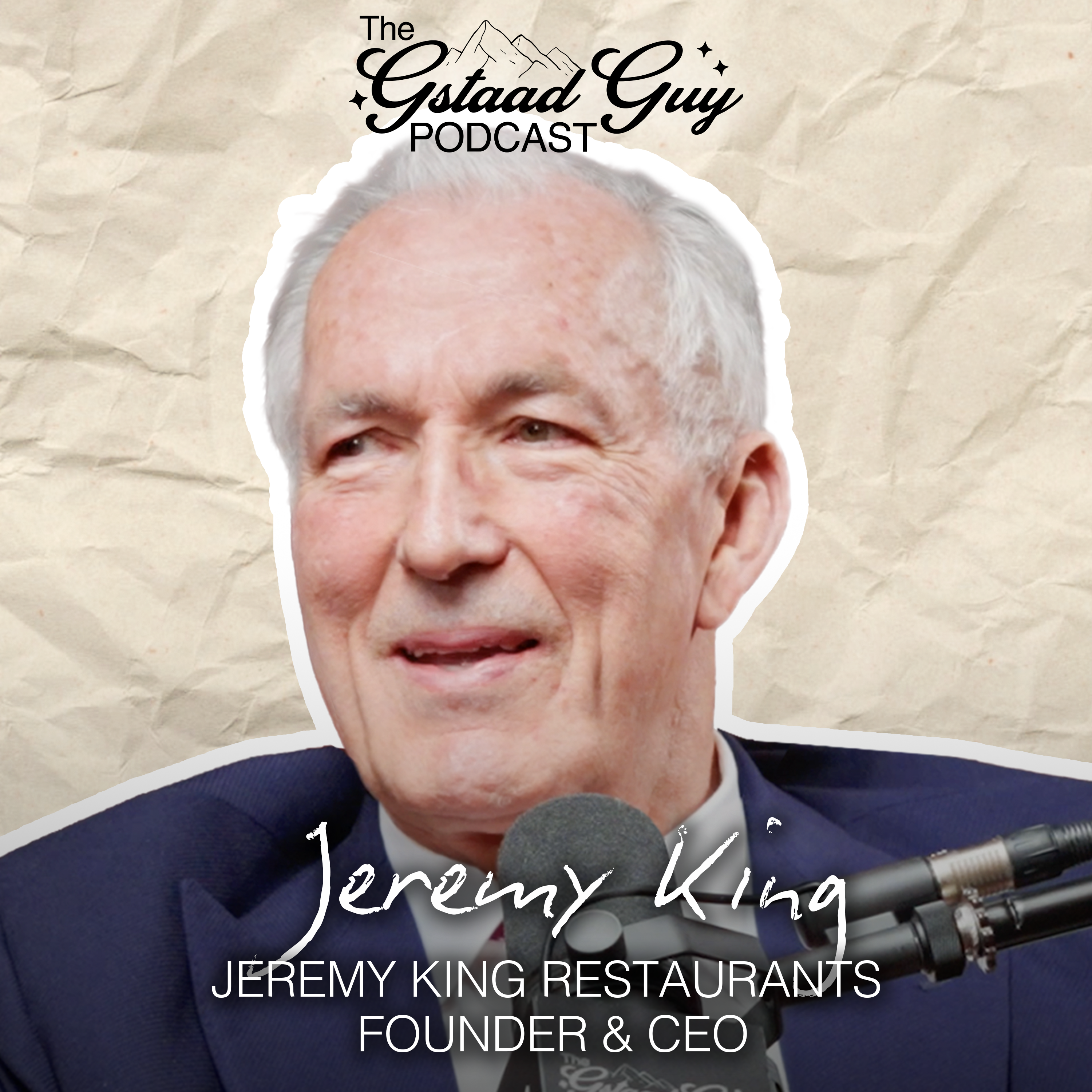
 The Gstaad Guy Podcast
4 Nov 2026 · 1h 28m

 Add vo to ChatGPT or Claude to ask about everything you hear
vo listened to this episode to put together the overview and transcript, so there may be the odd mistake.
Jeremy King, founder/CEO of Jeremy King Restaurants, discusses why people go out (to be loved/belong), the “grand café/brasserie” model, breaking UK class barriers in dining, and how design (especially acoustics and lighting) creates togetherness even for solo diners. He also explains his “location first, concept second” approach and his philosophy of doing everything “really, really well.”
Jeremy King Restaurants founder & CEO Jeremy King. Host: “Stad Guy” (podcast host).
King opened Caprice in 1981, later the Ivy (acquired after six years), then The Wolsey, Woolsey became a grand café-style restaurant; later opened The Park and Simpson’s; also ran Colbert (opened 2012) and Fishers (Marblebone). He previously worked in merchant banking and early Chelsea wine bars; mentored by Peter Langan (Langan’s Brasserie).
Successful restaurants create belonging, not just meals; class-mixing and all-day brasserie energy matter; “proof of concept” analytics can kill innovation; luxury is discreet comfort (e.g., silk underwear, shadowy lighting); leases drive homogenization; respect from guests sustains hospitality.
Colbert near Sloane Square tube; Woolsey’s “banking hall” conversion; Fishers corner-booth layout; London’s pre-1980s low restaurant frequency; bomb threats during early Caprice; “sound of success” acoustics.
0:01Jeremy King: This episode is brought to you by Google Chrome. You think you know a browser, but Gemini and Chrome? That's new. It can help you with practically anything on the web, like restoring a vintage motorcycle from a 50-page restoration block, or finally break down that long article you've had open for weeks. Gemini and Chrome is here for it. Ready to make anything online make sense? There's no place like Chrome. Check responses set up required. Compatibility and availability varies 18+. T 'was many nights before Christmas,
0:27The Gstaad Guy: and one woman knew she needed a Christmas tree, so to Wayfair she flew. Finding just the right one, and for years it will last. Wayfair shipping was free, and remarkably fast. What's this? Garland? A wreath? Essentials to host? Good thing she celebrates way longer than most. As her cart filled with magic and decor from the heart, Merry Christmas to all. Get your Wayfair head start. For holiday decor you can count on year after year, Wayfair delivers.
0:55Jeremy King: We mustn't forget that we go to restaurants not primarily to eat. We go to be loved.
1:01The Gstaad Guy: Jeremy, thank you so much for taking the time to be here today. Thank you. London today is, in my opinion, top three food cities in the world. You're a big part of that story.
1:09Jeremy King: 81 open Caprice, 90 open The Ivy, 98 Sheikis, Woolsey 2003.
1:16The Gstaad Guy: Colbert, for example, even Fishers. I could be alone and talking to no one. I really feel like I'm part of something.
1:21Jeremy King: I have a very simple philosophy. If you're going to do anything, and I mean anything, you have to do it really, really well. How do I know whether this is the right person? Just get them to take you to a good restaurant and watch how they treat the staff, because you can be sure that in five to ten years, that's how they'll be treating you.
1:38The Gstaad Guy: And I keep saying that, but honestly, this is all music to my ears.
1:40Jeremy King: I don't quite understand where dress code gets us, because at least 85 % of all the really serious problems I've had with people over the last 50 years have been caused by oiks wearing a suit and a tie.
1:53The Gstaad Guy: How do you generally feel about London Members Club culture?
1:55Jeremy King: My true feeling is that...
1:57The Gstaad Guy: Around the world with your host, the Stad Guy, we welcome you back to the Stad Guy podcast, sharing stories of excellence with those in the know for those who just know. Jeremy, thank you so much for taking the time to be here today.
2:15Jeremy King: Thank you. It's fun.
2:18The Gstaad Guy: I'm very excited for this conversation. I am first and foremost a big fan of many of your establishments. I think that your establishments, as well as you, have become ambassadors of London and the UK in many ways. I think you're an exceptional representation of British hospitality, even though some of your concepts are French, not English at all. But there's a true feeling of London when I have the pleasure of dining. with you at any of your establishments. And also congrats on your newly opened restaurant, the park as well.
2:57Jeremy King: The park, and of course, with the new, new one, which is Simpson's. But even that, although it's quintessentially British, it has the element of French. The restaurant upstairs is called Romano's, which makes it sound Italian, but actually was opened by a rather dodgy Russian further down the Strand in the late 19th century. And he had lived in Italy, in Rome, therefore he'd been known as the Roman, and therefore we made it the Romano. So it's just celebration of that.
3:35The Gstaad Guy: Well, one of your restaurants in particular is a childhood favorite of mine and my family's and my friends. we spoke about it briefly before turning the cameras on and that's Colbert for the Londoners particularly the Chelsea residents listening Colbert is an institution, it's a part of the neighborhood it is actually I think the core of the neighborhood and it is right next door to the Sloan Square tube station and there aren't many iconic restaurants that are great for date nights and great for anniversaries and great for intimate group dinners breakfasts lunches indoors and outdoors that share a wall with the tube station so something very unique happened
4:27Jeremy King: there i think you're right and i i was always fairly confident about it but it really took took me by surprise and I think in retrospect it's something you said it touches upon what makes a really successful restaurant is that that type of restaurant that's the sort of place I like to do which is kind of in the grand cafe style is that if a restaurant can act as a catalyst for what you want to make of it you made a list of different reasons that the family would would go there. And that's, you know, I'd add to it, you go to a restaurant, are you going to seduce? Are you going to fire somebody?
5:15Jeremy King: Are you going to divorce somebody? All those different reasons that people use restaurants. And they're a bit mistaken at times because, of course, they think that if they do the difficult stuff in a public restaurant, then there won't be a scene. That's not actually the case and i've seen some spectacular uh spectacular problems i mean not least on valentine's night and so on you know failed proposals and so so on and so forth um but for me that's the role and in a greater scale within within the culture because i often think of those brasseries and grand cafes across Europe, what great movement might be in the visual arts, in literature, in music, in any number of things, including revolution or politics, whatever, hasn't actually emanated from that sort of restaurant where people congregate and discuss and argue and create things.
6:23The Gstaad Guy: There's something very unique about the Grand Café, the brasserie energy of a restaurant which feels very timeless. It feels like it was always there, like it once was, like it's there tomorrow. It's a very constant feel about it.
6:40Jeremy King: I think that's right. And it was interesting because I'm effectively my third company, my third restaurant company, And in opening, one was the old Caprice, which was Arlington, which was an old favorite. And we first opened in 1981. But the park, which is up, funnily enough, by a tube station at Queensway. And that was in my mind is what would a New York Grand Cafe look like? and that's how the design and the feel and the menu etc emanated because and the really crucial thing is that if you appeal to a cross-section of the public because a lot of the most interesting people who go into a restaurant are not necessarily the most affluent and you have to have it you have to have that variation because whilst they may not be the most affluent they may be the most interesting and uh the most bring the heart and soul to a restaurant so that's what intrigues me
7:53The Gstaad Guy: that's very well said and you have at your restaurants this unique balance of commuters and people traveling literally for the dining experience but you also have this incredibly localized community of residents that also I see over and over again at some of the restaurants. And I think the French element, the French brasserie element you touched on is one that's special to that energy. Because if I think of French dining, I think the two stereotypically French dining experiences are actually quite polar. You have the very artistic expression of French dining, with the foam and the decadence involved and the iconically French fine dining.
8:43The Gstaad Guy: And on the opposite side of the spectrum, you have the equally iconic, bressery, very neighborhood style of dining with no reservations, the café trottoir of having a glass of wine or a coffee on the sidewalk and being there for hours and spending seven euros. And the two of them are iconically French and the two of them coexist uniquely in the same way that I think that Brasserie energy and that London neighborhood feel manages to coexist with your restaurants.
9:18Jeremy King: And that's why we were discussing earlier that originally the landlords wanted a Woolsey, a much, much grander place. And I want something a little bit more earthy and real. And the trouble is, when you talk about the restaurants and how French they are, the sadness is that in France, a lot of the Brasserie life has disappeared. They managed to keep it at Flore or De Magot, but a lot of it's disappeared because of the social working hours, etc. You can't get the staff, and they end up becoming restaurants. They'll open for lunch, open for dinner, but they won't be open all day. And it's the all-day scenario which actually makes all the difference.
10:05Jeremy King: And I don't – I suppose it's fair to say that I am always led by the building as opposed to a concept. Because I think a lot of the problems with restaurants these days is often people have a fixed concept and they impose it on the building. It doesn't always work. and hence when I talk about the park, I had a modern building. I didn't think I even wanted to look at it but when I went in and felt the light, etc., I thought, well, I can't, it would be easy to do a pure French pastiche, I suppose you would call it, but why not do something new? I'm much more interested challenging myself than just playing safe.
10:52The Gstaad Guy: well we got right into it talking about a few of the establishments but i'd actually love to go back in time and understand how you got into your line of work why you got into your line of work and and what actually constitutes all the different restaurant groups and brands
11:11Jeremy King: you run today i mean at risk of boring boring you so stop me if uh i do i i didn't know what I wanted to do. The one thing I did know was that as I left school, and I'd been to an interesting blue coat school, which is a charity school, but a very, very high quality one, where in fact we used to wear uniforms, long full blue coat, knee breeches, yellow stockings, silver buttons, and everything. But it taught me egalitarianism. And because people came from all walks of life, There was fallen aristocracy through to aspiring young East End boys. And I loved that. But the one thing I knew I didn't want to do was go to the university, which I was set up for.
12:04Jeremy King: I'd been a bit naughty, so I hadn't got into Cambridge or Oxford. So I was due to go north. And I thought, no, I'm not going to do that. I'm very arithmetic. I'm very logical. I'm going to go into the city, into merchant banking, and make my fortune, which was fine, except I hated it and wished I hadn't. Meanwhile, working part-time in a Chelsea wine bar, and this is the very early days of wine bars, and Chelsea, of course, being terrific, just coming at the end of the 60s, I started to enjoy that, just part-time to supplement income. And then I decided I'd apply to Cambridge, got the place, got my matriculation papers come through, and then I had a dilemma.
12:55Jeremy King: And during my time at the Merchant Bank, I had read a book called The Dice Man. And The Dice Man is a book I wouldn't recommend anybody to necessarily read, because it's It's dangerous because it's about a man who determines his life through the throw of a dice. And whilst I started off initially deciding what to eat that day, which restaurant, which cinema or whatever, I then started to make life decisions. And when I was bored in the bank, I'd even decide if I was a different character or whatever on the throw of a dice. and I was so into it that when the papers came through and I was clearly going to go to Cambridge I had to throw the dice and the only thing which is really really important with gambling is that there has to be danger and so the danger was that I put in one of the 12 options is that if you get a double six and then within a month of your 21st birthday achieve managership of this place or similar you stay in hospitality for life and it came up and then I got the managership and I eschewed the place at Cambridge which I have regretted pretty much certainly every week for the rest of my my life I think it would because I think it's enriching and uh it's not that i would have necessarily learned so much i'd have learned how to learn and um so i stayed in the in it and i i have problems but i have a very simple philosophy is that um if you're going to do any anything and i mean anything at all you have to do it really really well and I learned it as a 14 year old doing a holiday job at a school and I was given a brush and told to sweep a gym and the brush was really bad and as a 14 year old I was a bit bullshit about oh this was ridiculous and so on and so forth and then I said no I'm going to sweep this floor better than it's ever been swept before.
15:14Jeremy King: And that became, in a way, a credo for my life. So whilst I didn't know what I wanted to do, I was in hospitality. I went to career guidance, and they said that I should be an accountant because I was so arithmetical. I said, I can't do that. The only accountant I could be is a turf accountant, a bookmaker. And they went, that's brilliant. You'd be brilliant. No, no. So I just decided whatever I do, I do it really well and try and be different, not extreme, but try and be innovative, try and look at a way of doing it. And it was around that time that I fell under the spell of Lampedusa, who wrote The Leopard, and the Prince Tancredi quotation forever in the back of my mind is when he's asked by one of his retinue why Italy has to change so much and why can't it stay the same.
16:21Jeremy King: And Tancredi says, for things to remain the same, everything has to change. And that's such an interesting credo for me going forward. and that's made it fun for me how can i do it better how can i do it different uh then that led to eventually i eventually met chris corbin and um he was at langers brasserie i was at joe allen the two hot places of the time and we opened caprice in 81 and that was followed by and a lot of resistance to that people said it wasn't going to work because it was innovative It was a bit more like Odeon in New York. And so, but we persevered and made it really sing and the help of a lot of individuals, you know, a bit like the Princess of Wales.
17:17Jeremy King: And then eventually after six years of trying, acquired the Ivy. And the Ivy, I think, was probably the quintessential restaurant, particularly of the 90s. and then Sheik is. Then Chris was ill and we got a very good offer to sell and join another company, which didn't work out. I realized I'm not very good at being told what to do. And then there was the Woolsey and everybody said it wouldn't work. And it's... In ways, for a long time, it was the pinnacle. And not now, because of Simpsons.
18:06The Gstaad Guy: Why did you think the Wolsey would work?
18:08Jeremy King: I went in, and when I was offered it, I said, no, I don't want to go. It was a banking hall. And I said, I don't want to go. Banking halls make bad restaurants. And historically, empirically, that was the case. The atmosphere, the feeling. But I went and fell in love. And then I took Chris down and said, what do you think? And Chris said, well, you keep going on about the big Grand Café. Surely this is it. And I said, well, that's what I'm thinking. And I think you mentioned with France is probably the biggest compliment I've ever been paid about the Wolseers. A few months in, some very sophisticated Parisians came in, and they said, this is amazing.
18:54Jeremy King: We need somewhere like this in Paris. I said, well, hang on a second. We based it on places like yours in Paris. They said, but they're not the same. They weren't fulfilling that role. And there is something about being able to sit down at a table and have a cup of coffee next to somebody who's got a plateau to freedom there, next to somebody who's having afternoon tea. Make of it what you want. And there's a certain anarchy about those types of restaurants, which is appropriate that in mainland Europe is that that anarchy was pursued. But the restaurant business in the UK was very, very much dominated by the class structure.
19:37Jeremy King: You had working class restaurants, middle class restaurants, high class aristocratic type restaurants, and you weren't allowed to break out of your mold. And that for me, of course, became a challenge how can i how can i break the mold and to a degree the pioneers were the um mario and franco who the late 50s early 60s open uh changed italian restaurants you know when when i was young italian restaurants had chianti bottles in wicker baskets and candles on the table and a bad mural of Ischier or somewhere like Capri. And they then said no. And suddenly the terrazza would find Princess Margaret with Tony Snowden on one table.
20:30Jeremy King: And then, well, in the photographic example, there might be David Bailey and Terence Donovan sitting there. But then there might be Patrick, who are real East End boys. And then there'd be Patrick Litchfield, who was an aristocrat in his cell, that started to be fun. Breaking down the class structure was so important for England. And it was painful in its way, but it was really, really important if ever we were going to develop.
20:58The Gstaad Guy: Would you say that that class structure and dining is the main difference between England and mainland Europe?
21:04Jeremy King: I think in many ways. I mean, dining, an understanding of food is much more prevalent on mainland Europe. And it comes down, we're learning and we do restaurants really well in this country and actually have been more imaginative and inventive than let's say in Paris, where up until about 10 years ago, it was fairly moribund. and but there's a fundamental difference in the culture is that an english person or a british person might have their eyes opened to the possibility of food and you've got to remember that in 1981 when they did a survey in britain as to how often a year did people eat out in a proper restaurant, I suppose a white tablecloth restaurant effectively.
22:02Jeremy King: And the survey results came back less than once a year. That's absolutely inconceivable in Europe, in Paris or Spain or anything. And when you think about it, the metropolitan people were eating out 200 times a year, and the average was less than once. So we started to appreciate food, the class structure, We could go there. The restaurants became more brasserie-like, and New York was very, very influential. But the fundamental thing is that if we want to cook at home, we get a cookbook and look for a recipe, whereas if French or Italian or Spanish want to cook dinner, they'll go to the market and see what's for sale, and then they'll create the dinner.
22:54Jeremy King: So we didn't have it in the culture. We're better now, and we've caught up. And of course, France sadly has fallen into the arms of McDonald's.
23:04The Gstaad Guy: You have a very clear way of framing things, which makes a lot of sense.
23:07Jeremy King: Oh, thank you.
23:08The Gstaad Guy: You do. So I know that you, when conceptualizing the restaurants and the establishments, you are location first, concept second. at what point in that process is the archetype of the diner coming into your mind the archetype
23:27Jeremy King: of the diner i think for restaurants to be successful you well you have two two sets of people driving it there's restaurateurs and there's restaurant owners the restaurant owners and people say what's the difference well a restaurateur does it from the floor and a restaurant owner does it from the boardroom and they might be more akin to let's say if i quote the film moneyball whereby everything is done analytically and statistically and so on and see what's selling and that's why you get a lot of restaurants and hotels are very homogenized because everybody's copying everybody the other side of it the way to open a restaurant is first of all to conceive something that you would like to go to yourself and it's and just hope that enough other people feel the same and something i lament about modern life is everything seems to be about proof of concept statistical justification and all that sort of thing if you if if we applied that to what you do and what you've created you wouldn't have you wouldn't have got there anywhere near because it's you innovated within a genre but you in totally innovated.
24:59Jeremy King: And so for me, my core customer profile is me. And then it might be more of my friends or what we do. And I just have to believe. And it's the same with the buildings. I walk into a building and go, yes. Can we identify why I say yes? Not so much. In the same way as that, how many people walk into an apartment or a house and in the hallway they know that that's the house for them or the apartment for them? You feel it. And you can't explain it. You can't rationalize it. But you just know this is good. This is me. And I'm hoping that more and more people break free of the shackles of precedent and actually do what they believe in.
25:58The Gstaad Guy: Can you tell me more about you as a diner?
26:00Jeremy King: Me as a diner? I actually, as a diner, I'm not particularly useful because I'm an observer. Okay. I love watching. I can be very, very content in a place entirely by myself. I probably as a prop will have a book with me, but I like to watch and feel. And it's, for me, actually single diners, I always admire single diners. And of course, single diners think, particularly if they've been stood up, that there's almost shame in the fact that they're eating by themselves. It's one of the most glorious, glorious things. And of course, whilst the diner thinks, oh, everybody thinks I'm Johnny No Friends, actually the rest of the diners are saying that's so cool and so interesting.
26:53Jeremy King: So something I'm most proud of is that I managed to create a following which crosses three different generations. I get as much support from six-year-olds as I get from 60-year-olds, and that makes me very, very happy. It's appealing to people. But I will not pander because I think it goes wrong. You have to have confidence in what you do. And one of the things, I mean, I write a lot of stories. If I've chosen a restaurant, I then think, what is this restaurant? And if it's not immediately obvious, say, like the Woolsey was, I often write a story around the people who opened the restaurant and what it would mean.
27:42Jeremy King: I believe that in life, whatever we're doing, you should be able to sum it up in one sentence, maybe with a comma, and then you keep to that. So there's clarity in what it is. When I opened Fishers in Marlebone, and my backers at the time were miserable, and they were saying this is crazy and they came along to the pre-opening with it with their friends as a private equity group and they're saying this is ridiculous nobody can open a restaurant in malibone without a caesar salad and a hamburger and i said let's just see let's just see and i was most proud of that because it was very focused and i think if people if people sense that we as restaurateurs don't know what we're really doing, then how can they buy into it?
28:46Jeremy King: And it's a whole new world, the world of authority, that people trust you, believe in you, follow you, look for the good rather than the bad. It's an interesting world.
28:59The Gstaad Guy: It shows us the best schnitzel in London.
29:02Jeremy King: Thank you. I mean, I haven't been back, of course, since 2022 when it went, but I loved that restaurant. But there's a lot in there. I felt the space and I thought when I'm in Central Europe, maybe Vienna or whatever it might be, I just want that sort of restaurant where you walk into and it glows. and there's that chatter and hubbub. And it's a local restaurant, but it has a sophisticated, more than local appeal. In many ways, you could say Lip in Paris was that originally. It's now become something else. And if you look at Fishers, it has an inordinate number of corner tables and booths. And what happens with restaurateurs is that when you lay out the seating, in order to maximize the seating, you have to have lines of tables in a row, people sitting opposite.
30:14Jeremy King: It's not conducive. It's not private. It's not sexy. It's none of those things. But if you do the way I like to do it is corner table, table opposite, corner table. You only get three tables out of a space rather than four, but you get better quality tables. And Fisher's, I think, if I remember right, has 17 corners or booths. And that's how people like to eat. It's how I like to eat. That's how people want to eat. We don't want to sit in a line of twos sitting opposite.
30:49The Gstaad Guy: You know, when I walk into a historic-looking restaurant like Fisher's that does feel like this constant, that's timeless that i was talking about i'd never think that the number of corners was an
31:02Jeremy King: intention i think it's just a consequence absolutely is well and the whole thing about design and what i to a degree lament is that everybody feels they have to get more showy and capture attention. Whereas my design ethic is great design should never shout for attention, but should withstand scrutiny. And whether it's the suit you wear or the decor you put up, you want people to walk into a restaurant and say, this feels good. but you don't know why unless you stop and say why does this feel feel good but most people don't won't bother to do that that's that's where it's successful and it's the same with so many other aspects of um of design whether it's the clothes we wear or whatever that um is the way it's where you wear it whether it suits whether the person feels or looks comfortable in it very well said
32:10The Gstaad Guy: I love that. So it's a, it's a reoccurring theme. I like to unpack on this podcast. So I'm glad you brought it up. There's a certain feeling I get at your restaurants, which is a unique feeling of togetherness, even if alone. I know you touched on this solo dining feeling, and I am often a solo diner at lunch, rarely at dinner. And I've been a solo diner in cities like Tokyo where you actually feel very much alone and even with friends you kind of feel alone by design particularly in ramen restaurants or sushi counters it's a very solitary experience while at Colbert for example even Fishers I could be alone and talking to no one except for my server I really feel like I'm part of something could be the acoustics could be the room I think the general energy possibly, but after hearing you talk about the design, it sounds like that's actually something that's been engineered.
33:14Jeremy King: Very much so. And acoustics is really important, as you say. In general terms, within the UK, particularly London restaurant world, the challenge we have at the moment is that We've changed the way leases are written. And just about all of my leases over the years have been 25-year leases and what they call within the act, which gives you protection. So there's a high probability that you will get renewed at the end of the 25 years. What that means is you're prepared to invest. In New York, they always had 10-year leases with no security of tenure. and that's been adopted more here so what a restaurateur is then faced with the fact that i may be out of here in 10 years or they may be buying an eight-year lease or or whatever so they tend to get a lot homogenized um because people can't afford or justify to spend the money that you would want so the fittings the all those all those elements are redacted right or reduced right back.
34:31Jeremy King: So I'm particularly attracted to restaurants where I can build for the future. And there's so many elements because in a lot of modern restaurants, you've got poured concrete floor, painted walls, open ceilings, kitchen within. The acoustics are really, really terrible. And acoustics are as important an element of any way. You want that hubbub. I think Adrian Gill used to call it that, the sound of success. And you know it immediately, you walk in. We're much more sophisticated in a digital way of our brains than we use it, tend to be more analog, I suppose, you would say. We try to analyze it rather than feel it.
35:23Jeremy King: and so the restaurants i like people to belong um it was interesting when we we'd sold the ivy and to a guy called luke johnson and his company and then it was sold on again to richard caring and it was announced that the ivy was going to open a club and some wag said sorry i don't understand that i always thought the ivy was a club and that's kind of what you're alluding to is a sense of belonging and the way that manifests is that people will say to me why don't you put up a sign to show where the loos are
36:08The Gstaad Guy: that's because you only ask once and then the next time you come in and you know where it is
36:14Jeremy King: when you get up to go through you are confident your sense of belonging or if your guest says do you know where they are you can point it out and there are various rungs of a ladder of belonging to a restaurant and of course next step up would be being recognized when you walk through the door and then the next step up is the waiter comes to the table if the restaurant's doing the right job and you're feeling good because you're explaining to your guest all the dishes and they're famous for their fish cake, but personally I always have or whatever. This is why really successful restaurants work very well because the regular customers do a lot of the waiter's work for them and that's that sense of belonging.
37:00Jeremy King: And then when they order and they say, hmm, you might have some white wine, and the waiter says, would you like to try that, I don't know, Picpou de Pinay again. How good does that feel? And I think we all, we mustn't forget that we go to restaurants not primarily to eat. It's an important aspect of it. But we go to be loved. We go to be heard. We go to belong. We go to feel part of something. and who of us doesn't want to be loved more? And somebody recognizing us, understanding us, remembering us, there's no better feeling.
37:45The Gstaad Guy: I could not agree more. I am very grateful to dine out actually for most of my meals. And there's one meal in particular that I find quite difficult to enjoy out and that's breakfast. Really? I love breakfast. Yeah. I think you do breakfast incredibly well, which is quite rare, especially if you're not going for, in London, a typical full English, and you actually want to do something a little more tailored. Unless you're going to a hotel, it's quite rare, actually. Yeah.
38:18Jeremy King: And it's the unquestionably the hardest service in hospitality. It's really difficult. And that's why so often people, particularly hotels, throw in the towel and just go for a buffet. They just, because a la carte breakfast offer is actually very special. And I remember when we did a book, Breakfast at the Wolsey, with Adrian Gill, he wrote about it so eloquently, about breakfast being the beginning of the day and what is the ramifications of it and how we feel. I adore breakfast. I, for me to sit by myself for breakfast almost trumps everything.
39:06The Gstaad Guy: It really is very special. I think something else that's quite unique to London and interior design in London is this unique controlled chaos where lots of members clubs, lots of iconic restaurants, you can't really understand what's happening on the walls. there's the frames are all misaligned all in different sizes each room looks quite different as you alluded to the chairs are different here tablecloths are different there what's that all
39:38Jeremy King: about it's sometimes too studded isn't it um i i'm much more interested in an evolution and uh I once stood outside La Coupole and I was looking at it. Why does it feel so good? Why does it feel as though it's oozing history and all those things? The same way I've looked when I was doing a hotel, I was looking at brochures. I said, why do brochures look so atmospheric of a particular era? Now, the brochures thing was really interesting and I started to copy it, is that for a lot of people in the 30s, for instance, or even into the 40s, there was a dearth of hot type. And so if you were setting, you set a wordy page, you might, on one typeface, you might run out of Es or Es, so you then move on to another typeface to take the narrative forward.
40:44Jeremy King: And a clever printer would be able to create a really interesting, but you wouldn't necessarily know that. And I think the skill within restaurants is, for instance, glassware. The problem with glassware is that if you have two fine, or maybe a ground glass rim, it's going to chip. You're going to go through too many glasses. So you're trying to get as fine a rim as you can without it chipping. Minuscule amount of roll on the top, as opposed to the old Paris goblets, which you can still use 10 years later because they're indestructible. now having found that glass with the and there's no question that drinking wine from a fine glass rather rather than a paris goblet makes a big difference you don't say anything about it and people just feel it's good the same way with cutlery is that um you can if you're not using silver you can buy stainless steel 18-8 cutlery and it feels balanced in your in your hands nobody actually sits there going oh this feels balanced but they're subliminally of feeling it you can get an identical shape of cutlery in a 14-4 much cheaper but when you pick it up it doesn't feel right and that's is about luxury and i often get asked what's your definition of luxury and for a while i used to say slightly glibly um in the face of that most people think luxury is having big cars and boats and bling and watches and so on that's not i said no true luxury is silk underwear because you know you're wearing it you feel you're wearing it but technically virtually nobody else knows you're you're where you're wearing it but it it feels good it's discreet it's not shouting it's not it doesn't have any of that that grand eloquent status attracting it.
43:12Jeremy King: And that's the way I like to go. And I mean, at Simpsons, I've spent a vast amount of money on doing it up. And people are walking through the door and saying, oh, good, you haven't changed a thing. I'm happy about that. That's very good. I don't need them to think I've changed. It was one of the sadnesses about on the continent, both in France and Italy, is that when people started converting, it might be wine chateaus or restaurants, they would over-modernize, and suddenly the interior was at odds with the exterior and so on. And you've got a lot of very strange, bad lighting, because after all, the environment in a restaurant, the single most important thing by far is the lighting.
44:05Jeremy King: And lighting is about good lighting. I was taught by Peter Langan, the eponymous Langans-Brasbury head, who sadly died. He was a great mentor for me, not a role model, because he was completely debauched. But he said great lighting is about shadow, and he was so right. And it's getting all these little things, but not saying, look at me, look at me. And that's about luxury. And I mean, off on a tangent somewhat, when I was doing the hotel, I was thinking, what are people looking for a hotel nowadays? Because most of them are very homogenized. And I went to Norman Foster, Lord Foster, and I said, you spent quite a long time staying at the Berkeley.
45:02Jeremy King: why? Why did you go there? He said, because it just happened. I said, how do you mean it just happened? He said, we're fairly picky and specific about what we need, his wife and Elena and him. And when we went to the Berkeley the first time, we'd specified what needed to be in the fridge, what sort of flowers, and all these different things. And we were taken to a room, and nobody said, and here is your special this or so on. It just happened. And every time he went there, they would walk into a room, and it just happened. That's true luxury. I agree.
45:46The Gstaad Guy: I think that assumption and cocooning feeling, the ability to make the least amount of decisions possible. Just have those decisions be assumed is a really true luxury.
45:58Jeremy King: Because we have this innate desire to feel safe. We are animal at heart. Let's feel safe. Let's not feel challenged. Let's not feel discombobulated. Great English word.
46:13The Gstaad Guy: Let's feel cared for by the establishment. It's quite Freudian.
46:18Jeremy King: Yeah, I think that's true.
46:20The Gstaad Guy: This podcast is brought to you by Poubelle, bringing you interchangeable charm jewelry hand-painted with enamel on styling silver, allowing you to celebrate all the things you love and all the things you might question through interchangeable styling silver bracelets, bangles, whoop, charms, mini-charm, bracelets, rings, cufflings, and much more. And all customizable through our 3D builder on poubelle.com. That is poubelle, P-O-U-B-E-L dot com. Thank you so much for watching. And now back to the podcast. I think London today is, in my opinion, top three food cities in the world. Yeah. You're a big part of that story.
47:06Thank you.
47:07Jeremy King: Yeah, I think it is. There used to be a time when people would say, if you had to eat in one city for a week or a month where would it be and there was a time i used to say paris um for well i'd say paris for longer periods and and and london i'd say yeah a week or or two weeks but now it's it's gone the other way around i think You can very, very happily eat in London for weeks and weeks on end in different restaurants and still be really impressed.
47:47The Gstaad Guy: What would you say has been the evolution of London since your first concept in the 80s until today? What are all the eras we've gone through?
47:58Jeremy King: It's very interesting in terms of real eras. rather than answering it in generalities, I think we've experienced probably after the 60s, which was to my mind the really big social change. It was then to the 80s and we had the financial change. and when you look back at how everything got deregulated the big bang with with the markets thatcherism self-ownership suddenly just in the same way in russia but of course on a much grander scale and that was abused and and misused i think it the the big period of change was was the 80s and having lived through it all i mean it's interesting because at the moment everybody's saying how difficult it is to be a restaurateur i was interviewed by the times recently and i didn't play ball because they were they were saying um brexit covid rising costs utilities
49:22Jeremy King: wages even a zempick they're all that have made this the hardest time ever to be a restaurateur is this is this the the really awful time and i get this uh this question asked me a lot because i'm one of the oldest people who's is still uh operating i said no no absolutely not and i then talked to them about the fact in the 70s people were throwing bombs through restaurant windows or when we we used restaurants all had metal metal um frameworks up to stop people throwing bombs and then they started hanging bombs onto the onto the the grills and and um in i mean the first year when we opened Capri, so I got a phone call and the receptionist came to me white-faced, I've just had this call and it was an Irish accent and they're saying you've got to get out of there, a bomb's going to go off at eight o 'clock and I remember having to make the decision not to vacate the restaurant and police were there and they said we can't tell you because it was probably be a hoax and sure enough the bomb didn't go off but that was quite a feeling and scott's restaurant was bombed twice they machine gunned um the churchill hotel but we all forget that but that for me was the worst time i think the resilience of us all and the brits actually are much better when challenged because the british have a a prevailing predilection is to moan and moaning is very negative british moan um complaining is fine and there was a great piece for the new yorker written by john lanchester who's a very good very good british writer and And he explained the difference between moaning and complaining.
51:26Jeremy King: And moaning is negative, and complaining is positive in truth, because there is a differentiation. But where the Brits are at their best is in adversity. And if we give us a real challenge, then we'll rise to it. Otherwise, we'll sit back and mope.
51:46The Gstaad Guy: Well, I know this might be a tough question for you as the understated man that you are, but I was wondering if you could help me list all the establishments that you've worked on over the years.
51:59Jeremy King: Myself?
52:00The Gstaad Guy: Yeah.
52:03Jeremy King: Funnily enough, I may be reasonably good at this because I did put it down in writing in a book. And so the first serious restaurant for me was 76, but as a manager 81 open caprice 90 open the ivy 98 chic is sold the business wolsey 2003 2000 and i think six or seven opened a place calledst alban which no longer exists because we sold it we got a good offer it wasn't going terribly well it was i learned a lot through that because it was a bit of, I always call it a bit of a committee restaurant. It was too much input. I think great restaurateurs are benign dictators. And this, it was, you know what they say about committees is that, it's a lovely saying, a camel is a horse designed by a committee.
53:13Jeremy King: And actually when you think it through, it's actually very true. It will work, it will get you there it'll be cheaper and so on but it's not what what you want anyway so sost alban then delaney 2011 rasry zadel i was very proud of that 2000 and june 12 2012 and that was quite groundbreaking and because opulence affordable opulence i would call that uh then at the end of 2012 Colbert. And then we went on to, there was Fishers. There was Belanger in Islington. There was Soutine in St. John's Wood. I think that's all under that guise. And then now back to Caprice, but it's called Arlington now because I wasn't allowed to use the old name.
54:16Jeremy King: The park. which is a big restaurant, and now, earlier this year, Simpsons. Wow. I did also have a foray into New York and opened, with Graydon Carter and Jeff Klein, the Monkey Bar. Yeah. But I came out of that after about a year because the interaction between the three of us was not great. I mean, both of them are now very, very good friends, but it was important to get away.
54:48The Gstaad Guy: What do you think it takes to be a good business partner versus just being a good friend? I think one of the fundamentals is that if you're going to be a good partnership,
55:03Jeremy King: it's unlikely you're going to agree with each other all the time. And disagreement becomes competitive.
55:14Jeremy King: so if in a good partnership if you disagree disagree with somebody it mustn't be because you think you know better or anything is that the i always say if you explore the virtues of the other person's argument before you think of the negatives or the downside of it And if you look for the virtue and say, I trust this person, they're not disagreeing with me because they think they're better or just arguing for the sake of it. And then you'll often end up with a, and I wouldn't use the word even compromise, an agreement which is better than either of your opinions. but it takes a certain amount of generosity and love to make a partnership work.
56:10The Gstaad Guy: What about a partnership at home? I know that you are married.
56:15Jeremy King: I'm married, so second time. I think in relationships, which then transfers over into business relationships as well, I often think in a relationship we're attracted to people, either because we're incredibly similar, but more often because we're different. And the genesis of that relationship might be that we might be very reticent, shy, introverted, and we meet somebody who's the opposite. And we think that's wonderful. and we go to a dinner party with our new partner and everybody says, oh, they're marvelous, they're wonderful because they're electrifying the room. And it might be that when we say, let's meet for the opera or whatever and we say, meet you on the steps at 7.15, let's say, or 10 past 7, and you're there early and they're tripping up the steps at 7.27 and that's really exciting because all that anticipation of seeing them and then they arrive and it's exciting and if we are neat and tidy and the first time we're together they're throwing their clothes off these are all things you think I couldn't do that and you end up within a couple of effectively saying, you complete me, and you want to be with that person, you get married.
58:04Jeremy King: And if you're not careful, those things which attracted you to the person in the first place become really irritating. And, sorry, you know, we said 7.10, 7.15, it's now 7.25, why are you so late? or do you have to be quite so loud? I'm not talking literally about my wife, but in relationships, we try and change that person and they're no good at being us. So for me in a relationship, celebrate why you were attracted to the person in the first place. Never forget that. Within the business, Steve Jobs talked about it when he said the big tragedy is that you have big companies and then you have small, innovative, groundbreaking disruptors coming along and everybody goes, wow, that's amazing.
59:00Jeremy King: They're the future. And so you buy into them or you even acquire them and say, you know, this takes well. And then Steve Jobs would say is then having done that, you then start telling them what to do. And that ruins the relationship. it's giving people giving each other the space and the confidence to thrive as opposed to be
59:23The Gstaad Guy: cowed by the other person a lot of similarities i guess in all ways of being which actually was your first thought when we started this podcast you kind of alluded to how you do anything is how you do everything when you were sweeping the floor yeah and how you treat your business partners should share a similar level of respect as how you treat the family.
59:46Jeremy King: And I think that's right. And remembering that enough is never enough. You have to do much more. and that makes the difference because we compromise it if we compromise on our or on our integrity uh then it's it's very difficult as a story i'll always remember is when we were refurbishing the ivy and we'd run out of money and there was all those lovely harlequin leaded windows and i admittedly this is 35 years ago but i allowed two and a half thousand to refurbish the windows and we'd done about 40 percent and i think had spent 27 000 so we're running out of money really quickly and lamenting this to the architect a wonderful lady called mj long and she said well um you could save quite a lot of money because you've got a lot of site-specific um art to hang big pieces by joe tilson alan jones um howard hodgkin or people like so you've also got a lot of very expensive american oak so if we don't panel behind all these big pictures nobody will ever know i said but i'll know and that will undermine my love of of the building he said well nobody will know i said well they might do if there's damage for me the ignity of taking a piece of work down and there to be a sort of plastered behind it it means i'm not authentic and we must all strive to be authentic and it doesn't matter if nobody sees it.
1:01:50Jeremy King: We know. And that's the only way to be authentic.
1:01:53The Gstaad Guy: Really beautifully said, and I think very fitting to the room we're sitting in today, because we were at Oudmach Piggy's AP House in London. And the watchmakers of Oudmach Piggy are known to treat every minuscule gear within the watch as if it were a masterpiece. And And those are things no one will literally ever see. No customer's ever taking the watch apart. And all I can see is the face and the back of the watch. And I'll never see what's happening on the inside. But I know it's all.
1:02:27Jeremy King: We never understand it even. We won't even understand it.
1:02:30The Gstaad Guy: I don't actually even know what's going on. But I know it's there and I trust that it's there.
1:02:35Jeremy King: And that goes back to what I was saying about authority, is we trust. And if somebody said, this is the way forward, you'd trust them. No, I think it's a wonderful analogy. And when you find that it's a facade, the intense disappointment, the sense of betrayal is manifest.
1:03:00The Gstaad Guy: Unfortunately, I feel like there are more and more facades, and there's more and more status polluting the substance that still exists. I think it's up to the consumers to dig for that substance and decipher the profound among the profane.
1:03:18Jeremy King: Yeah. And I think you're absolutely right. To my mind, there is a growing narcissism throughout the world. And a narcissist allows you to believe things which aren't actually true. And they think that's self-aggrandizing, but actually it's detrimental in the long run.
1:03:35The Gstaad Guy: Very, very well said. Well, we've discussed what it takes to be a good partner, a good family member. One in particular that I think the audience would love to hear is what it takes to be a good client at a restaurant, a good diner.
1:03:49Jeremy King: The primary thing is respect. And if we go into a restaurant regularly, we want to be loved, and we want the staff to feel your respect. And a lot of the greatest people that I've been around, whether it's Paul Smith or Lucian Freud or whoever it might be, they have respected other people. They don't see position or class or wealth or anything of that. when it comes to the practical things about going to a restaurant is that respect continues, is that from the moment you walk in, people will feel the respect. And there's any number of things which people get wrong around demanding different tables or not fulfilling deals whereby I can get you in if you don't mind letting me have the table back and so on and so forth.
1:04:58Jeremy King: There's any number of that, but there's also really, really practical things. And if I, you were saying for your listeners, if I was to give somebody the best advice, it's seating at a table. and what I mean by that is that if you've been given let's say a really good table in the corner for four the automatic thing for the host to do is to give the guests the best seats looking out and they sit with their back to the restaurant that's a disaster because the waiter can't wait to waitress can't talk to you with their eyes so when they finish a bottle of water or wine or whatever it might be, they can't catch your eye and for you to nod and to go on.
1:05:50Jeremy King: And it gets more and more and more. Then a fundamental conspiracy against having a good time when it comes to seating is that, let's say you're taking out or you're being taken out by a couple. What will they do? They're on a square table or a round table. They'll put you in the middle. and then you'll spend your time turning your head backwards and forwards to talk to them. You should always have a situation that the single diner is on the wing, so to speak, of the three, because then you can talk to them both with their eyes. If you're two couples on a banquette, on a booth, the couples should sit together because you're not really wanting to talk to each other, but the people you talk to are the ones opposite, and you can cover them both with the eyes.
1:06:50Jeremy King: Because one of the people opposite, you don't know so well or you may not have as much to say to them, but you don't exclude them because you capture them with your eyes. and it's amazing how many of these these elements um conspire against the enjoyment of a meal and then people don't really understand why they haven't enjoyed it just it creates a problem and of course the the restaurant will will conspire um if you go to a restaurant if the music is too loud the service is over attentive the any number of things which means that the restaurant becomes more important than being a catalyst and that that's what what you're looking for um but i come back to that thing is that if that person serving you feels that you respect them.
1:07:53Jeremy King: And let's face it, we're all equal, so why shouldn't they have respect? Then you'll have a much more enhanced time. Anthony Bourdain used to talk about the fact that if you go to a restaurant and treat your server anything other than total respect, you're no friend of mine, I can't ever eat with you because it really is. And I used to say to my kids, particularly my daughters, I remember them saying they had a new boyfriend, and they'd say, how do I know whether this is the right person? I said, well, just get them to take you to a good restaurant and watch how they treat the staff because you can be sure that in five to ten years that's how they'll be treating you.
1:08:51Jeremy King: and I think it's prevalent. There's a wonderful story which I learned from Ruthie Rogers from River Cafe when I was sitting with her for tea, and a waiter came to the table, took our order, and we had her granddaughter at the table quite young, and as the waiter went away, she turned to Ruthie and said, a color brown, let's say, and Ruthie said great and I said what's this about and she said oh she's been taught this young Ruby had been taught that she's not allowed to be served by somebody unless she can tell us afterwards the color of their eyes because Pete if you look people in the eye whoever it is you are showing respect and that is the bedrock I love all of that truly truly I find that really
1:09:54The Gstaad Guy: meaningful we had a guest on the podcast called Sabina Belli who is the CEO of an Italian jewelry brand called pomelato and we spoke at length about manners particularly respect when dining out and I recently posted something valuing manners and respect on my Instagram page and some people were commenting that manners actually take some degree of privilege to use people need to be taught the manners and what sabina said on the podcast is that there's actually a clear difference between manners and respect where manners can actually be taught and can be performative but respect actually comes from the heart that's a nice nice way of putting it and it can actually fully transcend language and i think manners can be physical but they often require some degree of education some degree of language but respect i can be in a country completely foreign to me and feel respected and feel welcome even if the semantics are completely different or may even be perceived as rude where i'm from but i can feel that it's coming from their heart.
1:11:08The Gstaad Guy: And I think that's the most important part. The eye contact you mentioned, that authenticity and interaction of leading with the heart versus maybe doing something unique with the cutlery or doing something unique with the napkin. I think that goes the furthest.
1:11:26Jeremy King: Yeah, I think that that's absolutely, absolutely true. And it happens time and time again. And the trouble with restaurant staff is that they forget that the customer is not deaf or dumb, and they talk about the customers in earshot, and it can get really, really extreme and quite disgusting at times, so you cannot even talk about a customer, because if you say they're a really nice person, it begs you to say they're horrible. There's somebody I happen to know sitting at a table, and they got stood up and they were sort of apprehensively carrying on and they were garnering disdain because, you know, there's only one, that's half the revenue, et cetera.
1:12:23Jeremy King: And in the end, I got up and went and cleared the other place from the table so it didn't make it look as though somebody hadn't turned up. It made them look as though that they were eating by themselves, and there's no better thing. Nubar Gilbenkian, who was the great Persian philanthropist from years ago, he always said, the best dining companion is a good head waiter, which I always rather admired. And this lack of respect is fundamental. But manners versus respect is also good. I think manners and behavior are so much more important. At the moment, I'm getting quite a lot of people talking about dress code.
1:13:16The Gstaad Guy: Especially in London.
1:13:18Jeremy King: Oh, yes. And The Simpsons, because there's a certain amount of the old-timers and saying, I had an experience the other evening where there's a man who I'd known, he was quite elderly and I'd known him over the years and he saw me there and he said, Jeremy, you've really got to draw a line. And I said, what about? He said, well, is the man just walked in wearing jeans and sneakers? I said, yeah, so? He said, well, you've got to draw a line. I said, well, what do you mean, dress code? And he said, well, yes. I said, oh, funnily enough, I was talking to a couple of Americans last night, very, very elegant.
1:14:01Jeremy King: And they were saying exactly the same. And he said, there you go. And I said, so we should do the dress code like they say. He said, yes. I said, fine, get out. He said, what? I said, get out. Because their idea of a dress code is that if you're not wearing a tie, you shouldn't be allowed in, and you're not wearing a tie. So the suit's not enough. And the problem being is that I don't quite understand where dress code gets us, because at least 85 % of all the really serious problems I've had with people over the last 50 years have been caused by oiks wearing a suit and a tie. So I don't get it.
1:14:43Jeremy King: I'm much more interested in the behavior code. And I have a visceral reaction, an intolerance of bullies, for instance. And of course, the average bully is actually really insecure, but I don't care they're not taking it out on my staff that that's their problem i i sometimes say to customers are you making your issues my problem and um because that's for me is absolutely fundamental
1:15:13The Gstaad Guy: very well said and i keep saying that but honestly this is all music to my ears how do you generally feel about london members club culture my true feeling is that
1:15:26Jeremy King: whilst Robin Burley does a brilliant job with 5 Hartford Street and indeed Oswald's for me true club culture is members clubs and all the clubs which are springing up at the moment are proprietary clubs they're run by people to derive income and profit whereas true members clubs are run by the members for the members for a sense of of community and they come about for different ways somewhere like the garrick emanated from the world of theater but then it gets it got supplemented particularly when it was having financial problems with um lawyers who to a degree are actors anyway and a lot of a lot of the great clubs are truly members clubs and that's why they're often more affordable and so on and so forth.
1:16:34Jeremy King: A lot of the clubs, and there are some very, very well executed proprietary clubs, are playing into people's insecurity about belonging, exclusivity, and so on. And I've never, I nearly did a club actually where I found an amazing building up Clerkenwell Way, and I said the only way we can do this, it was a terrific building, is if we make it a club because otherwise we're going to attract a lot of the rowdy, city boys. But the membership I was going to do was based on how often you'd been to a club, to one of my restaurants. So you've kind of proven yourself. And interestingly, at Simpsons, we've got this bar, which is aimed at the theater crowd with a 3am license, which I'm not utilizing yet because the fear of attracting people and in a rather nice about turn there will be a residence at simpsons from my daughter and my daughter and a business partner partner opened a bar in new york called peoples which which has become incredibly successful and sought out and their model is invitation only there's no actual membership fee but unless you're on the list or you apply to be on the list, then you can't get in unless you maybe if you turn up on the door and the doorman might let you in.
1:18:13Jeremy King: So it feels more of a club than many of the proprietary clubs do, because it's a common purpose. And they, again, with that notion of you define what your business is, who you're trying to attract in one sentence, they've pulled that off. And so that I will, they will come take up a residency and with all that sort of New York feeling and verve, and there's plenty of followers in London. And then I'll go forward from there using their model, which is very neat that I'm
1:18:50The Gstaad Guy: copying my daughter that is very neat i think the model of a members club being a consequence rather than an intention and a reward for good behavior is is a great thing the invitation basically is that that's you've been a great member of our community so here's a community of other great members yeah versus just pay to play which i'm not a fan of but the problem is everybody wants
1:19:18Jeremy King: to monetize nowadays and within the club the proprietary club structure the main source of income is through the dues um and that's not the way to that's not the way to do it some people as i say robin burley pulls it off and and other people to to varying degrees whether sharon pazrica with uh with estelle manor and so on but those are the the very best clubs are actually members club i like sharon a lot yeah that's good yeah on this podcast we always play a game
1:19:52The Gstaad Guy: of a la poubelle versus fantastique which in french a la poubelle is to the trash things we'd like to change fantastique or a couple of things that we'd like to celebrate and see more of i know you've already listed a few off during this whole episode but if there are a couple of things you could share that you'd love to get rid of and change about your industry and a couple you'd love to celebrate and see more of. That'd be great.
1:20:18Jeremy King: My starting point is that I teach the staff is that if you look at somebody walking through the door of a restaurant as a source of income, you're finite. You are likely to fail. If you treat them as an opportunity and the opportunity is to give somebody a good time, then if you achieve that, then you'll make money. And, therefore, it's a strange thing to say, fantastique is counterintuitive for most people, which is altruism. To do unto somebody something without any expectation of reward or recognition. and I think if there was more of that within society generally, we'd be very much happier.
1:21:18Jeremy King: And I talked earlier on that I want in La Pubelle, I want to put the word enough. I think that creates an issue for everybody and there's standards going down. Trust is something which I don't see enough of and one of the great problems in the industry is that we want conformity, we want systems, particularly if all the company is getting bigger and bigger. An incidental that I'd like to put into La Pubelle is the big groups and the reason being is the big groups which conspire against restaurateurs, it's because they control the rents, the locations, everything about it. And we're getting to the point where artistry, imagination, intuition, etc.
1:22:22Jeremy King: are qualities which we can't afford. And I absolutely hate that. We need staff who actually... So fantastique is anybody who is training the staff, treating them as if they're creating a career. It's a different culture as opposed to a transactional society. And interestingly, commercially I am transactional, of course, but into La Poubel would go transaction society.
1:22:58Jeremy King: and that leads to harmony and understanding and conviviality and all these different elements which make up a wonderful experience. And as we walked in here and this amazing new building, the desire behind and the motivation is to create a more experience-led, environment as opposed to purely a transactional. So I haven't answered the question particularly well, but would that be?
1:23:37The Gstaad Guy: You've answered it exceptionally well. Oh, thank you. That's great. And to conclude, lots of our listeners are in their early 20s. I think probably some of the most confusing years for many. Very much so. Would you happen to have a message you can share with them, maybe particularly to those who are hospitality curious?
1:23:59Jeremy King: Well, the hospitality people, if they're going into proprietorship, always keep control. It's a simple, simple, even if you start very, very small, always aim to be in control because otherwise it'll be miserable. my life lesson and it's a very very simple one and i'll tell it by way of a story is that my eldest daughter came to me as she was about to graduate she went to georgetown worked in the restaurants and the holidays she came to me and said dad you know i'm graduating i say yes i know um i'm working in the restaurants been great and i've really enjoyed it. And actually, I'm told that I've done pretty well.
1:24:47Jeremy King: I said, you've done remarkably well. She said, then maybe I'm thinking perhaps I should come into the family business. What do you think? And I said, absolutely not. And she said, well, it's a bit harsh. Why do you say that? I said, because you use the word should. And everything I regret in my life pretty much has been something I did because I felt I should. You never regret the wants. They don't always go, well, you want to be a theater director, but you're scared and you know it's not going to necessarily derive much money from it, but you want to do it. Go and do what you want. And I think for those early 20-year-olds, whether they're coming up for graduation, there's all this pressure to be a merchant uh well what we call a merchant banker in in the old days or a lawyer or an m &a spec and people are maybe richer for it but their life is poorer and unless they're doing what they want to do so my advice to everybody is only do what
1:25:56The Gstaad Guy: you want to do in life i think this podcast is content gold thank you but i think this is as inspiring informative and eloquently delivered as it gets well i'm very grateful and it's been enjoyable to be with you i'm incredibly grateful and i really thank you for being here today for being as open as you have been and for sharing all this knowledge because it's uh it's incredibly valuable even as someone who's not in hospitality at all i feel really inspired and feel like i know
1:26:31Jeremy King: a lot more well then i'm i'm happy and we're all in the hospitality in one way or another
1:26:36The Gstaad Guy: thank you so much thank you so much for your time and i'm excited to see your new concept as well
1:26:41Jeremy King: thank you no let me know if you uh if you want to come along i'd love to show you so much thank Thank you. Thank you. Thank you.
1:26:49The Gstaad Guy: Thank you for listening to this episode of the Start Guy podcast. If you're keen to learn more, please follow along by engaging with our social channels on Instagram, TikTok, Spotify, YouTube, and Apple podcasts. And we look forward to seeing you next week. Merci beaucoup. A la prochaine. And a big hug from the Start Guy.
1:27:14Jeremy King: T 'was many nights before Christmas, and one woman knew she needed a tree, so to Wayfair she flew. She found more decor and added to cart. Merry Christmas to all. Get your Wayfair head start. For holiday decor you can count on, Wayfair delivers.
1:27:29The Gstaad Guy: This holiday, all plans, even unlimited, are just$15 a month. A holiday deal this good obviously deserves an enormously expensive holiday song, like All I Want. Right. Okay, we can't afford that. You know what, forget the music budget. We're going to stick with whatever's in the public domain. Give it a try at mintmobile.com slash switch. Upfront payment of$45 for three months,$90 for six months, or$180 for a 12-month plan required. $15 per month equivalent. Taxes and fees extra. New customer offer for initial plan term only. Greater than 50 gigabytes may slow when network is busy. See terms.
The Gstaad Guy sits down with Jeremy King, founder and CEO of Jeremy King Restaurants, the restaurateur behind Le Caprice, The Ivy, The Wolseley, The Delaunay and Fischer’s, and now behind Arlington, The Park and Simpson’s, to explore why a great restaurant has almost nothing to do with food. With fifty years spent on the floor rather than in the boardroom, Jeremy reflects on building rooms that act as a catalyst for whatever people bring to them, why he is always led by a building rather than a concept, and the uncomfortable truth that a whole career can turn on a single throw of a dice.
The conversation dives into the ladder of belonging and why he refuses to put up a sign to the loos, what luxury actually is once the bling has been stripped out of it, and the behaviour code he would far rather enforce than a dress code. Jeremy shares what he learned sweeping a school gym at fourteen, why the things that first attract you to a person are the ones you later try to change, and what he told his daughters to watch for in anyone they brought home. A generous look at service, restraint, and the quiet engineering behind every room that makes you feel at home.
Filmed at AP House London.
(00:00) Intro 🎙️✨
(02:40) Colbert, And The Tube Station 🚇🍽️
(03:32) What A Restaurant Is Really For 🍽️💡
(05:45) A New York Grand Cafe 🗽☕
(09:09) Led By The Building 🏛️✨
(10:17) The Dice Man 🎲🔄
(13:51) Sweep It Better Than Ever 🧹✨
(15:30) Everything Has To Change 🔄💡
(17:11) Why The Wolseley Worked ☕🏛️
(20:16) Less Than Once A Year 📉📅
(22:31) Restaurateur Or Owner? 👔🤔
(23:19) My Core Customer Is Me 🪞🎯
(25:36) In Praise Of Single Diners 📖🍽️
(30:08) Great Design Never Shouts 🤫🎨
(31:21) Togetherness, Even Alone 🤝💭
(35:04) You Only Ask Once 🚪☝️
(36:03) We Go To Be Loved ❤️🍽️
(38:44) Glassware, Cutlery, Shadow 🥂🍴
(41:25) True Luxury Is Silk Underwear 🤍💎
(43:39) It Just Happened 🛎️✨
(46:52) The Eras Of London 🏙️⏳
(48:23) Bombs Through The Windows 💥🪟
(51:08) Fifty Years Of Openings 📋🎉
(55:41) Celebrate Why You Were Attracted 💍✨
(58:57) I’ll Know 🪟💭
(1:02:53) Respect Is The Bedrock 🫱🏛️
(1:04:07) Where To Sit At A Table 🪑🍽️
(1:07:08) Watch How They Treat The Staff 👀🤝
(1:08:55) Manners Versus Respect 💬⚖️
(1:12:22) Oiks In Suits 🎩😏
(1:14:27) What A Members Club Should Be 🔑🏛️
(1:18:54) À La Poubelle vs. Fantastique 🗑️✨
(1:23:04) Only Do What You Want 🧭❤️
Learn more about your ad choices. Visit megaphone.fm/adchoices



Scan the code with your iPhone camera
Listen in the app.