
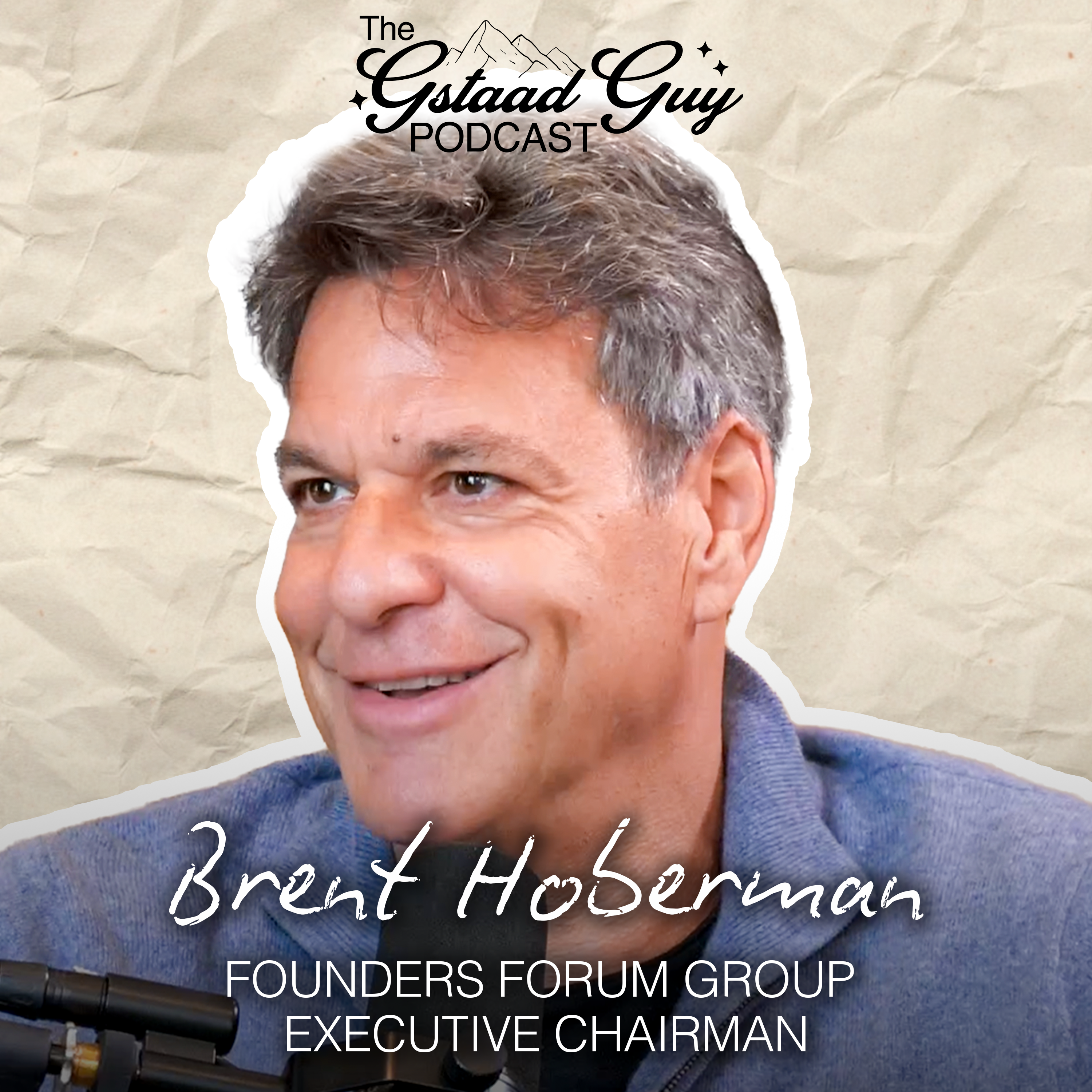
 The Gstaad Guy Podcast
14 Oct 2026 · 1h 1m

 Add vo to ChatGPT or Claude to ask about everything you hear
vo listened to this episode to put together the overview and transcript, so there may be the odd mistake.
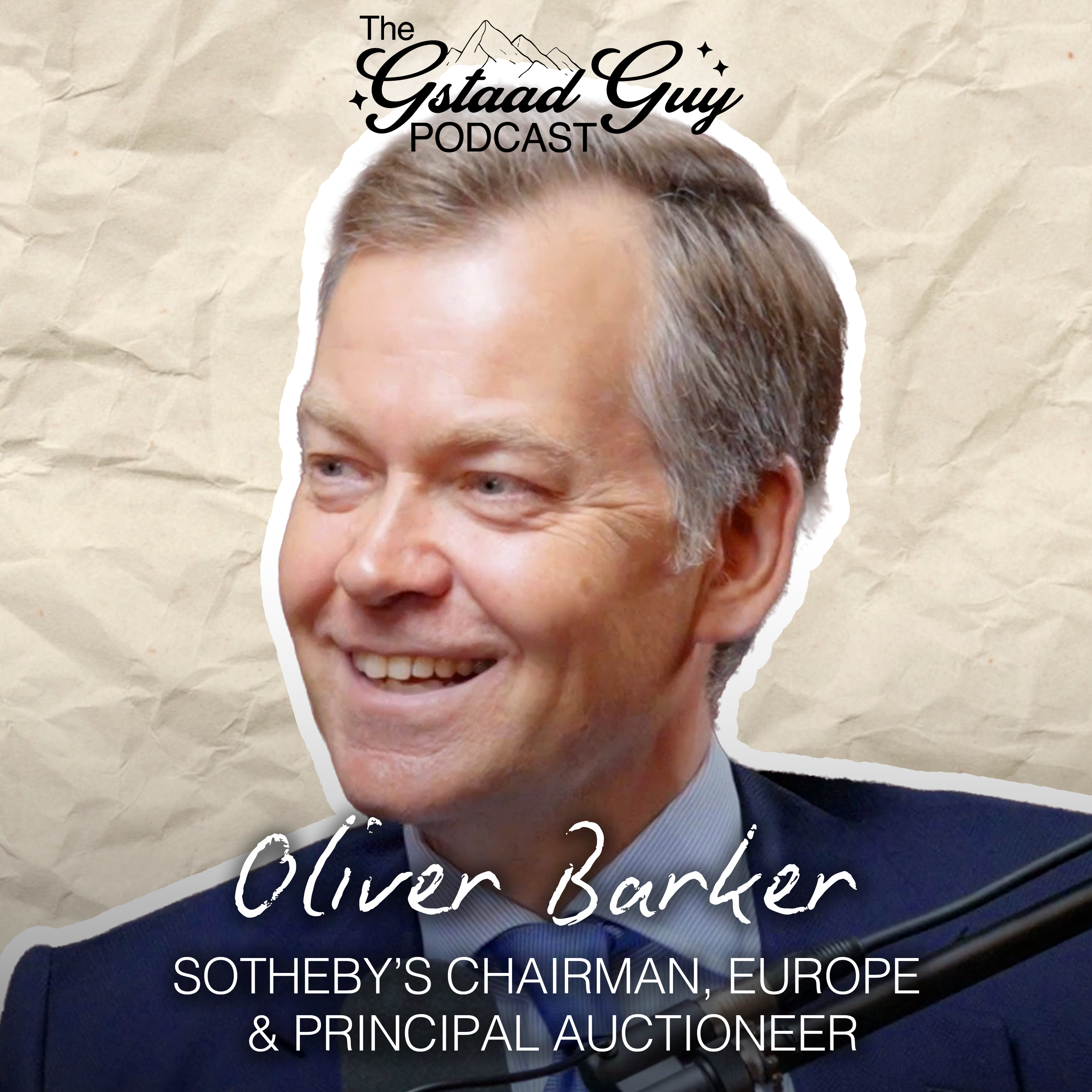
Oliver Barker, Sotheby’s Chairman for Europe and principal auctioneer, discusses the “magic of the saleroom,” auction history, Sotheby’s evolving categories, and how Sotheby’s builds trust through expertise, relationships, and due diligence. He also explains how auctions became more accessible via live streaming and how collectibles, watches, jewelry, cars, and sports memorabilia are expanding Sotheby’s audience.
Oliver Barker has been at Sotheby’s for 32 years, starting as an intern after studying at the Courtauld Institute (MA). He began in the Impressionist/Modern Art Department and later became an auctioneer; he also serves on the Courtauld Institute campaign board.
Auctioneering is an efficient trade from willing vendor to willing purchaser; Sotheby’s is “close to 280 years old” and began as a bookseller in Covent Garden (1744). The best auctions function like free museums. Expertise is collaborative and category-specific; authenticity and restitution require rigorous checks (e.g., Art Loss Register for pre-1933 works). Live-streaming made auctions more democratic (50,000–75,000 viewers).
Pele’s 1958 match-worn jersey; Freddie Mercury sale (100,000+ visitors); Pauline Carpides Surrealism sale; Joe Lewis collection (biggest single-owner value sale in Europe); Gantz Collection; Mercedes-Benz “Hull and Hau Coupe”; Gustav Klimt from Leonard Lauder’s collection; Vermeer authentication; David Bowie collection; Maradona “Hand of God” jersey; Wayne Gretzky jersey; Lawrence Graff as a cross-category collector.
0:00Now we're close to 280 years old. I mean, you know, we're a little bit older than America. Oliver, I really appreciate you taking the time today. I'm very, very privileged to be with you today, but also, you know, talk a little bit about, you know, the magic of auction. There has to be something innate in someone to even want to be exposed to the art world, I believe. By far, the majority of works that Sotheby's sells are probably in the region of$25 ,000. What makes the headlines, of course, are kind of, you know, the$100 million plus sort of objects. Are you a collector yourself? You know, the quantity of the works of art that one handles and which are in private collections are often as good, if not better than some of the works that are on public display.
0:34Lots of our listeners today are very art curious. Would you happen to have a message about how they can channel that curiosity into a career?
0:41Oliver Barker: Very much so. Around the world with your host, the Stardguy. We welcome you back to the Stardguy podcast, sharing stories of excellence with those in the know for those who just know. Oliver, thank you so much for being here today. It's a real pleasure. Thank you very much indeed for the invitation. Thank you. I know you didn't have to commute from very far. It took about three and a half minutes, I think. Yeah, exactly. We're just around the corner of Mayfair. So no, thank you. It was super local. So yes. I know that you are a face people recognize around Mayfair for sure, particularly if they are in the art world, but also around the world today.
1:23every big name auction i've had the pleasure of attending i've either seen you in attendance or seen you actually leading and it's uh it's very cool to be sitting here today with you well it's you know it's i'm very very privileged to be with you today but also you know talk a little bit about you know the magic of auction and you know this extraordinary kind of drama if you like that you conducted auctions as well and you know auctioneering has been around for millennia. And I still think it's really one of the most efficient ways to kind of trade something from willing vendor to willing purchaser.
1:58And, you know, I'm really interested actually in the history of auctioneering as well. I don't think the right sort of full-scale documentaries have really been made about that because it exists in so many different fields. But I feel particularly lucky, obviously, to conduct some of the sales at Sotheby's where we're selling, you know, tens of millions of dollars worth of property. And, you know, again, I think it's easy, you know, I don't want to be sort of flippant about it. You know, this is a very serious kind of business that we're in, but we're in a kind of real golden era in the art market, I think, and specifically for the auction business too.
2:26You are the chairman of Sotheby's in Europe. I know people know the brand very well when it comes to more traditional art on canvas, perhaps, but there's a whole lot more going on behind the scenes and also in the front of the scenes. That's right. We were just talking off camera a moment ago about the fact that we met about four odd years ago. And if I think about that period of time, and I think about the amount of new categories that we're selling today, and I think actually that's what's really key about our business, is that now we're close to 280 years old. I mean, this summer, America is celebrating their 250th anniversary.
3:02We're a little bit older than America. And it's kind of interesting to me that actually, you know, business like ours and others in our space are ultimately even more relevant today than they were in 1744, in our case, when we actually kind started as a bookseller, ironically, in Covent Garden in London. So our roots are very much in London, not so much Mayfair, but certainly half a mile down the road, obviously. But books we still sell very much. We have these incredible manuscript sales. We sell Jewish Torahs, and we sell incredible first edition Harry Potter books or great Charles Dickens. But I think it's everything else that we've added or layered on top of that.
3:40And of course, we have a sister company in RM in Sotheby's, so we sell cars and automobilia, paintings and things on canvas, obviously, kind of, you know, the core of what we do, at least in terms of kind of the value prospect. But luxury, I would guess, is probably the fastest emerging and growing sector that we're selling. In addition to memorabilia, we talked a moment ago about also sports memorabilia, you know, that has become very, very quickly an area which, you know, the collector base is truly interested in and focused on. And actually, we're selling one of Pele's match-worn jerseys from 1958 from a famous game in Sweden in the World Cup where he scored two goals as a 17-year-old player and emerged on the world.
4:20And of course, the timing is not coincidental. It's timed very much with the beginning of the American World Cup, which is about to kick off, obviously, very shortly. So we're very attached to our roots, as you mentioned in Mayfair. And we love to have the duality of buildings in major cities such as London or a major new premises that we've just opened in Paris at the north corner of Avenue Matignon directly opposite the Bristol Hotel. New York, of course, we occupy the famed Marcel Breuer. And we've just opened a great new restaurant, Marcel there as well. But we love this duality between the physical space, but also the online space.
4:55So more and more, I think our clients are very much looking online and looking at the plethora of different categories to your point about what we're offering. And they're super interested in that as well. I find the physical space really interesting and exciting. I had the pleasure of attending my first auction four years ago and actually walking into an auction house for the first time four years ago. And I've learned that day that actually it's completely open to the public. And I think people think of museums, they think of galleries, but they rarely think of auction houses as a nice afternoon free activity.
5:30In a city like London, you think Mayfair, you think Sotheby's. you don't assume every day out, actually. Yeah, no, it's really true. It's a great point. And I think actually, you know, in London in particular, we've been very sensitive to the fact that we're in a market where we're trying to offer collections, private collections that have been off the market for decades in some cases. And to us on the inside, I guess we've known these collections, but actually, you know, we're looking forward to sharing them now with a broader public who perhaps have never seen anything like these. And, you know, we play a very small role ultimately in the journey of a particular artwork or collection, you know, And ultimately, we're very frustrated collectors ourselves.
6:06We get access to these works of art just for a very small period of time when they pop up in the marketplace and they kind of go back underwater and again, once a new or private collector kind of acquires them. But to me, the greatest auctions are the ones which are celebrations of culture. And if I think about whether it was the Gantz Collection in New York or whether it was more recently the Freddie Mercury sale that we did here in London or in September in London, we did the Pauline Carpides Surrealis sale and we actually put outside of our building, we've got a wonderful design team at Sotheby's and they designed these incredible, almost Schiaparelli style eyes that were attached to the outside of the building because the auction itself was in September, which is normally in our world a fairly quiet time in the marketplace.
6:48But it attracted, you know, and I think social media also was part of the secret sauce in a way, it just attracted these incredible audiences. And actually with Freddie, I think we had comfortably over 100 ,000 people that came through the doors. So to your point, it is a free museum. And actually, we're on the eve today, in fact, of the opening of the Joe Lewis collection at Sotheby's in London, which we're really excited about. And there will be an extended exhibition before the sale itself happening on the 24th of June. But this is the biggest single owner value sale that we've ever held in Europe.
7:21And again, these are works which have been in storage in many cases for three decades. So this is a great opportunity for people to walk in through Sotheby's doors. you know we will offer extend a really warm welcome to people you don't have to be a buyer you can just come in and see it and you're totally right it's a great free museum has that always been the case i know you briefly touched on the history of auctioneering i'd love to know how it all started and where we are today you know it's i've been at sotheby's 32 years um it's my first job i joined straight out of university i did a master's at the courthold and uh i started life as an intern at sotheby's so i really feel as if i've learned i guess from the kind of the grassroots you know all the way through to the business.
8:00And I really feel strongly that to get ahead in the art business, it's really great to see all the different mechanics of what we do. And of course, the business has really changed beyond recognition. And I do think that actually the auction houses could be proven guilty of elitism at certain times. So to the point we're discussing about how accessible is an auction house to the public, I'm not sure we historically did that good a job in actually allowing people to walk into Sotheby's. And actually, interestingly, here in London, I've always been interested in retail space. And when you walk into Sotheby's and London, the first thing that kind of confronts you is a super long corridor.
8:37And you have to kind of walk past a guard and you have to walk past a reception. You have to walk past a restaurant before you even get to see the art. So in a funny way, if you're not used to that environment, it's actually quite, how do I put it? It's a little bit sort of confrontational. And I think one of the things that we're really, really keen today is to kind of make sure that when we open our doors, there's a super warm welcome waiting behind us. And I think the real definition of the difference between auction and, say, a gallery is that, yes, there are conversations in both, but the great thing about auctioneering is that you can actually do your due diligence upfront, as opposed to walking into an environment like the Basel Art Fair, which, by the way, is completely legitimate and has incredible art, and obviously I have great respect for the galleries and dealers that work there, but there is a kind of frenzy, which means that you have to make a retail decision very quickly, or else somebody else is going to get that opportunity to acquire something.
9:32With auction, it kind of works the other way around. You can walk through our doors, you can meet a specialist. In many cases, these are specialists who've not only studied art, but are truly passionate about the artist in question as well. I think also it's really crucial that experts understand that if they don't know about a particular artist, then they defer or can delegate a question from a client to another expert or colleague who does know. So I love this sort of idea of interchangeable expertise as well. We can't all be great at everything. We can't possibly all know everything at all.
10:02But under one roof, whether it's with us or some of our close competitors, you find some of the greatest experts in the world outside of museums. And that's the other thing that I find really interesting is that when you compare, I've very much been in the Impressions to Modern and Contemporary space, but arguably the deepest respect that I think we all have is for experts in places like the Old Master Paintings Department. These are experts who literally sometimes have to authenticate works which are not recorded in any books. Because, of course, with modern art, the invention of photography at the end of the 19th century just changes everything.
10:38Because the galleries and the dealers could actually start to record very comprehensively any art that was coming out of an artist's studio. So if we look at Picasso and if we look at the famous Christian Zervos Catalog Rizne, which was put together by a lifetime assistant to Picasso, So all of those works are very well known because they were being categorized at that particular moment in time. You can't say the same for Rembrandt. So when a new work of art comes up and there are wonderful stories of colleagues of ours. I remember Greg Rubenstein, a great colleague who's in the Old Master Paintings Department, Old Master Drawings, I should say.
11:12He authenticated, brought to market and sold a Vermeer painting that had previously not been authenticated. And it takes the most incredible expertise not just to convince oneself of the authenticity of the work, but also the community and all your peers out there in the museum world as well. So I think that's really what's so interesting about our world. I guess we occupy similar spaces in that regard that we love that expertise and we love talking to people who are just genuinely knowledgeable and excited about the product that we're privileged enough to handle. Who are the different experts and players in this space?
11:48You know, it's so interesting. I mean, in my sort of other life, one of the things that I do is I'm on the campaign board for the Courtauld Institute because I feel really strongly about arts education. I feel really strongly also about helping students get a footing in the art world as well. And I'm afraid it's still somewhat of a kind of prohibitive environment to find an easy route into certainly the auction world. I can't speak for the luxury world more broadly. But the experts tend to be people who have had some sort of education in the fine arts. Increasingly, what I find really interesting is that there are young people who also could be getting a little bit alienated from, say, the financial worlds.
12:27Or they're finding it very preventative to get into some of those worlds as well. And they're looking at culture in the cultural space in a way kind of thinking, okay, if I'm going to have a 30 or 40-year career, I really want to be in an area that just excites me and really titillates me on a daily basis. So at heart, the experts are genuinely interested people in the objects that they handle. They're brilliant people as well. They're great with clients as well. But most importantly, the object just turns them on every day. That's what gets us out of bed in the morning. I think that's what gets us into work every day.
13:04It's this incredible opportunity to just discuss, disseminate, articulate what's good about a particular object. And I should explain that by far the majority of works that Sotheby's sells are probably in the region of$25 ,000. What makes the headlines, of course, are kind of the$100 million plus sort of objects, whether it be the Mercedes-Benz Hull and Hau Coupe, for example, or more recently the Gustav Klimt later a portrait that we were fortunate enough to sell from Leonard Lourdes' collection. But the stock in trade, if you like, is very, very different. But again, that's what's so interesting.
13:38I remember as a young cataloger when I was let loose in the basement of Sotheby's and was able to take a Renoir drawing out of its frame. And having had three or four years at university where you're learning everything at arm's length from books mostly or really studying theoretical theses about art, that ability just to touch a piece of paper that a major artist has worked on or to understand about does something get damaged with light over time? Or does a sculpture pick up scratches? Or how did Picasso kind of think about that kind of use of sandpaper that he put on a 1912 sort of late analytical cubist collage?
14:15These are the things which just become embedded in your expertise, your data bank in a way. And I have a kind of theory also that I think as experts, as we get older, arguably you get better because your eye gets more refined. But I worry that the data bank just sort of fills up. There's no more megabytes available. So I doubt that. It sounds like everything you've, all the roles you've mentioned and all the different roles you've even played, all come first and foremost from this deep sense of passion for the craft and love for the craft, long before the expertise can even be built. So I think there has to be something innate in someone as well to even want to be exposed to the art world, I believe.
14:57I didn't really grow up in a kind of, you know, in a collector house. My parents weren't collectors. Actually, if anything, they bought sort of Victorian watercolors. And my father sadly died about 10 years ago. And actually, I tried to sell some of these Victorian watercolors recently, very unsuccessfully, by the way, at a small auction house locally. Sotheby's weren't prepared to take these watercolors. And it sort of reminded me in a way how taste changes. But it also kind of reminded me that, you know, when I first joined the art world, it was really because of a tutor at the Courtauld. So I grew up in London, and I went to the University of Manchester in the northwest of England.
15:35And then after that, I was trying desperately to get into the world of advertising, failed miserably to get into the world of advertising. My mother had been in that world. She'd worked at JWT in the late 60s in London, which was a really vibrant time in the London kind of advertising world. And so I kind of stopped and paused, and a very close friend's father actually just said, look, Ollie, it's obvious. You love art history. Why don't you go to the Courtauld? and um you know i took him at his word and and applied and got a got a kind of position or an ma uh position there and it was whilst there that that actually one of my tutors took us to sotheby's and i think it was to see a picasso ceramics sale and i never knew that picasso even made ceramics and i walked into this kind of pre-auction preview and i genuinely had one of those kind of like you know damascene moments where i suddenly kind of thought and weighed up art and commerce.
16:27That's where I want to be, ultimately. So I made a real nuisance of myself actually and got an internship at Sotheby's. Christie's turned me down because I didn't have a second language at the time. I worked in London for about three months in October 1993 to the end of the year. I wasn't paid. It was in the days before interns were paid. But I just immediately felt that this was an environment that excited me, that I wanted to be in. Way before I got to become an auctioneer. I was working in the Impressionist Modern Art Department at the time, which was very much, and is still to this day, one of the driving forces of our business.
17:02But equally understanding that the quality of the works of art that one handles and which are in private collections are often as good, if not better, than some of the works that are on public display of museums. And I remember one thing that I used to really love. There was a colleague of mine, Michel Strauss, who was one of the great eminence gris of the Impressionist modern world. And it was in the days, obviously, when we used to use old cameras and he would go to collectors' houses and he'd come back with a little camera capsule and he'd give it to me as an intern and say, right, you need to go to Snappy Snaps.
17:35There used to be one just around the corner at the back door of Sotheby's. And I'd take it there and they would have an hour minimum to kind of develop and kind of give you the photographs back. And I'd go off and get a sandwich and I'd come back and collect these photographs from Snappy Snaps and they'd be in this horrible plastic, sort of, you know, see-through kind of packet. but in them would often be the most incredible group of pictures from Cezanne to Degas, Giacometti to Bacon, Picasso and they were photographs that Michel had taken from one of his multiple visits to collectors homes whether that be in Switzerland or France or Italy or whatever and these were the paintings that were in private collections and of course it was my privilege to take these photographs back to our library and books and libraries have always been incredibly important to us in the auction business.
18:21And I would then just pour over these images and try and find them reproduced in the artist's catalog or isn't it. And of course, that was arguably one of the best ways to refine my eye at the time. Because at university, I was thinking about theory, about sexuality and politics and religion. This was purely about knowing the difference between, say, a 1907 Picasso or a 1921 Picasso. Was it a painting? Was it a work on paper? Some things that sound obvious, but other things where, you know, as I talked to experts that were kind of 10 years into their career, I could just tell they had this incredible innate understanding.
18:56And I wanted to be at the same place. And it's just through that kind of immersion. It's looking at images and going to museums and going to exhibitions again and again and again. And it does rub off after a period of time. And this is way before I thought about becoming an auctioneer. But it's relevant because now today as an auctioneer, I'd like to conduct the auctions for which I know the product and I know the clients. And one of the things that I like to think of as being somewhat defining about the style of auctioneering that I do is that I can really lean into someone who I know is a buyer or someone who I know is a prospective buyer or even the vendor.
19:32I feel a kind of personal responsibility to want to do a great job alongside my colleagues for that person. I'm curious about the relationship with the vendor and with the collector who's maybe letting go of a piece or of a collection. And the reason why I'm curious about that is the context that you share during the auctions. I think there's a lot of context and storytelling around the piece itself, around the artist, but also often what that piece may have meant to the collector who's actually letting it go. And I think that context can't be gathered on a PR press release or it can't be gathered through an email.
20:10It's clearly a personal relationship being built slowly that's quite intimate with the vendor as well as with the client, as well as with all parties involved. What does that process look like? What it doesn't look like is really interesting to me in as much as brands today are forming relationships with prospective customers so quickly, it seems. and advertising campaigns or limited edition products or celebrity endorsement has made objects so universal at such a short period of time. And I think that's so interesting. Our business tends to be very much more the longer-term play. And I think we're entering a period in particular now where the market is seeing more and more, I don't know if they're called the baby boomers, but collectors that were born mostly in the pre-war period who've had collections of art for, say, 50-plus years, who are very much electing now to want to bring these works to market.
21:10And it's either whilst they're alive, and I think there are certain benefits to doing that, which I'd love to discuss, or indeed it's those collectors' estates, and their fiduciaries, their lawyers, their families, their closest advisors who are equally navigating the auction world and how to bring those collections to market. at the center of all of that is this sort of indelible relationship with the objects themselves and their owners you know so we have quite sophisticated means now of kind of building our client relationships but i think one of the things that we're most proud of is when a great collector who's worked for 40 or 50 years building a collection in a very sophisticated manner you know and works of art aside from a collector's family are often kind of you know the works the position themselves as the most prominent in these collectors' lives.
21:58And they're not flippant about them. These are inherently emotional pieces of currency, I suppose, in collectors' lives. So they want to work with people that feel a comparable level of passion and recognition and responsibility with these collections. We're very, very lucky recently in London, of course, I mentioned the Pauline Carpides sale, and we're on the eve, as I mentioned, of the Joe Lewis collection. And in neither case, did those collectors make that process to choose Sotheby's as their location of sale competitive. And in our world in particular, we live in a highly competitive environment.
22:32Sort of behind the elegant facade of these auction houses, there's a very kind of aggressive machine that's really going on. And when you sell something like the Lewis Collection, it's incredibly fulfilling to build a relationship with someone who trusts us implicitly to do the right things, to bring the collection to market in the right possible way. I think most importantly, kind of understanding, respecting the objects as well. And also kind of understanding the, what I call really the binary nature of our market. You know, we're at a time in the world where taste is very definitive and there are certain things the market's really clearly looking for.
23:07And there are certain things which perhaps it's just not the moment for. And, you know, that's a way that we have to kind of navigate a little bit. But I think that, you know, at the core of it is building these relationships out so that when I stand up there as auctioneer, you know, I've gone through a journey with my colleagues as well, to really manage every possible eventuality of how that object has been seen in the market or being respected in the market or exhibited in the market. And I think, again, it's that trust, that indelible bond that we have with a collector, which, again, is really definitive.
23:37That's the bit, I think, as I kind of talk to young colleagues and even kind of senior colleagues, we're always challenging each other to build these deep relationships. Because I think, again, it's when you've got a relationship with a brand or with an individual or an expert or something in our case in the auction house, it's much harder to break that bond if Sotheby's has been with you as a collector every single step of the way. And again, it's a journey. Collecting is really a journey. Are you a collector yourself? You know, I am a little bit. I started in the early 1990s. I spent a small period of time in New York and I loved buying works on paper for two reasons.
24:13One, works on paper are often the kind of the most honest, integral kind of works of art that an artist can do. I mean, you know, the beauty of the line, particularly if it's one that doesn't get erased, if it's drawn in a kind of pen and ink, for example, you can't make any kind of mistakes. So I just love that sense of the purity of drawing. And I often look to kind of artist collections. I remember going to an exhibition of Jasper Johns' private collection, which was mostly made up of drawings. And that just really appealed to me, that kind of purity and that inability to make mistakes if you wanted to do a really great finesse of drawing.
24:46And the other reason is it was the cheapest way to buy known artist. So, you know, I was lucky enough at one point to own a Peter Doig work on paper, which I had to sell to raise money for school fees. Chris Zofili was someone that I liked early on. But the collection has, with my wife, we've sort of started building up, you know, we've bought a little bit of Roman glass. We've bought some great young contemporary artists. I have a Hervin Anderson painting, which I'm a huge fan of Hervin's work, which I am with a friend. We bought it in half share because I couldn't afford it at the time. So I had to find someone to help me acquire it.
25:19And even Roman sculptures. So I have diverse tastes. I know there's the category of collectibles as well under Sotheby's, which includes maybe non-traditional art. I think this is a point where the management of Sotheby's, I take my hat off to them in a way, because I think we're at a sort of inflection point in the marketplace. And I think, as you know, the ownership of auction houses changes, I wouldn't say frequently, but it certainly does change. And for the majority of my career, we were a public company. And I think in a public environment, arguably you're a little bit less nimble than when you're privately owned.
26:01And I definitely used to think that in the Sotheby's, kind of Christie's kind of world that we occupy, you know being a public company was was was hard for us at times you know and francois pinot in particular christie's is a collector by nature obviously highly decisive and as a public company when you've got sort of obligations to your shareholder it sometimes doesn't doesn't give you that sort of you know speed that you require particularly in our world to kind of you know respond to collectors or be aggressive particularly when it comes to things like financial guarantees that now occupy such a central space and what we do and one of the things that happened i think when Sotheby's was first acquired by Patrick Drahi, nobody saw the lockdown coming.
26:41And as you probably know, at the end of 2019, when the first round of lockdown really came along, we were in a position where actually there were, I remember, three pieces of business which were consigned for a Sotheby's sale in May of 2020. And because in America in particular, the IRS were not withholding the payment of tax on death duty, two of these pieces of collections were actually a state business. So we pretty quickly had to find a way to sell these objects. And actually the upshot of which was the invention of the live stream auctions. And in aggregate, what those live stream auctions did in a way was to make what had been a live theatrical experience to one of our evening sales become almost like a live stream process or environment.
27:30So we had occupied this very, very small private world where if you went to New York to watch an Impressionist sale, there would maybe be 300 people in the room, but with no cameras. And it was kind of locked off in a way. It became instantly much more democratic because we were getting on some cases, 50 ,000, 75 ,000 people watching. And I think it's still become this really fascinating collector sport. And the reason I'm mentioning this is that we suddenly realized that if we could diversify into areas like collectibles, for example, but we could just normally expand our business massively. So we have started to look at things like the sports collectible market very, very closely.
28:08I have a great colleague of mine, Bram Wachter, who, Bram's really interesting. He's the son of George Wachter, who is a legend at Sotheby's. He's been at Sotheby's 40 plus years. He runs the Old Master Paintings division, but his two children, Jackie and Bram, work for us. Jackie's in Los Angeles. She runs our Los Angeles office and does a lot of great contemporary art sales. But Bram does principally collectibles. So he's the guy that will sell the Maradona kind of Hand of God jersey or a Wayne Gretzky jersey. But then he'll also kind of sell MBA kind of collectibles and cards. And we do most of this in America.
28:42A lot of it's online as well. But I think we're looking for things which are evergreen. Because, again, we're very much limited in a way by the supply of property that we can find. It's not like we're dealing, for the most part at least, in terms of kind of made-to-measure or made-for-market. So by definition, everything we're selling is mostly secondhand. But clearly we're looking for areas where we can actually sell outside of the calendar of main auctions. So actually, if you look at our website, I think we're close to 90 % of our auctions are online auctions. So it's a big difference. It's not me standing up there in front of the room.
29:19It's actually a timed process. And if you haven't been online to kind of see one of these, I definitely kind of suggest you do, because it's just, they're so interesting. And actually, my wife sold a brooch at Sotheby's last week, and it was kind of great. It was quite low value, but super exciting to watch the clock sort of run down as there were kind of, you know, actually in that case, one bidder kind of really going for it. But I think suddenly we've realized, you know, if you can be on all the time. I definitely remember when we did David Bowie's collection sale in London, we were selected by the estate to sell the art collection of David Bowie.
29:49And it was really interesting because the lawyer at the time made it really clear, look, we don't want Sotheby's to talk about David's musical career. You know, we're taking care of that. That's fine. But what we do want you to really focus on is David has this extraordinarily culturally engaged animal almost. And he had a voracious appetite. You know, he bought great Eric Heckel works on paper, indeed, one of which was the model for one of his famous albums, Low. He had great modern British art. He had Memphis Group furniture. And again, that was a time when we suddenly realized, okay, we can expand the known Sotheby's audience into a group of collectors that is way, way bigger.
30:29And hence, why are we growing in the areas that I've discussed? And things like wine is really important to us now, or watches, or jewelry, or cars. And particularly, I think also, as we look to different parts of the world, the Middle East is the obvious one, where we've had connections to that part of the world for decades. but we've never had an office there. We've never had auctions until very recently. So our strategy in terms of kind of sales in Saudi or when I last saw you, one of the last times I saw you in Abu Dhabi, of course, is expanding rapidly because we're responding to collector bases and their specific interests as well.
31:01Oliver Barker: This podcast is brought to you by Kubeil, bringing you interchangeable charm jewelry hand-painted with enamel on styling silver, allowing you to celebrate all the things you love and all the things you might question through interchangeable styling silver bracelets, bangles, whoop, charms, mini charm, bracelets, rings, cufflings, and much more. And all customizable through our 3D Builder on poubelle.com. That is poubelle, P-O-U-B-E-L dot com. Thank you so much for watching. And now back to podcast. I know that there's one category of collectible that has a quantified grading system, which is like the baseball cards, trading cards.
31:46I think there's these two grading houses. I think it's PSA and BGS maybe, which make it a bit easier for a collector to make a decision of card A versus card B because they literally have a score out of 10. But I see that that has not really been a thing across other collectibles. I think the context is typically more qualitative and has a lot more to do with the story of the item versus maybe the condition. It's a scruff on Jane Birkin's original handbag, which we saw together in Abu Dhabi, is a beautiful thing and it's something that's celebrated versus something that is questioned as it would be in the trading card space.
32:31So the spectrum of what is valuable and what is questioned across the collectible space also is incredibly different. I think this is going to be one of the biggest challenges or requirements of our business in the next 10 years. I think particularly as the auction business or industry starts to think about how we harness AI, I think a lot of it is also based on how do we harness authenticity and the use of the blockchain in particular, I think, to have a kind of unified system of authentication. And what's really interesting to me is that different categories of collector base have completely different rules of analysis of that particular object or due diligence.
33:15And one of the things that we are particularly focused on at the moment is restitution. Where have objects been if they were created before 1933, the creation of the Nazi Party? And where were they physically between 1933 and the conclusion of the war in 1945? And obviously there are outside jurisdictions and lawyers or things like the Art Loss Register who play incredibly important roles in being a referee of some sort in this judgment. And we work very closely with them. In fact, the whole industry does. And for pretty much everything that we sell, which is made pre-1933, it goes through a very specific process, in that case with the Art Loss Register, or to see if things have been stolen, for example, and somehow find their way into an auction catalogue.
34:07But I think what you're talking about is the kind of due diligence which will become standardized as people look for a signifying unifier of authenticity. And I think it's a great idea. I think the blockchain in particular has got a lot of role to play here. And I think we're definitely kind of thinking about this tremendously. And I can think of many cases over my career where an object has two different external experts. And obviously when you buy a work of art from In Sotheby's you buy with a condition of guarantee of authenticity. So for a period of time after an auction, if you show that object to the definitive expert, if you like, the person who has the duat moral for the authenticity of that object, and they dispute the authenticity that we have given you, you are well within your rights to question and come back to us and have a discussion, maybe a legal conversation, to see whether we owe you your money back again.
35:04So you can understand that actually due diligence and kind of expertise and making sure that we can back up how we're cataloging something and getting behind its authenticity is crucially important to us. Particularly in a time when making fakes, and we talked about AI, for example, or AI is trying to recreate artists or make work in the idiom or space creatively of a well-known artist. We're going to have to be an RA game, I think, really to think about that. But it does intrigue me, and the longer I've been at Sotheby's and most recently where I've been exposed to different markets. For example, I've worked closely as an auctioneer actually for the RM Sotheby's auctions.
35:43And it seems to me that due diligence around cars is completely different to due diligence around, say, tribal African sculpture or Juan Miro works on paper from 1921. And in cars in particular, some of the greatest collectors that I deal with, where I see them also operating in other spaces, invariably the smart ones work with independent advisors who help them do that sort of process of due diligence. So if I think about, and I hope you wouldn't mind me mentioning him, but it's only because I've got such great respect for him, Lawrence Graff as a collector. Someone who inherently understands the value of works due to this extraordinary jewellery business and empire that he's developed, but has become, to my mind, one of the most superlative collectors in the world.
36:29And he doesn't just operate in one area, say, of pre-war art, Picasso, to give you an example. He's equally as comfortable in post-war pop art as he might be in tribal art, as he might be in classic cars. But even within the cars, you know, there'll be his 1960s kind of GT-type cars, but then there'll be a brand new kind of Ferrari Roma. And of course, even in those car spaces, you have to kind of be on your A-game to understand that provenance can play a key role. if it's a car that belonged to John Paul Belmondo or making something up for one second versus a brand new Ferrari where you want to have low mileage and absolutely zero scratches and things.
37:09So it's a difficult one, this. I think we need to have a kind of unified form of authenticity and analysis, if you like, but understanding that each of these different categories have different requirements. You briefly touched on an iconic collector who happens to be in Switzerland. And I think Switzerland plays a key role in the art world. storage-wise, collector-wise. But one of the markets that people discuss a lot today, particularly with artists who are from there, collectors who are from there, some of the most iconic auctions are hosted there, is also the US. And I'd love if you could help us paint a picture of maybe the high-level geographies of the auctioneering world, of the collectible world.
37:54What role does the UK and London in particular play? what role does Switzerland play and maybe cities like New York Los Angeles, the US Abu Dhabi, Qatar all these different places that I know you frequent how do they each differ from each other and why do some of the same people end up in all those different places for very different reasons Wow it's a multi-layer question and it's so interesting because I think again if you look at art galleries and dealers I think they kind of understood as the oriental market makers did that you need to have kind of trade routes it's almost like the Silk Road if you like and I think that one of the dealers particularly in America who defined in a way what the modern gallery system really looks like is Leo Castelli you know this is a man who was born in Trieste in Italy, northwest Italy found his way to New York married Ileana Sonnebend who in her own right was an incredible gallerist and had a great gallery, obviously, in Paris.
38:58But what Leo Castelli realized is that he had access to supply in the shape of Robert Rauschenberg or Jasper Johns or Roy Lichtenstein or Andy Warhol, but he needed to have a kind of dissemination point. So he built up associations with great galleries like Joe Hellman in St. Louis or Irving Blum in Los Angeles or Ileana in Paris or a major dealer in Turin. But it wasn't unified. It wasn't like Gagosian. But the reason I'm explaining this is that I think Larry, who worked with Leo Castelli, understood that this DNA, which again, it also started with alligate galleries in America, and particularly where Leo Castelli had just started, that And it made it a challenge, if you like, to kind of be in different geographies, representing this incredible product of post-war American art, which was clearly the big thing in the post-war period, but needed to be disseminated to parts of the world, ultimately where there was wealth creation.
39:58And I was in Cologne recently and went to the Ludwig Museum, which is one of the great collections of kind of post-war pop art, not just American, by the way, but also French, nouveau realist art, but also British pop art as well. and you suddenly kind of realize the importance of galleries as translators educators um supply merchants to show collectors what is available and what the kind of greatest level of creativity looks like in the kind of artistic cultural space and switzerland again is also kind of you know of huge importance if you look at young cruzier in geneva or if you look at unspeyler in basel or major gallerists in Zurich.
40:39And of course, we're mourning the passing of Bruno Bischofsberger recently. He was, again, had this incredible, indelible influence on the post-war market for a number of different artists, not least Jean-Michel Baskier. He was the person that put Baskier on the map. But through these galleries, and Beiler arguably is one of the most notable, he was a collector. He had an incredible list of clients, particularly a guy called G. David Thompson in Canada. And he was able to buy back that collection, which is what forms today the core of the buyer collection in Basel that Sam Keller is director for.
41:11And these are trailblazers who led the marketplace. And I think New York plays a critical role here as well. Because if you believe that the history of the art market, to some extent, started in countries like Italy, with the Medicis and great tastemakers. They happened to be in a city, Florence, which had arguably the greatest concentration of artists at one period of time. and championed those artists and collected those artists and made sure that art reflected the power and sophistication aesthetic level of quality that they were hoping to achieve. That's only really proliferated with time.
41:45And I think we're living in a very linear world. I was in New York last week and went to the Metropolitan and saw some of the great old master paintings there that have been in the newly configured galleries. And it just struck me, Robert Lehman's collections, that is the great banker. And it just struck me that, you know, sophisticated people who've made great fortunes have always aligned themselves with the great culture or civilization or creativity of the day that they're living in. And I think actually contemporary art to a larger extent has proliferated because of that. And we're fortunate enough actually now with the Breuer building, particularly in New York, to be in a proximity of say a mile or half a mile in the Upper East Side of New York, where you've got arguably the greatest concentration of collectors anywhere in the world.
42:27Now, that's not to in any way kind of overlook what's happening in the Middle East or what's happening in Asia. But our role today, if you like, as these middlemen people in this market is to have this duality of space that we discussed a moment ago between what's happening virtually but also what's happening physically. And I still think at the moment, at least, there is no substitute for walking into an auction house and seeing a major work of art for the first period of time. I think as humans, we are very sensitive to talking like this and being in each other's space, but equally being in the space of a great work of art.
43:05Which again, I'm not overly religious, but I genuinely believe that museums in particular are quasi-religious sanctuaries. And if you think about some of the greatest exhibitions that we have been fortunate enough to see in our lifetime, like Raphael that's on at the Metropolitan Museum in New York at the moment, or Vermeer in Amsterdam a few years ago, where can you possibly imagine to see in one place such pure refinement of beauty, outside of the luxury space as well, but by artists than in major museums today? And I think this cultural engagement is really what we're all about. In terms of the calendar, per se, of a collector, how would you say the calendar flows if someone was to devote their year to discovery, to collecting, to attending the greatest shows and auctions, when, where, and what would they attend?
44:03Well, you know, it's so interesting this because in the auction business in particular, we've actually been quite rigid about how we've gone about setting our calendars each year. So in London, for example, in the Imprecious Modern and Contemporary spaces, we have these fairly well-worn programs of auctions in March in London, June at the end of June in London, October in London is a major time for us, obviously, with the Fries Art Fair. Paris is changing a lot. I would say the Brexit has been quite damaging for sales in the UK. It's certainly logistically, it's become a lot more complex. There's a great deal more friction of bringing works of art and property into the UK than it was.
44:43So a lot of our clients are electing now to sell in Paris in October alongside the Art Basel Fair, for example. um in new york the calendar is is mostly occupies may in new york the middle of may and then the middle of november as well um you know but but that's doing a major disservice to kind of all the major art fairs and and indeed all the auctions that are going on say in asia so we do major asian art sales or modern sales in april and again in october we just recently had the most successful watch sale that we've ever had in asia and hong kong a month ago as well um but i think if you're very specifically focused in the modern contemporary space, I think those auction moments are the unmissable ones.
45:25But then in addition to that, obviously the art fairs play such a pivotal role. And we're on the eve of Basel, Basel, which is opening obviously next week on the 11th of June, which is still absolutely critical. Basel in Paris that I mentioned a moment ago, I think is gaining a huge amount of traction in the marketplace very rapidly. And then I think there are other fairs, you know, like the Teyfah Fair in New York, for example. So, you know, and indeed, Frieze is even going to be in Abu Dhabi, God willing, if the war is straightened out later this year as well. So I think there is really a sense of, you know, culture is reaching out.
46:02I have a huge amount of respect, by the way, for the galleries, the contemporary art galleries, who not only have to look after their kind of local galleries, whether those be in Tokyo or Paris or New York or Zurich or London, but they have to go out to these fairs. And, you know, some of them are doing 12, 13, 14 art fairs a year. So trying to kind of help define to a collector which is the best one to see is pretty difficult. But actually, I think either through the auction houses, we have a kind of preferred system, which in a way, think of it as our kind of black Amex club, helps guide collectors as to where they should be each year.
46:32And this year is a Venice Biennale year, which is not a selling institution, but obviously is a great cultural melting pot, if you like, to see some of the greatest contemporary creativity of the time that we're living in. And then in addition, we often make recommendations of must-see exhibitions as well. And I think that, as we've seen recently with the National Gallery in London, for example, when they did the Van Gogh exhibition, these are once-in-a-generation opportunities. Frida Kahlo is serving at the Tate next Friday. That's going to be another major, major kind of boon, I think. And we talk about how different cities are going through different cultural moments.
47:05And I think London is going through a really interesting moment at the moment. The National Gallery has just announced major plans to extend its buildings and to, for the very first time, show up post-1900, which has been a little bit controversial but I think will be kind of extraordinary. The British Museum is expanding. They've just announced a major cultural kind of expansion plan as well. The National Portrait Gallery went through one of those recently. The Tate Gallery is looking for a new director. So there's lots going on in that cultural space. And again, things like Sotheby's Magazine is normally a pretty good way.
47:38It's a good barometer of knowing what's out there. But equally, I think things like the FT are kind of excellent. The FT Life and Arts section is a brilliant barometer too as to what's going on. At the end of the day, I'm always amazed that collectors who are, for the most part, highly sophisticated, but equally very, very busy with their businesses and with their private lives still have the time, energy, and application to know culturally what's going on. But they do because they're passionate about it. Speaking of that passion and the narrow expertise that you and many people can have in certain categories, as well as deep curiosity across category, I don't think it's a very unique feeling to be very narrowly specialized and focused on one thing, but to be very curious about a number of things that people in your specialty also share.
48:29what would you say the relationship between being somewhat of a generalist collector who's curious about many categories is with someone who is rather narrowly focused on one certain type of art you know it's it's so i think one of the one of the most fulfilling things in our world is to not only deal with kind of so many fantastic objects um but equally to have the privilege to get to know the person behind the objects, you know, who's collected these objects. And it's definitely something that I try to encourage young specialists at Sotheby's. You know, too often as a young specialist, we don't necessarily allow those specialists or it's not encouraged, let's say, to build relationships with the collectors.
49:14And I remember being a cataloger and I mentioned it previously, you know, being in the basement of our buildings with no natural daylight, but focused on kind of works of art and just kind of, you know, cataloging them and building an expertise. But I think there's an extra layer to the process when you actually kind of start to meet the person behind the object and start to question, you know, why did you buy this? Or what relationship does that object have with other objects in your collection? And I think like humans, you know, we go through life and we have different relationships with our loved ones and our families and friends.
49:47And as we build sophistication or interest, again, our spheres open up and we have relationships with people that perhaps we wouldn't have had the confidence to have if we didn't have that understanding. Or natural curiosity leads you to build relationships elsewhere. And it still amazes me how collectors can actually start to build sophistication in one area. For example, when we sold Leonard Lauder's collection, he was a man who had been a highly successful businessman, who had inherited from his mother this incredible business, had made a huge success of it, obviously, but had found the time to become arguably the world's greatest collector of cubist art, which famously he then gifted to the Metropolitan Museum of Art.
50:32And I very sadly never met Leonard Lauder, but I had the most profound respect for him as a collector. and what was really clear is that you know he was never afraid to ask the right questions of people who had arguably greater sophistication or knowledge about certain areas that he was collecting in and so that was an example of a collector that was utterly focused on one particular area but but i think the point you raised is so interesting about more generalist collectors because there's beauty everywhere and you know we will often be asked to sell a collection of art which genuinely has no great connectivity between the objects in question and actually joe lewis's collection is is comparable in that regard because it's not a collection about one artist it's not a collection about one theme you know it's not about abstract expressionism or surrealism or something like that it's general kind of common denominator is figuration you know when you walk into our galleries and see this collection it's ultimately a great a great group of kind of portraits of people but it's it's hard to describe how powerful this is psychologically.
51:36You know, when you see these people and the rendering that each artist has given these people, for example, there's this portrait of Lucian Freud or by Lucian Freud of a famous model, Sue Tilly. And we invited Sue to come back in and see her portrait last week. She hadn't seen it in a period of time. She was just blown away. You know, that the artist had sort of, you know, excavated her on a mammoth scale. It's eight foot high, this picture. And she'd modeled for nine months for this picture. It's one of four pictures which she modeled for over a period of three years. So it was a genuine investment of time and energy and relationship with that particular artist.
52:14And the collector Joe, he's incredibly conscious of this. So again, I could never have learned that without getting to know him and understanding him in his business world as a trader, as the way that he goes about his day-to-day business. But then again, the voracious appetite he has for art in all its different forms. And I love that sense of generalization as well. On this podcast, we always play a game of à la poubelle versus fantastique, which, as you may know in French, à la poubelle are the things we'd like to throw in the trash and change, and fantastique are the things we'd like to celebrate and see more of.
52:47Can you possibly share a couple of things from each category that you would wish to change or celebrate and see more of in your world? We referred to one earlier, and I thought it was very precise of you to kind of pick up immediately on the fact that auction houses are kind of free museums. And one of the things that I've always hoped to develop culturally at Sotheby's, and I would put it in the poubelle, as it were, is this sense of elitism, this sense of we're only appealing to the tip, tip, tip, top of a particular audience, that we're snobbish and all the rest of it. I genuinely think there is a sort of fantastic moment to celebrate these cultural moments.
53:27I remember very clearly we worked on a series of auctions with the artist Damien Hirst. And Damien always used to say, look, there are no pockets in a shroud. And it took me a little while to really understand what he was talking about. And what he really, really meant is that when you die, when all this is left behind, it's not like you can take that work of art with you. So I think it's a fantastic concept, this idea that you can come into a cultural space, whether it's with us or elsewhere, talk to somebody about an object learn from them see an object as it kind of comes up on the marketplace before it goes back underwater again and there's something really fantastic about that it's you know and equally we recently sold a van goff work on paper in our most recent new york sales this is now the third time this picture has been sold in my lifetime in the in the auction market every single time i've seen that work of art it's got a little bit better now another example it might be a work of art, and there have been several in my career, where as you get to the auction, whether it's the work of art itself or whether it's because it's a difficult client, arguably what has been a wonderful object suddenly turns the other way and it's like, I never want to see that ever again.
54:39So if that's another way of answering your question, that's what I'm nominating. That's a great one. Well, lots of our listeners today are very art curious and many of them are as we often talk about in the most confusing age of life which probably the early 20s people don't know where they belong where they want to belong but many of them are very art curious would you happen to have a message to share with them possibly about how they can channel that curiosity into a career very much so it's i mentioned this previously actually i am you know i really feel very strongly about this understanding our idea of arts education how people could make a step from a formalized arts education uh into the into the practical art world and i think on a positive note actually there are now more roles or jobs specifically in our space you know whether it be the luxury world or whether it be in the journalistic world or indeed as influencers or experts i think the way that luxury is expanding is truly what's incredibly interesting.
55:43And we talk about this all the time at Sotheby's, what really represents kind of luxury? And I think it's as much the physical as it is the experiential. And I think that to build up an understanding and knowledge of what it is that people really love about luxury in all its different forms is definitely the most important. One of the things that I will often say to someone who's looking for a career in the art business is just be curious. Go out there and kind of, you know, ultimately be a sponge, you know, learn and put yourself in front of as much as you possibly can, whether it be virtual through listening to podcasts or going to museums, using some of the incredible resources that libraries or online resources have today, watching movies, talking to curators, reading books is really important.
56:29I mean, again, that's something which people don't really talk about, but, you know, buy auction catalogs, old auction catalogs, People are giving them away now. They don't have the space for them any longer. Go to an exhibition and buy a book about a specific artist or a movement of art and just immerse yourself in it. And, you know, no matter what city you're in, whether it's Zurich this weekend for Gallery Weekend in the preemption of Art Basel or last weekend's Gallery Weekend in London or major arts festivals, Sundance Film Festival opening in Boulder in January of next year, whatever it is, there are just these moments which allow you this sort of sense of immersion.
57:04and quickly also, I think, understand what is your particular expertise. There has to be authenticity as well. And I think that what I'm always amazed about is the experts in our world who are, or rather become, completely aligned with the marketplace itself. I mean, I'm thinking at the moment actually of a colleague of mine, Edward Gibbs, who runs our Islamic art department, who I think, by any measure, is a world-renowned expert in that field. And at times it's probably been a very enjoyable process to become that expert, but probably also at times quite lonely as you think there aren't many other people with this depth of understanding.
57:42But I think that's what makes that such an incredible journey. Or when I think about being the expert in kind of British miniatures or silver, some of these areas which are arguably a little bit overlooked at the moment, you know, be brave about your decisions. And go to different places. Go to the V &A. Look at Oriental Arts. Go to great country houses and look at great furniture. Go to the Metropolitan and look at those incredible rooms of old master paintings or in precious modern art. Go to Naoshima and look at Rothko. It's all out there to be enjoyed. Very well said. Oliver, I really appreciate you taking the time today and sharing all that you have.
58:20I think this is very inspiring to those who share that curiosity you once had and that you managed to turn into an incredible career and life experience. So very excited to continue seeing you around the world and to see the Joe Lewis collection as well. Great. Well, listen, thanks so much. I really enjoyed it. It's been a wonderful, wonderful opportunity to talk and discuss. And thank you so much for asking me. Thank you. Thanks.
58:44Oliver Barker: Thank you for listening to this episode of the Start Guy podcast. If you're keen to learn more, please follow along by engaging with our social channels on Instagram, TikTok, Spotify, YouTube and Apple Podcasts. And we look forward to seeing you next week. Merci beaucoup. A la prochaine and a big hug from the Start Guy.
The Gstaad Guy sits down with Oliver Barker, chairman of Sotheby’s Europe and the man on the rostrum for many of the largest sales in the world, to explore what thirty two years at the same house teaches you about objects and the people who love them. Oliver joined as an unpaid intern in 1993 after Christie’s turned him down, and reflects on a career built on one unplanned afternoon, an eye trained by looking rather than reading, and the conviction that the greatest auctions are celebrations of culture rather than transactions.
The conversation gets into how an expert’s eye is actually formed, what it takes to authenticate a work that appears in no book, and why he thinks the auction world has been guilty of elitism when its doors are open to anyone. Oliver is candid about collecting on a salary, and about the trust required when someone hands over a collection fifty years in the making. He explains why lockdown changed the saleroom permanently, what the next decade demands on authenticity, and why he keeps coming back to a line from Damien Hirst about pockets and shrouds. Warm, erudite, and genuinely delighted by the objects he handles, it is a conversation about expertise, taste, and the pleasure of looking properly.
Filmed at AP House London.
(00:00) Intro 🎙️✨
(01:36) A Golden Era For Auctions ✨🔨
(02:26) Older Than America 🏛️⏳
(05:06) The Best Free Museum In Mayfair 🖼️🇬🇧
(06:21) A Hundred Thousand People For Freddie 👑🎤
(07:36) Thirty Two Years, Starting As An Intern 🎓⏳
(08:17) The Long Corridor Problem 🚪💭
(09:14) Due Diligence Before You Bid 🔍🔨
(10:25) Authenticating What No Book Records 📜🔍
(11:43) What Makes An Expert 🧠🏆
(14:57) Sotheby’s Said No To My Dad 🎨😮
(15:22) The Picasso Sale That Hooked Him 🏺❤️
(16:54) Cézannes From Snappy Snaps 📸😏
(18:59) Knowing The Room As An Auctioneer 🔨👁️
(19:39) Collections Fifty Years In The Making 🤝⏳
(24:02) Collecting On A Salary 💷🖼️
(25:23) Lockdown And The Livestream Auction 💻🔨
(29:16) David Bowie The Collector 🎸🖼️
(31:38) Grading The Birkin 👜🔍
(33:04) Restitution And Authenticity ⚖️🏛️
(37:19) From The Medicis To The Upper East Side 🏛️🗽
(43:41) A Collector’s Year 📅🖼️
(48:05) Specialists, Generalists And Sue Tilley 🎨🔍
(52:35) À La Poubelle vs. Fantastique 🗑️✨
(54:43) Advice For The Art Curious 🧭🎨
Learn more about your ad choices. Visit megaphone.fm/adchoices
Scan the code with your iPhone camera
Listen in the app.