Ask ChatGPT


 The Healthtech Marketing Show
24 Aug 2026 · 41m · 13 chapters
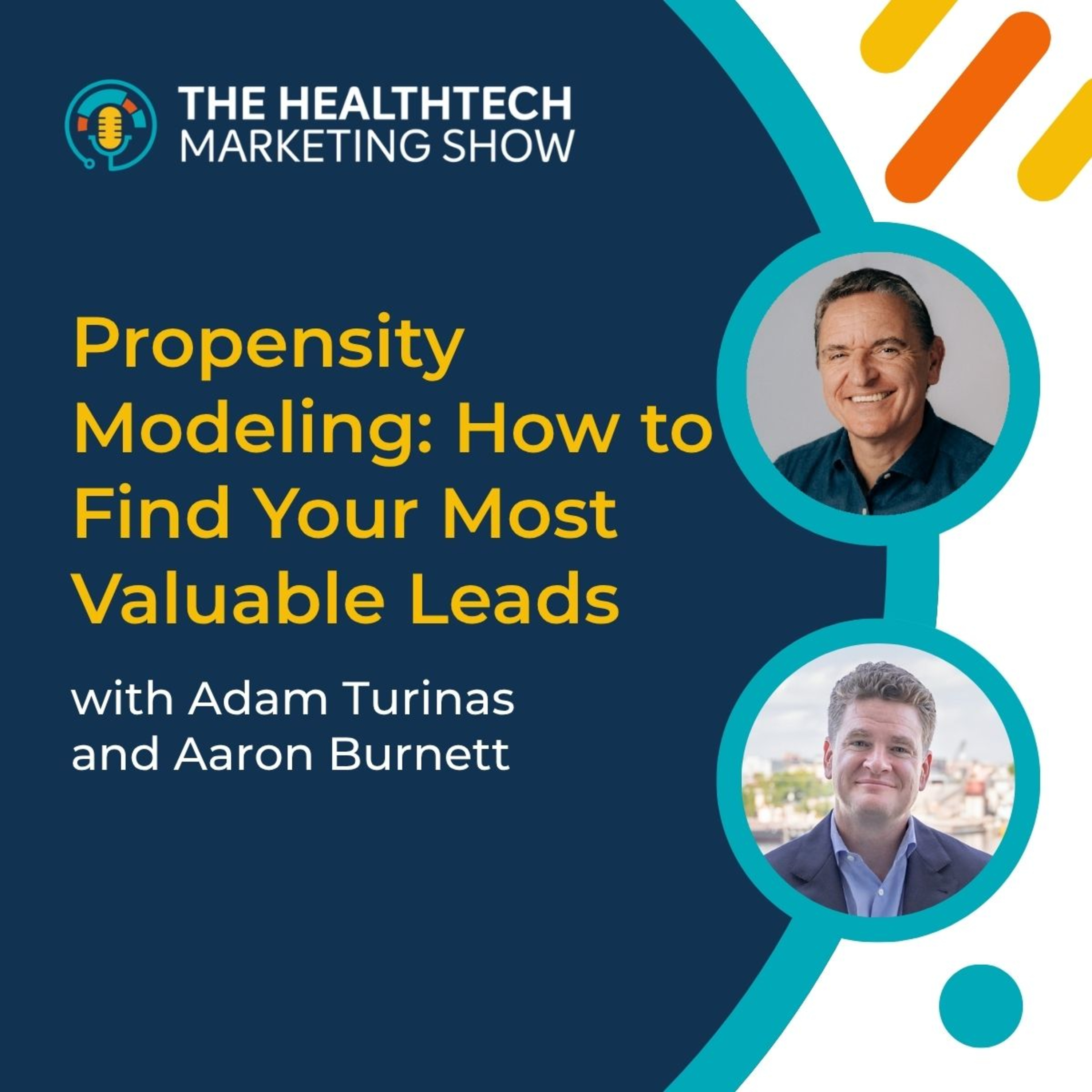
Wheelhouse’s privacy-first approach to “propensity modeling” for medtech/healthcare performance marketing—assigning each lead a predicted dollar value for lifetime customer value, then optimizing ad spend toward the highest-value prospects without sharing PHI. The episode also covers why “more leads” is the wrong goal, how HIPAA-compliant measurement enables real-time optimization, and how Wheelhouse uses AI to automate reporting (not replace experts).
Aaron Burnett, founder and CEO of Wheelhouse (performance marketing agency for privacy-first industries). Background: client-side VP of marketing roles including AT&T Wireless; founded Wheelhouse in 2010. Wheelhouse runs a HIPAA-compliant data warehouse, media mix modeling, and real-time propensity modeling; clients include medical device manufacturers, healthcare systems, and NASA.
send only a binary conversion event plus a financial propensity value to platforms; no PHI exchange; outcome-based optimization (new customer starts/patient show-up) beats lead volume.
for a large medtech provider, real-time propensity modeling increased new customer starts by ~50% in ~6 months.
Written by AI. May contain mistakes.
Learn how to assess the financial value of leads in healthcare marketing.
“And using all of that, we're able to say, oh, with this combination of characteristics, this lead is worth$8 ,000.”
Discover Aaron's journey from client-side marketing to founding a performance marketing agency.
“We're going to get into why more leads is the wrong goal for most medtech marketers.”
Understand the value of being genuinely helpful in building client relationships.
“I was a VP of marketing with a number of companies, starting with AT &T Wireless and then some other tech companies in the Seattle area.”
Discuss the current challenges in healthcare technology and offer advice for transitioning careers.
“I think we'll kind of look back and understand the moment that we're in in about five to ten years.”
Explore how Wheelhouse delivers marketing solutions tailored to healthcare and medtech.
“And I think of, there's one agency in particular I've come to know in our network called Sirona Marketing and a great couple of people who founded it called Abdul Rastegar and Caitlin LaHonta.”
Learn about Wheelhouse's approach to achieving meaningful business results for clients.
“No, the competitive set tends to be sites that harvest NASA's own research and information and repackage it and restructure it on their own sites and then commercialize it through advertising.”
Explore the importance of integrating CRM data to understand customer lifetime value.
“And so right from the start, we're asking about data and signals that typically aren't given to an agency and aren't even thought of for an agency.”
Discuss the unique challenges and solutions in marketing within HIPAA-regulated industries.
“Can you just sort of, if you don't mind, give a couple of stories?”
Learn how propensity data helps focus marketing efforts on high-value leads.
“and their own performance in a way that they don't have.”
Explore how AI is influencing business strategies and workflows.
“I've seen a couple of things over the last 24 hours that have really resonated with me.”
See how AI helps in creating presentations and reports efficiently.
“We've built out some vector stores so that we can put in concentrated information on a particular topic and put it in a secure place that doesn't expose it to the LLMs for other people to access it or train the LLMs.”
Understand how to guide clients on performance marketing readiness.
“You don't want to be doing performance marketing.”
Reflect on essential lessons regarding AI and marketing strategies.
“So said another way, it's start with outcomes and work backwards.”

Get the gist, explore an idea or ask about something said.
 Claude
On The Healthtech Marketing Show, what are the key points of this episode?
Searching your listeningAutomatic transcript. May contain errors.
0:00And using all of that, we're able to say, oh, with this combination of characteristics, this lead is worth$8 ,000. This one is worth$5 ,000. This is worth$10. And we send that in real time to the platforms. No PHI is shared. It is a pure financial value that is highly accurate and highly predictive of lifetime customer value that enables really step function in terms of campaign optimization. and performance. When we did this for a very large medtech provider, within about six months, we increased new customer starts by about 50%.
0:45Aaron Burnett: Welcome back to the award-winning Health Tech Marketing Show. I'm your host, Adam Chirinas, and thank you for taking the time to listen to our show. If you're new here, we've got more than 130 episodes in the library covering every corner of health tech marketing. So hit the follow or subscribe whenever you're listening to this show so you don't miss the next one. This show is very proud to be syndicated by Healthcare Now Radio, the only 24-7 healthcare-focused radio network and podcast platform out there. So big thanks to Roberta and Carol on their team for making this partnership with us work.
1:28Aaron Burnett: We really love working with you guys. Today's guest is Aaron Burnett. He is the founder and CEO of Wheelhouse. Wheelhouse is a performance marketing agency built specifically for privacy first industries like healthcare and medtech in particular. Aaron came up on the client side and he was like, for example, VP of marketing at AT &T Wireless and several other jobs before starting Wheelhouse in 2010. And he started with a very simple philosophy, which is be helpful first and let that generosity build the business. Today, Wheelhouse runs a HIPAA-compliant data warehouse and real-time propensity modeling with media mix modeling for clients ranging from medical device manufacturers to healthcare systems.
2:27Aaron Burnett: And they even work with NASA. We're going to get into why more leads is the wrong goal for most medtech marketers. And we're going to discuss how Aaron's team predicts a leads dollar value without ever touching PHI and why his agency sometimes tells prospective clients not to spend a dime with them yet. Let's get into it and meet Aaron. Aaron, welcome to the show. So it's so great to see you. You very kindly have me on your great podcast and I really enjoyed being on that. And so it's just wonderful to have you on this show. Well, thanks very much for having me. It was great to have you on ours.
3:12It was a fantastic conversation. So I'm looking forward to round two. Me too.
3:17Aaron Burnett: Nat, you've got an interesting background, right? You're not an agency person like me who grew up in the agencies and as a baby account guy. You came from the client side, right? I did. I did. I was a VP of marketing with a number of companies, starting with AT &T Wireless and then some other tech companies in the Seattle area. And in 2010, I founded Wheelhouse with a few things in mind. One, you know, I'd always been more technical than the average VP of marketing. I really gravitated toward deep understanding of technology that we were offering, services we were offering, and in fact, had invented some tech in working for other companies as well.
3:56And that sort of led me to a natural inclination to digital marketing. But there were a couple of other reasons that I started Wheelhouse as well. One is that I wanted to found the kind of agency that I always wished I'd been able to hire when I was running marketing for other people. And the second is that I wanted to create this sort of place that I wished I could work when I worked for other people as well. And I think the first of those is probably more germane to this conversation. You know, you grew up in agencies, and so you will be familiar with this sort of necessary dance that takes place, particularly between an account manager and a client.
4:33It's sort of a kabuki theater. You're the account manager. You are my friend. We're going to develop a nice, close relationship. And that is true. We are collegial, but it's also entirely coin-operated. And so if I ask for help, and that help is outside the bounds of a particular SOW that we have or a service agreement, then as the account manager, it's your obligation to flag that and say, here's a change request or we'll get another SOW for you and all those sorts of things. And that's just the way that agencies worked, certainly in my experience. And on a personal level, I recoiled from that.
5:07That made everything else that was collegial feel false. And on a professional level, what I wanted most was an agency and people who would just help. It's not always possible to know what kind of help you need when you begin working with an agency, particularly if you're trying to achieve a business outcome. You can't look 12 months ahead and know the challenges you'll face in month 10 and necessarily put them into an SOW. And so I tried to create an agency that would exist first to be helpful and an agency that would bake that into our values, where generosity was also a core value, where we say, okay, hey, look, we get we need to sign a piece of paper, but the piece of paper is going to be pretty simple.
5:47And you can ask us for any sort of help. And we will be generous with our time, expertise, and resources. We will probably do work that you're not explicitly paying us for. We'll commit to look out for your best interests, but we're also going to rely on you to look out for our best interests, just like the very nice people we were before we came to work. And this will all turn out fine. And in the main, that has been our experience. There are a few types of clients with whom that doesn't work. We learned to identify those after a few painful engagements that weren't good cultural fits. But otherwise, it's been a really good model for us.
6:21Aaron Burnett: I'm going to dive in more on that in a minute. But as you say, what occurs to me is that there's a lot of disruption going on and we're living through. I think we'll kind of look back and understand the moment that we're in in about five to ten years. but one of the things that I find so troubling particularly in healthcare technology is there's a lot of turnover there's literally not a week certainly not a month but often not a week that goes by without hearing somebody in our community losing their job laid off new management whatever it happens to be and I think that many of them if they have the ability to do it will go out and sort of they might not start an agency but they'll start fractional work or they'll be you know they'll come and join a company like ours and work as a contractor, maybe for a period of time before they go back into full-time work.
7:13Aaron Burnett: But I'm just really curious. It's like, do you have advice for anybody out there who's like, wants to do that? Said, you know what? I've got a little bit of headroom here. I've got the runway. Maybe I will go start my own thing. Yeah. There is a seminal book that I read early on in the development of Wheelhouse. So maybe year one, year two, called The Go-Giver. And I love that book. The thesis, it's an allegory. So a short read, easy read, it's a story. But the thesis is that if you're in a service business, the right way to engage, the right way to go to market is to treat everyone as though they're a client before they're a client, to behave generously from the outset, to figure out how you can be helpful to everyone around you and then let that helpfulness create the business that actually has value to the people with whom you're in contact and let that define who you are to your clients.
8:09And so it really does. It takes that notion of generosity and helpfulness to the extreme. And what's valuable in that is that we all know what it's like to engage with someone where we are absolutely conscious that there's an angle, that they're having a conversation, but they're also probing around for, okay, what thing might you pay me for? And how can I structure, how can I create a need here? Or how can I find a point of insertion? That feels bad. We are with, even if we don't consciously realize it, we brace ourselves, we're a little bit on guard. The key to this is to be sincerely helpful and sincerely generous in a way that is disarming so that people will tell you what they actually need and what truly would be helpful.
8:52And then you can sincerely respond with helpfulness. And if they need something more than you can offer as just casual advice in a conversation, they will want to work with you because they already trust you because of the way that you engage with them. So I would start first by identifying all the ways that you can be helpful to the people around you and generous with those people. And you will get signals that tell you what your value is in the marketplace. and people will raise their hands and say, I want you. You don't have to sell me. I want you. And that's a very different dynamic.
9:25Aaron Burnett: That is wonderful advice. And I'm going to make sure that there's a link to that book in the show notes. And I think of, there's one agency in particular I've come to know in our network called Sirona Marketing and a great couple of people who founded it called Abdul Rastegar and Caitlin LaHonta. And they visibly do that. Every week they publish a list of like jobs that they see out there. And we try to do the same with our network, but I think that they've really done a great job of just kind of formalizing it. People expect it. And I think it's created a great, a lot of goodwill towards them.
10:03Aaron Burnett: Right. Very early on. Yeah. Wheelhouse, tell us about what you do and the industries that you work in. Sure. Yeah. So we provide performance marketing for privacy first industries. So we have a concentration on healthcare and medtech, and the work that we do is all focused on achieving an outcome that has true business value. In a medtech context, that's a new customer start, for example. In a healthcare context, that's appointments booked, and even more to the point, that's appointments where the patient actually showed for the appointment and developed a relationship, and there was lifetime value in that relationship.
10:42Aaron Burnett: And so the type of clients are, so medtech would be device companies? Yep, absolutely. Medical device manufacturers on both the D2C and the HCP side. We work with healthcare systems. We have a few non-healthcare and medtech clients as well. And notably, we've worked with NASA for the last seven years. Obviously, not in either of those categories, but it is NASA. then we get to do work on a scale and a degree of complexity that you don't get anywhere else. That's kind of cool. Is the competitive set SpaceX then? No, the competitive set tends to be sites that harvest NASA's own research and information and repackage it and restructure it on their own sites and then commercialize it through advertising.
11:33Oh, how interesting. Gosh. Yeah, so it's aggregation sites, content aggregation sites.
11:38Aaron Burnett: So a lot of the people who listen to this show are B2B marketers. So the medtech angle is particularly interesting. Take us through sort of what a typical program would look like for either medtech or, you know, digital health. Sure. Yeah. Well, I'll kind of give you a thumbnail sketch of Wheelhouse and how we tend to be different from other agencies. And we're different in three ways. One is that we tend to hire and retain people who are at the very top of their game. So we are very focused on expertise. Top 10 % of your skill set, your discipline. We enable those folks with our own proprietary technology as well.
12:17And this is technology that is the culmination of years of developing solutions for clients in privacy-first spaces. So a HIPAA-compliant data warehouse, media mix modeling built on top of that, an enterprise-grade search intelligence platform, all tuned for privacy-first industries, and something called real-time propensity modeling, which I'll describe as well, which is a key signal in this market. And then the third is that because we have so much history in this space, we have developed a performance flywheel that delivers compounding returns over time. Our client relationships are very long.
12:54They're six and a half, seven years. And so it's not enough for us to step in, create some nice performance lift in the first six months, and then sort of coast on that. We need to double up and triple up year after year after year. And we've been able to figure out a way to do that. The way that we work with clients, it tends to be consistent with this performance flywheel, the same cycle. So we will step in, we'll identify client needs sort of consistent with my description of figure out what help is required. And that client need may be in the area of demand generation. So it might be digital advertising, it might be digital strategy, so organic, it might be complex analytics, implementation of HIPAA compliant measurement solutions.
13:37will start with their need, and then we will identify the business outcome that they want to achieve. And part of the magic of the way that we work is that we're not looking for the business outcome that clients typically describe to agencies, which is, hey, if I'm in medtech, I need more leads. That's not actually what a medtech client needs. They need new customers using their device. They need revenue. And so right from the start, we're asking about data and signals that typically aren't given to an agency and aren't even thought of for an agency. So we want to integrate with a client's CRM and backend systems so that we know when a new customer start happens.
14:23And then we can follow that customer through. And even more to the point, we can figure out their lifetime value to that client. We want to understand demographically what are the characteristics of that new customer and of the historical customers of this organization. And we want to do so because of the following. In our first six months, 12 months of working with a typical client, we're using conventional signals. We're going to use conversion signals available through ad platforms and analytics and the like. And because our folks are expert, we can drive rapid performance gains. And those rapid performance gains earn trust.
15:00They earn leadership trust. And most importantly for us, they earn access to data. And with that access to data, we can integrate our HIPAA-compliant data warehouse with a client's CRM. And we can get access to data that other agencies don't. And because of the way we aggregate data, all of the platform data, all of the analytics data, a client's first-party data, and these conversion signals, we now have a view of the entire prospect journey across platforms and channels and messages and creative types, whether organic or paid. And we can then begin to optimize for the actual moment of value creation, which is new customer start.
15:42With access to better data, we have better insights, we can drive even better performance, and that always earns us access to even more data. usually data that the client didn't realize would be valuable to us or we would care about. So we can do things like this. In the case of a med tech client and really any long sales cycle client, but this is particularly challenging in HIPAA regulated industries, you've got a couple of problems. The expansion of the definition of PHI at the end of 2022 was really problematic in terms of the use of third-party tracking. So you lose a lot of signal in terms of measuring conversion.
16:21You also lose a lot of signal in terms of targeting audiences. Most of the things that you would use to go after a particular audience demographically, psychographically, even in terms of their behavioral history, you can't do in this context. That is particularly problematic as ad platforms have become more algorithmically focused and they need real-time signal in order to drive the algorithmic optimization. You have a second issue, and that is that the moment of, let's say, lead capture for MedTech is often 90, 120 days, 270 days ahead of the moment that someone actually becomes a new customer for that client.
17:02So you've lost the signal from third-party tracking, and even if you had it, the actual moment of value creation is maybe six months down the line.
17:12Aaron Burnett: Just for clarification, when you're talking about a customer here, are you talking about an end user customer? No, we're talking about the med tech client. So device manufacturer wants to do one of a couple of things, wants to either attract and recruit HCPs. Quite often for us, they want to attract and convert new customers, actual users. Got it. So the campaigns that you're doing, Sounds like some of them are, say, a device manufacturer to attract maybe a new surgeon or a new endocrinologist to start adopting your platform with their patients. And then there are other use cases where you're actually trying to attract patients to use a device or a digital health application on behalf of your client.
18:08Aaron Burnett: Can you just sort of, if you don't mind, give a couple of stories? One, which would be a medtech company getting new, I guess, clinicians or new practices to adopt the application. And then a second one, which is all the way through to a patient. Sure, absolutely. Let's start with the second one first, because it builds on that description that I was just giving of that distance signal, the moment of lead capture versus the moment of conversion. What we've done to solve for that is something I don't think any other agency has done, and that is to develop a real-time propensity signal. We've worked with clients, and we've gone through their historical customer records, and we've identified those factors that are highly predictive of a high lifetime customer value.
18:56And we've used that to generate a financial value for every combination of characteristics at moment of lead capture.
19:06Aaron Burnett: So that might be income, health insurance, that kind of thing, right? Uh-huh. Income, health insurance, particular condition. Are they working with a physician who is a known HCP to the medical device provider? All sorts of things. And using all of that, we're able to say, oh, with this combination of characteristics, this lead is worth$8 ,000. This one is worth$5 ,000. This is worth$10. And we send that in real time to the platforms. No PHI is shared. It is a pure financial value that is highly accurate and highly predictive of lifetime customer value that enables really step function in terms of campaign optimization and performance.
19:55When we did this for a very large medtech provider, within about six months, we increased new customer starts by about 50%.
20:02Aaron Burnett: And it sounds like not just increase the volume of them, but actually the value of them as well, right? It sounds like if you're feeding the platform algorithms with focus on these because they're worth more, then more impressions are going to be put in front of those prospective users as opposed to not the level. that's true, but not necessarily more impressions overall. We may in fact reduce reach because we're being more targeted. Right. Got it. You may just say, don't bother with these, just focus on those. Yeah. Just give us that. And you're saying you're not sharing PHI. So are you doing this based on, is it based on like device ID or UID?
20:47Aaron Burnett: How does that work? What's the mechanics of that? So we send only one flag back to the platforms, and that is a conversion event. That's it. And it's a binary flag. And we'll send the conversion event and the propensity signal, which is a financial value, neither of which are tied to a particular item. So it said, we want you to advertise to these hundreds of thousands or 10 ,000 people. So here's our universes of 10 ,000 people. but actually we only really want you to focus on this, the thousand, because they're the ones that actually are our target. And we're not going to tell you why, it's just this.
21:24Aaron Burnett: But in the background, you're filtering that 10 ,000 down to 1 ,000. Exactly, exactly. And all of this is done server-side using HIPAA-compliant tracking that we've implemented. And so there is no exchange of anything that's even in the neighborhood of PHI. On the HCP side, we're doing a couple of things. One, we're able to profile and target audiences with a little more latitude than you can on the patient side, so we can be effective there. We also, because we can integrate and commingle this data and understand the relationship between HCPs and the downstream impact on new customers, we can understand and justify and tune and rate limit investment based on what we can be confident of is the downstream implication for revenue in patients.
22:17We can do that by geography. If we're conquesting into geography, we can do that by specialty, by going back to certain audience providers and defining exactly the sort of HCPs we're going after. And then as we do so, because we have everything integrated in our data warehouse and because we have sophisticated analytical methods like media mix modeling, we can see the relationship.
22:41Aaron Burnett: And so essentially for the HCP, and I think when you're talking about recruiting HCP, it's not necessarily a health system. It's probably like a specialty practice or something like that, right? Yeah, got it. And so it sounds like you're using the same propensity principles to focus the investment on the highest likely customers, same as you're doing on the patient side, but just applying it to the individual providers. Yeah. And then the thing that has been sort of the thorny gap in all of this is tying HCP engagement with patient or new customer impact. And again, because we have a unified data warehouse that includes all of that information.
23:30And we have the capacity to do very sophisticated modeling. We can see, you know, you're an agency guy, so you're familiar with MMM. It's direct, indirect, and joint effects. You can't use attribution modeling to see whether this worked or not. It's much more nuanced than that.
23:45Aaron Burnett: Right. So you talked about developing some technology. I've heard about Compass, Lighthouse, Sonar. I think those are some of them. Tell us about that, those tools. So we're a 16-year-old agency. Until 2022 or so, we were positioned as a generalist agency. We had all sorts of different clients, and we helped them with all of the disciplines we knew how to do. But like a lot of agencies, we grew through referral. And we had a beachhead in healthcare starting in 2012. We were working with one of the largest health systems in the U.S. then. And people went to other places, and we got more and more clients.
24:21And so at the end of 2022, when there was this announcement from OCR that really upended third-party tracking and changed the landscape for analytics and advertising, we realized a couple of things. One is, oh, actually, healthcare and medtech already was 70 % of our customer base. We just hadn't declared. It was a head-slapping moment. We hadn't declared the specialty. But the other thing is that we had already developed a HIPAA-compliant data solution, and it had been in production since 2019 with this very large health system. And so when the new HHS guidance came out, that health system didn't have to do anything.
25:00They were already compliant, and they were future-proof, which was their intention. That was their ask to us in 2019. We think we know where privacy regulations are going. Even if we're not right, we want to be future-proof. So build a system that does that for us. So we found ourselves in a place where we had a technical solution that was perfect for the moment. We already had a de facto concentration. We had been working to drive exceptional performance for clients in highly regulated industries already. And we already had developed our own data warehouse and our search intelligence platform.
25:37The issue for us was, you know, a performance marketing data warehouse can be described in lots of different ways to lots of different types of clients in lots of different industries, which is, you know, seems like a great thing. But you and I both know that's a real problem when you're trying to be very clear and concise in your messaging. And so we actually had a problem getting traction with our data warehouse when we were serving all sorts of different types of clients. It's the moment when we said, ah, we have shifted and we've now deployed our data warehouse on HIPAA compliant infrastructure and we've reworked our data pipeline and ETL processes and completely changed our infrastructure so that it's all HIPAA compliant.
26:22And now here is the value to organizations who are in privacy first industries that people said, oh, we absolutely understand what that's for and why this has unique value that is highly differentiated in market. And then we have continued to build on that infrastructure. And one of the obvious challenge that all advertisers have is that each of the platforms presents their own performance data in a way that is advantageous to them and uses different metrics, different language, different ways to frame what is and isn't a conversion. Meta will claim three times the conversions that actually exist in real life, and Google will do something else, and they will all call it something different.
27:05And so it's always been quite challenging to get a harmonized and unified sense for what your performance is. And we were able to do that with this data warehouse. And then by layering on integration with first-party data and CRM and building media mix modeling in a way that is privacy compliant by design and search intelligence on top of that, and then integrating propensity modeling with it, each new thing that we've done delivers better and better insights. And each new thing that we've done also deepens our relationship with our clients because we're able to give them insights and a view into their own marketing operations and their own performance in a way that they don't have.
27:50Often we're able to give them insights into aspects of their marketing operations or elements in their data that have nothing to do with what we're doing. We simply have that data and can show them something they wouldn't otherwise have access to.
28:04Aaron Burnett: Great. Adam here. I just want to tell you about something we do here at Health Launchpad. Aaron just walked us through how Wheelhouse uses propensity data to stop chasing every lead and focus spend on the ones actually worth pursuing. We do something for B2B health tech companies on the account side, especially the ones with long, complex sales cycles. Our ABM programs start the way Aaron's team starts a new engagement, which is figuring out which accounts actually will convert into revenue and not just the ones that you're going to have on your pipeline report. We build target account lists around your best fit buyers, and then we run coordinated outbound content and paid media campaigns against these specific accounts.
28:57Aaron Burnett: And what we're able to do is track the engagement all the way through from pipeline to closed revenue, not just measuring clicks. If your team is running broad-based demand gen and wondering why the pipeline doesn't match the spend, that's usually a sign that you need an ABM approach instead. So reach out to us at Health Launchpad and we'll show you what that looks like for your business. What's been the impact of AI on what you do and how you do it? So AI has been fascinating. I've seen a couple of things over the last 24 hours that have really resonated with me. One is that early on with AI, I thought I love new and I love technology.
29:37And so I thought, aha, we'll build all sorts of things. And very quickly realized, oh, all these things that appear to be real and ready are only 80 % real and definitely not ready. It's probably better to wait. And also it became very readily apparent that whatever you build, you're building on rented land. You don't own the LLM and that can all change as well. And so we sort of took a step back and said, okay, we're not actually developing anything. We are going to develop, we will assemble composable solutions, but we will not build our own anything. And that first has served us very well. So it's better to be late than early in AI, which is interesting and very different than other dynamics in my career.
30:20The second philosophical approach we took is that becoming an AI-enabled agency, as with offshoring in years past or creating really tightly defined processes and hiring low-cost labor to do that work domestically is just a rapid downhill slide to commoditization. And so our philosophy has been we have super expert people. We hire and retain them for a long time. We deliver a high degree of strategic expertise and performance. And so we're not going to replace anyone with technology. We're going to enable them with very thoughtfully developed, very sophisticated workflows, which we have done. So we're able to do things now that we couldn't do before, but we're not attempting to do higher volumes of things that had mediocre value before.
31:08We also have incorporated AI into our business intelligence practice. So we've standardized on an AI BI platform that is both computationally accurate, it's determinative, and it still has the non-determinative aspects that are kind of the magic of AI as a foil so that our expert strategists can talk to our data warehouse. They can ask all sorts of hypotheticals, but it is also true that their monthly and weekly reporting is automatically generated for them, and it is to the penny and to the single digit accurate for them. It just means that instead of having to spend a lot of time assembling spreadsheets and graphs, they can focus on higher value work.
31:53It's been a game changer, but not in the way that most other agencies have made it a game changer.
31:58Aaron Burnett: We found that the simplest word to describe its impact is it just does the boring stuff. I'll give you an example. We've built out some vector stores so that we can put in concentrated information on a particular topic and put it in a secure place that doesn't expose it to the LLMs for other people to access it or train the LLMs. So that's part of it. And then we've created a series of workflows and supported by, we call them AI teammates. They're typically sort of like custom GPTs or things like that. And then a whole bunch of different skills around that. And I give a real simple example of how it sort of saves us with the boring stuff.
32:44Aaron Burnett: I had a really great new business call with a prospective client early this week. and he's early stage, not sure whether he wants to do awareness advertising, sort of pure lead generation, wants to go all in on ABM. And so I said, yeah, I can understand why you'd want to do that. And so I said, well, tell you what, let's do a present. Give me a week and I'll present to you those options. And so I had a conversation this morning with Claude and I said, hey, Claude, I've got a presentation with this company. I want you to go into Fireflies, listen to the transcript, so that you get familiarized yourself with his business and his situation and the conversation that we have.
33:26Aaron Burnett: And then I want you then to go off into the new Vector store that we've created for new business with all the past proposals and case studies and all that sort of stuff. And I want you to create an outline for a presentation. So then had a conversation to get the outline right. Now go into the Claude skill and create a deck using our template. so it took me 20 minutes it would have normally taken me about three or four hours to do that presentation yeah and that's where so that's your example of like for the person who's got to do like the weekly reports or a qbr and it's got to do it's like it just makes that whole process easily and that's what i think it is right now yeah there is some interesting stuff starting to emerge in the area of intent data and so the next year is going to be fascinating i think that's Sort of, yeah.
34:16Aaron Burnett: Yeah. So very, very interesting. I mean, I want to ask you sort of a kind of a closing question, which is, do you ever get a client where they say they want performance marketing, but they don't really know what it is and you think, actually, it's like, yeah, it's just not, this is not right for you. You don't want to be doing performance marketing. Yeah, absolutely. We have, so that happens quite frequently. We have a client right now with whom we probably started speaking two and a half, maybe three years ago. And they came to us with, we want performance marketing. We're ready to go. And the team looked at their products, their website, their messaging, and said, no, this would be a waste of money right now.
34:58These are the things that are foundational that you should do first. And, you know, some of them you should not do with us. It's just some housekeeping that you have to do internally or find someone who can really help you with branding and messaging and really specializes in that. there are some things on your site that mean that no matter how well someone executed advertising for you, you would fail. And you would fail from a performance perspective. You would fail from a brand perspective. And so we can tell you what those things are, or we can just give you some advice and you can figure them out yourself, but you should not spend money with us right now.
35:35And to their credit, they went away and fixed those things. And we guided them a little bit on those things and then came back and said, now we're ready. And we were able to say, yes, you are. And now we can help you. But that sort of thing happens quite often for us, either in a way like that. You shouldn't, you shouldn't actually work with us right now. You're not ready. More often though, what happens is that a client comes to us and they say, we need digital advertising and we want to talk to your digital advertising team. And we listen and say, yes, okay, we understand that, but you won't be successful if you start there.
36:08You actually should start over here with a measurement framework that will enable you or us or someone else to actually understand if this is working or not. Otherwise, it's just going to be good money after bad. Even if it works, you won't know how it worked and you won't be able to replicate it. Or, you know, you need digital strategy. You have to create some brand awareness and positive sentiment, particularly now in the age of AI, so that if and when your advertising starts to work and people are looking for social proof or they're looking for some other validation and they drop into an LLM, the LLM has something to say about you in the competitive set and it's good.
36:47So yeah, we quite often steer people to other places rather than just saying, sure, how many of those would you like?
36:54Aaron Burnett: Yeah, absolutely. So said another way, it's start with outcomes and work backwards. And that's kind of approach that we take with ABM. The other thing is when you were talking about sort of the clients would come to you and said, you know, we want to get started and you tell them no. It sort of reminds me of an old David Ogilvie saying, which is there's nothing like great advertising to make a bad product fail faster. Yes. What strikes me is that the thing with performance marketing is that just happens. You know, it might take you back in the old days, that might take me six months to realize that you really shouldn't have been doing it.
37:28Aaron Burnett: You've probably figured it out within six days. Yeah, exactly. Exactly. Aaron, how can people find out about you and your business and all the great stuff that you do? Sure. They can find out about wheelhouse at wheelhousedmg.com. They can find me on LinkedIn. I'm slash Aaron Burnett, and they can reach me via email at aaron at wheelhousedmg.com. We'll have all that information in the show notes. Aaron, such a pleasure having you on the show. I've learned a lot from listening to you and my head's spinning. I'm really looking forward to come back and listening to this episode and to really process a lot of what you just said.
38:07All right. Thanks very much for the opportunity. Nice conversation.
38:10Aaron Burnett: I really enjoyed talking to Aaron. It's great talking to a fellow agency leader about the way that he works with his clients. And I really learned a lot. Here are some of my takeaways. ways. So takeaway number one, measure outcomes, not leads. Aaron's core argument is a medtech company doesn't need more leads. It needs customer starts and revenue. A healthcare system doesn't need appointments booked. It needs patients who show up and stick around. Build your funnel around the outcome that actually pays the bills, then work backwards. Takeaway two, real-time propensity data changes what platforms optimize for.
38:58Aaron Burnett: Wheelhouse assigns a financial value to each lead based on historical characteristics that predict lifetime value and sends only a conversion flag and that value back to the ad platforms with no PHI involved. For one large MedTech client, That shift drove a 50 % increase in new customer starts. Takeaway three, build compliance in before you're forced to. Wheelhouse moved to HIPAA compliant infrastructure in 2019, three years before the 2022 OCR guidance tightened the rules on third-party tracking. Their clients didn't have to scramble when the rules changed. They were already future-proofed. Number four, AI should remove drudgery, not replace expertise.
39:52Aaron Burnett: Aaron's philosophy, it's better to be late than early on building AI tools because you're building on rented land, i.e. someone else's LLM. Wheelhouse uses AI to automate reporting for its expert strategists so they can focus on higher value work, not to cut headcount. And the last takeaway, sometimes the right answer is not yet. Wheelhouse will tell a prospective client to fix their product, brand or messaging first before spending a dollar on performance marketing. No amount of media spend fixes a broken foundation. It just makes the failure more expensive and more visible. If you've enjoyed this show, there are plenty more episodes coming and there's a ton of them in our archive.
40:42Aaron Burnett: So do subscribe or follow the Health Tech Marketing Show so that you don't miss a single episode. You can learn more about Aaron and Wheelhouse through the links in the show notes below. And I've also included a link to the book that he mentioned called The Go-Giver. And lastly, if you think somebody else in your network would value this, why don't you go ahead and forward it to them? They'll appreciate it. And I always appreciate it when somebody new gets to hear our show. With that, I'll bid you farewell and see you on the next episode of Health Tech Marketing Show.
Does your team keep chasing more leads but can't explain why the pipeline doesn't turn into revenue? This episode is for you.
Aaron Burnett, founder and CEO of Wheelhouse DMG, built his agency specifically for privacy-first industries like healthcare and medtech, and he walked me through something most agencies can't do: predicting the dollar value of a lead in real time, without ever touching protected health information.
We get into why more leads is the wrong goal for most medtech marketers, how Wheelhouse's real-time propensity modeling drove a 50 percent increase in new customer starts for one large medtech client, and why Aaron's team sometimes tells prospective clients not to spend a dime with them until they fix their product or messaging first.
If you are trying to make sense of measurement in a HIPAA-constrained world, wondering whether your dual funnel of patients and physicians is actually working the way you think it is, or curious about how AI fits into a performance marketing agency without replacing the experts who make it work, you will get a lot out of this conversation.
Key Topics Covered
If you are interested in discussing this or any other topic, let's have a chat. Reach out to me directly to schedule a no-obligation discussion. This isn't a sales call, but rather an opportunity to talk through your questions and challenges.
Subscribe to The Healthtech Marketing Show on Spotify or watch us on YouTube for more insights into marketing, AI, ABM, buyer journeys, and beyond!
Find all of our episodes on the Health Podcast Library.
Thank you to our presenting sponsor, HealthcareNOW, 24/7 expert shows, interviews, and podcasts, powering healthcare leaders with innovation, policy, and strategy insights.