Ask ChatGPT


 The Healthtech Marketing Show
17 Aug 2026 · 38m · 18 chapters
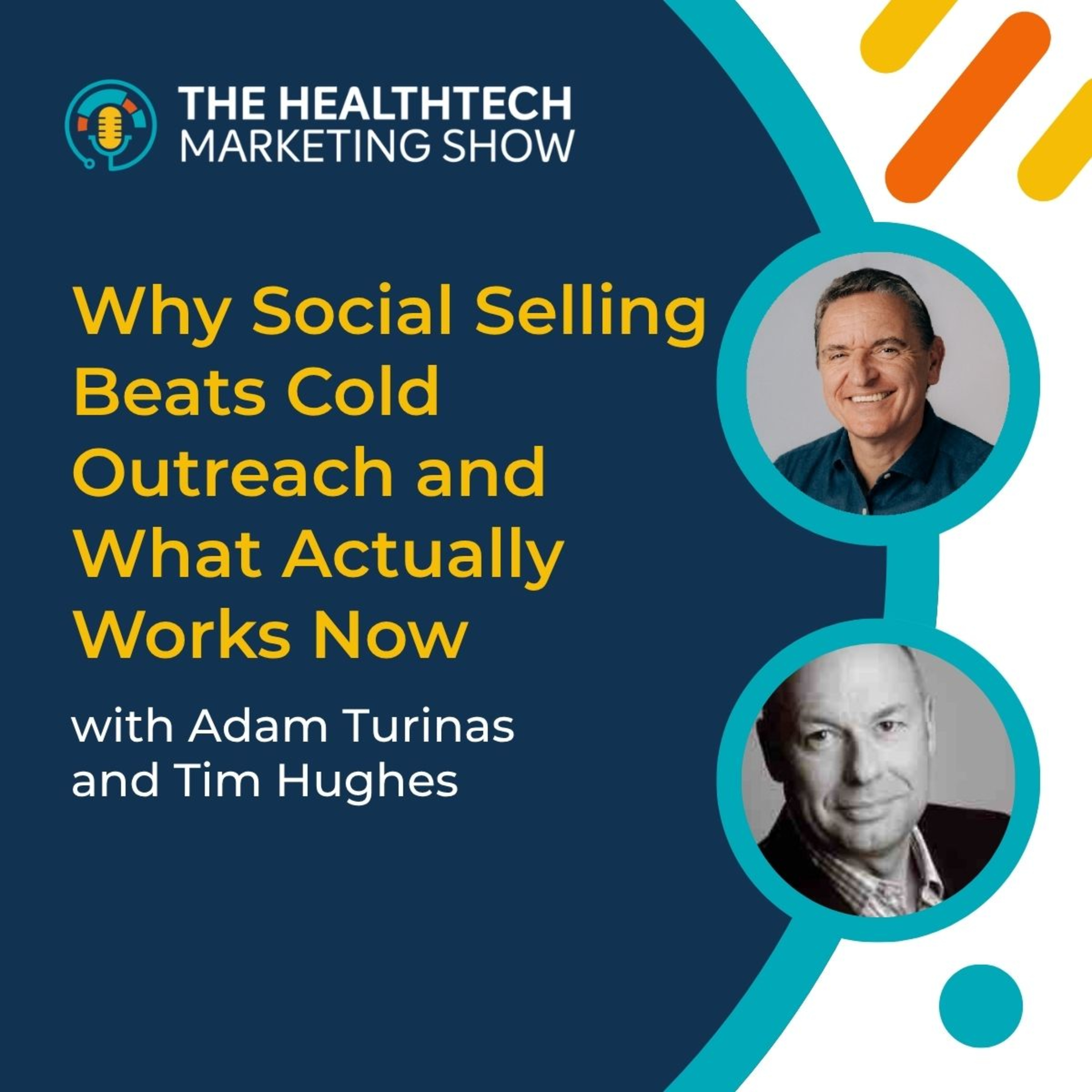
Why cold outreach is failing (cold calls ~3% connection rate; email blocked as spam; AI-generated LinkedIn/email messages are easily detected) and what to do instead: social selling that builds trust and conversations. The episode argues AI should help salespeople sound like themselves and follow brand guardrails, not automate spamming.
Tim Hughes, co-founder of DLA Ignite; 35-year new business sales veteran (20 years at Oracle/Oracle channel). Built a certified social selling methodology (10 years ago) and authored Social Selling and Influence (4th edition published Easter 2026). Builds an AI platform called Aspetillo.
Buyers still buy via trust/relationship; LinkedIn “selling” starts with conversation, not selling from the profile. AI should scale humanity by enabling authentic posting/commenting at scale.
Salesforce client using LinkedIn to get ~7 ICP meetings/week; Rent-A-Kill example showing tools fail without training; Aspetillo demo where posts are generated in the user’s voice with guardrails and scored for ICP/value proposition fit.
Written by AI. May contain mistakes.
Discussion on the challenges of cold outreach in sales and the rise of social selling.
“intersection of health tech and marketing.”
Guest introduction of Tim Hughes, discussing his background and expertise in social selling.
“I'm not sure I fully buy that, but it's certainly not getting any easier.”
Tim shares insights on the importance of building relationships and trust through social media.
“I spent 20 years either at Oracle or in their channel.”
Exploration of the challenges salespeople face with traditional outreach methods and spamming.
“You've been in a situation where either someone sends you a list of their products and services, or they connect to you and give you a list of products and services.”
Discussion on how an AI platform can help salespeople build trust and relationships effectively.
“and networking and getting conversations.”
Strategies for creating impactful content on LinkedIn to build visibility and engagement.
“And they come to me and someone came to me and said, there's people who started repeating back to me what I'm saying.”
Learn how to simplify social media content sharing for sales teams.
“We've taken out all of the friction so you can actually post content on social and you can do it in literally in a minute.”
Understand the challenges faced by B2B marketing leaders in current channels.
“Let's just take a second here to talk about something that Tim has laid out here.”
Explore how different sales team members respond to training and coaching.
“just aren't working like they used to, you can learn more at Health Launchpad about the different ways you can start to really get your pipeline scaling again.”
Discover how AI can create personalized content for salespeople.
“So everything that we do is completely AI native.”
Learn about the user experience and functionality of AI content tools.
“So the thing is, is that you're putting out content, which is applicable to your value proposition in your ICP that meets the brand guidelines.”
Understand how to simplify the posting process for busy sales teams.
“New product introduction in life sciences.”
Find out how to enhance engagement by effectively commenting on posts.
“We sat down and we said, how can we take all the friction out of that?”
Learn how commenting on social media can build connections and trust.
“So, for example, after we had the demo, I went and commented on three of your posts.”
Discover the importance of training in utilizing social selling tools.
“went to a company here in the UK called Rent-A-Kill.”
Understand why modern prospecting differs from traditional methods.
“And back to your earlier point, I mean, commenting becomes an absolutely critical way to do it.”
Learn how to connect with Tim Hughes and his insights on social media.
“So we're looking for the third, fourth and fifth.”
Explore crucial takeaways from the conversation regarding social selling.
“It was great having Tim back on the show.”

Get the gist, explore an idea or ask about something said.
 Claude
On The Healthtech Marketing Show, what are the key points of this episode?
Searching your listeningAutomatic transcript. May contain errors.
0:00Tim Hughes: To build influence, make connections, grow relationship and trust, which leads to conversations and commercial interaction. So that's not going onto the platform and sparing people. In effect, that's going onto the platform and networking and getting conversations. So we're not saying that you're going to sell stuff, even though we've got clients that are doing multimillion dollar deals on LinkedIn. Usually I say at the beginning of presentations to people, I said, right, you know, hands up. Who would like, if I was going to pick you up tomorrow, pick you up in my car, and I'm going to take you to a place.
0:30Tim Hughes: where all of your prospects are hanging out, all you've got to do is go and talk to them. Would you want to go? And everyone puts their hand up and they say, well, that's LinkedIn.
0:42Welcome to the Health Tech Marketing Show, the award-winning podcast covering everything at the intersection of health tech and marketing. I'm your host, Adam Turinas, CEO of Health Launchpad. Before we get into it, thank you for tuning in. And if you haven't already done so, please follow or subscribe with whatever podcast application you use. You can also find us on YouTube. And if you haven't checked us out before, look back in the archives. We've got close to 140 episodes covering just about every corner of B2B health tech marketing. A quick thank you to our syndication partner, Healthcare Now Radio.
1:26They're the 24-7 healthcare-only radio network that brings this show and dozens of others to listeners all around the world. Big thank you to Roberta and Carol for making a truly wonderful partnership. We really appreciate everything that you do. Today's episode continues our series on AI and sales enablement. We had Bruce Brandis from Whalehawk on the show to talk about agentic sales acceleration and Jennifer Lazars from Medical Informatics Corps, who talked about AI enablement and change management that goes with that. And then most recently, the wonderful Nick Panay talking about AI powered lead scoring, as he calls it, agentic lead scoring.
2:19Today, we're tackling a different problem. And this is that cold outreach seems to be getting harder and harder. Some even say it's dying. I'm not sure I fully buy that, but it's certainly not getting any easier. And some of the evidence of that is that connection rates seem to be cratering and emails are harder and harder to make work. They get blocked en masse by healthcare systems. And on top of that, a lot of people are using AI to generate email and LinkedIn messages and people that you're selling to can see it instantly. And it's a real turnoff. You know, this is really hurting all of the outreach media that we have at our fingertips.
3:08So what actually works these days? And to help me with this question, my guest today is Tim Hughes, who is the co-founder of DLA Ignite and a 35-year veteran of new business sales. 20 of those were with a mighty oracle working in sales and in the channel. 10 years ago, he built the only certified social selling methodology in the world. And this year, he published the fourth edition of his really great book, Social Selling and Influence. I read this book several years ago, and it's really helped shape my thinking on the power of social selling and how to do it well. Tim and his team have spent the last 12 months building an AI platform that does something counterintuitive.
4:00It helps salespeople sound more like themselves, not less. So with that, let's get into it and meet Tim. Tim, so great to see you. Welcome to the show. I think this is your second time on the Health marketing show.
4:16Tim Hughes: It is my second time, Adam. Thank you so much for inviting me on. I'm really excited to be talking to you. Yeah. Well, hey, so for folks who don't know you, tell us a little bit about you and what you do and how you're helping sales teams. Yes. So my background is new business sales. I've been in new business sales for probably about 35 years. I spent 20 years either at Oracle or in their channel. I was on the board in the UK. And 10 years ago, well, 15 years ago, I actually started getting bored with all that and wanted to do something else and started getting involved with social media. And then 10 years ago, I set up a company called DLA Ignite with Adam Gray, my business partner, and we train and coach people how to social sell.
5:01Tim Hughes: So that's not how to span people on social. It's basically a way of connecting to people and ultimately getting conversations and doing it in a way that the buyers actually enjoy. Now you've worked with hundreds of big companies. We've worked with people all the way from like solopreneurs up to, so Salesforce is one of our clients. Oh wow. So we have a guy at Salesforce who sells into, sells to government, but he still gets seven meetings a week, seven ICP meetings a week. He gets more meetings than anybody else in the whole of Europe, Middle East and Africa. And I gather you may or may not have written a book about this.
5:38Tim Hughes: Yes. So my fourth book on this came out at Easter this year, Social Selling and Influence. I went to a publisher for the first three. The first one came out 10 years ago, and this one came out at Easter 2026. I wrote it at Christmas 2025. And that has all of our experience from the last 10 years, plus some myth busters and stuff in there, which we quite often get. Like we got 10 ,000 impressions and I'll say, yeah, so what? It's meaningless. And I explain why and stuff in the book. I also have a chapter in there about AI, which is kind of the introduction to what we're talking about today because we've now been working with AI for over 12 months.
6:18Tim Hughes: I know we're going to talk about it today. Yeah, that's great. And I've read that book, well, the previous iteration of the book a couple of years ago. It was about four or five years ago now and I thought it was terrific. And actually, you know, when we're advising clients on how to use LinkedIn, it's certainly a lot of the thinking in there stuff that we're talking to clients about. So I can't recommend it enough. And there'll be a link down below in the show notes. Okay. So when we caught up recently, you were telling me about an initiative you've been working on, which sort of addresses like one of the biggest challenges that salespeople have in using LinkedIn.
6:56I mean, it's something which is, everybody knows they should be using it, but it's surprising how few people actually, salespeople, use it effectively. if at all?
7:07Tim Hughes: Yes, LinkedIn. If we talk about sales as a whole, I spoke to an SDR leader the other day, and he said that their connection rate on cold calls was down at 3%. That's just the connection rate. So if you think about how many calls then to go to voicemail and stuff like that, it's basically flatlining. And everybody I talk to around email marketing, it's so simple to use AI to basically spam people, that it's completely lost anything. So we've lost those two mechanisms. So what people have done is take it to spamming people on social. You've been in a situation where either someone sends you a list of their products and services, or they connect to you and give you a list of products and services.
7:51I always think it's interesting that in your LinkedIn inbox, there's two tabs. There's what they call, I think, focused, and then there's whatever the other one is not focused. And it's always, that's where the in-mail goes.
8:04Tim Hughes: Yes, because people are reporting. You know, anyone who spams me, I report contacting LinkedIn and they say that you can report them for harassment. So that's what I do. That's a full-time job. Well, it is, yes. You know, I'll get, you know, so just so people know, our definition of social selling, and I think this is important, is I'm just going to read it off the wall here, is using your presence and behavior on social media to build influence, make connections, grow relationship and trust, which leads to conversations and commercial interaction. So that's not going onto the platform and sparing people.
8:38Tim Hughes: In effect, that's going onto the platform and networking and getting conversations. So we're not saying that you're going to sell stuff, even though we've got clients that are doing multi-million dollar deals on LinkedIn. Usually I say at the beginning of presentations to people, I said, right, you know, hands up. Who would like, if I was going to pick you up tomorrow, pick you up in my car, and I'm going to take you to a place where all of your prospects are hanging out. All you've got to do is go and talk to them. Would you want to go? And everyone puts their hand up and they say, well, that's LinkedIn.
9:03Tim Hughes: You can access it in your plans at home. You don't even need to, I don't even need to come around to pick you up. And the other thing is that the mistake that people make is that they think they've got a sale on their profile. You're never going to sell anything from your profile. The whole point of your profile is to get a conversation. And if you're standing there going, hey, here we are at a sales kickoff and the clients are going, well, you told me you're going to spend the money on R &D and what you're doing is you're spending it on a good time in Hawaii. That actually isn't a great post.
9:35Tim Hughes: So this thing was about the psychology of people that want to buy. And fundamentally, people buy based on trust and relationship. So 12 months ago, when we started looking at this AI agent, what we were seeing were people creating robocallers and email spammers. It's like, that's the way you sell. and everybody hates it. Now, as a professional salesperson, there's lots of people, I've been contacting people, and they believe that the future of sales is spamming people with AI. Fine, that's great. We're not the people that, you don't listen to me because I'm not the person that's going to tell you to do that.
10:12Tim Hughes: What we did is that we said, okay, if that's not working, what is working? Well, why don't we create something based on how people buy? So how do people buy? Well, if you look at the research from Sixth Sense and Forrester, guess what? People buy based on trust and relationship. And they've done that for thousands of years. And so let's create something that enables salespeople to build trust and relationships at scale. And I've seen articles from marketing gurus from Mark Schaefer saying, how can we use AI to scale our humanity? It's like, well, actually, we've created it, Mark. I've actually got a meeting with him coming up.
10:49Tim Hughes: So, um, you know, that's what you said that you wanted and we have that now. That's fascinating. And I think about the way that it's, it's changed so much over the last two years. I, you know, it's about two years ago, I would say that 50 % of our business came in through referrals and 50 % came in through inbound marketing, which was primarily a combination of SEO and LinkedIn. It worked pretty well. And it started to break up about two years ago because of the entrance of LLMs. What I find these days is that you still get referrals, but the same sort of number of referrals. Our inbound has gone up.
11:33SEO has gone down. But the combination of the podcast and publicizing the podcast on LinkedIn has helped to raise my profile and the profile of the company. and which sort of like people kind of feel that when I talk to somebody, I feel like they know me before they, they sort of like I feel like it's not the first conversation.
11:57Tim Hughes: Yeah, we have customers that say, you know, I say to people, what will happen to your starving meetings? And people will start repeating back what you said. And no one's interested in what I've got to say. And they come to me and someone came to me and said, there's people who started repeating back to me what I'm saying. Yes. It's really weird. I said, yes, but get used to it. Good. Well done. So there's three things that we basically set out to do with the AI. The first is to understand how people buy, and they do that with trusted relationships. So how can we be building trusted relationships?
12:30Tim Hughes: How can we be building visibility and influence? So if you take the average buyer, what they're going to do, they probably know people in the market. So if you're going to buy a CRM, you'll know somebody at Salesforce. You'll know somebody at Microsoft Dynamics. you'll know somebody other crms are available and so you'll build that short list of three or four people but you'll also know that the crm market has changed over the last five years so okay let's go and look at some new entrants so how do we do that well we go onto social and we'll look at in in our network and we'll look at the people that are interesting now adam you are somebody that is interesting because of the fact that you're doing this stuff with your content and i'm going to come back to that in a moment.
13:12Tim Hughes: So what we do is we go out onto social, we use an LLM and we ask questions and it comes back and it suggests more people. Now, the only way that you're going to be visible on LinkedIn, visible in an LLM or visible on Google is by being active on LinkedIn. Why? Because LLMs and Google love LinkedIn because it's full of, let's use the term thought leadership. it doesn't actually have to be mark schaefer or brian solace but it's you know you're not brian solace or mark schaefer but you're adam but you're creating stuff which is interesting right and people are finding it yeah and that's the well so the second thing now this is where people will basically be saying to me the audience will be saying yes tim i know that but i don't have time nobody's interested in what i've got to say etc etc so what we've done is that we've actually built an easy button.
14:03Tim Hughes: We've taken out all of the friction so you can actually post content on social and you can do it in literally in a minute. All of the things that basically you need to forget everything that you know about SaaS, about how difficult it was. And so this is not taking you 30 minutes. It's taking literally minutes. We demoed it to a VC the other day and he said, this is for rookies, isn't it? And we said, yes, that's exactly the type of person that we're looking for. the third thing is that we always lost deals when the brand police got involved and they said we don't want our sales team basically talking our brand or talking what you know they may swear or or whatever so what we've done is that we've built in structures in it that actually allow you to do everything that you do is brand related so it's authentic but brand related so we can take you You can take the latest piece of beige, bland content that the marketing has created and you can put it out in your voice.
15:03Tim Hughes: So there's none of this employee advocacy stuff where people are putting out bland, beige content that nobody's reading. It's all going out in scroll stopping way based on the salesperson's voice. So traditionally with employee advocacy, you empower 10, 15 % of the people. Here, we're empowering 80 % of your sales force or 80 % of your employees. Hey, Adam here. Let's just take a second here to talk about something that Tim has laid out here. And that's that right now, a lot of B2B marketing leaders, especially in healthcare, are feeling that cold calls are getting harder to make work, emails are getting blocked, and LinkedIn is actually starting to go the same way in many regards.
15:52So the channels you used to count on for pipeline aren't producing like they used to. And that's exactly the problem Health Launchpad's pipeline growth work is built around. We help B2B health tech companies build GTM strategy that doesn't depend on any single channel holding them up forever. And what we do is we combine content, thought leadership, and the kind of trust-based visibility Tim's describing and help them turn that into pipeline engines that keep producing even as the old playbooks stop working. So if your pipeline is too dependent on a few tactics that just aren't working like they used to, you can learn more at Health Launchpad about the different ways you can start to really get your pipeline scaling again.
16:44When we talked once, you shared something which I thought was like, yeah, I've been in that room where you're training 20, 30 salespeople. And there's a certain percentage that are sort of, they're already doing it. They love what you're saying because it vindicates what they're doing. There's the sort of the next tier is probably the majority who are like into it, but just never really going to act on it. And then there's the lack, so we're never going to do it.
17:12Tim Hughes: And so they'll just sit there grumpy the whole way through it. Yeah. Tell me about the dynamic there and how this plays into that. Every time that we've ever run our training or coaching programs, there's always a bell curve, apart from once, which is actually in one team in Salesforce, which were actually, everybody ended up doing it. Anyway, 20 % of the people basically, they're sitting there going, why aren't you doing this? You know, I presented to a, and I can tell about these people in the room. I was presenting to a big company the other day and there was a whole row of these people going, yeah, everybody's on social light looking for this stuff.
17:43Tim Hughes: And there's a whole bunch of people going, I'm not on social. And so you know that there's this bell curve. So 20 % of the people, you're just empowering them. You're giving them the tools and a methodology rather than just, you know, random acts of social and they go off and do it. And that's the ROI. you've got this 60 % of people in the middle that are basically the, I've got nothing to say. I don't have time. People are going to laugh at me. I'm scared. I'm going to say something wrong. And what we've done is that we've built this tool for them. This is an easy button for them where they can basically put out content in their tone of voice, meeting the brand guidelines and everything in a matter of a minute.
18:23I can ask you to do something hard here, which is you showed me the tool and it's like intuitively it's like oh boy i got it immediately and i use some tools like i use this tool actually can't remember the name that off the top of my head that is really nice for publishing because it makes it really simple to sort of make the post look good and to structure it but it doesn't do anything in terms of content creation so describe the user experience here what what it does? Maybe take us through a story.
18:54Tim Hughes: So everything that we do is completely AI native. It's completely written in AI. And we use two AIs. We would recommend that an organization would use two. They can use one. And it's bring your own key. So we use Claude and Gemini, and you would connect your Claude and Gemini things. So the first thing that we do is that we ground the data. So that's bringing in data around your ideal customer profile, your value proposition, your brand guidelines, your SEO keywords, anything, your website, your customer success stories, all of those things, and do that from a corporate perspective. The next thing that we do is that we do that per individual.
19:35Tim Hughes: So your tone of voice is different to my tone of voice. We talk different ways. We'll use different language. And what we do is that we ground each of the salespeople or the employees with their own tone. How do you do it? I mean, with the first bit of what you talked about, I can see it's like you're uploading ICP information and company information and all that stuff into the dashboard of your system. How do you capture the tone? So, you know, my tone is very different from several of my colleagues' tones. It would be easy for you, well, it's easy for us with you because you've written stuff.
20:09Tim Hughes: Ah. Okay. So what we're doing, so usually that was the first question we got was, okay, I've not written anything. what do I do? Well, actually, we upload your LinkedIn profile. That usually is written in your tone of voice. Also, you may have written some emails. Maybe you write something for us. Maybe you've written a summary to an RFP or something like that. Anything that you've written can basically be uploaded. And we usually use three pieces of information that we can actually use a whole bunch of stuff. And it's amazing how accurate it is. Ah, that's great. That's really And that's actually, that's really important because I think for so many people, it's like when you, you know, if they don't post very often, the longer you leave it off of not posting, the harder that, the bigger that barrier is.
20:56And it's like, well, what's my voice? I'm like, you know, it's having the confidence to actually write in your own tone of voice takes a while. Not everybody's comfortable about it.
21:08Tim Hughes: So the thing is, is that you're putting out content, which is applicable to your value proposition in your ICP that meets the brand guidelines. Yeah. We also have a separate, when you press, when you're pressing publish, we also have this thing where it checks the, the, what's been written. Because sometimes brand guidelines don't have, people want additional things like you don't, there's no profility. You can't mention futures. You can't mention the competition. we have one where you can't use bro marketing terms so you're not supposed to mention but you can have n number of those so and it does you can set up guardrails as well yeah yeah so you've got all the guardrails that you basically need in terms of the brand guidelines but additional ones as well and what happens is that we're using claude to do the work and then we're using gemini to basically mark the homework so you've got it's the situation where claude is making marking its own work which is why we recommend having the two so you you set up the dashboard with information about your company and your icp and sort of like the kind of stuff that you need basically to sort of train it about what you're who you're selling to yeah you then create your voice using you know what other other assets the system using gemini sets up so i love the way to sort of graze your work, mark your work.
22:29And that's essentially a sort of a guardrail filter.
22:32Tim Hughes: Yes. So when you go in, when you go into the system, we have news items that we have a connection to a news item. So when you go in, it presents you with, here's a piece of news that we, that the AI thinks meets your criteria in terms of your value proposition, your ICP, and your tone of voice. Now, remember, each salesperson may have a different territory. Therefore, they will be presented with different pieces of, they may have different ICPs. They may have different, they may be selling to HR, one may be selling to finance. They may be selling to life sciences. They may be selling to financial services.
23:11Tim Hughes: So all of those things can be different, but it knows you and it presents you with something. You can basically take that and basically press the button and post it straight away. So it's literally seconds. We do have this facility, which you've seen, which is where it basically marks what you've done. And it shows, it gives you a score out of a hundred in terms of how applicable it is to the ICP, how applicable is it to your value proposition and how applicable it is to your editorial guidelines. And it then goes through a process saying, well, if you change this, the call to action is a bit stronger, or this is a better heading or something like that.
23:45Tim Hughes: And you can basically go in and either accept each of those things or accept it on the whole piece. Now, while we're here, let's talk about you've got the ability to take corporate content. So there's a whole place where marketing can place and say, you know, this month we're talking about this subject in life sciences. Right, there you go. Yeah, great. New product introduction in life sciences. And so therefore, we're having a campaign of that. Here is the content we want you to use. Put that out in your voice. and it will do that again using all of the guidelines and the guard routes you can also take articles i found a great article from brian solace which basically said we need to actually pretty much described our product though he's never seen it and i've never talked to him about it and i shared that internally and someone's actually taken that and said and they've actually rewritten that and done that out and then what we're doing is we're taking ellen's post and we're going to rewrite that in our own terms.
24:40Tim Hughes: So we can actually take colleagues posts that we think are pretty good and redo that. So there's lots of different ways of getting content that you can share. When you decide to post, what happens to you then? It takes you through a step, four-step process. So I've got to remember this. The first thing it does is what it looks at amplifier channels. So this is if you want to create tweets, what in the old days were the tweets. It also looks at the hashtags. So you don't have to go and research any hashtags. It will tell you what hashtags to use. It then does the search in terms of the additional guardrails, which I talked about earlier on.
25:17Tim Hughes: And I always put at the bottom of mine deliberately created in collaboration with Aspatillo. So if you come to my LinkedIn profile, you look at my content, you will see content. When we did a demo, I created a post and put it on LinkedIn and it's still there. And people can come along and see that and they can make a view whether they think that's in my voice or not. And then what happens is that you, it says, do you want to post and you accept and that's it. And it posts it straight off to LinkedIn. So like for that 60%, the ones in the middle of the bell that says, I know I should do it. I get the value of it.
25:50I just don't have time. And I just don't have the, I'm just, you know, I've got a million excuses as to why I really have just kind of, I don't want to change my behavior. it essentially just lowers the friction point so you could almost sort of like schedule like if you're trying to i'm sure there's all sorts of change management things you could do but you could just say all asking to do is to book 15 minutes with yourself every day maybe 10 minutes with yourself every three days just to to go through this process and when you go into it it's already going to have like three or four different posts and things you could do yeah
26:25Tim Hughes: Yeah, you don't have to think. We sat down and we said, how can we take all the friction out of that? We want to be in a situation where people don't have to think and there is no thinking required. I demoed it to an enterprise payroll company the other day and the sales leader said, my sales team are so lazy. I want to have an email that comes into their inbox every single day. That's now part on the development list for September. A daily nudge. That's great. Every single day, every email will be different because everybody's territory and what they're selling and that will be different. And it will be, this is where you go, go in and basically post something.
27:02So one of the people I'm a little bit a fanboy of is Richard Vanderblom and his annual algorithm survey, which I read obsessively. And I don't agree with everything he says, but I think there's a lot of really interesting stuff in there. And I love that it's based on analyzing hundreds of thousands of points of data. One of the things that he is just so hardcore about is the importance of engaging with others. In fact, I think his point of view is before you go post anything, just get into the habit of engaging with others. Does it help with that at all?
27:41Tim Hughes: Yeah, great question. Yes. So we've built a commenting piece of functionality. So you can basically cut the thing on LinkedIn, paste it into Aspartilo, and it will give you three different suggestions. One is a direct comment. One is informative based on what you've said. And one's basically a question. And I've used this a lot in the last couple of weeks. So, for example, after we had the demo, I went and commented on three of your posts. Yeah, you did. And usually whenever I do a demo, I'll actually do it beforehand and say, they're there. You can read them. you can tell me whether they're rubbish or not it's you know so i've basically gone to people i want to talk to i'm not connected to they're complete strangers cold no relationship with them and they've posted something and i've gone along and i've cut and paste put it on there and it's not just congrats or awesome or whatever yeah nice it's a you know i'm well done on passing your degree and you can imagine if you've taken the time to actually post something yeah and it's your baby and i've basically turned up and said i think your baby's really beautiful what are you going to do you come back everybody comes back every 99 of people have come back and said thank you so much for posting and then left me a comment and left me a comment so i'm able to then go back to them and say thanks for we've had a great exchange really can we connect what we found with apps was that people would be given an app and they wouldn't know what to do with it so we went to a company here in the UK called Rent-A-Kill.
29:11Tim Hughes: They'd get rid of your rats and wasps nests and stuff like that. They bought a tool. They said it was like the demo from the salespeople was like the immaculate conception. And what they did was that they turned it on and nothing happened. So we've all bought tools, but you haven't been taught how to use them. So what we've done is that we've taken the whole of our social selling methodology. It's the only certified methodology in the whole world certified by the Institute of Sales Professionals. And we've poured that into a computer-based training program. So it's not about it. So there's lots of tools and there's lots of training, but there aren't tools and training.
29:46Tim Hughes: So our competitive mode is the fact that we're offering that training. And still within that training, we had a debate about it internally. We were going to just automate it. And we went, no, the real competitive advantage about our training is that we offer five 30-minute one-to-ones and they're still kept in that. You finish a piece of training and then you can book through Canonly your one-to-one with one of our experts. So you're in this situation, which is why am I doing this? Well, I'm doing it because I know why I need to have a personal brand. I know why I need to connect with people. I know how to post.
30:19Tim Hughes: So we're teaching people how to post, how to comment, and then how to take that through to a conversation, which is in effect a meeting with your ICP. And back to your earlier point, I mean, commenting becomes an absolutely critical way to do it. I can't think of the number of so many conversations, relationships that I've built have sort of happened that way. And both ways, actually, too. I've sort of developed relations. People, you know, I get invitations on a daily basis from people. I just like decline, decline, decline, decline. But on the conversely, people actually, so many people do sort of this spam comment thing.
30:57And you can see them coming. You'll get like four comments on a row and a bunch of random posts. And it's like, okay, I bet you know, I look at my connection request. there's a connection from them. But when you actually make a genuine comment and you start a conversation on somebody's post, that builds trust.
31:13Tim Hughes: Yeah. I mean, you see, these are people that got these sequences things. I mean, you know, sequences went out of years ago. I know it's like selling in the, you know, it's like selling five years ago. I mean, these sales experts that keep putting this up, everybody knows it and they can spot it. And it's, you know, come on, it's 2026. we're using AI now. This is a way of going out and having conversations. This is modern day prospecting. Yeah. The irony is that they're using AI to speed up and increase the volume of what they're doing. By doing that, they're literally commoditizing themselves as a human being and they can therefore be replaced by AI.
31:50And then what will happen is hopefully we'll develop an AI tool which just blocks all that crap.
31:55Tim Hughes: Yeah, yeah, yeah. Absolutely. Absolutely. Maybe that's the next thing we'll do. If you AI is shit, Adam, it's still shit. Yeah, it is. It really is. Well, Tim, you showed me the application. I was really excited about it. Are you commercializing it or is it selling it part of training? How can people find out about it? So if you come to aspertillo.ai, you can book a demo. We're actively selling it now. As I say, we've got two customers with the second one, the French architect company with the first. So we're looking for the third, fourth and fifth. We're talking to quite some significantly sized organizations.
32:32Tim Hughes: And we're getting a lot. I mean, I'm pretty much spending my whole time either on podcasts or demoing the products. It's interesting. And we're getting a lot of interest. I'm sure you are. And Tim, how can people find out about you? Well, LinkedIn. I'm Timothy Tim Hughes on LinkedIn. If you Google me, you'll probably find me, I would suspect so, or aspartilo.ai. Yeah. And we'll put links down below. And I won't tell people what it is, but I think you've got the best headline of anybody I've seen. My summary headline on LinkedIn is unique, yes. It is very unique. So even if you don't connect to Tim, just go check out his summary.
33:14And Adam, the reason why it's there is it creates conversations. It does indeed. Tim, thank you so much. It's been great. As ever, I've learned a lot and enjoyed the conversation. Thanks, Adam. Thanks for inviting me on. It was great having Tim back on the show. It's been a while since we had him on. And I just learned so much by talking to him about the power of social media, which anybody who knows me knows I've always been a big believer in and more to the point about how to use it effectively, particularly for selling. Now, I've got four takeaways from this conversation. First of all, cold outreach is collapsing across every channel.
33:55So cold call connects rates are down to roughly 3%. And email is becoming spamware because too many people are using AI to generate generic messages and things like using LinkedIn to do connect then pitch those types of sequences are really easy for buyers to spot and it's underbinding the channel. The second takeaway is that buyers have always and still buy on trust and relationship and the AI tool that Tim's team built doesn't alterate outreach faster. It helps salespeople build visibility and genuine conversation at scale, which is a completely different goal than most of the other automation tools that are out there for LinkedIn.
34:46And the third thing is that any sales team rolling this out will see a bell curve. Roughly 20 % adopt things like LinkedIn effectively immediately. 60 % need the friction removed for them. And 20 % may never move ahead with something like LinkedIn. The design goal of Aspetillo is making this into a one-minute action for that middle 60 % and getting them moving quickly. The fourth takeaway is voice and brand guardrails can coexist with authenticity. So by grounding the AI on a salesperson's existing writing, their LinkedIn profile or emails that they've written, maybe an RFP response, something like that, and layering in brand rules that the output stays on brand without reading like generic corporate content and reflects the salesperson's true voice.
35:50So that brings us to the end of our four-part series on AI and sales enablement. Jennifer Lazar from Medical Informatics kicked this off with what it actually takes to manage the internal challenge when you bring AI into clinical and commercial workflows. Then Bruce Brandis from Whalehawk showed us how agentic AI can accelerate the sales motion itself. And then Nick Panay showed us AI-powered lead scoring, agentic lead scoring, and how that makes sure the leads feeding that whole system are worth the sales team's time. And then today, Tim Hughes closed the series off showing how individual salespeople can build trust and visibility on LinkedIn and how to make that work in the first place.
36:40So if you missed the earlier episodes, the links to those episodes are down in the show notes and you can catch up on the whole series. By the way, if you want to connect with Tim Hughes, I've got his LinkedIn profile down below and also links to his book and to Aspatillo. And if you want to learn more about Health Launchpad and how we can help you with your pipeline, with GTM, with ABM, anything that you need to do to get your pipeline growing, you can connect with me down below. And I hope you found this series useful. I've really enjoyed doing it. I'm so encouraged by seeing the progress that's happening in our industry.
37:20And it's night and day to where it was a year ago. And I just can't wait to see what the next year has in store. So with that, I will bid you farewell and see you on the next episode of the Health Tech Marketing Show.
If you have felt like the channels you used to count on for pipeline just are not producing the way they used to, you’re not alone. Cold call connection rates have dropped to around 3 percent, email is getting buried by spam filters, and now LinkedIn is starting to go the same way as more salespeople lean on AI to fire off generic connect-and-pitch sequences that buyers can spot from a mile away.
To close out our four-part series on AI and sales enablement, I sat down with Tim Hughes, co-founder of DLA Ignite and one of the most respected voices in social selling.
Tim built the only certified social selling methodology in the world, just released the fourth edition of his book Social Selling and Influence, and spent the last year building an AI platform, Azpertilo.ai, that helps salespeople sound more like themselves, not less.
We get into why buyers still buy on trust and relationship, how Tim's platform grounds AI output in a salesperson's actual voice, and how brand guardrails can keep content on message without making it sound like generic corporate copy.
Tim also breaks down why most sales teams just need friction removed rather than more training when adopting new tools, and how a simple commenting feature is helping him start real conversations with total strangers before ever asking to connect.
If you want to understand what actually works for building pipeline now that the old playbooks are breaking down, this conversation is packed with practical thinking you can use right away.
Key Topics Covered
Previous Episodes in this series:
If you are interested in discussing this or any other topic, let's have a chat. Reach out to me directly to schedule a no-obligation discussion. This isn't a sales call, but rather an opportunity to talk through your questions and challenges.
Subscribe to The Healthtech Marketing Show on Spotify or watch us on YouTube for more insights into marketing, AI, ABM, buyer journeys, and beyond!
Find all of our episodes on the Health Podcast Library.
Thank you to our presenting sponsor, HealthcareNOW, 24/7 expert shows, interviews, and podcasts, powering healthcare leaders with innovation, policy, and strategy insights.