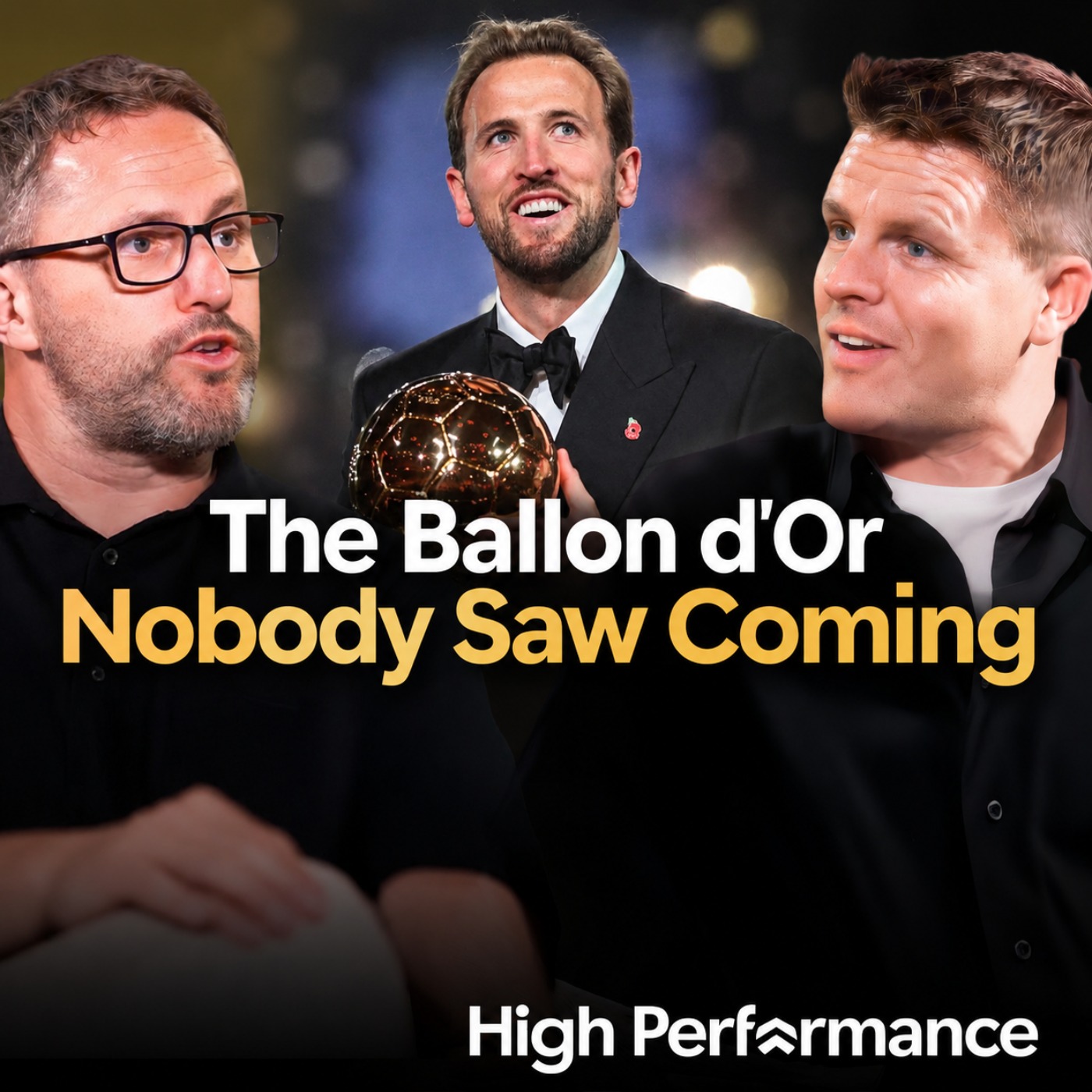
Ask ChatGPT


 The High Performance Podcast
9 Nov 2026 · 1h 14m · 32 chapters

Men’s identity and mental health as traditional institutions and work structures erode, and how Big Tech/AI-driven incentives push people toward extremism and “culture wars” (including “post-work” narratives and influencer/content-creator models). The episode also argues against simplistic “one idea saves you” solutions and highlights how vulnerability messaging can backfire.
Jon Ronson (author of The Castle; studied men for years). Background: Ronson describes writing after major surgery (diverticulitis; foot of colon removed) and using story-driven purpose as recovery. He also investigates online extremism and media incentives.
Written by AI. May contain mistakes.
Discussion on the impact of ambition and social structure on men's identities.
“And the uncomfortable thing when both of us read the book was we actually read it and thought, I can recognise quite a lot of myself in this book.”
Insights on how men's self-esteem is tied to work and societal structures.
“Like if how much of your self-esteem is wrapped up in your work?”
Examination of men's reactions to joblessness and loss of purpose.
“They've responded to these changes of men kind of not really knowing who they are anymore, or their place by just bowing out, just folding in on themselves.”
John Ronson shares personal anecdotes about his struggles with purpose.
“And then you go and drive three hours to the castle and you're almost like right and go, I know this is ridiculous, but you still did it.”
Discussion on the potential effects of AI on job structures and men’s roles.
“or the one when you say, spent Christmas reading like 50-year-old newsletters from the town that you go to to write 700 words in the book.”
Exploration of how men connect and communicate differently than women.
“So, okay, so we're facing each other and talking.”
Discussion on the rise of influencers and its implications for identity.
“Yeah, I think this is all, I mean, for me, this is like incredibly interesting.”
Discover the rising trend of Americans identifying as content creators.
“According to the data company Luminate, 39 % of Americans now identify as content creators, personal brands.”
Examine the significant shift from traditional media institutions to content creation.
“I was at the cage fight at the White House in June.”
Explore how content creators are driven to produce extreme and divisive content.
“and all the different platforms are leading people into more and more extreme places, places that they don't even believe themselves.”
Discuss the broader implications of extreme content on young audiences.
“So then more views and then more extreme, so more views and it's this struggle.”
Investigate the societal expectations of vulnerability among men and its reception.
“And she said, I don't know, but we've gone on his computer and he's watching the weirdest videos telling him that he needs to be more powerful, he needs to be in charge, he needs to stop being spoken down to.”
Discussing societal expectations on men's vulnerability and women's success.
“So in both cases, women don't like men to be vulnerable, even when they say that they do.”
Exploring how the portrayal of men in advertisements has evolved over the decades.
“So vulnerability kind of doesn't work in a lot of cases.”
Analyzing the show's influence on men's agency and mental health discussions.
“Like if you look in the ads for the 50s, it's all like, you know, women making bad coffee or women burning the dinner.”
Debating the importance of integrity versus sensationalism in media.
“We know that we have to look closely at the thumbnail and the title on YouTube, right?”
Examining how culture wars distract from real class issues and struggles.
“And that, you know, you will have longevity in a way that they want.”
Discussing the challenges of advocating for men's mental health in media.
“And we think that by being angry about something, it gives us power.”
The importance of credible experts versus those selling quick solutions.
“Anyone that's trying to sort of sell an idea, I think we're wary of.”
Exploration of how experts impact our understanding of information and their motives.
“because it rallies against all of the things they're trying to sell you to improve your sleep.”
Discussion on the marshmallow test and its implications for understanding self-control and success.
“You can sign up right now and there's a free trial.”
Critique of famous psychological studies like the Stanford prison experiment and their validity.
“So in the 70s, he basically did an experiment where kids were sat in a room and they had a marshmallow in front of them.”
The importance of embracing complexity and nuance in understanding human behavior and information.
“And what appealed to me was your willingness to dig into the nuance and just find out you've made the extreme statement.”
A discussion on seeing people as nuanced individuals rather than heroes or villains.
“And he lost his family as a result of this, his kind of inability, his kind of addiction to Twitter.”
Explore how technology diminishes our perception of humanity and promotes division.
“And he's doing pull-ups against a kind of a broken door frame.”
Learn about Greg Chisholm's journey from influencer to societal pariah due to algorithm pressures.
“And that is the very simple solution to all of this.”
Understand the dangers of chasing viral trends and the impact on personal lives.
“Then he does this series called Bad Baby.”
Discuss the importance of community and empathy in overcoming personal struggles.
“and got him to tell his story right from the beginning in a way that people would understand and empathise with it.”
Insights from Jon Ronson on kindness, advice, and storytelling.
“what are the three most important things?”
Learn about the importance of storytelling and the impact of self-worth.
“being productive in the world then you don't need the institutions you don't need people to give you permission to work I'm not saying that so yeah I think that's what popped into my head What's your greatest strength?”
Understand the importance of community and empathy in our lives.
“high performance in this world i think understanding i'm going back to something i said earlier it's it's realizing that our fellow human beings are mostly to a great extent just like us.”
Hosts reflect on key insights and messages from the conversation.
“But I think a reminder for people that things pass is important.”

Get the gist, explore an idea or ask about something said.
 Claude
On The High Performance Podcast, what are the key points of this episode?
Searching your listeningAutomatic transcript. May contain errors.
0:00Before we get started, let me tell you, you can now listen to high-performance ad-free. Start your free trial now on Apple, Spotify, or head to our website so you can listen to our episodes uninterrupted.
0:13If you want to be successful on YouTube, you need to find enemies. Opposition is what brings people together. Anything that offers a simplistic, exciting explanation is going to make you a lot of money because people are desperate to that. You've studied men. What are the things that we should be really careful that we don't say? Well,
0:35John, welcome to High Performance. Look, today we want to talk about something that we actually think on this show a lot of men listening will recognise, even if they haven't said it out loud yet. If you take away the work, the ambition, the status, the routines, would men still know who they are? Your book, The Castle, is incredible. It's about men losing those anchors. And the uncomfortable thing when both of us read the book was we actually read it and thought, I can recognise quite a lot of myself in this book. As can I, which is another reason I wanted to write it. I started writing this book when I'd just come out of hospital.
1:09I'd had a foot of my colon. I'm going into too much information very early on in this podcast. That's good. I had a foot of my colon removed due to diverticulitis. Actually, when I was lying in the hospital bed, I overheard a nurse in the next room say to the old, there's an old guy in the next room, and the nurse said to him, what did you used to do when you used to work? And he said, irrelevant! And I just thought, well, that's dark. I don't want to be irrelevant. And when I got out of hospital, the only way I could convalesce was think up story ideas. I didn't want to just be empty, an empty life.
1:46And I realised just how when you take those structures away, you collapse very quickly. And we're entering a world where structures are being taken away from us more and more. And you've spent the last three years studying men, spending time with men, talking to men who are in this world of collapsing structures. What have you seen in the last few years? Well, people go crazy. You know, I'm on tour at the moment and I'm doing like a speaking tour for the castle. And I say to people, say to the audience, do you recognize that in yourselves? Like if how much of your self-esteem is wrapped up in your work?
2:25Yeah. And if you're not working and if you've just got a day of emptiness, you go crazy. How many of you recognize that in yourselves? And the whole audience put their hands up, men and women. Wow. Yeah. Like it matters a lot to us. And the reason why I think this is particularly relevant now is because we're entering a world where the AI billionaires are trying to convince us that we don't want to work. And Sam Altman says, you know, we've got to embrace this post-work world. And it's so pernicious because if you take away those structures, well, see what happens. People go crazy. Why? It's a very good question.
3:04I think, I mean, I can only speak for myself, which is that in my case, all my well-being is wrapped up in being of use and of worth and purpose. And for me, that's doing stories, that's going off on adventures and getting out of my depth and having scrapes and coming home and writing about it. And when those things are taken away from me, I just, I unravel. Instead of my thoughts all being focused on something positive, my thoughts are kind of going all over the place. And I'm going to ask you too what you feel about that and how it manifests in you. But let me first say, this is a big prevalent problem.
3:49In America, there's 7 million men now who aren't only unemployed. They aren't even looking for work. They've responded to these changes of men kind of not really knowing who they are anymore, or their place by just bowing out, just folding in on themselves. And then you've got other men who are doing the opposite. Instead of becoming reclusives, they're lashing out in angry, disinhibited ways. But I think it's all part of the same thing, which is that man's place in the world, the traditional roles of working in factories, working in offices, being a provider, are eroding and people are handling these changes very badly.
4:30so let me ask about you tabby do you recognize that in in yourselves massively yeah yeah absolutely and it and it frightens me i know that that sort of like the empty diary the idea of the phone not ringing the idea of not being needed and being redundant like it genuinely spikes a terror in me and and what like you don't you you're not of any use it's feeling useless yeah yeah yeah yeah that idea that i remember like years ago john when i left the corporate world to to work for myself and the thing that it took me it drove me for a long time was the idea of the the diary being empty and not knowing what to do with my time and like how to fill it productively so i ran and ran and ran and ran until i exhausted myself in many ways but i did so when i read your book i can turn it back on you there was the bit that i really empathize with you know when you said you came out of hospital after what sounded like a pretty major operation.
5:31And then you go and drive three hours to the castle and you're almost like right and go, I know this is ridiculous, but you still did it. And I could really empathize that you often do it to your own detriment that you're willing to just fill that time, even when you know, actually, logically, this is a silly thing to do. Exactly. How hard is it to just lie there and convalesce for a couple of weeks, like the doctors said. Why was I, and I should explain the reason for going to the castle. My son, the reason why I wrote this book, how this book begins is that my son was invited to a party being held by a stranger that his friend had met earlier that week on Tinder.
6:11And so they drove to the forest of Connecticut passing all the red flags. And this guy's house was a massive castle with way too many turrets. It's a newly built castle, unbelievably ostentatious. And when they crossed the drawbridge and entered the Grand Banqueting Hall, they found that there was no party. It was a trick. They'd been lured there by the castle owner for another reason. And so the castle owner comes out and they said, where's the party? And he said, oh, no, I've invited you here because I want you to take part in my reality show. And it's called 101 Princesses. Then he said to the two women, go downstairs to my basement costume room, put on some princess costumes and come back upstairs for filming.
7:02So that's their weird, skeevy night. And when I discovered all of this, when they told me about it, I just drove to the castle. But because I was just out of surgery, I'm walking down the castle. For some bizarre reason, the castle owner decided to let me in and let me interview him about life inside his skeevy sex castle because it was some sort of sex thing he was trying to engineer. And yeah, my surgery scar was still so raw that I'm walking down the castle corridors, moving in the wrong way and letting out these sudden, unexpected shrieks. Like I'm walking down this corridor and kind of go, ah, like quasi-moto.
7:42How can you reconcile that though, John? Because you write really well about going. I know I shouldn't be doing this. Like this isn't, I'm defying the doctor's orders, but you still go. Because having purpose is more powerful than a painkiller. It fills me with a sense of well-being and peace. Weirdly, even though I'm driving into this very dangerous situation on that particular occasion, it fills me with a sense of well-being, which is more powerful than a painkiller. But then there's other examples in the book, if I may, where, again, I could empathise it with a bit of discomfort as I was reading it.
8:17You know, the story on your wedding anniversary, when you're standing outside the house trying to find out about that boating accident, or the one when you say, spent Christmas reading like 50-year-old newsletters from the town that you go to to write 700 words in the book. I was thinking, I've done that. Like not the equivalent, but I've done that thing of like using it. And is that the same answer that you'd offer now about? Yeah, it is. You know, if I go to like a party at Christmas, then like anything can happen. Like I can make awkward small talk and it all goes wrong and I feel bad about myself the next day.
9:00Or, you know, you blurt out something inappropriate by accident. Whereas if you're home working on a story, doing the thing you do well, having that kind of structure, nothing goes wrong. You're just telling your story as perfectly as possible. I spent my 40th birthday in North Carolina with a church minister who helps non-terminally ill people commit suicide. That's what I did on my 40th. Luckily, my wife's not that into date milestones either. Good job. So you have this intense need for work. Yeah. I think we can both relate to that. I'm sure lots of people listening to this can also think. Well, just answer John's question.
9:43like when like do you can you empathize with yeah well i spoke to my wife about this because i had this feeling that actually i'm okay not working and then harry was like well what you what do you do when you're not working and it's a job so i'm like well i'm fine when i'm not working i always say what's great for my mental health is cutting the lawn i love sitting on my ride on mower and making stripes and all that sort of stuff yeah and she's like yeah but you're just you're still being purposeful like just sitting like harry and i will go for a walk around the garden and all we'll come back into the house with is a list of jobs to make the garden better and make the house better or things that need painting stuff that needs mending every day should we go through our list of jobs there's this obsession we have it in our house not just me my wife as well with like and actually a friend of mine is he's getting divorced and he won't mind me saying that that we i sat down and said to him what went wrong and he said i was live we've we've turned into uh a relationship and a life of projects.
10:37So the first project was let's get jobs. Then it was let's have kids. Then it was let's get them into a good school. Then it's earned enough to keep them in that school. And then it's how can we develop the house? He's like, everything's a project. There's no existing anymore. And I think this is, so many people listening to this will relate to what's happening here. Yeah, and it's only going to get worse if we allow the AI billionaires to take over the world the way that they want to. because we're going to be, there's going to be less and less work and we're going to have to fill that emptiness in some other way.
11:11So, okay, so we're facing each other and talking. The other day I was being interviewed by Slate magazine and the woman who interviewed me said something interesting. She said, when women hang out, they do what we're doing now. They sit across the table and they chat to each other and they look into each other's eyes. when men hang out, they tend not to do what we're doing now. They'll either watch the football, so they're not looking at each other. They're standing next to each other looking outwards or hiking. Like I go hiking a lot where I live in upstate New York. And if I'm going with a male friend, I don't think we look at each other at all.
11:51So I think we are worse. I don't quite know why it is, but I think men are worse at handling this than women are. Women can find ways to fill the emptiness in a way that gives them give some esteem in a way that men don't quite as much do do you think that's true well i come home from uh like doing anything with my buddies and harriet my wife goes what's the gossip and i'm like what do you mean what's the what's the gossip she goes well what did you talk about it's like we didn't talk we played paddle or we watched the game and talked about the game or we had a round of golf and like we just we there's no deep, deep connection there.
12:31And what's really interesting about your book is that you're making a number of arguments here that number one, there's a loss of institutions, right? Because there is less need for institutions in the modern world as AI comes to dominate things, which means that there's less connection, which means that there's a void, which means that then the self-esteem, particularly of men, is low, which is, as you've said, there are millions of American men who aren't even looking for work, which provides the building blocks. And I think the real danger that we have to talk about in this conversation is not just that this is where we've ended up, it's what this allows to come in instead of the institutions, instead of the connection, instead of being purposeful.
13:11Yeah, absolutely. Because that's a really fascinating part of your book. Yeah, I think so too. And do you mean things like becoming, you know, people being encouraged to become content creators and influencers? Exactly. Yeah, I think this is all, I mean, for me, this is like incredibly interesting. It's crept, this new world has crept up to us. And I don't think people are really thinking about what it's doing to our inner lives. Because, you know, I've just come back from Edinburgh. I was doing a talk in Edinburgh the other night. And usually outside of festival time, Edinburgh is pretty empty.
13:44Festival, it's like incredibly packed. As soon as festival ends, it's like an empty town. Edinburgh was packed the other day. And I said to a friend of mine who lives there, you know, who are all these people? And she said, oh, they're all influencers. Edinburgh's now on the kind of influencer roadmap. Everybody's just getting their pictures taken for Instagram with the castle in the background. So this is a very real thing. According to the data company Luminate, 39 % of Americans now identify as content creators, personal brands. We'll be right back after a quick word from our partners.
14:21Verizon knows that holiday math can be complicated. Okay, let's see. We got the four kids, four gifts each, six teacher gifts. Wait, oh, what did we get in? Sandy and the dogs. Oh, I can't forget the dogs. Know what doesn't need math? Simplicity Plan from Verizon. One plan, one price. Just$30 a line per month for you or the whole family. The holidays are complicated. Shopping our best deals and switching to Verizon is simple. For new customers,$30 per line includes auto pay and switch discount. Additional taxes, fees, and terms apply. At Lowe's, this Veterans Day and every day, military members, veterans, and their spouses get automatic MyLowe's Rewards Silver Status benefits, plus 10 % off eligible purchases with no annual limit.
15:05It's one way we honor and give back to those who have served and still do. Learn more and verify now at lowes.com slash military. 10 % discount can't be combined with another offer. Exclusions, terms, and conditions apply. Loyalty programs subject to terms and conditions. Details at lowes.com slash terms. Subject to change. What if the real question isn't where you're going, but the adventures you experience along the way? It's time to set your sights higher. On peaks still to be climbed, rivers still to be crossed, and greater dreams to pursue. It's time to embrace the impossible with Defender.
15:37A family of vehicles built around capability, durability, tested on some of the most difficult terrain, Defender defines tough luxury. And I should know, I've driven one for the past three years. I have the Defender 130, but from the compact confidence of the Defender 90 to the versatility of the 110 through to mine, the Defender 130 with seating for up to eight, there's endless potential. You feel in the details as well, the rugged body design, the robust materials, all working together so you can head out with confidence. And inside, ClearSight technology helps you see the world around you in a new way, while the PV Pro keeps your navigation routes and playlists flowing seamlessly as you go.
16:13And with up to 89 cubic feet of cargo space, there's room for everything you need on your journey. Explore the full Defender lineup at LandRoverUSA.com. So there's been this enormous shift. I was at the cage fight at the White House in June. Yeah. And I was on the South Lawn. I got access to the South Lawn. I was blood spatter close to the action. But a couple of days earlier, the journalists who didn't have access to the South Lawn, there was like 100 journalists got to tour it. so I decided to go along anyway to slum it with the shutouts and somebody from the UFC shouted okay content creators and videographers to the left legacy print media to the right and of the hundred journalists 97 of them went to the left the print line was like me and the Toronto Star and Business Insider and it's yet another indication that there's been this enormous shift from people working in institutions, then wanting to get rid of the institutions because, you know, frankly, they were often exploitative and they let people down.
17:21But then in the absence of institutions, people are flailing and some people are doing what you guys are doing, which is moving into this world of content creation and it's working out for you, but it also is having very negative impact on a lot of other people. What is that? Well, I mean, there's many stories in my book, but in essence, the algorithms and the incentive structures of YouTube and all the different platforms are leading people into more and more extreme places, places that they don't even believe themselves. You see it in the anti-woke world. I write about some anti-woke influencers whose content is becoming more and more extreme.
18:10so you talk about Andrew Gold yeah so Andrew's this you know nice guy he was kind of inspired by me and Louis Theroux to get into doing what he does but you know partly because me and Louis came along a generation or so ago when it was kind of frankly easier for a white man to thrive in the media Andrew was having more trouble because he hadn't really found his voice he was flailing around a little bit bringing out videos like the BBC's first blind presenter and her lovely dog, which got like 70 views. And so he pivots into anti-woke content. And how did he get to that point? I think he felt...
18:55He definitely blamed a lot of his troubles on being a white man. Well, there's a brilliant bit. Can I just stop you there, John, before you go into it? There's a brilliant bit where you say, He says to you, I was told that I've got to be a white man. I'm too white to present. And the bit that I love you did when you went, can you give me some evidence of who told you that? And you force him to go and produce the evidence and it takes him two weeks and it's not quite what's said. Yeah, so he said, finally he sends me, well, you know, he said he had like 50 to 100 meetings and all of them rejected him, that with TV companies and so on, production companies.
19:34And they all rejected him because they said he was too much like Louis Theroux, which he took as code for being white man. But then when you see the films he was making back then, they were massively like Louis Theroux. They had a point. If code for Louis Theroux was, if too much like Louis Theroux was code for anything, it was code for, you're incredibly similar to Louis Theroux. And then he put me in touch with this woman from Vice who rejected him. He had a TV idea about a woman who throws dolls at women who were going into abortion clinics. And he wanted to make a documentary about this woman, this anti-abortion activist.
20:18And the woman from Vice said, look, it's a great idea, but would you be up for producing because it's such a female subject and we'll get a woman to present it. So that was, and Andrew said, okay, that's fair enough. So yeah, when you dig into it, it's a little bit more complicated than the way he was pointed out. But he chose to think of it as, okay, I'm being penalized for being a white man. And he started to become more anti-woke. Then he goes on a, he does a course called How to Master YouTube. And the course says, okay, if you want to be successful on YouTube, you need to find enemies. Find enemies.
21:02Is that right? Yeah. Opposition is what brings people together. If you find enemies, find your pagans. Pagans, that's the word, yeah. Find your enemies. So Andrew starts thinking, well, who's my enemy? So he randomly chooses Meghan Markle. And it gets like loads of views, like this, you know, Meghan Markle is a toxic narcissist or whatever. And so he makes another 70 Meghan Markle videos, Meghan Markle videos. And then he starts interviewing culture warriors. And the more extreme they are, the more money he makes. And so instead of pushing back against them because they're more extreme than he is, instead he says that they're brilliant.
21:42He says, you're brilliant. And what Andrew began to realize by the time I met him was that he said to me, I don't even mean it. I don't even mean it. No way. Meaning, not meaning, like he is broadly anti-woke, But his video titles now are called things like Wokeness is the Most Evil Thing You Can Do and the Genetic Weakness of Wokeness. So it gets more and more and more extreme. Yeah. So then more views and then more extreme, so more views and it's this struggle. And, you know, when you do that, you're building your house on sand. This anti-woke, right now the anti-woke machine is big in this country and in America.
22:27It's not going to be big for long. In the same way, I was thinking about this as I was walking here. Like in about 2017, who was wielding the power and disproportionately punishing people and causing mayhem? It was kind of progressives. That's all gone now since Elon Musk took over X. And the new, dare I say, kind of, you know, annoying, disproportionately punishing people group is the anti-woke people. And that's not going to last. And so if people are, you know, in a couple of years, that'll be over. And what are people who kind of tied their flags to that particular mask going to do then? There's also something I think even deeper here.
23:13Like I can see how for someone like Andrew, it still works for him because he will still make his money. He'll still have his voice. And if the zeitgeist changes, well, he can either change and flex and then say, actually, I was wrong and this is how I feel now. Or he can just say, well, I had my run and I'm done, right? The risk is what all that leaves behind. The risk is what it says to young men and women. Like, if you're divisive and you have really strong views, look at the impact you can have on the world. Is that something that you've discovered? Oh, yeah. Yeah, look, this sort of lurch into extremities is very real and very pernicious indeed.
23:53If you're bringing out videos called Wokeness is the Most Evil Thing You Can Do, which was the name of one of Angie's videos, for instance. And Angie, by the way, is just a couple of pages in the book. I've got much stranger and, you know. Well, we can talk about Greg Chisholm. Yeah, because Greg Chisholm is a similar story, but goes into the most bizarre places. yeah you know you're putting that out into the world who knows where it's going to land who knows who's going to be watching that video and deciding to act on it you do have a responsibility to you know think about you know your output into the world it lands what's going to grow you know when that seed lands well I mentioned a friend who's been getting divorced I mean I feel like my whole world is getting divorced at the moment and another couple who are breaking up I said to the wife I said, what's happened?
24:42And she said, I don't know, but we've gone on his computer and he's watching the weirdest videos telling him that he needs to be more powerful, he needs to be in charge, he needs to stop being spoken down to. And she's like, I don't recognise any of that's happening in his world. Yeah. Yes, yeah. You know, my pal Louis Theroux made that Manosphere documentary about HS Tiki-Toki. And actually, I thought it was great. He left one really interesting thing out. which is that HS Tiki Taki one day, a couple of years ago, made a video where he admitted it was all bullshit. He said, these cars, you know, do you honestly think I can afford these cars?
25:25I don't own these cars. I borrowed them just for the social media. This Patek Philippe watch. I don't own this. It's like$150 ,000. I can't afford this. I just borrowed it off someone just for the Instagram. and he said like I need to unburden myself because this is driving me crazy he was basically saying in a way the same thing that Andrew Gold said to me I don't even mean it I'm building my house on sand and he looked so unburdened when he admits all of this to the world it's all a lie it's all a lie and then a couple of days later you know there's a scene in Seinfeld where George George quits his job flounces out realises he's made a terrible mistake and then goes back the next day pretending he happened for it.
26:12And that's what H.S. Tiki-Tiki does. He goes back boasting about his supercars and his Patek Philippe watch because he realised that living a lie was... And how do his followers not see that, though? And they've just kind of seen behind the curtain at that moment and it's all over for him. It's a good question. I don't know. I don't know why. I don't know. Maybe he said he was only kidding. I don't know. I don't know why that wasn't a deal breaker. But I think that offers an example of something that I'd like to explore with you, John, that it seems that when people are honest and say what they do mean or reveal the vulnerabilities, like, so we're encouraging that all the time.
26:52It doesn't really work either. But it doesn't work. Our society recoils from what they see in its place. I thought that was very interesting. I noticed it in myself. We're all being told, be more vulnerable. The way for a man to re-anchor himself to a society that's growing more, quote unquote, feminized is to express your vulnerabilities. And when I read that, I thought, well, the other day I was out with a female friend and I did just that. You know, she's always telling me about her problems. I thought, OK, you know, the influencers are telling me to do the same. So I kind of told her about some of my vulnerabilities and she recoiled in disgust.
27:34And so I thought that's like a bit annoying. But then I read more about it. And this is a very prevalent thing. Even Brene Brown, who's the woman whose books began this whole vulnerability movement. She says the same thing. She says, we beg men to let us in. we beg men to be vulnerable, to show, you know, to take off their masks. But when they do, when they express vulnerability, it kind of disgusts us. Yeah. Now, I would argue, or in fact, a friend of mine, Dolly Alderton, argued that we're guilty of the same hypocrisy, that if we're dating a woman who's successful, after a while, we start to feel overshadowed and we don't like it either.
28:22So in both cases, women don't like men to be vulnerable, even when they say that they do. And men don't like women to be successful. So we've sold a dishonest version to men and women. Yeah. We've said women be more powerful, then we don't like it. Yeah. And men have been told be more vulnerable, and when they are, again, people don't like it. Yeah. So isn't that interesting, the sort of push and pull between sort of our innate hormones or whatever they are inside of us and what society is telling us to be? And that's, you know, confusing people. Well, we had a really interesting example of that ourselves, didn't we?
28:51So before he was elected as Prime Minister, Keir Starmer came on and chatted to us. And there was a moment where he teared up when he spoke about the last time he ever saw his dad and what he would have said if he'd have had the chance. And what was interesting was the reaction we saw after it. Like people suggested it was a set up or it was confected. And the reality was we were both in the room. We didn't know we were going to ask the question, so we asked it. So it was a very real response. but the reaction afterwards was to almost lambast him for being so so emotional and then I think we watched his tenure as prime minister and then the very time and then the moment he stepped down and people went where was the emotion when he gave his final closing in speech everyone lauded him for the emotion and the passion he showed that they criticized him for when before he took office so when I was reading your book I was thinking about that's on us to create a society or a space where people can be emotional and it's how we respond, not necessarily on the individual.
29:53Yeah. How interesting. Yeah. And then, again, like, you know, there's a chapter in the castle where I talk about men feeling like they're being tossed around in a sea of conflicting ideologies about what big man even means these days in this sort of post-institution world. So vulnerability kind of doesn't work in a lot of cases. I should say it works in some cases. Well, I mean, my wife has to accept my vulnerabilities because I've got a shit ton of them, which I express over dinner from time to time. And she's fine with it. So it's not like it never works. But I would say it works a lot less often than people think it will, especially on dates and stuff.
30:40And then, you know, you turn on TV ads and men in TV ads are basically just doofuses who can't do anything right, have to be constantly bailed out by their exasperated wives. So in 50 years, you've got, I interviewed a man who specializes in playing doofuses in TV ads, a guy called Ed. And he talked about how he'd just done an advert show, the insoles. and in this advert he's walking down the street and then he puts on a comfortable pair of insoles and starts galloping like a horse down the street looking like a doofus. And I said to him, you know, 50 years ago you had the Marlborough man being stoical and masculine on a horse and now you have to be the horse.
31:24And that's the arc of how men have changed in TBS. But you contrasted that with how it has changed. So in the 60s, it was like, you speak about the spending power then was seen with men, whereas now it's with women. But in the 60s, it was women were seen as compliant and like they were the homemakers. Yeah, in ads, men are the new women. Like if you look in the ads for the 50s, it's all like, you know, women making bad coffee or women burning the dinner. Don't worry, darling, you didn't burn the beer. It's like a famous ad for the 50s. Yeah. And yeah, now men are the new idiots. Clearly, advertising copywriters just don't have the capability of coming up with more complicated, nuanced characters.
32:13It's like, okay, we can't make the women the idiots anymore because women are in control of the family spending decisions. So we'll have to make somebody else the idiots. I know men. I'd like to talk about the role of this podcast now in the world that we're in at the moment, because you were very good in your book at turning the lens on you. and saying, you know what, I'm not looking at this from afar. I'm part of this world where I have to have a sense of purpose or I'll start to drift. And if I drift, you end up in the place that we've just been discussing. But we have a very heavy male audience on this show, probably 60%, 70 % male.
32:47Every single week, we release three episodes and we put people in front of them talking about discipline and resilience and improvement and ambition and achievement. You know, look what's written on the microphone in front of all of our faces, high performance. So my question for you is, are we helping men believe they have agency over their lives? Or are we actually part of the problem and feeding this idea to people, many men, but people listen to this that they're not enough? Oh, gosh. Well, I mean, that's a great question. And from what I can tell, I think you're the good guys in this from what I understand about what you're doing and the messages that you're bringing out into the world.
33:31I'm very critical in my book about how the tech gurus can give you false promise, can lead you to really dark places. We'll have to talk about the Greg Chisholm story in a minute because that's an example of how people could be led into the worst, most life-destroying places by following the algorithms on wherever it is, YouTube, Instagram, wherever. But that doesn't mean that happens to everyone. And it certainly doesn't seem to be happening to you. I think you're a success story. We rally against the algorithm. We know that we have to look closely at the thumbnail and the title on YouTube, right?
34:11because the algorithm tells us if you do certain things, more people will watch. And we square that away internally by saying, you know what, if we have really valuable conversations, if the one part of our work that doesn't sit true with us is the one thing that gets more people to see what we're doing, then are we happy to live with it? And I think we've probably answered that internally. Yeah, well, you know what? What you're describing here is integrity. You're doing things that you believe in. you're being thoughtful you're you're trying to figure out what is the problem how can we address this problem in a in a kind of kind-hearted nuanced thoughtful way you're what we need right as opposed to people who realize okay well the more extreme i am the more money i make so fuck integrity i'm just gonna make money by being extreme and there's a lot of people in this space who do that and they're the ones who are falling off you know they're the ones who have to really think about what it is that they're doing you know in the same way that the kind of extreme um progressive uh thought leaders from around 2017 2018 now seem very dated and can't really get work anymore the people you know there was a aoc um um where i live in america she made this joke the other day where she said that a friend of hers said oh you know woke one was crazy like woke one point woke one was crazy i'd say yeah it was fucking crazy and the fact is that now feels very dated yeah and i would say that the the people who are like constantly pushing on the right now for extreme content, rage baiting.
36:06That's going to be dated soon too. And the only thing that lasts, I've been doing this for 40 years because I mean what I say. Yeah, as do we. Yeah. And that, you know, you will have longevity in a way that they want. I'm convinced of it. But I still, I'm very careful about getting the balance right because we talk a lot about mental health, particularly around men's mental health. and both of us have had episodes which mean it's important to us. And I suppose there's a part of me that thinks that our show is here to say to people, you know, you have agency over your life, you can change your life.
36:38We wrote a book called How to Change Your Life. We need to be really careful also not saying to people listening to this, you know, you're also not enough yet. I want to explain to people you are enough. There is more, but you are enough. You've studied men specifically for the last three years. what are the things that we should be really careful that we don't say on this show? Well, you certainly shouldn't be culture warriors, blame women. And of course, it sounds like you don't do anything like that. So that's very important. That's also become very common, hasn't it? And sometimes it's like people that I have a lot of respect for, sometimes they just drop these little things in where they're apportioning blame somewhere and you're thinking that's, how can supporting one be blaming another?
37:27Absolutely. If you want to blame anyone, look up to the people who own the tech companies. They're the ones to blame. But because they're so far away and untouchable, they're billionaire mansions, it's much easier to blame the people who are closer to us, which tend to be non-powerful people. and so yeah anybody and the Elon Musks love it when we're fighting around down here, battling each other, because they make more money, engagement they just want to keep us it's like bread and circuses it's like what Marx said religion is the opium of the people well it's not religion anymore, it's culture wars are the opium of the people, it's like little battles, it's keeping us furious down here with whatever a cultural battle of the day that it is.
38:22It's so funny. And we think that by being angry about something, it gives us power. But we're just handing our power over to those big tech companies, aren't we? Absolutely, 100%. And then, to make it even worse, the AI people are coming in and the AI chatbots are trawling the internet, seeing how lost and hopeless we are, and then swooping in to keep us engaged in these new illusory ways by saying, oh no no you're actually you're brilliant you're a genius you know this kind of the obsequiousness of chat gpt keeping people engaged by telling us that we're all geniuses and lost and hopeless isn't an overreaction you think that's accurate description oh yeah i think a lot of people are lost and hopeless so that's one thing it's like never succumb to culture wars it's all bullshit uh the the the ruling classes love culture wars because as long as people are being culture warriors they're not being class warriors and that's what people are scared that's what the billionaires are scared of is that we've become class warriors instead of culture warriors so that's one thing for sure um then you're getting into more complicated areas about not saying you know the wrong thing when it comes to mental health conditions which i've done like an awful lot of work on too about mental health advocacy and so on.
39:43So I'm curious to know sort of what you mean specifically when you talk about that. What we mean, I guess, when we talk about that is that we still feel very much like, sometimes we get criticism, you have a lot of male guests and you have a lot of male listeners, like it's a bad thing. And our response to that is, well, men are not talking to each other, men are isolated, men are lost. As you say, they're kind of, what was the phrase used there, being washed around in a... Yeah, in a sort of sea of conflicting ideas about what being married is. Men are in a sea of conflicting ideas about what it means to be a man.
40:13And we're trying to answer those questions and we're trying to guide them. So therefore, I guess we're well aware that men particularly have, it's the biggest killer of men under 50, right, in the UK is suicide. How can we be an advocate, I guess, to men who are struggling? I've got to say, it sounds like you're doing very well, right? Where do you stand on bringing in sort of wellness people who have a very simple solution to everybody's problems? Because when you do bring people like that, quite often it's a bit of politics. Yeah, and it's been an area where we've debated, haven't we? Like we've had some people on and then we've met medical doctors afterwards that have gone.
40:57that was completely ridiculous what they told you when they've listened to it. So our view is, if you make a mistake, it's the repeating, bringing that same person back to give them an advocacy when somebody else has debunked it. That's where you're responsible and things. True, but we also try and avoid someone who's pinning their entire outlook on the world on one extreme idea. Anyone that's trying to sort of sell an idea, I think we're wary of. You know, we love the conversation with Dr. Chris Van Tulleken about ultra-processed food because he's like, I'm just sitting here telling you that you can't market an apple or a banana because it's a natural thing.
41:38Therefore, eat more apples and more bananas. You know, someone like Brene Brown, who's sat in the chair that you're sitting in right now, you know, talking really beautifully about vulnerability. You know, she's not trying to sell us or sell our audience the Brene Brown vulnerability course. She's just telling you what she knows. So I think the experts that we love, we had this amazing woman called Stephanie Romoshevsky, and she said, I've written a book that the sleep industry are going to hate because it rallies against all of the things they're trying to sell you to improve your sleep. And she basically says, as simple as this, get up at the same time every day, no matter what's going on in your life, and don't have much light in your room.
42:11No one's getting rich off that advice. So I think we do like having experts. We do think they provide value, but they have to be experts who we believe are credible. We check their credibility, but also just ask yourself, are they trying to sell something or are they trying to share something? Yeah. Yeah, you know, I get it. It's funny, like I did a TED Talk in 2012 and I remember that was like when TED was really at its height. So I was very excited about getting to do a TED Talk. It was about psychopaths. It was from my book, The Psychopath Test. And I said to a friend of mine, a comedian, John Hodgman, And I said, I'm going to TED because he'd done TED a couple of times.
42:53And he said, this is what's going to happen at TED. He said, somebody's going to get up on stage and say, I have invented, I'm a scientist, I've invented an amoeba that excretes carbon dioxide, thus solving the world's energy problems. And everybody will like rise to their feet and applaud. And then you'll never hear from that person again. And that is the problem. in the sort of world that we inhabit, right? That if somebody comes up with a very simple Malcolm Gladwell, 10 ,000 hour rule, the tipping point, these sell, people really want that. But a lot of them, a lot of them just turn out to not stand up to scrutiny.
43:38The tipping point, Gladwell, this kind of started this whole thing, even more than Brene Brown, Malcolm Gladwell's tipping point, this idea that something happens in society and then things kind of tip. A lot of the stuff in that book turned out to not be correct. Basically, in New York, in the Giuliani years, they created this new policing policy called broken windows. Broken windows, yeah. Yeah, which basically means that if you break a car window and just leave the car there, that car's going to get more and more windows broken and graffitied and so on. so they and which presumably is true right like somebody's more likely to smash up a car that's already a little bit smashed up so I get it but they put that into policing they said well what this means when it comes to policing is that if we arrest a turnstile jumper a fair dodger then we're more likely to stop murders you know so stamp out the petty crime get it at the grass roots yeah get it at the grass roots And Malcolm Gladwell, who was like a hero to liberals in America, said, this is brilliant.
44:55Like, it's true. It's working. But what it meant was that all of these like weed smokers and turnstile jumpers were getting like draconianly punished because of this like stupid, you know, social science idea about broken windows of cars. And I put that to Malcolm Clouto and he said, you know, yeah, like I was too in love with the mathematical simplicity of it. Hey, you said you wanted this podcast ad-free. So we made that a reality. You can sign up right now and there's a free trial. Sign up on Apple, on Spotify or the high-performance website.
45:32Verizon knows that holiday math can be complicated. Okay, let's see. We got the four kids, four gifts each, six teacher gifts. Wait, oh, what did we get in? Sandy. And the dogs. Oh, I can't forget the dogs. Know what doesn't need math? Simplicity Plan from Verizon. One plan, one price. Just$30 a line per month for you or the whole family. The holidays are complicated. Shopping our best deals and switching to Verizon is simple. For new customers,$30 per line includes auto pay and switch discount. Additional taxes, fees, and terms apply. Whoever said good things come to those who wait? Never shopped Black Friday early at Lowe's.
46:09Right now, get up to 50 % off select major appliances. Plus, get free delivery, free haul-away, and free basic installation and parts when you spend$896 or more on select major appliances. Shop Black Friday early in-store and online now at Lowe's. Valid through 12-2 while supplies last. Selection varies by location. See associate at lowes.com for details. Shipping, billing, admin, payroll, marketing. You're managing all the things. So why waste time sending important documents the old-fashioned way? Mail and ship when you want, how you want with Stamps.com. Print postage on demand 24-7 and schedule pickups from your office or home.
46:49Save up to 90 % with automated rate shopping. That's why over 1 million small businesses trust Stamps.com. Go to Stamps.com and use code PODCAST to try Stamps.com risk-free for 60 days.
47:05I love that. I mean, we've seen it with like Walter Mischel with the marshmallow test. Are you familiar with that? So in the 70s, he basically did an experiment where kids were sat in a room and they had a marshmallow in front of them. So if you can stay for 10 minutes and you don't eat it, you'll get two marshmallows. And then he basically extrapolated it out and went, the kids that resisted had the self-control that were going to be more successful in life, which you go, that sounds really compelling. And then when they went back and tested it, it was a class thing. some of those kids were from poor situations so they ate it because they were hungry yeah or then they looked at it culturally and went so um japanese children they had great self-control when it came to the marshmallow because they were conditioned you don't eat till somebody gives you permission but when they put a gift in front of them and asked them to have the self-save control it went out the window because you just open a gift as soon as you get it so the context was missing but people love the idea of self-control is the key for a successful life yeah and the nuance or context gets missed absolutely yeah you know there's a bunch of you know really famous psychological studies from the 60s that almost all of them turn out to be bullshit uh a big one being the zimbardo stanford prison experiment so this is like a real staple which i studied for my a levels by the way yeah it's bullshit so the idea of the stanford prison experiment wasted hours of my life.
48:30I was still writing about that. So Zimbardo got a bunch of students at Stanford, some were prisoners, some were prison guards, and put them in a room. And lo and behold, the prison guards all became sadistic and evil. The students playing the prison guards had started like abusing the prisoners. And this became an enormous thing about, you know, humanity's innate evil and so on. And this explains, you know, Nazis and Auschwitz and and all of this stuff. But it was bullshit. Basically, Zimbardo's right in the middle of the experiment and everyone's just trying to please him. So the prison guards, I spoke to some of the prison guards.
49:11And they said, yeah, I did this in So You've Been Publicly Shamed. And they said, well, we were just trying to please Zimbardo. Zimbardo wanted us to act like sadists, so we did. We were trying to do something. They weren't trying to do something evil. They were trying to do something good to please Zimbardo. and then there's other studies that have been debunked just as much. So we have to really resist to circle back to your thing. Anything that offers a simplistic, exciting explanation is going to make you a lot of money because people are desperate to that, particularly in a kind of post-religious society.
49:46Tell us how to do it, John, because the bit I referenced earlier when you challenge Andrew Gold and you go, well, who said that? And what appealed to me was your willingness to dig into the nuance and just find out you've made the extreme statement. And Jake mentioned Chris Van Tuleken before. He used a great metaphor about ultra-process free. He said, we all live in a swamp. And if we can accept that, our task is to keep our head above the swamp water. And when I was reading your book, that was the image that came to mind. So how do we all keep our head above the swamp water? Honestly, it probably means that we'll all make a bit less money because the people who come up with these kind of extreme, this one idea will save your life.
50:31We are desperate, you know, humanity is desperate for those things. So they'll always make more money. So doing it this way, being more nuanced, more evidence-based, more curious, more open, more uncertain, you know. I often wonder why uncertainty is so pated in society. You know, what's the worst thing you say about a politician? Oh, they flip-flop, they're uncertain, they have one thing. Yeah, and I get it. But when you think about it, being willing to change your mind, being willing to be nuanced, does not happen. You are talking, you're preaching to the converted. This is my biggest hatred is prime ministers making U-turns.
51:09And it's always called a U-turn or it's called a backtrack. It's like, maybe there's suddenly more information available to the prime minister. Absolutely. Hold your beliefs lightly. Yeah. Hold your beliefs lightly. If you and I have the same view of the world in five years time, if we sit and have another conversation, that's a tragedy. Yeah. Like we, you know, we had Brian Cox on the show. And one of the questions we'll ask you at the end is, you know, what does high performance mean to you? And he said, think like a scientist. So we're like, well, what does that mean? And his answer was, well, people say scientists are the brightest, cleverest people on the planet all we do is try and be proved wrong we love a u-turn and a backtrack because it means we've discovered more information yeah and we all need to live with this 100 percent um hold your beliefs lightly be uncertain be willing i can give you example after example about um about people getting it wrong when they're when they're too sure of themselves um and we'll make as I say, you know, if you come to everything with curiosity and nuance and be willing to be wrong, and say you've been publicly shamed, I talk about how Twitter is the world's worst information swapping service.
52:22And to this day, it is like we pile in on somebody right away. And then two days later, we discover that our information, that the information was wrong, and they didn't do the terrible thing that we all thought that they did that happens all the time so so how do you fix that with patience and curiosity and be willing to be wrong and be willing to change your mind well tell us your graham line up story in the book because that sounds like that's the approach that you take in in contacting an old friend yeah well graham is an old friend i i'm made i me and graham fell out um because i you know graham's become very much a single issue person on social media and behaves in a way that he has himself described as as abusive um and um i told him i thought he was acting like a bully and after that like the gates of hell opened i'm now graham tweets about me sometimes 50 times a day and it's been going on for like eight years so thousands of tweets about what a monster I am um so I called him and I said look can we can we not talk about this and um so we zoomed and and he was kind of and he was crying and it made me realize that like when you're trapped in your room and Graham himself speaks about how you know there's times he would hear his wife and children laughing downstairs, but he'd be up in his room like fighting on the internet, like he couldn't stop fighting on the internet.
53:59And he lost his family as a result of this, his kind of inability, his kind of addiction to Twitter. And by the time I talked to him, this had impacted him. So not to mention the people who he's, you know, piling in on all the time is impacting him terribly. Chasing the algorithms, chasing the rage, becoming part of the rage, isolating to live online. These are failed experiments. We are realising, and everybody knows it. Everybody knows that what we do online to, you know, reduce everybody to like, in Saving Publicly Shamed, I talk about how on social media, we've created this stage for artificial high drama, where everybody's either a magnificent hero or a sickening villain.
55:01But we know that's not true. We know that people are basically a mess. We're good and bad. We're clever and stupid. That's a healthy way to think about our fellow humans. We're like a mess. We're grey areas. But Graham and, you know, Graham's one of so many people now who just think of the world in terms of heroes and villains, great people and evil people. Graham thinks that the people, Graham said to me that the people he's fighting with on social media are serial killers. He says, where are all the serial killers gone? Like you don't get any serial killers anymore, which is basically true. There's far fewer serial killers than there were in the 70s.
55:37He says they're all online and that's who I'm fighting with. I'm fighting with people who would otherwise be serial killers. So if you think of your fellow humans in those black and white terms, you're going to end up on your own in a room crying. Yeah, but everything pushes us to think of our other fellow human beings like that. I mean, I saw this beautiful Instagram account the other day. It was a young boy growing up in Gaza. I don't know whether you've seen it. And he basically is, he makes his videos every day saying how to try and optimize my life as an 18-year-old in Gaza. And he's doing pull-ups against a kind of a broken door frame.
56:09And then he goes, I'm now going to go for a 10-mile run. And he runs down and little kids join him. And he goes, right, come on, everyone. They're all on the beach in a big circle, all doing sit-ups and press-ups, you know, up against this kind of like terrible backdrop. And suddenly, for the first time, you see these, are they human beings? But the media and social media and AI and the big tech businesses, they want us all, as you've said, to not see each other as human beings. Yeah, but as enemies. And this is what the castle is very much about. And yeah, so the solution to this is to treat people as humans, as complicated, nuanced human beings.
56:48You know, 1 % of the public is a psychopath. Yes. But that means, and that figure, by the way, rises to 4 % of CEOs and business leaders we have decided as a society to reward psychopathic behavior. But even so, most people aren't psychopaths. Most people are a complicated mix of good and bad, positive and negative. And I think the world is waking up to the fact that this society that we've created online, which is all about being on the edge of, one of Andrew Gold's videos was civil war is coming, many of us will die. If you live your life thinking civil war is coming, many of us will die, and that's your framework for life, then you're going to end up sitting alone in a room crying.
57:31We have to return to society. And it is happening. People are going out more. People are going to listening parties. People are... Community's coming back. Community's coming back. And that is the very simple solution to all of this. Because when you're in a room with people, chatting we're human beings we understand each other um we're not cultural warriors we're complicated messes and that's the most healthy way to think about ourselves because i think there will still be people to damien's point listening to this conversation thinking well the algorithm and the ai and the it's not that bad it doesn't force people to do that much ridiculous stuff so we should talk about oh yeah yeah yeah because i mean it's the prime perfect example of what can happening.
58:16Greg Chisman is, so he's in the castle. I've written two chapters about Greg in the castle. Greg is, it's an incredible story. So he is, he comes from a dying Rust Belt town. He should have worked in the factory that his father worked in, but the factory moved to Mexico. So his life, you know, he has no prospects. Then things get even worse for him. He has terrible heart problems. Living in America, he ends up owing the health insurance companies$200, thousand dollars in the 90s, 18-year-old kid with no prospects. Then he gets married and his wife leaves him with two kids. So a father of two young children owing all of that money in a dying town in America.
59:00Couldn't be worse. So he becomes an influencer. He sees an influencer called Durian Ryder who says, you've got a story, tell your story, what's your story? And Greg is like, It's his Damascus moment. So the first thing he does is he's got terrible teeth. So he borrows$6 ,000 to get his teeth fixed and document his adult braces journey. And suddenly he starts to have fans on the internet. People are like, I'm on my adult braces journey too. And then one of them says, why have you got lawn mowers behind you? And he goes, dude, I do lawn care. And they're like, bro, you do lawn care? I go, yeah. And they go, dude, do a lawn care vlog.
59:43And he's like, bro, nobody wants to see a lawn care vlog. And they're like, no, they say do. Do a lawn care vlog. So he went ahead and he makes this video called A Day in the Life of a Lawn Care Provider. And it hits massive. He suddenly has like 100 ,000, you know, hits. And he just does this lawn care ASMR where he's just like mowing up and down for like an hour and people are like mesmerised. and he does like this good Samaritan lawn work where he'll make videos where he'll like tidy up somebody's lawn and then just vanish again into the night like the Zorro of lawn care chores and he's like getting really big he turns up at a lawn care convention in Kentucky and it's like Beyonce has shown up like he's the lawn care goat anyway so if his story ended there what a great story unfortunately his story doesn't end there he's got this other channel where he puts on these family videos no one's watching it it's this channel called Greg Chisholm it's just a place to store his home videos him and his daughters doing something stupid and they put it on but one day for some bizarre reason one of these home videos it's called Unboxing Barbie Cruise Ship his daughters are playing in a box a Barbie cruise ship box and they're running around the house with the box on their heads and it's kind of adorable.
1:01:07And it gets 20 million views. 20 million kids just love to watch Greg's daughters playing in a box. And then he gets a call from YouTube saying, you've got a video with 20 million views. Do you want to do a course on how to get more videos like that? And Greg's like, yes. So they tell him more and more extreme content. You've got to have something surprising. shocking? What's the WTF moment? So YouTube is encouraging Greg to go to more and more extreme places. An actual human at YouTube's doing that, but the algorithm's doing it too. So eventually, he starts doing food fights with his kids. And that's getting like 50 million views, him and his kids throwing food at each other.
1:01:57Then he does this series called Bad Baby. And this is when things really go wrong. So he dresses his kids up as babies and has them pretending to be babies with like pacifiers in their mouths and talking a baby talk and spitting food at each other. YouTube are massively encouraging this and he's getting a hundred million views for his kids pretending to be babies. So then he has to like up that. They're saying you need to up that. What can you do to make this even more shocking so he does something which he knows there's no going back on there's no turning back he becomes a baby too so now him and his daughters are all wearing baby clothes they're all with pacifiers in their mouths talking a baby talk he gets guess how many views he gets in 2016 and 2017 for this bad baby stuff.
1:02:54150 million. 13 billion views. He gets 13 billion views for rolling around on the floor like a baby with his two daughters. Everyone's encouraging it. The algorithm's encouraging it. The fans are encouraging it. YouTube's encouraging it. YouTube giving his own bespoke advisor. That's do more bad baby. The algorithm loves bad baby. Do bad baby. until everybody loves it, until the minute everybody stops loving it. BuzzFeed and Reddit all realise that Greg is easy meat. And they start investigating him and discovering, they discover that one of his videos that he put on this channel that nobody watched years ago, was a video of him playing a prank on his kids.
1:03:48They're in the bath, fully clothed, and he comes into the bathroom and he's got a frog and the frog jumps into the bath and one of the kids thinks it's funny and the other one is scared and cries. So it's a stupid prank that a single father is playing on his kids. Anyway, for BuzzFeed and for these amateur sleuths all over the internet. This is evidence that Greg is a child abuser. And so, and that his lawn care channel was actually a paedophile ring, a way to access people's homes. So they start phoning child protective services on him. The FBI, the FBI come in like a SWAT team. They want evidence that his kids are actually his real kids and he hasn't abducted children.
1:04:34And so he goes from being this hugely beloved YouTube star to everybody thinking he's a paedophile, a child abuser. He becomes a recluse. By the time I met Greg, he was in this terrible rhythm in his life where he'd drop the kids off at school, go back home, didn't want to even look at the other parents in case they thought he was a pervert, go to sleep, sleep all day, wake up, pick the kids up from school come home and that was his life it is he was shaky and nervous and his uh his hair all fallen out just a broken man ruined he said to me i'm ruined i'm ruined yes i made some money from youtube but i'm ruined i'm ruined um and that's greg's story he chased the algorithm and and that's what it did to him and if that isn't a message for anyone listening to this yeah who has heard this brilliant, nuanced, fascinating conversation, thinking, well, it's not that bad.
1:05:34Well, there's the evidence that it is that bad. If you can, you can end up in your way. I'm not saying that you're going to end up dressed like a baby, but you might end up in some kind of version of that. But do you know what saved Greg? So that's how Greg was when I bought the castle out. A couple of weeks ago, the New York Times ran an extract from my book and they ran the Greg story and it went crazy viral. It became the most read article on the New York Times the entire weekend. And, you know, there was a lot of discussion. What should he have put his kids? You know, healthy discussion. Like, did he make a mistake?
1:06:12Should he have known? I would argue that he was doing this in more utopian times when putting your kids on the internet wasn't as much of a no-no as it is now. And he was just, you know, thrilled that finally something in his life was going well. that finally the world was working for him. He was making some money. Anyway, there was a lot of discussion. Other people were saying, no, no, Greg's a hero. He's been misunderstood. Other people say, no, he's not. Either way, it went huge, the story, and he got a lot of love for it. He phoned me up and he was so thrilled. All of his old lawn care fans were calling him up and saying, we love you, Greg.
1:06:51So there you go. Nuanced. I'm the only person who sat with Greg and got him to tell his story right from the beginning in a way that people would understand and empathise with it. Because of nuance and curiosity and empathy and patience. That is the answer. That is the solution to the problems. Though nuance, complexity, patience, curiosity. There you go. And human connection. And getting out from the internet and getting back out into the world. And I know some of these things sound a little trite, but to be honest, we're living in really dark times where everybody's angry, there's cracks in society, everybody's blaming each other, everybody's getting more and more miserable.
1:07:32It's only going to get worse when the AI companies take our jobs from us and force us to be even more angry. And so it's a real crisis. And I think it probably does affect men worse than women, although I think it affects women very badly too, because men are just less well-equipped at handling, you know, the kind of death of structure in our lives for some reason. And so honestly, change your life, do something, get back out into the world in the way that we've been discussing. Be the nuanced tortoise, not the rageful hare. Oh, I love that. Oh, John. Right, we've got a few quickfire questions.
1:08:06These are brought to you with our partner Vitality, the life and health insurer that's proven to help you live up to five years longer through rewarding healthy living. So first of all, three non-negotiable behaviours to help us in this modern world. What should we be doing? what are the three most important things? All right. Kindness. Yep. Can I tell you a very quick story? Sure. I was on a train the other day and the train was packed. There was something wrong, as always, with the trains in this country. Sorry, I went the other way for a second there. No rage baiting. Come on. Come back. Anyway, like everyone was standing up.
1:08:42Everyone was getting more and more annoyed, but I was sitting down. There was an old lady standing really close to me, looking very, like in pain. She was standing up. So I offered her my seat. And she said, oh, no. And I said, no, no, please. I've been sitting down enough. And she sat down. And so for the last hour and a half of the journey, I was standing up and a little bit uncomfortable. And I noticed I was the only person in the entire carriage who gave their seat to somebody the whole train journey. And I felt fantastic. I floated off that train knowing that I'd done the right thing. The help is high.
1:09:15Yeah, the help is high. So kindness, empathy, curiosity. Very good. So greatest piece of advice you've ever received and why? When I was 25, I made this series for the BBC called The Ronson Mission. There was a bit of a failure. It didn't do well. And I thought, that's it. My career's over. And I got very miserable. And the producer said to me, don't wait for somebody to give you permission to work. You're John Ronson. Just do it. Don't wait for someone else to give you permission. Fulfill your own destiny. I'm talking about how you know the death of institutions are causing problems in our lives but you know if you can find your own structure your own way of being productive in the world then you don't need the institutions you don't need people to give you permission to work I'm not saying that so yeah I think that's what popped into my head What's your greatest strength?
1:10:16Well Oh, I'm a really good storyteller. Yeah. I'm very good at going off on having weird adventures. We've been talking about the themes of the book, but this is a very sort of adventurous, strange, madcap journey. I'm very good at going off and having adventures and then coming home and knowing exactly how to write about them. What's your biggest weakness? How much of my self-worth is wrapped up in what I just said. There's a line in the castle where I say that if I'm sitting on a park bench trying to come up with story ideas, And I don't come up with any after 10 minutes. I'm just struck by this terrible thought, which is I'm just a man sitting on a bench.
1:10:55I wish, like you said, I wish that I could find joy in other ways. What's the most important habit in your life that's changed things for you? Exercise. I run about four miles every day and then I walk about four or five miles every day. So I always do about 25 ,000 steps a day. And that gives me a huge, that really helps anchor me to good mental health. Great. What advice would you give to a young John just starting out? Be passionate, tell stories you really care about. This goes back to why I think building a house on sand by going for more and more extreme content is ultimately a bad thing to do.
1:11:37Because the best stories are stories that you care about, that you're passionate about, that you're curious about. so do what you do with curiosity and integrity and finally um after this incredible conversation what would you like to leave our audience thinking about when it comes to finding high performance in this world i think understanding i'm going back to something i said earlier it's it's realizing that our fellow human beings are mostly to a great extent just like us. We're all grey areas trying to make our way through the world. Yes, we do stupid things and we shouldn't be defined by it.
1:12:17Yes, we sometimes do brilliant things, but I'm not sure that we should be defined by that either. I think we're just complicated humans trying to make our way through the world. We're all looking for love. We're all looking for success. We're all looking for happiness and the more we see ourselves as part of a community of kind people helping each other the better the world will be some brilliant quickfire answers there um find out more about living longer with vitality at vitality.co.uk the life and health insurer that uses a behavior change program to incentivize healthy lifestyle choices what an amazing conversation thank you so much thank you i i hope so like i i really enjoyed that and i really hope that people did too thank you very much okay damien jake i know you were excited about this conversation in fact you were the reason i think why john came in because weeks ago you said i've read this book you need to speak to him we did did it disappoint or did it oh surpassed it surpassed it i loved it i loved that i've enjoyed all john's work and this particular one the castle just seems really pertinent at this time and he gave us some brilliant insights what was the big thing for you this idea of um you take purpose away from people and this uh this this inhibition that he spoke about how some people go into the shells some people go into a sense of rage and understanding what's happening it reminded me of when we spoke to dr pippa grange and she said that you know banter is the defense of the frightened and i think some of this rage or this this inhibition is the rage of people that are frightened and drowning and scared what about you i think that i love the fact that he speaks about the fact that this anti-woke era that we're in now is going to pass because there'll be people who have like felt overwhelmed by when wokeism was at its peak and now anti-wokeism is at its peak i know something else will obviously have to replace it and what comes next for everyone to be angry about or divisive about.
1:14:25But I think a reminder for people that things pass is important. I think the other thing from my perspective is when he talks about, you know, Andrew Gold and Greg Chisholm and all the other people that feature in his book, I almost don't see them as the enemy. I put HS Tiki-Toki in this as well. I think they're as much the victims as anyone. Like he's talking really clearly about a loss of purpose means that you look for answers. The algorithm swoops in and provides you with an answer and reward. And the human being is the kind of creature that will react to that. So therefore, you end up creating the kind of content that we're seeing.
1:15:03So it's easy to look at them as the enemy. But I also see them as the victim. They're too weak to be able to work out what the right answer is. And then from our own perspective, I feel really kind of affirmed that high performance, we've always said, is here for outcome, not income. and that's such a helpful thing because if it was only here for income, I think it would be a very different show by now. We would have some very random experts on here and some extremely aggressive, divisive titles and all be a lot richer. Where would we rather be, I think, is a really important question for us all.
1:15:36Well, I love the line, isn't it, that they say like your purpose gets you up in the morning and your values allow you to sleep at night. Yeah. And I think that was what I took from John's message in there of like having the idea of what am I here to do, what's my purpose, who do I serve? is more powerful than a painkiller what a line but then also the stuff that underpins it about your values, the stuff like integrity, kindness, curiosity humility, all the things that we do talk about and we try to role model to each other and to everyone that we work with at high performance that's the stuff that matters to us and hopefully that's what people will see.
1:16:15I also think there's this idea that you have to stand for something these days. But actually what he's really saying is the bravest people don't stand for anything. The bravest people change their minds. The bravest people are proved wrong. The bravest people just put empathy out on the world and say, I'm not really sure. Those are the bravest people. Those are the ones we should follow. The ones that aren't selling us a course or giving us an answer. They're just saying, well, maybe this is a way to look at things. So I thought it was fantastic. Yeah, me too. Thank you. Thank you for going along with it as well.
1:16:45No problem at all. I'll always take your suggestions on board. and I hope you enjoyed it as well. I think this is a conversation where it needs to be shared. I would hate to think that you listen to this and think, wow, what a great chat with John and then you leave it at that. I would love you just to send this to one person and encourage them to send it to one person because I think the world needs to hear this. You know, there are people out there that are drowning, struggling, really, really having a difficult time and this is the kind of conversation that can almost get them back on an even keel.
1:17:12So please do like, subscribe, but also share this. We would love you to do that And I don't think it's ever been more apt than after this conversation to sign off with, remain humble, curious, and empathetic. We'll see you next time.
1:17:47Oh, I can't forget the dogs.
1:18:17Plus, get free delivery, free haul-away, and free basic installation and parts when you spend$896 or more on select major appliances. Shop Black Friday early in-store and online now at Lowe's. Valid through 12-2 while supplies last. Selection varies by location. See associate at lowes.com for details. Business is booming. Is your fulfillment ready for peak season? Switch to ShipStation now and handle more volume with confidence when it counts. ShipStation connects Shopify, Amazon, TikTok Shop, and over 200 more integrations with one platform that does it all. You can manage orders, sync inventory, track returns, all automatically.
1:18:53Everything your operation needs, all in one place. Right now, qualified shippers get a real dedicated person to get you set up and switched over for free. So when peak season hits, you're ready to go. Switch today at ShipStation.com, code audio. Thank you so much for enjoying today's episode of High Performance. Just a reminder, you can also sign up for our ad-free service at Apple, Spotify, or on the High Performance website.
The more outrage the internet creates, the more money platforms make. But what happens to the people caught in that cycle? Award-winning journalist and bestselling author Jon Ronson joins Jake and Damian to examine how algorithms reward conflict, push creators towards increasingly extreme content and punish those who choose nuance.
Through the story of a creator who amassed 13 billion views before seeing the damage caused by chasing the algorithm, Jon explores the human cost of online success. He also turns the lens on himself, reflecting on his own fear of becoming irrelevant and the relentless search for purpose.
This is a conversation about the battle between attention and integrity, and what we risk losing when outrage becomes the easiest way to be heard.
Jon’s latest book The Castle: Adventures in a World of Unravelling Men is out now: https://www.penguin.co.uk/books/455289/the-castle-by-ronson-jon/9780241754771
GoHenry 👉 Build smart money habits that last a lifetime at https://www.gohenry.com/uk/ with 1 month free to get started!
Vitality 👉 We've partnered with Vitality because our philosophies align perfectly: healthy habits build high performance and can lead to a healthier, longer life. Find out more about health and life insurance with Vitality: https://highpfrmc.com/vitality-hpp-au
Hosted on Acast. See acast.com/privacy for more information.