
In short
The Logan Bartlett Show - Episode 103: The Untold Story of Marcus Ryu
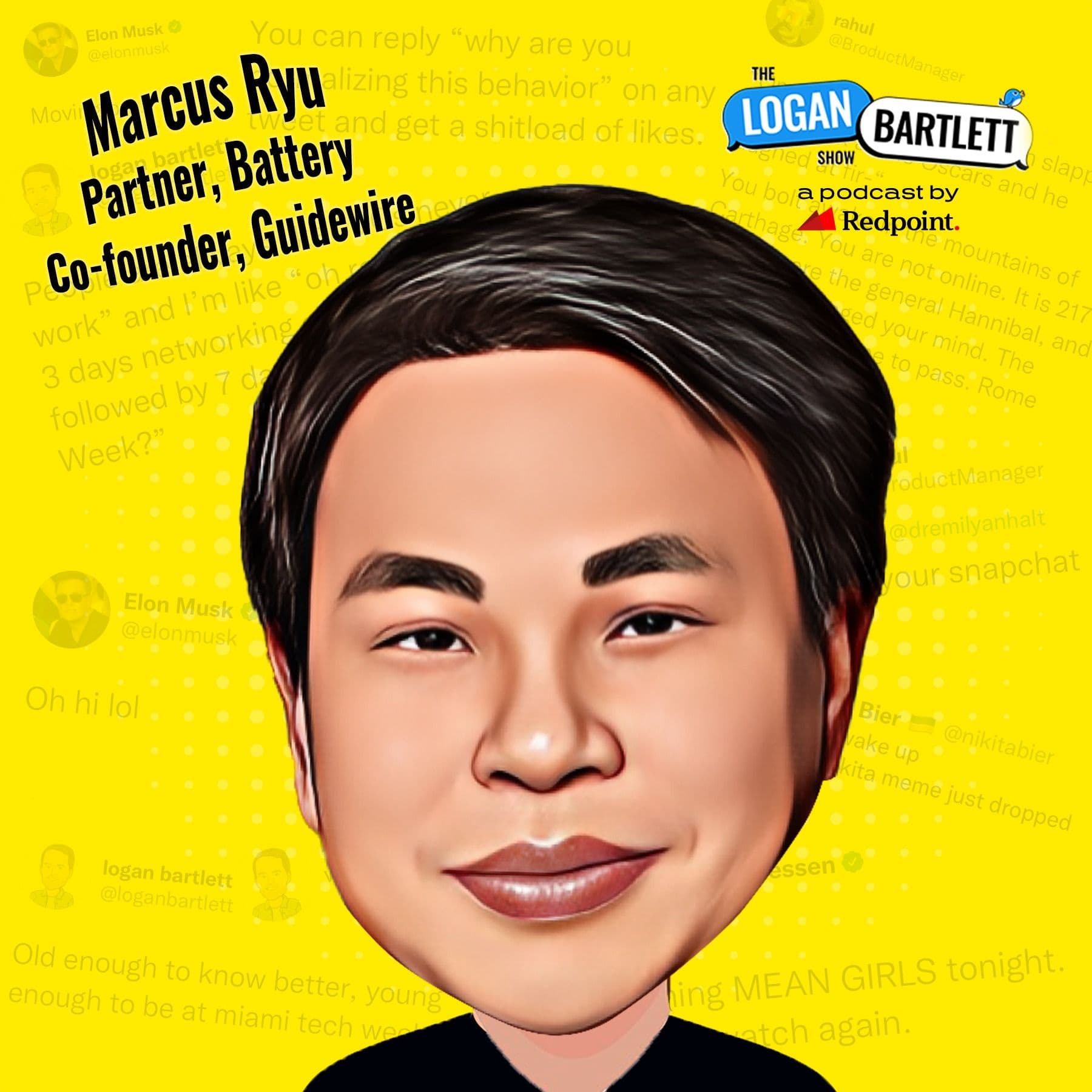
Podcast Overview In this episode of *The Logan Bartlett Show*, co-founder and former CEO of Guidewire, Marcus Ryu, shares his journey in building a successful startup within the insurance industry and his transition to venture capital at Battery Ventures. The conversation covers a range of topics, including investment strategies, entrepreneurial insights, and the future of vertical software.
Key Highlights & Discussions
Introduction
- Guest: Marcus Ryu, co-founder of Guidewire and partner at Battery Ventures.
- Focus: Transition from CEO of a $10 billion company to venture capital.
Philosophical Approach to Investing
- Discusses a philosophical lens on investment strategy and decision-making.
- Importance of coherent strategy and logical reasoning in entrepreneurial ventures.
Early Insights & Journey
- Philosopher to Entrepreneur: Ryu’s move from academia to entrepreneurship, initiating Guidewire after identifying gaps in the insurance software market post-9/11.
- Dot-com Bubble: Lessons learned during the dot-com crash that shaped his approach to building a sustainable business.
Building Guidewire
- Founding Challenges:
- Identifying a niche in the insurance industry.
- Building from scratch, emphasizing energy, time, and market demand.
- Product Development: The importance of precision in startup success and understanding market intricacies.
Resilience in Go-to-Market Strategy
- Navigating rejection and setbacks, including legal battles and customer churn.
- The Parable of the Horse: A story illustrating the unpredictability of business outcomes and the need for resilience.
Leadership and Company Culture
- Transitioning from founder to CEO and learning from leadership changes.
- Importance of maintaining integrity, rationality, and collegiality in decision-making.
Impact of Insurance on Society
- Civilizational Necessity: Ryu discusses the role of insurance as a buffer against economic risk and its moral implications.
- Future of Insurance: The need for innovation in insurance regulation and the impact of climate change on industry dynamics.
Lessons for Founders
- Founders should be authentic and true to their nature.
- Importance of understanding both personal and market dynamics when building a business.
Future Opportunities in Software
- Vertical specialization in software will continue to grow, with tailored solutions for specific industries.
- Emphasis on the increasing complexity of industry-specific problems requiring dedicated software solutions.
Closing Thoughts
- Ryu reflects on the emotional journey of entrepreneurship, emphasizing the integration of philosophical insights into practical business strategies.
- Importance of continuously assessing the strategic coherence of a business amidst changing market conditions.
Final Reflections
- Ryu's journey illustrates that the path of entrepreneurship is fraught with challenges but also filled with opportunities for growth, learning, and impact.
- The conversation highlights the need for deep alignment between founders and their investors in navigating the complexities of startup life.
Episode Credits
- Executive Producer: Rashad Assir
- Producer: Leah Clapper
- Mixing and Editing: Justin Hrabovsky
---
For a detailed exploration of Marcus Ryu's insights, check out the full episode of *The Logan Bartlett Show*.
Written by AI. May contain mistakes. Listen to the episode to check what was said.
Transcript
Automatic transcript. May contain errors.0:04Welcome to the Logan Bartlett Show. On this episode, what you're going to hear is a conversation I have with co-founder and former CEO of Guidewire, Marcus Rue. Now, Marcus is currently a partner at Battery Ventures, which is my former employer. We talk about Marcus's journey from a PhD in philosophy into an entrepreneur building one of the biggest vertical software businesses out there, and then what it's been like transitioning into the world of investing at Battery Ventures. We talk about his biggest traits that he looks for in the entrepreneurs that he wants to back, as well as what the key characteristic he seeks out in any company and whether it makes sense to invest.
0:41We also talk about the insecurity of entrepreneurship and how Guidewire almost failed in their ninth year in business and what it was like powering through and building the business into what it is today. One of the smartest individuals that I've had a chance to talk with and really fortunate to have this discussion with Marcus that you'll hear now. Marcus, thanks for doing this. Honored to be here. So in the early 2000s, you decided you wanted to be an entrepreneur and went out and hunted for a problem to solve and ultimately landed on Guidewire, which is a super successful. I don't know. You're still involved today, right?
1:15Indeed, yes. Still chairman, yes. In doing over a billion in revenue and very high valuation. Approaching a billion. Approaching a billion in revenue. Do you tend to gravitate to founders now that you're actually on the investing side that are uniquely passionate about some domain and come in with a bunch of experience? Or because of your experience hunting for a problem as an entrepreneur, do you side on one versus the other? You could call me promiscuous in that sense. I fall in love with pretty much every founder I meet at some level. And one thing you hear to be a good investor is you have to develop a discernment and only so many hours in the day, et cetera.
1:47But I find that in almost every entrepreneur I meet, even if there's some degree of insanity there, that there's something extremely compelling. What matters more to me personally, and as part of my underwriting process, is less a specific corpus of experience than a kind of spiky insight. And sometimes that derives from having been in the domain, but not necessarily. If you think about that spiky insight or wondering like the questions that you ask yourself from an investment standpoint, is there a handful of like heuristics or considerations that you come back to? Is it why now and why them?
2:23Or are there things that you sort of grab? Sure. Speaking immodestly, if there's one thing I think I might be good at, it's engaging in a certain kind of cross-examination about the strategy right off the bat. And I think I indulge in that a bit further than maybe some of my counterparts in the business who are, you know, attract to the metrics and so forth. I think the thing that I'm always trying to discern is like, is this strategically coherent? I think that is the that's the ultimate signal that matters most. That's it's necessary, not sufficient. There are a million other questions you have to ask and understand.
2:52But most importantly, you have to know, is there a coherent is there a coherent thought process? Is there a through line that, you know, where premises follow where conclusions follow from from sound premises? And to my astonishment, a huge number of founders, even those who have been incredibly credentialed, passionate, intelligent, etc., can be surprisingly weak on that count. Just to elaborate a little bit, what's a strategy? I mean, just at the most base definition, what is a strategy? I mean, it starts with a diagnosis. It starts with a theory of the status quo and an account for why that status quo is as it is.
3:30Sometimes there's been a coordination problem or a technology barrier or some kind of incentive problem. There's some reason that things are not as they should be. And that has to be very cogently, succinctly, and convincingly explained. That's not even talking about the company. That's just talking about the account of what is today the case. Then there's a market definition and an explanation of what is the point of attach? What is the insertion here? What is the claim that's being made? And that happens at the level of a noun phrase, not an account of some extraordinary breakthrough technology or some extraordinary team.
4:03It's a theory that can be explained usually in plain English with nouns, not with adjectives. And that simple initial step, that simple test, I find at least half of the companies I talk to fail by my criteria right in the beginning. Now, that said, I've kind of fallen in love at some level with the passion, the insight, and maybe you can extract a little more coherence. But if it takes too much effort to do that extraction, then I start to worry. When someone's coming back to, let's say they have a good grounding of understanding of the existing industry and why it's the way it is and see all the pieces there, but maybe don't have a history of why others have failed trying to attack this industry in some way, shape, or form.
4:47But sometimes a lack of or like a hubris of like, no, I can solve this problem uniquely is a really attractive thing and not being not being having your expectations quelled by precedent experience versus other times. It's good to know the history and the pitfalls that others have gone through in the pursuit so that you don't make the same mistakes. Do you prefer people that actually know the root of the history and the recent people that have failed? Or do you prefer that AUPT of pursuing something with a first principle standpoint? Actually, it's something slightly different. So I'd say like uninformed confidence is a fine line between uninformed confidence and just recklessness.
5:29You have to be confident. You have to be secure in yourself. And it takes a fair amount of ego to do that. That's also a necessary ingredient, but it's not sufficient. And you actually have to have a cogent theory. Sometimes you can be lucky, but we're not in the business of trying to bet on luck. We're trying to find a stronger signal. And I have found that sometimes people who come from the industry have had time just through sheer experience to formulate a theory in an account that's really deeply felt. And they've been able to visualize the product that should have existed, the thing that they wish they had when they were a professional, sometimes.
6:03But sometimes they've also inherited all of the presumptions, all of the conventional thinking, all of the inertial principles that have things be the way they are. And so they're actually, they have a kind of blindsight. Similarly, people from the outside can approach with a kind of naivete, you know, and an assumption. There's a very classic slide that you will see in many funding pitches. And it's like the spaghetti diagram. Let's show you how crazy and Excel and Lotus Notes based this process is. Isn't it insane that this is the way this happens? You know, it's time for a better, something better, and that's me.
6:34And often, I'd say the vast majority of the time, that spaghetti diagram is a grotesque and kind of disrespectful oversimplification of the reality. You're trying to dumb it down so that an investor can appreciate there's a problem that needs to be fixed. But often you're not doing justice to the actual situation. You're characterizing the existing constituents in that market as being kind of clueless. And that's rarely satisfying to me. There's an account. Maybe there's, again, a market structure problem, an incentive problem, a coordination problem. But it's rarely the case. It's just that people are idiots and have just consented to live in the Stone Age because they like it there.
7:09When you poke and prod a market, your investments today, which I want to talk about in a little bit, but you've done some stuff in the core domain of insure tech, broadly speaking, right? Yes. Which is where you spent your, I guess, first act or second act of your career as a CEO and founder. When you're looking at it, so I assume you have novel insights around the way things are and how things came to be around that area. But when you're looking at net new markets, are there specific questions that you'll ask of the entrepreneur or of industry people to understand why things are the way that they are and the different incentive structures?
7:47How do you tease out when it's outside of a domain that you've lived really well? Yeah. So with respect to insurance, I joined Battery with the explicit intention of not being the insurance guy. I failed in that. I am the insurance guy there. And so anything, even with a whiff of insurance, I end up getting a look at, which I appreciate. And of course, I'm opinionated. And forever, after spending 20 years deep in the salt mine of serving that industry, I will always see the startup world, certainly, through the glass of that insurance experience. Though I think there are very deep similarities to other verticals.
8:18We can talk a bit about that. But what I like to do, actually, when encountering with the founder, if there's something that's intriguing, is go through. Sometimes they're taken aback by it, but usually they appreciate a kind of, I call it like a cross-examination. It's like, let me restate the premise as I understand it. Like, how well substantiated is that? Is that based on your experience, or do you regard that as, is there additional facts to be known? What is the boundary of your confidence, and what are the unknowns, what are the frontiers of what you don't understand right here? What is the causality between this claim and this other claim?
8:52And it's not unlike, well, my training was as a professional philosopher. Believe it or not, there are such things. And in philosophy, of course, there's nothing tangible. You're talking about eternal ideas that people have been grappling with for thousands of years. And you're looking for very precise inferential connections between different kinds of claims. And a lot of times the argument will be, it's not that your claim is wrong, it's just that you've come from premise A and B to conclusion C in a way that's not warranted. You have not thought about these other possibilities or whatever it might be.
9:25And that training, I find, has been, was relevant to being a CEO, surprisingly, but it's even more relevant, I think, to the task of trying to discern if there's a coherent strategy behind the founder's idea. I want to say, again, coherent strategy is, to me, essential. There are examples that I see of extraordinarily successful businesses that are not that clearly expressed in terms of that strategy. it's you know but that's i think that's luck i think it's ultimately a kind of luck uh and it's it's a very hard thing to underwrite from the outside um but i get very attracted to those founders that um not only are coherent in their reasoning but embrace that kind of pressure that kind of intellectual pressure and don't don't take offense at it uh and it's a very very negative anti-pattern uh to find to say i'm already the authority why all this questioning right and sometimes you get that vibe too.
10:20So to back up, how does a professional philosopher find his way to starting a insure tech software company? Like how did that transition happen? I'll give you the very short version of the bio. I was a very good student. It was the one thing I was good at. I was extremely overeducated, but useless effectively. Fortunately, there was that moment in the late 90s where McKinsey took sympathy and was also strapped for talent and said, well, you have a doctorate in philosophy that could be relevant to advising corporate executives. That's totally absurd, but that's what they thought at the time. And they took a very kind of, let's say, an insecure overachiever persona, which I still embrace, and said, why don't we show you the world that you can pay off your student loans.
11:04So I ended up doing that briefly at the center of the universe in the year 2000 was, of course, here in Silicon Valley. So I followed the basic pattern and found my way out here, worked for Ariba, which was the most compelling software company of its time, or one of the most. It was the era of Priceline and the advent of Amazon. But in the world of B2B commerce, Ariba was the name. Went public in 1996, was at a$42 billion market cap in 1999 on less than$200 million of revenue. It was a different era. And everyone thought the world will be irrevocably changed and will be at the heart of it. And to my astonishment about my own self, a year later, I realized I was put on this earth to be a software entrepreneur and met four or five other brilliant co-founders.
11:53And we set off to start a company in 2001. It's very easy to date. Our first week in the office was two weeks after 9-11. And it was a nuclear winter out here. and it was a very, very, very hard journey. But also, you know, the singular experience of my professional life. What was it at the Ariba experience that made you realize that you were an entrepreneur at heart? So it was astonishing to me that so much capital, so much enthusiasm, so much talent and intellect had been applied on basically an incorrect theory. So I'll tell you what that theory was. It sounds kind of quaint now, 20 some years later.
12:38But there were huge conventions where thousands of professionals would aggregate around this theory. And that theory was, look how the internet has changed consumer life, right? And entire job professions are being euthanized or transformed, like the travel agent or the retailer. Well, the same thing is going to happen to B2B commerce, which is an order of magnitude greater. And it is an inevitability that within a small number of years, there will be a number of kind of industry consortium-led B2B marketplaces, right, where all the commerce that today is happening over EDI and through human interaction and exchange of spreadsheets are going to happen in these internet-driven nexuses.
13:20And there will be one for oil and gas. There'll be one for consumer packaged goods. There'll be one for the insurance industry. And everybody believed that. You could have polled all 10 ,000 people that went to the conferences that talked about this in the year 2000 or 99. And not every one of them would have bet their firstborn child that this was going to happen. And it was evident to not only me, but others that were very close to it, that this was not going to happen. And yet this company was being astronomically rewarded for powering this inevitability. So that's what triggered the idea, you know, maybe there's another way.
13:55So that's half of it. The other half was that I was, let's just say, repulsed by a kind of excess, a kind of unhinged exuberance that applied during that time. And I took away a lesson that I think is just self-evidently true now, that whenever you have huge amounts of wealth being created in too short a period of time, everything goes off the rails. People can't think straight. Relationships fall apart. No one can build anything. No one can concentrate. Nothing happens. Nothing good happens, right? Everyone is just obsessed with rising asset values and doing the calculation of what it means for their own net worth, envisioning the plane and the private jet that they're going to have and the divorce that now is necessary.
14:42All of that kind of insanity is completely counterproductive to building something. And it's just common sense that things of substance, things that are durable, things that overcome fundamental challenges are slow, they're unglamorous, they take a long time to build, and that's completely the wrong setting in which those things happen. So it did not take a lot of prescience in that year to realize this party is going to stop, and it'll stop abruptly. And when that happens, there will be a new opportunity, a new kind of sobriety with which to build things of quality. And we kind of, my co-founders and I, really track to that.
15:21and maybe to an extreme degree. Some things we did were embarrassing, like we're going to tighten our belts to such an extreme degree and we're going to eat rice and beans for the next three years. And we kind of made this sort of austerity, ration, ethos part of our company. I'm proud of it as well as it's a little bit embarrassing, but it was of the times. It was of a time when extreme excess and a recognition that things had to be rethought. So it was those two things, A sense that maybe we can come up with a more coherent strategy that actually is not just based on wishful thinking and solve a real problem as opposed to an aspirational problem.
15:59And then secondly, maybe we can form a different kind of culture, one that's founded on substance. I'm curious the portals and all of that stuff, the B2B portals and the supplier networks and all of that stuff. I mean, Ariba ended up being a successful business acquired by SAP for$3.5 billion. Okay, sorry. But real money, yeah. I always confuse the purchase price of Ariba with, what else did I say? SuccessFactors with Concur. All of them sort of blend together in my mind. All of a similar vintage of time. But some of the elements of it were inevitability that, hey, the supplier network can come together and people are going to purchase within their rebid network and all of that stuff.
16:39But what was it that you saw on the ground that, hey, it's not going to be as simple as the narrative around Priceline or Kayak or it's just the B2B world is different? Like, what did you actually see there? Yeah, we can go quite deep on this. I'll try to not lose myself in the intricacies. But it's that the market has a certain structure to it by virtue of the incentives that are involved. And sometimes it's very simple where there's just a friction that you can eliminate just by getting everybody in the same place. I have vintage Beanie Babies and you are a collector, but we live in various different parts of the world and now we find each other very easily, right?
17:18And so the internet solved that problem in a transparent way. Both of us are highly motivated to find each other as counterparties. That's not the case in the consumer electronics companies, between a tier one supplier and a manufacturer. They don't have trouble finding each other. They already know who each other are. And the internet essentially offers no value to that interaction. Or another example, the one that I know best is the insurance industry, right? The vast majority, well, let's say effectively all commercial insurance, it's not quite all, but effectively all commercial insurance is intermediated by a broker.
17:51And naively, you know, you would say the kind of tech bro guests would be like, why do you need these guys, right? We don't need travel agents. Yeah, we got rid of Kayak, got rid of travel agents. Why do we need travel agents? We don't need insurance brokers. They're just like information paper shufflers, you know, like, why do we need these people? And we should just euthanize them all. There's very good reasons why they don't. It's not the way that the purchases are made. There's a kind of informational decoding that they provide. And they are profoundly entrenched in the industry in a way that's not easy to displace.
18:22And there have been many failed efforts and a lot of wasted venture capital on the belief that that's not the case. So there are industry constituents that have a lot of market power that are not willing to go away and that are much more closely, that are closely attached to the demand that the demand, in this case, consumers or businesses appreciate, and that you cannot satisfy easily with a technology solution alone. So this combination of very weak value proposition and then not considering all the other market structure and intermediaries, but led to a very naive theory about where B2B marketplaces would evolve.
19:03There was just a sense, this ought to exist, but without saying, but who benefits? And who will be the losers if such a thing evolved? And why is this any better than it ought to be? I'll give you just one more example. There was a theory that pricing would be transformed by the internet. And there was a brief period where VCs and entrepreneurs were obsessed with the idea of auctions. It's like, this is the perfect form of price discovery. After all, look at the public equity markets. That's a daily auction for every security, and look how efficient that is. So isn't that the way that timber contracts should be done?
19:37They should be done by auctions or insurance contracts. Everything should just be done by bidding. And there were a lot of smart people who built very sophisticated, incredibly complex kind of algorithms for all these different species of auction types and say, we're going to now conduct these. It kind of reminds you of what you'll see in like the web three world right now uh where insanely intricate kind of financial instruments that make a certain kind of intellectual sense but have like no bearing to the way that people actually think about mortgages and consumer loans right the same kind of thing applied to this auction idea and so you know a lot of capital uh was spent on trying to instantiate auctions for b2b commerce and none of them got anywhere right so that was so witnessing that happening and having kind of a front view seat to seeing that, like the disconnect between the ideology or the aspiration and then what actual enterprises on the other side were doing and trying to puzzle out what is this internet thing and why is it relevant to our, to my consumer electronics business or my oil and gas business.
20:37So witnessing the, just the depth of that disconnect, like a grand canyon of, of, uh, of confusion said, well, there's, you know, if I want to be an entrepreneur, Sure, I see the incredible excitement of that, and we can talk about that separately, but it has to be done in a fundamentally different way. It has to be done closer to the end market, not in the ivory tower. It's hard not to hear all this and at least think about, you referenced Web3, but then also artificial intelligence as well and what's going on right now. As someone that lived in such a close proximity to all of the things that went on over the course of 99, 2000, 2001, 2002, how do you think about now looking at maybe AI as an example?
21:20Where do you draw parallels between that and now versus what is totally different? And you need to have a first principles kind of novel view of what's going on. Well, I think like many people, you know, within a few square miles of us here, we're dazzled by the potential of AI. There are things that seem absolutely magical. Which probably was true of the internet, right? Absolutely. Yeah, absolutely. And so, but the same questions apply. They're the same fundamental questions. So what is the use case, right? What particular process or human practice that exists today are you hoping to displace with something better?
21:56and first of all how certain are we are that it is in fact better is it actually better and and then that's not that only that's only the first question there many like well what other economic incentives are involved maybe you're better but at what price you know and that price could be dollars but it could also be loss of privacy or loss of you know loss of process control or loss of a customer relationship so these could be very heavy price that could be paid. It's not simply enough to say, well, this kind of customer inquiry could now be AI mediated, therefore it will happen. There's lots of reasons why it may not.
22:29And I refer again to the insurance example. Why are there still insurance agents? Because they do something that is non-obvious and useful still to a huge portion of the market. So where am I with AI? I know the limits of my own understanding. And so all the kind of foundational discussions that are happening with the huge, let's say, low-level foundational technology. It's very hard to understand without being a practitioner. And I know a lot of practitioners, and even they say, the pace of change is very hard to parse. No one really knows fundamentally. I appraise it at the level of, well, what are the use cases that I know?
23:06I like to focus on vertical applications. One of the motivations for Guidewire was a kind of higher-order belief that the most important software in business, most important enterprise applications will be vertically specific. And that's a whole kind of separate sub-thesis, right? But I think the most important, most valuable, most mission-critical software by definition is specific to an industry. So I like to look through things like, let me at least appraise the value of this tech as it applies to insurance. And here it's very much experimental mode. Lots of theoretical applications, you know, to policyholder service, to underwriting evaluation, to pricing calculation, etc.
23:46But all in the experimental phase, none of it in run rate expense, you know, OPEX right now for insurers, all very experimental. And so that kind of gives me a signal for where I think is the state overall. But I will say it's qualitatively different than, again, to go back to Web3, you know, there was a theory, let's say four or five, six years ago, that the blockchain would transform all kinds of financial services, including insurance. Now, I was a little dubious, but I said, let me look at it from first principles. Is this really happening? And let's talk about the insurance use cases. And one use case that was discussed was reinsurance contracts.
24:23So reinsurance, as you know, I'm sure, is insurance for insurance, right? It's a risk transfer from an insurance company to a smaller set of reinsurers that take that risk. Mostly in Bermuda. Often in Bermuda, right, for regulatory reasons, historical reasons, and in Europe. And the theory was, well, instead of these contracts, which are basically instantiated, you know, in paper documents, in legal, in their legal contracts, like policies, these happen on a blockchain. Because then when you are trying to settle up after, you know, a catastrophe, a tropical storm, then the blockchain will automatically execute and make sure everyone gets the right amount.
25:00Right. That was one of the use cases. And if you were, if you didn't know anything about the insurance industry, you say, yeah, that sounds better than paper. Right. No insurer has adopted this and never will because everybody knows their counterparties. Everyone knows there's only a small number of possible counterparties. They've been doing business for a very long time for hundreds of millions or billions of dollars. And that reconciliation is not something they need any computational help with. Right. It's quite doable in Excel. Right. So the idea that they were now going to entrust this new exotic decentralized instrument is a solution for a problem that doesn't exist.
Read the full transcript
25:41And sure enough, the actual contribution of blockchain to the insurance industry has been not little. It's been zero. Absolute zero. So in contrast with that, obviously AI will be much more constant. But I would be reckless for me to put the outer bound on it right now. It could be incremental, helpful in a few areas that are pretty obvious. I don't think it'll be transformational, but it could be meaningful. And I'm certainly paying close attention. Interesting. So backing up to the founding experience, so you got together with five other people? That's right. There were six of us. Six of you going to start a company, which is large.
26:19How did the six of you sort of come together and target insurance as a problem? Yeah. So we knew each other from the Ariba experience. There were two others who ultimately became CTO and head of engineering who were from a company called Kana that did a kind of like high volume response center. Call center. Call center. It was quite ahead of its time. Very successful. Other venture-backed company. The six of us were together. That does seem like a large group, but I will tell you, and I have said now for 20 years, the company would have failed unequivocally, without doubt, if any one of the six of us were not present.
26:53And why was that the case? Because it's so hard. There were so many things to do, and we complemented each other's skills, each other's cognitive lapses so well that each of us kind of covered an essential part of the waterfront that was necessary. And these guys are my brothers. We get together still very, very close. We shared an experience that I say with no disrespect from people who have actually been in harm's way, I would say is like having been through a war together. and it's a bond that I treasure. Now, how do we come together for insurance? The second part of your question. Well, again, we had this theory that the conventional wisdom at that time for enterprise software was you have to invent a new three-letter acronym.
27:41You have to find some new supply chain management, human capital management, ERP. You have to find, those are the big venture investable software categories. And you want to have maximum number of buyers and it has to be some huge new system. And we thought that was wrong. Not that you couldn't build, not that there weren't such markets, but that they systematically, that was systematically neglecting some of the most important mission critical problems that enterprises would face. But again, those problems, by definition almost, were specific to an industry. The things that a oil and gas company care about most are specific to oil and gas.
28:18Things that an insurance company cares about most are specific to insurance. And so we said, if we're going to pick a vertical application, then we're going to serve just one industry for the rest of this company's life. Well, let's pick a big one. Let's pick one that has a serious problem that we think is seriously unhappy with its incumbents and where we can motivate a meaningful economic value proposition. And let's also, again, informed by this kind of contrarian spirit that we had, let's do everything the opposite of what's happened in this dot-com insanity. so all of that that formula led us to the biggest most unglamorous most boring insurance industry you could come up with the insurance industry now i say that with no disrespect i love the insurance industry i've been a servant of it for decades but it's like the punchline to a joke of like what's the most boring problem you could think of as it turns out insurance is fascinating and i'll i'll elaborate on why i think that's the case and why it's it's it's fundamental to our way of life and has extraordinary room for intellectual curiosity and innovation.
29:23But at the time, the economic theory was very simple. It's that insurance companies pay out, at the time, it's a roughly$2 trillion industry, but as measured by aggregate premiums, it pays out about two-thirds of that, half to two-thirds of that in claims. And the systems by which that happens are ancient. They are 1980s COBOL, CICS, AS400 mainframes. or mini computers. And that's uncomfortable for the people who work in those systems, but that's not the real problem. The real problem is that they're making systematic mistakes. They make a mistake in coverage, or they pay a claim that shouldn't be paid.
30:02They wait too long because the process is so slow and the workflow is so poor that the claimant is unhappy and sues the company. And that, so they get sued excessively. They fail to subrogate, which means claim against other insurance companies. So they make all these systematic mistakes that, um, the cause that are deadweight economic loss for an insurer. And the theory is a new core system would help solve that. Now we did a lot, made a lot of mistakes, just like every young company. Um, there's a famous Mark Twain quote, uh, that, um, good decisions are the result of experience and experience is the result of bad decisions, which is so true.
30:41But one thing we got right, a number of things we got really right, were identifying the boundaries of our product and saying, we're going to build a core system for insurance that will be first easy to explain. The noun phrase for what we built is a property and casualty claim system. It's not adorned further than that. So our buyers would know what they were buying. We say, you have an existing one. We're here to replace it. We're not going to augment it. It's not an optimization engine or some new category of software. It's just a better version of what you have. And the reason you want to buy it is because you are making systematic mistakes that cause you multiple points of your operating income.
31:27And the way that it'll improve on that is it will make your most junior, most inexperienced to claims adjuster as good as your most senior. And we will guide them to make the right decisions. Hence the company's name, Guidewire. Like a wire that follows you, that you trace to the right path. Now amusingly, a Guidewire is also a medical catheter. That's the other name you would look up. So I will share with you, one of our early moments was, we had a sales doc at Guidewire email address that you could make an inquiry. The first maybe five to ten inquiries we got were people looking for medical catheters.
32:06So we would have a moment of excitement and then say, no, they're not interested in the insurance system. You toyed around with a few other ideas that I think were similar to LinkedIn, Dropbox, and Salesforce. That's right. Were any of those, do you think, you could have executed on with the same vigor and passion and had created something that looks like those companies? Or was it wrong time, team, whatever, if you think back on the road, not taking it? Yeah. The sadness of the human condition is that we only get to run the tape once. Yes. There's no counterfactual. No, there's no way to know.
32:37But along the way, many times we said, why did we choose a business so punishingly difficult? How long did it take you to your first customer? Approximately 18 months, 18, 24 months. Yeah, probably 18 to 24 months in. That's right. We should have done something easier. Yes. And it was a journey so full of false summits, so many moments of if we can only get that first customer. Well, if we can only get the first three because no one trusts the first one alone. and if only we can get these live and if only we can get the first customer of this scale or this particular size and at a certain point just realized it's just an infinite series of false summits.
33:08Yeah, moving the goalposts over and over. False summits. There will never be a moment of real satisfaction or achievement. That's not quite true. You have to make that for yourself. But there will be no sense that we've arrived and now we've kind of unlocked the easy part of the journey. That never arrived, never will. As for these other ideas, we thought, as entrepreneurs, we discarded a lot of ideas that we thought were too obvious, too simple. That'll be a feature of Windows, or there's no way we could possibly commercialize that. So we had a lot of those ideas. And when we would see companies that improbably, like Salesforce or Dropbox, thrive, we would say, these are ideas that we discarded in remarkably similar form, because we thought that they would not be defensible enough and so forth.
33:53So we have chosen our own path and we've committed our identity and our honor to it. And here we are. So we'll go the distance. And so in picking insurance, it sounds like it was a little bit of a top-down decisioning. There were those fundamental premises that you guys believed as a reaction to what had happened or what you had seen. But landing on insurance specifically, was it just a GDP calc down of like, hey, this is a really big market. It feels like an opportunity to create something important. Well, as all of us reflect on our lives, we realize just how random and improbable, you know, the little decision, the little butterfly's wing that caused us to marry this person or choose this career or whatever.
34:29In my case, it was that my office mate at McKinsey, so I've only worked for three companies before Battery, you know, McKinsey, then Ariba, and then Guidewire. My office mate, assigned at random, like a college roommate, was a former actuary. And over lunch, he educated me about the insurance industry. Now, I had no idea about Guidewire at that time or that aspiration, but he triggered he stimulated, let's say, some thinking about that industry. The second thing also at McKinsey was that when I joined in the late 90s, the one project that you did not want to be on, like the death project, was called a closed file review.
35:06And that's when you were sent deep into the bowels of an insurance company and buried in paper folders and told to figure out how many mistakes the insurance company was making that was leading to excess claim payments. So I took these little scraps of information. And when it came time to say, okay, we're going to do something vertical, I said, well, here's a place where I think software might make a difference. We're talking, and we have an end market that's sufficiently large, a kind of problem that superior software we can visualize. Now, that was only 1 % of the discovery. Everything else came from talking to people in the industry.
35:40Now, the insurance industry employs like two and a half million people. So not hard to find people. And remarkably, they're very willing to talk. You just have to ask them respectfully for their time and patiently explore what they're doing. So we visited probably a dozen insurers in their claims operations and sat with people in their cubes trying to understand their current state. And they did this for free. They did this because they were happy to have someone take a curious interest. And I think that's just part of the journey that you have to pay. I get exasperated sometimes when I meet young, enthusiastic entrepreneurs.
36:17And they just feel like they've figured it all out in the shower, you know, and they don't need to be in the field. It takes a lot of field work to figure out what you're doing. So how did you go about getting these people, like finding their email addresses or getting them to sit down with you? Oh, it's pretty trivial. Yeah, it's not hard to network. And then we would just say full frontal, hey, we're trying to build a software company. We have a theory. it would be so meaningful if we could just spend some time in your operations and observe you for an hour. And what we'll offer you in return is a summary of our findings.
36:53That's all we have. Obviously, you won't pay, we can't pay. Are you up for it? And our hit rate on that was, I don't know, close to 100%. Just asked respectfully. And we had a number of people in the early days who would spend huge amounts of time with us just patiently explaining every facet of the industry that we just described. And afterwards, it was a very satisfying moment to have given them equity and then for them to be amazed that it was actually worth something quite meaningful to them. I've heard you talk about the balance sheet that you have when starting a company and how the trade-offs that need to occur along that.
37:31Can you elaborate on that point and how you think about the balance sheet of a founder? You mean the allocation of energy and time? Yeah, or like I've heard you say the headpin of demand with what the market wants. Yes. Yeah. So it's very humbling when you start a company. You realize you have no product. You have no customers. You have no team. You have no brand. You have no assets, it may feel like. You are all potential. So this is the audacity to say, nonetheless, we're going to win in this market. So what do you have? One thing you have is an insight. You have a theory of a way that you can intersect with the market at this particular moment with perfect precision.
38:13That's the one thing you have that's so precious. And you have to define your market precisely, but then you have to find that vector of attack and hit it with maximum force, right? And the power of that, when it's done right, can change the world, right, as we know. And it's one thing that you immediately start losing. As soon as you have a customer, as soon as you start building, make some product decisions, you know, you are starting to lose that kind of, that infinite freedom that you have to hit with precision. And as a company gets much larger, like Guidewire is today, it's lost a lot of that.
38:43I mean, it's a battleship now to try to turn and hit the next thing, and therefore it's vulnerable. But that's the most important thing to maximize. And that returns, I think, to the point I was making earlier, Logan, that the first thing to underwrite is the coherence and the precision of the strategic intent. It's not the team. It's not the technology. It's that. Those things can be indicators. Obviously, successful founder has demonstrated some ability. Maybe it was luck. Maybe it was insight. But I like to see that really lucidly spelled out. 18 to 24 months without signing your first customer.
39:20How did you maintain sanity over that period of time and setting different milestones so that you knew you were moving forward in some way without having those proof points? Yeah, it was humbling. Let's say three parts of building a business, right? Like building a product, getting initial customers, and then the standard company building stuff. Company building stuff is fun. It's fun to pick out the logo and the t-shirt colors. It's all completely irrelevant. So you have to spend absolute minimum time on that. Building the product, two of them in particular I think are geniuses. I don't say that lightly.
39:50And they took all those interviews we just talked about and just described them and then conceived a product that, it is amazing to me, they put into a binder, we called it the binder, and it basically defined the company's product strategy for the next decade. It was a theory of what needs to be built and the sequence thereof, what was the MVP, what were the nice-to-haves, where we would have to satisfy existing requirements, where we could build something 10x better. And it was extremely precisely and lucidly captured in a document that we then built and defined the company's strategy for a long, long time, a decade plus easily.
40:27Then there was the go-to-market part. And that part was getting punched in the face every single day repeatedly. It was a level of rejection that I was psychologically unequipped for at the time. I had a prestigious education. I worked for the most prestigious consulting firm. I had been part of like a hot Silicon Valley company. I mistakenly ascribed all of the things that come with those things to myself. And then stripped of those and starting again with a meaningless brand was realized of nothing. And so it was just rejected endlessly over and over again. And I would not have made it myself psychologically, emotionally without the other five of us.
41:09So what we did is essentially make a pact, which is we don't know if we'll succeed or not, but we have committed our honor to trying and we will have to get there over. You know, we will commit a rational period of time before we'll have to rationally give up. But until then, we will not question, we will not second guess, we will only go forward. And that was essential. The second thing we did was define, of course, other measures of success. And so, you know, one of my co-founders, John Regan, who started the company as CEO, So he used to tell the story about how he went to college. There was a guy, I forgot his name, but, you know, who was able to date all the most beautiful women on campus.
41:51How did they do it? You know, it was a mystery because he was very ordinary in every respect. And then when John asked him, you know, what is your secret? He says, I'm just the guy who asks the most. Right. Not necessarily the most persistent. Just I just ask the most. I overcome my own inhibitions and I ask. And he says, that's what we will do. We will ask and we will just talk and not be not be deterred by rejection. And incredibly, this is an insurance principle, by the way, when you aggregate very small probabilities over over a large enough over a large enough mass, eventually you get to something like certainty.
42:27And that's what we did. We talked to every company, every individual that we could possibly network our way in through implausibly and eventually found just the right combination of willingness, risk-taking, the right new executive at the right moment in that company's history that they were willing to take a risk. And then we dug our foot into that toehold and, you know, use it to get to the next step. One of the lessons, or I've heard you speak about the parable of a horse and how that informed your perspective on the journey. And can you, can you, can you tell that story about the different milestones with the first customer and all that.
43:02Sure. You want me to tell the parable again? So this is not of my invention. This is like, I don't know if it's apocryphal, but it's supposedly a Chinese parable that there was a farmer and he had a horse that was one of his important assets. And then the horse ran away one day. And his neighbor said, oh, what a tragedy that that's happened. And he says, well, maybe yes, maybe no, we'll see. And then the horse returned and it returned with a mate, another wild horse that it found. So now he had two horses. and his neighbor said, how fortunate that this has happened to you. And he said, ah, maybe yes, maybe no, we'll see.
43:36And then one day his son was riding on one of the horses in the field and then broke his leg. He said, ah, what a tragedy. He said, ah, maybe yes, maybe no. And then a war was declared and all the young men of serviceable age were sent out to war with all the risks associated. And they said, how fortunate that your son does not have to go to war. He said, well, maybe yes, maybe no. And so the story is one doesn't really know the meaning of any event, good or bad, at the time that it happens. Things are never as good as they seem. They're never as bad as they seem. And internalizing that is a very important kind of life maturity.
44:10I think it's essential for a founder because you're having to regulate your emotions from hyper excitement and hyper despair all the time. And learning to blunt the highs and the lows is important to tracking the truth of what you're trying to build. Now, in Guidewire's case, what was our example? We had those highs and lows. We had those first early customers. Customer number one was called CNA. It's a huge, at the time,$12 billion premium insurance company in Chicago. Unbelievable. How improbable that they would buy from us at a multi-million dollar license. We were absolutely ecstatic. It turned out it took another almost 18 months, two years before we got the next customer.
44:52After that, it was so much harder. And the implementation was punishingly difficult because we had none of the assets of a real software company at that point. We had the most tragic thing, or not tragic, the most painful thing happened to the company eight or nine years in. In 2009, or now I've already forgotten, I think 2008, on two days before Christmas, we were sued by our primary competitor, Accenture. It was a very low blow. It was a very dirty way to conduct business. They asserted a business method patent against us. And long story short, our customers and prospects felt we cannot buy from you.
45:32Because it's not that the lawsuit has any merit. We're insurance companies. We're used to getting sued all the time for all kinds of nonsense reasons. But it's not about the merits in the legal system. Sometimes the bad guy wins. And we cannot spend$50 million on an implementation of your software and then find that we are enjoined by the courts from using it. So solve that and then come back to us. Very nice for them to say. Again, 18 months, we couldn't sell anything. And we thought it was game over. And it's one thing for things to be game over after, you know, at year two. It's quite another thing when it's game over at year nine.
46:03You know, it's really excruciating. And we thought it's what could possibly have happened that's worse than this. Yet we overcame it. And that's its own story. and in doing so, we kind of galvanized the company to this white hot rage, a sense of moral purpose on top of business or economic purpose. We had a sense of moral purpose. We were on a crusade. This is so unjust. We had built a better product and instead of fighting us in the market, like good American capitalists, they were suing us in this kind of completely shameful and dishonorable way and we were put on this earth to prove them wrong.
46:40And it unleashed a kind of intensity, a kind of bond with each other as a team at that time that was of profound significance. It also deferred our IPO for a good two years. And that was another blessing because we were not as mature. We would have stumbled. And that's obviously terrible for a young public company. And in the end, we triumphed over it. And those who had been part of that journey, that moment, were so bound to the company, We're so proud of that outcome that their loyalty and their contribution to the company were far above what you could expect. So again, something good that turned out to be not nearly what we thought, something cataclysmic that turned out to be salvational.
47:28And on the CNA point, didn't they ultimately churn and they would have deviated the product roadmap along the way? Well, actually, that was a different first customer. I didn't even mention that. Our very first customer was an insurance company called Fireman's Fund, which is just about half an hour north of us where we are here, Logan. And they were our first trial customer. And they canceled on us. I should have mentioned them as an example. That was the first horse running away moment. They canceled on us. And again, it was a blessing because that product was not right. Their conception of what we were building was to front end their existing system.
48:03And it was then that we had the realization we have to completely replace. For better or worse, we are saying, full tilt, you must completely kill the existing system. And we wouldn't have done that there, and we would have built the wrong product and so forth. Now, none of this was orchestrated or planned. It was serendipity. But it's part of a much larger humbling that I think is just a fundamental part of what you have to go through as a founder. And you weren't always the CEO, and John started as the CEO. That's right. At one point, the board wanted to bring in an outside CEO. That's right.
48:35And they did. And they did. But it actually proved to be beneficial. Yet another one of those cases. The quick backstory is the board at the time, this is a very different era in Silicon Valley. Now this would seem silly to you and me. But at the time it was thought, well, a couple of smart kids can come up with a good idea for a company. But once it gets serious, you have to bring in someone with gray hair that worked at Siebel or IBM or whatever. Cisco, Apple. Whatever. Salesforce actually even did it. People don't know that it's lost to history. But betting off stepped down for a little while.
49:04And now just the stupidity of that is well-established. But it prevailed at the time. And we had shaken the hand of the devil. We didn't get to say we changed our mind. We were good about it and said, okay, I guess this is going to have to happen. But part of the stupidity of that was not realizing that a company that hadn't really established itself was not able to attract phenomenal talent. So the CEOs that we were able to get were all, let's just put it bluntly, terrible. And eventually we picked one as a compromise, who will remain nameless, and it was a disaster. It was an absolute disaster, and over 11 months nearly destroyed everything that we had built up to that point.
49:45So you would say, terrible event, you know, how unlucky. But we had to kill that bad theory. And so when it became self-evident that the choice that the board had made was so terrible, we had decisively silenced that argument and never had to encounter it again. As you think about navigating these difficult periods of time, you had five brothers, as you said, that could support along the way. But the perseverance and kind of powering through, is there anything that you can extrapolate from that experience that is transferable to founders listening today, maybe going through their own challenges?
50:19I mean, I'm sure many of your other guests have talked about the way that founder relationships can deteriorate and that can be tragic and lead to an otherwise great company falling apart. It's very easy to see how that would happen. And it is miraculous that it did not happen to us. I think we had a set of principles, though, that were very foundational that carried us through. I'll just elaborate them quickly. You know, the first was integrity. So we will always just speak the plain truth. And it's actually not as easy as it sounds, because it's easy to tell the truth when things are going well, you have good news to share.
50:52When things are not, it's easy to lie. It's easy to lie to yourselves. But that was a bedrock principle. Secondly was rationality, meaning we're going to make decisions based on facts and logic. How else do human beings make decisions besides facts and logic? Lots of stupid ways. They appeal to their gut instinct. They apply shallow pattern recognition. They get influenced by some other charismatic person who tells them you should go east, not west. All these other dumb ways. And so we will not do that. We will hold ourselves accountable to a certain standard of evidence before we make choices.
51:30And we will hold each other to that. And then finally, collegiality, meaning we will treat each other as ends, not means. and those principles we really we were really were sorely tested because some of the the trials that i just described to you um but because they were so um so vocalized so so frequently attested to uh they really carried us through and a lot of companies i see you know they come up with their values but the values are vacuous you know i see it all the time and then it's particularly pernicious when you have a ceo who spouts the values and then everyone can tell this guy's a hypocrite, then the values are worse than vacuous.
52:08There's a sense this whole thing is kind of a, it's kind of a sham. You know, we talk the talk, but ultimately it's about the almighty dollar, or it's about whatever John the CEO wants. And all of his values is just so much, you know, so much nonsense. And I witnessed that too. So we were very true to that. And that carried us through a lot of the tensions, but it did not save us from all of them. I mean, in year eight, you know, the first Mark, Mark Shaw, it was very brilliant. He's one of the, he was a genius. on the team. He went on to, you know, to be, to co-found Strava, which is a, you know, very impactful company.
52:43And then he's on to his next. And, you know, it's been a privilege to work with him, but he left the company and I felt betrayed. And I'm not saying anything I didn't say to him with great passion at the time. And he said, dude, I did not, like, it's been seven years. I didn't say the rest of my life. And I said, but we're not done. And he said, when are we done? I said, I have no idea, but we're not done now. Where are you going? And he said, well, life is too short. I've got other things to do. And I took it very bitterly and very hard. And I may have said things that I have had time to apologize for since.
53:16And then the same thing happened when John left and the others eventually. And the last of my co-founders left, I think, around year 12 or 13. I went 18 years. And even then, I did not feel it was anywhere close to done. The culture point in coming up with the values around which you actually are willing to do what you say, how did you guys go about landing on those? And when evaluating companies today, how do you assess whether or not they're acting on the values that they have? I think there's a confusion between kind of values and culture. So values are actually moral principles, right? So sometimes when you see a list of companies' values, they'll include things like agility and decisiveness.
54:03And, you know, those things are good. They are general kind of principles for how you should kind of bias these in action. But they're not moral values, right? A moral value is, I will uphold this even when it is not in my interest to do so, right? And that's an important distinction. Why does that matter so much? Well, it turns out that I have a theory that what binds people to a collective is not actually success. What binds them is a sense of two things that are much more powerful than just succeeding together, as fun as that is. The two things that really bind are shared suffering, shared difficulty or overcoming, hopefully not excruciating suffering, but going through adversity together, and then a sense of equal moral conviction.
54:50Those two are the real binding force. And that's highly informed by my own entrepreneurial journey, but I could give you other examples where I've observed it. So I think we chose values that had a moral character to them and ones that actually we had to make decisions about, that actually informed the choices that we had to make along the way. In very garden variety respects, you know, our first version of our policy system did not perform. There was an architectural flaw not worth going into now, but essentially the product did not perform. And to go and say there was no ambiguity about what we had to do.
55:24We have to we've enlisted these early anchor customers. We've made promises. the product does not do what it has to do. There was no calculus, but what will this mean to our investors and what will they think in our plan? And it didn't matter. Those things were all below the line. What mattered is we made a promise and now we couldn't fulfill it on the terms that we had said. So we simply had to tell them. And believe me, it was very tempting to try to fudge it, to try to work around that truth. But the truth was binary. And we were either going to tell the truth or we weren't. And the fact that we all knew that we had made that pledge, it just made it so simple.
55:56We didn't agonize over it. We agonized about the fallout from that. But the choice itself was completely dispositive. How did you balance all these ups and downs being optimistic and galvanizing to the employee base while also being honest about the challenges you guys were facing? Yeah. I mean, it was a little bit of a joke. My brand was got to be a little bit silly at times, but I would always say I have nothing to offer but blood, sweat, and tears here. That's all we have. a phrase that got associated with me was we're going to tunnel through granite and what that meant was if you're trying to get around a mountain maybe you can find a way around it maybe you can find a secret passageway or a pass I said, better or worse, that's not our strategy we're going to go straight through the rock face and it'll be very, very hard but that'll be our reward and I would be often asked so what's on the other side of this granite?
56:48and I'd say, there is no other side there's only granite, it's infinite granite that's all we're going to get to do And of course, that was a little bit of, it was a humor to it, but it also set, I think, everyone's understanding in the right place. It said, you don't have to be here, right? I mean, if you don't find intrinsic joy in building a great product and living up to it, and I will tell you, we will talk about all the reasons that we serve a market that matters, and we will pay you a great living wage to take care of your family. But if that's not enough, I have nothing more to offer you.
57:18And by our very first principle of integrity, I cannot promise you anything beyond that about the future. Now, when it all worked out improbably, it was a moment of such pure joy. But I will tell you that in 2001, when we started the company, we documented this, in fact. We said, we will never go public. That's just, that's a fantasy. We don't know what will happen. We could just have to put our faith into, like, we'll build something of value and that'll sort itself out at some moment in the future. So I think we had an extreme version of this you have to enjoy the journey principle. And we made it part of the brand, including in our recruiting.
57:58So for example, we would say, look, we are half an hour away from Cupertino. That's the most interesting and the biggest company in the world. We are 20 minutes away from Mountain View, where you can work for Google, which is doing something extraordinary, and Facebook. And we do none of those things. Your roommate will never know what company you do. Your mother will never be proud of you for working for this company. We will never go public. We will never be able to offer you any of the perks that these companies will offer. We have nothing of that to offer you. All we have to offer you is we're going to build software as a craft.
58:32You're going to be treated with great respect. You will know honestly exactly where things are at all times. And you will be treated as an end, not a mean. That's all I have. And if that's not enough, sorry. And to my astonishment, it was enough. It was enough to get very talented, exceptionally dedicated people to work for an unreasonably long period of time to do a hard problem. And that to me is one of the wonderful unfoldings of my life to be part of that. You went five years without the other co-founders? Yeah, I mean, more than that, depending how you count, because they were all in various stages of disengagement after year 10.
59:12But yes, what what what ultimately caused you to step back and feel like at least your journey as a full time day to day person at Guidewire was done? I wanted to die in the saddle and I assume that would be the case. It was part of my spiel talking to employees or to customers that this is my life's work. I'm here until I'm no longer able to do it. But what changed is that, well, there was an insider baseball story about what happened with my board that it wouldn't be appropriate to talk in this forum about. But the more important proximate cause was actually exhaustion. And I made mistakes in that respect.
59:54Because it was so important to the way that we sold that I would be committal. We as a company were committal, and I tried to exemplify that. So when I saw a customer, I would say, I am at your disposal anytime. I had the little ritual, which now seems quaint, but I would pull out my business card and I would say, this is my phone number. There is no time. Never think about the time zone. You text me or call me and I will always answer and I will always be here. And 99 % of the time, that was sufficient as a gesture. But 1 % of the time, it was, we'd like you to come and you need to get to Wisconsin this week to talk to us.
1:00:28and as we got to a large number of customers that one percent of the time ended up being quite demanding and i and then we had customers in australia and germany and in uh you know in france and in the uk and i ended up um punishing myself uh by trying to live up to that promise because i felt what i felt like if i were not to do this something fundamental in the company would fall apart i think i was wrong about that i think i should have evolved to something more sensible and I think I hurt the company indirectly by being in a state of exhaustion, trying to live up to that principle. But long story short, that was already the long part of the story.
1:01:08I said, I have to change and I need to rest. 18 years is a long time. And that was a very poignant moment to decide to do that. And what was the path that took you into investing? Well, the first 12 years of the company, or 11 years, our IPO was in 2012. We were the first one in January of that year. But I would say up until then, I did not talk to other founders. It was kind of harder to connect with them than it would be today. There weren't all the kind of support groups and forums and podcasts, wonderful podcasts and things like that to interact with. It was a lonelier journey. Now, I had my brothers and the company, but very little perspective on what was happening with other founders.
1:01:55The company then goes public quite successfully, astonishingly successfully. And then suddenly, we've kind of made it onto a public stage. And I started getting all these invitations just to interact with other founders, be advisor, et cetera. And I took on a few of those. I joined a few boards, et cetera, which was, again, in the context of working so much, was time I didn't really have to spare, but I did. and as a result um i just came to realize how um how much parallel there was to this journey that i had been on and how um how much how meaningful it was to interact with others that were on their own version of it and i uh over the years i said whatever i do i want to be around more more founders they are maybe they're insane but they are the most passionate dynamic people in the world they are the agents of history there's some self-fashioning and grandiosity to my saying that but that's how I feel.
1:02:48And I want to meet more of them. And I want to meet them in a systematic fashion, not just who knows happens to know who. So therefore, if I'm not going to start another company, if I'm not going to die in the saddle in my company, I want to be attached to a platform where I get to meet the best in volume. And so I had a few offers to join the partnership of different firms, but I had an affinity to battery. They led my company, Series C. and I had tremendous regard for nearage from, of course, you know well. And one thing led to another productively. And it has delivered on that. Over the last 18 months, I've met 200 founders and every one of them has been rewarding.
1:03:30I spoke to some of the entrepreneurs you work with and one founder in particular highlighted that one of the skills you've been helpful in assisting them with is board meetings and setting expectations of your investors. can you elaborate on philosophically what you view as the role of a board and a board meeting and the kind of counsel you give around that? The simplest place to start is a board very, very rarely adds thrust to a business but it's trivial for it to add drag and so the most important thing kind of Hippocratic oath, do no harm not every investor has that philosophy, it's very much my philosophy that said a board can do something quite powerful.
1:04:13Two things I think that are very valuable. One is it sets a kind of cadence for the company. It's a clock, right? That we made these promises last quarter, where do we stand with them this quarter? And a company, especially in the kind of nip and tuck of a startup frenzy, can kind of lose that internal cadence, that self-measurement that a board very naturally provides. And I can see a lot of value if that's embraced and it's not treated as this homework assignment that comes up every 13 weeks. The second thing on occasion is it can provide a forum for a certain kind of provocation. And we were talking earlier about strategic coherence.
1:04:49If you're just operating your company, you never come back to question the first principles that you're based on. You had a theory of the market, you built a product, and now you have customers, and you have revenue, and there's a million things to decide from that point. But coming back to how durable or how enduring were some of those initial principles? Do they still hold? Do they hold to the same degree? Do we still have the same kind of edge or excellence that we think we did? Or why do our customers really like it? These kinds of questions, a company doesn't have a natural moment to ask itself.
1:05:21It's too busy doing other things. And a good board will actually pressure those hard and insist on either revalidating or will say, I think we're smoking crack about this. I don't think it's true anymore. And who else would do that? Right. And the more intense and kind of domineering the CEO is, the less likely anyone on his own team or her own team is going to ask that question. And so a board can do that. And some of those questions are the most important. In teasing out a good board member then, or picking the investor you get to work with, assuming you have choice, what things would you ask or try to vet to see if they're going to be additive in that regard?
1:06:03It's pretty simple. The most important thing for a director, and therefore an investor, is deep alignment. And notice the four things that are not on that list. Valuation that the investor offered you, the portfolio support that that firm is going to give you, the reputation of that investor, all of that, essentially, or reputation of the firm, essentially all of that's irrelevant. Or let's just say, very, very incremental. Very incremental. And yet that's the thing that I see founders obsess about, one of those four things. What really matters is deep alignment. And deep alignment means that on the principles that govern the trajectory of this company, you fundamentally see the world in the same way.
1:06:44And that you have explored the boundaries of your agreement and pressure tested that. What are those principles? Again, market diagnosis. What is the strategy? What is our attitude towards talent? What is the timeframe in which we're getting things done? What is the financial harness in which we have to operate? And what kind of culture do we want to set? That's the list of six things, say, that matter most. And if you can achieve deep alignment with your investors and your board, then you have a superpower as a founder. You can proceed with confidence. You know that when the world punches you in the face, as it will sooner or later, that they don't just have your back in some general sense that they like you and they want to support you.
1:07:26They have your back in a grounded, principled way because they would have done likewise. right and if you don't have that and there were long stretches of guidewire's journey that i did not have that um and i can take my own blame for that my own portion of the blame for that but i did not have that for a long portion then it's an immense tax it's exhausting and it is really punishing and that avoiding that so that you can put your whole mind to the task is worth so much more than than valuation or brand or anything else i find it very difficult to convey that to founders when I talk because they're applying their own heuristics.
1:08:05But that's what my journey has taught me. One of the other things I guess that you've alluded to, but is the founder psychosis and scaling as a leader. And it sounds like there were some things that you maybe should have delegated along the way and other things that were, I don't know, principled beliefs at which you pursued the customer example um i guess being most notable but how do you think about that scaling as a leader and managing the founder psychosis so that you can do 18 years as the leader of a business like guidewire yeah i don't i don't know if i did not crack the code on that certainly and many thoughtful super successful founders and you know who have who have thought about this and achieved it better than i did um i you have to avoid certain elements of psychosis i I talked about mine with respect to just traveling like a madman.
1:08:58But there are others, and that is a kind of messianic hero sense, right? What I learned along the way, the two principles that I learned very late in my journey that I could have learned earlier and would have spared me great grief. Number one is that the most important role of the CEO, once direction is set, the most important thing is achieving cohesion on the team. and having people, creating a clearing where the right decisions happen, as opposed to making those decisions, creating the clearing where that decision's, and that, that creating that clearing is a matter of space. It's also a matter of individuals knocking heads together if that's necessary to get to say, I don't know what the resolution of this dispute, this bullshit that you two guys are always seeming to argue about, but I need to insist that that's going to be resolved by this point on this topic within this timeframe.
1:09:49Right. And to just constantly be clearing the field of that kind of, those kind of weeds that naturally grow up, you know, between when human beings interact with each other, and then making those very painful assessments that someone is just not able to pull the oar that's necessary. So I don't think there's any great insight in that, but I learned it late. The other, I think, what I think is genuinely novel insight that I don't get credit for because someone told it to me, but I now talk about all the time, is that the power you have as a CEO is not fiat power. You have fiat power, meaning you can say, the t-shirt's gonna be this color.
1:10:24We're gonna go north, we're not gonna go south, right? The power of the CEO is a power of agenda. You get to decide what is the agenda of this company? What is the agenda of every meeting? What are we talking about? What is of priority and what is not on the agenda? Who is in the meeting? Who is not in the meeting? When is the discussion over? When does the discussion have to continue? you. That power is absolute and you have to use to the absolute maximum. So the things that we need to talk about that have to be resolved, who has to be here in this room? Have we talked about it long enough? Have we reached consensus?
1:10:58Have we not reached consensus? Is consensus necessary? That is such a fundamental difference between thinking I have to make the right choice and I have advisors, but I'm going to then make the right choice to saying I have to set the agenda it correctly, that this decision be made well. And I urge every founder or CEO that I talk to is think about that power. Think about that power and how you don't squander it. In transitioning to the role of the CEO, how many years in was it that you took over? I think I took in year six or year seven. Year six or seven. And had the institutional or the experienced CEO come through at that point in time?
1:11:34He had, yeah. So that was what allowed that to happen. After him, it was me. In stepping up into that role, I realize you were six equals initially in the early days, but in stepping into that role, was it evident before that process had taken out that you had effectively become the de facto CEO or what was it that led to those circumstances? We were all very low ego as a group and I'm so grateful for that because there's no room for it. You don't have the time to be squabbling with your egos. I think it was about a division of labor. So I said some people have to get this product right. Some people have to understand how to deliver it right.
1:12:08Some people have to play each of these roles. And we slotted into them so cleanly and so harmoniously that it was – but there's a set of things that a CEO has to do. And that is be the principal, be the spokesperson, and be able to commit the company as necessary. And ironically, it was my unfitness for some of the other roles. I could not design the product. I was no particular skill or experience in marketing. I could not write software. that it was a certain kind of default quality to it, which is amusing to me now. I see it differently as an investor and as a founder that walked the walk. I think that much of the company is embodied in the CEO, who suffers the most, who is rewarded but suffers the most.
1:12:58And I had a depth of commitment to the company that was irrational. That's fine. I embraced that. and it was a bit stronger, I think, than my co-founders. That's why I lasted much longer in it. And therefore, I think it was fitting for that reason, if not the others, that I should have been in that role. I let you for a second kind of wax poetic about the role that insurance plays in a civil society. I would be curious, I know you have some high-minded principles around the purpose of insurance and what it serves as a lubricant for how we actually conduct business. Can you explain what is otherwise a fairly, I think most people don't have a grand philosophical kinship to the insurance industry.
1:13:47But hearing you articulate it in a philosophical manner, I think is actually an interesting thing for people that maybe resent elements of the industry. So Warren Buffett, who has made more money from insurance than any other human being, he puts it eloquently. He says, insurance is a grudge purchase. People don't buy it because they want to. They buy it because they have to. It's statutory, whatever. It's just required. And that's okay. But what does the industry do? It's risk transfer, right? So something bad happens, I am buffered from that terrible thing that happened. And what's easy to overlook is that bad things are inevitable in the aggregate.
1:14:19They are inevitable. There will be storms, there will be wildfires, there will be earthquakes and other catastrophes. These are inevitable, right? It's just who they afflict that's random. And so if you don't have a way to pool the risk against those kinds of terrible things happening, they're so consequential that no person or entity can absorb them all, then people don't take on productive activity. That's the pragmatic consequence. And then it's terribly unjust that just for bad luck, some people's lives are smashed apart and they can't proceed. The workers' compensation industry, for example, in the US, which arose in the early 20th century, you have people who are doing economically fundamental and essential things.
1:15:01They're building railroads, they're in the coal mines, and yet some percentage of them, like clockwork, like a law of nature, are going to be crippled as a result. Well, is our attitude as a society, too bad, you drew the short straw, or are we going to say that these are fundamental industries? If we want progress, we have to have them function. And it is not right that some people who drew the short straw are then just smashed and rendered, you know, insolvent, right? It's just terrible. And so it's civilizational to say we need some way to buffer people against those kinds of depredations of bad luck.
1:15:36And it's pragmatic to say that if we don't have a, we need a way to transfer risk so that people can take on sensible, can take on risky activity. And, you know, the origins of the insurance industry, you may know Logan is from in the 18th century, you know, in shipping. Shipping was incredibly, you know, transatlantic shipping was incredibly lucrative, but also risky for piracy, storms, etc. So if there were no way to buffer and distribute, syndicate that risk, that extremely productive activity wouldn't happen. Well, today, you're 2024 facing vast manifold of risks, all the conventional ones that we now know very well, like crashing your car, or a wildfire happening.
1:16:12And then all kinds of new ones, you know, disruptions to a supply chain, terrorism, ecological collapse, et cetera. And we need a way to syndicate those risks. And if we get that right, then we actually get to send a signal back to the activities that we need. So there are all these very proud moments in the insurance industry. The reason we have seatbelts, the reason we have sprinklers in industrial buildings are because the insurance industry didn't just say these are valuable, but they priced it. They said there's a price in risk reduction that is achieved by these measures. and we are therefore able to, as a result, we're able to indemnify you at a different level of risk because you have taken on the productive, preventative activities.
1:16:56And that makes us all better off, right? So we need to harness those attributes in order to, you know, for human progress. The degree of underinsurance is actually terrifying. If you knew just the commercial underinsurance, just commercial property on the coast are hundreds of billions of dollars of underinsurance right now. And maybe we can use Florida as an example. And Florida, right. And so Florida is a classic example because it's an example of a market failure. So people have built recklessly and then the underlying level of risk has changed to the worse, right? There will be more storms, more flooding, more damage, all the terrible things that happen.
1:17:34By the way, people in the insurance industry sometimes call water poison because nothing causes more damage than water, right? Much worse than fire. uh and so uh there there what's happened so first you have people who are facing risks that they can't possibly absorb themselves and because the industry has been misregulated uh the private industry has left private insurers have left and they have not sent the right signal the right signal should have been to the market the cost of this house is not the five hundred thousand dollars it seems to be it's actually much more than that because there is a risk of a catastrophic loss And what has happened then instead when those losses happen is that they've been socialized.
1:18:12Everybody pays for it as a taxpayer, right? So it's a clouded signal that has led to a market failure, that has led to human tragedy, and has led to vast economic loss, economic waste. And as opposed to very well-functioning insurance markets like we have generally in the U.S. in the auto insurance, where for a very modest price, I know people don't like paying it, but when you compare to what it is protecting you against, it's incredibly reasonable. The final thing I would say about insurance is that it's actually a very good deal. It's a very reasonable price. And people in the insurance industry, with a few notable exceptions, don't get very wealthy.
1:18:49It's not like running a venture firm or a hedge fund or even being an investment banker. It's a much more prosaic, mature, actually kind of low return on equity industry, but it provides us vital social service. The thing is, the future is not going to be like the past, right? We already know that. And climate change is only one obvious, but not the only dimension of that. And the industry has to evolve in order to adapt to that fact. And that, I think, is what's so exciting about this moment in InsureTech that it can really contribute. You alluded to misregulation in Florida specifically. But what role does regulation play in insurance and the mandates necessary to force social change around different things?
1:19:37And so the heavy handedness of government or not letting private markets play out or not. How do you think it's a reasonable balance in the insurance industry? There's one bizarre attribute of insurance, which is it's regulated at the state level. Property and casualty is. So it creates an immense mosaic of complexity that insurers have to deal with for most of the big standard lines of insurance. Is that a feature or a bug in your mind? It's interesting. I think it's like 50-50, right? It has a little bit of laboratories of democracy quality to it where some states have figured this out better than others.
1:20:11But obviously it creates a lot of inefficiency. And that's another software opportunity. It's also allowed smaller companies to thrive because they focus in a particular locale, as opposed to having just a small number, an oligopoly of insurers. And I think that's to the social good for the most part. So regulation is important at the right level. I think sensible regulation is important for almost every industry, every kind of financial service in particular. But it can go too far. And when it becomes politicized, as it did in Florida, it said, ah, these rapacious insurance companies are screwing over the average Florida citizen.
1:20:47Therefore, we need to kick them out of the state and put a cap on pricing. Then you end up with market distortion and market failure. And then everyone pays the price. I guess that kind of dovetails to another thing that I know you have thoughts on, which is the aggregation of power in the technological industry right now. And just how big these businesses are today and the trade-offs that we've granted for privacy and data. in exchange for free service. I appreciate that question. Yeah, it's like a different whole other vector of like intellectual and say political or emotional interest for me.
1:21:24If you look at academic circles, there's actually a pretty substantial corpus of like deep, profound concern that we have, that we're on a terrible path. And I think there's one root cause, there's one demon, you know, at the root of it all, and that's ad tech. No one could have imagined the power of ad tech. I mean, Google's founders themselves themselves, you know, they thought they had to buy, they had to build like an enterprise search appliance. That was the only way to monetize this magical search engine they had built. They had no idea of the power of ad tech, right? And it has turned out to be much more lucrative, but also much more monstrous than any of us could have imagined.
1:21:59Because it is a rapacious, infinitely insatiable monster that wants all of our information. And as a result, it leads to terrible distortions and things that are horrible for our civil society. And many eloquent people have opined to that effect. I used to personalize that and say, well, if it weren't for Zuckerberg and the founders of Instagram and so forth, then we would be in a better world. I think it's far too simplistic. The power of ad tech is too compelling, too good an idea, too powerful a business model not to exist. I think it could have been applied more ethically in many cases, but it will have existed.
1:22:38The question is, how do we wrest back from that our dignity, our privacy, our sovereignty, and protect our children because they are at risk? What do you think? You've given thought to it. Is that the role? I mean, do private markets play the principal role in that? Or I assume there's government step in and all? Yeah. So I draw comfort from a few places. Number one, I think there's a broader recognition that we have signed a Faustian bargain as a society with some of these services. You know, we thought that now we've democratized journalism. So now we can have citizen journalists. We don't just have to read the Wall Street Journal and the New York Times.
1:23:16We can read, you know, the output of hundreds of citizens, millions of citizens. That's not what's happened, right? We're in a tidal wave of misinformation, right? And newspapers are going out of business at a mass extinction rate, and journalism is dead as a profession, right? So that's not the bargain we thought that we were signing. You know, a similar thing could be said of online dating. I've never used online dating, but I can tell from reading all the reports, it's not a bargain that people are happy with right now. Similarly, you know, social sharing, you know, with each other. We thought this is fantastic.
1:23:46We can now maintain all this connectivity with a vaster web of sorts. It has not led to people feeling more socially connected. It has led to people feeling more isolated and alienated. And it has gutted out the kind of institutions that used to be meaningful to people to aggregate in person. So all these things have turned out to be so much darker than we could have imagined. And now that's being more broadly understood. So that's the first, perversely, that's one area of optimism, that there's a broader mass market kind of sense that an uneasiness with it, right? I think the second is that there is the possibility of privacy preserving technologies that could emerge.
1:24:19And therefore, you know, none of these empires are invincible. We know that from history, you know, tech empires that we thought absolutely impregnable, they'll be around for eternity. Not the case. HP, IBM, a million other examples, they're not invincible, nor were the current players. As a capitalist, I don't love the idea of government involvement in that, but therefore I'm heartened by the fact that if they don't reinvent themselves and revitalize their value proposition, they could be vulnerable to competitive attack in a totally healthy way. I don't exactly know what form that would come in, but I'm hopeful for it.
1:25:02So those are some kind of sparse areas of optimism. And then I think just finally at a social level, people have kind of reconnecting to the value of human presence, of intimacy, of being together, of things that aren't mass produced, artisanal crafts, etc. All of that, I think, is a very healthy pushback to this kind of monstrous trend. The Guidewire journey was probably more difficult than you expected when you initially set out. But there was the focus on the inputs to it and the journey that seemed pretty impactful to you in building an enduring business. As you look now at private companies, do you try to avoid a childhood actor syndrome where things come easy early on and that it's lightning in a bottle and so you actually gravitate more to the ones that have had to toil along the way?
1:26:02Or do you find resonance in the path that you didn't happen to take and you're like, well, if this is coming easy, that's the same way that a lot of businesses were built into big successes? It's a fascinating question. I think that a false positive signal can be just as pernicious as a negative one. Now, eventually you need some kind of positive signal or you don't have a business. It's game over. But I have seen businesses and I have the privilege of being associated with one like Checker. Exceptional business. They are blazing a path in background check. And this isn't intended to be a commercial.
1:26:35It's just an observation that ties, I think, to your question. They had one of the most extraordinary initial launches out of the gate. They just hit that headpin that we were talking about with such precision. And the entire gig economy, you know, that was in a hyper growth mode said, we need a new way to handle this background check part of the onboarding process of the, you know, of the talent process. And it's just so core to our business model. And we need to do it with a tech forward API based way. And they just met that market. And they just had a magical, extraordinary blast off revenue in those early days.
1:27:08And Daniel and I often talk about how that was what a miracle, but also it was very two-edged because it allowed them to skip through, let's say, the one to five of the early stage chapters and get to a scale almost overnight that other businesses, other startups don't get to get to. And there was a certain humbling that was skipped over in that process and a certain unlearning that then had to happen with all kinds of assumptions from that point. And even though he's a very thoughtful CEO that did not want to declare victory early, there was no way to avoid, you know, his valuation, his company's valuation blasted off.
1:27:44He was, you know, a darling of everyone in one of them, right? It was hard not to let it go to his head and not to feel like maybe we have cracked the code on something. And he had, but that was not the end of the journey. He had to reinvent and he has to unlearn and he has to adopt new disciplines that were never required as it would be normally for a company to get to multiple hundred millions of dollars of top line. In Guidewire's case, that humbling came so early and so hard and heavy, and we were suffocating under it almost that we almost didn't make it. And so it became kind of just native to the company.
1:28:24But I don't say that we were particularly gifted. It was just the coincidence of factors and the market at that time. I've heard you say something to the effect of no matter how smart the people you're communicating to are, the more of them there are, the dumber the collective gets. as the audience gets bigger and bigger, your message needs to get simpler and simpler. And one of the things I reflect on the job of CEO is to be able to deliver a simple message over and over and over again with the same enthusiasm like it's the first time. How do you think about actionableizing that or the operating principle to take away from the consistency of a message or the broadness of a group you're communicating to?
1:29:00Yeah, you stated, I think, the first kind of simple heuristic to apply, which is the bigger the audience, then the bigger the font point, the bigger the font on the slide if you're going to use a visual, the shorter the sentence is, the simpler the inferential logic, and the shorter the message it should be. And that's just a basic heuristic you should apply. And, you know, this is a rare luxury to be able to hold forth at length in topic, but the vast majority, people's attention spans are short and they get very restless in groups, even if they're your employees. And even if what you're saying should be the most important thing that they're hearing, they have a very limited appetite.
1:29:32And so you've got to keep it short. And I struggled with that, as you can tell. there was a famous moment in the company where I said, look, I want to lay out for everyone. One of our principles is transparency and integrity. I want you to know exactly where we are. So I'm going to lay out the entire company story and its history and its strategy from premises to conclusions in a lucid way. It was like an hour and a half talk. I was proud of it. It was like the best McKinsey presentation you would see. And at the end of it, I was asked for a question and a guy in the back kind of like said, thumbs up, thumbs down.
1:30:06So are we doing well? Are we not doing well? That's what I wanted to hear. And you gave me a dissertation and I tuned out. And I was kind of hurt by that, but I said, I have something to learn here. And what I came to appreciate is that as a CEO, your primary job in communication is clarity and repetition. You have to say the same thing over and over again. And that means it's not because people are dumb. It's because part of what they look to you for is stability. They look for you for clarity and stability. And so when you say, we're here to build a next generation core platform for the$3 trillion insurance industry, they want to hear you say that next time too.
1:30:43They want to hear, and the time after that. And they want to hear you say, we've made progress against that, here we are. These are the obstacles to the next chapter of that. But they want to hear that through line. And what they don't want to hear is a constant revisitation from first principles and crazy pivots and all of that is deeply unsettling to a collective. Now, as individuals, they may be more than capable of appreciating all that nuance, but as a collective, it's toxic. So I had to get used to being repetitive and to use the same language, the same form of communication, sometimes the same corny dad jokes.
1:31:17I had to learn to do that and it made me more effective. But it took a personal price. I used to get tired of my own voice. I can't believe I would be almost on autoplay. I am saying the same thing. But that's the job. And CEOs who can't be bothered to do that, they're like, are, I think, underperforming something that's expected of them. You talked about early on the importance of verticals and that your core belief that the most important operating systems or software companies are going to be built around vertical-specific industries. Can you elaborate on why you think that's the case? Yeah, so inevitably, I have to talk about the industry I know best in insurance.
1:31:53like if you think about what the three big things an insurance company does very simply is they write an insurance policy they bill you for those policies and then they pay a claim when there's a claim obviously massive oversimplification but those are the three big system domains policy claims and billing now if you squint and you apply too simplistic a silicon valley rubric to it you would say well what is a policy a policy is just a legal contract so that's like contract management right what is a bill well bill a lot of lots of businesses bills you need a billing system. Fine. And what is a claim?
1:32:22A claim is like a case. It's like a customer issue. It's a case management system. So what you're really talking about is a contract management system connected to a billing system connected to a case management system. And that would be a grotesquely wrong. You could not possibly apply any of the horizontal software companies offerings for each of those three domains to an insurance company. It would be you would be so vastly far from something that would be functionally viable that you would have no chance. And that's because of a million nuances and particularities about the way the products are structured, the way that things are built, and the workflows and calculations that happen in the claims process.
1:33:07And if you build something general that you thought you could just configure your way into it, and believe me, there have been attempts, it would never work. And now, in 2001, or let's say even earlier, let's say in 1990, when some of the systems were being built that Guidewire replaced, that would not be a bad idea, or it would be a reasonable idea. And that's just because no one had built those specialized solutions yet. But that domain has now matured to a vastly greater sophistication. So here we are in 2024, the newest offerings I think will become, the future is vertical. The future of software is vertical, I believe.
1:33:48They will become ever more specific. And that applies to even the most exciting new categories like AI, right? That they will have to be kind of precision built to slot into very sophisticated, very industry specific kind of use cases. And the hard strategic decisions will be, well, how, what's a vertical? So for example, you could say insurance. Well, there's a vast difference between property casualty insurance and life insurance. There are two different continents on the globe. But even within PNC, the difference between a Geico or Progressive that sells direct-to-consumer personal auto insurance and let's say an Arch or an AIG that sells highly sophisticated, syndicated, specialty commercial insurance, night and day, almost two different kinds of industries.
1:34:34So figuring out the right boundaries of who do we really serve, this market definition question is ever more important. It's not simple enough to say, well, I'm going to build something vertically specific, therefore for insurance. That's level zero of an inquiry that will take you multiple other steps before you've actually defined a coherent market. How do you think about not over-extrapolating your experience at Guidewire and your entrepreneurial journey, form-fitting it onto an individual situation. Maybe you're working with an entrepreneur or something. What's the balance between drawing on your experience but not forcing it upon the lessons to be learned?
1:35:12Yeah, I try to approach these discussions with great humility because I recognize I had an N of one in my own as an entrepreneur. And there are many, you know, the world has changed in some very, very, very important respects that the capital environment is completely different. So the comportment that I would have advised an entrepreneur to take with respect to, you know, the venture world in 2005 would look unrecognizable today, right? And many other respects. So I try to focus on the universals. And I think there are things that are there will be just as true in 2050 as they are today, right now, there's a set of universal questions that have to be answered for any young company.
1:35:53Among them, for example, well, what is the definition of the strategy? But also, when is the right moment that a CEO should transition from founder sales to professionalized sales, right? When is the moment that you decide that a person that has, you know, an early employee or a co-founder that's done something really vital for the company, but how do you judge and communicate whether they're the right one for the next, you know, the next leg of the journey? How do you negotiate with customers that have vastly more market power than you do and get and get extract any kind of economic value these are universal questions and it's never that i know the right answer to those but i know the i know the questions and i feel like many times my role is just to frame the question and and then when asked to say well here are the considerations that might go to its answer but i do try to approach it with humility because one of the things i profoundly resented on my own journey was having patterns imposed on me.
1:36:50And some of those patterns were just wrong. You know, they said, if you want to grow an enterprise software company, well, you have to hire a lot of sales reps. And that was probably true for Oracle ERP, I mean, for Oracle SAP, Bond, Siebel, et cetera. They were completely, that would have been terrible anti-pattern advice for my company because we would be pushing on a string. And I'm mindful of how much bad guidance and how much obnoxious static you can create for founders by trying to overfit them to one paradigm of success. Organizations often really struggle to be rational. And when building Guidewire, your team, I believe, aimed to make as many decisions as you possibly could on objective facts over logic.
1:37:36I mean, sorry, over gut instinct. Yes. How, I guess, how did you actually go about doing this? Was there any mechanics by which you were able to turn it into a process? And then how does that translate to your VC experience? Yeah, I wish I had some kind of Ray Dalio system that we applied to this. And there was nothing of that sort. And, you know, over the last 20 years, we've been all humbled as a species, you know, as our cognitive biases have been explored and documented a thousand times over, you know, recency bias and frequency bias and all kinds of, you know, all these kinds of ways in which we make bad decisions.
1:38:12And I wouldn't say that we cracked the code at all on those. The one thing we did, however, was when decisions were made or when everything was communicated, there was always a forum when people, any person, regardless of level or rank, could say, I'd like the explanation for that. I'd like the reasoning behind that process, which is essentially saying, spell out the premises, what are the priors, and why this plan of action. And I want to have implicitly some period of time, some window in which we can talk about the counterfactuals, about the alternative paths, right? And here again is the power of agenda because as CEO, I would afford some time for that, in part because sometimes it actually yielded the right answer and also to show we actually take this seriously.
1:38:57No one is above the rule of reason. We have to be able to explain it. And if I'm incapable of doing that, then I'm embarrassed, even as the CEO or founder of the company. even the one who knows this company and our market the best, if I cannot give you a cogent explanation, then I'm embarrassed. And if I do, and the facts change, then I have to be accountable to the said, you know, for these particular reasons. So there was a classic moment in the company's history when we said, hey, we should build a self-insured system. So some companies don't use, they don't, they don't insure their risks. They, they take the risk themselves and they have their kind of own mini insurance company within themselves.
1:39:35And so we, hey, we can now serve to self-insured customers. And these are not insurance customers. These are companies like Safeway or Whole Foods. They self-insure. And why should we do it? Because it expands our tap. And obviously, more customers that we get to sell to. There was a set of premises that went into that conclusion. And those premises turned out to be false. And some companies would just, I think we were more resilient than most in recognizing, wait, the priors that led to this decision actually no longer hold. It's not just that bad things have happened. It's that we were operating under a false theory, not because anyone did anything wrong.
1:40:13We were just operating under a false theory. And then to acknowledge that to the whole company in a way that was very lucid. So I think we did that a little better than the average company, certainly from what I've observed. But we had no magic bullet to solve all the other dumb things that humans do when they make decisions. Are there ways that that's informed to your VC perspective? Yeah, so one part of the venture world that I love and I wish I had even more of is that kind of debate, that kind of discussion with my colleagues. And by that, I don't mean the other partnership. I mean like every member of the team who has, you get to have this really enjoyable, lots of counterfactuals, lots of comparables, and you're trying to underwrite a decision for which there's all kinds of unknowns.
1:40:59and that discussion to do it on facts and even to say we need more facts is very pleasurable. Like, I don't know if every founder, former operator would feel that way, but for me, I find it deeply satisfying and I like doing that. Does it lead to better decisions or not? I don't know. Every VC firm thinks, yes, they have a special process. They reason through these things better than others. But I am proud of the fact that I work for a firm where it is generally not okay just to say, I like it, I don't like it, or this looks like that, therefore this, then you have to spell out your reasoning with much greater precision.
1:41:36We've talked a lot about the product market areas around Guidewire as well as the balance sheet and hitting the head of the pin at exactly the right point for demand. It's a lot of points that are market-centric in a lot of the areas that we've talked about. What about the founder aspect of it? Rare have I sat with a founder CEO that has built a company as a success and we haven't waxed poetic about the intrinsic capabilities of the founder. And I know that's what appealed to you in getting into this job specifically. As you think about the best characteristics or the through line of founders that you enjoy working with or founders that you emulate, are there certain characteristics that you see?
1:42:24Yeah, indeed. So we've spent a lot of time, as you said, on Roman numeral one in the evaluation. which is the strategic coherence. But Roman numeral two, right behind it, is underwriting the founder. And I have kind of a great man or great woman theory of history, which is that, certainly for companies, that they really are driven by the founders in a profound way. And they're not smart people who happen to have the idea that they have a qualitatively different relationship and kind of agent power over the company's success that I used to feel was underappreciated by investors. but now these days is much more acknowledged.
1:43:00What do I look for? So one is derivative of a Roman numeral one, coherence in explication. Can they speak without pretension, without promotion, in a lucid way, and that can flex to a high level of cross-examination, right? Or are they brittle? Is their understanding of things brittle? Do they fall apart and come to like a word salad of truisms and platitudes, right? Are they able to keep a complex argument in their mind? If you ask them a three-part question, are they able to answer one, then two, then three? And with evidence, do they acknowledge when they don't know something, et cetera. So that's one category of evaluating or underwriting the founder.
1:43:45But the second is entirely character. It's character. And what do I mean by that? I don't really mean moral character, though of course that's important. It's hard to assess from the outside. but a character of an appetite, of a kind of a whole, the way that I sometimes describe it, and again, not my phrase, it's a hole that can't be filled, have a hole that cannot be filled within them. I have a hole inside me that can't be filled. Even though I'm married to the love of my life and my life is great, I have a hunger to do something more. That's why I continue to work now. And it's a trait that I've seen in many founders.
1:44:17They just have to do it because they need to feel that they are pushing against the world and they have something urgent to prove. And they are, again, the phrase, they're insecure overachievers. They have an insecurity within them that cannot be fully satisfied. That's not true of every founder. There are megalomaniacs. There are people who are supremely confident no matter what. But those are not the ones that I'm personally drawn to. The ones that I am are ones that are kind of perpetually insecure, that what they have built, they really understand the thing that they think they do. They have a conviction, but if something threatens that conviction, they want to understand it and they want to shore up that conviction or adapt their conviction.
1:45:02So how do you judge this quality? Some of it comes out in conversation, but some of it comes out in life history. Someone who's had a life that has some struggle to it. I think athletics can be a positive indicator, obviously not purely just by itself, but some track record of being humbled and trying over and over again, and also being insecure a little bit in the right way to a healthy degree. I know that seems peculiar, but I think that those qualities are the best to track between not getting over-exuberant and also not getting demoralized. and walking that line is where you have a shot at greatness.
1:45:46Are there industries emerging opportunities that as people are listening to this, founders or executives, are there things that are uniquely appealing to you? It sounds like vertical markets is a big one. I think software is infinite. That's not a novel observation, more so than ever. Every single facet of human life can be improved with better software, with better information, with better decisions, with more agentic power over what we do. So there will never be a shortage of opportunities, never. At least as long as our economic system and political systems stay viable. So another five years or so.
1:46:26Yes. No one knows the future, but that I have conviction over. And so, however, I think that, as I said, that industries themselves have gotten vastly more specific. and more sophisticated. Again, if you look at insurance, you look at the way that insurance products are defined now versus 20 years ago, 25 years ago, around Guidewire's advent, the products are much more complicated. The nature of the pricing is so much more sophisticated than it's ever been. The kind of data that is incorporated in order to make underwriting and pricing decisions is vastly more sophisticated, more comprehensive.
1:47:01So therefore, to build an application, something that's actually useful, and have it be generically useful for a vast array of industries, to me seems more and more improbable, more and more. And that'll apply even to categories that we kind of think of as horizontal, like CRM. So let me just cast one prediction out there. CRM is going to become verticalized. It just has to be. There was a time when just getting these 10 tables together and putting it together in a cloud-based environment as Salesforce figured out to do first was enough to win the market. It will not be in the future because what is a prospect?
1:47:37What is an opportunity? What is a contact? And what do you need to know about them for it to be useful? Are going to become so, are already become so much more, so much richer and more demanding than they were before. And therefore, what is a minimally acceptable CRM system will mean something very different over time and become much more specific to an industry or a sub-industry. When Guidewire was founded, it was a novel and kind of narrow idea to say, we're going to focus on the property and casualty insurance industry. Now I talk to insurtech entrepreneurs all the time and they say, we're going to handle the seeded reinsurance, you know, bidding process for complex commercial specialty insurers, you know, that participate in the excess and surplus market.
1:48:19Like that's the business concept. You know, it's something so much more particular. On the one hand, I worry as an investor, well, is there going to be a big enough market on the other side of that? On the other hand, I admire that it's, again, hitting that headpin of something that really needs to be done where the market is today. And again, if you succeed at one thing, that compounds. You earn the right to succeed at the next and grow the perimeter of your aspiration. This was fun, Marcus. Thanks for doing this. Your PhD in philosophy shows through in these discussions, and you have a very interesting thought at an operational level and also more of a meta level across all these different things.
1:49:01Thank you. That's high flattery. sometimes I worry about getting too professorial and that was a concern for me on the you know, on the CEO journey but the last, last bit of advice that I internalized for myself and gave to others is you must speak to your own strengths and your own nature and sometimes you feel as a founder of a company that you have to represent yourself as something else. It always fails people see through it, people hate inauthenticity and so I said, I'm this quirky maybe over cerebral, over intellectual kind of person and I'm either going to succeed and find a way to be a good CEO and founder doing that, or I'm not, I'm going to, I'm going to fail.
1:49:37But I know I will fail trying to represent myself as, you know, whatever, the second coming of Steve Jobs or something like that. I don't resemble that in any way. Yeah. Well, this was fun. Thanks for doing it.
1:49:51Thank you for joining this episode of the Logan Bartlett show with former CEO and co-founder of Guidewire, Marcus Rue. If you enjoyed this discussion, we'd really appreciate it. If you shared with anyone else that you think might find it interesting as well as subscribed on whatever platform that you're listening to on. We will see you next week with another great guest on the Logan Bartlett Show. Have a great weekend, everyone.
From the publisher
After 18 years leading Guidewire (~$10B), Marcus Ryu made the transition from CEO to partner at Battery Ventures. In the episode, Marcus shares his journey of co-founding Guidewire in 2001, steering the company through its IPO in 2012, and building one of the largest vertical software businesses in the world. He shares his insights on how to build a durable company in troubling times, what he looks for in entrepreneurs, the future of vertical software, and much more.
(00:00) Intro
(01:31) The Philosophical Approach to Investing and Strategy
(03:27) Unpacking the Strategy: Diagnosis, Market Definition, and Execution
(04:31) The Intricacies of Investment Decisions and Entrepreneurial Insight
(10:39) From Philosophy to Silicon Valley: A Personal Journey
(12:29) The Dot-com Bubble and Lessons Learned
(26:19) Guidewire's Founding: Identifying a Niche in the Insurance Industry
(37:13) The Early Days: Building from Scratch
(37:34) The Founder's Balance Sheet: Energy, Time, and Market Demand
(37:54) Starting with Nothing: The Humble Beginnings of a Startup
(38:14) The Power of Insight and Precision in Startup Success
(39:58) Product Development and Market Strategy: The Binder's Role
(40:37) The Brutal Reality of Go-to-Market: Rejection and Resilience
(42:59) The Parable of the Horse: Navigating Startup Highs and Lows
(45:23) Overcoming Legal Battles and Finding a Moral Purpose
(48:37) The CEO Transition: Learning from Leadership Changes
(50:49) Foundational Principles for Sustaining Founder Relationships
(53:41) Cultivating a Company Culture Based on Core Values
(01:01:31) The Journey from Founder to Investor: A New Chapter
(01:03:53) The Role of a Board and Achieving Founder-Investor Alignment
(01:08:25) Managing Founder Psychosis and Scaling as a Leader
(01:12:52) The Founder's Journey and Commitment
(01:13:27) The Philosophical Underpinnings of Insurance
(01:14:03) Insurance: A Civilizational Necessity
(01:15:01) The Impact of Insurance on Society and Innovation
(01:19:32) Navigating the Complexities of Insurance Regulation
(01:21:07) The Dark Side of Ad Tech and Its Societal Impact
(01:28:41) The Challenge of Communication and Leadership
(01:31:46) The Future of Software: Vertical Specialization
(01:42:05) Evaluating Founders and the Essence of Entrepreneurship
(01:45:56) Emerging Opportunities and the Specificity of Markets
(01:48:53) Concluding Reflections on Authentic Leadership
Executive Producer: Rashad Assir
Producer: Leah Clapper
Mixing and editing: Justin Hrabovsky
Check out Unsupervised Learning, Redpoint's AI Podcast: https://www.youtube.com/@UCUl-s_Vp-Kkk_XVyDylNwLA
🎥 Subscribe on YouTube: https://www.youtube.com/channel/UCugS0jD5IAdoqzjaNYzns7w?sub_confirmation=1
Follow on Socials
📸 Instagram - https://www.instagram.com/theloganbartlettshow
📱 X - https://twitter.com/loganbartshow
🎬 Clips on TikTok - https://www.tiktok.com/@theloganbartlettshow
About the Show
Logan Bartlett is a Software Investor at Redpoint Ventures - a Silicon Valley-based VC with $6B AUM and investments in Snowflake, DraftKings, Twilio, and Netflix. In each episode of The Logan Bartlett Show, we sit down with the people behind today’s most important startups and extract the tactics, lessons, and frameworks they’ve learned the hard way. Conversations span hiring to GTM, product, growth, fundraising and everything in between - collectively forming the ultimate playbook to make you a better CEO, investor or board member.
Tap follow and enable notifications to stay ahead of the game.