
In short
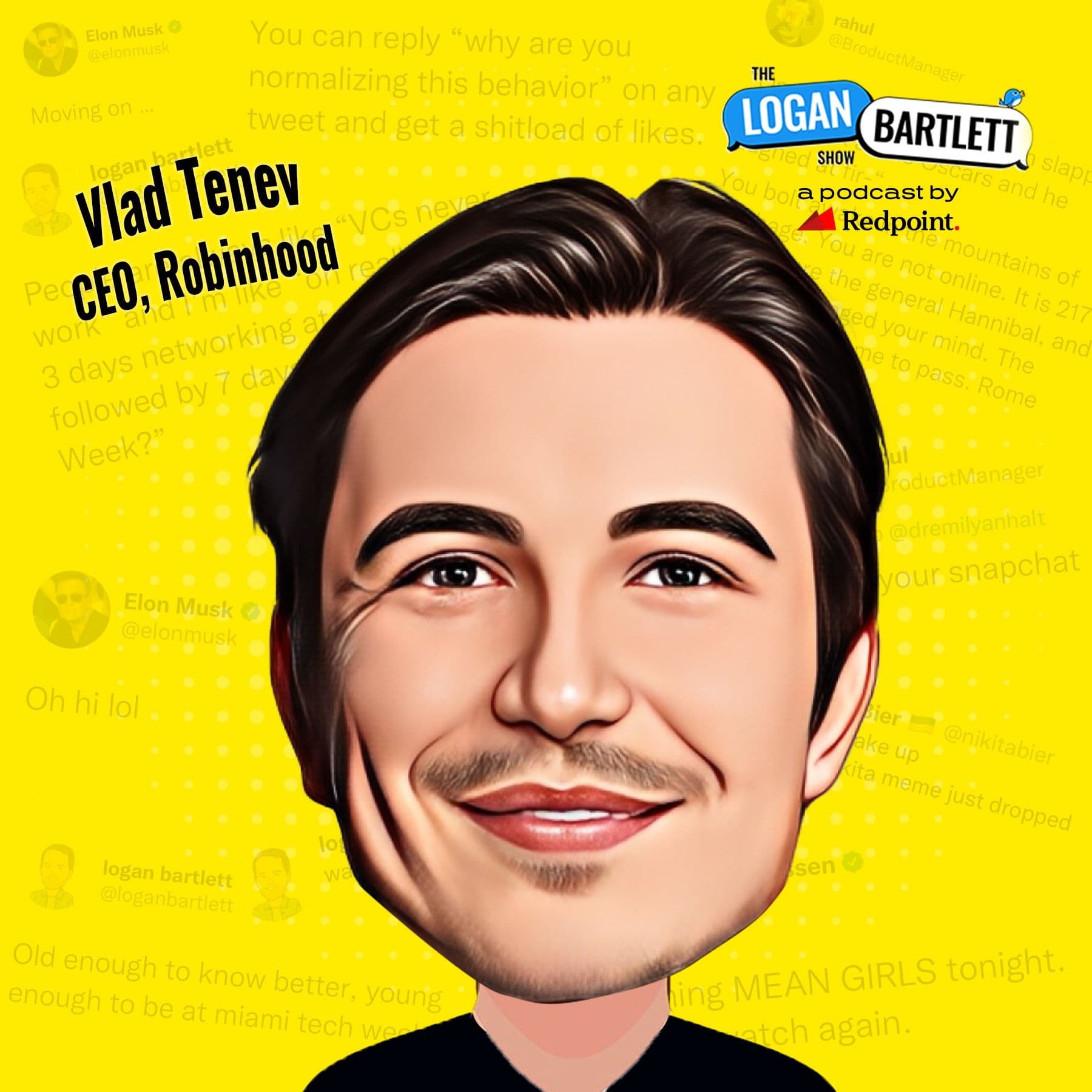
The Logan Bartlett Show: Episode 105 - Vlad Tenev (CEO, Robinhood)
Episode Summary In this episode, Logan Bartlett interviews Vlad Tenev, the CEO of Robinhood, as they discuss various pivotal topics surrounding the future of finance, including the meme stock phenomenon, the evolving landscape of cryptocurrencies, the launch of Robinhood’s Gold Card, and the integration of artificial intelligence within financial services.
---
Key Topics Discussed
- Introduction and Background
- Vlad Tenev shares insights into his journey with Robinhood, explaining the brand's ethos and the significance of its name.
- Origin of the Name "Robinhood":
- Discusses how the name reflects the mission of democratizing finance.
- Meme Stock Crisis
- Navigating the GameStop saga and its impact on Robinhood's reputation.
- The importance of crisis communication and rebuilding trust with users post-crisis.
- Financial Services Industry Insights
- An exploration of the future of trading, including Robinhood’s strategies and industry trends.
- The potential implications of AI in the financial sector.
- Launch of New Products
- Details surrounding the introduction of the Gold Card and Robinhood’s customer strategy.
- Emphasis on the importance of customer engagement and feedback in product development.
- Acquisition of X1
- Discussion on the decision to acquire X1 and its integration into Robinhood's ecosystem.
- Benefits of having a General Manager (GM) structure for product lines, promoting accountability and entrepreneurship.
- Challenges of Decentralization
- Addressing the trade-offs of decentralizing business units and maintaining brand coherence across different product offerings.
- Hiring and Talent Retention
- Insights on how Robinhood approaches talent acquisition in a competitive market.
- Emphasis on hiring individuals who resonate with the company's mission, especially during challenging times.
- Fundraising and Investor Relations
- Tenev reflects on his experiences in raising capital and the importance of establishing strong relationships with investors.
- Strategies for maintaining company performance amidst market fluctuations.
- Launch of Sherwood Media
- Announcement of the establishment of Sherwood Media, an effort to expand Robinhood's reach in the media landscape.
- Focus on creating accessible financial information for the broader public without paywalls.
- Reflections on the Journey
- Tenev shares memorable moments from Robinhood’s journey, illustrating the emotional highs and lows experienced throughout the process.
---
Key Takeaways
- Branding and Trust: Robinhood’s brand identity is closely tied to its mission of making finance accessible, which helps in building customer trust.
- Crisis Management: Effective communication during crises is vital for maintaining user trust and brand integrity; time is an essential component in regaining lost trust.
- Innovation in Financial Services: Continuous product innovation is necessary for long-term success, as demonstrated by the launch of the Gold Card and the push into AI.
- Employee Engagement: A strong company culture that resonates with employees’ values can enhance performance, particularly during difficult times.
- Market Adaptability: The ability to pivot and adapt to changing market conditions, such as embracing AI and exploring crypto opportunities, is critical for future growth.
- Media Strategy: The launch of a media arm can enhance brand visibility and foster community engagement, provided it maintains independence and journalistic integrity.
---
Final Thoughts Vlad Tenev's discussion on Robinhood’s evolution, from its inception to its current public standing, underlines the importance of aligning a company’s mission with its operational strategies and product offerings. Balancing innovation with responsibility and customer trust is crucial in navigating the complex landscape of modern finance.
Written by AI. May contain mistakes. Listen to the episode to check what was said.
Transcript
Automatic transcript. May contain errors.0:28Welcome to the Logan Bartlett Show. We also talk about the future of the cryptocurrency industry, what he thinks about financial services and trading in the United States, as well as how Robinhood thinks about new product launches, including most recently a gold credit card that they launched a few months ago. A really interesting conversation with Vlad that goes in a number of different directions on operating, on hiring, on firing, as well as leading a company through turbulent times. You'll hear that discussion here now. Vlad, thanks for doing this. Thanks for having me. So brand. Robinhood has a brand.
1:01Brands can be kind of an ethereal thing that's sort of hard to attribute ROI to or think about. How do you think about what a brand is and then what Robinhood's brand is? It's a great question. I spent a lot of time thinking about this. I think to some degree, everyone has a different definition of brand. It kind of depends on who's talking. So some people refer to it as, you know, the brand marketing that you do, the videos that you run on YouTube or on cable TV. I think those are parts of it. I think to me, when I think about the brand, it is if someone is describing Robinhood to a friend and I'm not in the room, what do they say about Robinhood?
1:54because usually they try to distill it in as simple and short of a message as possible. And, you know, if we're doing our job right, they're telling their friends about Robinhood effusively. And that's been kind of our leading driver of growth over time. You know, when we were a young company, we knew that we wouldn't be able to compete with the likes of Schwab and Fidelity and Scottrade and E-Trade and all the companies, some of which don't exist anymore on marketing budgets. They spend thousands of dollars to acquire a customer. They have incredibly large television budgets and things like that.
2:37So our one chance to be remembered and to actually grow would be to build a company and a product and a brand that people would talk about. And, you know, one thing that my co-founder Beiju and I always talked about is we can help sort of like plant seeds of messaging in customers' minds. And if that messaging follows the transitive property, then we know the messaging is right. And what I mean by that is if I tell you what Robinhood is in one sentence and you can tell your friend that and you're kind of relaying the same message, then the message has coherence the more and more people talk about it.
3:23And I think we were able to do that from the earliest points. I mean, it was very simple to communicate when we launched that other places charge you up to$10 every time you trade. Stop paying that. And we're kind of the vehicle that eliminated commissions industry-wide. And so in that way, brands kind of intertwined with a business model is intertwined with products. It's intertwined with some other principles, I guess, like all these things are kind of tied together. Yeah. The company name as well. I mean, maybe maybe speak to that. I heard I heard a Jeff Bezos quote that you referenced. I think it's Bezos that said the company name maybe only matters three percent, but it could be the three percent that that matters.
4:10I don't know if I'm wrongly attributing it to Jeff Bezos. Yeah, I think that was a Jeff Bezos quote. Yeah, it seems like he went deep in the podcast interview archive. It's very good. I think it's really important when you're making a decision about something that has to do with brand or messaging to not only consider things that are universally positive. So I think the interesting thing about the name is we're about 10 person company when we came up with the name Robin Hood. And there were some other contenders for the name. We thought of naming the company Omaha. And sometimes I think, you know, if we named the company Omaha, would Warren Buffett be criticizing it as aggressively?
4:59Because, you know, he can't criticize Omaha. Yeah, he's very pro Omaha. I think we could have avoided that. But basically, when Beiju and I came up with the name Robinhood and we sort of presented it to the team, we had some people threaten to quit. They were like, we hate the name. The entire business model is going to involve serving lots and lots of customers, but we don't want to scare off the wealthy people. Because if you look at economics of a financial services company, they tend to be concentrated in wealthier people. So there was just this fear that we would piss off the rich people and that they wouldn't want to join Robinhood because they would be worried we would take their money and redistribute it or something.
5:43The other half of our employees loved it. And our thoughts on that at the time were, and we both really loved it. So maybe you could say that we were rationalizing the decision we had already made. And your wife maybe deserves some credit for describing the product, I think, related to Robin Hood in some way was the original Genesis. So at home, you also had a tie-breaking boat if needed. That was definitely part of the origin. Yeah, my wife was, we were dating at the time. She was my girlfriend, and she would explain what I was doing. And the answer was, I was not doing very much to an objective observer.
6:26I was sort of working on this company, making very little money. She was a doctor. So, you know, when she would meet my parents and I would meet her family, the running joke for a while was that she had the stable income. And so she would have to support all of my entrepreneurial endeavors. And my parents felt a little bit sorry for her. They're like, are you sure you want to marry this guy? He doesn't have a job. he didn't finish his phd but uh anyway we got the idea for robin hood and she was telling her friends that you know he's in finance and then there would just be like a little bit of a groan like they thought i was some kind of investment banker or a venture capitalist no offense yeah even worse yeah but there was a little bit of a groan and uh and then she'd be like no no no not like that they're the robin hood of finance they're trying to help the little guy and uh we kind of like the the sound of that.
7:24And so our thoughts were that if the name elicited strong reactions, even if they weren't all positive, at least it would be memorable. And that would be better than kind of a name that everyone was okay with, because maybe that one, even if it was like uniformly a little bit positive, is not as memorable. I've never found that any name is is well received from, from day one, for the most part. I mean, maybe like, expensive, I, you know, thought that that was there, maybe they were super pumped. But for the most part, people, when they hear the name of a company, like shrug their shoulders and say, okay, and then kind of move on.
8:06So I, I, I think that reaction that people can have to it is probably, I mean, polarization or opinions is probably a good thing to set with people in some way. It means that you're standing for something. Otherwise, you're standing for nothing. And it is a big part of the brand. And the name is a part of it. And even though you hear a lot, product is not brand, product is different. Product is a huge part of brand. The messages that we put out and the way we say them are all part of the brand as well. And yeah, I think that what we've tried from the very beginning is to be very, very consistent with what we represent.
8:49And I think it's also consistency with the name Robinhood. We wanted it to be disruptive, and we wanted our company to be disruptive too. It was intended to flow into product decisions and business decisions around how we price things as well. We wanted it to be brave and bold and courageous not to do things just because other financial companies are doing them, but almost just as often kind of go against the traditional flow of things and do things a little bit differently. So I think that that stayed pretty consistent throughout time. And of course, there were distractions and things that entered the brand that we perhaps didn't want to enter like all the meme stock things and GameStop.
9:41And I guess a question on, did you know at the time of all that going on that like it was playing with fire given the volatility in the market? Or was it like clearly that that single situation was so unusual, but all the market changes that were going on, did you have any anticipation that maybe you would end up in some way? I think I did. Yeah. There's this old adage in the industry that anytime anything goes wrong and people lose money, they tend to blame the broker. You know, when you make money, it's all on you. But if you lose it, it's sort of externalized to factors outside of your control.
10:25And, you know, the broker is a very sort of like convenient target for that. And I think we saw that in a lot of situations, GameStop probably being the best example there. But, you know, that's just the, I guess that's the price to pay for being in this business. You know, if you're serving customers and you're dealing with something as emotional as money, you have to have thick skin because you're going to be blamed in a lot of situations where, you know, ultimately you have minimal control over how things play out. When something like that happens, and obviously that's the most, I guess, notable example, how do you go about, there's probably customer churn and like a bunch of metrics that you can look at.
11:15There's social media. I'm sure there's some sentiment index and all of that. But how do you go about assessing the brand impact? And then how do you decide or set course on rebuilding the trust? Like, was there certain milestones that you said, OK, let's look three months in the future, six months in the future? Or was it just, hey, what changes can we make in the next couple of days? Yeah, I mean, I always wanted to make the changes. If there's changes we can make in the next couple of days, those changes got to the top of the list. And, of course, we tried everything. There was a hit. And I mean, you could look at it with NPS net promoter score, which you're probably familiar, but for viewers, you basically ask customers a question, you know, how much would you recommend Robinhood to a friend?
12:10And, you know, it's like zero to 10. And if it's eight, nine or 10, that's actually a positive under that, you know, at some point it gets radicalized to zero. So it's a very skewed definition. Some people have issue with it and they prefer other metrics, but we found it to be pretty directionally accurate and the things that it shows do carry signal. So we measured that and that took a big hit on January 28th. And it was actually, you hear this phrase that trust takes a long time to be built, but can be lost in an instant. And I think that was my experience with it. Like after January 28th, our NPS went down.
12:58And then, you know, we've had to work really, really hard over a long period of time. And time itself has played a role in having that recover. And I would say at this point, it's pretty much recovered. You still see some people mentioning GameStop and meme stocks and expressing their dissatisfaction with what happened, but it's been less and less. And part of that is time. A big part of that is us improving things and going through a number of similar events where, you know, a lot of volatile trading and meme stocks has happened and other brokers have gone down and we haven't. So those events like this week certainly help.
13:42But the biggest element is just time. And I can tell you definitively, it is true that it takes a while to build. Like there's very few events where your NPS can spike in one day and stay at that rate. But, you know, I've been through an event where it can kind of plummet and takes a while for it to build back. At a personal level, at what point, it seems like through all that you were running on adrenaline. And I think you referenced lack of sleep and different stuff. And I'm sure it's like a whirlwind of emotions that those weeks were. At what point did you get to that you actually were able to reflect a little bit on how surreal it was and realize that that was a unique moment in time that very few people in the world had ever experienced anything?
14:42How long after were you able to really look back on it? I mean, that entire year or two years, I got very little sleep and there was always something crazy going on. So I don't know if I ever really sat down and reflected on things. I mean, I was reflecting on things and noticing their absurdity in real time. I mean, probably the craziest was I had to I had to carry a lot of things simultaneously in mind. Right. One was all of that happened. And obviously there was huge backlash and I could see the brand sentiment was very, very negative and customers were unhappy. And I felt like Robinhood was misunderstood throughout this.
15:29And there were conspiracy theories that were quite damaging about us colluding with Citadel and hedge funds and whatnot. And, you know, I thought it was like, it was definitely wrongfully accused and misinformation. And I don't know if it was intentional by others, probably to some degree, or also just misunderstanding. but I felt like it was my responsibility to fix that and get the word out and speak to as many people as possible. So that was one thing that was going on. Simultaneously, we were the number one app in the app store ahead of Instagram and TikTok, which is unheard of for a financial services company.
16:12Like that hardly ever happens. So I was dealing with that and people congratulating me on all the growth. Right. Um, and you know, I had people that wouldn't normally be interested in Robin hood or talking to me, calling me up and offering me advice on how to handle the situation and PR strategies and offering their help. Um, and, and that, that was pretty amazing. Um, you know, I had that clubhouse with Elon Musk on Sunday. Um, I don't know if you remember that, but I really listened to it. I assume you've never, uh, have you ever played it back? Um, I think I have, but not recently. Yeah. Anyway, that was like Sunday late at night, Pacific time.
16:59Um, and you know, a couple hours before that I got connected to him and, and he was offering advice on the whole situation. And he had been like a hero of yours from an entrepreneurial standpoint. Yeah, absolutely. Yeah. Yeah, absolutely. I mean, I had a lot of respect for what he did since, you know, 2009, 2010, I was, uh, before starting Robinhood, I was a Tesla shareholder. You know, I believed in that company and, uh, and what, what he's built there and other people too. Like, uh, you know, I remember getting on the phone with Zuck and Zuck offering me PR advice, um, which was funny because, you know, at the time I think he was under a lot of pressure for his public statements and how he came across in the media, but he was very helpful to me.
17:45So, yeah, sometimes in the whole sort of like scene of COVID, like I was talking to these people and it seemed like I was talking to people all around the world. But I was in a, you know, in Palo Alto and everything was virtual. The congressional hearing was virtual. It's weird that like all of this happened and you were like in your house and the world was going on like around. It wasn't like if this had happened in a normal environment, you would have probably felt more of the day-to-day of someone stopping you on the street or someone coming in. But you could put down your phone and go shower, go eat lunch or whatever.
18:31And that world didn't exist anymore for a few minutes. And then you went right back to this virtual world of all this craziness going on. It was probably pretty surreal compartmentalization. And that was probably the moment at which I was like very frustrated at the whole remote working setup. Like when COVID started, it was actually kind of nice for me because I had two young kids at the time. And pre-COVID, I wasn't spending a ton of time at home. I would kind of get back past bedtime and leave early in the morning to go to work. and at first it was really nice i was like oh the business is operating we're getting stuff done my kids are here and in a meeting my daughter can come and sit on my lap and and that's very nice but then uh when we had to get into like unique situations and i realized that i can't just like pull my team together and get into a war room and just go for 48 hours straight triaging issues like that is much more difficult virtually and kind of mentally draining too.
19:35I guess just doubling back and then we can move on from this period. But the lessons you learned around crisis communication and maybe just communication in general from a PR standpoint, like was there one or two salient things that either were imparted to you by Zuck or Elon or that you really learned from a first principle standpoint of dealing with this if anyone ever finds themselves in a situation like, not that, but some situation that's problematic. I think the general advice that I would give on that, and it's hard to follow, but it's just a lot of times people in this role think of themselves as actors, right?
20:23Like, oh, I'm in a role, I'm saying things, I have a script, I'm acting the role of a CEO of a public company, or in that case, we were a startup. And it's when you're kind of given scripts of things to say by people that you can kind of be pigeonholed into saying things that you don't feel or don't want to say. And I found it has been the most effective when you're not constantly running that loop in your head. Am I supposed to say this? How would this be perceived by people and just say what I want to say, right? And come off authentically, have it be true. And I don't think that's just important in crisis situations.
21:08I think it's like very Nietzschean in a way. It's sort of like in every person's evolution as a human, you have to go through a stage where you're kind of like doing things that people expect of you and then transitioning into doing things that you feel strongly yourself and that are true to your personality and character. And I think I went through, I mean, maybe I'm not like fully through that transition, but it became clear to me that that's where I needed to be somewhere in 2021. You were running the algorithm of, or the inputs from other people and trying to piece it all together and that led to some Frankenstein version of communication of who you are.
21:52Yeah. Or like the algorithm of what should I say in this situation? Yes. Yeah. Well, obviously I should say not just the truth, but like what I feel, you know? And that's probably true internally or externally, right? Yeah. And it's probably true in your personal life and in work life as well. What about leading employees through this? I mean, there's probably that similar lesson of, hey, be honest and communicate and be authentic to them. I'm sure that's applicable. Is there anything else on the employee side that you learned maybe changed you as a leader or how you approach managing a big organization?
22:34I think it's actually the same lesson. It's sort of like generally rip up the talking points once you know what you want to say and just speak authentically. I think, I don't know, when I actually said what I, when I say what I feel and what I want to say, not what is expected of me, I think it comes across much better. I guess to put a pin in this, we're recording this while Roaring Kitty's back tweeting and GameStop's back in the news and AMC's volatile. And I guess the infrastructure is in a great place to support all of that. Knock on wood. As well as it seems like the company is hardened from all of that stuff.
23:24You guys went through and came out the other side, and now these specific situations aren't causing the same amount of angst that maybe it once did. So I guess there's a light at the end of the tunnel on these things if you power through it. Yeah, I mean, I think what a lot of people don't realize is, I mean, Robinhood was a startup in those days. And the amount of work that we've had, too, not just going public, but, you know, building our engineering team, having leaders mature through various crises like that to take us where we are today, which is a company that's diversified, growing, taking market share across multiple competitive segments, expanding internationally.
24:09It's just a different company. And the people are different and more mature. and I think we've gone through some growing pains of an extreme variety, but that's made us stronger. Yeah, I would say so. I guess a couple of industry-related questions for you. If the whole industry adopted 24-hour trading, is that a net good thing in your mind? And what are the negative maybe implications associated with it? Yeah, I think that one's easy. I don't think there'd be anything negative about that. Yeah, I mean, if you think about it, to me it's a defect that there's an idea of a market open pop. It just means that liquidity was not optimally provisioned and there could have been a more continuous change in the price if prices were allowed to go 24-5.
25:09And I mean, that's what we're seeing. We have a 24-hour market offering that we launched last year with a small number of stocks. And then we've rolled it out to over 900 as of now that trade 24 hours a day, five days a week. And the liquidity has improved over time. So our entry into the market itself caused more market makers to express interest. It's caused exchanges to start looking at it as well because they want to make sure they're as competitive as possible with the ATSs. And it's for sure going to happen. It's just a matter of time. How does that actually work at a technical level or practical level with the liquidity?
25:55Is it all self-contained within Robinhood and the market makers that agree to do it? We route to an ATS that's open during the overnight session. So that's 8 p.m. to 4 a.m. Eastern. It's Blue Ocean ATS. And I think a big part of the challenge is our system has to move orders from different market centers sort of like seamlessly without the customer having to do it. And, yeah, it took a lot of, like, hardcore engineering work to get that right and to actually make it a seamless experience for customers, which is, I think, why you haven't seen others copy that experience yet, even though it's taken a year.
26:40because it's different than kind of matching us on pricing or doing promotions. Like here, you're starting to see the benefit of vertically integrated stack and us hiring amazing software engineers and builders to build these products. And I think that that's just going to compound over time as we keep adding more and more to our infrastructure. The top 10 companies in the U.S. make up a third, I think, of the U.S. stock market. I think Microsoft alone is something like 6%, 7%, 8%. Is this concentration that's occurred over the course of the last, I mean, it feels like probably 30 years that we've been headed in this direction.
27:21But is this a good thing in your mind? Is it problematic? How do you think about it? I think it is a good thing to the extent that, I mean, it's driven by free market forces, right? Free market forces, I think, have worked effectively rather than central planning. And I think it's almost a similar point to concentration of wealth in the top X percent of the country, right? Is that good or bad? I think if it was the same companies and the same people decade after decade, that would be something to look into and try to understand. But it's different companies. I mean, if you look back 30 years ago, the list of the top 10 companies by market cap in the S &P is largely a different list.
28:15I think there's the constant turnover and different companies are sort of at the top of the list. And I think I view that as a sign of the vibrancy of the U.S. economy. And I think things can be improved around the edges here and there. Like, I do think it should be easier to access private markets for retail investors without having to deal with accreditation or all the red tape there. Or companies should have more incentives to go public earlier because Microsoft went public at a valuation of$100 million. And right now, you know, no company would go public at a valuation of$100 million. At least there's adverse selection there.
28:59So I think that's a problem for wealth creation, in particular for retail. But yeah, I certainly wouldn't want to put my hand in the scale and arrange market caps of companies in a different way. You mentioned short selling there. You don't allow it on the platform currently. Yeah. Is that practical limitations? Is it philosophical? Where do you come down on short selling for retail? Yeah. I'm not against it philosophically. I think actually that there is value in short selling in the market. Like Alex Karp, who calls short sellers, whatever, cocaine-riddled Wall Street traders or something. Yeah, I don't agree with that.
29:49I think there's just like, if you think about it, you're asking, should I be allowed to borrow your stock? Let's say you're long a particular company. Should you be able to lend your shares to me? Well, sure. Why in a free society should we prevent you from lending your shares to someone? And also, that's at a philosophical, technical level, but also it exposes frauds. Is it having people not just bet on the upside, but also the downside has a lot of good financial incentives for the free market to operate well? It's not just downsides. I think a lot of these guys that are just coming out against short selling, it's because they don't like their stocks being shorted.
30:39So you have to kind of separate that out because they obviously are conflicted in there. It's not a purely objective opinion. And there's just a long list of things that customers want. I mean, they're asking us for tax lot selection. And just there's sort of like a big bucket of table stakes features that other brokers offer that we don't, that are critical. And we're taking things from that bucket and making sure we prioritize them. But then we also want to make sure we don't just do that. And we have a bunch of things that nobody else offers, like 24-hour market, for instance, that we also want to do.
31:19So we can't just be doing table stakes features. We have to do the right ones and couple them with infrastructure improvements and innovative products that you can't find anywhere else. How does AI change a business like Robinhood? So with AI, I think my mental model for which products are successful is, is there something that another human is already doing for you that you're paying for? I think for those use cases, you can see AI playing a huge role. or is there something that you're kind of begrudgingly doing yourself that you could kind of just like automate and streamline using using ai and there's some overlap between the two but um in financial services i mean there's there's things in that category like things in our industry that we use people for um customer support is probably the most obvious example But also a lot of financial advice is being delivered by RIAs person to person.
Read the full transcript
32:28And I think AI can help augment that experience by just taking a lot of like the transactional relationship stuff and completely automating it. Yeah. And so it actually, I mean, on one side, that can make a better business in that what is required of people can now be done by AI in some way. But also, as you bend the cost curve, it leads to more democratization and a lot of things philosophically that you guys have been championing for a long time. I get access to amazing financial advice and a lot of great service. And if we could take what someone like me has access to and give it to the mass market, I think that would be very, very powerful.
33:12And that's kind of the future that Robinhood is building towards. And AI is a big part of that. I mean, we've been hiring AI talent from when it was called machine learning. Sure. And now if you use that word, people laugh at you. Yeah. He doesn't know what he's talking about. He just said machine learning. Can you believe that? But yeah, I think we were pretty early on those technologies. And obviously now we have like generative AI and large language models, which is another flavor. But yeah, I think Robinhood will be the leader in AI for financial services. And that's one of my passions as a mathematician and an engineer myself.
33:53I think, you know, there's just one company in financial services that I think has the right to win in that space. And that's Robinhood. Crypto. How have your views of crypto changed over time? I'm a fan of strong encryption. That's a very specific answer to cryptocurrency. Cryptocurrency, I guess to lead you a little bit more, I actually heard you, and this is a while ago, but I heard you say, this is five years ago, that you were very pro-cryptocurrency themselves. But also, you were early in saying, hey, there's a lot of things being put on a blockchain that don't need to, and they can just be done with a database.
34:40And so I think you had a very reasoned perspective at that point. cryptocurrencies in general, that specific point. Is there any way in which your view around that has changed over the course of the last five years? I think there's certainly more use cases. So I think five years ago, Bitcoin was not as accepted by the regulators. Now we've kind of moved beyond Bitcoin and Bitcoin has sort of received a begrudging, maybe tacit acceptance. And we've moved on to other coins, like Ethereum and some of the others. And so Bitcoin, very clear use case. Inflation hedge, you can see it very powerfully in countries that have seen incredible devaluation of their currencies.
35:29You know, it has product market fit there. You look at Turkey, some of the countries in South America, Venezuela, El Salvador, it's been much more widespread. Instead, stablecoins, there's a huge use case in stablecoins. And in fact, a lot of the volume nowadays in the market is stablecoin volume. And you see sort of like market forces there too up until recently. And maybe it's still the case. USDT, so Tether stablecoin on Tron, was like the largest by transaction volume just because the fees of sending dollars electronically over blockchains were incredibly low on Tron. And you see a core need that people have there being met, which is people in these foreign countries want dollars.
36:24They want the cheapest way to transmit, store, and send and receive dollars. And crypto has facilitated that. And I think in the future, you'll see that kind of stablecoin use case being applied to other assets as well. Like, why shouldn't we have stock on the blockchain? If you think about it, the costs of operating that service would be close to zero because it's all on public infrastructure. You get 24-hour trading by default. You don't have to worry about everyone modernizing and dealing with all these companies and quasi regulators running on mainframes. Fractualization is built in and you have all these rich collateralized borrowing and lending protocols that run on software.
37:18So, you know, I've been telling the team that, look, we should take this incredibly seriously and be on the forefront of this technology. Because let's say that the crypto rails go to other assets like stocks and the cost of creating something like Robinhood falls basically to zero. Three engineers could do it in a dorm room, just writing some solidity code. That both should be a scary reality and an opportunity for us. And so I think there's the regulatory side of this where the U.S. is decidedly anti. But you look at Europe, for example, and Europe has led in regulation there, not surprisingly.
38:12And the European Union has not been traditionally the best place for business to be done. And they've sort of people make fun of us. And I can say us because I'm both European and American. So it's kind of funny that like that's where there is clarity and then that's where innovation is going. And I think that would be a shame if the U.S. were to kind of seed that position because of our infighting here. But yeah, you look at Robinhood Crypto EU launching lots and lots of products that we're just unable to launch here in the climate. And, you know, as time goes on, the products that we offer in the EU will just deviate tremendously from the ones we can offer here.
39:02And I think that's really an unfortunate situation. And I think it's incumbent on us in the industry to do what we can to reverse that. And that's why you're seeing us push for crypto clarity in the U.S. Yeah, by all of the means at our disposal. What is crypto clarity? Like, what is the end state that you hope? Because, I mean, it seems like in some ways you could argue there is clarity. It just might not be the answer people like, you could argue. Or what were you actually pursuing in terms of the clarity question? I mean, I think there's various ways that you could get crypto clarity in kind of a way that would sort of like satisfy us and the industry.
39:52The SEC could issue rules. They have the power to issue rules and engage in rulemaking. and they could do that even without congressional action. Congress could act as well and sort of compel the agencies to create rules or delineate what's the responsibility of the CFTC and what's the responsibility of the SEC. And right now they're not agreeing with each other. And I would say even the SEC, in a lot of cases, doesn't agree with itself internally. Depending on who you talk to, you get sort of like different opinions. So that's not tenable. I mean, I think any clarity would be better than what we have now.
40:42Robinhood was certainly at the right place, right time in the early days with an insight that you guys executed on. I'm curious, there was a wait list that you all, I think, built up to a million users or a million people waiting to get off the wait list at one point in time, I guess. Was that an intentional strategy or was that an infrastructure limitation just from a practical standpoint? How did you think about launching? It's both. I mean, one thing is we were kind of inspired by this company Mailbox that probably you remember. It was an email client. The first mobile first email client had really nice sort of like swipe gesture that I think later on became standard and the Gmail app adopted them.
41:30But Dropbox ended up acquiring that company. And I think I was using it until the very end when they shut the servers down. But yeah, they had a really interesting waitlist experience on mobile that we sort of like were inspired by and decided to take a little bit further. So from a design perspective, I think we stood on the shoulders of giants there. I think they did a really nice job. So then the actual launch itself, how did you go about saying that you existed and sort of galvanizing people behind it? We had worked on a couple of different products before the Robinhood waitlist launched in December of 2013.
42:09One was a social networking app for traders. And we had this idea that it would take a while to get the broker-dealer license. But until that point, we should actually build a community. And the best way to do that would be to build a social network for traders where they could follow each other, rate stocks, share news. And we were trying to grow this thing. And, you know, I was reading all the marketing tactics books and doing A-B tests and experiments and things like that. And nothing worked. We got maybe, you know, a few thousand signups with a few hundred daily active users. And when it came time to launch the Robinhood waitlist, we had our website up.
43:00Our engineers were working on it. We just put it live. We put it on the internet without any gating or any concern to wait until the embargo. And we had done a little, we've talked to a couple of journalists. We were planning a launch the following Thursday, and this was Friday night. And the last thing that occurred to us was that this thing was going to go viral on social media, and we would end up having thousands of users because that just had never happened to us. And with a year of trying every growth tactic and A-B test, I was unable to get anything to go viral. So I just didn't think that existed.
43:37I think most companies should assume they're not going to go viral is probably a fair assumption at all. So we're like, yeah, push the website live. We're launching next Thursday. Let's see if it works. And then I go home and I go to sleep and I wake up on Saturday and I get an alert from Google Analytics that there was 500 concurrence on the website, which was an insane number because we're used to like five, right? So it's 100x what we're used to. And I go on the Google Analytics to see what's going on. and I'm like, okay, I have to, we forgot like the DDoS protection or something. Bots are attacking.
44:14Yeah, bots are attacking. And then I look, wait a minute. All of these are coming from Hacker News. And I loved Hacker News. I read it all the time. So I click on Hacker News to see what's going on. And I remember at the time, number one was Chinese landing on the moon. Number two was Google acquires Boston Dynamics, the scary robotic dog company. Number three, Robinhood free stock trading. Right. And I'm screenshotting the page and, you know, doing everything because I'm a big Hacker News reader. And I didn't think we would go higher than number three. But sure enough, 30 minutes later, we pass the moon landing and we're number one on Hacker News.
44:55And we probably get up to like a thousand concurrence. And after I'm calling my parents and bragging to them and telling them, look, Hacker News. And they're, of course, like, what's Hacker News? Tell me when you're on Forbes or something, right? But we rush everyone into the office on Saturday and launch. And we had to staple everything together. Like, the emails weren't getting sent out. Just the basics weren't working because we thought we had plenty of time. And I had Josh Constine from TechCrunch calling me and saying, you violated embargo. Like, how could you do it? And I was like, I'm sorry, dude.
45:31I did not think that I would violate Embargo or launch on a Saturday. But we ended up doing that, 10 ,000 signups the first day on a Saturday, 50 ,000 in the first week, and close to a million in the first year. So I think we just sort of had the wind at our backs from the very beginning. So mobile was big. You guys were mobile only for a long time? For a long time. Yeah. So mobile, right place, right time. But zero transactions, it sounds like that was what went viral, or at least, I mean, among the design and product choices I'm sure you made that were very elegant. But that was what people gravitated to that maybe caused it to spike in the early days?
46:15That was a simple way to describe what the advantage was. Hey, you're paying$10 a trade. Robinhood offers it for free. And it's mobile first. I mean, people really like that. And actually that you can get started with as little as you'd like. Like most brokers at the time had account minimums. So you couldn't even open an account unless you were prepared to invest a thousand or sometimes even two thousand or more. And, you know, we just made the decision about account minimums, I think, a week before announcement. It's like we had to make the decision. Bejo and I got into the kitchen. We're like, all right, so what should the account minimums be?
46:52And of course, we simultaneously came to the realization that they should be zero. Why do we have them? Why do we need them? Oh, everyone else has them to avoid having to service customers that are unprofitable. But our conclusion when we heard that was we want the pressure of having to serve every customer because then we'll use technology to make sure we can serve as many people as we can profitably. And we want that pressure. We want there to constantly be an incentive for us to use technology to make our systems more and more efficient so that we can serve any type of customer. And so now as you launched the gold card when?
47:35In March. In March. We announced it, yeah. Announced it in March. And what decisions did you make? Obviously, there was an acquisition, which I want to talk about. But at the actual launch, what lessons 11 years later, things did you do the exact same, things you did differently in launching the gold card? Well, there's something really interesting about the gold card launch that I think reflects something that is underappreciated about why we do wait lists. and a lot of people say, oh, it's to create this feeling of exclusivity, the velvet rope and waiting in front of a club that's like very exclusive.
48:15But really, a lot of the times we make decisions, we have to make a decision about who we let onto the product first. And what a typical sort of traditional financial firm would do is they'd look at who their most profitable customers are, typically the ones with the most money in their accounts, and they would give access to the new stuff to them first. So they reserve the best for the wealthiest customers. And we always want there to be an option for someone that doesn't have any money, but is just like super passionate about the product and the brand to get access first. And that's why the referral mechanism around the solid gold card is 10 referrals.
48:57Typically, if someone rolled out a solid gold card, it would be at a high net worth. right? We want people with a lot of money to be valued customers. And of course, we love those customers. But we also want that college kid who maybe doesn't have a lot of money yet, but just cares a lot about using the technology and supporting Robinhood to have an equal shot at being one of the first to get this card. And so that's why we have these referral incentives, because not everyone has millions of dollars, but most people can find some friends to share the value of Robinhood with. And you can do that if you don't have any money.
49:41I was with Sam Altman earlier this week and he was very proud of his gold card. Oh, great. Did he show it to you? No, he whipped it out. He was like, we were making small talk after. He's like, what are you doing this week? I was like, oh, I'm going down to see Vlad. He's like, ask him about the gold card. And he pulled it out, showed it to me, He showed his version of it. He was very proud. So an honest plug from a satisfied user. I think he falls in probably the former camp of the high net worth users than the democratized users. But nonetheless, he was very excited about it. You should have asked him to take it out on the show and drop it.
50:18That would have been very good branding, actually, and a nice commercial. But yeah, this will have to do as a plug for it. But in making the decision to go after credit cards, so you made an acquisition 18 months ago? Yeah, that's right. Or maybe 12 months ago. Okay. Yeah, less than 12. So 12 months ago, you made an acquisition. The name of the business was? X1. X1. $95 million cash, right? That's right. And you had been a user of the product before? And it sounded like maybe, I mean this complimentary, but like a nerd of credit cards and trying new ones. and this is one that you gravitated to.
50:55Maybe take me through the journey of deciding to launch a credit card. I mean, I think that from relatively close to the beginning of Robinhood, we had this vision of not just helping you with investing and trading, but all of your financial needs. And the idea behind scaling the Robinhood brand to other products is really, I mean, I think it does scale because a Robinhood product, regardless of the category, should have best-in-class pricing and best-in-class user experience, particularly on mobile. And I think if you look at financial services across the board, not just trading, wealthy customers have access to tools and services that other people just don't have access to.
51:43And technology can level the playing field there and make it so that we make these products and services available to everyone. And that's the idea behind Robinhood, you know, taking the products and services that a high net worth individual would be able to get through your private wealth manager or, you know, chase private client experience and putting it in the hands of everyone. And for most of that, you could do with a Robinhood Gold subscription, which is as little as$5 a month, which I think is really amazing. I mean, can you imagine, were we to deliver this, a private high net worth experience for just$5 a month, I think that would resonate with hundreds of millions of people worldwide.
52:32So that ties into the mission and the value prop and how you think about products for Robinhood. So credit cards were a specific one, and you mentioned most Americans spend money on it. So at what point did it start becoming something that, hey, we're going to go down this path? And then how do you make the decision to build versus buy? You know, we considered going down the path in 2019. You know, we announced a product that was basically a neobanking product called Robinhood Cash Management, which was a high yield on your cash plus a debit card. And I think we learned a lot about how to operate a card program, how to deal with sort of the fraud and the chargebacks and the disputes through that.
53:20and we got a lot of familiarity with the space. But what we realized is the economics on credit cards were just so strong that once an American gets their first credit card, they typically stay with their majority of spend on credit. And once you have enough money to invest, you tend to be in that credit primary bucket. So actually the bulk of our customers, The most engaged ones were credit card primary already. And so we still have our credit card, or we have the debit card product. And I think that's a good entry point for certain customers. But in order to be competitive and to kind of recreate the Robinhood formula of industry-leading economics and industry-leading user experience, we had to get into the credit card business.
54:19And then acquiring versus building from scratch, how'd you land on X1 as the best path? I'd say we tend to prefer to build things in-house, but we always have a really long list of things that are on the roadmap. I mean, if you just think about the vision of delivering every financial product and service, custodianing all of our customers' assets and processing all their financial transactions, that basically touches every financial product. And I think if we built it ourselves, we'll probably get there within 10 years. But, you know, the Corp dev team is always on the lookout for great teams with amazing talent, strong engineering and design chops that we can partner with.
55:11And, you know, when we had been talking to X1, for a long time. And last year, we had the SVB-led banking crisis, which made it a very, very challenging environment for bank lending, which made it a challenging environment for startups like X1, which relied on that to grow their business. And so it was an opportune time where we could find an amazing team that we knew somewhat well. And I think for them, the value prop was strong because we have the balance sheet. We care just as much about design and user experience and engineering as they did. The kind of founding DNA of the companies was the same.
55:57I mean, we're all Stanford grads who were highly technical. And when we saw that there was an opportunity, we thought we could meaningfully accelerate the launch of the credit card, which we ended up doing. I think if we had gone through it, the organic path, I mean, it would have taken much longer. How did you actually go about like in acquiring them? How many fields do they have at the time?
56:52Maybe around 50. engineering, product design. We have a couple of platform teams and several GMs. And so that was also opportune because Deepak just became the GM of credit cards. Deepak's the CEO of X1, which we called Robinhood Money. And it incorporates the debit card business and the money transmitter licenses that we already had. And so it was actually very simple. Like the X1 team, coupled with a few Robinhood folks that were operating the money business, just turned into the money team here. It sounds like that was probably in process, absent the acquisition. How do you think about the trade-offs?
57:40Yeah, it happened about a year before. A year before. How do you think about the trade-offs of having a GM that owns, I assume they have a full team, engineers on their team, products, design, all that stuff versus having it roll up into a more functional manner. Yeah, I think by and large, the benefits have been very, very strong for Robinhood. What we've gained is the GMs live and breathe the products. They care about the P &L. They're super accountable. And, you know, they feel a ton of pressure over the entire success of the business, including the P &L. And that just wasn't the same in the functional structure.
58:25Of course, to some degree, the product leaders felt the success, but, you know, engineering was responsible for building it. Product was responsible for building a great product in partnership with design and research. The finance partners were responsible for the P &L. So there wasn't anyone really except me that really felt the weight of the P &L, or at least that's how it felt to me. And once there were three or four product lines that were separable, yeah, it just, it seemed like sharding that out and decentralizing the accountability and the responsibility Kind of empowers an entrepreneurial nature.
59:12And I assume, I mean, the risks, the trade-offs of that, I assume could be cultural, that they start to be very different cultural values within the money team versus the trading team versus the, I can imagine there's also, I don't know, different hiring considerations and probably a bunch of other trade-offs in that. How do you mitigate against some of the downsides? I mean, some of the biggest trade-offs are, you know, when you think about the brand, it's very important to the customer because, you know, customers get inundated with lots and lots of different messages. There's only so many things that you can remember at any given point, especially about a company.
59:58So for Robinhood to sound and look and feel the same, regardless of whether you're dealing with the brokerage, the crypto business, the credit card is extremely important. And so the way we mitigate that is design remains centralized, marketing remains centralized, and we have a core product team that's responsible for the design of the app. And, you know, related, but maybe not as directly to brand engineering standards, that's important to keep the same. So having a core infrastructure team with responsibility, with some responsibility in making sure that there's sort of like consistent standards applied throughout engineering is how we handle that.
1:00:44And of course, the cost is, then there's tension and conflict between the platform teams and the GMs, which oftentimes fall on me to mitigate. But at least those are conscious conflicts that, by and large, make the company better. because sometimes GMs want to move fast and be independent. And the design team will say, hold on, like what you're doing is not consistent with what the brokerage team or the credit card team is doing. So we'll have to slow down and kind of redo that. You have a lot of customers, a lot of end users, and there's a lot of ways in which you guys innovate on monetization, models and incentives and, hey, 1 % match or cash back or all of this stuff.
1:01:38How do you think that through as you're doing this perspective modeling in the future about LTVs of customers or the CAC to acquire the stickiness? Is there a centralized team responsible for thinking through all that? And then what is the time horizon that you map things like credit cards being profitable to the overall business? Or what are the inputs into that? Yeah. Yeah, I mean, it's a partnership. Finance obviously owns the financial model. Marketing owns kind of the CAC to LTV calculations. But of course, finance kind of shakes hands and agrees on what the CAC and LTV actually are. They're the source of truth.
1:02:23Data science provides sort of like dashboarding and machine learning infrastructure to those teams as well. But yeah, we're extremely rigorous about all of that stuff. I mean, we have people that really, really care about making sure the numbers and the economics are correct and actually nailed down. And we have hearty debates about all aspects of this. And then it flows up into, I mean, now that you're a public company, You can't be wrong on these things of, I mean, obviously there's some forgiveness in that, but like these, the modeling, like you said, expectations and people expect you to go hit it.
1:03:08So I assume it's pretty rigorous in how you guys go about it. Yeah, I mean, we try to be conservative in the modeling for that reason and end up in situations where we can be surprised to the upside. So we consciously, I mean, have various variations, bear case, standard, bull case, like very, very bullish case. typically the GMs, you know, look at the very bullish case and finance has to kind of keep them honest and look at the bear case. But yeah, I think being conservative and having ways that we can, having like levers under our control. So for example, the match promotions, we kind of knew that when we rolled it out, we would learn a lot by having it just be available for contributions to retirement accounts, like that would give us a lot more data.
1:04:00And the first launch with retirement of a Robinhood match program was just on contributions. So it was 1 % and it was really capped out at your contribution limit, which is 7 ,000 per year. So even if our assumptions were wrong, which knock on wood, they ended up being right, the downside was small. And then once we got confidence, we realized, hey, using this data, 1 % match on rollovers and ACATs, which is people bringing large sums of money from brokerages, starts to make sense too. And we tried that, and it worked very, very well. And then we figured out that, hey, the economics are so good that 1 % is not optimal for gold.
1:04:503 % is better. And then we did that, and that worked very, very well. and now we're bringing it to the taxable account. So it's kind of an incrementality of mitigating the risk as you sort of figure out the data points and what the implications are going to be as you broaden that. Yeah, at the end of the day, it's a data science problem and it's measurable. And yeah, I think we've been iterating with it and learning as we go along. It seems like you guys have moved back to in-person. Walking through the office today, It's probably more people I've seen in your office than any office I've been in in the last couple of years.
1:05:30Well, I appreciate that. That means a lot. I ask someone on the way in, I go, are you guys in the office every day? And they go, no, just Monday to Friday. And I was like, okay. That's what I meant. But I appreciate that attitude that the weekends, people are allowed to work from home. Yeah, well, there's one thing really interesting about that, which is that in, I think it was January of 2022, we made a big hoopla of being a remote-first company. So, you know, up until that point, we were kind of hedging our stance. We said, well, we'll be flexible to people's needs. We'll continue to reevaluate.
1:06:07And then January of 2022, we were like, all right, let's just like make a decision here and announce we're a remote-first company. And I think as soon as that blog post went out, I was like, oh, God, I've made a terrible mistake here. This is not good. I felt bad about it. And then the feedback I heard when we decided to go back into the office was not only has no other company managed to get their people back into the office successfully while hedging and saying that we're not remote first. They didn't owe anyone. It was like much, much harder that we announced we were remote first, and then we wanted to change our minds.
1:06:51So that was very difficult. A lot of companies, I think, are in this limbo period still, maybe more six months ago, 12 months ago. But how did you guys successfully navigate the going back in person without, sounds like too much uproar from an employee standpoint? I think explaining the why of things is important. I don't know, a lot of people just have fear of doing it, I think. You know, you talk to people that want their employees in person, and I come across these entrepreneurs and I ask, well, what have you announced publicly? And a lot of times they just aren't very direct. And I think we very directly said, I'd like people to come in person.
1:07:34I think it's better for collaboration. I think that we do a lot of important work across functions. And, you know, you have to have answers for all the concerns that people have that I think are reasonable. I mean, some people are going to say, well, we've got people all around the world. They've moved. Nobody that I work with is nobody for my team is in my office. So why would I come in? And I think the answer to that is everyone in this company is on your team. You shouldn't just engage with people on your team because what happens if you need to talk to someone from compliance or legal if you're an engineer?
1:08:19And having those relationships are extremely important. Having some awareness for what people are doing is important. And I think that's something that's very difficult to manufacture in the remote world. I mean, people are very efficient with their time, and they have to be because you have to kind of delineate at home time with work time. And you delineate that, of course, through meetings. um tactically on that point though did you draw like a radius around hey if you can commute if you're currently living within whatever an hour's commute of menlo park then you're going to be in in person or how did you or did you at say people hey with above this level you have to move here like i'm sure you hired people that were in utah or seattle or new york or florida or whatever like how did you sort of put the toothpaste back in the tube yeah and i think in those cases we're very understanding.
1:09:10I mean, if you actually lived far away, then we wouldn't make you come in. But most people actually clustered around locations where we have offices anyway. And up until January of 22, we were hiring people within radius of offices. So very little hiring happened outside of those in the first place. And that was the good part about it. We weren't remote first for very long. The period where we were remote first and we were hiring aggressively was pretty short. Since you've been public, you've had to deal with swings and stock prices for Robinhood, the business. And you guys raised a bunch of money in the private markets as well.
1:09:56Managing employee expectations more than investor expectations. I think investors, on at least the public markets are familiar with different swings in stock prices. But employee expectations, what have you learned about sort of, do you guys not look at the stock price? Do you guys encourage people to look at it once a month? Like how do you sort of manage this internally? Yeah, I think that was the advice that I got before we went public. You know, everyone calls you and says, hey, I have one piece of advice. Don't focus on the stock price. And I think it's great advice in theory, but if you look at the types of products that we offer and what Robinhood is, it's just unrealistic for us.
1:10:39It's like, as you're using the product and working on it, it's hard to escape stock prices of various things, including Robinhood. So that doesn't always work for us. I still tell people not to focus on it. And I think we've been through so many instances where it does something one day and then the next day it does the complete opposite. I mean, we went public at$38 a share and closed down on day one of trading. I think we closed at low 30s. And there were all these news articles saying, you know, this is the worst IPO of all time. Right. And then two days later, the stock went to like 75. And so once you go through that a couple of times, then you kind of realize that it's a little bit silly to like try to interpret one day stock moves as any statement of the company.
1:11:40And I think what I found is most effective is to constantly remind people what the strategy is. and make sure the strategy is supported by really exciting products that people can look forward to. And, you know, whether it's the credit card, advisory, retirement, international expansion. I mean, you don't have to, like, work very hard to convince people that if we execute on these things and if they're as good as, like, we believe we can make them, then that's going to transform the profile of the company and the value of the company should follow. And I think in the past year, you're starting to see that.
1:12:27I mean, our strategy, nobody, I think the market didn't have a ton of confidence a year ago that we would be able to pivot from speculative trading. You know, we had launched retirement, but you know, there were questions about would people trust Robinhood with their retirement savings at any significant scale. And rolling out those products, having the retirement product win a design award, having the credit card come out, and you've seen it, I believe, and a lot of people would agree with me that it's the most iconic credit card ever released. Solid gold, simple design. I mean, it's just, it looks beautiful.
1:13:07And I think that the team has done a great job. I wouldn't be surprised if we get design awards for that credit card too. So it's really a very, very nice product inside and out from the infrastructure all the way through to the user experience of the app to the design in a big market. You know, we think there's a ton of confidence in the product suite, the strategy. And I think that gets reflected in an employee sentiment. I think that ultimately everyone wants to work at a company that's doing cool things, rolling out disruptive products. And to some degree, people are here because they believe in the mission of giving access to the mass market to these awesome tools.
1:13:52What about hiring through? I mean, at one point, probably, I think it's safe to say there was a point in the private markets in which you would have been, quote unquote, the hottest company that people wanted to work at. I think it's probably fair to say if we like, I would have to think harder about the different points in time along the way. For sure. And so that probably, you probably got a lot of inbound on the candidate side, but also maybe led to employees that are prospective employees that were less interested in the mission and maybe more interested in the coolness of the business. And then there was a point in time of, you know, we talked through the brand impact and all of that.
1:14:32And so I'm sure it was harder for recruiting or the implications were a little different, I guess. In finding people and hiring people that are aligned with the long-term vision, are there anything that you've been able to find or tease out in the interview process that make people long-term successful here? yeah i mean um i think it's a really good question your point is a good one that there was a time period in which probably a lot of people came to robin hood because they thought it would look great on on their resume right um you know they they wanted to join a great company that was growing really quickly and was about to go public and the motivations of joining a growing company whose valuation was going way, way up and was about to go public were probably greater than the actual work that people were doing in terms of what provided them with fulfillment.
1:15:33And what happened was, you know, a lot of those folks were unhappy when things got challenging, right? After, you know, we did go public and we had kind of the reset and the broader market and in our stock. And, yeah, it became clear, not just to us, but to those folks that this probably wasn't a great fit. And conversely, when times were difficult and we had to actually go through an excruciating 2022 where we made lots of difficult decisions and ended up reversing things that we had put in place that we thought were great ideas, like remote work. some of the people that joined in those times were actually incredibly good because they not only cared about the mission because you wouldn't join a company whose stock has you know the stock price has been chopped by a factor of two or three and it's post IPO unless you really care about the mission and unless you actually like really care about fixing things and at the same time we challenged ourselves that we didn't want to lower our hiring bar.
1:16:53In fact, we wanted to raise our hiring bar even more. And, you know, there were some folks that were worried, like, could we hire great people in this environment? And it turned out, like, we hired amazing people. And there are just people that want to work here because their life's mission is actually, like, giving underserved folks and folks that didn't have the opportunity to access to financial services. They were users of the Robinhood product. A lot of times Robinhood got them into investing when they were in college. And I think that's an advantage that we have over other companies in the Valley that not many other companies share our specific mission.
1:17:37And you get people that are very interested in that, that want to join. What have you learned about fundraising, I guess in the private markets more so than the public's, but picking a VC partner and all that, any advice there? Yeah, I mean, it's something that I miss sometimes. Fundraising in the public markets is very different. I mean, you don't really do fundraising, but you go to these investor conferences where you can't really share any projections or anything non-public. It's just really commentary on what the business has already done and some color on results that you've already released.
1:18:17And to me, I think one of my skills was by the end of it, I got very good at raising capital in the private markets. I mean, I think we raised something like$7 billion or something like that through the life of the company. And it started off with a few hundred thousand in the seed round and then got up to a few million. And sort of, I think we got a lot better at telling the long-term vision and communicating just how ambitious the goals of the company were. But yeah, private fundraising. Yeah, I think we were pretty effective at it. What would you think you did particularly well besides growing fast and telling a big story?
1:19:04Was there anything that you learned tactically that you would impart to people? I mean, I think the biggest thing is delivering the goods, right? A lot of our investors that ended up leading subsequent rounds came in in sort of a reduced capacity in earlier rounds. So, for example, Index, who led our big Series A, entered in the seed round. with a smaller check, right? And they got to know the company. They got to see us operate. And then they were there when, you know, we were about to do our A and they ended up preempting that round. Ribbit also came in the A in a smaller capacity, but then ended up leading several rounds later on.
1:19:56DST, Rahul and Yuri were personal investors in the B round. And then they got to know us. They got to know how we operated and then ended up leading the C, D, and E rounds, which was amazing. I mean, they've only done that with a couple of other companies who have all done tremendously well. So part of it is making sure that you're talking to the right investors who actually are aligned and care about the right things. But I think another part is just delivering the goods and saying, articulating a plan and actually like sticking to that plan and delivering and over delivering on it. And I think to some extent, that's kind of what we're seeing in the public markets as well.
1:20:42I mean, that thing is the same. we are kind of communicating the strategy. The strategy is one that maybe public markets have to see executed well before they believe it. But now you're starting to see it resonating and us actually delivering the goods. And I think up until now, we've seen that have an effect and drive the valuation of the company in a reasonable way. So, you know, to your original question, I think day to day, the markets are driven by like systematic high frequency trading by and large. So it's hard to separate out the signal there. But over the long run, it has been remarkably consistent and sort of somewhat predictable in hindsight.
1:21:28You moved from New York to California with the founding of Robinhood. Is that right? A little bit before. A little bit before. Yeah, it was around the same time. Are there elements of New York culture that you tried to bring into Robin Hood? Or did you guys try to be a very, I don't know, Silicon Valley first principles in the way that we think about the ethos and all this stuff historically? Ooh. Yeah, that's an interesting question. I really loved my time in New York. I mean, you live in New York. You know. You don't need to pitch me. You know the story there. Yeah, I thought it was just a great experience for me personally.
1:22:14But sort of as a creative human wanting to make something, I found it very, very distracting. I mean, I lived in the East Village. There was a bar in the first floor of my building that was open till 4 a.m. every single night. Sounds awesome. There was this scene in New York, probably still the case, where people start partying on Thursdays because they want to miss the crowds on Fridays. So there was just this constant magnetism that I think made it distracting to work. And I think that's why when we moved to California, I not only wanted to move to California, but I was like, I don't want to be in a city.
1:22:57I want to be in this quiet little suburb, right? Because, you know, you get off work, there's really no bars, nothing's open past 9pm. You can go home and sleep and be well rested and get back to work. And I think that the environment here and the space that it gives you, at least for me, made it much easier to be creative. So I love being there. I thought it was like a great social environment. I made a lot of lifelong friends and I had a lot of fun, but I don't think that for an early stage startup, even in financial services, it would have worked as well for us. Yeah, it's interesting. I'm going to insert some New York propaganda as pushback.
1:23:40I guess, depending on what you heard there, I guess it's sort of in the eye of the beholder that you can come to San Francisco and have less going on and be less distracted, or you can be in New York and have more going on and potentially more distractions. And so I guess people need to pick which is the right path for that better personal level. I think that's true. Yeah, I mean, one of the early products that I used a lot in New York was Foursquare. I mean, I think that's one of the few, at least at that time, that was one of the few technology startups that actually had broad appeal that was headquartered in New York.
1:24:20And if you think about that product, it was for a New York use case, which is you're going out at night with your friends. There's like 17 bars, right? And you don't want to keep texting them. Oh, I left this place and I'm at this other place. Oh, I left this other place. Now I'm here. You could just check in. And we're going to sound old. Foursquare was a app. When you go into a restaurant or bar location, you would check in and it would alert your friends around you that you were there, which made a ton of sense in New York. You were probably 2009, 10, 11, 12 when I was there using it. And you tell your friends that were around the corner, hey, I'm at this bar.
1:24:58And I still think there's probably a use case. I find my friends probably address some of that use case today. I think it became commoditized and inserted into every other social app. Now people just take an Instagram story picture or something and it sort of assesses or does the same thing. On the recruiting side and assessing talent, has there been anything, any questions that you ask or types of things you look for in employees that might be different than, you know, anyone else might sort for or questions they might ask? Oh, that's interesting. I don't know if you're going to get an honest answer to that question.
1:25:35Nobody's going to give up their secrets. Your culture is going to be different than other people's culture. For example, I've found we really need to hire people with chips on their shoulder. And sometimes the flip side of that is you can get people that might have sharp elbowed or might be overly competitive or have a desire to prove and need to take credit. So there can be downsides to it. But our job is so abstract in some ways that if you're not self-motivated, you could feel a lack of fulfillment because the day is just so incremental. And so unless you have some broad desire to prove something, it's going to be hard to fill your calendar with stuff.
1:26:26At least that's what I found. I'm sure other venture firms might say something slightly differently. Yeah, I would say one of the unique things about me that I care about that I think are probably rare in certainly financial services is I look for people that are earlier career and maybe higher potential but haven't proven themselves yet. and people with high mathematical talent. Because I remember my own experience. I was a math undergrad from Stanford. And, you know, I felt like I had a lot of potential, right? I had a lot of confidence. I did really well in my classes. I did like pure math research, which I consider to be very, very hard.
1:27:09But I wasn't very employable. I didn't really get any job offers out of undergrad because everyone would ask me, like, what are the practical skills of all this pure math work that you did and studied? And, you know, most employers are looking for, like, demonstrated close alignment with your specific skills that you've learned in college classes and the job. And the reality of it was, like, I could learn most of those things given short enough time. And I think my observation when I started actually recruiting people was I'd like to bet on those people. If you're just like really, really smart and high horsepower, and you've had a history of doing challenging things and succeeding at them, then, you know, in some cases, even if you don't know how to code in Python, we'll give you a shot and see if we can help you learn that skill here.
1:28:09So I think Robinhood is a great place for early career people and people in hard sciences and mathematics, even if they have zero financial services experience. In letting people go, is there anything that a company at this size inevitably you've had to let people go either through for whatever circumstance? Is there anything you've learned about how to do that in a way that leads to the best outcome either for the business or for the individual? I think it's true that every company does it too slowly. I mean, some companies don't, but by and large, I think that, you know, the decision to let someone go once you made it, I think should be like executed quickly because it's not fair to the person and to the team to keep it going much longer.
1:29:07And I think what's maybe underappreciated is that it frustrates the team because, you know, if the team's like working super hard and motivated and there's one or two people that maybe aren't or for whatever reason, they're not gelling with the team, then you have to worry about their morale. And so it's a responsibility to those team members for managers to make those decisions as quickly as possible. And I think one of the things to look at at the sort of macro level is the company machinery incentivizing, making it very, very difficult to let people go once the decision is clear. And I think in a lot of cases, company machinery built up to correct, to sort of overcorrect in that direction.
1:30:01And we've built up these tools, especially through the COVID era, to sort of like protect employees against managers that are overzealous. And I think that went to an extreme degree. And, you know, what we've been trying to do is to just sort of eliminate the blockers there and make it so that we have as little bureaucracy as possible for managers to act. Yeah, it's a good point. No one regrets. I've never heard someone really regret letting someone go, which by definition means you're always doing it too late. And there's a clip of college football coach Nick Saban referencing like mediocre people hate high achievers and higher high achievers hate mediocrity.
1:30:55and they just don't work well together. Both end up dissatisfied with the other. And so it's something that I found once you reach that conclusion, just riffing the Band-Aid. If there's any doubt seeping into your mind, you probably know the answer if you really ask yourself the question. So it's just hard to do. Too in nature not to do it too quickly. You want to get people to doubt. Yeah. Yeah, I think that's right. And you certainly don't want, you know, decisions or concerns about sort of like getting sued to overwhelm and just make it difficult to do that across the board. Sherwood, media's subsidiary of Robinhood, you launched that when?
1:31:44A couple of weeks ago. A couple of weeks ago? Yeah. Okay, so it evolved from snacks you've had for a while. I guess maybe take me through the evolution of having a media subsidiary. Yeah. So it really started with Robinhood Snacks, which was a podcast plus newsletter. I think actually by some metrics, the number one financial newsletter in the world, I think we have something like 40 plus million subscribers. Wow. And was that organic or did you guys acquire? We acquired Jack and Nick from Market Snacks, which started a podcast. Um, but yeah, the, the newsletter really grew within Robinhood because it was bootstrapped with the Robinhood customer growth that we've had over the years.
1:32:30So, um, yeah, I think the, the newsletter readership was, was largely built here. Um, and so the, the first step was how can we actually take this large readership and turn that into a, into a broader media property? And the thought process on that, obviously, like Bloomberg, there's some precedent of other folks doing it. But was that something you were uniquely passionate about? Did you look at, hey, Bloomberg's done this, and so it seems like a decent enough comp to follow? Or how did you even think about it from a grassroots standpoint? Yeah, I think the way we think about it is Bloomberg started with the technology product, the terminal, and built a differentiated media platform offering on the back of that.
1:33:17And if you think about Robinhood as kind of the Bloomberg terminal for the mass market, everyone has a Bloomberg terminal in your pocket. Can we do a similar thing for that audience? And so we brought on Josh Topolsky, who actually used to run media at Bloomberg and started The Verge and Vox Media as well. And I think we both shared this vision. And, of course, Robinhood had the resources to execute on this. And he got excited about building that here. And so, yeah, a lot of media companies have been struggling recently. And we've had just an amazing time hiring amazing talent, bringing them on here.
1:34:06And so far, we like the results. Yeah, the goal is to be number one in this space. And it's a long game. We know we have a lot of work to do. But the audience has been growing. We're seeing more and more people hitting the site and sharing our articles. And so I think we have the ingredients for something really special here. How directly do you try to tie their ROI as someone with an ethereal ROI media property that I can't totally tie ROI to? Are you guys able to get click-through rates and sign-up conversions and all of that on it? Or is it more a vision bet and share a voice and you just sort of measure it on its own and know that it's doing its own thing?
1:34:48The goal isn't to cross-sell Sherwood readership into Robinhood at this stage. It's really just growing Sherwood readership independently by producing great content. And it's independently monetized using advertising. But we also don't need to be as aggressive and explore subscription models and paywalls. So, I mean, one of the things that is super annoying about financial news now is you can't even read it. You know, you're getting paywalled all over the place. The ads are really obtrusive. And I think one very easy thing for us to do is, since we don't have to rely on Sherwood exclusively for monetization, we can be as unobtrusive as possible and make sure people are seeing the content and that it's available broadly to the mass market.
1:35:41It feels like, at least right now, you're not trying to do journalistic endeavors. Like, there's not as much editorial. I mean, there is editorial associated with it, but there's not this church and state need to cover and how you break news. And, you know, does that go against a certain part of the audience as well? Or is there that editorial decision of what kind of content fits into it that is tied into the business or separate from the business? We want to keep it as separate as possible. We want to be as truth-seeking as possible as well. But, yeah, we're doing real journalism. Like we want to do scoops, breaking news, investigative journalism.
1:36:29Oh, I didn't realize that. You're doing all of that. Yeah. I think we can go super deep and like do creative things to understand how specific companies operate. So, yeah, and we've been hiring really, really good journalists across the board. Wow. That's super interesting. I was curious. I meant to ask this earlier. Have you still really not seen Dumb Money? I saw a few clips of it, the ones that I was in. Is that right? So you've seen your portion of the movie, but not the totality? Yeah, I haven't watched the whole thing end to end. Is that like a PTSD? Or is it a, hey, you don't like the concept of calling it dumb money from a nomenclature standpoint?
1:37:18I don't like that, that's for sure. yeah and it's I mean it's a little bit offensive to me and probably also I don't understand how it's not offensive to the retail investors to just be called dumb money explicitly like that. Didn't seem to do that well I guess so maybe people did find it offensive. Yeah but I would say like they got my mannerisms kind of right. I mean a lot of people when you know the movie comes up they're like oh you must hate that. It was terrible. It was completely wrong. I think the substance was wrong and the interactions were wrong, but I think they just have seen enough videos of me and how I move my hands.
1:38:01And I don't know that, you know, I enjoyed seeing the mannerisms actually. Is that just a surreal thing to think that you started a financial trading app and now there's like a mainstream wall street movie uh that of which you're a character is that like a weird thing to uh think about or when it was coming out i didn't really take it super seriously or i didn't think it was a big deal i mean part of it is the movie it's not like it won an oscar yeah um so um i think i've been in documentaries and the media enough to not have been totally blown away by that But what it kind of makes me think of is, man, I would love for there to be a better movie, a really good one that we're in.
1:38:52Better in terms of quality, not just portrayal, but also just like better Rotten Tomatoes scores. Yeah, just like maybe a movie that covered the Robin Hood story or the broader retail investor movement. listen Sherwood honestly I mean who knows right who knows where this media entity is going to take you guys yeah and I think it's just incumbent on us to deliver more good products and keep changing the industry and maybe there will be another movie at some point as you look back like 11 years in I'm sure all the GameStop stuff was whatever a weird experience and the IPO I'm sure was a very exuberant experience and all that.
1:39:38Is there any anecdote outside of those along the journey that you reflect on and just sort of seems surreal in hindsight, either access to someone that you couldn't believe you got access to or an experience that you look back on with some level of nostalgia that maybe wasn't portrayed in a movie or you don't think about the ticker day parade of an IPO. Yeah, I really actually enjoyed the Robinhood Gold Card launch that we had a couple months ago. I don't know if you had a chance to see that live stream, but yeah, just like the event where we invited a lot of customers who are gold members who are really passionate about the product and kind of our ability to turn a financial product into to sort of like a mainstream technology product unveil.
1:40:39That was just a lot of fun to do. And, you know, we have a lot of artists at Robinhood, which is rare to say at a financial company, but the design team did a tremendous job, the sort of like machining of the card and everything and having everyone sort of like contribute to this event. And it was the first time we'd done anything like this. So there was this ceremonial, almost spiritual quality to it. I think I'll remember that for a really long time. And it made me want to do it more. I think it's just a reminder that, yeah, we're a public company. We've been at this for a while, but we can keep doing new things for the first time.
1:41:19And I think that's what I'm going to strive to do. It's an interesting point where you've experienced the highs, some lows, done very well financially for investors personally, all that. Is it that stuff that keeps you motivated and going outside of the missions? Very noble, I think, at the end of the day. But those little, not little, that was a big launch. But like, are those the wins that you find the most fulfilling still? Or what's the motivation now? I think like I try to find magic and enjoyment in the little things too. Yeah. And I think like having gone through so much volatility, I think you can't get overly excited when things are going well because, and you know, because, you know, you don't want your mood to change when that changes.
1:42:18At the same time, yeah, you can't get too riled up and distraught when things are going poorly or things are moving against you in some way, because then that interferes with your ability to solve the problem. And, you know, you don't want to be like having a panic attack or freaking out if, you know, something negative happens. um so what i found is it's just through the highs and lows i'd like to stay even keeled and just have a general zest and enjoyment for for everything that i do uh so i i wouldn't say it's like the highs and the events that keep me going um yeah i try i try to avoid overreacting to to those even though it might be tempting i mean in that event you know what was kind of surreal was looking at the stock price on Robinhood 24-hour market during the event.
1:43:19And everyone was like, oh, did you see it? It popped up. And I was like, oh, let's not look at it too much. Let's just focus on shipping this great product out to customers because obviously that's what's going to matter in the long run. It's one of the interesting meta lessons for me in doing this and talking to different people that have been enormously successful is like there isn't any point on the journey that necessarily leads to total fulfillment. Like you're not working to some point, even when you sell the business, for example, it's always bittersweet that it goes away. Or when you go public, like there's still, you still show up to work the next day and you have more stuff to do.
1:44:00And so that's been a, it's a lesson that I think probably anyone can take away is, hey, If you don't enjoy the day-to-day and the inputs to it, there's not some grand output that you're going to get to. And this day is going to be so much better than make it all worth it. You have to enjoy the beauty of the process, I guess. And seeing it as an educational opportunity to learn more. I mean, a lot of people that go public say, oh, you're going to hate the earnings calls. and having this quarterly drumbeat where you have to show results quarter over quarter. And I kind of like the earnings calls.
1:44:44Learn something, I get to engage with analysts. There's a fun in that too. I've sort of found that the most quantitative founders enjoy the earnings calls elements the most because there's all that stuff to learn and then there's a score that gets put out there and you iterate on it and improve. And so I don't know to what extent your math PhD works. It totally makes the company. I mean, I think it's made the company better. We have to have - In what ways? I mean, we have to, there's sort of a pressure to like sync up on your progress every quarter. And if you're a private company, you don't fundraise every quarter.
1:45:24You may be fundraised once a year or every two years. And I could imagine a situation where, you know, it was 2022 and we had$6 billion of cash in the bank. The market turned. But if we were private, we could have probably just been like, this doesn't matter. Why change anything? But there were a lot of changes that we made that turned us into a better company. We're more efficient, leaner. We move much faster. We made a lot of hard decisions. And I think having to communicate your progress to dispassionate outside observers that tend to be critical and pessimistic, yeah, it's fun. It makes for a better company.
1:46:12While I have you on this, and this is the last one, I'll ask you. But to the people that say public investors are short-term oriented and it's hard to build products for the long term and the public markets, what would your response? I often hear it in private companies that aren't ready to go public. And it sounds like you guys have probably been able to do it. And so what would your response be to people that sort of take that point of view? Yeah. I mean, I haven't found that to be the case. I think that credit card is a great example, right? The results of that are going to manifest over the long run.
1:46:54It's an ambitious project. I mean, it's going to take time for us to roll this product out to customers, scale it, make it a big business. But we have confidence that if we put the investment in, it's going to It's going to be a big business and it's a huge industry in the U.S., but that's not going to be quarter over quarter results. 24-hour market, I mean, that's also built up gradually over time.
From the publisher
In the midst of meme stock craziness, Robinhood CEO Vlad Tenev shared his most eye-opening insights from running the company that transformed the game for retail investors. He talks about Robinhood’s new Gold Card, his views on crypto, the media side, how artificial intelligence could change finance, and more.
(00:00) Intro
(03:27) The Origin of the Name 'Robinhood'
(08:43) Navigating the GameStop and Meme Stock Saga
(10:52) Rebuilding Trust and Brand Impact
(19:10) Crisis Communication and Leadership Lessons
(23:54) Industry Insights and Future of Trading
(31:00) AI and Financial Services
(33:34) Crypto and Regulatory Challenges
(40:14) The Viral Launch of Robinhood
(47:01) The Gold Card Launch and Customer Strategy
(50:08) The Vision Behind Robinhood's Credit Card
(53:50) Building vs. Buying: The X1 Acquisition
(56:12) Integrating X1 into Robinhood
(57:11) The GM Structure and Its Benefits
(58:42) Challenges and Trade-offs of Decentralization
(01:01:08) Financial Modeling and Customer Economics
(01:04:48) Navigating Remote Work and Returning to the Office
(01:09:14) Managing Stock Price Expectations
(01:13:23) Hiring and Retaining Talent
(01:17:11) Fundraising and Investor Relations
(01:31:09) Launching Sherwood Media
(01:38:56) Reflections and Future Aspirations
Executive Producer: Rashad Assir
Producer: Leah Clapper
Mixing and editing: Justin Hrabovsky
Check out Unsupervised Learning, Redpoint's AI Podcast: https://www.youtube.com/@UCUl-s_Vp-Kkk_XVyDylNwLA
🎥 Subscribe on YouTube: https://www.youtube.com/channel/UCugS0jD5IAdoqzjaNYzns7w?sub_confirmation=1
Follow on Socials
📸 Instagram - https://www.instagram.com/theloganbartlettshow
📱 X - https://twitter.com/loganbartshow
🎬 Clips on TikTok - https://www.tiktok.com/@theloganbartlettshow
About the Show
Logan Bartlett is a Software Investor at Redpoint Ventures - a Silicon Valley-based VC with $6B AUM and investments in Snowflake, DraftKings, Twilio, and Netflix. In each episode of The Logan Bartlett Show, we sit down with the people behind today’s most important startups and extract the tactics, lessons, and frameworks they’ve learned the hard way. Conversations span hiring to GTM, product, growth, fundraising and everything in between - collectively forming the ultimate playbook to make you a better CEO, investor or board member.
Tap follow and enable notifications to stay ahead of the game.