
In short
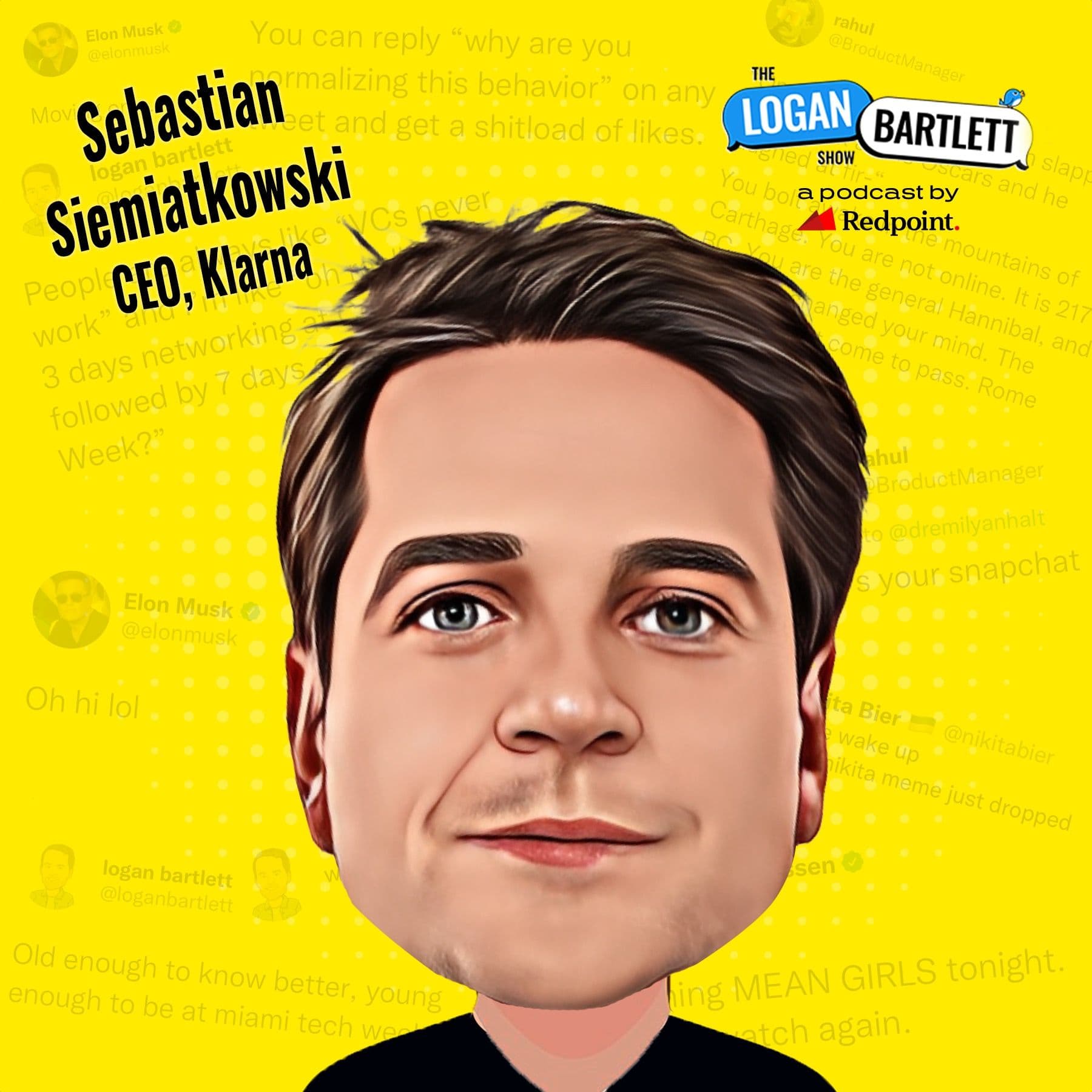
Episode Notes: The Logan Bartlett Show - EP 109: Sebastian Siemiatkowski (CEO, Klarna)
In this episode, Sebastian Siemiatkowski discusses the evolution of Klarna, the challenges of scaling a startup, and the impact of artificial intelligence on the financial sector. The conversation touches on numerous topics, from personal reflections on leadership to the operational changes that have shaped Klarna's current trajectory.
---
Podcast Overview
- Podcast Title: The Logan Bartlett Show
- Guest: Sebastian Siemiatkowski, CEO of Klarna
- Episode Title: EP 109: Sebastian Siemiatkowski on the Future of Klarna, Valuation Changes and AI in Finance
- Duration: Approximately 2 hours
- Key Themes: Company culture, leadership, AI in finance, operational challenges, and regulatory considerations.
Key Takeaways
Personal Reflections
- Journey to Sobriety:
- Sebastian reflects on his personal experiences with alcohol, influenced by family history, and how these experiences shape his leadership style.
Klarna's Business Journey
- Growth and Valuation:
- Klarna's rise to a $50 billion valuation was accompanied by significant financial burn and operational challenges.
- Discussion on the balance between maintaining profitability and pursuing aggressive growth strategies.
- Company Culture:
- Importance of building and maintaining a strong company culture amidst rapid growth.
- Shift toward a more competitive and performance-driven culture, moving away from overly accommodating practices.
Leadership Insights
- Leadership Evolution:
- Emphasis on self-reflection and the importance of admitting mistakes in leadership.
- Transformation of leadership approach from adhering to external expectations to being true to personal values and instincts.
- Decision-Making Under Pressure:
- Embracing difficult decisions, such as layoffs, as a necessary part of business evolution.
- Recognition of the need for transparency and communication during challenging times.
AI and Innovation
- AI Integration at Klarna:
- Klarna's ambition to leverage AI as a "digital financial assistant" and the operational changes that come with this transition.
- The role of AI in automating customer service and enhancing operational efficiency.
- Creativity Within Constraints:
- The importance of constraints in fostering creativity and innovation within business operations.
- Encouragement for teams to explore creative solutions while operating within defined limits.
Navigating Regulatory Challenges
- Embracing Regulation:
- Klarna's proactive approach to regulatory challenges within the banking sector.
- Discussion on the importance of adapting to regulatory frameworks to enhance customer trust and business stability.
Notable Quotes
- "Creativity is about solving problems with many constraints in a way that nobody has solved before."
- "To me, profit is an evidence that you're able to create value that is of value to your customers."
Conclusion Sebastian Siemiatkowski's insights highlight the complex interplay between personal experiences, leadership, and business strategy in the fast-paced world of startups and technology. His reflections on the importance of authenticity, creativity, and adaptability offer valuable lessons for entrepreneurs and business leaders alike.
For more insights from this episode, please consider subscribing to The Logan Bartlett Show on your preferred platform.
Written by AI. May contain mistakes. Listen to the episode to check what was said.
Transcript
Automatic transcript. May contain errors.0:28Welcome to the Logan Bartlett Show. On this episode, what you're going to hear is a conversation also talk about some of the drama that Klarna has been in the news for recently, including with Sequoia and what it's been like working with Mike Moritz for the last 15 years. Finally, we talk about Klarna's desire to push into artificial intelligence, which has led Klarna to being, as Sebastian described, OpenAI's favorite guinea pig to do the work of what would have been done by 700 customer support reps and a number of the different frontiers that they're pushing with AI going forward. Really fun conversation that you'll hear with Sebastian now.
1:01A lot of different topics. I'm happy to cover. We'll see how long we can go. I think there's some interesting stuff in there. I appreciated your, in listening to all this stuff in advance of doing this, I'll listen to a lot of the different things that you've done in the past. And the level of openness, I would say, that you've had, just maybe ask the question about it, but just about family and, you know, like leaving your kids money or not, and your father and, you know, drinking and your grandfather and immigrating from Poland and all that stuff. It's a it's it's refreshing to hear someone be so cerebral and thoughtful about all that stuff.
1:45I mean, we live in a society where people have a lot of opinions about what's spoken about in the public and not, you know, woke or not woke and all that stuff. But there are still two topics that, for whatever reason, are kind of taboo to speak about. And one of them is if you had issues with alcohol. And the other one is that most of us or a lot of people have issues getting babies, right? And those two topics are still very personal. And I feel that, like, obviously, every individual have to choose for themselves. But at least when it comes to the alcohol thing, I feel like, you know, If I can at least the slightest help with making it more like a thing that's okay to talk about, then I think that that's a good thing.
2:22So that kind of was a little bit the choice why I wanted to talk about. So is there a specific point that led you there or was it kind of just a gradual, like, was there a day that you were like, all right, I'm not going to drink anymore? Oh, yeah. It was. Okay, so there was something. For sure. No, no, no. But like, no, but it was like, it's very easy. I'm happy to talk about this. I mean, again, my grandpa had issues and died out of that. My father died in things related to alcohol abuse and other drug abuse, potentially. It's not entirely clear. But it wasn't your childhood, right? I thought that was interesting.
2:57It sort of exposed itself later in life. Yeah, exactly. I mean, when I was a kid, he was actually, I think, partially because of grandpa, dad was very careful. so like yeah you know we we many other families had like you know the parents had wine for dinner or whatever that didn't happen in our house like there was no alcohol uh visible and then it changed when he got a little bit older but like i think that the but the other thing that happened like despite these things i was just partying hard right like i i didn't i think most of my friends would have no no he didn't have an issue he's just partying hard right like but at some point in time my wife told me like you know my my nowadays wife but then girlfriend said look if you're going to continue hardying this hard like i'm out and at that point of time i was like okay but i really want to be with her so it was very clear for me it was just a choice of love i like i want to be with her so i got to drop this thing and um but then you know the interesting thing is just one note on this is that i met this um doctor who was specializing in alcoholism and he said to me which i don't know if it's true or you know scientifically proven but that there has been studies that suggest that your brain is physically altered by drinking, especially if you have kind of the genes for it.
4:11And then when you stop, it takes about 12 months for it to heal. And consequentially, if you off it for 12 months, then you're much more likely to kind of prevail than if you are not capable to keep up for the first 12 months. And the interesting experience I had, just quickly on this, is that if you would have asked me like for the first 12 months after I stopped like you know have you stopped can you drink and I'll be like no I cannot but inside my head there was still a voice that said but really you know at some point in time I'm gonna have a glass of wine and you know maybe at some point in time I'll be fine and I'm gonna do it again and then after 12 months it was this just miraculous strange thing like somebody turned a thing around in my head and suddenly it was just like wow I would have ended up as my father and grandpa.
4:58Like eventually I would have wasted my life. And then you just got this like cancer survival feeling where you're just like, I survived death. You know, I'm a survivor and I've just been celebrating the fact that I'm not going to fall into that trap ever since. So since then it's just been pure joy and happiness over not being drinking anymore. Isn't it amazing how, I know you've talked about like setting the six month milestone of, of, Hey, we're, we're not quitting our, you know, jobs or whatever. We're just going to set six months. We're going to go start this Klarna thing. And if it doesn't go anywhere, uh, then, you know, whatever, we'll go back to our other, uh, the rest of our life.
5:37And there's, there's something about like, uh, just putting one foot in front of the other and setting some realistic milestone. I remember when I was starting to do this, I was like, ah, I'll do four episodes. And if that goes well, I'll do 12 episodes. And if that goes well, I'll do six months. And like, that was my, If I had said, hey, I'm going to do, I don't know, it's 110 or something. There's no way I would have committed to do 110. But when you set these little incremental milestones, and for you, I mean, probably making it 12 months, that's reasonable. You can do 12 months of a lot of things, right?
6:09But if you set, hey, the rest of my life, the next 60 years of my life, I'm not going to consume alcohol. That's so daunting in such a way that it almost feels insurmountable. But doing these little goals, I'm sure 12 steps and all that stuff. you know plays into that but it's impressive setting these realistic milestones no you're totally right you know what like i actually have never made that connection before so i thought it was really nice that you did it i've never thought about the connection but you're obviously entirely right that like it was the same thing when we started a company it was when we could derive it down to such a you know shorter term decision and not try to because these like life shifting decisions i mean maybe with the exception of when you get married right like that's a bit There you're actually making that decision.
6:51But in general, you should probably try to avoid it and try to split it down like that instead, right? So that's probably a very good advice. I've never thought about that. You're right. Yeah. Well, that's one of the things that comes when you try to synthesize someone's entire professional existence into prep for a podcast. You get a very meta-zoomed-out point of your life versus you're just living it, right? So I guess one of the questions for you, just to start, there was an interesting thing you had said that I'd never really heard anyone articulate in this way before, but that there's like three different barometers of a company's success.
7:28One is like the internal momentum that you're feeling within the business. And then there's the that might be the most leading indicator, which flows down into the P &L of the business, right, which then flows down into the public perception. and in the fullness of time, I think those things are pretty directly correlated or they flow into one another. But at any moment in time, they could be disconnected, right? I'm sure when you were$50 billion valuation, but you're trying to figure out what to do, you might've felt one was off versus the other. And then when you lowered your valuation, you might've felt that the momentum was there versus not.
8:06I guess, can you speak about that concept, how you think about those three different barometers and then where Klarna is today on each of them? It started off as, you know, probably more like of an observation of mine that I just realized that, you know, I could come to work every day and I could feel that, you know, when I looked at what we were doing and what people were accomplishing and the work and, you know, the culture and the speed of decision making, or if we were shipping good or bad products and all these things that you kind of observe on a day-to-day basis that you know you could be very proud of it and feel very excited about it and you can feel more depressed and you know feel like oh my god nothing's really going like the way i wanted to do um and that doesn't necessarily you know to your point instantly translate into the pnl results uh or the perception in the market of the company's success but that over time it always correlates 100 obviously and i think that like I think that that experience grew over time.
9:07To me, it played an additional important role because, in my opinion, when I look at the company as such, between 2005 and 2010, when we kind of started it in the first startup years and started getting some momentum, in what people have to remember was a small market, right? Sweden, 10 million inhabitants. So it was great success on a Swedish market basis, but fairly small from a US perspective. but um we uh there was a lot of i mean there was obviously a lot of bad decisions you know things that didn't work out and whatever but in general still like i remember like on a whiteboard we let's sign like here's the list of the merchants we need to sign and then like and then we were like what if we sign only one of them it's gonna you know accelerate the business like amazingly and then like a few months later we signed all of them and you were celebrating like how did we do That's amazing.
9:57So you had this great momentum, right? And you realize that that's going to eventually show up in the P &L, but then it takes time to go live, to make sure that the product works as intended, and all that kind of stuff. But it's going to show up. And I think then, however, when we got to like 2009 and 2010, I feel that we went from$100 million valuation when Sequoia invested in 2009 to a billion in unicorn status a year after. And that's when the perception of the company suddenly was slightly ahead of where we were as an organization ability to execute. And then you start feeling that there's pressure, there's expectations.
10:37At the same point of time, there's a lot of opinions. You need to hire more senior executives. You need to have 20 % of creative time like Google. You need to, you know, whatever is the latest thing written about in the management press, you know, or whatever. or good to great tells you that you should hire the best. So please go and do that, right? Like whatever it is. And I just felt very confused personally in that space. And I felt like, wow, you know, and as I then started hiring, you know, senior executives and doing all these things, I kind of found myself looking around and I was like, I don't know, like I'm not impressed anymore.
11:19Like I don't like the pace of that or I don't like the pace of the product development or I don't like what's going on. I feel we're sitting so many meetings and just talking and I just didn't see things that impressed me. There's two fun ways in which that articulated. One was very clearly because in 2009 and 2010, we shifted a strategy. We pivoted towards what we today call the checkout strategy, which is funny since we announced that we're actually selling that part of the business away. But at that point in time, it was just when we launched it. And it was a pivot because up until that time, we were a simple payment method.
11:55And now we wanted to do a full PSP, a full acquiring offering. And I had this board presentation where I was like, there's this huge opportunity to build a global PSP business. There's just two small startups. You know, there's these Irish guys, the Collison brothers. They have some real good understanding of building great APIs for developers. And then there's these Peter and his gang in Netherlands, the Adyen guys. and they're doing something really good in this. And they're smaller than us. They're not as big as us. So we should just go and nail this. But two, three years down the road, as much as we had some success with it, Adyen launched 50 payment methods in Asia and we were struggling to add one in Sweden or in Germany, sorry.
12:39And like, it just became, that was a typical momentum question where like my investors started believing in this. A lot of investors were coming to us and say, oh, you're building like an Adyen. There's a huge opportunity. like, that's great. And they would probably even give us a premium on the valuation because they believe that we were just another ad in our Stripe. But to me, looking at it, I was like, no, we're falling behind. I mean, we can pretend to be an ad in a Stripe, but we're not moving at the pace that they are. Within Nordics, we did well, and that product worked really well in this context, but it was not at their level on an international basis.
13:14And so those are good example um i think another fun example was also like at one point of time we talked a lot about like company culture and like you know how to build a great company culture and we tried so many different things in this area like i still sometimes laugh about all the stuff that we've done but one of the things we did was we brought these consultants in they were going to help us establish what the klana company culture was and the way it was done very swedish was that we took the whole company that one time a few hundred people and divided them in small groups of 10 people and they were all supposed to sit in a group and discuss what is klana culture and then they were supposed to select like three words or three sentences that described it and then they had to decide and agree in that group and then each of the group had a leader who then met and then they negotiated and then at the end you know everyone negotiated with each other until we at the end had like three statements that should represent the klana culture and this was the consensus decision of 300 people of what Klauna culture should stand for.
14:16And the funny thing is like when I got back in front of me and I looked at it, I remember thinking to myself like, you know what, this is probably the most fair and still like nice, probably a little bit too nice description of our culture, but it's still probably a very fair description of what it is. And the only problem is I don't want to work here. I don't want to work in that environment. So it gave me two options. Okay, this means two things. Either I leave and let these guys continue in this culture, or I try to make this culture into what I believe it should be and what I want it to be and push in that direction.
14:56I obviously choose the latter. But it's a good example of when you feel like, the momentum here is not what it's supposed to be. This is not what I actually believe to be. What were the cultural things that they were espousing at an employee level that you didn't think was what you wanted to run a business as? Like, what are the types of things? Well, I think most, you know, most people, for good reasons, are they want things to be nice and they want things to be friendly, you know, and that's nice. I get it. But this is a competition. and if you would be presenting such values in a soccer team people would say well then you're not playing champions league then you're playing you know with your friends and soccer and that's a different thing and you can do that that's fine you can enjoy it but it's not the same thing as you know you know um and and people will have different expectations like maybe if you're playing with your friends on a sunday it's okay if you you know show up a little bit you know with a hangover.
16:02But if you're, you know, showing up to practice in the morning in the Champions League team, and you're not fit for fight, I think your colleagues, your comrades in your team will have opinions about that. Yeah, it's interesting. I mean, I've heard you talk about like expectation settings with founders, but then also, I guess, early stage employees. And one of the things that feels a little taboo, or it became a little taboo, certainly with different generations of employees, And I get yelled at anytime we splice something and it goes on TikTok or Instagram. And we espouse the virtues of long hours and working hard.
16:42And I always get yelled at for it. And I feel like one of the things you guys did, or I've heard you be pretty explicit about in the early days, was that you were in, I don't know if it was in at seven and out at 11 for the first six months and building that. It was longer than six months, my friend. Oh, was it? Okay, for the early days. How long was it that you guys were actually maintaining the culture? I mean, I think it's an important lesson because we've lionized the founder experience and also we've lionized work-life balance. The two were often, maybe always, very much at odds with one another.
17:19So can you just speak to that early days of setting the culture and expectations among the early employees from a work product standpoint? Obviously, it started with us as founders. And with us as founders, it was actually kind of a funny thing. So it started with this thing that we were three co-founders. We had all committed to doing this, right? But we got a little bit suspicious against each other sometimes of whether the other one was working as hard as the others. And so this started some fights. It was like, but you weren't here. You haven't done that. You know, whatever. like three friends sitting in a room and like, you know, and fighting with each other over these things.
17:58Like, oh, I did show up yesterday. No, you did not. You were on that call with, you know, whatever. And so we just said, okay, how do we solve it? We don't want to have these fights. Like, and so we just decided, like, one thing was we decided that at that point in time, we had put the computers in the office so that as you would naturally do, you each sit facing each other with the computer screen facing backwards. So I wouldn't see the other screen. I would just see their faces. But at this point in time, we were like, the problem with that is that like, then when I passed by Victor, my co-founder was like, but he's always on Facebook.
18:28Like, you know, and I was like annoyed. And then he got annoyed with me because I was always doing something else, whatever. So we just created this idea that like, we were like, what if we put the computer screens so that we can always see each other's computer screens? And it was like a self control system. But the funny thing is after doing that, we all like a month later had to like sit down and said, you know what, actually, I'll admit that since I turned my screen like this, I tend to work a little bit more. Because like, I am a little bit embarrassed if my colleagues saw me like on Facebook too long, right?
18:58So I felt like, so it was a little bit like some of these like self-disciplined things. And you know, they work in a founder, you just, at that point, I was just the founders in the room, right? Then you start growing and the company becomes more. And we used to call this like the open screen policy. It's like, it helps you to be disciplined, right? You do this when you go to the gym. You have things like your personal trainer that you hire. You don't expect them to say, hey, here's my target for you, your KPI to set. See you in six months. Good luck, mate. You're actually expecting them to stand there next to you and like, come on, do another way.
19:32You can do one more. You're paying for that, right? But in the work environment, we have come to the conclusion that that's bad. Your manager is not supposed to tell you that. You're not supposed to. Like you're not supposed to just give you a big goal and then you should go and do it. Right. But I actually think if you really want to, you know, if on the soccer field, again, somebody's running, your coach is coming. Come on, one more lap, one more lap. Right. Like there's something to that. And again, it comes back to what you want. I'm not saying or suggesting you cannot build a successful business.
20:05You can build a totally fine business without doing that. You don't need to work that much. Some people are successful working less. Some people are not successful working less. But I do believe if you really want to build a great business, then you need to put the effort in. Otherwise, it's just not going to happen. So I always say, look, activity does not equal productivity. But without activity, there is no productivity. Just let me be honest about it. So to us, that was one thing. I think on the working hours, yes, to answer your question. So the other thing that we did was we were also like always suspicious of each other.
20:43Like, have you actually worked as much as you say you work? So we said, look, to stop these conflicts, let's start doing like a stamp. Like, you know, you know how it used to be in the factories when you have to like stamp in and stamp out when you have to punch cards or whatever. Yeah. So we started doing that. We started writing up exactly how much we were working. And we and then we compared the hours so that it would be equal. It was just about avoiding the fights. We were just tired of like, because we quickly understood this is self-serving bias. I will always believe that I work more than everyone else.
21:14And unfortunately, it's just like how we humans work. We always have this self-serving biases. So let's avoid that and just put it on the table. How many hours have you actually pulled in? And so we started doing that. And we did that for the first seven years. And we tracked the number of hours for the first seven years. Just the founders or for all employees? No, just for the founders. The open screen policy we tried for everyone, but we didn't do this for the others. I think the others that came in in the early days, they obviously to some degree saw like, okay, here's some guys. They're working really hard.
21:47They started doing that as well, right? And it wasn't an outspoken expectation or anything. We never said it. We talked about, again, this concept of talking about the fact that ours actually makes a difference. And I feel sometimes I meet like more senior founders or people that have done an exit or two. And then they're coming to me. Yeah, when I was a kid, I thought it was all about hours. But now I'm grown wiser and I realize it's much more about what I do with my hours. And I don't need to do many hours anymore. And I feel that's a little bit like that's also not entirely true. Because the truth is like, yes, I am definitely today, you know, 20 years into it, much better about using my hours than I was 20 years ago.
22:30but if I add one more well-used hour it's still a little bit more so like and that doesn't mean again there's time for reflection there's time sometimes to go for a walk and think about things but I do think that this has become some odd thing that people are not okay with talking about and I feel it's I feel sad because like I tell people sometimes like people how I'm concerned about you burning out or whatever and I'm like look I feel like I'm an artist look if I would be a painter and I would be drinking Absinthe and hanging out and I would be like, last night I was painting until 4 a.m. because I was excited about this piece of art, then you'd be like, oh my God, he's so amazing.
23:10What a fantastic guy. But if I'm a CEO sitting at 4 a.m., like, oh, thinking about my finance sheet, then people go, oh my God, relax, man. You're like work-life balance. It's a choice. I understand that I'm sacrificing other things. I understand that it has implications and I'm not expecting the whole organization to work like that, because that would be silly and it's not going to happen. But I also feel that I have the right to work the way I like and the way it works for me, as long as I'm mindful of making sure in the organization, especially with junior people, that they don't misunderstand this as an expectation, but that I try to attract and encourage people to the organization that do this purely because of their passion and interest.
23:55And that's sometimes hard, obviously, to distinguish. And there's always risks to that. I'm recognizing those risks. You have to be a little bit mindful about it. But I still think you can do that. Like, I, for example, tell everyone, Slack, just so you know, guys, I will hit you on Slack any time of the day. But I never expect you to answer until you're back to office. If I need you, I'll call you. And I'm very specific about that. I publish it on my internal, like, wiki page so people know what to expect of me. Like, I'm trying to make it very clear. Like, this is the thing. But it should also be allowed for me to ping because I'm writing something down.
24:26I want to send a message or something. I should be able to do that. So we try to make that very explicit. I've heard you reference or there was some point along the journey, you mentioned the cultural thing when everyone was espousing the values and that it wasn't totally the company that you wanted to run. I also have heard you reference that at some point you realized that you just weren't going to be all things to all people as a business. and it wasn't going to be the employer that everyone wanted to work at. I guess a lot of our founders are currently thinking about putting the truth face back in the tube a little bit within office culture, or maybe they're managing rifts and trying to reset the expectations internally on, hey guys, what in the Zerp era, in the 2021 work from home era, there were some sloppy policies.
25:17We like slide and now we can't. Was there anything that you did operationally to really shift the mindset of the company that it's not going to be this soft place for everyone and we're going to espouse niceness and all of that, but instead we're a soccer team, to use your analogy, and we're working to win here? I think it's a very, again, it's difficult because it can be misinterpreted and it can go the wrong way. With that said, though, I do believe that, in my opinion, among the best leaders are people, like I always think about this, people will be motivated by a number of different things, right?
25:58So people are motivated by making a career, by making money, by being great colleagues and friends, by being, you know, when I think about the work-related part of our lives, right? And then they will also be motivated by curiosity and learning things and accomplishing things and so forth, right? So you'll have all of these. And for each individual, however, it will vary a little bit what's more important. And so, for example, I used to have a very senior member of my management team who was good in all this, super smart guy. I think he was at Stanford, like in top class, everything. But over time, I realized that his main driver was being liked by his colleagues.
26:35And the problem with that is just that that's obviously great. But if it's your main driver, it will sometimes stop you from taking the necessary important decisions that are necessary for the business. And that's not great. Right. And I think people forget about that. It's like, OK, let's say, for example, that our head of customer service a few years ago wasn't doing a great job, like from other angles and wasn't tough enough. Like, you know, we can internally say, yeah, but we want to be nice to that person. and so forth. But like my customers won't care. My customers don't care if, you know, I'm being nice or whatever.
27:10My customers expect great customer service. And if they don't get it, they will go elsewhere, right? Like that's just the way it works. And I think it works like that for a good reason, because otherwise we'll get into a society that doesn't deliver value to its, you know, and usually those societies tend to fail over time. So I think it's an important concept that obviously you have to be mindful of the implications on the individual basis and how you deal with those situations you have to be empathetic about but so that comes in so i think that like and i think but then to talk about the great people that are great leaders if you think about what drives them i think it is curiosity i think it is about accomplishing things and i think also one thing that i feel is very very clear with most of the greatest leaders that i work with is servant mindlessness they care about serving others there's this great movie about this indian guy who came to like the queen of britain like a hundred years ago and she's like depressed and he was like her guru and she and he says it's in one of the scenes like your purpose in life is to serve others and i think that's true like people are really great leaders have as one of their primary drivers that to serve others however if you have that as a primary driver then you also see a lot I see a lot of talented leaders who then feel conflicted because they want to serve others.
Read the full transcript
28:30That's why they're there. And that's why they're great leaders, because they're empathetic. I mean, being service-minded to a large degree is about empathy. You have to be able to understand and put yourself in the position of your customer, of your employee, of these people in order to understand their perspectives. That allows you to be very service-minded because you can come ahead of their expectations or whatever they want of you and you can deliver amazing service. But the downside of being service-minded is sometimes it goes too far. Sometimes you actually have to be able to say no in a good way.
29:02And I remember the first time we hired a senior executive that was really good was our head of customer service called Karin. This is like, I mean, 15 years ago, whatever. But at that point in time, I remember me and Nicholas, we were so service-minded. So whenever an employee would come and say, I'm unhappy about this or this doesn't make sense or whatever, our gut reaction would always be to try to go and fix it. Like try to go and fix it immediately, right? Because like we were service minded and we just wanted to fix everything and want to make everyone happy all the time. We were just running around the thing.
29:30And then at some point of time, there was a, and we were, you know, we were stressed out about this. We were running around trying to serve everyone to the maximum. And then at one point of time, this fairly like junior customer service agent comes in to speak to Karin. And, you know, service agent says something like, you know, this is not good and that is not good and so forth. and then Karin looks at this employee and says, yeah, life sucks. And that was it. You know, that was the end of the conversation. And then the employee was like, yeah, you're right. And then goes out and that's fine, right?
30:01And I was like, whoa, me and Nicholas, what, can you do that? Are you allowed to say that? Like, can you actually say like no to somebody? And so obviously you can. And for other people, this is much more natural in their characteristics that they feel that. But I actually think a lot of great leaders don't at first are not capable of saying no because they become good leaders and because they're empathetic and they care and so they want to serve everyone. And that's actually easy to burn out based on that requirement. But then you have to find a balance because unfortunately you do realize that like sometimes you have to say no.
30:33And also sometimes people don't really want you to fix their problem. They just want somebody to listen and that's okay. And if you just listen empathetically and say, I hear what you say, but you know, this is a situation, that's fine, right? And so I think that that was a, to your point. So that's when we started saying, you know, Klon is not for everyone. We're not here. You know, we're not a family. I mean, the key to me, difference between a family and a team is in a family, you can't, you know, you usually don't at least, sometimes, unfortunately, you have to. I mean, Oprah and Dr. Phil will say that your responsibility is to surround yourself with people that make you happy and feel good in life.
31:09But in general, we would mostly in society agree that you don't kick people out of your family because it's hard to do that, right? but if you look at like a team part of the coach job is to assess that like maybe this one player on the team doesn't have the prerequisites uh to make the team successful or doesn't have the motivation or isn't in the right place or whatever it might be and that's part of the job so it is different and then i think it's rather something you want to be able to express and and you know and say in a good and empathetic way right that like it's not and i rather make sure that people know that when they join us as a company rather than find that out later, right?
31:44I want people... I think this may also be a little bit where in Europe, due to the difference in labor laws, these topics were earlier at Klarna, maybe something that came up to the top. Then I think now in the US, they become more something that's discussed at a greater level nowadays. But to us, it's just been something that we had to talk about a bit earlier because the situation here is different in that sense. Now, we've gotten a while into this without actually describing what Klarna does. And it's funny, a lot of people I talked to when I said we were doing this podcast, everyone in the US, I think, knows what Klarna is, at least as a brand.
32:25Everyone's like, oh, I know Klarna. No one can fully, that I've talked to, can fully articulate what Klarna is. They're always like, oh, I've seen it. Yeah, I know that. And then when I describe it, I think it's like, oh yes now i know what it is how do you articulate uh because i've done it the last couple days and i don't have the pithy version down quite as well how do you articulate what clarna is in kind of an elevator pitch well i think this is coming back to the you know the artist because like people talk you always want me to do the 30 second pitch and i feel a bit like you would ask an artist to like express all of your art in 20 seconds like i was like i don't know yeah like i If I think about all the complexity I've lived to in the last 20 years.
33:07I'll take your answer, by the way, whatever you say here. I'll put it in chat, GPT, say synthesize, and then that'll be the output of it. So that would be the output. No, but I think that like, look, I mean, obviously at the core of it, we're a payments company. We offer an ability to pay online, debit or credit. We're mostly famous for this buy now, pay later, where you can split things into installments. You will see us on websites online, but also in physical stores. But I mean, nowadays, we're also a neobank. We offer card services. We offer full banking. We're a fully licensed bank. So it's kind of evolved beyond that.
33:37I think, so that's kind of that. But I think going forward, you know, this comes back to the whole AI thing. And this is actually, it kind of ties back to what I said about the client checkout when we launched at 2010. We basically tried to, you know, play in this PSP, Stripe, Adyen type of business. we concluded in 15 when adion signed with spotify which was like our neighbor here we were like okay you know your your worst competitor you know your your closest neighbor is signing with your worst competitor like that's a pretty good sign that you're gonna you know you're losing out and not a lot of the investors didn't see that at that point in time our pnl didn't say that at that point in time but we said that and we said it's time to pivot and at that point in time we asked ourselves, okay, what did we learn from those five years?
34:29And the one thing that we learned was that we were right. We were right about where the market was going, that these global payment solutions would make sense, that people like Stripe and Adyen and like this, that directionally we were right. We just didn't execute. And in 15, then we said, okay, what if we would try to formulate a new big hairy goal like that, as they use the term for it. And that was actually funny enough, was AI already then that we said, okay, in the future, at some point in time, you wake up in the morning, your computer will say your financial digital financial system tells you, hey, I'm going to save 10 bucks on your mortgage, Logan, by moving from bank A to bank B, and I'll do all the paperwork for you.
35:08The only thing you need to do is say yes, right? He said like, okay, that's eventually going to happen. Just like self-driving cars is going to eventually happen. We just don't know how fast. But if that is the direction of financial services, what do we want to be? And then it became clear to us the digital financial system like we want to be that we want to advise you on those decisions to help you save time save money make you feel less more in control of your finances and like i think that the and less worried about them but so i think that that's the like big vision goal right as much as like and then these services the payment services are amazing because we are over 100 million users and we you know acquiring them ourselves would have been very expensive and now Now we have these merchants who like our services and see that they help them grow their business.
35:52And as a consequence, they're advertising our brand and people see us online on Macy's or Uber or Airbnb. And then they try us and they're like, I like this. And then they start using us for more things. And in Europe, sometimes people drop their credit card and explain, you know, and replace it with ours. Or they drop their bank relationship and, you know, replace it with ours. But it's not like your bank used to be where you have to sign up and, you know, and please, please, please make me a customer. and go through 55 forums and beg with your local banking guy. It's different. It's more that you try us for something, and then you like us, and then you try us for something else, and then eventually that becomes a full relationship like that.
36:30So I think that was not the 30-second, but at least I did it in full five minutes. Yeah, no, no, you cut it down. As you reflect on the Addy and Spotify thing or the Stripe, you were doing more things at once around that time where I think Adyen and Strike were sort of singularly focused on that part of the business, if I recall correctly. Do you attribute them succeeding in that arena? And as you reflect on your guys now selling off part of that and you know, not winning the Spotify account or whatever. Was it a focus thing in your mind? Was it just execution, hand-to-hand combat? And Peter and those folks just did a great job.
37:19What do you sort of, as you self-flagellate and say, oh, what could have been, what do you attribute it to? Look, I think both the Collison Brothers and Peter are fantastic entrepreneurs. And I think it would be very like, you know, you would not have understood the world correctly if you believe that would be an easy thing to compete with them so i don't think it's that simple i think they did an amazing job the question to me is not necessarily the commercial outcome like could we have one more commercially or less but from a product perspective could we have built a product that was great with the bandwidth and capacity or would that have required more focus or less i think the point is that we had the focus in my opinion at that point in time this was the main focus of the company.
38:03It was mine and at that point of time management teams and the company's ability to turn that vision and understand how do you turn a vision into a working product? You know, like from this big, grandiose idea of direction into something that actually delivers value on a day-to-day basis. And we were simply not doing that right. And I think I cannot promise that we would have a different commercial outcome. But I think with my experience today of how to turn vision into an actual product outcome, I could have had a better chance at least coming out with a product that would have been more competitive going back with the same amount of resources and focus.
38:46So I do think that we learned a lot from that and the people who were involved learned a lot from that. So there's tons of learnings that I would have done differently. As you're an entrepreneur or someone's listening to this, is there a specific staffing thing or is there any salient point? I'm sure you have a million of them. But as you reflect on that and you were to distill it down to one or two things that now you would do in retrospect that you didn't do at that time and you're an entrepreneur listening and trying to get the wisdom of those five years executing on this, is there something that stands out?
39:26well there are a few things i mean one is obviously we did hire too many senior executives from the outside um that had great cvs but not really and one of the major things that i did in 15 when we decided because 15 to us was such a pivoting time we realized that klana checkout was not going to become a stripe or an adjun it was going to do well but it was not going to come to like a hundred billion dollar outcome and so as a consequence of that you know we had to pivot But it was also the time when my co-founder, Nicholas, departed the company, which was good from the perspective that over the last years, we had become a little bit like a married old couple.
40:05So when he was saying something, I was like, I already know what he's going to say in a sentence. I know where that's going. And we weren't really listening to each other anymore. And to some degree, some people internally, some troublemakers, were basically using that to their advantage to create political infighting. And that was not good. And when he left, it wasn't really about who was right or wrong, but it was about the ability that it created clarity suddenly. Suddenly it was like me. And I think the biggest, actually, to me, benefit of that was that before he left, if something went wrong, I could always say in my brain, like, yeah, but I listened a little bit too much to Nicholas.
40:42If I would have done it my way, we would have been like, you know, whatever. And you don't learn. You don't learn anything thinking like that. The benefit, like, after he left, it was like, we screwed up. It's only me, man. And it was me and like, there's nobody else to blame. So let's figure out what the hell I did wrong, right? Because that did not turn out well. So I think it like, it forces this. I think that's the funnest part of being a CEO. Like there's nobody else to blame. Like there's a lot of other people to give credit for great things, but there's nobody else to blame. So like, so I think that just accelerates your self-development.
41:15But I think that the, from the learning cycle, so definitely, so in 15, when Nicholas left, I wanted to form a new management team and one of the things at that point the company was 10 years old so it allowed me to actually promote some people from within and bring them up to management level when everyone had advised me oh people are too young for that they're not going to be typical startup advice and it was the opposite it was the right thing these were proven individuals there's a reason why if you go to very traditional industry companies like industrial companies or these things they almost never hire senior executives from outside I was talking to the guy of Volvo Trucks, running Volvo Trucks.
41:55They don't hire some senior guy off the street and just like, hey, come on in and fix our Volvo Trucks. You have to work there for 20 years. There's a reason for that. So to me, actually being willing to bet more, even if they're junior, and even if they're learning, allow these people the same development and learning that I myself had had, because I was a CEO at a young age, right? So very critical. I think the other thing that I probably think it's a lot is just like, you know, just stay very focused and close to product development and the actual, like today, I spent so much more teams, like even today, my work week, if I look at it today, I really enjoyed when, you know, NVIDIA was talking about, you know, 60 direct reports.
42:46I don't have 60 direct reports or whatever, but I do have four days out of five spent very deeply with specific teams at Thana doing specific things, interacting with them, working with them. I feel like I'm a team member. That's what I want them to feel. Sometimes they do, sometimes they don't. But I'm trying to engage with them. And we're reviewing exactly how we're doing the product, how the code looks. I mean, the amount of code I've been reviewing. like we're into the details and we're discussing you know how does this execute a reality and people often feel that like how am I going to scale if I do that you will scale better than ever if you nail something with a team and really understand how to do things together and then you move on to the next team if you do that on you know over and over again you'll have a fantastic organization that can execute amazing things but you need to be close and you need to help these teams succeed because there's so many blockers so many things in the organization oh i'm dependent on that team and i didn't get an answer and i'm not sure but because they said this and they said that like just helping them resolve these things these teams want to be successful these people want to be successful but many times they're they're stuck in a larger organizations in inabilities to take decisions or having senior leaders who don't understand the product and the nitty-gritty you know importance of the nitty-gritty details enough to be able to advise their teams and support their teams on what's really important.
44:10I think those things. Was that more critical? Yeah, no, it's super helpful. I guess one question on that is, as you think about the tension that exists, there's a spectrum between autonomy and empowerment and centralization and standardization, right? And they sort of live at extremes. And if you go all the way to centralization and standardization, you're not empowering people to make their own decisions, but you get some shared frameworks and design consistency. And hey, here's how we do things. If you go on the other side, you're empowering people to be nimble and moving quickly, but you could end up with 50 different businesses or little autonomous units operating within an organization.
44:56And there's no cultural consistency. There's no design consistency. Maybe this is on TCP, that's on AWS. This is written in Java. That's written. How do you think about the balance of empowerment with consistency or centralization and the tension that exists within an organization? You know, it's a very good question. And actually in 15, the first thing that we concluded after feeling that we had failed was that we need to change like, okay, we now have this big hairy goal of becoming this digital financial assistant. If we're lucky, it's a hundred billion or even bigger kind of opportunity ahead of ourselves.
45:36So what's going to be different this time around? And then the only difference, if we're lucky and the vision is right, then it has to be that our execution is different so that we actually deliver on this and we become that adjunct-stripe success. And so then it was, what do we do differently? And the first thing we did was to change the operating model. We had a very typical functional setup with like marketing, product, engineering, etc. We moved into these autonomous small teams that we called startups. We decided everyone in the company would be organized with eight people, the two pizza slice team, Amazon influenced.
46:12They were all going to act as startups. They were all going to write a press release of what they were going to accomplish in a few years. We were poor. I feel now sad because Because a lot of these teams made so much effort in these amazing press releases. And today I realize they maybe are of some limited value. But now we were crafting them to death, all of us together. We're just going to have a perfect press release. And what this product is going to, or this team is going to achieve in a few years. But there were some things of that were great. But the downside of that was we created this 500 teams that were rowing in totally different directions, to your point.
46:46Applying different standards, working in different pensions. So it was a great uplift in productivity already then, in my opinion. We managed to get much more done than the kind of traditional functional organization. And the agility, and I'm very influenced by the Agile, and Agile is partially coming from the Toyota way. That in itself is coming from the Americans who were preparing for the war, World War II and stuff like that. So these methodologies have been around for a long period of time. But the point is that they were part of it. But to your point, there's a downside to it that there is something about standardization and doing things in a consistent, coherent fashion in the organization.
47:23I think about it today a little bit more also. If my kids go to taekwondo class, right? When they come in in taekwondo class and they have white belt, the first thing they do is not start to discuss if you should hit like that or stand like this or whatever. You're kind of expecting your coach to come and tell you, like, move like this. No, no, not like that. Move like this. No, no, no. Move like that. And then maybe if you showcase that by hard practice and learning, you know, swipe off, swipe on, right? Like care of the kid. If you at some point in time reach a level where you're black belt and so forth, maybe you will suggest the new movement.
48:04Maybe you'll create a move in Taekwondo nobody had done before. Maybe you'll do something, right? but it has to build on the amazing work and you know you have to work you have to build on top of the giants that come ahead of you right so like today with the teams so like it's awesome that you know we have this amazing passion energy people coming in and wanting to do things new but like let's make sure that we actually build on what we have done and like let's find a balance between that and there is logan what you're describing is to still today one of my biggest challenges when I go in and I speak to teams and I'm like, did I like, am I pushing them too much on how to do things right now?
48:43And am I like stopping their own creativity and their own independent thinking? Or, you know, or the opposite, am I getting them too loose? And I think it's like, to me, almost like it should be a consistent evaluation of a leader. There is a nice leadership program in Sweden called situational leadership. but it basically speaks to the fact that like each situation is different so you would apply different methodologies depending on you know the situation and if i assess maybe this person right now needs clarity and i just need to you know make sure to develop their skills but maybe right now what they need is to go and you know and do something on their own and learn something and make some of their own mistakes and i think you and then you have to obviously weigh that versus how important is this for the company is it okay if they fail you know or is this like a mission critical thing that I need to be a little bit like, I think it's more of something dynamic where you, you have to apply it slightly differently from a situation to situation basis.
49:39And I think the best leaders, the best managers I see at Klana are doing that. They're, they're very thoughtful about like, maybe now like this may push a little bit more and, you know, no, move back, let them, you know, et cetera. You referenced Toyota there. And I, I've heard you, uh, espouse or, or, or celebrate Toyota's culture and, or some of the things that they've done from from a process standpoint, I guess. Why do you take inspiration from them? What stood out about the way that they've operated historically that you've maybe tried to bring in to Klarna's culture? I mean, as you know, I get a lot of management books pushed my way and then you try to read some and some you're just like, oh, you know, I guess.
50:19But, and then I just, at some point of time, it's like, I'm stopping with this in my life. I'm only going to read like Kafka and Dostoevsky from now on. I'm not going to do this anymore. And then you start reading. But the problem is then you, as a CEO, you start reading Dostoevsky. You're like, there's management ideas in here. You know, there's like things to do. But anyways, what I liked about Toyota, I liked when I read the book, but it was not close to what it meant when we finally, after many years talking about it, we booked a session to go to the factory in the UK. We went to the factory.
50:51We brought our 50 top managers. and we brought them to the Toyota factory outside. I can't remember, it was somewhere north of London. And we got there and they walked us around on the factory floor and they explained to us in practice, how does it work in the factory? And they showed how they did the Gemba and the Kaizen and all the different methodologies that they have developed. And you just look at that and you're like, God, this is freaking impressive. you know and I I think to me like you know I mean obviously Elon with his management technology has also been able to establish himself in that industry and he has shown that even the Toyota way has its flaws because there are some other benefits to the way he does things but there's also downsides to how he does things right so like there are always there's many ways to be successful but the point is that like it just inspired me and one of the things I really loved which I think was really cool and I know it's going to sound a little bit like maybe Vogue or whatever, I actually think it's genuinely true from the heart, from my heart, is that Toyota has this fantastic capability of bringing in people that don't have academical backgrounds, that aren't, you know, trained at amazing universities, and actually encourage and involve them into a continuous improvement of how to build and manufacture trucks in a way that, or in cars, that is simply, you know, that just improves.
52:21And, you know, Toyota as a manufacturer has beaten the profitability and growth of basically virtually any other car manufacturer in the world for decades. Right. And it was quite inspiring to see these people really being part of that. And I just I found it very, very, very interesting. I really recommend it for people to book one of those. The nice thing is they give away the money from that to a charity as well. So you book that and you get to walk around the factory and really reflect on this. And the one thing that I really loved about that is the Gemba walk, right? So the Gemba walk is the fact that the senior manager has to walk the factory floor.
52:58And I found that very difficult to do in a digital company until we started being a little bit more disciplined talking about your standardization. Today with Inclana, we're a little bit more tougher on the expectation that every team in Inclana has a Slack channel. and that that Slack channel is actually the one that is public and that is genuinely used for the day-to-day work conversations and so forth. And the amazing thing about that, it allows me to do virtual Gemba walks. I can walk around, I can read these Slack channels, and I can see directly like, okay, here's a team struggling with something and I can jump in and support them and resolve a Creole matter.
53:38Things that will not come up in meetings because people maybe feel shy to ask for help or they don't feel that it's a matter for the CEO or whatever. And here, these things come up and I can come in and say, like, hey, you should talk to that team. And like, you know, can you sort it out? Or here's an idea. This is how we solved it. And it's such a nice to me. That's the same as I see the coach of my kids on Taekwondo. He's walking around and saying like, you can hit like this instead. And then if you do that, you get a different outcome. And, you know, that's an amazing type of leisure. That's the way I would like it to work.
54:11And I don't, you know, you know, obviously, sometimes people can feel afraid of that. Oh, my God, the CEO wrote something in our Slack channel, whatever. I get it. But it still must be the way that we do, right? We support each other and we're like engaging in people's work. I think it's amazing. One of the interesting things I heard you say is just it was something to the extent of like leaning into regulation and you have a bank license now. now in that I think the point you said was doing hard things is the way that businesses create value, which I hadn't heard articulated in that way. And in the US, we have a lot of people doing these, what do they call the bank lending licenses or maybe cut corners in pursuit of the end customer.
55:02And then maybe they'll go back and do some of the regulation or some of the harder things. It seems like you guys have leaned into doing the hard stuff from a regulatory standpoint. Can you speak to that? Is that a philosophical thing? Is that just happenstance of what you needed to do for your business? Yeah, I think, look, well, first, I think I stole it from Martin Lawrence on the co-founder of Spotify that's less known than Daniel. But I think he said at some point in time that and he probably stole it from somebody else. It's always through these things. But still, he said at some point in time that, like, you know, the value of a business is the sum of all the, you know, tough problems you solve or something like that.
55:40And I think that, like, it's pretty, you know, it comes back to that internal momentum as well. Like, I mean, the P &L is something, you know, the investor perception is something. But still, you have to go around and look around and ask yourself, like, are we creating true value? Is it really working? Right. I think the, and to me, you know, people were always warning us about like, oh my God, it's going to be difficult to launch in Germany. It's going to be, oh my God, it's going to be difficult to launch in the US. Oh my God, it's going to be like, and at some point of time you're like, yeah, you know, it's probably true.
56:12It's not going to be easy. But like, again, if you don't do it right, you're not going to create real value. And the same goes for the product and regulation and so forth. I think is, I mean, it's just a long rule book of things that you need to do. And if you allow it to be this scary big thing, you're just not going to learn anything. But if you embrace it and start learning it and understanding it and what it is and how it can be used. I feel, for example, that the funny thing about bank regulation is that when you really read it and you get into the nitty gritty details, most of it makes tons of sense.
56:44Some of it is like, let's take an example. So banking regulation requires us to do new product approval process, which means that when we launch a new product, we need to actually have some kind of assessment of whether this is a good idea or whether we're going to blow the things up. And like, that's a pretty good thing to do. And a lot of tech companies may at the beginning, like, just ignore it and run. But then eventually they're going to blow something up. And then they're going to say, hey, you know what? We put some a little bit of like order and just like a few. And if we commit code, maybe we have at least a four-eye principle before we put it into production.
57:18These things are going to happen. So it's not actually that. What unfortunately happens, though, is a lot of these things, the language is different. More and more, the longer I work, the more I see that lawyers are thinking and doing things in a similar way, but the engineers are doing it, and then the marketeers are doing it. They all call it slightly different things. They use different terminology. And as a consequence, companies put layers of layers of administrative process on top of each other that really is there to basically do very similar things. A new product approval process is not that different from committing code and having code review.
57:57It is very, very similar. But because it's not described with the same language, people believe it's something new. And then you create additional layers. And those layers of administration, the problem with them is they instead increase the risk of errors and increase the silo thinking, which in itself creates more risks, right? So the critical thing is to recognize that these things are the same and try to harmonize and fight, you know. And then when we talk to regulators, we sometimes have a translation box where we kind of translate it into terminology that they would recognize. Because we internally may use slightly different because we want more of the different competences that are working at Klarna to recognize the terminology.
58:41And then sometimes we need to apply it in a more banking-ish language in order to feel regulators feel more comfortable recognizing it. But it is the same stuff. so yeah so I think that like to me solving these problems solving the difficult stuff is like and it's also more I think partially that's why I love being in banking and fintech is that like it's freaking difficult there's so much complexity in this you have to the regulators and the customers and you know it's not like I'm not just doing some gaming app so that if it's like if it breaks down and stops working you know people will be a little bit sad and you'll be a little bit angry and your investors will complain your revenue drop but like if we drop like payments doesn't work.
59:19I'll have the CEOs of Nike and Macy's calling me and what the hell is going on? And there will be pretty big disruptive things going on. And that's fun. It's difficult, right? It's very, very hard. It makes it more interesting. I think, and I might be a little wrong on the years here, but it seems like for maybe 90 % of Klarna's history, you guys have been profitable, plus or minus, in the money you raised. I know there's some funky stories in the early days of you're not technical, your co-founders aren't technical, you had to hire engineers to come in, and then ultimately there's a lot of secondary buying folks out.
59:57But I sort of did the rough math, and I think it was about 90 % of the... Are you 19 years now? How long have you been at it? Yeah, 20 years next year. Yeah. So I think the vast majority of the time you've been profitable. You swung the pendulum at one point, very unprofitable,$150 million in burn a month. which I realize on a dilution basis, based on your valuation, I realized it was nominal. It was 2 % a year. I totally get that. In moving in that direction, did it feel unnatural to the DNA that you had built for that amount of time? Or was it, hey, we're just going in the US and we need to be aggressive to do this?
1:00:40I guess shifting from one side of the pendulum so far to the other, Can you just take me through what that actually feels like as a business when you've been so frugal historically and then all of a sudden so ambitious, if you will, in terms of capital consumption? I do think, yeah, it's a tough question. I struggle a little bit because I feel some degree that's like, I wonder sometimes if it helps me to be that transparent. but I think that like you know but at that point I can't stop that's my problem I'm just like a very honest person but like the problem is that I think the truth is right is that when what we had identified from our perspective was that Klana got a hundred million dollar valuation then a billion in 2010 and then we went down the Klana checkout thing which delivered but didn't deliver growth at the pace we were hoping to.
1:01:42In 2015, we got a$2 billion valuation, which was 100 % increase, but not necessarily what GA and DST who had come in at the billion were hoping for. And as a consequence, they wanted to sell - And the Sephora realm was 08, 09? Yeah, so Sequoia came in at$100 million in 09. 09, and then a billion later, one year later, and then five years later. Just a year later. Yeah, just a year later. And then five years later, it was just$2 billion, right like and so and i think that and sequoia bought a 25 stake back in 09 right of secondaries mostly because over these years we were always profitable so there wasn't much of primary being raised most of these investments were really secondaries that people were trading in like ga and dst there was a little bit of primary was limited which is also why you know sequoia has been very little diluted over the years because they there was never a big round until we hit very different valuations and so um then ga dst wanted out i think partially maybe because they started you know i think maybe since ga then invested in adian maybe they were listening a little bit too much in the board meetings me complaining about adian moving faster than clon i don't know i don't know maybe that was the reason i have no clue but anyways um they ended up basically selling clon and buying adian and stuff but um and then dst wanted out nicholas my co-founder had quit and And he wanted to give everything to charity.
1:03:05So actually 25 % of the cap table was for sale. And I was just like, Jesus, it's going to be difficult to get the company's valuation to grow. I mean, some people wanted us to IPO back then. Me and Michael of Sequoia felt that was much too early and wasn't the right time. This is 15? Yeah, it was 15. And so finally, we got two new shareholders come in and split that 25 % on a 12.5 each. And they invested at a$2 billion valuation. and that was good because we got some new people that wanted to believe in the company um i mean the funny thing though is that the private equity fund that invested permira they were kind of still hoping that we were going to do clown checkout and kind of go and compete with adi and stripe so it was a little bit of misalignment about the focus and you know whatever but like we we managed to you know agree on that eventually and they were also you know so so that kind of changed i think though at this point of time we started having some success, which actually, you know, I don't want to credit to myself, which is funny, but in the UK, our UK team at that point in time, they said, look, this client checkout thing, like, it's not actually that interesting to us.
1:04:14This buy now, pay later thing that you've been doing in Sweden for a long period of time, like, we think that would make sense in the UK. And I was like, no, it's never going to work. People have credit cards, forget about it. Like, so I actually told them not to do it. And talking about autonomy, they went and did it anyway. And then a year later, I was like, what are you guys doing? You promised you would not do this. Yeah, but, you know, like I was like, no, you have to stop. It doesn't make sense. And they still did it. And then they signed ASOS and then it just took off, right? Like, boom.
1:04:41And so in 17, we're like, wow, you know, this is really working. And then we started hearing about this company down in Australia having the same success. So now we're in the situation where also, like, the perception of cloud is starting to change. there's you know because after bay was listed um it became a phenomena buy now pay later and you know after bay had made a lot of private retail investors in australia very wealthy so that started spreading a lot of rumors of this like growing new thing and um we just realized like wow you know this is going to be a point in time where you should not be careful like this is the time to double down invest you know and so we started seeing that articulated in our valuation started growing like two three and a half five billion dollars but and then basically michael morris calls me one day and says look sebastian like we've talked about the u.s now for 10 years like but if you don't do it now i think you're never going to do it and he was so right it was like he's right so we started looking at the u.s market that point in time we had been around but we haven't really had any meaningful success and um and you know and then you know Nick out of Afterpay comes in, sounds Urban Outfitters, and starts creating this massive momentum around his business.
1:05:56And I'm just like, no, no. This is unfair. It's a funny conversation. I think I've told him one place or something, but it was funny. There's an amazing guy that I think is really great, Mahmood, who runs a business called Boohoo. And I was sitting and complaining in his office. I was like, and he's a very frank guy. And I was like, oh, you know, it feels like the Olympics. You know, it's the third Olympics for me. I'm the seasoned guy. and now like finally my olympics to win the gold medal and then this young nick comes out of nowhere and like you know is about to win the gold medal it's just like it's so unfair and then mamut just looks at me like shut up this is the best thing that ever happened to you you know competition is just going to make you stronger right and that's obviously very true i mean the years competing with afterpay in those early 19 and 20 they were amazing we were both like so focused on just winning in the US market, but it did lead us to conclude that like we need to raise money.
1:06:51So we started raising more money. We went into losses, right? Or like red numbers as a consequence, which also to us was like, okay, this is a US market is massive. And I think it's actually true that like people don't fully understand that in Europe, the concept of kind of creating a loss making business in markets that are maximum 50, 60 million people, it does not make sense to the same degree it does in the U.S. where you have 220 million people. It is a more viable business case to burn through cash, to reach scale and then win in the U.S. The European markets are smaller and it just doesn't lend itself to the same degree to that idea.
1:07:29And so in our case, however, we realized, OK, when I was going into the U.S., we're going to have to invest much more. And so we started investing more and our valuation, because also investors went from like, oh, there's this European buy now, pay later, we maybe give them 5 billion to like Egon and Silver Lake coming in and saying, you know what, like, you know, this could actually be the winner in this space and other investors as well. So like, we'll give it a$10 billion valuation. And then, you know, COVID happens and digitalization goes nuts. And everyone's like, you know, blah, blah. And suddenly the valuation is 30 billion.
1:08:01And you're seeing this heavy multiple expansion, right? like the multiples, because the business is not growing from 10 to 30, like, you know, 3x in a year. Like, I'm sorry, as much as we were doing well, we weren't doing that well. And so you start realizing that it's getting ahead of yourself. But the problem is you're in this echo chamber. Every business around you, everyone is seeing growth. I mean, we had like 50, 60 % growth in 2021 or something like that due to COVID, right? So you're seeing this. You're like, maybe there's a shift. You know, everyone is saying the same things around you.
1:08:31So you get caught into it to some degree. and I feel a little bit like, you know, looking back, I obviously can be self-critical. Like I get caught into it a little bit too much, right? Like I, I wish that I was a little bit more careful going back now when I look at it. I wish, and that's why I said about transparency, maybe I shouldn't say this, but like I do, I'm not happy about that. I feel a little bit like I got swept up, swooped up too much in that. But then again, I wasn't alone. There was a lot of other people, right? Everyone got swooped up in it. A lot of people got swooped up in it.
1:08:59And I think the good thing is we really doubled down and we spent a lot of money on building our success, which today U.S. is our largest markets. It's been profitable for five quarters. It's a massive success for us as a company. And that would not have happened would we not have doubled down. With that said, did we need to hire so many people? Was that necessary? Did it make sense? Could we have been a bit thoughtful? Yeah, of course. Looking back at it, I regret some of that. And I wish that we would have been a little bit more thoughtful about it. But it's unfortunately like everyone does mistakes.
1:09:33So I think that there's a mix. And I do think that it changed the focus of the company where we weren't as thoughtful. We weren't as bootstrapped. We became a little bit excessive on some places. And it wasn't good for the culture either when there was money everywhere, cheap money everywhere. But I think it was true for a lot of other businesses as well. One of the things that you were unique in was you reset valuations in the private markets, which I don't know. I could go look at the numbers, but if I looked at a firm or PayPal or whatever, I'm sure it was directionally proportional with what those businesses did.
1:10:16But you did it in the private markets, which makes it a little more anomalous. I think most businesses have been reticent to reset valuations and deal with all that. I guess as you internalized that with your employee base and sort of set expectations, and I know there were some layoffs associated with it or not, do you wish you had done it in the public markets because, hey, that's normal for valuations to swing like this? and it's a little more anomalous to do it in the private markets? Or were you glad that you could do it with a little bit more, I don't know, discretion and less quarterly increments in the way that probably a firm had to deal with it?
1:11:05I think that the few things, right? Since I've never been public, it's hard to compare. But one thing, I remember at the point of time when COVID first came and there was so much uncertainty what it was going to mean, one of my investors called and said, you have to throw that growth strategy out of the door you have to start you know um shutting down and you you may remember at the very early days of covid a lot of businesses started announcing that they were like shutting things down or closing or etc and then the digital businesses realized like oh wow the effect is the opposite and i said at that point in time to the investors look i'm a captain of a fairly big ship now like i can't turn around like that right like i have to wait a little bit more, get a little bit more information.
1:11:47When we were fundraising and we needed at some point in time to raise money and the latest valuation was $45 billion or whatever, $50 billion. It's actually not entirely true because SoftBank actually got a blended deal. The actual investment was, I think the valuation was$33 or something, but media reported it as$45. But there were transactions happening even at$50 in the stock. like when that shifted and to your point paypal and everyone drops the same amount like to me it was just like okay one we're gonna have to raise money but it was also clear that like we're gonna have to change and take this and i feel that like to me at least after being a ceo for so many years it's like once you can conclude that this is my now current belief that the markets are changing and it's going to require a different way of operating going forward then you just want to act as fast as you can and just like bite the bullet and just do it as much as it's tough empathetically speaking to your point about the implications and i feel that like you know the odd thing was that like the whole the whole world hadn't necessarily woken up yet to the fact that things were changing to that degree especially not the private market and then we got a lot of publicity for like oh we're you know are we in trouble because we're you know laying off and and stuff like that.
1:13:09Right. And then only a few months later, other companies were doing the exact same thing and nobody really cared anymore because it became norm. And there was even this like silly thing where like, you know, some of our employees had created a Google sheet where they advertised and said, everyone can put themselves on this list. And then like, you know, people start doing that. And I wanted to help out and promote because they wanted to promote that list is like, these are people that are now available for jobs. This is the layout list. Yeah, exactly. And I put it out on LinkedIn. and then the press was hammering me for why I'm exposing people being laid off and it was insensitive.
1:13:45Things like that happening. So we got a lot of bad press. And it was also interesting watching some of the big companies afterwards. If we did a recorded call because we had to inform people across like 20 time zones of this and operationally speaking, we kind of made it recorded and we got a lot of hammering for that. So then everyone started doing live calls instead. And afterwards, like you see the other companies were like learning from our mistakes, which kind of makes sense. And like, you know, but it was just a very hectic time. But we decided we wanted to do that before we raised money.
1:14:19And I remember also having some discussions with the board, like, should you really do this? You wait this on you. You close the funding round. And I said, look, look, I don't want to wait. I want to get this done. It's the fair thing to just get it done. And to some degree, I also felt like that it was going to be better for the employees because my suspicion was that the employment market was going to worsen. And if these people got out in the market earlier, they were more likely to find other things. I also felt like from that perspective, it was actually better. So anyways, so those were kind of decisions.
1:14:52It was not an easy decision to make. And I felt obviously embarrassed about the fact that we should have been smarter about it and stopped recruiting earlier. And there were tons of things that you learned from it. But I do think it was a necessary decision. And then would it have been easier as a public company? Maybe the valuation drop, to your point, would have been less debated because now it became big news. And we were like, hello, but PayPal dropped 90 % and Affirmed. Nobody cared. There was a claw now, 90 % drop. Like, and, but I also feel to some degree that I had the benefit of not being in the public market because it was going to take us 12 months to set the business right.
1:15:33And after that, things quieted down and nobody was looking at us because we're not public. And it gave me, you know, the mandate to continue. You know, I could have been challenged in my position at that point in time as a CEO, right? But if I was in the public market, maybe more so than in the private. But here I had long-term board members and investors who allowed me the mandate to continue and show that not only did we know how to grow in the US and make it successful, but we also could turn it around back to profitability. And I feel now as people look at that, they say, wow, that's actually pretty cool.
1:16:05You took it from minus$150 million to a plus 12 months later. So I think to some degree, maybe it was helpful more after that to be private, actually. And I'm not sure to what degree you would have been given that ability in a public company, unless you have like voting stock and whatever. I guess to that point there, and I guess I don't need you to comment on any specifics around this, but I have two questions related to... I wonder what's coming now, Loren. I think you know what's coming. So I'm curious what you've learned. One would be the media point. And let's put a pin in that. I want to come back to your coverage.
1:16:48And I mean, you've taken your lumps in the public markets from the media and all that. And I'd be curious, whenever I get in any media thing, there's always the reported truth, you know, the like close to the truth and then the actual truth. But I'm sure you've lived in different manifestations. But I guess, what have you learned about working with venture capitalists in general? And there's been something in the news over the course of the last couple of months, which I don't need you to comment necessarily on the specific players and dynamics and all of that stuff involved. But you've worked with a bunch of different venture firms with a lot of different interests at different price points when they got in, different outcomes that they're underwriting to, different generational transitions maybe they're going through.
1:17:40Is there anything that you've learned or that you would take away or pass on to the next founder about picking your investors, working with investors, all of that, that might be salient? well i do think that like you know despite what was publicized i would still say that to me sequoia is stands out like the quality of people um and what they've been doing i'm like you know uh i've seen multiple sides of sequoia but i still gotta say i'm a big fan i'm just sorry but i'm always gonna be a fan like i just think i'll edit this out i don't allow nice things said about sequoia on this podcast so i'll cut this part yeah yeah yeah we'll do some ai dubbing over this uh yeah no uh yeah they're obviously they're obviously a great firm but that's that's great to hear i mean that's honestly great i know you've you've dealt with different elements of it it was sunny because the funny thing is that like after that whole what i sometimes laughingly refer to as my succession episode drama are you lucas natson in this case.
1:18:50I don't know if that's right. I don't know. You kind of look like I've actually, so people have told me I've looked whatever that actor's name is. I've been told I kind of look like him. You maybe have a little bit of a Luke Patson thing going on. No, but I actually happened to be visiting with Sam Altman at OpenAI just like a few days after that whole thing went on. The only person with a more complicated board dynamic in the last nine months probably. Exactly. And I felt that my problem dwarfed when he was there, I had to ask him, how did your phone look when this was going on? And he was like, I had some issues with my phone that not even Apple understood that you can have these many messages coming in.
1:19:29I've done an episode with him and he told me that it actually broke the number of messages that came through. He broke iMessage for something, which is, yeah, at least you didn't have that, right? No, I didn't have the same amount, even though there was a good amount of public scrutiny as well. No, but I think, look, but obviously one thing, No, the one thing to seriously say on that is that I think still that it's a lot about the person and not the firm. You will have different people. And it's all about that personal report. If you can find a person that you really trust and believe in, it makes a big difference when it comes to the VC.
1:20:07So I think a little bit less about the brand as much as I think about the individual that I deal with. And I've had fantastic people that I dealt with with firms that are less well-known. and I have people that I've been less impressed by coming from very well-known brands. So I think it is still very much an individual, you know, and then some firms are simply very good at attracting more people of quality and being more tough in scrutinizing and making sure that it works, right? I think I do feel that, you know, what I liked in Sequoia, in particular in Michael, was just also very long-term approach.
1:20:43I mean, I've worked with that man for 15 years now or something. And he is one of the most like smartest, really, you know, he's about making money for sure. There's no doubt about it. But like, that's what he wants to do. That's what he likes to do. But he's extremely long term and he recognizes the importance of building a reputation about long term visibility and being able to come back. and that if you do something really karma in a sense, if you do something good here, we'll come back and stuff like that. He's very thoughtful about that in a way that I am very impressed by. And he also had a very long-term view.
1:21:23He never stressed us to IPO. He never did these things. And you can challenge him on that. But I think in general, my view sympathizes with him. I think that there were a lot of times when I saw... And this was also why it actually changed a little bit my view on this voting stock idea, because I was actually against all of that. I always believed that one vote, one stock and all the things. And because I felt that rational markets will do their work and stuff like that. But I ended up in situations where people, some investors, I felt, they were logically arguing for something that makes sense.
1:22:04but I could sense that behind it were things like our fund is running out in two years and we want to make sure that like, you know, there were other things that also played into their decision-making. And I think the integrity and ability as a VC or a representative of VCs to some degree push back on that a little bit and look at like what makes sense for this company, what are the prerequisites is really separates. I think another example that I had is a friend of mine runs a business called Truecaller here in Stockholm. which has been backed by a number of, you know, great investors. And at some point in time, one of them came, you know, some of these investors came and said, the best engineers in the world are in the Valley, right?
1:22:45Like, and then they basically said, if you don't move your engineering team to the Valley, you know, like, you're gonna, you know, you're not gonna be successful as a business. You have to do it. And we're not gonna invest if you don't do it. So they pushed him and the guy, you know, created an office in the Valley, but like, try to recruit the best engineers to this like, you know, 20 people office of some Swedish Indian company that nobody has heard of in the Valley. Like it's going to be very hard to compete on talent. And it ended up just being them overpaying for people that weren't really as good as the people they had in other countries.
1:23:17And it just, it was just a lost year, right? Like based on some preconcepted idea that this made sense because that was what people were saying back in those days. I think that like, so, you know, I think again, it comes back to evaluating the individual. Do I like this person? Do I think that they're thinking themselves a little bit contrarian? Do I have a good relationship with this person? Sometimes I feel like I can trust. I feel that that plays to me more today. How do I feel about this person? Yeah, there's this interesting thing that I guess I would encourage all founders to think about is there's the stability of the institution, right?
1:23:53And if the institution isn't stable and they can't raise money, then you're going to see a lot of perverse incentives that play out within the boardroom. And, hey, if I need this win as your VC firm, then you're going to see a lot of perverse behaviors and knobs that are going to get twisted. And then there's the stability of the individual within the firm. Right. And it's sort of like, hey, has that person had a win before? How easy would it be for them to get fired? How comfortable are they within their standing within a partnership? And by both of those vectors, Sepoya and Michael Moritz, are in very good standing.
1:24:35And then there's all the individual characteristics associated with the person. And that's the intellect and the amount of time they have to provide to you and, you know, how long term they're going to be oriented or the stylistic approaches and all that. But I sort of think of all those as like the foundational pillars of it. And even if you have a really stable firm, but an insecure individual within that partnership, you're going to get some perverse incentives for sure. Like, hey, I need a win. Otherwise, I'm going to get fired or whatever it is. And then you're, as a founder, feeling a lot of knobs being twisted and you're not sure where they're coming from.
1:25:13And so it is your point, like you need the firm to be established and then you need the individual to be established. And then you need to like them and get along with them and all that stuff. Because otherwise you could have so many different manifestations of perverse incentives or things that you're not really sure where they're coming from. For sure. And I think partially when I look at how some of these firms are operating compared to how myself I'm operating, I feel that there is a little bit of too much. Once they hired a young, super smart person out of Stanford or whatever it is, right?
1:25:50And they put them in that role. There's so much autonomy given to these individuals. And then to your point, if you're lucky and that person is good, or if isn't too stressed or whatever about their job or whatever, because it's a combination, then it may work really well. But in situations where, to your point, there's some bad incentives or something's going on, it may become problematic. And I feel that one of the things that I would apply more as a VC, if nothing else, is that I do what I call random sample testing, which is to me, I occasionally participate in customer service calls. I occasionally listen in in meetings.
1:26:27I occasionally walk around. And I feel sometimes that the leaders of these VCs don't do that to that extent. That like, hey, sit down to one of your young, amazing, up and coming, but also listen in. Like, how do they sound in the board meeting? How do they act? How do they advise? It's like get a little bit hands dirty side by side in order to also coach them and educate them. And then you will also caught if there is some bad behavior going on or if they're being a little bit too arrogant because they feel like, oh, I'm working for this fancy firm. So I don't need to be that nice and humble as maybe the first generation of leaders where, you know, whatever is going on.
1:27:00Right. You'll catch some of that, those behaviors. So it's a little bit dangerous to just sit at the top and allow the individuals in the organization to feed the full story of what's going on and happening in every situation. Talk to the founders. I mean, even I want to respect, obviously, the reporting lines. If you have a board member, you'll be surprised how seldom the CEO of some of these VCs or investors have called me directly to also like, OK, how's it going? like you know actually want to like one credit i want to give is to permira a private equity company that i worked with like i they were like sharing this report where like they're actually doing more and more of these things where like these conversations also happening they're listening like actively asking their ceos what could we do to you know to make this relationship work better it's pretty impressive because i feel like sometimes that humbleness gets lost a little bit in the vc community like where it's like we're the investors and we know this and like and we sit in the room and we talk about these companies and these founders do those mistakes and whatever, like that may be the, there may be an accurate description of reality, but there could be also a different perspective, right?
1:28:03And the only way to find out is talk to the customer. Like, I mean, that's the only way, right? Like I can, I can hear so many stories about what Klana does to his customers internally. And then I can talk to our customers and get a very different story of what the experience looks like and what the real problem is, right? You touched on a little bit of this, but Michael Moritz, Sir Michael Moritz, one of the iconic venture capitalists over the course of history, right? Certainly the last 25 years. You mentioned long-term oriented and smart. Is there anything else that stands out having worked with them for 15, 16 years at this point that you would say is particularly notable that has benefited you along the way outside of those things?
1:28:47I got to say one thing that like it truly blows me away about Michael is that, and I think that's actually to some degree what made him so successful. He just has this, you know, he just has this amazing, like, I mean, his ability to just cut through the noise and just get to the relevant thing in this like massive thing is just like, I don't know, like, I just, I get blown away sometimes. Like, it's just crazy to me. And that's just like, I mean, that's something that is just about gift and talent, I guess. And he'll at least train that over the years. He's been doing these things and learned.
1:29:27But he's pretty amazing. He just has this capability. And that's a little bit why I was referring to that. Like, you know, we've been talking about the U.S. for a long period of time. And at Klana, we had tried a little bit. And we launched something and this and that. And then he just out of the blue calls me on the phone one day and just like, Sebastian, it's now. Like, you're like, and he was all right. Like it was exactly the timing. It's like, but I hadn't talked to him about it. I hadn't like, you know, it's just like, I don't know. It's just, it's just funny. I think that was make somebody a legend.
1:29:57I think it's cool. It is pretty cool. So I think that's like that ability to really, because I think, you know, so much is noise, right? Like the same in media, a lot of these things, like what is actually working and not working? I feel that to a large degree, that is about business as well, right? Like not listening to the trends, the industry trends and all these things, cutting through all of that. and finding what is genuinely true here, what is genuinely important that will make a difference. And I think that that's also what I found, you know, great managers and leaders in the company understand and are good at and great CEOs and co-founders and other founders that I talk to seem to have that skill set.
1:30:37And then to some degree, I also think some really good investors have that ability to like sort it. Yeah, there's some pattern matching along that stuff that like you just see enough reps and you get it. But then there's the intuition side. Yeah. And I think my job, I think an investor's job is there's one to two things that are going to matter a year. And you got to lean in when they matter and make sure that you're trying to give the best counsel you possibly can. And if you work with a company for 10 years, there might be one or two things a year. but there might also only be one or two things that like really are going to be a determinant of success in really helping the company see around the corner.
1:31:21And it's such an ethereal thing to describe to a founder of like, what's your value add? And it's so easy to be like, oh, we make customer intros and we, you know, we have a recruiting team and we have all that stuff. But at the end of the day, if an investor helps you even 20 % see around some corner or help you get to a conclusion six months before you otherwise would have. I mean, that could be the determinant of making it or not, you know, billions of dollars of equity value or not. And it's so squishy, it's hard to describe, but it sounds like Michael's been a real counsel for you in that regard.
1:31:57I fully agree. And then in addition to that, one thing that just reminded me when you said that, the other thing that I feel he says sometimes, and I do feel that he does, is that he generally says, look, a lot of people will be able to describe what can go wrong, I'm like, okay, this is the risk and this and that and so forth. But like imagining what happens if this actually goes right, right? Like what if this really delivers? Like how sizable could this be? And I think to some degree, I think that's one reason he stuck with Klana. Because like Klana was this odd European investment that Sequoia made back in 2009.
1:32:30And like I'm sure there was a lot of discussions like what are we doing over there? This company and it's not moving fast enough and this and that or whatever. and then over time but I think you know to some degree it's like okay but if I think my impression is that he thinks more like this right like if they actually are successful if they accomplish this idea of becoming you know third party network the digital financial advisor you know really huge like payments is like a trillion dollar industry right like the market addressable market is insane right so if you do really make it it's important and I think if you combine that with a founder and CEO, which I think is important.
1:33:08It's just that somebody that consistently is willing to recognize their mistakes. I go to the board mostly and whine about how frustrated I am that we're not moving fast. I'm not a great marketeer. I don't go there and tell about all the amazing stuff. I go there and like, oh my God, I'm so disappointed about this. And sometimes people misunderstand. I remember Chris was the representative of Sequoia back in the day, who made the investment together with Michael. Just after the investment, I sent him a text message i was like call me you know and he thought that like the business had blown up and you know and i was like just wanting to whine about something i was unhappy with that we weren't moving fast enough right like so i think that like i think michael to some degree recognized that like i mean the most important thing is that you have somebody that's willing to learn and just like recognize their mistakes and learn from that if you're not gonna you're not gonna as much as people want to push push around and say like i'm so smart and i know all this stuff like nobody's that smart but what you can be is you can be extremely self-critical and really take to heart when things go wrong and try to adjust it and learn from that.
1:34:07That you can do. And if you do that on a repetitive basis over and over again, you're going to see, in my opinion, slightly better results and outcomes. To that end, how have you changed most as a leader since you were a 23-year-old, right? Is that when you started, Colorado, 23? Yes. In what way do you look back and feel like you've matured the most, changed the most? What would you tell your 23-year-old self about leading and managing a company? Well, I think it's almost funny you ask that because to some degree, I feel that I am closer running it like I did 20 years ago than I've done over the full 20 years.
1:34:47Because I get so much bad advice about this is how you're supposed to do it or that's supposed to do it. And then you don't listen to your internal voice and don't follow your heart. And then you end up doing things and then you can blame that you listen to the advice and not learn from it. While actually today is to some degree, like I've never been as involved with my teams. I work as closely with them. I'm like, I feel like I'm, you know, I'm basically on the battlefront out there fighting with them, with the teams. And I may be a little bit more relaxed about noise in the market as well and things going on.
1:35:26to have a little bit more comfort that don't worry, things will sort out and will work. But I feel to some degree that I more recognized myself from 20 years ago than maybe I did 10 years ago when I was trying to be a corporate CEO or when I was trying to follow the latest industry standards or do what you're supposed to do and all these things. So to some degree, I feel like... And it was actually partially what happened in 2015 as well. was one of my you know one of my promises to myself was that you know that uh back then i said look i had had this like co-relationship with my co-founder i have sometimes listened to him and let him decide and sometimes i haven't listened to myself and sometimes it makes it unclear and then i said in 15 to myself like now i'm just going to go all in i'm going to try to do what I believe to be right and just like always make that the leading thing and and not listen so much to what other people say and then you know and then I'm sure I may blow it up and whatever but at least I can look back and said I did what I thought was the right thing to do and at least it's fully on me right like and I ever since that I've been trying to do it that way and I feel that that has made me better since 15 when, you know, I feel that like between 10 and five, I was quite confused.
1:36:50Yeah, it's hard to, I mean, it's one of the most powerful things about being a founder is that confidence that, hey, it came from nothing. If it goes back to nothing, I'm going to do my desk. If it goes back to nothing, that's sort of where it came from. And so I'll execute on it. I sort of think about the canonical, like John Scully versus Steve Jobs thing. When Scully was trying to shepherd Apple, it was like, oh, I can't mess this up, right? Versus Jobs is like, well, I don't know, it started in my garage and now I'm back here. And if I blow it up, so be it. But it's an interesting point that you can't, just in leading in general, especially in startup culture, I feel like you can't try to present a version of yourself.
1:37:30You sort of need to present the totality of yourself. And some people are going to like it and some people aren't, but you need to lean into all of that. You certainly keep improving, but you can't try to be the leader that someone else wants you to be because you'll always be playing a part, being an actor in that regard, which I'm sure you felt through that period of time, 10 to 15 or whatever. Sure, but I also feel that, I mean, obviously to some degree that is true. I also feel that obviously Steve Jobs cared. Obviously he cared about winning. Yeah, and also that. It's a combination, right?
1:38:06Um, and I care, I don't want to mess up, but I also feel that like, you also start recognizing over 20 years that like, I'm not in full control of everything, right? Like these are going to happen, like, you know, and so you just have to do, you just have to go. I just feel, I want to come back from home when I come home from work and I want to feel I did my very best based on my prerequisites. At least I like, I didn't hold back in that regard. Right. And then, you know, things will happen. Like, it's sometimes funny when, you know, one thing that I do that helps me, I laugh about this, but is when, you know, when I was, for example, dropping from 50 to six and a half, I had this like, you know, interview with some CNBC anchor, something that starts yelling at me, this is a disaster.
1:38:52And like, you know, this is like WeWork and, you know, whatever. And I was just like, oh, my God, like, this is a funny interview. You can actually watch me like, I'm just like, what, what is he saying? like um and then you have these situations with my succession drama here with the board in q1 and stuff and one of the things that i do that helps me is like when i'm in these situations i um i go into the car and i put on under pressure by queen and i put it on maximum volume and i just listened to that and i was like yes like you know like a great song it's a great song and you're like that's exactly how it feels you could to some degree to some degree you're like okay it's super hard i've i don't want to play down like i've cried i've been like very like emotionally drained i've been stressed out in these situations it's not like i'm laughing about them that's very far from true but at the same point of time i can also to some degree enjoy that like okay this is you know this is life it's difficult it's hard and i appreciate the fact that i am given a good challenge you know if you would be religious you would talk about god is giving you a challenge right like and so the point is like i'm given a challenge and i can only make my best to try to do that but it's also it's it it really pushes you and i i usually again make that soccer comparison that like if you if you genuinely you know are slatan as this great swedish soccer player but if you you know you dream about playing in the champions league it's not like the finals of champions league is easy you have a crowd yelling you're the biggest stress hormones ever in your career this is the game you know everything is at stake like you watch that with the you know sports professionals like the amount of pressure they're under when they come in these situations and but at the same point of time it's like this is what i trained for this is what i dreamt to try to solve these difficult i i can still also feel in that some of the things that like this situation is now really testing me you know and and again if you would be religious who say, God is testing me now.
1:40:57This is my ability to show what I'm made of and how I'm going to deal with this and do my very best. So you also have to find some solitude in that, I think. And then at least that gives you a little bit of help and comfort to deal with the situation. When I was a kid, Under Pressure, I think, was my favorite song or one of my favorite songs. And I learned, I'm like 99 % sure of this, that David Bowie came out after the fact and said he didn't remember recording a single lyric of the song. I think him and Freddie Mercury went into the studio and there was a lot of substances around and they recorded this iconic song and neither of them have any memory of recording it.
1:41:37So I always, whenever I think that, I'm like, well, it's a great, I'm glad the output was great. Yeah, exactly. It was a little questionable what was going on in that studio. But I'd be remiss to not ask about artificial intelligence. And you guys have been, I think, at the forefront of a lot of things related to this. My understanding is you told Sam and OpenAI that you wanted to be their guinea pig for a lot of the stuff that they're... Even their favorite guinea pig. Their favorite guinea pig. Okay, got it. So they have some other guinea pigs, but you are the top of the shelf, the primo guinea pig.
1:42:12What led you to want to pursue that? How did you go about actually operationalizing that within Klarna? So, I mean, I guess as many others, I'm on Twitter November, you know, 22, and somebody's tweeting, you got to try this. And I try it. And my, you know, my mind is blown away. I'm just like, Jesus, I'm speaking to a computer. And as many others, probably I went away a little bit depressed first. I'm like, okay, this is it. This is over. You know, like, but, you know, and then Christmas passes and I come back and I'm just like, okay, I got to, you know, I got to reach out to Sam before it's too late and he's the most wanted man in the universe.
1:42:53So, like, I tried to reach out. So, I jump on a plane to San Francisco pretending I have other business, but the only reason is to meet Sam when he still accepts me. By the way, that's a patent adventure capitalist move there, just showing up at someone's office saying, oh, I'm in town. Yeah. So, you know, a different career. I know you're happy running Florida, but I do that all the time. So, you know, my meeting initially with him was two hours. By the time I arrive, it's cut down to 30 minutes. So flight time, flight time to meeting time. The ratio is a little skewed at that point, whatever.
1:43:2910 hours of flying for 30 minutes. And I think it was just, you know, what was happening, OpenAI was just like, you know, taking off. So anyways, but I get some time with Sam and I tell him these things that I want to be a favorite guinea pigs. And I understand from the team later on at OpenAI that they were like, yeah, some, you know, European bank, like, sure, you know, like that's not going to happen, that they're going to be fast moving and so forth. But we got a Slack channel with them and we're just like, give us everything you have and we're just, we're going to try it and use it. I felt that there was too much.
1:44:01Look, it again, like I have obviously one of the people who haven't been all excited about Bitcoin and crypto. You and me both, man. Sorry? You said you and me both, man. I got yelled at. I'm happy to hear that. Yeah. Finally. Finally, I meet someone. No, but the thing is that like, and the reason for that is just like, I've tried a technology and I don't see how it solves the problem for my mom, you know? And I always like think about my mom and these situations like, how does it help her? and like she doesn't really care if her money is with the central bank of sweden or with something else as long as it's safe like you know she didn't really care about the monetary systems of the world and all that stuff she cares about being able to pay with simplicity right like so the point is that like that technology never got me on the hook because i just didn't see it solve a real problem and you know maybe it will take off and do something for people in some areas whatever um this technology the instant i tried i was just like my god this will solve a lot of problems And so that just made me feel like, okay, this is something I want us to double down on.
1:45:03And I started spreading that message internally. And there were, at that point of time in Klana as well, people being skeptic and data and privacy and training and this and that. And we tried to obviously first resolve all this stuff. And then we just encouraged people to start doing things and not being too careful about them doing things that were business core to Klana. So as an example, one of the things I think is a good example is that there was a team came up with an idea that instead of doing these employee surveys where you ask, like, how happy are you at work, one to five and whatever, we're like, this is pretty cool.
1:45:38We can actually now send up a bot to do an in-depth interview with all of our employees and actually ask questions and read free text answers and then summarize, like, what is people's perception of working on? And maybe instead of like trying to interpret if they answered a 2 or a 3.5 on this question, what does that mean? Why are people saying 3.5 on how happy they are at working Klana? And then you're trying to look at the free text comments and make something like, here we actually, you know, and again, it's just a compliment. The best way to manage your culture is have your great leaders that actually talk to your people and find out what's going on, right?
1:46:11But that's still not going to be replaced by neither a survey nor an AI tool. But we built that tool. that's not core business of Klana to build AI employment engagement tools but the learnings the team had from doing that and the learnings that we had have been now applied to so many things inside and I think that to me is that like just encouraging people to explore and learn and not trying to decide what the business is initially because you have to realize when you become larger as a company you can't run it like that anymore when you're a startup you have to be very selective. We can do these three things.
1:46:47And these are the features that we have time to build. And we have to bet that these are the best ones that are actually going to build, you know, bring the company forward. When you're a CEO of a larger company, it's a little bit more of a portfolio of bets. You just got to say, look, I got to make sure we're making a lot of bets. And that these are in general, I'm giving them to a lot of teams. And then I'm going to see which ones take off. And I'm going to double down on them, right? Like you have to a little bit more run a portfolio strategy of these bets, like a VC in that sense. And so you have to do a little bit more like that.
1:47:14And so we did that with this and we were like, just try things and see what takes off. And then it turned out that one of the things that really took off was a dispute resolution co-pilot for our customer service agents that helped them resolve disputes, which is one of the more tricky errands for a payments company because the consumer complains and says, I didn't receive the package, the merchant said, but we did ship and here's the delivery shipment proof. And then you have to be this mini court that takes a decision. that it's a tough thing to do for customer service agents. You have to collect a lot of information, take decisions, go through a protocol.
1:47:49And the co-pilots just started helping them resolving these things. And then we realized it's actually mature enough to be able to help customers. And when it helps customers, it does so with at least the same customer satisfaction score that the human agents do. And that to ourselves was also learning. And so I felt that like, and then we started being very excited about these things. and we started testing and it's just, we've learned so much from this exercise and it changed our ways of thinking internally and the momentum has grown internally. And then one of the biggest thing that we did, which has gotten some, but not a lot of attention just yet, is we stopped hiring in September, October last year.
1:48:34And I said then internally to all people, I said, look, to me at least, It is pretty clear. I believe that we will be able, I don't know what other companies are going to do, but in our case, we can see that we can do what Clon is doing. We can do more with less. But we have a 20 % retention, 20 % churn or retention, like people leave 20 % every year, typical tech company. People stay five years, whatever. So by stop hiring, we're going to shrink 20 % a year. And so that brings us from 4 ,000 to 3 ,200 people at the end of this year, as an example. and it requires some thoughtfulness on how you manage that.
1:49:13So when somebody leaves here, you can move people around and stuff like that so that you can constantly make sure that people are working on the highest return on investment stuff and the biggest, most important thing. But I have also said internally that our total payroll cost will go down, but my ambition and commitment to you is that our cost per employee will go up. So you guys will all benefit from it if you stay around and participate in this. And if you don't like it, there's also other options to go in other places. And I think each one has the optionality to decide what you want to do.
1:49:51But the good thing is it allows us to avoid layoffs and such things, right? And so we can actually allow people to take the decision. And we've seen a lot of people lean in. And I feel that that has made people less nervous about it. Like, of course, there's tons of meetings where we sit and we're like, oh, like this was a lot of work. This just was removed. And so like, and that's fine. But I feel that like people can relate to that. And the other funny thing is because we got so much virality. I mean, we did a tweet about, you know, our chatbot removing the equivalent of 700 full-time agents, which again wasn't, you know, these are employed by companies that have hundreds of thousands of employees.
1:50:33these customer service companies so nobody lost a job they were just reapplied to other companies at this point in time but obviously long term we wanted to be honest about the fact that we think this is going to have implications for jobs and i i don't want to like hide that um but with that said um we we got a million views on that tweet it became viral we also had now another where we shared what we're doing in marketing that got three million views and the funny thing is what happens is, you know, people told me, if you're a cloud employee, you have four times as many job offers now on LinkedIn than you used to do like six months ago, because everyone wants to hire these AI people from us.
1:51:13And so to some degree, it's like, good, like everyone's a winner, right? Hopefully it doesn't go from 20 to 25%. Yeah, exactly. We're going after him. We have to find a balance there. But like, I think right now it's a win-win. Yeah. I mean, one of the things with that and the derivative consideration, It's a point I've heard you make, which I'd love to get you to expound on, but also just say is the job of a business is to produce profits, create value. Profits are a derivative of value in all of that. And I guess how do you think about like you're no longer empire building. You're no longer you're going to hope at some point you can't attrit 20 percent forever.
1:52:00I don't think I think at some point you might need to get some equilibrium and hiring back. I don't know. There's probably some number of people. But can you make that that point and how you think about like the societal implications, which you touched on there for a second with the karma implications and how you hold those two thoughts in your head? But I think first and foremost, at the core, as much as capitalism is getting a bad reputation now and then and people talk about it, I think there's some very strong aspects to that system. The point is that I'm a CEO. It means that I have multiple constituencies.
1:52:34I have my employees. I have our customers. I have our investors. I also have society at large. As the company starts growing, you have to take that into consideration as well. If you run a restaurant, you can ignore some of that things. If you're McDonald's, you have to think about it a little bit differently on your impact to society. By the way, you don't use Burger King. Is it PTSD from your first job? You're right. You're right. I should have used Burger King. That's a good point. No, but like, so I think that like you have multiple constituencies. And obviously what people sometimes miss is that it is a trade-off.
1:53:08And a good example of that to me was when we had to make the larger employee layoffs back then. because we simply recognized that the investor sentiment has changed and they were not going to be willing to invest at those high valuations, which in the end would have meant the end of the business in a longer term perspective if we did not make adjustments to how we were working. Like, I mean, maybe it would take a few years, but it would not have been good. So at that point of time, we decided to make the layoffs as much as it was tough and sad. And in that discussion, one of the things that we raised is like, you are so greedy.
1:53:43Why can't all the employees keep their IT equipment? Why can't you keep your computer when you're leaving? And to some degree, it was fair. We just hadn't thought about it, to be honest. It was just a very hectic time. But we then calculated, and it was a few million dollars to let everyone keep their IT equipment, which is the equivalent of a few jobs. And so what people tend to forget is that as a CEO or as a management team, you're sitting in that situation, it's like there is no free lunch. There's always in that balancing these constituencies, the investors, the shareholders, society, the customers.
1:54:20If I give the employees more, it means my customers get less. It means a little bit higher prices for them for the same service, which may make it less competitive. And that may make it less success in the long term. I have short term value. I have long term value. And part of this job is constantly trying to balance that in an optimal way. The interesting thing is that an organization is based on the concept that everyone, I try to tell this to the European Union because we tend to forget it in Europe sometimes. The whole concept of creating a union is that everyone comes together and sacrifice a little bit in order for a greater good of the common, right?
1:54:57And the problem is if everyone goes to Brussels or Washington for that stake, only thinking about how to get as much as possible to their own constituencies and ignoring that effect, then you will have a less well-functioning organization. And over time, it may lead to an outcome where that dissolves or ends, like the fall of the Roman Empire, when the Romans didn't care anymore what was happening in the empire. They only cared about what happened in the city. I think that you have to remember that. And so the same applied here, like, fine, we can give everyone computers, but like, please remember, it comes at a cost, like there's not, there's no unlimited resources.
1:55:35And I think people tend to forget that. And part of leadership is to try to, you know, keep the saneness of these decision making and make sure that those tough trade-offs are being made on a continuous basis. And I do think that I believe that that's good for society to work like that. My parents came from a communism society that had a different idea of how to make that work. And it turned out in most cases that over time it leads to dictatorships and a different way of distributing means where there's less for everyone to share of. And whatever is good is usually taken by the top people at the top.
1:56:10It doesn't seem to work as well as a system like this system has flaws, but it has a lot of benefits. Now, with that said, also, I'm not an anarchist. I don't believe that, you know, like free capitalism, like everything is just going to solve itself. I think like, you know, we have rules in society for a reason. Like it's not allowed to just go and hit somebody on the face. And the same should apply in a capitalistic society. There needs to be some minimum amount of rules. And I see that very much because as a bank and as a credit issuer, there's been a lot of like expectations. How should Klana do underwriting?
1:56:44What about, you know, people getting in depth and all these situations? And there is a limitation to where I as a business, I can say I have a long-term perspective. I want to build a long-term successful business. And hence, I'm going to take decisions that are beneficial for the consumer, which means I'm willing to sacrifice some short-term profit for the long-term trust of my business and the belief in it and the support of it from a society perspective. However, we can't entirely rely on that to function as a mechanism. When it comes to things like climate change and other things, there is a need for an additional amount of regulation and some rules being forced because otherwise we're just going to see is that like there's going to be too much pressure on me if like if you as a business can do whatever and you can totally ignore your consumers and find ways to you know put them into really difficult situations and whatever and there's no rules applying then what will happen is people who try to do it in a little bit more long-term and sustainable way are going to be out competed or find it difficult to compete.
1:57:50So it is, I mean, in the end, it's not that hard. Think about a freaking soccer game where like one of the teams was allowed to hit the other ones on the, you know, and do what else they wanted. Like they could win the game, but like it wouldn't necessarily make for a great, you know, outcome in the longer term of playing soccer, right? So like the same applies in business, right? So politicians do have to come in and put some rules in place. Problem is also if you put too many rules or rules that are counterproductive, it may sometimes hurt and doesn't really help the game and doesn't help it produce the value.
1:58:21But in the end, profit is nothing else than the fact that you're able to create value to your customers, that they are willing to pay more for than what it costs you to produce it. That's what it is. And that means inherently, that's what NGOs struggle with. It's easy to set up an NGO and just give money away. But are you really creating value? That's very unclear if you're not measuring it. The benefit with profit is if you don't have profit, it means that people are not attributing value to what you're creating to a level that is higher than the cost it costs you to produce it. And that means you're not creating value.
1:58:58That's basically it. So that's how it works, right? So to me, that is the indication from a society perspective. I think often this profit thing gets lost in a lot of other discussions. And again, I'm simplifying things. I realized that. And I Occasions, it may look differently. But generally speaking, directionally speaking, profit is an evidence that you're able to create value that is of value to your customers. And they're willing to pay more than it costs to produce that. Now, banking and financial services, unfortunately, protected by barriers of entry, poor competition, very many times seldom feels like that.
1:59:38because we feel we have to have a bank and it's horrible customer service and we don't think it's creating value that is equal to that. And that's true because it's not competitive enough and it hasn't allowed for that level of competition. But restaurants, they in general do live up to that requirement. Like, you know, you like the food and you pay for it because you like there and you go there. And then I'm still happy that there's something called, you know, municipalities controlling that they're not making that food with like tons of bugs in it and germs and that they have some minimum health inspections and stuff.
2:00:09I still think that's nice because otherwise I would probably get food sick a little bit too often. So like, that's pretty good. Yeah. Well, one more and I want to let you go, but there's one comment I heard you make that I thought was profound. I hadn't heard articulated in this way. You said, and this is a more general thing about entrepreneurship and founding companies, but you said something to the effect of creativity is about solving problems with many constraints in a way that nobody has solved before. So you satisfy the problem in a better or new way than anybody has thought of. I thought that was an interesting sort of way of talking about creativity.
2:00:49And as we go, can you just expound on that or elaborate on how you think about constraints and creativity and the two kind of intertwining to breed some special output? Thank you. Well, I do think it's funny, because I also remember your previous question about, you know, what happened in 2021 when we got a little bit too much money in the system. Right. I think that the truth is that, you know, if you have unlimited resources, you can't be creative because you basically relax one of those requirements. And so it just, you know, that's why society tends to have these cycles, in my opinion, when there's too much money in the system.
2:01:33You know, the productivity and creativity goes down. And as a consequence, you know, the bubble bursts and then, you know, you start over again. but like from my perspective when i think about a lot of the problem solvings it's like they remind me of when i was solving equations at school you know like math right and you had these different you know you had to solve the equation and that means that you had a number of constraints and you know the eloquently of solving a a um such a thing was that you could create a very simple relationship between those and show look this is true this equals x right and you had to write down the assumptions that you were doing and which constraints you were using in order to solve it.
2:02:15I feel that that is very much, if I think about a painter, a painter has constraints. He has the oil and the colors and he has the specific canvas that he's using and the size of it. And despite the fact, it's a very constrained environment to create. There are these things and the colors work and the oil works like it does and so forth. And yet, over and over again, these people come in and they surprise us like, wow, I didn't know you could do that with a canvas and a little bit of paint. I didn't know people are creating things that we're just like, whoa. Or somebody making music like Max Martin is a friend of mine.
2:02:54He's one of the most fantastic music makers. He makes the most famous song on Donald and so on on the weekend, as an example. And like, and you just like his ability to take these tones and whatever and combine them in a totally new way. There's tons of constraints in that, in that creative system that are applied. And I think about business problems many times. So the problem in business is that, and what makes me excited about them is that the number of constraints is so much more inherent in your brain. Like, you know, that's why I meant with also doing the Gemba walks and virtual. When I go in and I read what my teams are doing, I realize that they think they need to follow or they have this constraint or they believe that constraint applies to their problem solving or they think that they need to do it this way.
2:03:37And a lot of me working with them is highlighting to them, look, maybe you can try to do it this way instead. Or what if you would try to do this or like relax that constraint and focus on these constraints instead? What would the outcome look like then? And so I feel that that is, to me, creativity is about, you know, creating something entirely different or new by really, truly understanding what are these constraints are important. You know, OK, I have the regulators constraints. I have the employee constraints. I have the consumer constraints to your point about constituents previously, but also in the kind of day to day product development cycles.
2:04:11Like, OK, I need to think about usability, but I also need to think about technically for it to scale and have this and that. I just find that fascinating. It's to me, and when people come to me and present, look, we solved it this way, that is creativity to me, that somebody's been able to take some of these constraints and then presented a solution that satisfies them in a way that I didn't think was possible. Like you can actually satisfy all of these constraints to this level. And like, that is just amazing, right? But then sometimes people come and say, look, I have this solution. And I'm like, yeah, but you've totally ignored these requirements or you have overemphasized on this and forgot totally about that.
2:04:53That's a pretty common conversation, right? Or this solution is just not very good. Sometimes it's just like, it was pretty bland. Well, Sebastian, thanks for doing this. This was a lot of fun. I appreciate you going through all this stuff. It was a really fun conversation. Thank you, Logan. I appreciate it. And thank you for doing this call. Thank you for joining the Logan Bartlett Show in this episode with Sebastian Shamiakowski, the co-founder and CEO of Klarna. If you enjoyed this discussion, we'd love for you to share it with whoever else you think might find it interesting, as well as subscribe on whatever platform you're listening on.
2:05:34We will see you next week with another great guest here on the Logan Bartlett Show. Have a great weekend, everyone.
2:05:46We'll see you next time.
From the publisher
Klarna CEO Sebastian Siemiatkowski led the rise from a profitable business to their peak $50 billion valuation, in which they were burning $150 million a month. In my latest episode, Sebastian shares how he turned Klarna back to profitability and discusses Klarna’s ongoing pursuit of creating a digital financial assistant. He also reflects on their recent boardroom drama with Sequoia and outlines the operating principles and the repaired mistakes that have made Klarna the company it is today.
(00:00) Intro
(01:45) Personal Reflections on Alcohol and Family
(03:03) The Journey to Sobriety
(05:57) Milestones and Achievements
(07:59) Understanding Company Success
(10:54) Challenges and Pivots in Business
(16:50) Building and Maintaining Company Culture
(26:16) Leadership and Motivation
(32:42) What Klarna Does
(41:33) Reflecting on Leadership and Self-Development
(41:48) Promoting Young Talent and Internal Growth
(44:52) Balancing Autonomy and Standardization
(46:29) Adopting Agile and Toyota's Influence
(55:05) Navigating Regulatory Challenges
(01:00:11) Klarna's Financial Journey and Market Expansion
(01:10:38) Handling Valuation Resets and Layoffs
(01:23:57) Evaluating Individuals in Business Relationships
(01:24:22) Stability of Institutions and Individuals
(01:25:40) Perverse Incentives in VC Firms
(01:26:50) Hands-On Leadership in VC Firms
(01:28:54) The Impact of Michael Moritz
(01:34:52) Leadership Evolution and Self-Reflection
(01:39:11) Facing Challenges and Finding Solitude
(01:42:19) AI Integration at Klarna
(01:52:03) Balancing Capitalism and Societal Impact
(02:00:53) Creativity and Constraints in Problem Solving
(02:05:41) Conclusion and Final Thoughts
Executive Producer: Rashad Assir
Producer: Leah Clapper
Mixing and editing: Justin Hrabovsky
Check out Unsupervised Learning, Redpoint's AI Podcast: https://www.youtube.com/@UCUl-s_Vp-Kkk_XVyDylNwLA
🎥 Subscribe on YouTube: https://www.youtube.com/channel/UCugS0jD5IAdoqzjaNYzns7w?sub_confirmation=1
Follow on Socials
📸 Instagram - https://www.instagram.com/theloganbartlettshow
📱 X - https://twitter.com/loganbartshow
🎬 Clips on TikTok - https://www.tiktok.com/@theloganbartlettshow
About the Show
Logan Bartlett is a Software Investor at Redpoint Ventures - a Silicon Valley-based VC with $6B AUM and investments in Snowflake, DraftKings, Twilio, and Netflix. In each episode of The Logan Bartlett Show, we sit down with the people behind today’s most important startups and extract the tactics, lessons, and frameworks they’ve learned the hard way. Conversations span hiring to GTM, product, growth, fundraising and everything in between - collectively forming the ultimate playbook to make you a better CEO, investor or board member.
Tap follow and enable notifications to stay ahead of the game.