
In short
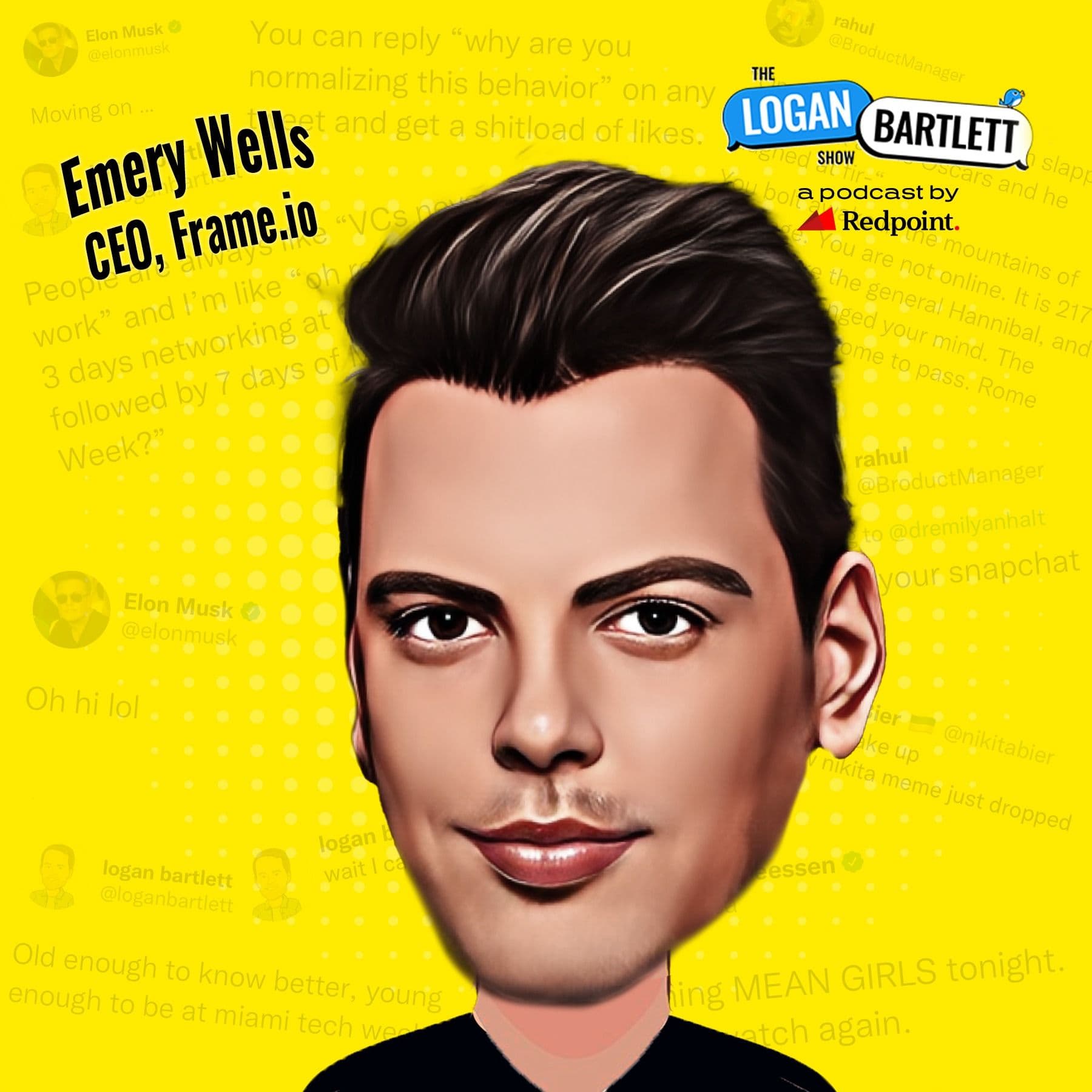
Episode Summary: The Logan Bartlett Show - EP 114: Emery Wells
Introduction In this episode of *The Logan Bartlett Show*, Logan interviews Emery Wells, the co-founder and CEO of Frame.io, who sold the company to Adobe for $1.3 billion in 2021. Emery shares insights into his journey, the challenges faced while building Frame.io, and his philosophy on leadership, design, and company culture.
Key Topics Discussed
- Emery's Journey to Founding Frame.io
- Background: Emery started as a bartender in New York City and transitioned to post-production, working on digital shorts for Saturday Night Live.
- Recognition of Pain Points: His experiences in the post-production industry highlighted inefficiencies that inspired the creation of Frame.io.
- Philosophy on Startups
- Rejection of Lean Startup Concept: Emery argues that the lean startup methodology can cause harm and emphasizes the importance of a strong internal vision over mere data-driven decision-making.
- Obsession with Design: He insists on a high standard for design, encouraging his team to obsess over details to create a superior product.
- Company Culture and Leadership
- Cultural Reset: Emery discusses a cultural crisis at Frame.io that required a reset, leading to clearer values and stronger company identity.
- Importance of Values: He emphasizes the need for distinct cultural values that guide decision-making within the company.
- Hiring and Team Dynamics
- Hiring for Cultural Fit: Emery highlights the significance of hiring individuals who align with the company's values and possess a high tolerance for pain.
- Leadership Style: He describes his approach to leadership as being deeply involved in the product and decision-making processes rather than delegating entirely.
- Fundraising and Acquisition
- Valuation Strategies: Emery shares his experience raising seed funding and how initial acquisition offers influenced future fundraising strategies.
- Acquisition by Adobe: He recounts the negotiations with Adobe, emphasizing the role of Scott Belsky in facilitating the acquisition and the importance of aligning company vision with a larger entity.
- Insights on AI and Future of Creativity
- Impact of AI on Creativity: Emery predicts that AI will significantly shape the future of creative industries, potentially allowing for more efficient content creation without sacrificing quality.
- Taste vs. Creation: He suggests that in a world dominated by AI, having a keen sense of taste will become more valuable than technical creation skills.
Key Takeaways
- Founders should maintain a close relationship with product details and design.
- Company culture is essential; values should be clearly defined and embraced by the team.
- Hiring for cultural fit and the ability to handle challenges is crucial for startup success.
- Navigating the acquisition process requires strong leadership and a clear vision.
- Embracing AI will redefine the creative landscape, with taste and vision being paramount.
Final Thoughts Emery Wells' journey from bartender to CEO of a billion-dollar company illustrates the importance of resilience, vision, and the relentless pursuit of quality in product development. His insights provide valuable lessons for current and aspiring entrepreneurs in navigating the complexities of startup life.
---
About the Podcast The Logan Bartlett Show focuses on sharing insights and lessons from successful entrepreneurs, aiming to equip listeners with practical knowledge that can help them become better CEOs, investors, or board members.
Follow the Show
- [YouTube](https://www.youtube.com/channel/UCugS0jD5IAdoqzjaNYzns7w?sub_confirmation=1)
- [Instagram](https://www.instagram.com/theloganbartlettshow)
- [Twitter](https://twitter.com/loganbartshow)
- [TikTok](https://www.tiktok.com/@theloganbartlettshow)
Written by AI. May contain mistakes. Listen to the episode to check what was said.
Transcript
Automatic transcript. May contain errors.0:05Welcome to the Logan Bartlett Show. On this episode of Frame.
0:30that worked alongside SNL to make their digital shorts. This led to Emery's recognition of the pain point that ultimately led to Frame. We talk about a number of different things related to operating a startup, including why Emery categorically rejects the lean startup concept and why he thinks it's done far more harm than good for businesses. We also talk about his near-Jobsian obsession with design and getting into the details of almost everything he cared about while operating Frame. We also talk about what culture really is, including a near fatal experience that led to a cultural reset within Frame and ultimately set it on its course to its sale to Adobe.
1:08You'll hear that discussion with Emery here now. Emery, thanks for doing this. Yeah, thanks for having me. So maybe for people that don't know, can you describe what Frame does? Sure. So Frame.io is a video review and collaboration platform. At least that's where we started. We've expanded a little bit since then. But essentially, if you're a team working on video like this podcast here, you're recording a video. You go through an editorial and review process after we're done recording. And Frame is the platform that teams use to do that. So you can upload the work in progress edit, leave comments at different points in the video.
1:42You can draw and annotate on the Frame. So really kind of everyone from Hollywood studios down to teams that are doing podcasts like this. We use it all the time. We were just talking before. I think Slack maybe is the thing we're in the most. but Rashad on our team, he said this would be the single tool. If it went down, it would ruin his week most. So I think that's a good place to be. It means there's a stickiness to it. That's funny because I remember in the early days of pitching, the common thing that investors ask or think about or talk about is, are you building a vitamin or a painkiller?
2:15And I think early days people were, I think there was a consensus with a lot of the early people I spoke to that it was nice to have vitamin. And then it gets embedded in the workflow and probably in the early days too. I'd be interested, who were your initial customers? I assume VCs doing podcasts weren't in the TAM analysis originally. It was probably a lot of media and agencies. Yeah, I mean, I think our earliest customers were, well, our very earliest customers were a lot of kind of individuals and small teams that were making video, a lot of small boutique post-production companies. But yeah, I think that media-focused companies were our first enterprise customers, and it's expanded to kind of like all sorts of people that make video.
2:58You evolved this out of SNL in some ways. like I mean I realize the through line's not perfect but maybe maybe talk about the the SNL digital source shorts and how that came to be a part of frames founding journey yeah sure so I mean I had a post-production company prior to frame so it was a boutique agency that that did all kinds of post-production did visual effects and color grading and finishing mostly for broadcast advertising like commercials and one of our clients was SNL and so I used to do all the the digital shorts for SNL did a, you know, for, I don't know, four years or something, everything that was prerecorded for SNL is what they call their digital shorts and that's their movie trailers and, you know, fake commercials and music videos and things like that.
3:45So my company did the post-production for those. And, um, we were, you know, I was working on those while building frame incubating frame in my post production company amongst other, amongst other things as well. But I'm sure people remember a lot of those like Andy Samberg and Lonely island and all that stuff what was the biggest one that you it was already kind of going before your production got in right so what was the biggest one you guys worked on that was kind of viral on the internet um so we i started working with snl you know the tail end tail end of andy sandberg's time so they had already done like you know the the big viral like lazy sunday taking a lazy sunday i'm on a boat those were like the like three early viral hits they did but um but we We did start working on them for like, so Dick in a Box wound up being a trilogy.
4:31There were three of them. So there was two more after that with Andy. Three dicks in boxes. It was, I think the names were, it was, one was called Mother Lover. Oh yeah, yeah, I remember that. Another one called Not Gay in a Three-Way. Yeah, yeah, yeah. And then, yeah, there were some other big ones. There was, oh gosh, there was one with Kristen Wiig called Red Flag that was a really, a really big one yeah i remember all these yeah yeah that was like a dating one about like signs of red flags or something in the in the yeah it was like if she was like in a beautiful ballroom it was like a perfume commercial that's right perfume was called red flag that's right and they were talking about like i don't know you know what different red flags red flags yeah i remember all that did you uh her pinky fingernail is longer than all the rest red flag did you uh did you get in with that group at all like did you get to do after parties or go to any of the shows or anything um yeah a little bit yeah i mean there was uh yeah it was it was like it was a tight tight group and um yeah i was always invited to like the the um i usually i mean so so generally the way that it worked is i mean when the show was on airing we were usually still working so the whole nature of snl is like so live it's so last minute um the digital shorts you think well they're pre-recorded like they probably do those well in advance no they don't the schedule for those is they would shoot them on Thursday so they would have sorry they would shoot them on Friday so they would have their I forget the exact schedule like they would have their writer pitch meeting on I think Wednesdays was the pitch meeting they would have one day and that's when they would decide like what they were going to shoot like of the things that were pitched and then they would have one day of pre-production on Thursday they would shoot on Friday and they would air on Saturday which means that we were working on them.
6:26Usually, we were still putting the final touches on them when the show had already begun airing. So oftentimes, you're delivering the final piece, sometimes 10 minutes, 20 minutes, 30 minutes before it actually goes. So are you on site? Because I'm just thinking file transfer times and all that. How are you actually getting them the files? Yeah. So no, I had my post-production company office which was you know 15 blocks from from uh from where they were from you know from snl and uh no i would i would i would upload stuff i would like ftp stuff to them and then uh sometimes we would have like random slow internet days and i would have an assistant that would like literally just like be running up the street with like a usb with like a hard drive and stuff so we would ship hard drives i would messenger hard drives but then i would messenger hard drives and then you know for like for the the main delivery and then we would upload ftp stuff like last minute for like replacement shots or whatever and then sometimes somebody would just you know have to like sprint up the street so we were building frame while we were doing all that work i mean that's the thing i think frame you know was very very classic founding story of we we built what we needed and there was no question there was like zero question in my mind what needed to be built.
7:48I knew that, you know, how we made video and our experience working with clients and back and forth, I knew that was completely universal, even though we were doing, you know, broadcast advertising. So very much a product that was built from, you know, a deep insight of doing the work and needing the product ourselves. So normally I don't like to go linear in this, but you have an interesting, I guess, story to New York. So you grew up in Miami, moved to New York didn't didn't do college you're originally going to go to college skip college yeah and did you always have interest in media and entertainment movies that's what I moved to New York with the intention of trying to be a filmmaker okay got it yeah so so that was the intention and you bartended for a while when you were initially here I guess any interesting things you learned about the service industry or like that frame from bartending?
8:42Actually, I think that being in the service industry, I bartended for three years when I first moved here. So from like 20 to 20, I moved here when I was 20. So from like 20 to 23, I was bartending. And yeah, I think you learn a lot in the service industry. I mean, I worked at, I'm sure you know it, I bartended at Bond Street Sushi. So I was in the lounge bartending. This was over 20 years ago. and um you know you in the in the in the service industry um you learn to be of service you know you say yes a lot and you you have to you know kind of you know cater to the to the people who you're serving and that apps that that that absolutely stayed with me for years i mean when i started my first post-production company um you know i went from being a bartender to starting my first company and I'd never worked in a company.
9:33In fact, I've still never basically worked in anyone else's company. Oh, I'm at Adobe now. But I brought that mentality into, you know, starting my post-production company and doing a post-production company is a service business. And I would, you know, I think the thing that made me successful in the early days is I said yes to everything all the time. I just, like there was, I don't, I can't remember the time I'd say no to a client. Whatever they asked me for, I said yes. And I don't think that's common. I think a lot of people are, I don't know, they bring their ego or their, I don't know. I always said yes.
10:16No matter what it was, I said yes. And I did that for years and years and years, which meant my life was pretty tough for those years. I mean, I slept in that office, I don't know, thousands of nights. Really? Thousands of nights. Over the years. I mean, I had that company for almost 10 years, for eight years, I guess. So post-production, it's a very 24-hour business. So the big post-production companies basically do run 24-7 because people are shooting, they drop stuff off late at night. It's like, I don't know, these things, the post-production companies literally do run on a 24-hour schedule.
10:52There's a morning shift, a day shift, a night shift and overnight shift at all these at all these companies and you know i was in the beginning a company of one trying to compete with that stuff so i mean i lived in that office i slept because people would call hey we we got this shoot can we drop off at 10 p.m you know they'd call me at like 5 p.m and i'm like yeah yeah sure no problem and i'm there till 10 p.m and they needed something the next morning and i would just you know i would stay up all night and do it and i did that hundreds and hundreds of nights did you have an inkling of being a software entrepreneur while you were doing this or like when did that start entering the consideration set?
11:28Yeah, I always did. I, cause you know, one of the things, so one of the, the, the areas of post-production that I got really into was visual effects. And the thing that I love about visual effects, which I think is very similar to software is visual effects is deeply technical and deeply creative. It lives at the intersection, depending on what type of visual effects you can do. Eventually visual effects, by the way, it becomes programming. I mean, you know, if you really get into like complex stuff. uh and so that was my entry point into into into coding i mean you know you start by doing you know python scripting and then you have to build you know kind of more complex workflows so so my entry point into software was through visual effects it is not full scale i mean at least what i was doing back then was certainly not full scale software engineering um but uh but that was my entry point i always wanted to do software i always always always wanted to do software um i never really i mean i eventually i think the opportunity arrived when i met my co-founder and i hired i hired my co-founder as an employee at my post-production company and he had um he minored in computer science i hired him right out of right out of college it was his first job so he likes to tell people that his his first interview ever was with me at my post-production company and i hired him and he never did another interview and has never worked anywhere else.
12:48So he likes telling that story. But he had a minor in computer science. And together we started tinkering on software, which ultimately led to doing Frame. But we did other stuff before that. Was there a unique why now for Frame, like in the moment in time? Or could it have been started a couple of years before? Could it have worked a couple of years later? Was there something special about when you actually got going? I don't think, I think a couple of years before would have been tricky i think even you might argue that maybe a couple years later maybe would have been better for frame uh but i think it was about the right moment in time and it was um i think bandwidth played a role like you needed you needed better like video on the internet's gotten you know now it's it's commonplace but but just being able to like upload move files watch high resolution video like all of that stuff um we launched frame in 2015 so it was about the right time to you know to build a product like this you needed you know you also needed um i mean you basically needed you know video like high bandwidth video to work on the internet which it was pretty much working at that time and um you needed cheap storage and so like for the workflows that we were doing and and how much we needed to charge per month to make this a service that people would pay for and offer them enough storage to actually utilize it that was probably around the right time.
14:10But I think that the first couple of years of frame, I guess the only reason it would have maybe been better a few years later, and this might have only been true of some other players that come into the space, but we spent years kind of educating people about the problem. And back to the thing earlier about whether frame was a painkiller or vitamin, it absolutely is a painkiller and has proven to be a painkiller. But sometimes people don't realize the pain that they're living in until they take the painkiller, right? Like if you've just done things a certain way for a certain amount of time, um, because there literally was no other solution, you just sort of don't, don't know that you're living in the pain.
14:50And then, you know, when the solution comes along, you realize that. So it took, it took years of kind of educating the market. At one point you had tweeted a bunch of different lessons that you had learned or some things that were maybe contrary to popular opinion. And one of the ones that stood out to me was CEOs shouldn't get caught up in the details. And you had said this is a myth. And if you consider leaders like Steve Jobs, Elon Musk, Mark Zuckerberg, Brian Chesky, and the Collison brothers, all are slash were deeply involved in the intricacies of their businesses. Can you speak to that point and how you were able to do that within Frame?
15:29Yeah. I mean, I think we kind of touched on this. But I think people have the idea that a CEO is supposed to do business stuff. And I honestly don't even know what that means. The most important thing that your company does is build a product that your customers buy. And I think that it is the leader's job to be deeply involved in creating that outcome. And I, you know, I think the people who I think do, you know, incredible work and build the best products are the ones who are who know every single detail of what they're building and are deeply involved in it. Yeah. I mean, my experience of scaling frame was that a lot of people around me told me I was doing it wrong, you know, because I was I would if I would look at a design like what?
16:21you know, to see us don't like CEOs aren't involved in designs and, or they're not involved, whatever it is that I was, that I was looking at. And, um, you know, and I think in those days, I also, I was trying to, cause I never, I never built a software company. I never really scaled up like a large company. I was trying to listen and be like, maybe I shouldn't be like, am I, like, is it weird? And everyone tells me like, I shouldn't really be so involved. and um i would you know i would listen to an extent but then but instinctively i knew that i just knew there was no other there was no other job that was more important than than manifesting the outcome that you give to your customers and that comes through that only comes through details there's not really it's not really a high level way of of doing that i've read that uh you've said something about lean startups doing more harm than than like that methodology maybe can you speak to that and i guess the derivative of how it informed your philosophy around frame.
17:20I read Lean Startup when everyone else did. And this was before I had ever built any software. And I remember reading the book and thinking at the end of the book, like, wow, there's a magic formula that you can just sort of mathematically find your way to success. A-B test your way. A-B test your way to success. Yes. And, you know, I mean, I subscribed to like part of it for some time. But when I really started getting into building the company, you know, I think a lot of the people that we hired early on where we were all young, I was young, I was inexperienced, we were hiring young, inexperienced people.
18:00And I think what young and experienced people do is they sort of like, you know, they like want to read what the Internet saying and try to follow those those formulas. We had a lot of people that were really trying to kind of follow that that lean startup methodology, which now, you know, sort of 10 years into building software and having an exit and everything. I fully reject lean startup as a methodology. And it doesn't mean that you shouldn't like use data as, you know, one input into the decisions that you're making. But I think it really has done a lot of harm. I mean, here's my realization about Lean Startup is years later, I went back and I looked at...
18:39By the way, I think Eric Ries is a really brilliant guy. I don't agree with his framework. But I went back years later after reading the book and I was like, man, I wonder what product Eric was building. Because he used his whole experience of Lean Startup was this game he was building. And I went back and looked at the product he was building. And it was an abomination. I mean, it was clearly something that was built by people that have absolutely no idea how to build a product. And Lean Startup was, you know, sort of like their mathematical approach to trying to build a product. And that was not their skill set.
19:16So, you know, it's equivalent to like teaching an artist how to paint by numbers. Like you can do that. You can try to like, you know, learn how to paint by numbers or you can learn how to be an artist. And I think that product is an art. I think that if you're a founder or a product person and you have this company that you want to build, I think you have to have really strong internal conviction and you have to be able to see the world more clearly than everyone else. And yeah, along the way, you should have data bump you two degrees this way and bump you two degrees that way. But if you have to use that sort of approach to building software, I don't think you're going to make it.
20:00And I think that I've seen a lot of the industry kind of turn and start to kind of evolve their thinking. Because what happened was Lean Startup just built tons of really bad products. They were too early. That was the other problem, this whole idea of getting the MVP out. And we've evolved since I think the market in general, the industry in general has evolved past like like what a lot of I think a lot of people maybe were misinterpreting, you know, the the MVP approach, the minimum viable product, because people were just putting out products that were just not good, you know, and they're like, well, I guess it doesn't work.
20:30And it's like, well, no, it's just the product's not good. It's not fully baked. You know, it needs other things for people to to love it and think that it's it's valuable. So, yeah, I mean, internally at Frame, we did spend a couple of years building it before we released it. But I mean, I don't know that that was intentional. I wasn't even thinking about it back then. That was just me and my co-founder because we were the only two people who built the first version. And we spent about two and a half years building it before we launched it. Did you pick some point in time in the future of what you needed the product to look like and just build to that?
21:08Was that the journey or were you getting feedback incrementally from other people from the outside as you were going along? We actually got no feedback. Really? Yeah. So it was just, hey, I know this is what the market's going to need based on my experience and let's go from there. Yeah. We actually really, I mean, we, you know, a couple of friends here and there, we would show it, but we didn't have any formal feedback for the first initial launch. It was like two and a half years of building. And I don't think that, I'm not saying you shouldn't do that. You certainly should. I think it depends on what kind of like who you know, what your what your founder market fit is.
21:40You know, I was building a product for myself of a problem space that I deeply understood, which I think, by the way, is a very valid way of building. I think that building a product for yourself is is a great way to build. Like let you let yourself be customer number one. And I still I would still do that if I were to do another company, maybe in a space I didn't understand as deeply. I probably would incorporate, you know, more more customer feedback along the way. But no matter what product I build, I would try to make sure that I was customer number one, even if I wasn't the real customer.
22:10I think that you can try to like psychologically shift your mind and say, I'm going to be the customer now. And there's a real there's a real mind shift. And I even did this with frame, even building frame. There's a difference between a builder mindset and a user mindset. And even as the designer and the builder and the product thinker of frame, I would have to very intentionally shift my mind and say, now I'm going to use it. Now I'm going to experience it. And I want to experience it from the mindset of a user. So no matter what I did, I would always put myself as customer number one. And I would have to be personally satisfied and sort of, do I like using this product?
22:46Does it solve my problem when I'm in that user mindset? I heard you say something to the effect of as a company scales, it's inevitable that founders spend less time focusing on what really matters, which is the product and get more involved in process and all that. Was that something that you made the mistake of getting more bogged down or were you able to focus on product as number one throughout the journey? Oh, I definitely got bogged down. And I think that, you know, one of the things that also I was, I would hear a lot from kind of my own internal echo chamber. And I think that a lot of founders experienced this is that, you know, my own, I think that, that a lot of the company, and again, I think we were all pretty young and inexperienced, but everyone thinks the founder should be this like business guy or, or, or girl, right?
23:37Like as the founder, you have all these executive things that you have to, that you should be doing. I don't even know what those things are. The only reason that a company exists is to build the product that it sells to its customers. And so I think that that should be the time that a founder spends the most amount of time on. Um, and I, I, I would, I definitely always stayed close, but you know, it, it got, it got harder and harder to, um, I stayed close, but I think what got harder to do is, is, um, maybe be a, be a driver of, of the vision as, you know, the company scales, there's more people involved and this gets to, you know, like, how do you, how do you set up like a culture around decision-making and what's the founder's role in decision-making?
24:26because, you know, people think that distributed decision making is another thing that should happen as you scale. I don't believe that. I think that as you scale, distributed decision making is really just going to make everything substantially slower and worse. It doesn't mean that people don't have lots of responsibility, but, you know, you need clarity of decision making and clarity of vision. If you think about all the best products out there, the ones that people universally love, the ones that's like, no question, everybody loves these products, whether it's software or hardware or whatever the case may be, there's probably a very good chance that those are the companies that are led by founders who really drive that singular vision.
25:06And the companies that do distributed decision-making, probably less so. And I think this is, I'll just say one other thing about this is I'm not saying that there's one right way to run a company or build a company or whatever. And this was a key insight for me. I think that to build a really world-class product, it requires a founder or a small group of people to be directly driving and making decisions. But there's obviously lots of companies that are not run that way that are incredibly successful. And there's just not one right way to do anything. There's just lots of paths up the mountain.
25:46And the most important thing is that you build a company where everyone knows and understands what your path up the mountain is. Because if you have a group of people that think, no, we should do it this way. No, we should do it that way. And there's disagreement. That definitely doesn't work. Do you think that the point about having more centralized decisioning leading to better products, what do you think that is? Is it the consistency of the design and the experience? Is it just the more opinionated nature that you get from having a more narrow subset driving the vision? Yeah, I think it's a couple of things.
26:25One, I think that, you know, I mean, first of all, some people are better at making decisions than others, right? I mean, there's people that have like you need to find rather than distributing decision making, you need to find the people who are who have proven over over time that they are best equipped to make a lot, you know, that they're best equipped to make decisions and be right a lot. And I think that's one of Jeff Bezos is like leadership principles is that executives are right a lot. And the idea that everyone does that is just not is just not true. right we'd all have if people were like you know you just just distribute decision making and um you'll have a lot of great outcomes uh i think some people are better so you got to find those people it doesn't necessarily mean that that's always the founder it's certainly not uh but you got to find the people who are who are best equipped to make decisions and then yeah i mean when you have one person who's really thinking holistically and again this doesn't always have to be the founder but somebody has to be thinking holistically with deep ownership uh about what every part of the product is going to do and how it works together.
27:31And inevitably, you know, when you distribute decision-making, everyone has squads and they'll have their areas of responsibility and they, you know, they're trying to, you know, make great decisions for their areas, but they absolutely have a gazillion blind spots of, you know, every other product's responsibility, every other team's responsibilities and then how it all fits together as a whole. So yeah. And then just generally somebody that has a really clear vision of what the future is supposed to be. And someone that can be thinking about the micro decision that you're making today on one small team and how that's going to evolve three years from that decision into wherever you're trying to get to.
28:16Implicit to all this is an element of culture and how you define what it is that your business stands for. You guys went through a period of time where there was a little bit of a, I don't know if cultural crisis is the right way of articulating it, but if my research was correct, you had to fire your VP of engineering and then three directors of engineering all resigned in the same day? We had, yeah, we did have some cultural crisis, and it was over a short period of time. But basically, yeah, we had three directors of ENGE, which by the way, you shouldn't have three directors of ENGE. I was about to say, I'm not exactly sure how that happened.
28:51No, no, we had three directors of ENGE that all left within a couple days of each other. Partially because we had some cultural crisis, partially because I had already hired a VP of ENGE and that person didn't work out. And so that is a risk often as you hire. And when you bring in an outside leader, sometimes the people who are doing the job don't like that new leader and that can drive them out. I think there was definitely an element there. But overall, yeah, we did have some cultural crisis and really was kind of a reset moment where that was a big turning point in the company's culture. How far into the business or how many people were you around then?
29:32We were probably 60-ish people. And so a couple of years in. Yeah, a couple of years in. And had you not been explicit about values? Definitely had not been explicit about values. But here's the thing is, you know, the to me now, what like what culture is, is very, very, very clear. And I it was very it was something that I didn't understand for a long time. And I would always listen to people talk about it. And even still, I hear people talk about culture and I don't think they describe culture in the right way. Culture is the is the political affiliation of your company or the religion of your company.
30:11You know, when you think about it, I like to think about it that way because it's much clearer. Right. It's like you think about a political affiliation, you're like, oh, it's a group of people that all have these like strong convictions and values about a certain way of thinking. And what we know is that two different political affiliations, they cannot work together. And I don't know. I'm not saying one is right or wrong. But you have to get a group of people that share the same political affiliation or religion. The same thing with religions. I mean, there's some very, you know, strong shared ideas in one religion, which would be not okay in another religion.
Read the full transcript
30:53So it has nothing to do with like, you know, what do you guys do for fun? And do you hang out after bubble? Like that, that's not culture. Culture is, you know, what are the, what is the shared belief system about how you build, how you make decisions, et cetera, et cetera. um and i you know i just in the first couple years of building frame um when the very in the very beginning i had never even thought about this never never even crossed my mind that you know like this was something i had to care about and i thought well you know you hire people and you're the boss and they'll sort of like follow your lead and um i didn't even understand that there was such a wide range of of ways to like i don't know make this it sounds silly thinking back on it i didn't even understand there was such a wide range of ways to to make decisions that could lead to so many disagreements.
31:41And so I wound up just hiring. Also, I was hiring kind of whoever I could get. This was 2015, 2016, 2017, I'd say kind of early in the sort of ZERP cycle, but very hard to hire. I didn't have a network. You're hiring who you can get. but anyway, yeah, we wound up hiring people that just a large group it wasn't like there was just one sort of cultural ideology that existed at the company at that time there was just a lot of different ideas and it just led to a lot of internal debate you know, in an unhealthy way and so we did wind up having three directors that left in the course of a couple days and then, you know, maybe like a month or two later, I let go of of the VP of Eng.
32:33And so at that point it was kind of like a big, a big reset moment where I had to take in everything that I'd learned and say, okay, well, how do we want to move forward? And, and there was three people I brought in at that time. I brought in a new head of Eng, a new head of product, and I brought in a chief of staff and, um, and, and, uh, and then, well, later a new head of design, but really those three people at that time came in and, and, you know, we really sat down and intentionally started kind of working on kind of repairing, you know, the, the culture and the team that was still there.
33:05It was most, we didn't, we didn't really have that many people leave. It was actually, you know, those three directors left and most, most everyone stayed. It wasn't really like a big exodus. Um, uh, and that, and that was the beginning of a, of a new chapter. Did you all do, was that the group that ended up defining what the cultural values were? Yeah. And, and what, and that was essentially my leadership group through acquisition. And so what did you find, I guess, in going through that process and coming up with the values? Was it things that you think everyone mostly agreed with within the company and you just needed to codify it and make it more explicit?
33:42Or were these more aspirational traits? How did you go about actually assessing what the culture was? yeah i don't think that culture oh i think similar to i i think i think that i think that um i think values need to be potent and come from you know one or a small group of people i think with any type of you know decisions that you sort of like lay on people you want to make people feel like they were part of the process i think that's one of the you know that's like the magic is if you're going to set values, you want to set them yourself, but somehow make people feel like they set them or they were part of it.
34:23And so the way that we went about it is, and I had gone through, actually, this is, we had gone through a few. So yes, we did sort of officially set values as, as part of this exercise. And, um, I had previously tried to do like a, a value setting exercise where, you know, like we had, you know, we had pulled like that we'd sent out surveys and ask people like what they thought the values were and blah, blah, blah. Um, I'd done it a couple of different times. We never, we never had rolled, we never finished it because it was such a, like, I don't know, it seemed it one, it seemed unimportant into the process that we were running to try to like set the values.
34:58We were just getting such watered down stuff. If you do, if you send out a survey to your company and you ask them for values, I promise you, you're not going to get anything platitudes, you get platitudes, you get platitudes back. So, uh, the process that I wound up going through was, we didn't have any, there's no values committee. There's certainly no committee. First of all, if there's ever a committee for almost anything, it's probably a bad idea, but there was no values committee. But what I did do is I reached out to like 15 or so people that were, you know, who had been at the company for a while and, and I thought were kind of, you know, important figures in the company.
35:34And I asked them to, to just over Slack, I just said, Hey, like I'm, I'm, we're working on values again, can you please tell me like the one, only one, the one most important value to you personally or like, you know, an idea or a principle or whatever that's most important to you. And when you ask one-on-one, there was no, nobody could see what these, you know, what, uh, someone else was thinking. And you said, just for the one most kind of potent idea, I actually started getting some, some, some better stuff. So I, I think I wound up asking even more people, maybe We asked like 25 people. And then I took all that and I sort of wordsmithed it and distilled it.
36:15And I actually had a lot of good ideas in that, but I could shape it into kind of what I wanted the values to be. And then I would go back to that person and say, hey, I interpreted it this way or I shifted it this way. Does this still kind of align with the core idea of what you were thinking? And they'd say, yeah, yeah. and say, okay, well, I want, will you be, you know, the, the kind of the spokesperson of this value. And so when we rolled it out, um, I didn't roll out the values. I had, I had a group, I'd have like three people that would speak to each value that they, that they had selected it.
36:49This was the most, this was the most important idea to them. And so they got up in front of the company and said, you know, this is the value. This is an example. This is what it means. So really it was delivered, you know, uh, as if it was all from the company. Um, and if I'm being honest, it really was all from me, but, but, you know, I think that's like a really important part of leadership is you have to make, you know, you, you have to have like clear, potent ideas. And it doesn't mean that people, they, they, they legitimately did inform, inform, you know, those ideas, but I ultimately got to like shape that and, and have it be what I wanted the identity of, of our culture and values to be.
37:31And it was really successful rollout. It took time to kind of work those into the fabric of the company, but we got there. How many values did you end up landing with? Nine. Was there anything you did in the hiring process then subsequent to that to make sure you were... Did you have someone that was responsible for assessing singularly in an interview? Did this person map to those, uh, those values? Kind of. I don't think I ever perfected that, to be honest. You know, we, we tried, I would, um, I think I would, I would continue experimenting with, with better ways of assessing that stuff out.
38:14But we did, you know, we did, we did culture, you know, we certainly did like culture value interviews. The, the number one thing that I would do personally is, you know, over time you learn like what your more controversial ideas are, You know, the things that you get more pushback on and whatever. And I certainly had learned them a couple of years in. And I, when I would interview people, I would just unsell them. I would just say like, these are, I would just, I would unsell them based on all the most controversial ideas, you know, controversial things I'd learned about the way we operate myself and, and, and I would just unsell them on it and make sure that they're signing.
38:51Throw it all on the table and say, Hey, here's what you're. Yeah. Yeah. Like one of the things that was just, you know, I'd say that I probably had a, I'm not comparing myself, but I had a Jobsian obsession with design. I am insane about design. I'm a maniac. I didn't know that about myself until I really got into it. And I have that maniacal, you know, obsession with wanting to have great design. I don't even know. I'm not saying I get there, but I certainly have the pursuit, right? I have the goal and the desire of getting there. And how does that manifest itself for an individual employee in this case?
39:30Is it just constant iteration? Yeah, it's just, I mean, it's a lot of iteration. I mean, I think the difference between, look, let's start with like, there's, if you want to have the world's best design, it starts with, you need some people that are at least capable of reaching there from like a hard skills you know perspective but let's just say that you have those people still getting to that you know kind of apple level of execution creates you know requires a culture of of um of of deeply caring and what deeply caring means is really it's probably just iterating more than other people and and not stopping when this is actually the key difference It's the hardest thing about getting to like 11 out of 10.
40:18It's not even the work. It's pushing through the emotional boundaries of people thinking they've put in the work and we've reached the point where we're done. And it's pushing past those uncomfortable moments and doing it again. And then it's doing that 5 to 10 to 15 to 20 more times where people, they're like you're you push people to their limits right and there's an art to that as well um because there's a way of doing that where people just burn out and and you know don't like you at the end of the day and there's a way of doing that where people get to the other side and say wow i didn't know i we were going to get there yeah because you can get you can do half the effort and get to some to get to 95 of the outcome or something but then you need that other half to get to the last 5 % or whatever, which is unnatural.
41:09Most people say, this is, will this actually, will the customer actually ever notice this or will they ever care on it? So in an interview process, did you, was there any way of teasing that out? Yeah, I would tell people, I would tell people, especially with leaders, because I think I could be a little bit more open and direct with leaders, but I told people, one of the things that I would that I would battle with is that, you know, I would hire people who would be really interested in frame and think it was like a cool, exciting company to work at. And they would, one of the things you'd always say, oh, you love the brand and the attention to detail and the design and everything.
41:45And then they would come in and be at, be in opposition to the very things that, that created those, those outcomes. And often have the experience of like, why would somebody come in and say, we want to make the company worse. We want to pull it down, you know? And so I would tell leaders, and this is something I did, you know, only kind of a few years in, but I'd say the one thing that you can never, ever do, and I just want to be really clear, is that if you ever lower my standards, we're not working together. Your job is to come in and raise my standards. I want you to pull me up. Like you should be pulling us, you know, getting us higher.
42:24And it was hard because my standards are really high, but that was one of the things that I would tell leaders. And it is probably one of the things that is like, you know, where I get probably would make someone incompatible to work with me if they try to lower the standards. The best employees at Frame, if you were to go run it back and start another company, was there a shared characteristic that stood out for the people that you had the most success with? Yeah, I like working with people that have high pain tolerance. And, you know, I think that's, I think that like on the journey to great, you know, and doing like doing great things, I think you need really high pain tolerance.
43:12um yeah i remember that tweet i shared about pain tolerance i deeply believe that i mean i want to work with people that have a high tolerance for pain and i remember when i tweeted that i people said yeah well like pain tolerance sounds painful you could you could say like you know why don't you say uh uh i don't know what were people trying to rephrase it as because it sounds like you're just like rephrasing it in a nicer willingness to do their best or yeah yeah and i'm like i'm like And if it's uncomfortable to you to hear pain tolerance, that's one of the things we look for. That means you don't have a high pain tolerance.
43:45Like if you have to like soften it to make it okay, then I'm sorry to say you don't have a high pain tolerance. Some of the most important things about values that I found is the opposite also. If the opposite also isn't true, it's a platitude. Everyone will agree for it. If you can't frame the counterbalancing thing in a positive way, then what you're saying is probably hollow in some way. And so having high pain tolerance, there's probably there's an opposite version of that, of being inclusive or empathetic to other people's feelings. There's some version of that that's probably also true. And you want people to opt into your way of doing things.
44:26If it's true for every person or the majority of people in the population, then you're not discerning or you're not getting people to opt in in some specific way. Is the design side of building product, when you think about what motivates you and what drives drove you through the ups and downs of, how long was the journey? Seven years before selling to Adobe and now you're nine-ish. Yeah. Is that right? Yeah. Yeah. Was design what you came back to as the thing that most motivated you and most drove you through it? Or was there some other element of building a company? It was probably definitely design.
45:03Yeah. Yeah. As you got more and more senior within the organization, or as the company got bigger, you stayed the same, but your responsibilities started to become more disperse. Was there a structural way that you maintained responsibility for design so that didn't start to be decentralized? No, I think it was something I struggled with. I mean, I did wind up hiring some really good people in the design organization, which, you know, which they brought a lot of intensity to, to design. And so, yeah, I mean, naturally, like naturally when you scale, I mean, you, you just, it's, it's impossible to be like involved in, you know, every minute little detail, but the thing that, so, so this was the big, so, so one of the big turning points that we did and something that was really critical for my continued involvement in, in not just design, but product and just kind of overall high quality execution.
46:04So like after we had the big reset moment and we brought in these new leaders, and then shortly after that, we brought in a head of design. So we had this new leadership team. And, you know, my, you know, my objective with them was like, we want to really elevate the quality of our execution. And so we set up, we set up a pretty simple, a pretty simple framework where we would have on, on Fridays, is we would have what we called stakeholder reviews, which were sessions to kind of review the work. But let me, if I back up, if there's ever a problem within a company, and this is super common, right?
46:42You're like, you sort of expect something of the team and they deliver something else, right? That's just like one of the most common things you can experience as a leader. I have developed what I think is a pretty straightforward, simple framework. And these are ideas that are not new. They probably exist in every management framework. It's just that management frameworks have a lot more steps that I don't think about. So I just use three things, which is the key to changing anything is first you just have to sort of align on expectations. Like what does success mean? If we were to all say, yeah, we knocked it out of the park, what does that look like?
47:15And the more detailed you can be, the better, right? Like write it down in excruciating detail and then get everyone to sign up for it and say, yep, we all understand that this is what success is. looks like. Because now you have this thing you can all point to. If you ever stray from it, you have this shared understanding of expectations. So expectations is one. The second is accountability. How do you hold people accountable? Or how do you ensure that people are aligning to those expectations? You have to do check-ins. You have to do inspections. A favorite quote of mine that I did not come up with is that people do what you inspect, not what you expect.
47:55And so if you're not inspecting the expectations, I don't think you're, I mean, through some process in the organization, I don't think you're ever going to get there. And then the third thing is actually the accountability or the action. Like what happens if somebody is not meeting those expectations, right? You've aligned on them. You set it, you check in to make sure that they're happening. Now what happens when they're not happening. And obviously, firing somebody is the most extreme thing you can do, but usually that's not the right tool. And that's a last resort tool. And so for us, what we did is we set up these stakeholder reviews.
48:37They were held every Friday. We basically took all of Friday and we had every single team had a slot on Friday they could use to present work, but sometimes they weren't ready to present. And so they didn't have to use the slot. But when they did have a piece of work that was ready to present, they would use these slots. And so as we were trying to change the kind of internal expectation of what we were delivering, one of the things I did is when we rolled out this program is that prior to the Friday presentations, the teams would come in and they would present their work, I would have my leadership team do like a pre-inspection of the presentation.
49:20And in this case, let me just clarify, we had two types of meetings. We had what we called a stakeholder review, and that was they could present, you know, work in progress design or kind of anything to get feedback. And then we had something called a build review, which was like, this was a finished unit of work and it had to meet every expectation that meets kind of our shipping criteria and what customers would experience. And so importantly for this builder view, I don't know how many times you've been in a meeting and I'm sure founders can relate to this. The team is doing the demo of the thing they're going to ship, but there's like always a caveat.
49:56There's like 10 caveats. It's like, okay, well, yeah. So there's this, we're still working on this one thing. And it's like, this meeting was to say no caveats. At what point do we have the thing that's going to be the thing that our customers use. And that's what this meeting was for. And so my leadership team would do a pre-inspection of the work to make sure that it met the criteria. And one of those criteria among many was that the execution of the build had to be pixel perfect. And so what pixel perfect meant was not 99.9 % accurate, but 100 % accurate. So that meant if one pixel was misaligned or not centered or whatever the case may be, we actually would cancel the meeting.
50:39And that seems like kind of like not a big deal, right? Like it's not like you're certainly not the same as firing somebody, but it actually was a really big deal. And because what it meant is when we, when we rolled out these, you know, kind of the expectations in this new program, the builder views, we canceled these meetings for months. I wouldn't look at the work for months and months and months the meetings were canceled and it created a lot of tension on the teams a lot of tension internally um but eventually you know we we uh the team had to build the muscle and all collectively we had to build the muscle and ultimately ultimately kind of became part of our our you know culture i'd say um that this is what it meant to ship product at at frame and uh and after those you know sort of three four months of of pain i mean i'd say that we one just like across the board radically shifted our quality of execution up and i think after those three four months i don't think i've ever seen a pixel off i don't like in like years i don't think you just you know and it's one of those things like you experience with apple and it's not to say that apple's perfect but one thing that you know you'll get with apple is like shit's going to be like 100 % polished.
51:52It's going to be polished, right? And yeah, maybe there's other things they didn't get right or idea, but like there is a quality of execution that is just fundamental. Like they can't nothing will ever come out of that company that doesn't have that veneer of polish and that's even just that. Forget about like all the foundational decisions underneath that. That's really, really, really hard to do culturally and at scale. And so we, you know, we we got there and um and that and that whole kind of builder view i think um it was cumbersome on the teams i don't think the teams always loved it um i would imagine getting their meeting canceled was it uh yeah but just overall the the pro like i think you know it was cumbersome on the teams there was we actually wound up getting rid of them as we were trying to accelerate our speed of execution after after working on quality of execution then we worked on speed of execution and one of the things we tried when we were trying to accelerate our speed of execution was to get rid of those meetings because teams wound up putting a lot of prep time.
52:54You know, it's one of those things like when you're, when a team is presenting to a leader or an executive or the CEO, you know, even if you don't want them to put a lot of prep time, you're like, hey, just show me what you're doing. It's impossible. Yeah. They will spend days and days. They spend so much time and I've experienced this like now being at Adobe and I'm not the CEO and I'm not the boss and I have to go and present to senior leadership or to Sean Tenu, the CEO. And you're just like, gosh, I can't just roll in. Even if their expectations are different, you feel like you're not doing your job.
53:30You don't show up like buttoned up professional presentation. It's designed well, the whole thing. And sometimes that's necessary, but a lot of times it's not. And anyway, we tried getting rid of our kind of review process. And I don't think it really accelerated us. Is that right? Yeah, I don't think it accelerated us. And I think that there was a hit. That was like these gates that ensured we were always shipping the quality. The quality that you wanted. Brand is an interesting thing for B2B companies. I think you guys were pretty purposeful about the brand of frame. How did you think about going about building a brand in the B2B world?
54:14You know, I didn't think about it a lot other than the fact that I, you know, I think I probably just instinctually built Frame. I wanted to make it cool, number one. Like, I just want, I want to make it cool. I want to make it a desirable brand. I had never worked in enterprise software prior to, prior to launching Frame. I had really never bought enterprise software because I had a small boutique agency. Any software I ever bought was just something I could sign up with a credit card myself. And I think I built, overall, from the brand to the product and everything, we started by building Frame in the way that, I don't know, I would use it, buy it, etc.
54:58And so we had this kind of very kind of more consumer looking motion, you know, from sign up with a credit card, self-serve, focused on brand. But I've come to evolve my thinking, and I think there's people who think maybe brand is not a worthwhile effort in enterprise software. Design is not a worthwhile effort in enterprise software. I mean, I've shared tweets around how there's such an opportunity in enterprise software. If you just come in, like, just like do like high quality execution, you can basically just win in any vertical. And there's people that are just like hundreds of comments of people saying, nobody cares about the product.
55:35Nobody cares about quality. Nobody cares about design. Like, that's not going to matter to the buyer. And I'm like, guys, this is why enterprise software sucks. You know, because this is, there's a belief system that whether, you know, a brand doesn't matter, design doesn't matter, you know, quality of execution doesn't matter in enterprise software. And I think that that might have been true, truer, you know, earlier. But I think today where one, we've seen this this big shift in the consumerization of enterprise software. And what does that mean? It means that like I think people's expectations of what software is, is just different.
56:12Right. Like we all use much more high quality software and whether you're using software at work or using, you know, Instagram on your phone, you just have like an expectation of what good software is. And I think the end user within organizations has a bigger voice than they've had, you know, than they've had before, like, whether it's IT, or, you know, whoever's making the buying decision, they're much more careful about buying something that their users are going to hate or not use. And, and so I think there's just been this big kind of consumerization of enterprise software. Anyway, you originally asked me about brand.
56:50We built a brand because I love, I mean, it's just fun for me really. And I, I don't know if it's like,
57:26This is what I'd say. I think it was probably more innate. And my background was in post-production and production and post-production and filmmaking. And so I'd want to use that tool set as well. Like we were able to do stuff that maybe less expensively than someone else could do it because I just literally had done that work for years and knew the freelancers and the people to hire and things like that. So yeah, I think it was more innate. You have a methodology or a style of launching twice, doing a pre-announcement and then an announcement. Can you talk about that and what the benefits of it are?
58:03Yeah, I think that you just basically want to milk a launch for everything that, you know, for as much as you can. And for most of our launches, we would always do, we would do a, you know, like a teaser. So you want to let people know that it's coming. And a lot of people do this, but I think we would, you know, maybe milk it a little bit more. Um, so you do, uh, you know, you do some kind of teaser where you get people excited and, and let them know that it's coming. Um, and there's lots of ways to sort of maximize, you know, that experience. I'd say like, if I go back all the way back to our, like actually launching frame for the first time, and we use the same framework for subsequent launches, but, uh, we would do a, uh, we, you know, we do this sort of like an announcement launch and, um, and, you know, build a landing page.
58:53and experience in a teaser video. And then we'd build lots of kind of gamification around,
59:03if I go all the way back to the original launches, this is before anybody had access to Frame. And I'm sure we've all seen these gamified launches. I guess you see less of them now, to be honest. But back in 2015, it was like the era of gamified launches. And so what we did is we had a landing page that wasn't just any landing page. We put a lot of effort into creating an experience of a landing page. And most people, when they're launching something, it's like, hey, drop your email in, right? And then to get notified when it's going to be ready. And that's sort of the end of the journey. But I think that's a missed opportunity because when people are interested and engaged and excited and wanting access to something, you can usually get them sort of do more things on your behalf.
59:46So in the earliest launch, we had this landing page where you could drop your email, get notified when it's ready but then as soon as you put your email in we kind of took you through this whole gamified journey where we had like a point system and we said you can do this for five points and this for five points and this for five points and the more points you gain the earlier you know like kind of you raise your ranks in terms of getting access some of them were like if you send this email and share with five other people that yeah it was it was it was um it was shared on social i think we had i think we had back then uh twitter and facebook so we got you got points for sharing it on social.
1:00:22You got points for, I think you could add friends' email addresses in. You got bonus points. Oh, you had to answer a survey. It was like five questions. And then you got bonus points for following us on social. And we had like 15 ,000 people go through that flow. This was when we were literally zero, no one. I mean, it was just me and my, this was our earliest launch. It was me and my co-founder. I had no one else that were helping us. And, um, and that early launch got like 15 ,000 people to sign up. Um, uh, and then, and what do you think, I mean, was it, were you previewing on the landing page, what frame was?
1:01:04And so we were previewing what, what, what made it, what made it work, what made sort of the, the viral loop work was, um, we, when we seeded it with, uh, it did just like kind of grassroots marketing. Like, you know, we were, we, we come from the industry. So our, my previous industry was in post-production. So knew all, you know, knew all those people in the industry and identified, you know, people that were kind of influencers that were, didn't exist in 2015. I don't think like commonly, but you know, that we identified people that, you know, had a following and asked them, we just asked them, Hey, will you, I mean, like people were, I don't think people were getting paid to do a kind of influencer stuff in 2015.
1:01:39I think. So we just like asked people, Hey, would you, you know, we're launching this thing. Would love your support. Would you share this? Um, And so we kind of seeded, we seeded the, the, the sharing with, I don't know, 50, 75 people that, that would, you know, share the announcement on, on Twitter. And, and then, and obviously we did trade press and we were on the front, we actually were on the front page of Hacker News because we were using a, we were using a front end framework that was new at the time for the landing page called Famous. It was this front-end JavaScript framework that was supposed to...
1:02:19Their mission was to build once, run anywhere, and do iOS-level animation on the web. We wound up using it for the landing page, not for the whole product. But just because we were using that framework, we were front page on Hacker News. And I think that got some... Actually, it probably got more like Silicon Valley-type potential investors. That's where they found us on Hacker News. we were also an early version of product hunt like the one it was back as an email distribution list but it was all just through these like organic seating and then the social sharing flows and and it just kind of worked right so like somebody would would tweet it and another person would see it they go they'd sign up they tweet it and we got that loop going so we had 15 000 people sign up for for that initial launch and you also did a personal touch like automated follow-ups you would reach out after 15 minutes or something to someone?
1:03:14Yeah, that was, that was really, uh, important as well. So you'd sign up and then you would get an automated email for me 15 minutes after. And I think a lot of people do this now. Um, but the email that you got for me 15 minutes after signing up was, it was totally plain text. There was no one subscribed, which I know technically is, you know, not, you're not supposed to do that, But I was really trying to make it look like it was an email that I wrote and it was super plain language. It was like two sentences. I think it was like, Hey, I just noticed you signed up, you know, um, you know, what interested you in, in frame, what pain points do you have?
1:03:48And I got thousands and thousands of responses, um, which I went through every single one of them. And I, uh, I, I went through and read every single one of them. And that was, and in them there were like, you know, there were, there were potential future enterprise customers. There were, there were, uh, investors. Um, and the, one of those emails was, uh, from Balaji at, uh, Andreessen. He was at Andreessen Horowitz at the time. And that was my, that was like first contact with Silicon Valley. I was a total outsider. I didn't know a soul, like not, I didn't know an engineer. I didn't know a founder.
1:04:27I didn't know a venture capitalists, I knew zero people. And sort of like my first contact with Silicon Valley was this email from Bellagio. And I remember getting that first email and I'm pretty mellow guy. I don't really like show a lot of visible excitement, but I was, you know, it was, I couldn't believe that I, one, it was, you know, it was an investor who was voicing interest and it was from Andreessen Horowitz. And it was like, oh, like bingo. And that anyway, you know, of course I responded and And that led to an introduction to somebody. He introduced me to Steven Sanofsky. But that automatic response email really kind of opened up these conversations with VCs.
1:05:12What did you learn about fundraising? So you went in and met Andreessen in the early days pre-products fully launched? We had the announcement. Yeah. So this launch that I just told you the story about, that was an announcement launch. the product was not ready to use. And I, yeah, so Balaji, you know, responded to that email from Balaji and he, you know, he said, you know, not really my space, but I think, but I'd like, you know, to meet my colleague, which was Steven Sanofsky. And so I went in my very, my first, first, first like contact in person, or really, I guess at that point, other than that conversation with Balaji, you know, my second conversation with anyone in Silicon Valley was, was Steven Sanofsky.
1:05:59And for those listening, I think most people know, but you know, Steven was the president of windows at Microsoft. He had left Microsoft and he was now, uh, at Andreessen. So that was, I came in and I, you know, had a, had a conversation with, uh, with, with Steven, um, which did lead to a board pitch at Andreessen, you know, some weeks after that, but I, uh, they did not invest. But you asked me what I learned about pitching. There was a really important thing I learned about pitching, which was when I came in, first conversation with Steven, I mean, he kind of knew a little bit about the industry and the space.
1:06:35So he did get it. But I mean, my original pitches, I think were all bad. And one of the things I noticed is that if you were to sit down and ask me, hey, tell me about Frame, tell me about the story, like on a phone call or just like casually, whatever I would, I would tell you a story of who I am, what I'm doing and why it matters. And when I, but then I looked at my pitch and it's like, well, this, the pitch looked very, looked very different. And so basically my realization was if somebody just asks me about frame, when I'm not doing like a pitch with a deck, I, I'm able to tell a really compelling story, but my, my pitch isn't there.
1:07:17So, um, And one of the conversations I had upcoming with an investor who had reached out, typically when you make first contact, you're like, oh, so tell me the story, right? You're just like, tell me about what you're doing. And I knew that my storytelling that I just would do off the cuff, I couldn't like recreate. I couldn't sit down and think about it and recreate it. Like you just have to do it. There's something about I have a job where I'm communicating to a human this thing that I need to tell and your brain just like works differently. So I recorded my conversation with this investor, just my side of me pitching my story.
1:07:53And then I took that recording and I'm like, okay, this is the, this is the narrative. This is the framework. So I took the story and then I made the, I put slides to the story, which I think other people, it's just, I've done this a lot now. Like I always just want to first, like, let me just, let me just like talk and tell a story. If I'm doing a presentation, I try to just talk and tell a story. And sometimes I would do that, you know, with my chief of staff, I would, you know, just or dictate and talk about what thing I wanted to tell and then go back after I had that story and start working on how the pitch and the slide deck sort of aligns to it.
1:08:24And that made my pitch like infinitely better. Rather than people inevitably speak to slides and they just kind of go slide by slide through it. And ultimately, oftentimes slides are an amalgamation of a bunch of people's thoughts and feedback all going into some version of it versus what you naturally want to communicate. Um, did, uh, in the early days you got an acquisition offer for like 10 million bucks. Oh, this is a great story. Yeah. Why, uh, what made you say no, uh, to doing that? The first two people I ever made contact with was, was first thing was the Balaji that got introduced to Steven Sanofsky and this, and the third or second person was, um, uh, was Aaron Levy from box.
1:09:08And he had also responded to that auto responder. He saw it, you know, or wherever he saw it, he responded. he's just like hey Aaron Levy here like you know think what you're doing is really cool so when I flew out to uh San Francisco which you know by the way when I flew out to meet Steven when I flew out to meet Aaron they weren't like hey come out to meet I you know you're I'm just like hey I'm gonna be out there these dates if you want to meet and I'm like I'm no reason to be yeah yeah and they're like I'm not here and I'm like actually it's these other dates I'm gonna be here yeah so right so i went out and um i think actually i'm trying to think if i what was it was did i meet erin first or did i meet steven sanofsky first i forget which one but i went out same trip and um anyway you know erin was interested in what we were what we were building and uh i met him for dinner at fuki sushi on el camino uh near the box headquarters back then i think they moved and he brought like his whole executive team too.
1:10:07And we had this like long, my first contact with, I think I'd maybe had a phone call with him prior. I don't remember, but we had this like long dinner. And then after dinner, we went back to Box HQ and I gave him a demo of what we had. This was all pre-launch. We hadn't launched anything. It was pre-launch, gave him a demo of what we had built. And that kicked off a series of conversations uh with with aaron who you know um i think was really kind of interesting you know aaron's background i think he's you know famously was like an intern at like a movie studio for like universal or somewhere and he always had this interest in filmmaking and i think saw the angle for kind of what we were doing and how that fit fit into to box so it kicked off a series of conversations and um you know uh i i loved getting to know to know aaron he's a he's a great great dude and someone I've stayed in touch with over the years.
1:11:05But it did ultimately culminate, like I knew that there was a, I knew, you know, the nature of the conversations were like leading towards some conversation around, around an acquisition. And we had met, you know, I don't know, four or five times, different scenarios. And I kept thinking, you know, it's actually funny as I think back about this, this, these conversations with Aaron, I really only had two, I guess, kind of serious acquisition dances. I had interest along the way of the years, but nothing that was really real. It's funny, as I think back about these conversations with Aaron, it was similar to acquisition conversations with Scott Belsky, where there is a dance.
1:11:45Scott's at Adobe, who ultimately acquired. Scott Belsky's at Adobe, who ultimately acquired. There's a dance where you're getting to know someone. And thinking back to those early conversations with Aaron, we had met four or five times. and I'm like, you know, I remember thinking then I'm like, gosh, the next conversation, it's got to, it's got to, there's got to be like a serious, there's got to be like, it's got to lead to an offer, right? Cause the first year you're kind of getting to know each other and all these things. Uh, and so I remember after, you know, several, several meetings with, with Aaron, we had a meeting scheduled.
1:12:17I was back in New York. I'd met him a couple of times in San Francisco. He was in New York. We met somewhere in New York. Um, we had a call scheduled. It was like late my time. It was, I don't know, 10, 11 PM my time. And I'm like, okay, there's only one thing we could possibly talk about on this call. It's got to be an offer. And prior to that call, I called my co-founder and I said, okay, look, Aaron's going to call me. I think there's got to be an offer, right? So I want you and me to be aligned on what's our buy it now price. And by the way, are you dual processing with VCs at this point? are you self-funding as this is uh going on i mean i was just self-funding i mean i was just self-funding i was dual processing with vcs um we didn't wind up actually getting we were not able to raise until after we had actually launched the product and then we had a lot of early traction and everything but um but yeah i called my co-founder before the call with aaron i was like what i just want to be aligned like what's our what's our buy it now price and i think uh honestly i don't remember what our buy it now price was but it was something like north of 20 million dollars or something like that and and mind you this was it's pre-launch you know like we were it was just he and i and yeah i had a company that was doing well but like that would have been yeah that would have been a lot of money for me for me back then for all of us for anybody um and so aaron called and you know we're having our back and forth we're talking and hey let's gotta get to the thing like when's it gonna come out and i think uh i think he had sort of, I think he had offered like, you know, a million dollars was the opening bid.
1:13:58And, you know, I told this story before. And so like, I want to be consistent as I tell this story. I think I've told it like on an interview before, but I don't remember what number I countered with, but it was an absurdly high number. Like it was a number that, you know, he was just inappropriate to counter with. I mean, like 30 or like. I think it was like 50 or something like that you know like something stupid uh and you know i think i remember his his his response was like his response was funny because he's you know he's a very funny guy he always he's got a great joke and he was like he's his response was like god damn it you really are a founder and uh yeah so it um i think that uh yeah he in that conversation he was you know he was pretty i i think we got in that on that phone call he got up to a verbal like he's like look there's there's the highest number that we could ever acquire a company for that's like a pre-launch company with two people um is 10 million dollars like the board would never allow me to do anything above that and it's just probably wouldn't you know and so we and i don't even think i don't even know that that was like an offer yeah for 10 it was just basically like kind of setting uh Yeah.
1:15:10Just so you know. Demarcation of, yeah. But you used that and that was the anchor for the seed round, right? That was the valuation. I used that and I, yeah. So that was my anchor for the seed round when I pitched Andreessen and then later Excel. And that was our valuation. So we did our, you know, we raised 2.2 million in a seed round and a 10 million pre. So I used that as our anchor for the valuation. Flash forward all the way to the actual acquisition. So how did all that come to be with Adobe? It started off with the DM on X, then Twitter, still the Twitter back then from Scott Belsky, who, yeah, he just sent me a DM on Twitter saying, hey, been following you guys, would be great to connect.
1:15:59and I knew getting the DM from him already was,
1:16:05you know, I think I sort of right off the bat kind of knew like, okay, this is probably going to lead to some kind of interest in a conversation around acquisition because I have - Is this the end of 2020, beginning of 21? It is the beginning of 2021. So I think it was March of 2021 when he reached out, the first contact. I'm kind of surprised you guys didn't know each other. Well, that's what I was going to say is that, But, you know, I mean, one is Scott is, you know, a really prolific investor. He's, you know, really prominent, you know, figure in the industry. You guys are both in New York.
1:16:39Both in New York. Both in the same space. But yeah, so I had 15 people along, you know, over the years had offered to introduce me to Scott. And I always said yes. I was like, yeah, yeah. Because every person I would talk to, every VC I would talk to, like, hell, you know who you should talk to? Yeah. Like, do you know Scott? You should talk to Scott. I'm like, great. I'll talk to Scott. But then it would always just go silent. So, you know, I think on the other side, Scott was like, nah, you know, because he was at Adobe and basically, you know, they were competitive, right? So he didn't, Scott doesn't invest in competitive companies and things like that, right?
1:17:12So I never met him, but then he reached out over DM and that kicked off, you know, a series of conversations similarly to the Aaron conversation. you know series of conversations where it was like lots of getting to know each other lots of walks in the park a lot you know there's a lot of um you know over a period of a couple months um before we got to maybe not a couple months it was like uh probably six weeks from initial contact to a negotiating a verbal offer mentally at that point in time you're running a business and you're planning for a subsequent fundraise, an IPO, whatever the things are.
1:17:58And then there's this orthogonal... Well, we were actually closing our Series D. So it was close to$100 million Series D that was all being done by our insiders, our existing investors, when the conversations started. And Scott actually convinced me to pause the closing to see if there was a path to acquisition. That would have been a very unnecessary, dilutive amount of capital taken. And I think, you know, one, my board was supportive. You know, they were like, they were supportive of pausing the round. So we did pause it. And we did pause it for a little bit, but we reached a point in the negotiation where we felt like we were probably too far apart on valuation.
1:18:48situation and so you know i had um you basically thanked scott and you know just kind of said hey like after we eventually did get to that first offer i i'd um you know said hey i think just indicative i think i think the the offer is indicative that we just have more work to do and so i'm going to close the round and um you know maybe we'll you know there'll be an opportunity to speak in the future. And, um, and I, and that, and that was my true intention. I, I was like, I, cause I talked about it with the board and, and it's, you know, we, I needed to capitalize the business. Like we, we needed to get this, this round done and I had been holding it for, for a while.
1:19:26So I reached out to, uh, my, uh, lawyers at the time was Gunderson was the team we worked with. And I told them like, we're good to go, like send out the wire information. and I think this was um it was Friday it was a Friday and I and I told Gunderson to send out the wire information but then I got another I got like another follow-up call from Scott and he was like he's like Emory don't do it it's like just give me one give me 24 hours give me one more day and uh and so I I called you know I called the lawyer back I was like hey did you did you send the wire information out yet like just no don't don't don't send it he's like I was just about to send the email.
1:20:04I was like, don't, don't send it. So we paused it for one more day. And then it was that next day that we wound up having our verbal agreement. Was it hard through that period of time to have these two things going on? Oh, it sucks. It's, I mean, it's really hard. Yeah, it's really hard. I mean, because, you know, the full acquisition took from first contact in April to closing in October. And during that time, I was spending 95 % of my time on the acquisition and 5 % on the business. And then as things progressed and actually we got to the LOI and we signed it, then you have to pull in more people.
1:20:48Diligence is intense. Diligence for an acquisition, I mean, I've only gone through one, so I don't know what other acquisitions are, but it's like a venture capital diligence but like times 100. I mean, it's just like it was intense. We also, as part of the acquisition, we had never done an audit. And Adobe being a publicly traded company, they required that we complete a three-year audit. And to do a three-year audit in the course of like a six-week diligence period, which normally a three-year audit, I'm told would take, you could spend like six, eight months, even longer. It's depending on like how much you want to, how much time you want to spend on it.
1:21:28Like we, we did a three year audit in, in about, I think it wound up taking about eight weeks, um, which was intense. I mean, like it is, you know, you are digging up, I mean, the amount of crap you got to dig up, like some random receipts that like, you know, the auditors pull out some random charge and you're like trying to find some receipt. Cause you know, in the early days you have like, people are just spending on credit cards and whatever, whatever. um anyway yeah it's intense um i mean those that was that was by far the most intense period of the entire journey was trying to do the acquisition uh while continuing to run the business also the business was going through its deepest growth inflection point at that time um uh but yeah it was i mean my i would start i would start i would do like a you know because because we were trying to run the business and the executive my my my leadership team had all their normal responsibilities we would start with a exec team morning huddle at 8 a.m.
1:22:27And then, of course, we're in New York. Adobe's in San Francisco. And our bankers, we were using Catalyst, who were based in San Francisco. And a lot of times Adobe would have their acquisition update meeting around 6, 7 p.m. or something like that, usually late. And then so that was already even later in New York. And then, you know, my team at Catalyst would usually like have dinner with their family. Anyway, I would talk to Catalyst in the evenings at like 11 p.m. midnight. And then we were just dealing with all of the diligence stuff like throughout the whole day. So and I did that for, you know, six months.
1:23:06It was intense. Is there anything you would have done differently in the process? Or if you were advising a founder to be prepared for something that could be, I mean, this is the outcome for 99.9999 % of companies, maybe audit sooner. I don't know what, what, yeah. Yeah. I think there's a lot of stuff you can do just hygiene wise that, you know, if I were doing differently, I would just know that, you know, have a little bit of better hygiene about, yeah, you should do an audit. You should probably do, you know, a yearly audit. Um, I, I think that, um, I'm trying to honestly, like I've sort of purged a lot of this from my, from my mind.
1:23:41There's some trauma compartment in there. Yeah. Yeah. Put you on a couch over here. Yeah. Yeah. Yeah. But no, there, there is, I I'd have to sit down and think about it there's there's a number of things from from a hygiene perspective like um just keep you know like the how you you know keep all your and just like your enterprise contracts keeping those like making making sure that like you actually have like every executed signed like you know sign both sides the final executed contract like you know in your salesforce database along with the bubble just like you just gotta have good hygiene like you gotta i mean our we you know we're a little messy like we some like we're like a startup your startup yeah like we couldn't like we couldn't find like our fully execute some of our fully executed contracts you know like their side signed but then like we didn't have like our counter signed and blah blah blah yeah just a lot of little stuff a lot of little stuff yeah on the way was there something unique at that moment in time that you felt like uh it was going to be a good partnership with adobe versus going on your own?
1:24:44Or did they just end up making the compelling offer that made it worthwhile for everyone involved? No, it was definitely, I mean, I think a big part of moving forward was Scott. You know, Scott Belsky is a really, he's just, first of all, he's just like a really good, he's a good dude. And anybody that knows him would all say that he's like a good, kind, like honest, like he's the type of person you're like, oh, I want to work with Scott. You know, like he's super likable. And he's a startup guy. His company, Behance, was acquired by Adobe. And so he was able to really relate and tell me about his journey of Behance being acquired by Adobe.
1:25:25He was also really transparent about the things he was trying to change at Adobe, the things that he was like, hey, these are the things that, you know, I think we're not good at. And, you know, we're trying to change and, you know, would love your help with it and blah, blah, blah. so I think a big part of the deal happened I mean no first of all like the reason the deal happened was Scott I mean he sponsored the deal sold me on it sold it internally um and so yeah I mean the the deal happened because of Scott in a lot of way in in more ways than one um but uh for me personally he really he really sold me on it and I you know I think also I looked at it as Adobe was the natural home for frame.
1:26:07We didn't have a lot of natural acquirers. There's always a random like, oh, Amazon somehow thinks they should be involved. But in terms of a company that's like, this is in their wheelhouse, what they do, Adobe was the company. Yeah. So it just made sense. That makes sense. Like maybe Autodesk a little bit. They were sniffing around around the same time. Um, but it was, I really like, and then, but Adobe was the more natural fit. So you've been within Adobe now for about two and a half years, a little more than, little more than two and a half years. Uh, what have you, um, taken from Adobe's culture, way of operating that, um, I don't know if you were to run it back with another startup in the future, just something that you've uniquely learned from working within it.
1:26:55Yeah. Yeah. Well, you know, I think that I'm super grateful for the experience of, you know, of working at Adobe. I think it's a really great company. But, you know, I think that I think the key takeaway is. And granted, I'm not running Adobe, so, you know, it's not like I have the same purview of running frame versus running Adobe. But, you know, I got a seat at the table. I'm in a lot of the important meetings and a lot of the exec meetings I was reporting. I was reporting directly into Scott, you know, who's the I was reporting into the into the E team, the executive team. um so point being i've had some purview and my experience is that it's not that different and if anything it is it's like it's it's all this it's all the same stuff it's a lot of the same problems like of course like you know the bigger the company grows like the the nature of them change a little bit but the problem solving is is kind of the same and and it's funny it's something Scott said to me during our early walks is, you know, he's like, you know, Adobe's a giant company.
1:28:10It's over 20 ,000 people. But at the end of the day, like still just like five people in a room making decisions. And that's true. You know? So if anything, I think it's given me maybe more comfort or confidence that like, I don't know, I guess I, I, I think I could do that. Yeah. It doesn't seem that different. What's that Steve Jobs quote that like you look around the world and like anything you see is created by people no smarter than you or something when you get into these big companies or you meet these people it's uh yeah and i think they're normal people yeah i think they're they're normal people and i think what i'm about to say is not it's not indicative it's you know in many ways the jobs that people have at startups are a lot harder there's a lot more responsibility and you know at startups i think that you know just naturally the scope of responsibility can be much more narrow at big companies at big companies sorry at big companies the scope of responsibility can be much much more narrow and um and you know so i i think that like i don't know i'd like to maybe have somebody have the opportunity i'll come back on and tell you after I've run a 20 ,000 person company, like, is it any harder?
1:29:29But, you know, I think in some ways, startups can be a lot harder. Adobe spent a lot of time thinking about AI. I'm sure you have as well. There's been a number of different tools that have come out related to video, during the video. There's so rare from OpenAI, Runway. There's a bunch of stuff related to that category that seems to be coming out. Um, what's your, any high level thoughts? I know you've tweeted a little bit about, uh, different things related to AI, um, being in the creative world, working with design tooling. It sort of feels like you're in the eye of the storm to some extent.
1:30:09What's your, what's your purview or perspective on like how it's going to impact the creative world? Yeah. Just in general, any thoughts, observations? Um, I think predicting the future is really hard and I don't, I don't, I don't proclaim to be able to do it. But, you know, I think we're a couple generations away from seeing how truly impactful, you know, kind of video generation, you know, can be for the for the creative industry. You know, you it's certainly potent enough to be involved in like a creative process. And you can, you know, sort of do a shot, you know, you can generate a clip and use it as a B roll or, or whatever, but it's still, you know, it's, it's still tricky to kind of guide it.
1:30:52Um, and when you get into really like what, you know, like professional creative workflows, I mean, there's a lot of intention around what they're trying to create. And I think that, you know, AI is, it's hard to, I think everyone's trying to work on controllability. Like how do you, how do you sort of steer this thing? Cause it's obviously incredibly powerful, but I mean I just you know not not speaking for Adobe I I think of like over the next few years
1:31:20um it's like I don't know if it's two years three years ten years but there's clearly going to be a day where it's probably not so far off that you can really just like input a script and output a movie and probably be as good as like great great movies um and how does that change the landscape landscape of creativity? I don't know. Does it lend itself to more, I mean, I guess inevitably it will lend itself to more taste in some ways and more like back to the original point around what motivates you design and some of those considerations as the functional skills maybe get up-leveled in a more meaningful way?
1:32:02Yeah. I mean, I think absolutely. Taste is, I think in a kind of a Gen.AI world, taste becomes a more important skill than creation. There's a lot of people that have the technical skill to create, but maybe their taste is lacking. And if you can put these tools in the hands of people who have great taste, I think that'll be fun to watch. And, you know, back to like great, I think great things in general come from a framework where you have one person driving really clear vision and then, you know, lots of contribution from other people. And, you know, movies are really, really hard to make. I mean, it is a shocking number of people that have to collaborate.
1:32:54and you know movies do have like like culturally it's about like a director driving a vision but still there's just so many people that have to you know come in and be part of that to make a movie happen um and it's so expensive that your ability to iterate or fix something that didn't work well like just doesn't really exist you can't really do that so when you get to the point where you have a tool that one person's mind can, can guide and, you know, create a story around and iterate and iterate and iterate basically for free until they can find what they love. I, you know, maybe the best, you know, maybe we'll have some of the best content we've, we've ever had because you'll have absolute clarity of vision.
1:33:37It'll cost nothing to iterate and explore different ideas. And, um, I think we're going to see a ton of cool stuff. Is there anyone from the outside in that was particularly influential to the business or the outcome? Anyone you would want to shout out or give credit to? I will say that I had a really awesome board. I think that startups go through tons of problems and for many startups, board problems are one of them. And I just never had board problems. I had Voss from Excel, Amish from First Mark and Itai who was a board partner on behalf of Insight, but now has his own fund, LGBP, Ytai Sidon.
1:34:16But those were my three board members. And for a long time, it was just Voss and Amish. And I also had Chris from SignalFire. He was a board observer. He was also involved from, but all of them, I think that I really heavily leaned on my board. And I think there's a lot of conversations around how much value add to investors bring. And I don't know, I thought they brought a ton of value because for me as a first time founder, they really had just like, didn't know a lot about business, especially when it came to really thinking about like, how do we, you know, how do we think about capitalizing the business, setting, you know, success milestones, you know, scaling a sales organization, thinking about like i mean i think a lot of i think a lot of the stuff i did wind up talking to the board with was was on the you know kind of the business side the product side i always drove instinctually but i mean i thought they were invaluable was there anything you did in selecting them that was purposeful or lucky i was lucky yeah i was lucky i think i was lucky yeah i i mean i'd say that I, for our seed round, we had a competitive seed round and I wound up choosing Voss from Excel.
1:35:35And I think I chose Voss because he, um, he did seem to like just truly get the frame IO value proposition the best there's, you know, there's the, the term founder market fit. I think there's also like investor company fit, you know, in terms of like who really understand, like he just, he, he, he really understood it. He was an investor in Envision, which was Envision was similar to Frame. They were kind of like, you know, Frame for design and Envision was ahead of us by a few years. And Amish was as well, right? Amish was as well. So, you know, Envision was a great company that kind of like set a path for us.
1:36:15It can be so much easier when there's a company that's kind of like proven something out, you know? And I think we had a lot to prove in our market because, you know, there wasn't, you know, video collaboration like didn't exist and um kind of the review and approval market was like pretty nascent but but envision had at least charted a path for us and proven like this space can be valuable so yeah um boss and amish were both on the envision board and they were on on our board and but i think that what it what it meant was when i would speak to them they they really they really got it they really understood it so um and they're both great sass investors both great b2b investors, they work well together.
1:36:54That's important too. There's the board dynamics of do your board like each other? Because you might like all of them, but they don't like each other. And that can create tension. So I never had any board problems. The only time I had a little bit of tension with my board was during acquisition. And that was because there was one board member that was really playing his fiduciary responsibility to maximize the outcome. And there was a little bit of disagreement on like when we should like continue to push on the negotiation where i felt i had pushed like i was on the front line of negotiating so i had all the you know kind of easy for the armchair quarterback to say you should push harder yeah and i but i felt like you know i really knew what the limit was of the pushing and i and and so anyway but in retrospect i guess but it's fine we had there was i mean that was just like a little moment yeah small in the small little moment so if nothing purposeful in retrospect uh if you were giving advice to someone and picking a board member, picking an investor, would you probe on how deep they can go into the space and how unique their actual interest is in the space?
1:37:58Would you just spend more time with them and get the vibe check and really pin that down? Yeah, that's a good question. I mean, I think that, yeah, I mean, I think that especially, you know, especially for, I guess, for all board members, it's not dissimilar to hiring, you know, an executive. Like I think it's super important that you like each other. Yeah. You know, like if you don't, if you don't want to hang, if you don't want to go to dinner with that person, this is actually both, this very much applies to hiring executives. And it's something that I kind of came around to a little bit later.
1:38:31Cause you think that like, nah, you don't have to be friends. Like that's not what it's about to like work with someone. I think you kind of do. I think you have to like each other enough where like you, there's some level of enjoyment of spending time with each other. And I call that a friend, you know? Um, and I'm not super, I'm not like, I don't, I don't like hang with my employees a lot. I'm not like friends, but you do have to like each other. And I think that's important for the board. Like you, you gotta like each other. I think their, their conviction in the space, in your space, their understanding of the space, I think really, really does matter.
1:39:05And then, and then I think you want to understand, you know, like talk to other founders. and founders, hopefully founders that have, it's probably much more valuable to talk to founders that, you know, of companies that did not succeed or went through some moment of crisis and understand how, uh, how, how the board would respond to that. We did go through one moment of crisis where I had to like, I think was a, you know, the wrong board maybe would have led to, I can't talk about the moment of crisis, but it was, I think the wrong board would have maybe led to a different outcome. And it all turned out to be totally fine because we had a good board.
1:39:40So, you know, it is a marriage. Marriage with not necessarily the recourse of divorce, I guess. Yeah. It's hard to divorce your board. Yeah. Also, I think, you know, I've heard like other founders where you have like a board member, they're out of fund and like you sort of don't think about it, but like they leave the fund they're at and then you're sort of like giving over to somebody else or whatever. I mean, I think kind of understanding where they're at in their careers and, you know, their intentions of, I don't know, you can really like learn that much by asking because whatever's going to happen is going to happen.
1:40:12But I think it's good to sort of maybe have a conversation around that and think about it. I think the seniority of the person kind of does matter. It matters. I think the seniority of the person matters. There's probably some people that are not a senior that is just as helpful running the business. but the seniority matters in terms of like, let's leverage on being able to get stuff done for future rounds, whether it's them doing a round or helping you do, you know, a round with somebody else or however you construct that. Voss was particularly, you know, Voss was actually kind of early in his career when we started working together.
1:40:47He was pretty young, but one of the things that Voss did do is we worked together on every single fundraising round. We worked together on every single pitch deck. We built every pitch deck together. every single one. I mean, I would go to his house and we'd sit down at his table and, you know, and, and, and go through the pitch and rewrite the pitch and practice the pitch. He was, he was particularly helpful on, on, on pitching. Well, good. Well, Emery, thanks for doing this. Yeah. This was fun. Yeah. Thanks for having me. Thank you for joining this episode of the Logan Bartlett Show with co-founder and CEO of Frame, Emery Wells.
1:41:27If you enjoyed this discussion, we'd like for you to to subscribe on whatever platform you're listening to us on, as well as share with anyone else that you think might find it interesting. We look forward to seeing you here next week on another great episode of The Logan Bartlett Show. Have a good weekend, everyone.
From the publisher
Emery Wells is the co-founder and CEO of Frame.io, which he sold to Adobe in 2021 for nearly $1.3 billion. In our conversation, Emery shares his journey from NYC bartender to startup founder, including his agency work with Saturday Night Live that highlighted the pain points that led to Frame.io. We dive deep into his rejection of the lean startup concept, how he gets his team to obsess over design details, and the cultural reset at Frame.io that set the stage for its success.
(00:00) Intro
(01:34) Emery's Journey to Founding Frame.io
(03:23) SNL Digital Shorts and Post-Production Insights
(08:30) From Bartender to Entrepreneur
(11:45) Building Frame.io: Challenges and Philosophy
(23:14) Leadership and Decision-Making in Startups
(28:40) Cultural Crisis and Turning Points
(30:10) Understanding Company Culture
(32:57) The Big Reset: Leadership Changes
(34:16) Defining and Implementing Values
(38:09) Hiring for Cultural Fit
(39:18) The Importance of Design
(46:06) Framework for Quality Execution
(54:23) Building a B2B Brand
(58:17) Effective Launch Strategies
(01:05:36) Fundraising Lessons
(01:08:30) The Art of Storytelling in Presentations
(01:09:19) Meeting Key Industry Figures
(01:10:06) The Acquisition Dance with Aaron Levy
(01:16:04) Adobe's Acquisition Interest
(01:18:12) Navigating the Acquisition Process
(01:27:04) Lessons from Adobe's Culture
(01:29:59) The Impact of AI on Creativity
(01:34:16) Advice on Board Selection and Dynamics
(01:41:40) Final Thoughts and Reflections
Executive Producer: Rashad Assir
Producer: Leah Clapper
Mixing and editing: Justin Hrabovsky
Check out Unsupervised Learning, Redpoint's AI Podcast: https://www.youtube.com/@UCUl-s_Vp-Kkk_XVyDylNwLA
🎥 Subscribe on YouTube: https://www.youtube.com/channel/UCugS0jD5IAdoqzjaNYzns7w?sub_confirmation=1
Follow on Socials
📸 Instagram - https://www.instagram.com/theloganbartlettshow
📱 X - https://twitter.com/loganbartshow
🎬 Clips on TikTok - https://www.tiktok.com/@theloganbartlettshow
About the Show
Logan Bartlett is a Software Investor at Redpoint Ventures - a Silicon Valley-based VC with $6B AUM and investments in Snowflake, DraftKings, Twilio, and Netflix. In each episode of The Logan Bartlett Show, we sit down with the people behind today’s most important startups and extract the tactics, lessons, and frameworks they’ve learned the hard way. Conversations span hiring to GTM, product, growth, fundraising and everything in between - collectively forming the ultimate playbook to make you a better CEO, investor or board member.
Tap follow and enable notifications to stay ahead of the game.