
In short
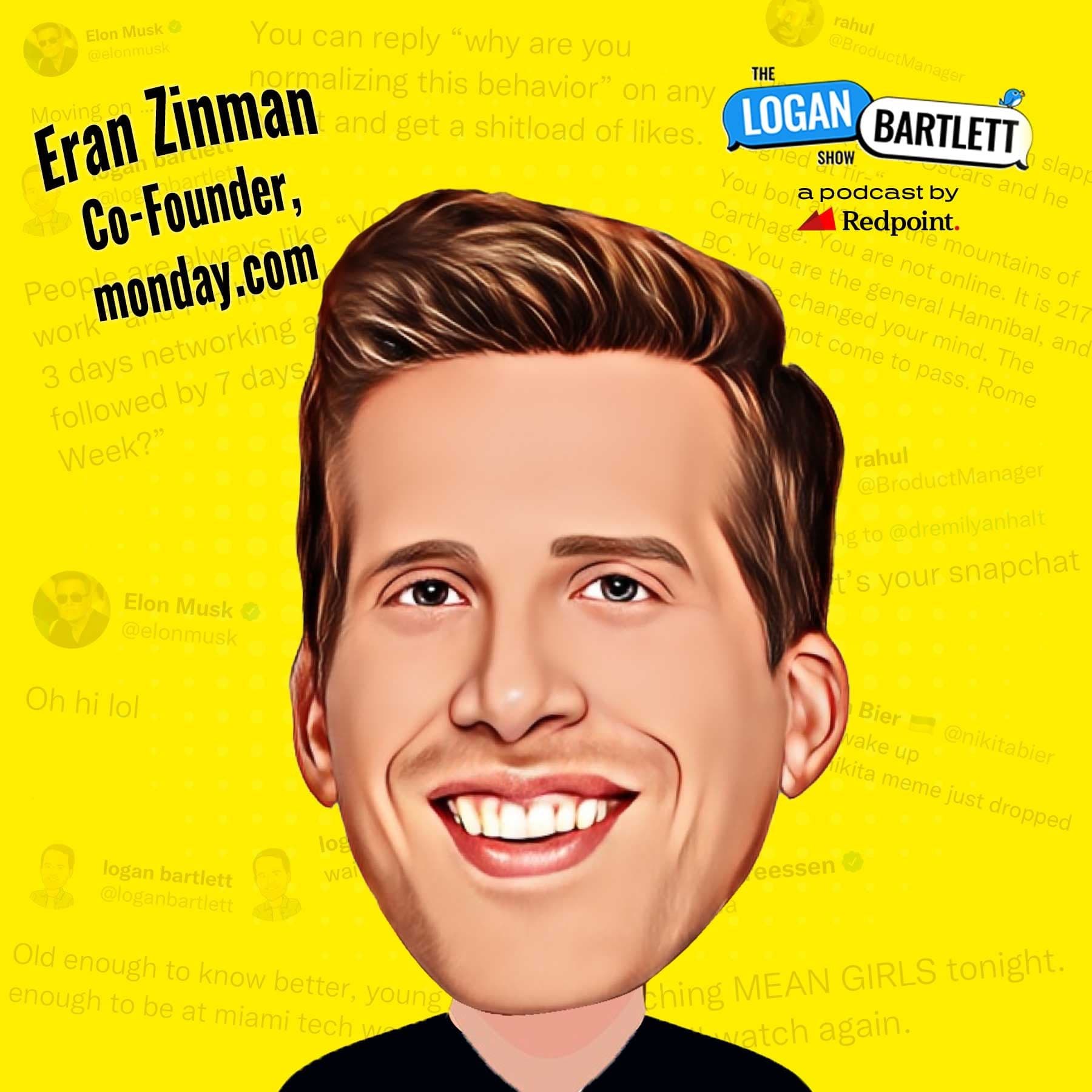
Podcast Notes: The Logan Bartlett Show - Episode 126: Eran Zinman (Co-Founder, monday.com)
Episode Overview In this episode, host Logan Bartlett speaks with Eran Zinman, the co-founder and co-CEO of monday.com, as they delve into how the company grew into a $14 billion public entity. The discussion covers the operational strategies, unique philosophies, and innovative tools that have driven monday.com's success in a competitive market.
---
Key Themes and Insights
- Philosophy Behind Monday.com
- Flexibility and Customization:
- The platform was designed to be highly flexible, allowing users to tailor it to their specific needs rather than adhering to a rigid structure.
- Zinman emphasizes the importance of empowering users to shape the software to fit their unique business requirements.
- Entering a Crowded Market
- Strategy for Competition:
- Instead of avoiding competition, monday.com entered a saturated category (work management) and aimed to disrupt it by offering a better solution.
- Focused on differentiating through flexibility and modular capabilities rather than merely competing on features.
- Operational Excellence
- Cash Efficiency:
- Emphasis on cash generation over other financial metrics like LTV or ARR.
- Monitoring cash flow and collection timelines has been critical for sustainable growth.
- Big Brain: In-House Analytics Platform
- Data-Driven Decisions:
- Development of ‘Big Brain’ as an internal analytics tool that tracks performance across various metrics.
- Initially started small but expanded its role in analyzing user journey and marketing effectiveness.
- Performance Marketing Approach
- Focus on Data:
- An effective performance marketing strategy was established early on, prioritizing data-driven insights to guide marketing investments.
- Zinman discusses the importance of understanding which campaigns yield the best ROI and how that has shaped their growth.
- AI Integration and Future Prospects
- AI Features:
- Integration of AI tools into the platform, allowing for automation and enhanced user experience.
- The potential for AI to play a significant role in the future direction of monday.com, including customizable AI agents for users.
- Company Culture and Practices
- Transparency and Accountability:
- A culture of transparency where performance metrics are shared openly with staff and investors to ensure accountability.
- Direct communication channels to leadership are encouraged to enhance customer service and support.
- Hiring and Team Dynamics
- Interviewing Philosophy:
- Focus on assessing candidates’ problem-solving skills rather than just their background.
- Emphasis on hiring individuals who take ownership and are driven to make decisions.
- Co-CEO Model
- Partnership Dynamics:
- The co-CEO model has proven beneficial, allowing for shared responsibilities and collective decision-making.
- Zinman highlights the importance of having a partner with a shared vision and mutual respect.
- Adapting and Learning from Mistakes
- Value of Failure:
- Acknowledgment that failure is part of the growth process.
- Encouragement of a culture that embraces experimentation and learning from setbacks.
---
Key Takeaways
- Flexibility in Product Design: The key to monday.com's success has been its commitment to flexibility and user empowerment.
- Cash Management as a Priority: Maintaining a focus on cash flow has provided a sustainable growth model.
- Data-Driven Marketing: Analytics tools are essential for understanding market performance and optimizing spending.
- AI as a Transformative Force: Embracing AI technology will be crucial for future growth and user engagement.
- Strong Company Culture: Transparency and a customer-first approach have fostered a positive brand perception and strong internal morale.
- Partnership Over Loneliness: A co-founder relationship based on shared goals and devoid of ego can significantly enhance leadership effectiveness.
---
Conclusion Eran Zinman’s insights reveal that the combination of a flexible product, data-driven decision-making, a strong culture, and innovative marketing strategies are vital to competing and succeeding in a crowded market. Emphasizing adaptability and learning from failure paves the way for sustained growth and evolution in the tech landscape.
---
For further engagement
- Follow the Logan Bartlett Show on [Instagram](https://www.instagram.com/theloganbartlettshow), [X (Twitter)](https://twitter.com/loganbartshow), and [YouTube](https://www.youtube.com/channel/UCugS0jD5IAdoqzjaNYzns7w?sub_confirmation=1).
- Explore more episodes and insights on startup growth and innovation.
Written by AI. May contain mistakes. Listen to the episode to check what was said.
Transcript
Automatic transcript. May contain errors.0:05Welcome to the Logan Bartlett Show. On this episode, what you're going to hear is a conversation I have with co-founder and co-CEO of Monday.com, Aron Zinman. Aron has built Monday into a business worth over$14 billion. Aron and I talk about a number of different things, including the operating discipline and focus that has allowed Monday to blow past a number of their initial competitors, as well as his use on how AI is going to change the potential for businesses like his. some of the implications that exist for things like pricing, as well as the culture that Monday.com has been able to build.
0:44A really fun conversation with someone that I've long admired and been curious about how they've been able to execute in a otherwise very competitive market, as well as they have thus far. You'll hear that discussion with Aron here and now. Aron, thanks for doing this. Great to have you on. Thanks for having me. So maybe first, for people that don't know, how do you describe what monday.com is? Oh, wow. One word is a work platform. But I'm going to need probably more than one word to describe exactly what it is. That's good. Yeah, yeah. We have a lot of time here. So feel free to filibuster or talk as long as you want.
1:20Great. So basically, Monday is a platform where one of the main principles that we had from day one is to make it 100 % flexible, which is very different from, I would say, traditional software. We give people the freedom to shape how to use the software to feed their specific needs. This has been a core principle for us from day one. Essentially, every business is different. Every business operates in a different industry. And it just seems all right to build one solution that will be rigid for everybody that's going to force them to use our software in a very specific way. So from day one, we operate on this principle that we're going to give the superpower to our users to shape the software to their needs.
2:07And they basically do whatever makes sense to them for their own business. I know it sounds a little bit high level, but being a developer... We can dive into the specifics of all of that. One of the things that I heard you say that I thought was interesting is that you're not a big believer in ideas, but instead you fell in love with this problem. And that was how you oriented the business. Can you describe what this problem is that you started pursuing for Monday? Yeah. I think as a founder, often, people's intuition is let's find a problem that nobody tackled before. Or let's think about a brilliant idea that nobody thought about before.
2:48And I have this passion for... let's think about an industry that's actually fully packed with other players. It shows that there's a lot of demand from customers. And let's try to think how we can disrupt it and build something better for those people. If you think about it, our initial product was mostly focused on work management and project management. That's probably one of the most packed categories out there. And then afterwards, we went for CRM, service, dev. Those industries have been interested for years. but we just came with a different approach. We wanted to build something, as I said, that gives a lot of freedom to our users and just give them something that didn't have before as a tool.
3:33I think that a lot of work management software, for example, or project management software, they come with this concept of we found the best way to manage or we found the perfect structure for people to lay out information. And I don't think a perfect structure exists. I think that's the wrong way to think about things. I think we need to give them the best tools and the best building blocks to help them solve their own problems. I want to get into the operating side of things, but maybe from a philosophical product architecture standpoint, standpoint, as you mentioned, at least the original category you went after is certainly a crowded one.
4:16And some of the names that I think were ahead of you in terms of scale and maybe valuation as well, companies like Asana and Smartsheet and Airtable perhaps as well, were all buzzy at different points in time. From a product and insight standpoint, was it this flexibility that you think allowed you to be better received by the market? I mean, I think you've surpassed all those businesses from an evaluation standpoint. And I realize you operated very well. But was the insight this flexible architecture that sort of allowed for modularity that maybe those other systems were a little too opinionated to do?
4:57Yeah, but I don't think it's a product. I think it's just that it's a totally different business direction and we built a different kind of business. When we went public initially about 3.5 years ago, investors compared us to the companies you mentioned. They're signing us through the world, the smart sheets, private players. And that shifted over time because investors, the market and customers realized that what they buy is something much wider than that. It's the Monday platform. And work management and project management was one use case that we've built on top. that platform. But for example, now we have Monday CRM and Monday Dev.
5:39No player in each one of those categories competes in the other categories. So you won't find a certain player competing in the work management and vice versa. So what we built is very unique. We just built a different kind of business that initially can be compared to Asana or Smartsheet. But over time, the course that we took and the path that we took is very different compared to those companies. And definitely the flexibility allowed that, but also create a huge product differentiation compared to the other players. I guess I want to go down this rabbit hole a little bit. So from the start, did you think that you would have this underlying platform and build applications on top of it?
6:22Or was that something that you realized along the way that this was possible? Well, I would like to say yes, but that's not the truth. So when we started, we had one concept in mind is that we want to build a platform that's 100 % flexible. Both my partner, Roy, and myself were developers. So we always had in mind this concept of we have the superpower where we can write code. Now with AI, it's not such a superpower anymore, but we have this ability to customize our own software, let's say. and we wanted to give it to other people. And nobody knew what low-code, no-code meant at the time. Nobody knew what platforms were at the time.
7:03But we just had this crazy concept that we stuck with throughout the way. And along the way, we found that because of that belief and that concept that we stuck with, it just led us through this path. Because when we launched our first version of the product, But we thought initially it's going to be mostly startup tech companies using us, traditional industries. I had no idea that today 70 % of our customers are going to be non-tech companies. I had no idea that we're going to have customers from hotels management all the way to retail to other verticals that have no idea how to operate in. But they use the money abilities to build the wrong software.
7:45So I couldn't predict the path that we went through. and definitely not building like a full-fledged CRM or dev or service. That actually came from our users doing it themselves on the platform. So we were very open throughout the way and trying to change what can be achieved with the platform. But the core principles of that flexibility that I've mentioned, it's been since day one. Is there a broad insight there that you would potentially espouse for founders that are listening and thinking about their journey and where their product can take them. It sounds like maybe you were less opinionated about where you were headed and more receptive to being nimble along the way.
8:33I realized at one point, like the pulse way back when the former name of monday.com was centered on like an entirely different application of maybe this product versus the one you ultimately found initial success with. And so I guess, is that something that you would recommend for founders in general? Or do you think that was unique to your end market? No, I think that's something I recommend to other founders as well. Because like you said, something that we really believe in is fall in love with the problem and what you find to build. And essentially, we saw a huge vacuum in the work management space and other markets as well.
9:16But we were open to change the products along the way. And I think a lot of founders are going to fall in love with one specific solution. And I don't know any successful company. I don't think back in the days, take Microsoft, for example, they would imagine they're going to have gaming consoles or AI or even assets. But this is how you create a huge company. You change it along the way. I don't think that's a disadvantage. I think a lot of founders feel that if they change course along the way, they somehow failed. And I think the opposite. That just proved that you're resilient and you can operate and you can change because the reality changes all the time.
9:54The market changes, etc. In entering a competitive market, in sort of thinking about when there's a bunch of different solutions there, did you feel like there was this product architecture and flexible structure around, you know, pursuit, not necessarily being prescriptive about how the problems are going to be solved. Did you think that was ultimately going to be enough of a differentiator? Or was it just competence in your ability to operate and execute? Because I want to get into some of the specific things that you did from a tactical level. But you guys have almost been a machine in terms of just your operating execution and all of that.
10:39So I'm curious, do you think it was requisite to have the product insight? Or were you just confident in your ability to out-execute people from a marketing standpoint, a customer success standpoint, whatever incremental thing there was? Yeah, I would say both. Because it could be an executioner machine, but if you don't get the right product, nothing can help you. And you might have the most amazing product, but if you fail to execute, eventually the company is going to fail. So definitely, I think you should have both. I would say that having a strong DNA in the company and being open to change makes you much more resilient over time.
11:18But definitely having the right product was a huge game changer for us. And again, I think it's not a matter of yet another feature. I think what I'm trying to emphasize here that I really see this as an evolution of SaaS software because definitely Salesforce was the first pioneer of building the cloud software, SaaS subscription principle, and so on, which created a huge trend of many SaaS software out there. But I feel that with Monday and just other players doing that, we built on the second generation of that, which is to give more power to our users and to allow them to use software the way this sits down.
12:03So I don't think it's a matter of a feature or a nuance in how we build the product, just a completely new way to help people adopt and use products over time. So I spent six years at Battery Adventures before joining Redpoint. I've been here now for five years. But I remember you were raising what I think was your Series B. And when you were at DePulse, and I was kind of brought in as an ancillary member of the deal team because I had spent time in broader project management. And there were two things that stood out to me about your business that were perhaps counterintuitive at the time or not conventional wisdom that you guys were executing on and I think has powered you in a meaningful way to where you are today.
12:50One was performance marketing and big brain. And you guys were unapologetic about this being something that you wanted to pursue. And I think that was at least, I don't know, looked down upon a little bit in the venture community. I know that was certainly my sentiment at the time. So I can at least speak for myself. And the other one was more cash-based burn and thinking about collections and all of that stuff. And so I'd love to talk about those two things maybe separately. For people that don't know, can you explain maybe what Big Brain is and how you thought about performance marketing in the early days and driving growth for Monday?
13:33Sure. First of all, I think Ryan myself is probably one of the worst raisers of venture funds. I don't know. You guys did it. Venture fundraising is a means to an end. And so I think if you build a good enough business, ultimately, you get to be pretty good at fundraising because people will find you. So I think you did a good enough job to get to where you are today. Yeah, I appreciate that. I think it's better to build a good business and be lousy at raising money than the opposite. I think that's right. I think that's right. One of those ends up sustaining itself and one of those ends up burning up or going bankrupt or whatever.
14:12I'll take it. um so yeah so so um first of all uh we built the platform called big brain uh just uh uh just explain what it is it's it's not a product that we sell uh it's it's a system we built in-house actually it's not very intuitive but we started we were like six or seven people total in the company so like super early days and um you know our initial intuition let's use something off the shelf you know analytic software off the shelf uh but i don't know since day one we had this huge inspiration that we want to build a big company um and we said that you know if we want to be successful we have to control our own destiny we have to control information and we cannot fly and fly blind we have to know exactly what's going on and we need to optimize um and build a business that's very efficient because back in the days, unlike what happened in the later years, we didn't have a lot of resources to raise money from.
15:18Our CRSA was actually$1.4 million. Well, because we call it like a seed round, but we had to be very efficient in how we spend money. So since day one, we tracked everything, literally everything. every campaign clicked every visit to our website every banner view every YouTube ad being watched and then because we built it on our own platform we could track a user all the way throughout the sign-up funnel conversion to payment eventually expansion and so on so you could see like a complete user journey years back with all the data all the touch points everything that converted that user into a paying account and eventually how they expanded over time.
16:04And first of all, having that data, that's kind of the main work we've done over the years. And then on top of that, what we built is a very efficient personal marketing engine that can kind of crunch all that data and let us know in a very specific way which campaign that we're running is very effective and which one we're using money on. And also that, going back to your second point, like the question is what do you optimize for like ltv cac um you know mdr acv what do you optimize for because you can collect all the data but then what's what's the target function um and and for us you know it was always cash because you know i'm i'm i'm the sass geek freak whatever you want to call it like i know all the metrics in the in and out but um i don't know it's because cash was out there in the last 6 or 7 years.
17:01But it seems like almost nobody cares about cash. Everybody talks about financial value and financial costs. But nobody talks about what actually goes in and goes out out of the company bank account. But at the end of the day, I always say to people, I joke that you cannot go to the supermarket and pay with LTV. You cannot do that. People need cash in order to operate their business. So we always try to opt for that. How much do we spend? Actual spend going up. When do we get the cash back? Do people pay us annually or monthly? Do they upgrade and so on? And I think that eventually what made Monday a very efficient cash machine over time.
17:49I'm curious. I want to unpack both of those a little bit more. But going back to Big Brain and setting up the culture or the operating discipline to track everything, I'm curious, at a quite literal level, how did you go about staffing against it and building the culture so that you could maybe test all these different things and track it? Was BigBrain, was that a dedicated group internally that didn't have a singular functional responsibility, but went across organizations? Or how did you ultimately build that up? Yeah. So practically, initially, it was Ryan and myself. We're both developers.
18:30But then we got out of that group of 7 people, we had one dedicated developer for that. Percentage was a lot. Right now, it's a huge team, over 100 people in the company. And how many people do you guys have today? 2 ,400. Okay, wow. So it's a big portion of the business, 5 % or whatever. But that's probably one of the best ROI we ever have in the company. Having BigBrain, we probably would have been twice the amount of people we are now just to operate the business without BigBrain. so again this is an estimation but you know throughout the years we always thought about what are we doing that's manual what are we doing that doesn't involve deep thinking but rather like you know manual work or just optimizing things that could be um being done using a script or an algorithm and let's put that into big brain because we want people to focus on deep work we want to focus on you know moving the company forward and not operating the company and big BigBrain has saved us so much time and money over the years.
19:38And I just feel we would have been probably a different company if we haven't built this tool internally. And initially, it was focused on performance marketing, but it sounds like it's maybe extended from that. Or do I have that correct? Yeah, initially, it was focused on performance marketing. Also, we had all the company metrics on it. So there are groups and all the breakdowns, all the cohorts and VR. actually big brain uh was open and still today open for every in the company everyone um you know whether you're a vp or you just joined two days ago you can see everything uh that kind of tied up to our transparency um um principle that was very deep in our dna uh so we had everybody's eyes on the company metrics everybody knew how much cash we're spending how much cash is in the bank how much we're collecting how was the arr yesterday last month um so everybody still have access to big brain so initially it was focused mostly on performance marketing and just seeing general company you know analytics i would say in the 100 people today is it mostly engineering or does it have a bunch of different um uh functional um types of people within the within the grade yeah i would say mostly engineering um data analytics people um but also product people um we care a lot about the user experience in big brain because they could build the most amazing tool but it's nobody uses it internally you know it doesn't worse the investment so we care about a lot about usage interaction um just make it you know out of the super efficient for everybody in the company.
21:20And I guess the cash point, maybe it sounds obvious, or at least it sounds obvious when you say it at a high level. But as you drill in at a more fundamental level, there's obviously trade-offs in prioritizing cash collections. And so I'm curious how you thought about a dollar of ARR that you could get over the course of 12 months. Let's say it was paid quarterly or something like that versus what was the appropriate tradeoff to get that cash all collected up front? And how did you sort of think about what balance you wanted to optimize for the overall ARR versus what you could collect individually from a customer at that point in time?
22:11Yeah, I think that's the point because I think a lot of people, when they think about we want to be more aggressive or we just raise another round, we can spend more on acquiring customers. Let's say we got a great LTV of, I don't know,$100 ,000. So we can spend more to acquire those customers. But that's not the point because when you recycle cash quickly, you can reinvest that into the business. I always say that our best investor has been our customers because the fact that the tool upfront, the fact we managed to get them on board quickly, allowed us to get the cash back, reinvest that into marketing.
22:54Essentially, let's say out of that 1.4 I mentioned, we spend... I don't remember the exact number, but about$5 million in performance marketing using that 1.4. So that's being aggressive. That's capturing more larger portion of the market and being very efficient. As opposed to spending that$1 million on getting great customers with long LTV, then you have to wait out for that LTV to become real cash. You can reinvest the business. So for us, being very efficient and aggressive and grow rapidly was, how can we quickly grab a significant portion of the market to fulfill our potential as a company, if it makes sense?
23:43Yeah, totally. I'm curious, as you mentioned, plowing more money back into performance marketing. If I remember correctly, or what I had heard from investors way back when, you obviously had to diversify the different channels of acquisition that you went after. And I forget what the first one was that you targeted. Maybe it was a Google AdWords or something. What was it? Facebook, maybe? What was the first one? It was Facebook, actually. How did you think about the platform risk or going deep into a single channel versus A-B testing others from the start and figuring out what other ones could find different efficacy around it?
24:23Did you try to be diverse initially or did you just go as far as you could in one and when you started to saturate that, go after others? It was more about going deep initially on Facebook ads, but that actually led to a great outcome because I feel that if we were very specific to begin with, we probably wouldn't have realized the potential of what the platform can deliver. because essentially everybody is on Facebook or YouTube. Even if you're a high-level executive or a CEO or a Fortune 500 company executive, you'd probably be on Facebook at some point or YouTube. So you probably have access for everybody, tech or non-tech.
25:05And just because we did more of a broad messaging just captured different types of audiences and verticals that we couldn't have imagined that have potential to be our customers. And then eventually when we went on to go on another platform, I feel just the inventory that we felt that we could target was much wider than what we initially thought it was. Yeah, I remember you guys were super successful with different landing pages. And you would have pretty bespoke, at least on Google SEO, when I would type in, I don't know, HR onboarding template or something, you guys always rank really, really high in terms of like building sort of modular presentations of what the functionality could exist within it.
25:56And obviously, it was under the same underlying primitives or platform within it. But a lot of different modular applications of it that you were then able to sort of tie out to, I assume Google ads in that case, or Facebook or YouTube or whatever in terms of personalization. Yeah, I think that eventually the way people search tools online, they have a very specific intent or a business need thereafter. And they need immediate satisfaction usually. And I often joke with people that we build this very modular platform, but nobody goes on Google and search for a selectable platform. Nobody does that.
26:37That's what we want to build, but nobody searches that. Yeah, yeah. And BC is like that, but customers like problems being solved, right? Exactly. And it makes sense. So we always said we need to serve our customers and drive them towards our grand vision and not just wait for our customers to convert to our vision. We need to be there where they are. So what we've done is, like you said, because money can be anything for everyone, we package it for different people's needs and get them started. And then eventually they discover what they can actually do with the platform. I want to talk about AI more generally in a second, but I guess I'm curious just as we're on the performance marketing thread.
27:22I assume you guys have been experimenting with some of the different types of advertising that you can do in this generative AI world. I'm curious, are there any interesting takeaways or things that have been counterintuitive to you in the early days of playing around with some of this stuff? In terms of the actual ad creation? Yeah, I mean, all of the above. I guess maybe how do you think about advertising on some of the AI platforms that are coming out? Like, I assume that some perplexity said that they're going to start doing advertising, I think, next year. ChatGPT at some point, I assume we'll have some advertising stuff around that.
27:59So I guess that's an interesting question, but that might be a little more speculative. I'm curious on the more generative side of actually presenting these ads on things like Instagram or Facebook or YouTube, where you can actually create, copy, or different types of A-B tests around things that are generative in some way. I'm curious what you guys have seen in that. Yeah, I mean, we do use some tools to generate ads, but I would say it's a significant way for us to generate ads right now. It might change in the future. It still involves some humans behind the process. But in terms of advertising on AI platform, definitely open to it.
28:38I mean, we're open to any platform, I would say. but once that's become available, we'll be happy to explore it. Yeah. It feels like you don't know which side of the coin. It's like the old adage of marketing. I don't know which 50 % works and I don't know which side. Being early to some of those things, I have to assume it either presents a total waste of time and it's not going to be effective, or it's enormously beneficial and super effective and very underpriced. And it's hard to know which one it's ultimately going to be. So I assume you need, uh, you want to be out in front of some of these things trying to figure out which bucket it's going to go into.
29:14Yeah. I mean, look, eventually it's a free market. So, uh, those things even out over time. So, uh, we'll try, uh, if there's a, you know, huge benefit to that, I'm sure other players will notice that. Yeah. Yeah. Typically there's usually a couple quarters or so, you know, people not being totally perfect with it um uh so on the ai side i'm curious um how you all think of uh the opportunity as well as uh things you're thinking about maybe on the risk side for for ai as it relates to monday's business yeah uh well first of all i'm super excited for it uh genuinely excited for it both on the personal level but mostly on the company level um actually um you know we've been working on a few things within Monday.
30:04So just to give you a high-level overview. So far, the way we see AI incorporating to Monday is in three ways. One, we build something that we call AI blocks within the platform. What it does basically is that people build automation on top of Monday. Automations, integration, basically you can think about it like an automated workflow that they build for themselves, anybody with their own business. And we built those... All of those blocks in those automations are AI driven. So you can do a lot of work that used to be manual, used to be done by people using AI, whether it's to extract specific information from a document, all the way to auto-assigned people to different tasks based on their skills or anything like that.
Read the full transcript
30:58And that actually has been literally exploding on our platform. We're a public company, so I can quote what we said on the last Ernie call. That grew 250 % Q over Q. Something growing 250 % Q over Q, that means it's growing super quickly. We get great feedback and customers have been adopting more and more of those AI features. So that's One thing that we added to the platform. The second thing we're doing is we have those different products, Monday CRM, work management, and so on. Monday Service as well. So for those, in each one of those categories, we build AI capabilities. Monday Service is going to be able to auto-answer tickets.
31:47Monday CRM is going to be able to do automatic exploration emails and so on. But that's something you see in other players in the industry. And I say we have to do it just to compete with other players. And the third thing, which I'm very excited about and really ties to Monday's vision, is we're building just the same way you build a new board or a new dashboard in Monday. You're going to be able to build a new agent, an agent that's specific for your business. So we took the same principle of giving that superpower to our users, the same way we've done it with the Monday platform, just allow them to build their own AI bots or AI agents, if you like.
32:32So that agent not only can help you with the Monday platform, but can actually help you with your own business. So automate some of the things you do in your hotel, for example, or your shop or your tech company, whatever it is, just super intuitive, easy to use, and build your own the Monday way. So I'm very excited for this because it really ties with our vision of giving complex tools to our customers, just in a very intuitive and easy-to-use way and allowed them to build themselves. And we're now going to give access to the most advanced technology to almost everybody or all of our users, which really excites me.
33:12As you think about this move or shift to people doing work within your system, to people using your system to do work, and maybe this agentic world that we're moving towards, I'm curious, a lot of our companies are dealing with or considering the implications for a pricing standpoint. and I realize you guys are a public company and so there's only so much that you can share around this but I'm curious how you guys you've historically been a little more centered on seat-based pricing do you think that that proves to be the model going forward for you and you just figure out some of the add-ons that are some of the agentic things that are automations that you're going to offer as well or do you think that the model actually maybe shifts to more usage as perhaps less people are actually logging in on a daily basis to do the work instead of letting your system do the work for them?
34:12Yeah, I actually think that AI is probably not going to lead to seed compression, maybe on some very specific tools like service-oriented tools or sales-oriented tools. But I don't think that's going to lead to seed compression. However, I agree that probably we need to price AI features differently based on consumption and actual usage. And I feel that's a great thing. I think the fact that SaaS software just aligns the values of customers and software makers that you can cancel anytime you have everything on the cloud. I think that consumption-based pricing on AI just leads to more alignment between the value customers get and the company expenses and what they invest in.
35:02And I think it makes a lot of sense. I think most companies are headed towards that direction and probably something that we're going to explore as well. You alluded to something earlier about where product insights came from and some of the realizations that you had about the potential of Monday, perhaps coming from seeing the number of different customers that were using it for different things. I think sales and service were maybe one of the examples. I had heard you mention that a lot of the material transformative features or functionality that you built out, though, did not come from the customers and instead came from your own intuition about what the product or the platform could do.
35:49Can you maybe speak to that and how you think about the balance of listening to your customers versus thinking about what the future could or should look like from your own intuition? Yeah, I think that's a fine balance you need to work on because, of course, we listen to customers and process their feedback and do a lot of things that are requested by our customers. But like you said, and I said this before, the most significant changes that we've done that made the most impact on our business were actually not situate for our customers, but rather us driving towards our vision. When we initially launched automations, none of our customers wanted that.
36:32Nobody asked for that. But that was one of the most significant things we've ever done. Same goes to the products, by the way. they've done it on our own platform. We've seen our customers go above and beyond building their CRM on Monday, which was marketed to them as a project management software. Why would somebody do this? And not in the hundreds, not in the thousands, in the tens of thousands. So we realized there's something here. And nobody asked for a specific product, but we just saw what they've been doing with the platform. and decided to take this step forward. That was a huge decision on our side.
37:15Monday used to be like this one tool. Doing that transition of moving Monday from a single tool, a single software into a multi-product suite was a huge change for us. And again, it's a bet that we chose and we believe in and paid off tremendously strategically. In the early days of building the company, You guys, both co-founders, were technical by background, but I get the sense that you dove into some of these competencies that you hadn't had exposure to in the past, be it marketing as one example. I'm curious how you thought about balancing building up your own knowledge and being the person that became a domain expert in an area that you didn't have competency in the past versus bringing in different people to augment your knowledge and having trust or delegation that, you know, this isn't going to be my core competency.
38:24and I'll trust other people to run whatever XYZ function. And I'm just not going to go as deep into it. So I guess the question is, how did you pick what areas to go learn versus hire people in just to augment the blind spots you had?
38:41It's easy. We just chose to run that machine ourselves. That's right. Yeah. You just do it all. I guess that's what the kids are calling founder mode these days. No, I mean, we are the amazing people, but we never thought it was a good idea to let somebody build what we call a black box within the company. We always cared about every tiny detail. I and myself were, like I said, we're developers, but we're also obsessed with details and data. I'm not sure every manager allows that, but that's what we care about. and we also try to think from our own perspectives on what we feel is right i would say that along the way you know you mentioned you saw us when you were in battery ventures but uh we always we didn't always go through the conservative path i would say like you know with performance marketing with big brain with the name change with um the fact we didn't have a sales team product like pro like we always felt like we're misunderstood or you know people look at us like we're thinking in a different way, but we've always been loyal to what we feel is right.
39:57And I think it just led us in a path that's unique to us. It created a lot of opportunity for us as a company as well. This is what we are. I don't know. But we both come from developer background that we wanted to learn how to do marketing our way with code, with data, and analytics. And I think that what's helped create a marketing engine that's very unique. Were there areas you hadn't teach yourself to care about or that were more like eating your vegetables versus eating dessert in some ways? Or did you find enjoyment in the totality of the operating details and things to focus on? No, I mean, we learned a lot along the way and made a lot of mistakes um look initially um we are like um going back to you know 2018 2019 i thought we never gonna have a sales team within the company um that was obvious to us maybe a little bit before uh we were sure that the best way to succeed is to build an amazing product and then everybody in an enterprise company is going to adopt it like we didn't know how enterprise companies work Like that's the main thing.
41:16We had to learn this the hard way. Like we learned that, you know, larger companies require different process of implementation, different sales process. The way we frame it to ourselves always is we need to build a bit better products for our large customers and a better product is not just the software itself. It's also the process around it. It's the buying process. Are you conveying information to them? How you explain to them what's the value you deliver? So we always think about building products. Just sometimes those products involve humans as far. I'm curious, how did you ultimately find religion or change your perspective on hiring salespeople?
41:56Was it a customer? Was it an executive? Or ultimately, how did you switch your perspective around it? Yeah. I mean, look, we want to win. We want to be successful. We want to build a huge company and we'll do whatever it takes. and we have our strong beliefs, but sometimes we're wrong. And we do whatever it takes. And at some point where you realize that somebody is not working as you expected, you try to go back to all those principles and re-examine them. And we've done this several times throughout the life of the company. And now I'm super excited about the amazing sales team we have. We have almost 1 ,000 people in our CRO group.
42:39So it's one of the most amazing teams. I love it. I'm obsessed about it. It's I just feel it's it's such it basically what made the company what it is today. So without it, we were totally different company. I'm curious about the customer success side of things. So I think you, I heard you read Deliberate Happiness, and that proved to be pretty influential in terms of how to service customers. Can you maybe speak to that and the philosophical perspective that you all have about customer service and how you go about responding to customer requests or inquiries or anything along those lines? Yeah.
43:29So we're obsessed with delivering an amazing service to our customers. It's been like this from the very beginning. I just feel eventually when you build an amazing software or a business, almost the only interaction the customers have with the company, which is human interaction is with people with customer support. Those are the people they meet. This is their perception of who the company is. And you want them to have the most amazing experience. So I feel that that's a major part of building a very strong brand over time. And we built a few cool things. Maybe I'll start with something a little bit unrelated, but I think it's worth mentioning.
44:13When we were a small company, I remember one day, like 30 people, really small. I remember one day, I got a complaint about a customer support team that didn't answer a ticket within a few hours. And actually, it was a lunch break. So I went to their room and the phone went ringing and nobody was there to answer the phone. We're all in a lunch break. And I remember asking myself, what happened? How can we improve this? And at this point, I realized that we need to measure them in a better way. So one thing that I feel a lot of companies miss is, what do you optimize for? What is it? Time for them to wait, customer satisfaction.
44:57So we work really hard to get the KPIs right. What do we optimize for? And we have a very sophisticated system within BigBrain of measuring that our customer success is really doing the best for our customers. Because sometimes if you optimize just one metric, you get the wrong result. Because if you optimize for answering time, people might answer quickly, but inefficiently, it's the optimist for other metrics. So getting the right KPIs is the most important thing. And then another thing that I'm really proud of. you can email directly to Roy and myself. So we have like email to the CEO feature, which I really like people that are frustrated or feel they're doesn't get the service that they wanted.
45:43They can actually email Roy and myself and we go through those emails every day. I don't answer them directly, but I go through them. We have a team dedicated for that. It's also something that we really care about. It makes a lot of sense. And I mean, it's a great principle to have. I think from the early days, too, you guys set like an SLA around response time or how quickly you're going to get back to customers. Was that something you had seen in the data or was that just a philosophy that you wanted to impart within the business? We said that the first thing to create a great service is to answer people quickly.
46:25That's the bare minimum we need to focus on. So that was kind of the initial metric that we tried to optimize for. And then we made it more complicated just to make sure to get the best service as well and not just a quick answer in time. This was a great start to start optimizing that team in that process. I know that you think of a bunch of elements of running the business like shipping products. I'm curious how that applies to things like culture. How do you think about setting a product ethos in different departments and how to make the org operate consistently from that approach? Yeah. So first of all, one core principle that we always had is giving people as much ownership and autonomy as possible.
47:17So even now, with the new products that we launched, each one of those teams is independent. They make their own decisions. They have their own KPI and they drive the company forward, which I love because we created this startup mentality within a large organization. And they're very ambitious. They're quick to respond. And they feel the ownership is on their shoulders. So I think that's something we've created that's very efficient. If you look at the sheer percentages, our R &D is relatively small compared to other companies just in terms of expenses. We always believe that having a small team that's very effective is much better than having a lot of developers moving very slowly.
48:00So we always optimize for talent. We always optimize for quick decision making. I think a lot of time being wasted on choosing A or B, where I feel choosing either is good. so it's just about let's move forward make a decision, you bring smart people probably either choice is going to be great, let's move forward so we give them this ownership and we say we trust you go forward and that led to the most amazing results within the company I think that companies begin to slow down where you have to get management confirmation for everything you want to do so we try to avoid this as much as we can Yeah, I've heard the false trade-off, especially when shipping products, but I think this applies to anything.
48:45Do you want it to be high quality or do you want it to be fast? And I think consistently all the best product teams or engineering organizations that I work with, they tend to ship fast and they tend to ship high quality. And so it's this false dichotomy that we put in that time and quality are at odds with one another. And I assume that applies to your A or B. Why not both kind of philosophy there? Yeah, the faster you ship, the faster you get feedback, the better product you create over time. What types of people have you found to be successful within your organization? And I guess as you interview or think about traits that you uniquely seek out versus not, that might be different than other organizations.
49:37I think people that like to take ownership, like to drive things forward, doesn't like to be micromanaged, and want to make their own decisions are the people who forge in Monday. Even though we're a public company and we might look from the outside like a success story, inside, internally, we feel we're constantly failing and we feel that we haven't accomplished 1 % of our potential. So I just feel we have so much we can accomplish as a company. And everybody shared this feeling that we're just getting started. And I love it. There's a feeling that we're still hungry. We have so much we can accomplish.
50:22I just feel we have so much potential that I don't want to waste. I feel like we were given the most amazing opportunity as a company. Even the platform, just the broad customer base, the different product suites. There's so much we can do and no one to blame. Like only ourselves. It's on us to deliver. We have huge dam, huge customer base. They love the product. Almost no limitation. It's really up to our own execution. So on one hand, it's a little bit nervous, but on the other hand, you control your own destiny. So I love the challenge. In interview settings, one of the things that this maybe is really dated, so I'll make the reference and you feel free to correct how you're doing it today.
51:10But that you all will ask open-ended questions to hear how people talk through or think about different problems. And one of the examples that I had heard you reference was, I think, related to the Facebook. And I think it was like a timeline or a chronology of friend-related things versus maybe a more algorithmic seed in having people talk through how they would think about the trade-offs. Can you speak to, I mean, maybe I'm the example wrong, but can you speak to maybe the interview questions or what you try to get out of a process like that? Yeah. Also, interviews is something that we learn how to do the right way.
51:57I still feel we have a lot to improve. But I think traditionally, the way people interview people is they go through their CV. I don't know. The way I experience it is that people for 45 minutes talking about the resume, it usually doesn't give you a lot of information about the person in front of me. Uh, and I try to avoid that. I try to minimize that part to five minutes. And then I try to ask them questions, not about their history or the work experience, but actual questions that probably they're going to need to answer on their first day at the job. Um, but I cannot ask them questions about Monday because like they have no knowledge on that.
52:44Uh, so I try to find a different product or a company that might be a consumer oriented the company that they might be using and then ask them like intuitive questions and just see how they think and then challenge them and then see how they react to that. So learn more about their thought process and how they, you know, think and handle conflict or handle uncertainty. And that gives me a lot more information about the person as opposed to just go through their court history. Do you uniquely take on this responsibility or is this something that you encourage the rest of the team to do as going through an interview process?
53:24No, it's something we apply throughout the company as one of the principles that we do when we hire people. Are there other things you've learned about the interview process or hiring from a candidate standpoint? I'm not sure if it's related to the batching references or how to run an effective process. I trust given your operational rigor that you thought about and maybe A.B. tested a bunch of different ways of going about interviewing. So I'm curious if there's any lessons there. Surprisingly, I think the most important thing when you interview a person is to get, it might be not intuitive, but to get as much confidence as you can before the interview.
54:04So when we are supposed to meet somebody, we try to find as many people that worked with that person before through our own network or the network of our network and try to find as much information about that person for people who actually worked with her before. before. So that gives you a lot of insight of what's working and what's not. And if you really deliberate about the questions and also find the best candidates before the interview. So that's something we try to focus on in our process. You guys went public, you said three and a half years ago? Yep. Is that something you encourage other people to do?
54:45Has that been a net benefit for the business? or is it just a stop along the way and you're indifferent to the pros and the cons of it? Look, I love the site that we went public. If I had to go back in time, I would do it again. The process itself wasn't as enjoyable as you might think.
55:11I've been through it as an observer, so I think it's not very enjoyable. Maybe that the average person would think. Yes. But I think being a public company brings a lot of benefit. I personally really love the quarterly cadence. The fact that we have to think as a quarter. I used to love board meetings before going public. And people ask me why. Because it's forced me to think. It forced me to prepare. It's forced me to think about strategy. And now we need to do this in front of all of our investors, all of our public investors. And one thing that was, I wouldn't say surprising, but I found out that public investors are super sophisticated.
56:04I always thought that the private investors knew exactly how SaaS companies work. can really ascend the business model. But I would say public investors are as sophisticated, if not more, even because they're also super interested in financial information. So for me, the whole process of learning from investors, getting feedback, and our approach, both Roy and myself, we try to learn, like genuinely learn from people, and we ask investors, what can we do better? What are we doing wrong? We don't try to appear as somebody who has all the answers, but rather that we on a living process. And I feel this builds a lot of confidence and also help really help us in our journey as a public company.
56:47It's interesting. I think some of the smartest people are public market investors. And so I agree with your sentiment that there was probably 10 years ago when the SaaS, there were maybe 12 years ago or 15, whatever it was, when there were 6 or 8 SaaS businesses and most of them were kind of enterprise oriented, that there was just a lack of appreciation or understanding for some of the things related to how to build SaaS businesses. And so the private market had a much deeper appreciation or understanding of all that stuff. But now, I don't know if it's 75 or 80 or 65 or whatever the number is, but there's so many data points out there.
57:31And the public market is just so attuned to the different changes that occur in these businesses. And they're just very good pattern matchers against all that stuff. And so I find them to be super sophisticated in terms of their understanding and observations around detail. and all that. Yeah, 100 % agree. Have you found that there's been more of a short-term focus in the public markets? Or have you been able to balance the medium-term objectives with the near-term and the expectation setting with your public investors now? That was actually not a surprise for me because all the investors that we talk with are all long-term.
58:16and even now, the last earnings call, our stock actually went down outside the earnings call and I was surprised. We got great feedback from investors, long-term investors and they really kind of look at the business what's working so a lot of them really focus on the long-term and we got great feedback from them so I just feel that, you know, similarly to a private company as a public company. Obviously, you've got the edge funds, you've got the retail investors you don't have control on, and they see kind of short-term gains. But there's a lot of long-term investors, great ones, that are really supportive and kind of hold for the long-term.
58:58They understand the strategy, they care about the product, they care about the vision. And that was great to see in our journey as a public company. One of the things that became evident to me in prepping for this, as well as this discussion is just how detail-oriented you and Roy seem to be and just the operating rigor that you have for the business. I'm interested, is that something that you've always been? And does that date back to you as a kid? Did you have a meticulously clean room? And you were always on top of all this stuff, homework done well in advance of it being due? or is that something you've learned professionally to focus on?
59:45Look, if you ask my mom, my room was not clean, but my folders and my computer were very tight. So I organize what I care about. But I don't know. I take joy out of making this machine, this company more efficient. It just feels satisfying. to know that we're doing something right. It feels satisfying. We have the saying here that we love to hear problems. We love to hear problems. We love to touch problems. We love to go deep. And that just encourages everybody on every level to share what's not working. I think a lot of companies, they have this tendency to ignore problems and they tend to grow over time and become serious problems.
1:00:37And I think one of the things that really help us grow is that we always try to figure out what's not working. And once we do, we have this sense that we can fix it, whether it's big or small. So we get excited. Had a phone sign the problem as weird as it may sound. I'm interested. You all have a bunch of data that you run the business on and metrics that you track. How many metrics do you think about on a daily basis? Is it six KPIs that you sort of use as the North Star and then another 150 that fall out of it? Or do you track 30 as kind of the core framework by which you run the business on a daily basis?
1:01:29Yes. So actually, BigBrain built an internal mobile app that's called Monday Morning. it's a tool we use internally that people have on their mobile and you can see in real time on all the main KPIs so I would say on a daily basis I'd probably check around 10 to 15 main KPIs but this app and if you go on big brain on your laptop computer you can drill down to anything you like so if something is outgrown as we expected we can drill down and see the information Different teams focus on different types of the business, but usually on a day-to-day basis, we try to share the high-level KPIs. Actually, when we were a private company, we used to send everybody in the company a daily SMS with all the information about what happened last night.
1:02:24And all of our investors got the same SMS every morning. That's one of the best things we've done. Nobody was surprised at the end of the quarter. Nobody was surprised before the board meeting. Full transparency with your investors. And it's one of the things that really I'm proud of and I think traded the very efficient board for us over. Do you think that led to better accountability within the organization? I can imagine that could be a little anxiety inducing in different organizations. But it sounds like you guys found a way to just be transparent and upfront about it. I think being transparent removes anxiety because anxiety comes from problems.
1:03:02And problems you don't fix. Not because something happens. Everything happens. Even to the best companies, you have bad orders, you have bad years, you have bad month. Nobody's perfect. But the fact that it's out there and you talk about it and you fix it just reduces the anxiety. So I just feel that being transparent and immediate in how you tackle things and fix them just removes the anxiety. You're one of the few public companies that I know of that has evolved with a co-CEO model. How have you been able to make the partnership work as well as it has? Are you 12 years in now? 11, something like that?
1:03:4912. Do you guys end up dividing different functional areas of responsibility or do you both oversee the entirety of the areas within the organization? How does that work? Yes. First of all, Roy, my partner is really the most amazing partner I could look for. And when we started a company, originally he was the CEO and I was the CTO, although he's as technical as I am. Uh, but, um, how did you guys land on that? By the way, it was just, it started a few months before me. So, uh, and, uh, we didn't care. So, uh, we just said, okay, let's do it this way. Um, and, um, but I remember first week he told me, I want us to do everything together.
1:04:36And I said, of course, we're, we're co-founders. They said, no, no, no. I want us to do everything together. It says it's like CEOs. And I said, okay. and that's kind of suited my character as well and what's so special about Roy a lot of things but he doesn't have any ego like he doesn't care about himself he cares that the company is going to be successful that's something I always appreciated about him it's not about himself it's about the company and that also made me kind of let go of my own ego and I said look I'll do everything with you and I don't care about the time whatever you want we'll do it together and we've done this and And it's funny because in the early days, we would meet investors, maybe like people in your team.
1:05:19And we would confuse them because I sometimes might talk about the business model. And Roy will talk about technical part. He was officially CEO. I was officially CTO. And I saw the confused look on her face. And then after a few years, we decided to make it official to be co-CEOs. But it's been like this from day one. And I really feel it's like a hack that we have on building companies because we share the burden. We talk about everything. We talk hours every day. We actually both sleep next to the office. We walk home almost every day. We talk for hours and hours. And I just feel I share the burden with somebody.
1:06:04I'm not alone. A lot of people describe being a CEO as a very lonely job. And we're not lonely. We got each other. And great leadership. So I just feel it's a huge benefit. And also, when we go to investor conferences, we're one of the only companies that have two rooms. So we meet twice the amount of investors. You can divide and conquer. It sounds like you do everything together. Minus you can divide and conquer a little bit on the investor conversations. I guess I didn't have this in my research. So how did you two get to know each other originally? Yeah, so I actually know Roy since I was 18.
1:06:43We've been in the same unit in the intelligence force. He's actually five years older than me. So he actually recruited me to the team. He was part of the team. And we both started before Monday and we kind of talked throughout the years. But then eventually we decided to do something together as co-founders after like 10 years that we know each other. Are there any lessons from your co-founding journey that you would impart to people that are listening, either have already started a business with an existing co-founder or maybe thinking about starting a company and evaluating who the right co-founder should be?
1:07:24Yeah, I think eventually a lot of companies fail because of founder relationship. And people, I think, undervalue how much this is important because it's... Such is a significant part of making a company successful on scale, this relationship. And because of the fact we were both without ego, the fact that we care about the company being successful and we knew what we care about. When we built the company, we were very aligned with the deal today. I think that really helped us go through. And we went through a lot, ups and downs and hard times and good ties. But our relationship has always been very stable.
1:08:03And I think that really gives us a lot of confidence. towards the future as well. One of the good things and potentially bad things about these podcast platforms is they're fairly persistent. And so I think this is going to be up on YouTube or Apple Podcasts or Spotify for a while. If someone's listening to this in five years time, where do you hope Monday is from a business standpoint? what do you hope to be accomplishing that you can maybe call your shot now, November of 2024?
1:08:44But I'm not the best person to predict the future, but... You've done a good job with Monday or at least building towards the future in some way. So you're as good as any. I'll tell you what we aim for as a company. Look, Monday, it built this amazing platform. We're very proud of. It's very unique. And we built those products on top of it. And eventually, I see a future where companies buy Monday for their business and run the core of what drives their business on Monday, whether it's work management, CRM, dev service, another tool. And by doing that, the compound value of using different tools from the same vendor just releases so much information, creates everything much more smooth between different software.
1:09:31A lot of the information, if you think about today, is siloed. If you use Salesforce, for example, and Zendesk and Jira, it's a great platform, but eventually they'll communicate with one another. And data is captured and siloed with doing each one. And Monday really liberates that information and makes everything accessible across all tools. And on top of that, everything is so flexible. So it really suits your business. So definitely see a future where companies be courseful by Monday and use it throughout their company. And on top of that, definitely AI is going to be a major part of that. So I feel Monday has one of the biggest potential to be a significant driver in AI adoption for our own customers.
1:10:14So I see a future where a lot of the work has been done using AI on Monday. Other work has been managed on our different products and companies literally run on Monday. Well, as we wrap here, one last one for you. I'm curious if there's a piece of conventional wisdom, either in Silicon Valley or about operating companies that you hear espoused from, I don't know, BCs, people with podcasts or anyone else's blogs that you disagree with or you just found to be fundamentally untrue. Are there any counterintuitive things that stand out to you that you disagree with? Well, a lot. But I would say my main one is that it's something I mentioned before, but failing is one of the most amazing things that you can do as a person and as a company.
1:11:14And failing often makes you perfect over time. And this is something that I'll not only do myself, but also is a key and core part of our company DNA. And we encourage people to try and fail. And we said to them, like, we're behind you. We trust you. Failing is part of the process of making the most terrific company. And let's just continue and fail until we succeed. Yeah. Well, that's great. Ryan, thanks for doing this. It was great to have you on. And yeah, I really appreciate you making it. Thank you so much.
1:11:51Thank you for joining the Logan Bartlett Show with co-founder and co-CEO of Monday.com, Ron Zinman. If you enjoyed this discussion, I'd really appreciate it if you subscribe on whatever podcast platform you're listening to us on, as well as share with anyone else that you think might find it interesting. We look forward to seeing you back here next week with another great guest on the Logan Bartlett Show. Have a great weekend, everyone.
1:12:23We'll see you next time.
From the publisher
Eran Zinman entered a crowded category, out-executed everyone, and scaled monday.com into a $14B public company. In my latest conversation with him, he details their unique metric tracking system (dubbed Big Brain) that allows them to do the same amount of work with ½ the people, along with their relentless focus on cash over other metrics, and the little tactics that brought significant ROI (like sending everyone—including investors—a daily SMS with yesterday’s metrics).
(00:00) Introduction to the Logan Bartlett Show
(01:12) The Philosophy Behind Monday.com
(01:29) Building a Flexible Platform
(04:12) Competing in a Crowded Market
(06:21) The Evolution of Monday.com
(13:43) The Importance of Cash Efficiency
(14:22) Big Brain: The In-House Analytics Platform
(23:54) Performance Marketing Strategies
(29:47) AI Integration and Future Prospects
(38:51) Founder Mode and Company Philosophy
(40:53) Learning from Mistakes and Adapting
(43:04) Customer Success and Service Philosophy
(46:53) Building a Strong Company Culture
(51:10) Interviewing and Hiring Best Practices
(54:49) Going Public and Investor Relations
(01:03:38) Co-CEO Model and Partnership
(01:08:34) Future Vision for Monday.com
(01:11:07) Embracing Failure and Continuous Improvement
Executive Producer: Rashad Assir
Producer: Leah Clapper
Mixing and editing: Justin Hrabovsky
Check out Unsupervised Learning, Redpoint's AI Podcast: https://www.youtube.com/@UCUl-s_Vp-Kkk_XVyDylNwLA
🎥 Subscribe on YouTube: https://www.youtube.com/channel/UCugS0jD5IAdoqzjaNYzns7w?sub_confirmation=1
Follow on Socials
📸 Instagram - https://www.instagram.com/theloganbartlettshow
📱 X - https://twitter.com/loganbartshow
🎬 Clips on TikTok - https://www.tiktok.com/@theloganbartlettshow
About the Show
Logan Bartlett is a Software Investor at Redpoint Ventures - a Silicon Valley-based VC with $6B AUM and investments in Snowflake, DraftKings, Twilio, and Netflix. In each episode of The Logan Bartlett Show, we sit down with the people behind today’s most important startups and extract the tactics, lessons, and frameworks they’ve learned the hard way. Conversations span hiring to GTM, product, growth, fundraising and everything in between - collectively forming the ultimate playbook to make you a better CEO, investor or board member.
Tap follow and enable notifications to stay ahead of the game.