
In short
The Logan Bartlett Show - Episode 132 Summary
Episode Title
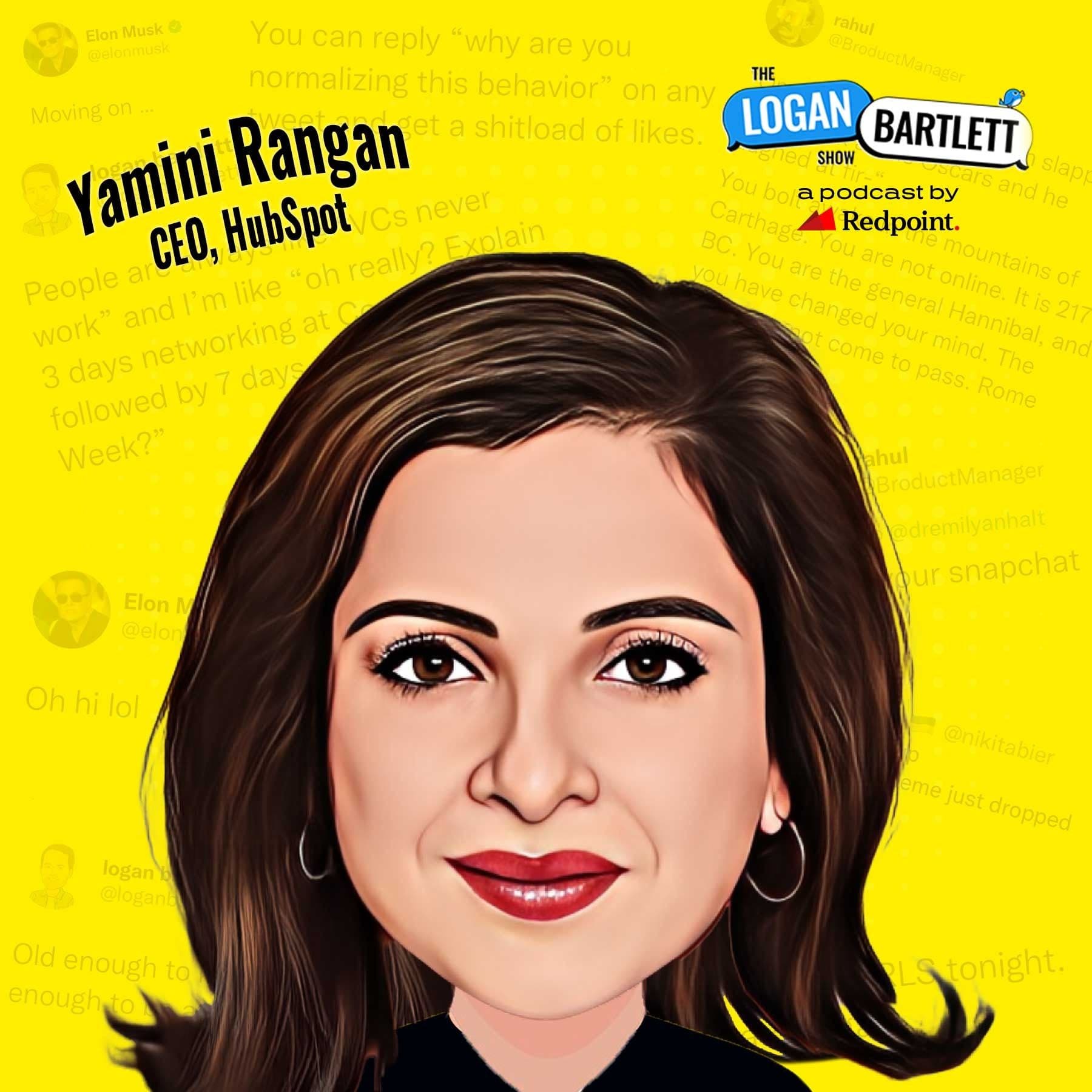
Yamini Rangan (CEO, HubSpot) On Sales and Marketing Frameworks That Win in the Age of AI
Episode Description
Yamini Rangan, the CEO of HubSpot, discusses the transformative impact of AI on go-to-market strategies, her journey as a first-time CEO, and the sales tactics she has mastered. The conversation also covers the challenges of navigating significant business pivots, such as transitioning to an AI-first business model, and strategies for maintaining competitiveness in a rapidly evolving landscape.
---
Key Discussion Points
- Yamini Rangan's Background and Journey
- 30 years in the tech industry, starting as an engineer.
- Previous roles at Siebel, SAP, Workday, and Dropbox.
- Joined HubSpot in January 2020, just before the COVID-19 pandemic.
- Transitioning to CEO
- Initial role as Chief Customer Officer focused on integrating marketing, sales, and customer success.
- Became interim CEO in March 2021 after Brian Halligan's accident.
- Full-time CEO role began after Halligan returned to the company.
- Strategic Planning and Long-Term Vision
- Emphasized the importance of a three-year strategic planning cycle instead of one or five years.
- Regular "think big" sessions to define company direction and adapt to customer needs.
- AI Transformation and Product Innovation
- AI's influence on product innovation and go-to-market strategies.
- Launched products like ChatSpot and Content Assistant to leverage AI in customer relationship management.
- Focus on differentiating features in AI to provide unique value to customers.
- Sales Strategies and Customer Engagement
- Emphasized the balance between the art and science of sales.
- The significance of curiosity and resilience in sales roles.
- Importance of understanding customer challenges and enabling their success as a path to long-term partnership.
- Evolving Company Culture
- HubSpot views culture as an evolving product that needs to adapt to changes like remote work and AI integration.
- Ongoing updates to the culture code to emphasize a growth mindset.
- Leadership Style and Management Lessons
- High integrity, authenticity, and high expectations for performance.
- Transition from an individual contributor mindset to a management approach focused on team empowerment.
- Importance of asking questions rather than providing answers to foster team growth.
- Insights from Workday and Startups
- Importance of foundational processes and data systems in scaling a startup.
- Acknowledge the value of being data-driven in decision-making.
- Future of AI and Market Dynamics
- Discussion on how AI could redefine the CRM landscape and the potential for incumbents to leverage existing data infrastructures.
- AI's role in enhancing productivity while also raising questions around pricing models for software.
- Customer-Centric Approach
- The importance of aligning sales strategies with customer success metrics, focusing on building long-term relationships.
---
Key Takeaways
- AI Integration: Companies must pivot quickly to incorporate AI into their workflows to remain competitive.
- Long-Term Planning: A three-year strategic vision is more effective than one or five-year plans.
- Curiosity and Empathy: Successful sales professionals must combine technical knowledge with a genuine understanding of customer needs.
- Cultural Evolution: A flexible and evolving workplace culture is essential in adapting to rapidly changing business environments.
- Data-Driven Decisions: Leveraging data to inform decisions will drive better outcomes in both customer engagement and operational efficiency.
---
Conclusion Yamini Rangan's insights provide valuable lessons on leadership, customer engagement, and the transformative effects of AI in business. Her journey from engineer to CEO reflects a deep understanding of both the technical and human aspects of running a successful tech company. The episode emphasizes the need for ongoing adaptation in an ever-evolving landscape, particularly as AI continues to shape industry dynamics.
---
*For more episodes and insights, subscribe to The Logan Bartlett Show.*
Written by AI. May contain mistakes. Listen to the episode to check what was said.
Transcript
Automatic transcript. May contain errors.0:28Welcome to the Logan Bartlett Show. leading sales organizations, and the strategies that she has employed when businesses are going through major pivots, including how to transform into an AI-first business. You'll hear that conversation with Yamini here now. Thanks for doing this. So happy to be here. A pleasure to have you. I think HubSpot might be my first two-time from a single company. We did Brian maybe two years ago. That's right. Thanks for having me. Yeah, I'm a big fan of HubSpot. So maybe for people that are listening that don't know, can you give a quick synopsis of your background to joining HubSpot and then your role now?
1:09Okay, super quick synopsis. I spent the last like 30 years in the tech industry, first as an engineer. I started as an engineer, built some code, then went to business school and came out of business school in 2003, three, which was another kind of very recessionary time, and joined Siebel, the original CRM company, in their sales organization. Spent a decade in Siebel SAP, mostly in sales, value-based selling, and then spent another decade across Workday and Dropbox, both before going public, all the way through public, and a little bit of scaling. So I would say learned a ton of scaling in those two companies and then joined HubSpot in January 2020.
1:59Who knew it was going to be such critical times? I joined Redpoint in March of 2020. Oh, okay. Your timing is even more. March 2nd. I think I got seven days on the ground. Seven days on the ground. I felt better now because I got like two months and seven days. I kindred spirit on this one. It's a weird time. It was weird to get to know people and all of that stuff. I sort of had some arrested development of like getting to know my colleagues. And it just, it was, it was an unusual time to start a job. It was. And it's so funny. You, you talk about to Brian, right? So I joined in January. He says, take your time, go slow, meet people, get out to different offices.
2:42And then March happens and he's like, go fast. You can't travel, get moving. What are you doing in five days? I mean, it was crazy. And people forget now because I think COVID's thought of as the acceleration that it became in the Zerp era and all of that stuff. But the first like month or something was total panic. I remember thinking like, hey, I switch jobs and now I probably won't have a job in six weeks time. Like now I'm at this new firm and they're just going to fire me. It was a lot of mental oscillation on that. And then so you joined as, what was your title when you originally joined?
3:13Chief customer officer. And you know, we have this concept of flywheel. How do you bring marketing, sales, and customer success together and put the customer at the center? And when you do, you attract customers better, you engage with customers better, and you delight customers. And we call that the flywheel. So the whole idea was that I would come in and take care of this flywheel organization and drive our next phase of growth. So you joined, there was a weird beginning and then COVID happened and it was kind of off to the races after that six week period of time. And then March of the following year, so 14 months later, you ended up taking over as interim CEO?
3:57That's right. That's right. So the first year was crazy. At the end of first year, I still remember it was Christmas Eve. And Brian texts me this article of Jamie Diamond. And the article was about Jamie Diamond had to have critical surgery. And he hadn't figured out his succession. And he talked about how important it was to have made those decisions. And so he forwards me this article and he says, if I get hit by a bus, then you're my successor. I was like, you're not going to get hit by a bus. So let's not worry about that. And that was it. And then March happened. And unfortunately, he did have an accident.
4:39So he literally says, remember that conversation? Take it on and run it. It wasn't a bus. It was a snowmobile, but it was a set, which Brian and I talked about. We'll link to that episode if people want to hear that story. But ultimately, he's doing very well today. He's doing great. But how long was he? He was out. Well, we didn't know at the time of his accident, but we knew it was going to take a few months. And our first thing was, you need all the space and time. We've got this. And so I do think that the whole leadership team stepped up. It was everybody recognizing he needed the time and the space.
5:17And then he came back, and he's doing really well. but he came back in August of 2021. And he came back and said, you had all these things ready for him. Hey, Brian, I want to run these through with you. I had a long list for him. Long list. I was like, here are all the things that you should be doing. When CEO back, here's what I need. And what did he say to you? He was like, great, do it yourself. Yes, so you became the full-time CEO then at that point in time. I guess I'm curious. I mean, not a position many people have gone through. In the public markets, right? All of this is happening and you guys are, you have responsibilities to your shareholders, you have responsibilities to your employees, to your customers and all that.
5:57I'm curious when that moment happens and you realize you're going from this interim title to the full-time title, like what is that mental shift or how long did it take to really set in that like, oh gosh, I need to drive this bus now? It doesn't quite, you know, set in that quickly. Now, I was doing it on an interim basis, and I was very clear that Brian had, you know, a long list of things that he should be doing. And you do it, you know, when you are an interim CEO and you're, you know, you're kind of caretaking. You're like, I'm not going to make any architectural changes. You know, I just want to make sure that everything is right.
6:35But then when you are taking this on, you got to look at the foundation up. And that is that takes a brief moment. And the number of stakeholders you now have to consistently manage just broadens immediately. When I came in as a chief customer officer, it was the customer partner and certainly all the employees within my team. And now you had the board, you have investors, you have, you know, stakeholders that are kind of much broader in nature. And that takes a little bit of time getting used to. And I think the fact that Brian is a visionary leader and he'd done such a great job. He'd led the company for 15 years and you sit there wondering, really?
7:18Like, I'm going to follow this. You as a CEO, you mostly want turnaround situations. You know, this was clearly not a turnaround situation. You want the bar set low so you can easily exceed it. You want the bar low, but this was like, okay, this is a high bar. So how are you going to do it? And I think the way I looked at it is I can get overwhelmed with all of those things, Or I can look at where should HubSpot be in five years? And what would I feel very proud of having accomplished for HubSpot in the next five years? So let's just go and build that. And that's kind of the working backwards is how I looked at it.
7:51And honestly, that saved me a lot of sleepless nights. So five years in the future, because it's an unusual situation, because Brian's still involved. He's executive chairman, right? Co-founder Dharmesh is still full time, right? And so you're taking the stewardship for the thing that they created while they're still around in some ways. And so I guess it was five years the right time to pick in the future. And you're like, all right, this is where we're going. And you get their buy-in on it. Or how do you sort of orient around those balances? It is a lot of balancing. And I would say that I've now, I think one year is too short.
8:32And I actually feel five years is too long. And three is about right. Because you can accomplish a lot more in three years than you think. And one year seems always overwhelming to accomplish. So I think if I were to redo it, I'd probably say three. But now I'm like, always, it's the next three-year plan. So we actually have a cadence built into HubSpot, where every Q2, we call it the think big season. and it's the strategy season. And the only thing that we think about is what are we going to be in three years from now? And how do we build towards it? So I think three years is a good season. When did you start doing the three-year plan?
9:11I mean, we've always had the strategy planning process, but certainly in the five years I have been, it's always what's the next three-year plan look like? That's interesting. Do you find you have pretty good accuracy around it or is it more the exercise? Yeah, the exercise is probably good. The accuracy is so poor. I mean, the first year we did it, we didn't know that you're going to go through huge digital acceleration. And 2021, we were talking about that. That was 81 % net new error growth. One of our fastest growing years. We were a billion and we added like 500 million to it like almost immediately, right?
9:52So no, we didn't plan for that. And then the following two years was a lot of digital optimization. People pre-bought a lot in one year. They bought a lot of stuff and then they were consuming it over the next two years. And so obviously those two years were not right. And then, you know, there's generative AI. We'll talk about it. Which I want to talk about. Yeah, I'm very interested in that. So it's none of those years are very accurate. But the fact is you have to think about where is your customer going to be three years from now? And what's the best thing you can do to serve those customers, you know, even before they can articulate their needs.
10:29And that allows you to think much more broadly. And so is the exercise itself then the reason you keep doing it despite the mixed accuracy? Is it just helpful to get the team outside of the day-to-day and the normal cadence of it? Or is it future-proofing and making sure you don't get disrupted from something orthogonally and that you're really thinking in the future of where things can come from? It is a combination of both. We run such a monthly business. It's a tight business. You're constantly thinking about what's happening this week, this month, this quarter. Sales cycles are quick. And sales cycles are super quick.
11:08So we ask ourselves two questions. What are the decisions that we need to make in order to compete better and deliver more value for our customers in the next three years? and what are the decisions if we don't make today will disrupt us in the next three years. And those two questions, when you ask it consistently, we actually take a couple of months to write prompts. And the prompt writing process actually makes us all think about both of those questions. What should we be doing and what are we not making decisions that's going to disrupt us? And we go through the process of thinking, debating, discussing, and bringing together kind of our top leaders within the company.
11:53Healthy exercise, super healthy exercise. I feel that HubSpot was at least, I worked in Boston for three years in venture. Yeah. And it was pre-HubSpot IPO, but I knew the team and the ecosystem. And I feel like it was maybe certainly never expected to be the success that it has been today. I think it was always a strong business. I think Brian and Darmusch would disagree. I think they would disagree. But I think they would say that they were underestimated along the way. I think they would agree with that. I don't think the initial investors were expecting it to be a$40 billion plus company. I guess as someone – now you're the steward of it and guiding the ship in a meaningful way.
12:38But I guess in coming in, both in the interview process of taking the job and then once you got there, what do you think as a student of business and software and all that, what do you think HubSpot got uniquely right that's allowed the company to scale to the level it has today? Yeah, look, when I was talking to Brian and Dharmesh, this was in 2019, I was looking for what were the founding principles and what were the founding insights for the company. And what is maybe not as well understood is that Brian and Dharmesh made some counterintuitive bets. And we've continued to make counterintuitive bets, insights that are uniquely well positioned for you to drive results based on.
13:21So the first one was SMB is a big market. Every single time, even now I get asked the question, are you going upmarket? Are you going enterprise? And there's just this common belief that you have to go upmarket in order to scale. And the first belief that we had is that the two to 2000 space is mid market. It's a huge market and point solutions or enterprise solutions don't serve them well. And we have a unique value proposition. That was number one. The second is that you have to be something special to become a platform. We believe that we need it to be a platform and we need it to be an organically built platform.
14:02I talked about Siebel. You go into SFA and then you acquire a bunch of things. That's the playbook for CRM companies is you start with one product and you buy your way into other products. That just creates a clunky experience for your customers. And so we had this counterintuitive belief that if you built it organically, one, you can actually speed up your organic pace of innovation because any primitive in the platform layer would benefit every one of your hubs. And two, it actually benefited the customers better. And that was probably even more important. So I think the counterintuitive beliefs, and I think the couple other ones that I really appreciated, you know, is around culture and how you think about culture as another product and you constantly evolve.
14:49You know, imagine a product that you saw 10 years ago. The UX has changed, probably the underlying data structures, the application logic, everything has pretty much changed. And it's the same thing with culture. You have to have some core tenets around culture, but you're constantly evolving it like a product. And so to me, those three were unique and some things that I believed in. And that's why I've kind of continued to double down on those beliefs and those core strategic choices that they made. So ChatGPT happens in, I guess it was fall of 22. November 22. November 22. And you had been on board for two and a half plus years, almost three years, and in the CEO seat for however you want to score it, interim versus full time.
15:38I guess when that happens and you start realizing that this is going to have big implications, what do you do? How do you become AI native in some ways? Look, it is... Remember that beautiful strategy planning process that I talked about? Yes. That process carries through. You have a plan, an annual plan, and a product plan, and a go-to-market plan. We literally came into the new year and we threw out all of that. So November, it happens. By January, you're like, we're done. Done. and we said, this is too big and we're done. And I remember having a conversation with Brian Dharmesh and our top product leaders and we're like, we're changing our entire product roadmap and we need the first features delivered as quickly as possible.
16:28And we started like experimenting and we pivoted the company, pivoted the roadmap and we said, we need to go fast on this. Our first product features were released in March, 2022. It was the first version of ChatSpot because the thing that we saw is you now have a natural language interface into everything that you do within the application. So ChatSpot was our generation one of the product where you ask a question, you can get answers from HubSpot as a CRM. And then the other thing that we launched was content assistant, which is, again, very early on, you knew that content creation, content generation and content diversification, personalization was going to get completely changed.
17:12You know, remember 2017, 2018, we were all asking the question, what's the next big thing? What's the next big thing? And the next big thing is staring at us. And you know, with AI, you can ask questions and get very different answers than ever before. You can look at the potential of the technology and you could say all of the things that you were never able to do in sales, you now can do in sales. The time it took for you to research companies, the time it took for you to discover, all of that changes. So, you know, you look at this technology and the reason all of us got excited was that we could solve age old problems that we've never been able to solve within the CRM industry with this technology.
17:56So it wasn't, you know, I describe it as a pivotal moment. Our roadmap changed, but then we didn't quite see the full potential. I think that's why I think it happens in stages. The first stage of it is table stakes, role basics, right? We can summarize contacts. We can summarize content. We can create content. We knew that was possible. But we also know that there's a couple more stages to play out. The stage that we are in with AI is differentiation. How do you create unique value for your customers that nobody else can actually do? And I think the stage after this is reimagination. You know, we always think about this and say, we're not building a faster horse.
18:40We are building a new car. How does that new car look like with AI in CRM? And that's the reimagination process. So I do think that the industry is going to go through all three phases. We are probably right in the differentiation stage right now. So it's interesting. I was going to ask you this. So there's the table stakes stage. Yes. Then there's the differentiation, the reimagination. And so now we're in this world of people differentiating with some of the existing solutions. As you think about the reimagination stage, is there something for someone that's listening that understands what CRM is, or maybe is thinking about how this is going to impact their life in a B2B context.
19:17Is there a use case or something that you think about? Like, this is clearly going to happen, and we might not be there right now, but it's going to re-imagine how we work. I actually want to talk about the differentiation, and then I'll kind of, you know, extend that to re-imagination. So when we say what gives us the ability to differentiate right now, it has to start with data. And, you know, we all know, like, structured data is what is in a CRM or has been in a CRM. You buy a CRM because you want a company record, a contact record, a customer record, and you want to have all the conversations of when you close the deal and how the deal progressed.
19:53All of that is the core thing within a CRM. And we've always been really good at that. What has changed, Logan, is what you can do with unstructured data. 80 % of the conversations that you have with customers is unstructured. It's not in your structured fields within the CRM. It's in the emails. It's in Slack conversations. It's in Zoom meetings. It's in phone calls. It's in all the transcripts. And there are new things that you can now ask of unstructured data in real time to get better insights. And we're so excited about that because we are uniquely positioned. We have 1.8 million CRM weekly active users, and every day they're generating all of these conversations and they're using this.
20:44So I think we get excited about what we can do with bringing structured and unstructured data together. But then it's more than that. The second part of the differentiation is what's the context that you can bring across these two. So imagine you hiring a new person at your company, you onboard them. And the way you onboard them is to say, this is the voice of the company. This is the tone. This is the language that we want to use. This is our ideal customer. This is our value proposition. That's, and a whole bunch more, you onboard. How do you now onboard agents without that context? So there's a context layer on top of that data layer, which is something that we believe we can uniquely provide because we look across the whole customer journey and we can connect the dots and we can give the agent all of the context.
21:38Otherwise, you're going to lead to having point agents, very much like point solutions and point apps. They didn't work. So point agents are not going to work either. So we think that there is a ton of differentiation in our strategy and how we're going to be able to bring that. And I think we also believe that the future is a hybrid, you know, workforce where it's agents and humans working together and augmenting each other to get better results. And in that world, a network of agents is really important. And that's why we have agent.ai, which Dharmesh is so passionate about. You can see him post on LinkedIn, mostly at 3 a.m.
22:24in the morning. And he's excited because the future looks like agents talking to agents and helping humans to do better things. And we're creating a very vibrant ecosystem where people can build and users can leverage it. And we want to make it all easy and simple for our customers. So there's a lot to be done in that differentiation phase. And we're super excited about it. Now, the reimagination phase, which is definitely coming up next, is what happens with all of this? I think, you know, it's we'll have to extend our imagination. You know, go back to App Store when the App Store was first created and app started coming on mobile.
23:08You had like the basic apps. You basically converted everything that was on your desktop into mobile and put it into an app. And you said, oh, that was innovation. And then four or five years later, DoorDash came about. Airbnb came about, Uber came about, things that you never thought were possible in the pre-mobile, pre-app era just happened. And that required a little bit of a settling phase. I think that's what needs to happen. But you can imagine CRM to be hands-free. And that is profound. For the 20 plus years that I have been in go-to-market, you know the single thing that I've struggled with?
23:48getting sales reps to input basic stuff into CRM. Nobody wants to do it. It's such a waste of time. Let me write to you about the customer meeting I had. Let me write to you about the conversation we had there. Nobody wants to do it. But if CRM can now listen to your emails, listen to your conversations, listen to all of the transcripts that you have, then why do you have to type something into your CRM in order to communicate to the rest of the team? So I think there's a future where it's hands-free. There's a future where CRM is actually listening to the conversations that are happening. And there is a future where we have composable UI.
24:35And that in and of itself is also profound. If you think about SaaS, it is point, click, configure. So configuration and ease of configuration was a pretty big deal in SaaS apps. I think when we think about the next five years in CRM, at least, in applications, it is, you know, composable UI. You ask a question, how's my pipeline doing? And your CRM should say, your pipeline is doing better than last week. Here are the four regional views of your pipeline. go take a look at Europe because somehow they're lagging behind in pipeline creation, and specifically look at these four teams that don't seem to be getting their job done.
25:21That's what your CRM should do. And so I do think that there are constructs of how this can really develop, but I think we need to keep expanding our imagination to be able to get there. It's an interesting point where talking about the data centricity and the opportunity you have to do a bunch of things, when you have that atomic unit, which is the customer record, whatever the case may be. One of your big competitors went on a podcast not too long ago and made the case that as we move to more of this headless CRM, composable CRM, it might make products like CRM crud databases, I think was his word on it.
26:07And I think the implication being it would be easier to swap systems than it was otherwise? I guess, how do you think about the tension that exists between maybe UI lists being people aren't logging in every day to the same extent, versus on the other end of the spectrum is, well, yes, but you have the data and the data architecture and all that, which gives you an opportunity to do a bunch of different things. I'm curious, your perspective. Well, look, first of all, I have a ton of respect for, you know, every one of those leaders. They've led the industry, they have some incredible perspectives.
26:37And I've, you know, looked at, listened to your podcast. I think, you know, it's great. I wish it were as simple as, you know, you have a CRUD database and you're just like, you know, all of that disappears. The SaaS layer collapses and, you know, things begin to work magically. That is really not the world that we are in. I don't see us going into that world anytime soon. And so the constructs of what you do need to get out of this massive transformation is, can you provide customers an easy ability to access all of their data? Can you make that interface more intuitive so that they're not asking questions, they're not coming in every day and clicking and pointing and configuring?
27:23Can you be much more intuitive and can you provide answers to help them grow? Like our mission consistently has been helping small and medium businesses grow. Can you imagine a 50 % or a 500 % company becoming prompt builders, LLM experts, knowing the difference between DeepSeek R1 and O3 and which one they should be doing? Absolutely not. What are they waking up thinking? They wake up thinking about growth And they wake up thinking about how in this resource constrained world can I grow? And if there is a technology, it needs to be easy. It needs to be simple. It needs to have fast time to value.
28:06And it needs to be unified. And all of that actually requires work. So I don't see a world where everything collapses and it just becomes super easy. There's a lot of work that we need to do to get a powerful technology like AI and democratize it for the segment of customers that we serve. And that's why it's super exciting. On the content side of things, it's obviously, we live in this world of proliferation and personalization of content. I heard you say AI-driven personalization has led to, I think, 82 % increase in conversion rates at HubSpot. How do you think about content and conversion rates and what role AI will play for HubSpot customers or any business that's sort of thinking about these things?
Read the full transcript
28:55Logan, when just AI came on the scene, everybody is like, we have to create more content. You can create more content. But when you create a lot more content, you know what it's called? Spam. It is spam. Like we talked about email spam ways ago. And, you know, if you use AI just to generate a bunch of, you know, content and throw it out there, that is spam. So we've been really focused both internally within our marketing team, but also with our customers to really drive a level of personalization and insights. And so you mentioned the 82%, which is what we shared at Inbound last September. What we did is this.
29:33When people come to the website and they look around our website and they give us the email, we didn't just send an email follow-up back. We used RAG to reverse look up which company they were coming from, what their role was, what conversations they've had, the intent that they have. And we have all of this access, right, this data. And then we looked at all of that and we said, let's use the data to then look at our academy courses and the content that we already have and personalize a response back to them. So we did that. And literally those email responses, the personalization drove 82 % conversion.
30:16So it is not about more content. It is about better, more personalized, more authentic, more insightful content. And if we can get the construct to go from AI helps us generate a lot more content to AI helps us get insightful and personalized content, then you can win with AI. And that's what we're doing internally. That's what we're doing with our content hub and marketing hub and helping our customers really understand how to win with content in this new world. Are there roles that you think about within an enterprise or an organization that you think will be far more important in the future than they are today as we sort of move on this AI-driven journey?
31:02I think every employee that becomes AI fluent will become more important than anybody who is not AI fluent. And I think every role is going to go through a phase of evolution, right? Think about support. And this is the primary use case. Everybody knows that it's, you know, AI's number one probe and high value use case is, you know, within support. very soon after we pivoted our roadmap, we said to our support organization, can you go and leverage AI to support our customers? And they did. As of last year, 35 % of our support tickets are being handled by AI. And I think we'll push the boundaries for this year.
31:53But if you take your question and apply it to support, a lot of our support agents are now doing more premium kind of support, they are doing more complex support, they're actually becoming more proactive. When they see a customer who is getting onboarded into our product get stuck in certain places, they're like, hey, can we help you with this? Or here are things that you can do. So their jobs are evolving from support to being much more proactive in providing technical assistance. And so you can imagine almost every role becoming that way. So anyone who is AI fluent is going to win in the next five to 10 years.
32:33HubSpot was built very SEO oriented, I think, and did a great job of content and would pop up anytime you did Google search. And I guess search is changing in a meaningful way. I'm curious, do you have any observations about this content and differentiation and all of that as we maybe move to less 10 blue links and more knowledge first in the world that we're operating in? Absolutely. Look, I think we talked a little bit about counterintuitive insights. One of the early counterintuitive insights we had when SEO started coming up was that you need to provide value before you can extract value and the value comes from much better content.
33:16And thus, you know, a whole set of optimization for how do you build content? How do you make it show up in the blue links was formed? Now, I think, you know, AI overviews has completely changed the game. And it's no longer about blue links that will direct someone to your website. It is about how can you be where your customers are, not just within a search, you know, because AI overviews answers pretty much all the basic questions. And if you still are the subject authority, then you become part of the answers that AI overviews give with the sourcing that then still brings you back. But it's not enough.
34:00You now need to go from, you know, search to where your customers are, and they are YouTube, they are in LinkedIn, they are in communities. And so our content diversification strategy has been a few years in the making from blogs to YouTube to podcasts. I mean, how do people consume information? By listening to you, Logan, and by listening to authorities in the fields. And I think we've built a whole podcast network for that reason. And email newsletters are still in fashion. So I think customers in this age should have a diversified content strategy, which certainly includes clear blogs where you are the content authority, but you should also be in all of the places that your customers are.
34:49Do you have customers coming to you helping inform elements of where to take the AI roadmap and any interesting lessons from some of the conversations with customers and what people are kind of thinking about and trying to push the ball forward? We are constantly talking to customers, but more importantly, we're constantly observing the patterns of usage in AI, right? Sometimes when the technology is well-established, you can just go ask your customers what they want. When the technology is in an early part of the new curve, you just need to observe and see what is happening a lot more. And a couple of observations.
35:37When customers are using AI, they're looking for intelligence. And in fact, they're okay with your AI feature thinking, analyzing, reasoning, and giving them a better answer versus what you were optimizing in the cloud world, which was just giving them information. So there's actually a pattern distinction that's happening from age of information to age of intelligence. And what is important within the pattern is the more accurate you are, the more you reason and the better your results are, the more usage that you get in terms of customers. that's a new interesting pattern because you know what for decades we've been focused on optimizing millisecond speed right like the latency was such an important concept now it's like you're used to thinking you're used to waiting for you know any of your reasoning models actually thinking and giving you a better result so that's a different pattern right now the other pattern that's emerging is that customers want context to follow them across ai features so think of like I'll say my tabs look very different now than five years ago.
36:56I have Cloud with projects open, Gemini with gems open, and OpenAI with deep research open. And every one of those, I have the context of what I'm working on in each of those. And if I'm putting a prompt in and it does not get the context, I'm like, I'm so annoyed. I'm done with it. And that's the thing that is new within AI is that the context needs to follow you. So who wants to go into every single prompt and give like a huge context window of things, right? It needs to know what products you're selling, what your value proposition is, how you communicate that value proposition, which competitors you connect with.
37:36All of that context needs to follow. And when you build in a way that context is prevalent across your AI features, you get much better usage. And then the other pattern is there are features that are just neat, and then there are features that are necessary. So we are looking, when we launch a bunch of features, we're kind of like looking at usage patterns to see which ones are going from neat to necessary. Because the neat ones are going to go away, and they're just not going to be useful for customers. But the necessary ones are going to drive repeat usage, repeat value. and that is what we want to double down on.
38:17The hedonic or the insatiable element of AI is a funny, I mean, anything I guess that we go through in society, but it's funny where you go immediately from just pure wonder and joy that AI can do these things to a little upset with it that it didn't switch context with you over the course of a couple months. It's like, this is amazing, best thing ever. And now you're upset with it. I feel the same way about flying. No, no, no. I mean, Waymo out here. The first time I got into a Waymo, it was just pure joy and amazement that we've gotten here and that society's at this point. And then I got one the other day, and it was like it didn't stop near enough to where I wanted it to.
38:56And I was like, you've got to be kidding me. I've got to walk a block to go get this car. And it's amazing the human psyche in terms of what expectations change and adjust all this stuff. But I think it's true with AI as well. It is true, right? People's expectations shift very meaningfully. patterns are emerging, which are just like absolutely fascinating to watch. And yeah, I probably shouldn't be annoyed at AI. I'm like, really thrilled. I'm like obsessed with, you know, everything has changed in my working pattern, because I have these different tabs, and I'm always asking questions. But I'm also like, no, I don't get this.
39:28No, no, it's amazing. To that, and I guess I'm curious, is there, what's the single thing that you've adjusted most from a day to day productivity standpoint, or just like, how you go about your day work-wise from an AI standpoint? Look, I have days when I'm meeting with partners and customers, and those days are dramatically different. If I'm meeting a new customer, I go to agent.ai. There is a customer research agent, and it gives me what used to take me literally hours of researching and putting briefs or having someone on the team put the brief together. You know, I go to this agent and it gives me everything that I need to know about the customer.
40:07So I'm much better prepared. If I'm meeting an existing customer, then I go into, you know, our co-pilot, like summarize the company, summarize the context, summarize all the last conversations. What were the next steps? What are the objections that these customer has been talking about? And where should I hit all of that? Like preparation. And then you go into meetings much more informed. and the preparation time has changed. The depth of conversation you can get to in 30 minutes has changed and obviously follow-ups have changed. So I think my day has changed that way. And then on everything else in terms of it, it is, I have multiple LLM tabs kind of like open and I'm constantly learning.
40:50And most of the time I'm amazed that you can take a topic and research it and honestly go to someone, let's say in legal department or finance or even product and have an intelligent conversation about it because all the basics you kind of like understand. And so the depth of conversations have just, you know, changed pretty dramatically. Yeah, deep research is getting, I haven't yet been able to use the full building block of like deep research for podcast prep or something. Yes. It's good though. I didn't do it for this episode, but I've done it in prep, just sort of seeing what comes back and how it compares.
41:36And it's getting pretty close and you can cherry pick questions from it. And if someone has a decent web presence, it's pretty creative in terms of being able to be an assistant or a co-pilot for thinking about questions or different things that are interesting. So it's, yeah, I'm trying to integrate it more. And so the productivity hacks are super helpful. Yeah. And to me, it's like brainstorming, right? It is, I want to say this way. Is there a more creative way to say it? Is there a more compelling way to say it? And how would you say, like, I've put all my podcasts and my LinkedIn posts into one project.
42:14And now if I give it some thoughts, it's actually pretty clear. It uses words that I have used before. And that's just such a, I mean, it's a delight, honestly. Yeah, it truly, truly is incredible. I'm curious. So you came up within sales with a technical background, I guess, as you think of the world of selling going forward, what role do you think feels uniquely human and that is always going to exist in the world of sales? versus what do you think can be automated or AI can play a good role from an augmentation standpoint? Prep's an obvious one, it sounds like. Yeah, I mean, look, I have always thought of sales as part art and part science.
43:04Science can be augmented and science can just get much, much better with AI. The art of me connecting with you and having a conversation and you trusting me as someone I'm selling something to you and you buy, not just because of the product, but because the value proposition that I communicated to you resonates with you. That is art, art of getting to know what the customer wants, what their challenges are, what success looks like and how you can help them with that. That is art within sales. And I don't think that can be replaced. I do not yet foresee agents selling to agents. Can you imagine an agent selling to a procurement agent and both of them are negotiating?
43:50I mean, I don't want to be there. I think it's human selling to humans, but with much more insight, with much more personalized demos, personalized discovery, personalized solution forming. And I think that is an exciting world. So you said it, like on the science part of it, of course, you can research companies faster. you can discover deeper by asking the right questions. I mean, imagine you had the agent and said, look at similar customers and all the objections and be prepared for all of this. You can do that better. You can do the follow-ups better. It's also all of the administrative work.
44:26I mean, I still remember the decade in sales where I was entering information into fields, which I never wanted to. And then, you know, as I went into management, I forced everybody to enter information to fields. All of that part completely changes over the next few years. And the art still remains. You were an accidental salesperson. Is that fair to say? Yes. But you stuck with it. Yes. So I guess what element of sales, as someone that was technically trained and thinking they're going to go into product marketing, but lands in sales, what uniquely appealed to you about it that you built a career around it, ultimately becoming a CEO, but that wasn't the direct path you took.
45:12Thank you for asking the question. Yeah, I got out of business school, wanted to be in product marketing, and I got a job in product marketing at Sebel, and then they were like, oh, go and be in the sales organization. The first job I took was a value sales engineer. There was a role, and there still is a role called value engineer, but it was about communicating the value of technology in financial terms. So I was mostly talking to CFOs back then, NPV analysis, ROI analysis, and really - Building the case. Building the case. Hey, I guess, were there homegrown systems that you were competing with?
45:50Home Act. Act used to be the system that we used to compete with. This was like well back in those days. And then obviously, homegrown grassroots, all kinds of, you know, green shoot systems. And so you're saying, hey, this is a new product. We have Siebel. But what's the ROI for you switching? And what's going to like how much close time or rep saving productivity? And what I found, you know, in my value selling days is that you can really get deep with a customer to understand their problem. I was not very good in the first five minutes of the sales conversation because that was mostly like banter and relationship.
46:31I was like, I was terrified of those first five minutes because I probably didn't watch the game that they watch or I didn't go where they were. Go to the golf course. Go to the golf course. I didn't do any of that stuff. But the next 25 minutes were about, do you understand their business? Can you remain deeply curious and ask about what the biggest challenges were? Can you then connect it to what you can offer in a way that resonates with them? And then when they buy, did they get promoted? That was like a moment for me where a sale or being in the sales organization was not about selling, but was actually about getting your customer promoted.
47:10And if you can look at sales that way, then it becomes deeply fulfilling. And I think that, you know, over that next decade, I had conversation after conversation. I was on the road. I was talking to customers a lot. And every time that clicked, every time I could connect deeply to the customer, their problems. And then, you know, six months later, two years later, they get promoted. It was like, this is it. It's such an important point that getting the person promoted. Can you unpack a little bit why that is an amazing North Star to have and how that's kind of the canonical thing that you want to accomplish as a software seller?
47:50It was, you know, I looked at quota after quota and, you know, getting to a quota is nice and it's great. But the moments I felt like I was doing something really unique was I'd go back to the customer, you know, and a year after, two years after, and that they had gotten promoted. And to me, that was my North Star. And I've tried to kind of have that customer centric view in almost every company I've gone to, because when you collectively think about customer success and their success in metrics that they choose to focus on their success and what gets them promoted, then, you know, you know, you're not aligned on in the short, just the short term.
48:40Because sometimes salespeople tend to think about the month or the quarter or their annual goal. And the way to optimize it is really to optimize it over the medium to long term, which is why that's a much better North Star. It's also like, you know, that's the way I felt much more fulfilled as someone in the sales organization. And I think that builds deeper empathy for customers. and the deeper empathy for customers then translates into the right optimization. If you know you're going to go back to the customer and have a conversation with them one year out, two years out, what decisions will you make today?
49:24It's a very different conversation that you'll have today, knowing that you will talk to that same customer a year out, two years out, versus you just sell and then you go on to the next deal, right? And it's particularly important because especially with startups, that person is taking a chance on you. They're putting their neck out there organizationally saying this is the solution. And so if that's your aspiration, not only is it a fulfilling way of going about your days that they're ultimately going to get promoted, but it's actually one of the best demonstrations that there was ROI, that the value sale actually was material in that way.
50:03That's exactly right. And when you are in the same industry doing the same thing for a while, you know that that customer is going to go into the next company. And if you've done a great job for them, helping them, then they're going to bring you into the next company and the next company and the next company. And that is also super valuable. So I think like maybe the broader point here is optimize for the longer term, you know, and do all the right things that will get your customer to be successful in the longer term and then everything else will follow. As you've continued to rise within these organizations and manage bigger and bigger teams, I know you've coached a lot of young sales reps, sales managers along the way.
50:52I guess as you look back and reflect on the people that have been most successful that you've worked with within sales, is there a certain characteristic that you think stands out the most, maybe as a through line across the people that have really worked and succeeded that you've been fortunate enough to work with? You know, I'd say curiosity is probably the number one thing. And resilience, you know, I look for that. I look for what have you done in your life where you overcame odds and where have you remained very curious to learn and grow? You know, a lot of sales folks, you know, start with their company, their product, their value proposition.
51:38And really the best ones, the ones that have the art form down, they start with, what is your business like? And what are your biggest challenges? And they get like super deep and remain very curious about the customer's business. That's an art form. Asking the right questions is truly an art form and remaining very curious and then connecting your, you're then taking the mental burden of connecting your product and your solution to a customer's problem versus dumping your entire product and the 100-page deck in a 30-minute format and saying, now you figure out how you're going to take this and use it in a way that changes your business trajectory.
52:18Resilience, I assume you can tease out examples in someone's background of when they've had to overcome something. Curiosity, I would think, is a little harder to try to interview for or figure out? Is there any way that you've found the best try to tease that out through an interview process or a case study or whatever it is? There's the simplest question. What questions can I answer for you is literally the simplest question that you can ask in the interview. And you know, it is so interesting. Some people will be like, no, I have no questions. I looked at your website. I looked at your 10K, your 10Q.
52:56I have no questions. I'm like, how can people not have questions? That is literally the question I ask. And half the times I get very thoughtful questions, and then I know they are curious, they're thinking. And then half the time I get the very basic questions that I know, okay, they've not done their work. And so there are basic things you can do. HubSpot's evolved. We talked about the culture and how it's shifted over time and being the organization that you are today. I guess, can you share more about HubSpot's culture code and how the process of actually evolving works? Thurmesh, you know, wrote the first culture code deck, and I think it's now been downloaded, I would say, five plus million times, you know, over the years.
53:44And the idea is simple. Culture is another product and needs to continue to evolve. And culture is what attracts employees, just like marketing attracts customers into your company. Culture is what attracts employees into your company. And then it's a living, breathing thing. So over the years, every time we have gone through kind of, you know, big changes and sometimes even not without big changes, we have looked at what needs to evolve within the culture code. So for example, we went through the pandemic and overnight we went from a Boston-based and in-office company to a global hybrid company.
54:26So then your culture needs to evolve around how do you have norms and behaviors in a virtual hall where you're not coming into a space and what is the expectation of how you behave and how you actually bring, you know, your strengths into that space. And that is, you know, the culture code. Like last year, we went through a fairly big, you know, shift in terms of the culture. I think we're still going to this year, we're going to go through another big shift in terms of the culture. Now, imagine AI comes in, what is forefront in the culture is a growth mindset. Because in the next five years to 10 years, anyone who can learn, grow, and get AI fluent is going to become a much better employee, a much more successful employee than the ones that don't.
55:19So we've been updating our culture code to reflect the growth mindset and the growth orientation that is required to thrive in the current world. And so the process is really ongoing changes to it. How would you describe your leadership style? I don't know. This question always trips me out. I don't necessarily think about what my leadership style is, but maybe if you ask people that worked with me. How would someone else describe your leadership style? Yes, exactly. So they'd probably say I have high integrity. I'm authentic. I expect a lot out of people. I have very high standards, but I also put in a lot.
56:01I don't expect anything that I don't put into the business or to the environment. I'm curious, management style, I heard you say that maybe initially you had something like an individual contributor mindset around managing. Can you talk about that and what you had to shift to, what you learned from it? you know, early years of being an individual contributor, what is really key is you're prepared and you have answers. And interestingly, the first time I took on management roles, I took that same mindset and went into being a manager. I was prepared and I had answers. So anytime my team would come to me, I'd be like, Logan, this is exactly what you need to do.
56:44And what would you do? You'd be like, no, I don't want to do this because I want to find my own way. So I think the first transition that I had from being an individual contributor to a manager was rough. And I had to learn, you know, two things. One, I needed to slow down. I needed to slow down to make sure the team was going to go far along with me. And that I'm, you know, I'm kind of like I have this little bit of an action bias. And so that was hard for me. And the second thing I had to learn was stop giving answers, you know, but start asking more questions. And how do you ask questions of your team so that they can think a little bit more about what they need to do?
57:29Nobody wants to be given a set of playbook to follow. They want to come to a conclusion about what that playbook should look like. And so I still, you know, I have a tasks board for me every day. But the one, you know, piece of the task board, which is always there, is daily reminders. And the reminders that I have go slow, ask more questions. And, you know, literally, I have to slow myself down every day. And I think I learned it early, but it continues to be a lesson that I want to get better at applying. Workday is known as one of the, it's a canonical software business along with HubSpot. And I think it's known, similar to HubSpot, as having a very distinct culture and strong sort of foundation around that.
58:23I'm curious, was there anything that you internalized from your time there that you keep with you and maybe that an entrepreneur listening or an executive listening could bring to bear in their own business? Look, almost every company, I've been really fortunate to work, you know, with great leaders in great companies and I've learned so much, you know, along the way. A couple of things I learned at Workday, one, you certainly mentioned that product was as important as the culture and I think they continue to do that. The other thing, I was working for Mike Stanky, who is the COO, and he's phenomenal, continues to be one of my go-to mentors.
59:07I probably go to him and ask questions. And the thing that he taught me was how to be data-driven and remove kind of emotions out of decision-making and how to recognize patterns in data. So I worked with him for many years. And, you know, he would say something like, in God, we trust everybody else bring data. And, you know, we all took that to heart and you'd go to him with data, but he would also remember a data point that you probably shared with him six months, you know, before. And so being very precise with the data and using the data accurately and looking at how you apply patterns, that was something that I learned from Mike and I continue to kind of like use that.
59:49The, maybe the, for startups, I thought one of the things that Workday did really well was even early stage startup, they thought through the core foundations of scaling a company, reasonable amount of processes, good data, good systems, a common way of getting things done. And I don't see that enough. I've had the opportunity to work in so many other companies. People ignore the basics, which is, you know, is there a basic way to get work done? Is your data in one place, you have basic systems to do the headcount process or look at your forecasting in a common way. Startups tend to ignore that.
1:00:33I would say don't ignore it too long because when you scale, and I think now the current generation, the current cohort of startups are scaling really fast. Your basic infrastructure needs to keep up. Otherwise, that is going to slow you down. And that's something that I learned at Workday. The basic infrastructure, as you think about it, What are those primitives? If you're a founder listening to this and thinking like, okay, I got, like, I want to be, I don't want to break. I don't want to go too fast and all this. Are there, are there things that stand out as examples or potential choke points that you should just get out in front of as a, as a high growth business?
1:01:15Logan, we were talking about this. The times that we've grown faster than our infrastructure, you know, you don't hire well, you lose out people, and you don't find the right customers. You churn out customers, and that eventually slows you down. So when you think about scaling, you got to get the people processes right. Do you know the kind of employee that you want to hire? Are they clear about the value proposition that you have as a company? Are you onboarding them well? Are you making sure that they are getting the right coaching in the early process? And if you can do that consistently, then you can actually scale.
1:01:58Then on the customer side, you again have to have the basic processes. Do you know the ideal customer profile is, you know, can you get one salesperson to do the job of 10? Well, in order to do that, the data all has to be in the same place. You should know which, you know, customer profile is going to stay longer and get value from you as a company. That means that information needs to be there. So I think like really asking those two questions of can you hire well and can you retain your employees well? Can you find the ideal customer profile and make sure that you don't churn them out? Those are good places to start with.
1:02:40Are there any companies or anything that has you excited outside of some of the stuff we've touched on, different company types or work trends or anything that comes to mind? You know, I literally wake up and sleep thinking about AI. Is that right? Literally. So you wake up every day thinking about AI, which is exciting. Does this remind you of any trends that you've lived through in the past? Or do you think this is more internet, more mobile, more cloud? What do you think? I oscillate back and forth. I think one of the things I think is probably when I think about mobile, it changed the world in a really meaningful way.
1:03:28The vast majority of value is captured by incumbent players in some way, shape or form. And so that being Google and Apple and large part, to some extent, meta, there are still really big businesses built around it. And that could be Uber or Instagram now or WhatsApp or Airbnb that weren't possible in the past. And I guess I don't know if we end up with multiple trillion dollar plus companies, which we had in the internet world. We had Amazon and we had Google and we had Facebook or all kind of internet vintage businesses. Mobile, we didn't really end up with any that were like mobile. You could argue maybe Facebook, but not really.
1:04:11And so I think it's probably more mobile, although OpenAI certainly seems on the path to being a trillion dollar business. At least it seems that way. But I think a lot of the value is going to be captured by the incumbents. So I sort of go back and forth. Yeah, tell me more about that. And now I'm like asking you a question. Yeah, that's great. You want to switch seats? Yeah, I would love to do this. You know, I've always wanted to be on a podcast show host. So where do you think the value is going to go? Is it like incumbents or startups? And how do you, what's your thesis? I think incumbents, if it's an existing, to your guys, and not just to compliment HubSpot, but I think that if there's data centricity for existing processes in some way, I think that the incumbent will get 15 chances and the startup might only get one.
1:05:03And so there'll be some that mis-execute on it. maybe making this up. A service now mis-executes on ITSM. And so some new company comes in. And I think there will be one of the potentially big cloud players, if I think about the businesses of your guys' scale and up, I think that one maybe will mis-execute, but there's probably only 10 of them. And so that means 10 will capture the vast majority of the dollars. And then I think there's a bunch of businesses and processes that are just discrete and totally different. and there isn't some data gravity that already exists around it. And that's where we've been spending a lot of our time in those things.
1:05:44And it could be, I mean, Brian talked about, was it service as a software or something? And so I think that was his term originally. But there's definitely a lot of service spend that I think new companies will be able to tap into. And one of the things we're seeing is when you're able to price now based on some outcome in some way, the market's far bigger than the seat-based pricing that we saw in the past. I mean, you've been following mobile and social and all of those. I lived my life through the on-premise to cloud and now obviously cloud to AI. I think a lot about the changes that needed to happen then, both in terms of the technology architecture, customer behavior and pricing, and then now.
1:06:35What is interesting is that when we went from on-premise to cloud, there was a discontinuous architecture where you needed to go from single tenant into multi-tenant. Remember those days we were talking about multi-tenancy? Is your cloud product multi-tenant? Every cloud product should be multi-tenant. We were going through that, and that was discontinuous. You had to do something new in a different architecture. But if you look at where we are now, incumbents can expand to support agentic AI versus a discontinuous thing. What do you need? You need a lot more data. Great. You can grab a lot more data.
1:07:16What do you need? Better context. Great. You can build that context. What do you need? You need orchestration across all of that, better loops with customers so you can learn whether an answer was good or not. And yes, you can build that. and you need a more reimagined UX. And so a lot of what you need in an AI-first world, the incumbents either have an advantage or can innovate quick enough to get there. Of course, it comes down to execution. And that's a given. But I'm not seeing a discontinuous architectural shift. Now, on the pricing side, again, going from, you know, maintenance and, you know, the license models and maintenance model into subscription, discontinuous, right?
1:08:05Because your entire revenue model changed because of that. Here, I do think that future pricing is going to be hybrid. You're going to have some seed-based stuff and you're going to have a lot more usage and results-oriented stuff. But again, that is not discontinuous. If you take HubSpot today, we certainly have seed base, but we also have contacts and things that are much more consumption usage base. So we'll expand the number of consumption levers that we have, but it's not a discontinuous move. So maybe my view, and I think about this every day, is there's a lot that we can do. HubSpot has distribution and speed of innovation.
1:08:47We are innovating like a startup and we have to keep executing in how we innovate, but we have distribution and innovation. We have structured and unstructured data. We have context across the customer journey and functional view and lots of advantages. Of course, execution wins. Doesn't it feel like the incumbents, and I would call HubSpot an incumbent, I would call Microsoft an incumbent, a Facebook an incumbent, like the material businesses in their category, It feels like they're also far better prepared and just executing at a higher level. And I guess I didn't totally live through the vintage of the on-prem to cloud transition, but there weren't that many businesses that survived.
1:09:30And to your point, it was discontinuous innovation and that. But there were a lot of businesses that failed that transition. It feels like on the AI side, people are a little bit more prepared and forward-leaning and they've read all the books about how to be disrupted. Totally. It feels like it's a lot better run companies. If there's a foundational value at HubSpot, it's paranoia. We wake up every day being paranoid. And I think it's actually served us well. It's been there even before this disruption cycle. Every day, we'll think about how do we serve customers better? How are we going to get disrupted?
1:10:09And so I think there's a healthy amount of paranoia. That was not there. I lived through two on-premise companies as we were going through cloud. And, you know, I had the fortune of being in some rooms where decisions were getting made. And we would talk about how cloud companies were growing very quickly in revenue. Every year we would have a competitive, you know, plot and the size of the bubble for cloud companies would get bigger. And the conversations were not urgent. and the conversations were like, yeah, cloud is interesting, but you know what? Our customers want security. They want control.
1:10:46They want to be here. I think you're not seeing any of us operate with any of the, you know, that kind of mindset. We are running as fast. And I can tell you about HubSpot. Urgency is so critical and we have multiple conversations a week about what we need to do to innovate. And so that's very different mindset. Is it because we're more interconnected societally. And so you get maybe information just flowed a lot slower 20 years ago. And so you've heard, oh, we were talking to our enterprise customers and GE said they're never going to go or IBM said they're never going to go to the cloud. And so we don't have to worry about it.
1:11:23And now there's more proof points out there in the wild and it's happening a lot quicker. Why do you think this generation is a lot better prepared for it? I think we all read the same books. Yeah. And we're all tightly connected. We all read the same books. We know the graveyard of companies that didn't transition, you know, different S-curves is filled with, you know, case studies and examples. I think we've all grown up looking at who didn't make the transition. BlackBerry didn't make the transition. Blockbuster didn't make the transition. Every one of these transitions, we've read about those case studies and they're ingrained in how we think about, you know, scaling and growing.
1:12:02And that's one. I think the other aspect is that there is true value in this. At the end of the day, you know, I don't get excited about technology unless there is a clear path for driving value and solving core problems of customers. And this is so obviously the case. It's so obviously the case that you can do things completely differently with AI in support and sales and marketing and coding, engineering. You can almost do any one of these very differently. And so the value is also very obvious. As you shift that pricing, you touched on it. It made me think of something. As the pricing shifts, do you think that ends up being to HubSpot?
1:12:48Obviously, the value will be a conversation between a customer and the vendor itself. But do you think that overall, the value that AI provides will be an uplift for revenue for all of the businesses that are able to do it well? Or do you think some element of the seat-based pricing, and maybe we talked about composable interfaces and all that, it might be deflationary in some way? You know, there's this very simple equation of P times Q. And everybody talks about, you know, if the quantity goes down, what happens to price, right? Even in a world where, let's say, there are fewer, you know, support reps doing their jobs.
1:13:34Who's doing the job? Software is doing the job. How do you price software based on the outcomes and the results it delivers? So that world has more software. And while it might be deflationary from a seed perspective, the value that you are delivering is actually higher in the future world, which means how you'd be able to monetize that is actually going to increase and improve. So I, you know, I think the world is going to have more productive people with more useful, you know, application software agents. Interesting. Well, that's that's it on my end. I don't know anything else you want to hit.
1:14:17We're good. I think we're good. Thank you. It was good. Thank you for joining this episode of The Logan Bartlett Show with CEO of HubSpot, Yamini Rangan. If you enjoyed this conversation, I'd really appreciate it if you subscribed on whatever podcast platform you're listening to us on, as well as share with anyone else that you think might find this interesting. We look forward to seeing you back here with another great guest next week on The Logan Bartlett Show. Have a great weekend, everyone.
1:14:57you
From the publisher
Yamini Rangan, CEO of HubSpot (a $40 billion leader in the CRM space) shares how AI is transforming go-to-market strategies, the key lessons Yamini has learned as a first-time CEO, and the sales tactics she’s mastered.
She also discusses the challenges of navigating major business pivots, including how companies can successfully transition into AI-first businesses and what it takes to stay competitive in an evolving landscape.
(00:00) Intro
(00:56) Yamini Rangan's Background and Career Journey
(02:33) Joining HubSpot and Early Challenges
(03:49) Transition to CEO and Leadership Insights
(07:33) Strategic Planning and Long-Term Vision
(15:15) AI Transformation and Product Innovation
(18:57) AI's Impact on CRM and Future Prospects
(28:51) Content Strategy and Customer Engagement
(37:34) Contextual AI Features for Better Usage
(38:13) Human Expectations and AI
(39:36) AI in Daily Productivity
(42:54) The Art and Science of Sales
(51:05) The Role of Curiosity and Resilience in Sales
(53:23) Evolving Company Culture
(55:27) Leadership Style and Management Lessons
(58:27) Scaling Startups: Lessons from Workday
(01:02:54) The Future of AI and Incumbents
(01:14:10) Concluding Thoughts
Executive Producer: Rashad Assir
Producer: Leah Clapper
Mixing and editing: Justin Hrabovsky
Check out Unsupervised Learning, Redpoint's AI Podcast: https://www.youtube.com/@UCUl-s_Vp-Kkk_XVyDylNwLA
🎥 Subscribe on YouTube: https://www.youtube.com/channel/UCugS0jD5IAdoqzjaNYzns7w?sub_confirmation=1
Follow on Socials
📸 Instagram - https://www.instagram.com/theloganbartlettshow
📱 X - https://twitter.com/loganbartshow
🎬 Clips on TikTok - https://www.tiktok.com/@theloganbartlettshow
About the Show
Logan Bartlett is a Software Investor at Redpoint Ventures - a Silicon Valley-based VC with $6B AUM and investments in Snowflake, DraftKings, Twilio, and Netflix. In each episode of The Logan Bartlett Show, we sit down with the people behind today’s most important startups and extract the tactics, lessons, and frameworks they’ve learned the hard way. Conversations span hiring to GTM, product, growth, fundraising and everything in between - collectively forming the ultimate playbook to make you a better CEO, investor or board member.
Tap follow and enable notifications to stay ahead of the game.