
In short
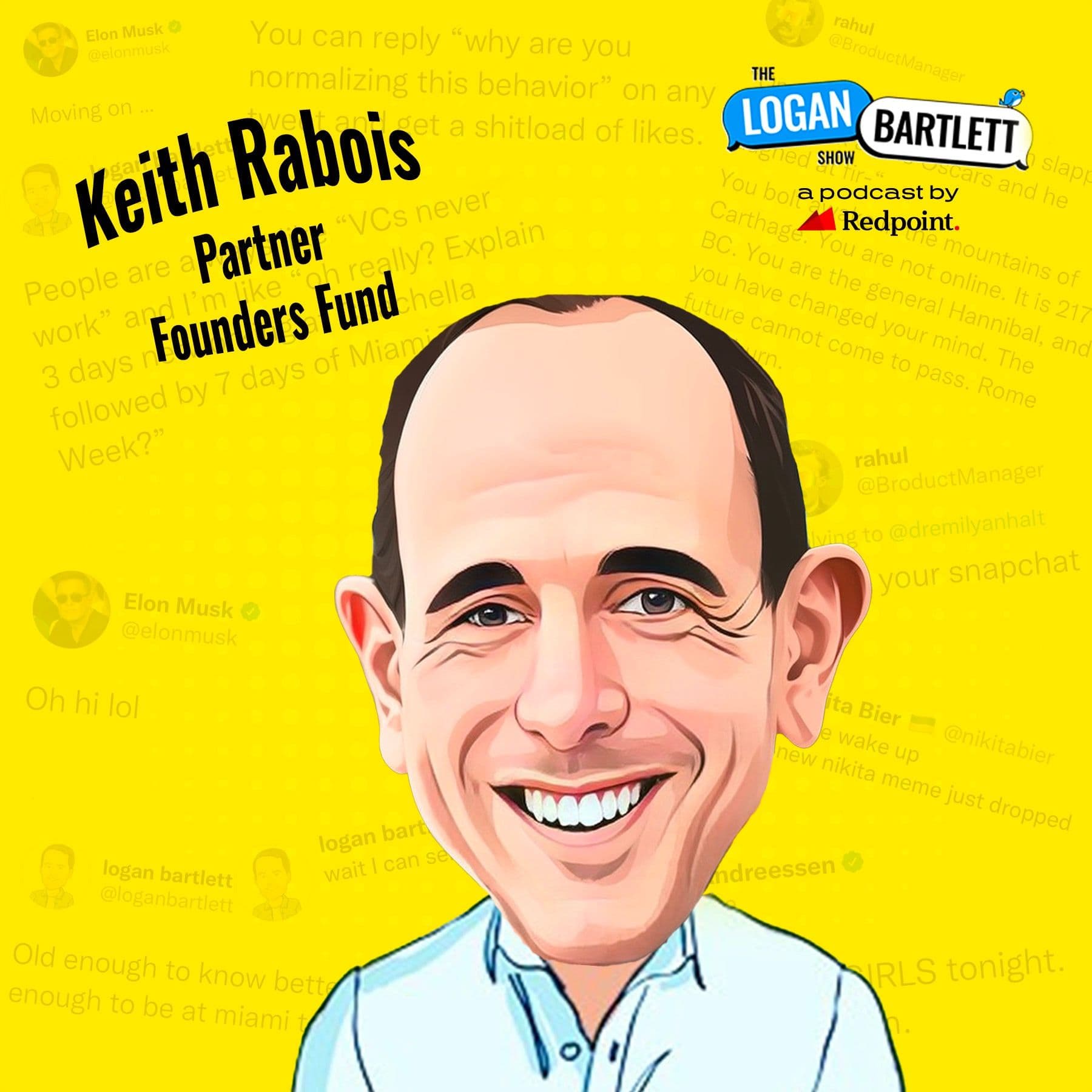
Podcast Summary: The Logan Bartlett Show - Episode 62 with Keith Rabois
Episode Overview In this episode, Keith Rabois, a prominent figure in the Silicon Valley startup scene and current CEO of OpenStore, discusses his experiences and insights gained from working with notable entrepreneurs such as Peter Thiel, Reid Hoffman, and Jack Dorsey. Key topics include Rabois's aversion to Objectives and Key Results (OKRs), his stance on remote work, and his decision-making frameworks as a venture capitalist at Founders Fund.
Key Topics Discussed
- Introduction and Background
- Logan Bartlett introduces Keith Rabois, highlighting his extensive background in startups and venture capital.
- Rabois is known for his role as COO at Square and his involvement in the PayPal Mafia.
- Dislike for OKRs (Objectives and Key Results)
- Rabois expresses his disdain for OKRs, stating that they can lead to a focus on outputs rather than fostering breakthrough innovations.
- He believes that a focus on inputs allows for greater creativity and exploration of unknown solutions.
- Decision-Making Frameworks
- Rabois discusses his frameworks for decision-making, including how to assess when to delegate versus when to make a decision.
- Emphasizes the importance of understanding the potential of the individual and the company when making investment decisions.
- Remote Work
- Rabois is firmly against investing in remote-first companies, arguing that it hampers the learning and development of employees.
- He advocates for in-person collaboration to foster creativity and community.
- The Role of a Venture Capitalist
- Rabois describes the venture capitalist's role as one of supporting and propelling founders' visions through capital and strategic guidance.
- Stresses the importance of providing insightful feedback rather than simply approving decisions.
- Metrics and KPIs
- Discusses the significance of using metrics and KPIs effectively to drive company performance.
- Rabois shares his insights on the importance of a well-structured dashboard for decision-making.
- Age Trends Among Founders
- Notes a trend of older founders being more successful, although he admits there isn’t a clear consensus on why this is happening.
- Insights from Influential Leaders
- Rabois shares valuable lessons he learned from his five bosses, including:
- Peter Thiel: Finding undiscovered talent and the benefits of focus.
- Reid Hoffman: The importance of timing in negotiations and decision-making.
- Max Levchin: The value of metrics and tenacity.
- Jack Dorsey: Design-driven thinking and attention to detail.
- The Future of AI
- Rabois discusses his views on artificial intelligence, focusing on the need for clear value creation in AI-driven products.
- He expresses concerns about the competitive landscape between the US and China regarding AI development.
- Current Trends in Venture Capital
- Observations on the influx of capital and new venture firms, expressing skepticism about their long-term viability.
- Discusses Founders Fund's strategic decision to reduce the size of their new fund in anticipation of fewer opportunities.
Key Takeaways
- Focus on Inputs: A focus on inputs over outputs encourages innovation and encourages employees to tackle more challenging problems.
- In-Person Collaboration: Remote work limits learning opportunities and collaboration, which are critical in startup environments.
- Venture Capital Philosophy: Successful VCs must understand their unique advantages and how they differentiate from others in the market.
- Age and Experience: The most successful founders are increasingly older, although the reasons for this trend remain unclear.
Conclusion Keith Rabois provides a wealth of knowledge from his extensive experience in the startup and venture capital space. His insights on decision-making, company culture, and the future of technology offer valuable lessons for entrepreneurs and investors alike.
Written by AI. May contain mistakes. Listen to the episode to check what was said.
Transcript
Automatic transcript. May contain errors.0:04Welcome to the Logan Bartlett Show. I am your host Logan Bartlett and on this episode you're to hear a conversation that I had with Keith Raboi. Keith is most known as an investor at Founders Fund, which was founded by Peter Thiel. The firm has made a number of investments, including in companies like Palantir, Stripe, Airbnb, Facebook, New Bank, Andurl, among a bunch of others. Before that, Keith was at Coastal Adventures. And prior to that, he was the COO of Square alongside Jack Dorsey and a part of what the so-called PayPal mafia with Reid Hoffman, Max Levskin, founders of YouTube, Peter Thiel, among a bunch of others.
0:44Most recently, Keith has also stepped in as the CEO of OpenStore. In this interview, we touch on a bunch of different things, including why he hates OKRs, why he'd never invest in a remote-first company, lessons he learned from working under Peter Thiel, Jack Dorsey, and Reid Hoffman. One minor disclaimer, in the second half of the episode, the audio quality cuts out due to some production issues. Really disappointing because it's a really good conversation, but we've done our best to impact it using a bunch of different tools so that hopefully it's palatable to actually listen to. The quality is good throughout, so I trust you'll enjoy this episode with Keith Rappoy.
1:22Keith, thanks for doing this. Pleasure to be back. I want to do stuff different than what you normally. I feel like in listening to some of your other podcasts, you get a lot of like politics questions these days, like wokeism and all that. I'm not going to go down that rabbit hole too much. What I want to know is, so you created a bunch of interesting, concise, thoughtful frameworks. I would add it was into your YC, which everyone said this, how to operate, how to operate, how to operate, 2013. Three of them that sort of stood out to me, and the issues of barrels, two-by-two matrix of delegating versus consequences, and then growth rate of an employee versus growth rate of a business.
1:58I thought those were... You've been in the CEO seat now at OpenShore for how long? Two years. Have you changed any of those or any other frameworks that you've had in the past as you've been back in the apparatus? Not yet. Those two frameworks are designed to answer like three very common follows, very common questions I would seek for founders. So, I'm in tech count. Why are things not accelerating? Why is our front of velocity slowing down in fact? First framework. Set the framework. How do I know when to make a decision when to delegate? it cost a question from a CEO to a board member to advisor mentor and CBR third question around how do you know which place someone how to upgrade self-wintering what offering when you hire a still a person shortly promote so I basically tried to address all the three common options I gave a couple of CEOs so I don't really have a third or fourth the fourth question and I don't know what the current fourth question is but when I call the question I try to find something I do rate as a baseline.
2:54And if you use that with CEOs so they can do a lot of pre-digesting versus constant advice every single client. Yeah. Delian also did a really concise post of his blog about a bunch of things related to this updated graphics. I don't know. I recommend everyone go look. It's version free. Yeah. In being a people-centric investor, I've ever talked about wanting people that spike in some regard, but they need to be the hero for the story or whatever it is. are there questions that you actually are able to ask to assess this, or is it a total intuitive thing? How do you think about fitting the founder to the story then in that case?
3:29How do you know what they need? So there's two different comments. One is, I think I'm looking for an extraordinary trait. The reason why is the chance, if you think about what's the likelihood that someone starts a company and reinvents the world or an industry in the proverbial garage with their college are made. Rounds to basically zero. So unless you have a trait that is so extraordinary that the probabilities shift off rounding to zero, you should not invest. So that's why I need a top 1%, top 10 basis points, something spike, or I'm not going to invest. Then you want to ask a question. The second question is, does what the person spikes on relate to the skills that are required to build this particular company?
4:10Some of these traits are transferable, like if you can recruit better than anybody else on the planet. Like if you can assess people, close people, that will apply to any company, whether you're building SpaceX or Facebook. Some skills don't translate. Like for example, if you're the savviest technologist in the history of the world, there are some companies where you could, like let's say we're doing a database company, a new novel architecture for database. Sure, that's perfect company to fund for that kind of founder. They want to do a photo sharing app. I'm not sure they can really leverage that trait.
4:37So you do ask that, but that's usually the second question, not the first. And when is domain expertise a good thing versus a bad thing. So in my view, it's never a good thing. I don't fund people with domain expertise. I do like them to be able to answer the Balaji and the Chris Dixon blog post that summarizes it, intellectual maze question, which is Balaji, when he's teaching startup engineering at Stanford, had this great paragraph that explained how the most amazing founders can walk you through the roadmap from where they are to super success and know how to avoid the pitfalls, trap doors and navigate.
5:07And when you hear the clarity of a roadmap, it's extremely rare. It happens once a year or so. That's a reason to invest, maybe independent of the traits. But the traits that are exceptional plus the intellectual roadmap is like a home run. It's like instant investment. Here's your money. Do not pass go. You don't have to meet my colleagues. Here's your money. Please, please, please do not take any more meetings. That rarely happens. That can be based upon some experience. So, for example, one of the founders we work with in Miami, before he left Uber to start his company, had been a warehouse supervisor.
5:43before he went to Uber. And he started a labor marketplace that connects workers to light industrial warehouses. So the fact that he'd started his career out of college as a warehouse supervisor was insightful. But it's the other traits about this founder that make him extraordinary and a top 1 % founder on the planet. And is there, if not in the founders, at some of these companies, you need domain expertise brought in so that you don't fall in. So you can borrow it. This is the trick. You can always call up people with domain expertise and ask them questions. They're actually pretty happy to talk to you usually.
6:16And then you just say, why can't this work? So the question I always ask when I do diligence, like let's say I invest, occasionally invest in some pretty deeply technical things like autonomous driving or genomic sequencing. So when I call up experts, what I'll ask them is, tell me why this can't work. I don't want to know whether it can work. I want to know metaphysically, point to something that will make this impossible to solve. And if they can't articulate a specific blocker, then I'm pretty comfortable backing a world-class founder to try to solve it. I've heard you say that the most successful founders are trending older than they were in the past.
6:51Yeah, we've observed at Founders Fund that there's about a five-year shift on average of the most successful founders in the, let's say, median age over the last five years. We have no agreement internally on what the root cause of that shift is. Do you have a theory? I actually don't have a great theory. I can walk you through some proposed hypotheses, but I think most of them are confounded by the actual data. So, for example, some people think it's cultural. There's different influences, et cetera, et cetera. Some people think it's like this entitlement and wokeism and all this other stuff.
7:19I don't think that really drives. Some people think that the businesses are more enterprise, which requires more experience than, let's say, maybe a consumer. I don't think that's actually true. I think most of the logical hypotheses are defined by the actual data. So I'm not at all convinced of a theory that works. And so it's more descriptive than prescriptive for me right now. Now, you've stepped into more of a firm management, as we touched on earlier, and developing young investors, setting firm strategy, all of that. I think that was, at least Delian said, with KB, you were more IC-oriented, sort of eat what you kill.
7:53And now it seems like you've taken on more of a firm initiative setting. Is that? No, I wouldn't say that. I wouldn't agree with that. I think that one of the keys in venture is grooming more and more talent because it's a 10, 20-year journey. And you need to replace yourself. I don't think venture capitalists age very well. Like, there's a point at which you improve and there's a point at which you start decaying. We can talk about why and where. But so I think you always need to be consciously aware of how do you get more talent into your firm and how do they learn by osmosis to be world-class investors.
8:25So at KV, I hired several people, Delian included. I recruited Evan Moore to KB like three times to try to add to the talent at KB. So I don't think that's accurate. Maybe just because of my profile, I may get more inquiries from other up-and-coming investors that want to join us, and they may route to me more frequently, so I may interview them or assess them more. But I don't think it's a conscious strategy. How do you think about setting a founder's fund strategy for the next whatever it is and influencing where you're headed as a firm? Well, the way we generally do it is the GPs debate a fair amount.
9:02We meet, let's say, every quarter. We do an offsite. But the GPs will debate what do we want to do differently or better, or what do we want to amplify or not. So that's basically how we work. And decisioning, how do you actually think through making an investment decision as a group? The historical way we've worked at Founders Fund, which is pretty different than most VCs, including at KV, we have voting thresholds. So for different size checks, you require a different level of support from different colleagues. So let's say you wanted$10 million. I translate to our voting rules and know how many people need to approve that.
9:35And we'll introduce the founder to the requisite number of people, or the people I think are differentially likely to approve. At the KV, we would do more like a traditional partner meeting on a Monday. Team would come in and present, and then we'd have a dialogue debate after and decide whether to approve an investment in what terms. What characteristics have you found in the good young VCs that you've been around or you've worked with? Well, there's not that many of them, by the way. I think one of the fictions of the 2019 to 21 era was venture is easy. And so people thought that entering venture early in your career was attractive, lucrative, and potentially easy from a lifestyle perspective.
10:13And it's none of those things. Venture is a really hard business. To be successful in terms of driving true returns and distributions to the LPs and to yourself and your colleagues is pretty rare. It's about the equivalent of being an NBA all-star. And to be a consistent NBA all-star is pretty rare. And so I think now there's very few people that are young investors, qua investors, that are actually truly driving distributions for their LPs or for themselves. So I don't know what the formula is. I wish I did. It is something we actually discussed, like what's the formula for a future great VC?
10:48But it's a little bit like trying to predict who the next Steph Curry is. Steph Curry didn't look like the Patrick Ewings and Elijah Wands and Moses Malones, nor did Charles Barkley, actually. And, you know, so you're trying to figure out where the sport's going and try to project what you want to hire, recruit, train for. And so when you bring in someone like Sam Blonde joined recently, which he was a CRO of Brex and Zenefits before that, right? And so when you're hiring an operator that hasn't done investor before, are you doing the same assessment of where they spike? Is it more of a holistic liberal arts assessment?
11:25There was a couple of dimensions to hiring Sam. One was he had a pretty significant angel track record. So that is a good proxy. It's not a perfect proxy for venture, but it's relevant. But B, as a byproduct to that, he also had referenceable CEOs who are in our portfolio that we respect deeply. Let's say Parker at Rippling, for example, that worked with him very closely. So that's a good proxy. Like, would you differentially take money from this person? That's the answer you want to hear from founders is, yes, I would prefer to work with this person versus the rest of the world. So like having a repertoire of people you've served very closely with that are very close to us that we deeply respect is a good proxy.
12:02So angel investing plus CEO respect are pretty important predictors. What do you think about the firm brand, Founders Fund specifically? How much of it is something that is set at a top-down versus the totality of the people that work there? Are there elements of both, or how do you sort of think about it? I think we'd like it to be maybe set a little bit more top-down, but what it's become is kind of a bottom-up evolution. So I think the brand now stands for being courageous, having conviction, being direct. I think we can add some things on top that are conscious, intentional. But right now, I think that's the manifestation is people want to work with founders fund because when we believe in something, we'll support it.
12:44We don't care what other people think. We will fund things that other people might not want to fund. And we will take the proverbial contrarian stance that later becomes a consensus view. Think Anderil. So, you know, my partner Trey co-founded the company Anderil to propel the United States forward in defense technology by using the classic tools of technologists and then allowing the United States to compete in the world. At the time, nobody else in Silicon Valley would have funded this company, period. Now, because of some of the changes in the world and the success of the company, there's lots of investors that chase after the company, but that's years later.
13:20So we're looking for areas where at the time other investors have blind spots, intellectually, ideological, maybe by founder trait, like you can think about Parker that way. And then we'll take a conviction-based, courageous investment. And then later the company and the founders become successful in everybody else's view. Speaking of contrarian, you guys hired a crypto partner, right? Right. Which it's been amazing to me how many people were so dogmatic about crypto investing and then pulled back versus actually leaning. Like if you believe this stuff, this should be the best time to invest. Right.
13:55That's the internal thesis. So how did that how did that actually come to be? And because crypto, you guys held Bitcoin for a while. That was public. But you weren't as involved in other. We follow the historical view of Founders Fund going back to, I think, 2014 even, was most of the alpha in crypto could be obtained by buying Bitcoin directly. And it had the liquidity advantages go in and out, you know, opportunistically versus obviously the company. We don't do that. Even if we wanted to, we probably couldn't. So fundamentally, crypto investing in Bitcoin was a very successful set of investments and maneuvers by really Napoleon and Peter for the most part.
14:36over time, we developed some views that there might be alpha in specific companies, and that we weren't perfectly set up to capture that alpha. So we wanted someone who would help us if there is alpha in crypto oriented companies, how could we make sure that we would capture disproportionate share of that alpha? What do you think a lot of money has been raised over the last 2019 to 2021, 2022, whatever you want to call it, a ton of venture firms popped up, a bunch of People raised a bunch of money. What do you think happens to all those new venture firms that were founded? I think they're in trouble.
15:10There will be some that break through. I mean, I've looked at the list of what I consider to be the top venture firms. Who do I compete with for real? Who produces returns that are real? About half are new over any decade. About half are the same. So there's always been a velocity of change. Half the funds right now that are pretty good, I suspect, were created post-2005. And the other half have been around for 50 years. And so I think there's always some refresh rate in variability in venture. But it's not going to be easy to break through. And raising too much money is definitely not the formula.
15:43As you know, we announced a year ago a$1.8 billion venture fund. And then we decided to cut it in half and make it an$800 million venture fund. So we're voting with our feet that the opportunities are not going to be vast, that too much capital is not a good thing for either founders, companies, LPs, or GPs. And so we literally slashed in half a fund that was already raised. And how did, I expect more people are going to follow suit with that. I think they have to. I think LPs definitely, it definitely resonated with LPs. They were appreciative of it? Oh, of course. Like we're going to produce significantly better returns for them.
16:21And, you know, because we don't rely upon management fees. At the end of the day, we are very light on the management fees and compensation. And we have significant potential and upside and value creation, just like a healthy startup should. And so LPs like the alignment where we're only going to make real money if we produce real carry, which is a function of real returns to them. I want to go through some quick hitters here. So I'm going to transition a little bit. But I think you've had five bosses in your career. Is that right? Yeah. Here's the list I had. Peter Thiel. Peter Thiel, Reid Hoffman, Max Levchin, Jack Dorsey, arguably Vinod.
16:56That's the five I have. He wouldn't describe himself that way, but yes. Can we go through each? Well, I guess first, what do you think? I mean, those are all opinionated people, big personalities. What do you think, as a compliment to those people, what do you think you do particularly well that's allowed you to sort of resonate with big personalities? I think the most important step early in my career was to implement their ambition and their vision. I didn't have an alternative ambition and vision. It was like, make them successful by using the skills, traits, characteristics, levers I knew how to deploy.
17:27So I think that's being a compliment to a very strong-willed, visionary founder type. that's required. I think secondarily is to understand what, absorb the brain as much as possible. So I learned this actually as a law clerk of all things. My first job at a law school was to work as a law clerk for an appellate court judge in Texas on the Fifth Circuit. And the way she sort of explained the job to me on day one, my first professional job in life was, your job is never to let me make a mistake. And I took that very seriously. And I've always taken it very seriously. My job is not to let the person I report to make a mistake.
18:02Whatever I have to do. However, I have to persuade them, I have to go find new data points, marshal different arguments, figure out how to, because a mistake by the leader is potentially catastrophic, certainly has asymmetric downside. So I always blame myself when the decision, the outcome, isn't what I wanted. It's not Peter's fault, or it's not Reed's fault, or it's not Max's fault, it's mine, because I didn't persuade them correctly. And so I think taking that with me allows you to pair very well with visionary, ambitious founders. We've talked about lessons from Peter. I want to go through quickly best lessons you learned from some of these folks.
18:35So Peter, I think we've hit on a few, but anything in particular that we didn't touch on? Oh, yeah. I mean, I basically quote Peter every day. Yeah. And often remixes, to be fair now, I've taken a lot of his views and slightly remixed them to make them my own. But just like in music, a remix can be arguably better. Sometimes it's worse, sometimes it's better. So I'm hoping I'm getting the Glantus remix of Kygo, not the worst version. But so, yeah, Peter taught me you have to find undiscovered company, undiscovered talent. That's how you scale companies. Be the weakness of general managing. You want people who are excellent at their craft and you want to promote them.
19:09So a lot of philosophies that I apply all the time, the benefits of focus, allocating time, people systematically undervalue their time and happiness is another Peterism from 23 years ago. So I applied those literally daily. Did he, are those derivatives from some other, I mean, everyone's sort of remixing some concept for standing on the shoulders of giants, but what has allowed him to come up with so many different frameworks and ideologies? I don't know. I actually think most of them are fairly original. Maybe they're pithy, succinct distillations. Peter's really good at taking a lot of data points and describing it, describing a lot of data points in a really succinct, powerful, explanatory equation.
19:49it. Simplifying complex things is when if someone can't explain it to me, it probably means they don't understand it. Yep, that's always true. Like when I also learned to law school, I had the benefit of taking constitutional law with some really good professors, including Charles Freed. And he basically said, all complicated arguments are wrong. Right arguments are always simple. Reed Hoffman. Reed taught me the benefit of two things. The decision-making framework that I mentioned of not falsely equivalating using pros and cons. Don't weight everything equally. And then in negotiation, specifically the dimension of time.
20:24So when you're negotiating, most people focus on economic terms and other pieces of the puzzle. But time can be your friend or foe. And how do you use time to affect other terms is something that's very subtle, but very, very powerful. What about Max? Max taught me a couple of things. The bottom up, how to use metrics and KPIs to really drive outcomes. Secondly - By the way, maybe talk about dashboards and how that relates to that. Well, that's another whole topic. I gave a speech on, the first I was invited to present to the Coastal Ventures CEO Summit before I joined as an exact, was to talk about dashboards and how to do dashboards properly, which doesn't sound scintillating, but I turned it into a talk that hopefully kept most CEOs' attention.
21:07But anyway, so I'm a big proponent of dashboards in that you want to orchestrate the dashboards as CEO or COO by yourself. Like literally go to whiteboard and write out the business equation and then make the dashboards reflect that and use that to drive decision-making across the organization down to every single person, including CSRs. And if you don't do that, you can't expect them to make wise decisions. You're going to just get frustrated. Anyway, Max taught me the benefits of tenacity. Max is one of the most tenacious people on the planet. Also subtly taught me the benefits of fitness. Like when I was working at PayPal, we'd worked really hard, but Max would go for like a three mile run basically every day.
21:40And I remember looking up to the co-founder CTO and saying, if he has time to run, I'm going to run. And I'd also try to shadow him. The problem was in shadowing Max on a run is he easily runs like a six minute mile, like very easily. He can run 430 probably. I can't. So it wasn't the best, but it was aspirational. But yeah, Max Dobby also benefits of certain technologies that I didn't have an appreciation for. Once in a while, I can spike on, there's a new technology which has certain characteristics that can lead to a breakthrough in business. And I didn't know how to do that kind of analysis in my brain.
22:15And he taught me with one specific illustration around Flash in 2003. And then I applied it later to other technologies. Which led to your investment in YouTube, right? It did. It specifically led to the investment in YouTube. Max told me to look for something based on Flash in 2003. In May 2005, I found Javed Kareem, who co-founded YouTube. And the first question I asked him was, is it coded in Flash? He said, yes. I was like, we're off to the races. Jack Dorsey. So Jack taught me literally how to do design-driven thinking. So I've been an Apple fanboy for all my life, literally since eighth grade.
22:54but there's a difference between like reading about Steve jobs and Apple and actually understanding what design driven thinking really means that every deep crafting every single detail paying attention to every single detail and how to scale an organization so that's the most important thing the thing that makes Jack so powerful is he actually is a first-rate designer a damn good technologist and a first-rate business person and that that combination of all three people maybe it doesn't exist uh Max is actually a first-rate business strategist and a first-rate technologist, even that Venn diagram is extraordinarily powerful.
23:26By the way, this is the other founder answer. The third founder answer for me is combining two things you don't see together. So a first rate salesperson and first rate technologist, I'd invest in that. Almost never happens. Like I remember this first rate technologist, first rate business person, description of Max, Reid Hoffman articulated this to me, January of 2001, that that's what was going to make Mac special. He's like, there's five people all of Silicon Valley who have that trait. And what about Vinod? So Vinod is a technology visionary. He can immediately see a new technology and feel like almost intuitively all the ways it can be levered to change business equations.
Read the full transcript
24:07And it's extremely powerful. But the most actionable piece for me, because I'm not a technology-driven investor, was when he's on the board of Square, he pointed out to me this adage, the team you build is the company you build. And you can get distracted in everything we do around products, technology, but it all comes down to the team. And that adage is the most important, succinct way to communicate it. It's always about the team you build. Because we talked about the node and we talked about YouTube, and you would have a unique opinion on this as a former lawyer and IP licensing rights. What do you AI these days?
24:44But I guess, what is your perspective on AI these days? Also, there's a fair use debate going on about all the training. Do you have an opinion on that? Well, let's decompose this. Actually, so let's talk about the YouTube example. This is a really good illustration of the question you asked me about why me. So I was able to do the IP analysis in my brain for YouTube and then literally walked Sequoia's outside counsel through the analysis on behalf of the company. Which is what everyone was scared about. Everybody was scared of YouTube because of IP. And I had been partially an IP litigator. And so I knew how to do the analysis and was comfortable taking risks.
25:20It was a probabilistic assessment, but I mostly got it right. There's one little thing I screwed up. Background music? Yes, background music. Yes, definitely. There's a separate licensing scheme that doesn't work like the rest of IP law, which is really annoying, but I sort of forgot about it. And that's why YouTube had exposure there. So this is kind of recursive. But I had a very specific reason. I also had worked with all three of the co-founders at PayPal. So I had unique people and an intellectual IP background that allowed me to make a diligence assessment without having to call some external counsel that has the wrong sort of risk appetite.
25:54So that's a good illustration. On AI, my question on AI is not, is it transformative? Not is it revolutionary, blah, blah, blah. It's like, where's the value creation? Because that's what I do for a living is try to find things that are going to capture the value. People use metaphors like mobile. Well, most of the mobile value is captured by Apple. So if OpenAI wants to ship a device or Microsoft that's powered by AI, I can see that capturing a lot of value. Some people use AWS as a metaphor. Okay, well, all of the large institutions captured value in cloud computing. Well, that may mean that startup funding in AI might not be that great.
26:30But the way I approach AI as an investor is I'm looking at products. I'm always looking at products. What's a value proposition to a particular set of customers? AI is the magic wand that enables you to deliver a value proposition that would have been impossible before. And so I want to find founders who want to create unique products, and they know how to use the tool of AI to deliver a unique product experience or an economically affordable one that would have been actually impossible. Think your proverbial why now slide. The why now slide is I can use AI to do X, Y, or Z, but the X, Y, and Z are completely independent of AI in the sense of the customer experience.
27:03Customer doesn't know this is AI X, Y, or Z. So that's what I'm looking for personally when I invest. From an IP perspective, it depends exactly what you're using for what. Like, you'd have to give me a specific, like, this company's going to do X. I guess an interesting one. I mean, certainly we're seeing it play out in real time with Grimes and Drake and all that stuff, which I think is pretty clear. Like, I feel like that's pretty. Now, the training on top of Reddit data or Twitter data or whatever, a bunch of things that are controlled by a company in some way, but is being used to then train on top to answer questions that are abstracted away from the underlying data.
27:40I guess, is that a fair use thing? I think there's a strong argument for fair use there. The weakness in the argument, insofar as there is a piece that's the weakest, is if they're training on the entire corpus, typically fair use works better when you're taking a snippet of something and when you're using the entire collection, you can run afoul of some of the ingredients in the analysis. But I think more people would be comfortable on the fair use side because you're obstructed it away so much. That said, there is a concept of a derivative work. And you've got to be very careful that depending upon how it's used, it could be closer to a derivative work versus a new work.
28:18So anyway, it's more complicated. I think you're right. The music stuff is actually pretty easy. Do you think there's an existential risk that we face as a country with artificial intelligence in China? Yes. I knew China would get you. The biggest competitive threat from an existential threat to the United States in my lifetime is with the CCP. The biggest arc of that competition is going to be through AI, both for economic leverage and for military application. It has actually a combination of both. And we are behind in several dimensions. A, they have a bit larger training set, just more people, less privacy.
28:54More data makes things a lot easier. You don't have to have as good a mouth if you have a lot more data. like order of magnitude, two orders of magnitude, more data, trade that for math. Secondly, they absolutely have better chips than people realize. So you need compute power, computing abilities. They have some pretty cutting-edge chips that have not been appreciated. I didn't really appreciate it until relatively recently. Third is the organizational structure that leads to success in AI may be driven by some brute force, like large organizations with brute force. That's not the typical Silicon Valley style management.
29:25So it may be at a competitive disadvantage there too. Those three things are very dangerous because if we lose this war, the United States is going to be very much in jeopardy. You said a year ago when we sat here, Miami Tech Week, San Francisco is the next Detroit. We've seen some reinvigoration with artificial intelligence energy in the last few months. Have you changed that opinion at all? No, San Francisco is the next Detroit. You can look at crime statistics, vacancy statistics, homeless statistics. I see the governor's sending in federal troops or sending the National Guard or something, which actually sounds like Detroit.
29:58The only thing that would make it more Detroit is like riots to the National Guard. And then we'd actually look like 1960 montages. So, no, it's getting worse, not better. I think you can see some trends in the South Bay that might be a little bit better. I think there is a bit of resurrection around energy about company building that's real versus entitlement versus woke, you know, in the pockets like Mountain View and South. So maybe slightly more optimistic there. But of course, that's also a lesson of history. San Francisco, as the epithet of technology, wasn't really a true story until at least 2010.
30:33All of the technology companies that people remember were built in the South Bay, not San Francisco. And it's only like the modern Square, Twitter, Airbnb that were SF phenoms in that relatively recent era. So I think it's an anomaly anyway that San Francisco is equated with technology. How is Miami trending these days? I've seen people on Twitter claim that there are certain people moving back to San Francisco. Every time I see someone tweet that someone moved back from Miami, San Francisco, I'm like, name a single person. And they never cite a name. I'm like, I don't know a single person, socially or professionally, that moved from the Bay Area that's went back.
31:11Single person. I'm happy if anybody tweets a name. That'd be great. I do know people who've come here from New York and been back for whatever set of reasons. and maybe some other GOs, but I don't know anyone in the Bay Area, but it'd be like, yeah, it's like, do you want to like step for the next 10 years and be in misery or do you want to be happy? When people move to Miami, they are inevitably happy. So for example, 60 % of the Teal Fellows are in Miami this week for their reunion, 10 year reunion. And most of them actually had not been to Miami before. I went to an aggregation, a party sort of thing, Saturday night and talked to a lot of Teal Fellows, probably talked to 40 Teal Fellows.
31:47my uniform that's takeaway was wow they're being blown away by Miami in the first 24 hours that they're on the ground and I've already persuaded about five or six to cancel the return flight that's pretty good for you know two days in Miami yeah no for sure I mean listen I love coming down that's my metric for tech week by the way so what fraction of people here come as the magnet is tech week and what fraction cancel the return flight what's what's your most contrarian view today It's a great question. Actually, I don't have a good answer, and it's very embarrassing. I got asked this at the Teal Fellow event, and I'm super embarrassed by this.
32:18All my views that I've had are out there in the public domain, and I think most have been validated by history. The idea that remote work was fiction, I think, is more conventional. The idea that the coronavirus was not a byproduct of some bat biting some random person in some wet lab is almost surely true. which Bloomberg dismissed as a fringe theory only a year ago. The idea that the markets were overinflated and were on the precipice of a 1999-2000 collapse has obviously been true and proven. So I have to come back with new ideas. The more interesting version of this is how do you get these new ideas, perhaps.
33:02And so what I tend to do is I like to read books, like real books. And by reading books that other people don't read, you spark, you encounter new anecdotes, new data points and new ideas. And then there's kind of combining your brain often when I'm sleeping in the middle of the night to be a spark. And that spark is something that creates the next contrarian idea. What's the single most impactful book to you over the last, whatever, 30 years? To me is a little bit different than the single most impactful book. I highly recommend the upset and stress about, it's all about why the benefits of stress, The challenges of stress are good for you physically, emotionally, health, financially, and from a health perspective.
33:44It's very counterintuitive. But I already believe those things. The book is just a manifestation of evidence that I can give to other people. The most impactful to me, that's a really good question. Most books that really resonate with me are manifestations of things I already sort of believed. Professionally high output management for the first 15 years of my career in technology. I re-read it at least once a year and always learn new things, always wound up underlining new sentences because I appreciated them differently based upon my new experiences. So that was probably pretty influential, actually.
34:18Speaking of contrarian views, what's the biggest misconception of open doors business today? What would you say to short investor or people that don't believe in the business? Well, some people think it's unprofitable, which is ridiculous. Like if you look at it's in live in 52 markets. And with the blip of maybe one quarter when interest rates spiked all in the same quarter, the company has been profitable for 22 of the last 23 quarters, I think, or something like that. And in 47 of the 52 markets, the inventory looks pretty good right now. I mean, they're going to do an earnings on May 3rd. So we'll get the latest update.
34:52But I think there's some misinformation, actually, truthfully out there. Secondly is I think that people don't understand. I think it's actually been good to go through kind of a housing crisis. Once the company gets through it and shows that it can navigate it well, I think it'll get disproportionate credit. Square went through something like this. Tesla sort of went through something like this. Amazon went through something like this 30, you know, 23 years ago. A misappreciated business. Eventually, you know, the metrics line up. People have to, you know, realize and recognize reality. A top-down perspective on OpenDoor is simply, it is impossible to fathom that in all of the trillions of dollars of residential real estate that goes on in the United States, that the largest market cap company is going to be at$10 billion, which is roughly where Zillow is.
35:40That just doesn't make any sense. You're a frequent user of Twitter. Are you friends with Elon? How would you characterize it? You used to work with him. Well, he was on the board when I was at PayPal. I've considered working with him at SpaceX back in the day in 2003. So you've known him for a long time. What's your opinion of Twitter right now? I like Twitter. I use Twitter. I think, you know, as I said on stage recently at a conference, he's making all the right enemies. So I use the Lincoln adage to judge people. You can judge someone by who their enemies are. And since all the people who are most wrong in the world and most evil hate him, he's doing a great job.
36:13How do you use Twitter? Like, what is your intent? Besides, you know, you do a good job of using your platform for companies and whatever. Sure. The original use of Twitter for me was just like a custom New York Times. Like I used to read the New York Times on Sundays. And so I created the right people to follow in sport, politics, and technology. And I would then be able to wake up in the morning and track what was going on in the fields I care about. And so that's how I used it. I didn't actually use it as a broadcast mechanism for a very long time. Then when I joined Square, I started using it for customer feedback, meaning I read every single tweet about Square for two and a half years.
36:47And I'd retweet some to help the company amplify its message and story, which actually helped raise venture capital, truthfully. This was before it became cool to do this. And so VCs weren't quite as savvy about this. But that's how I mostly used it. And then I would typically only use it for broadcast around sports because I was a big sports fan. And so I figured that was safe, you know, running companies. I could talk about sports less controversially. It wasn't until I became a VC that I started using it more to proselytize. And I used it to proselytize because I realized I had a platform. I had a lot of followers.
37:16I had over 100 ,000 followers. And I didn't want to wake up at the end of my life and say, I have this platform. I had the ability to influence people remotely that I'll never meet. and change the world and impact their views and not have taken advantage of it. And it was actually refreshing. At the same Teal Fellow party, I had a couple of Teal Fellows come up to me and say, thank God you tweet what you do because it's helped reshape my brain around X, Y, or Z. So that totally justifies the effort to proselytize ideas. But mostly it's because I know I have the potential to impact people and I don't want to regret living my life without having been able to try to influence people.
37:50Have you ever regretted anything you've tweeted? Yeah, I mean, mostly because of the distraction. Meaning, like, I think most of what I tweeted or all of what I tweeted is accurate, or I wouldn't have tweeted it. But there are times when either you slightly miss say something or you step into a landline, and then the rest of the day, you kind of have to respond to it. And like, look, I have things to do. I have a company to run and investments to make, meetings to take. And so once in a while, I'm like, oh, shoot, you know, is it really worth like three hours of distraction to have done this for whatever upside?
38:19You do meet founders this way. founders are really happy about your willingness to defend their company. Every company struggles at some point. And having VCs, people with presence on Twitter that are willing to defend the company when the company is under pressure. I did this with respect to DoorDash when people are like, oh, DoorDash is never going to be more successful than New Reeds. Or DoorDash is never going to make money. So leaning in and helping crystallize the true story can be very valuable to companies, but the distraction isn't always worth the cost. So I've been more guarded sometimes now about like, oh, this week I'm really busy.
38:54I don't have time for two extra hours on like Twitter debates. Yeah. One that I wanted to ask and we can answer if you want, but you overlap with Bob Lee at Square. Yes. And he had moved to Miami. He did. How will you remember, obviously tragic events that were still sort of unfolding. What would you like people to know about Bob? I'll give you some unique, I'll give you like unique insights. Like obviously, you know, lots of other people will comment that knew him better, you know. But two Bob anecdotes. One of Miami one is to show you how Miami was really tracking. He literally moved here and texted me after he signed the lease.
39:32Like I had nothing to do with moving him here. He just texted me like I signed the lease in Edgewater. So that's when I knew Miami was really working was like, Bob moved here proactively without my involvement and texted me after the fact. Okay. Second, a kind of better anecdote was Bob Lee actually hired Delian. The engineering team at Delian, when Delian interviewed as an intern, had rejected him. The recruiting team actually sent him a rejection note. This is at Square. At Square. And Bob personally overruled the team. And so they had to call Delian after they sent the rejection and say, you know what?
40:01We didn't really mean that. So Bob had this spike and spidey sense for real talent. And otherwise, you know my life would probably be different if i had met dullings would probably be different so one person going out on a limb because they have confidence and conviction about someone totally changes the world if you had the culture of any of those any new or different things uh that each sort of found in stepping back in after what a year's not like yeah like almost 10 uh it's a little bit like i feel like my thoughts already quoted minor least maybe spot yeah yeah trying to come to ask me about the company.
40:33So yeah, your muscles actually would be dominating the infection populist, develop a lot of it. You may learn some new things, but you also sacrifice a lot of insights, a lot of memories, a lot of skills. And it's taken about a year or two for those muscles to redevelop. For example, I buried myself for a quarter, and first year, best case, I got a B plus of a quarter. Usually I was bolded out of myself grading. lost Q4 me as a B +, Q1 this year definitely find this and making this score I'll find it hey because it a decade of after what was like writing a wide piece or step right back into it and what what sort of required of redeveloping those muscles you see the center chain of pirate assessing people closing candidates future essentially doing that as P-sanctures very similar you're assessing entrepreneurs you're helping them assess exactly candidates that I interview a lot 10-50 % by tribe calendar you see to interview candidates, go for a full-day of companies, providing feedback to founders, sometimes helping close.
41:34So that skill, maybe, has an absolute remedy in a crib. The performance management of getting people to do things at a faster tempo, increasing the quality of working together, you know, they have different views. Those type of skills really become difficult when you take your foot off the gas, a 10 % of pace. Creative problem solving took me the first year to recreate that ability at the end of last year. I've been pretty good at the creative problem solving. But then also the adventure calculus might use that skill whatsoever. But really, meeting by example, Saffir is completely gone. Like the adventure in Avni, by example.
42:17They're not going out, working 80s out. They're probably underworking every crowd, but whatever. Sadly, you'll have a large team here that are reading by example. So there's just a lot of differences. is uh actually watching some of my best founders has reminded me more than uh familiar uh this fun and best way to rebuild these skills of watching the best one percent of followers of different traits and trying to imagine putting myself back in their shoes rather than trying to recreate myself you know back when that was in my friends yeah that's interesting and do you have the other like uh operating things that i've heard you talk about i sort of want to go through some of these points is to elaborate on them one of one one of which is you hate okrs i do hate okrs The biggest reason, this is outlawed, and there are one or two views I've changed since 2013.
43:01One is about outputs versus inputs. I used to be more on the side of measuring outputs. They cut out the manuscript by Android. If you watch some of us, I'm not sure. It's mostly focused on output. I'm shifted to mostly evaluating inputs and looking at the outputs as a bi-product. That's been a 10-year journey. Do you think venture? I mean, because in our job, in a lot of ways, it's hard to actually impact the outputs once you decide on the inputs. Do you think that's your sort of drill? He can drive and it may have reinforced it subtly and subconsciously. The biggest drive was A-square was more input than output driving.
43:36Except we were the presentation I watched by Jeff Bezos where he was explicit on all these ways to why you need to drive by inputs, why you need to teach people why inputs, not outputs. And it really lofted my brain that he was basically right. So I had to recreate all that news So they try to firmize like 30 years running stuff. But Bezos is a little bit of square and a little bit of extra. And so what was Bezos' point? Or what's the reason why inputs should be a focus more down? The biggest reason is that I want people to create fundamental breakthroughs. Valid creation in startups is feasible.
44:11And that's usually an upgrade for a real tax breaker. If you ask people to drive the route through repairs, they will only give you and sign up for things that they know how to do. Breakthroughs by definition, when you start, you don't know the answer. And so your best people, if they think they're being measured by outputs, will then raise their hand and say, I'm going to take on this for a real definition where I don't know the answer. I don't know how much time to take. I don't have the line of size of the solution. But that's how you create iconic companies, is by the best people, not the worst people, signing up and saying, I'm going to solve this problem with our cakes.
44:44That was the most insightful comment because it resonated with me instantly. So we used this at PayPal, Peter, a different way of framing this. At PayPal, he had a focus point where everybody was deciding one thing, one thing only, wouldn't talk to you about anything else you're working on. His way of communicating the Inklit's breakthrough report was, I'm only going to allow you to look at one challenge and don't talk to me to solve that challenge. So you would bang your head against the wall for days, weeks, months, I suppose, longer, until you solve that problem. So even if you used OKRs at the end or outputs at the end to measure the success of the initiative, you weren't allowed to get distracted and you didn't have a choice for what you raise your hands for.
45:26Because Peter would base it with his side. He knew what he thought the most important realms of the company were. So it kind of works through different mentalities. So it's really combining a little bit of Peter's focus theory with Bezos' theory and then the venture world where you have to drive late, which don't have choice. On the goals point and the focus, did you all push back on only one thing within a company? Every single exactly you push back. Peter, most things Peter was hypocritical because he, of course, did more than one. Yes, I know. No, we all tried to push back. And he did worse.
45:58Peter once made his decision. It's very difficult to press his reset, but I probably didn't successful on it three times for 30 years. So we all adopted it. And then actually, over time, I've known the theory of why I believe it's actually a superior wing job company, which is this was a part of his logic. When I agree by him two years later, I kind of agree. So everybody has this kind of list they use. We click on the more you write down a list of things to do. And there's a second one to the satisfaction of costing things off. So you usually put the list in order of afforded, but then you cross things off at the release of Ford Collins.
46:34Company know it is about solving those before it comes. And so you want to take away the other things out of that list. So you don't have the psychological satisfaction of solving the other challenges. And you've only solved the A-level problem. And that's all you do. And once in a while, someone comes through and derives a solution to that A-level problem. And then your company's going to work. I had called it the, for me, I've internalized that as the Kanban board problem, which is on a campaign board, each item shows up the same size. Spend time, each one is proportional in their impact at all.
47:07And so it feels equally satisfying pressing the checkbox, but it doesn't mean that that's equally the pat-pull to the ad. So I think it's another way of making decisions that Reid Hoffman taught me in 2002 and 2003 that I think most people totally misunderstand, including people close to me where I was making years time to communicate this. So I want to make decisions by creating lists, pros or cons. So Reed convinced me in 2002 that that's a horrible way to make decisions. Because if you make a list, you're silently implicitly equivalent weight to each other factors. So I never make a pros or cons list on any decision.
47:39And I hate what people beat up. And you have to decide to do it. You have to first go off on a different methodology by a steeple weighting, artificial people weighting, at least typical and common techniques lead to very mediocre results. Interesting. saying one of the things um i heard you say i think it was in the yc talk was actually the quality of office space and food can be a a good thing to just get out of the way and focus on like the quality that you want it to be where do you think that's the case well i think basically you create a cult so there's another peterism but basically any good startup is a cult and a cult has unique ways of doing things versus the external world unique will be structures this is like what we believe that nobody else will be a secret in some zero-to-one vocabulary and to reinforce that you want people to enjoy and choose at the margin to spend time to the office so by making the office better by making the manifestations reflect the cold so if you're design driven comedy i swear you want everything every detail dollars to be perfect if you want reflective behavior for example let's say a venture capitalist you might want your orcs and like you know landscaping out the windows because there's actually research that that fosters creativity so depending on what you want and want a different layout if you want collaboration then you want an open office you want concentrated work because like what you need to do requires tons of good study you don't want an outdoors so it's all very top down like what kind of company i try to build why and then make the visible plans reinforce the behaviors the traits and the food side of it isn't that uh you you believe in all the perks associated with an office but it can be distracting if you don't have what people want i think they're seeing that's one uh really good engineers really good designers are world class of what they do they're serving athletes and you want people who are athletes to consume the best possible nutritional content as a least performance so by improving the fall on your food you get better performance soundarily there's distraction just like watchful cognitive load of like what do i need today where should i go to eat where that causes distraction from shipping.
49:44So you want the velocity of shipping is the most important thing, but you're a investor of RAM. The most important thing about RAM is the velocity of product. The product of philosophy is a function of people not getting distracted by artificial thing. By simplifying decisions that people don't spend time going to get a sandwich, people don't spend time hearing how much it will ignore it as, but you're providing the food that they can consume quickly, easily, and in a healthy, strict way, you're maximizing the performance is that fast stage it compounds how would you internalize that stuff for open store where's your office laid out where are some of these things well we're actually moving finally about a week to our ideal office one large open floor plan all together all functions uh it's it's taking a while to get the right off it be you know building it doesn't always work at the same velocity and speed on a startup but we're finally going to be in the proper office so i'm super I think it's going to reinforce a lot of behavior.
50:39But we always be moderately conscious with the choices. We work in person. We don't allow normal work. I don't allow resuming to be in the night tent. So there's a lot of reinforcement learning. One, we capture behaviors. I tell a lot of people to take a laptop, sit on a meeting, tell the focus, concentrate, and debating, not like a technique. I need some old noise from keyboards to shopping. it pulls efforts in the lottly. So I think you have to design all this stuff, you know, from the first principles of graphic, what am I trying to create, what cultural am I trying to create, what visible principles am I trying to, what visible principles am I using to reinforce behaviors all on.
51:19Do you not believe in a remote work? I don't believe in a remote work for our startups. I would not follow the company. Now, we're so, we're probably not following the co-op and leak as based on the role. And why is that? Well, I think if you've ever built a company, I don't actually, I don't believe in a remote work, successfully believe in a remote work, first of all. the reason why is another feature is that is basically have to build a company on their suburb or talent people are learning their career that large companies like google based stuff whatever they don't know how to process these people because you don't want to peel it based on the cops you need to find people that they're not going to want to attract and they need a little coping when people are really in their career for really in their craft in any career they learn by osmosis the way you learn by osmosis is you need to be shadowing people for instructional learning.
52:03Take away the instructional learning people cannot advance behind a wisdom of their ears. Secondly, you need to know, promote. The way you figure out how to promote and give them opportunities by watching very soft, subtle cues that don't pop up while they're sitting pop. So if you need to and you can't build a company with undiscovered talents and give people internal promotion opportunities if you're using any version of a real work. And the other thing is there's this element of osmosis that ultimately comes from being able to observe how people interact. Yes. So as a leader, I used to always try to have a desk, a permanent bill, a seat in the middle of the office.
52:40I would kind of look to the loft and look to the right. And the one is very subtle, huge. And that would give me a pretty good signal. I could also see the odd meter for both. It would be challenged with more complex opportunities. Another reason why their bone work kind of is destructive is there is collaboration that leads to sparks. so we launched it when we saw our new product out in February called Dime. We were asking it to buy the product on February 1st. We lost it six weeks later. The three puzzle pieces that led to the product, one was a conversation at an off-site, smart webmgp of engineering.
53:16Second was preaching from the head of revenue, who did like the first version of the NDA, chewing on his negative feedback. Third was sparked, a leachate was sparked by two other things, a spontaneous lunch I did actually have with one data scientist at night, where he asked me a question about were we taking enough asymmetric press? And then last, there's an interior review, deep dive in it. The four things combined to be the insight that led to a brand new product that's been to the point of the COVID-19 for the last two months. That would narrow out. None of those were fakes, probably with a couple of those Zupont.
53:53What do you think about moving into digital contributors to managers, Do you take your best ICs, either on a sales or in theory or whatever it is, into manager? Well, 100 % of the time, this is another thing I've learned from Peter. Peter taught me the first week I was at PayPal, don't believe in general editors, which struck me as odd at the time, and this is 23 years ago. Believed in providing the single best person, designer, engineer, to run whatever the craft is. So that's like philosophy. The greater fast of X is going to be burning X. Now, the biology degree of undiscovered talent, because they know that the person who's leading the office are pretty down to get into what they do, and they can absorb self-centered integration, also least for them solving.
54:33The person who's leading the function can solve the problem with their server hands if they need to. And the third is you avoid demoralization. People hate when they work for someone who knows what the hell they're doing. So we talk about things that can be distracting within the office, and one that has been uncomplified for a long look at these you work with is social issues, broadly speaking, right? I think some people will characterize it as wokeism. And certain companies have sort of been further out of a curve on this versus not. What do you think within OpenShore or the companies you work with, like, what is a social issue versus when did it start to seep while we're into a social issue that should stay external to the company versus something that's actually a pat-pull to the business or the people?
55:15I think it's actually very easy to tell. If the company, if there's some issue that's going to interfere with some business metric that it's perfectly appropriate for company to focus on. If it's not going to interfere with self-kept AI, then it's totally inappropriate. We like to say at Founders.com, you bring your work self to work. And so if there was some discriminatory law in Florida, for example, right, on transgender or gay rights or black or whatever it is, something, would that become an open store issue? Probably not. And in fact, I would assume because Florida has a belting pot, people probably refresh your different perspectives.
55:49There'd be people on open store with completely different views on all those topics. Interesting. So it's just what's happening outside, even if it impacts you on the inside, it's a force that, and yes, it's not going to back down. That's an absurd philosophy. We wouldn't fund a founder's fund company's founders that have that philosophy. They can go take money from other people. Interesting. Switching gears to investing, what do you think of the role of a VC? Great question. I'm not sure you're on. I'm new to it for a day now. My personal version of it, which is not for everybody, is I think my role is to fuel and propel a founder as a credible potential to achieve his or her ambitions by giving it capital and serious responsibility.
56:35And so how does that manifest itself? Like, what do you actually do in that practice? Actually, usually it's responding to questions. So really good founders are drawing decisions, executing constantly. But their question is, did they want either intellectual framework on how to resolve this trade-off, this short trade-off, or sometimes there's experiences they have in high-git, like they're hiring their first CFO. Which should they be looking for? How to assess the CFO? They may be an MIT broad, who's an affiliate engineer, who's never met a CFO before. So helping them triangulate to solve a new problem, that's great according to the business's success.
57:10And for how to navigate called much triumphal cities. The easy question is, They were already resolved by definition. I almost laugh at each other do well and without her because two or three questions in, it's all the hardest to have questions in the world. And I'm lucky because they're so damn hard because they wouldn't be asking me because they're so good. They would have decided everything, but it's easy. How was it for you to shift that two by two matrix of consequences versus delegating decision? and they've talked about. One of the things I've seen when people come in after having success is they're very opinionated about, well, here's how we did it, laying their exact framework or how past experience sits on top of the company itself.
57:49But ultimately, you don't get to make a decision, right? And you're sort of an advisor to that. Was that difficult for advising companies or was it kind of natural? I think it was very natural. I think the benefit of being on one of different companies, you know, so it helped build a leading square on different companies. at the vantage point of being on two or three other boards, like things you all have in Zoom, for example, and just see how different each of those companies were with different challenges, different people, different cultures, led to me to believe that there's not a one-size-fits-all answer ever.
58:19There are trade-offs that can be subtle. The grass is always greater. And my job is to communicate those trade-offs so the founder can make a wise decision based upon knowledge and the benefits of history. it, but I'll never, almost never, and give you the point example, it's really amusing. I don't think I've ever told about it, you have to do X. At one time, it's really, I think it was something that most subtle would need to tell. I think if you ever listens to this, you could all pound it off it. But my conversation is always around, here's how I might think through that problem, or here's some of the things to look for that might be going wrong.
58:56You don't need to go X, like here's the early warning signals that you might want to reverse course. but I'm very, very, very prescriptive. I might be more prescriptive about judging a cavity. Like now, I'm going to interview a family. I might have a strong allergy or strong enthusiasm and I'll communicate that. But on the business strategy, execution, the pacing, all of that, it's really, it's no company. It seems like you think about what can go right. You're a people-centric investor that thinks about what can go right in certain situations. Have you, anyone, is that fair? Or did you ever been surprised by an outcome, like in your wildest dreams, that outkicked what you expected in your what can go right?
59:34Presumably what go right grade where it was inside and learns, either left or in your athlete through my words, of always reminding yourself to ask that question. Because when you meet an early stage, I'm mostly focused on early stage, about stage, really called seat, series A, and 80, series B. There's so many things that are wrong. It's not very difficult. They've lost a little bit of things. Don't at all. That's a good trip. Being a cynic sounds smart. Yeah, it was very easy. There's lots of things occurring through, but there's lots of things that can backfire. So you have to imagine, you have to course correct yourself and retrain your way to imagine, well, if this were to come together, is this going to be a company of consequence?
1:00:11Because not every company will be a company of consequence. It will not be iconic. It will not be worked together with all of the plots. So you need to think about what's the upside potential against the risks that something can go on. And what is the strategy for minimizing or addressing the risks of the things that go on? Does the founder understand the potential problems default? Do they have a probabilistic approach that's likely to work? But you want to start with what could this be when it grows up? What's the potential? It's like an athlete. You know, if you look at an athlete in high school, you want to imagine not just like what are the limits of that athlete, but could they meet the next, you know, mental disorder or something?
1:00:44And so it's a lot like that. Also, being a lawyer is a really bad screening for this because the way you're graded in law school is issue spawning. So when you take an exam, if not as well as a law school threat, that by all the things that can go wrong in the scenario, and then you kind of resolve it, and you get massively penalized for the same issue. So you don't want to do that as venture capitalists as early-stage ambassadors. So start with what would this be? Yes, what's a viable? Like, after you got a lot of founders, like, when you realize someone has ridiculous potential, sometimes they do surprise or upset.
1:01:16But that's when you make the conscious decision that the linear shell relation of this business probably only looks like S, But this founder is clearly special. Even if most people would take it to a billion-dollar outmobile, there's a chance to be by the 10, and that's worth me funding. So we actually did that relatively recently in Miami. Last September, I invested in a finalized company where the natural extrapolation of the business has applied under a billion-to-billion-dollar company, which typically would not have said capital to fund. But he is acceptable. And there's a chance to bring the hit on and achieve an outside success.
1:01:51How did you pass that along? Did one of the things when people are early in their career, there's a natural bias to not run a fucking parade? Like, honey, I don't want a big zero to go up on my scoreboard as my first deal. But it's a tension because ultimately the venture is a game of power law distributions. How do you encourage that with people with a boundless one to be willing to take that? Well, it's really complicated, dynamic. I think to meet early stage at Master of Devskate, they have to be bullied to lose money. And that's easy to say. The more success you have, the easier it is to say.
1:02:24But unless you start with that dynamic, I think it's really important to have success. And so it's like, which comes first? The confidence to be totally comfortable losing money. Actually, I actually did like for a while during the model, or let's call it 2018 or 2021, where I'd done enough companies as money for family. And I thought that that might mean I wasn't taking it up for us. Now, I think it was partially propelled by people propping off companies with a lot of money. There's a capital. I've inflated a crisis. And then that's changed. But I was nervous. That was a lot. Thanks to the re-varm and the risk.
1:02:58Yeah, but I wouldn't have made enough risk for being too constrained, worrying about what other people think derimatively, which is not an idea. So one way I, of course, go out, I've mentioned this on a podcast before, is I like to fund things that I run through my algorithm with half my friends who are VCs. He's my founder. And a lot of Tesla looks pretty well because it's pretty suited. Like I imagine you laughing at a company when you read it. I just let them about it. Yeah, yeah. And so I think half of the smartest VCs I know a lot, but I know I'm taking sports. How does that actually play out within founders' funds, like from a decisioning standpoint, right?
1:03:30You've been here a while and you're here and have all the credibility in the world. So I assume not too many people laugh at you. They still do. I mean, I've been here four years, but I still occasionally filter myself. And maybe two months. I did a KB. It was my fault, I'm my lawyer's fault. But there were times when feedback to our partners leading led me to either be less aggressive or more aggressive sometimes. And I still own the decision every time it came to me, but it does affect you, even if you don't want it to, and even if you don't want it to, it should be. Stereo-sorout is useful, but you can also get caught into it's stereo-sorout.
1:04:05Like, one of my years, I know it was Walter Thatcher, and she had this 50-quad, and I always read your diary, but I saw a lot of sheets, and don't read the papers. they might deter you and they got an insure full of venture so i mean to two other people might deter you that's not what jordan is so for example uh i was pretty i had some very high lindic shit on doorhouse it was very controversial at the time at kb globally uh lots of people like there's this company that was this company that was at the college that worked on the law i'm so weak i was he says i would not have enough conviction to pull the trigger and just shut everybody up other than jordan worked for me like if i didn't have that little delta asymmetric information I can just rely on, that eliminated my career.
1:04:47I would listen to too many people. There was another time when Thayer was starting. Everybody was like, oh my God, you're doing retail, blah, blah, blah, real world, Amazon, Amazon, everything. And had Max not worked for me, I would not have nibbled to make that an estimate. There were so many critics like KBF, Cpro, that the delta of Max and Jav, two of the four co-founders, had not only worked at Square, but were for me, were directly hired for me, were directly reported to me. I was like, no, these people are going to make this work. And you guys are all in the edge slight. And so you need to have that conviction sometimes.
1:05:23But there's quite a lot to it. Actually, I was a little too, let's say, nervous on it. Bringing Joe Farnham to me at, let's say, KB. And he will be more enthusiastic than I expected. So there's a couple of ways, but you've got to be careful about not listening to other people. And do you find it's harder or easier to take that level of risk now that you've seen all these successes along the way? I can imagine the one way it's like, hey, well, my money will speak for itself regardless if this goes to zero. The other way is like, does this actually live up to those other companies? I don't know.
1:05:55I don't know if this is really going to be a fair or a door to ash, potentially. And so I could pass on, you know, potentially great outputs. I hope not. It's where the real lover is the road is you get so concerned with board commitments and other commitments. And you don't have time to take these fresh, provocative meetings. So, like, you know, I gauge myself by to make the right decision. The information is available at the time. Now, I'll look at that in some type of site because that does really help. And I think my biggest weakness is in the filter of which meetings to take. You can't take every meeting that you get introduced to.
1:06:28And I've made some mistakes on which meetings to not take in my career, both as being political and as I should power the list. But as you get more busy and more established,
1:06:45Now, one of the things I think you're very conscious of, and this is something I think a lot about as well, is to wind you into potential investment. And it's something that I've found people can delude themselves into thinking. Like, hey, well, of course me, right? And I think you're very conscious of, hey, there's other investors out there. Why would I meekly do that? I think she talked through time to think about that and not tell the future's life. Let me first say is, let me say that the reason for the reports is most venture returns are me-o-ground best. So you don't want out that other venture pebbles because your venture returns that other venture pebbles is either in your fund or in your fund.
1:07:20It's a shitty-ass classic sound, right? It's not very good. So like being the door is not what you want to do. So one way to create output is to say, like, what is special about this or me that's going to lead to the probabilistic distribution being different than the normal distribution? And so I always want to answer that question. It could be why me or why I don't have the fair advantage. So in the fair authority spaces, both of the followers, yeah, it worked with me. I should not make that call there with anybody else in the file. I can't listen to the DC. Now, what I need a random founder left for coffee.
1:07:55how do I have a dependent advantage versus you? That's not so easy to imagine. So I ask myself very seriously, why am I getting better calling the logo on this? Because if not, I'm going to produce the same returns as you or collective mass and collectively the mass view of BCs. So unless I have an answer, I know I'm going to rest in the middle of the bell covers. I'm like, oh, so yes, it can be out of personal relationship, but the first thing is I can make the call about these traits better. that's a very good answer. It could be in some vertical perhaps where I have depth of knowledge, but that costs both ways too.
1:08:29So that I should get burned by knowledge in some weird ways. But there should be a really damn good answer for your ability in the middle of the altar. And that does help. So I've heard you say you've never done the analysis. It's not actually true. It's actually true. And why is that the guess? I think markets are either a trillion large or a trillion small. They're a trillion large. The reality is that a trillion dollars, $2 trillion is the use of, Especially where you're investing. Yeah, yeah. So it was press free early. I think as you got later, we used some about a bullet to do this. But what I've watched new is for the stage investing, 80 % of mine.
1:09:03Secondly, I think you're fooling yourself because an extraordinary founder will create popular opportunities you can never imagine. So the last thing we want to do is constrain yourself, you know, when talking to an edible founder. And the third of all, the best in us that's often in non-consumption markets where any town is like a silly calling shop. Like, what's the TAM for Instagram? Like, I mean, I wouldn't even know how to do that if I wanted to do it. But, like, for example, when I had some TAM concerns where the team has outperformed any other classic, let's say, TAM analysis, I was the first investor, first-seat investor in Strava.
1:09:42Sure, I'm going to be a TAM company. I don't think you could have talked to Ray, the TAM of Strava, with any of your goals. else and you could have said there's this many bikers but that's it if the first market was actually pretty small runners bigger market definitely um to me but then nobody's paying for these things at the time so what's your tan like you really do need about founders i i think in early stage and they will take you to crisis that makes sense uh also there's a price to pay you have very massive billion dollars you make sure there's 10 100 billion billion dollars there Yeah, I was living on a main point, actually.
1:10:18People misunderstood the potential of Bandoing pretty massively when Julia Cabin started the company. And basically, nobody externally really appreciated the company until they get$100 million gross ticket sales, which isn't that large. But once they get$100 million gross ticket sales without four or five employees, the VCs, I mean, self-VCs, too, particularly, appreciated them. If there's$100 million of long-term ticket sales that four or five we book could tell me to, it must be going somewhere. There's always four or five people who are not even able to get to that level of scale. So sometimes you are using data points.
1:10:54This time to market, four months and more people get you here. Well, there was a piece of afterword. So if you sell them on the mean from that data, you can convince me that data about, well, there's a there or there, where they just drop, so it's not up there. People did expect that as I was crushing all these independent retailers. And NASA had one slide that was currently developed to me, where it showed close to 2008, actually, an innovative bookstore was actually from. So I was like, okay, well, bookstore is right. I think it's Amazon today, but it can drive me to Amazon. Like, totally false narrative.
1:11:26So I needed one data point to walk in my brain, that the Amazon is totally everything. It's just false. I do want those data points, but I'm not doing a top-down 10. Well, Keith, thanks for doing this. Thanks.
1:11:42Thank you.
From the publisher
Keith Rabois is a prominent Silicon Valley investor and entrepreneur. He is currently the CEO and founder of OpenStore, and a partner at Founders Fund, a venture capital firm co-founded by Peter Thiel. Prior to this, he served as the COO at Square, a mobile payments company founded by Jack Dorsey, and was also part of the so-called "PayPal Mafia," a group of individuals who co-founded PayPal or worked there in its early days and went on to become successful entrepreneurs and investors. Throughout his career, he has been involved in the founding and growth of many successful technology companies, including Yelp, LinkedIn, and YouTube. In Keith's second appearance on the podcast, he discusses topics such as his dislike for OKRs, his aversion to investing in remote-first companies, and his experiences working with Peter Thiel, Reid Hoffman, and Jack Dorsey.
(0:00) Intro
(1:14) Welcome back, Keith
(5:35) Hating OKRs
(10:03) On making decisions
(14:09) Not believing in remote work
(17:33) Social Issues in the Workplace
(19:00) What is the role of a VC?
(22:08) Thinking about what can go right
(29:35) The "why you" in a potential investment
(34:28) Fitting the founder to the story
(37:59) The most successful founders are trending older
(43:21) The firm brand at Founders Fund
(47:57) Lessons learned from Keith's only five bosses in his career
(55:48) Thoughts on AI
(59:36) Artificial Intelligence in China
(1:03:23) What is your most contrarian view today?
(1:06:56) On Elon & using Twitter
Show Notes:
https://twitter.com/rabois
https://www.youtube.com/watch?v=6fQHLK1aIBs
https://delian.io/lessons-3
Mixed and edited: Justin Hrabovsky
Produced: Rashad Assir
Executive Producer: Josh Machiz
Music: Griff Lawson
🎙 Listen to the show
Apple Podcasts: https://podcasts.apple.com/us/podcast/three-cartoon-avatars/id1606770839
Spotify: https://open.spotify.com/show/5WqBqDb4br3LlyVrdqOYYb?si=3076e6c1b5c94d63&nd=1
Google Podcasts: https://podcasts.google.com/feed/aHR0cHM6Ly9mZWVkcy5zaW1wbGVjYXN0LmNvbS9zb0hJZkhWbg
🎥 Subscribe on YouTube: https://www.youtube.com/channel/UCugS0jD5IAdoqzjaNYzns7w?sub_confirmation=1
Follow on Socials
📸 Instagram - https://www.instagram.com/theloganbartlettshow
🐦 Twitter - https://twitter.com/loganbartshow
🎬 Clips on TikTok - https://www.tiktok.com/@theloganbartlettshow
About the Show
Logan Bartlett is a Software Investor at Redpoint Ventures - a Silicon Valley-based VC with $6B AUM and investments in Snowflake, DraftKings, Twilio, and Netflix. In each episode, Logan goes behind the scenes with world-class entrepreneurs and investors. If you're interested in the real inside baseball of tech, entrepreneurship, and start-up investing, tune in every Friday for new episodes.
Executive Producer: Rashad Assir
Producer: Leah Clapper
Mixing and editing: Justin Hrabovsky
Check out Unsupervised Learning, Redpoint's AI Podcast: https://www.youtube.com/@UCUl-s_Vp-Kkk_XVyDylNwLA
🎥 Subscribe on YouTube: https://www.youtube.com/channel/UCugS0jD5IAdoqzjaNYzns7w?sub_confirmation=1
Follow on Socials
📸 Instagram - https://www.instagram.com/theloganbartlettshow
📱 X - https://twitter.com/loganbartshow
🎬 Clips on TikTok - https://www.tiktok.com/@theloganbartlettshow
About the Show
Logan Bartlett is a Software Investor at Redpoint Ventures - a Silicon Valley-based VC with $6B AUM and investments in Snowflake, DraftKings, Twilio, and Netflix. In each episode of The Logan Bartlett Show, we sit down with the people behind today’s most important startups and extract the tactics, lessons, and frameworks they’ve learned the hard way. Conversations span hiring to GTM, product, growth, fundraising and everything in between - collectively forming the ultimate playbook to make you a better CEO, investor or board member.
Tap follow and enable notifications to stay ahead of the game.