
In short
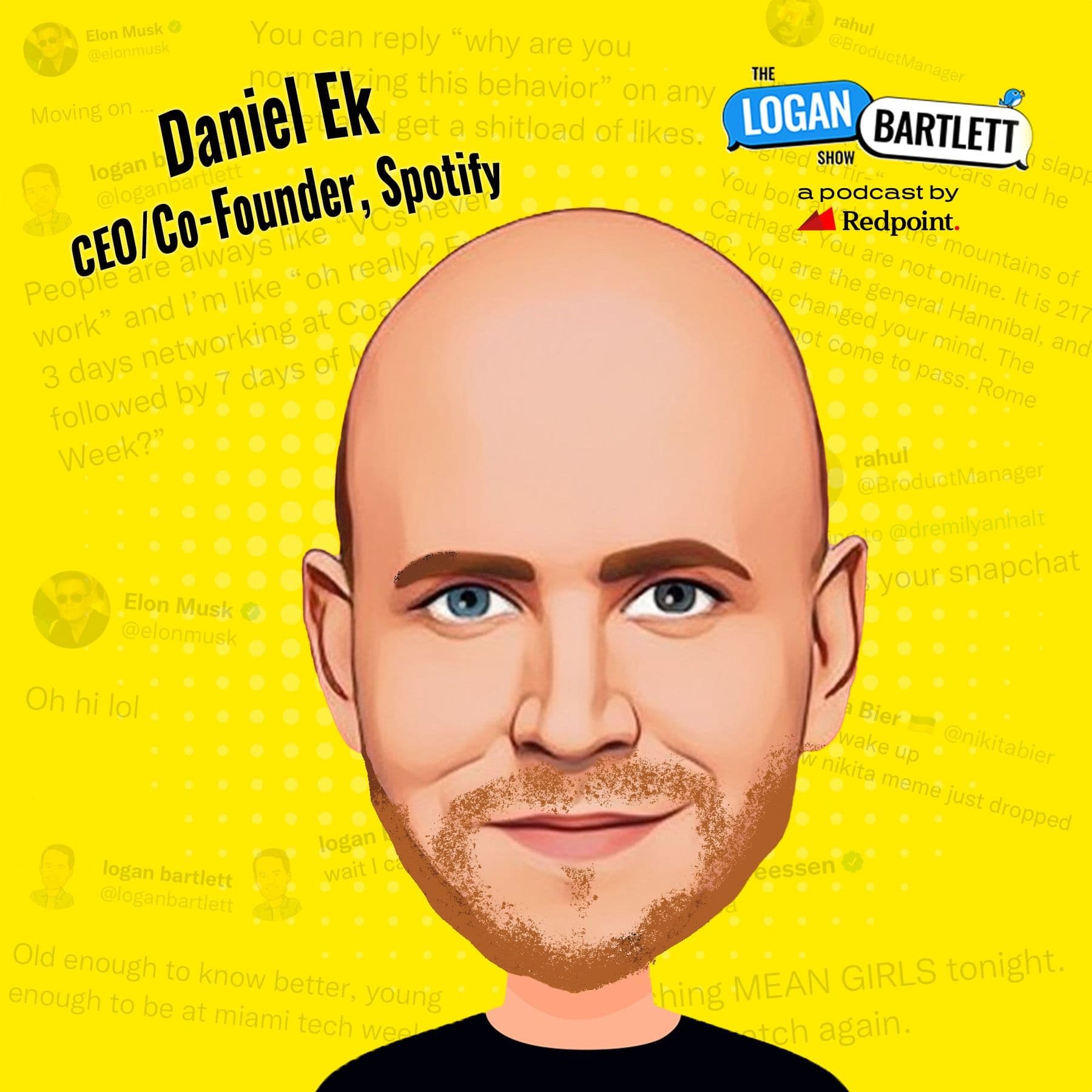
The Logan Bartlett Show: Episode 67 - Daniel Ek (CEO, Spotify)
Episode Overview In this episode, Logan Bartlett interviews Daniel Ek, the co-founder and CEO of Spotify, discussing his entrepreneurial journey, the creation of Spotify Wrapped, the challenges posed by Apple's market policies, and the responsibilities of a platform regarding free speech.
Key Topics Discussed
- Daniel's entrepreneurial journey from Sweden to founding Spotify.
- The origins and evolution of Spotify Wrapped.
- The impact of Apple’s policies on innovation.
- Insights into leadership and responsibility as a platform.
---
Episode Breakdown
- Introduction
- Host: Logan Bartlett welcomes Daniel Ek and shares a brief overview of his background and significance in the music industry.
- The Entrepreneurial Journey to Spotify (4:05)
- Daniel describes his path to entrepreneurship, including early ventures and how he unexpectedly moved into the tech space.
- He highlights the lack of entrepreneurial influence in his upbringing and how he stumbled into starting businesses.
- Initial Success and Aimlessness (10:05)
- Despite making millions from early ventures, Daniel expresses feelings of aimlessness and depression, realizing that wealth did not equate to happiness.
- Defining the Roots of Spotify (19:12)
- Discusses the initial struggles of Spotify, including the challenge of convincing music labels to partner with them.
- Emphasizes the importance of constraints as a benefit in the startup process.
- Evolution of Spotify Wrapped (21:17)
- The concept of Spotify Wrapped originated from a marketing team's brainstorming sessions and evolved from a standalone campaign to an integrated feature.
- Experiences with Record Labels (27:33)
- Shares anecdotes about persistence, including spending nights outside record label offices to secure meetings and pitches.
- Being Vilified in the Music Industry (35:39)
- Daniel reflects on how Spotify has been perceived within the industry and how he navigates criticism.
- Learning from Iconic CEOs (45:16)
- Discusses how he has drawn inspiration from leaders like Gates, Jobs, and Musk but emphasizes the importance of authenticity and creating his unique leadership style.
- Responsibility of Platforms in Free Speech (1:02:14)
- Daniel shares thoughts on free speech responsibilities, emphasizing the need for platforms to enable a variety of voices while ensuring a safe environment.
- Criticism of Apple's App Store Policies (1:07:10)
- Discusses the challenges Spotify faces with Apple's monopolistic practices and the impact on innovation.
- Advocates for a fair competitive environment where all ideas can thrive.
---
Key Takeaways
- Evolution of Ideas: Successful products often result from collective team input rather than a single individual's vision.
- Navigating Failure: The entrepreneurial journey is fraught with challenges, where learning and adaptation are crucial.
- Authenticity in Leadership: It is vital for leaders to remain true to themselves while also understanding their role in enabling others.
- Importance of Free Speech: Platforms should strive to allow diverse expressions while maintaining safety standards.
- Market Constraints as Opportunities: Embracing limitations can lead to innovative solutions and deeper understanding of one's target audience.
---
Conclusion The conversation between Logan Bartlett and Daniel Ek offers invaluable insights into the intricacies of entrepreneurship, leadership, and the evolving landscape of the music industry in the digital age. Daniel's journey underscores the importance of resilience, innovation, and the impact of corporate policies on creativity and expression.
Written by AI. May contain mistakes. Listen to the episode to check what was said.
Transcript
Automatic transcript. May contain errors.0:04Welcome to the Logan Bartlett Show. I am your host Logan Bartlett and what you're going to here on this episode is a conversation I had with Daniel Ek. Daniel is the co-founder and CEO of Spotify, the world's largest music streaming service. Daniel has a really interesting entrepreneurial journey from growing up in Sweden to selling a few companies and making a couple million dollars to ultimately combining two of his biggest passions in the world, both technology and music. And he tells us the stories of how he got the music labels to actually work with him, as well as how the first few million dollars he made did not bring him happiness.
0:38This is an amazing conversation with a legendary entrepreneur. And as a reminder, if you're enjoying these episodes, please do share with your friends so that we can continue to grow and have great guests on in the future. Now, here's Daniel. All right, Daniel, thanks for coming on. I think first, the most important question, and I got this from a bunch of my friends, is who came up with Spotify Wrapped and how did that come to be? Oh, wow. And should that person be the CEO of Spotify? Because that is one of the stickiest products I found out there. So hopefully it was you. Yeah, well, no, it probably wasn't me.
1:14And the truth is, this is one where I have a lot of problem with the lore of Silicon Valley. Because I think what often happens is these CEOs are portrayed as sort of demigods, they can do nothing wrong, and they're larger than life personalities. And some of them are, by the way, in terms of their personalities. But I often find that usually great ideas are the product of a lot of back and forth by a lot of number of people. And you're kind of constantly honing that idea and evolving it from what may have started out in one concept and actually ended up with something entirely different in the end.
1:58So Wrapped's been around, I believe, since 2015. I don't know who came up with it. I think probably started somewhere in our marketing team as an idea. And it's kind of evolved since that point quite a lot of times. So the first iteration of it was outside of the product as a one-time standalone campaign. And then it became a recurring thing. Then it became a social shareable product. Then it became integrated into the app. And it's kind of evolved over the years. And I don't think, I'm relatively certain if we would have kept to the original idea, it wouldn't have been as successful. But it's been more kind of a constant evolution that made the product as successful.
2:46And that's certainly been true almost, I think, in the entire Spotify journey. Like if you really ask me, sure, did I come up with the original idea? that's true. But is Spotify today my idea? And the answer is no. It's probably the product of thousands of people's input. And by the way, I have talked about this publicly before, but another one of our hit products, Discovery Weekly, that a lot of people love, I actually hated it. And I tried to cancel it multiple times, but it kept coming up in our internal hack weeks because people were really excited about it. And it wasn't, in the end, exactly what we shipped.
3:28We adjusted it. So Discover Weekly wasn't Discover Weekly. It started off as just this Discover playlist, and then it became Discover Weekly. And this whole format of weekly updates became a thing that people started resonating with. And I think all of those details ended up making the product that successful. And I think that's just a great example of how products happen at Spotify. It's not the product of me. It's not a product of a single individual, but usually it's sort of the back and forth between the entire team, myself included, many times. I do want to talk through the entrepreneurial journey of what led to Spotify.
4:10And so I guess in preparing for this, I heard that you almost went bankrupt and were staring down, laying off a large sum of your employees before at the last minute, it sounded like there was, what was the acquisition? Was it the acquisition of Skype that kind of unlocked the market and then you sold the company to eBay? Can you talk through your initial entrepreneurial endeavors at that point? I know as a kid, you had a bunch of different side hustles in that project, but what was that story of what you were working on and what ultimately came to be? Yeah, I mean, I don't come from sort of an entrepreneurial family or even a community where being an entrepreneur was something anyone I knew did.
5:05So it wasn't a big dream of mine to become an entrepreneur. In fact, it probably was the anti of what everyone around me was talking about. So I sort of accidentally ran into becoming an entrepreneur. And it took me probably 10 years of being an entrepreneur before I started identifying myself as one as well. I just considered it as I was starting things. And I had no intention of actually running them or building these companies myself. I always envisioned someone else being the front person and someone else running these projects and not me. So I consider myself being the tech guy who was almost like an inventor, but definitely not an entrepreneur.
5:51And it was really through a series of kind of accidents that I ended up starting businesses. But I didn't think of them as businesses, which probably, you know, ended up becoming the reason why I had to lay people off and not understanding, you know, how to manage a business as well. And that later on obviously led me to actually take it more serious, the business side. But I was doing projects that was fun. And I remember I was 14 at the time when I was like the one kid in the community that I was in that knew anything about computers. And so naturally, people started gravitating towards me. And this is probably around 1997 now.
6:36And the World Wide Web became a thing. And just to set the scene, the World Wide Web at that time was everyone needed to have a web page. That was kind of the norm that was created and certainly here in Sweden. But creating a web page usually involved having like this very expensive consultancy firm. That consultancy firm would charge you like$50 ,000 to make a web page. So there was all of these small businesses that heard that they needed to create a web page because otherwise they would be irrelevant as businesses. but they obviously couldn't pay$50 ,000 to do it. So what happened was there was a local business guy who came up to me one day and said, hey, I heard you know about computers.
7:21I was wondering if you'd be interested in helping me build a webpage. And I was kind of into coding and a bunch of that stuff. And I thought HTML was kind of simplistic and I wasn't that interested and didn't know how to design a webpage either. So it was just not something that I was very interested in. So I kind of turned him down and kept coming back. And he's like, well, I really want you to help me with this. And eventually I figured that the way to get rid of him, and I didn't want to be rude. So I figured I'd just quote him a very high price so that he realized that I didn't want to do this.
8:01And hopefully that would get him to eventually stop asking me. So I said, sure, okay, well, I'll make the webpage for you. And I want$5 ,000. And that was, for me, an outrageous amount of money. That was more than my parents probably had in life savings at that point. And he said, done. I was like, oh, shit. Now I actually have to learn how to create this webpage and design it. And so I did. And he was very happy. And then a few weeks after completing that project, someone else knocked on my door and said, hey, I heard you helped my friend here with a web page. I was wondering if you could do the same.
8:37And fast forward to that, I was basically running an illegal sweatshop in my high school where I had all my friends who were really good at math. I taught HTML and all my friends that were really good in arts. I taught Photoshop and we had this new computers in school, ironically donated by Bill Gates early on. He had this thing where he took schools that were in particularly rough neighborhoods, which mine was, and donated new computer equipment. And so these are all new computers, all sort of 100 megabits internet connection. And so that was like the perfect first office for my thing. So that's kind of how I started my entrepreneurial journey.
9:25But even then, And even as I was doing all these things, I didn't think about it as business. I thought about it more as like, well, we're building projects here and we're making money doing it. And that money we can reinvest in buying servers and doing other cool projects. And it was only until I almost went bankrupt until I realized that, you know, hey, I'm actually running a real business here where real people's livelihood are dependent on what I do. And I need to learn how to do this and I need to be serious about it. because sort of just being the tech guy who builds stuff and don't bother about anything else just didn't scale anymore.
10:04So you sold some companies or you had like a handful of different projects and they sold and you made a couple million bucks. And I think what was what was interesting for me to hear, and I would love to hear your perspective on this, is everyone thinks they're working to some end, right, of which they have millions of dollars in the bank account. and therefore they're successful. They have this exit, their friends that they've hired, make money and all of that. But I heard you say that that was actually more depressing than potentially having to lay off your friends or like going through the whole entrepreneurial journey with your first company because you were a little aimless and now what do I do?
10:47And I have this money and I've been working to this end, but it wasn't as fulfilling as maybe you thought it was going to be. And that, I think, ultimately led to Spotify, right? Combining two interests that you had together. So can you talk about or tell that story of what it felt like to have made millions of dollars and actually be even more depressed than you were before? Yeah, sure. And so just to tie the two stories together. So what happened, obviously, is my businesses that I thought of as projects kind of grew and grew and grew from 1997 onwards, to 2000 and 2001, and then the bubble burst.
11:26And almost everything froze overnight. And that's when I had to lay off a bunch of friends and hunker down. And we kind of took whatever projects or whatever thing anyone needed help with. So we basically became consultants overnight, doing whatever anyone needed help with just to survive with whoever I had left as employees. And then through a series of luck, really what ended up happening, and this shows how little I knew about business, sometimes people couldn't pay me because they ran into financial difficulties. And they gave me something called equity, which I didn't realize what it was.
12:01I thought it was literally that people would pay me back once they had the money. So I thought it was like kind of a death note or something like that. And so they gave me equity in their firms. And so I didn't really understand what it meant. And I never assumed anyone could pay me back. So I kept accumulating that and I became disappointed every time someone couldn't pay me and got equity. And I got very lucky because one of the firms I got equity in, you know, and I remember it very clearly. So the market kind of turned around the eBay acquisition of Skype. So that's 2004, I believe 2005, around that timeframe, where between 2000 and 2004 and 2005, if you were in the internet era.
12:50We forgot about it long since, but it was like the worst of the worst. There was no money available. No one wanted to do anything. And everyone looked at you like you were pariah. I can imagine, might be a little bit like if you're in the crypto community at the present moment, that's kind of what it felt like. No one wanted to touch you. And so it was really rough. And then everything kind of turned from one night to the other. There was new optimism. Companies were like, holy shit, this internet thing might be real. We got to step up our game. And one of the businesses that I had been involved in gave me some equity.
13:30And they called me up one day and said, hey, we're going to get acquired. And this is really great news. And I said, well, you know, that's great. Congrats. and the guy was kind of confounded and were like, well, aren't you happy? And I said, yeah, sure. I'm very happy for you. This is great. He probably didn't really, you know, still confounded why I wasn't born happy and why I didn't understand it. And honestly, I didn't even realize he would pay me back. I thought it was just like he called me up and was just a happy person. And so I didn't think much more about it until like, you know, a week or two later, someone from my bank called me up and said, hey, what do you want us to do with the money?
14:20And I had no idea. So I was like, well, and I figured then that maybe the guy just paid back the debt. And I was like, well, that's great. You can just leave it in the account, I said. And the person then from the bank was like, well, well, we would advise against that. This is like a large sum and you really should invest it and so on. And I was like, well, really? What are we talking about here? And I said, well, it's a few million dollars here. And I was like, what? There must be something wrong. And literally, no, it was all right. And that was the equity and that was great. And then within a series of events, I actually sold two other businesses in the next six months.
15:11And not for great sums of money, but I own 100 % of them. So it ended up accumulating. And actually, one of these companies I sold, I sold to my co-founder of Spotify, his company. And yeah, so I literally went from kind of having no money at all, basically just trying to survive, to six months later having more money than I knew what to do with. And actually, I'd read somewhere that if you had$5 million, you were economically independent for the rest of your life. And I, by that time, accumulated more than that. And you're 22, right, at the time. Yeah. I was exactly 22. This is the dream, right?
15:53You've made it. You should be as happy as anyone. This is what everyone aspires to. Yeah, exactly right. And for me, it was like even more so because I literally came from the projects in Sweden. Like I had no money at all. I was growing up with my single mom. And on top of that, I had this winter where I sort of between 2000 and 2004 and five, where things were really rough. Like you were basically just trying to survive paycheck to paycheck and doing whatever jobs you could to pay your rents basically. And so obviously I had this kind of dream of one day, maybe I can get to this level. And I thought maybe if I work really hard, I can get there if I'm lucky 50 and then I'm going to retire and so on and so forth.
16:38And obviously here I was 22 and I reached that milestone. And it sounds perhaps a little bit sort of obnoxious to say it, but as a society, we're fighting to get to that limit of economic independence. But no one actually talks about what happens when you get there. Instead, you're just hearing from these rich people how money doesn't mean that much and so on. Well, it certainly does if you have none. I can tell you that. And they don't really teach you what to do and what actually matters. So it feels like a very foreign concept where you're thinking that they say that out of a sort of false humility when in fact, you know, they're probably very happy about having it.
17:27And they probably are to a certain extent, but to a certain extent they were right. But no one taught you that. And for me, you know, as a funny sort of side note, I actually learned how to speak English through watching MTV. And my favorite program at that time was like Yo MTV, which is the rap part. And so you watch MTV Cribs and you watch kind of all of these like great places that these rappers are living in and rock stars are living in. And it's always these kind of well-filled fridges with like all the drinks in different colors and like all that stuff. And so I was like, you know, I made it.
18:09This is the life. So now I'm finally going to be able to get to the really cool nightclubs. I'm going to get all the girls that could never get beforehand. And I'm going to be one of the cool people. And I thought literally for a while that that would make me happy. And so I spent a bunch of time doing that spring champagne on people in central Stockholm. I, you know, tried to hook up with the girls I could never get before, somewhat embarrassingly. And some of them you could actually succeed with. But I realized that, you know, they didn't want me for me. They wanted me for the status that it provided.
18:47because I probably offered them free champagne and hung around the cool people. And I realized many of these people probably wouldn't be there unless I had money. And that got me to be pretty depressed because, again, I didn't get into tech to get rich in the first place.
19:08And it wasn't one of the things that made me happy either. So tech in itself made me happy. Music made me happy. And so I went on a number of months of soul searching of what I really wanted to do. And I realized up until that point in my life, there's basically been two interests in my life. One was music and one was technology. And I was thinking about that. And during the same time, I met my co-founder and we started spending more time because he had just left the company that acquired my other company. And we started hanging out together and he had made an IPO. and he made even more money than I made by an order of magnitude more.
19:49And he too was quite depressed because he too didn't have anything really that tied him up. And so we talked about maybe we should do something new. Maybe we should do something that is different. And what we centered around was really these three core concepts. We wanted to do something that we thought we could get passionate by. We wanted to do it with people we could learn from. And three, we wanted to have fun while doing it and have a positive impact in the world. Those were the kind of three things. And he said, what are you really passionate about? And I said, well, really, I'm passionate about music and technology.
20:34That's my two kind of main passions. And he said, well, why don't we do that? And I said, well, that's a really dumb idea because, you know, music piracy, it's really hard and so on. And then he kept asking why, you know, okay, well, why is it hard? Why is piracy such a big problem? And basically through these series of why, we eventually said, well, maybe if you did this, you could sort it out. Well, why isn't someone doing it like that way? And I said, well, probably labels are going to be very hard. okay, well, why is that if they're losing so much money as it is? Shouldn't they be interested in doing it?
21:13And eventually we centered on the idea of Spotify for all of those reasons. And I know constraints, you're a big believer in constraints breeding excellence and opportunity and all of that. And so the constraint for you all was actually the geographic constraint, right? You had to start in a narrow market and there was a ton of piracy. And so the music labels were willing to say, hey, fuck it. like this market's broken anyway. It's a small market. Let's let them try. Can you talk a little bit about constraints as a benefit to you and Spotify? Yeah, sure. And perhaps this wasn't as obvious from the beginning for me.
21:54You were like, I don't want to be in a$20 million TAM or whatever. I don't know what the market would have been, but yeah. Yeah. And so we tried to launch Spotify actually globally everywhere because that's what we thought an internet company should look like. And it's ironic because we only realized that portion 15 years later, two years ago, when we locked the rest of the markets. But we stumbled upon a very important insight, which is that growing in concentric circles is incredibly powerful. And in my opinion, when I look at startups today, I would say almost every single successful startup has followed that formula where they've started off self-constraining themselves, focusing and honing on developing their craft and being really, really precise.
22:45Because it's really hard to make a product for 500 million people because 500 million people have a lot of different opinions about things and what makes a great product. But you have to start with sort of a core set of customers and solving a critical problem for them, basically reducing the time it takes from point A to point B in a pretty material way. And so we started in Sweden, and as you said, for a number of reasons, it was sort of the perfect market because you had broadband penetration, which back in 2008, 2006, actually, when we started, wasn't a very normal thing. And by 2008, still wasn't very normal.
23:25And because people had access to very fast broadband connections, they used a lot of piracy services to get their content. It also was a place where iTunes was late to launch in because again, it wasn't a very large market. So they prioritized other markets before that. So there really wasn't much other solutions that was there. And then from a business model standpoint, there was a lot more willingness from labels that we were dependent on to launch this, to innovate because frankly, they didn't have much else of options other than the continuous decline of their business. So we stumbled upon that, but it is actually something that I've been ever since.
24:13Whenever we do something, it's something that I've been constantly pushing on the teams that I work with, whether it's at Spotify or my other ventures at this point, is just always kind of staying very, very consistent and close and self-constraining our growth, so to speak. And just as an analogy, I just recently launched a healthcare business called Nico. And we launched it here in Sweden too. And the way we did that was we kind of controlled everything, but we self-constrained it to one physical location. And that meant that literally, unless you're in central Stockholm, there's no way to try the product.
24:56And many may say, well, you know, wouldn't have been better to launch it in the US because it's a much larger market and so on. And actually, for a number of reasons, I believe Sweden might be even better because you have a situation where no one pays for health care today. So it's an even harder problem to solve. But the benefit is in Stockholm, it's a very large concentration of people at a relatively small surface. So it helps from that sort of Venn diagram of opportunity and constraints in terms of TAM as well, to be just very concise. Yeah, it's interesting. It's one of the things I actually give advice about when people are starting podcasts.
25:37And I made this mistake. Everyone makes this mistake. You want to get the biggest guests initially, and you want to be broad and copy so that as many people will listen to it as possible. And one, you suck when you initially start, like 100%. You're just shitty at asking questions. Your audio is going to be off, whatever it is. And two, you're wasting your bullets on great people early on. And three, your interests aren't going to be aligned with a target market. If I just interviewed everyone I wanted to talk to, no one else has the exact same interests I do. And so I have a ton of respect. And this is the mistake I made.
26:15But all the podcasts that started very narrow, be it the Acquired Guys or Lex Friedman or Patrick O'Shaughnessy or all them, you get the right to expand after you have some success in the middle, right? And so define your market very narrowly. Lenny does a great job with his product podcast, which I know your co-founder went on, where it's like, start really narrow, make sure you appeal to that narrow group, and then you can deviate to the areas to the left and right. And I think it's true of companies. It's true of media. It's true of whatever. It's an interesting lesson for sure. Yeah. And I think it's, you know, you can even apply to investing, right?
26:56Like your circle of competence is usually a lot more narrow than you think it is, right? And by narrowing yourself, you're going to get higher signal, you're going to learn faster and better, and you can expand over time. But trying to, you know, go for everything probably means you're going to be pretty average. And you can always deviate, right? I tell people I only do Series B, mostly B2B investments. And is that all I do? No, that's not all I do. But people have to think of you for something. And so better to narrow what they think of you for, and then you can, by exception, go elsewhere. It's just a much easier framework by which to operate.
27:34Hey, one question in the early days of Spotify I had from you, and I'm not sure how much this is a metaphorical story versus a real one, but I've heard about you sleeping outside of record labels offices. And I'm wondering, quite literally, were you inside their building and in front of their doors? Is this like one of those stories that gets retold and it's like maybe an allegory, but was it actually like, how did that actually come to be? No, I didn't actually sleep outside of their offices. It's more of a sort of expression and a sort of mental analogy, as you said, or allegory. But just to paint the picture, I literally slept in hotels where the wallpaper fell down on me and I had cockroaches everywhere.
Read the full transcript
28:31Not one of these finer five-star hotels or even four stars. I think I had minus one-star hotels. um so and and uh there's funny stories in the beginning where i and the guy who helped negotiate the licenses we even shared bed um and and uh bed covers because literally and he was snoring horribly so we didn't sleep very much um so so that's uh sort of painting the picture but what was true is i literally sat outside of the office waiting for opportunities to arrive where i could come in and pitch because they wouldn't take the meetings. And so I took whatever slots I could get. And the best way was to sit.
29:15They had a Starbucks just outside of Broadway, in this case, in New York. And I literally sat outside of that Starbucks, which was right on the border. and I befriended the assistants to the point by giving them enough free coffee and free gifts and other things that I, whatever I could do to bribe them basically so that they would tell me when the CEO was about to leave or about to enter or if they had sort of a spare moment where I sort of just by accident would be next to the coffee machine as they were getting the coffee. So it was directionally true, although it wasn't technically true that I slept outside of the office.
30:00What kept you going through that period of time? Because I know there was like two and a half years of chewing glass, essentially. And was it just that you were uniquely passionate? You knew that your life's work would ideally combine music and technology. And so, hey, I'm going to keep going ahead on this. Or what really kept you motivated through that period? Well, I think a combination of really several things, but the most important thing is it was totally logical to me that whether I succeeded or someone else has succeeded, people would want to access music and they would want a better experience than piracy.
30:39And if there was a better experience than piracy, people would start paying for music again. That was just so obvious to me. And this whole idea of people wanting to own music that the whole world believed to be true just felt to me like, no, it's kind of obvious that the better products should be access to music. And so I believe that at the core of my bones. And if we weren't going to succeed doing it, someone else would. That was clear to me. And that gave me a lot of just mental fortitude to go on because I believed it to be true. And it was a lot of ups and downs. And the truth is, I believe every startup journey is a mental roller coaster.
31:24And I believe now, perhaps more than ever before, that what really sets apart the great entrepreneurs from the average ones is really how you handle that mental roller coaster. And I believe so much more now that most people just don't want to do what's necessary to succeed at that level. It is really hard. And I don't blame them, but it's like you have to give up birthdays, friendships, family relationships, all of the above oftentimes are required. And it's very hard. People talk about balance. I don't believe that to be true. You should absolutely strive to have healthy relationships because you'll perform better and you should strive to obviously having love in your life because I believe you'll be a better person.
32:18But to have balance of equal time on everything, that's not been my experience. In fact, I oftentimes even today feel awful because I'm down prioritizing something in my life because I'm pretty extreme. Sometimes that's my health. Sometimes that's a friendship relationship. Sometimes that's work because I'm prioritizing a personal part of myself. But I always feel almost inadequate because I'm constantly putting so much effort into so many parts in a pretty extreme way. And that's two and a half years of my life, I gained probably 45 pounds in weight. So I really wasn't feeling very well. I lost a lot of hair, still haven't been able to grow it back.
33:10Like, it was just an awful, awful, awful time. And I wanted to give up several times, but I also had my team. And my team was fighting, and they were making the product more and more amazing. And I was able to try it out. And I was like, wow, we really have something special on our hand. And I didn't want to fail or disappoint them. and it so happened to be that again I retrenched from those U.S. offices back to Sweden and kind of managed to find the wedge by one foot in the door where we basically guaranteed the entire profits of the entire Swedish recording music industry with our own money for a year and said And you really don't have anything to lose.
33:57At best case, you double your money in one year and we fail. And by the way, on top of that, we have something that's ongoing. At worst case, you double your money for this year and you have at least a little bit more time to figure out what the right solution is. I didn't realize that. So piracy was such, and the original deal you made with the labels was, hey, because Sweden was so upside down with piracy and people just stealing music. You said to the labels, hey, we're going to guarantee for the first year the revenue for you all to make back. And worst case, it doesn't work. Best case, we have a new business.
34:37Pretty much. Pretty much. I think it wasn't one-to-one, but it was like 80 cents on the dollar or something. So it was basically totally no downside for them. And so they eventually kind of like, I don't know whether they actually believed in it or whether they were just cynical and realized that, you know, heads I win, tails I win. Both are kind of fine. But we succeeded. And what I do know is we succeeded way more than anyone thought, including ourselves. and really through that period of time, we then kind of quickly expanded in another eight markets and started growing really rapidly from there on too and then it took another sort of two, three years to unlock the US because it was the number one market in the world and they had still a lot to lose and a lot to win and that's why it took so much time for the same behavior and for the same sort of model to be proven out so much in the rest of the world that they were willing to take the same risk in the US.
35:39Speaking of success, so you've paid out close to$40 billion to the music industry. Is that right? And you're the biggest driver of monetization in the industry. And you've almost single-handedly pulled the industry towards a model that works. And now, at least on a dollars basis, maybe not inflation adjusted, but dollars to dollars, the industry has now passed the peak of what it was in 99, 2000 from those days, the good old days. But does it bother you? You're still kind of vilified at times from people that don't understand what all you've done. Does that get under your skin? It does and it doesn't to be very candid.
36:26So I think on the one hand, obviously, I did this not because I thought we could make a ton of money doing this. We've actually widely surpassed what I thought in that regard. But I did this because I cared about the problem, right? I cared about music and I cared about compensating artists fairly. And I cared about giving consumers what they wanted. And so obviously it hurts when you have artists who I deeply respect and admire for doing what they're doing, say that they think that I somehow, or that we somehow want to cause harm to them because it's just not the truth at all. And we're doing that.
37:12But, you know, I also have, you know, in this process, I mentioned that earlier, but I think a lot about the mental game these days. And oftentimes, whenever I see someone who's lashing out to another person, I try to have empathy with what they're going through. And there's always someone who's hurting. There's always someone whose story exists on the other side. And you don't know that. You don't know what they've gone through. You don't know what their reality may look like. And so I try to have empathy with that. And the reality of the music industry, It's a very complex narrative. And the narrative is, as you rightly said, the music industry overall is doing well.
38:01It's doing better than it's probably ever done before. Certainly the recorded music industry. And it's at its all-time high and its all-time profits from these record companies, et cetera. And more artists than ever are being invested in. So that's the good news. but we're also dealing in a reality where if you look at 1999 or or year 2000 which probably arguably the two of them was the peak of the recorded music industry in terms of the the last peak you had probably 10 000 or so albums being released in the u.s that year i don't know the exact numbers, but order of magnitude, that's probably right.
38:45And then if you contrast that today, Spotify has about 10 million artists on our platform. And so the best way to put it is there's more success now than ever before, but there's also more people than ever trying to make it in music. And so both of these two things can be true at the same time. There could also be more people being successful, but there could be in relative terms, more people failing also. And so, or in absolute terms and even in relative terms. So I think that there's a lot of people who may have in the past made it in music, but are no longer, you know, doing as well. And they obviously feel bad about that situation.
39:31And there's also a lot of people that want to make it in music that for whatever reason may not be successful in music. And because we're the number one player in music, obviously a lot of responsibility falls on us, rightly or unrightly, for the role that we play in the music industry for them to succeed. And these are people who may have spent 10, 20, 30 years perfecting their crafts. And many of them, by the way, are great at that. And it's really hard, but it's a very hard game to succeed in, right? I sometimes make the analogy to another one of my favorite sports, soccer. You know, it's a very popular sport.
40:18Several hundred million people around the world are playing soccer in one shape or form, but there's probably only tens of thousands of them that are professional, right? So, you know, on the one hand, we have a lot of artists here that are trying to make it in music. More so probably than ever before in the history of time. There are more that's succeeding, but there's still a lot of people that are not. And so those are usually the ones that are unhappy. And I get it, and I understand it. And many of them are also very talented, by the way. And so it's really tough when they feel like they can't make it.
40:58And obviously, we become a big part of that debate because we're so big. And there's two components, I guess, just to give people a quick primer on why these complaints maybe come out is one back in 99, 2000. It was a lump sum payment from a CD, right, versus you guys are paying out like an annuity over time. And so your long tail, that's why you're seeing people sell back catalogs is because they want to monetize it up front. But an investor is willing to wait for the next 20 years to monetize that. So one is the cash flow cycle. The other one is you pay out a percentage of your revenue to the labels, which is mostly the three majors.
41:41And that's based on the number of streams and your business model, right? And that's a percentage of your revenue. And then the labels pay out whatever their deals they cut with their artists are. They pay out that to the artists. And so you've negotiated this thing with the labels. The complaint is ultimately, to some extent, it's with the labels, right? Of like the deals that they cut with the artists individually. You cut the deals with the labels. And so it's like there's this middleman in the middle that people are pointing at you when in truth, this is the deal that the artists have often cut with the labels themselves.
42:21Is that fair? Well, that's sometimes part of the story. And it's very complex, right? Because there's all sorts of other things, too. With songwriters, it's even more complicated because you may be assigned to a publishing company or there may be a collecting society in a certain market. And some collecting societies takes 18 months before they pay it out. So you may think you have a certain amount of streams, but in actuality, and you see no revenue, but the revenue comes 18 months later, as you said. So there's all sorts of very complicated dynamics from an industry that for legacy reasons been built up over many decades.
42:57and that's hard and that's a hard part of the story. The other one is pure optics, right? Oftentimes, even though exactly as you said, we don't pay out per stream, we pay out on a percentage basis. But quite oftentimes what people do is in order to figure out, well, how much was I getting was they take the number of streams and take the revenue and divide it on a per stream basis. And then the number seems very low because it's point something, something, you know, sent per stream. But I think the failure there is like, this is the equivalent of CPM. And this is probably where we could have done better from an optical point of view.
43:39You know, originally you were probably getting paid for every single impression, but we don't in the ad world, you know, measure it based on what you're getting paid for every impression, but we, we bottle it up to a CPM and that CPM could be variable. So it's thousand impression that sort of adds it up. And so we still optically screw it up in the sense that we make the number seem lower than what it perhaps is. And so there's all the, all of those things that kind of add up to it. But I would still say the number one problem that's the most confusing to people is, you know, there are more people successful than ever before in music, but there's also more people trying.
44:22So therefore, there's also more people failing at becoming successful in music. And so both of these things are true at the same time. And that's what people are having such a hard time because they see these anecdotal things on Twitter and artists saying, well, I only get paid X for what seems like a large amount, a million streams. But a million streams is actually a very, very low amount of streams. Like the most successful artists on Spotify are literally a Miley Cyrus that can get a billion streams in the matter of weeks, right? So a million streams over the course of a year is just not a big number in the case of Spotify.
45:04And so that's also, you know, it seemingly seems a big number, but it just isn't. So that's the optics. And those two things are why it's such a difficult problem to explain to people. Now, I've heard you say you spent time trying to copy different elements of iconic CEOs, Gates or Jobs or Musk or whoever it was. But ultimately, you realized you needed to be yourself and that it didn't really work internalizing elements of other people. How do you think about taking elements that you've heard from how someone that's super successful has operated while also following your known North Star or what is authentic to Daniel Ek as a leader, as a CEO?
45:48Yeah, I mean, I think about quite often this quote by, I believe he's a philosopher, Kwame Appiah, and he says, you know, most people are spending time figuring out to basically, I'm going to butcher the quote, but it's basically trying to learn the rules of the game instead of figuring out which game they're playing. and that was the most important realization for me you know we all obviously take impression from the the gates the mosques the bases the zuckerbergs of the world of tech and they've been remarkably successful and they're very very good at what they do but they're also in many instances playing a very different game than the one you're playing right And that's what I realized is you can't just copy someone's tactics without understanding what game they're playing and what game you're playing.
46:55And trying to go to sort of first principle of just understanding who do I want to be and what's important to me, back to that sort of mental side of things. And who am I at the core of an individual? You talked about sort of social media. one of the big things for me that I see time and time again is that at the end of the day, people see right through when you're not authentic because you can't stay consistent in whatever game you're playing on social media if you're not authentic to who you are as an individual. And that's really hard because people obviously game you in the sense that they'll give you feedback of what they think works.
47:39And we want to be liked as individuals. So we try to amplify those behaviors. And social media does that even more. And at the core of it, I think it's a very easy way for young people and honestly, all people to get very unhappy about life is because you keep seeing these rewarding pictures of the perfect life that everyone else is leading without actually understanding that the authentic story probably isn't that. The authentic story is probably that they have a bad hair day sometimes. They have argued with their significant others. They have kids that are screaming and refusing to go to bed, all the normal stuff.
48:20But what we see is this perfect thing. And that's what people are reacting to. And more and more, I think that authenticity is the only thing that will allow you to persevere for not just a year or two, but a decade or two. And so the big realization for me was just working with myself, my own mentality, my own psychology, my own being, back to that point about me believing I wanted to be popular, me believing I wanted affirmation from these girls that could never get to pay attention to me before. I realized that that just wasn't who I was as an individual. I'm a nerd. I like reading. I don't like spending time with lots of people.
49:09I like a few friends that I have intimate relationships to. In large crowds, I get inwardly focused or it drains me of energy. Not that I don't think it could be fun, but I have to lie down and rest after doing it. And there are other people, obviously, that get energy from being in crowds and love meeting other people. And I think those are the realizations that you have to work with. And so, of course, I take elements and I learn from all the greats, not just in technology, but more and more from all over the map and in other fields as well. but um i i tried to um most of the time think from first principles about what it is i want to achieve and then turn whatever don't copy them exactly but kind of take the spirit of of um what it is that you're trying to do and adjust it to my game and and that's how i think about it the Remix, the Danielek remix.
50:15Yeah. One of the more poignant things I heard you talk about is being very self-aware of your role within a company and as a leader and within meetings and being cognizant that if someone's presenting to you, it might be the one time a year that they get to meet you, or maybe their entire tenure of Spotify. This could be the only time they get in front of you and your role in meetings and also in social gatherings that you used to maybe gravitate to a handful of people that you knew just because you were comfortable there, but realizing that you actually had to go talk to the people you didn't know because that was your role.
50:59How do you think about your natural bias to do some of the things that come naturally to you versus your role either in meetings or leading and doing the unnatural because it's going to be very impactful to the individuals in that specific meeting or in that room or at that party or whatever it is. Yeah, I mean, I think the important part, again, is on the one hand, as I said, staying true to yourself and the polarity of that obviously is in what way can you be the most impactful and constantly kind of sort of peddling between those two extremes. But it actually started when I was really unhealthy.
51:44And I was lucky enough that one of my neighbors became, or is at this point still, a very famous hockey player. His name is Matt Sundin. He was an all-star NHL American, team captain of Toronto Maple Leaf for 13 seasons, always playing in the All-Star game. And we were talking one night over dinner, and he talked to me about sort of training. And it got me to change my perspective because he talked about the reason why he trained so much and why he could keep at the level where he was for 13 seasons wasn't to get better. It was to make sure that his worst was consistently better than everyone else.
52:36And so it was like basically raising the average bar rather than sort of raising the bar of the extreme. And I thought about that a lot. And so for me, what I realized was that there was times when I had a lot of energy when I was great in meetings. But there was also times when I was completely drained and I wasn't adding anything to the meeting and probably I was grumpy or all of those different things. And I started taking my own well-being, not just mental health, but physical health, eating, exercising, all those things for learning from maths. Basically, just making sure my worst day, I would still be better than most.
53:20and showing up in that meeting with more energy, being able to make people feel good. Because so much of what it is that I do, I have many thousands of employees here at Spotify. It is them that's doing the works. It's not me. And my job quite often is to get to the positions where all the good options are out the window. And we only have decisions where huge trade-offs are needed in. and to bring that A team mentality out of people in that moment by getting their best ideas, getting them to be there, but feel seen, feel heard, and feel like they can participate. And I'm not always succeeding with that, by the way.
54:07I'm failing quite a lot of the time, but I realized I'm not the smartest person in the room. I'm definitely not. And I realized my goal is to bring the smartness out of other people in those meetings. And that means creating an environment where people can be direct, where people feel seen, where they feel validated. And so I've learned so much about leadership from that. And I just referenced, again, from the world of sports. So it's not always from people in business, but I think it's my game. And I know other leaders, by the way, in business people, that the sole goal is for them to be the driving force and lightning rod in a meeting.
54:57And most of the time they're having a group meeting with 10 people. It's actually them interacting with one people at a time. And the meeting is really for them, not for the people around them. And I don't say that that's wrong. I'm saying that could work for them and their individual. But in my case, I look at myself as the bottom of the pyramid, helping everyone else get things done, not at the very top of the pyramid. Even though obviously, from a hierarchical sense, I am obviously at the top. But I'm trying to enable other people to do their best work. And it's through that that I think we'll achieve amazing results.
55:35I know as a CEO and a leader, you have a philosophy around missions, both for yourself and also for your executives, and that people might be the right people for a certain point in time, but that they may not be the long-term person. Can you talk a little bit about how you think about that for yourself in reevaluating what you need to be for the mission that you're on at that moment in time? And also how you have that conversation with executives or direct reports saying, hey, this could be the job for you for the next two years. But after that, we might need to bring in someone else. Yeah, sure.
56:08And maybe just to level set. I'm not saying this is necessarily true for all companies, but I certainly think it's been true here for Spotify. So I believe one of the very unique things about startups is the rate that you have to learn, basically. So a startup founder, CEO, in many instances, are trying to learn on the job things. And maybe sometimes they have six months to learn what other people learn in two or three years at a time. And because of the nature of growth in their business, the challenges that get thrown at their table happens much faster than it would take a business that's growing 5 % or 10 % a year.
56:50They may have plenty more time to accumulate those experiences and learn on the job than the startup CEO does. And I shamelessly stole this concept from Reid Hoffman, where he at LinkedIn supposedly had this concept called tour of duties, you know, based on the US military. I didn't really like the military reference, so I called it missions instead. But my belief was that if you really think about it, as a CEO, as a CFO, as a VP of products, certainly in a startup, but it's very rare that whatever requirements you have for your jobs are going to last for more than two or three years. And the problem you end up having is by not being clear that it's not the person's fault.
57:43And this can go both ways. The person can develop and the job develops in a different direction. And obviously the job can develop and the person wants to keep doing the same thing. Both in a world of startup is actually a big problem. Because if you have the expectancy that the job is mine for all eternity, no matter what the job spec actually requires, even though the title is the same, that just feels wrong. And it is not in this instance that you as a CEO, if you have an employee where you have to have that tough conversation, that you're necessarily forcing that on them. It could be the startup in itself that just requires something very different from you as a leader.
58:24So I think that's been a helpful mental framework to explain to people why that is and why the job changes, but the titles remain the same. And the harder thing though is culturally really enacting that because it's so unusual. And I think the best way to do that is obviously by role modeling that yourself. And so in my case, what I often say is I've had the same title for now close to 17 years. It's pretty crazy. But I'm on my probably eighth job at the moment. And actually my newest job started in January. so I handed off the reins from much of my day-to-day responsibility to my core people Gustav who runs product and technology and Alex who now runs the business side and so my role is vastly different than it's been and I'm actually still trying to learn on the job what I'm supposed to do and what I'm not supposed to do in my new role description and that's two benefits I think it means that new opportunities will be created So in Alex and Gustav, they've been with me 12 and 14 years, respectively.
59:39So they've been with me for a very long period of time. I am 100 % certain that if they were really doing the same jobs like they were when they got to the company, they wouldn't have stayed. So this creates growth opportunities for them, but it also creates a very clear path where you can have very honest conversations with people and talk about what they want to do in their career. and whether or not that matches what that next evolution of that role looks like at your company, or perhaps it might be other roles at the company that's always beneficial. So I like to think about, let's see if we can create the job internally first.
1:00:18And then only if that doesn't work, then you start looking at maybe it's time to look sort of externally for the same job. And the harshest way to do it would be almost asking people to reapply to the same job again. I don't formally do that, but I like checking in with people to kind of say, do you really still want this job? And does that make sense? And yeah, I mean, I think it's a huge part of why I'm here 17 years later, because my job keeps changing. And yes, it's been the same title for quite a while, but my day-to-day responsibilities today is very different. My first job was kind of being the janitor, screwing together tables and chairs and all that stuff.
1:01:05There's a whole team at Spotify that does that now. So I'm lucky enough to just show up and the whole space looks beautiful. And I sit down in furniture and IT equipment that just works. But my job today is like engaging with regulators, with all the different stakeholders, dealing with very complex stakeholder problems, whether they are employees and unions and all what it requires, dealing with very complex, what does it take to run a platform with 500 million consumers and tens of millions of creators? Very different challenges where even a small change in that platform, you can't make that thing when you have an entire music industry that's totally dependent on every single tweak that you make.
1:01:51So you can't sort of move fast and breaking things in that regard, where obviously when you were a startup, that was kind of what you needed to do. So very different job, very intriguing and intellectually challenging. And I probably wouldn't have been ready for the job I'm having now 17 years ago. But it's kept it interesting and I've been able to grow with the company. Now, you've been fairly outspoken about Apple and the App Store practices in the last couple months. I know it's been an ongoing thing for you all. How much has that been something that you feel for your own business, you have to speak out about what they're doing and favoring their own products and all the maybe monopolistic tactics they're doing?
1:02:39And those are my words, not yours. I don't want to put words in your mouth. That's my perspective. versus you're in a unique position to be able to speak out for all the companies that can't because they're so beholden to Apple. Well, I think it's both, right? So obviously, we believe that our business would have done tremendously much better if we would have fought on a level playing field. And it feels like we are instead having to innovate and fight for our business with our hands tied behind the back. Now, we're still winning and we're still kicking their ass. And I feel good about that. But we could have succeeded and we could have benefited the music industry and creators a lot more.
1:03:20And there's still lots of innovation that we're constantly being hampered by. So a great example is when we wanted to innovate on behalf of authors in the audiobook industry. And truthfully, what we had in mind was something that was a lot better than what we ended up launching in the end because Apple kept blocking us. So that's on one end. We're constantly, we're succeeding in music anyway, but we're all the future innovation is being hamstrung by this. But more importantly, as you said, not just for the entire ecosystem, but coming back to my 14-year-old self and the principles and values that attracted me to the internet and wanting to build things on the internet was that it was this completely open place.
1:04:09It was this place where this kid from basically the projects in Sockholm was able to compete on similar terms that everyone else was able to do. And I truly believed that because of things like net neutrality and all those things that we fought for in the late 90s, I believe the best ideas won. and it was very hard for someone to use their size as an advantage. We saw it all the time. Startups was constantly beating the bigger companies. It happened all the time. It doesn't happen as often anymore. And that's, I think, really problematic. And part of that reason is because of the situation that we're in.
1:04:59Basically, in this case, we have most of the internet now is being accessed through smartphones, which is two different platforms by two different companies. And one of these companies have decided to basically tax that entire ecosystem with 30%. And in our case, that happens to be more than what we're currently making. So if we really followed what they would like to, we would have two options. We would either be loss-making business in perpetuity with negative units economics, which means we would be bankrupt, or we would have to raise prices. And if we raise prices, they would take more than we would from that price increase.
1:05:41But more importantly than that, they also have a competitive product, which they obviously don't have to pay the same price points, so they would be able to bleed us dry. And so I look at it and I think I'm not just fighting for Spotify's case, but I'm fighting for what type of future of the internet we want. And I want one where the best ideas win. I want one where everyone's competing on equal terms. And to be clear, I don't mind that Apple has an app store. And by the way, they can charge whatever fees they wanted to if it was a possibility to not be on the App Store and still have an app, right?
1:06:19So they can charge 30 % or 50%. If there was another store, I would be like, great, we're just not going to be on your store, then we'll be on another one. But maybe for some developers or something else, that price is worth paying to be on Apple Store. But that's not a possibility, right? And that's what we're fighting for. And imagine now all the innovation, like we wanted to sell NFTs on behalf of artists today, we would have to use Apple's IEP and pay 30 % for it. That's just one innovation that just honestly makes it almost not worth trying even because of all the cumbersome and all the problems.
1:06:58And there's so many more examples of this, what we could do, but it'd be really hard because we'd run afoul of Apple's draconian rules. I have one last one for you, and hopefully we can get it in under the wire here, but speech. I don't want to talk about specifically Rogan or R. Kelly or anything like that. But how do you think about speech just as a platform that can host these different conversations on? What do you think your responsibility is in all of this? And how do you approach it? Yeah. I mean, again, I come back to it. We talked about the internet, right? And for me, the amazing things is we want to enable as many voices as we can.
1:07:46Because again, Spotify is a global company with creators in more than 180 markets. What's acceptable in some markets may not be in others culturally. Doesn't mean it's illegal, but just in terms of socially acceptable things. Our view is we want to enable more of these amazing creative people. If you look at something like hip hop, they use foul language to talk about things, but it's a cultural expression. I don't always personally understand everything, the cultural references that they do, but I think hip hop culture is so important for development in our society. It's been such an important cultural thing for us.
1:08:30So imagine if we started censoring hip hop based on the lyrics it's been. That's just unthinkable to me. And so our view is we want to enable more voices, not less. And obviously, with that said, we do care about safety, right? So we do try to keep the balance by enabling more voices by obviously creating a safe platform as well. And that's a hard balance to follow. And it's not a clear answer. And it's really based on the situation. But I think speech is really important. I felt like we as a society went from having sort of no rules in place for a long period of time. And then as more and more people got on the internet, we realized we needed some rules.
1:09:17My personal view is we went too far in the other direction and limited very important voices and speech on topics that's super important. and that's why in our case, we take the approach of enabling more creative voices, but obviously take our responsibility of keeping our platform safe as well, very high. Daniel, thanks for doing this. I really appreciate it. Thank you. Really appreciate it.
1:09:55Thank you.
From the publisher
Daniel Ek is the CEO and Co-Founder of Spotify and an overall legendary entrepreneur. Daniel grew up in Sweden and after selling a few businesses went on to found Spotify and disrupt the music industry against all odds. On this episode Daniel shares his entrepreneurial journey, stories from the earliest days of founding Spotify, his beef with Apple's app store policies, his views on enabling free speech, and more.
(0:00) Intro
(0:50) Welcome Daniel Ek
(4:05) The Entrepreneurial Journey to Spotify
(10:05) Making millions but feeling aimless
(19:12) The roots of Spotify
(21:17) Constraints as a benefit
(25:34) Defining your market narrowly
(27:33) Sleeping outside record label offices
(35:39) Being Vilified in the music industry
(45:16) Taking elements from iconic CEOs to mode
(50:59) Natural Biases
(55:35) Reevaluating what you need for your mission
(1:02:14) Being outspoken against Apple
(1:07:10) Responsibility as a platform in free speech and censorship
Mixed and edited: Justin Hrabovsky
Produced: Rashad Assir
Executive Producer: Josh Machiz
Music: Griff Lawson
🎙 Listen to the show
Apple Podcasts: https://podcasts.apple.com/us/podcast/three-cartoon-avatars/id1606770839
Spotify: https://open.spotify.com/show/5WqBqDb4br3LlyVrdqOYYb?si=3076e6c1b5c94d63&nd=1
Google Podcasts: https://podcasts.google.com/feed/aHR0cHM6Ly9mZWVkcy5zaW1wbGVjYXN0LmNvbS9zb0hJZkhWbg
🎥 Subscribe on YouTube: https://www.youtube.com/channel/UCugS0jD5IAdoqzjaNYzns7w?sub_confirmation=1
Follow on Socials
📸 Instagram - https://www.instagram.com/theloganbartlettshow
🐦 Twitter - https://twitter.com/loganbartshow
🎬 Clips on TikTok - https://www.tiktok.com/@theloganbartlettshow
About the Show
Logan Bartlett is a Software Investor at Redpoint Ventures - a Silicon Valley-based VC with $6B AUM and investments in Snowflake, DraftKings, Twilio, and Netflix. In each episode, Logan goes behind the scenes with world-class entrepreneurs and investors. If you're interested in the real inside baseball of tech, entrepreneurship, and start-up investing, tune in every Friday for new episodes.
Executive Producer: Rashad Assir
Producer: Leah Clapper
Mixing and editing: Justin Hrabovsky
Check out Unsupervised Learning, Redpoint's AI Podcast: https://www.youtube.com/@UCUl-s_Vp-Kkk_XVyDylNwLA
🎥 Subscribe on YouTube: https://www.youtube.com/channel/UCugS0jD5IAdoqzjaNYzns7w?sub_confirmation=1
Follow on Socials
📸 Instagram - https://www.instagram.com/theloganbartlettshow
📱 X - https://twitter.com/loganbartshow
🎬 Clips on TikTok - https://www.tiktok.com/@theloganbartlettshow
About the Show
Logan Bartlett is a Software Investor at Redpoint Ventures - a Silicon Valley-based VC with $6B AUM and investments in Snowflake, DraftKings, Twilio, and Netflix. In each episode of The Logan Bartlett Show, we sit down with the people behind today’s most important startups and extract the tactics, lessons, and frameworks they’ve learned the hard way. Conversations span hiring to GTM, product, growth, fundraising and everything in between - collectively forming the ultimate playbook to make you a better CEO, investor or board member.
Tap follow and enable notifications to stay ahead of the game.