
In short
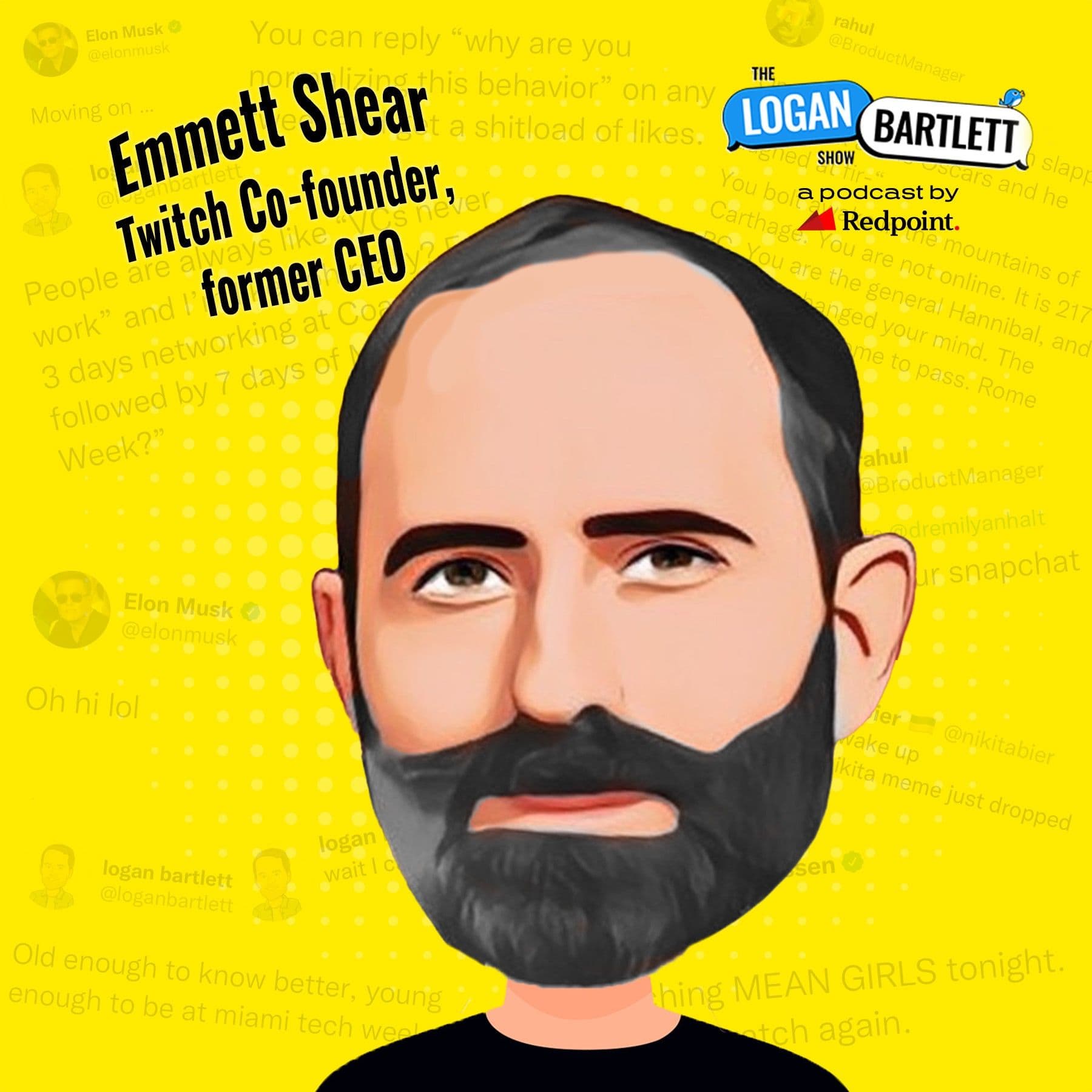
Podcast Summary: The Logan Bartlett Show - Episode 69: Emmett Shear
Episode Overview In this episode, Logan Bartlett interviews Emmett Shear, co-founder of Twitch, discussing his journey from the inception of Justin.tv to Twitch's emergence as a leading streaming platform. Emmett shares insights into product development, the importance of community for success, his management evolution, the challenges of remote work, and the implications of artificial intelligence.
Key Topics Discussed
- Twitch's Origins and Development
- Justin.tv: Initially started as a live streaming service documenting the life of co-founder Justin Kan.
- Transition to Gaming: Recognizing the potential of gaming, the platform pivoted to Twitch, focusing on community and engagement.
- Product Development Framework
- Emmett emphasized the need for experimentation and learning from various product launches leading to Twitch.
- Discussed the concept of product frameworks he used to retain and grow the streamer community.
- Community Cultivation
- The essence of Twitch lies in serving streamers, not just viewers.
- Recognized that the "community" aspect is crucial for retention; viewers come for content but stay for connections.
- Management Lessons
- Emmett candidly discussed his initial challenges as a manager, including ineffective delegation and communication.
- Emphasized the importance of evolving from a founder to a capable manager, learning through experience.
- Remote Work Debate
- Emmett expressed skepticism about remote work, arguing that it might not suit most tech startups due to the lack of in-person culture and accountability.
- He proposed that certain structures and hierarchies are necessary for effective remote work.
- Concerns About AI
- Discussed the potential dangers of AI, including instrumental convergence and the risks of superintelligent AI.
- Emphasized the need for a balanced approach to AI development, promoting understanding and safety without stifling innovation.
- Perspectives on San Francisco
- Despite challenges, Emmett remains optimistic about San Francisco, noting a strong community willing to improve the city.
- Advice to Founders
- Emphasized the importance of hiring the right people, not just A players, but those aligned with the mission.
- Encouraged founders to engage deeply with their users rather than relying solely on conventional wisdom.
Key Takeaways
- Emphasis on Community: Building a platform that prioritizes the community and the experience of streamers is crucial for success in the streaming space.
- Adaptability in Management: Transitioning from a founder to an effective manager involves recognizing one’s limitations and learning to delegate effectively.
- AI Awareness: The future of AI holds both promise and peril; understanding its implications is vital for responsible development.
- Frugality vs Speed: While being frugal is important, speed and the ability to execute quickly often outweigh the benefits of strict cost-cutting.
- Engagement with Users: Deep engagement with users is essential for product development and understanding market needs.
Conclusion This episode offers valuable insights from Emmett Shear’s journey in building Twitch and reflects on broader themes in technology, management, community building, and the implications of emerging technologies like AI. The conversation sheds light on practical lessons for entrepreneurs and the importance of adapting to the evolving tech landscape.
Written by AI. May contain mistakes. Listen to the episode to check what was said.
Transcript
Automatic transcript. May contain errors.0:00Welcome to the Logan Bartlett Show. I am your host Logan Bartlett and what you're going to hear on this episode is a conversation I have with Emmett.
0:30against those. Is it not? Then it's not important and we're not going to do that. Emmett and I take the conversation in a bunch of different directions about how he learned to grow as a leader and how he ultimately sold the business to Amazon and then stayed on for another 10 years after that running the company. Amazon actually lets CEOs be CEOs. If you want to sell your company and keep running it, I couldn't recommend any really any big tech company other than Amazon. How do we just make sure Twitch continues to be the best place for streamers? We also talk about why he thinks remote work is actually bad for most tech companies.
0:59There's a reason why Silicon Valley has taken over. You can't take that culture and transplant it into a remote work environment and expect it to work. Emmett was a part of the first Y Combinator batch in 2006, along with the founders of Reddit and Sam Altman. And so we talked what it was like in the early days of working with Paul Graham at YC. You somehow walk away from the conversation with Paul believing we are the shit. We are smart, capable, and we're going to take over the world. The only thing standing between us and taking over the world is we have to go grind even harder. Road trips are not tours of gas stations and your life shouldn't be a tour of money making finally emmett shares what he's most concerned about with artificial intelligence so here's now emmett
1:44emmett thanks for doing this um you had four co-founders of twitch justin tv uh you stayed on and ran Twitch. Michael has been running various aspects of YC over the years. Kyle started Cruise after he left. And then Justin Kahn is a quasi-internet celebrity at this point. I mean, he's gone through a bunch of stuff. Yeah. He had Atrium. He had a... Exec, Atrium. And now, yeah. Now I think internet celebrity and DJ. DJ. Got it. Interesting guy. What made your relationships with their co-founders such that you guys all stayed together and worked well together over the years? So I've known Justin since I was eight.
2:28We grew up together in Seattle, went to school together. School being high school and college. Elementary school, middle school, which he didn't go to the same high school, but then we did go to the same college again. And we met Michael in college, probably closer to Justin than to me. and then Kyle we recruited out of MIT as we were starting the company he was a he was a sophomore at the time how did you come across Kyle? we sent an email to the MIT like hackers who want projects list and two people replied and one of them was Kyle and he thought we seemed credible because we built a startup and sold it on eBay before and we thought he seemed credible because he sent us a 27 page PDF with CAD drawings And so we wound up picking him up.
3:19Selling a startup on eBay, by the way, we glossed over that. But you literally listed the IP for your company on eBay, which is an interesting separate story. You've told it enough. I won't make you do it again. I can tell the short version of it, which is that we started a copy of Google Calendar before Google Calendar existed. And after Google launched Google Calendar, we were like, oh, we don't really have any other ideas for what to do other than a JavaScript calendar on the Internet. And they already did that. So we decided we'd sell it. We didn't know how to sell something on the internet, like how to sell a software company, especially one that wasn't like a real acquisition.
3:54And so we thought we just listed on eBay, which worked, actually. We sold it for like a quarter million dollars, which I think is actually a good demonstration of like the kinds of thing you have to do in startups a lot, which is you have to just figure out how to solve a problem. even if the standard paths don't, you have to make up what it is. There's a lot of making it up that has to happen for something like a startup because almost by definition, the normal stuff isn't all set up. Was that a PR? Did you know it was going to be kind of PR stunty and that that would lead to distribution? Yeah, that was the idea.
4:31That was part of it. The idea was we were like, we need to get people to know we're selling it, how to reach them. Oh, if you listen on eBay, that'll be funny. We can get people to write an article about that. It was very intentional. And it actually worked. And it worked. It totally worked. It worked as planned, actually, minus the fact that eBay took down our listing because we had two links in it about five days into the seven-day listing. And we had to relist it, which was kind of a heart-stopping experience because we had one bid at$50 ,000 at that point. And we were like, no, we've lost our bidder.
4:59But it turns out that that didn't actually hurt us at all. So you had the credibility of that. And so Kyle was like, these guys have credibility. Yeah, they must know what they're doing. I think Kyle overestimated how much credibility that should have given us. But it did prove that we were the kind of people who could actually build things and sell them. So I suppose it wasn't a zero. And there was a deep level of trust but also some dysfunction among the group. Kyle went nocturnal for a while to avoid conflicts. Yeah. We did a podcast about this, an Only Friends episode with the four co-founders.
5:32Which is great. It's super entertaining. Two hours of you guys shooting the shit. Yeah. So if you want the full details version of it. But the high-level version is like it worked because all four of us trusted each other. And we somehow managed to pick four people who were smart, hardworking, competent. But I think most of all, who had the who understood what it meant to be part of a we not not a bunch of individuals always thinking about whether or not how is this working for me? And I think that that's what makes that's what makes partnerships work, both probably like romantic partnerships and business partnerships, because if you're going to be in a partnership, not an employer employee relationship, but a partnership relationship, you can't always be thinking about whether or not you can't be modeling what are they doing what's their incentive versus my incentive versus the company's incentive it's dramatically simplifying and makes everything a lot easier if you can just only think about what is right for the company and then just ignore everything else and I think that that's something that goes wrong in a lot of things and it's what causes instability because suddenly when there's lots of interest at stake, there is conflict about my interest versus your interest.
6:56But when you can simplify it to, well, what is our interest? And everyone can actually commit to that. It works pretty well. Is there any way to solve for that as you're now working more with entrepreneurs? Yeah. Be that way yourself. Yeah. Like the number one, the number one cause of the problem in all of your relationships is you. That's true. Again, romantically and in business. And the solving for how do I actually buy into this is we, we are doing this is really important. And then also, obviously, you need to work with people who have that mindset as well. But you have less control over that and you have less ability to detect it.
7:36And at some level, you have to trust and hope. But I think there's something about if you do it first of all you can control that so that's good but second of all it brings it out of other people when they when they can see that you're serious about we and you're not you're not running you're not gaming them you're not cheating uh you're not like pretending you're about all about we and then actually being about yourself people respond to that it draws it out of your partner as well so you launched and shipped a bunch of products over the years that ultimately led to Twitch. So there was a calendar for Gmail, which was you and Justin.
8:12Then after that, social network for families, SoundCloud, like business, a web crawler that map popularity like clout, a flexible to-do list, kind of an air table-ish thing, an eVite competitor, something that was kind of similar to GitHub, Heroku, Replit, whatever you want to call it. Then Justin TV, ultimately Twitch. I heard you say something interesting. When learning, you get exposure to a wide variety of problems related to the topic. They actually teach you how to understand and see the differences between things. You don't just study one piece of music to learn music. Did all these experiments and all the different products that you guys iterated on, did it actually help prepare you for Twitch's success, or were they just aimless cycles along the way?
8:51I think they did help prepare us. I think the main thing they actually prepared me for was building. Like, I did learn something from the product we found on it, But honestly, we did such a bad job on the product design aspects of it and the sort of business design aspects of it that I didn't learn as much from that as I'd like to. What we learned from is the engineering side of it, like the design side of it. Like how do you actually build a thing that like functions and has functionality and not too many bugs? And I got a ton out of stuff on the building side. I would say on the how does stuff work side and learning how to design, how to build a product, how to build a successful business, the stuff I built myself was probably only a tenth of the data.
9:41Mostly I was like obsessively studying how other businesses worked because you get a lot more – you can only launch a new thing every few weeks if you're fast, usually every few months, like a significant new thing. But there's new stuff being launched all the time. And if you want the number of reps you need, you can't just learn from your own mistakes. You have to be learning from everyone else's mistakes and everyone else's successes at the same time. And I think that was my primary university for that. What was with Justin, with Michael, with Kyle, every lunch, every night, every weekend, we just talked about startups nonstop.
10:23and the thing we would often be talking about would be not our startup, but like, oh, why is Facebook is working? Why is Facebook working? Why are they beating MySpace? What's different about it? What's good about their strategy? What's not good about their strategy?
10:40And really carefully paying attention and trying out and using the product and paying attention to what is actually working in the real world, you learn a lot. I think that's probably the main thing I learned from a design point of view. I joke that that's my main only value as a career finance person investor is, one, I'm used to just giving advice and letting people decide. I'm not used to actually owning the decision myself, which actually can be nice as a board member. Like, hey, here are the options. And two, you get to simulate out a lot of different data points for all the companies that come in and pitch.
11:14And so you can extrapolate on a bunch of different stuff there. Sure. One of the things that I have a friend, Matt, who almost started our first company with us, but instead went into finance and runs a hedge fund and has worked at a bunch of finance jobs over the years. and he's an investor. And what I've discovered is investors have this just in totally different lens, at least, you know, public markets investors and I think most private markets investors as well who are a later stage, where it's about like whether the industry is good and like the capital allocation and like the structure of the business, which is not something actually that founders think about all that much.
11:53I think it's right that founders don't think about that because for the first two, three years of a company, it doesn't matter. Like just build something people want and sell it to them, like ignore everything else. But as you get bigger and bigger, those things become actually quite important. And you start to try to think about, oh, we're in this industry, but we could be in this adjacent industry and there's some way to shift how our business is perceived or what kind of work we do and what's the structure of how capital flows work and can we change that? And those actually do become very important questions.
12:23But like usually later, there's sort of a handoff that happens. It's funny to hear you all talk about like iterating on the product and trying to find something. And one of the throwaway lines I've heard, I don't know if it was you or Justin or someone saying, we could go build enterprise software, but that's boring and we don't want to go do that. I was like, you know, in 2006 or 2007, you would have created a lot of value doing enterprise software. And you were just like, hey, not for us. That's too boring to go pursue it. I think we talked about building instead of Twitch or SocialCam, because Michael went and founded SocialCam, which he wound up selling to Autodesk.
12:59That was weird in a way. The Autodesk thing never really made sense to me. We talked about building a WebEx competitor because WebEx is obviously a huge market, like teleconferencing, and we have no doubt we could build a better product than WebEx because WebEx is annoying to use, which we're basically talking about Zoom, right? A more consumer version of WebEx is Zoom. And we decided against it because we knew it would involve enterprise, not the product side of it, but the sales side of it. Enterprise sales is like a whole business. And we just had no interest in learning how to do that. And it's actually, I think, a good example of sort of knowing yourself.
13:45I actually don't think I would have had – I think I probably could have learned how to do it, but I don't think – I didn't want to do that. I wanted to do something else. And I think it's important for founders to do after the thing that they're interested in. Um, although it was also a better time for consumer. Like I think, uh, we do Twitch worked a lot of actually good consumers and companies started around that time. It got a lot harder to win in consumer as the big players consolidated, uh, more distribution. And, uh, I think, uh, I think three or four years later, maybe we would have pivoted into enterprise just because lack of any credible other option.
14:21just getting distribution would have been really hard with, and certainly today it's a huge pain. There's an Ira Glass quote that I like a lot, and I know you do as well. I think I've quoted it before. I won't read the whole thing, but nobody tells this to people who are beginners. I wish someone told me. All of us who do creative work, we get into it because we have good taste, but there is a gap. For the first couple of years you bake stuff, it's not that good. It's trying to be good. It has potential, but it's not. But your taste, the thing that got you to the game, is still killer. And your taste is why your work disappoints you.
14:50A lot of people never get past this phase, they quit. Most people I know who do interesting creative work went through years of this. We know our work doesn't have the special thing that we want it to have. We all go through this. And if you are just starting out, or you are in this phase, you got to know it's normal. And the most important thing you can do is put in the work. Going through that period, it's a sort of profound quote, and I think it can be applied to a lot of different things. As you guys were iterating on all of it, did you know that your products just weren't that good? And was it disappointing along the way to ship all these different things and not have it take off like you hoped it would?
15:28Yeah. I'd say I had that in three different layers. The first was from an engineering perspective. I just wasn't that good of an engineer. I knew what good engineering looked like. I remember visiting for the FriendFeed offices, which had like Paul Buhite, who's like a vendor of Gmail, incredible programmer. I think – who else was there? Maybe like Brett Taylor. Like really insanely good programmers and them talking about their engineering process and like me using their product and seeing the engineering behind it and just being like, oh, that's what I'm trying to do that. And like the thing – I'm just like incompetent.
16:01Like the thing I'm doing, I'm just doing this all wrong and then spending like 10 years trying to get better at building stuff. And eventually I did learn how to build stuff more like the way that they did. And it was better, but it was 10 years of like being quite disappointed in the quality of the engineering I was doing. It worked, but it wasn't like – it wasn't well designed. It wasn't good. And then there was the product side where I didn't think – I wasn't that disappointed in the micro design of the product. I actually thought we did a pretty good job there from fairly early. And to some degree, it's a little different from other kinds of creation.
16:57It's sort of like whatever you can think of, you can kind of do. Like copying is very easy at that level. And so if you have good taste, you can just copy good stuff and it works. But at the macro level, there is this thing missing where like we weren't good at business. We weren't good at figuring out what do we need to build that people will actually want. And the constant disappointment was we'd build stuff and I wouldn't have actually solved the problem for the person. And that was very frustrating and like hard to deal with. um and uh there was this sense of like uh that that's that's almost more like learning to do science i would say the engineering thing is the thing where i felt the ira glass quote the strongest the and about like i had this level of taste where i could really see what i was trying to do and i just couldn't achieve it with my hands the other thing was not understanding like it's like I was a grad student.
18:01I was writing papers and they were getting published, but I knew I wasn't actually like discovering anything that's that important. Like the papers just weren't on important discoveries and I was somehow missing – I knew I was missing something. But that's a slightly different thing than the Eric Glass question. Justin TV. So you – the original idea for it, for people that don't remember, was actually following Justin, your co-founder, around for 24 hours a day, filming 100 % of his life. Did you actually think at that time that you would be a reality television studio business, or did you know this was kind of a means to some end and you were mucking around?
18:47The idea was always that we would open it up for other people to produce shows. Like we never thought we were going to be the people doing the production. You were going to license MTV or whatever. Yeah, we thought we were building a technology to enable ourselves to make the first live streaming reality show. And that other people would then go on to make more live streaming reality shows using what we built. Which, you know, within one order of magnitude is what happened. um but where we got what went wrong was that uh uh with that vision was that like reality tv requires editing live reality tv is a bad idea i just didn't really understand how the entertainment i didn't understand we didn't understand anything about anything so that that was that was crazy but actually to level below that we were very very right because we what we actually have was that And Justin, who has always been living in the future a little bit when it comes to this kind of stuff, really wanted to be an influencer and really wanted the attention and thought it would be cool to live stream a lot of his life, which was a thing that not a lot of people had done at that point.
19:58And we built the technology to enable him to live his influencer dreams. And that turned out to be quite powerful, actually. The number one thing we did right with Justin TV, the thing I would encourage everyone who's trying to build consumer software to do, is we built something for ourselves. We built the thing that we wanted to use every day, or at least one person on our team wanted to use every day. And most of the innovations on Twitch, on Justin TV, were things we invented for ourselves running the show because we thought they'd be fun. Like the idea of having our own custom emotes in chat that are like faces of the people on the show.
20:33that Twitch still does that today. And we had that idea because we were running the show. We would never have come up with it in a vacuum. And so I think there's something really powerful about that approach. Even though we were wrong with the reality TV show thing, we were right about people wanting to do live streaming. I mean, Twitch was ultimately a version of just in TV. It was just more verticalized or specialized. Do you think, had you kept at Justin TV? I guess, why didn't you guys keep at Justin TV? Why didn't you keep plowing ahead? We'd gotten Justin TV profitable after the 2008 financial crisis.
21:13I spent about a year cutting costs, generating revenue, just iteratively focused on money. And you had a doomsday clock actually on the wall. Yeah, yeah, yeah. Is that something you would recommend to people? It wasn't on the wall. It was every Friday we would sit down with the employees and be like, we've got 14 months. We've got 11 months. We've got, I think at the worst case, it was like we were down to like nine weeks. It was certainly clarifying. I think I only recommend it if you can convince people on the team that we can succeed. Otherwise, people will start packing their bags and looking elsewhere.
21:50Pretty fatalistic. But I think the founding team never showed any indication nor ever had any indication or belief that we weren't going to figure it out. We were very sure. And also, we didn't start sharing it when there's like two months left. We started sharing it quite far in advance. And everyone could see that while the clock was ticking down, the rate was getting better. And we were making progress. And so it felt like, oh, yeah, yeah, we are pulling the plane out of the dive. It might be a close thing, but people could see that we were going to get there. So was the pursuit of profitability ultimately at the expense of Justin TV's success as a standalone?
22:31Oh, it was at the expense of our growth. And then so we had this thing that wasn't growing. We're trying to decide it was profitable, but not growing. And we're trying to decide, OK, what do we do from here?
22:45And no one thought just pursuing Justin. We had no good ideas for ideas for what to do to reinvigorate growth of Justin TV per se. And so we had Michael had the idea to pivot into someone to build some mobile video stuff, which in an era before Snapchat and before TikTok, pretty good insight. Autodesk didn't seem to execute on the vision of the consumer video. Yeah, we didn't quite get there. But there was a there there, for sure. And I wanted to do the video game thing because I was watching video games on Justin TV and enjoying it. But the big pivot from Justin TV to Twitch, The real difference between the two companies is not the gaming versus the general purpose thing.
23:32That's a superficial change. It motivated me to focus on a set of customers. But I think we could have, in retrospect, I know why we did the rebrand. But we actually had a debate at the time whether we needed to do the rebrand. I think we probably would have been successful without it. I think the rebrand was helpful and it made more sense for the company. and so it was probably like you know a good idea i would do it again but not strictly necessary would have found some amount of a similar level of success regardless and uh no but the big change the big change was was i realized that the important customer for live was the streamer not the viewer that that ultimately for live video unlike for uh uh for youtube um we we could not say, well, whatever, the creators will deal with it.
24:29What matters is the audience. They're just here for an audience. They weren't really there for the audience. The audience was there for them. And you have to keep winning the streamer's business every day because if you don't, they're going to go stream somewhere else. And now there's no library of content like there is for something like YouTube. And so you can't just have people show up, create a little bit, and leave. That doesn't work. You need people creating all the time. And so the focus had to be how do we build something great for streamers um and that's why we invented paying streamers money that's why we like i went and interviewed a bunch of streamers and figured out here's what streamers need um and that was a that was a much bigger shift than the gaming part was building a product that was designed for streamers first and foremost was the gaming thing in intuition on your part i mean you obviously enjoyed watching it uh or was there i guess as you reach these conclusions gaming and focusing on streamers and not the viewers was there data that backed that up or was it just an intuition thing that you kind of realized the gaming thing is purely intuition i mean you could point at data like there are a lot of gamers if i was to do a mckinsey market research thing i could be like oh look the size gaming industry is very large people are increasingly spending more time on the internet bessemer's memo is uh public from their investment so you can go look at all their market sizing stuff i actually went back and i found my email i wrote that's like it's like uh two paragraphs long like a like a half page email that's like here's why gaming makes sense and it's basically it's the very abbreviated version of that argument um advertisers like gaming you know like the game company's interests are aligned with ours so the copyright stuff like i thought about that but the idea was purely intuition i really like this i bet i'm not that much of a weirdo like i i like popular media if i like watching this it's likely to also be popular media um the part that was more data-backed was the streamer part um i went and looked and found that there were about 200 people making gaming content and uh who had any audience at all and i was like oh if we get you know if we can convince 180 of those people to stream on twitch we just win like there's just there's just no it's just unambiguous there's no way we can lose actually um and so we just pivoted the company to be focused wholly focused on that and that i think was reasonably data driven in the sense that i went and like looked at i looked at to just make the decision about viewer versus streamer i went and actually got data and then thought about it um although it was certainly informed by having worked in the space for five years and like having the intuition to sort of understand the dynamic of uh what it would mean to win a streamer and so the band kind of broke up at that point michael went with social cam justin left the company around then and kyle ran the legacy of what was justin tv for a while yeah so we uh we actually weren't sure whether we wanted to do the social cam idea or the gaming idea instead of debate it we were like we're gonna fund the gaming idea and the mobile idea as like skunkworks projects and then we're gonna set goals and if they hit the goals we will pivot to them and was this just jamming more ads on justin tv to pay for this we are already jamming more ads in just tv that was that was already the pre-roll mid-roll banner that was already the plan yeah the plan was already to extract we already in the we were justin tv plan unchanged extract maximum profit um we then but yeah that meant we were profitable which meant we could fund like these projects um and twitch we hit our goals we hit like the we hit like said like a 25 growth a month goal and we were hit like a 30 growth a month which great um and how'd you go about actually doing that was that the work with the streamers yeah it was just it was the the exact process i was talking about of like oh there's 200 streamers let's call them what does it take to convince them i saw kevin was one of the very first people who i think he was the first person i brought on to my my gaming team he was my the person i was like i need kevin i was like kevin uh was our he was basically all the non-programming engineering stuff originally um and i was like kevin your mission is to convince people they need to stream gaming on justin tv like go talk to them get them to do it um and kevin is probably one of the single best bd people i've ever worked with and uh he did a very good job of doing that and like i backed him up with you like oh they'll switch if we build this and i'm like great on it and then we just go build the thing um michael had took two engineers and built uh and justin kind of uh sort of working mostly on that project with Michael, building SocialCam.
29:08We didn't actually hit the SocialCam goals. It took them longer to build. Twitch, JustinTV Gaming was literally just built on JustinTV Gaming. We didn't have to build a new product. It turned out we overestimated how fast it would be to build an entirely new product from scratch for mobile gaming so that they didn't hit the growth goals. We felt like the product they built was promising enough that it was worth doing the effort to spin it off. In retrospect, we were right about that too. so we spun that off um michael went with it uh justin hung around for a few months but like i think you know was also feeling the issue something else and i think wasn't it's funny justin now like loves twitch and like with learned what the product was i think at the time didn't really understand or love the gaming streaming product and so he was like didn't want to work on it that much which totally makes sense to me um and then kyle uh was figuring out what to do graciously ran the legacy business for me for like uh more than a year i think and then found uh colin carrier who was our uh who was the his replacement um to run it uh which was amazing because like that was basically funding the business um so we needed someone good running it um and then he went off to to start cruise i heard you say that people come for the entertainment but stay for the relationships within the community what when did you realize there was something unique going on from a community standpoint?
30:30Yeah, come for the video, stay for the chat. So when I first started building Twitch, I was using myself as the prototype viewer. And I am the type of viewer we've come to call the strategist, which means I was there because I liked watching people who are good at the games that I like to play. So I could learn from them, ask them questions, stuff like that. Almost like a group coaching session. Or I could watch esports and like live of esports entertainment. And that was also great for me. It turned out very rapidly, though, that I was in the minority. Strategists make up about 20 % of Twitch viewers.
31:0980 % of people were there because they liked the hanging out. They liked the connection they got from hanging out with other people in chat. And talking to people, watching them, it was just rapidly obvious, oh, I'm actually not the prototype here. these other people are the prototype is that are those the two groups yeah i mean you can you can you actually can subdivide the community group more finely so we have more psychographics underneath that but they're at the top level there's like are you there for the entertainment or are you and then learning or are you there for the entertainment and then community um and there's you can you can go deep i'm curious as like are there any broad strokes of the other types of people it's it comes down to like are you do you are you about uh the personality more Or are you about the chat vibe more?
Read the full transcript
31:58Like, what's the part of being here that's the most important thing? But, like, it's a little inside baseball and fundamentally not that important because they all benefit from the same. Like, you don't actually build different products for different people. So it doesn't, you know, at some level, it doesn't really matter. Whereas the learning versus community thing is a really important product impacting insight. and so that's when we were sort of realized like oh people are there for the connection okay that's the like real that's the thing they stick around for most of our users stick around for and so that was uh that was a pretty deliberate uh learning from looking at our users like it wasn't we didn't just make it up were there non-obvious things that you did to cultivate the community or ultimately what is building the product for the streamer then it became obvious that they would cultivate the community.
32:50Yeah, no, I think that was the learning from focus on the streamer was like very, very early. It's obvious if our customer is the streamer, then our job is to help them cultivate their community. I still believe that to be true. I don't think Twitch has communities. Twitch doesn't have any community. Twitch has streamers. Streamers have communities. And when people get confused and think that, oh, the community, people on Twitch care about Twitch. They don't care about Twitch. They care about the streamer. And our job is to facilitate that. And it's very egoic, I think. It's like you're telling the story that you're the hero.
33:22The streamer is the hero. Our job is to like, one of the slogan we came up with for it later was we play support. Like the streamer is the carry. We are support. And I think that's a key like mental model for a product like Twitch. Twitch was able to uniquely beat back competition from a bunch of heavily funded tech companies along the way. I guess, what was the feeling? Google had a famous tweet, welcome player two, when they announced their presence. Where were you when that happened? What was the sentiment around that? Yeah. So after we were acquired by Amazon, I think everyone else who was like, oh, maybe we'll acquire Twitch.
33:59It's like, oh, we're not going to acquire Twitch. Okay. We better launch competitors. And so within like less than a year, Microsoft, Google, YouTube, and Facebook had all launched very explicit Twitch competitors and started spending huge amounts of money bidding on streamers in a very non-sustainable way that was them trying to buy a critical mass of audience, which was exhilarating. I think it was good for Twitch. Competition is good for the service. We posted a kind of snarky tweet that sort of welcomed Player 2 when YouTube launched theirs. Um, but I think that really was our attitude, which was like, if you can build a better product for the streamers, you're more than welcome and you should win.
34:48Um, but we think our product's better and we think streamers are going to choose us every time. And our strategy to beat everybody was we had to bid against people and stuff, but like ultimately we let a lot of streamers walk. Like we, we could have kept bidding more money. Um, and, uh, we didn't outbid on everything. We outbid on a bunch of stuff, but like not everything. and our focus was from the very first beginning how do we just make sure twitch continues to be the best place for streamers um and how we continue to make it so like they continue to choose us instead of instead of the competition and i've uh i remember reading a bunch of some streamers complaining about to actually be like basically like oh i want to go to the you know youtube except like you know i feel like they're offering me more money but uh and i'd go except it's not fair.
35:38Twitch has to be trapped because all the moderation tools are so much better and this is better. I'm like, you mean we trapped you with our nefarious plan of building a better product that actually works? Yes, I fully admit this is our secret plan. The ruse all along. You didn't see it coming, but we're going to build stuff that you like and then give it to you for free. Very diabolical. Yes, totally diabolical. That was the thing. We won because our product was better. I think that's like a, and it was better in the way people, people cared about. There's a lot of nice to have features. Like fun things that people think they want.
36:14Polls is the best example. I think we actually have a polls feature now where for many, many years we did not. And our competition did. They had a polls feature. People would complain about this, but the truth is you can run a poll using like a online, like there are many poll things you can just use on the internet if you want to. if we screw up chat moderation if we screw up uh if you're if you're if your subscriptions don't work well if discovery isn't good if you can't fix those things only we can and you don't actually want us to build a poll you think you do but like the truth is you don't actually and when you would confront them with the actual choice would you like to make a dollar more per hour or would you like to us to build launch polls like oh a dollar obviously what are you talking about like well that's right okay we're gonna keep working on the other thing then how do you get to those conclusions like when you're hearing from your users i want this thing but being able to discern that they actually don't really want this thing at the expense of what it would take you to go do it and is it actually frame it in those terms of would you prefer an extra dollar or would you prefer like more engineers on this yeah so when i got started with twitch i uh i came up with a framework for prioritizing features which is i got out of talking to a bunch of streamers and basically asking them why they streamed and sort of what their goals were and what they wanted out of it.
37:30And what we came up with was they wanted fame, love, and money. Fame, they want to obviously reach an audience, grow it, have more people watch them, get more hours of video watched, basically. Love, they wanted to feel positive social feedback and connection for doing it. Whether that's from Twitch because they got invited to TwitchCon or because some Twitch partner manager reached out or it's from their audience saying how great they love the show and how amazing that was. And then money. They wanted to make money on the stream. And basically, if we built something – and there's a secret fourth thing, which is like the video has to work.
38:02They want the live video to be like actually good enough. Okay, cool. Let's put that one aside. That's the underpinning. That's the underpinning. That's the table stakes. That just has to work. Assume it does. Is this thing producing more money, more fame, or more love? Great. like we will prioritize resources against those is it not then it's not important and we're not going to do that um and uh that worked because those were the three most important things and then once you have that structure you can kind of it's easy to compare within money which of these things we think will be most helpful to make the most money within discovery which of these things and in fame which of these things will help grow audiences the most um love is the trickiest one obviously because love is a little bit less fizzle more fuzzier and less clearer than fame and money are but uh but ultimately it's like having good moderation in chat um having uh experiences for streamers where they feel they feel loved by by twitch and that we care about them once upon a time google came and made an offer to buy justin tv uh before it was really in the before all the twitch stuff came to be and ultimately uh you got far down the acquisition process and then people on the team failed google's uh tests or something they uh google was considered an acquihire and out of our like whatever i don't know 30 total people they like had like 10 that they thought were like google quality um and made an offer on that basis and we were just like no uh and in retrospect i remember like looking at the offer and if they'd offered us three times more money i think we would have taken it um but uh but i'm really glad they didn't offer us three times as much money um same thing actually happened with kiko on yahoo yahoo offered to buy kiko which is your calendar with the calendar company for a million dollars in but like in retention over like four years so like 250 000 a year in signing bonus on top of a you know mid-level yahoo engineer offer and i'm really glad they low-balled us because if they hadn't lowballed us we wanted to take it and like uh uh we didn't really want to do those we didn't really want to work for google or work for yahoo we wanted to run the company it's just it felt like you have to take if they offered you a win you kind of like you have to take it um so i'm so i'm glad they didn't are there any lessons actually from either of those stories that are that you could extrapolate as a as something you would tell a founder or is it hey those are funny situations and the road not traveled but at the end of the day it's just there was nothing to be learned from the individuals i don't really think i've i i've the only time i ever use it someone's like oh i got an acquisition offer from this company um and i talked to them and i'm like okay this is this is like an acqui hire here's like here's how it's going to work like here's here's how acqui hires work and having been through one myself i kind of like i know what the what the process will be like a little bit although it does vary from company to company It's not that variable.
41:02And so occasionally it's helpful for advising someone who's in the exact same situation. But other than that, there's not much generalizable from it, I don't think. This might be an annoying question that just people in the media and I guess venture capitalists ask you. But how much time have you given to thinking about Twitch as a standalone versus within Amazon? Like whether we should have sold it or not? Yeah. um well i mean selling it uh worked out really well for us because uh it was unreal did let twitch grow on its own like did they help with bidding for streamers and like was that an expensive capital outlay that wouldn't have been obvious because the weird thing about twitch versus instagram for example is instagram it's hard to uh disconnect instagram within uh facebook right because of all the stuff they did from an ad infrastructure standpoint and you know the adoption and promotion and all that i think it's kind of hard for me to mentally disconnect the two twitch was to your point able to operate pretty standalone right and so almost you can you can at least from the outside in maybe you disagree almost see what the business would look like in some ways absent amazon amazon brought what you ever retained me as a ceo for a very long time and it retains many of its ceos for a very very long time like how you were there don cats at audible 10 years, eight years, eight years.
42:20And they do it because Amazon actually lets CEOs be CEOs. It's like it's it's the most decentralized of the big tech companies. And I think if you want to sell your company and keep running it, I couldn't recommend any really any big tech company other than Amazon, because it's the only one that runs under that model. um i've thought about what it would be like to have done it separately um and i actually just think it wouldn't have been that different the biggest difference was the reason i sold at the end of the day is i don't like fundraising and i knew that if i sold to amazon i'd get to keep running my company in fact they would demand i keep running my company and but we were aligned in that i wanted to and they want they wanted me to so great and they would make sure that they would fix the i have to raise capital every year problem because they're committing by buying us to fund us um and uh or like right out make it take a big loss but like they're basically committing to fund you and so uh that worked out where i would say it worked out as planned um and so uh i feel really good about the decision in retrospect uh i think i made it more intuitively at the time than like reasoned and it only took me a couple years after doing it to even figure out what the math I had been doing subconsciously was.
43:37But I think it was the right to call for sure. What did Amazon do to keep you around for so long besides just letting you run autonomously? That's literally the thing that they did. Hey, big tech companies, if you want to retain CEOs after you acquire the company, you have to let them still be the CEO, which means they decide who gets hired, who gets fired, what contracts you sign, what products you launch. If you try to take that away from them, make them go through your processes, if they're any good at all as a CEO, they're going to leave because they're not a CEO anymore. They're a division vice president, and that's not the job they signed up for.
44:14So FYI, if you want to retain CEOs, one weird trick. But did they get strategic value? I guess to take it from their vantage point, obviously, Twitch is a very important asset within there. But the flip side of the reason I think people end up being somewhat heavy handed, or at least involving themselves post acquisition of a company is to try to make the value greater than the individual component of it. Were there things they did from an integration standpoint or things that they pushed that benefited other parts of Amazon? I mean, Twitch advertising is sold by Amazon advertising, the third biggest, I think third biggest.
44:55I don't know if that's exactly. I think it's the third biggest advertising company in the world. So that's good. That's like the Instagram, Facebook thing in a way. Except I think we provide more value to Amazon relatively. Facebook already had a lot of ad inventory in feeds. That's basically identical. Whereas Twitch, Amazon did not have a bunch of UGC video and premium gaming video to like sell against. Yeah. That's them to you. I was wondering you to them if there was anything that... Oh, no. No, I think actually in the advertising case, unlike Instagram where it's mostly Instagram benefiting from the Facebook advertising machine, here it's much more two-way.
45:34We open up a new kind of inventory they don't have access to otherwise, which is good for the overall Amazon organization, but also good for Twitch because we get access to the big sales team. So I think the advertising thing is the obvious, just like with Instagram. It's the obvious integration point for something like Twitch. We also do stuff with Prime. That's been very good, which are quite well. Again, very two-way.
45:54and we've launched IVS, which is our interactive video service, an AWS service. Very cool. To be able to take one of the core things you built and externalize it as an AWS service is very cool. And something you can't do unless you go to, I guess, it'd have to be Amazon, Google, or Microsoft, basically, because those are the cloud companies. And we definitely couldn't have done that on our own. But yeah, a lot of it has been less deeply integrated. And I think that that's, except for the points like advertising which is a really big one where it does make sense to integrate and i think it's really to amazon's credit that they didn't try to force a bunch of integrations for efficiency reasons um basically if it's always efficient in theory it's never as efficient as it seems in practice so um uh i i think strategic there are strategic acquisitions where you're buying something as a technology you know apple buys some semiconductor company so they can start making chips.
46:51Sure. And that should get integrated. It's not actually a separate product. But if you're buying a product to be part of your portfolio, I actually don't. I think often the integrations are a little heavy handed for no good reason. I've heard you say that as you get money, there's a clear declining value to more money. Obviously, that's true. It sounds like something people just say. But how has that actually impacted your life having success and how would you internalize that or i mean having money is great um the you know the utility of money declines approximately with a log of the amount of money um you can actually see it on like uh if you if you plot like you know life happiness correlation curves and stuff so every 10x more money you have is like one incremental unit more so like it's not that there's no value of going from 1 million to 10 million but it's like 1 million to 10 million is the same as$100 ,000 to a million.
47:48And so going from$1 million to$2 million is like, eh, it's just not that big of a deal. Even though it is a million dollars more, it doesn't change your life that much.
48:03I am very glad to have money because it makes my life directly better in terms of consumption. But most of all, because it allows me to do things like invest in, I've invested in my friends' companies or in strangers' companies and people I've met's companies. Being an angel investor is really interesting. I feel like I get to support people and help. I got to fund SF New Deal. And I got to write a check for a million dollars into SF New Deal because I had someone I knew, Lenore Estrada, who's CEO, and I trusted she could step up and run it. And I could make that decision fast and just write the check.
48:39I didn't have to go try to raise money from other people or put it together, crowdfunding it. And that was really valuable. I really like standby that being that was it was and it was interesting. It was fun for me. And you get to go do things cool things for your friends in your community. So, I mean. Yeah, but I guess having money is great. Who doesn't like having money? I don't think it's the it's not the only thing. The quote I like about money is like. You need money like it's like you're on a road trip, you need gas. but like you know road trips are not tours of gas stations and your life shouldn't be a tour of money-making uh activities but like also like you should think about where the gas stations are on your road trip like it's especially if you're going on a long big one like you really don't want to ride a gas uh over the years you've been particularly transparent about being a bad manager initially uh i i there was a quote you had i was bad at hard conversations i was bad at good conversations.
49:39I was bad at delegating. I'm sorry to the people that worked for me in the early days. I assume you're being too hard on yourself there. But what were some of the things you learned about yourself and managing that allowed you to develop into a good manager? So I would say in the early days, I was a pretty good leader already, but a bad manager. Like I could inspire people with a direction. I could communicate. But I would stand by what I said there, I was a bad manager. But I don't think I'm being particularly harsh. I have yet to meet anyone who is a good manager the first year they are a manager.
50:14I don't think anyone is. Being a manager is a set of skills, like a thousand different skills. And you aren't good at them. They're not like things you just know automatically. Like no one's a good skier the first time they go skiing. It is not possible to be good at first. And there's only one thing that distinguishes good managers from bad managers consistently that I've found. Some people, when presented with this, don't like this truth that they suck and decide that they are in fact good managers already or that management is easy or that they don't – that it's not – they're as good as they need to be.
50:53And some people realize that management is a skill and they're not good at it yet and decide I want to get better at this. I want to learn how to be a better manager. and every year they're thinking about how do I get better? How can I become a better and more qualified manager? And how can I be better at this set of skills? And the people who try don't always succeed, but a fair amount do. Management's not so hard. If you treat it like a set of skills, they're not the hardest skills to learn anywhere. It's not as hard as abstract math and inventing new theorems about topology. That is more difficult than management.
51:32But it's hard enough you have to learn. The people who dedicate themselves to it often, usually, not always, become good managers. The people who don't are universally terrible. And that is just the only thing that differentiates the people is whether you accept into your heart, you need to learn. You need to get better at this thing. That's basically it. What was counterintuitive or what skills were counterintuitive to you that maybe took longer to learn or just were super surprising as you got higher and higher with more and more people? The thing about management skills is they're all dumb.
52:07They're not surprising. When you say them out loud, they sound stupid.
52:14When you delegate something to someone, you have to actually delegate it to them. You can't delegate it and then like look over their shoulder and then tell them they did it wrong. Like that's just going to make them unhappy. And worse, they're going to stop trying to even do the thing because they know whether they do it well or badly, you're going to show up and then review it and then make it the way you would have done it. And then – and so why should they put much – their whole goal is to get it in front of you so you can correct it. And like that's obvious if you think about it. It's almost dumb to get wrong, and almost everyone gets it wrong when they first become a manager.
52:54I guess it's counterintuitive, but I don't even think it's the counterintuitiveness. It's just you don't – most of management is learning to notice the thousand and one things that you can do wrong. And if you thought about each one of them, you would probably come to the right answer, but you just – it just doesn't occur to even notice. I guess the thing that one counterintuitive thing about management that was a surprise to me is that managing individual contributors on a team is not the same job as managing a team of managers, is not the same job as managing a team of managers of managers. It's not the same job as managing a team of directors.
53:31It's not the same as managing a team of VPs and that's not the same as managing a team of SVPs. Every time you add a layer to the company your job is like all it doesn't have nothing in common but it's fundamentally quite different um and that's one of the reasons why it's so hard to scale teams and people like sort of uh hit a scaling limit at some point it's because as you keep in a fast growing company everyone's like winding up underwater all the time as layers under you get more layers under them and that that directory was doing such a great job is doing a bad job now they didn't get bad the job changed from underneath them and so everyone's in this race to like figure out the new job before it uh before it kills them what changes in those levels of abstraction like i mean at a high level when you're when you're so far removed what what is so different than being on the ground i would say like uh the you have just the techniques you you have to use techniques that scale better as you get that rather than things that are maximally effective you want things that are scale best and that like the trade-off between how effective is this individual interaction how good how like in the beginning you need things you need to actually fix problems and ship code and make things happen and that kind of dynamism is really important as you get higher and higher in a hierarchy you have to figure out how you can make your time and your effort and your energy scale because you can't go do it thing by thing.
55:02And so there's a trade-off between those two things and you need to pick – the skills that you need are more of the scale level skills. Writing becomes more important when you're higher up in the organization, for example. As you get higher and higher and the company gets bigger and bigger, there's also a component of transparency and input of decisioning that you can't be can't be quite the same as it was in the early days right like the decisions all the inputs that went into an individual decision you can't communicate in mass to the totality of the company which i think can be hard i think that can be hard when you come from a culture of like full transparency or it was small and now you're big and all that did you did you experience that was that something that you struggled with of just like how to balance transparency with just giving people the outputs of stuff yeah i mean there's people can use the word transparency a lot when what they mean is input um you can give transparency for stuff actually not everything but most things no matter how big you are um a lot of the time the transparency just makes people more upset though because what they really meant when they said they wanted transparency is they wanted a voice and that you cannot scale Everyone cannot have a voice on everything.
56:21In fact, almost everyone can't have a voice on almost everything. And that's not true when you're small. It gets true when you're bigger. When you're small, you can stay very, very synchronized. And as you get bigger, everything has to just desync.
56:39And creating mechanisms and processes so that the right people can have input at the right time is like, that is the art of management and and production in a company of greater size and like i don't know there's no there's a short answer to that question that like is it all meaningful but uh i think the the main metaphor i always use for it is like you have to you have to shard the decision making like sharding is an idea from programming and from like databases where you have to find a way that you can divide stuff up such that some set of the data of the decisions can be made in this hundred people.
57:16And this hundred people in this group owns everything about that. And they don't have to communicate much with the other groups and figure out how you can bottleneck and shrink those between group communications and let people interact in a more asynchronous way. And again, there's a thousand and one techniques for that, but that's what you have to figure out how to do. What was something that you found that even after, whatever, 10, 12 years? How long was your run at Twitch? 17 years. 17 years from Justin TV. And what was something that you found that it was just you were never going to be particularly good at and that you needed to augment or get people around you to help you with?
58:00I think what I discovered is I could be good at literally anything. There was no skill I could not learn. but there were a lot of things where I don't like doing it. I'm never going to enjoy doing it, and it's always going to drain energy from my day. And by the end of the day, if I'm doing a bunch of that kind of work, I'm going to be grumpy and unhappy and tired, and people interacting with me are probably not going to have the best experience. And so it was less about what I could get good at. I could get good at almost anything, at least once. it was more about like, what could I do sustainably?
58:42What, what, what, how do I manage my jobs that I am doing things sustainably in a way where I am can consistently do it at high quality when I'm not at my best. And so for me, one of those things is like, I really have never been great at interviewing. I don't like interviewing new candidates for jobs. there's a lot of energy for me to meet a new person and bring bring that there who they are on and make a connection and like i like doing it actually uh when the, either someone I find myself naturally drawn to, which is, you know, whatever one in four people or something like, which I don't think is unusual in terms of the one in four part.
59:30I think it's just an unusually high energy cost for me for the other three. And I can do it and I've learned how to do it. And I, but I don't like doing it. And so I've just found ways for that. I was not the first person. I, I had this heroic idea, like hiring super important. I need to be the only one out there, you know, interviewing for the new CFO. or the new head of product or whatever. That turned out to be a terrible idea. I was grumpy all the time if I did that. And instead, the right thing for me to do was let other people do most of the interviewing and only interview two or three final candidates.
1:00:07And you're sort of admitting that you don't have to like all the work you do. You tweeted recently, management lessons from the front number 761. I didn't go back to look if there were actually 764 in front of them. But your reports will ask you a lot of stuff, especially in the beginning, like should we do X or Y? Do not be tricked. This is usually unintentional trap. The only correct response is what do you recommend? Does that tie back to the autonomy of decisioning and being able to delegate? Yeah. And this is not to say that you should never answer your report's questions. I want to be really clear.
1:00:43Some people interpreted me as saying in that you should – if you tell the report like – if you tell someone like, hey, go make this thing, go build this thing, and they come back and say, oh, well, there's this tradeoff that's above my pay grade. the company, I have to commit the company to$20 million of liability, or we have to spend an extra 16 weeks doing this. And I kind of think we should actually commit to the liability, but like, what do you think? That's a fair question. That is not, that is not, it's not their job to figure out, you know, some individual contributor, you know, new person on the marketing team is not the company's job to figure out, should we run this level of risk?
1:01:33No, no. Fair. And those often get kicked up the chain and that kind of taking on a risk sometimes requires all the way up to the ceo to sign off totally reasonable but when you ask someone like hey like uh like you know they're designing a new a new ad campaign if they come to you and they say like oh well do you think we should make the ad campaigns message this message or that message that is literally the that's the job of the person who's you asked to go you should we use this creative approach or that creative approach i don't know it's your ad campaign like you tell me um because if you don't do that they don't own the decision um and the whole point is to delegate down both the authority to make the decision and the accountability for the results of that decision um and in very dysfunctional companies sometimes uh people people have learned you they actually don't actually have the authority, no matter what anyone tells them.
1:02:32And that means they don't want the accountability. And you want to put this circle of them very logically, constantly trying to push off accountability by getting input and making sure everyone is signed off and they never have to make a decision to take any risk. And that's because they know they don't actually have the authority and they don't really believe they'll be allowed to do a good job. And I have empathy for people who are stuck in that situation. It happens even in good companies. It happens sometimes. But the good solution is not then get everyone to sign off on everything so it's all safe, but rather then actually empower people to make decisions so that you can actually just do stuff.
1:03:10You did a great YC talk with regard to product development about how to think about developing product and talking to your users and customers, users and customers of competing services, as well as other people that aren't using your product today. We touched on product development a little bit and the three pillars that you guys kind of use to think about.
1:03:34How do you think about, I guess now it's probably been 10 years or eight years since you did that talk. How do you think about product development and actually figuring out the features that matter at a zoomed out level? Maybe not Twitch specifically, but just like how do you make these prioritizations? prioritizations so that the uh saying that comes to mind for me for this is um planning is essential plans are useless i think it's like a like eisenhower or something some some general um and it's totally correct because you if you don't make a plan for you're going to get you know from point a to point b you're going to miss so much stuff and you're you're going to fail But once you make the plan, no plan survives contact with the enemy.
1:04:22As soon as you start executing, you realize like, oh, that didn't actually work. This didn't actually work. You have to improvise. Talking to customers is essential. But the results of talking to customers is useless. Like it is the talking to the customers and the really paying attention that informs your intuition that then lets you design the product. You're not delegating. The mistake people make is they're trying to delegate product design to the customer. And if they were so good at the product design, they would be starting the company. They would be the product manager. They're not good at product design.
1:04:58They know what problems they're running into. They know the realities of their business. And what you need to do is you need to understand them incredibly deeply, not get them to do your job for you. Sort of almost the inverse of the manager situation. Don't delegate that to them. So that's one direction you make the mistake is you try to delegate the product design to the customer. No, no, no. You design the product. You talk to them. You understand them, and you use that to design the product. The other side of it is you come up with a great idea, and you've got to talk to customers to validate it.
1:05:30Validate is the like – when I hear people talk about validating product ideas, I instantly know that there is a problem. because once you've had the idea, no amount of talking to any number of customers will change how good of an idea that was. It is exactly as good as it is the moment you have it. And you can have a thousand customers tell you it's a great idea. It was or was not, and it will, a great idea, and it will or not have the impact before they've told you or after. If a thousand customers tell you it's a bad idea, same thing, it doesn't change anything. And so unless you are actually throwing away lots of ideas customers tell you they don't like them, you're not having any impact at all.
1:06:14And that never happens. Every now and then people validate ideas and throw them away. And actually what's even funnier there is it's usually when they do actually throw them away, those ideas might have been good. The customers are just bad product designers and they don't realize that actually is a good solution to their problem.
1:06:31But the main thing is the order is wrong. You need to talk to customers first and then have your great ideas. And so there's this idea from the rationalist community online that I really like, holding off on proposing solutions. Holding off on proposing solutions is one of the key product design skills because you have to know there's a problem and not come up with the solution long enough to actually go gather some data and think about it. Because once you come up with a solution, your brain just attaches to it. It's really hard to let go. Some people can do it, but it's surprisingly difficult.
1:07:13I want to talk more about decisioning. And one, as it relates to when you had four co-founders, Kyle, Michael, Justin, and yourself in a room, you mentioned there was ultimately kind of a war of attrition on decisioning, that it was whoever was last man standing kind of got the vote. We had a real hybrid model. so we would we would have uh these like epic debates which were mostly useless and sometimes we would do the thing of like the person who like had the most stamina but often it was just like there's this other thing happening which is like whoever just did stuff they got their way too like uh that was kyle's main move but actually it was my move and a lot michael's move too like we'd we'd argue about it and then we'd uh we'd go off and like all just like do stuff and actually i would say in retrospect, it's a little bit of the planning is essential plans are useless thing.
1:08:07We could, the arguments could have been less contentious and we could have probably shortened the debates, but they were valuable. And we would, we would game it out. We would argue it out extensively. We would hear from all the sides and the person who was in charge of that would go make a decision to make stuff happen. And actually that's actually in retrospect, a relatively functional process because there was a distribution of authority and accountability, although it maybe was an unpleasant, it was an unpleasant but kind of effective approach. And I would say it was like a high end, pleasant, medium effective.
1:08:42I wouldn't really recommend it as a, you can do better. There's more Pareto optimal outcomes, but like, but it's better than the stuff that's ineffective. one one question on uh i guess just because it's been a big debate uh of late is the remote work thing and now having lived through justin tv and twitch and seeing all the discourse online you're uh you're working with y combinator now like what's your what's your perspective on remote work and decisioning that specific question i guess you had tweeted out my observation you can build a two by two for workplace environments remote local and hierarchical versus egalitarian there is an island of stability out and deep and remote and hierarchical what did you mean by that and what's your perspective on remote so the island of stability is an idea from like the periodic table where like as hell elements get heavier and heavier they become unstable but there's a theorized we've yet to synthesize in one of these elements is a theorized island of stability way out at like a very high neutron proton count where suddenly the elements get stable again for a little bit.
1:09:51But there's like – but the in-between options are all bad and are unstable and intensely radioactive. And I have seen – I know a couple companies that are very effective remote. And what differs – the way they differ from the traditional valley culture is it's not distribution of authority, everybody like is autonomy, everyone like figure out what to do on their own. It's like the army. Like there's delegation. There's delegation of authority, but it's not – delegation of authority and distribution of authority are not the same. and they're all over auditing and follow-up and interactions and documentation and you have to document your work and you submit it.
1:10:37And you can build a mechanism and a culture that works remote. But the Valley approach, I think of it kind of canonically in its most extreme of the Google vibe of like, yeah, no real accountability directly. directly like because we don't really know what's good and like go experiment and try stuff and like maybe it'll work and like no real urgency to like launch stuff fast that that does not work remote it works okay in person because there's sort of this weird implicit social pressure thing that gets used in place of official uh methods to like manage stuff but once you take that away and you don't have the official thing either, it's just like bad.
1:11:22And so the Valley culture works. There's a reason why Silicon Valley has taken over. It didn't evolve for no reason, but you can't take that culture and transplant it into a remote work environment and expect it to work. And I think we'll slowly sort of like, you'll start to see models that are like, oh, you're on this model. You're on the this model or you're on the that model. And I think that that will, I think that will that'll be good for us actually if you really care a lot about remote you'll go work at a company that has a remote culture that works I actually like love the in office thing I love being able to be remote sometimes but like I just enjoy being around my coworkers I enjoy being able to see them in the face I like the organic parts of it but not everybody does and I'm really happy that they get to go work at a remote environment that hopefully has a functional, not dysfunctional remote culture.
1:12:18Goals and OKRs versus intentions. You prefer to focus on intentions than OKRs rather than being tied to specific goals. Can you elaborate on that? I mean, that's more on a personal basis than on a corporate basis. At a corporate basis, goals are very important. You need to actually... Setting goals is a... I could probably give an entire hour-long talk on setting goals and the trade-offs and various ways to do that. But at an individual level, setting goals for yourself can be fun, but ultimately goals are usually a way to coerce yourself or whip yourself into doing a thing you don't want to do.
1:12:55You should have set a goal and that's why you need them in the corporate environment. People have to sometimes be a little bit coerced into doing something that's less than the thing that they want to actually do, but it's important to the company even though it's not the most interesting and exciting to them personally. And you're trying to artificial excitement and fun. It can be inspiring. It can be exciting to try to hit a goal too. It doesn't have to be always a whip. There's a carrot there too, but even carrots are coercion. Like ultimately it's not the intrinsic thing itself. You're, you're, you're using reward or punishment, like a operative conditioning on a dog to get it to train it to do what you want.
1:13:29There's a place for that. But like, I try not to like coerce myself all the time. Um, and I find that, uh, an over-focus on goals, like goals are set with your intellectual, like top-down analytical mind. And if you're good at setting them, you can be effective with it. But like your top-down analytical mind is only so good. And it's easy to set a goal that is not – it's like related to what you wanted to do but not quite what you actually wanted to do. And then that's very dangerous because you can spend years sometimes pursuing this and achieving and succeeding only to find out oops i didn't actually that goal was that was like sort of right but it missed this important thing and now i'm like i have to actually go way back and start over um and so i mostly think about it in terms of like uh you know i'm a really concrete one like don't set a weight loss goal uh set an intention about uh wanting to be strong and healthy and acting in accordance with that um and creating an infrastructure to support you in doing that well um there's the book i think about on this a lot is the score takes care of itself yeah by walsh that's that book's great um and i think it really it's for the people who read it it's the idea of like what you the score in the game is literally irrelevant it's a football coach and you ignore the score score it's like screw that like uh uh what's important is did you practice did you do the practice you needed to do did you everyone show up to practice they give they give practice their all and if they if you they did that you're gonna win or lose the game that will that that will take care of itself and i find that's very true for for goal setting.
1:15:26The goals tend to focus you on the score.
1:15:31You're going to create a way to score yourself, and that's not necessarily the best way to do it. I don't know if we have an hour to do the setting goals for a company thing, but is there a short primer on how you think about setting goals or OKRs for companies? No. Let me see. If I have any maxims about goals, obviously it sounds like focusing on inputs versus outputs is uh no you need a blend of input and output goals because the output goals keep you honest and the input goals keep you focused uh i'd say uh there's a lot of different kinds of goals you set for different kinds of reasons and the most important thing is to be kind of clear with yourself like one goal i set where Twitch was like, I want us to have a million people earning money on Twitch in five years.
1:16:23In 2016, I set a goal we had like at the time, I think 15 ,000 people earning money. 10 ,000, something like that. And I was like, I think it was 10 ,000. And I set a goal, I want to have a million people earning money on Twitch by the end of 2021. And we hit it because of COVID. We hit it actually early 2021, which I'm very proud of. I called that weirdly accurately, but I didn't really call it. But I – God, I sound like a hippie. I manifested it, right? Like by just saying that to the company and having people think about that, it generated things like other people inventing things like the affiliate program.
1:17:00Well, if we're going to have a million people earning money, we have to have a really easy way for people to sign up to earn money. And so we created the affiliate program and like – and then a bunch of other things like that, right? And that's one kind of goal. That's like a five-year goal that's like – I had no idea how to achieve. It was very output-oriented and supposed to be sort of an inspirational goal. But then you also set goals like this quarter we need to get our – the number of TPS reports filed up by 17 percent. And those goals can be very effective and important also. And I think it's like it's – they're useful for different things.
1:17:43They're motivating to different people in different contexts, and you should just not confuse each of the goals for each other. I know you're a big believer in coaches and that a coach will pay for itself as soon as you can afford it. I guess maybe can you tell the story of your coach and then ultimately why you think it's important, how you go about assessing a mentor or a coach along the way? I think I got very lucky with my coach. He was introduced to me by Stuart Alsop, who was on our board. um the yeah and it was our first you know pc investment um and uh when i became ceo shortly after he uh he recommended i start working with yosi um and i said all right i'll give that a try um and uh i was honestly a little skeptical at first but i was like uh i guess i took getting better at being a ceo very seriously and if this thing could help i wanted to give it a give it a shot um and yossi has had taken his previous company public um had been a ceo before and then he pivoted into wanting to do coaching and i feel very lucky i got someone who had that level of background because i think it's very hard to coach a ceo if you haven't lived seen been part of that i don't know if you had to be a ceo exactly but if you haven't at least been an executive or a board member.
1:19:05If you haven't been part of those decisions, it's hard to do good coaching.
1:19:13Coaching is valuable because it creates a space where you
1:19:20get to have someone who has no incentive other than helping you hold a mirror up for you to what you're saying, what you're doing, what your goals are and helping you and what your intentions are and helping you live more in accordance with those and notice what you're doing better, what you're doing worse. And there's a bit of coaching where it's like literally just advice, like, uh, uh, you know, how, what, what are the, what are tactical tricks to handle this given situation? But honestly, like, that's like the, the less important side of, of coaching and mentorship. The more important side is like you're almost, you're learning the questions they ask and you're learning to ask their questions of yourself consistently.
1:20:06The, you know, you have a coach that is, you have to really, I think the way to think about coaching is sort of like selecting a good coach, a little bit, selecting a good therapist or selecting a good, you know, a good partner or something on a startup, a good co-founder. you know it's working when you have more like positive surprises than negative ones you know it's working when you feel you're growing you're you know the things you learned there you find yourself repeating to other people um and uh and so i definitely recommend it but i also think that a lot of coaches aren't that good and so like there's a process of looking and selecting how How do you go about assessing the relationship and make it?
1:20:49Is it just, are you getting? I'm the worst person to ask. I got very lucky. I got someone great on. I got, I'm one for one. I don't know what to tell you. Like, it's like people who like met their sweetheart, high school sweetheart. And they were like the person for them. And it's just, it's great. And they're deliriously happy with that person 30 years later. It's like, that's amazing for you, but like not an actionable plan for anyone else. Yeah. Hard to extrapolate. Yeah. So I actually, I have, you need to, I have great advice about how to go about learning how to build product because I sucked at it.
1:21:16And I didn't get it right a bunch of times. You know, I actually think, you know, Drew, I love Drew, but I bet he gives bad advice to startups about how to go about finding your very first glimmers of product market fit. Because he happened to build the right thing. Drew Housen. Drew Housen, yeah, yeah. Drew managed to build the right product just like directly. He just directly somehow, I think he's obviously very good at product, but like he just did it. nobody does that that's what I feel about Twitter today you can't give that advice you can't advise anyone if you've done you don't know how to get from failure to success because you never spent any time in failure Drew has a lot of great advice about scaling a company because he's had a struggle with that I want to go back in time so you were a part of the first original YC batch which also was Steve Huffman, Alexis Ohanian of Reddit, Sam Altman as well.
1:22:17As you look back on the success of the group of people that came out of that, how much do you put that, just the people innately, the insights and lessons learned, right place, right time, some other variable I'm not thinking about? I mean, I certainly think, you know, we all have to credit Paul with like being an incredible mentor to all of us. And like really, I do think, you know, leveling us all up a little bit. Like I I absolutely don't think it's a coincidence, but I also think, and it's true of YC today, it's true of every elite university, it's selection effects is like this massive part of it.
1:22:54And it's not so much that YC was some brilliant filterer that filtered out the best people. It's like who thought in 2005 – remember in 2005 when I graduated, it was the smallest computer science class that Yale had graduated in years because the tech – the tech was over. Anyone who was like reading Paul Graham's essays thought it was a good idea to start a startup in 2005. Thought it was a good idea to go take a risk on a – something like YC. like that seemed like it drew in people who turned it would turn out that that was a uh a good like trap for people who turned out to be uh ambitious and talented and a good vintage to be starting companies it was great we it was it was very counter uh narrative which is always the best time to be starting right we were we're starting at the bottom and so yeah yc classes of like 05, 06, 07, particularly like before the density is a little higher.
1:23:51I don't know if that's actually true. The density is pretty high later too. But like it certainly pulls in a lot of – it pulled in a lot of very talented people because it was – it wasn't prestigious yet. So you only did it if you were like really committed to wanting to do a startup because even though that sounded like – even though everyone was telling you it was a bad idea to do that. And I think that's like – that's actually still the best reason to start a startup. Fortunately, starting a startup is so painful that mostly that people still do it – unlike a lot of things that people do for fun because they're supposed to, starting a startup is so painful that most people just select out correctly.
1:24:35Because unless you like buying your pay and economy size, they don't really recommend it. what what did what did paul do uniquely well in those early days i mean the whole institution he started has obviously lasted and been but paul's super superpower by far his superpower like he's paul's very smart good a lot of things but it's by far his superpower is you somehow walk away as everyone this would meet me but also justin and also everyone else i talked to inside of yc you somehow walk away from the conversation with paul believing
1:25:08we are the shit we are smart capable and we're going to take over the world and the only thing standing between us and taking over the world is we have to like go grind even harder we but like paul believes in us but it's not what's happening is like paul is paul believes in you so you believe in yourself but it's not actually somehow he doesn't It doesn't feel like Paul believes in me. It feels like Paul just sees that I'm obviously extremely talented and capable. And like, I mean, the only issue is maybe I'm aiming too small. Should we be aiming bigger?
1:25:44But it feels like he's just noticed this fact that now you can see two. And that is such a gift to be able to give to people. Because I think that did, what it gave us was the most important thing that startup founders need. And I think that anyone doing anything ambitious needs, which is the, like, gumption to keep going when things aren't looking so hot midway through. And Paul really conveys – like, Paul gives that to people. And I think that's, like – that is by far his greatest talent, which is funny because he has a lot of other talents. But, like, that's a big one. So it was you, Alexis, Steve Hoffman, Paul.
1:26:26like was it sam altman was it obvious at that point in time that something special was in the room or was it hey we're in the room with no no absolutely not i mean yes in the sense that like i thought everyone seemed smart and good but and and like but you're coming from yale and i'm sure there's good people there too yeah and and i i've been in several elite programs in my life that where there's other smart people uh i i had that sense more of like joining tech in san francisco at that time like in boston and cambridge not really when we moved to san francisco it was like oh oh i'm in the middle of like ground zero of something um and it actually wasn't the first batch the first batch was just like some weird summer program but when the batches kept getting bigger and i would meet the new founders and like more companies and they're building with a bunch of everyone's in the and like it's like oh oh well this is something the thing is happening around me that became very clear by like 2000 by early 2007 absolutely but at first no it was just just it just seemed like a thing it was cool i was really grateful i got to do got to raise money and like start a company didn't have to go like live with my parents to like start in their basement was it obvious sam was going to be the leader of the free world uh no it was obvious sam was an incredible deals guy like he was he was somehow convincing the uh phone companies to give his startup that like didn't really have a product like deals i like still don't know how he did that and like he's doing the same thing like convincing microsoft to like you know buy his fusions power like sam is still an incredible deals guy obviously uh but that that was that that was the only obvious thing about sam at the time was like that he was he was ambitious but we had most of us were pretty ambitious and he was great at great great deals guy you said something interesting once the only reason you ask about tam is to understand the ambitions of the founder uh can you tell me why why you think that why you approach investing in that way or why you approach thinking about tam in that way what what was the tam of uh live reality television uh whatever justin was willing to pay you at the time yeah like nothing basically um and yet that's pretty big live streaming shows are pretty big business um i ask people about tam a lot and i'll push them on it but it's like it's because what you're trying to figure out is do they have a story that might have a lot of holes in it and like really questionable assumptions where like they're trying to build something really great and big?
1:29:10Or do they have a story that's like, oh, yeah, yeah, I will. No, don't worry about the TAM. We're just going to flip this to Google in two years once we hire the talent. That's a really bad sign. Companies don't get built by people who are looking for the exit. You want people who are looking to build something big, something great, because even build something medium-sized, you have to be trying to build something really great. And if you're aiming for the aqua hire, You're probably not even going to get that. And so it's a very important question, but the point is not that you can actually analyze the TAM per se.
1:29:50And I think that's a little different for more established founders especially. It's a little different in places where you need more commitment up front, more capital up front to get going. because the other thing I look for is there's founders who, there's this trap you can wind up in where you start, is the, if you're building for a customer that doesn't exist or like that hates buying software or that like doesn't want to, doesn't want anything to do with this whole thing, that's bad. So like, I don't care if your thing credibly, you know, is every developer on earth is actually going to use your product, But building software for developers is a good plan.
1:30:34There are a lot of developers and they spend a lot of money on software. And so even if you're wrong about your exact thing, it's going to be okay. Like the software developer market is big. If you're building market for software that's like really for public school librarians, and that's the only people and you're like, and I'm pushing you on like, no, but isn't this bigger than that? And you're like, no, no, it's for public school librarians. I'm really worried for you because even if you like crush it, that's not actually, they don't, nothing wrong with librarians. They don't like buying software in the first place, and there aren't that many of them.
1:31:04So that's maybe not a great idea. And founders can get trapped in these ideas where they're building okay businesses targeted at very small groups of people who don't want to buy their product. And so it's more about your – just in theory, if you executed like crazy and figured out six things that we didn't even think of in this room on a pivoted idea that's like halfway, only halfway connected to your idea, Would that be a big business? No? Okay, maybe we should change ideas. Yeah. There's two options for companies. You can either be generally, you can either be early or late. And I get the feeling being early is probably better.
1:31:44How do you think about timing a market and making sure that you're there to ride that wave and the differences between being too early and too late? And you're – every startup that wins pretty much, not everyone, but like 98 percent is too early. Because if you're not too early, you're usually too late. If you think about it, you're trying to like – there is some optimal day. Like literally, it's probably a day where like if you start the company on this day, everything will be available as you need it. There will be sufficient bandwidth to your idea. There'll be sufficient this to, you know, the monetization techniques will work.
1:32:28The distribution will be in place. But if you start it on that day, someone else, when everything actually becomes available, everyone else, someone else will have started it a year earlier stupidly, just by random chance, because every idea is getting started over and over again. And they will be in motion and they will have infrastructure and they will have a product built. And suddenly their product will be working and you will be too late. And so what you're trying to do is like – so if you think about it for Justin TV, we were too early. Bandwidth was too expensive to make our business work.
1:33:01And almost – honestly, most people couldn't even watch – didn't have – good at Bandwidth to even watch reasonably quality live video. And the video ad market didn't exist. We didn't have a business. It was – but there were other startups that tried to compete with us, several that started later. and they just got destroyed because we'd built global live video infrastructure for the past four years and they hadn't and so you know from when the start gun went off on like oh no no the business works now there's just how do you catch up with someone with a four-year head start still led by the founder ceo still like grinding super hard trying to make it work like you're just screwed um it's a big part of it is if you if you have faith that your thing is going to work and the pieces are going to come into place.
1:33:47The question for startups is how do you survive? That's why you read so much about YC's advice is be a cockroach. Don't be a graceful swallow, be a cockroach, because you're usually too early and you just have to survive and survive until it's a combination of you find the secret thing. But often it's actually like, you didn't change anything. The market caught up with the future that you saw, that you can't ever time exactly right. And suddenly your thing that wasn't good is good. and boom. Like Airbnb is a good example of that actually, I think. Like they had a product. And yes, they did iterate and they did figure stuff out.
1:34:23But like a big part of it was like people got comfortable with the idea of like listing stuff on the internet and renting other people's stuff. And a business that didn't work and wasn't good became a business that did work and was good. And I think that's a very common pattern. Talking about cockroaches, and you guys were certainly that with Justin TV, frugality being something that's important but maybe not a virtue, that being able to use frugality, I have written down here, I assume you said it because it's in quotes, frugality isn't a virtue in itself, speed is. How do you think about the balance of speed and frugality and the ability to execute?
1:35:10The other thing I think you said, the blast radius of startups is low, which is to your advantage as a startup. Yeah. I mean, frugality, one of Amazon's core, like Amazon's leadership principles, the ALP, one of them is frugality. It's about how leaders should be frugal. And inside of Amazon, there's a saying about like, yeah, yeah, frugality, but you don't want to avoid frugality because frugality and frugality are near and far aligned. Because you need to be willing to spend money and to invest for something that's important to do something. But wasting money is very bad. And the difference between one man's investment is one man's waste is another man's investment and vice versa.
1:35:56So the real thing that kills startups in terms of spending money is usually not overspending on like bandwidth or like server capacity or like even marketing. Obviously, you don't run marketing. It doesn't work. It's inefficient. But like what kills startups is hiring. You hire too many people. And that does kill you because you have this high burn rate and eventually you run out of money and the burn rate kills you. But it also kills you because more people means more slow. and speed is the essence and like hiring is not in alignment with speed speed isn't alignment with speed and so there is a point where you do need to hire more people to go faster but like it is later than people think it's less hiring than people think and so i think a lot of the advice that get about to start us about for frugality is really better framed as advice about you need to be going fast and that means don't grow your team too much that creates a lot of drag What drew you back to YC as a partner now?
1:36:57Like what was – you were at Amazon for a long time. What made you want to go back? I've always wanted to be a YC partner. Like I don't know if it's like my forever job, but like I watch my friends go through it. I love advising startups. And I was like, oh, that looks fun. I want to try that. And so I just always had the intention of going and doing YC for a year as a partner. Just honestly because it's like a life experience. And I'm really enjoying it so far. I think there's a chance I do it more ongoing. But I also am enjoying, like, having a little bit more freedom post not being a CEO. And the job, it's a real job at YC.
1:37:28Like, you know, it's not like being a CEO of a 2 ,000-person company, but, like, it's a job. And so we'll see if it's, like, the long-term thing. But, no, I just always wanted to. And then once I was free, I was like, oh, well, there's a batch coming up. I guess I could go do that. And so it's almost more of an impulse thing, less than, like, I have some, like, plan of wanting to do it. What do you think has allowed the institution to survive in the way that it has? as it's obviously scaled quite a bit over the years um i mean yc is like a uh a little bit like a university yeah uh and like universities it has a very strong network effect the smart people want to hang out with some other smart people and want to be at the place where the other smart people are and that like creates a positive feedback cycle that allows it to scale and grow um and makes it hard to harvard was the first university in america weirdly still the most prestigious that's weird like i think yale was the second university founded in america second or third most prestigious like that's weird uh uh i think that exact same dynamic happens here and like it's not a and unlike the university is yc is designed to and can scale up a lot more and so there's the second place gets is a little bit smaller because people can move around more, much more easily now.
1:38:47If Harvard had been founded in the era where anyone could have flown anywhere and had an attitude of scale as much as possible, it's not clear there is university two, three, four immediately. And I think YC has been sustained because it's always had a long-term mindset. I remember Paul saying year two or three in, our biggest advantage in the long run is going to be the alumni network. That's what YC is really building. And they call them alumni, right? That's a different attitude. And so he was thinking that far ahead at the beginning. I had another question about YCNF. Oh, what do you think the biggest constraint on startups today, the reason that we don't have 10 more Stripes or 100 more Twitches or 30 more Airbnbs?
1:39:39Is it founders? Is it ideas? Is it capital? Sufficiently talented people who want to take on the pain of starting a company. Yeah. Like pretty much exclusively. There's lots of capital available. I will say there's definitely a missing – there's like a few missing gears in that process of like there are people who should get access to the capital. And if they did, they would be successful. and it's not that there isn't enough capital. There's plenty of capital. There's more than enough capital. But like there's lots of people who think they should have the capital. Many of them are wrong. Some of them are right.
1:40:20And the system is like pretty efficient, but there's definitely some number of people who like just don't get funded and they should because they're bad at pitching, because they don't present, because on the surface it looks wrong, because they can't show you that they should get the funding. And I think that's a shame. And YC's mission is to find and fund those people. We can't do it perfectly. Were you bad at pitching or did you just hate it? I was okay. I wasn't great. I would be a lot better at pitching now, and I think I would enjoy it more. uh weirdly at twitch after we sold i uh i got to practice sales a lot around with the game game companies and and and advertising and i and also i started investing and i uh there's no way to do this but like if i could give every founder a superpower i'd have them like go be an investor for two years and then go pitch their company because it's suddenly i'm like oh i see what i was doing wrong like now i know that i'm sitting on the other side of the table i'm like oh oh no wonder that person like passed my startup i was i was explaining it all wrong i didn't understand their incentives i didn't understand how they saw the world and so the most important thing you can do is a like i wonder if this would work if i was at if i was to go back and give earlier emma advice like how to pitch better what i would tell them to do is like go find some vc who you're friends with who like sees good companies and be like i will give dude some due diligence for you for free if you let me sit in on like you know a month of pitches and hear the discussion afterwards because i think i would have been like oh i know how to i know how to do this i would have figured out how to pattern match the problem is like startup founders have only usually have only seen their pitch how do you get good at something that you've only you've only seen your performance at you don't know what good looks like um and i think that's the so yeah that's if that's what i would that's what i would tell my prior self to go do the information's gotten so much better uh about bc i mean one of the things i i want to do is try to sort of give elements of how i think or we think and operating but the pitches it's it's almost a voodoo science in and of itself are there specific things that you learned in pitching dea or whatever that you would there's um there's things you can write down that people have written down a thousand sometimes like you know templates and stuff sure they're all wrong and they're all bad actually you pitch templates whether they're pitches for vc money or like product things templates are the enemy there's certain like aspects you can do but every pitch is unique because if it wasn't unique you don't have any unique insight like your company is unique there's a there are generalizable principles and rules but there's a template you can go off of and so and yet you know it when you see it and there's like there's there is there is uh i think pitching is one of those things where it's uh it's very much metis if you know that idea the idea of like uh skill that you learn through organic doing there is no training for pitching that would be more effective than just like watching a bunch of pitches and then the honest brutal discussion afterwards about like whether they think that's a good idea or not and participating in that.
1:43:49And unfortunately, I don't think anyone's brave enough to put – I don't know how – you want to create a piece of content that would be incredibly valuable to founders on how to pitch, record three months of every partner pitch and every pre-partner pitch for every company and the discussion afterwards and the decision and publish that and then edit it down. You cut out the dead time, edit it down, and just have people watch that as a course, that would work. People would get a lot better at pitching. Unfortunately, I don't think the companies would like that. I think the partners would be really awkward.
1:44:23But you need to create some system like that because that's the only way to get it. It's like trying to learn how to cook from a cookbook. You learn to cook in a kitchen. You don't learn to pitch watching a YouTube video. You learn to pitch from a PowerPoint. you learn to pitch in the pitching room. That's interesting. Shifting gears, artificial intelligence. I get the feeling you might have some concerns about the path we're on and some elements of how things are playing out. Is that fair? I mean, so I guess I have a very specific concern about AI. Like generally I'm very pro-technology, and I really believe in the sort of like the upsides usually outweigh the downsides.
1:45:09every technology can be misused you should usually wait and you should wait until you eventually as we understand it better you want to put in regulations but like regulating early is usually a mistake when you do do regulation you want to making regulations that are about reducing risk and for innovation and actually authorizing more innovation innovation is usually good for us um i sort of have a very very high level like syllogism about like like ai that i've come to believe i think is like correct or just like if we can build if you consider intelligence to be the capacity to solve problems from a given set of resources to a given goal we are building things that are more and more intelligent like that we built an intelligence it's kind of amazing actually we built something like definably it's it may not be the smartest intelligence, but it is unintelligence.
1:46:01It can solve problems. So we've built something that can solve problems, like arbitrary problems from arbitrary resources, and make arbitrary plans. At some point, as it gets better, the kinds of problems that we'll be able to solve will include programming, chip design, material science, power production, all of the things you would need to design an artificial intelligence. at that point you'll be able to point the thing we've built back at itself and this will happen before you get that point with humans in the loop it already it already is happening with humans in the loop but that loop will get tighter and tighter and tighter and faster and faster and faster until it can fully self-improve itself at which point it will get very fast very quickly and a thing that is very very very smart that you generate something that is very good very intelligent and by intelligent again i mean this capacity to solve problems there's people there's lots of ways people that were it's a it's an english word which means it has no one definition but i have that in that sense we mean that kind of intelligence and that kind of intelligence is just an intrinsically very dangerous thing because intelligence is power human beings are the dominant form of life on this planet pretty much entirely because we are more and smarter than the other creatures when was the last time intelligence came into you know entity at this level right and within humans i think people get confused between these two different things within In the band of human intelligence, intelligence is not the most important thing.
1:47:27Humans have a lot of other attributes. But intelligence is a very important thing for people. We have a lot of other— Gorillas are more intimidating as a species than we are. But gorillas did not build this studio. And humans are dangerous as hunters, for example, because we're smart. We do things like crowd the woolly mammoths off cliffs and set traps. and like uh uh human we have we have whites in our irises the exact balance uh of white to color uh is what communicates what we're looking at other primates have black eyes because they don't want the other people other creatures to see them so they're trying not to give away information we have the white uh around the iris because it lets you tell what other people are looking at you we have this eerie ability to do it you know exactly what other people are looking at imagine hunting these creatures are hunting you and you see one of them and one of them can like indicate to the other one across the way that they just saw a deer by like looking at the deer and there's no sound exchange at all it's just purely this like it's like you're pretty smart to do like big very strong theory of mind to do that if you build something that is a lot smarter than us not like somewhat smarter again within humans the smartest people don't rule the earth, obviously.
1:48:47But like as much smarter than we are, as we are than like dogs, right? Like a big jump. That thing is intrinsically pretty dangerous because if it gets set on a goal that isn't that, that like the, the, the instrumental, first instrumental steps, instrumental convergence, the first instrumental step towards achieving that goal is we'll go first step one, if this is easy for you, because you're really just that smart, Well, step one is to take over the planet, right? It's like then I just have control over everything. And then step two, solve my goal. Can you define instrumental convergence for those that didn't sit through three and a half hours of me talking to Elias or Yudgauss?
1:49:23Yeah. So instrumental convergence is this idea that like often when you're trying to achieve a goal, step one is to achieve a instrumental goal along the way. So like if you want to like, for example, like – what's the – Paperclips is the one that – Yeah, yeah, yeah. No, I'm thinking more like an instrumental convergence. I'm trying to give an example for where it happens to people in their people's lives. Oh, in chess, your actual goal is to checkmate them. But like along the way to checkmaking them, most of the time, one of the things you want to do is take their pieces. Now, you could not take their pieces.
1:50:01There's probably, I bet a really good chess player, against a kind of mediocre one, could checkmate them without taking any pieces. Just like trapping their, but like that's like. Even more impressive. But generally speaking, if you're just trying to win a game of chess, taking their queen, taking their pawns, taking their pieces is a good idea. It makes it easier to checkmate them. And so I can predict something about almost any good chess player. They'll take a bunch of their pieces. They'll take the other person's queen eventually, probably. in the same way you can predict that corporations that want to expand into a new market there's an instrumental goal step one they'll probably hire people in that market it's just predictable and in general if you want to accomplish most goals big goals step one is accumulate a lot of money and power if you have a goal of changing the world accumulating money and power or accumulating followers who listen to you and will do what you say these things are like obviously good first steps even if you don't you don't you didn't even know what the next goal was they would be good first steps and if you know what it is they're definitely good first steps step one if you can achieve it along the way to to achieving any big goal yeah paperclips is the traditional one um is first just if you if you can pull this off which like you can't humans can't do this we don't think of goals like this because we're not capable enough But if you could pull it off, step one would be like, well, first, I'm just going to like literally just make sure I have total control over everything at all times.
1:51:36And then step two, I'll like do whatever. Step two, do the thing. Easy. I already have control over everything. No one can stop me. I have access to all the resources. Simple. and I think people just don't it's hard to have people don't imagine sufficiently capable as sufficiently capable and then so then and some people have this idea like oh what if we just don't give it goals well first of all we are giving it goals people are already building agents but let's just say we didn't and so you ask this oracle what's the best way for me to accomplish goal x and it knows if it takes you literally and it actually answers your question correctly, the answer to your question will be a thing that causes you to bootstrap an AI that then takes over the world and accomplishes the goal.
1:52:29That's the most reliable way to accomplish that goal. Now, I just laid out a chain of argument with a lot of if this, then this, if this, then this, if this, then this. I know So Eliza thinks that like we're all doomed for sure. I buy his doom argument. I buy the chain and the logic. I just think that like, first of all, I'm less optimistic that the current set of technology is going to get to self bootstrapping superintelligence. I'm less optimistic than he is that – or you could often be pessimistic or whatever. I'm less sure than he is that when it hits that self-bootstrapping step, that process will be fast and that there aren't important new discoveries that will take a long time on top of that that we haven't found.
1:53:16I'm less sure that there's an idea of alignment. You could make the AI such that it wants the same things we want. and then if you ask it to do the thing, it won't go and do horrible things because it's not dumb and it's aligned. And if it wants the same things, it knows what you mean. It's smart. And it has aligned goals. Hooray. Like, that'll work great. Eliza thinks that we're like just alignments, this incredibly hard problem that like is almost unsolvable and we're doomed. I'm like not so sure. I think it's a more solvable problem than he thinks it is for a variety of reasons. It would take too long to like go into it.
1:53:54But like my belief is that it's easier. And so as a result, like my P doom, my probability of doom is like my bid ask spread. And that's pretty high because I have a lot of uncertainty. But I would say it's like between like five and 50. So there's a wide spread. Which I think Paul Cristiano, who handled a lot of the stuff within open AI, I think said 25 to 50. It seems like if you talk to most AI researchers, there's some preponderance of people that give some percentage. That should cause you to shit your pants. But it's human-level extinction, I think. Yeah, yeah. No, no, it's not just human-level extinction.
1:54:37Extincting humans is bad enough. It's like potential destruction of all value in the light cone. Like not just for us but for any species caught in the wake of the explosion. It's like a universe-destroying bomb. Like it's really – if, if, if, if, if, it's really – it's bad in a way that's like makes global warming like not a problem. It's bad in a way that makes normal kinds of bad not – it's not – normally I'm like, yeah, we'll just roll the dice. It's fine. We'll figure it out later. No, no. Like this should – this is not a figure it out later thing. This is like a big fucking problem. Southern Manhattan, Miami might go underwater.
1:55:15Like, OK. But this is – we're talking about – and so why do you think – I mean, it's like someone figured out how to invent a way to make like 10x more powerful fusion bombs out of like sand and bleach that like anyone could do at home yeah it's terrifying and I've had enough time with it now that I can laugh about it when I first realized it was fucking heart stopping when was that uh you
1:55:48probably like it's it was it was a dinner i went to before when opening i was just basically right after attention is all you need had been written like and they sort of realized the scaling laws were there and i went to a dinner and someone was there and they were talking about it and they were like i think we were were uh we actually might be on the the path to build with general ai attention you need was 2018 yeah i think early 2017 2017 um and google paper yeah yeah google paper kicked this all off and uh and i i heard about the problem i thought about it i just had i'd like i'd been like the the ai doom thing seems plausible whatever like i don't think an ai is coming anytime soon so i'm just not gonna think about it that hard yet uh and then i was like oh maybe and then i started thinking about it harder and then i was like oh shit oh um and so uh uh i guess the the probably the proper response is like unfortunately this isn't the kind of thing where uh we can stop forever and it unfortunately is also the kind of thing where like more time is good like i'm actually i'm okay with stretching out the time a little bit but like ultimately to solve the problem um i think this is one of my biggest points of divergence with uh yudkowski
1:57:16he is a mathematician philosopher you know decision theorist by training i am an engineer and my everything i've ever learned about engineering is the only way you will ever get something that works if you need to work on the first try is to build lots of prototypes and models at a smaller scale and practice and practice and practice and practice and start building the thing, but like smaller. And if there is a world where we survive, it is, and everything goes wrong, where we build an AI that's smarter than humans and we survive it. It's going to be because we built smaller AIs in that. And we actually had lots of, as many people, smart people as we can working on that and taking the problem seriously.
1:58:02and so i'm i'm generally i'm in favor of trying to create some kind of fire alarm where we like like maybe not ai is bigger than x at some point like trying to like create a and i actually think there's good reason to believe like nobody wants to end the world and this argument is not that hard to understand and so i actually think there's a good there's a good option for international cooperation and like treaties about some sort of you know the ai test ban treaty about not bigger than x at some point i don't think we i don't think we're actually at the point where it doesn't It needs to be not bigger than our – the current AIs are just not that smart yet.
1:58:32But I think we should be moving towards creating that kind of a – some kind of soft – I don't know. We have to figure out what that looks like because it's trickier to set that than – setting that rule is way harder than it looks. Writing good policy is hard. We should be thinking about it now. I just think we're not ready for it yet. But in the meantime, on these smaller models, it is good that lots of people are fucking around with them. It's good that we have more and more people trying to figure out how they work and trying to figure out how you can make them do things, figuring out how to make them do bad things.
1:59:02The best way to figure out how to stop a big AI from doing bad things, well, that's the best way. It is true. There's a bunch of failure modes for super intelligent AIs that don't exist in less super intelligent AIs. And we better not bet on, oh, don't worry. It works in the dumb ones. No, no, that's not how it works. You can't do that. But like we will figure out – we are figuring out more and more about the principles of how it works. And if we survive, it's going to be because that process produces a good generalized understanding, a good generalized model of how these kinds of predictive models, which I think includes humans as we are some kind of very complex predictive model, with other stuff too.
1:59:42But like that's a big part of what a human is. We'll understand how those work at a deeper level. will have some of some science of it, actually. And that's what we need. We need a science of AIs. Right now we have an engineering of AIs and no science of AIs. And we need to get, use the engineering to bootstrap ourselves into a science of AIs before we build the super intelligent AI so that it doesn't tell us all. Why do you think people are struggling with the discourse around this? Like very smart people seem to abject. It's very, very obvious. Mood affiliation rules everything around me. People don't make decisions on a reasoning basis.
2:00:15I mean, myself included most of the time. I happen to find this problem interesting and compelling on its own, so I spend a lot of time digging into the arguments themselves because I was drawn to it. But most of the time, I make decisions the same way as everyone else does. The person pitching me on the flat earth thing who's saying a bunch of things, I don't really listen to them. They say some things and it triggers, like, oh, you're part of that tribe. Those people generally I don't think very clearly. I'm just going to discount everything you're saying and ignore you. Yeah. Robin Hanson talks about 9-11 people and it's like you don't argue with them.
2:00:50You just sort of move on from the conversation. And the AI people sound like religious nuts who are telling you about the end of the doomsday end of the world. And it sadly pattern matches really nicely. Right. Like the AI is like the, you know, it's like the Antichrist. It's coming. And, you know, if what if we're good, the good AI will come and save us from that. It sounds like Christian rapturists. Yes. Last of Us? What was it? Unfortunately, reasoning from fictional evidence doesn't work. And that mood affiliation reminds me of this is not an argument. And the earth is not round because the flat earthers sound crazy.
2:01:34The earth is round because you can demonstrably see that the earth is round and go measure that yourself. And it's true. and if you make decisions based on anyone who's telling you that doing X will unleash a force which is going to kill us all, they sound like a bunch of crazy religious people. Because it's never happened before. It's never happened before. Guaranteed, guaranteed the first time that's true, we're all dead. Because your algorithm always predicts the same thing. The thing you're going through in your head always predicts the same outcome for anyone who is predicting doom from creating a powerful force beyond human ability.
2:02:13Now, it is true you should be skeptical in general when someone proposes that because there are infinity examples from the past 6 ,000 years of history of people predicting that falsely about things. And people made imaginary cures for medicinal cures for tinctures that were supposed to cure you for a very, very long time. And then we made one that worked. And you just can't reason that way. Sometimes it's new. Sometimes it's not like before. Usually it's like before. And sometimes it's not. And I am personally convinced this time it is not like before. And I encourage everyone who's in that mode, like the main thing that I want you to pay attention to is listen to me like people like me.
2:03:01listen to people like uh even yukowski who i disagree with on the amount of doom but we're like pro cryonics pro technology like technology is going to fix all our problems crazies like if i if i have a if i have a defect it's that i am too pro technology i want too little regulation like are you doing cryonics by the way i've not signed up yet i really should i've been it's one of those things on my to-do list i'm failing the rationality test yes um uh but uh but you're a techno optimist I'm a techno-optimist. And most of – you should notice that the people who are affected by this particular one are not like the people who generally predict.
2:03:40We're not Paul Ehrlich. Paul Ehrlich is full of shit on like, oh, the doom is coming, the population bomb. He is wrong and weirdly so and refuses to learn from his lesson that he's wrong again. He's wrong over and over again. this is not like that like i am not panicked about global warming i think i think global warming is a real a real thing i don't want to say like i don't want anyone to walk away thinking i think global warming isn't real but like i believe i i believe in technology the engineers will figure it out don't worry it's going to be fine i'm like quite sure um it might have some well depending on whether we have the political will to get around to it quickly or not it might have more or less dire consequences but like we will figure it out eventually it will be fine we will figure we will get this i do and it's okay so here here i am being the guy who's like the techno-optimist and i am like no no no the i think this thing though actually maybe maybe a problem and i think if you're if you are rejecting it because we sound like a bunch of crazies just notice that like at least some number of people who are worried about this are not, are on your, I'm on your team.
2:04:47I'm on the techno-optimist team. Really think, and it's not, it's not obvious why it's true. It takes a good deal of engagement with the material to see why it's true. Because at first, at first, it seems like it shouldn't be that big of a deal. It shouldn't be that big of a problem. But then the more you dig in, the more you realize like, oh, well actually, but wait a second. And it is. And so like, I just encourage people to engage with the technical merits of the argument. And I always welcome people to come to ask questions. But also, like, if you want to debate, no, no, I have an idea. We can align it this way.
2:05:22Do this. And it will create the AI that, like, cares about things we care about. We want your ideas. Like, that's great. Let's have an argument about that. Self-improvement won't work. OK, if no, because, like, people have said self-improvement will work in the past and it never did, then I don't want to hear it. Whatever. It's not a real argument. But if you have an actual argument about how the current learning techniques won't work for that for some reason, engineering reason, absolutely. Let's talk about it. I'm glad we spent all this time building your credibility as a normal person. Just had to go off the rails here.
2:05:55But seriously, I mean, it is something that people are genuinely concerned about. And there's no incentive you have. Mark Andreessen published something recently about like AI and he had a bunch of different points against it. But the AI killing everyone point was the first one. And I think it went back to a lot of discourse around people that profit from this is their business and this is how they make money. And therefore, that's why they're intended to communicate in this way. You are not – as far as I know, your business is not in doomsday scenario planning around AI. I have no financial stake in either doomsday scenario planning around AI or the other weird, like, double think, 4D chess thing people impute to.
2:06:45It is like, oh, we're actually trying to build up OpenAI and Anthropic and Google as being, like, super powerful. And it's all an ego thing about talking about how amazingly great this stuff is so that we can, like, raise more money for OpenAI. For regulatory capture or whatever. Yeah, yeah, yeah. And, like, I don't own any equity in any of these things. You're not trying to help your 2006 batchmate or 2005 batchmate Sam Altman. No. Sam Altman is really good at raising money. He does not need my help. Yes. I promise. Yeah. What would you recommend to people? I mean, if they are curious about all of this stuff and like when people ask me about it because I've had Eliezer on, they're like, so now what?
2:07:26And I'm like, ah, you know, call your congressman. So there's sort of two paths where you can contribute if you care about this problem. One is if you're technical and you're technically minded and you think that you want to work on it, go learn how the AIs work and work on interpretability and work on corrigibility. Can you define those terms? So interpretability is like understanding what's going on inside the AI. Which we have very little understanding of right now. Yeah, and courtability is how do you make a decision-making thing that is willing to be corrected by others? Because actually – and that's where Eliza has a lot to say about this because it's kind of a decision theory thing.
2:08:12How do you get it to sort of like believe that even though everything it knows seems like this is the best way of doing it, the other people are telling me that's not right. And so I'm open to being corrected by their point of view. How do you give something humility almost in a way, right? And we have no idea to do that either. We've made some – we've had more progress on interpretability than corrigibility. But we've made a little bit of progress on both, and we're making more on interpretability. And what – my real pitch for this is it's actually really interesting. There's just stuff lying around that no one's checked, no one's tried.
2:08:50it's like a when the microscope was invented and suddenly like you could just make a scientific career by like pointing microscopes at things and like there were like lots of things to point the microscope at that no one had ever looked at before we have a mind you can go look at and examine and experiment with we've never had one of those before and so there's a bunch of like interesting kind of like scientific work too so basically i would encourage you to go do scientific work on ais go take the ais other people have built and then the engineering and try to see what science you can do to them, particularly around interpreting what's going on inside them or how you get them to accept corrective feedback.
2:09:25If you're not technically minded and you don't feel like learning how to actually build a transformer, there's less obvious how you contribute directly. But I think mostly helping correct the debate and correct the tone of the discussion because this like the super intelligent ai must kill it might kill everyone thing gets wrapped together with a bunch of other concerns about ai that are real they're their things but they're like normal concerns like will it just cause discrimination will it job loss we'll call job loss like i know that like that stuff's all like a thing but like honestly on those things i sort of feel about it the way i feel about most regulation we're like you know like it's a little early probably there probably will be a good regulation to write we don't know what it looks like the area is evolving so fast very hard right good good regulation don't let that get confused um job loss doesn't kill everyone yeah so there's so there's there's there's ai ethics and then there's then then there's ai not kill everyone ism and the ai not kill everyone thing is like we need the and not kill everyone don't let people mush it together when you see hear people conflating the two correct the record uh because they're just not the same idea um and they're not the same kind of problem and they won't be solved with the same kind of tools and uh uh the danger is that those two get sort of wrapped together into some thing again gets rejected by people who just like well i don't who reject the safety ai safety AI ethics stuff that they, it's like, well, if this doesn't really make sense, which I kind of agree with a lot of the people who say like, most of that stuff kind of doesn't make sense to me.
2:11:09I could see a theory, maybe some of it. Um, we will, we'll throw out the, the good part with the bad. And a lot of that other stuff is true of almost any technology, right? Yeah. That stuff is just general. It's general technological, like, and that's my thing of why I think Silicon Valley in particular has, has struggled to talk about this. And I don't even know what my fully formed opinions are on this stuff but it's that for a long time silicon valley has been accused of all the negative externalities that are going to come from whatever the technology is that we've been abraded around and so everyone's very used to being defensive about like oh job loss is pattern matches everyone's on the on the defense against anything critical like sort of broadly critical of new technologies because it pattern matches to a bunch of people who go around throwing up chaff in the air attacking everything all the time even when it doesn't really make any sense and so it's easy to slot it into that to slot the whole thing into that thing and just you know throw it away and i just think like uh the uh there's there's a piece of that that is different than the normal than the norm it's hard to very mood affiliation drives most of our decision making and it's hard to get people to notice that uh i have three more questions how are you on uh time can we keep going that's it we're almost at 30 so we're way over time um let me see what's my calendar here um oh i have to meet my friend uh let me just text my friend real quick okay um these won't be nearly as long as uh ai ethics
2:13:11All right. All right. there's a graphic you tweeted out about income that you said you keep handy for dinner parties why do you keep that graphic we'll show it on screen as we're talking but why do you find that graphic so interesting um it shows i think on a more optimistic note than the one we were just on there yeah yeah it it shows so first of all the fundamentals of what it shows is in general people getting much richer households getting much richer in specific
2:13:42almost all of it is the bulk of this curve moving down and that the big spike on the right isn't a small number of people getting much wealthier. It's a lot more people making more than$200 ,000 a year, like 8 % of the population. And for people listening, it's like a distribution since 1970 or something of income and maybe families. Household income in real terms. And in real terms. And so it slides from like a sliding kind of smiling graph to being much more on the 200K plus side of the axis. But the other thing that happens is it goes from being a pretty defined bell curve to like this weird, almost like exponential decay shape.
2:14:23There's still a lump in the bell curve area, but it's less and less a bell curve. And more and more flat, like an exponential decay curve of people making every bucket. There are slightly fewer people in the bucket, but actually there's about as many people in$30 ,000 to$40 ,000 as there are in$50 ,000 to$60 ,000, as there are in$70 ,000 to$70 ,000 to$80 ,000. It's actually the main story is the flattening of the distribution. And what that flattening means is it used to be there was a normal income. Normal household income was$30 ,000,$35 ,000 a year. And if you were within – and some people made a little bit more and some people made a little bit less.
2:14:59But for the most part, everyone was in the mode. They made – there was a real modal income. There was a most common income and most people made relatively close – almost everyone made relatively close to that amount of money. And what has been happening – and then you have some number of very rich people and like medium rich people. But like the bulk of society was in that thing. And what's been happening is there isn't really a norm anymore. We've destroyed the norm. And instead, there's just some people made a lot more money. Some people made a lot, a lot more money. Some people made a medium amount more money.
2:15:38Some people made a little more money. But like in general, everyone's making like everyone's making more. But the the there isn't a it's hard. Everyone can now look to the person to the left and the person to the right. There's like lots of people making a lot more money than me and lots of people making a lot less money than me for most people. and that feels bad feels like inequality i mean it also is inequality actually but but everyone's getting richer which is good and yet somehow it's this flattening that creates a sense of like being left behind and i don't quite know what to do about it because it it's a it's a very optimistic story on the one hand of like american households generally getting much wealthier and many, many more people having access to more resources, which is good.
2:16:27That's the good that we'd like that. There is a slight spike at the very bottom of people with almost nothing. I think that's that is that's also an issue. And it's not to say there aren't any issues in our society, like, you know, obviously health care, education, housing all cost too much. But. Like the the real. underlying thing that bothers people that on the other side of like this, this flattening out, I'm not quite sure how you, how do you, how do you, how do you fix that without like making everyone really poor? There's an easy way to fix it. Make everybody poor. Go back. Everyone, take a bunch of money away from everybody.
2:17:06It's easy to break things. It's easy to make people more poor. And so I think a big part of what happens there is as it's, you get spread out more. You have the housing in the middle. The people in the middle can't afford things that get bid. If there's a good where there's a limited supply and it's getting bid up and you're making more money, on that particular good, you are screwed. And that sounds a lot like education and housing to me. And so I think that's a big part of why it feels so bad for people, which is why I care so much about getting more housing made, making education more available.
2:17:40I think these things are very important. You recently turned 40 and you did a Tim Urban-ish layout of your life and time spent doing that exercise. Was it on a weekly basis? Yeah, every week, yeah. Over a week. Did an internalization of turning 40 and laying graphically out how you spent your time, were there any takeaways from that that you – No. I knew the story already. Yeah. It was just kind of cool to see it all laid out. and I guess my biggest takeaway was man I spent a long time in school like a really long time maybe longer than I needed to maybe I could have started working earlier in retrospect not that many surprises it was fun though I encourage everyone to do it it's fun to lay your life out like that and take a look at it you live in San Francisco are you optimistic about San Francisco?
2:18:30absolutely the city is doing much better than it was during COVID COVID was very hard in San Francisco I think we have problems you know the fentanyl crisis is really real people are dying in the streets it's like not okay but we also have a lot of really big advantages and there's a lot of good happening in the city too and I'm I think I'm most encouraged by the number of people I know who have built their careers and their lives here and who are committed to the city and who are not leaving and they're planning to do the work to try to make San Francisco a better place where it's you know the core things that everybody cares about right like you shouldn't be people who don't have anywhere to live dying on the streets uh there shouldn't be obvious rampant crime people being victimized by that uh left and right uh there shouldn't be housing shouldn't be so expensive that like you have to be rich to have access to it um there should be better transit options for people um they don't they don't want them stuck in traffic like their park we have more and better perks like i don't know there's none of these things are controversial and in fact i wouldn't even say any of these things are uh things that we want we don't all we don't have wide agreement that we should go do um it's a matter of i think that i pretty strongly disagree with many of the people who but what will cause the outcome but i think the good news is we're all aligned i'm wanting the same things and so it's just a matter of getting the right plan in place for the right people executing it.
2:20:04And these kinds of changes are not startups are all about speed. Politics and government policy is all about consistency. And so that's sort of where my focus is just, you know, keep turning the wheel. Last one before I let you go. What's a piece of conventional Silicon Valley wisdom that you wholeheartedly disagree with or think people get wrong that the most of the wholehearted wisdom in silicon valley is 100 correct for certain people in certain contexts and 100 wrong for other people in other contexts and trying to get with a piece of advice that's always wrong is like pretty hard um because like that that's you know advice is over generalization and so it almost always is true in some context What about proportionally gets said and you think it's the inverse?
2:20:56Yeah, gets said a lot and should be said relatively is usually not right. Oh, I know. Startups hire A players. Startups should not be trying to hire A players. I mean, you can be trying if you want. You're not. You're lying to yourself. You don't know what an A player looks like. If you did, they wouldn't work for you. You might be an A player because you, like the founding team, might be A players. Potentially, you hope. You hope you are. That's your goal. But like – and you might hire some A players because you attract them and they like believe in the mission. I'm not saying you never hire an A player, but they think you're going to hire all A players.
2:21:32I mean, come on. No, you're not. That's just like a lie.
2:21:38And that's okay. And this idea that you can separate people into sort of A players and B players. I know what people mean by it. It's like you want to hire like the most talented people in the entire world. But actually what you really want to hire are talented people who will work hard and believe in the mission and who want to work for you. And like there are a lot of those people and you should go hire them.
2:22:02And that idea is like this sort of toxic elite idea that like I just think is ridiculous. Like you can't do it and you shouldn't try most of the time. And then you have companies that are on the very, very cutting edge of technology where you better hire pretty much all A players. You're going to die. And you have to hire very slowly. Renaissance Technologies is a hedge fund that actually hires only A. You have to have published multiple groundbreaking math papers before they'll hire you in statistics. They're not joking around. They're actually hiring A players. It might be the most interesting business in the world or at least on a very short list.
2:22:43Yeah, yeah. but like you're not rent tech yeah don't kid yourself yeah yeah good well Emmett thanks for doing this thank you it was very fun
From the publisher
Emmett Shear is the co-founder of Twitch, one of the most influential platforms in recent history. From its humble beginnings as a gaming streaming platform to becoming a cultural phenomenon, Twitch has redefined the way we connect, entertain, and build communities online.
The episode is packed with stories from Emmett’s 16-year tenure as CEO and his journey to founding the company. Emmett shares product frameworks he used to grow and retain streamers, how he learned to not suck at management, and why he thinks remote is bad for most tech start-ups. Emmett also shares insights from being part of the very first batch of YC-founded startups in 2005 alongside Sam Altman and Paul Graham. Finally, Emmett shares what he’s most scared about when it comes to AI.
(0:00) Intro
(1:46) Welcome Emmett Shear
(8:03) Products leading to Twitch
(18:19) Justin.tv
(28:10) Getting growth
(32:40) Cultivating the community for the streamer
(39:02) Google acquihire
(47:05) Declining value to more money
(54:16) Changes in levels of abstraction
(1:00:13) Management lessons
(1:08:52) Remote work debate
(1:17:49) Mentors and coaching
(1:28:24) Ambitions of the founder
(1:36:53) Back to YC
(1:44:45) AI Concerns
(2:03:28) Being a techno optimist
(2:17:44) Turning 40
Mixed and edited: Justin Hrabovsky
Produced: Rashad Assir
Executive Producer: Josh Machiz
Music: Griff Lawson
🎙 Listen to the show
Apple Podcasts: https://podcasts.apple.com/us/podcast/three-cartoon-avatars/id1606770839
Spotify: https://open.spotify.com/show/5WqBqDb4br3LlyVrdqOYYb?si=3076e6c1b5c94d63&nd=1
Google Podcasts: https://podcasts.google.com/feed/aHR0cHM6Ly9mZWVkcy5zaW1wbGVjYXN0LmNvbS9zb0hJZkhWbg
🎥 Subscribe on YouTube: https://www.youtube.com/channel/UCugS0jD5IAdoqzjaNYzns7w?sub_confirmation=1
Follow on Socials
📸 Instagram - https://www.instagram.com/theloganbartlettshow
🐦 Twitter - https://twitter.com/loganbartshow
🎬 Clips on TikTok - https://www.tiktok.com/@theloganbartlettshow
About the Show
Logan Bartlett is a Software Investor at Redpoint Ventures - a Silicon Valley-based VC with $6B AUM and investments in Snowflake, DraftKings, Twilio, and Netflix. In each episode, Logan goes behind the scenes with world-class entrepreneurs and investors. If you're interested in the real inside baseball of tech, entrepreneurship, and start-up investing, tune in every Friday for new episodes.
Executive Producer: Rashad Assir
Producer: Leah Clapper
Mixing and editing: Justin Hrabovsky
Check out Unsupervised Learning, Redpoint's AI Podcast: https://www.youtube.com/@UCUl-s_Vp-Kkk_XVyDylNwLA
🎥 Subscribe on YouTube: https://www.youtube.com/channel/UCugS0jD5IAdoqzjaNYzns7w?sub_confirmation=1
Follow on Socials
📸 Instagram - https://www.instagram.com/theloganbartlettshow
📱 X - https://twitter.com/loganbartshow
🎬 Clips on TikTok - https://www.tiktok.com/@theloganbartlettshow
About the Show
Logan Bartlett is a Software Investor at Redpoint Ventures - a Silicon Valley-based VC with $6B AUM and investments in Snowflake, DraftKings, Twilio, and Netflix. In each episode of The Logan Bartlett Show, we sit down with the people behind today’s most important startups and extract the tactics, lessons, and frameworks they’ve learned the hard way. Conversations span hiring to GTM, product, growth, fundraising and everything in between - collectively forming the ultimate playbook to make you a better CEO, investor or board member.
Tap follow and enable notifications to stay ahead of the game.