
In short
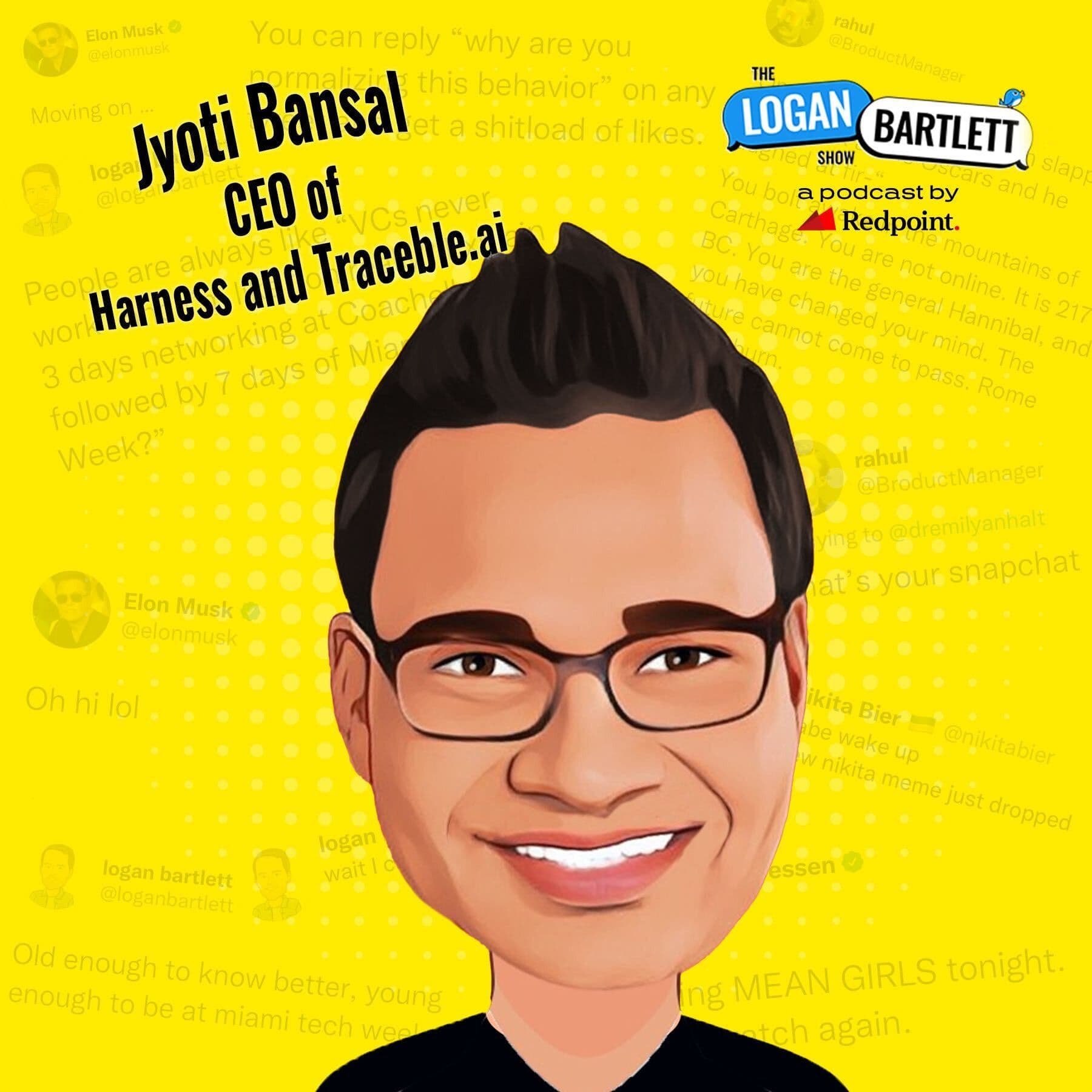
Podcast Episode Notes: EP 73 - Jyoti Bansal (Founder, AppDynamics): Life After Selling a $3.7B Company
Episode Overview
- Podcast Title: The Logan Bartlett Show
- Episode Number: 73
- Guest: Jyoti Bansal, Founder of AppDynamics
- Release Date: Not specified in the transcript.
In this episode, Logan Bartlett interviews Jyoti Bansal, the founder of AppDynamics, which was sold to Cisco for $3.7 billion. The discussion delves into Bansal's entrepreneurial journey, his decision-making frameworks, and insights into the tech startup landscape.
---
Key Topics Discussed
- Introduction to Jyoti Bansal
- Founder and former CEO of AppDynamics.
- Current CEO of two companies: Harness (valued at $3.7 billion) and Traceable AI (valued at $450 million).
- Time Management
- Bansal emphasizes "impact management" over traditional time management.
- Focus on where he can make a significant impact rather than rigid time allocations.
- Maintains a flexible calendar with limited scheduled meetings.
- Finding Product-Market Fit
- Bansal uses a framework to evaluate market size, need for the product, and personal passion.
- Importance of validating these aspects through interviews and cold outreach with potential customers.
- Startup Dynamics
- Concept of "startups within startups" to foster innovation.
- Encourages teams to operate with a startup mindset to enhance agility and efficiency.
- Hiring and Firing Executives
- Importance of hiring individuals who have relevant experience but also a growth mindset.
- Bansal uses a framework involving four lists to prioritize product development: customer requests, sales feedback, technical debt, and vision.
- Fundraising Process
- Discusses the importance of storytelling in fundraising.
- Emphasizes building relationships with investors who genuinely believe in the company's vision.
- The Sale of AppDynamics to Cisco
- Reflects on the bittersweet nature of selling the company just before an anticipated IPO.
- Discusses how the decision was influenced by various stakeholders (employees, board members, investors).
- Current Market State
- Shares insights on the technology market and venture landscape.
- Believes the current market correction presents opportunities for more disciplined operations.
- AI Integration in Business
- Discusses the role of AI in enhancing product capabilities at Harness and Traceable AI.
- Emphasizes AI's potential to significantly improve operational efficiency across various sectors.
- Personal Reflections on Work and Life Balance
- Bansal reflects on his journey post-AppDynamics and the importance of enjoying the process rather than focusing solely on outcomes.
- Advocates for finding a balance between professional ambitions and personal fulfillment.
---
Key Takeaways
- Impact Management: Prioritize tasks based on potential impact rather than strict scheduling.
- Product-Market Fit: Validate ideas by engaging with potential customers early on.
- Culture of Innovation: Foster a startup mentality within teams to drive innovation.
- Storytelling in Fundraising: Articulate a compelling narrative to attract investors who believe in your vision.
- Informed Decision Making: Weigh decisions carefully, considering the impact on all stakeholders.
- Adaptability: Embrace market corrections as a chance to strengthen business practices and operations.
- AI Utilization: Leverage AI as a tool for enhancing efficiency and competitive advantage.
---
Closing Thoughts Jyoti Bansal's insights provide valuable lessons for entrepreneurs and leaders in the tech industry. His reflections on balancing passion with professional pursuits resonate with the challenges faced in the fast-paced startup ecosystem.
*Thank you for tuning into this episode of The Logan Bartlett Show. If you enjoyed the conversation with Jyoti Bansal, consider subscribing and sharing with others interested in the world of startups and technology.*
Written by AI. May contain mistakes. Listen to the episode to check what was said.
Transcript
Automatic transcript. May contain errors.0:05Welcome to the Logan Bartlett Show. I am your host Logan Bartlett and what you're going to hear on this This episode is a conversation I had with Jody Bonsal. Jody was the founder and CEO of AppDynamics, which sold in 2017 to Cisco for$3.7 billion right before it went public. We talk about that sale, as well as Jody now running two separate businesses. He is the CEO of Harness, which not coincidentally was most recently valued at$3.7 billion, as well as the CEO of Traceable.ai, which was recently valued at$450 million. In this conversation, Jody and I talk about a bunch of different things related to operating and his different frameworks for making decisions for finding product market fit, hiring executives, firing executives, as well as the saddest day he had running AppDynamics, which was the day he actually sold the business to Cisco.
0:53A really interesting conversation, one of the more thoughtful and tactical leaders that exist in the world of startups. And so I hope you enjoy that conversation with Jody here now. And if you're enjoying this show, please do like, share, and subscribe on whatever platform that you're listening to us on. It really does go a long way to helping us continue to grow and have other people find our shows. So without further ado, here's Jody. Jody, thanks for doing this. So I want to get this right. So you're the founder of AppDynamics, sold to Cisco for$3.7 billion in 2017. But today you have three separate jobs-ish.
1:29So I want to get this right. Harness. Traceable. and unusual. So Harness has about 800 people, most recently valued at$3.7 billion. Was that... That couldn't have been an accident. Yes, you know, that was the goal I was shooting for. The valuations don't mean anything, but still, like, you know, you have... You know, a good number is a good number. You sold FD for 3.7. And it was kind of the five-year mark of selling FD, and I wanted to get, like, you know, that was the goal five-year. Let's try to get to the number. Yeah, that's great. uh traceable has about how many people what 175 175 and most recently valued at 450 450 million and then unusual ventures has a billion under management roughly 1.2 billion and so you're the you're the ceo of the first two and you're a partner on the third so you have you have uh way more jobs than than most people how do you actually spend your days like how do you allocate your time across those different things?
2:28First of all, I don't think of like, and a lot of people ask me this thing. That's probably the number one question. How do you do all this? It's unusual. I mean, yeah. And I really don't think in terms of time management. I really think of like, you know, where do I have to make impact? And I even call it like impact management now. So like if I'm not making impact, you know, it's not worth spending time on those things. And if you tune for that, like, you know, where impact would be like, you know, if you're spending time, can you move the needle? If you're not spending time, can you move the needle negatively as well, right?
2:55So that's both impact on both sides. And I like to maximize most of my time on those. And that can change. Like, you know, that can change. We end up spending a lot of time on things that, you know, it's not going to move the needle one way or the other. If I reduce that, then it creates a lot of time, free up a lot of time. Like, you're not doing just unnecessary things for the sake of it. But, you know, obviously you have some patterns that you have to follow. You know, I follow some like, you know, like the regularly scheduled meetings for hardness happens on one day. And, you know, for traceable happens on one day.
3:25and rest are kind of free-flowing. So I kind of try to keep like no more than one-third of my calendar, which is like just locked up on things, you know, so it's like free-flowing and I can figure out what to do. And so does the time end up balancing, I guess, over the course of the year? At any point in time, it might oscillate up or down on the companies itself, but does it end up being 50-50 over the course of a year or some years? Is it 30 % here, 70 % there? You know, I don't even know. You don't even know. I don't even know. I don't like to interact like that. I look at, like, you know, the company's doing well, you know, which are the areas.
4:00If some area needs a lot of work, like, you know, requires, like, you have to really, really drill down and spend, like, you know, 50 hours a week on something, you know, you find time to make that happen. You know, if you don't have to do that, that's great, like, you know, but you have to find time to make forward progress. That's how I look at it. I don't look back at a year and say, where did I spend my time? It's like, you know, I look back at the year and say, what did we do in the last year? Do you have overlapping investors between the two companies uh yes um unusual ventures is yeah so your venture firm investment yes and um one of the firms ivp is invested in both got it yeah that's it did the other venture investors ask this question or is it like hey you sold a company for 3.7 billion dollars so we're sort of just in the josey bonds all business it's a it's a very natural question everyone asked me and they should ask me like how do you how do you do you know three different things and you know i tell them like and i would i do it as long as i think i'm doing a great job at it you know or if i think my time is becoming a constraint and doing doing it right then i will you know see that maybe i should not do it and your time doesn't become constrained if you you know look in more in terms of impact and how do you are making the uh doing the right things that will change the trajectory of the company in the right way second one is that second is you still have to set the tone of the as ceos of the of the of the business as you are doing that are you building the right you know bringing the right vision the right uh you know the alignment across the different leaders that's there uh but i also like to work long hours you know it's not uh for me like 60 65 maybe 70 hours is not you know abnormal if i'm not if not doing that i feel like i'm slacking that week yeah and but it's my choice like it's not that i'm someone anyone is asking me to do it you know it's uh you know i don't have too much interest in playing golf or like you know doing things that uh you know this is what i enjoy when people give me shit about having a podcast as well i'm going to point at you and say like if this guy can do all of that then i can do i can get behind a mic uh once a week to talk to people why not like you know it's if you are enjoying it you know and you can balance it it's like i look at like we are all smart enough mature enough at this point and or these you know where we are in our our careers and lives that we learn how to manage you know different priorities it's not like you know when you have to really, really tightly track your time and figure out the priorities.
6:18But it's all about prioritization. You're assuming a lot that I am mature, but I appreciate that sentiment there. So do you keep, I'll let this topic go in a second, but you said you keep about a third of your schedule unbooked, and that's for things as it comes up and kind of variable things. Is there anything else that you do interesting with your calendar? Well, I like to see, like, you know, you have like almost a recurring meetings, Like, you know, weekly, you know, executive staff meeting, you know, every two weeks, you know, in both my companies, we have all hands meetings. You have like, you know, one-on-ones, things like that, which are like just on the calendar, either once a week, once every two weeks, once a month, once a quarter, whatever it is.
6:57I like to keep them to fill no more than 35 % of my calendar is normally my rule. So then the rest of the time, you can plan and you can adjust on, you know, what you need to do, where to make the most impact. You know, you obviously need the recurring things to have the cadence in your business. But what I've seen in many times, like your whole 100 % of the calendar is filled with just recurring things, but you don't have time to do anything else. So that's why I like to keep simple and kind of make sure, like, you know, I have flexibility. Does that time, the two-thirds, does that tend to get filled with other meetings that are sensitive, time sensitive in some way?
7:34Or does it tend to get filled with deep thought and stuff for you to where you can make the biggest impact? or is it, am I looking for? No, it really depends on what's going on. I say, you know, I like to spend time with customers. So that's like, that's there. Like, and I want to go and meet customers. I like to spend time like recruiting and like say sometimes you're recruiting for some key hire. You know, maybe your whole two weeks are filled, you know, majority of the time you are spending in trying to recruit the right person there, right? So, you know, sometimes it's like, it might be just deep in the product with the product teams.
8:05The deep thought of like, and I'm sitting in a cave somewhere and doing deep thought, I don't think so. Yeah, yeah, yeah. That's a venture person. But that happens also sometimes. You just want to put your headphones and maybe research something and think about something. But that, to me, is happening all the time. Now, I talked to one of your investors, Matt Murphy from Menlo, who worked with you as well at AppDynamics. And he said that you have a number of really interesting frameworks. And he was very complimentary about how you have been able to go about finding product market fit. So I want to ask about that.
8:37But one of the things that you did have a structured framework that I heard you talk about was evaluating opportunities for entrepreneurs. And so I think you said there are three different components in how you thought about it, evaluating the market size, the actual need for the product in the market, and then the passion for the opportunity. Can you talk about that framework and how you give that advice to the founders? That's the number one question people think of a lot of time. I have this idea. Should I quit my job and start a company? or should I start a company about it? And people ask for this thing all the time, right?
9:11As an engineer, I like to create frameworks for most things, at least some basic mental frameworks. You have a lot of good ones, by the way. I'm going to ask you about a bunch of them. So my framework on this is like, I look at like, you know, first of all, you have to look at, you know, do people care about solving this problem? You know, that's like, is this a real pain that people, the world cares about? You know, second is the world, many people in the world care about it or there's a small number of people. So that's the market size one. How big is this market? And I look at, like, let's say someone has an idea that, you know, I want to build a trampoline for dogs to jump on.
9:41You know, do people care about it? Like, you know, maybe some people do. Like, if, like, 100 people in the world care about it, do you really want to start a company on that? The third is then, you know, so you have to really validate that. And I look at, like, you know, you have to talk to a lot of people to figure out, like, you know, is it a big problem that a lot of people care about? Is it a real problem that people will pay for solving? And then if you figure those two out, then you look at, like, are you really, really passionate about this problem? yourself. And I also ask people to look at, do you have some kind of unique insight, expertise, something about this?
10:12Why are you? Why are you part of it? Because if it's a real problem that the world cares about solving, can you really win in solving this? If you want to, if I have to start a company in fashion, something, even though some real problem is there that identify, it's very unlikely that I'm going to win. I don't really have any unique insight, unique expertise, unique something. So maybe you should not start a company there. So the simple test you can do, that you're pretty convinced that the market is large, pretty convinced that the problem is people are going to spend money on solving this problem in some way, and that you are willing to spend a lot of time because you're passionate about this problem, and you have some unique expertise or insight, that's a good thing.
10:57Then you jump and start the company. Do you think about if the market is large today, or do you pick a point in the future and say, hey, can this be large if XYZ happens? It's a combination of things. I do think, you know, and I've tried to create a framework around it, but didn't really work well on that topic. But still, I feel roughly about, like I feel like two years is about a good, you know, future reference. Like where you think like, you know, if the market is not today, it's fine if it's there two years from now. It's going to be five years from now, your startup may not survive that five years.
11:29Like, you know, you have to have a very, very unique spot to have so much capital to survive through that. So I feel like two years is the right. If the market is right now very, very ripe, there's a high chance you're a bit late. So I feel like two years is about the right time, like where the puck is going two years from now, because you can find early adopters now. If something is going to be ripe and mainstream like two years from now, there will be a good number of early adopters today. So you go after the early adopters now. Two years from now, it starts getting more mainstream. That's where most people are getting to.
11:59So you're ready to go and capture the mainstream at that point. And, you know, that's kind of roughly I like to follow the rule. Now, you've had to find product market fit a few different times, starting a few different companies as well as investing and having seen it. How do you think about what framework you apply to making sure the component outside of the market size? The second one was, will the dogs actually eat the dog food, right? Or will the dogs jump on the trampoline, to use your example? What's the methodology and process that you go about evaluating this? Product market fit is such a vague process.
12:29So, like, you know, you ask 10 people, there will be 10 definitions to begin with. How do you go to product market fit is really, most people think it's just a dark art. So, we have tried to create a framework around that. And, you know, I've brought in my experiences from AppDynamics and Harness and Traceable and, you know, everything that I've seen. And, you know, at Unusual, we write a lot about it. We have the Unusual Field Guide to talk about it and to share the experiences. kind of bring it down into a few areas, which is one is that focus on real cold outreach to get to the, to have real conversations.
13:04What happens many times is like, you know, you start as a founder, you find some friends and family, some investors will introduce you, or if you're in a place like Silicon Valley, there will be the Silicon Valley echo chamber, you'll talk to like, you know, people you know in Silicon Valley, and you just not hear the right feedback. Like, so if you can find people cold who will be your likely target buyers at some point, and they will even take a meeting with you and you can validate something with them, you know, that's a good sign. So that's what we, I would say, first part of the framework, like, you know, don't just go in this warm meetings.
13:35I remember, you know, AppDynamics, I first started there as one of our investors. So let me introduce you to some banks in New York. And, you know, the investor had a few connections there. And, you know, I did a trip to Wall Street, you know, and this was like company was four people. And I did a trip to Wall Street, you know, I didn't have any, I didn't want to spend any money. So, you know, took up, you know, changed my shirt and, you know, washed my face in a Starbucks too. So that I don't have to pay a hotel room. But then I did the whole, like I met like seven different banks in one day, like back to back.
14:07Came back, like, oh, great set of meetings, you know, high fives to our team. Like, you know, we have found the product market fit, like I have great meetings. And then I started following up with those seven people. Like, you know, hey, we had a great meeting in New York and, you know, following up on being a beta customer or something. No one even responded. it you know and that that click to me it's like you know that those people took the meeting because you know it was a warm intro they wanted to be nice to the the person making the intro and the meeting was good because they wanted to be nice to me because you know they just if you're a founder who are passionate about your thing they don't want to be like you know telling your face that you know your thing is not good or they don't care about your thing or they don't need your thing and since then i realized like you know the best way to get real good feedback is cold like you You reach out to people cold on LinkedIn.
14:51If you've not been getting a response from anyone, there's a good chance that no one cares about your problem or an audio message or how you're talking about it. If people take the cold meeting with you, there's a good sign that that means there is an interest in this thing. If the meetings go well after that, where they don't really have an obligation of any kind to be nice to you, that's a good sign as well. So that's really the first part of it. Second is do a lot of it. A lot of people do. I talk to three people or five people, and this one customer we talked to here, they said this thing and they're excited and ready to go.
15:24And I like to tell everyone, you've got to look at at least 30 to 50 conversations. And the conversations to the point where the test is when you're hearing the same things. If you start hearing the same things, that means you have done enough conversations, that you're not really learning anything new, it's the same things again and again. And the third is being iterative about this. Whenever the first thing you start with, you say, this is the problem you're solving, This is why our differentiated technology solution to solve this problem is, you know, your message and story would not be right the first time.
15:56So you do five conversations, you trade, and do another five, and you trade, another five, you trade. By the time you're at 40 conversations, you kind of figure out the solution of how you sell it and how you talk about it and do you have the right product market fit or not. So I like to promote that. And that's why we talk a lot about that on Newswell as well, which is this kind of framework of go cold in outreach to a high volume so you're not biased by a few. And it trade quickly on that. And then you have a sort of a good definition of your 40, 50 people who are saying the same things. You figure out how to talk about this, the differentiation, the product, the pain.
16:31That's the basis of a good product market fit. So you've gone cold to these people. You've heard validation of product market fit being there, at least commonalities that they're using the same words. Now you start building the product. And there's a balance between speed and product quality. And there's a tension between those two. How do you think about that now that you've heard this feedback going back to those customers and saying, hey, we have it? What's your framework for making that? I think this one a lot comes down to what is the market, right? If you're going in a market where there's no existing incumbent, speed is important.
17:09Because the quality bar could be low. The quality as in the completeness of features, etc. Because something is better than nothing. The MVP is low. The minimum viable. You used to have this whole lean startup thing. And people got too crazy on the lean startup thing. People would come in and build this thing very lean and then this thing. Now look, if you're going in a market with a lot of incumbent players, strong incumbent players, Whereas the lean startup thing doesn't work. Like no one is going to buy your lean MVP. And so it's like, you know, you have to find something that's, you know, many times it's like you have to get to at least the, you know, some kind of parity with the incumbent if you want to go and replace the incumbent.
17:48And if incumbent has a lot of, you know, important features, you have to go and get parity. And then you build a differentiation on top of that. Right. So your MVP definition is very different, depends on how strong the incumbents are. And so to me, it's like, you know, how what you build out, it depends on that. If you look at, say, a great example was Workday. When Workday was starting to, we're going to be the SaaS version of PeopleSoft. People will replace PeopleSoft with Workday. Now if you apply the, let's start with a very small subset of the PeopleSoft features. And now no one is going to replace PeopleSoft with Workday.
18:23So even your MVP v1 has to have everything that PeopleSoft will do. And that's your differentiation is that you're SaaS, PeopleSoft was not SaaS. So that's, you know, but your MVP bar is high. So you have to finish that to go and build that market. You're going into a completely new market where there's no one there, then you start fast. So that's how I would balance it. What about in the product development lifecycle? So now there actually is a product that's out there in the wild and you've either gotten it quickly or you've built for a while and you're trying to take feedback. And there's a bunch of different constituents that can give you feedback, right?
18:56There's your own intuition, which then there's salespeople out there talking in the field. There's what your engineering team thinks. There's what their product team thinks. All of them are probably, ideally, they'd be singing the same tune, but probably all have different competing priorities. They are not, and they're competing priorities. And I would say the product leadership team in a startup has to, or any company, really, with startup, normally the founders and CEOs will be the product leaders. You have to manage that. Actually, I've written about this framework in a post called the four lists that someone has to manage.
19:27The one list is, you know, what your customers are asking for. You know, and customers are asking for, hey, I don't have this feature, I don't have this feature, I can't adopt. And if they're unhappy about something, they can, you know. And so you have to build that list. The second list would be what your salespeople are saying that, you know, we don't have this feature, we're losing this deal. Or, you know, our competitors are, you know, are really, you know, putting things in the market that we can't compete with, you know, unless we have these things, et cetera. so the third list after that is your your kind of like technical debt that builds up over time like you know architectural debt quality debt you know different kind of things which the engineers are asking for hey we need to stop building features and do this otherwise everything will crash or we will have performance issues or we'll have like you know security issues or whatnot right and the fourth list you know which is i call like the the kind of your vision list which is like what the what where do you need to grow the the the part that your time your market your opportunity like the new you know many times when you start to start something anything like you have a big vision and you start with maybe 50 of that initially and now you have to build the rest and you know maybe your vision is growing over time as well so that's the fourth list so anytime you almost have to balance the four like you know it's like you know your four list you any let's say doing a like a planning for one quarter of engineering work or one sprint of engineering work you pick some things from each of the list and say okay what's the that's your that's that's your your plan for this quarter or this sprint and things can change like you know you're losing a lot of customers, you know, on churn, you may have to fill most of your work with that.
20:53And if you're losing a lot of deals to customers, to competitors, because you don't have like one feature that's like your competitor is kicking your ass on that one feature, you have to, you know, prioritize that, you know, but it's normally you want a balance of balance of things that are on those four. Do you, do you actually have those lists written out and you're, you're checking them off and I'm assuming some of them double overlap and you're, you're, yes, they do. Like, and, you know, normally we'll have like you know let's say the feature requests that are coming from customers you know we'll make them like you know as a as a list and these are like you know mechanisms we'll use like you know maybe tags or something like we'll we'll you can filter in in jira and you so these are the list of all the feature requests coming from customers you're prioritizing it the product managers are managing their backlog you know you have another list that's coming from like you know sales people not most likely sales engineers who are like you know maintaining a list of the feature gaps you have compared you know where you why you're losing a deal etc etc and then the engineers maintaining their tech and so these are all like you know uh the lists are are there very openly for us you know and then we kind of manage bitten the when we plan we we you know we balance them out the framework works very well like you know i've been doing it for a for this kind of thing for a long time yeah yeah now it's it's it's a simple framework but i do think like you know having that mindset of like you know that it's always a balance of those four and you make a conscious decision on what you're taking from those and you know and also like you know sometimes you're also making consciousness you know where do you spend your your dollars on right you know let's say you know the fourth bucket i call the fourth bucket is like the the with your vision kind of bucket is you're also expanding your addressable market like because if you keep doing what you're doing in the first three buckets maybe like you know you're fine for this year but like you know i that's that's how you look at like say you're doing five million revenue this year and your plan is to 20 million next year that's you have to start building towards like do you have enough addressable market and do you have enough like you know you have to expand into adjacent areas for that going from five to 20, you know, so you have to invest into into that that far ahead, right?
22:46So it's, it's, it's, it's, it's key as well. I've heard you say that you structure your teams as startups within startups, and you there's, there's some way of operating in which you assume, or that you encourage the team to assume that the other departments aren't actually good at their job, and that they need to be the best at what they're doing. Can you talk about like, what a startup within a startup actually means for these different departments? It's two different things. The startup within startup, when I set it up, it's more around the product areas. Like, you know, it's like, say, and I look at, like, you know, most companies will start with, like, one product or one, call it, like, one product, one major use case that you are focused on.
23:23You know, and you will start slowing down on your growth if you only do that one. So at some point, you have to go from one to two. So your second product to third product to fourth product. And, like, you know, most of the markets, you have to keep growing into a platform at some point. Like, you know, if you want to be billion dollar revenue, it's hard to do it without becoming a platform. But it's very hard to innovate, you know, in building a second product successfully or a third product successfully for the companies. And that's where I, you know, like this kind of a model of, you know, when you're building a second product, almost start that as a startup inside the company.
23:54You know, and what that means is like, you know, when you start your first product, which is a startup, which is a real startup, you normally have a small team. Maybe like, you know, five, six engineers working on it, you know, who are very driven about, you know, finding the product market fit, building, moving things, moving fast. You know, they're not slowed down by processes and the burden that comes with it. So when you're building a second product, you want to do the same thing, which is not normally what normally happens. Like, you know, if your first product is mature and selling, and, you know, at that time you have to mature your processes on quality and how you do engineering and how you talk to customers and you have, like, you know, how you sell it.
24:32All of those are like, you know, were designed for that mature scale. And now you try to build the same things on your product number two, it just fails. Like, so I like to do like, you know, product number two build exactly, go back to exactly how you build your product number one successfully. And it should not be any different. You know, when you build your product number three, it's the same kind of thing, right? So I like to structure these when you build new products into like a sort of a small startup inside the company. And even the funding model is very similar to a startup. Like, you know, when we look at like, you know, let's say when you're building the, you're starting building the product, you normally need like five, six engineers.
25:05And once you start getting to, let's say, you know, call it the seed stage startup, right? And when you start getting to like, say, half a million, a million of kind of revenue, then you kind of grow that to, you know, 10, 15 engineers. You know, when you start getting to, you know, maybe three to five million of revenue in that, then you start growing it to like, you know, 20, 25 people, you know, in that product kind of startup. When you start growing it from like, you know, maybe 10, 15 million revenue, then you put it to like 30, 40 engineers. and at some point it starts like you don't need it.
25:31But you can even tie your investment not too different than how the venture kind of investment works. And to me, that model has worked so well. Like AppDynamics, we started with one product and we grew to, by the time we were going IPO and all that, we were about nine products at that time. And that was why we were growing so fast. We were growing like almost business, almost doubling at that time because the nine products we were able to build. At Harness, I kind of brought in the same model and try to kind of do a even more mature version of the startup within startup model of like how we go from one product to much more.
26:05Like, you know, Sarnes, we are in the DevOps platform space and we started with one product, continuous delivery. And just in a few years, we have expanded into like, you know, we have eight products in the market who are really strong and competitive to the best in class players there. And people really ask like, how do you build all these things? Like, you know, you have CD and you have, you know, CI and feature flags and cloud cost management and so many separate startups that compete in all of these markets because of the startup within startup model that we have been able to do. So that's the startup within startup concept, which I really like that it allows to scale.
26:38And to me, the inspiration has always been Amazon on this. Amazon has done a, how Amazon became Amazon, is this fundamentally a model like this. That's how they have gone from one product to second to third to what they've gone into all these different markets and build amazing products in these markets. So it's kind of a similar-ish concept in the B2B kind of world that we bring in. Your second question was about, I think I talked about this at some point, where I want every department to be excellent on its own. I call it like, what's the competitive advantage? Some companies have that your competitive advantage is how you do engineering, that you do engineering so well that it's hard for, that becomes your competitive advantage.
Read the full transcript
27:23Some companies have like, you know, sales is your competitive advantage. Like they do, you know, the sales execution is so strong and that's your competitive advantage. And people even say that, like, you know, the companies with engineering has a competitive advantage. Like our product is so good, it sells by itself. We don't need sales and marketing people. And sometimes the sales people comes from really good sales environments, right? They will say, you know, we had the fourth best product in our space, but our sales was so good, we still beat everyone because, you know, we are so good sellers, we can sell even like a comb to a bald guy kind of thing, right?
27:54So I start to like, you know, like why not just have that as a mindset then, right? You know, it's just not a mindset. So to engineers, I like to say like, let's build a product that, you know, we can, you know, that is so good that we don't need the best sellers. And to the sales guys, I tell them like, you know, let's bring the best sales execution like that you don't need the best product. You know, so we have both as a competitive advantage. And the other one I also look at is like customer success. Like, you know, can you make customer success as a competitive advantage that your customers are saying, hey, these guys are so good in supporting the customers that we want to buy from, you know, that.
28:26And then I've seen that as a competitive, like, you know, becomes a competitive advantage as well. You can have your marketing brand as a competitive advantage as well. So I like to say, like, you know, if you have one competitive advantage that your product is great, but other threes are not, that's still fine. But you get two or three as competitive advantage that buy on their own. They are a big competitive strength and advantage. Why not? And then you combine them, then it becomes, like, you know, really powerful. Before founding AppDynamics, you were an engineer at Wiley, which was kind of a V1 to AppDynamics' cloud version of the product.
29:03And you went from that to CEO of a... How many people did AppD have? About 1 ,500. 1 ,500. So you scaled along the way. I'd be interested in that path and going from figuring out how to manage all these people and all that. But one of the things on the journey that I thought was particularly unusual that you've alluded to is you really found religion on sales and enterprise sales. And even at the beginning, when I asked you how you spend your time, you talked about meeting customers and recruiting, which are both sales. Was there a mentor or someone that sort of taught you that path? Or did you just figure out this was something you needed to become best in breed?
29:40Because especially at the time you were doing this, 2008, 9, 10, there was all the no salespeople, optimizely mindset of let the product sell itself. We'll never need salespeople again. First of all, let me correct on where I spend my time. The core of it, I'm a product guy. So where I like to spend the most of my time is product. It's like the customers recruiting can take a lot of time, which is great. But where I run most of my time is product. And actually, in most of my companies, I'm the chief product officer as well. Like, you know, AppDynamics, I was the chief product officer. I don't hire chief product officer because that's my, I consider that's my job and that's my strength.
30:16And same in harness, like, you know, I'm the chief product officer. I run the product myself, like the product teams, you know, I don't have a senior level product leader because of that. And that's where a majority of my time goes. So that's, you know, that's one to correct that. But you can't build, you know, great products without talking to customers, especially in our kind of space where the B2B kind of enterprise kind of space. So that's why you have to spend a lot of time with customers there. But being a product guy, you know, that's where the challenge is. Like, how do you find religion in sales as well, right?
30:49So I'll tell you, like, at AppDynamics, you were about, our product was very strong. You know, we had the best product in the market. You know, we are growing rapidly. You know, we are about, like, you know, grew from, just launched the company. We were in maybe 7, 8 million of era, growing fast there. and I met with Dave, Dave Iticharia, who's the, you know, CEO at MongoDB now. He was, let's say, trying to figure out what to do at that point. You know, he just left BMC at that time. And I met him for breakfast and we were talking about this, like, you know, that our product is doing so well. And I was also in this thing of like, you know, the product, it's all about the great product, which I, you know, that's my strength, that's my superpower is.
31:29And that we had all these advantages in our product. And Dave was like, you know, that's all great, But imagine if you have the similar kind of advantages on the sales execution as well. And if you can combine the two. And that's really what started me on that kind of journey. Can you combine a great product with a great sales execution? What happens at that point? That was his challenge to me. Can you combine the two? You're a great product combined with great sales execution. Then I met with John McMahon right after. John McMahon, as many of your listeners and all will know, is kind of the legend in the enterprise selling world.
32:11You know, it came from this company, PTC, which became a legendary company on how the sales, you know, sales was done in a very scientific way. And so, you know, he became an advisor to AppDynamics. And I learned a lot from him, you know, on what does, you know, selling means. When I started as an engineer, I thought selling was like slick guys with slick hair, wining and dining and playing golf. And that's the only way you do sales. It was kind of almost like a black art. And by the way, most people still think that's how it is, which really is not the case. So that's what spending time with the likes of John McMahon, you start learning there's a science behind enterprise sales.
32:55Like, you know, the science of, like, you know, the how it's all works, like, how can you do it in a repeatable, scalable kind of way? And that really fascinated me. Like, you know, that's that you then you don't have this, like, you know, you know, product. I know how to how to build the great products, you know, but I almost felt like, you know, this is black art of selling, you know, after that. And the only way you do that is product like growth, et cetera, which is what, you know, what we're doing at Epdynamics early on. And then once I learned that sales could also be more predictable and manageable and there could be a science behind sales, I just got very fascinated about it.
33:30If you combine the two, then you get the best opportunity there. That's why we ended up building at AppDynamics. And that's how I look at Harness. We have built. That's why we are starting to build at Traceable. It's amazing the McMahon tree that permeates Silicon Valley at this point, The number of great companies that have sort of grown up under his tutelage. If you're a first-time founder or a young founder that comes out of technical background, product-oriented and that, were there any lessons in particular that you have about thinking and even approaching understanding sales? You mentioned the architecture point and that there's actually methodology behind it.
34:13But any interesting things that you learned along the way that might be helpful to someone that's kind of first broaching this topic? I think the number one, if someone is new to understanding this, is sales is a numbers game. That really is the foundation of everything scientific about sales. That it's really a numbers game that you want to manage in the right way. which is like, you know, if you want to have a million dollars of business, how many, you know, sales opportunities you need to have? You need to have maybe$3 to$4 million of sales opportunity. What does an opportunity mean that, you know, that it will convert from$3 to$4 million to$1 million?
34:51What's the definition of it? You know, so that becomes a qualification and all that criteria, right? So you have a predictable rate of conversion from a numbers game from stage one to, you know, know some stage to the final stage you know to get to a sales opportunity how many meetings you need to to do you know and it's it's it's eye-opening for many first time you know um engineer turned the founder ceos and it was eye-opening for me like you know like to get one customer when i when you realize okay to get one customer we need to have about about you know somewhere around 15 to 20 meetings and then you realize like you know that we are like obsessing with every meeting which is good which is good but really it's the numbers game of like you know that I need to build a machine that I need 15 to 20 meetings, you know, the 15 to 20 meetings will convert to, like, you know, maybe five to, you know, five, six, you know, qualified sales opportunities.
35:39That will get me, like, you know, two or three, you know, closed deals there, something like that, right? But that, just realization that it's a funnel with a numbers game, and what you need to do is to manage the size of the funnel right, like, at every place, but also the conversion rates at every place right and tune them in the right ways. That's the, you know, I would say the primary first time learning from an engineer to, you know, to have our own sense. What about scaling as a leader? So you grew from just yourself as a solo founder, which I want to ask about, but then leading a very big team.
36:20What were some of the lessons about hiring people along the way? like different executives you brought in, different team members that you had from the AppD journey and then that you brought over to Harness? You learn as you go, right? You know, a lot of times people think like, you know, the answers are all figured out. Like first time founders, I tell them all the time, like it's, there's no point trying to learn everything, you know, upfront. You know, focus on what you need to do for the next 12 to 18 months and just try to learn that. Like there's just Silicon Valley and the whole tech world is so bombarded by so much advice, by the way.
36:52And the advice - Some guys even have podcasts for it. Yes, you know, or like some guys who come and talk on podcasts and give advice, which are like, you know, sometimes that advice could be overwhelming and too much. Like, so you really focus on what the way I like to think of is like, you know, what do you need to achieve in the next 12 to 18 months? That's the next major milestone. What do you need to learn in that for that? Right. So you learn in that. And then as you go, you achieve that and you don't think about what beyond that too much. And then you go to the next one and you learn there.
37:18so same when growing as an engineer turned first time founder to like managing the business that's kind of how i look at it like when i just first starting like what was the the success criteria for me for the very beginning was like raise capital uh and you know hire an initial team of maybe five seven people and build a good product market fit so when i look at like you know hiring team and learning skills for myself as well it really came down to those three like you know i I never raised capital before. Can I learn how to raise capital to get the company going? You know, I actually never recruited before.
37:53So can I convince like five, seven engineers, good engineers to come and join me as they are? And then can I find product market fit? And do I need people to help me through either of those three? Right, so that's your journey to building the team. Now you achieve that milestone, let's say, right? You know, which is like, say, you're 18 months later. Now your next milestone is in early sales. Like, you know, that you need to find people to do, you know you have as a company you have to get to the first million or two of sales and get the you know the close your first deals maybe launch a company out of stealth so you need some marketing expertise you need to launch the company get the messaging and positioning right you need to have like the sales expertise to get that early sales going to you know so you need to find the people with those skills and you have to learn some of those skills so you know into some level as well then you start getting the next stage like you know okay now you are you know you have to start scaling your sales where like you know you can't just have the founders with a few sales people selling.
38:48Now you need to find people who are good in those skills. How do you build a scalable sales organization? How do you do demand generation in a scalable way? How do you do customer support in a scalable way? Your engineering team is growing, so how can you do more structured engineering at a scale? So now you start bringing those leaders and learn how to manage them. And then you go to the next level and now it's about scaling even more and you're running like where it's not just one level of management you have like two three levels of management what do you need to learn on that you keep start getting closer to an ipo it becomes a lot about financial management and financial tuning and you know the the the you know uh so it's all different skills and i look at like you know it's best is to just go as you you know uh and go deep into that particular skill area and bring the right people on hiring you know who are very good on those like So at any stage, you want to partner and bring the right people who you can learn from also and who have done some of those things before.
39:49So as a founder, it becomes easier for you. I always look at the areas where I don't know too much. I need to hire someone who's extremely experienced and who has done that kind of job before. In areas where I know a lot, maybe I can hire someone who's not done that job before and it's still fine. I'll still feel comfortable. so that's how I that's a framework I kind of done it what I did at AppDynamics like and I never did sales before so the first time I wanted to like many people will just hire a sales rep or two or three sales reps right and I was like if I can the I don't even know how to interview the sales reps and I don't even know how to manage them like you know so can I hire someone who has done that before and like you know so I can learn and they know how to hire sales reps and they have more experience I don't need to teach them you know or I don't need to manage them in a in a high amount of detail because I don't even know how to manage them.
40:39So then I bring a VP of sales who knows how to do that, and then it becomes easier. And then you learn from them as you go. So then you can improve at some point. Maybe now you can do sales better. In the interview process as well, you had said that you'll use that as a learning opportunity. And so maybe you use VP of sales as an example or VP of marketing or something. How do you go about using, if that role exists, using that as an opportunity to really learn and get better yourself at it? You know, interviews are great. You know, it's almost like a hack to learn about something. Say, let's say you want to figure out, like, if you want to hire a VP of demand generation for your company.
41:23And you have no idea, like, what really to look for, right? So let's say you start interviewing people. People will come in and you ask them, hey, this is where we are. Right now we are at$5 million of revenue and we want to grow to$50 million of revenue over the next year. These are our constraints. We are not getting enough demand from here. Our product is like this. Our competitors are like this. How would you build a demand generation program for our business to solve these problems? and what's your experience of success or failure of similar situations before that you know of. And someone who has done that before, they will tell you, this is what your plan, if I was in this role, this is the plan I would build, this is what I would do.
42:08And they can also tell you, we tried these things in my last job here, this worked well and this job didn't work well and I've done this before, what the learnings are. And now you have that conversation with someone and if you do it with five to 10 people, learn a lot. You'll know what is the right plan for you, your company probably. It's almost like what I was talking about, the product market fit. At some point, the conversations start sounding the same. Same thing on this as well, because you start learning in the interview process and then you can start asking the next level of questions and then you know what your plan should be and who is the right kind of person for your company as well.
42:47So I find interview process quite a good, you know, it's a good hack to learn about something. It sounds like it depends on the functional role that you would do this, but how do you think about hiring someone that's been there, done that? Because inevitably, if they're willing to join your company and they've been there, done that, there needs to be a reason that they would go to theoretically an earlier stage business to go do it versus taking a chance on someone that can be in their ascendancy of their career who is very high potential and so which one of those did you orient more towards um you know it's a it's it's it's a it's normally my teams have been a balance of the two like half the teams would be on the you know young upcomers you know you take a chance on them and you kind of build on that and half the team is very experienced people and so it really depends on the person and you know i normally would say i really like to take chance on people who are earlier.
43:46But at the same time I do think if every function in your company is kind of the same, you're taking some risk of lack of experience in the organization. So you have to kind of balance the team out. It's on how your executive team is. In some functions it's a good seniority and being there, done there. And yes, it's hard to recruit being there people if you're earlier. But that's the beauty of the startup economics in the startup world, like, you know, and the startup people, like, and people who do want to come in earlier stages, you know, they, who want to build, you know, they like the, they like the building, like, you know, and you want those people you want, like, you know, that someone who has, and maybe they've not gone, like, you know, let's say you're bringing someone, someone who has gone from a, you know, 3 million to 25 million journey of a startup.
44:33And, you know, now maybe they want to go from, you know, 10 million to 75 million journey of, you know, this time. But they like that build up, the journey, the hyperscale. Those are the people you want to bring ideally, right? But it's good that they have seen some of that, you know, what happens as you grow. And maybe they've not gone to the stage that we want to go this time, but it's still those learnings are pretty powerful. I heard you say that culture fit wasn't something that you hire for. Why is that the case? I find the concept of culture fit very strange. Like it's the way I look at this, like, you know, see you're hiring someone from Google, a very different culture.
45:05Hiring someone from Apple is a strong culture. You're hiring someone from Amazon is a different culture. Now, if you ask them to assess the culture fit by, tell me how you did X, Y, Z in your current job. And if they're working at Amazon, they will tell you, this is how you do things. They're working at Apple, they will tell you in a different way because that's how the company cultures are. So it's really a judgment on that person, on how they operate. It's not really. So the way I look at them is like, my company has a culture, Harness has a culture, Traceable has a culture, Abdomics has a culture.
45:35Can this person fit in our culture? which is very different than like you know a lot of the culture fit is all about like you know so i look at like you know can we teach them our you know you know so we focus a lot on like teaching our culture instead of like you know uh instead of trying to figure out the fit etc like you know if someone joins apple they will learn how to operate in apple culture are they a fit there at the time they joined probably not but if they're not willing to change how they operate that's probably the bigger problem you know if someone joins what joins amazon they will operate in a very different way than they join Apple.
46:07So I look at, like, can we teach people to operate in our culture? Can we be deliberate about defining what our culture is? You know, and can we create a deliberate framework around that? And so to me, it's more about, like, can people go and learn our culture? Less about, like, you know, what culture, how they operate. And most of the culture fit then ends up about, like, you know, is this a, you know, is this a person you want to grab a beer with? Which is an important thing. But the problem with that is that creates a lot of the lack of diversity. Everyone starts looking and feeling and talking the same.
46:42And that's why I don't really think too much about testing for culture fit. I look for hire the right people who are coachable, who are smart and coachable is what we look for. And then we coach them our culture. But that's it. That's it. Can you assess that in an interview process, or do you need to do reference calls to figure that type of thing out? Most of the times you can do interview process. If you have an interview process done with multiple people in the interview panel the right kind of ways, you can. The smart part is like, you know, a lot of it is like, you know, what they have done before.
47:21But how you ask like multiple levels of questions in an interview on, you know, do they really have the depth in what they're talking about? They have to really push the boundaries of something to solve some hard problems. So that's what you look for in that. If you have four smart people interviewing someone and they all say, okay, this guy is pretty smart, there's a reasonable chance that that guy is pretty smart. The guy or girl. And you have like, now it's the same thing applies to the coachable part. Coachable part, I like to look at like, throw them different things and see how they're flexible.
47:59like the intellectually flexible on new things and learning and, you know, how fast learner they are and how they like to learn new things, et cetera. So you can make that as part of your, you know, interview process, et cetera. References are important for some roles. References are pretty important. But, you know, it's hard to do references for every role. Second is I feel like most of the references are kind of bullshit. You know, it's like people don't say bad things. You know, you have to find the right references. you know i feel like you know many times instead of doing the reference call you can you can achieve everything from the reference but just having a list of references if someone can't give you a good list of references from their prior bosses etc that's like you know that's a problem if they give you a good list of references you probably don't need to do the call because you kind of know like you know if these people are willing to be this person's reference they you know that's all all good all good there the flip side of hiring which you've done a lot of is firing um what have you learned about letting people go um that you might want to impart on founders or operators yeah you know that's always the hardest thing to learn for any any um any ceo or any leader um but that's that's that's probably the single most important decision you have to make most of the times first of all like you know hiring is not accurate all the time like in whatever you do in the hiring process you know you're not gonna get like let's say eight out of ten right so now you have your two out of ten that are not right you know it's and now how long you stay with them that's a that becomes a important question you know i like the the simple rule of like you know if you if you are again going to a framework but my framework is if i'm defending someone fourth time there's a problem like when someone comes to me and say okay you know this this person is not working out and you know we have we made a mistake you know especially if you're a culture which is of openness transparency etc right then you know and someone comes and like it also like you know we have a we made a mistake on hiring like this person is not doing a good job here whatever it is right and i'm defending them and you know that's that's that is fine but i'm defending second time third time by the time is fourth time i know it's it's it's it's it's a hiring mistake there that i have to defend whatever that that is and you know obviously i'm taking those first three as a feedback and uh you know and as a as a coaching opportunity for that person so that they have the opportunity.
50:21But if they can't get there, that's a sign that you have to make a change. But you can figure that out. I think the harder ones are when someone has worked well in the past and you have to remove them. Those are even harder because then those require even more thoughtful thinking. In the early days of APTI, I heard you say you weren't great at fundraising, but now if you look, you've done a fantastic job of fundraising with Traceable and Harness. What have you learned about the process of fundraising and maybe even sitting on the venture side of the table sometimes about selling a compelling vision and getting investors excited about the story?
51:04Yeah, it's kind of funny. At AppDynamics, I had to pitch almost 30-35 investors and got a lot of like 30 plus rejections before I got the first term sheet. When I was starting Harness, I had like 30, 35 investors pitching me and giving me offers. So that's definitely an advantage of being a second time founder. So it's not just like that I've become so much good at fundraising. You were smarter, you were funnier, all the above. They're just throwing money at you. When I was doing those 30, 35 rejections at Abdi, you know what i learned was a lot of it comes down to like you know the right right story on fundraising and the right story is is uh storytelling uh that you have to do as a founder and the three things about the storytelling that you have to do right one is the why is this a big opportunity because the the whole vc model and you know works in big bets like you know and you have you need the big hits and so if a company is going to be successful the chances are pretty low that most companies are going to be successful.
52:10But if a company is successful, then it's going to be pretty big. That it's going to be, you know, used to be a billion was a big deal and now it's like maybe more than that. But let's say it's a billion. Yeah, back to a billion now. So let's say like, you know, would this be a billion dollar, you know, company or not? So you have to paint that story well. You know, if you're not painting that bigger story and, you know, that makes it hard. Second is you have to paint a story of evidence. You know, a lot of it's like, you know, You can paint the story of this is going to be big, but if you know evidence, that's going to be hard to sell.
52:44And the evidence comes from either you have a product in the market already and you're showing traction, or you have a lot of customer interviews and you can talk from that, or you have some cases like a report, and analysts and industry experts creating that evidence. Most of the times you have some product with some traction is the best evidence. And the third is the, now it's about you, right? You have to sell you. Like, why you? Because any company you start, you know, you have to compete and you have to make the point, like, you know, why you are the right founder or founders or the team to bet on, why you would be the winners in that particular space.
53:24If you get those three, your business does become pretty fundable. So when, you know, when I was getting all these rejections at AppDynamics, I was asking people, okay, what's, why? I think, why are you rejecting? And, you know, most of the times VCs won't tell you why. But let's say some are good and they will tell you, like, in an honest way, why? And then you start learning from that. You know, someone was like, market is not large enough. I will hear that story quite a lot where, like, you know, at this time, this was, like, you know, application monitoring. It's application monitoring that's such a small niche market.
53:55Like, this is not, like, now where you have AppDynamics and New Relic and Dynatrace and Datadog and, like, you know, observability monitoring, like, you know, multiple, you know, companies with, like, billions and billions of valuation. so market was small wasn't the number one objection I would get and at some point I had to start and I realized that I'm not doing a good job in telling the monitoring does seem like a small niche market but you have everyone building so much code in the world and it's so painful to monitor and troubleshoot and fix when the problems happen in the code and to tell the story you have to tell how many developers are there and how many application servers are being installed and, you know, how much money being spent when something slows down and why this could be a very large opportunity.
54:39But it was not very evident that application monitoring was a large opportunity at that time. You know, so that's something you had to become good at selling. Second was, like, you know, what's not evident was the, you know, the evidence around it. Like, you know, how do you prove it, like, that it's going to be a large opportunity? How do you prove a differentiating kind of things? So I ended up then, like, you know, doing a lot of the cold calling, kind of the customer conversations. to create that, you know, that compelling evidence around it. Because I didn't have a product to show, you know, and I didn't have traction to show.
55:11It was like, you know, in those days, it was hard to, you know, build a product without any, especially products like that, without any revenue. The third was the, I have to sell my story, which was pretty hard for me to sell because I was like a first-time engineer turned founder. I didn't have too much experience, but still had that experience in the domain. I had like a lot of patents in that area, you know. But that's, I had to paint the right story, craft the right story. And obviously, when you become more successful in one thing, then maybe you can go easy on the other two areas. You wrote a blog post in 2017 that we can link in the show notes, but it's about pitching the venture capitalist to work with.
55:49And I'm going to read back the points to you, and I would love to get you to elaborate on this framework. So the first one was reach the highest tier of VC firm you can, but don't go overboard comparing firms. Can you talk about what you were thinking in that and the perspective there? Blog from back in the past, before I became a VC, you know? Yeah, exactly. Now, he called me first. Yeah, the right VC me and now I'm from, yes. I would say what I meant was like, you know, a lot of times people are like, you know, I'm getting, like founders are figuring out, I have offers from three firms and I want to, you know, figure out whom.
56:29and many times it's like you know this firm is higher in the ranking than this firm so i need to go there like it's and i would like i try to tell founders it doesn't really matter like you just you definitely want to get into the like these that you are you have investors from tier one firms that's a good validation that's like you know obviously they're those firms are tier one for a reason but they're all kind of the same at some level like you know it's the and once you are in that that tier and like you know if you look at like the and people go very overburden and like, you know, this ranking set, this firm is higher there, and this firm is this, and this is the number one firm, and this is number two, and this is number three.
57:04And so my guidance is like, you know, look for just that you are in that, you know, you can attract the highest tier possible. And then after that, that becomes a material like which firm it is. And then the second point was what really matters is the partner. Yes. That's the second point, like what matters is the partner. Because partner is where you will spend so much time. Like if you're building a company, probably the partner will be deeply involved in your company for five years, 10 years, you know, could be longer even these days. And it's hard to unwind. Yes. It's like, you know, it's pretty much impossible to unwind, right?
57:33You know. Divorces happen all the time. Divorces from partners are really hard. Yes. You know, divorces are much easier compared to divorcing your VC partner in your board. And VC partner in the board, if it's not the right person, then it will create so much friction down the line. And many times people are like, and I see founders are like, you know, I'm picking this firm over this firm. but it's okay who is the partner that used to be like once the it doesn't really matter which firm at some point the partner will be more important in in your journey look for believers that's an important point you know you know the the nature of vc business i think like about probably 80 to 90 percent investors just invest because of the fomo like they don't really believe in the opportunity they're like in all chasing oh firm x and partner x is doing doing a term sheet so i need to do that and that's how most of the investing world unfortunately works i find them like the the wrong investors in any company i look at like and if you have an option as a founder look for people who are not investing in your company because other people are investing in a company which is the majority of them by the way uh you know that they want to invest in a company because they sincerely believe in your opportunity irrespective of other other you know other investors chasing you etc and because the the nature of the startup is that things will invariably go bad at some point or some like some hard times will happen and people are not really believers in you or your company you know they will it will become you know much much harder in hard times because of that because they didn't fundamentally believe in it they just chased you because this was the hot thing you know your company was hot or your category was hot or your market was hot at that point but they didn't really fundamentally believe in it and that's what i look at like you know the one major criteria for most people to follow is like find those those investors who sincerely will believe in you your company your opportunity your market how do you assess that is it is it just in the conversations and getting a feel for how deep of knowledge base they have in the category or how long they've been thinking about it yeah like how much research they've done in the category how much knowledge they have you know can they tell you about something like you know than others like you know um my partner at unusual ventures you know when we started uh john virionis uh i remember like when i was raising capital for app dynamics you know i was talking to a whole bunch of folks and you know john came into a into the meeting with me you know and he before i presented he knew high level you know and he presented to me like you know their thesis on that particular on that market you know a lot of investors i was talking about like you know why monitoring market large enough etc and he came with a thesis on why monitoring market is large and why the first generation of monitoring kind of companies like wiley and all are not the right kind of companies for this next world and you know there is a gap here that someone needs to be and that was a presentation and thing that he had built on just for me actually he had it built before he had it like built and i was kind of sold on that like you know okay this person already believes in this market and this opportunity and kind of what we're doing so it becomes easier alignment going forward because it's he already believes in that so that's like you know that's a that's a good test in many cases i had another investor you know i was talking to was like much before talking to much before and they were like really hard to like they said like they will not say no but they were like just dragging me forever and you know what then one i had like you know uh two or three term sheets and offers and the guy was like oh you know now you have the once they knew that they have another offer now suddenly the interest was like so high and they just wanted to you know make an offer then and where they had an opportunity to be the first for a long time when they didn't you know so that to me it's like also a sign that you're reading like you know there are they really a believer in your opportunity are they only doing it because now they now others are interested like so that so if you find people who believe in your opportunity your company and you that's the best because it's it becomes easy you said understand what kind of advisor they are going to be what did you mean by that you know that's the hardest one, you know, and that comes from some, let's say, experience over time.
1:01:33And the learning side comes with it. What I like to, you know, again, I like to create frameworks, as we've talked about. I think of like, you know, when VCs, investors are in your board, right? You know, you want their advice and help. And they do want to give advice and help. But I like to call them like two dimensions to it. One is the how qualified they are. And second is how strong their opinions are. You know, and so, you know, one time, so like say if you have like highly, highly qualified and you have very strong opinions, still, you know, still great. If you have like, you know, if you're not as qualified and you have very strong opinions, that's really bad situation to me.
1:02:17Because now it's like, you know, the investor has a lot of control in the company normally. You know, they have the, you know, board seats and voting rights and all kinds of controls, right? and you know now as a founder you are almost like you know that's you someone who is not really that qualified and they hold very strong opinions you are in a very you know strange place with that right so i look at like you know it's the the you have the other category where like you know someone who's uh you know uh strong very qualified but like still like you know softer opinions they are great as well you know those are probably the best ones and you know you have the you have the other category which is like you know you're not very qualified and you have soft opinions and And that's all fine, too, because, you know, you're not at least being disruptive because you can bring other board members and other advisors around you.
1:02:56To me, the worst are the people who are not very qualified and very strong opinions, which is common in the VC world. Primarily because, you know, the venture world is the dynamic of the venture world is like in a few successes and people grow a lot of egos. You know, so the egos get very high and the egos where you get the higher your egos get, your opinions get stronger. And if you're not very qualified and your opinions get stronger, then you become a sort of a bad advisor in the board. Right. So that's what I was trying to make the point in that case. If you can figure out what is their advice style, is it like this is my point of view and opinion, and I'm in the board, and you have to listen to me in a very strong opinion, then you better find someone who is very, very, very qualified for it.
1:03:39Otherwise, you want people who have a softer style of giving opinion. I want to pull out a nuance in there, is that qualification as you're defining it doesn't necessarily just mean successes or experience there. That oftentimes you can be fooled by just because they were associated with a successful company early on and they saw that journey doesn't mean that they're qualified to weigh in on the inputs into your company. I think that's a great question. Yeah, how do you judge someone who's qualified to give you an advice or not? And I convert down to a very simple question now. Like, would I have this person in my board if they were not investing?
1:04:18Thank you. you know if if you have like you know if the answer is yes like you know and this for a variety of reasons Like, you know, this person was maybe a former founder who I respect or maybe a very seasoned investor that I respect, you know, involved in great companies or thought leadership in the market that I respect or like, you know, or like, you know, that would you take this person as a to be in your board or in some way involved in your company if they were not an investor? If you meet that criteria, then you are in that bucket. And that, to me, is very important. If you want to give someone so much control in your company as an investor, you want to find the people who would be there, or you find people where their style is not dictating their opinions on you.
1:05:06So that's important. It's kind of nuanced to it. But when I look at, like, you know, the investor-founder conflicts and dramas and all that happen later on, the root of that comes down to this particular area. Anything you would add to that now besides call you first six years after you wrote the post? You know, it's a good question. Like, after six years, I wrote this framework 2017, right? I would say, yes, there is one thing I would add to it, which is the stage appropriateness. And that's very, very important when you pick the right investor. Like what stage your company is, because the help you need in different stages is very different.
1:05:43So almost like, you know, kind of like having a doctor. A doctor for babies is different than a doctor for, you know, when you're in a grown-up versus when you're like, you know, if you're trying to, you know, get help with cancer. So I do think that stage appropriateness element is important. Like, you know, if you're starting a company, you need help on the very early stages of company building, like going from the zero to a million dollars. You know, and if someone is very, very experienced on the later stages and they're very, very good on the later stages, are they the right investor for you in that stage?
1:06:14Right. So that, you know, that that part is important. But otherwise what happens is like, you know, you get investors, you know, who are not really the right fit. You know, there may be there will be would have been great fit for when you are early or would be great fit when you are late in the in your in a few years down the line when you need the help and advice now. So I think that part is important. And, you know, we talk a lot about that on user ventures as well, which is when you have to build that kind of mindset. Like, you know, then where are you focused on? You know, what is the help we can provide at what particular stage?
1:06:52Right? So, you know, and founders have to pick that because that's when they get the most specialized help that they need. I want to shift gears a little bit and go to the APTI story. But can you give me the background of you all the way up, not your whole life story, but just leading to the founding of APTI? So you were born in India and then moved over to the States when? Yeah, I was born in India. I went to study computer science in IIT, Indian Institute of Technology, the top engineering schools in India. And I was fascinated by Silicon Valley. At that time, the Indian startup ecosystem was almost non-existent or very, very, very early.
1:07:29What year is this? This was year 2000. Got it. So I was, you know, Silicon Valley is the place to come. Let's go here. And I started, you know, where I learned my numbers game kind of thing. Let's apply to a whole bunch of startups and someone will hire me. And I started applying to a lot of startups in India. And I got into a, got in Silicon Valley as a startup because that's what I wanted to work in. and that I wanted to work in a Silicon Valley startup and learn the startup. Did you have any exposure to it as a kid? Like, how did you even know? Was it just... I had a lot of exposure to, I would call it like a mom and pop startup concept.
1:08:05And almost, I grew up in a small town in India and my dad had like a business selling, like, you know, ladies' bags, you know. He had another business selling irrigation machinery. Like, these are like small startups, like you know small businesses and almost all my family members like you know uh uncles and you know cousins and all were kind of in these small businesses because there were not too much other things to do so there's a lot of so i had a lot of exposure on the small businesses and i was when i was a kid you know starting when i was like maybe six seven years old after school or weekends you will go to the shop and help your dad so i kind of learned a lot of the small business thing there so you know it wasn't a startup in the tech startup sense but They were like these small businesses that I was exposed pretty much as a kid.
1:08:52And then I went then done engineering and I almost like, you know, just, you know, I feel like, you know, I just that's what I've always wanted to do. Like, can I bring the business and the engineering side together? And that's where like the tech startups and Silicon Valley and all of that just fascinated me so much. So I was like, let's pack the bags and come here, you know. And I started applying for jobs, and one of the companies was like, we can sponsor your visa if you can come here. And I went to my dad and was like, can you find a way to pay for my flight? And he paid for the flight, and I got here.
1:09:27And so that was at the.com, like right in the bubble? This was right before the bubble was bursting. I came here, and the bubble was just right about bursting. And so that was a pretty hard time. It was almost like I think along those months it was bursting, almost then. and a lot of those startups didn't survive there. But you learn a lot. You work in startups and they don't survive and they go through that kind of bubble burst, hard time. It's kind of a lot of learning that happens through that. And so did you bounce around? How did you end up at Wiley? Wiley was at that time my third startup.
1:10:04I worked at two startups before as an engineer. And actually it was interesting that I was in the startup company called DataSweep like manufacturing data intelligence kind of thing. Excel was one of the investors. And they were also interested in Wiley at that time. And, you know, I was, as an engineer, I was like struggling with like performance, troubleshooting for our software, that it was like hard to debug problems and fix things and all. And Wiley was doing the job and I was like, oh, this is a great product, you know. And, you know, this is something I, this is the area that I, you know, I find interesting.
1:10:41So I got rid of Wiley. And then one of the investors made the connect at that time. And then Wiley was a great story at that time. It was a great company. We had a lot of good innovative technology. It was acquired by CA, which is Computer Associates for many people who don't know from back in the day. It used to be one of the biggest tech companies at that time in the enterprise software space. $450 million or so? About$375 million. $375 million. which used to be a big amount at some point. That was 2000, what year? It was 2007, 2006, 2006. 2006. 2006. So that's, you know, it was pretty clear to me, like, you know, the world is changing.
1:11:27And this was when, you know, AWS just came out. And so it was like everything will move into the cloud at some point. You know, people are building this very distributed software systems. and the products like Wiley and all the previous generation stuff was not really designed for the next generation. Also clear, like, you know, CA Comparasives, it's not where any new innovation is going to happen around this. So new starters have to solve this problem in a big way. And that's where I was like, you know, you know, it's kind of met my, even though I didn't have a framework like that at that point, kind of met my three criteria.
1:12:01At least I was convinced that the market is large and it turned out to be large. You know, even if some people didn't believe that time, it was large market. You know, everyone has to monitor and troubleshoot and fix problems in the code that, you know, that people were struggling with it. I knew it firsthand because I saw the struggle, how people were, the pain was real. You know, it wasn't like a fake pain. Like that was one of the big pain points for almost every software engineer. And then I also, you know, knew that I could build a grid, you know, that I was very passionate about it. Like I went from my previous startup to Wiley because I was passionate about the domain.
1:12:34And, you know, I was working on that for quite some time. And I knew that I could spend, you know, time and energy. I knew also I had expertise on it. You know, maybe I didn't have business expertise, but I had a lot of tech expertise on that particular area. And, you know, that I could solve that. So that was kind of my conviction. I still do remember that I was still at Wiley. And I was pitching to VCs at that time. And one of the VCs was like, you know, hey, do you really believe in this thing? I said, yeah, I do. You know, so why are you still in your job? So, you know, that was, I was, I don't have an answer.
1:13:06And I slept over it. And the next day I quit the job. It's like, yeah, that's a good, like, I do believe in it. So why am I still doing my job? And, you know, because you have to, like, put yourself in that. And I think it's a very valid question at that point. Like, you know, this founder is asking us to put a lot of money. And, you know, they're still, like, you know, not willing to quit the job around this. How'd you end up a solo founder? Not by design. It wasn't intentional. It wasn't intentional. You know, it's just happened like, you know, I couldn't find the right founder, co-founder fast enough, you know, and things moved.
1:13:35And even though like, you know, I had 30, 35 rejections and all that, but still like things moved in the, you know, in the next, in a few, in few months. Like I quit my job. I was already kind of pitching to folks. And like, you know, after I quit my job, maybe like a couple of months, things were moving. And like I was getting offers and term sheets and the company has to get going. I couldn't find, you know, the right co-founder, you know, and there were some attempts where like, you know, almost like the shotgun marriage kind of attempts that were actually the first offer I got from VC was that I had to get a co-founder who was EIR at the firm, who was a very qualified, you know, very qualified person.
1:14:17But I had to decide to have the person as co-founder, you know, as part of the term sheet in like two days. And, you know, I couldn't get comfortable with that. You know, it's like I just like it's it's a to get there. And, you know, that person was very qualified, became successful in his own ways, in a very major way. But I just got to a place where I didn't have co-founder. But then the first person I hired was one of the, you know, one of the best engineers I know at Wiley. And, you know, come in and, you know, join me here. And over time, he kind of like, you know, he wasn't co-founder, but like, you know, he played a lot of the role a co-founder will play, which is like you're someone you can trust and you kind of go through the hard times together, that kind of role.
1:15:01I don't advise people to go solo if you can find a good co-founder. But at the same time, I won't find co-founders just for the sake of it. It's very important. It's as important a decision as picking the right VC. A VC partner to be on a board is even more important, I would say. So if you know the right person who you trust, the right person who you respect and admire. And you know the role they can bring, and you can have a good amount of clarity on it. That's the way to go. Apti seemed to have a pretty charmed existence from the outside in. I'm sure there was a bunch of chaos in the inside, as there always are in startups.
1:15:47Any particular things that you wish? I mean, we've talked about a bunch of different frameworks and lessons learned along the way and all that stuff. But any particular thing that along the way you wish you knew when you were starting the business? So far, charm existence. That's a pretty fancy word. But, you know, I don't think anyone has that. Like, there's no startup I can guarantee who has charm existence. From outside, yes. Inside, no one does. Like, you know, inside is always hard. Like, you know, you always have, like, you know, from outside in the long term, it looks like a big, big straight line going like that.
1:16:18Like, you know, it's like you have like the day to day is crazy. But yes, you know, we I think the core of what we had at Right End of Dynamics was the market was large and we were the early kind of early believers that the market was large. Like, you know, that people, you know, it was kind of we were in the earlier stages of that application observability kind of space. Second was our product was very, very, very strong. Like we always were the best product in the market. It was hard for people to catch up on the product innovation that we were doing. And then we started building the very strong sales execution tied to it.
1:16:57And then I always had the fundamental belief on customer success, which many people find very odd that how much I talk about customer success, but that's something I was always obsessed with, that every customer has to get value and be successful. And so those are the things that made it kind of easy in some ways. Like if you get those, the flywheel works with that, right? Your market is large, so that's kind of a tailwind to begin with. Now your product is strong and your sales are executing well and your customers are happy. The flywheel starts moving, and then you can keep growing from there.
1:17:30Your major competitor ended up being your old boss from Wiley. Any funny stories about that? Because for people that don't know, Lucerne started New Relic, and New Relic was kind of the mid-market version and Apti was the enterprise version. Any funny stories? Yeah, yeah. It was a strong, healthy competition. Like, you know, so Lou, I have a lot of respect for him. He was the founder at Wiley and he was my boss at Wiley. And he, you know, so after, you know, a lot of people at Wiley had the same realization that this market is just starting. You know, there's a lot of people building these modern distributed apps and things moving in the cloud and, you know, next generation solutions to it.
1:18:15And so Lou started New Relic about a year before I started AppDynamics. And he had a different thesis on a few things, you know. First of all, the programming languages. You know, his thesis was the modern programming languages like Ruby, Excel, and Google become more dominant. And they were growing very fast, and they became pretty popular there.
1:18:42and that you could, you know, you don't need salespeople. He had a strong thesis on that as well initially, early on. And, you know, he was a great mentor and advisor to me as well. So when I started Abdan Mix, actually, we didn't think it would be competitive because we had a very different, you know, thesis on, like, you know, that, yes, the new languages like Ruby, et cetera, are getting in popularity, but a lot of large enterprise still codes in Java. And there's a lot of pain points in Java, so I wanted to focus on Java. So we actually initially, you know, he was, you know, it's kind of most a lot of people don't know.
1:19:10He was for the very, you know, when I was just quitting my job and starting, he was advisor to AppDynamics, you know, because we didn't think it was, you know, that will compete. People will be like, you know, okay, he was building for Ruby, you know, and I was building for Java. And, you know, I knew that Java was more large enterprise. So I need to build more to sell into enterprise and figure that out. And you knew like Ruby was more this kind of younger tech company. So he wanted to build a go-to-market model around that as well, which actually didn't really need salespeople. So we actually started like that.
1:19:40But, you know, a few years down the line, you know, if you're good companies, you figure out where the opportunities are and they start to converge, right? The markets start to converge invariably. So it did start to converge. And we had a very strong, healthy competition for a long time. And we became very good at what our strength was, which is selling for very complex applications in larger companies, larger environments, Java,.NET, those kind of programming languages. New Relic became very good at selling into SMB, high-velocity languages like Ruby and PHP, et cetera. So both became successful in a major way.
1:20:20There's this now legendary story about selling the business to Cisco while employees were already in New York for the IPO stock listing. Can you tell that story? But then also, how do you come to the decision to sell? I'm sure it's an emotional and financial decision. So what were the inputs into that? Yeah, I'll start with the story. I think many people might have heard that before. We were about to go public. A lot of people ask me, were you doing a dual track for your IPO versus acquisition? And I tell them, there's no dual track. We were just doing IPO. And we had IPO planned for, you know, this was February of 2017.
1:20:58And Thursday of that week, of one of the weeks there. And Cisco came in a few days before. And, you know, they made an offer. And I'll go back to the decision process. They made the first offer, you know, we said no to. and then they made the second offer we said no to and then they made a third offer and we said, you know, we should have to do it. But we had, like, you know, for IPO we planned on that we'll take our, like, you know, mostly our first 20, 30 employees and some of the people who played a big role over the time as well. So, like, you know, about 40 employees or so will go to Nestec and will ring the bell and do an IPO.
1:21:36And most of these people, you know, they're very, obviously, it's a very proud moment, exciting moment. And, you know, most of them are engineers. and most engineers don't have a suit. And they were like, people were, oh, I'm going to, they got a suit made for the IPO and everything was planned there. And they were in Wall Street in New York for that. And we announced that we are getting acquired like less than 24 hours before the IPO moment. And all these people were like in New York for the IPO and we were selling the company for like pretty good amount, $3.7 billion. And everyone was sad that, you know, what about my suit?
1:22:10Like, you know, I just got it for the IPO. I think NASDAQ had, like, cupcakes and stuff with your logos on it and all that. Yeah. You know, so actually the good thing was we were able to make a deal with Cisco. So Cisco has a big clout on NASDAQ. So we made a deal with them on, like, you know, hey, can you, if we close the deal with you, can you still go and ring the bell on NASDAQ? And, you know, they did their work. And, like, once the deal was closed, like, two, three months later, we actually did go back and did ring the bell and did the same kind of thing. which was a good moment. So the decision, the inputs into the decision, I mean, obviously you said no twice.
1:22:47I think if you think about who are the stakeholders in deciding to sell the company or not, obviously the founders, in Abdanmi's case, I was the only founder. You have the board, and mostly investors, let's say, who own the majority of the company. And then your employees who have put in all the hard work in building the company, and they're all shareholders and they all have a lot of input. So at a certain price, you know, it makes sense for all stakeholders. At a certain price, it doesn't, right, you know, for some stakeholders. So as, you know, when I looked at it as founder, for me, it didn't, you know.
1:23:26So if we went IPO, we would have gone IPO around. Our initial pricing was like$1.4 billion. And we would have gone through like, you know, kind of the normal, that, you know, the interest was very high. So, you know, repriced it higher to go, you know, around 1.6 or so. And, you know, the Cisco offer initially was kind of like, you know, not too far off from there. And it makes sense, like, you know, why won't we go public and, you know, if we go public and 1.6 billion, you know, we will take that chance. And, you know, the final offer was$3.7 billion, right? So which was more than, you know, which is about two and a half X of what we would have gone IPO with and would have taken us a couple of years, you know, at least to build towards that.
1:24:12Like, you know, all the market valuations to change and all, but let's assuming the multiples and all stayed the same. So you start looking at like what's the risk, you know, in going forward from here, like three years from now, you know, do you take that or not? What is the right thing for the stakeholders involved? you know personally for me as a founder at some point it doesn't make really a difference from the from a financial perspective like it's still you know both outcomes are are financially only so many beach houses you can have right yes it seems like you're still working anyway which yes because beach houses can get boring after some time yes if you're too much on there but then you know you have the investors you know and investors have different opinions on that and then you have the you know the employees and you know we it was it was pretty hard the it was like a three days of process, like, you know, back and forth decision making.
1:24:59We were all holed up, like, you know, three days. People probably had, like, two hours of sleep in three days, you know, in getting all this done. And it's a hard decision. It's a very bittersweet decision also. Like, you know, it's like, do you end the journey? Do you continue? Do you sell the company or not? You know, no one is, at the same time, it is, like, very, like, it's a great outcome financially for everyone. You know, we had 400-plus employees who made more than a million dollars. You know, it's a financially very life-changing outcome for a lot of people. people made like you know tens of millions of dollars as well um but it's it's it's there's no easy answer to it like you know i was really really sad when it closed like i can tell you that you know you're celebrating a big celebration party and you come home from the celebration party and you're kind of depressed you know because it's like kind of the end of uh you know end of end of the journey in some in many ways uh no easy way to do it but i would say like you know you have to look at like what's the risk profile what's the what happens for the next few years also like how do you you know your business well you know where the gaps and challenges were we had some gaps and challenges that you know that we knew you know that would made it would have made it harder but at the same time in hindsight the market actually exploded after that you know and you know Cisco did a good job with the acquisition for the first few years and after that it becomes like you know becomes a bit different would have been valued much more, actually, over time.
1:26:26So now if you look back five, six years later, was it the right thing to do or not? But I do think at that time it was the right thing for all shareholders. Was there a specific conversation you had along the way or an input? You referenced the 400-plus people making a million dollars that really swayed you? I think that was the biggest point for me. I have 400 employees who can make a million-plus here. you know we are getting a value that's like you know it will take a three to four years to grow into that valuation and um so you know do we take a chance with like you know all this financial impact that all the employees are going to get now or not right and like yes we could have gone public and you know and taken the chance in the public market for the next three four years and that was really to me the biggest factor on on deciding that i want to get your quick takes on the current state of the markets and where we are today.
1:27:15So you're operating two companies, as we referenced, Traceable and Harness. You've had to raise a bunch of money throughout the cycles for both. What's your perspective on the current state of the technology market, the venture landscape, all that stuff? You know, I have a point of view which is a little bit different than many people. I feel it's a great opportunity and actually a pretty good thing, the current state of the markets. you know we all got in the tech world we all got let's say a bit too sloppy because there was so much money easily available the valuations were too high money was so cheap interest rate was low and all of that stuff and companies were not really executing well and i will start with like even my own companies like you know uh you know app dynamics as i mentioned like you know was was kind of gone through that fire test in the 2008 uh decision you know i started app dynamics in March of 2008, and we raised our round, et cetera, at that time, like, you know, about$5 million.
1:28:15In September 2008, the big crisis happened, and, you know, like, almost 2009 and 10 were, like, just really, really bad for any kind of fundraising. So it was really clear, like, at that time, like, you know, we need to, like, operate in a very, very strong discipline. You know, focus on the core areas, you know, focus on, like, you know, that your product has to be very strong so you can reduce the cost of sales. You know, you have to, you know, don't do things that, like, It don't matter, do things that create a good amount of efficiency. And that became the core foundation of how AppDynamics was built.
1:28:44But the money was so easy and cheap for many years after that, in the last four or five years before this correction, that it creates a company's culture in not the best way. And including, I've seen that in my own companies as well. You just don't have any pressure to operate in the most optimal, efficient way. so I think this is a great opportunity that this is happening and this correction is happening and you know it's so strange like you know you can pretty much operate deliver the same outcome with significant lower cost and you know much highly efficient kind of model if you pay attention to it and the money was so cheap no one was paying attention to it you know so which is kind of unhealthy to me like you know as a company like most companies are not doing any profits and cash flows and you know even as a public company you'll be like five years seven years you're not cash flow positive and so it's it's a great opportunity in that sense obviously there's a lot of bad outcomes that come with it like there's a lot of pressure with the in the you know to the employees you know layoffs and job cuts and you know the startups not being able to raise capital all of that those those things are there i really think those are also not necessarily bad like we need to get to a right balance because we got into as industry we got into a two craziness there.
1:30:05You know, a lot of startups that were getting funded and getting started and going probably didn't need it to be. So we have a more kind of the more let's say the real capitalism of tech, VC, Silicon Valley kind of model that how it's all started. Like, you know, you fight and compete and the good ideas and the good execution and the good companies make into it and they generate a lot of profits and value and all that. And we were starting to kind of dilute down on that too much. So personally, I feel like it's a good thing in the long term. Short term, we go through, obviously, a lot of pain.
1:30:46You have a.ai on one of your companies, traceable.ai. And then Harness, I think, is leveraging artificial intelligence as well. What do you think about that market and that opportunity? AI is massive. You can't deny it in any ways. One thing I like to, you know, so at Harness we launched a lot of generative AI capabilities for software development lifecycle, how do you do deployment and testing and everything. And people will say, oh, now you're on the AI bandwagon as well. I say, okay, you should look at when we launched Harness in the market five years ago. Five years ago when we launched in the market, we were the first one to bring AI into DevOps at that time.
1:31:22You know, it's like the, you know, I was, you know, like there was an article about in TechCrunch about us launching our AI now. So, okay, look at the article five years ago in TechCrunch when we launched the company. It was also all about AI. So we have been doing AI from five years ago, not just now. And same with Traceable. Like, you know, Traceable is out there for like, you know, three years. It has AI in its name and its fundamental technology from then. I'm a strong believer in AI. I do think it's really the next frontier of, you know, how you, of kind of a technology that can apply to almost any discipline.
1:31:57So any discipline, whether it's like, you know, developer tools or cybersecurity or marketing tools or sales management, customer support management, I do think, you know, AI has a strong, strong potential there to make that whatever the workflow is, you know, anywhere from 2x to 5x better, you know, maybe even more, you know. So everyone has to leverage that. I'm not a huge believer in generic AI, at least for the startup, but I feel like AI for a purpose, for whatever the problem you want to solve. That's massive, and every company should do it. One of the things that I think you'll agree with is, given especially that you're working still, despite not needing to after the success of AppDynamics, is not living your life or not spending your time to then go live your life and working towards some end and not enjoying the journey along the way.
1:32:57How has that impacted you? How do you sort of think about following your passions or your work on a day-to-day basis? An advice for anyone that's kind of thinking through their career? It's always a very interesting question on why you do what you do, right? So after AppDynamics was sold and, you know, I didn't have to stay there at Cisco at all. Because I was, the day-to-day responsibilities were already handed off. the first instinct was that I can retire now that I don't need to do anything I should just retire and I did retire You were how old at the time? I was like early 30s I retired as in like you know let's do things that you know actually I was putting things on hold when I was doing AppDynamics so I had like you know a big bucket list of things that I need to go safari in Africa and I need to hike in the Himalayas in Bhutan and I need to hike Machu Picchu and I want to you know see the fjords in Norway and I had a whole list and it's okay let's just do it and like six months the whole list was done you know it's but it was great six months you know six months of my bucket list was done at that time and i was like okay what next like am i really gonna be like this and this is what really put away and i what i realized that i enjoyed the the epidemic journey it wasn't the means to an end to just do the that what i'm doing like i actually really enjoyed that that's what i want to do like that's what i I like the, you know, kind of the tension of operating, you know, competing in the market and building good products.
1:34:29And it's like, that's what I enjoy. And that's when I started looking at, like, you know, I need to not think about, like, you know, what's that this is an outcome to something. But I need to do it because this is what I enjoy. But I like to build frameworks, right? So, obviously, you know, I have to have a framework for something like this. So I put a very simple, like, let me list down, like, you know, let's say, you know, 10, 15 years from now, what would I look back? What would I look at? Like, you know, I did all the things I wanted to do. Right. You know, and, you know, obviously I want because one thing I decided that I cannot do that.
1:35:09Let's do things. And once you achieve those things, then you do something else. Let's try to do a balance of everything. like so which includes like you know fun family you know friends you know your intellectual challenge of work you know what you what what you like to do you know uh anything that you want to do like you know can i get a healthy balance of doing it and that's what i look at people say you're running three things and you know are two companies full-time and you know venture capital and everything do you have do how do you balance anything your time for everything i i said i do actually because that's how i like to manage it and uh because i i if i'm committing to this for long term this is what i would like to do and i might be doing this job that i do for who knows like my whole life uh i can't put things on hold on other other parts of the life right you know a few things you can like you know actually i put a list and i said okay there may be one or two things i can put on hold but not not not not and nothing else like you know i i was very interested in philanthropy but you know i decided that for me to really go deep into it i need to put on hold that one like you know that i will deal with 10 years later uh but everything else i was able to to balance but i do think that's very important at some point like you have to do what you you know to be nothing wrong with like you know working for the end like you know let's say you you have a passion that doesn't produce too much money and so you want to work in a job that will produce money so you have to do a passion that's that's also fine but if you can find something where like you know what you're passionate about and what you enjoy can give you the lifestyle and you know things that you need that's uh you know then it's then it's great and if you have already the the lifestyle and the the money and all that you need then it's great also because you can continue to do what you're passionate about so i i for me the driver on always is being good at what you do i like the you know that kind of just that mindset of like you know if i want to be an entrepreneur in this space i want to be very good at my craft that's my craft like that's you know forget like, you know, if I want to be investor fully, I want to be good at that craft.
1:37:08Like whatever the craft is, you want to be good at your craft. And kind of the view, to be good at a craft, you have to enjoy it. You know, there's no way, like, you know, if you want to be a really good pianist, you have to enjoy playing piano. If you're doing it just to an end, means to an end, you're not going to be, never be. You know, if you want to be great at, you know, playing basketball, you have to enjoy playing basketball. You can't just be doing it for the, you know, that it's a means to some kind of end, right? So I feel happy, I feel fortunate that I found that this is what I like.
1:37:40You know, sometimes there are times when I feel I made a mistake, you know, that's crazy, and do I really enjoy it? You know, those are bad days, you know, in the world of startups and things, you know, impossible to not have bad days, but in general, I think, like, you know, it's good to find something you enjoy. Well, Jyoti, thank you for doing this. This was great. Amazing frameworks and inspirational to see you execute on this job that you're done being an outside observer on the app dynamics path and then now harness and traceable and unusual. So thank you for doing this. Great to be here and catching up also.
1:38:28We'll see you next time.
From the publisher
Jyoti Bonsal was the founder and CEO of AppDynamics, which sold in 2017 to Cisco for $3.7 billion right before it went public. We talk about that sale as well as Jody now running two separate businesses. He's the CEO of Harness. Which not coincidentally, was most recently valued at $3.7 billion, as well as the CEO of Traceable ai, which was recently valued at $450 million.
In this conversation, Jody and I talk about a bunch of different things related to operating and his different frameworks for making decisions for finding product market fit, hiring executives, firing executives, as well as the saddest day he had running AppDynamics, which was the day he actually sold the business to Cisco. A really interesting conversation, one of the more thoughtful and tactical leaders that exist in the world of startups.
(0:00) Intro
(1:40) Welcome Jyoti Bansal
(2:51) Time management
(8:43) Finding product market fit
(19:05) Product development cycle
(23:12) Startups within startups
(29:14) AppDynamics
(34:14) Lessons for young founders
(43:16) Hiring someone who's "been there, done that"
(51:02) Process of fundraising
(56:04) Reach the highest tier of VC firm
(59:45) Finding investors that believe in you and your company
(1:07:20) Founding AppD
(1:13:47) Ending up a solo founder
(1:20:42) Selling to Cisco
(1:27:33) Current state of the markets
(1:31:09) Jyoti's thoughts on AI
Mixed and edited: Justin Hrabovsky
Produced: Rashad Assir
Executive Producer: Josh Machiz
Music: Griff Lawson
🎙 Listen to the show
Apple Podcasts: https://podcasts.apple.com/us/podcast/three-cartoon-avatars/id1606770839
Spotify: https://open.spotify.com/show/5WqBqDb4br3LlyVrdqOYYb?si=3076e6c1b5c94d63&nd=1
Google Podcasts: https://podcasts.google.com/feed/aHR0cHM6Ly9mZWVkcy5zaW1wbGVjYXN0LmNvbS9zb0hJZkhWbg
🎥 Subscribe on YouTube: https://www.youtube.com/channel/UCugS0jD5IAdoqzjaNYzns7w?sub_confirmation=1
Follow on Socials
📸 Instagram - https://www.instagram.com/theloganbartlettshow
🐦 Twitter - https://twitter.com/loganbartshow
🎬 Clips on TikTok - https://www.tiktok.com/@theloganbartlettshow
About the Show
Logan Bartlett is a Software Investor at Redpoint Ventures - a Silicon Valley-based VC with $6B AUM and investments in Snowflake, DraftKings, Twilio, and Netflix. In each episode, Logan goes behind the scenes with world-class entrepreneurs and investors. If you're interested in the real inside baseball of tech, entrepreneurship, and start-up investing, tune in every Friday for new episodes.
Executive Producer: Rashad Assir
Producer: Leah Clapper
Mixing and editing: Justin Hrabovsky
Check out Unsupervised Learning, Redpoint's AI Podcast: https://www.youtube.com/@UCUl-s_Vp-Kkk_XVyDylNwLA
🎥 Subscribe on YouTube: https://www.youtube.com/channel/UCugS0jD5IAdoqzjaNYzns7w?sub_confirmation=1
Follow on Socials
📸 Instagram - https://www.instagram.com/theloganbartlettshow
📱 X - https://twitter.com/loganbartshow
🎬 Clips on TikTok - https://www.tiktok.com/@theloganbartlettshow
About the Show
Logan Bartlett is a Software Investor at Redpoint Ventures - a Silicon Valley-based VC with $6B AUM and investments in Snowflake, DraftKings, Twilio, and Netflix. In each episode of The Logan Bartlett Show, we sit down with the people behind today’s most important startups and extract the tactics, lessons, and frameworks they’ve learned the hard way. Conversations span hiring to GTM, product, growth, fundraising and everything in between - collectively forming the ultimate playbook to make you a better CEO, investor or board member.
Tap follow and enable notifications to stay ahead of the game.