
In short
Podcast Episode Notes: The Logan Bartlett Show - EP 76: John McMahon
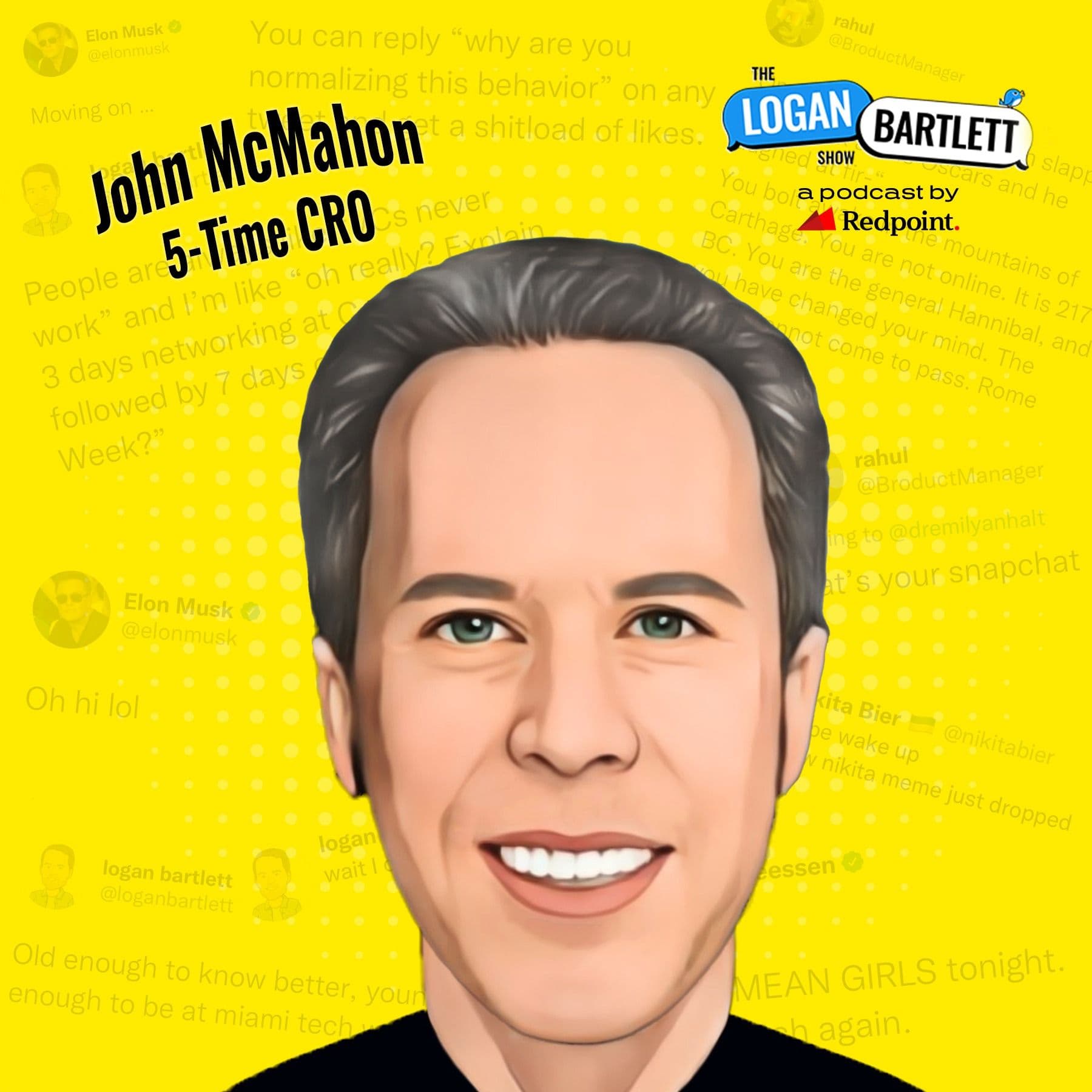
Episode Overview In this episode of The Logan Bartlett Show, host Logan Bartlett interviews John McMahon, a seasoned enterprise sales expert and five-time Chief Revenue Officer (CRO). The focus is on the essential sales playbook every founder needs, emphasizing actionable insights for startups seeking to build effective sales processes and teams.
Key Highlights
Introduction to John McMahon
- Background: Former board member at MongoDB and Snowflake, with extensive experience in building sales processes for enterprise sales.
- Goal: Share practical sales tactics and lessons for early-stage startups.
Key Topics Discussed
Sales Fundamentals
- Common Vocabulary in Sales:
- Importance of shared definitions (e.g., champion, coach, technical buyer) to avoid miscommunication.
- Need for a clear understanding of each role in the sales process.
- Active Listening:
- Sales professionals must be fully present in conversations to effectively understand customer needs and respond appropriately.
- Self-Awareness and Intuition:
- Salespeople should be aware of their impact on others and utilize intuition to gauge client reactions and needs.
- Urgent Curiosity:
- A trait of successful salespeople; they ask probing questions to uncover customer motivations and objections.
Sales Organization Structure
- Hiring A Players:
- A players are crucial for building a successful sales team; they often hire other A players.
- C players tend to bring in lower caliber talent, affecting overall team performance.
- Sales Management Transition:
- The challenges of transitioning from sales rep to sales manager include the need to adapt leadership styles and understand diverse team dynamics.
- Recruiting and Training:
- Emphasis on structured recruiting to ensure the right fit and ongoing development to cultivate skills and capabilities.
Sales Process and Methodologies
- Accelerating Sales Growth:
- Mistakes in scaling sales teams, including underestimating ramp-up time and neglecting management support.
- Importance of defining processes and KPIs for sales success.
- MEDDIC Qualification Framework:
- A sales qualification process to ensure that sales teams identify the right prospects and understand their needs deeply.
- Key components include: Metrics, Economic Buyer, Decision Criteria, Decision Process, Identify Pain, and Champion.
- Performance Metrics:
- Shift focus from activity-based metrics (e.g., number of calls) to performance outcomes (e.g., closed deals).
- Importance of establishing meaningful KPIs that indicate potential for success.
Firing and Letting Go
- Process of Letting Go:
- Importance of having tough conversations and ensuring employees are aware of performance expectations.
- Recognizing when an employee is not a fit for the organization and the necessity of timely action.
Key Takeaways
- Sales Excellence: Sales is both an art and a science; understanding processes and metrics is crucial for success.
- Recruitment Focus: Hiring the right people is paramount; characteristics often outweigh experience.
- Leadership Adaptability: Great leaders evolve with their environments and continue developing their skills.
- Communicating Expectations: Clear communication and defined processes help in managing expectations and performance.
Conclusion This episode provides valuable insights into the complexities of building and managing a sales team, as well as the importance of a structured approach to sales processes. John McMahon's experiences and frameworks offer a guide for startups aiming to enhance their sales strategies and drive growth effectively.
Listening Links
- [Apple Podcasts](https://podcasts.apple.com/us/podcast/three-cartoon-avatars/id1606770839)
- [Spotify](https://open.spotify.com/show/5WqBqDb4br3LlyVrdqOYYb?si=3076e6c1b5c94d63&nd=1)
- [Google Podcasts](https://podcasts.google.com/feed/aHR0cHM6Ly9mZWVkcy5zaW1wbGVjYXN0LmNvbS9zb0hJZkhWbg)
Follow on Social Media
- [Instagram](https://www.instagram.com/theloganbartlettshow)
- [Twitter](https://twitter.com/loganbartshow)
- [TikTok](https://www.tiktok.com/@theloganbartlettshow)
About the Show The Logan Bartlett Show is hosted by Logan Bartlett, a software investor at Redpoint Ventures, where he interviews influential entrepreneurs and investors to extract actionable insights for startup success. Tune in for deep dives into essential business strategies every Friday.
Written by AI. May contain mistakes. Listen to the episode to check what was said.
Transcript
Automatic transcript. May contain errors.0:05Welcome to the Logan Bartlett Show. I am your host Logan Bartlett and what you're going to hear in this conversation is a discussion I have with John McMahon. Now, John is both a board member at MongoDB as well as Snowflake, but he is best known as a five-time CRO that has built the sales processes and trained the sales people that power enterprise selling in Silicon Valley. John and I talked through a bunch of different things related to selling and sales process, including the biggest mistakes that early stage startups make, as well as how to hire a team to supercharge your company to the next level.
0:38Now, before we get into that, a brief request to please subscribe to this on whatever podcast channel you're listening to us on. Now, without further ado, here's John. So the Logan Barlett Show with your name, it sounds like I'm getting on a Johnny Carson show. That's what we're going for here. It had a different name once upon a time. And I realized the reason I was doing it was to have accumulating value to myself. And so why why have a distinct brand that was separate? Why try to create a third brand around all this stuff? And so I rebranded it in January and it's been good. So our audience, so you have it, it's mostly founders, investors, and executives of tech companies or tech curious people.
1:28And I think people that write books are really good at this. And so I've got you right here. But the structured frameworks for how to think about things, but some of the questions I pulled together, some of the things I want to ask you about, I think people just want to be educated. and I'm sure you found this with your own podcast. Like people want to walk out of this and be able to tell their colleagues that they heard, here's how to hire a VP of sales or here's how to internalize that our reps, what our reps need to do better for next quarter or whatever, like all that little actionable stuff.
2:04So I'm going to try to tease out a bunch of that stuff from you, but your book did such a good job outlining it that I think it kind of gives me the playbook to go about it. Yeah, the hard part of writing it It wasn't actually structuring everything because I could put that together very quickly. But then I didn't want to write a boring, what I call like college textbook, where it's just a chapter. You close the first chapter, you feel like, I want to close this book. My head hurts. I don't want to see it again. Totally. That's why I made it into a story. And making it into a story, when you're really not an English major, I was an electrical engineering major, that was really difficult.
2:40So I had to learn about the hero's journey and character arcs and stuff like that. Boy, that was hard. I came into it not realizing what style of book it was going to be. And so I expected the textbook. That was what I was expecting to get. And the first few pages of it, I was like, hang on, are we going to... Is this just going to be fictionalized characters? And so the first couple of pages of digesting it, I was like, wait a second, what's going on here? And then it puts all the stuff in practice in actionable terms that was easier to internalize than trying to remember the five forces of hiring a VP of sales or going through the characters and all that stuff.
3:31It was an easier read than maybe I expected from a sales book. I've heard that from so many people. They felt like they could put the book down and go do something right now. And so many people say now that they just have it on their desk. It's like their Bible with all the yellow sticked notes in it and they reference it all the time. And then some companies, it's mandatory reading when you come to the company, Okta, Zscale, or a number of other ones. That's great. My one quip with you is that I need an audiobook version of that beautiful New York Jersey combined accent of you just reading to me through all the salient points.
4:14This is the first hardcover book I've probably read in, I don't know, a year or something. So that's what I want. I want the audiobook. Okay. So I thought, because I just literally hired a guy and I said, I can't be every character. So what I'm going to do is get somebody that can help me. I'll read all my parts and then I'll get somebody that can go out and outsource other people to read the other characters. I don't know what you think about that. Because I think it's pretty boring of me just reading it. I mean, I don't know. You in like falsetto, you in a tenor voice, you up and down. I don't know.
4:52I don't have that reading, brother. You're thinking of something else. I don't know. I think it would be good. I think you could play all the characters. A one-man Broadway show out there, just you acting out the forego journey of the company. Well, good. Well, I appreciate you doing this. So I do want to talk about the book and a bunch of different stuff here. But I think first and foremost, I'd be curious your perspective. I mean, you've been doing this for so long and the industry has evolved, but also stayed the same. Is there a single thing that you, as you look back on your career of working with startups or even now being a board member, the single thing that's hardest for executives or investors or founders to internalize about sales?
5:42Yeah, there's a number of things. I think that they, especially with the venture capitalists that I've been with that haven't been operators of a business. I think they, first of all, they don't understand the importance of planning early in the year, this year, for next year. And why I say that is, if you think about enterprise salespeople, they have a six-month ramp before they're considered that they should be productive. Productive meaning that every quarter after they've been there, six months, they're going to be on quota, right? So what I saw was it would be like November, almost December, and they'd say, hey, we're going to do 50 million this year.
6:29And let's say they have 50 sales reps to make the numbers easy. Let's do 100 next year. So they don't really understand. And sometimes the tech CEO hasn't been through this process either. And they say, great, let's do a hundred million. They go to the poor CRO and say, hey, next year, we're going to do a hundred million. Well, how's that possible? I have 50 sales reps today, each doing a million dollars in business. How am I going to do a hundred million next year? We'll just go hire 50 more sales reps. Well, you can't hire 50 A players in a month. You know, it's the old, you know, well, I won't actually say it, but you just can't hire that many people that quickly and expect that you're going to come out with, you know, the productivity that you need.
7:20So you can't onboard 50. If you only have 50 people, you can't onboard 50 people. You can't train them, develop them. And then you can't squeeze that ramp. If the ramp was six months previously, there's no reason to believe that that ramp is now going to be a month. So even if you hired 50 salespeople on January 1st, they're not fully ramped until July 1st. You lost six months of the year. So there's no chance of you doing 100 million. Yet I've still seen many organizations still try to make that work, and it just doesn't work. The second part of that is the discipline of recruiting. Because if you're going to hire 50 salespeople all at once, chances are you're not going to get all A players.
8:03You're going to get some Bs. You're going to get a lot of Cs. The second piece of the discipline of recruiting is that you have to lead with management because all these reps are going to need a manager to train them, develop them, and help them sell and actually try to squeeze that ramp time down from six months. So what a lot of companies do when they have a race to have the right amount of headcount, those 50 reps to make next year's number, they hire a lot of reps. But it's almost like building a bridge over, let's say, the Bay Bridge in San Francisco. It's almost like they put the pillars down in the water first.
8:42Those would be the leaders. Then they build the road over the pillars. What a lot of companies want to do is just build a road out there with no pillars. and the thing collapses on itself. And I've seen that happen time and time again. And then if the company's scaling, what I think a lot of people don't appreciate is that before you're going to scale, you have to nail everything down as a process. The recruiting process, the pipeline generation process, the candidate interviewing process, all of those things need to be processes that are nailed down with measurable steps and KPIs for each and every one of those steps so that you can really understand what's going right and what's going wrong.
9:25In the book that you go through and you outline a bunch of sales basics, and I would love to talk through each of those. And it might require you circling back to some of the points you just made, but why they're important in building out a highly efficient and scalable sales organization. So the first one you talk about is common vocabulary. Can you say a little bit about why having a common vocabulary is important to a sales team? I've gone into many, I've been invited into many QBRs. And then they ask me to sit there and listen to them go over the forecast. So then I hear people say champion, economic buyer, coach, technical buyer, and they're throwing out all this terminology.
10:11And then I just make like I'm innocent and I stand up and say, hey, can I just ask a question? Since I'm new here, what's your definition of what a champion is? And I might ask three different people in the room live and I'll get three different answers. So that means that in this conversation that they're having about the forecast, they're talking past each other. And I think any sports playbook, every position, every player has a name to it. It has a definition to it, what they do. Every play has a name. Every play has the finding actions and what every player does. And that has to be the same in sales so that when we talk about the customers that are in this sales situation, the economic buyer, the champion, the coach, the fox, the enemy, those types of things, we all conjure up the same definition in our heads when we're talking about it.
11:03And the same has to happen in the sales process. For every step and every stage in the sales process, we have to have a definition of what has to occur there, who has to do that, what skills do you need, and what knowledge do you need to be able to execute that play flawlessly. The next two points you had were listening and be here, were the phrases you use. What do those mean in the sales context? Well, be here. I think that these days I say that everybody's in a constant state of partial attention. What I mean by that is they're checking social media, they're hearing their alerts, they're getting texts, they're getting emails, they're getting phone calls.
11:49And no one really seems to be in the moment and be here right now, present. And if you're going to make sales calls and you're going to talk to customers, you've got to be here and you have to be in the moment. And if you're not here and you're not in the moment, there's no chance that you can be a very effective listener. And in fact, in most situations in daily life, when you're speaking to people, you almost get the feeling that before I'm almost done speaking, they already have something that they want to say. So they're not listening to really what I'm saying. and listening is maybe one of the most underrated skills or characteristics that a salesperson can have.
12:28And the reason I think it's a skill and it's not a characteristic is it's something you have to pay attention to all the time. Am I really here in this moment? Am I truly listening to what Logan says? Am I listening with the intent to understand or am I listening with the intent so that I can say something? So I think that those two things go hand in hand. In terms of self-awareness, intuition, and transformational mindset, those seem to be characteristics of people that you bring on. Are those skills or are those innate things? And how do those translate to a sales process? Well, intuition goes basically with being here and listening, right?
13:11I mean, for me, I've always thought that my intuition gave me like a second processing unit. So I have my head that can process data and what I see, but my intuition can really process data also. So for me, actually, Logan, I always felt that I was best, you know, in a sales situation when there's, let's say, 10 customers in the room. So I walk in the room and I'm really trying to be here. And I'm using my intuition as I go around the room shaking hands and looking in people's eyes. saying, okay, this person could be a potential champion. This person looks like they don't care. Somebody just told them to show up to the meeting.
13:49This person could be the economic buyer. And I try to use my intuition just with those handshakes and looking in people's eyes and saying, hi, I'm John. What's your name? And then when I sit down and through the meeting, I'm checking how my intuition is doing. Am I right? Am I wrong? But so many people, because they're not here, they're not in the moment, they're not listening, they don't really use their intuition anymore. And I feel like the best decisions that I've made is when the data that I logically get presented to me and process through my mind, that when that rings true with my intuition, then I know I'm making the right decision, right?
14:29Self-awareness is a little something different. Like as a salesperson or a leader, you have to know how you come across to other people. So I can't tell you how many times I've had some issues with people that works for me, and I would pull them aside and sit them down in a room. And I'd say, hey, Logan, when you're not around, what do you think the book is on you? Well, what do you mean? Well, if we were going to describe Logan's characteristics and his effect on other people, what do you think the book would say? And it's amazing how many times these are supposed to be salespeople that are supposed to be perceptive, that they just don't understand what the real book is on them.
15:11So they don't, they lack self-awareness. And if you lack self-awareness and you don't understand your effect on other people, that can become very problematic in trying to be successful as a salesperson. Can you tease these things out in a hiring process? Are there specific questions that you're able to ask for self-awareness and seeing if a person actually has that? You definitely can with intuition. I might be halfway through the interview process and say, hey, Logan, how do you think you're doing? Well, what do you mean? Yeah, that's exactly what I asked you. How are you doing in this interview?
15:48Is it going positive? Is it going negative? Now, there may not be any real right answer, but I want to hear how they answer. What factors did they put into that answer to see whether or to tell me whether or not they think it's going positive or it's going negative. So I can kind of test out their intuition and also go back on for listening, go back on some things that I've said before and ask them and go back and check on it again and see if they were truly listening to what I said. On the urgent curiosity side, that was the last one of the basics that you spoke about. And there was a very colorful gentleman that you referenced in here by the name of Carlo Carpinelli, greatest salesperson in the world.
16:35So I want to read you the excerpt from the book describing Carlo. And it's such a visible person in my mind that you were talking about. But you described him as when you first met him, he walked in with a three-day-old beard, a closely cropped DIY haircut, and a black turtleneck sweater covered with a purple sports jacket. In addition, his tan corduroy pants with large tufted cords and brown shoes were a typical of any Italian candidate I had previously met. It was hard to understand his broken English, and I couldn't help but noticing his two chipped front teeth when he smiled. So not exactly, I think, people hear Italian salesperson and Carlo Carpinelli, is that right?
17:18I'll get it right eventually. Yeah. It doesn't sound like the typical salesperson. What made him so talented? And why do you describe him as the best salesperson you ever met? Well, let's put that into perspective, the way he showed up, because these days you might be able to show up like that and that was OK. But back then, like 20 years ago, you know, in the Milano office in Italy, every candidate that walked in looked like they were going to be an Italian model. They had their hair perfect. They were clean shaven. They had a suit on a Brioni or a Ketone suit on with beautiful Ferragamo shoes.
18:02And they played the part. And then in came Carlo. And this is where I had to use some listening, questioning skills, and also my intuition on whether or not I was going to take a chance to hire this guy. But what made Carlo so amazing as a salesperson is, one, he never took anything personally. Two, he was so curious that he would genuinely ask, why? How come? I don't understand. So if a customer basically attacked him and saying that was something really wrong with his product, he'd look him in the eyes and say, yeah, but why? And it might be true, but Carlo wanted to understand why does the customer think that way?
18:50And it was so genuine that it would disarm these customers and it would allow him to overcome those objections. and he sold some of the biggest deals in the company year after year. And he was actually able to get to the highest levels of organization. So I'm talking about like the CEO of Ferrari, who at that time was Luca di Montezemolo. And he would get to the CEO of GD and all the major corporations in Italy. So that's what made him great was he wanted to understand why. And it was genuine. one. Is that something that you knew and sensed when you were first hiring him, this urgent curiosity as you described it?
19:36Or was that you just had a spidey sense and an intuition or feel that this was a special individual? No, I couldn't really understand him so well with his broken English. So what I did to him is I said to him towards the end of the interview, I paused so I could create a little urgency. And I said, Carlo, I'm not so sure you can do the job. And he looked at me with those eyes and twisted his head a little bit and said, but why? How could you possibly think that way? And at that moment is when I knew, okay, I'm going to hire this guy. So yeah, you could say I took a leap of faith, which I usually don't do when I'm hiring people.
20:20But in Carlos' situation, I did. You talk a lot about the whys of selling and Jody Bonsall referenced this as well. But can we talk about how each of those are important and how you think about it from a product market fit standpoint? So the first one is, why do they have to buy? And I think, why do they have to buy from you? How do you think about that question? Well, there's a couple of ways in which I use that if I'm going to go actually, like I did work with Jody at AppDynamics, and if I'm going to go talk to Jody and I don't know him and I don't know his product, and he's asking me to maybe be an advisor to his company, I'm going to hide the fact that I'm going to ask him those three whys.
21:03So the first, and then the same thing, if a sales rep gets in front of me and they're going to tell me about their forecast about a certain customer, I don't really need to go into MedPic or Medic to qualify, I can just simply ask them first, tell me why they have to buy. So the reason that they have to buy is they have to solve a pain. And if you can't identify the pain, then you don't know why they have to buy. The second one is, why do they have to buy from us? And the reason that they would have to buy from us is because we have differentiators in our product that perfectly align to the customer's pain points, which means we can solve their problem uniquely more than any other company that's on the earth.
21:50So there's perfect alignment there. And then why do they have to buy now is the urgency. Why do they have to buy now? Why not later? Why not a workaround? Why do they have to buy it all now? Why can't they just buy some of it now? Why is it so urgent? And I think when you can truly answer those three questions, okay, it's time to think about where that deal is in the sales process and whether or not we can forecast it right now. And if I'm sitting in front of a CEO that asks me whether or not I want to advise this company, consult, or be on the board, they have to be able to answer those three questions.
22:27Otherwise, I'm really not interested. And one of the important things is that being true for a subset of customers, right? It doesn't need to be true for the totality of businesses out there, but there needs to be, I guess, the Snowflake example. It was initially ad tech and a little bit of tech businesses as well. Do you prefer to have a very narrow landing point within an industry for answering those questions initially? Or would you prefer it be a broad set of customers that it applies to? You mean when we're starting the company as a startup? Yeah, in the early days of selling. How important is it?
23:05Yeah, well, in the early days of selling, it's super important because too many companies hire, they start their company, they get a big round of funding, and then they do what I call sprinkle the infield. So they put a sales rep in all the major cities or NFL cities in the United States, right? And then they're hoping that those people can sell. But what they haven't done is taken the time to understand their ICP. What's that? That's the ideal customer profile. So going back to the three whys, understanding the differentiators that we do have in our product right now, okay? Now we work backwards.
23:37What pains do they really solve? Okay, if we know that they solve these pains, what use cases are those pains in? Okay, now what use cases, where are those use cases typically located? Like what companies are they in? Okay, inside those companies, which persona owns those use cases? Okay, and then what industries are they typically? Now, based upon that, I'm not going to sprinkle the infield with sales reps. I'm only going to put them in the cities that have the greatest amount of those companies with those use cases. So therefore, I can sell there. Then what I do is train my sales reps and choreograph my messaging, choreograph my demonstration, particularly to those use cases.
24:23And so it will resonate with those personas. And I know everything about that persona, too. I know how they're measured, what their budget is. And I speak to them in their language. And when you do that, then you can go down to tech and ad tech like Snowflake did originally, build up enough revenues that you can feed development and development can continue to add enhancements and take you into other bowling lanes that you can go down. Yeah, it makes a lot of sense. Being able to target customers and then there's the referential element of people in ad tech know other people in ad tech and having that validation within these industries, I'm sure, leads to even more efficient sales processes and the ability to go from the early adopters to whatever the crossing the chasm stages are or something.
25:18But it's really number one reason why so many startups burn so much money and don't really come out, you know, efficient. They're not making efficient use of the money that they pour into the sales force because they really don't understand their ICP. So we dove into a bunch of the specific stuff that you cover in detail in the book. But one of the things that I think you touch on a little bit, but that you're perhaps best known for or the father of is the medic qualification process, not sales methodology. I know that's not the right term, but it's a qualification methodology, right? Medic and MedPIC.
26:01Yeah. So let's think about it. Let me give you an analogy if I'm going to explain it is you have a sales process. Your sales process is like a Google map. If I'm going to drive from Boston to New York, I type it into Google Maps. It tells me the ideal route to get to New York the quickest. Same thing with a sales process. You're talking about all the different stages, maybe five stages, and different steps inside those stages that tell you if you follow these and don't skip any steps, you're going to get the fastest way to a purchase order. Now, when I am driving from Boston and I get an hour outside of Boston, I got to stop for gas, I might get off the road and now I got to get back on the road.
26:41So I made a wrong turn, essentially. Okay. I need a GPS to tell me, tell Google maps how to get me back onto the right highway. And it's the same thing with MedPick. It's something that has to layer onto your sales process so that you can understand when you're asking people questions, you know, So at what stage are we at and what step in that stage is the deal? And it's used for a lot of purposes. One, to forecast deals. Two, to train your sales reps. If I know that Logan always gets to step three in stage two and his deals start to stall, then just like that playbook we were talking about earlier, I now know that he's either lacking a certain knowledge or he's lacking a certain skill to overcome that step in the sales stage so he can execute it flawlessly.
27:36So I can use it for multiple ways, but mainly it's used to figure out where are we in this deal? Who do we need to talk to? What information do we need so that we understand what the next steps are? What was the history of this? Because, and I want to talk about the background and coming up with MPTC and then Blade Logic and all of that. But was this a process that you had refined at one of the stops along the way and then the terminology was only later codified or how did it actually come to be? Necessity is the mother of invention, Logan. So for the first three and a half years of PTC when we started, the product didn't work.
28:21and at that time, we came out with a major release every six months, which at that time seemed like really fast, whereas today, you could do a release every hour. You could do a major release every week. So it was still V7, right? You were shipping a product that didn't totally function. So when you went back a year later or two years later with a new version of it, were they saying, hey, this didn't work, and you were saying, yes, but now this one will? No, they would say it didn't work. So we would sell them a copy of the software because we only had a two-stage sales process. We would demo and close.
Read the full transcript
28:57We were no different than pot and pan sales guys or vacuum cleaner sales guys. We got our way in the door and we were going to give you an amazing demo, so well choreographed. Then I knew what I was going to say. The application engineer knew what they were going to say. We knew what objections were coming. We've handled them before. And we're going to demonstrate this thing flawlessly. Like the curtains open, the white hot spotlight comes on and we're going to town. We're dancing. And people would say, this is really amazing. Hey, can I get a loaner? No. Can I do a benchmark? No. How about a POC?
29:31Nope. Can I lease it? Nope. What can we do? You could buy it. You could buy it. Yeah. Okay. So they'd buy it. We talk them into buying a copy. They call back like a week or two later and say, hey, I'm trying it on this geometry because it was mechanical computer aided design. And they say, like, I can't get it to work. I need an enhancement. Okay, well, if you need an enhancement, you're going to have to order a couple more copies. Well, John, I just told you the one I got doesn't work. I know. But if you want to step up and get priority in the enhancement process, you have to buy a couple more copies.
30:04So we talk them into buying one or two more copies. And so what happened is in Rev7, we could demo the product and the sales process could change where we actually could do it like a POV. What happened was we were competing against two companies that were a billion dollars in revenue that had a broad breadth of product. And we knew that if we tried to just say, OK, we'll compete against those people, we're going to lose. So this is where the decision criteria came into play, where we had to lock down a criteria that we knew if we can frame it in this box, we can win. Anything outside that box, we're going to lose.
30:45And we actually got a bad reputation because we would go into an account saying we would play. And then once the criteria got too big for us, we'd say, we're out. We're not even going to play. We're not even going to let you touch the software. So then what happened is we would lock down the criteria and then we would find out, you know, again, this is all the scars of experience. We would find out that sometimes there was a strong champion in the account for the competition and they would change the process on us. They'd make us do the POC and then they'd say, and then we'd win and they'd say, oh, well, we want to add some more stuff and they'd change the process.
31:24So we said, okay, now we got to nail the process. Who's involved in the process, how many steps are in the process, and when does it end? So that's the second date. So we started to do that, but then we also realized like, hey, we got these guys that really don't have a lot of power in the accounts. They're buying one seat here, two seats there, but they don't really have a lot of power. And this decision criteria and process still changes on us. When we walk into an account, it can be unpredictable. As a sales rep, you want to walk and know that things haven't really changed. So then that's when we figured out we have to get somebody that's called a champion where they can help us control the criteria and control the process.
32:06Not a coach, a champion. They got power inside the account. They have influence with the top executives in the account. So that became the seed. Okay, so now we really started to win. Now, instead of one or two seeds, we're winning 10 and 20 seeds. But then we started looking around and saying, hey, this company has 500 seats, 500 engineers. We want them all. Why don't we go up high? So we go up to this guy that we call the economic buyer because they basically had all the money. And that might be the VP of engineering, maybe a division leader, a general manager, or a CEO of a company. And then we started talking our features and functions and they'd say, hey, time out.
32:48I got a CAD manager, four levels down, go talk to them. So we realized at that point, in order to get to the economic buyer and talk to them about what we could do, we had to change our language. And we had to talk about time to market, engineering productivity, engineering costs, those types of things, and never mentioned CAD, never mentioned anything technology-wise. But we also found out, hey, what they're looking for is they're looking for other customers that did the same thing. And we're going to need an ROI to do that. So we're going to need the before scenario and the after scenario. So here came the I, like identify the pain, identify the problem, identify the initiative, and then tie the metrics around the pain in the before scenario.
33:34And then what can we do in the after scenario to enhance engineering productivity, reduce costs, and increase revenues by getting the product out the door quicker. So that was the genesis of MedPick. It took years to really get there. And again, through a lot of scars of experience. So it's a process or it's a qualification methodology where you're shaping the decision criteria, one of the D's, and the process around the decisioning. That's the other D as well. but then setting yourself up for success so that you can qualify down the right number of opportunities and then make sure that you have the highest probability of landing a large deal within the account.
34:22And what's amazing to me about this and internalizing all of this stuff is that it's very scientific in a lot of ways of how you go about architecting the sales process I think most founders think of sales as a, or technical founders can think of it as black magic, and it's very much an art. But when you lay it out in these terms, it's such an architecture of building the process that I think has a lot of parallels to being building a technical architecture as well. Was that going through your mind or did that just happen to be that both of these things sort of have mathematic structures to them in a way that also would resonate with technical founders?
35:09No, it definitely went through my mind. You know, I have an electrical engineering degree. And if there's only one thing you're taught in engineering school, it's that everything has to be defined as a process. Right. So you had to think in terms of, you know, a sales process and then think in terms of how am I going to measure exactly where I am at each and every point of that process? so I can change things. I can understand why I'm doing things right or why things are going wrong. But the biggest thing in that whole MedPick thing, it all hinges on having a really strong champion. And that's where most salespeople make a mistake.
35:44They get a coach. They get somebody that likes them, wants them to win, gives them inside information, kind of masquerades and tells them, yeah, I got the power. I can buy this stuff. And they really don't have any true influence in the account with the economic buyer. They can't get a meeting with the economic buyer. And the difference between a champion and a coach is the authority and the influence. Can you draw the distinctions there? Yeah. I usually think of an organization chart as that's something that just shows you who has authority in the account, who's in the leadership positions. That's authority, right?
36:19But authority doesn't always go hand in hand with influence. So if I'm the CEO of the company or CRO of the company and seven o 'clock at night, and I got a problem, depending upon what the problem is, I may go down three, four levels to people that I know are subject matter experts or have made good decisions on these things in the past. And those are a lot of times in organizations, especially big organizations, people that are in charge of initiatives. So the CEO says in the annual report, we're going to do these six things. They put initiatives in place. Guess who's in charge of those initiatives?
36:56All could be potential champions, right? So they have influence with the economic buyer. They have respect in the organization. That usually comes from technical respect or political power. Everybody knows that Logan is an up and comer. You ask enough questions, they know, oh, that guy right there, he's going places in this company, right? Or if it's on a certain domain, then there might be a technical champion that everybody turns to and says, when it's this subject, that's the person in the organization everybody's going to turn to for the decision. And you have to smoke those people out. You have to find out where they are.
37:32Has your thought process on sales changed with the rise of companies like Atlassian or HubSpot or Datadog or some of these more bottoms up PLG businesses? Has that informed any of these these things or is that just kind of a distinct motion? I think it's a distinct motion. Again, if you think like I do, that everything's a process, then in PLG, it's a process too. It's just not as an extensive process as enterprise sales where you sell on multi-million dollar deals. All you're doing with PLG is you're taking like a free tier and trying to convert people to a paid tier. So there is a process and you have to understand, well, what are you trying to qualify for in that process?
38:12Is it usage? Is it activity? Is it usage of specific functions? Is it the person, the title, the organization, the persona? So everybody's looking for indicators and they start analyzing every which way in PLG to analyze what indicators do we need to see that can say that this is a qualified opportunity and this thing should convert from the free tier to the paid tier. One of the things that you highlight in such a meaningful way in your book is the importance of hiring. And one of the quotes that resonated with me was, if sales managers hire C-grade players and do everything else perfectly, onboarding, training, developing, and maintaining a great sales process, that team will still have a difficult time becoming the number one sales force.
39:01However, if you only hire grade A players and do everything else average, the A players will find a way to win. And then the other adage or phrasing you use in the book is A players hire A players, but B players hire C players. Can you talk a little bit about the importance of recruiting and hiring and why these things are the case between A players and B and C players? Yeah. Well, first of all, that statement is a little bit of an exaggeration. I'm not saying that we should do anything average, but it was just trying to - You should probably try to be good at all of them. Show the difference between hiring A's and hiring C's.
39:40Well, I think recruiting is everything, especially if you're a startup and you have big aspirations to be in a multi-billion dollar company, then recruiting becomes everything because the people you recruit today are your future leaders tomorrow. So you have to, for me, I didn't really care so much about, let's say PTC as an example, and we can use other companies. A lot of people want to know that they have domain experience. Okay, I don't really care about that. And they want to know that they have a skill in certain things. I don't really care about that so much. What I really care about is the characteristics of the person.
40:18So if I really think about recruiting somebody and interviewing somebody, they have knowledge, they have skills, they have execution experience or a track record, which tells you a little something about their background. But their resume doesn't really tell you much. It tells you whether or not they're job hoppers. It tells you some domains that they've been in, but that's about it. The big bucket is the characteristics. Why is that so big? Well, if I hire somebody that's super intelligent, then they're going to be able to learn and gain the knowledge that I train them on very quickly. If they're super competitive and they have what I call a PhD, persistence, heart, and desire, then they're going to pick up the skills because skills are things that are learned over time through many different repetitions.
41:04Then I'm looking for people that are coachable and adaptable because sometimes people are very coachable and Logan will say, yeah, John, I understand exactly what you're saying. But then I have to come back to Logan two weeks later and tell him again. He goes, yeah, I understand what you're saying. I'm going to do it. But Logan never adapts. And when the startups I've been in, sometimes you're in a startup and for two years, you look at certain people and go, oh my gosh, their skillset and the things they know are just, I wish I could do some of those things. Two years later, when the products change, the competitions change, the customers have changed, the markets change, the messaging has changed, they haven't changed.
41:45They haven't adapted. And now they look like a dinosaur. And that's when those people typically have to leave on their own fruition or are asked to leave. So coachability, adaptability, and then you and I talked about curiosity, I think that's huge because that just is another sign of a willingness to learn and a potential willingness to adapt. And then finally, for me, the last one is integrity. You know, if you have real integrity, then I don't, and this is a fast growing company, I don't have to worry about looking back over my shoulder into the past. What are your best interview questions for these different traits?
42:22I read in the book, The most competitive thing you've ever done is one of them and the most difficult situation you've had to overcome. Maybe speak a little bit about those questions, but then also any others that you can try to assess. Well, I think you have to be careful when you ask some of those questions too, because again, like we talked about earlier, you have to be able to listen, be in the moment and really be inside their situation. So if you ask that question, tell me about the toughest situation you've ever been in your entire life. I mean, I've had many, many people crying in my office, right?
42:57And what I'm looking to hear in any of those situations is walk me through how you overcame that situation. What did you do? What help did you get? And how did you overcome it to be the person that you are today? And all I'm trying to do in questions in an interview is I'm not asking these superficial questions off the resume. I'm asking, I want to be inside Logan's head. I want to be in his thinking, how he thinks, what he thinks about. Those are the types of questions that I'm trying to get deep on. So those questions that you just posed are just opening salvos, but I'm going to ask six, seven, eight, nine, 10 more questions to get deeper and deeper inside Logan and understand how he thinks and what motivates him and what issues does he have and fears and desires and goals, those types of things.
43:54That's what I want to know. And I can't tell you how many times I've interviewed people and they've told their manager, geez, I feel like John was inside my head. I can imagine getting into the most difficult thing someone's done in their life. And if the person starts potentially breaking down, I can imagine that you're really inside of how they're thinking about things. And you also think about how are they handling me? How are they handling this whole situation? Have they shown up prepared? Are they asking curious questions? Are they listening carefully to what I say? You know, and then I sometimes might stress them out a little bit.
44:31Like I said to Carla, like I pause and I say, they say, how do you think I'm doing? I said, well, I don't actually think you could do the job. You know, so I'm going to salespeople are always getting objections. And if you can't handle objection about yourself, it's going to be really difficult for you to handle objections about the product that you sell. So I've always felt like I had to at the right point throw out one or two objections. One of the things that you highlight or that I've heard you talk about is like it's there's a right rep or person for a moment in time with the business. And what someone that's super successful at a huge enterprise where they never have to go figure out where their laptops come from or how to be scrappy in that regard is not necessarily going to be the person that you want to hire in the early stages of a business.
45:27Is that something you can actually figure out from the resume? Or does this go back to those questions? How do you figure out if someone's scrappy or the right moment in time for your company? Well, if you're a raw startup, you have to be able to... You have people that can do what I call scrounge. They have to scrounge for resources. Everything that they do, no one else is doing it for them. They have to do it for themselves. So if you look at their resume and they've only been at big companies like Salesforce.com and Oracle and some of those big companies, there's a high probability, very, very high probability they're just not going to make it in your organization.
46:11In a raw startup like that, if most people, and they'd agree with me that have been in this situation, they see a resume from Salesforce.com, IBM, HP, Oracle, they just take it and throw it in the trash can because they just know those people aren't going to make it. Now, if they've only been there three or four years and they went through the salesforce.com training program, yeah, there's a chance that they might make it. If they've been there 15 years and 10 years at Oracle, chances of them being able to scrounge for resources, yeah, low probability of success. Now, if you're a founder or CEO listening to this and you're trying to assess the caliber of your sales leader and thinking about, is this an A person?
47:00Are there questions that you would ask or is there a way of assessing if this is truly the person that's going to help take you to the next level? You're talking about trying to hire your CRO and it's a startup? Yeah. Or maybe you already have the person and you can't tell how much is the product's fault versus the salesperson's fault. Yeah. Well, first, I'd want to see if they've ever had a history of doing it, doing something like this before. Right. So because the greatest indicator of future performance is past performance. So if they've never gone out on their own, built an ideal customer profile and figured all those things out that you and I just discussed and then train the sales force, however small it might be on the messaging, choreographing the demo, getting to those personas.
47:52and starting to drag in some business, yeah, you might have the wrong person. What about the position, the Tom Brady example of him understanding the field, but also we touched on a little bit like the point in time at which someone makes sense for the company. Can you talk about the Tom Brady example and how that might feed in the startups? That's really just more the difference between knowledge and skills, right? Like I'm a gigantic hockey fan, right? Who's your team, by the way, Bruins? Yeah, the Bruins. And now they'll be in a five to 10 year rebuild right after Bergeron and Kretzky just left.
48:33But I can tell you so many things about hockey when I'm watching the game, especially even with people that, you know, have played at Division I, you know, college teams and even, you know, into the pro levels, they'll say, wow, you know so much about this game. But, you know, I can't take a slap shot from the blue line. probably fall down. And it's the same thing like with Tom Brady. No one will doubt that Tom Brady might go down as one of the greatest quarterbacks ever. And he has tremendous knowledge of the game. But if we take Tom Brady out of the position of quarterback and put him in any other position on the first play, you don't even need to know much about football to say, what is he doing in that position?
49:15He's failing. So it just emphasizes how important skills are in the game of sales. You really have to have the skills for the position. And what I mean by that is you can't just take a number of territory sales reps and then all of a sudden decide, oh, we're going to take these 20 territory sales guys and just throw them all into calling on one major account like Goldman Sachs, Citibank, or Morgan Stanley. Chances are they're going to fail. Why? They've never seen that movie before. They haven't seen the politics. They haven't seen the divisions. They haven't seen where decisions might get made at the top and across other types of functions.
50:00So it might be a multi-department decision. And how do I corral all these people into a common decision criteria, a common process for a common POV and come out of there with a win? I've never seen that movie before. And that's a skill set that a lot of people that don't know sales just take for granted. It's fascinating because we talked about the hiring process and how important it is to hire for a lot of the traits, intelligence, PhD, coachability, adaptability, integrity, curiosity. But then there's also this element of or some element of requisite experience and domain, like throwing out the example of Salesforce or Oracle if they're trying to come in as well.
50:45And also making sure you have people that know how to go through a process at Goldman Sachs or a healthcare company and all of that. It's an interesting balance between the traits a person has and the domain that they've built over time. It usually comes with the natural growth of the company, right? When you're Snowflake and with Chris Degnan and you're first doing just tech and ad tech, you're not throwing sales guys into the biggest organizations in the world yet, right? You're starting to develop your product. You're making sure that it can fit into many different use cases. The company's growing.
51:21Instead of 50 reps, you have 100, 200 reps, 300 reps. And now you can take a chance on hiring some of those people that might have more domain experience and more skill sets in hiring, you know, going into major corporations like Morgan Stanley and being successful. We've talked a lot about hiring and how important it is to bring in a people. But one of the things that I think you believe is that it needs to be the job of the sales organization and not HR, not recruiting or any other to bring in the sales talent. One, I guess, do you agree with that? And two, why is that the case if so? I never understood why I would want.
52:05I'm the coach. I'm the head, let's say the head coach. I don't understand why I would want anyone else doing my recruiting for me. That's going to define my team. And whether that team is only five people or 50 people, why do I want somebody else doing that? And the next thing I know, I show up to the room, let's say it's 50, and I show up to a room where somebody else helped doing most of the hiring for me. And I look at the room and I think, oh my God, I'm going to lose my job. These people are horrible. There's no chance that I'm going to take these misfits and turn them into A players overnight and make these big numbers that are sitting in front of me.
52:41So I think that sales leaders have to take ownership over who goes onto their team and who doesn't go on their team. They have to take ownership. And the reason you have to take ownership is not only to be highly successful, but you need to understand everything about that person that you are bringing onto your team. And you can understand, as we've talked before, so much through that interview process. And I'd want to know when the person shows up, here's where I think they're strong and here's where I think they're weak. And I can start to help develop them so they can be successful a lot faster.
53:17One of the things that often happens within organizations is the individual contributors end up growing into sales management roles in some way, shape, or form. What do you see as the hardest part of that transition? You've been a really successful rep. Now you need to go manage the Northeast territory for the organization. The hardest part for most reps when they make the transition to management is that they think they have to prove themselves as salespeople. So they want to be super salesperson and they want to sell all the deals. And then the second biggest mistake they make is thinking that everybody's like them.
53:57so that they think that everybody's the same, right? So anybody that has had kids understands that these kids grow up in the same house, same parents, but they're completely different. And that's no different when you pick up people on a sales team. You have to understand that each person on that team has different strengths, weaknesses, goals, insecurities, doubts, fears, all those types of things that you have to help them overcome to develop them and make them successful. And so those two mistakes are the ones that most first-line managers make the most. And if we really think about it, the way to hold everybody accountable to develop their people and recruit the right people costs you nothing.
54:44So I used to stand in front of everyone and say, you know, today we're 50 million, next year we're going to be 100 million. Here's all the open leadership positions that are coming about. Now, if you want to get one of those positions, especially if you're a first line manager and you want to go to second line or second, go to third, you have to prove to me that you're able to recruit someone, develop them, and lead them to take your spot. And if it's not apparent that somebody can take your spot on your team, why would I promote you? Why? Why? You're going to make it my problem? I'm going to promote you.
55:20And now I got a problem down below because you can't recruit, you can't train, you can't develop. And the flip side is true too. To hold people accountable, if they get rid of people, there's too many organizations that just say, oh, Joe, the sales rep, or Sally, the sales rep, oh, they just no good. And we got rid of them. Well, wait, whoa, hold on a second. Whose fault is that? Sure, Sally and Joe play some part in it. But what about you? Didn't you hire them? Yes. Weren't you responsible for training and development? Yes. Weren't you responsible for leading them? Yes. Okay. I want you to go down to the bathroom.
55:57I want you to look in the mirror and think hard. Come on back and tell me which one you failed at. because we have, we can't keep failing when we're hiring people, right? So we have to understand, you know, what are we doing wrong so we can't keep making the same mistakes when we're hiring people? We either couldn't recruit, we can't train and develop, or we can't lead. It's going to only be one of those three things. I want to talk about the process of actually letting someone go and, you know, how that ultimately ends up occurring. But there's a distinction between KPIs and inputs and then also quantifying the actual output of it.
56:41And so one of the examples in the book you talk about is like a hockey team gets assessed on goals and not on shots. But you also need to have the measurement in place so you can manage to some of the up funnel activities as well. So how do you think through upstream KPIs? And is it the Bill Walsh, the score takes care of itself? Or is it, hey, we got to keep track of what the score actually is. Otherwise, we're just putting shots against the net that are getting saved. A couple analogies. So first of all, if I'm a baseball coach and Logan's hitting 300, I don't really have any problems. Then all of a sudden, Logan starts hitting 220.
57:23I got a problem, right? So now I'm going down to the coaches, the pitching coach, and saying, hey, is Logan watching film of opposing pitchers? Yeah, well, he used to spend a couple hours a day in here, and now he's only spending like 10 minutes. I go to the batting coach and ask the same thing. Yeah, he used to spend a couple hours before and after every game hitting balls. Now he comes in for 10 minutes and he starts hitting some balls. Okay, so those activities of watching film and hitting balls, that's starting to play a big part into the accomplishment of hitting 300, right? And that's the same in sales.
58:01Like too many leaders are keeping track of activity, but they're not measuring true accomplishment. So what I mean is they're saying, how many emails did you send? Calls did you do? How many meetings were you in? Okay, those are great activities, but that doesn't mean that they're going to accomplish it and get a sale. So somewhere in the sales process, there has to be an anchor that says, when I do this thing, when I get to this point, then I know I'm going to get a sale. So one of the things that I did, like at BladeLogic, is I said, I want you to get two POVs a quarter because the quota was$500 ,000 a quarter.
58:41The average deal was$250 ,000. And if they got the POV, and I trained them around the POV, it meant, and they could only get to a POV if they met the economic buyer in person. And the only way to do that is you had to have a champion, right? So basically, all those things were going to happen by definition. So I don't care about how many emails you send and how many meetings you have and how many calls you make. I don't care. I only care that you're getting two POVs that are successful every quarter, because then that means by definition, everything else has happened. Kind of like if you're hitting 300, you're probably doing all the other activities, right?
59:20So I think too many leaders, especially first line, second line leaders that haven't done it before, they're measuring on these people going in and getting meetings. So they run in and they get a meeting so that they can say, I got a meeting with Logan and XYZ Corporation. Okay, great. But what does that mean? Logan's just one guy and 50 ,000 people. That doesn't mean this is going to lead to an order. It's not an accomplishment. Yeah, it makes a lot of sense. I think one of the things that is, for the most part, a lot of founders ask, when the business is going well, where are the examples, and I would love to talk about Chris Degnan, where he's been able to scale from the very early days of Snowflake.
1:00:02He's almost been there 10 years as the CRO. And I think that's the exception. And I have a lot of founders asking themselves, hey, is this the person, this person got me from one to 10? Is this the person that's going to get me from 10 to 100? And if you're a founder in that seat, thinking through the CRO or the VP of sales, or maybe the VP of sales, and you're thinking through a first or second line manager that's been with you from the early days, how do you answer that question? Or what are some of the inputs that you can ask yourself of like, yes, this has been the person, they've done a great job through this point, but it might not be the person for the future.
1:00:42Yeah, it's really hard, but it's all again, all about coachability and adaptability. So many times in the early days of board meetings, when Chris would step out of the board meeting, the CEO might look at me and go, do you think he's going to make it next year? And I'd have to say yes or no. And when I would say yes, it's only because I saw a material and tangible increase in his abilities, which gave me confidence that he's going to continue to grow. And so if you're not seeing tangible evidence of progression in leadership and the ability to manage people, the ability to handle deals and higher complexity deals and higher complexity problems, then the chances are that they're not going to make it.
1:01:33But I don't think that you can just go off of one or two indicators. That's really tough. Yeah. I mean, certainly people are keeping track of sales productivity, is the average deal size going up and is the churn going down? What's the churn on the salespeople? There's a lot of things to pay attention to, but that doesn't necessarily say that the leader is actually making incremental measurable jumps towards progression. Yeah. So of all the traits, it sounds like the coachability and the adaptability are the ones that you need to ask yourself, is this person demonstrably better or growing at the speed at which I need them to, to be this next role?
1:02:13Yeah. And they take coaching very well. So you can see that too. That's evidence. Like if you say, hey, Chris, in order for you to make it next year, here's some things you're going to have to start to pay attention to. And then you see evidence of him actually putting that in place. And he's never done that before, but he's doing it now. I'm starting to have a lot of confidence. Firing is something that I think all companies deal with and figuring out how to let people go. In your experience, I'm sure you've had to let go of more people than you care to remember. Did you know it early on in the cycle that, hey, this was maybe a mishire and you waited too long to let them prove themselves?
1:02:56Is it just hard to have a heuristic around that? What did you typically find when you made the wrong hire? What's interesting is always typically goes back to characteristics, right? It doesn't go back to their domain knowledge or any of that stuff. It goes back to their characteristics that you missed in the interview process. Certainly, I've made mistakes and early on, you have to decide this person's just not going to make it. But I've also been guilty of holding on a little too long. In fact, there's a person that's been the CRO like three times. And when I was at Blade Logic, they hadn't sold anything in nine months.
1:03:38So I had the CEO telling me, hey, you have to get rid of this person. So then it was a year. And the CEO and the chairman of the board told me, you got to get rid of this person. I said, no, I'm not getting rid of them. They said, why are you not getting rid of them? I said, because I personally am making sales calls with them. And I can see, again, that tangible jump in their capabilities. And it was in the fifth quarter that they landed two deals, one for$1.1 and one for$1.3 million. That person's a CRO today. I could have really hurt their career. if I didn't take a real intimate interest in understanding them and where they were, I could have ruined their career.
1:04:16But if I don't see that incremental evidence and I don't see the hard work that they're putting in to learn the skills and gain the knowledge, then certainly if they don't want to put the work in, why am I putting the work into them? It has to be a shared responsibility, the leader and the person. It sounds like in that example, you uniquely believed the entire time and maybe the board or the outside people didn't. Have there been examples where maybe you lost faith and that person actually ended up course correcting and it worked out? Are there the counterfactual of maybe you thought you should fire them and they proved you wrong over some period of time?
1:04:58Or maybe you did fire them and in retrospect, that was actually the wrong call? No, I think most cases when you do let somebody go, it might be that they reached a certain level. Enterprise sales has many different levels. It's almost like double A ball, triple A ball, single A ball, and then going into the pros as an example. So there's different levels of it, different complexities of product, different complexities of selling, especially when a startup, when they don't know your name and they don't know your product. And if I call up and say, I'm John McMahon from Cisco. Okay. They got the budget.
1:05:34They know the person to call on. They know your products. Hey, I'm John McMahon with Blade Logic. They don't know who you are and they don't know what your product is. They think you sell Blade servers and you're selling software, right? So there's different complexities to it. So sometimes you see a person where you say, hey, this person is just not going to make it over here with us. You let them go and they find their way to a place where they really find a home based upon their knowledge and their skill set. And they're successful. And in a funny way, you did them a favor because they were miserable where they are.
1:06:11And the funny thing about letting people go is I'd say that 95 % of the time they know it's going to happen. And they're sending you signals subconsciously. They're sending you signals or little things that they do. They're saying, we need a watershed event. I need you to let me go because I'm not just going to quit. Because I've never terminate a person too early. That was kind of my assumption on that you never, once you've made that decision, it's such an emotional thing to get to the point of letting someone go. They have a family. They depended on you. You, it's also a reflection of yourself, right?
1:06:52that says, hey, I made a mistake. And so you have to admit getting through all those psychological hurdles to get to the point of letting someone go for you to be wrong about it is just so unlikely. And so once one of the things I'll tell my founders and try not to be too Machiavellian about it, but if that's the way you're feeling, it's probably that snowball is just going to keep building. And you're going to regret not doing it earlier. Yeah. Oh, no, you're right. It's very emotional. I've had people where I've been to their house, met their kids, had dinner with their families. And wow, they just get to a point where you just got to let them go.
1:07:30And it's painful. But you know what? Again, they land on their feet and then they're doing much better. They just weren't making it. It's like we said, you just went from single A ball to triple A ball. And now that ball is not 85 miles an hour anymore. It's 93 miles an hour and it's moving and you can't hit time to develop that skill or back go down a little. Yeah. Well, and it's also could be false. Like it could be selfish to you of holding off. You're delaying this person finding their next career that they're going to be able to be at for years. Right. And if you're just waiting, holding out hope for another quarter, but you've mostly made up your mind already, it's actually not fair to the individual, right, to keep hanging around if it's already predetermined what you're going to do.
1:08:18Yeah. What's funny is sometimes I look at these board decks and then you'll see the people who put down, you know, that they churned, let's say, 25 % of the sales force and they'll say right next to it, non-regrettable. And I'm thinking, okay, so that means you have to become a better recruiter. If every single one of those people you churn, you don't regret, you're a horrible hirer. You're horrible. You got to get better. Normally, I think a lot of our enterprise companies see roughly 20 % attrition modeled into their business, and that includes promotions, right, as well as managing out. Is there a percentage that you think about on an annualized basis of what's a normal versus excessive amount?
1:09:02I think it's typically in the super fast-growing companies that I've been associated with, it's closer to 25%, right? Because even Jack Welch at one time said, if you can hire eight A players out of 10, you're a really great recruiter, right? So that's 20 % right there. And then you have 5 % for promotions, right? So, yeah, I've seen mainly 25. And I call it like, you know, churn, you know, attricions plus promotions equals churn in the sales force. You've probably had to have a lot of these hard conversations with with people going through this. Is there anything that you would say to someone listening, having been through a lot of those emotional cycles about how to actually go about the process of letting someone go?
1:09:48Well, usually it's not a surprise. It can't be a surprise. Right. I mean, you had to have as a leader, if you're intimate with your people and you know their skill level, their knowledge, all those things we talked about, their fears, uncertainties, doubts, because you're intimate with them, then this should never come as a surprise. Even if they quit on their own, that should not be a surprise to a leader. So anytime I've seen a leader where they say, you know, Logan just quit. What do you mean, Logan just quit? You never told me like he was thinking of quitting. So they're surprised. You should never be surprised as a leader.
1:10:23One, it shouldn't be a surprise. And two, they should understand a lot of times you're putting people on a plan and you're hoping that they're going to get there. And a lot of times they might choose out. So you say, you know, we have two choices, Logan. Here's some things that we've discussed, you know, 10 different times. And now I'm going to have to put you on a plan because your performance just hasn't been there for the last couple of quarters. Here's the things you're going to have to get correct in the next 90 days. And the other option is that we package you out. What do you think you want to do?
1:10:54And a lot of times Logan will say, I'll take the package. I don't think I can get there. I want to take a step back just because I think your background and path into all of this, you referenced earlier electrical engineering by trade. And I get the feeling in hearing you speak and talk about all this stuff that in some ways you might have been an accidental sales leader, that this wasn't some predestined thing that you were going to go into this field. And I don't know if you consider yourself introverted. I've heard you describe yourself introverted. You can fake a good extrovert on a podcast here.
1:11:35But if we go all the way back to NJIT or growing up in New York and then move into New Jersey. What sets you down this path of being an iconic now sales leader? Well, what happened is I went to engineering school and then I was one of the, even though I was an extroverted introvert is the way I'd describe myself. I could speak and people elected me to be the president of the student body of the Institute of Electrical and Electronic Engineers. And to make a long story short, one night I had a panel. I brought in a panel to talk to the students, you know, people from production and QA and design.
1:12:22And I had these round tables set up so the students could sit down with one of those authorities and ask them questions at dinner. And when I got done running the logistics, the only table that was left was sales. And no one was sitting there except the sales guy. So I sat down and talked to him. And the sales guy, I could speak with the sales guy. So I went home and I told my dad, because I lived on campus, but I went home and told my dad. And my dad never went to high school. So I told him the situation. He said, well, you know, I don't know a lot about this world, but I do know that really good sales guys can make a lot of money.
1:12:54And being a poor kid, I was like, okay, it's over. I'm going into sales. Was that HP or did you find your way to HP after that? Yeah, HP selling electronic test instruments to electrical engineers. Yeah. So you were selling hardware, physical products at that point. And then you found your way to software sales when and how? Well, I was one of the top salespeople at HP selling instrumentation. HP was worried that software was going to come and eat their instrumentation business. Some of these boxes back then were like microwave analyzers and spectrum analyzers were$100 ,000. That's 30 years, 30 something years ago.
1:13:34So they acquired a software company, and the VP of sales came over near my desk. I didn't know who he was. He said, hey, you know, my name's Mike Reed. I want to introduce myself. I said, hey, Mike, how are you? Good. He goes, I hear you're one of the best sales guys. I guess so. And he said, well, I want you to join my team. I said, well, why would I do that? He goes, because all my guys make over$100 ,000. Remember, this is over 30 years. I said, okay, done. We're selling software. So it didn't take too many, you know, a lot of thoughts for me to change career projections, you know, and that's how I got into it.
1:14:07But any time I did anything, thinking back on my dad, though, he had a big effect on me because any time that I would brag about anything that I did, I'd say, hey, dad, you know, I just did that, did this. He'd say, yeah, that's really good. That and a token will get you on the subway. Now get the fuck out of here. So it always kind of like, you know, put me back in my place about what's important versus what's not important. So titles and all that type of stuff really don't matter. It only matters what you really do. That's great. And so then you were selling CAD and you ended up at PTC. What was the connection to going over to PTC?
1:14:50I got promoted to manager as one of the youngest managers at HP. And I remember being in a meeting. At that time, I was in Southern California. My territory was from San Diego to Santa Barbara. And I was in a meeting with all these first-line managers, second-line managers, all the way up to the VP for the whole Western area, more than probably from Colorado West. And I remember they never talked about how we can help salespeople sell more. It was never about selling issues. This is a sales organization. It was all about the politics and bureaucratic BS. And I remember sitting there saying, I don't want to grow up and be like any of these guys.
1:15:33I want to do something else. So I just started looking around and there was this, back then, you know, I didn't have the internet and this thing fell on my plate about some company called PTC that was just starting out in Boston. So I called the CRO at the time and I said, Hey, you know, I want to join the company. He said, you got a resume? And I said, no, because I'm not really looking for a job right now, but if you want me to make one up, I'll make one up. And I, everybody told me I was nuts because they had zero revenues, products, you know, didn't work, but I felt like I had nothing to lose.
1:16:10Like I wanted to try to prove to myself that even in a small, small company, I could really, I could, I could excel at this sales game. Let me take a chance now. I wasn't married, didn't have kids. Let me go. And did you go in there as an IC initially, or did you go as a sales manager? They had just put a guy in, in the, in the Western US and he had a team of like five people. And so So I became one of them. And two months later, we went to a QBR back in Boston. And when it was over, the CEO came over to me and said, well, we're flipping you with the guy that runs the West. So now you're running the West.
1:16:50So I was only doing it for a couple of months. What was John McMahon as a sales rep way back when? I assume leadership and management has been your calling, but you must have been a pretty good sales rep as well. I don't know if I was great. I was never the greatest presenter. I was a good listener, and maybe that's from what we talked about before. So I was a good listener, and I didn't want to present anything because maybe that's part of that introversion. I didn't want to present anything until I thought I was really right, and I heard everything that, let's say, Logan told me that he really wanted.
1:17:24But the one thing that I was was persistent. So when I wanted to sell something, if I wanted to get to the VP of Engineering at General Dynamics, I'd go at six o 'clock in the morning with a couple cups of coffee. And at that time, like they, they would put on those cement bumpers, you know, VP of engineering. So I just stand there and wait till he came. Now this one, you got to get your elevator pitch down pat, right? Cause you got 30 seconds to a minute where he'll hopefully let you in the door and you can have a cup of coffee with them. But that's the type of salesperson was, I was, is just more persistent than really excellent at the craft.
1:18:04And maybe that more people need is they need a little more persistence. Yes. Well, you hear these stories and now people are unwilling at times to cold call. And I'm like, some of the old days you get restraining orders today for the stuff you needed to do to be effective salespeople. I'm curious, PTC and BladeLogic both have such a unique sales tree of people that have studied under your tutelage and Steve Walski as well. And dating back to, I mean, Mongo, obviously, and Datadog had it, Snowflake had it, Okta as well, Zscaler. There's so many people that came out of those organizations. How much was the unique talent of density of the people you were able to recruit versus the process.
1:19:00And all these people just, I look around to my friends that I came into the venture industry with, and we were all likable people. But the fact that we've risen was we were investing in software in 2013, 2014. And so there's some like survivorship element of it as well. What do you, did you know it was special from a talent standpoint then? Or how do you sort of think about the inputs of the process around it and the actual people that were there? Well, you know, I put such emphasis on recruiting. So that's probably at least 70, 80 % of it. So the people had all the inherent characteristics to be successful.
1:19:40And then I would just like spend a lot of time training and developing them. So every week we'd have forecast calls and use the forecast calls as understanding what the forecast is, but it's development sessions. Every quarter, I got everybody together, everybody. It was very costly. And I remember the first time I presented it to David, I played Logic and he was like, oh my God, it's going to cost so much money. And I said, Dave, if we just start getting more, just think about how many extra deals we have to get that's going to pay for the whole thing. And then to Dave's credit, after we did it a couple quarters and he saw the increase in productivity and the deal sizes growing, he bought in.
1:20:21So it was really a lot of training and development and investing in the people. And a lot of things that we talked about today where you had to invest in your people, you had to train your people, you had to understand them and be intimate with them and help them grow and develop. And if you didn't do it, I wasn't going to promote you. And I think a lot of the really good guys, the Dolly Rodgers, the Adam Arons, all those guys, they took it to heart and they did it. And now they're preaching the same thing where they are. You referenced Dave, who is now the CEO of Mongo. And I want to ask about him in a second.
1:20:58But people probably, this is long, I think, since forgotten to most of the people listening, but the BladeLogic Opsware wars were pretty iconic, right? You had Dave on one side and then Ben Horowitz, who people might be familiar with from Andreessen Horowitz on the Opsware side, and you were leading BladeLogic and they also had a PTC crew as well, right? So can you talk about just like the culture of those wars and the battles that you guys had between BladeLogic and Opsware? Well, we were definitely in a lot of battles, but I tried to focus my people not on them, but focus on making sure that what we did, we did with excellence.
1:21:45And then the second part is truly understanding your competitor and understanding where their weaknesses are and where our strengths are, and making sure that we had our messaging just really down pat and really exposing their weaknesses and highlighting our strengths. And Cranny was trying to do the same thing on the other side. Mark Cranny, who is the Opsware CRO or VP of sales. Yeah. So yeah, it was fun because sometimes I could even talk to the VP of purchasing at a company and it might be down to us and Opsware on who's going to win the deal. And then I could basically tell the VP of purchasing, let me, oh, did you meet Mark Cranny?
1:22:26Yeah. Okay. Let me tell you exactly what the program is. and they're laughing on the other side. Because you and Cranny were at PTC for how long together? Yeah, I hired him twice. I almost never did that because I hired him and then he left. And he might be the only person that I was willing to hire back. It's wild that a war that waged from whatever, 2001 through 2005, 2006, has produced such iconic sales leaders as well as relevant CEOs as well. So you're still on the MongoDB board today. Is that right? Yes. Yeah. Dave Echeria is, in my mind, you get exposure to two of the, for my money, the best CEOs in software between Frank Slootman and Dave Echeria.
1:23:21What makes Dave so special? You worked with him through BladeLogic. You're on the board now, Mongo. What do you feel like his secret sauce is? Well, I'd say that both of those guys, if we can put them in the same bucket, they're both fighters. There's fight and flight, and there's not an ounce of flight in Frank Slootman. There's not an ounce of flight in David Egeria. They're coming every day, and they're coming every day to play. And like you were saying that sometimes this is war, and they're ready to go to war. They got the war paint on and they're ready to go. And they both have really strong opinions on the way in which things should be done.
1:24:02But at the same time, they're open to listening. And if they have to adjust their thinking a little bit, because maybe times have changed, competitions changed, products changed, you know, I give them credit for adapting. Again, I mean, those guys are not the same guys that they were even five years ago. They've all changed and adapted. So, but when I think of both of them, I think of them as like pure fighters. And I like to believe that that's what I have in me too. Like, I'm just a pure, I'm just going to keep coming at you. I'm going to wear you down. If it's a wear down contest, I'll wear you down.
1:24:41The commonalities of the adaptability, it sounds like, and sort of the iterative learning, even at this stage, both of them have proved quite a bit, but it sounds like they're still learning. And then also the competitiveness seems to be the two commonalities or characteristics between both of them. Well, yeah, if you think about their products, think about the product that Frank only had when he took over versus the product that he has today and how many more doors and disciplines they go into inside an organization and how he changed it from a data warehouse to the data cloud. I mean, then think about what Dave has to go through where he had a free tier and he just was converting people from the free tier to the paid tier.
1:25:25And now he's got free tier, paid tier, channels, inside sales, outside sales. Cloud, he's built cloud. And he's in China and he's with Alibaba and Tencent. And he's I mean, it's the complexity just keeps changing every day. And what makes those guys so good is not only are they fighters, but they're adapting to the challenges that are presented to them every day. And I don't think enough people understand the challenges and how CEOs have to adapt in order to stay ahead of the game in this world with technology changing so fast. What's the most common misconception about sales that you think people have?
1:26:10I think it's what you brought up earlier that they think it's an art form when really it's a lot of science. And certainly you're dealing with people, people that are selling for you and people that are your potential customers. So there's a lot of art there, but there's so much science to the game too. And you need the science so that you can figure out, like we talked about before, what's going right, what's going wrong, and how do I quickly adapt and make changes? Because we're measured in quarters, but when you subtract out weekends and a couple holidays every quarter, you're left with 60, 62 days to execute a much bigger number.
1:26:51And if you don't have everything down to a process, like a scientific process, and something goes wrong and you don't have that, well, where are you going to point your finger to figure out what's going wrong and make a quick change so you can post a bigger number within those 60 working days? It's going to be pretty tough. And the companies that nail those types of things, those are the companies that consistently tick up and to the right. I've even gone and spoken to the deans of a couple of business schools and said, hey, you know, I don't understand why you don't have a sales program. You came in here as the new dean.
1:27:29You put an entrepreneur program in place, but why don't you have a sales program? Well, I even had one of them say to me, well, John, if I really wanted to get a sales in here, the rest of my people that helped me run this place, they would think there's something wrong with me. And I go, well, let me ask you a question. How do you think a company buys three or$4 million worth of software? Do they just pick up the phone and say, I want to order$4 million of software? How does that happen? And he said, I really don't know. So then I started walking them through, like, you know, all the discovery questions and account, you know, items, account plans and territory plans and ROI models and, you know, operational value versus business impact and quantifying, you know, value before and after and those types of things.
1:28:24and the deans are blown away and started implementing sales programs. And it's, again, it goes back to answer your question that they mostly think it's an art. Can sales leadership be learned or is it only sales management that can be learned and sales leadership needs to be innate? I think you have to be, to be a good sales leader, you have to be selfless. You can't be selfish. And if you're willing to be selfless and you're willing to understand that the only way I get promoted and the fastest route to my success is through my people and making them successful, then you can be a really good sales leader.
1:29:05If you think it's all about you and you're selfish and you think you're going to get your way there by horse whipping people, it's just not going to happen and not truly understanding where those people are coming from. Besides buying your book, The Qualified Sales Leader, here as a plug, what would you recommend to people that are trying to learn more about sales process and enterprise selling? Is there anything that you would guide them to? There's the Challenger Sales, pretty good book. The Spin Selling is a pretty good book. And Andy White wrote one specifically on Medic. That's a pretty good book if you want to dive even deeper than my book does on Medic.
1:29:50You happen to have a great podcast yourself. So if people want to hear you flip the tables and talk to some of the best sales leaders, I guess that's another one, right? Yeah, we go really deep on different issues like how do you handle an RFP? How do you, what is the, you know, an hour just on, how do you prepare for an economic buyer meeting? Or what's, what is the difference between a coach and a champion? So we go deep on those specific, you know, different issues like that. And to your point, if you're educating people, they're going to come, you know? So I think right now we're up over like 230 ,000 listeners and we never advertised or anything.
1:30:26That's incredible. Wow. I, yeah, Yeah, well, it's you and John Kaplan, right, together. So John, who runs force management, the consulting firm that teaches a lot of the stuff we talked about here as well. So I can imagine it's a good group to hear from. Yeah, it is. John, thanks for coming on. This was great. I'm sure we will want to run back this at some point and go through a bunch of the lessons, but I really appreciate you coming on. Yeah, thanks, Logan. It's been fun. I mean, you asked a lot of really good questions. You bounced me around from people to process to personalities. So it was fun.
1:31:04It was fun. Kept me on my toes. Kept me on my toes. Yeah, exactly. Exactly. Well, thanks for coming on. All right. Thanks, Logan. See ya. See ya.
1:31:27Thank you.
From the publisher
John McMahon has served on the board of MongoDB and Snowflake and is best known as a five-time CRO who has built the sales processes that power enterprise sales in Silicon Valley. In this episode, John talked through a ton of practical topics around sales, including the biggest sales mistakes that early-stage startups make, how to hire a sales team to supercharge your company, and more.
(0:00) Intro
(1:20) The Qualified Sales Leader
(9:57) Sales basics in building an efficient and scalable sales org
(16:53) Carlo Carelli - Greatest Salesperson in the World
(20:55) Product market fit
(26:07) The medic qualification process
(36:35) Difference between a champion and a coach
(42:51) Best interview questions when hiring
(53:49) The hardest part of transitioning to sales management
(1:03:06) On firing
(1:10:06) The process of letting someone go
(1:11:30) Accidental sales leader
(1:17:25) John McMahon as a sales rep early on
(1:21:24) Blade Logic and Opsware
(1:26:37) The most common misconception about sales
Mixed and edited: Justin Hrabovsky
Produced: Rashad Assir
Executive Producer: Josh Machiz
Music: Griff Lawson
🎙 Listen to the show
Apple Podcasts: https://podcasts.apple.com/us/podcast/three-cartoon-avatars/id1606770839
Spotify: https://open.spotify.com/show/5WqBqDb4br3LlyVrdqOYYb?si=3076e6c1b5c94d63&nd=1
Google Podcasts: https://podcasts.google.com/feed/aHR0cHM6Ly9mZWVkcy5zaW1wbGVjYXN0LmNvbS9zb0hJZkhWbg
🎥 Subscribe on YouTube: https://www.youtube.com/channel/UCugS0jD5IAdoqzjaNYzns7w?sub_confirmation=1
Follow on Socials
📸 Instagram - https://www.instagram.com/theloganbartlettshow
🐦 Twitter - https://twitter.com/loganbartshow
🎬 Clips on TikTok - https://www.tiktok.com/@theloganbartlettshow
About the Show
Logan Bartlett is a Software Investor at Redpoint Ventures - a Silicon Valley-based VC with $6B AUM and investments in Snowflake, DraftKings, Twilio, and Netflix. In each episode, Logan goes behind the scenes with world-class entrepreneurs and investors. If you're interested in the real inside baseball of tech, entrepreneurship, and start-up investing, tune in every Friday for new episodes.
Executive Producer: Rashad Assir
Producer: Leah Clapper
Mixing and editing: Justin Hrabovsky
Check out Unsupervised Learning, Redpoint's AI Podcast: https://www.youtube.com/@UCUl-s_Vp-Kkk_XVyDylNwLA
🎥 Subscribe on YouTube: https://www.youtube.com/channel/UCugS0jD5IAdoqzjaNYzns7w?sub_confirmation=1
Follow on Socials
📸 Instagram - https://www.instagram.com/theloganbartlettshow
📱 X - https://twitter.com/loganbartshow
🎬 Clips on TikTok - https://www.tiktok.com/@theloganbartlettshow
About the Show
Logan Bartlett is a Software Investor at Redpoint Ventures - a Silicon Valley-based VC with $6B AUM and investments in Snowflake, DraftKings, Twilio, and Netflix. In each episode of The Logan Bartlett Show, we sit down with the people behind today’s most important startups and extract the tactics, lessons, and frameworks they’ve learned the hard way. Conversations span hiring to GTM, product, growth, fundraising and everything in between - collectively forming the ultimate playbook to make you a better CEO, investor or board member.
Tap follow and enable notifications to stay ahead of the game.