
In short
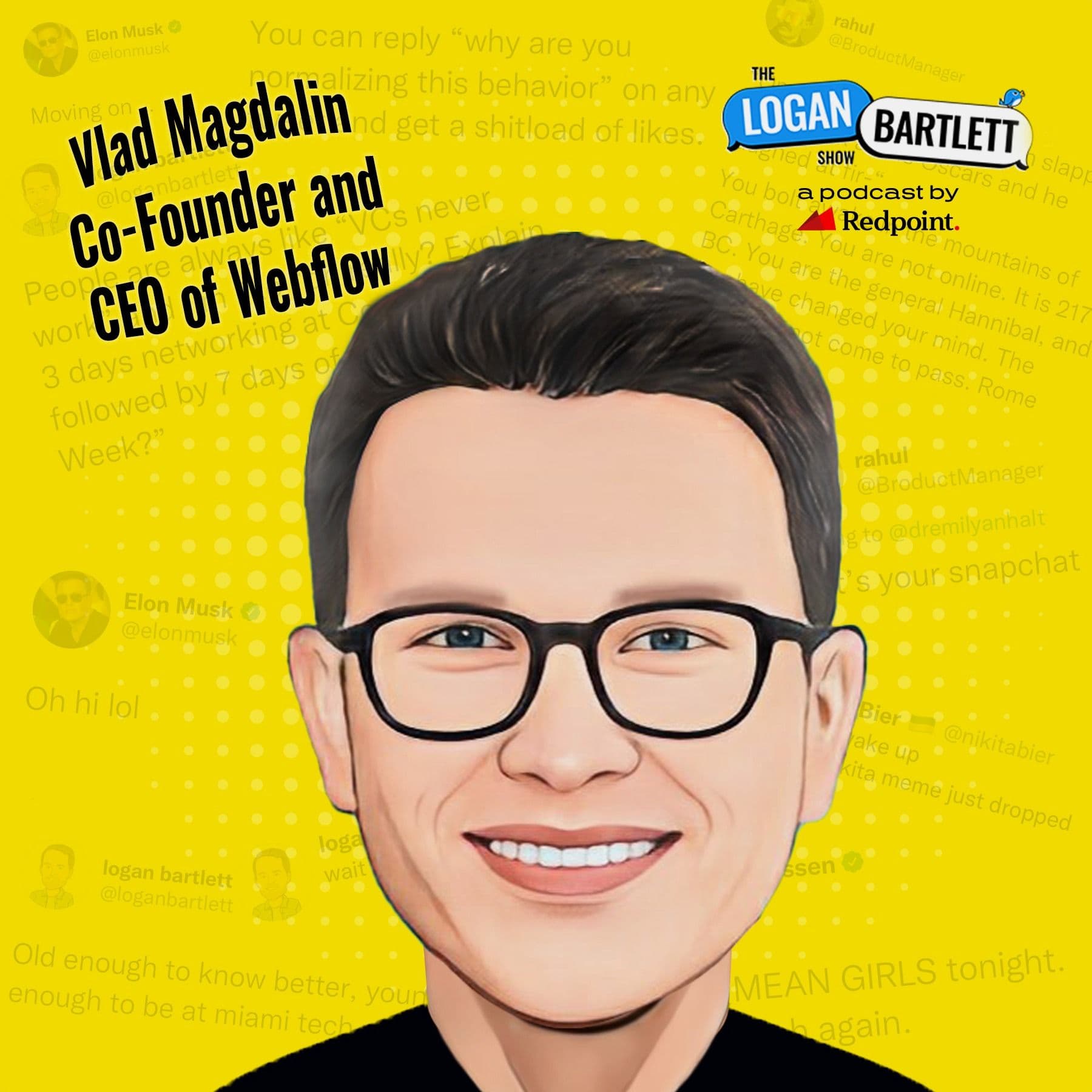
Podcast Summary: The Logan Bartlett Show - Episode 78 with Vlad Magdalin
Overview In Episode 78 of *The Logan Bartlett Show*, host Logan Bartlett interviews Vlad Magdalin, Co-Founder and CEO of Webflow, a no-code platform that has empowered over 3.5 million users to create websites and web applications. Vlad shares his journey from immigrating to the United States at age 9 from Russia, starting Webflow multiple times before its eventual success, and the values that guide his leadership and company philosophy.
Key Takeaways
- Personal Journey
- Immigration Experience: Vlad immigrated from Russia at age 9, and his family faced significant struggles, including welfare reliance and working low-wage jobs.
- Overcoming Challenges: His early experiences instilled a sense of gratitude and motivation, leading him to view life in the U.S. as an opportunity to make a meaningful impact.
- Founding Webflow
- Multiple Attempts: Vlad attempted to start Webflow four times before succeeding in 2012, learning valuable lessons from each failed attempt.
- Support and Community: The initial support from customers and the feedback loop established through community interactions played a crucial role in Webflow's development.
- Essentialism and Leadership
- Concept of Essentialism: Vlad emphasizes the importance of focusing on high-impact activities that align with personal and organizational values.
- Management Philosophy: He believes that effective management is learned, not innate, and emphasizes the need for honesty and care in delivering feedback to team members.
- Product Development and Market Fit
- Product Evolution: Webflow’s product roadmap has included significant milestones such as the interactions engine and CMS, which were vital for growth.
- Community Engagement: Vlad attributes a portion of Webflow's success to its engaged community of users who contribute feedback and content, reinforcing a supportive ecosystem.
- Funding and Capital Efficiency
- Raising Capital: Vlad discussed the strategic decision to delay fundraising until they were ready and assured of their revenue model, raising a $72 million Series A in 2019.
- Social Contract with Investors: He introduced a "social contract" for investors, promoting long-term thinking over short-term profit motivations.
- Pricing and Value Proposition
- Complex Pricing Structure: Vlad speaks about the challenges of pricing Webflow competitively while ensuring it reflects the value provided to users compared to traditional web development options.
- Customer Understanding: The importance of understanding customer pain points and articulating the value of Webflow’s platform is a continuous challenge and focus.
- Cultural Values
- Core Values vs. Core Behaviors: Vlad distinguishes between what companies claim to value and how those values manifest in day-to-day behaviors and decision-making.
- Team Dynamics: He emphasizes creating a workplace culture that allows for open communication and constructive feedback.
Pivotal Moments in the Conversation
- Personal Stories: Vlad shares heartfelt anecdotes about his upbringing, the struggles his family faced, and how that shaped his perspective on business and success.
- Webflow's Journey: He recounts the rollercoaster ride of launching Webflow, the feedback from early adopters, and the importance of iterating the product based on real user experiences.
- Vision for the Future: Vlad expresses a belief in the ongoing democratization of web development and the potential for tools like Webflow to empower a new generation of creators.
Conclusion This episode of *The Logan Bartlett Show* explores not only the entrepreneurial journey of Vlad Magdalin and Webflow but also the underlying principles of management, community building, and the balance between growth and sustainability in business. Vlad’s insights into leadership, customer engagement, and personal gratitude provide valuable lessons for aspiring entrepreneurs and seasoned business leaders alike.
Further Listening
- [The Logan Bartlett Show on Apple Podcasts](https://podcasts.apple.com/us/podcast/the-logan-bartlett-show/id1606770839)
- [The Logan Bartlett Show on Spotify](https://open.spotify.com/show/5WqBqDb4br3LlyVrdqOYYb?si=3076e6c1b5c94d63&nd=1)
- [Subscribe on YouTube](https://www.youtube.com/channel/UCugS0jD5IAdoqzjaNYzns7w?sub_confirmation=1)
Written by AI. May contain mistakes. Listen to the episode to check what was said.
Transcript
Automatic transcript. May contain errors.0:04Welcome to the Logan Bartlett Show. I am your host Logan Bartlett and what you're here on this episode of the conversation I had with Vlad Magdalene. Vlad is the co-founder and CEO of Webflow, the platform that has three and a half million users that helps people develop websites and web applications. Vlad has a really interesting story having immigrated from Russia at the age of nine, his family starting on welfare when they got to the United States, as well as cleaning dental offices with his parents throughout college. Vlad tried to start Webflow four separate times before ultimately succeeding in 2012.
0:39He went a long time without raising any venture capital, ultimately raising a$72 million Series A in 2019. He's taken a very interesting approach to working with investors, including making each of his investors sign a social contract that they will prioritize things different than just shareholder value as board members and investors in the business. A great conversation with Vlad about his journey to America, building a company that was a part of and helped inspire the no-code movement, as well as his values and why he's grateful for the opportunity to start this company in the United States.
1:17You'll hear that conversation with Vlad here now. Vlad, thanks for doing this. Thank you for having me. So there's this concept called essentialism and focusing on things that bring you energy. I know this is something that you think about and maybe have reoriented how you operate, how you spend your day. Can you talk a little bit about what essentialism is, and then also how you've, uh, how you've utilized it? Ooh. Um, interesting that you started with that. Cause I feel like I'm in a non-essentialist period right now where I sort of go in. Cause you're doing a podcast and this is a distraction.
1:51No, no, no. This is, this is off the time well spent. Uh, but just like the season that Webflow is in has sort of pulled me into some, you know, things that feel very essential. But if I was to like really dig down and say, you know, is this what I want to be doing like every single hour of my life? There's a lot of, you know, preparing for a conference. And there's a dichotomy, I guess, from an essentialism between what the company needs and you as a CEO versus what you get energy from, I guess. Yeah. At the core of it is like constantly re-evaluating is the thing that I'm doing right now is the way that I'm spending my time, the most impactful for myself, for, you know, my family, my teammates, the company, and just really having that questioning mindset around, like, is this the most important work that I can be doing?
2:41Because our time on earth is limited. Have you changed, like, the types of people you hire to augment things that you don't want to do? Or have you ruthlessly prioritized things that kind of fall below the waterline? Like, How have you actually put it into action? I've created a lot of constraints where, especially people I work with very closely, like my chief of staff and executive assistant, where they're very ruthless around, is this something you should be committing to? Is this something that aligns with how you are prioritizing health, family, the long-term future of Webflow, et cetera?
3:15So it's almost like having a, like, no, you can't, kind of somebody hitting you with a ruler when you're like, oh, it would be fun to do this. and having that second opinion thing. Is that really? And sometimes just asking that question makes you immediately realize like, oh, actually I shouldn't be spending my time that way. Do you do like calendar audits or anything like that to sort of go back in time and see if you're actually - Every month, but like the way that calendars are these days, it's almost like a different exercise every month, right? Because as much as I want to create intentionality around like this is what my month is gonna look like three months from now, like at every stage of the company and every sort of like season of the month, like right now we're in this conference season, completely different than two months ago.
4:02So there's a, I actually live totally by my calendar. I don't even have a to-do list anymore. I used to try to like convert these things, but now my calendar is basically my entire to-do list, all my personal stuff, every reminder. And I have like an entire system with my EA that essentially, as time goes, I either like accept or decline whether I did things or not. And it's a silent communication method that like helps prioritize pretty much like every rolling thing. And there's like rules where if I decline something twice, meaning I didn't do it, that means it's not important enough. Right.
4:37So it's like comes off the list. How many people are Webflow currently? Webflow, something, I want to say 625, somewhere between 610 and 650. And so prior to Webflow, were you an individual contributor as an engineer? Totally an individual contributor. Either a freelancer working by myself or trying something, trying to start Webflow as a founder, as an IC. But my entire working life was either an intern or as an engineer or as a designer. And so leadership probably has elements that are innate in some way, but there's also things you can learn. And then managerial ability is something I think that's mostly learned.
5:23It's not like a natural skill set. I don't think anyone's a great natural manager unless, I don't know, maybe an army drill sergeant or something. But I never really thought of leadership as like a discrete skill. We're like, oh, I need to go learn leadership. It's almost always like, hey, somebody has an idea or they want to rally folks around a cause or a project or whatever. And then it sort of organically evolves. Management is the thing that you quickly realize, holy cow, this is a skill that takes work and takes sort of understanding how other people do it to see what works, what doesn't at different scales.
6:02I think that's been the hardest sort of like phases of adjustment to learn how even management itself is a completely different beast depending on, you know, the size of the team, the sort of like seniority of team members. Like if you're managing individual contributors, it's a lot easier than, or it's a different skill set than managing managers of ICs and then managing directors who manage managers who manage ICs, a whole different ballgame, right? How did you learn about that development process? I know you have a coach that you work with. You have a set of board mentors, I assume. I mean, this is like a combination of, I think, how most founders learn about this stuff.
6:48A combination of coaches, peers, other founders that are slightly ahead of the curve or a couple years ahead of where we were. Literally blogs. and YouTube videos around TED Talks that talk about great management, the HBR articles. It was like new inputs every situation. The first time you have a performance management conversation, you try to learn the best practices. You learn how to give feedback through specific workshops because you just realize you suck at that. And I think over the last 10 years, It's a combination of all of these things sort of like compounding. And it's a lot of trial and error, right?
7:35So things that work in the abstract, you read a book on management, like a lot, you know, you might walk away feeling pretty inspired. And then the first situation that, you know, a hard situation that you face, it's like, all right, well, that stuff goes out the window. Because in reality, it's, you know, some aspect is totally different. And a lot of it, I think you just learn through practice. What was unintuitive about the developing into a manager process? It sounds like there was a bunch of different inputs that influenced you, but what were the hardest learnings or the things that were not obvious?
8:13I don't know if I would qualify this as unintuitive, but I think the hardest learning for me or the biggest transition was to go from like this sort of individualistic understanding of kindness towards a single person to what I would call like the aggregate of kindness to a broader set of people. So one example of that is early on in my management journey, it'd be pretty hard to have a conversation with an individual that you really care about, right, that clearly is trying and, you know, wants to be successful and you want to set them up for success. And delivering pretty hard feedback, you would kind of want to protect them from that, right?
8:55Because you think it's kinder to them and realizing over time what net effect that has, not only on potentially broader team members, but also on that person as well. And realizing that this like the scales of aggregate kindness, sometimes having something that feels unkind to a one individual might actually be the kindest thing you can do for a broader team. and ultimately in the business context might make the entire team more successful, therefore making this person ultimately more successful, even if they, or like their stake in a company more successful, right? And to give an example, I guess, would be something like, hey, you've decided this person probably isn't gonna make it long-term.
9:40And so rather than saying, hey, let them stay in the seat for six more months and then we'll have that conversation at that point, it might be better to have that conversation now. You've already made up your mind, Have that conversation now. And then the aggregate for the company would be, hey, there's someone that's actually could come into that seat that's going to be better than the individual. Yeah, that's the more extreme example. But the more nuanced one are things like you want to see this person grow into the next role, like become a director, for example, or become a manager. But you believe that it's going to take them, you know, a year or two.
10:15and you're too afraid to tell them that path might be closed off for you because I believe bringing in more experience sooner is actually better off for the company and the team in the shorter term. So that's a more nuanced one because they're not really doing a bad job at their current role, but they might have ambitions that they're working towards that just their individual readiness and the company's readiness or needs at a given time misalign in terms of time, right? And you kind of, you want to give them that shot. You want to give them the opportunity, but you also realize, you know, it could put them into a position of failure or put the company into a position or the team in a position of, you know, not doing as well as if you were to like bring in additional help or, you know, put somebody else in that position.
11:05Motivating people is something that you have to do as a leader. And there's a book by Daniel Pink called Drive that I've read. I know you have as well. What were some of the things that you took away from that, or what were the learnings that might be interesting to hear for people that you've actually applied into Webflow and leadership? I mean, the three key pillars there are autonomy, mastery, and purpose. Like people want to feel like they are in control of, you know, the work that they do day to day. And nobody likes feeling stale in like what they're learning or what they're sort of exploring, whether in their working life or personal life.
11:42But it's really like this last piece, the sense of purpose that I believe is the most, most important for broader motivation. Like, you know, we all have one life, right? And I don't believe in this concept that, you know, work has to fulfill like your entire sense of purpose or your passion or whatever. It is a, of course, you enjoy work a lot more when you feel like what you're doing actually contributes to other people in a very positive way. It makes other people's lives easier. So that sense of purpose is what I took away as the thing that we have to weave throughout everything we do. We have to make it clear why our work as a company, as individual teams, as individual team members, how that actually helps, whether it's our customers or our community, have a fundamentally different, better experience in their life.
12:33So they can say, what this company, what this team did for me is, you know, made my life better, made it easier. And that led to, that book actually led me to, I don't know if you've ever heard of The Infinite Game by Simon Sinek, where it's all about, you know, finding a just cause, which is essentially a shared purpose as a team. And one that actually brings 10 times more value to the world than it does to you as a team member. And that in itself is like such a fulfilling sense of experience, right? And, you know, a company just happens to be like a social vehicle for completing that purpose.
13:10and to me nothing because work is always going to be like have ebbs and flows of like stuff's hard or stuff is like through the roof exciting right or we're innovating or we're fixing bugs or we're like you know getting our servers from melting down that might not be the most exciting if everybody can see like what ultimately we're working towards like that sense of purpose overrides everything and I think there's like to autonomy itself I had a very sort of hardline definition understanding of it at first, even after Daniel Pink's book, where there's a way to understand it of like, you know, just empower me to do anything I want to do, right?
13:49But I think a very different way of looking at autonomy now is, I think of it as like, autonomy and alignment, where you want to make sure that you get on the same page with, you know, a team that you're working with, a person that you're working with, where you have like a shared vision and direction and perspective, and then like, go run with it, right? You have to solve this problem, or like you're empowered to solve this problem, versus like this, like really kind of hardline definition of autonomy of like, you know, just bring people onto a team and let them do whatever they want. Ultimately, it doesn't even serve that person, right?
14:24So there's a concept called the Friedman Doctrine, which is named after Milton Friedman, and basically says that if you all for shareholder value, everything else falls into place after that. Milton Friedman, I think, wrote an op-ed or something about it in 1970. I think most companies kind of follow that because you brought up Infinite Game, kind of bouncing around here. But my understanding is you reject that concept or it as an absolute. Can you talk a little bit about the Friedman doctrine and how you think about Infinite Game and how that fits in? I don't reject the concept altogether. I think it, you know, ultimately, if you solve for shareholder value, like in the in a perfect world, that would, you know, essentially solve for the needs of everyone else.
15:09Because, especially in today's construct of like tech companies, for example, your shareholders are your employees, sometimes they're your customers, a lot of it's not just investors. However, However, what I don't believe is, in practice, what happens, it's just like, you know, communism. You know, I came from a communist country where like in principle, great, it works on paper. But in reality, like human nature comes into play, right? And with the Friedman Doctrine, short-term incentives come into play. That when you're solely focused on shareholder value, that starts to potentially destroy all kinds of long-term value.
15:47So I think of it as like shareholder value plus plus, right? So the way the infinite game frames it is the most important thing is to find a just cause or a just mission that brings 10 times more value to the world. And second is prioritize real human beings and people in your business decisions. That doesn't mean like just people working at a company or your customers, but literally like are the things that you're doing as a company, you know, with the support of your shareholders, let's say damaging the environment or contributing to. some negative externality that starts to, might increase shareholder value, but might decrease the net value to the world.
16:31It's good for you, but it's not good for the real human beings that are impacted by the work that you do as a company. And only third is, the third responsibility is to generate revenue, specifically to do, not to make a bunch of investors richer or to return dividends, but to do the first two things for as long as possible to advance your just mission and to prioritize people in your business decisions. And I happen to believe just like some people believe in like trickle down economics. If you solve for those, those two things, like naturally you build a much more valuable thing for the world because you're making something that people really love and they're willing to pay for.
17:11And then that naturally creates a lot of, you know, makes the pie bigger that then you can like split however you want with whether it's shareholders, investors, or, you know, the typical shareholder value kind of like argument. So I think it, you know, I don't fully reject it because I think it has value and it does drive like the majority of capitalism. Right. But I do think that it's a shorter term point of view that sometimes like makes it easier to justify doing some like net harmful things. What is one of the nice elements of the Friedman doctrine is It gives you kind of a singular focus to solve for.
17:51And there's not competing constituencies or trade-offs that you need to do this three-dimensional math against, right? When you're solving for customers versus employees versus whoever else, right, Vlad as an individual versus your Excel and CAPG and Meritech and the folks that own some percentage of the company, how do you actually think about those tradeoffs? And what is the North Star? Do things have different weightings or do they blend to some, like, just gut instinct at the end of the day? I wouldn't call it gut instinct, but it's some informed instinct. And, you know, you can call it sort of grown intuition, right?
18:43And a lot of relationships with all of those parties that helps you make this kind of what is the kindest and best thing for the vast majority of all constituents. It almost never ends up in a situation where you're like not hurting some or benefiting some person less than another. So there's always nuance. And it's always like at the end of the day, some sort of gut call. but it's a but I think even something as clear as the Friedman Doctrine still has a lot of nuance to it right because like there's different types of shareholders and etc so you still have those same dynamics the things that helped us in or helped me make decisions in this sort of trifecta of you know investors shareholders employees customers kind of our community the environment is trying to align as possible, like people coming into the fold, like who we partner with, right?
19:44A, we talk about this a lot in terms of like leaders that come into the company. Whenever I interview execs, like I want to make sure they're really aligned with like this longer term perspective, like what's important for them, like they should want to care about this stuff. And when we pick investors, I actually have this social contract that they sign that actually, that we mutually sign. I call it investing on principle based on this like video that inspired Webflow called Inventing on Principle. But that specifically says that we're like this partnership is meant to be long-term oriented.
20:23There are going to be trade-offs that will feel like as a direct VC shareholder, you might see trade-offs that are like, don't feel like totally in your favor. and that turns a lot of people off initially, right? That doesn't lead to further like partnership conversations, but for the partners that we've brought on, there's been like this long-term alignment around, even if it's not a perfect rule that we always solve for X, that there's a more holistic sort of consideration around what's most important in the long-term. Did you have investors actually disqualify themselves from, hey, no, I want to be focused only on shareholder value at some point?
21:03It was never as explicit as that, but that, which, by the way, lots of credit goes to Arun at Excel because I was really hesitant to go the VC route. This was like many years into the life of the company. And we developed this contract together that then served as the basis of all new relationships. What usually happens is there's like a lot of excitement from investors, like potential new investors sort of like, you know, reaching out. And then literally before the first conversation, I will share this like, hey, this is really important for me. Just so you know, like where how I think about investor type of partnerships.
21:45And you can usually tell with like, you know, there's like it was nice to chat or whatever. Like maybe let's connect next year or whatever. You could just tell that it didn't resonate. Which just saves everybody a lot of time. Totally. There's never been like a, I'm going to fight for shareholder value. I think you're wrong. I think it's just like a philosophical, people can see like culturally. So you have a core set of behaviors and not core values. Can you talk about the distinction between the two? Yeah, that was honestly something we stole from, stole or got heavily inspired by Patreon in the early days.
22:22And the distinction is very, like values are things that you can say you value, but then behave completely differently. Behaviors are like the values lived out in practice. Yeah, the manifestation of the values. Yeah, you can say that you value, you know, customers, et cetera. It really only shows up when you act on those values and how you behave when, you know, no one's looking, et cetera. So that's just like a slight terminology shift, but for us really meaningful because it's even in the way you think about it is like, okay, am I behaving in a way that like if somebody was observing this, would they say I am behaving in a way that demonstrates that I value this thing?
23:06And what are your core behaviors? We obsess over customer experience, which means that everyone in the company is expected to not just assume that there's something that customers want, but live and breathe their experience. We move with heartfelt urgency. Like heartfelt means, and we went through multiple iterations of this one. that's where we landed, is having the sense of dreaming big and really understanding why we're building the thing that we're building, but also seeing the value that comes with getting something to our users' hands or to our team members' hands, like helping out somebody faster.
23:46Like that, it's not meant to, you know, often urgency is translated as like you're working day and night. For us, it's like, it actually has a lot of elements of essentialism, inspiration, like constantly question whether the way that we're spending our time is on the most important thing and constantly question whether the way that we're working and what we're doing is the most important thing. And can we do what we want to do in less time? The hardest one for us, also the word hard in it, is say the hard thing with care, which is kind of like a rebranding of Radical Candor. But that is, you know, what I mentioned earlier, one of my hardest kind of management growth journeys have been like, how do you get to the truth of the matter?
24:32How do you build the best possible company and product and team and innovate like hell if you are afraid to tell each other what a better idea might be or why something might not be its best version, etc. That one has been probably the hardest for people to transition from, you know, we used to have a core behavior called practice extraordinary kindness. And that one was like heavily translated as like, don't do anything unkind, right? And this is, this core behavior is one where we like rallied as a team or like, how do we come together to make sure that we can get to the best ideas and be able to do that with like a sense of humanity and feel like that the person who wants you to improve in a certain area or like show up differently, uh, is you feel that, that sense of care from them.
25:26You mentioned your, your second principle, uh, what move with heartfelt urgency, urgency, urgency, uh, once upon a time was move uncomfortably fast. Yeah. Yeah. And then it became move intentionally fast. Uh, and then, uh, we combined them with, uh, with another one. When you codify these behaviors, how do you think through the positive? There's two sides to every coin and any decision you make is going to have some negative downstream implications around it. How do you go about actually making these decisions? Well, one thing I learned is that there's a lot of, you're never going to have it perfect, right?
26:02You're not going to put things on a wall or in a dock or in your onboarding that is going to like drive the behavior of the company, right? So there's a lot of nuance to all of these. And we try not to overthink it anymore, right? Like where now it's more around like, how do you give a lot more examples? So one thing we do is we have this ritual around giving props and sharing gratitude, and they're usually framed around core behaviors. And through examples, you see, like, what's celebrated and what's encouraged and what's discouraged. And that is instead of, like, trying to wordsmith or change these even more, right now, our last one that I didn't mention earlier is make your mark, right, which sometimes could get translated by some people.
26:48is like, oh, as long as I make my mark individually, everything else can, you know, if I am seen as like the savior, like the hero to like, you know, bring our servers back online or something like that, then that's the most important. It could be perceived as individualistic, right? So instead of trying to version it and adding, like make your mark and work as a team or whatever, we just, when we see sort of a different translation of it in practice where people start to celebrate, different things that don't feel like in the ethos of what we're trying to encourage here, which is also kind of making your mark as a team member, not just in this individualistic sense.
27:27We just work our way through just talking about that. Like, hey, it doesn't actually mean this, it means that. So just by giving, we have this internal kind of living doc that gives a bunch of examples and counterexamples of these behaviors in action. And sometimes when we see a lot of like repeated uh sort of uh you know like in that previous sense people start to weaponize is a very strong term but sometimes uh start to like um say things like oh i'm just uh trying to say the hard thing uh trying to say the hard thing with care whatever just to justify you know like sometimes being an asshole right and just just saying things without a level of care um you like those make it as like examples that we talk about.
Read the full transcript
28:10And a lot of behavioral norms emerge outside of these things that you might have codified that require different sort of application or a different approach to shaping the culture that you want as a team. I get the feeling your culture, you're very thoughtful and purposeful about it. We've seen over the course of the last, I don't know, two years, 18 months, We've seen examples of, I think, most notably Coinbase and Shopify saying, hey, we're going to keep certain elements of stuff out of the workforce. And I don't know if there's a spectrum, but I get the feeling you're more or much more on the side of like bringing your whole self to work.
28:55I don't want to put words in your mouth in there. But how do you think about like the tradeoffs that come as we live in a world of social issues coming up all the time and how that fits into your cultural values and keeping some semblance of slack normalcy and like the ability to do work and not debate, you know, the latest Supreme Court decision? Thankfully, we haven't had to move into like mandate territory, like the examples you cited. But we are closer to, you know, in living to our success over customer experience, like that is, you know, our mission to bring development superpowers to people.
29:37Like that's what we're all about. Our just cause as a company is to empower so many more people to capture the economic and creative power of the Internet, right? Like that's our unique advantage in the world. And over the last three years, we definitely have gone to where like, I don't even remember the last sort of more broadly social conversation we've had internally as a company. And that just happens organically, not by banning certain things, but by just like celebrating and focusing our attention on the things that collectively unite us. We have a worldwide team across so many different countries and cultures that has in the past created a lot of friction when folks expected the entire company to have a specific position on something that is in many ways untenable.
30:29You can't make everyone happy in that sense. It's not a scalable application of a company as a social construct. That said, we have been more progressive on making decisions around who we do business with or not and creating frameworks around where we'll go actually seek business and where we'll actually do things that we don't want to be associated with. But we also have like a lot of nuance where like, you know, a lot of politicians that we disagree with, for example, will host their stuff on Webflow. And we want to have a very principled stance on even when we disagree, as long as they're not breaking, you know, our direct policies, we want to make sure like we're applying the same exact rules to everyone.
31:20And that's been a, again, not directly intentional focus, but it's when people are focused on a single mission, that just organically starts to show that that is the context of us working together. That said, we don't want to stop anyone from being a full person at work. Just the expectation is not that the entire company will become sort of a representation of kind of distinct values that an individual might hold. I mean, I guess you guys sit in an interesting point in an ecosystem, probably similar to Stripe or Amazon Web Services, that you need to make some decisions about who you're going to do business with, with bigger implications.
32:07I mean, you're actually the hosting framework that they're actually developing this stuff on. And so have you come up with some doctrine that everyone has? And we'll do business with XYZ politicians, but if they cross a line into QRS, that's just not something we want to work with? Yeah, it's essentially public. We've made it public in our terms of service. We actually base it on content versus individuals, right? So an individual might hold a view that they're talking about somewhere else. But as long as we're not amplifying content, that it breaks our policies, whether it's, I mean, there's the whole range of things that we prohibit on our platform.
32:53And we make very principled decisions around, like, does this content break the policies that they agree to? If it does, we take down that content. But we're not quite in a Cloudflare-like position where it's like infrastructure. We, you know, there is a lot of nuance to deciding on that policy. But I think we've come up with a pretty reasonable one where broadly the content that's published on Webflow is not going to be like hurting like broad populations or sending a lot of misinformation out there. You have an interesting philosophy around compensation. You might have to remind me. Once upon a time, I had heard you say that if you're going to be in the 75th percentile of a band for engineers, you're also going to hold consistent that for HR and salespeople and marketing and not prioritize, hey, we're going to have world class.
33:56We're going to pay 99th percentile for engineering, but our HR department, we're going to pay, you know, whatever, 25th percentile, I guess. Is that still consistent? That is still consistent broadly in the sense that we just don't want to treat anyone as a second class citizen or basically divide the company into different tiers of importance. That doesn't necessarily mean that specialized roles aren't going to be well differentiated between roles that are easier to find talent for and those that are harder. So, for example, you know, engineering talent that is somebody that is really, really experienced in AI, for example, where we're not going to we're not going to say like everything needs to fit into this like one software engineering band, because otherwise, like you would not be able to get that type of talent at all.
34:56nor does it make sense from a business or fairness or like any sort of perspective to just say well if like everyone gets paid exactly the same thing regardless of just by virtue of a job title so I mean this is one of those things that I think when I might have referenced that that was also before we expanded internationally where that adds a lot of nuance right like when you have to like create entities across many different countries and figure out sort of the norms and expectations and regulations across many different options taxation yeah then you start to get into things that were like worldwide hardline principles around for example everyone gets the same amount of equity wherever you happen to live in the world that might land completely differently in some countries it's actually a negative because it's like so heavily taxed and other countries is completely not valued and in other countries it's uh you know you need to have like way differentiated sort of bands to attract talent in in that area so this is kind of a ever-evolving um you know space but ultimately i think it's a um from that daniel pink drive perspective um compensation is one of those things that you have to make sure you're like people aren't thinking about all the time, but it's not in the top three list of the things that are like the reasons people join our company, for example, and most companies, I think.
36:29Yeah. And it becomes an issue when people think that they're not treated fairly. That's right. People lose their mind no matter how much people make, how much, how little, like fairness is the single thing. And so at least having some level of principles around it. What about, so have you guys been hybrid-ish from the start? Is that a fair characterization? Yeah, we've been, I would say, 90%, 85 % to 90 % remote from the beginning, kind of by necessity initially, because the three of us, the three co-founders were in the Bay Area, but in different places. And then the first person we hired was Sacramento.
37:07The second person we hired was Finland. And then like Europe, and in the East Coast. But we still had decided to get an office here. So it had like this, you know, central base where people could travel, et cetera. Now we're probably like 95 % remote, moving closer to like full, just because the size of the company where we've hired has gone more and more. I wouldn't even call it hybrid because it's the people that do make it into the office sometimes or in a physical location, they're like calling in from Zoom, just like everybody else. And there's actually way more time spent in person on company offsites or team offsites, which we heavily encourage and fund, than in the one office that we have here in San Francisco.
37:55Cisco. The tactics of executing on remote. So I think you guys do the thing where everyone needs to be on Zoom. You can't do shared meetings together, even if we're in the same room. We're going to go to our own rooms and take the Zoom so everyone feels like an equal first-class citizen around this. Yeah, that's a... I don't think we've ever made that a hard requirement. We've always like encouraged it. It sort of became culturally normal, but that's what was expected because everyone could see that it was like really awkward for three people to be in a room and one to be remote or most often two people to be in a room and like 10 being remote.
38:35Right. And those two people having like a side conversation that the people on Zoom are like, what is this? I mean, this is like, you know, five years ago. Right now, it's we have the vast, vast majority of people that even if you're in an office, you're you don't have that many people around you. So you're like dialing in. I can't think of a situation where when there was the last time where we had kind of the need to like enforce this or like remind somebody that it's like more inclusive to to just have everyone kind of represented the same. There's a lot of accidentally hybrid companies now that sort of COVID let the genie out of the bottle and came back in.
39:18What are some of the other things, and maybe it's hard to think of just because you've been a fish in water for so long, and so you don't totally appreciate that what's normal. But are there other things that you would say to CEOs, founders, executives of companies that have found themselves now in a more hybrid world and they didn't want to end up there, but COVID happened and they hire people all over and now they're trying to figure out how to make it work? Are there any other tactics that you guys have done that might be unique or interesting? I think the biggest one is it's less, I guess it is a tactic, is having some sort of structured way for people to, and teams to feel like they can get together.
40:01Whether it's for planning or even sometimes, we used to do just purely social off-sites as well. And now we try to mix them to where, you know, there's social time, but it's like focused on something work-related. that has been the biggest unlock in terms of getting that sense of like camaraderie and human connection and honestly like sometimes you get you you do in one week you make way more progress especially when when it's like higher level thinking or like planning or sort of planning innovation or just brainstorming that is probably the biggest delta in terms of if you're not if you're trying to stay hybrid or fully remote and not having something like that, I just don't, like, I can't see looking back on the last 10 years, how we would have as much connection or as much like camaraderie or teamwork.
40:52Take me through how that actually works. So the marketing team wants to plan for 2024. And is there a set budget aside? Like, how does this actually work? There's basically a yearly budget for each person that can be used in any different way. By the manager decides how it works. Well, it's actually company-wide. We have a system where it's because a lot of people on cross-functional teams. So you might have a product team that is like a product manager and like five engineers and a designer and maybe a data person. Right. And maybe a PMM or product marketing manager is supporting them, like planning this big release.
41:25Right. and the usually they can like that whoever is like the lead driver usually the pm we can just see like how much budget is available across all these folks whether they're essentially and it's not hard line right like you can our ops team helps like understand whether like that that person's like way over budget or whatever and they just you You know, there's a process for finding, you know, whether a hotel or Airbnb or coming to our office for like a basically what we call an onside day or set of days. And, you know, there's some like light approval process. We kind of had to put in some rules around like, yeah, don't go to, you know, the Bahamas, even if it's cheaper, just because like optically that doesn't always look great.
42:14But there's a pretty standard process around it. It gets more complicated the larger the team is. So for example, if it's the entire marketing team or the entire engineering team, typically that doesn't happen unless we do like all company retreat, which we only we used to do them every year, but we've only done one after the pandemic. So last year trying to decide what to do next as the team has gotten bigger. But what will happen is instead of an all team like a, you know, an exec will get all of their direct reports and kind of like their first team into into an offsite. And then each of those people will decide independently, do they need to do like a separate offsite for their sub teams, et cetera.
42:56The other thing, I think we're not super great at this yet, but like where because we are mostly remote, sometimes in person, a lot of offsites, we need to get much better, like centralized documentation, almost like the GitLab style. like everything is transparent, everything is visible. Like that's one area where we've been like diving into more, like can we do a lot better on that front so that everyone in the company, potentially even externally, can sort of like see how we operate. And I know, you know, Zapier and GitLab have like set a lot of great examples there. We're sort of in the middle between somebody who's like newly hybrid, who kind of had to be, and kind of where those companies are.
43:44Do you give guidance of how often teams should get together? Like, should people on a team try to see their direct reports once a year, once a six months, or is it not? Our current guidance is somewhere between quarterly and every half. And it depends on how often that happens. Like, some people will see each other quarterly because you might have a team that's, like, in the same time zone and, like, travel is cheaper. and they just have like norms where they've figured out ways to get together without like disrupting other dependencies and others who might go on like one offset a year. All right, I want to go to the early days of Webflow.
44:23You tried to start Webflow in 2005, 7, 8, and then finally in 2012. Were they the same idea the entire time? Exact same idea, exact same name. I wouldn't say exact same idea. It had like, you know, it shifted from, you know, it shifted with the times, right? I didn't know about responsive design and browsers weren't such a big, you know, not a lot of things were built in the browser in 2005. It was sort of like more back-end-y oriented, but it was the same exact idea of how do you make software and website creation much easier. Is there a version of Webflow that could have worked in any of those prior iterations or was 2012 like the first time that it actually could have?
45:06I think each of those could have worked. Like the 2005 version was actually what Heroku wanted to be. They sort of like built the infrastructure, but they had aspects of a visual builder that I think would have been. And then at that time, like the things like Dreamweaver were already kind of dropping off, but you could see that there's a lot of market opportunity there. And if we had enough, you know, enough will and innovation horsepower, we like it could have been, could have been huge. I think 2007, 2008, I didn't have enough confidence in myself. Like 2008, actually 2007, I think Weebly was just coming out where we're like, oh, the idea is close enough to it, but not quite.
45:56I imagine that they would pivot into that space. And at the time, I didn't think it could be, I thought they had won the market. but the 2008 iteration I think could have been huge right that was the age of web 2.0 like AJAX was emerging you know you had like a lot of a lot of companies that were like realizing the potential of what you could do on the web you still didn't have the maturity of web browsers as a web platform. Things like Safari, Chrome, kind of like dev tools and programmatic access to sort of browser APIs were like really immature. So you would have still had to build it more on the back end, but we could have sort of augmented that with more front end tools.
46:46I've talked to entrepreneurs that their first idea didn't succeed. I don't know if I've ever spoken to an entrepreneur that had the same idea and tried four different times. What did you learn about like entrepreneurship from the three times that it didn't work. Like, were you all in or was the 2012, I know you had to go into credit card debt. You sold your car and leased and did all these things that were like 100 % committed to it. Were you all in at each of those prior points? I felt all in at various aspects. So the first time in 2005, I felt all in. Like I went into, just to buy the domain name.
47:22Like I thought it was, I couldn't believe it was even on sale. It was like, yeah, It was one of those dot-com sort of crashes that was a big company. I think like Eric Schmidt was one of the executives there. And I like leveraged all the debt I had to get that name that I paid off maybe like six years later. The second and then I thought like even the money I don't have I'm willing to put into this. I work like day and night on it. But when it, and then it sort of tapered off because it's not that I stopped believing. It's just like life took over, right? I got married. I had to like get a job.
48:01I wasn't making any money. I had to quote unquote provide. Spouses don't like that. Not making money thing. And different factors like led to sort of temporary demotivation at different times, right? like the third time in 2008, it was like a trademark lawsuit and just running out of money that was like, okay, I have like bills to pay for, I have a family. It's not worth like leveraging everything to chase like, you know, and I was so attached to the name, like irrationally attached to the name. I'm like, at some point, I thought I'd rather not have a company than just name a company. Like we had all these iterations for like really silly names that would have been replacements.
48:49And I sort of got like demotivated that way. But in the back of my mind, I was always thinking that, you know, this is something I have to try before I die. But honestly, I did kind of give up from that 2008 to 2011 era, where, you know, I had two kids in that time. I, you know, had a pretty stable job at Intuit. And I had just come to terms with, all right, this is sort of like move past. The industry has moved past the opportunity is, it's too late, right? It's too late to start something here. And there was like this series of totally random and fortuitous events that like re-energized me like, okay, the universe is telling me I have to do this.
49:36Well, and so what were the big, I know the IP lawsuit was dropped. You had a random thing in the mail saying, hey, by the way, Webflow's name, you can now go with. The short story there is we had applied for a trademark. This other company in Florida was like, you can't use it. And we're like cease and desist, essentially. And I totally forgot about it. And then four years later, I had moved like two or three times at that point, like an actual trademark certificate arrives. Like, all right, this has to, after I already gotten a rejection, like a formal rejection that, you know, your application is denied.
50:09with the USPTO or whatever. So that was like, okay, you know, I like brought it to my wife. The universe is telling me. Yeah, what is this? But even that wasn't enough. It was like that, I think like four or five months later, I saw this video, Inventing on Principle, which is like literally the next morning, I called my boss and said, I'm going to be leaving because it was so, it was shared at the exact, exactly the right time. It had, it's like this conference talk about visual direct manipulation, basically doing visually what you can do with code. We'll link it in the show notes. Absolutely life-changing talk.
50:44Like I think multiple companies have been started because of it, Figma included. Like I know Dylan's a big fan. So that was like a clear sign that, and right at that time is when browsers started to become way more powerful. It was like Chrome 1.0, I think, where you could actually like go build something that now resembles Webflow and like responsive. So design became a thing. And you could already see that, like, you know, Weebly wasn't going in that direction. Squarespace wasn't going in that direction. And I could see this, like, massive opportunity. Even though Adobe was already playing in that space, it was like, all right, it's time to try again.
51:23And was your wife totally on board and like, hey, I don't want to be married to a version of you that doesn't at least try this? You've been talking about it for seven years. And was she encouraging? She was very encouraging, but it was a combination of like, I don't want you to resent yourself or me if this is something that you're going to look back on and say, I should have tried. The thing that helped with that is that we had, I think it was like three months of savings at that point because I sold all my Intuit stock, like whatever I had at that point. going to say, like, look, in three months, of course, we're going to get like revenue, we're going to do this Kickstarter.
52:00And we're going to be back to back to being able to kind of get income, etc. So that started, so we had like full buy in, and that started to get harder and harder, the like, the closer we got to running out of money, then totally running out of money, then like, going like heavily into debt. But it was a we still had a, we were always clear around like, okay, when do we call it? And it always felt like a partnership of like, okay, by this date, if we don't have any sort of traction, then I go back to get my job. Was there some quantifiable metric that you had of like any traction is a little...
52:39Yeah, initially it was, you know, the carrot was like, oh, if we get into YC, then it's like, you know, all up into the right after that, because we'll have some validation. Then we got, We applied, got rejected in like late 2012. Then had to like convince each other that it was, you know, we'll try for the next time, six months later. Each other at this time was your brother and one other co-founder? Yeah, this is my brother and my ex-co-worker from Intuit, Brian. And we'll try next time. But at that point, like next time was in March. So it went from, you know, rejection in November to March would be the next opportunity.
53:18but at that point the constraint became my brother where we were both like you know we're running out of money he's like I I need to he had just graduated he was dating his now wife and you know we're like where is this leading where we gave ourselves a deadline of the end of January 2013 to like build something and put it up on the web on like Reddit or Packer News or whatever and that was going to be our like milestone if if that doesn't get traction then we you know uh uh cut bait and you know run and that ended up being actually you know we we got close to that date we're like oh we're so close but we don't we're not ready to launch it and ended up being late february uh but um it was always like something we were like uh let's try this thing and see if if it takes off and you guys Because we're waiting for a big unlock.
54:10And I think for a company that has balanced growth and profitability and been cost conscious throughout your journey from a capital efficiency standpoint, in those days, you may be safe to say wasted some money on things that didn't work. Is that a fair characterization of the Kickstarter campaign, for example? Yeah, so many things. The first purchase I ever made with company funds, which was personal savings that went into a company bank account, was new laptops. Why do we need them? It totally felt like, hey, start a new thing. Might as well have the best of the best or whatever. And there was this Kickstarter campaign that took us two months and didn't pan out or into anything.
54:59Kickstarter doesn't take SaaS. Maybe they do today. Yeah, maybe they do today, but it was basically the vast majority of our remaining savings. And then we had some missteps later on because what happened was we were self-funded until YC and then we got a little bit of a seed round. And then we were like when that happened, we were still in the mindset of we're going to raise a Series A next year. We're going to do what, you know, the typical startup does. and that's when we invested into like this expensive sandwich video production which is like you know probably 20 of our fund funding at the time was it a marketing it was a marketing video to like launch our cms i think where it just it just felt like hey every startup is doing this and we're going to get a bunch of traction by by making this thing but it was the combination of that and seeing our, you know, our cash balance like drop and then not having enough traction to go raise a new round and getting like that kind of feedback from, you know, from investors that be like, you just don't have the numbers to raise more money.
56:04We just had to force ourselves into, all right, like we kind of have to, we have to be default alive no matter what. And that forces to make like different decisions and how fast we hired and how we actually like started monetizing much better and just focused on building a product that people bought and used and loved. And we sort of rode that wave for the next, I think, seven years before we did our actual Series A. Is the takeaway from that you were looking for silver bullets and it was actually lead bullets? You just needed to not think we're right around the corner from all these things working out.
56:43And instead, we need to assume this is the status quo and just keep chopping wood to get there. Almost all of these decisions were driven by irrational optimism. Like, we'll build this thing and they'll come. Or we'll do this thing and we'll get distribution. And 95 % of them didn't pan out that way, right? And the takeaway is like we just got a lot more, you know, by making more of these mistakes, more data that was like, we have to be more disciplined, right? These wild, uninformed bets don't lead to like easy money. Now you did have though, one thing that there was a Hacker News post or launch that went viral kind of pre-product and led to 50 ,000-ish people signing up or something.
57:31Can you take through like that one? That was the pre-YC when Sergi and Bryant and I set this deadline of end of January of like, we're running out of money. We're working on this demo. It's still online. It's called CSS Playground, playground.webflow.com, which essentially like the, we knew we didn't have enough time to build a full product, but it was like, let's just ship the UI part of it to show people like what this new visual abstraction of editing CSS and HTML would be. And that was our last ditch. Like, let's get this out into the world and show it's almost like a fancier marketing site.
58:09Like, what is it going to be if we have a chance to build the whole thing? And that's the thing that took off. And it took off in surprising ways because we initially wanted to post it. We posted on like designer news, which was a thing back then to Reddit, to dig, I think was still a thing. And all of them were duds. And then as a last ditch thing, we're like, all right, we'll put it up on Hacker News, which is like exactly the audience we thought was going to feel like threatened by the thing we're trying to create. Because you're abstracting away some of the work. a no-code tool, but because of the way that we, uh, the way it resonated, it was like, oh, actually we're like respecting the medium.
58:45Like we're actually creating almost like a visual programming language. Um, it, um, it took off like crazy. And we actually, there was one thing that we did that, um, uh, I think led to a lot of that. It's, uh, it wasn't purely the hacker news crowd. It was the fact that we put in on our marketing page at the time, like in order to get into the beta, you could increase your place in line if you were to share your referral link. And I think maybe 10 ,000 of the initial signups came in purely through Hacker News, but the remainder came in through these referral links because people were just giddy to get access to it first.
59:28And that was a huge vote of confidence. for us and for like, I think that's what eventually got us into YC to see that kind of traction. It turns out that out of those like 40 ,000 plus people, maybe 40 converted to paying users in the, you know, the initial launch that we did. So like the expectation and the reality of, you know, were those the right people or like people motivated to like actually use this product? But it was enough to give us like that. Validation and then YC cared. With those 40 customers, you did a bunch of not scalable things to make them work and make them happy, I guess.
1:00:10Instead of being focused on automation and perfection and all that, you were fairly handholdy with them. Can you talk through what some of those non-scalable things were? Yeah, this is almost not intentional, but initially came from a place of fear, to be honest, where we're like, whoa, 40 ,000 signups on a waiting list converting to like almost no one is using the product. But people who are, they're in there like eight hours a day. So we're like, all right, we can't lose this. We can't. There's something special here. So let's wrap our arms around them to at least understand what's working for them and keep improving their life.
1:00:48So we would, you know, it was just the three of us then. We were all, we created a forum. We were like in Skype calls. We were like maniacally trying to make sure that the things that those few users who were like in it every single day, like whatever was blocking them, we prioritized first to essentially make them see that we're like fanatical about improving the experience because we just didn't want to lose them. Were there shared commonalities between what they were liking in the product or were you kind of disparately solving different things? Thankfully, there were. So the overlap was the product was so limited initially, right?
1:01:29You literally build one single static page. So it was so limited in its use case. But the fact that the vast majority of those folks were designers or somehow designer oriented people that came from an environment where they had to rely on a developer to build, you know, pro like more pro websites, they had that commonality. Like everyone's like, I know the power of, you know, being able to build a site for a client and how much they're willing to pay. And now I can do that myself without relying on a developer. Like that for them was like deeply empowering. Like now they can make a living or at least start to like build a practice or make a living through this tool that otherwise would require them to go pay some developer, give them like Photoshop files and have them translate it to HTML and CSS and JavaScript.
1:02:17script. So it was that commonality. I'm building things for clients or I'm building like my own portfolio. So it was all within a surface area that was like broadly cohesive where we could pick out like, okay, this big thing is actually going to address 90 % of, you know, the folks here. Some people had like wild use cases that were like, yeah, we don't want to be there. Yeah, we want to, we want to solve it, but we don't want to like solve it at the expense of these 90 So it's three of you, you're using Skype calls. What are some of the like, non scalable things that you did beyond just talking to them and hearing their use case and prioritizing their problems?
1:02:57Is there anything that stands out or that you remember? It was like, Alright, this isn't going to work for a long time. But yeah, the thing that didn't feel scalable was, you know, every support ticket, because we were essentially doing support seven hours a day and like coding three hours a day or something. like that because there was just so much so much hand-holding through like the early um customer cohort then um what that created uh thankfully is that like those people then started supporting other people in the community like they'd get together like through a forum or whatever but that definitely didn't feel scalable the ceo responding to support tickets doesn't yeah at that point uh we were so there wasn't even this um Um, yeah.
1:03:37Everyone knew there was three guys in a garage basically working on this stuff. So there wasn't even a, like, I would expect you to respond to this because you just like released it to the world and it kind of sucks and it's buggy. So, of course, I would expect the people building it to be responding. But to us, it felt like it was months and months of like, okay, we're not building anything. Like we're understanding more about our customers, but we're also like so tired from like constantly doing support. And that's when we started to create more and more systems for like our community to be part of like that story.
1:04:11so that people can support each other and kind of build up ambassadors, build up people who are really passionate and knowledgeable about the product to be like that. I want to come back to the community because I think you guys have done that uniquely well. So you apply to YC. There's this big launch, 40 ,000, 50 ,000 people sign up. You have some path to paying customers and some sign that there's something people want. They call you and say you get accepted. and then they email you and you're rejected? Yeah, that was probably the biggest roller coaster. Because YC was going to be the validation of whether or not to keep going or not, right?
1:04:52Yeah, I mean, there's a, I don't know how much time we have for this story, but it was basically - Much time as you got. Yeah, we, you know, the three of us were so nervous after our interview. They're like, we thought we bombed it because there was an interviewer there, Kevin Hale, who had like started Wufu. It was like this form builder thing that he knew everything about web design, right? Because he was like a designer and he wasn't even on the website. And we go in and we get grilled by this guy who like knows the ins and outs of like WordPress, HTML, CSS, et cetera. And a YC interview at that time was how long?
1:05:2410 minutes. 10 minutes. Yeah. So you have Wufu, someone that's built form builders, understands like how web design actually works in 10 minutes grilling the three of you. Like with extreme precision and skepticism around like this is where, you know, have you thought about this we're like no have you um uh you know do you understand how like agency sort of monetization works uh so we we walked out feeling completely dejected like all right we we bombed this thing so just to pass time we go to watch this this movie uh oblivion tom cruise uh and that's when i get the phone call now and it's from uh paul bukite who's like the creator of Gmail.
1:06:03And he's like, you're, you're in, would you like to accept? No, of course. And we go back to watch, watch the movie. And I'm like, still, for whatever reason, like religiously checking my email, because they, they tell you, like, expect an email, if it's a rejection, or expect a phone call, if, if it's a, if they accept you. And this rejection comes through that says exactly what I would say if, you know, an investment opportunity like Webflow came along. It was like the product that you have is not sophisticated enough for pros like developers. And it's too hard for, you know, everyone else to figure out.
1:06:44Because Webflow is sort of, if you think of Squarespace and Wix, those are like iMovie, we're like After Effects or Final Cut Pro. It's like a super pro version that gives you the power, but it has a learning curve. And that is the most specific reason. Of course, that's the, like the rejection is the correct one. I think back to the conversation I just had over the phone, you know, not like 20 minutes ago. And it was very generic, like didn't even say Webflow, didn't, you know, call me by name. It was more like a, hey, you guys are in type of thing. And I immediately assumed that the phone call was a mistake.
1:07:16And we try to reach, you know, call Paul back, try to respond to the email. We don't get any responses back. And by the way at this time before we went in to watch the movie we called you know I called my wife and kids they're like got a restaurant and they're like already driving to like book a table um uh you know my brother Sergei's uh girlfriend was on the way and um co-founder Brian's girlfriend was also driving from San Francisco to Almeida so we're like you know excited we're gonna finish this movie gonna have a celebration dinner um and for two hours we don't hear anything back and um We're like calling our families saying like, hey.
1:07:54Did you guys step out of the movie? We stepped out of the movie. It was like I showed the guys the email and we're like, you know, we went from a leash. It's a good movie. It's not that good of a movie. Yeah, yeah, yeah. And Oblivion is kind of an oddly appropriate name for how we felt then. And it's already getting dark. So at that point we're like, well, we can't get in touch. Might as well just go try to drive to where we had the interview and see if somebody will open the door. And as we're driving, we get a phone call. This is like, hey, the email was a mistake. Did you ever get to the root of what happened?
1:08:31I mean, clearly someone was against you joining if it was that specific in the rejection, right? What I understand so far is that they had a pretty rudimentary process on a whiteboard. and once there's and it was sort of someone saw the wrong line that we're rejected and had to come up with a reason so it was sort of like they were responsible for writing the email so they came up with the reason because they were in the room etc so I think it wasn't just an honest mistake you know there was a part of me that thought initially that you know they were sort of kind of meant to reject us and then accepted us anyway because of the mistake.
1:09:16But I think ultimately what was described to me was just like, it was just a, you know, they changed their process after that to make it more like spreadsheet based or whatever. So now you joined YC, how big were cohorts at the time? This was the last batch, I think that was all together. So there were 45 companies. So it was Paul Graham still leading it? I think it was his last batch. Got it. So 40 companies all together. Across different office hours. So I think we were in four different groups. Got it. I believe, yeah. And so how long is YC? Two and a half months, three months. Two and a half, three months.
1:09:52And so you have this very ambitious roadmap of stuff that you're going to go after. And we want to build this perfect product. Because you know what good looks like, right? You were designer, CS. you know what you want to build. And the roadmap to get there was probably years, not weeks. What I thought back then, because I was thinking more as a client, because I did a lot of website sort of jobs for smaller businesses. And I was a web designer. So it's like, no way I would pay for something that only lets you build a single page or I can't do a blog. So in my mind, like the bare minimum was like, You have to match what WordPress has for anybody to be willing to pay for it.
1:10:36Because you know what good looks like. And so doing something less than that just feels unbecoming or not a real... It wasn't just unbecoming. It was like, I literally didn't believe in my heart of hearts that people would be willing to pay for a limited product. I thought people would just laugh at us because that's what I thought I would probably do if I saw a really limited product compared to what I'm used to as a web designer, being able to do in code or in Dreamweaver or whatever. So I really thought that like the bare minimum of product market fit that we would be able to like reasonably charge for had to have like all of this breadth.
1:11:10I think in my mind, I thought that, you know, we could build all that stuff in six months, you know, just given the momentum we had back then. But even with that momentum, it took us like almost two years to build what I imagine was like the bare minimum of wanting to charge for. And so YC actually threatened to kick you out for not shipping a product? Yes. One of the one of the we were like struggling with this, like, well, we're definitely not going to monetize because we just don't have we'll get users and we'll let them like play with what we have. But we're not actually going to add any sort of like paid plans because it's not good enough yet.
1:11:46And one of the partners, essentially, it was a visiting partner who was like, look, you if you don't actually charge for it, it means that people don't value it enough. that means you're not creating a good product. Like, so I, if you're actually going to demo day and you tell investors that you're afraid to charge for your product, it means that you believe it's not good enough, right? And A, you're not gonna have any traction to show them. And it felt, we felt enough of like, I don't know, fire in our bellies. I might as well do what YC says. Did they know, you know, they've sort of been around the block I can have seen companies make this mistake before.
1:12:30And it was absolutely the right call. Like it felt deep in our bones that we weren't ready for monetization. And the initial, like I initially had some, some of these sort of like regrets when we went from like 40 ,000 people to just, you know, a handful or like 40, 50, actually converting. You know, I was thinking to myself, well, that must be because we're like overcharging or we're charging for something that's not ready for prime time yet. But ultimately, that was the best decision because it like, A, it really elevated like who we should be listening to, like, you know, people who value what we had at the time enough that they're willing to pay for it.
1:13:08And it brought them so much, like seeing what they were actually able to build with it, even with what I imagine was like a limited product. because I was a developer and I could see how I could do, you know, Webflow plus development. You know, I sort of saw it as like a, well, it kind of empowers me a little bit, but not like, you know, to a 10x degree. When we saw that early cohort of users, they were like, this is a 100x superpower for me because I'm coming from being like creating a design and relying on somebody else to do it and paying, you know, if they're working with a client, usually like 90 % of the entire service fee to developers, because that was the hard part.
1:13:51For them, it was like life changing, right? Sometimes they were making thousands, tens of thousands of dollars for like sites and landing pages that they were selling, that they were paying Webflow like 20 bucks a month to develop on. At that point, the community started to get built out. And we touched on this a little bit earlier, but today you have a uniquely, I would say, fanatical or supportive community that's very passionate. And I'm sure that's mostly a good thing, but at times, you know, you probably - It's absolutely a great thing. Yeah. Yeah. Yeah. I'm sure there's some underbelly to it at points in time.
1:14:26How did you think about getting like that point in the journey where it went from Skype calls and you were just handholding, dealing with all the support tickets to the point that it was a little bit more scalable and there was some community there. And you mentioned, I forget if you call brand ambassadors or people that were doing first line support work and helping answer other people's questions and all that. Can you take us from that initial point to like when it became a little bit more automated? I don't think it ever became automated, but it definitely became organically more scalable through, especially that first year where we identified by spending a lot of time with like early users.
1:15:16We kind of by necessity, we knew we had to set up a forum. We had to set up a place where people could like ask questions and kind of document how they were doing things, et cetera. Like we had to by necessity say, hey, you know, we're not going to get back to your ticket for like 24 hours just because we're overwhelmed or whatever. But in the meantime, please check out the forum. And as we were talking to more and more people, like in these live sessions, we literally like asked them to like, can you can you also jump into the forum and help the thing that we just walked through? Can you maybe like create a video or tutorial?
1:15:53And that started creating a kind of organic flywheel where those people would do that once or twice and they would see the reaction to like thank you i was trying to figure this out um and that created a i don't know a different sense of purpose for them i think where they were um i think the thing that's unique about webflow as a product is that like it unlocks the ability for people to truly make a living right they go from um kind of being a not a cog in a machine but maybe part of a process to now like potentially driving the entire like creative creative and production process for them So when it was actually surprising to see that a lot of freelancers or people who were like learning this tool, who theoretically would be competing for the same clients, so enthusiastically jump into the forum and like offer to jump on a call and say, here's how I did this.
1:16:47Or here's how like I pitched this to my clients or here's how I built this layout or whatever. I think in that case, the sort of benefit to others and like this, you know, feeling of like I'm providing value, I'm supporting others, I'm like creating the sense of community, like won out over potential like fears of, okay, am I, you know, kind of disclosing that this is my secret weapon that feels like a secret weapon compared to what I had before. But it was honestly like more organic than like intentionally super structured. You were doing the Reddit thing that you were populating. Like in the early days of Reddit, I think they submitted like the first whatever every single day.
1:17:26I think it took like a couple of weeks before it was outside submitted. We did a little bit of that in our forum. Like we created some accounts that would like encourage other people. We have this thing where, hey, if you're if you are posting a site that you want some help on, but it's like read only links. So other people can go in, including us from a support perspective to see how they built something and say like, oh, hey, you got this wrong, et cetera. So we created some fake accounts where we just try to encourage the behavior of like, hey, can you please post your read-only link? So it wasn't just like us reminding.
1:18:02That sort of built a little bit of a norm that other people, like real people who would respond, would start with that. Even if they didn't know how to solve a problem, they'd be like first to jump in, which actually created the sense of like, hey, my problem's not solved yet, but somebody cares. Somebody is engaging in this thread, where usually like you post something in a forum and just like goes to die. So I think all those things combined kind of led to the sense of momentum that like self-reinforcing. We absolutely had to still like scale a support team and start to figure out how do we actually create like, you know, frontline support that doesn't just rely on community members.
1:18:41But the community relationships that started happening from that have like absolutely blossomed, right? Like people in competing agencies will like get together, you know, every few months or every year and like share tips around how to like leverage the platform or how to get clients. And that has just been like really awesome to see. And kind of this pay it forward mentality where you have like larger agencies who have like figured it out, creating programs for like freelancers to grow into agencies or like hiring from that community base. I think that's just been like probably Webflow's biggest superpower in that it's, I don't know, so much about the people.
1:19:25It's not just a tool. The lightning in the bottle element of the community, it sounds like that was very organic in how it came to be. If you're trying to get there or even capture a fraction of Webflow's community as another company or B2B or maybe just a founder, like what the lesson of all this is. Is there anything you can extrapolate from it? Or was it just such a unique moment in time that recreating it might just be survivorship bias? Well, I know that recreating it, especially in companies or products that actually have this direct correlation to income. So I think of WordPress, right?
1:20:09They have a massive community that we were inspired by. Shopify, Salesforce, through their Trailblazer program, Figma, et cetera, where you have, there are a lot of things you can learn. There are probably startups and sort of services or offerings or products that are not quite, they don't have, they're not conducive to, you know, community as a, whether support mechanism or distribution mechanism, because there's no, there's not much value to people supporting each other. So, like, I don't know, I'm just randomly thinking, like, pick a fast-growing startup, like Ramp. You know, we both love Ramp.
1:20:52Ramp uses Webflow, one of my favorite companies. I don't know if Ramp has a, you know, ambassador program. I'm sure they have, like, a referral program, but I don't know if there's, like, a huge community. Like, I'm not drawn to go, okay, what other companies are using Ramp? Let's go have Hangouts. And not a knock on Ramp, but it's... You think the distinction is that income element of like building your... It's like that income element or something is hard enough to learn that there is a group learning and group support dynamic that is required. So usually something that needs like training, like I think of UiPath, for example, big community, right?
1:21:31Because you, like it takes a while, anything that you might put on a resume and say like, this is a skill. Credential. Exactly. Like this is a certification or a set of experience that actually qualifies me for a certain type of like knowledge work or whatever. I think that is more conducive to community. And the other aspect to which like our community has been super powerful is not just the support aspect, but in this like customer driven way of seeing what's possible. because Webflow is in the category of tools that have a pretty low barrier to entry, but extremely high ceiling of what's possible.
1:22:09Because it's essentially an abstraction over HTML, CSS, JavaScript, databases, et cetera, the kinds of things you can create are so diverse that just by seeing what another community member has created can inspire like, oh, whoa, how did you do that? And we had, and still have all of these sort of like structured programs around how do you, we have this concept of clonables and like experts where you can showcase the things that you've built and then others can sort of like remix and copy paste or like clone those things and like build on top of them or just learn from how you did that. But just the fact of seeing, it's kind of like what's happening with AI right now, seeing what's possible, like inspires a, you know, okay, now that I know that this is a sort of tool in my toolbox, I can imagine doing this in a fundamentally, like I can now try to explore like the kind of possibilities of this medium or whatever, which was a pretty big factor in not just like that support angle, but people actually just being blown away of like, whoa, you did that and you did that in like a visual tool.
1:23:20Maybe I should check it out. Maybe I, you know, can like dive in and see what this is all about. As you think about product roadmap and development, is there a single archetype that you're solving for? How do you think about, like, you have the spectrum of customer size, you have the spectrum of user technical capabilities and all that. How do you think about the tradeoffs of product roadmap? It's a great question. And my answer would probably change year to year, right, because you, like, learn more. It's kind of whack-a-mole. Not quite whack-a-mole, thankfully, but it is such a diverse set of customers across business sizes, individuals, use cases, etc.
1:24:04What we found that is kind of most centering is to build at the intersection of where it benefits the most people, but that still benefits from defining a pretty concrete, like ideal customer profile that, you know, in our case, it happens to be companies that are getting towards a larger scale into like the corporate realm of, you know, 50 employees and up, maybe all the way to like 2000. that have, you know, they really value a professional website. Like it drives their entire funnel, right? And they have the need to express, they need the kind of customization that Webflow provides because it provides a similar level of customization as if you were coding, right?
1:24:52And that means that it's probably not the best solution for like a mom and pop shop to go like learn all of that complexity or learn how to build a super pro website. But a company at that stage is willing to pay for a service provider that might be an individual, right? That needs the same level of capabilities because they're ultimately serving that kind of company. So then all of a sudden you're like serving the needs of a individual freelancer or a small agency. But the ultimate goal is that they're building a pro website for a business that really values it and is willing to pay for not only the initial build cost, but the ongoing like maintenance and because it provides them a lot of business value.
1:25:34So that has like this really, even by focusing on that one ICP, it gives you a pretty wide halo effect, even into larger enterprises, because you might have, you know, like we're building for, let's say, a thousand person team and their needs. And then we're looking at something like, I don't know, Procter & Gamble, massive enterprise, right? they have such disparate requirements to try to rebuild their main website. But they have a bunch of subsidiaries like Pampers.com runs on Webflow because it's a smaller team, it's more in that size, and it introduces that concept of building completely differently into a much larger company, which then grows and spreads to other departments.
1:26:17So the vast majority of the things that we do, Even if we say, hey, there's this primary target, it has this very wide applicable surface area. There's still a lot of nuance in how you price this stuff when the willingness to pay for a company that's like 500 employees is so drastically different from a small business or a small startup that will be 500 employees three years from now, but is like two founders in a garage today. I want to talk about pricing in a second. But one of the things like a feature of your product is graduation, right? And the negative term for it would be churn. But has it been hard at different points in time to say, hey, we have this customer and they've grown up with us.
1:27:06And now they're at a scale where they're going to go do something else. Like, I assume now you've come to peace with like, that's actually a feature and we'll go get a different department within them. But did you ever feel the pull of like, well, if we reprioritize our product roadmap, then we could keep them around for longer? Or is that just that long term focus that you do? Inevitably, people will graduate and therefore we just need to keep focusing on that ICP. The graduation for us has become less and less of an issue, the more powerful the platform has become. So it's usually there's a lot more friction on initial adoption, especially with enterprises, when they're coming from a much more complex platform like Adobe Experience Manager or something like that.
1:27:53So that is much more of a you lose a lot more people on the way in to convince them that you can actually replatform and have the vast majority of the benefits that they have in the other platform. But in the areas that really matter where we differentiate, which is like visual development, you can move 10 times faster. Marketing totally owns the production of the website without relying on engineering. Engineering actually loves it because they get to go work on the hard parts of the product, which is like where innovation lives anyway. And once you get them, websites don't change so dramatically, even at these like fast growing companies that you grow out of what's possible, right?
1:28:33Given the flexibility that we have in the platform right now, because even if we might not have a specific feature, we have all these escape hatches with our developer ecosystem, with custom code, with different ways through plugins and extensions to augment that power.
1:28:51Historically, the tougher churn has been more on the, you know, somebody comes in, tries to learn or tries to start a business as a freelancer and kind of struggles to get clients. Right. And then they, you know, kind of fall off or try to come back or they don't don't make enough to make a living. And they, you know, start to do this on the side or whatever. That is a much more, you know, historically has been more of a challenge than a graduation. And I think the but there is a to answer your like, I guess the last question was there were times in the life of the company. I think it was 2015 where we got this opportunity to work with Under Armour.
1:29:31They were our first biggest enterprise customer. And we were like, anything they ask for, let's just build it. We just don't want anything to get the deal done. And we pretty quickly learned that companies at that scale have such wildly different needs that something that works for them doesn't work for 99 % of our customer base. So we just had to deprioritize that opportunity. You touched on something earlier about once there's this tension, Adobe Experience Manager, much more complex products, that there's elements. Increasingly, it sounds like you can do the same with Webflow as you can. But certainly in the early days, probably, there were lack of features or capabilities that you didn't have.
1:30:19But that it was actually, engineers were ultimately relieved to not have to empower the marketing department. It's an interesting tangent or, I don't know, allegory or example for AI. And the debate of, hey, there were definitely people that the whole job was probably centered around managing Adobe Experience Manager within these big enterprises, right? and web flow comes in and they say uh well no i don't want to do it because we can't do these features and uh but ultimately they they found their way to being more empowered because they could go work on more impactful uh interesting problems than that how do you think about uh that i guess as it relates artificial intelligence and i know you're you're embedding ai into your product as well.
1:31:17Is that a fair analogy in your mind? Yeah, I think the historically, what I've seen, there's like, the fears of that kind of displacement. And I know AI could be a whole different level. But historically, like the fears of that kind of technological displacement have actually paradoxically led to more opportunity than displacement of certain skills. So, you know, I think of Webflow itself, when we first launched, a lot, there are a lot of people who are just like doing purely Photoshop to HTML and CSS translation, right? They're mostly coders. And none of those coders lost jobs, right? They're just like coding more complex things.
1:32:01They learn jQuery, they do front end stuff. Sure, like they might have, might have had to like retool to where they can't run a business anymore, like give me a Photoshop file and translate it. But it broadly led to way more opportunity, including for those folks who might have been displaced. I think it may be a different story for AI in general, right? There might be some roles that are overly manual today that could be more or less fully automated, especially around the things that are so directly aligned to large language models. You know, literally had people like Mechanical Turk style summarizing things that might not be viable anymore.
1:32:49But to me, it still feels like a bicycle for the mind type of situation where the vast majority of the time, the added benefit of this new assistive technology actually creates a lot more avenues for new knowledge work to emerge, like new products to be created. you know paradoxically with like the entire no code and low code movement has created more demand for coders because there's now more shots on goal like more people creating things that publish to the web that become like web app like experiences that then inevitably reach some limit of like the initial sort of like no code or automation tools where you have to bring in additional engineers.
1:33:34Because now you have like 10 startups trying to do the same thing that as they scale, maybe six of them fail, but the three net additive ones that wouldn't have been created if it wasn't for no-code tools just mean that there's like, would have been less demand for coders. And we have like the biggest software engineering gap than we've ever had today, right? Even with like, even with AI, even with Copilot, even with every single, you know, university trying to train more people to become developers. I think it's going to be true for AI, right? Like, especially for things that are really complex, even with generative AI right now, with like, as well as it understands code, you have to, like, it generates code into an editor that you have to, like, know how to connect to everything else.
1:34:22And when we're still in a world where the vast majority of, like, fully generated things that are not edited in its, like, source code, in whatever's generated, they're still so, so limited, right? We don't have line of sight to where, like, the entire software engineering process is completely prompt-driven. It's just sometimes it's not even, like, the most efficient way to do things, right? Because, like, trying to describe, hey, on this element, in this, you know, column, in the third button, make it blue or whatever, there's a even the act of describing something is like so much slower than like direct manipulation at some point we moved from uh prompts to a mouse and that that empowered a lot of different i mean sure some people still use the keyboard to get around in microsoft excel and that's faster but like there's at times visual elements that are just quicker to do things for the masses to me it's just like the equivalent of a calculator or maybe the equivalent of excel right when excel first came onto the scene, there was like all these massive fears around, you know, financial modelers are displaced, like every, every computer scientist that's working like Fortran and Pascal to like build these charts or whatever.
1:35:40And lo and behold, we now have like completely transformational, like entire businesses sometimes run their, you know, I started my career in investment banking and investment bankers I talked to in the eighties worked 18 hour days. Investment bankers I talked to in 2023 work 18 hour days. I'm pretty sure. You know, this sucks to say, but 10 years from now, like, even with all the enablement and assistive technology that we'll get, we'll still figure out ways to work 18-hour days in investment banking. Yes. Not a workflow. Yeah, yeah. People are very imaginative in their ability to make up work, especially at investment banking.
1:36:21Right, and you always see new opportunities, new innovations that you're just building. You just now have more Lego blocks to combine, and you're standing on taller giants, but you're still standing on the shoulders of giants to create something new. So you waited a long time to raise money, or you raised initially after YC and then took seven years off from raising money. Maybe take me through why didn't you raise more initially and then ultimately what was the decision to raise? I think there was a genuine desire to initially, but we just weren't growing fast enough. What was the constraint to growth for you?
1:37:05Was it just product fullness? It was product. It was essentially we didn't have many distribution channels. It was primarily word of mouth and community. there wasn't a place outside of the WordPress ecosystem where you could find a lot of web designers in one place. It was so disparate, right? Was the market ready at that point? Had you had all the distribution channels, would it have worked or did the market need to mature more? It's hard to say. I think if we were able to get in front of every potential web designer somehow, we would have had way faster growth and we would have inflected earlier.
1:37:44so it was mostly like we weren't able to reach the folks that we needed to reach we know that now from you know when people discover webflow they're like i wish i knew about this you know many many years ago or like we we heard that a lot once we actually like got to them we just didn't have they're they're not there's not a place there's no like webdesignernews.com or whatever where people hang out and it's usually like the person in the neighborhood was like the web person uh or like the website person who like knows the thing. So yes, it was a version of not having distribution. But also I think once we saw this sort of existential moment of like crap, we're running out of cash, we have to get to default alive and actually like live on revenue.
1:38:30Once you cross, once you see that like chart turnaround where your revenue and your expenses, like your expenses start to grow or your revenue starts to grow at the same, you know, they're parallel, if not like revenue is faster, it's just like such a magical moment because you like feel in control of your own destiny. You're like, why would we mess this up? Like, why would we create a situation where like we put ourselves in danger of running out of cash? Which at the time I thought that, you know, all or most VCs were kind of oriented around, you know, growth at all costs. this entire infinite game type of thinking I thought it would be like a hard sell for a lot of folks and it was only after years and years of dating and finding the right partner that it was like okay I actually believe that somebody is like very philosophically aligned from like a values perspective also so excited about like seeing you know where we can head 20 years from now and like had all the reassurances that not only is it them who are like all in, but also like even the LPs that they have are more long-term oriented.
1:39:46So even if they had to like wait 15 years, like there's mechanics to make sure that there's not like, you know, undue pressure that the company is not ready for to kind of go public or whatever. So that's a, it's just a combination of those things where once we became profitable or break even, it just kind of left our minds for a while and just focused on building product. When it became more top of mind was where we saw, holy crap, we have so much more opportunity. Like we could be building, where every time we would make another 10K in revenue, we'd like go hire another person. So it was like very constrained by revenue, but we had like these larger and larger ambitions around like if we had more people, we would be able to like take these bigger bets.
1:40:38And that's when, you know, this was like 2019 where it was like the math started to make sense around if we actually have a very long-term oriented partner, our set of partners, and are able to actually build much sooner. Because now we have like all these customers who are like, I want you to, like your platform is great, but I'm now basing my entire business on it. we need X, Y, Z and we're just like not building it fast enough. And that's where it made sense to like forward invest and actually take, take these big swings, but always from the perspective, like this is the last money we're going to raise.
1:41:12So let's not, let's still always be thinking of, you know, this is, we have to remain default alive. Of course we had our moments where like you kind of start to forget about discipline when, you know, So when you're hiring really quickly and you start to feel less and less constrained, but then having that previous experience always reminds you of like, all right, we're getting a little too far away from our more disciplined roots. Were there points in that journey up till you raised that there were big product market fit unlocks where you got to a fullness of feature set that it really growth accelerated because of the product being there?
1:42:00Was it really just compounding throughout and incrementally making the product better? We had pretty marked inflections of growth that were almost always product-driven. So we released our interactions engine, which led to a ton of growth. What is the interactions engine? So it's basically making all the animations and interactions. It's essentially the JavaScript abstraction where you can, without code, say, hey, when I scroll this page, something appears. Or when I click this, there's an animation, et cetera. That was our first big bet. And actually that came from, it was our first employee's idea.
1:42:41He was kind of working on it on the side. We were like, I don't know if it's going to be a big thing. It ended up being like one of our biggest growth drivers. Was there a lesson there of like empowering people within the team to make those? After that, we started doing like more hackathons, more ways to encourage people to bring their ideas forward. Like that's when we learned, right? Maybe just founder intuition is not the, like, you know, your gut sense is not always right. Neither is like, you know, purely data-driven sort of decisions always right, are always right. And then our CMS was probably the biggest inflection point where it was really unlocked the ability for, you know, going from static to dynamic sites.
1:43:25And then e-commerce was a big inflection point as well. Since then, it's sort of been like growing. It's more like this enterprise bet where it's actually the same core product, but expanding into like the, you know, sometimes people call it like the user and chooser sort of features where it's, you know, the things that are important to like larger teams, like compliance, security, enterprise grade kind of roles and permissions and things like that, which are kind of like a slower unlock, but not a, like you launch something and all of a sudden things take off. We have some big bets coming that I think will be an even bigger acceleration because we're going from one product to potentially multiple, depending on how you want to look at it.
1:44:12So you took money from Arun at Excel in 2019? 2019. And it was a$72 million Series A? Something like that, yep. Now, looking back on it, and for people that are listening, how do you think about the pros and cons? Clearly, constraint was a benefit to you. I think it sounds like it was fair to say. How do you think about the venture capital as a product, venture capitalists? What advice would you have on all of that? Honestly, our experience has been stellar. in terms of both Arun and Ben at Excel, they essentially became extended team members. And then Layla from Capital G, and then most recently, Ali from YC Continuity, which unfortunately they shut down.
1:45:11But the journey has always been pretty much like adding another co-founder. That's what it's felt like. You know, somebody that is so inspired, so inspired and motivated by the overall mission, but also is there for like, all right, how do we make this better? So for us, it's always been a really positive type of relationship. But I think it's also a byproduct of, again, some survivorship bias in the sense that we were able to get to a certain scale that we had the optionality to be able to say, hey, actually, I'm, you know, like literally asking you to like, it sounds overly formal, but agree to this social contract.
1:45:54The social contract's not getting signed at the seed stage when you don't have any traction. Exactly. We're just trying to get any money in to survive. So I think it's a, like everything else, it's a tool, right? But I think it could be an especially dangerous tool if not well understood or not well respected in the sense that you are bringing a co-founder or starting a company with somebody that you don't trust or somebody that you don't know well, that could have really negative side effects, not only personally, but like for the entire company, like strategically, financially, et cetera. So it is something kind of like sometimes people say it's more like a marriage where you have to go in eyes wide open with like both the pros of what that partnership brings because any great partnership should have benefits to everybody, right?
1:46:51And any toxic partnership is, you know, harmful in every sense of the word, right? And if you are intentional around, like, creating the conditions where you can, like, keep each other accountable and honest and actually have that forward alignment around, like, what's most important, And that's, you know, for us, it's given us wings and superpowers. So just feels like more people rowing towards our mission. We touch on this a little bit, but there is a it's more in vogue today, the tradeoff of growth and profitability. And it sounds like you got particularly inspired by seeing the balance, the account balance at least stay flat or the two grow in concert with one another.
1:47:36How have you thought about, like, is there a rate of absorption that your market has? And so you want to go as fast as you possibly can so that XYZ competitor doesn't take it? Or is it, hey, we want to stay within the bounds of controlling our own destiny, and so therefore we can go as fast as, or is it, hey, we can only hire so many people a year and therefore? Like, what are the constraints as you think about growing? The main constraint has always been default alive. Like, does our mission survive in the way that we want if we don't raise additional capital? So that's always the first line in any financial model, right?
1:48:17Like, when do we run out money? What's our runway? Then there's a lot of optionality and nuance there, right? Like, there's a big difference between you forward invest for a year or two where you're burning faster, but then you still have like every option that's like, if you stop hiring or like slow down your pace of hiring, then you're essentially like keep the same runway forever, right? Because you're like your revenue and your expenses are the same. That's where the nuance comes in and how we've planned every year since then. But it's always been like, we can never run out of money. We can never be in a place where we are having to, we're, we're investing so fast or having to grow so fast or be upside down in terms of like our expenses and revenue, that the only way out is if like this 2 % chance of like everything works out and we build exactly the right product and it finds the right like product market fit and like nothing else happens in the business or the world or macroeconomically.
1:49:21Either that happens or we have to raise another round. And I've just never been like super comfortable with that like uncertainty. and it kind of goes to the entire like infinite game sort of structure where you know you are chasing this just mission or just cause that helps more people and ultimately like you're generating more revenue to fund that for as long as possible it's like that as long as possible piece that for me has been most important because I think we're even though honestly I thought that right before we launched, I'm like, okay, maybe we built 80 % of like this front end piece.
1:50:01Sure, we still have to build this entire CMS to match WordPress. But I thought we're like nearly done with the piece that we like launched initially with like the front end editor. Now I realize we're maybe like 8 % of the way 10 years later. And I see even more now that we've seen how much impact Webflow has had, how many people have like transformed how they live and operate, how they run their business, how they run their marketing teams, what kind of people have built like really incredible products with Webflow. I mean, yeah, they have to augment it with other NoCo tools and code itself, but like there's a ton of stuff that goes up on Product Hunt that you never know.
1:50:35You look at the source code and it's like hosting a Webflow. You know, never imagine it getting to that place. And I want to continue that for as long as possible because I think we're still in the world where similar to where the printing press was like 400 years ago, where like a tiny percentage of the population has the skills at their fingertips to be able to leverage the power of software and especially leverage the power of software on the internet, which has like broad economic potential. We've all seen it. You've seen it through like companies that have been created, that you funded, that you partner with.
1:51:08So much of that is a direct result of like the tools that were put into those people's hands, right? And we're nowhere near the democratization that I think we like the world deserves. We haven't seen our best ideas yet. But so that to me is like whatever puts that in danger of us maybe like going too fast and like, oh, crap, we like bet wrong. And now we have to like sell the company or wind things down. Like I don't want to risk any of that. It helps that you have your eyes afield. One, the market's as big as it is. And two, that you're building towards some inevitability of democratizing this, that sometimes the seam opens up in the market and you have a year to run through it or five years to run through it.
1:51:49And I guess you feel like, especially your market, it seems that you're not in a zero-sum game with Excel's also investors in Squarespace, right? Totally. Presumably, there's some companies at times that might evaluate you versus Squarespace. But it sounds like you don't think about it as a zero-sum thing. It's definitely not zero-sum. Look, like 40 % of the internet is still not online even. And the vast, vast majority of people who are developing like really like code level sort of web properties, websites, web applications are primarily English speaking. Right. Or have access to, you know, code tutorials, resources, platforms, et cetera.
1:52:31Like the kind of enablement to create the types of things that like businesses in, you know, in the U.S. and Europe, et cetera, have our table stakes. So, sure, the internet might not be growing at a similar rate as it was before, but the amount of things that are yet to be built, I really do feel like we're in the early typewriter age, or the early personal computer age where people are still figuring out what's still possible on the internet. The sky seems to be the limit still. I assume you think that these constraints and the forced prioritization of capital made web flow into a better business than it would have been otherwise.
1:53:20What is that element of? If you look at it, there's so many companies that have been very efficient with capital that have created a ton of equity value. And capital abundance doesn't necessarily lead to more value creation. What do you think? Are there specific things you can think about that where that's manifested itself of just being more focused? Most of the capital we raise, we still have in the bank, which kind of is a reflection of like we want to, we're not, we don't necessarily feel constrained there. And I think for us, it's always been where do we see a lot of like customer pain or customer opportunity that we can like solve faster?
1:54:04And to your previous question, like we have made bets before where like we see, you know, either a competitor or a new opportunity that might be emerging where we concentrate our efforts, right? And like build faster or like get more focused where time becomes like such an important factor and maybe investing more, like more than what we budgeted for the year before or whatever in a way that might not be profitable in the short term. but those are like having having more constraints broadly gives you the flexibility to do that because then you're just like not scared to go deploy capital because like you're going to run out but I think it's a for us it's like a combination of a lot of things like luck in terms of like right market timing the fact that so much of our so much of our business and like product like in a good way so but like sticky because you like running a website but also in kind of a bad way you only build a new website like every four years or something like that so it's kind of a long-term game you only have a even if you catch somebody who's like oh that's an awesome product where like i just rebuilt my website you know eight months ago like why would i go invest a bunch of time to like re-platform again i might you know check you out two years from now.
1:55:24So there's all these dynamics where for us, it's just been every quarter, every month is a different decision around does it make sense to step on the gas or does it make sense to be more disciplined and more structured or more constrained, however you want to call it. But I think the broad theme is that we always want to make sure that we have essentially infinite runway, even if it's not like literally on paper, infinite runway, right? It's, but it's like, we can see a path towards never running out of money and being self-funded or funded by the revenue that we collect from customers. I get the feeling you've evolved pricing and packaging quite a bit over the years.
1:56:13And you have, you have this weird problem. I mean, every company deals with pricing and packaging. How did you know I have a weird problem? Yeah, yeah. You have this unusual business problem. We can talk about your other problems in a minute. But this unusual business problem that B2C versus B2B, right? Like the amount of website traffic something gets might not be commiserate with the value that the customer finds from it. You're abstracting away, could be the scarcest resource in the company, which provides a ton of leverage internally. there's also a bunch of precedents of, we mentioned Squarespace or Wix or Weebly or, you know, WordPress, there's open source stuff out there, Adobe.
1:56:58How have you thought about like iterating on pricing and trying to find the key kernel of value? Cause I swear it's every board meeting I have, we talk about pricing in some way, shape or form. Anything that you've, you've done in terms of the process of making decisions around pricing? Well, our biggest challenge has been to You convince the market and convince customers what the value of the product is. Because it's not like any of those other tools, right? You pick a template and change some content, and you're off to the races, basically, never touch it again. It is literally like replacing what a front-end engineer does, that is writing HTML, CSS, PHP, whatever.
1:57:36So moving more of our kind of value and pricing conversations to what does this make, what does this replace in terms of what you're already doing, right? And what is the cost of that? Which really has worked, especially on the kind of more upmarket, more contract driven sales conversations, because it's such a clear sort of night and day of you can have this exact same outcome of a super pro level production website that, you know, like you can rebuild apple.com, stripe.com, et cetera, and Webflow. So sites of that order and not have to rely on like this whole IT chain or developer chain or like submit a ticket, convert this thing to whatever CMS, whatever code base and like deploy to production.
1:58:22So that's been like more straightforward. On the kind of self-serve side, that's where it becomes more complex because we have our what is called service providers who like really realize the value of the platform. but they think of it as a, they're essentially like a channel or a, they're a way to, they use it as a platform to serve the needs of businesses, right? And a lot of times those are like very small businesses or like medium-sized businesses that are, you know, willing to pay for, you know, some sort of contract labor to get that done for them, like a professional to do that. But they're so price anchored to, you know, previously we were, you know, whether it's like Squarespace or like HostGator or some developer, you know, FTP'd up a, you know, a code bundle to kind of GoDaddy or something like that where they were used to paying$10 a year as opposed to like$20 a month or$100 a month or whatever.
1:59:21so it's it's more of a has been a burden on our customers to explain the value to their customers because they're almost agnostic of like they they just want a website build right um and and we've um that's one of the reasons why over time we start to shift our pricing and messaging and our overall narrative to like hey this is a a platform to build really really powerful professional websites that run main.coms that generate that power like, you know, billions now tens of billions of like visits a month where like a massive scale protected against like DDoS attacks, whether you're up on Reddit or Hacker News or whatever, or you're doing like a, you know, a conference launch, like it's that level of scale.
2:00:09And what do you typically use to solve that level of scale. Usually a bunch of engineering, a bunch of, you know, in-house kind of like talent platforms, but, you know, sometimes like really expensive agencies that are building on, you know, with their own internal frameworks or on these like more kind of more traditional, I don't know, the Drupals of the world, et cetera. And those are typically like hundreds of thousands of dollars and not millions of dollars. So then that becomes like an easier comparison. But we still have like a massive like product led or like community base that, you know, you still want to empower them.
2:00:48Like our mission is to put these development superpowers into the hands of everyone. So we don't want to just say just because there's like a higher willingness to pay here, like good luck to everybody else. We still want to make sure that there's like those tools are maybe not universally accessible, but broadly accessible for those who need them. So that if you are a service provider who's like trying to start an agency and you have to start with like smaller businesses before you get into these like 500, 2 ,000 person startups are willing to pay like hundreds of thousands of dollars for a website build.
2:01:20You're not gonna be able to afford, you know, like a 50K contract or whatever. Is the lesson and all of that tied to value and not precedent or try to up-level the message so that you're making sure you capture the fair value? I think the lesson is ever moving, right? Because three years ago, you might have been able to price on things like consumption, like bandwidth, et cetera. Now that's becoming kind of a race to the bottom, right? Like people just like look at a pricing sheet for AWS or whatever for S3 and like, here's what this traffic costs. Here's what, you know, you're trying to charge me.
2:01:59So that shifts over time. But I think broadly, it has been more around like, hey, what is the end result of the asset and the workflows that you get that fundamentally make the way that you do marketing? And then you bring your business and it's like, it's image, it's front door, it's main kind of funnel driver, the way your customers discover you. How do you, what is the before and what is the after and what does that work to you? And I think that that's a, even for like service providers and like smaller companies, that starts to become more and more obvious where like the flexibility and the customization power that Webflow provides is like, that's when you graduate to like, okay, now you're at this pro level of like customization.
2:02:46I want to go back to you as a kid and your family immigrated from Russia at what age? I was nine years old. This was 91. And it was for four more days, the USSR. And then for like four days after we landed here, it's like the USSR. Where did your family come to? Came to Sacramento. How did that journey, how did that impact you today? I'm sure in so many different ways. But what was any entrepreneurial elements of that? I think to me the biggest, so a couple ways, by the way, little side note, the only word that I knew, I just remember repeating it on the plane, was cloud. Which kind of... It's ironic.
2:03:35Yeah, because somebody on the plane were watching like Prince of Thieves, which was the first time I was on a plane. And first time seeing like, you know, a movie in a different language. We didn't even have a TV in Russia. But I just remember that pretty viscerally that somebody taught me the word cloud because it was another Russian guy sitting next to me. I think the biggest thing is that it just kind of gave me the sense of like, holy crap, I've already been, my life would have been so much worse or so much different. Like I have nothing else to prove really. Like I, life is already so much better than it would have been that everything else is kind of like the cherry on top, right?
2:04:14so I have no chip on my shoulder, or something that, you know, some drive to create. uh you know a certain type of company or outcome or whatever it just feels like i've been given so much of a um in every sense of the word like this kind of free opportunity. Right. It was just my family got super lucky to be considered in this like refugee quota. We just happened to be of like the, you know, it was a basic Protestant religion that was being persecuted that people happened to, you know, lobby Congress to kind of open up the refugee quota. There's so much privilege in that. And like it just happened to be the same kind of religion that people here in Congress happen to practice.
2:05:02So that's why they cared. Right. So I feel like we I was lucky for so many reasons to end up here in almost like an undeserved type of way that it just always made me realize that, you know, I'm already content with what I have here. So it's, I don't know, just provide some long-term peace around, like, life would have been so much worse. And then the other thing is I think it created a pretty hard, not hard driving, but a necessary work ethic that through the first, like, seven or eight years, like, we, you know, I had to, like, learn graphic design because my dad was trying to create a business to make ends meet.
2:05:42So I had to learn how to, like, use CorelDRAW. That kind of led me to, you know, in some ways to 3D that led to Webflow. And, you know, our family would, like, pack up in a van every night and go clean, like, these dental offices. And we never even questioned, like, why? You know, like, you know, why us or whatever? We were just like, hey, this is what we need to do to support the family. You were in middle school and high school and going with your family to clean? Yep, that was end of middle school and most of high school. And your family was on welfare for the first couple of years? For the first two and a half years or so, yeah.
2:06:15And that was like, you know, as my parents are like studying English and that was another thing. Like, you know, why would a country like accept us and just give us like a way to live and survive and pay for rent where we're not bringing any value in return, right? I mean, obviously, I can see now what the value of that is in terms of what generally so many immigrants have been able to build in this country. And I think we have a pretty short term immigration policy to this day that I wish was more open. But I think that those two things of just, you know, even if everything else fails, life is already a thousand percent better than what it would have been.
2:07:03You know, I lived in Russia and like on the border of Georgia, right where like the Chechen conflict is. And like all of my family that's left there is, you know, it's just like a terrible existence. You went to school for CS, then design, then CS. And then you had this sort of circuitous route to being an entrepreneur working for Intuit for a while. Sounds like you did some agency work on the side throughout. If you were giving advice to people that are trying to find what their career fulfillment is, I assume copying the path that you trotted down was a little random and you wouldn't exactly recommend that walk and all the debt you went into to make Webflow.
2:07:47Anything you can take away from the journey of following your passions or finding fulfillment in work that you'd recommend for people? I think that the main through line I can think of was that everything I tried, it came pretty naturally when I was trying to solve a problem for myself that I understood pretty well. And then I learned so many skills through that just by necessity. So, you know, the first, you know, you had mentioned I went to computer science school. Like that was, so I went to Cal Poly because my brother was going there. I hated computer science. And I dropped out after the first year because I was terrible at it.
2:08:30I almost failed some of my classes. And then I moved to San Francisco to go to the Academy of Art to study 3D animation because I wanted to make movies. But right then, this startup that I was using, it was called QuickDot. It just crashed in 2001. That I was using to communicate with my friends, it went down. And that was my way of sort of like WhatsApp. But it was in a browser. And I was like, oh, shoot, I kind of want to keep talking to my friends. So I picked up a book on ASP.net and very clumsily built this sort of hack together tool that worked enough that people could log in and recreate most of that experience.
2:09:09And through that, I learned to fall in love with programming. Because it was like, okay, now I'm trying to build this thing that I need, that I can see solving a problem in my life, or somebody really close to me that then is super... All these other things, you learn how to do them out of necessity, because you care so much about creating that thing. And same thing with Webflow. It was seeing so many people struggling, like designers and myself, going through this translation phase and then like ultimately working with my brother where he would see like all of these limitations of he's so much more creative than me and then I'm like the cog in the machine that says that that's not possible or I can't translate this or I can't do this fast enough.
2:09:55And then like realizing that we can create something that like it can empower him like then that became the driving force like we know that this is possible it's just like And that's where you learn front-end engineering and management by necessity over time as the team grows bigger. So I think it just feels like it's a cheat code when you're trying to create for yourself. Because you're almost like your initial first customer and you have this intuition like, hey, I think it would help others because I can see how it helps me. And I think that's the foundation of most products, right? Like most founders start from that lens.
2:10:33Um, so I don't know if it's like good advice or anything, but I just, that's the through line for me where the most hurdles I've ever, um, gotten past was when I was excited about creating something that I was pretty convicted would make the world a better place for myself and for others. How has Pixar influenced you? Very deeply. Um, but temporarily, um, I, so the reason I went to, uh, I dropped out of, um, Cal Poly and moved to, uh, San Francisco was because I wanted to work at Pixar because I saw Toy Story 2, initially Toy Story 1, but it was Toy Story 2. And like when I was really like, holy crap, this doesn't look like a toy anymore.
2:11:14I want to be part of putting these like stories online. And at that time, I was, you know, a couple years before and sort of through that period, I was already doing a lot of graphic design just to make ends meet. I was working at this place called Russian Yellow Pages. And then I was making websites for folks where it was, I saw the creative potential like you build something you get it out there but but it was like you know for lack of a better word like one-dimensional or two-dimensional versus like 3d which is like whoa you can do so much with it so I went to the academy of art to to study that but then the combination of this other startup failing and me doing this sort of asp.net thing and like falling in love with it and the fact that the school was primarily oriented around like classical art you know like sculpture painting like you didn't get into 3d until like year three um and seeing sort of the financial opportunities like everybody who was graduating from the school was like either getting temporary jobs like at one movie at a time and it was like a you know pretty miserable uh life unless you're so good that you get into pixar in which case you have like um you know it's still hard but like it you know then you're um kind of at the best studio in the world and creating like these amazing movies.
2:12:29I think I just got convinced that like, I don't have what it takes on the 3D kind of artistic level to make it to that level. But the second I got back to Cal Poly, I had to get, you know, an internship and a job to try to start to pay back student loans. And that was at a web design agency where it was like a designer creating stuff in Photoshop, giving it to me as an intern to translate to HTML, CSS and like their custom sort of CMS that had some like SQL, et cetera. And immediately like the spark came around, like, wait a second, they're using a visual tool, but then they're like trying to describe it to me to make it happen.
2:13:07I just came from, you know, like seeing Pixar as a huge inspiration, sort of like learning 3D tools on the side, which are like so much more complex technically. And it's all driven by creatives. Yeah. There's some technical directors in the background, and creating the tools. But the things you see on screen are like 95 % driven by the creatives. And here I am, most of the creative work is being done by the design team. And I'm translating it as like this intern. And then I happened to see like the invoice that the agency was charging for that kind of work. You know, the design team and myself were getting like 5 % of what the actual value was to the business.
2:13:46And like all these things sort of came together. Like why doesn't a platform exists? Why is every other creative discipline, film editing, 3D animation, special effects, you name it, game design, all in this like direct manipulation, like really, really sophisticated tools that, you know, you press a button and it goes to the render server or there's like, there's not this barrier in the middle that says like, oh, I have to go translate this to code. like that has to exist for a medium that is like so much larger than um you know that's used by every single person every single day that's online uh you know through the web um so that was like you know how do we make pixar the tools that pixar uses happen for web design what's your best interview question or favorite interview question oh man this changed i used to have like some some sort of trick ones that I like, like tell me your story, um, that led to really amazing conversations.
2:14:46Um, but they diverge so much that sometimes it's like more good for relationship building rather than like learning something. Um, uh, I typically like to lean into a lot of situations, like trying to understand how people, um, uh, what they did in specific, like hard areas that I know like we have as potential challenges that are like the things that they need to solve. But by far, my actually my favorite one, the most revealing one is what brings you a sense of impact and fulfillment in the work that you do. Because that usually opens up so many, so many avenues towards like what they what they really care about and what they are seeking in not only their role, but in their future as a professional, what matters to them personally.
2:15:37Like a lot of times it leads to conversations around like values and principles. Why do you keep a gratitude journal? Why do I keep one? Yeah. It feels like it's, I don't know, it's a habit at this point, but. What started it? What do you put into it? How frequently are you updating it? Obviously, it was stress initially that started, and it's a suggestion from, I think, a coach or a therapist that was like, hey, this is a practice that helps them. And it's just a way to ground yourself. And you write down what you're thankful for. Yeah, morning and evening. Oh, you do it every day? Yeah. Twice every day?
2:16:16Yeah, it's just like three things, and sometimes they're the same things. And a lot of times it's family-oriented. A lot of times it's health-oriented. A lot of times it's work-oriented. You can put me in it. You're going to be number two and three today. Good. That's what I like to hear. So how long have you been doing it? I've had fits and stops, but probably three years. And it's something you would recommend for people to? If it works. I've never really been able to, like I've tried meditating. I've tried all sorts of like rituals. um there's just one that's like so you know low impact in terms of low commitment but also but the reward is i don't know just tricks your brain into seeing the positive a lot more often do you go back and revisit you know that's a good question i have not for the last year like i think even the practice of but i probably will tonight um i have two um because it's like it's it's not a special one it's basically like i have a um it's like a page per um i just have a regular notebook um where i do this stuff but i haven't i haven't gone that that's a i wonder if that says anything about does that mean this year's been good or bad i guess if you haven't thought about revisiting i do this thing oh i this is my favorite ritual actually so for seven years now six or seven years now i do this uh actually i hope you don't mind no no do it i do it right now we can do interact.
2:17:46Um, uh, so I record, uh, a, a few seconds, say hi. Hey, yeah. Um, I record a bunch of seconds every day of video. Um, and then there's this app called one second every day. And then at the end of the month, you just like choose a second from every day. Um, and it just reminds you, and then you basically can, uh, review it. So it stitches this together like a video. It stitches together a video. Um, I can show you after what it looks like. Uh, but But I've had, you just like relive the entire year and I, you know, over and over, like, we'll watch it with my kids or my family or even, you know, send it to friends because a lot of them like make it as part of that.
2:18:26A lot of people at work know that there's like, that's just my ritual. And like, hey, you just made my one second. And it's just something that helps you appreciate how, and it's not always, it's almost never highlights. Where it's like, oh, I just went to some basketball game or like some unique thing. This will definitely be a highlight. sometimes it's like me driving, sometimes it's me walking my dog. But it's just a way to reflect and see how rich and multifaceted life can be, even in its day-to-day routines. And sometimes I go through it. You can see my kids growing up. You can see the company changing.
2:19:10You can see people around you. um uh like it reminds you when different people enter your life and sometimes exit your life and um it's i don't know to me that's this kind of been like uh a habit i've picked up that i saw somebody else do that it's just been really meaningful it's cool flat thanks for doing this absolutely thank you for having me this was fun
2:19:44You
From the publisher
Vlad Madgalin is the co-founder and CEO of Webflow, a platform with 3.5 million users that helps people develop websites and web applications. He shares Webflow’s journey as an integral player in the no-code movement, as well as why he's grateful for the opportunity to start this company in the United States.
Vlad tells many sincere stories including immigrating from Russia at age 9, starting Webflow four times before succeeding, going through a rollercoaster experience with YCombinator, and much more.
Show Notes:
Inventing on Principle Talk: https://youtu.be/PUv66718DII?si=FQgWF4018HGpin7a
https://youtu.be/PUv66718DII?si=FQgWF4018HGpin7a
(0:00) Intro
(1:56) Essentialism
(6:01) No one is a natural great manager
(15:01) The Freedman Doctrine
(22:42) Distinction between behavior and core values
(26:23) Two sides to any coin
(32:31) Choosing who to do business with
(38:31) Working remote
(44:57) Early days of Webflow
(57:07) Looking for silver bullets but finding lead bullets
(1:05:57) The YC interview and walking out of Oblivion
(1:10:01) Joining YC
(1:14:57) From Skype calls to brand ambassadors
(1:24:02) Product roadmap and development
(1:27:24) Graduation vs churn
(1:37:10) Taking your time raising money
(1:24:17) Big product market fit
(1:44:59) Pros and cons of venture capital
(1:52:10) Not a zero sum
(1:57:01) B2C versus B2B
(2:04:22) Immigrating from Russia
(2:11:24) Influence of Pixar
(2:15:07) Favorite interview question
Mixed and edited: Justin Hrabovsky
Produced: Rashad Assir
Executive Producer: Josh Machiz
Music: Griff Lawson
🎙 Listen to the show
Apple Podcasts: https://podcasts.apple.com/us/podcast/the-logan-bartlett-show/id1606770839
Spotify: https://open.spotify.com/show/5WqBqDb4br3LlyVrdqOYYb?si=3076e6c1b5c94d63&nd=1
Google Podcasts: https://podcasts.google.com/feed/aHR0cHM6Ly9mZWVkcy5zaW1wbGVjYXN0LmNvbS9zb0hJZkhWbg
🎥 Subscribe on YouTube: https://www.youtube.com/channel/UCugS0jD5IAdoqzjaNYzns7w?sub_confirmation=1
Follow on Socials
📸 Instagram - https://www.instagram.com/theloganbartlettshow
🐦 Twitter - https://twitter.com/loganbartshow
🎬 Clips on TikTok - https://www.tiktok.com/@theloganbartlettshow
About the Show
Logan Bartlett is a Software Investor at Redpoint Ventures - a Silicon Valley-based VC with $6B AUM and investments in Snowflake, DraftKings, Twilio, and Netflix. In each episode, Logan goes behind the scenes with world-class entrepreneurs and investors. If you're interested in the real inside baseball of tech, entrepreneurship, and start-up investing, tune in every Friday for new episodes.
Executive Producer: Rashad Assir
Producer: Leah Clapper
Mixing and editing: Justin Hrabovsky
Check out Unsupervised Learning, Redpoint's AI Podcast: https://www.youtube.com/@UCUl-s_Vp-Kkk_XVyDylNwLA
🎥 Subscribe on YouTube: https://www.youtube.com/channel/UCugS0jD5IAdoqzjaNYzns7w?sub_confirmation=1
Follow on Socials
📸 Instagram - https://www.instagram.com/theloganbartlettshow
📱 X - https://twitter.com/loganbartshow
🎬 Clips on TikTok - https://www.tiktok.com/@theloganbartlettshow
About the Show
Logan Bartlett is a Software Investor at Redpoint Ventures - a Silicon Valley-based VC with $6B AUM and investments in Snowflake, DraftKings, Twilio, and Netflix. In each episode of The Logan Bartlett Show, we sit down with the people behind today’s most important startups and extract the tactics, lessons, and frameworks they’ve learned the hard way. Conversations span hiring to GTM, product, growth, fundraising and everything in between - collectively forming the ultimate playbook to make you a better CEO, investor or board member.
Tap follow and enable notifications to stay ahead of the game.