
In short
Notes on Episode 79 of The Logan Bartlett Show: Liz Zalman and Jerry Neumann Debate Startup Experiences
Podcast Overview Title: The Logan Bartlett Show Description: In each episode, the podcast features discussions with startup founders and venture capitalists to extract lessons, tactics, and frameworks useful for CEOs, investors, and board members.
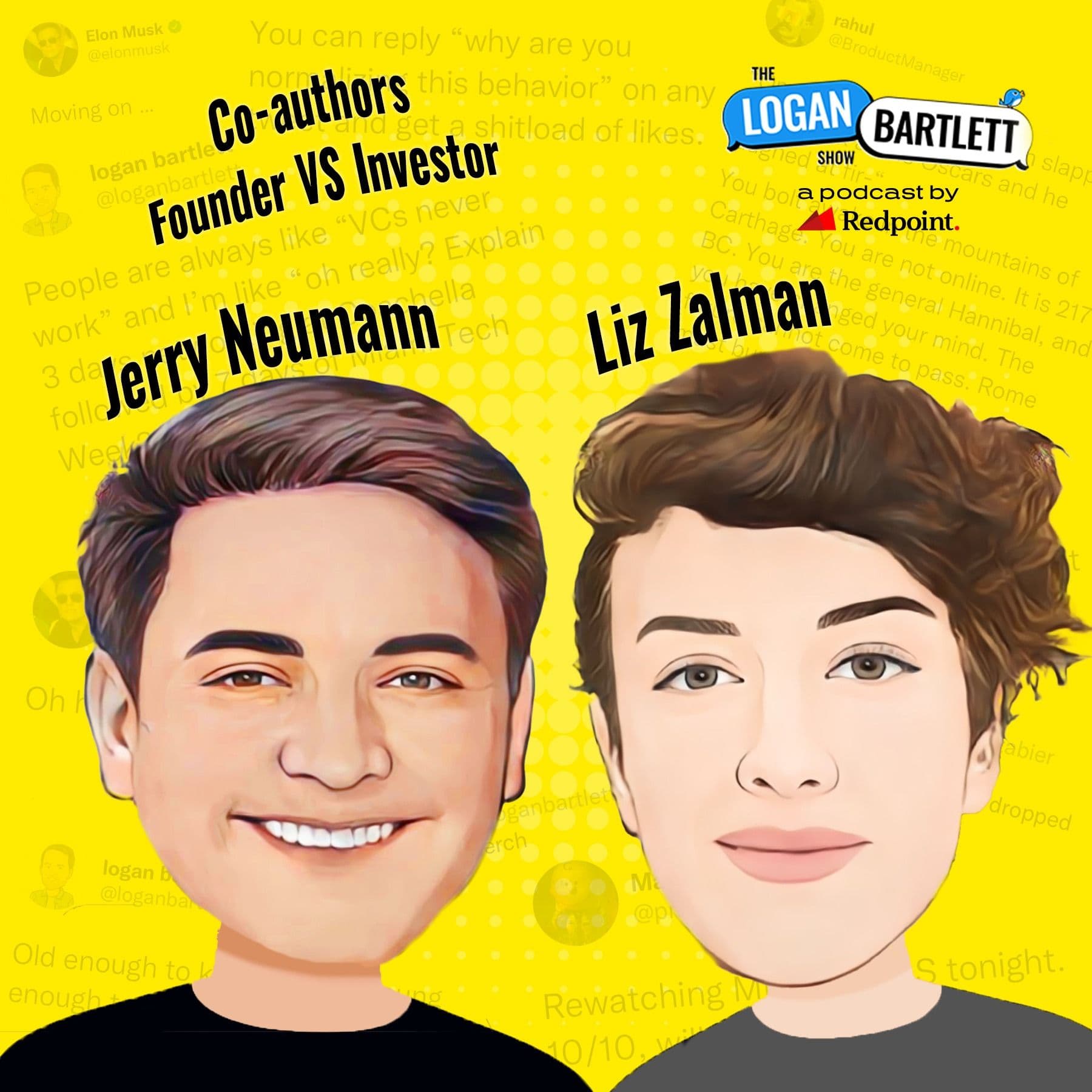
Episode Overview Title: EP 79: Liz Zalman and Jerry Neumann (Co-authors, Founder VS Investor) Debate Startup Experiences Description: Liz Zalman and Jerry Neumann discuss the dynamics between founders and investors, drawing insights from their book *Founder VS Investor*, their personal experiences, and observations of the startup ecosystem.
Key Guests
- Liz Zalman: 2x founder with over $100 million raised.
- Jerry Neumann: 25 years as a venture capitalist, known for successful investments in companies like Datadog and The Trade Desk.
Episode Structure
- Introduction: (0:00)
- Founder vs Investor Concept: (2:01)
- Venture Capital Roles: (9:04)
- Book Structure Discussion: (14:19)
- Balance of Numbers and Relationships: (16:14)
- Liz's Fundraising Principles: (21:11)
- Market Absorption Dynamics: (28:31)
- Board Purpose: (36:21)
- VCs as an Asset Class: (43:27)
- Board Meeting Dynamics: (47:54)
- Bootstrapping Decisions: (59:34)
- CEO Roles Over Time: (1:05:47)
- Fundraising Disagreements: (1:13:01)
- Interacting with Associates: (1:20:51)
- Capital for Scaling: (1:26:33)
- Insights on Founders and Founding Dynamics: (1:29:23)
- Personal Reflections by Logan: (1:37:06)
Key Takeaways and Concepts
Founder vs Investor
- *Purpose*: To present the differing perspectives and tensions between founders and investors, sharing candid thoughts on the challenges of each role.
VC Dynamics
- Two Constituents: VCs serve both the founders and their limited partners (LPs). Conflicts can arise between the interests of founders and the financial returns expected by VCs.
- Investor Roles: Investors are also governors of the company and have the responsibility to ensure proper management and oversight.
Board Meetings
- Functionality: Board meetings should be governance-focused, but often devolve into performance meetings that do not yield actionable insights.
- Liz's Critique: She feels many board meetings are unproductive and overly focused on formalities rather than genuine assistance.
Fundraising Principles
- Direct Communication: Emphasis on the importance of direct communication over associates when trying to gain investment.
- Preparation: Liz insists on being fully prepared with a well-structured pitch deck, emphasizing the necessity of engaging directly with decision-makers rather than intermediaries.
Capital as a Scaling Tool
- Offensive Weapon: Capital can be an effective tool for scaling but isn't a guarantee of success. The underlying quality of the product and market traction is the primary driver of success.
- Market Dynamics: The influx of capital can distort market competition, with well-funded firms often overshadowing smaller, less-capitalized competitors.
Personal Experiences
- Both guests share anecdotes from their careers that illustrate the risks and rewards associated with venture capital, the emotional toll of fundraising, and the complexities of board dynamics.
- Liz highlights a troubling experience with a term sheet being pulled just days before closing due to ego conflicts, reflecting the unpredictable nature of venture funding.
Recommendations for Founders
- Diligence: Founders should thoroughly vet potential investors, focusing on individual behaviors rather than firm reputation.
- Awareness of VC Dynamics: Understand the dual nature of VCs' roles and manage expectations accordingly.
- Adaptability: Founders should be prepared to evolve their roles as the company grows, acknowledging that sometimes a CEO transition may be necessary for the health of the business.
Conclusion This episode presents a nuanced perspective on the founder-investor relationship, encouraging open dialogue about the inherent tensions and dynamics at play in the startup ecosystem. Both Zalman and Neumann provide valuable insights from their distinct experiences, offering listeners a comprehensive view of the venture capital landscape and practical advice for navigating it.
Written by AI. May contain mistakes. Listen to the episode to check what was said.
Transcript
Automatic transcript. May contain errors.0:05Welcome to the Logan Bartlett Show. What you're going to hear on this episode is a conversation I have with Liz Zoll and Jerry Newman. Now, this is a slightly different conversation in that the two of them recently wrote a book together entitled Founder vs. Investor, The Truth Behind Venture Capital from Startup to IPO. These two are both equipped to highlight the opinions of a founder in Liz's case because she has raised over$100 million, including a Series A most recently from Doug Leone of Sequoia. And Jerry, having served as an angel investor for over 25 years, including investments in Datadog, now worth$32 billion, and the Trade Desk, currently worth$42 billion.
0:46Liz explains why she thinks board meetings are total BS, why she will never talk to venture capital associates, and why she will never send board decks in advance of a fundraising meeting. Jerry contrasts these opinions and explains why he doesn't think a venture capitalist role is actually to stand on the board and what it's like when a founder's interest diverge from that of their investor and having to replace that founder and CEO from the company that they built. A really interesting, fun conversation with two people that are credible in their fields and wrote a thoughtful book that's worth reading if you're interested in the behind the scenes of venture capitalists and the dynamics with their founders.
1:27All right. All right, guys. Thanks for doing this. Yeah, we're happy to be here. Thanks for having us. Liz, Jerry. So you've written a book that has come out, I guess, by the time we'll be releasing this on Friday. It's Monday. The book officially comes out. Tuesday. Tomorrow. At 12. So available wherever you purchase books. And it will also have audio books available with each of you reading your sections. Is that right? That's right. You can listen to us for seven hours. That's honestly, what more could someone desire? So maybe as background to the book itself. So the title of the book, Founder vs.
2:09Investor, which I'll give a quick plug to right here. A wonderful, nice hard copy. um what was the background of writing the book and i guess if you could also uh speak a little bit to your your qualifications so i wrote a blog post about two years ago called your board of directors is going to fire you it's probably going to fire you which is factually true more than half of founders get fired by the board of directors and it turned out to be really divisive on the one hand, I had more people read it than anything else I've written in the first day, hit the top of Hacker News, crashed my web server.
2:49And on the other hand, I got a lot of email from people I knew in the industry who said, you know, I don't really think this is fair. So, and I also got an email from Liz saying, when did you write this? Why didn't you tell me this before? So she and I started to talk and we decided that the divisiveness is just there. It's something that's part of the relationship. People have different goals. They can't always make the same decisions and agree with each other. So we decided to write the book and each present our own side of these moments when there's a lot of tension between the founders and investors and not try to compromise, not try to adopt the other side or be soft about it, but say what's really in our heads.
3:32Yes, that's exactly what we did. And by background, so you guys had worked together, investors in your most recent company, is that right? Jerry was an investor in both of my companies. Both your first investors in both of the companies. Jerry, you've been doing angel investing, but at a big scale. I put it in quotes because it's a little bit beyond traditional angel investing, I guess, at this point from a scale standpoint, right? Yeah. So I'm a venture capitalists investing my own money, meaning that it's not a hobby. It's what's paid my rent for the past 15 years. And then Liz, you are a multiple time founder.
4:08I'm a multiple time founder. I've pitched you for one company. You have pitched me for one company. One company. So my last company was Strong DM, which raised from Sequoia. Doug Leone was on my board, Tiger. And I think over my two companies, it's been something like$100 million that I raised. Yeah. And so in this book, you're no longer the CEO. No longer the CEO of Strong DM. Strong DM. I've been writing this book for almost two years now. Yeah, a year and a half or so. Yeah. The meta point of the blog post was in the genesis of all of this was, hey, this is most likely the inevitable state when you take venture capital is that a founder, you're going to probably get fired or asked to step down.
4:53or some transition is going to happen, you're no longer going to hold that CEO role that you had when people invested in you? Inevitable is the wrong word. So I didn't, what the post was, what the post said was, you're very likely to get fired unless you know about it and manage your board meetings so that you don't get fired. And I think, you know, the underlying point was a lot of founders approach board meetings kind of stupidly. They walk in, they're like, this is a meeting for these people to help me. That's what the meeting is for. And it's not really, it's not always. I think the venture capitalists will help, but they're also there to govern the company and decide if this is the right person to be CEO.
5:35And I think founders sometimes just don't realize that. So board meetings at startups are run very differently than board meetings at big companies, right? The founder will walk in and say, I've got these problems that I just can't solve, you know, help. And that's not really not what investors want to hear more than once say, because if the founder can't solve the problems or can't have people who work for them to solve these problems, then maybe they're the wrong person to be running the company. So the point of the post was you have to be careful of that. You're not walking in with problems.
6:05You're walking in with problems and solutions. It's there. The board is your boss in some sense, And you should treat them that way. And the inherent tension there at its earliest stage, and I want to talk about a bunch of specifics of how this manifests itself, but at its earliest stage, a company is the founder for the most part, right? A founder, co-founders, a few employees, and the success or failure is almost entirely predicated on those individuals. And so there's fairly clear alignment that exists between the investors and the founders, because absent the founders, there might not be anything.
6:50And then over some period of maturation, if we get to the point of your Coca-Cola or your General Electric or your IBM or whatever, that stops being the case. And it's very much a company. and the founder, if they're still in place, but more importantly, probably the CEO. The board is 100 % serving the company and all their shareholders. And whoever happens to be leading it is a cog towards that end. And I guess the tension, and I don't want to put words in your mouth, but the tension happens over the course of that transition. And at what point does the, does it stop being about the founder itself and being more and more about the company?
7:36Is that a fair characterization? Oh, definitely. And I think one of the reasons I could write this is because when I invest, it's usually two people and an idea. It's really the first money into a company. And if I go on a board, I won't stay more than two years because I've got other work that I can do that is a better use of my time. And the company will have brought on other VCs who can be on the board. So from where I sit, obviously I can't fire a founder because then what? I'm just, I'm going to run it? So I'm always pro-founder and I look for founders that can certainly manage the company, hopefully till the exit, but certainly for the first four or five years.
8:18But then you bring in investors who are later stage, they've written checks at a much higher valuation. They have a lot more pressure to get a return on that valuation. And if the founder's not doing it, they're going to bring somebody else in. At the end of the day, there's two customers-ish. And Fred Wilson has a blog about the difference between, you know, which customers are serving, or I forget exactly how he articulates it. But basically, there's two constituents that a VC is serving at all times. One is the founder and the CEO and the company and all of that. And more importantly, there's also the limited partners on the other side.
8:58And those two can frequently be at odds with one another. And I'm not sure that that is fully appreciated. Like the most founder-friendly firm over the course of 2021, for whatever reason, it's okay to use them as the placeholder for everyone else, was Tiger. I think there's a bunch of firms that we can put in the same bucket. But for some reason, it's okay to say Tiger. Tiger was the most founder friendly firm because, you know, governance, high prices, all the things that I think founders thought they wanted at that moment in time. They have proven to not be the most LP friendly firm on the other side.
9:40There's these two kind of sometimes warring factions at one another. Famously, the example of Bill Gurley and Benchmark and Uber and all that. Like these things exist at odds with one another. And as much as we want to talk about them not being the case, but they inherently are. Ideally, they're not. And Mark Zuckerberg can ride it all the way through or Bill Gates can ride it all the way through or whoever it is. But inherently, those two things proved to be at odds. And so was the point just to bring this to light, Liz, I guess, in your mind is, hey, we don't really talk about this. And founder friendliness means one thing.
10:22But at the end of the day, our ability to keep the lights on, our ability to keep doing what we're doing is much more predicated on limited partners giving us money over and over again than it is like founders specifically saying, oh, they were so nice and such good board members to me. Yeah, I think Jerry's post called out, it put it out there into the Zyka, said these things are happening. And I think it's talked about, but you're talking about it behind closed doors with your partners at Redpoint. And I'm talking about it with founders that I know who are way ahead of me and have gone through it already.
10:56And I got to find them and pick up the phone and say, yo, what don't I know? And so to me, I think my goal was to put that out there because I think founders do lose their jobs or do lose control of their company or do get into struggles that they don't need to get into. And a lot of that has to do with naivete and that naivete doesn't actually need to exist. They can be more well-informed. And so my hope was to put it all out there so the founders would read it and be like, oh, what actually don't I know? And how do I go about addressing it? because I think some of the more nuanced things that I know I certainly didn't think about was tiny, itty-bitty minutiae when it came to exemptions from the rofer or how to maintain control of the board and what it meant to have a seat declared to be, you know, then serving as CEO, for example.
11:45And those things came to be much more important later on than, for example, how high of a valuation I could get, which at the end of the day is probably a rounding error if I do it right. How many investors do you think you've raised institutional capital from? Rough order of magnitude. Is it five? Is it 10? Is it four? Seven to 10. Seven to 10. The tone in the book comes across as cynical. It was is maybe one fair characterization of it. It may be as a sensitive, fragile flower of a B.C. here. cynical would be maybe my optimistic description of it how much of that was like each of those those points you uniquely believed you were you were dressing them up to be a little bit more sensational and it was a little bit more performative because I can read some of the quotes I took them down because I want to hold you to count for them but do you believe a hundred percent of it?
12:52Or were you, was it purposely provocative to get people to think of like, hey, here really are the extremes of how this stuff can operate? A hundred percent, I'm playing a role maybe 20 % of the time. Let's say 80 % of what I wrote, I truly do believe and I follow those roles. I think there are things in there where I sort of say, hey, here's what you can pull off, but you might not be the average founder. You might be me or maybe even people that are far beyond me at this point. But I wanted to lay bare the extremes of where a founder could go. And I think Jerry does probably a more even-handed job of representing the VC than I do the founder, so that you could actually see the polarization that exists in the hopes that maybe both sides edge a little bit more towards the middle in their relationship and understanding.
13:45And it was interesting that the actual structure of the book going back and forth where you're laying out, hey, here's a topical area. Here's my view as a founder. Here's my view as an investor. Here's my response to that as a founder. Here's my view as an investor. The totality of it reads very even handed in you're at least getting the fullness of two people's opinions of this, which I know was purposeful. How did you land on that format? Yeah, I don't think we were looking for a middle ground because that's not, that wouldn't tell you what's actually going through people's heads, right? The conversations you have with your partners when the founders aren't there might be different than the conversations you have with the founders themselves because you need to get along with them, right?
14:34So you would probably be a little gentler with the founders. And I think probably as founders, Well, I know. I was a founder once for a little while, and conversations we had about the VCs when the VCs weren't there were quite different. So what we wanted to do was let people see that. Let them hear what the other side has to say when they're not trying to be cooperative. They're not trying to find some sort of middle ground. We did not have any other model. We looked for other models of books like this. There's plenty of models in other media, the point-counterpoint kind of thing. but we couldn't find any other books like this.
15:09And I think that's because people write books to say, I have the answer and here's the answer, read my book and you will also know the answer. But that can't be true, right? Because people still have these fights. Nobody's found an answer. So we think the best thing to do is to understand both sides of the argument and then you can work your way through it. Yeah, there aren't, sorry, there are no answers in this book. There are there are two sides and pick, pick, pick with a path that's right for you. You started writing it when? January, February. 2022, last year. We have ebbs and flows in venture cycle.
15:43One of the things I'll tell people is that like, I started my job as a hedge fund analyst and I became a Hollywood agent and I was a VC the whole time where my job was like only analytics and, you know, assessing numbers and all that. And then at the end it was just glad handing and kissing babies and taking people out to dinner. And now it's reverted back a little bit more to a balance between the two. But I would say the peak of 2021, it sort of felt like the job was just founders had all the control and it was how charismatic or well I could sell myself. And everything else in between of actually making the decision around the business itself.
16:25Price was kind of fixed oftentimes and the founder was telling you what they were raising at And you could say yes or no. And do you think that these dynamics, was there a was there a point in time that you sort of felt like, hey, this is going to hold true in the fullness of time and markets are going to go up and down and be crazy and crypto will be a bubble and then not and I will be a bubble and then not. and the zero interest rate phenomenon will be a bubble in the knot, but mostly this will be true for long periods of time. I was a little worried a year, year and a half ago that the things I was writing and saying, as an investor, you need to do this, you need to do that, you need to get to know the founder for longer.
17:12Wasn't great advice because it wasn't really applicable at that time. I would get people calling me and say, hey, do you want to invest in my company? I say, I'm really interested. And they say, great, we're closing on Friday. okay you know that was the way the world was i actually think our advice holds for a more normal time when both sides have more power right so because when both sides have more power then they're going to wield it they're going to fight a bit more and i'll and i'll add i i raised my series b from tiger and gv in the froth of 2021 and that fundraise took four days i think from start from start to finish and you're right the price was fixed and the terms were fixed and it was a plus or minus a bidding war.
17:51But I do think that my position on fundraising was sort of, it was definitely hammered out over a decade. And so at least my perspective on it was tried and true over a period of time. But I've seen what that market can be. And that was a fun market. As a founder. Yeah, I was going to say, I disagree. I hated that. But yes. I was going to say, how did it feel to you to be on the other side? it was the least fun I've had. So I'm coming up on a decade of doing this. And it was the it was the most existential questioning of like, why I'm doing this. And it kind of goes back to the story. In 2013, I was talking to Vista Equity.
18:33And that was sort of what set me down the path of thinking about what I wanted to do for a job. I enjoy the balance of like salesmanship with analytics and decisioning and then help. I like sort of like that triumvirate of being a VC. And it felt like the job was only salesmanship at that point. And there's probably if you're just going to be a salesperson, I don't know, working with Hollywood agents or NBA basketball players is probably cooler. I don't know that they probably have all their own crazy stuff that they have to deal with. But like, if I was purely going to be a salesperson and not really thinking through analytics and helping along a journey in that regard.
19:15There were probably other industries that I could go do that in. So I actually really hated 2021. I think we're getting back to a point in time in which I enjoy the partnership with founders and, yeah, participating in the board and having people actually ask questions and whatnot like that. That feels much truer to why I've enjoyed this job from the start. But yeah, I didn't particularly like that, like that period of time. So the chapter is the layout. So there's fear, trust and making money, which is sort of just explaining this whole dynamic, right? Like what venture capitalists, startups are all that stuff.
19:52There's fundraising, which is advice about how to actually go into fundraising. There's terms associated with it, board of directors. There's growth, there's exit. And then there's you guys going back and forth as a little bit of a summarization of where you disagree, where you agree and all that stuff. The areas that I found most interesting where I think maybe you both disagreed or at least there's nuance in your perspectives. Well, fundraising, I thought was interesting in general because, Liz, I want to talk to you about that. I think there was things that I wholeheartedly agree with. You had Liz's absolutes of fundraising, Liz AF.
20:35Liz AF. Which I actually think I agree with most of those, but I do want to talk about a few of them that I disagree with. The board of directors section, I think, was probably the one in which I don't know if I was disheartened by the sentiment that you personally felt about interacting with a board of directors. And maybe I just overly convinced myself that, oh, no, you're one of the good ones. You're not creating problems for your founders, when I'm sure I am in different ways. We touched on this a little bit, but the overarching dynamic that exists with investors and with companies and founders in particular is that tension that manifests itself between servicing your LPs, servicing your founders.
21:31And then when a company becomes more than a founder, and then you need to think about your LPs. Right. And I think that's I don't know if that's a fair articulation that you guys would agree with of sort of like that's the crux of the tension of the board of directors. Anything that you would add or articulate differently about that that chapter and some of the tensions that exist? I think it's when the company ceases to be a call option and has real viability. Yeah. Call options. An interesting thing, because I do think there's a lot of we saw this period of time and I think it's dissipating a little bit.
22:08But call option as defined by, hey, there's bigger firms that are putting small dollars in at early stage just to see what happens. Right. Is sort of my concept of a call option. I mean, there are purposeful seed funds that every seed investment they do isn't singularly focused on like a call option for later stage and pro rata. I would think. Right. But there's still you would agree with that. Well, it's true. It's true. I guess. But even if a seed fund is is investing in 25 companies out of a single fund, they believe that one of those is going to pay back the fund or maybe two at a slightly lower multiple.
22:49So to me, those are still the call options that every single one of them has yet to come to fruition. I guess I would define that as the power law of venture is the call option in my mind is the pro rata opportunity to put in more money at later stages than to continue to drive future returns. The power law is the fact that like, hey, most likely this investment isn't going to matter. and there's a basket of things that will matter over, or in the basket, one or two will probably matter. And so maybe by that definition, it's a call option on which of these things are going to matter. But I guess that might be a minutiae of a distinction between the two.
23:34But I hear your point on it. Yeah, I think of it as at some point, people realize there's real money to be fought over, real value. When a company is just starting, you put some money into it, you don't expect to make money. I mean, rationally, VCs always expect to make money, but rationally, you know you're not going to make money on the average company. But at some point, you realize, hey, this actually could be the fund returner. And then it becomes much more important to you. You laid out in the book your distributions over time. And the furthest up into the right was that Trade Desk? It was, yes.
24:10Which is a$30 billion company today. I still don't totally understand what they do. This is some advertising software thing. I actually want to have the CEO on at some point to explain to me what his business actually does and how all that works. But that was very far in the power law. How much of your returns when we see it, I don't know, 250x or 300x or whatever that one, how much of that was at the entry dollars that you put in versus any subsequent dollars along the way? If it was only the entry dollars, that would have been more like a 3 ,000x. 3 ,000x, yeah. So some blended call option, optionality of participating in the pro rata.
24:53But you still would have done very well if only that as well. Okay. I think diving into a few of the things that we disagree on. And Liz, I don't want this to be, well, we've known each other long enough that I have a feeling that you will be able to defend yourself in some of these things. And I don't want this to be the two investors agreeing. And you think I can't take it? I think you can. I think you can. I think you've been enough enough board meetings with with different ages of white men trying to trying to disagree with you on stuff. So I feel pretty comfortable that you're going to have thick enough skin to deal with this.
25:28Before we get into the board dynamics, two of the things that I want each of you two separate quotes that I thought I disagreed, disagreed with you on. But Liz, you said investors aren't capable of helping and won't help the founder get through it. The investor only cares if the company is going up and to the right. Jerry, you said if VCs could operate better than you, they would be operating because that's where the money is. I guess I'd be curious, Liz, on your side, like the investor being incapable of helping you and that they only care about going up and to the right. I assume there's some element of lived experience that you're feeling.
26:09And, you know, not to speak ill of prior businesses and all that. But that quote specifically, what were you referring to or thinking about when you said it? So, of course, there's some hyperbole in that. But let's imagine. So I think going back to this idea of a company actually being worth something and people being interested in seeing it all the way to a big exit. But I, as a founder, have to transcend being a founder and become an operator if I'm going to stay as CEO or even stay on as any C-level executive that isn't a chief strategy officer. And so in order to do that, I need to grow. And I need to grow in half a dozen ways.
26:49And speaking from personal experience, I love operating and I love doing things and I love doing a lot of things. And so I need to get out of micromanaging, essentially, and become a manager and let people do the things that I do that I've hired them to do. And so who's going to be able to tell me that? Is it my co-founders? Probably not, because they're also struggling with their own thing. Maybe it's some executives that I'm hiring, but I don't know that they're going to have the guts to stand up to, you know, a boisterous personality. And so I would hope in those instances that it would be my investors say, hey, Liz, you're really falling down when it comes to operating metrics.
27:27And so what I'd like to do is coach you through whatever. Get this coach, that coach, let's bring in a CFO, whatever the solution is, and then help me through that in order to help me grow. But instead, what I've heard over the years is you're doing a really shitty job or this thing is failing right now. I would like to see investors invest more in their founders to grow them. Similarly to how employees often complain that we bring people in from the outside as opposed to growing and promoting from within, I feel the same way as a founder. Yeah, my thought, not related to the founders, but on the employee side, is that oftentimes there's these market opportunities that open.
Read the full transcript
28:08There's a handful of businesses that founders singularly will on a totally different timeline than would have otherwise existed by access to capital or manifesting these things in a way that wouldn't have otherwise been possible. And I think SpaceX and Tesla or whatever, we can come up with examples of just things. They're often very capitally intensive. They require some galvanization and leadership and all that. There's these other ones that the market kind of opens and people can run through them. And at some point, someone's going to capture some level of equity value. you. And I think about the best founders in those situations can take it beyond what the natural absorption of that market would be.
28:56And I think, for example, one of the ones I was thinking about this weekend is like Cloudflare, what Matthew Prince was able to do with that versus what Fastly did. Fastly would have been a very good company going through this boring CDN stuff for people that don't know, but Fastly would have done a good job. But Matthew Prince was able to tell this story that went like beyond that. Sometimes when those market opportunities open, and I'm not referring to founders, but employees, there's a rate of growth in a business and a rate of growth in an employee. And maybe this is true of founders as well.
29:26I don't know. And I will draw a distinction on my perspective on this specifically. But it makes sense to me when the stakes are so high, and the opportunity is so there for us to go through that you might need to, despite them being great people on the executive team or whatever it is, the rate of growth in the market and the business might just outpace their own ability to go through. Now, the one caveat I will say about founders is recruiting in an outside CEO. You will never have someone that cares more about the success of the company than the individual that started the business. You just won't, right?
30:10No matter what. Everyone else will be a mercenary. And when shit hits the fan, they will not stay there. And so with executives or rank and file, I'm a little bit more inclined to say like, hey, this business might be outpacing your skill set there. With the founders, I do think that there's an element of like, we should give the benefit of the doubt and let them kind of scale to it. So on the employee side, I can say I completely agree with you. In the seven years that I was CEO at Strongium, there was exactly one person I can think of that made it into management and grew with the company. The rest, we hired him from the outside.
30:46It wasn't fast enough. Now, Jerry, your comment. If VCs could operate better than you, they would be operating. That's where the money is. I'm curious. Well, you're a VC. How were you as a founder? Oh, I was awful as a founder. Really? Yeah. I was actually fired by my board. The whole management team was, although I think that the people who were on the board weren't VCs. They were investing as venture capitalists, but that wasn't their job. So they misunderstood what was happening, decided to push us out so they could make money in the short term rather than build value in the long term. And then they managed to run the business into the ground within a year and a half afterwards.
31:22But when I left, I thought about starting another business. I'm an engineer. By training and building things is why I became an engineer. When you're an investor, you're not building things. But I couldn't do it. I just, you know, I started investing in the people who were leaving my old business because of the new management. And I realized I was just better at it. Do you think that the operator versus advisor distinction in that regard is a meaningful one and that boards can play tactical and strategic advisors related to operational tasks, if not actually being operators themselves in a meaningful way?
32:06Oh, yeah, absolutely. I mean, I think in Liz's example, she talks about, well, nobody told me I was a micromanager. I did tell her that. And then she says, well, softly. And then she said, well, nobody's saying your operating metrics are awful. And I think those are two different things, right? The operating metrics being awful doesn't reflect on whether you're a micromanager in the short term. I think it's actually easier as an outsider to say, hey, look, you're focused on the details of day to day. you're thinking about this 24-7, you need to stop for a second and say, why am I not growing faster?
32:42You know, not because some sales pitch isn't working. It's probably because you need more people or because you're the bottom. So I think board members and investors are very good at that, at the strategic advice, the high-level stuff. You know, I think, you know, I said it softly, you know, my tactic is usually to try to can, not to tell people what the truth is, because the truth is usually fairly obvious. It's to walk them into coming to the truth themselves so that they really buy into it. And I think that frustrated Liz to some extent that I would do that instead of just saying it. And I get that.
33:16That's just who I am. But yeah, no, but I think you're right. Like sometimes founders will ask me to, look, can you do this very specific operational thing? And maybe I can technically, but that's not my job, right? You don't want that to be my job. You want to have somebody in the company to do that. I think the single thing that I was most curious about throughout the book, in which there was probably the most disagreement between the two of you and maybe me as well, was just related to the board dynamic and the purpose of a board. So I guess, Jerry, go to you first on this. What do you think the purpose of a board for a venture-backed startup is?
33:59So I think the confusion is that there are many purposes, right? And every venture investor knows this, but you're wearing several hats. As a board member, you're the investor. You have money at stake, and you're worried about your own returns, your fund's returns. You are legally a governor of the company, meaning that the CEO reports to the board, and if things go wrong, it's your fault in the end. You're the last word. And then you probably also have a relationship with the founder. I mean, I know I do. You work with them for a long time. You get to know them. You go out and drink with them and eat with them.
34:33it's, you know, it's a personal relationship. So all of these things get mixed up. The purpose of the board is really, I mean, at its base, twofold. One is, is the company going in the right direction? And is there anything you need to do about it as a director? And getting to know what's happening at the company at a pretty granular level and the inside information, right? So why do venture capitalists go on the board? You know, they don't usually don't get paid for it, but they do it because they need to keep track of the investment at a granular level. And they also want to make sure that the company is doing the right things to increase the value.
35:05The other stuff, giving the advice, being a friend of the founder, those aren't really board jobs. They're jobs of the investor, perhaps, or of the person, but they're not board jobs. They're not director jobs. And I think people get those things confused. And you've now stepped down from all your board seats? I'm not on any boards at the moment. Is that a long-term thing? Is that a moment in time thing? It was partly. Partly in the last five years, there's been a lot of smaller funds whose partners felt they needed to be on the board because they had just raised their first fund. They needed to show their LPs that they were on boards.
35:40And I'm happy to be off the board. But partly, I think I might be more effective at giving advice not being on the board. Liz, what do you think the purpose of a board is? I think the purpose of the board is governance. How is the company doing? Can it be doing better? is it going poorly? And I think both sides, both the investor side and founders, often, frequently fall down on that thing because investors, from my perspective, are sitting there with LP returns in mind or ego. And on the founder side, there's also ego and also, how do I keep my job? And in that case, in both of those cases, governance falls down.
36:18What do you think it is? I think it's governance as it relates to the business and ensuring some level of compliance and, you know, audit related financials doing right by the totality of the shareholders and holding to count all the executives around the table that they're doing the best that they can to drive shareholder value. You're right. I mean, one of the things that you guys tease out in this is that there are mixed incentives that exist between the investor that invested at a high price in the most recent round and the governance related to all shareholders. Right. And the relationship to the CEO or the executive team, like all of these things kind of get commingled into here's what the board is in that regard.
37:30And there's there's probably I forget, Jerry, I think maybe you referred to it in the book as a beauty pageant or something like there's some element of pageantry associated with with the board meeting. and how effective it actually is in driving operational changes to it. I do take less of a cynical view. Liz, I want to read some of the things that you said back to you. So in preparation, I have less of the cynical view where when we ever go from raise to our limited partners, I am never like the most excited to go do that. It's like, OK, great. We get to go poked and prodded similar to a fundraise for a founder.
38:15But there's some level of hygiene and discipline and strategic thinking and getting on the same message and just just thinking through all the different considerations that I think go with synthesizing material, telling a story over and over again, figuring out all that stuff. And now a fundraise is slightly different than a board meeting. But I do think there's a healthy forcing function of pulling all that stuff together, at least in the boards that I've been in that seem to operate in some cohesive and well-intentioned way. Now, some of the quotes that you have in the book imply, and I don't want to, you've been on multiple boards, and so we don't need to make people try to backtrack on which experiences of yours you might have had less of a great experience around this stuff.
39:15But I realize that's not the totality of people's experiences. Right. And we talk about these things in not absolutes, but everyone's experience is going to be unique. and even when we start talking about your fundraising advice like it works your fundraising advice can work really well for a founder living in new york technical idea going after some like big infrastructure product with uh referenceable prior investors that can speak to you know your credibility as a founder or whatever but if you're from nowhere whatever i'll make fun of tennessee if only because that's where all my family is, and your idea isn't as scalable and you don't have all those references, like a lot of those experiences might need to deviate a little bit from it.
40:08I think that's probably true of board meetings as well, like who you have around the table, how well-intentioned they are, where in their careers they are, all of that stuff too. Well, but I think this also holds for venture investors, right? Because I have found that in board meetings, if I can, I insist that there be a board, even when I'm investing at the earliest stage. And the founder will often be like, look, what are we going to do in a board meeting? This is just a waste of my time. I don't say that usually in those words, but they imply that. And I say, let's sit down once a month and you show me what you're looking at to see how your business is doing.
40:42And we'll talk about it. That's all I want. I don't want you to prepare a deck or all this extra stuff. I don't want to waste your time because I want you spending all of your time I'm working on the company, but I need to know what's happening if I'm going to help you. And I found that to be pretty effective. And I think, obviously, that doesn't work when the company is larger. You have to look at the financials. You have to look at the sales pipeline. They have to prepare some stuff. But I think too many venture investors will go in and say, I've got this thing that I always want to see, which just doesn't make sense.
41:10And the founders find it hard to push back. And it doesn't mean every venture investor does that, but you only need one on a five-person board to do it, and all of a sudden, things start to get out of control. So I think venture investors can think about this as well. I'm asking these things, are they helping the company or not? Let me tell you two experiences. So in both of my companies, so two separate boards, one in ad tech and one in infrastructure, not a single investor that ever sat on my board agreed to log into my product with me and see what it did. Why should I, as a founder, take anything that they're saying seriously when they don't care, they don't seem to care about the product or the company enough to even look at it.
41:51So that's just one experience. Second experience. So I advise for a Seed Sage VC fund and they're invested in this company. So completely distinct set of investors than I've ever had. This company raised at the froth of the market, also in the infrastructure space. And I'm observing these board meetings and the investors have told the CEO exactly what they want to see. Young guy brought in as a co-founder later on. And he pulls this together and he spends days pulling everything that they've asked for together. And this meeting is four hours long. And I've heard the investors after the meeting complain about how long and tedious it is and how we're getting mired in the details and this and that.
42:31And so he's done exactly what they've asked. I can tell that the company is not doing well and he's six to nine months away from getting fired, just listening to what's happening. And not a single one of them, some of them career VCs, some of them former operators who've turned into VCs have gone to them and said, hey, I think this could go better and told them how they're actually feeling. What do you do in those instances? It's hard. We talk about VCs as an asset class. I don't know what it was. Jerry, when you were getting into it, it was probably, I don't know, 50 people or 75 people or 100 people maybe like in new york well oh i don't i mean not maybe in 25 years ago right you've been doing this for 25 years oh 25 years ago you could get everybody who worked in the startup sector in new york city into one bar yeah i remember doing that yeah and like you throw in so maybe there's i don't know you throw in silicon valley and it's 200 maybe it's it's not a it's not thousands and now now it's certainly thousands and so i guess i'm curious i haven't had we joke about the uh the vcs that are like this among my friends and uh we we hear these stories and what's what's the weird uh we we talked a little bit about like how the different constituents that you're solving for is founder friendliness, right?
43:58Versus LP success. Those two things are very much at odds with one another. And what people thought founder friendliness was, was like being hands off in 2021, right? And now I think people are actually more and more amenable to having help in some way, shape or form, at least having people give a shit. And whatever that is, maybe not overstepping, maybe stepping within the right degree. And I think it's hard because whenever these, every two years, there's a VC review site that comes out, right? And it's like, hey, rate my VCs and you'll come through. And it's just, it's so interesting because we could all be talking about the same VC and assessing the same actions.
44:46and people could be totally taking it in different ways based on what their own unique experience was, what their failings were in that board meeting, what their expectations were setting in. So the purpose of board meetings, we just touched on it. Liz, I want to read back a few of your quotes just because I think it's funny. But you said, boards suck and nothing they do matter. It once got to the point that I refused to allocate more than a few hours on the weekend to pulling together a deck that nobody would read ahead of time. The challenge is that each board deck must be a work of art because it has to address all the egos and opinions in the room.
45:22I believe the only point of a board meeting is to get things approved like auction grants or compensation adjustments. Try to take these meetings as infrequent and short as possible. Do you think that that sentiment, well, maybe a little purposefully sensational, Do you think that that sentiment had to do with the specific people you were working with? Do you think it had to do with this is just the nature of of board meetings and this construct that exists between who they're serving, the amount of capacity they have to actually help the the call option, as you referred to it earlier? What do you think, one, I guess, how much do you actually believe those specific words versus them reading well in a book?
46:10And two, what do you think the crux of all that stuff is? I'm being a good founder. I'm telling a narrative story. No, no, no. A good author. Good author. I believe it something like 80 % true. So I've felt that same thing at both of my companies with totally distinct sets of investors. What I find, so if I'm being a good founder and a good CEO, I have a very good sense of what's going right and wrong with the business. And I would much rather pick up the phone and call Jerry and say, yo, can you help me through this particularly thorny problem? Help me think through how other, you've seen a thousand companies pattern matching to this.
46:52Tell me what I don't know. And there's an example in the book where I think I just raised my Series A, it was right before my Series A, and Jerry walked me and one of my co-founders threw an exercise on whiteboard and we were 18 months behind in hiring aes or something insane insane like that and so and you decided to raise a lower valuation or something because of it is that right we didn't take the highest it was plus or minus a few million bucks but it wasn't the highest valuation yeah i've actually never taken the highest valuation of term sheet yeah and so for me uh as what i think is a fairly good ceo i want somebody to help me think through a problem and not necessarily like, hey, I feel like a babysitter in a board meeting.
47:31Oh, look at the financials. Who are you hiring? Are you on track? I'm already looking at that. But that's your job in the board meeting, right? You have to update your investors. That's part of the reason they're there. And you are in some sense not a babysitter, but it is your meeting. So why is that bad? Because I don't feel like the other side is bringing anything to the table. There's just nothing on the other side of it. There's ego or there's falling asleep or there's constantly checking the phone. there's no real thought going behind it. I had an observer once who was a seasoned operator, public company CEO, and the only advice that this person could give me with respect to sales was like 10 years old.
48:12And it wasn't appropriate for the moment that we were in with respect to maybe exploring a bottoms-up motion or different ways of pricing or so on and so forth. And so I don't see them showing up with the same kind of preparedness that I show up. So do you think like Jeff Bezos, who's running a big company, thinks his investors aren't bringing anything to the table because he's got to tell them all these things and they don't come back and help? We should all be Jeff Bezos. No. Well, but I mean like that's right. But going back to your point, a startup board looks completely different than a public company board.
48:46In what way? I think in all the ways that we've discussed, right? It's a board in name alone, I think, with startups. And I don't have 10 independent directors that show up, right? I don't have a$50 billion valuation. It's three people in an idea or two people in an idea, maybe a couple million in ARR. And then I have these people, these VCs, you know, I'm showing up. And maybe it's a bandwidth problem. Or maybe they're not actually as interested. Or maybe they, right? But maybe it's not their job, right? They're investors. They're there to govern and to find out what's happening with the company so they can see how their investment is doing.
49:23It may also be their job as investors, but not as board members, to try to help you because it's in their own self-interest. But to your point, those two get highly conflated. Even Logan has spoken about helping the founder. If the board meeting is to get an update on the company, then that's exactly what the meeting should be. And I can get that done in 30 minutes flat. If you want to give me advice or help me to grow things or figure out problems, then let's do that separately. But all of that gets lumped into one giant meeting that's a major stress ball and takes weeks to prepare for. Yeah.
49:55Well, there is this conflation of governance and advice, right? Hi, I'm Logan Bartlett, the host of this podcast. This is not an ad. As you may know, we do not advertise or monetize this podcast in any way. I just wanted to take a quick second to tell you that we have a bunch of killer guests coming on over the course of the next few weeks. And so if you're enjoying these conversations behind the scenes with both entrepreneurs and investors, please do subscribe to our channel so you don't miss out. Now, back to the episode. At some point, you could argue that the level of data points that an investor has seen, if they give a shit, which it sounds like a lot, I'm sure a lot don't.
50:38But if they give a shit, I don't know how many, 25 investments or something that I've lived board meetings through. right 10 years of doing this and companies i've seen with close enough proximity to have some level of fidelity of information on it is probably another 150 right so i can draw on i cannot step in as your cmo and tell you what to do around that i could probably give you somewhat good advice about hiring a cmo at the stage just just based on all the evidence i've seen Is that why I'm in a board meeting? I don't know. I think we've probably conflated those concepts in some way that that like advice and governance come in together in one another.
51:25But it's also just this function of like how many people are going to be in the room and how many voices every body that you add to the room gives they're going to want to say something. And so it's added oxygen and airtime to that. And so I think I forget what you said in the book, but I do find there's elements of performative-ness from the investors during those meetings to try to communicate, hey, here's the meta points that we want to hit on and talk through. And I think people are constrained in the amount of time, particularly at the early stage when people are sitting on 18, 22, 25, 28 boards, which like isn't actually an exaggeration.
52:14There are people that are on those and they can't have conversations with you really even outside of those contracts. So I guess my question to you would be, if you're going back in time and we're not drawing this broad brush blanket of who and what type of investors you're going to have, like, how would you pick differently besides just like get Jerry and I involved? In the book, I advocate for a ton of diligence, picking up the phone and calling around. And I will say it. So I'll say two things. One, that is an area with respect to how people were in board meetings that I fell down on in diligencing at both of my companies.
52:52I just never asked that question for some reason I said well what are they like to have an argument with or have they been helpful in introducing you to customers or or prospective employees but I never asked the question which was how they have the board meeting until until after after the fact when I needed help in having a conversation with that ego and I will say I've looked back at the board decks that I that I did at StrongDM so I'm gonna I'm gonna agree with you for a second. I gave up and I read back through my board decks and there are four or five pages of, quite frankly, a lot of fluff.
53:25I had stopped even respecting, I think, the governance portion of it because I was so tired and fatigued in dealing with a whole bunch of people wanting very different things and having to deal with lots of voices in the room, which is also a mistake as a CEO. I should have gone and said, I'm struggling with this meeting. How can we make that better. And shame on me as an operator for doing that. So reference calls on the individual, not on the institution. On the individual, not in the institution, or probably also in the institution, but second order. And you, I mean, Sequoia, very high profile, true high profile seed firm.
54:07I don't know who else were investors along with Tiger, obviously graycroft graycroft all notable names in the in the ecosystem um so so referencing them would you have optimized differently for uh less so i mean people people sort of have this brand uh desire and the the validation that comes from being backed by let's use sequoia as a placeholder because they're very renowned in the ecosystem. Would you have thought through more brands that were at the tick below that or two ticks below that that maybe referenced differently and not to speak specifically against Sequoia, but being less centric on like, who's the creme de la creme of the name and more who are the people at a more medium tier?
55:02So, yes, I think as a founder, the things that were front and center in me and my co-founder's minds were, can we get introductions to customers? Can they help us attract top talent? Is that logo going to be really helpful when we're closing deals? Because especially earlier on when we're, I don't know, sub five or six million in ARR and we need our first bank, right, our first public company, somebody at that bank is going to look at the list of investor logos and say, OK, check. they're not going to disappear in five years. And so I think that would have been achievable with a first tier, probably even with a second tier.
55:38I told her not to take Sequoia's money. Is that right? I did. And what was the... I think if the company is doing really well, Sequoia is a great partner, but the first hiccup, they're an awful partner. That's just been the experience that every founder I know who's worked with them has had. So I can say it. She can't say it. I do think, I mean, and this sort of goes to the VC dynamic in general, where, and again, Sequoia has been nothing but great to me. And so we'll use a tier one placeholder name of successful firm. But all of those firms can insulate from or are insulated from a brand standpoint of any individual experience or reputation of working with a founder and not giving it their all.
56:32Right. Like, I think that I don't think Logan Bartley can't can't survive too many checked out board meetings, not giving my all, not trying to help. I don't have a preponderance of references that are going to carry the day with the future investments. They're going to call around and be like, no, no, no. He was checked out that entire time. It wasn't really paying attention. Right. When you have a venerable firm in place. Right. And I hear it with the firms with very big executive reefing centers or whatever you want to call them, customer intro networks that actually you you end up. They say, oh, we know everyone under the sun.
57:15Right. But you actually end up competing for resources to get access to any of those people because they only want to prioritize the best that they have internally. And so while they may have access to the CISO of Bank of America or the CIO of Walmart, right, they're not going to do that for their seed early stage business. It's a rounding error to them. And I think this is really dangerous for founders because other venture investors around the table, if there's somebody who's a big name, are going to defer to them. Because venture investors work with each other over the course of a decade or more, and not just on one deal.
57:50So, you know, if you're like me, you're a small guy and you're like, geez, I really like those guys to like me because I hope they'll fund my next company that I'm going to bring to them. You know, you might tend to be more agreeable. So I think, you know, I say like it's really the founder's job to control the board and it is. But to do that, they need to get whoever the biggest venture investor around the table is to side with them, to control the other investors on the board. And if the biggest investor on the table is a jerk, then you're screwed. So I think it's not just because you can't control everybody on your board.
58:28But if you make sure that the biggest investor is somebody who's going to work with you, then you're much better off. And what's also fascinating is we're talking about a founder. I mean, if you had asked me 10 years ago that these were the types of skills that I would need to develop, I mean, I'm sitting there writing code and trying to bird some idea into the world. Like, that's just crazy to think about how much a founder has to grow in order to match wits with institutional funds. It's hard. I believed in you. You did. Thanks, Terry. Whatever that was. In retrospect, having lived through a few different versions of this, so referencing the VCs more at entry point, like presupposes venture capital at all.
59:19Would you have just bootstrapped this StrongDM, your most recent company? Would you have just bootstrapped it in retrospect? or was VC definitely the right path and you might've constructed it a little bit differently? So VC was the only path for us and it was because one of my co-founders wasn't able to quit his job in order. So it was essentially, how can we take this idea and put it into action? And then I would have continued to choose it because we were the top product and the hottest market at the exact right moment in time and it was the way to accelerate. Right. Now it depends. It really does depend on the business that I want to start.
59:59And I think that one of the things that I'm saying now is venture capital seems to be the default option for every founder with whom I speak. And they haven't taken an ounce of consideration and been like, is this the right thing for my company? If I'm going to grow to a$20 million a year business, why can't I do it in another way? It's like there's no other option that exists anymore. And I'm not quite sure when that happened. Well, I think that's always been true, or at least for the past 50, 60 years. I mean, if you're starting a tech business and you want to grow fast, I mean, I absolutely try.
1:00:30There are plenty of founders I say no to, not because they have a bad idea, but because they can't be venture scale and they don't want me as a partner if they're not going to be venture scale. Yeah. And I tell them that. Don't take my money unless you absolutely need it because when you take my money, you're also bringing me on as your partner. Yeah. Why would you want that? I think SaaS perverted it in a lot. not in a lot of ways. I think software as a service is a great business model, but just given the cashflow dynamics of how it plays out, I think if we had stayed on a perpetual license model, more cash upfront, we probably would have seen more companies being able to bootstrap it.
1:01:10But when you're assuming an LTV and a payback of two years or something, you just inevitably dig yourself into a cashflow hole and cycle within B2B that I think was less true 20 years ago that you just saw a lot of businesses that, I don't know, Atlassian, for example, were able to sell on-prem for a while that funded their free cash flow. And so I think that's one of the big business model things. But it is interesting that people keep trying new financial products that are like, okay, well, we can do it. will give you some whatever, some cash line of credit that will fund based on your recurring revenue over time.
1:01:54And people are trying to innovate around it. A lot of them did seem like zero interest rate phenomenons that like now that interest rates have gone haywire, the business models don't seem to make sense. But you would hope that there's more of a different product out there that people can kind of choose to go down that path where building a company that sells for 30 million bucks just doesn't really work in the venture model and certainly the venture model at the scale of funds that we've gotten to today of five billion dollar plus funds um you would hope that there's going to be more optionality given to people to make like good businesses that can be very successful for their founders and all that.
1:02:38One of the things that you touched on is, Liz, you mentioned something, and I'm not going to read the entire quote, but outside of the early seed investors with whom you may become friends, I don't know if that's you guys included, it's hard to see a path to a genuine, real relationship with your investors. You can cultivate strong and freaky communication and honesty to a point and spend dinners enjoying yourself with them. You can get a healthy transactional relationship. You cannot, however, rely on this relationship to be real in the traditional sense. It simply isn't. It's a function of convenience for the investor, time bound and event bound in the existence until you are no longer necessary.
1:03:18I typically get involved at growth stage. And so I would like to believe that I have real relationships with some of the companies that I invest in. But real is a, I don't know, kind of an ethereal definition of a relationship. What do you mean in that? Is it that incentives inherently diverge? And so a seed stage investor is the only one that you can really have true real relationships because they are the ones that have been there from the early days and their incentives are most aligned? And often even not the seed stage. I would put Jerry in a pre-seed category because the seed stage, similar to what Jerry said with a large ego on the board, when push comes to shove, if there's an argument, the seed stage investor is going to align with a larger investor because they need that relationship for the rest of their port codes that are going to fundraise.
1:04:17For me, I mean, you know my personality. For me, like I want a relationship with somebody, somebody that can pick up the phone and say, hey, I'm having a problem. I want to be able to cry on the phone to you. And I want to be able to tell you what's going on in my mind as directly as possible. Oftentimes that's not possible in the founder investor relationship. And I found folks get uncomfortable as a result. And so there's this tension for me whereby it is a business relationship. And yet I'm yearning for something more because I am my company and my company is me and my company is my co-founders.
1:04:51And so it is by definition personal. And so I need to get to know you personally in order to make this the most productive relationship possible. But then we get to the point where the company is growing. And I do matter less at that point. And I might not be the right CEO for the business. And so then how does that relationship get teased apart? Quite frankly, it fractures. Do you think that founders should always be the ones to remain as CEO over the course of the journey for a company? I think it's a question about what is right for the business at that particular moment in time. Which would imply no, maybe not.
1:05:33Maybe not. Or I think there are different types of CEOs, right? You have visionary CEOs who get up on stage, you have product CEOs, you have operator CEOs. I think that once the founder leaves the company, it really fucks it up. And so I would almost maybe shift the question slightly, which is, can I keep the founder CEO in that position because they are doing great for the company and I don't think they do as great as a CTO or a chief strategy officer or CEO or whatever it is? How can I augment them with additional help so that we have the perception and maybe a little bit of ego boost, right?
1:06:10And they continue to run it. But I have confidence in a really strong operating layer right there below them. Jerry, what's your perspective? How many CEO transitions have you been invested in where someone had to step back or decide to step back? Probably four or five. Four or five. So fewer, I think, than average. But a couple of those I was directly involved with. And I think it's in the case where the founder won't do what they said they were going to do before you invested, you really have no choice. And meaning the things like, you know, there was one founder who I said, well, you need to hire these people or before I invest.
1:06:48And they said, oh yeah, no, no, no, we have them. We're interviewing them. We're about to hire them. We're going to hire them, but we need to close. So I'm like, okay, I trust you. We're going to close. And then a year later, they still hadn't hired them and refused to hire them really, not refuse directly, but just every time it came up, there was a runaround, oh, the candidates aren't there, et cetera. And in the end, you can't run a one-person company. Yeah. And it was even talking to the recruiting firm, the person was intentionally disqualifying qualified COOs basically out of fear that they didn't want to share the leadership position with them.
1:07:23Yeah, I think it was a little paranoia. Yeah. So we didn't fire that person. And we moved them over to the head product officer, and then they decided they didn't want to stay. But it was effectively a demotion. You know, the dichotomy that exists between the relationship to a founder, limited partners, employees, overall shareholders, and all that. Do you feel that that's just an obligation? Once venture money is raised and you're invested, they've signed up for this construct that we're going to grow. And growing is going to involve changing and figuring something else out along the way. And if you're not willing to sign up for that, then you're not agreeing to the contract, either explicit or not, that we decided on.
1:08:11Yeah, I do. I think the problem becomes venture investors assume the founders know this contract because it's so obvious. If you're paying attention to the ecosystem, I don't know if that's always true. So I've started asking founders before I invest, what do you want this company to look like in five years? And not that I would want to know what they think the company is going to look like in five years, but do they want to build a big business or not? And if they say like, oh, I hope we'll have like 20 million in revenue in five years, I'll be like, okay, not venture scale. Now, the people who say something crazy, like I think we could be, you know,$5 billion in five years and we're going to compete with Google.
1:08:47OK. All right. I think it's crazy, but that's the kind of attitude I want. Somebody who wants to grow. Yeah. I don't think I have ever heard in my career from an investor. Hey, so just FYI, know that these are all of the things that you're going to encounter and going to need to do as an operator. Like for me, being 100 people, I wanted to build a big company. right? I did build a big company. But the idea of getting to 100 people was never a real idea. It just it was this abstract thing. And then all of a sudden, it was there. It was like, oh, I have no infrastructure set up in order to support these people.
1:09:22And I'm ill equipped in a variety of ways. No investor ever said, hey, this is what you're getting into. And shame on me as a founder for also not diligencing that and calling around being like, yo, what's it like to be a Series A CEO. It just never happened. One of the things I try to get my companies to do is actually org chart out by quarter, by half year, by year of like what it's going to look like. Hey, here's the number of AEs we're going to need. If you say we're going to do 15 million in 18 months or whatever, that means we need this many people doing this many deals. And that means we need this many customer support reps dealing with that amount of business.
1:10:00And that means we're probably going to need this amount of engineers. And that tends to serve as a forcing function for them to internalize, holy shit, we need to hire another 85 people. And sorry, we need to get to 100 people. That means we're gonna have to hire 85. That means we're probably going to churn about 20 % of that. So that actually means we're hiring 105 or whatever. That means we're gonna have to interview 1000 people or whatever it is over the course of the next 18 months, are you equipped for that? And that's usually a psychological preparedness that forces people into that. Is there anything like that that you would recommend for people to like actually internalize?
1:10:41Because venture capital, it does seem because of the glitz and glamour around it, I think. And I think the press releases and I think the media coverage and I think it's all of those things that it just holds this gravitas around it, but people don't totally understand the implications. Are there any other things that you would suggest for people as they're sort of thinking about this? There are two things. And that's the exercise you just described is what Jerry did for me from the AE step. I would go a step further on that and say, okay, you're going to run this plan. And in two years, I'm going to look at it.
1:11:20And I'm going to tell you that the cost of goods sold, it's too low because you hired all of these support and CS people, but really we're just hemorrhaging money here. And so now we need to find a way to make your sale more efficient. Like I would actually forward think this company because I didn't even know that words like CAC and LTV and COGS even existed. And then when I needed to know they existed, I was already having problems with them or needed to make them more efficient. So that's number one. Number two, my CTO had us do an exercise and we're all of a sudden, we're 40 or 50 people and just too busy to do anything.
1:11:54We went through our calendar and we wrote down in 15 minute increments exactly what we were spending our time on. And I would call up a founder and do that for the next stage. And it turned out that I was spending like 10 hours a day interviewing. Wow. Wow. So I'm not doing anything that I love to do. And in order to grow the company, I'm just interviewing four days a week. That's eyeopening as well. Because it's not just hiring the people. You've got to talk to people. You've got to hire the learning and development people to train the people in sales. Calendar audits are pretty powerful in that regard.
1:12:27So I want to go through your absolutes of fundraising. And in particular, I want to tease out the ones that I disagree with. We can breeze by the ones that I think are great advice, which was mostly the case in my opinion. But Jury, feel free to interject if you disagree with any of these. So the first one, you said you're more powerful together as co-founders And as a hero CEO, I think that's true. I think just having an extra set of eyes. Usually I find it's two is the right number. Even if you have three co-founders there, my only advice in those situations is not everyone needs to don't try to make the best point.
1:13:06Like just just say the point and move on. And if you have something that's really important, let the next person chime in. The real problem with having three co-founders is one will say 90 % the right answer. Then the next one will come in with the like 9 % better one. And then the third one will come in with like the, there we go. We got 100 % the best answer. And you wasted 15 minutes of the conversation with a question that was mostly there. But I agree. Mostly better to have co-founders with you. Fundraising is your new full-time job. I agree 100 % with that. And I think that there was another thing that you said in there that I think is related.
1:13:45There's no such thing as getting investor feedback, which I think is true. I think your point in that was that like do or do not. There is no try, right? It's sort of like you're fundraising or you aren't. I do think there's opportunities to build relationships ahead of a fundraise. But once you're showing up with materials or starting to talk through numbers and all that. Any metric. I mean, you're going to remember that conversation. And the next time we have coffee, you'll be like, so 20%. How did you hit? Correct. Yeah. No matter how much you trust the person. And so I think fundraising is a full-time job.
1:14:21And you're always fundraising to some extent if you're talking to an investor. I do believe in building relationships ahead of time, though. Always pitch with a deck. I think that's great advice. I think it just structures the conversation. and it allows you to flow through things. So I agree with that. Never do anything without being on video or in person. I think there's an example in the book of you taking that to a dogmatic degree that I probably wouldn't have been comfortable doing of telling what happened. The founder pulled over, or the VC pulled over to the side of the road to actually make sure that they could take it.
1:14:56Yep, on Zoom. On Zoom, which is impressive to be able to do that. to get someone to do that. Well, but I think they did it as a point and then immediately rejected us. Yeah, got it, got it, got it. It was a power trip. Yeah, okay. They were like, we're going to sit on the side of 101 just so I can say no to this person. So I don't need to do another conversation here. Correct. Yeah, yeah. Make your appearance a non-issue. I think this is probably more, at least your advice, seem more geared towards women than men, but I think it's probably true of both. Just like wear something that people aren't going to draw attention to, right?
1:15:34Don't do the Mark Zuckerberg showing up in pajamas and don't do whatever the female equivalent is that might draw attention to the conversation beyond the substance of your pitch. Yeah, and for men, if you're a co-founding team as part of a technical product, collared shirt, tie, suit, pants, uh-uh, it's not going to fly. Yeah, yeah, I think that's right. Pre-turn sheet diligence can drag you down. I think that's probably true. But disqualify quickly. I agree with that. I think that getting to getting someone to tell you no quickly is better than dragging along. I think we all want optionality and the ability to learn more.
1:16:15Just it was very well said. It's not even in a sinister thing, especially growth stage VCs, where we're like not that busy looking at that many companies all the time. And so the ability to learn is always nice. And to have someone willing to educate you is a good thing. I don't think it's like a malicious, we're wasting your time necessarily. But very rarely does the 2 % chance convert to the opportunity, right? And so I think disqualifying, getting people off your list is good. So now the somewhat agree, the buckets I put into the somewhat agree, always answer the question you want to answer.
1:16:55So what did you mean by that? Um, so if you ask me, um, uh, uh, but doesn't, I think the example I gave is, but doesn't AWS do this? No, it doesn't. That would be the direct answer, but that's not actually answering the question that you have. And you're not actually asking me the question that you want to ask. What you're actually asking is, aren't these guys, the behemoth that's already in the market sufficiently dominant such that no matter what you do, you are not going to gain traction. That is the question. And that means if you were to actually say that to me, that I need to educate you a little bit more on the market and why we have a certain perspective on the market and why we've chosen this to be the entry point.
1:17:38That's what I mean. Got it. Yeah, I would agree with that then. I'm going to move that up from my somewhat agree to my agree answer. I was a little, I really hate when people distract you in answering the question instead of like, just take you down the wilderness of some other thought. And that can be very disqualifying in my mind if I ask some very specific question and they take me on a walk in the wilderness that I didn't choose to go on. But that is a more nuanced opinion than what I thought. Investor data requests are dumb. So, OK, so in my defense. That guy's a good laugh out of Jerry. Yeah, it's good.
1:18:22In my defense, this goes back to the get to a yes or no quickly. So oftentimes, if we're having eight or nine or 10 conversations, I'm getting more and more requests for numbers to be crunched in this way or that way. Or can I get this screenshot or that screenshot? In those instances, I find that investors are trying to convince themselves of something and giving you more information is not the answer. The answer is, help me to understand why we're looking for this, because I've opened the kimono. Why aren't we at a yes or a no yet? Yeah, that's interesting. Jerry, do you agree generally with that?
1:18:56We argued about this point during the writing of the book, because I think the more that you can help the investor make a decision, the more likely they are to make a decision in your favor. There's probably some level of commonality that exists across investor requests. And having that stuff ready to go at the point of fundraise is great. And then I think there's moving them along the process. And ultimately, there's going to be some information requests that they might specifically need to get one partner over the edge. And it might seem dumb, but it also could be the gating item for them to ultimately get there.
1:19:34And so I agree that solving for one-off investor requests probably doesn't make the most sense. But the totality of data requests from investors, I think you can probably frame 90 % of what they need, especially as these businesses have been standardized. I feel like 10 years ago, SaaS wasn't well understood. And so there wasn't the standard customer by ARR and sales rep by productivity or whatever. Now that we've got no more standardized format, I think I agree with that. Okay. Now, the ones that maybe I disagree with. So never talk to associates. So Liz, curious, defending all our associate brethren out there, what is your experience in talking to associates and why do you skew away from that?
1:20:24An associate, so if I'm trying to sell you something, so if I'm selling a piece of software, right, I want to go straight to the top because that person can make the decision yes or no. If I start by selling whatever, StrongDM to a DevOps manager, they're not going to be able to buy it. They're just going to be able to say no. They can't say yes. Similarly, associates cannot say yes. They are not empowered to do that. They can only say no. And so why would I want to invest my time getting to somebody just saying no to me when I want to be able to have both opportunities? Because if an associate says no, I'm updating the CRM.
1:21:04I'm dead in the water. there's no way I'm going to be able to, maybe I would probably try actually to you. I'd be like, yo, I think your associate made a mistake and here's why I think you should take a 15 minute call with me. The odds of you doing that are low. I want to go straight to the top and plead my case. I don't agree. No. I mean, yeah, if you can, sure, you go straight to the top, but you can't always. And I think Liz on her second company could, but if you are a first time founder, the associate may be the person that you can get the best audience with. And if you can convince them and then they have to go convince the partner.
1:21:35But I think there's some bias towards allowing the associates to have their voice heard and make some investment decisions at each firm. Otherwise, why have them? So yeah, there's that. There's also the associate can tell you things about the firm or how things get done that the partner may not. So you get more information. So I'll also add that many firms, I think some firms, correct me if I'm wrong, associates are now titled as partners yes in some cases and so often as a founder i have no idea who i'm talking what do you think about that by the way i can't stand it yeah it's crazy we haven't done it you haven't done i would do that but tell me so like founders will call me like oh i'm talking to such and such a partner such as a firm and i'll look at their linkedin profile i'll say that's not a partner yeah that's a person who's fresh out of business school and this is you know four months in i was like and they're like how can you tell i'm like because i can just tell yeah And so I wish they would advertise that.
1:22:30It's been an interesting debate internally. I think, one, we don't want people that are associates representing themselves as partners externally for that reason. Like, hey, we want the person that's interacting with a partner to feel like, okay, that was a partner at a firm, and if we're doing that. Now, it does make it easier to break in and have those first meetings. things it also um it also devalues the people that are now the partner there's this weird cutover point at like at what when do you do it and so the people that have been at it for five years and now we call them partners and we're like oh and by the way all the people that just joined are now also partners it's this weird thing from their perspective as well of like well what the fuck i've been working on this for five years and now you're making everyone a partner So we've held off on it.
1:23:22I think the industry more and more, these things tend to move in one direction and people tend to not go back the other way. And so I think once I think it was Andreessen that did it first. Once some firm starts doing it, then it seems to keep manifesting itself in the industry. And so I wonder if it's an inevitability that we're going to get there and we just need to find a crossover point to do it. But I will say that titles are one of the things that we spend the most time litigating internally for this reason, right? Because it would help them in talking to people externally, at least breaking through and getting those first meetings and not saying, oh, well, I need to have a partner on the phone.
1:24:00So never send out a deck over email. Yep. Same principle. Why should I give you the power to say no? No thanks, as opposed to getting on the phone and giving me 15 minutes of your time. Now, a demo, 30-second loom video, one-minute loom video on the product, great. Deck, it's the whole story. I want you to talk to me. I am most powerful when we are talking and you are looking at me and I'm telling you a story and we're having a conversation. Email is not a conversation. I mean, if people won't send me a deck, I just won't take the call. Yeah. So, you know. I mean, because, you know, look, I mean, there's at least a 75 % chance that whatever your company is, it's not the kind of thing I invest in, no matter how good it is.
1:24:43Yeah. So I don't want to waste my time and your time, I suppose, but mainly my time talking to people who I'm just going to have to say after about 30 seconds, this isn't what I do. And how are you qualifying? Do you have anyone that works on your team with you? No, not right now. So you're 100 % qualifying all of these things yourself. And so that's the thing for me. We have three or four people working, doing some form of qualification before. And so I'm willing to tolerate no decks coming in. But like if my, you know, the funnel I see in a given week is 10 and not 10 ,000 or whatever, you probably see 500 or something.
1:25:26I don't know what the number is of inbounds coming to you or referrals coming to you. And it just starts to be a quantity of managing all this stuff. right it's not 500 a week um i you know i try to make myself harder to find than that but you know you literally people will send me plans that are i'm starting a restaurant or i'm starting you know some small business and i don't invest in that sort of thing so you know i'm happy to send them an email back and say hey this isn't what i do people send me series c companies otherwise it's just not what I do. Yeah. Yeah. Yeah. I wanted to talk about capital and how it's used as an effective means of scaling and growing.
1:26:08And so Liz, there was a section I think in which you spoke about Okta versus OneLogin. And then we talked about Datadog versus Logly. And the takeaway from it that I read was that implicit, it was laid out the amount of money that each company had raised and how that had led to some level of success, that they were able to out-execute through fundraising to that. And I guess my pushback on both of those examples was that those were the outputs of their success and not the inputs to their success. And so they didn't succeed because they raised more money. They were able to raise more money because they were succeeding in that.
1:26:55How much do you think capital can be used as like an actual – this sort of goes back to the soft bank idea. And Jerry, I'd be interested in your opinion on this as well. But like, do you think that capital can actually just unduly shift the markets in general in a way that wouldn't otherwise be possible? Or, yeah, where do you exist on that spectrum? So at StrongM, I think our number one competitor was Teleport. And Teleport raised, I think, they raised a large amount of money right maybe six months before we raised the B. and the company became very tormented, a little bit internal. Oh, my God, they've got so much more money they're going to deploy.
1:27:39And so we did see it become a factor when it came to calling on customers because all of a sudden they had three times the size of our AE team and also on recruiting, although at the end of the day, the product won out and we were still able to win 90 % of the deals. And so I think in that case, it actually did make a difference. And then I think a few months after Razor B, They raised, I think,$100 million from Bessemer or something like that. And I can imagine the dynamic was similar. Now, you raise that amount of capital, the expectations are crazy outsized. And so I think it came back to bite them a little bit.
1:28:11But I've seen it shift. Is that shifting a market? I don't know. Is that shifting me gaining traction as a first mover? Absolutely. What's your perspective on capital as an offensive weapon? I think it depends on the business, right? So even back in the 90s, you'd see companies that would go out and raise a ton of money and announce it. And that was the reason why people would want to join them, why people would want to partner with them. But it's not usually the reason why customers choose them, right? Customers don't choose a company because it's well capitalized. So it doesn't make you successful.
1:28:44It can suck the air out of the room and make everybody else unsuccessful. Yep. I agree with that. Now, when people open the book, and I would recommend everyone read it if they have some interest in these discussions and the trade-offs between venture capital and board meetings and investors and exits and all that. When people open the book, there's going to be a passage from Sandy Lerner, the founder of Cisco at the beginning of the book. For people that don't know, Sandy founded the company with her husband in the late 80s. and she was fairly unceremoniously, maybe ceremoniously, I don't know exactly how it went down, but she was fired from Cisco.
1:29:34And she was fired by arguably one of the best venture capitalists of all time, Don Valentine. And when they read the passage, they will notice that she is not pro-venture capital, I would say. And I don't have the exact quotes in front of me, but if you scan it, I think one of the ones that stood out to me was, there is no concept of ethical behavior in the venture capital playbook. Sandy's obviously a very credible person in the ecosystem. What was your thought in opening the book in that way? And have you gotten that feedback from other people as they've kind of pre-read the book? And I'm sure it's going to hook a bunch of people in that are like ready to burn venture capitalists at the at the stake.
1:30:22So maybe maybe that'll be good for for for readership or not. But what's your guys perspective on opening it that way? So it was my idea. Liz executed on getting Sandy to pay attention to write the forward, which we thought was she was the perfect person in that she's obviously a credible founder. or she started a Cisco. She was fired, so she was on the other side of it as well. And then she started another business, which was very successful, Urban Decay. So she was the perfect person. When the forward came in, I said to Liz, we need to have a second forward. We need to have a venture capitalist write the opposing view, which would be in keeping with the book, as a second forward, because this is pretty harsh.
1:31:07And we tried, actually. So Liz said, okay, go find somebody. And I asked a bunch of people I know, and nobody wanted to touch it. And people were like, this is, you know, this might not be, it certainly isn't going to help my career. So we don't have one. And I think in the author's note, I think we tried to soften it a bit because, you know. But, you know, the thing is, Sandy is certainly entitled to her view. Totally. Right? I mean, she started the company. They fired her less than a year later. Don Valentine had to know before he invested who they were, or he should have known. Fired her anyway.
1:31:43So was it really an investment or was it a takeover? Yeah. You know, I mean, there's, I know people can read, you know, you can go back and read, and we did the magazine interviews, all the things that Don Valentine and the people who were involved say, but are you really hearing both sides of the story in that instance? Or are you hearing the story as told by the people who had the power to get people to write articles? Um, so having Sandy, letting Sandy have her say, I think it's important. Now, it would have been nice if we could have somebody come in and say, look, you know, venture capital is pretty important to our country, to our economy, to progress, et cetera.
1:32:19Um, but we, we didn't get that. Um, so we, we went ahead without it. You know, I mean, I'm curious to know why you decided to have us on your show because that issue is still an open issue yeah um i think that well i i told liz after having read that passage uh and i i sent her a note saying i think this is limited upside and a lot of downside for me to do this like i i that was after having read that and not having gotten all the way through the book. And having actually read the book, I think that these are discussions that we should have. And in a weird way, I wish more founders didn't take venture capital or went in a little bit eyes wide open to the trade-offs that come with venture capital.
1:33:15And so having read the book, I think I came to appreciate a little bit more of the nuances of the perspectives and that this isn't just a pure massacre of the venture capital ecosystem, which it felt like it was going to be having just read Sandy Lerner's passage. And honestly, having read your Hacker News post or the post that went viral that sort of led to starting this book, I was apprehensive about what the advantage of having these discussions would be. Now, the reason to do it for me is these are all good conversations to have, I think. And I do think that people need to be more aware of what a board role, a board's role is in all of this stuff.
1:34:07And I think coming wholeheartedly on the side of like, we only back founders and that's all we'll do. I think that's really good branding and marketing. And I respect the people that hold that in very high regard. I don't know if that's always the best case or best solution for all these things. Right. And I also don't think the more Machiavellian, hey, we're going to replace CEOs when they don't execute to the exact ability that we think they're going to is good. And so this felt like a uniquely good conversation to have about a bunch of the nuances related to the venture capital asset class and the opportunity to take venture capital at a time that I think the industry itself is reeling a little bit with a whole bunch of different things that have happened over the course of the last couple of years.
1:35:02be that Theranos or FTX or crypto at large or 2021 bubble or whatever, just the amount of assets that currently exist in the asset class. I think everyone's kind of reckoning with the fact that we went from this little cottage industry that did seed-ish Series A deals to now it's a big institutional asset class. And I don't know what we want to call what stripe raising at a$50 billion valuation from venture investors are to cash out early employees because of tax ramifications. It was done by a bunch of venture capitalists that I have a lot of respect for. I don't think that's venture capital, right?
1:35:47That is some different product. And so all of these things are kind of getting bucketed into one big bucket. And the answer is there's nuance in all this stuff. And so I think having that discussion and figuring out, like, I don't know where truth herein lies, but there is truth and nuance to everyone's situations and their opinions and all that. And so talking it through, and I think talking through people that have been through these lived experiences across a bunch of different data points, Liz having done it with a few companies, Jerry, you having seen it across a bunch of different boards and investments.
1:36:24I find it interesting. So I think that was the reason for it. But my last question for you. It doesn't need to be the last question. You can go. Did you learn anything from the founder perspective to get more empathy for something? Were you surprised by anything? I feel like we went through there was kind of this old boys cottage industry that I think I thought really, really existed in the 90s in Sand Hill Road. And it was elements, there were elements of misogynistic behavior. There were elements of just like, I don't know, glad handing and black room dealing and all of that. And with the advents of social media and how public people are, I think I thought that a lot of that stuff, everyone's very referenceable today in a way that they were in the past.
1:37:27We joked about how often there's like a rate my VC site that pops up in some way, shape or form. I kind of thought that we had moved past that point of like founder backroom or all the backroom dealing among VCs and playing a sort of the iterative game that I think a VC of. And one of the things in the book is like, hey, you will always play an iterative game for the sake of the other investors around the table because they're going to be there again. And I maybe slightly disagree with that of like, you're also always playing a somewhat iterative game around the founders because you'll never be able to scrub them as a reference in some way, shape or form in how you treat them throughout the process.
1:38:14And I think we've I thought we had moved more and more to that point. And I think my generation, I'm 35 years old, I thought my generation had come to appreciate that a little bit more than maybe the generation that's 10, 15, 20 years older. Not to say that there's bad people exclusively doing that stuff. But I think just the world you grew up in and the foundation of your firm and the foundation of who your mentors are, all that were like big influences on it. I think I was surprised how much you personally felt like everything you wrote, Sandy Lerner could have wrote in 1990 and probably use similar-ish words.
1:38:54And so I think that was maybe the biggest takeaway or the most interesting element of it was that there's that level of still antagonism or feeling like it was performative. and maybe I want to be like, oh no, I'm not like the other VCs in some ways or maybe all the things you say I implicitly have for the founders I work with and they're just doing some song and dance and some pony show for me at all times. But I thought that was particularly interesting. I'll raise from you next time and then I can tell you. That's right, yeah, yeah. We'll see. You might have to manage me. You talk about managing your existing board and all that.
1:39:37So I don't know. So long as you don't fall asleep, I think you're starting off on a good foot. Is that actually someone fell asleep in board meetings? Yeah. What anecdote stands out the most to you in writing and reflecting on your experience working with VCs? Is there a single thing that either you put into the book or was almost too sensational to put into the book that you look back on and you're like, gosh, I just can't believe this is the way that this ecosystem works and treats founders? I can tell you the one that was most devastating. Actually, it wasn't the board. It was having a term sheet pulled.
1:40:12It was having a term sheet pulled three days before the close for personality conflict, ego reason, not being able to have a conversation with somebody. And it was devastating to me personally and then also to the business for many months. Employees, customers, we were just like in a trough. And I couldn't understand why anybody wouldn't want to try to work something out that they were feeling that they hadn't shared before and instead would just go like this. And the entire fund and partnership would be behind that person. That was crazy to me. Have you seen the industry actually improve with regard to some of these things over time?
1:40:56Or is it the same? Does it feel generally the same as it was 10 years ago? The people who've been doing it longer have improved. So I think people, venture capitalists who've been doing it for a while, educate themselves more. They're more sensitive. More of them have been founders, so they're more sensitive to founders' needs. I think the countervailing force is that the industry has expanded so much that you have a lot of people who have just started, and they're still learning. So has the average experience gotten better? Probably not. But I think if you raise from good VCs, the experience is much better.
1:41:29yeah good thanks for doing this guys thank you yeah thank you this is great
From the publisher
In this episode, Liz Zalman and Jerry Neumann (co-authors of Founder VS Investor) debate venture capital and startup dynamics. Liz is a 2x founder who’s raised over $100 million, and Jerry has over 25 years of experience as a venture capitalist with successful bets on companies like Datadog and The Trade Desk.
The authors banter on topics from fundraising, board meetings, the best role of VCs, and much more.
(0:00) Intro
(2:01) Founder vs Investor
(9:04) Two constituents that a VC is serving
(14:19) Structure of new book
(16:14) Balance between numbers and schmoozing
(21:11) Liz’s absolutes of fundraising
(28:31) Beyond the natural absorption of the market
(36:21) What is the purpose of a board?
(43:27) VCs as an asset class
(47:54) Feeling like a babysitter in board meetings
(59:34) Would you have bootstrapped it in retrospect?
(1:05:47) Should founders always remain CEOs?
(1:13:01) Absolutes of fundraising disagreements
(1:20:51) Talking to associates
(1:26:33) Capital as an effective means of scaling
(1:29:23) Sandy Lerner, founder of Cisco
(1:37:06) Did Logan learn anything from the founder's perspective?
Mixed and edited: Justin Hrabovsky
Produced: Rashad Assir
Executive Producer: Josh Machiz
Music: Griff Lawson
🎙 Listen to the show
Apple Podcasts: https://podcasts.apple.com/us/podcast/the-logan-bartlett-show/id1606770839
Spotify: https://open.spotify.com/show/5WqBqDb4br3LlyVrdqOYYb?si=3076e6c1b5c94d63&nd=1
Google Podcasts: https://podcasts.google.com/feed/aHR0cHM6Ly9mZWVkcy5zaW1wbGVjYXN0LmNvbS9zb0hJZkhWbg
🎥 Subscribe on YouTube: https://www.youtube.com/channel/UCugS0jD5IAdoqzjaNYzns7w?sub_confirmation=1
Follow on Socials
📸 Instagram - https://www.instagram.com/theloganbartlettshow
🐦 Twitter - https://twitter.com/loganbartshow
🎬 Clips on TikTok - https://www.tiktok.com/@theloganbartlettshow
About the Show
Logan Bartlett is a Software Investor at Redpoint Ventures - a Silicon Valley-based VC with $6B AUM and investments in Snowflake, DraftKings, Twilio, and Netflix. In each episode, Logan goes behind the scenes with world-class entrepreneurs and investors. If you're interested in the real inside baseball of tech, entrepreneurship, and start-up investing, tune in every Friday for new episodes.
Executive Producer: Rashad Assir
Producer: Leah Clapper
Mixing and editing: Justin Hrabovsky
Check out Unsupervised Learning, Redpoint's AI Podcast: https://www.youtube.com/@UCUl-s_Vp-Kkk_XVyDylNwLA
🎥 Subscribe on YouTube: https://www.youtube.com/channel/UCugS0jD5IAdoqzjaNYzns7w?sub_confirmation=1
Follow on Socials
📸 Instagram - https://www.instagram.com/theloganbartlettshow
📱 X - https://twitter.com/loganbartshow
🎬 Clips on TikTok - https://www.tiktok.com/@theloganbartlettshow
About the Show
Logan Bartlett is a Software Investor at Redpoint Ventures - a Silicon Valley-based VC with $6B AUM and investments in Snowflake, DraftKings, Twilio, and Netflix. In each episode of The Logan Bartlett Show, we sit down with the people behind today’s most important startups and extract the tactics, lessons, and frameworks they’ve learned the hard way. Conversations span hiring to GTM, product, growth, fundraising and everything in between - collectively forming the ultimate playbook to make you a better CEO, investor or board member.
Tap follow and enable notifications to stay ahead of the game.