
In short
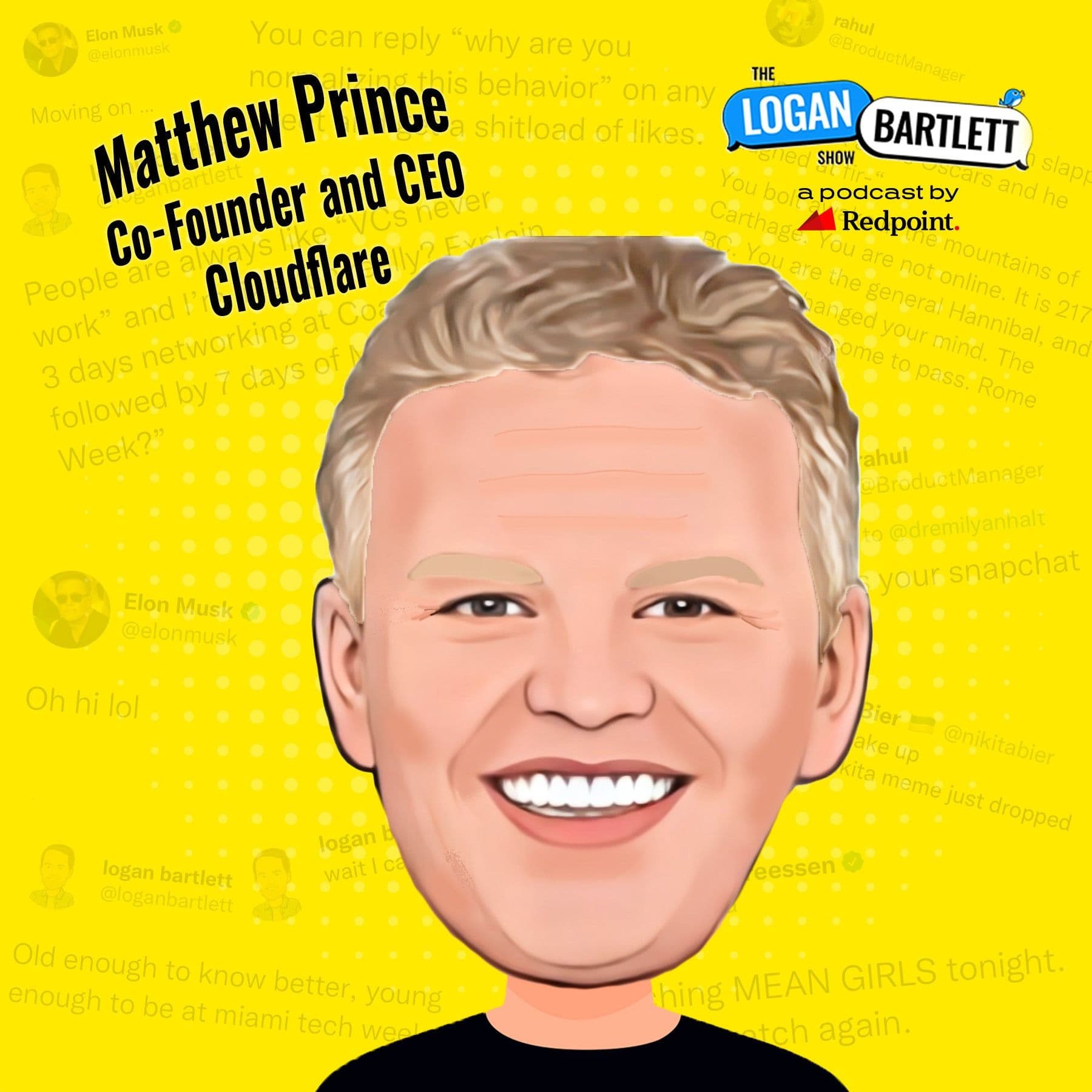
The Logan Bartlett Show - Episode 81: Matthew Prince (CEO, Cloudflare)
Episode Overview Matthew Prince, co-founder and CEO of Cloudflare, shares his experiences building the company into a significant player in internet infrastructure. The conversation covers Cloudflare's origins, its mission, and the challenges faced while scaling the business. Prince discusses the importance of talent, transparency, and the lessons learned along the way, including personal anecdotes about his co-founder Lee Holloway's battle with illness.
Key Themes and Takeaways
Introduction to Cloudflare
- Mission Statement: Cloudflare aims to build a better internet, focusing on security, reliability, privacy, and accessibility.
- Origins: Prince reflects on his initial skepticism about the internet's future, which turned into a realization of its potential.
Early Days of Cloudflare
- Project Honeypot: Initially a side project that led to the creation of Cloudflare. It tracked how spammers harvested email addresses and garnered significant early user interest.
- Founding Team Dynamics: Prince and co-founder Michelle Zatlyn had complementary skills. Prince focused on product and marketing, while Zatlyn excelled in operations.
Talent and Hiring Philosophy
- Talent Bar: Cloudflare maintains a high hiring standard, emphasizing curiosity and empathy in candidates.
- Hiring Practices: They prioritize diversity and the avoidance of hiring friends to build a more dynamic and innovative team.
- Employee Equity: Initially consistent offers were made to new hires, with the expectation of regular evaluations and raises based on performance.
Transparency and Communication
- Company Culture: Cloudflare emphasizes transparency in operations and decisions, including sharing board meeting insights with all employees.
- Public Company Experience: Transitioning to a public company has fostered a culture of accountability and growth, with Prince finding it beneficial for long-term relationships with investors.
Product Development and Innovation
- R&D Focus: Cloudflare allocates a portion of its budget to long-term innovation projects, fostering a culture of experimentation and adaptation.
- Market Response: Public feedback mechanisms allow the company to gauge reactions to new products and features, enhancing customer engagement.
Lessons from Founding and Growth
- Avoiding Conventional Wisdom: Prince warns against blindly following trends set by successful companies, advocating for unique strategies tailored to one's own vision.
- Crisis Management: Small operational issues (termed "mosquitoes") often pose greater threats than large competitors (the "sharks").
Personal Reflections
- Lee Holloway's Influence: Prince speaks about the impact of his co-founder, Lee Holloway, who battled a severe illness, emphasizing the value of empathy and collaboration in leadership dynamics.
- Background in English Literature: Prince credits his English literature degree with enhancing his storytelling ability, which he believes is crucial for effective leadership.
Conclusion Matthew Prince provides an insightful look into his journey with Cloudflare, highlighting the importance of mission-driven leadership, the value of high talent standards, and the need for transparent communication within organizations. His reflections serve as a guide for entrepreneurs and leaders navigating the complexities of building and scaling successful startups.
---
For more insights and to listen to this episode, check out The Logan Bartlett Show on [Apple Podcasts](https://podcasts.apple.com/us/podcast/the-logan-bartlett-show/id1606770839), [Spotify](https://open.spotify.com/show/5WqBqDb4br3LlyVrdqOYYb?si=3076e6c1b5c94d63&nd=1), or [YouTube](https://www.youtube.com/channel/UCugS0jD5IAdoqzjaNYzns7w?sub_confirmation=1).
Written by AI. May contain mistakes. Listen to the episode to check what was said.
Transcript
Automatic transcript. May contain errors.0:28Welcome to the Logan Bartlett Show. Escort Market. Matthew and I also discussed keeping the talent bar high at Cloudflare. And finally, Matthew talks about what it's like losing your co-founder and one of your best friends to a terrible disease. A really interesting conversation with Matthew, who is very gracious and vulnerable in this discussion about what it's like building Cloudflare to the company it is today. Now, here's Matthew. Your college thesis was on why the internet was a fad. Do you still believe that? No, I don't. Thankfully. But it really was. And I was pretty good at computers from a young age.
1:04And I went to college thinking I was going to study computer science. And my mom, as a kid, had stuck me into all these computer science programs at the University of Utah, which is why we lived in that area around. And they had this amazing computer science program. Adobe came out of that. Pixar, Evans and Sutherland, the defense contractor. And so I got to college and was just immediately completely bored. And he had the hubris of an 18-year-old kid and thought, there's nothing to learn here. So I switched to English literature, but I kept getting dragged back into it. And there were these three other students who wanted to create an online magazine.
1:44And so they brought me in, it was the four of us, and we built this original thing in HyperCart, the old Apple technology. This is back, it must have been like 1993. And we would email it out around campus. And these HyperCard stacks, which are like little applications, they would get so big that we kept crashing the school's mail server. And they kept buying us bigger and bigger mail servers. And at some point they said, you know, this isn't sustainable. We've got to figure out another way to do it. And so there are these two different groups we want you to meet. One was this printer company out in the Bay Area that had this thing called PDF.
2:19And I was a big fan of PDF. And the other was this group of graduate students at the University of Illinois with this thing called a browser. And thankfully, the other three students were like, that's the future. But it was really clear that it was just for nerds and geeks and no one was really paying attention. And if you were a college kid trying to impress the cute girl down the hall, then clearly the Internet wasn't helping you with that. And that was, you know, 93, 94, 95. and so pretty disenchanted with it. I was like, this doesn't make any sense. It's going to create all kinds of just bad incentives.
2:57Some things that were sort of I predicted in the thesis about how search would become incredibly powerful. That was right, but I thought that there would be sort of a political search engine. There would be a conservative and a liberal search engine. I'm surprised it hasn't happened, actually. But then a lot that I got just completely wrong and graduated, had offers to go work at companies I thought weren't going to go anywhere, like Microsoft and Yahoo and Netscape, and instead went to law school. What is Cloudflare? I'd start with our mission. So Cloudflare's mission is to help build a better internet.
3:34And what we mean by that is if we all knew back in the 60s and 70s when the original protocols of the internet were being laid down, what it would be used for today, a huge amount of commerce, a huge amount of just information, our lives tied to it in so many ways. We probably would have thought a little bit more about how to secure it. We probably would have thought a little bit more about how to make it private from the very beginning. We would have made it actually much more affordable. It's great that 4 billion people use the internet. It's really kind of incredibly discouraging that 4 billion people out there can't afford to use the internet.
4:08So half the world's population still didn't have access to it. I think that what we do at Cloudflare is we try and solve those fundamental issues. How do we make the internet secure by default, more reliable than it was otherwise? How do we make it fast? How do we make it private? Because the original sin of the internet is that it doesn't have privacy. And then how do we do that in a way that actually makes it more efficient so that we can not just take the 4 billion people that have access to it today, but actually expand that both in the direction of making more people be able to have access to the internet.
4:35But then also making it so that a brand new startup is able to go out there and have the resources that one of the internet giants has today. And so one way that we've started to think about this is how do we make sure that everything in the world can be connected securely, efficiently, reliably, privately, and quickly together? And that's what we're trying to work on every day at Cloudflare. And so you announced this week the connectivity cloud, which I guess is the positioning of all of that? You know, we've really always had a hard time sort of just wrapping it up into a specific sentence. And if you think about what you can do with Cloudflare, it's programmable.
5:16So you can actually write code and deploy it. It has security built into it. It's got the ability to do networking. And so people are like, oh, you're the fourth public cloud. And at some levels, there's parts that are similar, but there's parts that are really different. I tend to think of the AWSs, Azure, Google clouds of the world as almost being like captivity clouds. Like they're the metric that if you work at AWS that you're measured on, the KPI is what percentage of a customer's data do you store and hold on to? And that's just not how we think about ourselves. What we think about is how many endpoints are we connecting together?
5:57And data flows through us, but we don't actually hold on to it for the most part very long. And we want to connect things together. And so I think as we've thought through this and tried to say, how can we make in a simple description what we do and how it's different than some of the other clouds out there is we're all about connectivity. And fundamentally, that makes us the connectivity cloud. Take it back to the early days. It's you and Michelle, business school. You guys are ideating on a business idea. She tells the story of walking out of a class. I think in Silicon Valley, right? And had met some entrepreneurs and said, like, if they can do it, that probably means I can do it as well.
6:33And so you guys are brainstorming ideas and you had Project Honeypot as like a side hobby. Can you take us through the journey of Project Honeypot, Michelle, Lee, Cloudflare? I had started a company previously that was, and you're a VC, so I'll pitch you. This was the idea for the company. What we were going to do is, first of all, we were going to build some technology that allowed two people to compare a list without either person knowing what was on that list. We would then go to governments around the world and we would say, you care about spam email. So you should pass a law that requires that there's basically a do not call list, but for email.
7:16And then after that happens, the law would get passed. They would then put it out for a bid for the contract. And then we would go and even though we'd had no experience as government contractors, win the business to provide this do not call list for the governments that had created this. and that's an absurd business and yet that's exactly what i remember pitching that to vcs not far from where we're sitting right now and they were like that will never happen that's exactly what we did and what was interesting is the tech was actually pretty straightforward and pretty simple um to to build it the business turned out to not be a very good business but we assembled a pretty cool group of relatively young engineers and what we would do in order to just keep them occupied because we kind of needed them around but there wasn't a lot for them to do in the main business after we'd built the basic tech was we'd come up with all these kind of crazy ideas.
8:12So one was we predicted the winners of the Sundance Film Festival in advance using Bayesian statistical analysis, basically what people are doing kind of with AI today. But we did it with Sundance and it was wildly successful. Like we got 86 % right the first year, we got like 92 % right the second year. And we can talk about why that works, but it was basically the act of being a film festival programmer is a lot like being a spammer. You want to convince everyone that every movie is great, whereas some are there just because, you know, the director is friends with Robert Redford and you can pick that up and the signals from it.
8:49We did another thing where in the days before Google had Gmail and other things, we made a browser plugin that would swap your Google cookie back and forth with the idea being that It's really hard to keep Google from gathering data about you. But if you just threw enough garbage at it, then it could keep you private online because it would be impossible to differentiate me from you from anyone else. And then another thing is Paul Graham, the founder of Y Combinator. Before he started Y Combinator, he used to have a conference at MIT called the MIT Anti-Spam Conference. And he invited me out there to give a talk.
9:24And one year I came out and I gave a talk and I gave a talk on how to write laws in order to basically put spammers in jail. And he's like, that went over really well. Come back, give the same talk next year. I was like, Paul, it's going to be 95 % the exact same audience. And he's like, yeah, but it'll go over really well. And I was pretty sure that they would tolerate the lawyer coming in and giving that talk one year. But the following year, it wasn't going to work. So I went to this guy, Lee, who was on our team and said, can we build a system that tracks basically how spammers steal your email address?
9:54And Lee was like, yeah, we could do that. And we brainstormed for a little bit. And he built the back end. And I built sort of the front end. And you can see my UI skills to this day. If you go to projecthoneypot.org, it was entirely, and in fact, if you look at the CSS underlying it, we ripped off what was the hot startup at the time, which was LinkedIn. And there are still references to LinkedIn in the CSS on the Project Honeypot site. We changed the colors a little bit, but it was basically the same. And we launched it at this event. A couple hundred people signed up for it. We've got some press to do it.
10:24Gathered enough data to be able to tell some interesting stories. It's like the average amount of time between when a spammer harvests your email and when they send you the first message is about a week. Someone who is spamming messages for fake Viagra is different than someone who's spamming messages for like diploma spams. There's actually specialization there. And all this data was interesting. And then we put it in the corner and completely forgot about it. And it ran. And every single month I would be like, hey, you know, we should just shut that down. and it's costing a bunch of this. We had to have dedicated servers to run it in the days before AWS.
11:02And I was like, this doesn't make any sense. But we kind of kept it going. And over time, over 100 ,000 people signed up for this crazy thing. Meanwhile, the company I had started, the anti-spam company, we actually got sued by, of all the crazy things, the pornography industry, because the legislation that we'd helped write regulated alcohol, tobacco, pornography, and gambling wasn't our, that we didn't really care what it regulated, but the states cared about those things and those things targeting kids. And so the alcohol, tobacco, and gambling folks just saw it as a rounding error. And it was sort of the Superman three or office space business model where we collected a fraction of a penny every time they checked against our database.
11:41But the porn folks saw it as this huge civil rights violation. And they basically said, you know, you are helping governments infringe on our first amendment rights. Therefore, you're jointly liable with the government. And one day the process server showed up, we had no money. We had no idea. We certainly had no idea what we were doing. And so we basically shut everything we possibly could down in the business. And I was just desperate to figure out what to do. And so on a lark, like the night before applications were due, I applied to eight different business schools, was rejected from seven of them, and then somehow gotten to Harvard.
12:21So I find myself kind of still running this business on the side, managing a federal lawsuit, which is working its way through the courts, while also going to business school. I was much older than the average business student. And I was sitting in class and most business students, myself included, can be really obnoxious. And they think that the sort of point of class is like to raise your hand and crack the case, show something that nobody else has seen before. But there was one student there who's really interesting. She'd get called on. And instead of trying to make a point herself, she'd say like, hey, that point that Amy made, you know, a few minutes ago seems really important.
13:02Let's go back to that. And my first thought was like, wow, this person's doing it wrong. And then my second thought was like, wow, this person's actually doing life right. And it is so inquisitive and really has a whole set of skills that are almost the opposite of the skills that I have. And that was Michelle. And so Michelle, I spent a huge amount of time just trying to convince that we should start something. And she would just tell me over and over and over again that that might be a good idea for someone, but it's not the right idea for me. And I said, well, what do you want? She said, I want something where if I look at myself in the mirror, I'm going to be proud of what I want to do.
13:40And I want to go to Google before it's Google. I want to go to Amazon before it's Amazon. I want to build something that's really iconic. and so I was running through this and at some point I described Project Honeypot to her and she was just perplexed by the whole thing she's like why do people sign up for this it doesn't make any sense and I sort of tell her we track this, people are interested it's ugly it doesn't make any sense I said Michelle someday they really want us to build something that will actually stop the bad guys and she stopped right there and she said that's it, that's what we're building and that turned into Cloudflare so Lee, the original architect of Project Honeypot But became our first technical leader.
14:20Michelle was really the person who made the buses run on time. And then I was sort of the initial product and marketing and salesperson. Was the pursuit of Michelle to start a company that her skill set was so complementary to yours? Did you just see a spark in her? What was it? Yeah. I think that I had learned at the last company, I had the two people I picked as co-founders. Both good guys, both friends, were two people I had my locker next to in junior high school. And we're all basically the same height. We're within 12 months of the same age. Three dudes grew up in the same town, all some variation of kind of geeky, wonky person.
15:08And while the org chart said I was CEO and somebody else was CTO and somebody else was COO, because we were so similar, we spent the entire time effectively fighting over who was in charge. because the reality is you could have just turned it and we could have all been in different chairs and nothing would have changed to the point that two of us left, the company's still humming along. It's not a great company, but it's doing its thing. And it's certainly no worse off for not having two of us there. And so what that made me realize was that the goal wasn't to start something with your buddies.
15:53The goal was to start something with people who had a different skill set than you did. And what Michelle brought was, she was a Six Sigma black belt, you know, at Toshiba where she was a product manager. She is, she's, I can be the person who's like, hey, here's how we go sell, you know, the first customer. But then she's the person who can take that and operationalize that. And that's just not a skill set that I have, but it's something that I recognized in her and I really wanted to seek out. It's interesting because I heard a quote, if you need to talk about how you divide responsibilities among a founding team, it means you have the wrong founding team.
16:30I thought that was pretty profound of like, hey, complimentary and skill set. So you had you as the CEO leader, Michelle, keeping the lights, running trains on time and all that, and Lee as the technical wonk. No, and it's amazing to this day. I mean, I was just, we're recording this about a week before it's going to air. And I was just at the TechCrunch Disrupt Conference, which is why I have this silly shirt on from 13 years ago. And, you know, we literally had people come up to us off stage asking, hey, my co-founder and I are having a hard time figuring out how we split things up. And I'm like, you guys were friends beforehand?
17:03They're like, yeah, my best friend. And I'm like, you're dead. And I mean, that's a little strong, but it's super hard. And Michelle and I weren't friends. We were in a cohort of 90 students in business school. If she had hosted a birthday party, she invited 40. I would not have made the list. 60, I would. So 50 is kind of on the bubble. And I think we had a ton of respect for each other. And today we're incredible friends. We've been through a battle together. But we are still radically different humans. And I think that that's one of the things. There's a lot of talk in the startup world about the importance of diversity.
17:42But I think a lot of people miss why diversity is important. It's not so you look good in some government report. It's not so you feel better about yourself. It's because more diverse teams win. And if you have people with different perspectives on every dimension, you are more likely to come up with a solution that is different. And so you can have a diverse team on sort of surface level by just hiring the entire kind of upcoming class of MIT. Because the incoming class of MIT is pretty diverse, and so you can have an upcoming class that's pretty diverse. But if everybody went to the exact same computer science course and went through the exact same program, they think the same.
18:27And as a result, they're much less likely. And so we work really hard at Cloudflare to this day. And I think it started with that initial decision that Lee, Michelle, and I were such different people. We work really hard to make sure that we've got someone with multiple PhDs sitting next to someone who barely finished high school. And we think that those different perspectives are part of what helps us see the world in different ways. I think in the early days, you knew either this is going to be a zero or it's going to be huge. And venture capital was a good path. That's a good alignment for venture capital.
19:00Did you find in the early days it was harder to get customers to sign up or get venture capitalists to buy into the big vision? You know, honestly, we lived a very charmed life. And so neither of those was actually that hard for us. I think the things that we did that were smart were, first of all, we had a real recognition that in order for this to be a big business with over a billion dollars of revenue and public company, all those things, we would need to sell to very big enterprises. People would spend millions of dollars with us. And today that's exactly what we do is where the majority of our revenue comes from.
19:40But we also knew that you can't, in order to do that, we had to get to a certain scale and trustworthiness. And so we would start somewhere different than we would finish. And I think the thing that, and this is very Michelle, but the thing that we did that helped us in both of those fronts was, first of all, to understand that signing up small customers today, or when we were starting, was a critical thing for us to do to build scale, build reps. but it wasn't where the business ended. It just was where it started. But then secondly, to make sure that we chose what the KPIs that we measured ourself were that accurately reflected what it was that we thought were the right steps in the business.
20:26So our board meetings, our first board meeting was awful. And we, I mean, it was awful. And I remember Ray Rothrock, who was one of our first investors who was at Venrock. He was like, I need you to come talk to an operator. And I can't remember the guy's name, but I think his name is John. He sat down and he said, listen, your job as the CEO of the company is to be the pilot of the plane. And there are going to be some times where you can go through turbulence and your job is to sort of reassure the passengers everything's okay. There are other times where it feels like everything's going incredibly smoothly.
21:02And your job is to just keep the nose of the plane about 10 degrees above the horizon. Because if you go too fast, too high, you can stall out and crash. and just to have a really even keel. And so to that end, the extent that with a board meeting, you can start to think about, here's the formula of how this goes together. And the first 10 pages of the board meeting should be exactly the same every single meeting. And the only thing that changes is the numbers. And put those together, but you've got to then really take the time to think about what those numbers are. So for us, revenue was not a number that we talked about for the first four years of Cloudflare's life.
21:37But we spent a huge amount of time talking about what the cost of processing requests were because we knew that that was something that we had to keep driving down and down and down and down in order to make the business viable over the long term. And we only started talking about revenue when we started to sign up customers that could really drive the revenue story. And so I think that that was one of the things that was really smart in terms of making it so that we were focused on signing up customers, making it easy to sign up customers, accepting just about everyone. There were so many crazy customers in the early days of strange things.
22:17Turkish escorts? Turkish escorts. We had a... You cornered that market for a while, right? There's a good story in that. But even before that, all these weird corners of the internet that made us learn how to make it easy today to serve. We're a third of the Fortune 500 and somewhere between 20 and 25 % have followed the web. The internet was built on some of these like corner cases. And I mean, we could probably say porn, a large portion of the internet was built on the infrastructure to support the porn industry. Did you have the vision or did you, Michelle have the vision or whatever that actually saw through to, I saw an example that the CTO of Salesforce used it on a personal blog and then took it to Salesforce.
23:00I mean, did you see that through line the whole time and have the confidence that is going to turn into the opportunity for enterprises? fundamentally we thought that cloudflare's business was if you could see enough of the internet you could have better data on both the good guys and the bad guys if you could see as many people doing legitimate transactions online like that's a signal that when they go in to do something else online um in an anonymous way you can still say that's a legitimate consumer versus if somebody is trying to launch some sort of an attack. And so we always knew that just being able to gather as much data as possible was really the key to how our business worked.
23:46And the Turkish escort story, the way that worked, there was a bell that would go off in our office the first time someone would sign up, and we ran over to the computers and looked at what it was. And I remember it was the moment I was like, wow, we've really got to get in on writing like that employee handbook, because all of a sudden it was like, it was a Turkish escort site, which was exactly what you would imagine a Turkish escort site looks like. Which was no big deal, except then there was another one and then another one and another one. By the end of the first week, we had like 250 Turkish escorts that had signed up.
24:14And there were eight of us. And we were sitting in Palo Alto. And it's like, how did they even hear about us? And what had happened, we finally got one of the webmasters on the phone, merely because we were curious. And the webmaster said, oh, my gosh, thank you so much. You've solved this enormous problem for us. You may not know this, but Turkey is this complicated country. As you go further west in the country, it's relatively European. It's relatively cosmopolitan. It doesn't love what we do, but tolerates it. But as you go further east, it becomes very, very conservative, very, very Muslim.
24:43They see what we're doing as just an absolute threat to the underlying kind of way of life of more conservative Turkey. And so we suspect that someone who lives there is launching these attacks to knock them offline and that it's basically a political statement. We didn't have any way of stopping it before, so we would just go offline. Cloudflare came along. You stopped it, by the way. There's not a lot of money in Turkish escorts, and we don't have credit cards that we can pay in U.S. dollars. So we just signed up for your free service, but thanks so much for the service. And our systems behind the scenes, we would call it machine learning today.
25:15I guess we'd call it AI, but would classify these attacks, and they got classified as the TE attacks for the Turkish escort attacks, and they'd bubble up. and almost exactly a year later I got a call from a very frantic Dutch gentleman who was calling from Baku, Azerbaijan and he said you have to help and it was like 6 o 'clock at night on a Thursday night and we'd moved up to San Francisco and so I was I happened to answer the phone, he said you have to help the contest is tomorrow and all of our systems are offline and we don't know how voting is going to work I said what contest and he said Eurovision and I grew up in Utah so I had no idea what Eurovision was um but it turns out now I do that it's the the largest non-sporting event by viewership in the entire world and it's basically it's American Idol but with nationalism built into it and Europe just shuts down for this contest every year and and all the European countries plus um strangely Australia, participate in this thing.
Read the full transcript
26:22And they pick different winners. And whoever won the previous year hosts it. In this particular year, the host was Azerbaijan, who had won the previous year. They were down to the five or six finalists. And one of them was transgender. And there was an Iranian student who sent out a threat to Eurovision saying, this is an insult to the Muslim country of Azerbaijan. I am going to wipe Eurovision off of the internet and launched a series of attacks. I, again, had no idea what Eurovision was. And so I was like, yeah, it's late here. Just sign up for the$20 a month plan. You'll be fine. Click. And the next morning I came in and we had these French engineers and their eyes were like saucers and where they were staring at the screen being like, do you have any idea who signed up last night?
27:10And I was like, oh yeah, the Eurovision guy. And then they're trying to explain to me what Eurovision was. But what was amazing was behind the scenes, our system just kept flashing T-E, T-E, T-E. And lo and behold, it turns out that the exact same style of attack and it turns out the exact same attacker was launching this. So it wasn't actually someone living in eastern Turkey. It was someone in Iran. And we kept Eurovision online and it went through. So what's interesting is that that then that student caught the attention of the Iranian military. He now runs offensive military operations, cyber operations for Iran.
27:50And about a year after that, launched an attack against all of the U.S. financial institutions, consumer facing financial institutions. We got called in. That's how a lot of the big financial institutions became became our customers. But we wouldn't have had the data to be able to protect against that if we hadn't accepted that sort of not particularly attractive early customer. And today, I'm sure there are still lots of Turkish escorts that use us. But importantly, so does Eurovision. We powered all the voting, online voting for Eurovision this year. And so do a lot of the biggest U.S. financial institutions in the world.
28:25That network effect and that buildup is such an interesting flywheel to get to that point where you ultimately were. There were, in the early days, like 2009, I think you had to borrow money from your mom to pay your taxes or something. So where are we when all of this stuff is going on and that flywheel is taking off? Yeah, 2009 was what I mean. It was, I had, I mean, I had to pay rent. I mean, I didn't have any money. And if we hadn't, we closed a round of financing in November of 2009 and immediately set payroll up because otherwise I wasn't sure where I was going to live. And so the Turkish Escort of Tax Credit would have probably been early 2011.
29:16Eurovision would have been sort of summer of 2012. and then the Financial Institute of Tax Work 2013. It's basically one after another. You sit in an interesting part of the stack as we talk about all these different unusual businesses and complicated problems. And free speech is something, weirdly enough, your career as a lawyer, professor, going to law school at least, kind of comes into play in this whole free speech way. How do you think about where you sit in the stack and your responsibility to not judge some of these businesses, but instead provide them protection? Whereas on the other hand, some things you will take down or not support.
30:02I think free speech is actually the wrong thing to focus on. And, you know, I think one of the amazing things about the U.S. is the fact that we have the free speech policies that we do. And if you go back and read Alexander Hamilton and mostly Madison, actually, on the Bill of Rights, and then what inspired them, which was a lot of Aristotle, what is important about freedom of expression is that it enables what is a layer lower than that, which is really a robust rule of law. But I think it's critical to acknowledge that the U.S. conception of freedom of expression is radically libertarian. And there is no other country on earth that has as radical a view of freedom of expression.
31:07And we have to operate in all of those places around the world. And I've sat with officials in Germany who are polite enough to not roll their eyes when you know some american says well you know what about the first amendment and they say we understand that that is part of your tradition which was built out of your history but i hope you understand that we have had a very different history and so something like neo-nazis are illegal in germany and and so i actually spend a lot more time instead of thinking about freedom of expression, I think I spend what's kind of one layer below that, which is rule of law.
31:47And if you think about the technology stack, like at the top of all of it is an individual, somebody is creating content, maybe that changes today with AI and all kinds of things. But let's start with sort of Matthew, Logan, or posting something, doing something. And, you know, probably, let's say one out of every 10 thoughts that the average human has, they probably shouldn't say out loud, right? So we self-censor ourselves all the time. And in an ideal world, maybe we would create a series of norms where we'd understand what the appropriate time and place to say things was. But people get that wrong or people just disagree about it.
32:23And so one layer below that is now what is the media by which they are taking what is the thought inside their head and broadcasting it. And that turns today into something like social media. So X or Twitter or whatever we're calling it today, Facebook, YouTube, in those cases for those businesses, it's probably about one out of every thousand things that gets posted to them they're taking down. And they have to have a robust team that's doing that. And that's probably about the right ratio of what's going down. And that differs depending on what the platform is. But I think that having some ability to control that is probably responsible in those cases.
33:12And it's driven, and we're seeing this play out with X right now, it's driven by their business models at a large part that says that in order to be a safe place for advertising, you've got to have these things. And so regardless of any regulation, Facebook would probably have kind of the squeaky clean place it is because they want to be able to have ads for Clorox that are on there. And that doesn't work if you have content that's otherwise. A layer below that is the hosting provider. In some cases, like a Facebook is their own hosting provider. But you could imagine in that case that it's every one out of every thousand things gets posted.
33:49Maybe it's one out of every hundred thousand where you're going to say, actually, that's a bad thing. I don't even want it on a host. layer below that is the network and that's generally where we exist and maybe it's one out of every 10 million customers that signs up for cloudflare and that's about right because if i think about it over our history we take things down because of legal process all the time and there's stuff that's available in the united states that's not available in germany and we comply with the law and i think that's the right thing from a rule of law perspective but but when we make a judgment that we're going to take something down it usually is in this really narrow scene where it is not illegal but it's grossly immoral and it's one of these places where the law hasn't quite caught up and in those times and you know in 12 plus years we've had sort of three incidents so the meantime to incident for us is sort of once out of every four years where we have to take some action that's sort of beyond, where we think we have to do something that's beyond.
34:51But it's not something that comes up on a daily basis to us. And that's, again, one out of about 10 million customers creates some sort of problem where we feel like we have to go beyond that. What I think is different about us is that we try to be extremely, extremely transparent and extremely principled about it. You would never have asked me that question. And I don't love that everybody asks me about neo-Nazis and learn more about these weird subcultures than I ever cared to because of this. But I think it's super important. And I think a mistake that most tech companies make is that they point to paragraph 13G of their terms of service and they say no comment after that.
35:41Whereas I think actually, if you really believe in the rule of law, if you believe that we're all part of creating whatever this community is, then it's important when you do take that kind of radical action to not hide from it. But to actually talk about it, talk about why it's hard in various issues, talk about what the consequences could be, and go through that struggle. And I've been fortunate enough to sit in some of the public policy conversations that companies like Facebook and Apple and Microsoft and Google have. And to the outside world, they seem very almost robotic and monolithic. But I think inside of those, you would find a series of people who are struggling with what are some really tough issues.
36:31And I think if tech did a better job of actually talking about those issues, we wouldn't be in the same sort of kind of dark place that we are right now where there's a lack of trust in technology companies, where there's a lot of really well-intentioned but misshapen regulation that's emerging in those spaces. And I think it's part of our role to be very transparent and very principled as we think about these issues. That's always been kind of a cultural value of yours is the transparency and the ethos. I guess, where did that come from? And then there's this ethos of secrecy that maybe dates back to Fairchild Semiconductor in Silicon Valley.
37:10But what do you think? Why is it important to you? And why do you think more startups don't practice it? Cloudflare's in the business of trust. People trust us with, from their business perspective, an enormous amount to just route all their traffic through Cloudflare's network. And in order to do what we do, we have to actually decrypt some of it, inspect it, re-encrypt it. But there's an enormous amount of trust that someone has to have. And that's in our customers. Our customers' customers also have to trust us because we're, at some level, this organization a lot of people in the world haven't ever even heard of.
37:53And yet, 20 to 25 % of the web flows through us, you know, an enormous amount of that. And so from the beginning, I think Michelle, Lee, and I would always talk about, you know, what can we do to be as trustworthy as possible? and you know you can you can become big and just do the right things but before you're that you got to get there and so how do you do that and and the conclusion we came to was we just had to be extremely straightforward in our business model so over the years the number of companies that came to us and said oh my gosh do you have any idea how much money you could make Like if you just sold data that's off the back end of your business, you could have an incredible advertising business.
38:38And, you know, we would think about it and we'd say, yeah, you're right, but that's not our data. That's our customer's data. And if we're selling it, then that devalues it for our customers. And that's not straightforward. And so we should have a really straightforward business model of we charge customers to make them fast and secure and reliable. And it's really straightforward. forward. We also thought the key to trust was really transparency. And if you, again, look back to sort of the Aristotelian principles of rule of law, rule of law is all about how do you create trust? And what Aristotle writes is it's about being transparent, it's about being consistent, and it's about being accountable.
39:21And those are sort of the three pillars of what you need in order to build trust. And that's true for governments, but I actually think it's true for technology companies that get to a certain scale as well. And so I think we thought about those things really early on. And the question we would always ask ourselves, which when it was eight of us above a nail salon in Palo Alto, California, had definitely a certain level of hubris. But we would say, if Cloudflare ran the entire internet, what would the right decision be? And I think that that helped us make technical decisions that has allowed us to scale.
39:58I think it helped us really as we thought about who the right team members were as we continue to scale the underlying business. And as we made decisions on, you know, if we do something, if we make a mistake, because I remember the first time we got, there was a kid named Cosmo the God, lived in Santa Monica, California. he bought my social security number off of a russian website which had hacked into i believe wells fargo where i once had gotten a mortgage so they had my social security number use that to then trick at &t into redirecting my cell phone's voicemail to a voicemail box that he controlled use that to get into my personal gmail account which didn't this is my personal gmail account who so who cared to have two factor on that occasion had a strong password but he could bypass it.
40:49Use that because I had set up the original Cloudflare account to get administrator access to the Cloudflare account using a zero-day vulnerability in Google's G Suite. It was whatever Google used to call it, G Suite. Or now it's, I guess, Workspace. And then use that in order to get into one of our accounts. And at the time, he could have redirected the FBI's website wherever he wanted. He could have redirected the Central Bank of Brazil because they were a customer too. But instead, he was a 15-year-old hacker kid, went after 4chan. And I remember calling Chris Poole and like as the phone rings Chris Poole ran 4chan and 4chan's this weird hacker site that's out there and Chris was like I am so sorry and I'm like no no I'm supposed to be apologizing to you we just got your site hacked and and we could have completely like we didn't have to say it and then no Chris was like I don't care like it's back it was only down for like three minutes no big deal and we're like no we have to tell people what happened and be radically transparent.
41:51And I thought the business was over that day because I thought everyone would be like, no one's going to trust us again because we got hacked and we're a security company. And exactly the opposite happened where signups doubled and people wrote all these posts about, wow, if these guys are willing to be that transparent, then when they do something stupid, then I know that they're going to do the right thing. And I think that that lesson early on just reinforced sort of the philosophy of trust comes from transparency. Hi, I'm Logan Bartlett, the host of this podcast. This is not an ad. As you may know, we do not advertise or monetize this podcast in any way.
42:30I just wanted to take a quick second to tell you that we have a bunch of killer guests coming on over the course of the next few weeks. And so if you're enjoying these conversations behind the scenes with both entrepreneurs and investors, please do subscribe to our channel so you don't miss out. Now back to the episode. We referenced the early days in a few different ways. And it was you, Lee, Michelle, and there's a beautiful Wired article about Lee Holloway and his life and tragically diagnosed with frontotemporal dementia, which is early onset dementia. I guess for people listening, like, how do you want them?
43:08How do you want Lee to be remembered? And I'll link in the show notes, the article. It's I know it's a beautiful. No, it isn't. You know, we worked really hard to get that written. And Sandra, who wrote it from Wired, did, I think, a really great job. And Wired has actually put a lot of their material behind paywalls. And one of the requirements that we had was that they couldn't paywall the article, which I'm glad they've looked up to. You know, Lee was just this really incredible, focused kid from the very beginning. and was able to take what were super hard problems and focus in a way that I've just not met many engineers that did.
43:53And he didn't have the best interpersonal skills, even from the beginning, but he was really good at inspiring other people around him to think about hard problems. I remember we were going to pitch Venrock before our first financing round. And he was supposed to build a demo that we were going to show. And he was late in delivering the demo. And I kept saying, Lee, the meeting is tomorrow. If we don't raise money from that, I was terrified. If we don't raise money, I couldn't pay my rent. if we don't raise money for this, we're not going to be able to build a company. And he said, I said, what are you working on?
44:40And he's like, I am figuring out how to cache a request for a variable period of time between one and seven milliseconds because I've worked out the sort of clock rate of the processor and the memory and how it works together in order to be able to. And I'm like, Lee, if we don't raise money, this is going to be completely worthless. And he said, but Matthew, if we do raise money and I haven't solved this foundational issue, I'm not sure we can build the rest of the business. And there's a lot of those sort of very early foundational decisions that Lee was critical in making. And I remember back that if I look back, So frontal temporal dementia is not actually early onset dementia.
45:32It's the same disease that Bruce Willis was just diagnosed with. What it does is the frontal lobe of your brain, and if you look at scans of Lee's brain, there's something clearly wrong with the frontal lobe of his brain today. And the frontal lobe is what helps you have empathy. It's what helps you have interpersonal connection. And again, if I look back at Lee over the now almost 20 years that I've known him, he had the disease the entire time. And it was just a slow descendant. Early on, it made him kind of quirky and weird. And we worked together before for Cloudflare at the anti-spam company for quite some time.
46:14And then when he came to Cloudflare, he was in this weird window of time where he had, I think, the ability to shut down the rest of the world. I think partially because the frontal lobe of his brain was dissolving. That let him do things that still to this day, there are engineers on our team that are like, wow, how did anyone ever come up with figuring out how to do these things? And the real kind of quintessential time was in 2014, the free version of Cloudflare did a bunch of stuff, but one thing it didn't include was encryption. And to get encryption, you had to pay basically$20 a month. And a bunch of our team made a pretty impassioned plea that the future of a better internet had to be an encrypted internet.
47:08And so we should be pushing forward to making encryption free. And this is before Let's Encrypt and a bunch of the things that existed out there. And that was a very complicated business problem, not the least of which was that the biggest differentiated between our free and our paid product was encryption. We were about to give it away for free. it created a partnerships and a kind of vendor problem because you had to buy certificates and the way certificates were sold was on a per-certificate basis and we couldn't afford to buy a certificate for every customer so we had to figure out how to solve that.
47:46But most importantly, it created a technical problem both in terms of how you just had to manage and deploy and provision and rotate all of those certificates but also just how you could do that many cryptographic operations on a certain amount of hardware. And we weren't sure it was possible. And, you know, Michelle really kind of took the business model problem. I took the kind of go negotiate with vendors problem. And Lee's like, I got the technical thing. And he would wear this hoodie and he'd put it up and he'd put these headphones on. And he'd just like a stereotypical, you know, developer.
48:22He'd just be heads down writing code. And the night we launched it on September 27th of 2014, on September 26th, Lee was just still cranking away. And we're like, you sure we have to delay the launch? He's like, no, I got it. And we're like, shouldn't we do some tests? He's like, Matthew, I got it. And again, I'm not sure if he didn't have the disease that he would have been able to sort of just lock in and focus that way. And it was amazing. We flipped the switch on September 27th, and there were these external services that would monitor how much of the web was encrypted. And they would kind of go along like this.
49:01And then on that day, the web doubled in the amount that was encrypted. I was like, oh, right. And that was one of these things where he did that. Singularly. Yeah. It's incredible. As people think about this disease and Bruce Willis has brought it into more mainstream, is there anything you want people to know about like warning signs or is there anything that would be helpful to share about it? I think this particular disease is hard because it is extremely rare. It's very rare in people generally and it's especially rare in someone who's in his 30s. and the other thing that's hard about it is there's really nothing that anyone can do and so you know before while he was still able to communicate I saw him and I said hey how are you feeling about you know this this illness that you have and that's a question he's incapable of answering because how are you feeling is exactly the sort of thing where the frontal lobe of your brain starts firing like crazy.
50:13And so I think that, you know, we, I think we can all have some appreciation for what it's like to have something like Alzheimer's because we've all forgotten something and it's like, but it's hard to relate to a disease that makes you literally unable to relate. And, um, and so I, I think it's, I think it's tough. And, and, you know, I don't know what, I don't know what we would have done differently. Um, I mean, we probably, we, I, I wouldn't have, I wouldn't have been as angry at him. I think if, if I'd known that he was sick, um, but I do, I, it has caused me to, whenever I see a colleague who just acts strangely or that their behavior changes to take a second and, and, and a beat to really think, you know, what might be, what else might be going on, um, behind the scenes.
51:09And, and, um, and I think that's something that, you know, is, as hopefully made me a better leader. Yeah. That's a good lesson in empathy. Um, well, I want to talk about the, the culture and the, the hiring practices that you, Michelle and Lee built from the early days. Uh, I think Michelle said somewhere that maybe you held the bar too high at times in bringing people in to the organization. But for people's benefit, so you still spend 30 % of your time on hiring and recruiting today. I'm not sure, still totally true, but you never hired an outside recruiting firm for at least a long time, it sounded like.
51:45We have for very senior, like when we, some very senior positions, we have, but we would never for We've never, you know, seven or eight positions in the company's history. Every manager is expected to spend roughly 20 % of their time, one full day's work on recruiting. You consistently pass on filling roles if someone doesn't meet your bar. There's actually an HBS study that people can reference about how lean you all ran the company as well. What's your philosophy behind hiring and talent? Well, companies are just collections of people. And, and so the most important thing as you build a company is to make sure you get great people.
52:32And if you do that, like almost everything else takes care of itself. It's better for you to get the right person than it is to get a person right now. and that the biggest way that you can ensure success or failure is getting hiring right or wrong. And so that then means that it has to be part of everyone's job to do that. Now, where that can go wrong is if then everyone just goes out and hires their friends. And so from the beginning, we also tried very hard to say, not only are we going to hold the bar really high, but you also then can't go hire your buddies. You've got to hire people who you don't know and that are different than you are.
53:22And it made for, we had investors early on who were like, you know, you guys are such a, like, you don't look the part. You guys are such a motley crew of various people. But we really hired for, people had a little bit of a chip on their shoulder who were clearly really smart, had something to prove, and wanted to roll up their sleeves and go forward. I think the other thing that we did that was hard but turned out to be really, really smart, and every time we broke this rule, it caused a problem, was we had a rule that said you can never more than double the size of the company or any individual team in 12 months or less.
54:06And the rationale for that was that most things in companies are not democracies. we don't take a vote on what programming language we use or what crm system we use or what customers we go after or what products we build next um we have people who specialize in each of those things but the one thing in every company that's democratic is culture in fact it's harder to find what culture is other than it's what the majority believes in how they act and and so if that's the case, the problem is that if you grow faster than doubling in 12 months, that means that inherently your culture will change because you will have more new people, people who've been there for less than 12 months, than you'll have old people.
54:53And if that happens, you know, maybe that's okay if you have a really rotten culture and you bring a whole bunch of new people. But it's a little bit like a, you know, bone marrow transplant. You might want to do it every once in a while if you're really sick, but you certainly don't want to do it, you know, every three months. And, um, and so I remember there was a, there was a, um, there was a, there was a chart, uh, that actually every time I go back to HBS to, to help teach the course on us, um, it, it, it's from like 2015 and it's, you know, what are the companies that are growing the fastest?
55:32And it was in tech crunch, and it was like, look, these are the companies you want to work for, they're growing the fastest. And if you look down the list, it's the best. implosion or screw up. And so I think we tried to grow and we had lots of pressure from our investors to be like, you need to hire faster. You've got a tiger by the tail, go. And Michelle and I would actually tap the brakes and say, no, no, we're going to actually slow things down and try and hire it at the right rate. We broke that rule from time to time. We woke up one day and we had 100 people in sales and six in marketing.
56:17And I don't know what the right ratio of marketing to sales is, but it's not six to 100. And so we hired like crazy in marketing. And then our marketing team blew up in a bunch of ways. But the math of it suggests that that's actually a pretty reliable law. And even in times where we could afford to hire much faster than that, we really did try and cap that. focus on quality, focus on diversity, not just on the headline metrics, but really finding people who had different perspectives. And I think that that has served us well and has caused us to be a place that it has, we have a culture. It's not the right culture for everyone, but it is one that is, it feels very stable.
57:03It feels very reliable. And I think that's part of why we have the tenure and some of our team that we do. How do you tease out some of those characteristics of people? Because one of them that you guys don't do is you don't hire from specific schools or use that as a filter. Schools are a shortcut in some ways for, hey, this was qualified by someone else, some random administrator somewhere, but at least it says something, right? But you guys go to first principals on all these factors. What are your, like... I mean, I was thinking the other day, if you look at our 10 people on our senior management team, I don't think I know where half of them went to school.
57:43I have no idea. What I think is the risk of if you hire everyone who went to the same school is that you end up getting a whole bunch of people who may, again, on the surface look very different, but underneath are very, very similar and very the same. And so we want to have people from different perspectives. What I think has helped us, you know, when we started Cloudflare, people would say, what's your mission? And I was like, there's a giant opportunity where software has moved to the cloud and storage has moved to the cloud. And obviously, networking is going to move to the cloud. And we're going after that and hopefully we make a bunch of money.
58:23But I think in part because of the fact that, you know, we started with a free product. We made it available to so many people that we saw how important the internet was. And our mission emerged as being to help build a better internet. And there are probably some people out there that are like, yeah, that sounds nice. But there's actually a good hunk of folks who are like, I can't imagine anything more important that I could work on. And those are the people that we want to have on the team. And so I think because the mission emerged out of the business, as opposed to being some cute marketing thing that we did to attract people, and because we've been very faithful to it, I think that's helped us attract just a really, really, really high caliber of individuals.
59:15And we're this weird networking B2B security company. And we'll get, I don't know where the year will end up, but we're on track to have over a million applicants for a little over a thousand positions. So we get to see a huge amount of people. And I think that's because the mission is important. we're still small enough that you can make a real difference but we're big enough that you know your paycheck's going to clear and that there's a lot of upside and we're working on really, really, really hard problems whether that's on the engineering side of the house or figuring out how we sell to some of the biggest companies in the world this is a place where you're going to go and learn and if you really get down to why people go If you think about what jobs you've loved, it's the jobs where you feel like you're constantly learning and that it's hard not to learn when you're at Cloudflare.
1:00:22I heard you say that you prioritize curiosity and empathy almost over anything else. Why are those successful characteristics or traits for the Cloudflare employee? I think we came to that ourselves, but now I've heard Amazon has a very similar list of things that they prioritize over Google. as they moved away from the sort of pure, you know, what's your SAT score, kind of, which is definitely not us. I think that people who are curious are incredible students. They want to learn new things. They want to take on new challenges. You know, when people ask me for my advice, I say, basically, you know, if you've gotten a job offer from us, it means that you're a bright person which means that at some point in your childhood there was some person and you can close your eyes and picture this person who said stop asking so many questions and my advice when you start at cloudflare is forget that person ever existed and just curiosity curiosity curiosity that can get annoying if you don't have other people who are incredibly empathetic and empathetic people are great teachers.
1:01:33And I think if you've got people who are always asking questions, wondering if the way we're doing something is the right way and you've got people who are saying, let me teach you how, why we've made the decisions we've made to date, but be open-minded that there might be a better way of doing things. I think that that's, that's what, that's what gets you away from dogma. That's what gets you toward looking for what the right answer is. And I think that's something that has always been true inside the company. And, you know, I was just with a bunch of our senior team in Austin and we all were very much looking for, okay, what's the answer to solve, you know, what's some of the really hard challenges that we and the rest of the internet are facing going forward.
1:02:23And that's, again, I think that those are the people that I like to hang out with. And I think those are the people that really invent what the future looks like. I found, and I think you'd agree, that people kind of lose their mind if they're not treated fairly within a business. And I think in the early days, you all were pretty relentlessly formulaic about the initial offer, but then very magnanimous over time once people proved themselves. Can you talk a little bit about the fairness of an initial offer and how that leads to loyalty? You know, the minute that you hire someone to be on your team is the minute you know the least about how they will actually do on the job.
1:03:05And every minute that passes are after you learn more. And so the theory was that in the absence of information, fairness is consistent. consistency, right? Two people, systems engineering roles, you really don't know who is going to be great and who's not. And you can pretend like for them to even get a job offer, you think they've met some hurdle, but then how much higher over the hurdle? It's really hard to tell. And so as a result of that, we did a handful of things. One was, we were very light on titles for as long as we could get away with it. Because there were lots of times that we would hire someone thinking, oh, they're going to be the manager, and that's gonna be the individual contributor, and totally flip and turn out.
1:04:01And maybe we're just bad at it. But also, having that plasticity was, was really important. And again, I think that was really very much driven, driven by Michelle, who I think, again, in the spirit of fairness, at our very first board meeting, we presented like Michelle was going to be VP of this and Lee was going to be VP of that. We had all these other positions. We were hiring someone and one of our investors was like, have you asked this person who you're about to hire how many people they've hired? And we're like, no, we don't think to ask that. How many people they've fired? We're like, no, we don't think to ask that either.
1:04:36They're like, hey, your company, you can make whoever you want VP, but I would just, those are the sorts of skills that you probably should have if you're a VP and you probably should have asked those questions. And driving back up in the car, Michelle's like, I haven't hired or fired that many people. Maybe I shouldn't be VP either. And so she just didn't have, I mean, at first, she didn't have a title. And I think by, you can't, because then when we hire someone and say, well, you don't have a title either, they'd say, well, what about, and we'd say, Michelle doesn't have a title either. And people would go, oh okay and it and that sort of because people just want to be treated they want they want to understand where they are in the pecking order and can today we have titles and and and hierarchy and you have to at some point but early on that gave us a lot of plasticity in terms of offers what we tried to do was say day one like and we did almost no negotiation we wouldn't chase chase people on on offers and we would just have a very consistent formula on here's what the salary was and here's what your initial equity grant was.
1:05:42But then six months later, we had a calendar reminder to go back and evaluate it. And the expectation was that we would always give people more at that period of time. And the answer could be anywhere from zero to three times as much, basically, as what they had initially gotten. Of equity. Yeah, equity. And we would also have, I can't remember what it was, but there was something about we could actually raise salaries. And that worked super well for us early on to be able to be super fair. Because again, lack of information, consistency is fairness. But then as you have information, then fairness means rewarding, actually accomplishment.
1:06:29And that worked well. It gets harder to do that as you get bigger. We obviously can't do exactly that today, but I think it was one of the things early on that worked well for us. Although it meant that there were some really great people that we lost, but that was fine because we found other great people. Because there's kind of a school of thought that titles are cheap, and so you might as well, you know, you can give them away. But the Zuckerberg or the Anderson, Andreessen school where, you know, Andreessen's titles are free. you give them away as liberally as possible. And, and Mark, and I think Mark's right, says no titles are the most expensive thing that you can, you can do because it cements the org structure and the hierarchy that you have.
1:07:13And, you know, we didn't have a CFO until we were getting ready to go public. Because the one thing I knew is that if gave someone the title of CFO, they may have been awesome, but they weren't, you know, nobody that we were hiring when we were eight people, even if they were going to kind of do our books and make sure we paid our taxes, they weren't going to be the people who took us public. And there are some exceptions to that, but very, very, very few. And what that then does is it creates a problem where it might be that there's someone really great who's on your team, you want to have on the team, but there's no way you can, once you've given someone that title, that you can demote them without creating enormous amounts of issues around people's ego and vanity.
1:07:58I heard you say it's not the sharks that'll kill you, but the mosquitoes, which I think I philosophically understand. But what specifically do you mean or do you think about with that? I think a lot of people spend a ton of time worrying about competition. and when they worry about competition there especially as startups they worry about
1:08:26what's going to happen if Google enters our space I remember very specifically there was a day where Google launched a product it was called PageSpeed Service and at some levels it replicated a ton of what Cloudflare did and it freaked us out we spent a whole bunch of time worrying about it But like many things Google does, they have subsequently abandoned it. It didn't matter. And there was probably some good that came from us worrying about what was there. But they're the shark. Whereas I think what is much more likely to kill businesses, especially startups, is you have squabbling between the founders because they really haven't found the right founding team.
1:09:14or you hire the wrong people or you get compensation wrong. And each of those individual things doesn't seem like much, but any one of them has the risk of being infected with whatever pathogen ultimately kills the organization. And so I don't see a ton of, I mean, again, there are examples and people get eaten alive by sharks from time to time. But I don't see a ton of examples of startups dying because the big company came in and completely crushed them. I do, on the other hand, see a ton of examples of startups dying because they didn't take all the small problems. Seriously, they outsourced hiring to someone else and the founders didn't stay in touch with it.
1:10:04They chased salaries in one way or another and all of a sudden screwed up what they were doing. They didn't pay attention to the details in the term sheet between two different investors and all of a sudden find themselves with some just horrible ratchet clause that screws up their entire cap table. I think those are the sorts of things. It's those tiny little things which are just total pain to pay attention to and frankly aren't nearly as sexy as worrying about what happens if Google crushes us. I mean, there's a little bit of ego that Google would even care enough to crush you. But it's those small bits that are much more likely to cause real problems to companies over the long term.
1:10:51Speaking of fundraising, what do you think founders should know about VCs' incentive structures and recognizing you're talking to one? But it seemed like you were very thoughtful in the process and the methodology of engaging with VCs and all that. Yeah, I think first of all, it's important to just understand what VC's business is. VCs raise money from LPs and those LPs expect a certain return within a certain timeframe. And to some extent, the more that you try to do something atypical, even if you think you're a special snowflake, it creates problems because the VC then has to go explain like well yeah we did this thing and it looks like an asterisk on a big report.
1:11:44Cloudflare won't hire anyone and then you have to explain that to your partners and then you have to explain it to your investors. And I think the thing you know one of the things early on that we did I remember when we none of these numbers make any sense today because the whole thing has changed. Multiplied by 10. But our first round of financing, we basically only talked to one VC. It was Venrock, and they led it. And it was because we wanted Ray to be on our board. But our second round of financing was super competitive. And there were a lot of firms, including Redpoint, that looked at that deal.
1:12:24And what we did, I think it was if we were to write a textbook on kind of a perfect fundraising process. I think we did that extremely well where we knew we were going to raise money. We got every one thing lined up where on a Monday, because their partners meetings are on Mondays, we met with, I think, eight different firms on one Monday. Got term sheets from many of them. But we said to ourselves that this is a repeated game at some level. This is a small industry. Part of what's important for us to do is treat the people who entrust us with their capital with a level of respect, even if we choose not to take their capital.
1:13:16And so we set an internal deadline that said we were going to make a decision by, so we got the term choose on Monday, we're going to make a decision by Friday. And we're going to let everybody know on Friday that that was the case. And why we thought that was important was there is nothing. If I just sort of try to have empathy for what it's like to be a partner at a VC firm, which by the way, I think is maybe the worst job on earth, that you give a term sheet out, you've got to pitch your whole partnership on that. There's a certain amount of firm equity and social capital that you're putting forward that.
1:13:58And then when founders don't give you an answer for a couple of weeks, you got to go back to your partners and they're like, hey, what's happened with that term sheet? And you got to say, well, yeah, they're still thinking about it. And your capital in the organization just goes down and down and down. And we didn't want anyone to feel that way. And so we tried to treat people with a certain amount of respect. We said, thank you. We didn't, we understood at some level what was negotiable and what wasn't. We'd sort of studied the process. We didn't ask for things that were crazy or out of the ordinary.
1:14:39And we tried to fit kind of, you know, we tried to be at the edge of the, our edge, you know, positive founder edge of the box, but still in the box where we weren't sort of the problem child. And I think that level of respect for people who are trusting you with an enormous amount of capital. I remember going out to dinner after the first round of funding,$2 million came in and Michelle and I went out to dinner and I was like, how do they know we're not just going to leave the country? Which unfortunately happens sometimes but but there's there's an enormous amount of trust there and it's not you don't have it's it's not an inalable right that you have a right to get venture capital money like there's someone's put their reputation on the line with you and i think you've got to you've got to appreciate that and then for the people who you say no to you know our word was absolutely you know our our what what we what we did and we we we let people know we treated them with respect if we said, listen, we're not going to go with you this time, but we will give you first look the next time around.
1:15:41We made sure that we did that. And I think that that was just a really honorable and respectful way to engage with people whose business is to have faith in you. And I think that that built an enormous amount of trust. And it's why two of our original investors are still on our board to this day. And, you know, I consider both really good friends, but also terrific investors and advisors. And again, I think that just there's sometimes it's sort of an us against them. And I definitely have people who I raise money from who I like more than others, but there's not a single person that, you know, the day we went public that first of all, we hadn't returned at least 10 times the capital they invested in us.
1:16:32And then secondly, that I wasn't just super excited for them having been part of the journey. And it's fun when you have someone who is an associate at a VC firm who runs into you at a conference or calls you up sometime and says, hey, I was able to buy a house because of what you did. Thank you. And that's really cool. That's amazing. Yeah. And I guess to the point that you actually took half the price in the series C, right? That there was a billion people were coming in and then USV at 500 million or something. Yeah. I mean, the total story behind that was things were going really well. And again, our first round of financing, we only pitched one firm.
1:17:14So second round of financing, I think we did just, we were very humble. We did it really well. Third round of financing, the business was going great. Everything was looking like every metric was good. And someone was like, you're worth a billion dollars. And we, and we were like, yeah, we are worth a billion dollars. That sounds good. We're going to be worth a billion dollars. And we went and we set out to get that price and we got it and we got it from, there were two firms. Um, and, um, it, and I, and I remember I had the term sheets and we were looking at them and one was uh you know traditional vc and but and that but the terms were really hairy and there was all kinds of funny stuff and you know big liquidation preferences and and ratchet it was it was until we got the number but it was but we got it with a bunch of asterisks um and then the other was not a vc firm but much more of a pe firm and it was just you know dealing with them was clearly it was a different thing.
1:18:19And they're like, okay, here are the KPIs that if we do this, we want you to start reporting. And we looked at them and we were like, those are the right things for us, but they're the right things for us in about two years. It's just, we're not quite there yet. And I remember going to Scott and Carl, who are still on our board today, Scott from NEA and Carl from at the time Pelley Adventures. And I said, we got the terms, but I I just don't want these people to be partners in this. I just don't think they're the right people. And Scott and Carl said, then don't do the deal. And we were, you know, Michelle and I had a general rule that whatever amount of money we had raised in the previous round, as soon as it got to half that amount, that's when we would start to think about raising more.
1:19:08So we had plenty of cash. but but it was just we'd run this whole process and it was really incredibly disheartening and we were having a holiday party at our office and there were a bunch of reasons that it made some sense for us to do something before the end of the year but we kind of resigned ourselves so we'd sort of restart the process after the year but it was kind of a bummer and Scott and Carl came to the party and they pulled me aside halfway through and they pulled out a term sheet and they said, we know it's unusual that we would do around ourselves. Uh, and we, and we want the optics to be good.
1:19:47So we've held a little bit out where you can go out and just pick whoever you want to be in it. And it's not the valuation that you may have wanted, but it's clean and no new board seats, no new anything. And if you, if you're interested, we're interested. And I was like, done. And, and, uh, and so then we went out, um, and I just really enjoyed, um, you know, especially Brad at USV and then, and, and Fred and Albert as well. And so we said, Hey, do you guys want to be, be involved? Um, but they, but it, it actually wasn't them leading. It was sort of the other way around. And we were a very unusual, you know, they were very, very, very unusual.
1:20:29And Brad was like, we're not going to make any money off this. And they, they obviously very, very well still. But, but it was, but, but again, that was, that was, again, I think that's, if you treat investors with a lot of respect, if you understand what their business is, if you, if you, if you treat them as partners, in our experience, they will turn around and do the same back for you. And, and I, and also I think just making sure that you pick such as the firms, so many people care about the firms. It's so much more, you know, the individuals and And we said no to some really great individuals, but they just weren't the right energy for us.
1:21:07In the same way that Meteor might have been an incredible employee, probably has been an incredible employee, probably built some AI company today that's worth a trillion dollars. But he wasn't the right person for us. Professionally, you wandered a bit in the woods. We alluded to this earlier, but you grew up in Utah and then studied computer science for a while. Ultimately, we're an English literature major, then went to law school. Was a bartender and a ski instructor and basically a degenerate. Very unusual path, I would say. I wouldn't pattern match against all that. But I think a lot, I mean, we talked about the law degree.
1:21:44I think that's benefited you. Obviously, CS has. I'm sure bartender, maybe I'm recruiting employees to join or something was helpful. But English literature, I think that's actually benefited you or I've heard you say that it was a useful thing, which is counterintuitive to me. How has being in English literature major manifested itself? I mean, your job at some level is just storytelling. Every leader, if you think about the people who have been great leaders, they're good at storytelling. And storytelling sounds like lying. It's not lying. It's how do you take some set of circumstances and facts and combine them together to relate in a way that other people find relatable and memorable.
1:22:32Um, and, and it's, um, it's, I remember I was, um, I was talking with somebody about, um, you know, it's, it's really hard to answer the question of, you know, what is a company's culture and how do you describe it, uh, in a, in a series of words that I was talking to Adam Grant, the, um, uh, organizational behavior professor at UPenn. and he said you know the organizations that have done the best job of this are actually religions and if you think about it most people can't recite what the Ten Commandments are or you know any list but they can tell a lot of sort of religious stories even if you're not particularly religious you can tell those stories because stories are just much more memorable much more relatable and so I think that anybody who wants to be a leader or a manager, figuring out how to be able to communicate clearly is probably the most important skill that you'll have at some scale.
1:23:37And we spend, you know, we really try to optimize for that across our team, you know, where things like our corporate blog, who cares about a corporate blog? It's usually run by the marketing team. And it's, you know, in our early blog posts, we're like, here are the top 10 reasons you need a fast website. And it was, I mean, it was awful. And then at some point, we turned it over to our engineering team, and just said, tell the stories of the interesting work that you're doing. And, and there's probably it's the most cost effective and effective marketing that that you can that you can possibly do.
1:24:13And so I think understanding audience, understand whether that's internal or external, understanding how to communicate, being able to write and write quickly. Um, you know, those are all things that, you know, I learned as a, as an English literature major. And I think it's probably, you know, probably the most important of the many degrees that I have to, uh, to, which sounds, which wasn't because that's, that wasn't like, Oh, look how many degrees I have. It was more just, wow, I can't believe I spent that much time in school. But, but, but I think that, that, that the first one was, was the most important, which was how to, how to be able to write.
1:24:52I had heard that you maybe built bombs in high school. And I think three out of five of the PayPal mafia founders did as well. Is there something, should I just invest in pipe bomb builders? Pipe bomb builders. Yeah. It's, that's my new thesis. What's interesting is we didn't try to build bombs. You just told things that exploded. No, it was my friend, it's a guy named Peter Wolf, who's a computational biology professor now at the University of Michigan or something. He's actually, he's married to a woman named Leanne. And Leanne was, I remember going to their wedding and I got seated next to Leanne's ex-boyfriend.
1:25:41And we were going around the table and they're like, what would you do? And I was like, oh, I'm starting this startup in Utah. And then the guy next to me was like, yeah, I'm starting this startup in Mountain View and around. And his name is Larry. It turned out it was Larry Page. Didn't know that at the time at dinner. I felt like I was explaining how cool my startup was. His turned out to be a lot cooler. And so, but Peter's is just genius and attracts people who are interesting. And we always were fascinated with fireworks and sort of the pyrotechnics around it. How do you make those things?
1:26:17And I remember we went to the University of Utah, the Marriott Library at the University of Utah. And they had this set of instructions on making fireworks that were on, first of all, micro cards, which was a problem because there was no micro card reader at the entire. They had microfiche and microfilm, but they didn't have micro card readers. That was problem number one. Problem number two was they were all in French. and so we had a long philosophical discussion of whether or not it was ethical for us to steal the micro cards to take them home where we had a microscope that we could actually then read transcribe the French and then learn enough French to be able to build fireworks and we decided that that made sense we would eventually return them but obviously no one else was going to be reading there because they had no market micro card reader and we took them home and we translated them.
1:27:17I was in French classes, but I'm terrible at French, which showed by the fact that we would think we were following the instructions to the letter, but instead of being beautiful fireworks, everything that we built basically exploded. But it was, you know, I think there was something, I remember my mom, there was a shop called the chem shop where they sold chemicals. and we went and we had made this list and we're two like 12 year old kids you know and and my mom goes in and because you have to be 18 or whatever to buy chemicals from the chem shop and the guy behind the counter reads the list and says ma 'am there is nothing that they can do with this list of chemicals other than build a bomb and she looked at him and said did i ask your opinion or did I ask you for the chemicals?
1:28:11And he brought the chemicals and we thought we were making fireworks, but we made a lot of bombs. That's amazing. One follow-up to that, though, why was Leanne's ex-boyfriend at the wedding? They were still friends to this day. In fact, what I believe, and I mean, this is maybe a little speaking out of school, but I believe when they broke up, Larry felt bad. I mean, she's in the pictures in the background in the garage scenes and everything, but felt bad and so gave her some you know shares in this company they were starting and peter called me when when google was going public and said you know what do you think's going to happen i was like oh search is a totally tired category yahoo is dominant you send him his thesis internet as a fad internet as a fad totally and by the way it's it's neither republican or democrat so it's never going to work and um and uh and so um and so i'd sell it just as quickly as you can.
1:29:05He's like, oh, we've got a six month lockup. I don't know that we can do that. And thankfully he didn't. So I am surprised by the way that there isn't like, it is amazing to me that search has risen above the political fray. There is nothing more editorial than search. Here's a, here's a ranked list of things. Like if you have a newspaper and you publish, like here's the top 10 restaurants in San Francisco, that is the most editorial thing you can do. That's what Google does every time you type something in. And yet, with the notable exceptions of Yandex and Baidu, there's really no, why isn't there a French search engine?
1:29:41I had dinner with Robert Thompson, who's the CEO of News Corp. And I said, Robert, I know you're battling Google and all this stuff, but why doesn't Fox just launch a Fox News search engine? And overnight, you'd have 10 % market share, which is a$100 billion business just in the United States. I think, thankfully, he didn't take me up on that. But it is surprising to me that in a time when we've had social media that's so polarized in terms of trying to figure out which direction does it lean, that search has so far risen above the fray, even though it's probably the most editorial. Why do you think it's the case?
1:30:29Is it just because it's the hardest, it's a very hard problem to solve and you can't just get an echo chamber in the same way? I'm not sure it's that hard a problem to solve. I think what it is more is that it's something which is, we can't imagine living without it. I was, before we went public, And as we were going through a lot of these issues, I got to know Eric Schmidt, the former CEO of Google. And I was talking to him and I said, Eric, how do you think about public policy issues? And he said, Matthew, there are no public policy issues. There are only product issues. and what i think he meant was um if you built a product which is valuable enough it rises above the fray and in some levels it almost becomes unregulatable and i think um i think it's part of why we can all imagine living without facebook or youtube but i'm not sure that we can imagine living without google search or uber which even though it had its own political problems, I mean, for how radically disruptive it was, somehow pulled it off.
1:31:49Or Amazon, you know, the fact that we can push a button on our phone and toilet paper shows up at our front door is pretty amazing. And as a result, I think that you get a lot of people fretting about TikTok, but not as many people fretting about, you know, some things that are equally editorial. Speaking of editorial and publishing and all that, Twitter X, whatever we're calling it these days, you've at different points in time been a fairly active user, as have I. How have you found it best to use when commenting to engage with fans or critics or analysts or customers? How have you used it? What are some of the things you learned?
1:32:34I mean, I think that Twitter for us early on was a extremely fast Twitch customer support and reliability measure. where I had the Twitter client that was set up on my phone when I would open it. And I have an iPhone in the bottom four kind of items. It was one of those four items. And anytime I would have free time, I'd click the Twitter button. And we thankfully picked a name for the company that was unique enough that you could put that in as a search query. and you could get an instantaneous readout of what people were saying about the company. And there were many times where we would have some problem in some data center in some part of the world where a server had gone offline or a router would have failed or something.
1:33:37And the very first time that it was picked up was from that Twitter feed because being low friction short, fast, universal, and as it is, and even creating a culture where knowing that if you saw something wrong and you posted it to Twitter, companies responded more quickly. That became a really useful tool for us to get immediate feedback on how our product was doing on a global basis. And so I fairly obsessively, for a long time would search just be constantly searching for Cloudflare and then use that to flag to our team where there might be might be issues to the point that our technical operations team built what they called the auto Matthew, which was basically something that search Twitter looked for patterns of things that indicate something was wrong, fed them back and so that they would be able to say, oh, we've already solved that before you sent it to us.
1:34:52That value has gone down substantially. Like you just don't get, I mean, and as posts have gotten, and it wasn't, I mean, even pre-Elon, when they went from whatever it was, 120 characters to 270, people started to think about it a little bit more. It became a little bit less instantaneous. And so my engagement with it, and Threads, the Facebook competitor doesn't even have functionality that lets you function in that way. Because again, I think that that's not what they're thinking about it for. But for me, I was a late adopter of Twitter. I was in a course, Andy McAfee was a professor of mine at HBS.
1:35:45And one of the assignments was sign up for Twitter. And I remember thinking, this is completely worthless. What am I ever going to do with it? But then had an account laying around. And when we started the company, it became this really immediate customer feedback mechanism. Yeah. It feels like it's I've lost whatever that was as well. And it makes me feel old to say that, you know, it sort of feels like you're the gray hair complaining about the way that things used to be. But, you know, I think there were plenty of but but again, I wasn't, I was not sort of the doom scroller through. And I didn't follow that many people.
1:36:22And really, it was that search functionality that gave you this ability to sort of say, what's going on right now. and it was there. Where it still is, it's still sometimes valuable is we, you know, we're recording this the week before, but when this airs, it'll be the end of this birthday week, which is a series of announcements that we do. Year 13, right? Yeah, 13th year of doing it. And oftentimes, like I'll on, you know, the beginning, we always do it around September 27th. so at the beginning of the month I'll I will send a tweet out that says hey what should we announce for birthday week and um and inevitably there's always like one or two ideas that still come surfacing up from twitter which we're like huh that's a really that's a really good idea and we could probably build that in the period of time that we have and so I do think that there's still some value in that.
1:37:22And I, and I miss that aspect of it. Um, and I, and I have not yet found another platform. You can't replicate that with Facebook or Instagram or Snapchat or TikTok or threads or any, any of the different platforms that are out there. So, um, it'll be interesting. And I think that it would have been much harder for us to get the scale and awareness and to have the transparency that we did if that platform hadn't existed. And so, I mean, if you're building the company to try and come and disrupt Cloudflare, it got a little bit harder as Twitter has morphed into something which is a little bit different than what it was as we were coming up.
1:38:06But that doesn't, at least to follow the same path that we did. When did you all go public? September 13th of 2019. Okay, so four years ago. Four years ago. I heard you - 16 earnings calls. 16, yeah, I bet who's counting. I heard you reference that it made you grow up as a business or that there's been benefit from it. Everyone always talks about the negativity of having to deal with earnings calls and institutional shareholders and all that. Can you talk about what it's done to the positive for you all? I think it's been great. I love being public. People can talk about what's wrong with public market investors, but I'll tell you one of the things that's right is they can sell your stock if they don't like you.
1:38:55VCs can't, right? And so you're stuck in a marriage in a jurisdiction that makes divorce really, really hard. and I think that the data tends to suggest that places where divorces are harder, you have much more abusive marriages, you have many more problems, you have many more challenges. I think that the fact that you can find investors who I think having more liquidity in your investor base is good both for you and for your investors and that is a feature of the public markets. and everyone's like, well, yeah, but what about sort of short-termism? And I'm like, well, I'd look at Bailey Giffords, an investor in ours, in Cloudflare, top-time investor, and I think their average holding period is something like 18 years.
1:39:51The average VC fund is 10, so that's their average. So it is – I think that bad public investors are bad, but good public investors are really good. A couple of things we did that were smart, I think, and for any company that's sort of on this path, I remember Scott Sandell from NEA introduced us back in 2011, early 2011 or late 2010, to a guy named George Lee, who's at Goldman Sachs. and I would just meet with George early on and then later met with a bunch of the Morgan Stanley team and a bunch of the JP Morgan team and then started talking to the financial analysts that today cover us way before we went public to build kind of just a relationship and trust so that we'd been having conversations for a very, very, very long time with the different players and we sort of knew each other.
1:40:57And again, it's a relationship that you build and tried to just be very candid about, you know, what was interesting about our business. And I think we, as a result, kind of were seen when we went public as being straight shooters and trustworthy. We weren't pulling something over because we'd been saying the same thing for that entire period of time. We took in, in 2015, we raised money from a Fidelity led, led around. And I, and I remember I said, you know, we would love this to almost be a practice for our IPO. And they said, okay, really? And so they, they actually did an allocation across a bunch of their fund managers.
1:41:40And they said, okay, if you want this to be like an IPO, there are two things that will be different. One is we expect you to do quarterly earnings calls, fully scripted. Obviously, don't send a press release out, but we want you to do that with guidance included in them. And then secondly, we're going to tell you what we're marking you to market on a quarterly basis. And we're like, okay, let's do this. And our first earnings call back in, it took us a little bit to get it together, but our first earnings call in 2015 was a just total disaster. and we were just kind of mocked by our VCs but also the Fidelity folks and they were like, thank God that was not when you were actually public but then we did it every single quarter and our guidance at first was terrible we had no idea how to give guidance and so it was way off and it was terrible but again, we did it over and over and over and we could do it and so by the time we actually got to our first public earnings call, it was actually I believe our 13th that we had done and the machinery was in place and I think it gave us a confidence to be able to do that.
1:42:53So it was less of a big step from one thing to another and I think we were very prepared. On the telling what we were marked to market, what was great about that is we would then tell the entire team because we have this culture of transparency. Every time we have a board meeting, from early on, we would stand up in front of the entire company after the board meeting and say, here are the slides we ran through. Anyone have any questions? And we still to this day, after we have to wait until after earnings now, but we do board meeting, then earnings. And then the afternoon of earnings, I stand up in front of the entire company and say, here, there's the deck of the slides.
1:43:27We want to be super transparent. Um, but we would tell everyone, here's what fidelity is holding us at. And like the first quarter, it went up and the next quarter went up and the next quarter went way down. And I was like, I thought we were doing well. And then we got to have this conversation around, well, sometimes your stock goes up because you do smart things. And sometimes it goes down because you do dumb things. And sometimes it goes down because the employment report comes out and everyone fears the Federal Reserve is going to raise interest rates. And people are like, oh. And so I think then the transition to being a public company, everyone talks about the other peers of mine who've gone through that, talk about then walking through the office afterwards and seeing everyone having Yahoo Finance open on their screens.
1:44:10And we had a little of that, but not nearly to the same level and not nearly that sort of kind of obsession over the individual fluctuations of the stock price. The last thing that was a surprise about being public that I really like is the challenge. So we try to have a lot of our product investment in how do we solve the needs for customers over the course of the next two quarters. And we have a roadmap and it lays out the next two to four quarters. But we also believe that there's some amount of our R &D resources that should go into sort of big bets that are probably not going to pay off for sort of two years.
1:44:54And we generally try and earmark about 10 % of our R &D budget to do those things. And some of the big new things that we do, you know, a lot around what we announced this weekend or what we will announce next week, although it's this week now, And AI came out of that sort of investment. A lot of some of the new product areas come out of that. And it's, I think, part of what has given us the ability to continue to expand into the company that we are and will continue to allow us to do so. But what's hard about those types of investments is it's really tough to get feedback from customers because no customer is asking for whatever that is.
1:45:36and so as a you know as a product manager you launch these things and it feels like you're just sort of launching them into the void but what's great about the public market can be if you launch something and you get it right that all of a sudden you see your stock price go up and when that happens and a product manager sees it and they go oh wow this these are actually people who are living a little bit in the future and i but i can see their reaction to it today it's not a perfect representation of when you get it right but it um but it is an additional signal that's much harder to get when you're a private company well at this point we'll know uh all the announcements and what the reaction what the reaction was yeah exactly yeah uh last one before i let you hop is there a piece of conventional silicon valley wisdom um that you adamantly disagree with that gets passed along i don't know if it's a piece of conventional wisdom But I think that there's a lot of times where people are trying to do it the way someone else did.
1:46:39And oftentimes, a lot of the people who, again, show up in TechCrunch or whatever are some of the flashier folks. And I'm amazed how many of those companies have kind of just burned out along the way. I think a lot of times what we decided very much not to do is try and build a company that replicated college. Obviously, that worked great for Google or, you know, grad school and I guess their case. But, you know, we were very much, we were, you know, early on someone proposed on our team that we would pick a different bar every Friday after work and go get to know each other socially. And Michelle and I vetoed it.
1:47:33Not because we didn't, like, that sounded fun to us. but we were really worried that even though at the time we were all a bunch of single um uh lonely dorky 20 to 30 year olds who hanging out together at a bar sounded great um we knew at some point we were going to hire people that that wouldn't fit that mold and that if we if we put that as part of our culture early on that it would be really hard to sort of break it break it back out. And if you didn't have, if you weren't part of that, that you would, um, that, that, that you would, you would never be kind of part of the rest of the team. And again, we thought that having the most diverse team with, yeah, single moms, um, and, you know, 21 year olds who wanted to go out and party, you wanted both of those people to be on the team.
1:48:30And, and that that was that that was really, really important. Um, so, so I think that, you know, just cause you've seen somebody else do it, don't feel like you got to do it that way just cause we did it our way. Um, it's not going to be right, um, for, for everyone. Um, and, and it's, it's, um, I think that, that having just the confidence to kind of understand from the experience you've had what works for you and then really trying to imagine okay a year from now 10 years from now i mean like now and we're starting to think like 20 years from starting 30 years from starting what does that look like and how do you put that in place thinking about that in the future is is um is so much more important for the organization you want to become because you set the seeds for that with the people who you pick as your co-founders, you know, the people who you hire as your first employees, those first lines of code, it's really hard to change that DNA once it gets in place.
1:49:41And so you've got to be really true to yourself, not true to, you know, what you think looks cool. That's great. Matthew Prince, thanks for coming on. Yeah. Thanks for having me.
1:49:58Bye.
From the publisher
Matthew Prince is the Co-Founder and CEO of Cloudflare, a public company doing over a billion dollars in revenue. In the episode, Matthew shares fascinating anecdotes from Cloudflare’s early days and how they scaled up customers from obscure markets to major enterprises. He also explores Cloudflare's commitment to maintaining a high talent bar and candidly reflects on his co-founder’s battle with a devastating illness. Overall, an unfiltered conversation about the journey of building Cloudflare into the powerhouse it is today.
Wired article on Lee Holloway: https://www.wired.com/story/lee-holloway-devastating-decline-brilliant-young-coder/
(0:00) Intro
(1:12) The internet was a fad
(3:49) What is Cloudflare?
(6:42) Project Honeypot
(12:53) Meeting Michelle
(19:12) Buying into the vision
(23:04) The internet was built to support the porn industry
(28:48) Borrowing Money
(37:18) Transparency
(43:08) On Lee Holloway
(52:23) Philosophy behind hiring and talent
(1:00:45) Prioritize curiosity and empathy
(1:02:54) The fairness of an initial offer
(1:07:11) Titles are cheap
(1:21:59) How has being an English major manifested itself?
(1:25:14) Building explosives in high school
(1:32:38) Engaging with fans and critics
(1:38:32) Going public
(1:46:39) Conventional Silicon Valley wisdom
Mixed and edited: Justin Hrabovsky
Produced: Rashad Assir
Executive Producer: Josh Machiz
Music: Griff Lawson
🎙 Listen to the show
Apple Podcasts: https://podcasts.apple.com/us/podcast/the-logan-bartlett-show/id1606770839
Spotify: https://open.spotify.com/show/5WqBqDb4br3LlyVrdqOYYb?si=3076e6c1b5c94d63&nd=1
Google Podcasts: https://podcasts.google.com/feed/aHR0cHM6Ly9mZWVkcy5zaW1wbGVjYXN0LmNvbS9zb0hJZkhWbg
🎥 Subscribe on YouTube: https://www.youtube.com/channel/UCugS0jD5IAdoqzjaNYzns7w?sub_confirmation=1
Follow on Socials
📸 Instagram - https://www.instagram.com/theloganbartlettshow
🐦 Twitter - https://twitter.com/loganbartshow
🎬 Clips on TikTok - https://www.tiktok.com/@theloganbartlettshow
About the Show
Logan Bartlett is a Software Investor at Redpoint Ventures - a Silicon Valley-based VC with $6B AUM and investments in Snowflake, DraftKings, Twilio, and Netflix. In each episode, Logan goes behind the scenes with world-class entrepreneurs and investors. If you're interested in the real inside baseball of tech, entrepreneurship, and start-up investing, tune in every Friday for new episodes.
Executive Producer: Rashad Assir
Producer: Leah Clapper
Mixing and editing: Justin Hrabovsky
Check out Unsupervised Learning, Redpoint's AI Podcast: https://www.youtube.com/@UCUl-s_Vp-Kkk_XVyDylNwLA
🎥 Subscribe on YouTube: https://www.youtube.com/channel/UCugS0jD5IAdoqzjaNYzns7w?sub_confirmation=1
Follow on Socials
📸 Instagram - https://www.instagram.com/theloganbartlettshow
📱 X - https://twitter.com/loganbartshow
🎬 Clips on TikTok - https://www.tiktok.com/@theloganbartlettshow
About the Show
Logan Bartlett is a Software Investor at Redpoint Ventures - a Silicon Valley-based VC with $6B AUM and investments in Snowflake, DraftKings, Twilio, and Netflix. In each episode of The Logan Bartlett Show, we sit down with the people behind today’s most important startups and extract the tactics, lessons, and frameworks they’ve learned the hard way. Conversations span hiring to GTM, product, growth, fundraising and everything in between - collectively forming the ultimate playbook to make you a better CEO, investor or board member.
Tap follow and enable notifications to stay ahead of the game.